5 244 résultats
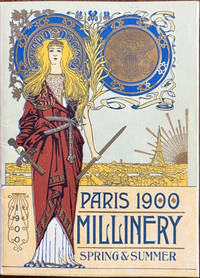
190060928Porland OR: Lipman Wolfe & Co. 1900. 16mo. 32 pp unpaginated. w/ photo illustrations throughout. Colour-illustrated softcovers view of the goddess Minerva holding broken sword city of Paris stretching into the background and medals which originally honored Czar Nicholas for the disarmament conference of 1898 now changed to the United States Seal w/ original mailing envelope post-marked 1¢ Franklin stamp NF/NF copy from the library of Caroline Augusta Gray Kamm 1840-1932 noted socialite and philanthropist in Portland built home for poor women & girls with the YWCA and was daughter of PNW pioneer William H. Gray 1810-1889 who traveled to the Lapwai Mission in Lewiston ID in 1836 where he was the Nez Perce secular agent and subsequently later married Jacob Kamm 1823-1912 pioneering Oregon industrialist and entrepreneur. First edition of this beautiful belle epoque 19th-Century fashion catalogue issued by the historic Lipman Wolfe & Co. department store in Portland OR featuring elaborate large-rimmed hats with extensive trimmings featuring fashions created by such women designers as Madam Michniwicz-Tuvee Esther Meyer Camille Roger perhaps best remembered later for her Art Deco Suffrage hats the Guillard sisters and others. The famed Lipman Wolfe & Co. department store was founded in 1880 by Adolphe Wolfe who teamed up with his uncle Solomon Lipman and at the time still maintained their original Dekum Building at 3rd Street and were the first to introduce customer elevators to their many floors. No copies in Worldcat. Lipman, Wolfe & Co., paperback
185464185New York NY: Harper & Brothers Publishers 329 & 331 Pearl Street 1854. 12mo. 369 13 pp. With numerous woodcut-engravings. Embossed plum-coloured publisher’s cloth gilt lettering on spine minor sunning to spine slight sunning to fore-edges minor bumping to corners occasional light foxing still VG- copy from the library of Eleanore Weinstock. Revised & expanded edition of this groundbreaking work by one of the most significant women reformers of the 19th-Century older sister to Harriet Beecher Stowe and Henry Ward Beecher. After the death of their mother Roxanna Foote Beecher left the 16-year-old Catharine as surrogate mother she spent her career promoting education for women and urging education reforms treating women as teaching professionals including founding of the short-lived Western Female Institute in 1837. Beecher advocated that not only should women receive rigorous instruction in child rearing home economics and domestic science but also taught history Latin rhetoric algebra logic physical education and science. Although she vigorously advocated for women’s education supported better health practices and increasing public roles she remained later in life resistant to women’s suffrage believing it would interfere with their roles in ensuring morality and security in the home. Harper & Brothers, Publishers, 329 & 331 Pearl Street, hardcover
190460815New York: McLoughlin Bros. 1904. 4to. 280 pp unpaginated. Colour chromolithograph frontisp. woodcut engraved borders throughout in red illustrated title page illustrated throughout some full page plates many woodcuts woodcut decorated initials & lettering. Quarter-brown publisher’s cloth over colour chromolithograph illustrated boards cover art of an a Brass Era Santa Claus whizzing along in his 1904 Locomobile steamer which was the last year Locomobile manufactured the runabout which retailed for $ 750.00 decorative endpapers minor bumping slight shaken front inner hinge starting some occasional toning edgewear still a VG- copy w/ former ownership markings on ffep. First edition thus of this expanded holiday anthology issued by the McLoughlin Bros. for the Christmas season of 1904 with many of the stories hold-overs from the previously released versions in 1897 1898 1899 & 1901. The anthology of short stories morality tales poems anecdotes and more were mostly written by women authors and served as a key entree into publishing for aspiring authors during the Progressive Era. Racial awareness and cultural opinions are reflected in the stories including Louise Church Brooks’s story of Little-Baby-Not-Afraid-To-Cry an orphaned Native American child who after trying to decorate her hair & clothing was feathers was disciplined and encouraged in the future to act like “a quiet little American gilr†rather than a “real Indian.†Depictions of Santa Claus driving automobiles began as early as 1898 with Santa driving a runabout and in 1899 an ad for the Akron Tribune depicted a “Twentieth Century Santa Claus.†Santa Claus driving an automobile never received wide acceptance but featured in novelty holiday books holiday postcards cards and advertising through the 20th Century into the 21st. McLoughlin Bros., hardcover
195859253New York: The Macmillan Co. 1958. 8vo. xii 225 1 pp. With over 350 text illustrations weaving diagrams sketches and photographs. Black publisher’s cloth white & blue lettering & decoration minor rubbing shelfwear w/ d.j. cover art by The Strimbans using handwoven textile by Virginia D. Aldridge minor shelfwear minor chipping head & foot of spine slight scuffing still VG/VG copy from library of Agnes Parsons w/ the original advance order form folded and laid-in. First edition of one of the scarcest and most significant manuals for handweaving in the Mid-20th Century. Following World War II and with increasing interest in designing and weaving textiles the author demonstrated the basic principles of cloth construction by focusing on harness-controlled patterns and four-harness fabrics. Frey 1893-1972 began as an occupational therapist in woodworking at the U.S. Army’s Walter Reed Hospital and began learning and teaching handweaving as well as training her students to construct weaving looms. After moving to New York she worked in the textile industry and later opened her own design studio taught weaving and by 1940 was one of the co-founders of the New York Guild of Handweavers whose first year’s weaving programs focused on studying Native American Weaving of the Cherokee Tribe. See: Diane Kirschner History of the NY Handweavers Guild 2022; The Macmillan Co., hardcover
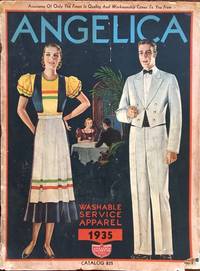
193557734St. Louis MO: Angelica Jacket Co. 1935. 4to. 9 x 12 in. 6 14 8 15-29 1 pp. 1st 4 pp. on pink colour-tinted paper colour-illustrated throughout double-page centerfold illustrations for Angelica wait staff uniforms inserted as landscape folio sheets minor chipping & tears to fore-edges corners minor dustsoiling still G copy. First edition of this brightly illustrated catalogue for uniforms and service apparel during the Great Depression featuring stylish uniforms for men and women wait staff as well as doctors nurses hospital attendants utility dresses chef’s aprons and more. With most sewn from durable and long wearing cotton duck cloth the company presents here multiple service ensembles for kitchen staff dining rooms and taverns many with decidedly Art Deco lines and patterns. The company originated in 1878 when Carmine Ostari Angelica 1850-1883 created an entirely new cook’s uniform for her husband Cherubino Angelica d. 1898 while cooking for the railroad based out of St. Louis MO. Featuring a tall white hat with a crown double-breasted white coat cloth buttons sewn to the sides and reversible layers of cloth to protect from heat and grease splatter and even cuffs which could be turned down to function as hot pads. Within a couple years Cherubino with Carmine supplying the uniforms founded the Angelica Corporation and after her death his second wife Therese Hirsch del Angelica b. 1855 would join the company and oversaw the introduction of the iconic Harvey Girls uniforms. After Levy and his brother purchased the business and the sewing machines in 1903 the company quickly expanded to dominate the service uniform market and still is one of the primary suppliers of uniforms across the country. See: Angelica Corporation History International Directory of Company Histories Vol. 15 1996. Angelica Jacket Co., hardcover
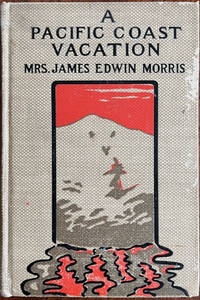
190160698New York London & Montreal: Abbey Press Publishers 1901. 8vo. 14 255 1 pp. including 1 leaf of publisher’s ads for Morris. Title in red & black. Portrait photo frontisp. w/ tissue guard numerous photo plates. Pictorial beige publisher’s cloth front cover illustrated w/ image of Alaska glacier w/ gilt red & black black lettering minor scuffing wear to cloth a couple signatures poorly opened w/ minor closed tears rough cut fore-edges slightly shaken still a VG- copy. First edition of this breezy fast-paced travel memoir of Ida & her husband James traveling from Arcola & Arthur IL through Chicago and points West to fulfill her lifelong dream of seeing Alaska and the Aurora Borealis. She was insatiably curious and frequently writes of Native Americans as they traveled by rail across the Northern United States including tribes in Minnesota Lakes region Dakotas Montana the Pacific Northwest British Columbia and Alaska. She also observes in Havre Montana the African-American “Twenty-Fourth United States Infantry came aboard. . . stalwart colored soldiers who will do credit to the uniforms they wear. . . how many of these brave men would return from the deadly Philippines.†She writes details about the Salish Northwest Coast Indian legends the First Nations peoples’ potlatches in British Columbia and their banning by the Provincial government along with making frequent mentions of Japanese-Americans Chinese-Americans and more. The couple visits the Muir Glacier Alaska gold fields Walla Walla in Washington State as well as Yosemite and Yellowstone National Parks. Morris 1859-1927 was a school teacher in Mattoon IL who married James Morris 1848-1925 local banker and merchant in 1887 and the pair traveled often. Abbey Press, Publishers, hardcover
193663389London: Ivor Nicholson and Watson Ltd. 1936. Thick 8vo. vii 1 330 pp. Colour frontisp. numerous photo plates. Green cloth printed paper spine label extra label inserted at rear pastedown minor bumping to couple corners shelfwear light foxing to fore-edges slightly cocked w/ d.j. portrait of Madame Glyn minor shelfwear toning to spine still VG/VG copy. First edition 2nd printing July 1936 1 month after June 1st printing of this outspoken frank and often humorous author whose shocking “Three Weeks†1907 bestseller titillated and attracted readers with her heroine seducing a younger man to conceive a child on a tiger skin rug; or her flapper era screenplay “It†which offered up Clara Bow as the quintessential sexually powerful Jazz Age heroine in 1927. She writes of defying her family as a young woman spurning suitors who were too old too fat or just didn’t appeal to her before they forced her exiled to Jersey where she would write columns on fashion and design clothing with her sister Lucy Duff-Gordon. The original British editions are surprisingly scarce and even more so in the original dustjacket predating the 1937 Dutton American edition. See: Erin Blakemore Before There Was ‘50 Shades’ . . . There Was Elinor Glyn’s ‘It†JSTOR Daily Feb. 20 2015; Denise Cummings & Annette Kuhn Elinor Glyn Women Film Pioneers Project 2013. Ivor Nicholson and Watson, Ltd,. hardcover
1972132j0052Ardrossan Alberta: Ardrossan Unifarm. Good. 1972. First Edition. Hardcover. 0919212166 . Presents the local history of the former rural areas of Wye Baker Uncas Garden Deville Douglas Bremmer Agricola Ardrossan Salisbury Brookville Ypres Valley East Clover Bar North Cooking Lake and Clover Bar Alberta located just east of Edmonton. viii 712 p. Index. Generously illustrated with black and white reproductions of archival photos. Includes almost four hundred pages of pioneer stories/family histories. Unmarked with average wear. Binding intact. A sound copy of this informative local history and invaluable genealogical reference. Krotki 2nd Edn 32 Strathern 3302. ; 8vo . Ardrossan Unifarm hardcover
Lintelman, Joy Kunknown
190440230Philadelphia: Journalists' Home. Very Good with no dust jacket. 1904. First Edition. Cloth. 12.5" x 9; 406 pages; Editorial Edition de Luxe. Limited to 100 copies. Two blank end papers with repaired rips. Wear to cloth extremities. Title page states this is volume I but no volume II appears to have ever been published BOHEMIA. Official Publication of the International League of Press Clubs for the Building and Endowment of the Journalists' Home. A Symposium of Literary and Artistic Expressions by Men and Women distinguished in Journalism Art Romance Literature Finance Diplomacy Politics and Statecraft. Especially prepared and voluntarily contributed. Edited by A. K. McClure and others. With numerous colored and plain illustrations portraits facsimiles etc. Thick 4to. Contents generally VG with a few scattered light water stains. . Journalists' Home hardcover
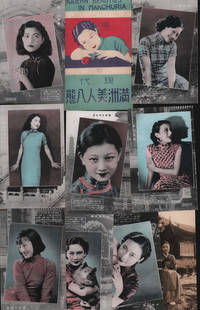
1933217569Japan. Circa Showa 8 1933 . Nine postcards eight in colour and one real photograph black and white postcard which is not part of the set 14 x 9cm envelope size 15.2 x 9.5cm Japanese captions. All cards in very good condition presented in a slightly worn and soiled pictorial colour envelope. This collection of post cards features eight young women in Manchuria and a separate real photograph postcard showing a beautiful Korean woman in traditional dress. Most of the Manchurian women wear qipao the accompanying captions introduce them as "attractive companions". Some of the women are portrayed as seductive while others look shy and innocent. . unknown
Madeline, LaurenceIn Pristine Condition. Ltd. Edition unknown
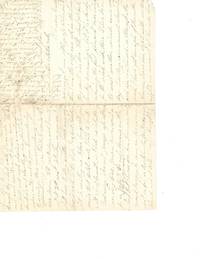
1877167441877. Bertha von Hillern. Autograph Letter Signed Describing a Pedestrienne Performance in Maine. Four-page autograph letter signed written in Bucksport Maine and dated August 12 1877 from a woman identified as Caitlin to her parents. The letter provides a vivid firsthand account of a public endurance-walking exhibition by Bertha von Hillern one of the most celebrated pedestriennes of the late nineteenth century and a pioneering figure in women's athletic and feminist history. The pedestriennes-now largely forgotten-were among America's first female sports superstars drawing large paying crowds to theatrical endurance contests staged in repurposed halls and theaters. At their height leading pedestriennes earned more in a single week than many Americans made in a year were widely covered in newspapers sold photographic likenesses influenced women's fashion and appeared nationally as celebrities. Their feats challenged prevailing assumptions about women's physical limits and helped reshape public attitudes toward women's independence endurance and public presence.<br /> <br /> The letter situates von Hillern within this broader cultural phenomenon while recording the details of a specific performance witnessed by the writer. Von Hillern a German immigrant from a military family was widely regarded as the first great feminist pedestrienne and performed at least twenty-five solo exhibitions across thirteen cities. In Boston alone approximately 10000 spectators reportedly paid fifty cents each to watch her walk continuously at Music Hall and the Washington Post described her as "one of the wonders of the nineteenth century." Writing from Maine the correspondent recounts attending the exhibition at City Hall noting both the social experience and the athletic spectacle: "in the evening we went to City Hall to see Miss Bertha Von Hillern walk. Perhaps you have seen an account of her in the Boston papers. She is great walkist. She walked 88 miles in 26 hours without resting more than twenty minutes at a time." The letter continues with precise observational detail describing the sawdust-covered track the number of laps required per mile and the nonstop duration of the event which began Friday evening and concluded late Saturday night.<br /> <br /> The writer further conveys the charged atmosphere surrounding the performance emphasizing its communal excitement and theatricality: "Chanlers band furnished music through the whole walk. It was nice music and such excitement and such cheering & waving of handkerchiefs and shouting every time she would make a mile." As a primary document the letter captures not only von Hillern's physical achievement but also the emotional and social intensity of pedestrienne culture at its peak. For institutional collections the letter is an exceptional piece of early feminist Americana offering rare eyewitness testimony to a moment when women's athletic endurance became a public spectacle capable of reshaping gender norms and laying cultural groundwork for modern sports the revival of the Olympic movement and the suffrage-era reimagining of women's capabilities. Condition: The letter shows original folds and age-related toning but remains very readable throughout with no loss of text. Overall condition: Very Good. unknown
1847162581847. Archive of 13 letters regarding the qualifications of a 19th century teacher in New England dating 1847-1853 . All letters are in very good condition. Fold lines and creases but clear writing and very little foxing. A collection of letters of recommendation and certification dated 1847-53 for a teacher Miss Emily L. Goddard from various schools and individuals in towns around Western Massachusetts including Barre Wilbraham New Salem Athol and Petersham. In the 19th century women were limited to workingonly in certain fields and teaching was generally accepted as one of these fields. The recommendation letters state her certifications in various districts or her general qualifications to teach a common school. The common school movement was a public education movement started in Massachusetts that promoted free schooling for all children. This archive outlines one tenacious young teacher experience as she gained recommendations and respect from those who worked with her to further her carrier. unknown
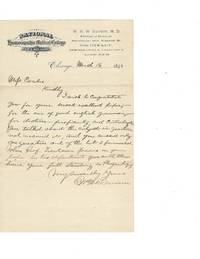
1890162101890. Women in Sciences Two letters commending a female medical student Clara Cowles who is about to enter the field. The first is an autograph letter signed and dated 16 March 1893. 1 page handwritten on National Homeopathic Medical College of Chicago letterhead from the desk of W. M. W. Davison M. D. 9 x 5 ¾ in. Excellent condition with two horizontal fold lines. Davison writes in part: "Miss Cowles Kindly I wish to congratulate you for your most excellent paper." This letter also comes with a business card from W. M. W. Davison again dated March 16th 1893 which verifies that "Miss C S Cowles has passed the examination in Histology and Physiology and her standing is 90 in the former and 100 in the latter."<br /> <br /> The second is a typed letter signed and dated January 24 1896. 1 page on The People's Health Journal letterhead from the desk of editors L. D. Rogers M.D. and Ida Wright Rogers M.D. two married doctors. 8.5 x 11 in. They write:<br /> <br /> "Miss Clara CowlesEl Dorado Kas.<br /> Dear Miss Cowles:--<br /> Your favor of the 17th. together with your first examination papers came duly to hand. We have returned the papers. They were excellent. <br /> We thank you for the names of your two friends and will write to them. Let us hear from you often. <br /> Yours very sincerely Drs Rogers & Rogers"<br /> <br /> Very good condition with two vertical fold creases and one horizontal one at center. Small tear at upper left crease. Comes with a joint business card for Drs. Rogers & Rogers and inscribed in pencil on verso is the address for Dr. E. S. Reed Dentist. Four more inscribed business cards from doctors are included. One of the cards is from Dr. E. S. Reed and has a neat inscription on verso in ink declaring that Miss C. S. Cowles "has a standing of 98 in Dental-Surgery for the session of 1892 & '93" signed by E.S. Reed Professor of Dental Surgery. Interesting 19th century correspondence related to a young woman's medical education and those who offered her professional support and encouragement. unknown
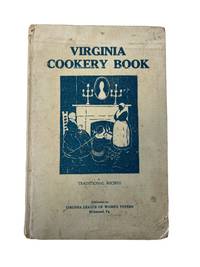
1921200801921. Suffrage Cookbook Virginia League of Women Voters. Virginia Cookery Book: Traditional Recipes. Richmond VA: Virginia League of Women Voters 1921. First edition. 192 pages. Cream illustrated boards. 9.25 x 6.5 inches. "Believing that our spirits are strengthened by well nourished bodies we have collected with care the recipes contained in this volume." The Foreword reads: "The Virginia League of Women Voters offers this book of Virginia Cookery in the hope that those who use it will find it helpful and will have the added satisfaction of knowing that by purchasing a copy they will have contributed to the fund of the League for education in good citizenship." The Virginia League of Women Voters was organized to help women attain and exercise their right to vote after the 19th Amendment which gave women the right to vote was passed in Congress in 1919. Virginia however was one of the nine southern states that opposed the amendment and refused to ratify it. Virginia women at last won the hard-fought right to vote in August 1920 when the Nineteenth Amendment became law and exercised that right soon after in the November elections. Recipes are attributed to members of the community with local advertisements giving the reader a genuine feel for the community. Binding is tight. Text pages and illustrations are crisp and clean. Minor cracking to board at spine fold edge wear corner creasing and foxing to cover. Overall very good condition. unknown
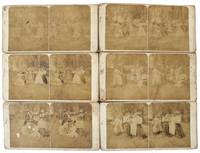
1900188011900. Women SPORTS Six action shots of a women's fencing dual in the early 1900s. 4" x 6" each. Stereoview on cardboard mount. N.p. Captioned "Le Duel" with each photograph numbered. Historically fencing has been primarily a men's sport and though women have been fencing for hundreds of years there was still heavy stigma against women taking up any sport. After WWI many French fencing schools opened up classes for women to grow their economy. This act opened up the doors for women to eventually be allowed to fence in the Olympics in 1924. This set of six stereoviews showcase two women fencers with a female referee and a group of female viewers. Each stereoview is numbered in the order of the duel; the first shows the two women facing each other with their swords down the second and third show the women mid duel and the last three show the victor heralding over the defeated opponent with two women side by side helping her recover. Minor wear to edges some sunning and wear to photos. Overall only good condition. unknown
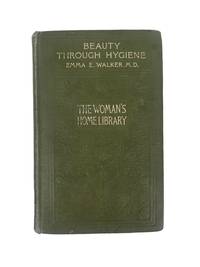
1905206671905. Women in Science Walker Emma E. Beauty Through Hygiene: Common Sense Ways to Health for Girls. New York: A.S. Barnes & Company. First edition second printing 1905. Part of the Woman's Home Library. Edited by Margaret Sangster. Illustrated throughout. 8vo 306 pages. Original green cloth boards with embossed ornamentation and cream font on the cover and spine. Written by Emma E. Walker M.D. a female physician and member of the New York Academy of Medicine who published several women and girl's health guides. Beauty Through Hygiene is a guide to health and hygiene for girls discussing sports and exercise including exercises in housework weight complexion care of skin and hair care during menstruation remedies and for common ailments and illnesses. <br /> <br /> Emma Elizabeth Walker received her A.B. from Smith College in 1887 and earned an M.D. from Johns Hopkins University in 1898. Later that year she opened her medical practice in New York City. Walker authored Beauty through Hygiene 1905 "Pretty Girl Questions" in Ladies Home Journal and many articles and pamphlets for both popular and medical audiences. She lectured widely on the topics of personal and social hygiene and was a member of numerous medical and professional organizations. Ex-library with spine label interior pastedown and pocket. Minor general fading and staining to the covers. Cloth scuffed and worn along the extremities and hinges. Walker's journals mainly focus on the ailments that primarily affect women where most male physicians had improperly diagnosed or treated making her guides a historically and contextually important field of study. unknown
1911171151911. turn of the century Championship Women's Baseball Team Photo Postcard. "The Western Bloomer Girls-Ladies Champion Base Ball Club-Watervliet Mich." Vintage photo-illustrated postcard of the girls baseball team. No date c. 1911. Eleven uniformed girls pose for a team photograph. 3.5 x 5.5 inches. The Western Bloomer Girls were founded in 1911 by Maud Nelson a renowned pitcher in her own right. "Bloomer Girl" baseball teams of women were formed starting in the 1890s taking their name from Amelia Bloomer who designed loose fitting trousers that women wore while playing sports. Bloomer Girls teams rarely played each other but traveled across America challenging local amateur and minor league men's teams. Bloomer Girls were disciplined sportswomen and frequently won games with their solid skills and competitive spirits. Interestingly these "Boomer Girl" teams were integrated when it came to gender; while most of the players were women each roster had at least one male player. In this image two male players pose in the second row. Verso is blank with space for message and address. Light crease to bottom left corner. In very good condition. unknown
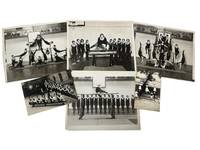
1910175701910. Early Female Gymnasts Photo Archive with six silver gelatin photographs of various sizes circa 1920s. These photos documents early female gymnasts before it was an accepted sports for female athletes. At this point in history gymnastics was still a mostly male sport but starting at the 1928 Olympics women were able to compete in "artistic gymnastics". Includes 4 press photos from New York city Female Gymnasts measuring 10" x 8" inches the set of 4 photographs are from the Savage School of Physical Education in New York City and appears to be taken during the 1920s. These 4 photographs bear press captions and stamps on verso. The women are photographed in a gymnasium in a series of gymnastic formations. Press captions give names and brief descriptions on verso. The archive also includes 2 other smaller images that seem even earlier in time one is a circa 1910 real photo postcard showing girls and their coach performing gymnastics and walking along a beam. All photos are overall in very good condition. unknown