66 723 résultats
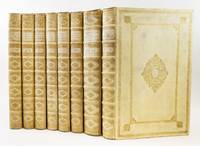
1735ST18632Amsterdam: Petrus Shenk 1735-38. First Edition in Dutch. 415 x 264 mm. 16 3/8 x 10 3/8". Entirely complete with continuous pagination but with a jump in page numbering from the end of book XIII to the beginning of XIV as usual. 15 parts in eight volumes. Translated by Florentius H. J. van Halen. <br/> HANDSOME CONTEMPORARY VELLUM covers with large gilt entrelac centerpiece framed with gilt floral rule with bouquet-like cornerpieces gilt floral border raised bands compartments richly gilt titles and volume numbers handwritten in ink on spines all edges gilt. With head- and tailpieces 15 engraved titles printed in red and black with engraved vignettes and complete with frontispiece two engraved portraits of the author and the engraver the latter with shorter margins probably tipped-in and 760 OFTEN STRIKING COPPER ENGRAVINGS on 758 plates one with partial hand coloring a few double-page. Front pastedown of first volume with handwritten note in French on lined paper; with additional black & white title to first work erroneously dated 1728. Nissen ZBI 3661; see also: Faber du Faur "German Baroque Literature" p. 472. Trivial soiling to the vellum the seventh volume with a faint marginal dampstain affecting a few quires but not touching engravings the odd negligible blemish but AN OUTSTANDING SET the very attractive original bindings showing only insignificant wear and THE CONTENTS ESPECIALLY FRESH AND CLEAN THROUGHOUT WITH VERY FINE IMPRESSIONS OF THE PLATES.<br/> <br/> This is the first Dutch translation of Scheuchzer's "Sacred Nature" one of the most splendid German illustrated books of the 18th century presenting what surely is the most impressive combination of biblical exegesis and scientific illustration to be found in any printed book. First published in 1731-35 as the "Physica Sacra" in Latin and as the "Kupfer-Bibel" in German so-named for the amazing array of copperplate engravings this work is arranged according to the progression of books in the Bible citing passages from those chapters where phenomena from the natural world are mentioned. The typical pattern here includes a textual citation followed by the author's often lengthy remarks on the passage and in many cases a dramatic engraving to illustrate what is said. The plates are identical to the earlier editions retaining the inscriptions in Latin and German and are the work of Johann-Melchior Fuseli of the well-known Zurich family of 18th and 19th century artists. The engraved scenes are always executed with great skill are generally very animated and are often fascinating. Of the 760 images meant to illustrate the text many are strictly or primarily depictions of biblical scenes; several are simply illustrations of specimens of nature; and a large number perhaps half offer a kind of combination. An example of this last type includes a wonderful scene showing the birth of Man as related in Genesis 1:26-27 depicting not only a startled Adam in his fecund paradise but also 10 images of fetuses placentas and the skeletons of children attached like mounted specimens to the architectural frame of the illustration. According to Faber du Faur it is in this work that "the Baroque attains philosophically as well as artistically its high point and its conclusion. It is the last of those elegant works which do not really contain illustrations to a text but which are in effect composed of splendid plates with a text to accompany them." Scheuchzer 1672-1733 was a prolific naturalist who promoted at every opportunity the most modern scientific ideas though without wanting to risk the accusation of being irreverent. He says that the present work represents an attempt at finding a harmony between reason and revelation though it can also be seen as an effort to promulgate progressive theories under the venerable cloak of biblical commentary. The bibliographies disagree about the number of plates that ought to be present in this work and in other editions but ours corresponds to copies previously sold at auction as complete. Copies of the "Physica Sacra" and its translations show up regularly for sale but almost never does one see the work both complete and as here with a clean and fresh text in remarkably well-preserved and attractive contemporary bindings. Petrus Shenk unknown
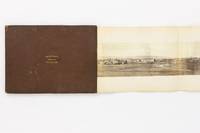
1866141595Adelaide: Townsend Duryea 1866. First Edition. Hardcover. Adelaide Townsend Duryea circa 1866. A photograph album 254 × 340 mm containing a magnificent panorama of Adelaide comprising five roughly uniform albumen paper photographs mounted as issued slightly overlapping to form a continuous image 124 × 880 mm on a linen-backed card mount 244 × 951 mm folded into three plus 12 albumen paper photographs nine of them around 130 × 200 mm or the reverse one 130 × 172 mm and the last two approximately 220 × 285 mm mounted on the rectos of stiff card leaves. Original russet pebble-grain cloth lettered in gilt on the front cover; cloth slightly flecked with minor wear to the extremities; endpapers foxed with slight loss to silverfish and the rear free endpaper is missing; leading edge ribbon ties appear never to have been inserted; mounts lightly cockled and occasionally lightly spotted and foxed; bottom margin of the final mount lightly stained with trifling loss to silverfish; minimal signs of age and use; overall a very pleasing copy with the photographs - and in particular the stunning panorama - in uniformly fine condition. The twelve individual photographs are captioned in pencil on the mounts: 'View in botanical gardens - showing Asylum' 'View in Botanical Gardens' 'View in Gardens' five captioned simply 'Botanical Gardens' 'Bridge between N & S Adelaide' 'near Willunga' and two captioned 'Willunga' both superb large-format prints. <p>New York-born Townsend Duryea 1823-1888 emigrated to Australia Melbourne in 1852 and commenced work as a photographer the following year. In 1855 he relocated his studio to Adelaide. By the early 1870s Duryea's panoramas royal portraits and prizes won in Society of Arts photographic competitions had made him famous 'Australian Dictionary of Biography'. Much more detail on Duryea may be had from the lengthy article in Joan Kerr's 'Dictionary of Australian Artists . to 1870'. However the panorama in this album is not the one described in Kerr 'a fold-out 360-degree panorama of Adelaide taken from the tower of Adelaide Town Hall in 1865 was the album's major feature' nor is it the larger panorama 'taken from the top of the GPO tower soon after it was completed in 1870'. The present panorama is taken from a local rise in North Adelaide and sweeps left to right from the hills towards the sea. All of these panoramas are very rare indeed not least because 'Duryea's studio and enormous collection of glass-plate negatives stated to number 50 000 were destroyed by fire in 1875'. This catastrophe effectively ended Duryea's career as a photographer. It must assuredly account for the genuine scarcity of material by Duryea on the open market other than bread-and-butter carte de visite portraits. <p>This album is very rare in our experience and if the available records are any guide for long before we came on the scene in the mid-1970s. Although this is the fourth example we have handled it is also only the fourth one we have seen on the open market in that time. We have inspected three other examples in institutions; all seven copies are bound similarly and contain the same panorama. However the balance of the contents varies in quantity and image selection in each instance. <p>Duryea began to advertise these albums in Adelaide newspapers in August 1866. One such from the 'South Australian Register' for 28 August 1866 reads: 'DURYEA'S VIEW ALBUMS. These Albums are neatly bound in cloth and form a beautiful acquisition either for the drawing-room table or transmission home. A PANORAMIC VIEW of the CITY of ADELAIDE and the SUBURBS three feet in length has been introduced as a Frontispiece; and as a further advantage purchasers have the privilege of choosing Photographs from a large Album containing 90 of the most interesting and picturesque Views of Adelaide and the Country. The above are open to the inspection of the public at Mr. Duryea's Studio 66 and 68 King William-street. Any of the Views mentioned above can be had separately. Photographs of Gentlemen's Country Seats Business Offices Shops &c. taken at the shortest notice by Ross's Improved Wide Angle Lens'. <p>Provenance: Edwin Ashby 1861-1941 South Australian property developer and naturalist; by descent. While Ashby was obviously not the first owner of this album its numerous images of the Botanical Gardens must have appealed to him. The fine gardens he established at his property 'Wittunga' at Blackwood in the Adelaide hills after the turn of the century were later donated to the State by his heirs and are now the Wittunga Botanic Garden. Townsend Duryea hardcover
1487046404Milan: Antonius Zarotus 1487. Second Edition. Hardcover Full Leather. Very Good Condition. 19th century red morocco gilt hinges and spine rubbed and a little weak but still generally sound and attractive. Added marbled endpapers and a description of the edition and a note on the binding penned on added blank endpapers. The second edition of Tacitus much improved by Puteolanus from the first and the first printed with The Life of Agricola first published by Zarotus in a collection of panegyrics ca. 1482. It was once thought to have been printed in the 1470s but now usually pegged as 1487. Likely washed though gently except for the first and final leaves Agricola leaves 176-187 with a dampstain in the margin final two leaves darkened. Four small wormtrails in last section leavs 121-end two trails in the textblock but generally very unobtrusive. Top edge gilt and trimmed slightly when rebound leaf numbers penciled lightly and neatly in the inner gutter.<br /> <br /> Five 6 line and one 2 line initial colored in early or contemporary color 37 lines set in a fine Roman typeface often compared to Jenson and assumed to be set by him at one point 187 leaves with the blanks at 160 and 176 but lacking the final blank. <br /> <br /> Graesse T7 Dibdin Bibl. Spenc. v2 461 Brunet V 633 Goff T7 ISTC it00007000<br /> <br /> Provenance: With the label of A.C.C. Brodribb but likely from his father C.W. Brodribb who wrote and published in The American Library Annual a poem describing this volume laid in with a penciled date for the binding of 1855; an inscription on an added endpaper bears the same date. Also laid in is a 1949 letter to A.C.C. Brodribb Esq. from L.A. Sheppard at The British Museum describing the volume which he likely inherited following his father's death in 1945 Size: Folio. Quantity Available: 1. Shipped Weight: 2-3 kilos. Category: History; Incunabula. Inventory No: 046404. Antonius Zarotus hardcover
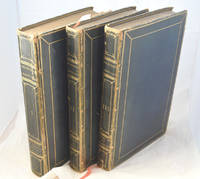
1587033342<p>At London printed in Aldergate Street at the signe of the Starre: John Harrison George Bishop Rafe Newberie Henrie Denham and Thomas Woodcocke 1587 A good copy of the 2nd edition of Holinshed's Chronicles bound in 3 volumes. This edition is particularly known for its association with William Shakespeare who used it for historical background for example in Macbeth. It lacks the extensive woodcuts found in the 1st but has ornate initial capitals and head and tailpieces. This set was rebound in full morocco leather in the 1800's. The bindings have flat spines with gilt titles and volume numbers and gilt lining. The boards have gilt lining around the edges and gilt dentelles on the inner edges. Endpapers are marbled and all volumes have silk bookmarks. The leather is worn on the edges spine joints spine ends and corners but the bindings are currently sound. Vol I has a small closed tear at the top spine end. Vol II has a scuff across the front board. All page edges are gilted. The 2nd edition brings the history up to the date of publication and as such attracted the displeasure of Queen Elizabeth I who had clear views on how her reign and actions should be recorded. The Archbishop of Canterbury was required by the Privy Council in February 1587 to recall the work and reform it. The process of printing large works was very different to that of our digital world and the censorshjp and revision process must have caused chaos at the printers. Sections of the work on Scotland in Vol I and parts of the Chronicles of England are affected and all copies reflect the censorship mess to some extent with odd pagination cancels substitution and gaps in some copies. This set is largely complete lacks title to Chronicles of England and the colophon. Very different thicknesses and colour of the paper suggest where sections have been substituted and there are several instances of mispagination. Contents - Vol I: title and prelims viii; text 250 pp; Historie of England in 8 books; iv; 202 pp; title The Second Volume of Chronicles containing Ireland and Scotland viii; Ireland pp 9-61 blank verso; title Irish Historie xii; 183 pp with blank verso; title - Description of Scotland 2; text pp 3-23 blank verso; title Historie of Scotland blank verso; preface 2pp; text 29-404; Annals of Scotland pp 405-464 ; table alphabeticall First to Fourth 53 pp; Colophon January 1597 1p. Vol II: lacks title - text covers William I to Henry VII- vi; text 1-798. Vol III: text from Henry VIII pp 799 - 1267; Continuation - preface 1268-9 text 1270-1592; third table 58pp; lacks colophon. The contents generally bright clean and sound. There are some minor areas of staining or marking some paper repairs and some mispagination. Please enquire if you would like to see the details on each volume and/or further images.</p> John Harrison, George Bishop, Rafe Newberie, Henrie Denham and Thomas Woodcocke hardcover
19561125558196Montreal : Published for the McGill Poetry Series by Contact Press 1956. Book. Near Fine. Hardcover. 1st Edition. 8vo - over 7¾ - 9¾" tall. black cloth silver spine lettersdust jacket79 pages illustrated five full page line drawings by Freda Guttman with some minor wear to dust jacket at top of spine with very small loss and at top corners of d.j.very slight tone to spine of d.j in protective mylar jacket. a fine example of the author's first book of which approximately 400 copies were printed. part of the McGill Poetry Series operated by Louis Dudek.First published in 1956 when he was twenty-two years old Let Us Compare Mythologies is Leonard Cohen's first collection of poetry. It is an accomplished and passionate collection which demonstrates Cohen's remarkably assured voice even as a young man. An unprecedented debut published to immediate acclaim. [Published for the McGill Poetry Series by Contact Press] Hardcover
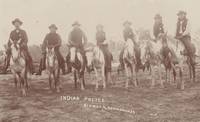
1900List1916Purcell 1900. Unmounted gelatin silver prints and one mounted boudoir card most images measuring 8 x 5 and 7 x 4 ½ inches. Varying levels of fading else about fine. With gallery stamps of Fenn Gallery Santa Fe verso. Near Fine. In the years following the Land Run of 1889 which opened land in Indian Territory to Euro-American settlement professional and amateur photographers alike moved to the region. Their motives varied with some attempting to document the vanishing indigenous culture and others trying to capitalize on the Euro-American demand for photographs of Native Americans in both traditional and western attire. Some studios would use single sets of props for different tribes. Despite these issues the images from the period do illuminate the period of acculturation and displacement in the history of the Southern Plains Indians tribes and also provide a record of the motives of the Euro-American photographers behind the camera. <br /> <br /> William J. Lenny and William L. Sawyers were photographers working out of Purcell in the years immediately following the land rush. They photographed the tribes on the Kiowa-Comanche-Apache and Wichita-Caddo reservations. Lenny was a field photographer and likely took most of the photographs while Sawyer managed the studio. Offered here are a very extensive group of photographs taken by the duo - twenty-seven in total - giving a visual record of the Kiowa and other tribes during this period. Some of these images - though not these copies - were included in the Museum of the Great Plains Exhibition In Citizen’s Garb and we have included their reference numbers where applicable. <br /> <br /> Overall an uncommonly large group in fine condition with some fading. From the collection of Forest Fenn the noted Santa Fe gallerist. <br /> <br /> 1. Indian Police / Kiowa and Comanches Supplied Title. The images shows seven mounted police officers with the one furthest to the left appearing to be Euro-American. <br /> <br /> 2. Arko Captain of the Indian Police Comanche. Supplied Title Indian police commonly earned $8-$10 per month to work on the reservation where their duties included expelling intruders bringing children to the schools curbing crime and preventing the sale of alcohol. He’s dressed traditionally including a single feather worn as a headdress. In Citizen’s Garb 32<br /> <br /> 3. Chief Tow-Wac-A-Ny and Wives. Wichitas. Supplied Title. A portrait of ‘Towacany Jim’ a famous military scout posed with a Navajo-style blanket along with his two wives. The women are wearing purchased shoes common in this period. He earned $10 per month as leader of the Indian Police and traveled to Washington D.C. on diplomatic missions. Fine contrast. <br /> <br /> 4. Big Tree’s Boy and Girl. Kiowas. Supplied Title A portrait of two children of the chief Big Tree. The pair wear traditional dress. Faded. <br /> Big Tree. <br /> <br /> 5. Kiowa Chief. Supplied Title A portrait of A’Do-Ette or Big Tree the Kiowa chief. Fine contrast. <br /> <br /> 6. Portrait of A’Do-Ette . He wears the same costume used by the photographers for various other tribal leaders including a large headdress. Faded. <br /> <br /> 7. Chief Big Tree’s Daughters. Kiowas. Supplied Title The image shows two girls identified as Alma left and Leena right. Alma wears a dress of dark buckskin. Both girls have beaded bags known as “Strike-a-Light†bags hanging from belts. <br /> <br /> 8. Lone Wolf. Kiowa Chief. Supplied Title A photograph of Mamay-day-te or Lone Wolf the Younger in the same costume used for O’Do-Ette’s portrait and others. Some fading.<br /> <br /> 9. Photograph of Laura Dunmore or Laura Pedrick. Dunmore was a graduate of Carlisle School and sister of Chief Aptone. She is pictured here with a parasol tartan cloth and tinkling cone earrings providing a striking study in fashion during this period. Fine contrast. <br /> <br /> 10. Photograph of a Camp Scene in Summer on a Reservation. This scene perhaps a Kiowa-apache camp contains a tipi made of canvas instead of hides. A man in an expensive set of purchased clothing sits in the foreground. Excellent contrast. In Citizens Garb 9<br /> <br /> 11. Photograph of a Camp Scene in Summer. A variant of our no. 10 showing the same scene from a different angle. Excellent contrast. <br /> <br /> 12. Chief Wild Horse Supplied Title Title written in ink on margin. A photograph of Kobay-O-Burra second chief of the Quahadi who took over principal chieftanship when Parra-o-Coom died in 1874. <br /> <br /> 13. Photograph of Mamay-Day-Te Lone Wolf. A variant pose as number 8 with the same dress. <br /> <br /> 14. Photograph of Five Comanche in Mixed Attire. They have been identified as Pah-do-pony top left To-pooh bottom right and Big Kiowa bottom left brother of Pah-do-pony and Perk-a-Quannard. In Citizens Garb 14<br /> <br /> 15. Apache Papoose Supplied Title. A photograph of a child in traditional dress. Faded. <br /> <br /> 16. Photograph of Four Indigenous Subjects in Mixed Attire. A portrait of a man and three women the man in a Euro-American style suit and the women in a mix of traditional dress using trade fabrics. Excellent contrast. <br /> <br /> 17. Portrait of an Unidentified Man. A portrait of a man in heavy fringe breechcloth and fringed leggings. This was marketed under the name “Big Tree’s Son†in the 1890s and the subject is identified as Kiowa in the In Citizens Garb catalog. In Citizens Garb 16<br /> <br /> 18. Kiowa Squaw and Papoose Supplied Title. A photograph of a woman and a child in a studio setting. Very good contrast. <br /> <br /> 19. Portrait of Zah-Tay or Lizzie Woodward. Zah-Tay appeared in other photographs with her niece and son. <br /> <br /> 20. Portrait of Cora Caruth. A portrait identified as Cora Caruth who graduated from an Indian School perhaps Carlisle and eventually worked as an interpreter for Wichita at Anadarko. Fine contrast. <br /> <br /> 21. Portrait of a Man in a Serape. A portrait of a seated man in a serape or striped Mexican blanket. A breechcloth legging and moccasins can be seen under the serape. In Citizens Garb 23<br /> <br /> 22. Chief Cat. Kiowa. Supplied Title A photograph of Ba’o Cat also Goon-Saudle-Te who wandered from camp in Colorado when he was twelve and was not recovered for five years. Comanches sheltered him. Fine contrast.<br /> <br /> 23. Kiowas. Supplied Title A portrait of Lizzy Woodward Oliver and her niece posed in Kiowa clothing. Oliver is in a beaded cradleboard Lizzy’s dress was tied with Tartan cloth and wears traditional Kiowa moccasins. In Citizen’s Garb 10<br /> <br /> 24. Portrait of Lizzy Woodward Her Niece and Oliver. A variant of our no. 23 with Oliver and Woodward in different dress. Fine contrast. <br /> <br /> 25. Portrait of Two Kiowa Girls. Two girls pose one in buckskin dress decorated in paint. Buckskin would become less frequent. Fading. In Citizen’s Garb 2<br /> <br /> 26. Big Tree’s Papoose. Kiowa. Supplied Title. A portrait of Alma later known as Mrs. Ahote. Fine contrast. <br /> <br /> 27. Kiowa Braves. Supplied Title A photograph of two young men on horseback. Very good contrast to foreground slight fading to background.<br /> <br /> 28. A Young Kiowa Warrior Supplied Title. A photograph of Enoch Smokey later known as Apenguadal who lived near Verden Oklahoma. His mother was noted as a beadworker and his horse is fitted with unusually decorative gear. His personal dress includes a hairpipe breastplate and a pelt around his arms. In Citizens Garb 36<br /> <br /> 29. Portrait of a Standing Kiowa Man. He wears the same headdress used in other studio photographs. Some fading. <br /> <br /> 30. Unidentified Man Possibly Euro-American Posed in a Headdress in Studio Setting. This is a mounted image unlike the others with the Lenny & Sawyers mount. The subject appears to be Euro-American and wears the same headdress used by the Indigenous subjects in several of the earlier photographs. He holds a prop bow and arrow. <br /> <br /> An uncommonly large group of images which in total provide an impressive visual record of this period of forced acculturation and transition in dress. unknown
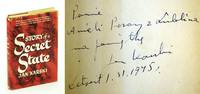
1944864H4484Boston: Houghton Mifflin Company. Good in Good dust jacket. 1944. First Edition. Hardcover. Signed and inscribed by Jan Karski upon front free endpaper. Karski 1914-2000 recounts his experiences when his homeland of Poland was rent asunder by the joint Nazi and Soviet invasion of 1939 and his harrowing subsequent life as a member of the Polish underground during which he was captured by the Gestapo and severely tortured. Provides a ghastly eyewitness account of life in the Warsaw ghetto into which Karski was smuggled so his observations could be reported to the outside world. Firearms advocates will cringe at Karski's account of what happened after he and a large group of Polish soldiers handed over their weapons to their 'comrades' from the Soviet Union. In 2012 Karski was posthumously awarded America's highest civilan honor the Presidential Medal of Freedom by President Obama. 391 pages. Moderate wear to publisher's red cloth. Dust jacket now preserved in archival-grade Brodart. Binding intact. A sound copy of this truly unforgettable WWII narrative. Laska 672 Kehr & Langmaid 5407 Weiner Library Catalogue Seven 997 Enser p.343.; 8vo - over 7¾" - 9¾" tall; Polish Underground - World War 1939-1945 Gestapo Torture Warsaw Ghetto Poland Resistance Espionage Polska Holocaust; Signed by Authors . Houghton Mifflin Company hardcover
1948566h5692London: Westropa Press. Good with no dust jacket. 1948. First Edition. Hardcover. "This book is different from other books. First of all it is only in form a book at all. In reality it is a part of the life of action. It is a turning-point in European history a late turning-point but a real one. This book is itself the first blow in the gigantic war for the liberation of Europe. The prime enemy is the traitor within Europe who alone makes possible the starving and looting of Europe by the outer forces. He is the symbol of Chaos and Death. Between him and the spirit of the twentieth century is unremitting war." - Foreword. "The spectacle of Yockey 1917-1960 being persecuted framed and driven to his death simply because he wrote this book is not one we would expect to see in the Twentieth Century in the land of the free and the home of the brave." - Willis Carto. 10 iv 4-405 3 pp. Average wear and soiling to publisher's khaki cloth. Title embossed atop front board. Black lettering upon professionally restored backstrip. Modicum of moisture-induced rippling near fore-edge of back board. Binding sound. Contents tanned at periphery. Foxing to free endpapers. Publisher's address lightly penciled upon copyright page otherwise unmarked. No dust jacket. A sound copy. 7.25" x 5". Singerman 757; 12mo - over 6¾ - 7¾" tall; Francis Parker Yockey Imperium history . Westropa Press hardcover
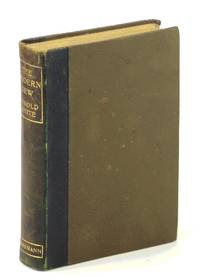
1899163H3899London: William Heinemann. Good. 1899. First Edition. Hardcover. "The circumstances under which the wealth the power and the numbers of the Jewish race domiciled in this country are likely to be indefinitely increased seem to call for more prescience and thought at the hands of our rulers than have yet been bestowed upon them. To make people think is the object of this book. Should they refuse they will wake up one morning only to discover that they have parted with the realities of national life and are dominated by cosmopolitan and materialist influences fatal to the existence of the English nation." - Introduction. Chapters include: What is a Jew; The Problem in Russia; The Jew in Austria/America/France/England/The Argentine Colonies; The Aloofness of Israel; Money Lenders; The Destitute Alien in Great Britain; Zionism; "Darkest Russia"; The Conversion of the Jews; Jewish Humour. pp xvii 301 32 ads. 7.5 x 5.3 inches. Quarter-bound in black leather and olive cloth. Gilt lettering to spine. Top edge gilt. Modest lean to spine. Binding intact. Prior owner's name dated 1899 inked atop front free endpaper. Large rectangular tanned area upon front free endpaper presumably caused by an item formerly laid-in. Average wear. Faint spots upon front board perhaps from water droplets. SINGERMAN 46.; 12mo - over 6¾" - 7¾" tall; Modern Jew Arnold White Anti-Semitism Zionism Argentina Relocation Russian Jews Usury Conversion Money Lenders Chedorim Lord Rothschild Rev. J.E. Salkinson Great Britain Immigration Jewish Question . William Heinemann hardcover
185612958NY: Derby & Jackson. Very Good with no dust jacket. 1856. Second Edition; First Printing. Hardcover. The spine is dulled with wear to the spine ends & corners light rubbing to the covers. ; Inside the front cover is an inscription gifting the book to Jefferson Davis from "M. P. Abbott . " Also inside the front cover is an inscription telling how the owner's brother was a forager with the Union Army who took the book from Davis' library at his brother's plantation near Vicksburg where it had been moved deemed safer than on his plantation. An anti-slavery book from Jefferson Davis' own library. Wonder what he was thinking when he read it. Brings to mind all the conflicts he had when he took his post with the Confederacy. What an association! ; 12mo 7" - 7½" tall; 298 pages . Derby & Jackson hardcover
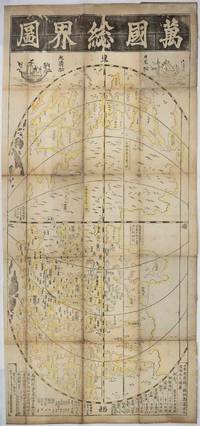
1708219243東京. Tokyo.: 須原屋茂兵衛. Suwaraya Mohei. Hoei 5 1708. Black and white woodblock map with yellow outlining in original hand colour 55.8 x 127cm map; 59.5 x 131cm sheet folding into the original Japanese wrappers chipped and rather worn 26.4 x 17.4cm the map with old repairs laid down on washi rather browned and wormed at the folds but with no serious loss the sheet age-toned and a little dusty but overall in remarkably good condition. Preserved in a modern blue linen Japanese case with toggle-closures. A famous woodblock-printed Japanese map of the world by renowned Edo Period map-maker Ishikawa Tomonobu who is also known as Ishikawa Ryūsen. This is a revised version of an earlier map produced by Ishikawa in 1688. <br> <br>The map appears to draw on Chinese and Portuguese geographical knowledge. The Chinese production of world maps had been transformed by the influence of the Italian Jesuit Matteo Ricci who collaborated with Chinese cartographers to produce a 1584 map of the world. In Japan the production of maps of "the myriad countries" or "the international countries" bankoku had been inspired by contact with Portuguese missionaries and with the Dutch in the 16th century. <br> <br>Ishikawa's map broadly resembles the Ricci map in being placed in an oval frame with the Pacific and thus also China and Japan at the centre. The content though is different. While Ricci's map is oriented to the north Ishikawa's is oriented to the east with America at the top of the page and the sketchy outlines of Europe including 'Ikiresu' England and a large and clearly marked Holland and Africa 'Kafuri' at the bottom. This orientation apparently influenced by the first world map in Japan "Bankoku Sōzu" 万国総図 which was published in 1645. Interestingly although Ishikawa had earlier produced a quite detailed and fairly accurate map of Japan the Japan shown on this world map is a rather loosely outlined collection of islands in which for example Ryūkyū the Ryukyu Kingdom now Okinawa and Hachijōjima appear much larger than they are in reality. Japan is also unusually oriented making it appear as though Ezo now Hokkaido is in the middle of the Pacific. It seems that the cartographer's interest here was less in outlining Japan in detail than in broadly setting out the country's place in relation to the land masses to the east and west. <br> <br>Like other Japanese world maps of the Edo period and like Ricci's map Ishikawa's image of the world includes imagined countries such as 'The Land of Giants". The continuing centrality of China in Japanese thought is indicated by the fact that Ishikawa's map contains a very clearly marked depiction of the Great Wall and that the map is decorated at the top with depictions of a Japanese and a Chinese sailing ship. The text at the bottom gives estimated distances between Hizen Province where the port of Nagasaki provided Japan's main official outlet to the world in this age of seclusion and various places in China and between Hizen and the Ryūkyū Kingdom. It also gives the estimated distance from Korea to Tsushima Island which served as Japan's gateway for diplomatic and trade relations with Korea. <br> <br>Engelbert Kaempfer a German physician and explorer brought back the 1688 edition of this map printing to Europe after his stay in Japan between 1690 and 1692. The map was introduced to European audiences in the 17th century and impacted on later European cartographic endeavours. <br> <br>Copies of this rare and historically significant map are held only in a handful of major collections: the British Library National Diet Library NDL of Japan the Staatsbibliothek of Berlin University of California Berkeley's Japanese Historic Maps Collection and the University of British Columbia. . 須原屋茂兵衛. [Suwaraya Mohei]. unknown
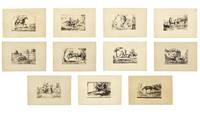
1864142931Adelaide: The Author 1864. Fine. Adelaide The Author 1864. Eleven albumen paper photographs approximately 88 × 134 mm mounted on the recto of individual cards approximately 165 × 240 mm neatly captioned below the plate with the title at the head of the first one with all captions by George Hamilton himself. A few light spots and marks to some of the cards; essentially in fine condition with the photographs uniformly rich in colour. The Art Gallery of South Australia has all 11 original artwork - pen and ink with wash - in its collection. The 'Adelaide Observer' on Saturday 27 August 1864 contains a review of Hamilton's recently self-published book 'a well-conceived well-written neatly-printed and elegantly-illustrated brochure under the above title'. It describes at length the illustrations '11 in number photographed from the author's drawings by Colonel Biggs Mr. Baines and Professor Hall and they bear ample evidence of the artistic taste as well as the correct judgment displayed in the spirited originals'. <p>Robert Holden 'Photography in Colonial Australia. The Mechanical Eye and the Illustrated Book' 1988 describes this book and one other Molesworth Jeffrey's 'Various Exercises and Fragments in Metre by Divers Authors' Hobart 1864 as being the 'first recorded use of original photographs as illustrations in commercially produced and dated books' in Australia. His descriptive bibliography records that the published work indeed contains 'Photographs of eleven drawings . by Colonel Briggs sic from rough sketches by the author. It would appear that these images were printed eleven to a sheet and then arranged in random order throughout the text'. His collation of the three copies in the State Library of South Australia indicates the individual print sizes range from 20 × 35 mm to a maximum of 40 × 60 mm. <p>The present offering clearly predates the published use of these images and its presentation is much to be preferred. The first and most obvious difference is the superior size and quality of the prints. However the captions greatly enhance the images; when they are read and viewed in the intended order numbers 1-11 are lightly pencilled in the top right-hand corner of the cards this becomes a proto-photobook of the highest order . and far from being a prosaic account of how to look after a horse as the title might suggest it is a searing indictment of the widespread ill-treatment of horses. 'Mr. Hamilton proceeds with pen and pencil to describe and portray some of the trials a horse has to undergo from the time his liberty is first invaded in the bush until in the last scene of all that ends this painful history he is reduced to the drudgery of a hackney car'. <p>See Ferguson 10180b and 10181a; Holden 50 and 51 plus pages 13-21. Both bibliographies contain errors. 11 items. The Author] unknown
157963961Frankfort & Wechelus: Francofurti Ad Moenum Apud and Wechelum 1579. Around 1961 a previous owner writes "According to the recent national archives survey this is the second oldest book in the State of Florida." Ask for scanned images of this rare volume and the laid-in notes of early researcher. "THIS CONSISTS OF ORATIONS AND COMMENTS OF FAZELLUS or FAZELUS WHO WAS PROFESSOR OF THE CUSTOMS OF THE SICILIAR AND SACRED HERITAGE OF THE PREACHER.". First Edition 1st Edition. Hardback LEATHERBOUND. Good Used Antique Condition. 13 3/4 Inches X 8 1/5 Inches X 2 1/4 Inches. Francofurti Ad Moenum Apud and Wechelum Paperback
178025574Paris: D. Lothrop & Company. Very Good with No dust jacket as issued. 1780-1804. First Edition. Hardcover. Full leather is what appears to be contemporary bindings. The first 2 volumes have minor separations along the ends of the hinges. The Atlas volume is missing the title page and has numerous notations in the first maps in French. ; 8vo 8" - 9" tall . D. Lothrop & Company hardcover
20182081502111906688line book office 2018. Soft Cover. Fine. The book is in fine condition. line book office paperback
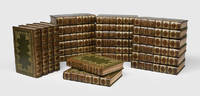
1900168277Philadelphia: George Barrie c.1900. An attractively bound set Limited edition number 262 of 1000 sets printed on japon with this set printed for Mr Thomas Breslin. This is an attractive and richly illustrated work on European court intrigue which includes works on the courts of Marie Antoinette and Napoleon. Provenance: with the bookplate of William Lawrence O'Neill 1935-2016 to the front pastedowns and his initialled inscriptions dated December 1932 to the front free binder's blanks of volumes V and IX. 24 vols octavo 215 x 140 mm. Frontispieces in coloured and uncoloured states richly illustrated with all plates in two states all with tissue guards. Contemporary green morocco by Stikeman for Brentano's titles to spine gilt spine decorated gilt in compartments covers elaborately gilt wide turn-ins marbled endpapers top edges gilt others untrimmed. Spines toned occasional rubbing to extremities; an excellent set. unknown
1804009517New York and Washington City: Printed By C. Wiley Isaac Riley and Daniel Rapine 1804. Book. Fine. Imitation Leather. First Edition. 8vo - over 7¾" - 9¾" tall. The complete set in nine volumes published 1804 1812 1816 and 1817. Recently professionally rebound in full dark brown goat sweps imitation leather spines with two new imitation labels similar to original saving original flysheets and adding new parchment end papers while retaining the original bookplate in Volume One of John H. Peyton John Howe Peyton 1778-1847 a Virginia lawyer and planter who served in both houses of the Virginia General Assembly. Volume One is a First Edition Washington City Published for John Conrad and Co. Volumes Two-Four are Second Editions so stated at title page printed in New York in 1812 by C. Wiley. Volumes Five and Six are First Editions printed in New York in 1812 by Isaac Riley. Volumes Seven - Nine are First Editions printed in Washington City by Daniel Rapine Vols. Seven and Eight in 1816 and Vol. Nine in 1817. Published over a period of fourteen years in three different cities by three different printers RARE in either the First or Second Editions of any of the volumes. Near Fine uniform browning and scattered toning to interiors in lovely new bindings that can be handled for years to come. Front end pages Vols. 2-9 with the small stamp of Brownlee & Brother. Title pages Vols. 2-9 inscribed by D. D. Pratt with his blindstamp. Daniel Darwin Pratt October 26 1813 - June 17 1877 was a United States Senator from Indiana 1869 - 1875 and Commissioner of Internal Revenue holding that office in 1875 and 1876. A complete set with Vol. One added to the Pratt Volumes Two-Nine with good historical provenance. William Cranch was the 2nd Reporter of Decisions of the Supreme Court of the United States from 1802 to 1815. Cranch's Reports contain accounts of over 350 cases from the court of Justice John Marshall including Marbury vs. Madison that are basic to the history of the Supreme Court and helped to form the backbone of our American Constitutional system of law. RARE. Printed By C. Wiley, Isaac Riley and Daniel Rapine Hardcover
14755547Basle Switzerland : Michael Wenßler Wenssler 1475 1475. Hardcover. Very Good. Folio - over 12 - 15" tall. 169 Folio leaves ; 31 cm. ; 2° ; bound in quarter suede with three raised bands hand-written titles on spine ; an incunable from the early and important press of Michael Wenssler of Basel Switzerland ; this partial copy without title page or colophon ; Hain 12383 Proctor 7464 British Museum 15th century III 722 IB.37053 Polain 3034 Goff P-83 Walsh 1114 ; single column 36 line Gothic type with conventional 15th century printing ligatures and with rubricized initials throughout; some generally minor edge staining and tears ; a few worm holes in the margins ; a few pages with larger stains ; this copy with no chapter headings or signature marks ; begins at Quintæ Partis Principalis Tractatus de Beatitudinibus with the section on Patience and the temptations of demons and ends the Beatitudes with the discourse on Peace; rubics in the same hand that executed those for the 1474 Quennell edition at the University of Darmstadt ; Michael Wenssler floruit 1472-1497 name variations: Wensler Wensel Vrenssler Wenkler or Wenßler was originally from Strasbourg but became a citizen of Basel in 1473 and was active from 1475 to 1488 when he had to sell his press to pay off his debts. He then leaves Basel for Cluny while his family remained behind in penury and he does not return until 1499 when he retires ; this publication amongst the earliest for Basle is of the celebrated work of William of Auvergne ca. 1180-1271 : the Summa de Virtutibus or The Summation of Virtues the first of the famous two-part tract whose second part published separately treats of the vices. William was born in the former Province of Auvergne about 1180 and by 1223 he was master of theology at the University of Paris and a canon at Notre Dame. He was consecrated Bishop and given the See of Paris in 1228 by Pope Gregory IX and he remained there until his death in 1249. The Summa de Virtutibus et Viitis On the Virtues and Vices a massive work is itself part of a much larger work the Magisterium Divinale et Sapientiale The Teaching on God in the Mode of Wisdom. The style of the work is somewhat rambling moving off into many tangents as it explores related concepts and makes the work appear as an extemporaneous discourse often making a point and then immediately raising objections to that point which William then proceeds to refute. It was reprinted many times and was a monumental Dominican theological work. name variants for William of Auvergne: Guilelmus Peraldus Guillermus Parisiensis Guilielmus Peraldus Guilelmus Peraldus Guillaume Perrault Guilelmus Peraldus Willelmi de Peraldo Wilhelm Peraldus Guilelmus de Petra Alda Guillaume de Peyraud Ardeche G. Lugdunensis G. de Peyrauta G. de Peraudus G. Parisiensis Guil. de Lugduno Guillelmus Peraltus Fr. Guil. a Peira Fr. Guillermo Peraldo Wilhelmus Ep. Lugdun. and Willelmus Arch. Lug. ; extremely rare edition ; VG <br/> <br/> [Basle, Switzerland : Michael Wenßler (Wenssler), 1475] hardcover
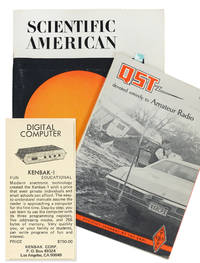
1246261971. Various publishers and places: 1971-1976. <br /> <br /> 9 groups of material in original format as issued and generally in very good condition. See below for details.<br /> <br /> § A fascinating collection of magazines and newsletters assembled for the advertisements and announcements which document the birth of Microsoft and the personal computer. The collection includes: <br /> <br /> 1 Scientific American Sept. 1971 first advertisement for a personal computer on p. 194.<br /> <br /> 2 QST March 1974 the first ad for the first minicomputer on p. 154.<br /> <br /> 3 Radio-Electronics July 1974 pp.29-33: Titus Build the Mark 8 Minicomputer.<br /> <br /> 4 Popular Electronics Jan. 1975 pp. 33-38 Roberts and Yates: Altair 8800 Minicomputer part 1<br /> <br /> and<br /> <br /> 5 the same Feb. 1975 pp. 56-58 Altair 8800 Minicomputer part 2<br /> <br /> These two issues feature a two-part article titled "Build a Minicomputer" by Ed Roberts and William Yates. This was the first time an affordable personal computer had ever been described in a magazine. The January edition provided detailed diagrams of the Altair 8800 and the February issue discusses programming possibilities. The news galvanized hobbyists around the country inspiring groups such as the Homebrew Computer club to form. Famously Bill Gates cited these articles as his inspiration for dropping out of Harvard and launching Microsoft.<br /> <br /> 6 Byte Magazine Sept. 1975--Jan. 1976. The revolution begins.<br /> <br /> 7 Computer Notes Altair Users Group Nov.- Dec. 1975. P. 19 Bill Gates on the status of BASIC originally on paper tape first revealed in March 1975 one month before Gates and Allen founded Microsoft.<br /> <br /> 8 Computer Notes Altair Users Group Jan. 1976 announces the first Altair Convention. P. 13 Gates on programming and p. 14 Gates on software.<br /> <br /> 9 Computer Notes Altair Users Group Feb. 1976. P. 3 Gates: An Open Letter to Hobbyists outlining the Microsoft business model and clarifying the distinction between proprietary and open-source software. Altair licensed Microsoft BASIC.<br /> <br /> Foundational documents heralding the birth of one of the most important scientific achievements of humankind. In July 1975 the first computer store opened in L.A. In March 1976 Albuquerque hosted the first World Altair Computer Conference see #8." John Doerr a Silicon Valley investor from the earliest days once opined that with Apple and Microsoft opening with months of each other "it was the greatest legal creation of wealth in the history of the planet unknown
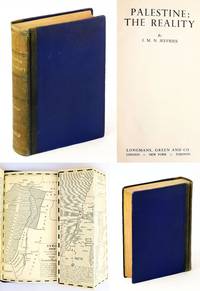
1939222j2678London: Longman's Green and Co. Good with no dust jacket. 1939. First Edition. Hardcover. "This is a very long book but it has to be long. Since the real history of Palestine for two decades has been kept hidden from the public it is in a sense necessary here to recreate those lost twenty years in as much of their detail as possible. Half the facts I have to give have never been mentioned at all many of the documents have never been quoted. There was no Palestine Question nor ever would have been one if certain statesmen had not created it. The book deals primarily with the story of how Palestine was placed under Mandatory government in order to establish the 'Jewish National Home' which later - it was intended - should become a Jewish State. Under no circumstances can it be sustained that because of the prophecies of the Old Testament the Jews have a permit to return to Palestine arbitrarily and wrongfully. To do so would provide an example never before seen of Scripture being quoted for the devil's purpose." - Introduction. J. M. N. Jeffries 18801960 was a British war correspondent historian and author. Between 1914 and 1933 he wrote for the Daily Mail serving as a war correspondent as head of the Paris bureau during World War I. In 1922 he travelled with the owner of the Daily Mail Viscount Northcliffe to Mandatory Palestine." - Wikipedia. vi-xxiv 728 p. Index. Bibliography. Foldout map of Syria 1916 indicating "reserved area" and of Zionist Holdings in Palestine. Former library copy with usual markings and average wear in tight contemporary quarter-leather library binding. A quite uncommon and sound example. Multiple online sources suggest much of the original print run was destroyed by a German bomb during WWII. A 2016 Christie's auction listing mentioned the possibility that the scarcity of this title stemmed from the Jewish Agency buying and destroying as many copies as it could. ; 8vo . Longman's, Green and Co. hardcover
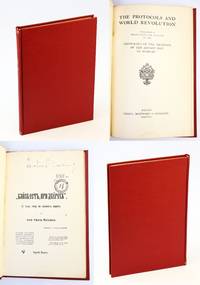
1920426j1799Boston: Small Maynard & Company Publishers. Good with No dust jacket as issued. 1920. First American Edition. Hardcover. A first American edition example of what are now more commonly known as the Protocols of the Learned Elders of Zion. 6 149 p. Part One inclues an eight-page introductory statement with a three-page summary of the Protocols followed by the XXIV Protocols. Part Two begins on page 74 and provides evidence as to the origin and authenticity of the Protocols with an examination of parallelism between the actual policies of the Bolsheviki and the Protocols and an examination of parellelism between the Protocols and Jewish writings. Professionally rebound in dark candy apple red buckram with silver titling and decoration upon backstrip. Prior owner's name atop facsimile of title page of a Russian edition otherwise tight and unmarked with moderate wear. Small faint moisture mark to bottom edge of first eight leaves. No dust jacket as issued. A sound example of this ever-contentious work. Singerman 0109. 9.2 x 6.2 inches. ; 8vo . Small, Maynard & Company Publishers hardcover
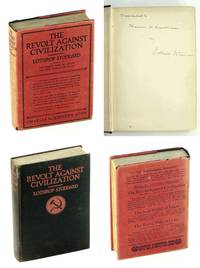
1922441j1364New York: Charles Scribners Sons. Good in Good dust jacket. 1922. First Edition. Hardcover. Signed and inscribed by Stoddard upon front free endpaper. "The revolutionary unrest which to-day afflicts the entire world goes far deeper than is generally supposed. Its root-cause is not Russian Bolshevik propaganda nor the late war nor the French Revolution but a process of racial impoverishment which destroyed the great civilizations of the past and which threatens to destroy our own. In light of recent biological discoveries confirmed and amplified by investigations in other fields of science especially psychology all political and social problems need to be re-examined. Such a re-examination of one of these problems - the problem of social revolution - has been attempted in the present book." - Preface. "A penetrating study of the under man here in America." - Boston Herald. "How any one with an interest in the future of the nation can fail to heed studiously the questions he very lucidly raises it is difficult to conceive." - Harold Callender in the New York Herald. "Lothrop Stoddard 1883-1950 was an American historian journalist and political scientist. He wrote several books advocating eugenics white supremacy Nordicism and scientific racism. His books were once widely read both inside and outside the United States. This book introduced the term Untermensch the German translation of 'under man' into Nazi conceptions of race. As a journalist he spent time in Germany during the first months of World War II where he interviewed several prominent Nazi officials." - Wikipedia. 10 273 p. Somewhat above-average wear to original black cloth lettered and decorated in red. Small bookplate inside front board. Front hinge tender but intact. Back hinge discretely repaired by prior owner. Small ink stamp upon back free endpaper. Incidental faint one-inch ink squiggle to page 189. Moderate loss to periphery of dust jacket now in glossy new archival protection. Laid-in is a photocopy of a letter signed by Stoddard endorsing a 1924 Virginia petition requiring all residents to be registered by race prior to the granting of marriage licenses. Weems p. 94 ; 8vo; Signed by Author . Charles Scribners Sons hardcover
1675ABC_50456Amsterdam 1675. 4to 19.1 x 14.5 cm. Michiel de Groot Contemporary multicolour brocade paper wrapper covered with protective clear plastic. With a large woodcut illustration of a Dutch merchant ship on the title page 3 woodcut illustrations in the text including a repeat of the woodcut on the title page and a large decorated woodcut initial. 6 42 pp. Very rare 17th-century Dutch edition of the earliest published biography devoted entirely to a pirate and one of the most vivid narratives of maritime freebooting to emerge from the Dutch Golden Age.Claes Gerritszoon Compaen 1587-1660 began respectably as a merchant before turning privateer and ultimately pirate. Around 1620 he abandoned the constraints of licensed privateering despite holding a commission from the States-General and the Prince of Orange and embarked upon an independent career of sea-robbery. For three years he hijacked ships in the English Channel the Mediterranean the Caribbean and off the coasts of Africa America and the West-Indies acquiring a formidable reputation. Contemporary chroniclers record that Spaniards Portuguese French and English alike feared his attacks. Officially branded a Zee-Roover and Schelm he nevertheless achieved legendary status and remarkably was eventually pardoned and allowed to return to Oostzaan where he lived out his days as a local celebrity.First published in 1659 the present work proved an immediate success and ran through numerous editions into the early 19th century to 1803. All editions are now scarce the 17th-century editions 1659 1662 1675 1688 in particular. The text is set in gothic textura type characteristic of popular Dutch prose works of the period and most editions including the present are illustrated with woodcuts. With a black oval library stamp of Missie Huis Arnhem in the bottom outer corner of the front wrapper the number 9<<1621:1627>> in the top margin of the front wrapper and the title page an ownership stamp of de Mul on the inside of the front wrapper and on the title page and a small bookplate of Librairie ancienne et mod Nartinus! Nijhoff La Haye mounted on the inside of the front wrapper. The paper wrapper is worn the spine has previously been stengthened with black paper/tape the whole is now covered with protective clear tape. Slight foxing and browning throughout with a small tear in the outer margin of pp. 39-40 not affecting the text. The present work is complete but leavs in the final quire have been mis bound: p. 30 is followed by pp. 35-38 31-34 39-42.l Buisman 116; Lunsford Piracy and Privateering in the Golden Age Netherlands 2005 pp. 161-163; STCN 097051624 1 copy; USTC 1811907 1 copy; WorldCat 951918594 6 copies; cf. Cat. NHSM p. 897 1659 ed.; Muller America 2131; Muller 839-840 other eds.; Sabin 15015 1663 & 1685 eds.; Scheepers II 1026; Tiele Mémoire pp. 248-249; Waller 218 all ed. 1662. unknown
192928401Brooklyn New York Hicksville etc. 1929. Very Good. Brooklyn New York Hicksville etc: ca. 1920s. One hundred and eight 108 movie advertisement text cards nearly all hand-painted in white on stiff black card stock and measuring ca. 17.5x18cm to ca. 20x20.5cm.; many with painted pictorial elements or color printed paste-ons. General wear to margins some placards suffering shallow losses at extremities not affecting text or illustration while a few have larger pieces missing though the vast majority in Very Good condition. Date based on the lone dated advertisement 1929.<br /> <br /> A remarkable time capsule from the early days of blending film-going with advertisement one placard even promoting this form promising that "This novel advertising medium brings results to the merchant." Not only did it bring results it was also cheap for the movie house to produce: at least sixteen of the examples here are painted on the versos of trimmed silent film text cards. The ad for Frankel's Men's Shop offering holiday suggestions of silk scarfs neckties bath robes and hosiery when flipped tantalizingly reads "The bath after the ceremony." Chas. Friedopfer Furniture on the other hand is painted on the verso of the text placard "Then followed rank houses headquarters for the half-bred gauchos who herd cattle over the vast estates" possibly text to accompany a jingoistic newsreel or Western film.<br /> <br /> Of special note however is the breadth and diversity of the businesses that made use of this advertising novelty many of them first- and second-generation immigrant-owned family businesses catering to their fellow countrymen and countrywomen the collection including six advertisements in Italian two in Chinese and one in Czech. <br /> <br /> Businesses range from the garment industry Army & Navy Store Self-Acting Shoe Store Father & Son Clothes Shop "Pants to match your coat!"; to pastry and ice cream parlors; florists; garages and bodyshops; movers; pharmacists; optometrists and dentists "at the subway station"; radio repair; electricians; beauty salons our favorite: Joe's Beauty Parlor; furniture stores and auction houses; banks; cleaners and laundromats; department stores; jewelers; haberdashers; malt and hops stores; a Chevrolet dealership out in Hicksville; a taxi company "polite and courteous drivers"; quality meats; hotels and boarding houses; Singer sewing machines; and finally a coal company located inside a pet shop. unknown
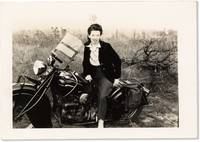
81167St. Louis: Ozark M.C. 1927-1942. A rich archive of original source documents for one of the earliest motorcycle clubs in the Midwest with clear precursors to the "Outlaw" clubs of the post-WW2 era. Includes minute books for the Club's primary years of activity; founding documents including draft Constitution and By-Laws; membership rolls; correspondence; printed and promotional ephemera and photographs complete inventory in note below. Condition generally Good or better with expected aging to some documents and a few in fragile condition. The archive has been removed from the decomposing ring binders in which it was originally housed and organized into manila file-folders respecting where possible the as-found order of contents. The original binders have been retained and are included with the archive. The entirety comprises sixteen file folders housed in two hinged Hollinger boxes occupying about half a linear foot.<br /> <br /> <br /> INVENTORY:<br /> <br /> BOX 1: <br /> <br /> Folder 1. By-Laws and Constitution. Ten items including five drafts in mimeograph with extensive holograph edits; one apparently final draft in typescript on lined paper; related documents including roster of charter members with addresses; suggestions for effective Presidency; directory of other regional motorcycle clubs. <br /> <br /> Folder 2. Minutes June 15 1928 - October 18th 1929. Continuous; 32 leaves used plus 12 blank<br /> <br /> Folder 3. Minutes Jan 8 1937 - December 24th 1937. 24 leaves fully used recto & verso<br /> <br /> Folder 4. Minutes Jan 7 1938 - December 30th 1938. 21 leaves fully used recto & verso<br /> <br /> Folder 5. Minutes Jan 6 1939 - March 1 1940. 26 leaves most used recto & verso plus about 20 blank leaves as found. Entry for March 1 1949 is annotated possibly at a later date: "This is last meeting." <br /> <br /> Folder 6. Membership Forms 1935 - 1939. 33 numbered completed forms plus two unnumbered completed in holograph with name date of application record of membership vote and signatures. This presumably comprises a complete list of all Club members from 1935-1939.<br /> <br /> Folder 7. Miscellaneous correpondence 1930 - 1942. Twelve pieces on various subjects including political statements apparently by Michael Verderber not related to Club activities. Envelopes laid in as found. <br /> <br /> Folder 8. Printed and promotional items. Six pieces produced by the Club and by others. <br /> <br /> Folder 9. Midwest Motorcycle Association. Two pieces documenting an attempt by Ozark M.C. members to start a rival association to the American Motorcycle Association. <br /> <br /> Folder 10. Races Meets and Competitions 1932 - 1939. Sixteen pieces including correspondence race forms sanctioning certificates and related materials relating to competitions and Club meets. <br /> <br /> Folder 11. American Motorcycle Association 1930 - 1941. Eight items including correspondence bulletins and blank forms from the American Motorcycle Association the main sanctioning body for motorcycle clubs across the U.S. <br /> <br /> Folder 12. Ephemera including event tickets pit passes business cards club receipt book for 1936. Nine unique items some present in multiples. <br /> <br /> Folder 13. Photographs. Thirty-nine vintage silver-gelatin photographs most measuring 3" x 5" or the reverse; a few smaller; also twenty-three original negatives some but not all replicating the prints above. <br /> <br /> Folder 14. Photographs. Three larger format vintage silver-gelatin photographs two measuring ca. 8" x 10"; the third 5" x 7" on card mount this image fully cracked through image at lower third; verso of board held together with masking tape. <br /> <br /> Folder 15. Michael Verderber personal. Two items relating to 1943 registration certificate for Verderber's Indian Model "4" motorcycle.<br /> <br /> Folder 16. Fragments and extraneous envelopes as found. <br /> <br /> BOX 2: Remnants of 3 original binders from which the archive was removed. <br /> <br /> -------------------------------------<br /> <br /> The original Ozark Motorcycle Club was founded in 1927 by a group of twenty St. Louis cycling enthusiasts including Mike Verderber who appears to have been the original keeper of these documents Louis Ahrens first President Fred Tremozini Vice President Hank Eiler and sixteen others. It is unclear when the group began holding formal meetings; extant minutes for this iteration of the club begin with June 15 1928 and end without warning or explanation on Oct 18 1929 leaving about twenty blank leaves in the minute book. As this last recorded meeting was held just six days before the stock market crash the cause for this cessation of club activities may be conjectured. We can find no public mention of the Club in its pre-Depression phase; the minute book included here would appear to be the only record of its existence. <br /> <br /> The Club was reconstituted on August 16 1935 in the depths of the Great Depression by Verderber and about twenty others. Included here are multiple drafts both in manuscript and mimeograph for the new Club's Constitution and By-Laws which specify that members shall be "White Male Riders and Owners of Motorcycles" emphasis in the original but "may bring their wives or such persons as they see fit to club-affairs." The earliest minutes appear to be missing but the archive's record of meetings is complete from January 1937 to March 1 1940 which appears to have been the Club's last official meeting so marked in the minute book though other evidence included in the archive suggests that the club persisted for at least a few more years perhaps more as a social group than a functioning organization. For the first two years meetings focus mostly on club events including meets tours and rallies. The availability of beer at meetings is a topic that arises with some frequency as does the matter of the American Motorcycle Association for which at least a few members express strong antipathies see our note regarding Outlaw motorcycle clubs below; at one point it appears that a club faction even attempts to launch their own regional association the Midwest Motorcycle Association to challenge the AMA's supremacy in the promotion of meets "gypsy tours" and hill climb events. Eventually the Ozark M.C. appears to have made the decision to affiliate with the A.M.A. though we mysteriouly do not find any vote for this decision in the meeting minutes just correspondence from the AMA sanctioning club events but it clearly cost the club some members: by 1938 membership had dwindled from 22 riders to no more than a dozen. In later years beginning especially around mid-1939 meetings address with increasing urgency the Club's dwindling membership and futile attempts to collect dues from the many members in arears. By early 1940 it seems the eight remaining members can agree on very little; the minutes grow sparse and by March of that year the Club appears defunct. <br /> <br /> This winding narrative is supported by the archive's many other documents including correspondence which includes several lengthy letters from club president Verderber to prominent public figures including Franklin Delano Roosevelt publicity materials and especially photographs which are remarkable: all are vernacular nearly all captioned with names and dates taken during biker events throughout the midwest evoking the rough-and-tumble nature of early cycling events and the decidedly proletarian milieu in which they took place. "Outlaw" culture was still a few years away from being fully articulated by clubs such as The Outlaws The Boozefighters The Bandidos and others; but its roots are most definitely to be found among these risk-taking beer-drinking blue-collar riders of the Great Depression.<br /> <br /> The roots of Outlaw motorcycling in America have been widely documented typically traced to the years directly after the Second World War when returnig G.I.'s out of work and deprived of the close bonds they'd formed in battle found an outlet in the rough and occasionally dangerous world of open-road cycling. "Outlaw" Clubs - those that refused to affiliate with the American Motorcycle Association a commercial trade organization founded in 1924 - developed a mostly undeserved reputation for antisocial and sometimes violent behavior cemented in the public imagination by the 1953 Marlon Brando film The Wild One and its many imitators. But as is clear from the evidence in this archive an independent and contrarian spirit prevailed even in the pre-War years and we suspect it was members of Depression-era clubs such as this one who were most active in forming the post-war Outlaw clubs. In fact Verderber in one telling line from a long letter to his girlfriend included here describes himself as an "outlaw" rider - then thinking better of it crosses the word out and replaces it with "independent." By war's end such reticence would be a thing of the past; independent bikers would begin wearing the "outlaw" label proudly and defiantly. And though the use of the term "outlaw" before the war is hardly unnown - the Outlaws M.C. of Chicago were using it as early as 1935 - documentation of these pre-War motorcycle clubs is nearly non-existent making the current archive an invaluable resource for both the study of working-class culture in the midwest and one of the earliest instantiations of a uniquely American subculture. unknown