119 833 résultats
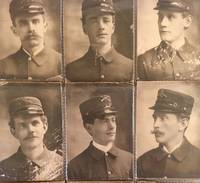
1898List319Massachusetts 1898. The 2nd Massachusetts Volunteers mustered into service in May 1898 and within a month saw significant action in Cuba at the Battle of El Caney. They were one of three volunteer units from Massachusetts to see action on the Santiago Campaign. The regiment was inexperienced - 55% were untrained recruits. The lack of experience combined with their rifles giving off a very visible black smoke led to a heavy casualties in the Battle of El Caney. After an encampment near Santiago de Cuba in which a large number of the soldiers became ill with disease - estimates are as high as 65% - the regiment returned home in August. Historians have noted that soldier demographics changed considerably from the Civil War to the Spanish American war as the smaller number of troops and the lack of a draft led to a more enthusiastic army with higher morale. <br /> <br /> The photographs in this group are interesting as a typological grouping of images of untrained soldiers and also for their historical value as most contain identifications to versos. The highlight of the group is forty-four uniformly mounted portraits of soldiers nearly all identified measuring 3 ¾ x 2 ½ inches each. Other photographs include a large portrait of Captain Frederick E. Pierce with the blindstamp of Goldsmith Studio Springfield Massachusetts and a 3 ¼ x 3 ¼ inch square card of Capt. Pierce in Camp Turner. Also included are two slightly larger photographs on similar mounts. <br /> <br /> Overall an interesting group. Good condition overall with assorted chips and wear. unknown
19171993Chicago: Mayhart Studio 1917. Very good. Large panoramic photograph 8 x 90.5 inches. Rolled. Light wear at edges with a couple of small chips and very short closed tears along top edge. minor dust soiling and toning. A fabulous and extremely long panoramic photograph measuring approximately 7.5 feet in length that depicts Camp Bowie in Fort Worth during October 1917. At this time the camp was still under construction but also housed an entire infantry division in training for World War I. Ongoing construction efforts are clearly evident as piles of lumber in various states of organization occupy the field in the center foreground. Already completed barracks and other out buildings occupy the right of the image and thousands of army tents sweep into the background of the center and left portions of the image. A group of standard houses likely for officers and their families is located at the lower left of the image. The photographers Mayhart Studio of Chicago were responsible for a number of military and patriotic views during the United States' involvement in the Great War including the well-known "Living Flag" image of thousands of servicemen composing an American flag.<br /> <br /> "Construction of Camp Bowie began on July 18 1917. The camp in the Arlington Heights neighborhood about three miles west of downtown Fort Worth was established by the United States War Department to give training to the Thirty-sixth Infantry Division. Local officials expected financial gain and urged that the camp be located at Fort Worth. Including the adjacent rifle range and trench system the site encompassed 2186 acres. Camp Bowie's greatest average monthly strength was recorded in October 1917 as 30901. For about five months after the departure of the Thirty-sixth for France in July 1918 the camp functioned as an infantry replacement and training facility with monthly population ranging from 4164 to 10527. Shortly after the Armistice on November 11 1918 Camp Bowie was designated a demobilization center. By May 31 1919 it had discharged 31584 men. The heaviest traffic occurred in June when it processed thousands of combat veterans of the Thirty-sixth and Ninetieth Texas-Oklahoma divisions. The demobilization having been concluded Camp Bowie was closed on August 15 1919" -- Handbook of Texas Online.<br /> <br /> A quite remarkable photographic document of this short-lived World War I-era army camp in Fort Worth whose grounds and surrounding neighborhood are now touted by the municipal tourism office as "the city's premier commerce corridor." We locate no other examples of this excellent and large panorama. Mayhart Studio unknown
19171992San Antonio 1917. Very good. Large panoramic photograph 8 x 92 inches. Rolled. Minor wear at edges with one very short closed tear at top edge. Light blemish in negative at center of image. Light dust soiling and toning. An outstanding and extremely long panoramic photograph measuring well over 7.5 feet in length that depicts Camp Travis in San Antonio following its recent opening. Although the camp was open and housing an entire division-in-training at the time of this image the camp was still under construction as evidenced by the organized piles of lumber at the far right of the image and the incomplete barracks building in the center foreground. The panorama nevertheless gives a sense of the scope and size of the training camp with barracks and outbuildings stretching almost as far as the eye can see in the center and left sections of the photograph. Structures are sparser in the right-hand side of the image both because they as yet unbuilt and because some of the training fields were located in this part of the camp. The photographers Mayhart Studio of Chicago were responsible for a number of military and patriotic views during the United States' involvement in the Great War including the well-known "Living Flag" image of thousands of servicemen composing an American flag.<br /> <br /> "On July 15 1917 after its selection as the training site for the Ninetieth Texas-Oklahoma Division of the army Camp Wilson was renamed Camp Travis in honor of Alamo hero William B. Travis. The camp was ready for occupancy on August 25 1917. Additional land was subsequently acquired for vital training facilities and numerous structures were erected by the soldier welfare agencies. Camp Travis comprised 18290 acres of which 5730 were on the main campsite adjoining Fort Sam Houston. The Ninetieth Division was organized at Camp Travis in September and October of 1917. During the summer of 1918 Camp Travis served as an induction and replacement center with an average strength in July of about 34000 White and Black troops. On December 3 Camp Travis was named as a demobilization center. The facility was also designated a local recruiting station and a regional recruit depot in March 1919. Some 62500 troops were discharged at Camp Travis in about eight months. The camp then became the home station of the Second Division. Its service as a separate entity was terminated however upon its absorption by Fort Sam Houston in 1922" -- Handbook of Texas Online.<br /> <br /> A quite fascinating view of this enormous World War I-era training camp in San Antonio now a part of the even larger Fort Sam Houston military base on the east side of the city. We locate no other copies of this large and remarkable panorama. unknown
1860D130301860s. Hardcover. Very Good. Cloth morocco backstrip; folio 400x260mm; approx. pp. 100 full of manuscript entries by a single hand with permanent instructions and headings in ink and crew member names and station designations in pencil; numerous additional blanks at rear. Nonetheless a trove of information. Lined paper listing the 614 men aboard assigning each a number gun and location Fore Castle Port Main Top Mizzen Top etc.; listing division and stations; and recording details of every situation that might occur on the ship see examples below. The ship is unnamed but it appears to be a ship of the Line or a Frigate which had 3 masts as well as some minimal amount of steam power. There were 6 African-American members of the crew all of whom were Union Sailors during the Civil War Edward Turner Joseph Davis and Thomas Mills from Maryland; Henry Andres from the West Indies; Joseph Gordan from New York; Samuel R. Whittaker from Buenos Aires. Three of these men served on the USS Minnesota which may help identify the ship. Also includes the ship's Fire Bill crew member stations of Making Sail from Single Anchor Mooring and Unmooring and much more. A rich volume worthy of further study. Cloth torn; front hinge cracked; first few signatures loose. Alittle faint waterstaining and soiling but generally nice and clean. <br/><br/> hardcover
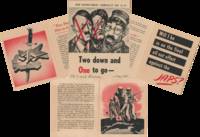
1945List2747Paris France; and Washington D.C. 1945. Six 8 x 10 inch and smaller typed pages; one 4 x 5 inch card with two tickets; one twenty-six page 4 x 5.5 inch pamphlet; one six page 6 x 8.5 inch pamphlet; six 2.5 x 3.5 photographs and two 3 x 4.5 inch photographs. Of the printed matter most is affixed to paper some small tears and folds; overall excellent; photographs near fine. Mary J. Bremer 1917–2019 was a Technician fourth grade from Grant Township Nebraska. Her correspondents here include June Miller 1920–deceased an aviation cadet from Michigan and John Melotte 1919–deceased an artilleryman from Philadelphia. Bremer and Miller were members of the Women’s Army Corps WAC. Established in May of 1942 as the Women’s Army Auxiliary Corps the WAC converted to active duty in July of 1943. The women of WAC known as Wacs served in noncombatant roles across the various theaters of World War II.<br /> <br /> Offered here is a small archive of Bremer’s documents and photographs relating to WAC: a few letters including a description of Paris the day after the Nazi surrender; two pamphlets including the War Department pamphlet Two down and One to go –; and a collection of photographs of Eisenhower’s victory parade and Roosevelt’s funeral procession.<br /> <br /> On April 12 1945 President Roosevelt died of a stroke in Warm Springs Georgia. His body was returned to Washington two days later and a military procession escorted it from the train station to the White House. Two photographs of the funeral procession are included in the archive. One showing a woman at the start of a section of the parade is identified verso as “WACs led by Capt. Machenâ€.<br /> <br /> The following month the Nazis surrendered. Bremer’s friend June Miller was stationed in Paris at the time. She wrote to Bremer the next day describing the celebration:<br /> “It began the night before when we stood on the roof and watched the flares go off all over the city--just like the 4th of July; the Sacred Couer was blazing with lights and it looked like a miniature fairy-land. Last night all the famous old buildings including the Arc d’Triumph was all lit up the fountains in the parks at Concord in front of the Trocadero--they were all going and the kids were wading and splashing around having the time of their life. It was really something to see--something the French had been waiting a long time for. “Fini le guerre†they kept saying--the end of the war!â€<br /> <br /> Miller also claims to have witnessed a bomber flying a celebratory loop through the Eiffel Tower:<br /> <br /> “When we came out of the Trocadéro the fountains were on and what a sight that is. Looking down over the water that looks like a miniature waterfall to the Eiffel Tower at the bottom of a small hill. And if I hadn’t seen it with my own eyes I would never have believed that I saw a small bomber come through the bottom but that’s just what it did--and just did clear it too. The planes seemed to be going as wild as the people on the ground--they were so thick up there that pretty soon we thought surely something would happen.â€<br /> In June Dwight Eisenhower returned from Europe and a homecoming parade was held for him in Washington D.C. Six photographs of this parade are included in the archive including a shot of his plane arriving at the airport and one where he is visible standing in the back of a Jeep.<br /> <br /> Miller notes in her letter from Paris that “you wondered what was coming next; where we would go from here ‘cause in a sense there is still a war very definitely going onâ€. In fact John Melotte who seems to be Miller’s partner writes to Bremer that he “May be slated for that place they call the CBI but don’t tell June please. She does not want me to even mention the place in my letters so I let well enough alone†July 15 1945. Hostilities would continue in the CBI—the China-Burma-India theater—until September of that year.<br /> The process by which soldiers were selected to be sent to the Asia-Pacific theater is laid out in the War Department pamphlet Two down and One to go –. The pamphlet reminds them that there are still “a couple of big jobs ahead†the primary one being to “crush†or “smash†the “Japs†and the second one being to occupy and police “conquered lands . until the peril of future aggression is gone.†It is a visually striking piece with illustrations in a bold black and red color palette; its cover is a reproduction of a caricature of Hitler Mussolini and Hirohito by Polish-Jewish artist Arthur Szyk.<br /> <br /> Also included in the archive are a card from a friend with tickets to an American League baseball game; a humorous poem congratulating Wacs Ruth O.B. and Lenore I. Nier on new work assignments; and a Christmas 1945 WAC pamphlet with a dinner menu and list of WAC officers. The pamphlet assures the Wacs with a note from Colonel Kenton Cooley “Before another Christmas you all will have returned to civilian life and each of you will take with you my appreciation and my sincere admiration for a great job well done.â€<br /> Of interest to scholars of women’s history especially in the military; and of the events leading up to the end of the Second World War. unknown
194356100Duluth MN: Barnes-Duluth Shipbuilding Co. Office & Yards at Riverside 1943. Oblong 4to. 11.5 x 9 in. 20 linen-backed silver gelatin photographs sized 8 x 10 in. each mounted on linen hinges text w/in negative at lower right corners. Original Smead Manufacturing Press-board binder Acco-fastener sliding posts at gutter margin typed and printed label on front cover rounded corners NF. Scarce in-house shipbuilding photo album documenting the construction progress for several Lake Maracaibo type tankers for the Standard Oil Co. of New Jersey subsidiary in Venezuela Creole Petroleum Co. or Esso originally developed by Edward Doheny. The shipyards were originally developed by Captain Alexander McDougall who built whaleback barges and steamers in Duluth for bulk cargo and passenger travel on the Great Lakes and later sold the shipyards to Julius Barnes who renamed them the Barnes-Duluth Shipbuilding Co. which in 1943 were purchased by Walter Butler Shipbuilders. The Barnes-Duluth Shipbuilding Co. was quite popular with non-government and government contractors as it was one of the few which produced nearly fully outfitted ships. Photographs in the album show the progress of several hull Nos. 683 including the SS San Cristobal owned by Creole Petroleum until about 1950 later reflagged the Witwater when it ran aground in 1968 in a storm; the SS Temblador which operated on Lake Maracaibo until 1977 when reregistered and reduced to a barge at Hamilton ONT and flagged as the Liquilassie; the SS Valera which was sunk less than 6 months later by the German Navy U-518 submarine on July 3 1944 with Captain Russell perishing in the sinking as well as the SS Guarico and SS Guiria. Rubel 1917-1980 was commercial photographer for the Walter Butler Shipyards in Duluth MN during World War II and also photographed the shipbuilding in the Barnes-Duluth Shipyards after they were purchased by Butler in 1943 before enlisting in the US Navy and served until April 1946. At its’ height the Duluth Shipyards employed over 3000 workers and following the War were sold to the Spirit Lake Marina with most of the buildings raised restarting commercial boat building in 2014. Worldcat locates only some construction data and photos of the San Cristobal & Liquilassie Milwaukie City Library; See: Dierckins & Norton Lost Duluth: Landmarks Industries Buildings Homes and the Neighborhoods in Which They Stood 2012; Our History Spirit Lake Marina & RV Duluth MN 2014; Bowling Green State University Libraries Historical Collections of the Great Lakes 2019. Barnes-Duluth Shipbuilding Co., Office & Yards at Riverside, unknown
1974List3157St. Petersburg Florida: unpublished 1974. Ninety-four typed and photocopied pages measuring 8 ½ x 11 inches in a soft binding. Binding with wear; pages generally excellent to Near Fine. Overall excellent to Near Fine. Annemarie Bliwernitz 1905–2005 née Entz was born in Notzendorf East Prussia. In 1952 after surviving both World Wars she and her husband Bruno 1900–1992 immigrated first to Canada and then to the United States. Offered here is Annemarie’s unpublished memoir written between 1972 and 1974.<br /> <br /> Bliwernitz grew up in a wealthy land-owning country family which she remembers lived far west enough that they did not have to flee the Russians during World War I and was less affected by the postwar economic situation than were city residents. Most of the memoir is taken up by Bliwernitz’s remembrances of World War II and life leading up to it. Of Hitler’s rise she writes:<br /> <br /> “During these years conditions got worse in Germany . A new name came up ‘Adolf Hitler.’ – It was not hard for him to find followers now by the thousands and soon by the millions. He dared to stand up against the Communists with his brown uniformed S.A. men and a new wind seemed to blow over our illfated land. No wonder young people looked up to him and followed the new star nobody had much to lose. . Bruno and brother-in-law Willy after some meetings attended showed up in the new brown uniform also and farmers and laborers seemed to be united in that new idea. – It really changed Germany in a short time nobody could deny that unemployment ceased people got jobs again and housewives and mothers could buy the necessities of life for their families especially food. And it brought us to our feet again also.â€<br /> <br /> Though of course Bliwernitz maintains that the “Concentration Camps and what happened in them was not known to the German people" she mentions that Bruno quickly became an Arbeitsdienstführer—essentially a labor camp overseer—and remembers dissenters being disappeared:<br /> <br /> “As an example I will tell about Bruno’s oldest brother Alfred. He was all against Hitler from the beginning. One day he came home and picked up his neighbor’s paper at his frontdoor and wrote his ideas about Hitler and his lies down with pencil. This neighbor reported him they picked him up and that was the last his family saw of him. They were told ½ year later that he had died in Stuhm West Prussia a Concentration Camp. No explanation to his wife whatsoever. The same destiny happened to my co-worker a highly educated person at the Translation Office. She said in the lavatory where many ladies could hear: Hitler’s big picture in the office should be placed here in the toilet-rooms where it belongs. One of the ‘kind’ co-workers reported her and she came next day only to pick up her belongings and was not seen any more.â€<br /> <br /> While Bruno is sent to the Eastern Front Bliwernitz and their children flee the Russians trying to reach the Americans on the Western Front. Along the way they encounter deserting German soldiers and near Hamburg liberated camp inmates:<br /> <br /> “Shooting started close to us and we heard bombs exploding would we be hit We found out that the Concentration Camp near us had been opened and those freed inmates had shot their guardians. At daybreak we met the first one still in his black and white striped prison-suit kneeling on the ground by the chicken-coop and with his both hands feeding himself out of the bowl with the chicken food. . They came to us begging for a little bit of salt to cook the horse-meat they had cut out of the dead horses lying along the ditches . We talked to them and I remember one told me he was imprisoned because of his religion not to go to any war. He was from Elbing where I had gone to school as a young girl.â€<br /> <br /> The family are reunited with Bruno and shortly before they surrender to the Americans they destroy the evidence of their party involvement: “Bruno’s N.S.D.A.P. membership-card my certificate for the ‘mother’s cross’ the passports of Horst and Juergen showing that they had been students of the Nazi-school in Stuhm etc.†After the German surrender the family is sent back east where they struggle to avoid starvation then return west where they are sent to live in Hardegsen. They finally decide in 1951 to emigrate as life in postwar Germany is simply too difficult but make the mistake of being honest about their history:<br /> <br /> “Another big obstacle for us was that Bruno had been in a member in a Nazi-party though not an active one. But it was still a handicap in those days for any undertaking. We had not kept it secret in our immigration papers and they wanted a detailed description about our political involvement. That we did wrote a long letter in German didn’t have the money for an interpreter and never got an answer. . That was a bitter pill to swallow.â€<br /> <br /> After this they decide to try for Canada instead and this time savvily “didn’t mention any Nazi-party attachmentâ€. This is a success; the family moves to Winnipeg and eventually to St. Petersburg Florida where the narrative was written. Bliwernitz recalls working as a housekeeper which she contrasts with her previous life in which she and her family would not allow maids farm hands or tradesmen to eat at their table with them.<br /> <br /> Of interest to historians of the German civilian experience during the Second World War especially that of women and children. unpublished unknown
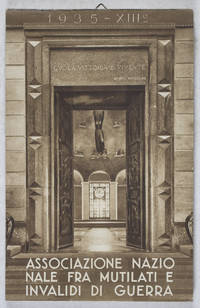
193440175Roma; Milano: Luigi Alfieri & C. 1934. First edition. Softcover. vg. Quarto 6 x 9". Unpaginated. 32 leaves. Original photo-illustrated wrappers. Photo-illustrated title. <br /> <br /> Published by the Italian War Mutilated and Invalids Association this splendidly preserved 1935 calendar opens with two photographs of the siege of the 'Associazione Nazionale fra Mutilati e Invalidi di Guerra' Front cover and title and is followed by three full-page photographs of king Vittorio Emanuelle Benito Mussolini and the portrait of an Italian war mutilated. The next 24 leaves feature the actual 1935 calendar with two leaves per month. Each leaf contains a half-page photograph showing Mussolini among other Fascist personalities army parades inauguration of homes for mutilated soldiers the Duce during a speech etc. The last three leaves are photographs of various homes for war mutilated and a full-page striking view of the impressive via del'Impero in Rome during a march of war mutilated veterans. All the photographs are reproduced in photogravure. The picture of the title page as well as all the photographs featured in the calendar were intended to be used as postcards.<br /> <br /> Captions in Italian. Wrappers and interior in overall very good condition. The Italian Fascists used Roman numerals to denote the number of years since the March on Rome in 1922. Therefore 1935 was XIII E.F. era fascista. Luigi Alfieri & C. unknown
1862WRCAM46948Fredericksburg 1862. 4pp. Folio. Old folds. Tanned light wear and soiling several very small holes. Good plus. An anti-secession newspaper published in Confederate Virginia by Unionist James W. Hunnicutt. Hunnicutt published his paper until August 1862 when he fled Fredericksburg because of his Union sympathies. How he got away with it as long as he did is remarkable when one reads the contents. This issue includes a report on Rebel cruelty news of the continued fighting in Charleston updates on the activities of the Army of the Potomac and an interesting column outlining twelve ways in which those advocating secession lie just like the devil: <br> <br> "We have always known and ever maintained that the only security the South and Southern institutions had was contained in the provisions of the Federal Constitution. We indignantly spurn the base imputation and pronounce it an unmitigated secession falsehood. The traitors and enemies of the South are the Secession leaders of the South. Where are the men who fired up the Southern heart and precipitated this once glorious independent prosperous and happy country into the present terrible revolution.Abolitionism and secession combined to effect the overthrow of our government - the downfall of our country - Great God! What a fearful retribution awaits them in the awful future!" unknown books
186424202<p>Two tickets to the Great Central Fair in Philadelphia. One admitted a pupil of the public schools of Philadelphia and was used on Saturday June 11 according to the stamp on the verso. The other is an apparently unused "Season Ticket" that admitted the bearer "<i>To All Parts of the Fair</i>" except the Children's Exhibitions but was "<i>Forfeited if Transferred and Not Good unless Endorsed</i>." The verso includes the oath "<i>I hereby promise that this Ticket shall be used to obtain admission to the Fair by myself only</i>" and a blank line for a signature.</p> <b>CIVIL WAR. ABRAHAM LINCOLN.</b>Great Central Fair Tickets June 1864. Pair of passes for the Great Central Fair held in Philadelphia June 7-28 1864. One ticket is for one day's admission for a public school student. The other is a season ticket. 1 p. each 3½ x 2¼ and 3½ x 2 in.<p><b><br /></b></p><p><b>Historical Background</b></p><p>During the Civil War several northern cities hosted sanitary fairs between 1863 and 1865 to raise money for the care of wounded soldiers. The Great Central Fair held at Logan Square in Philadelphia in June 1864 was a fundraiser for the United States Sanitary Commission and was one of the largest fairs. The main exhibit building constructed in forty working days by local volunteer skilled labor enclosed 200000 square feet. It featured nearly one hundred departments offering a broad range of displays from Arms and Trophies to Fine Arts to Umbrellas and Canes. Curiosities included a $1000 doll house a recreated parlor of William Penn with Penn artifacts the boat used by Arctic explorer Elisha Kent Kane and George Washington's carriage.</p><p>Over three weeks the fair welcomed more than 400000 visitors. The season ticket offered here cost $5 a week's pay for a day laborer or a domestic and several days' wages for skilled workers. The fair served more than 9000 meals per day in its restaurant and had a daily newspaper with descriptions of the various departments. During its existence the fair raised approximately $1 million for the Sanitary Commission second only to New York City in money raised.</p><p>President Abraham Lincoln attended the fair with his family on June 16. He also donated forty-eight signed copies of the Emancipation Proclamation printed under the auspices of George Boker of the Union League which were sold for $10 each.</p><p><b>Condition</b></p><p>Both have glue discolored on the reverse sides. The smaller card has a 1" edge tear on the right side neatly repaired with archival tape.</p><br /> books
176136901London: Chez D. Wilson T. Beckett & P. A. DeHondt 1761. First English edition. Pp. 2 60. Wanting half-title. 1 vols. 4to. Calf-backed marbled boards spine lettered in gilt. Some rubbing stitchmarks some light discoloration. Ink notation concerning first edition on title else very good. Provenance: John Carter Brown armorial bookplate with deaccessioned stamp on the bookplate and ink stamp on verso of title. First English edition. Pp. 2 60. Wanting half-title. 1 vols. 4to. Choiseul's narrative and commentary with the state diplomatic correspondence and papers relating to the treaty of 1762 dealing primarily with the areas of the cession of Canada the fisheries of Newfoundland Cape Breton and the West Indies and the limitation of Louisiana. Sometimes attributed to Jean François de Bastide. The London edition is considerably more scarce than the French first edition published the same year. Goldsmith's Kress 9718; Sabin 47516; Howes M-507 Chez D. Wilson, T. Beckett & P. A. DeHondt unknown books
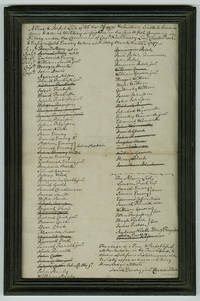
1757WRCAM51214Kittery Me 1757. Broadside 12 x 7 1/2 inches. Old folds mild toning. Very good. In frame. Appears to be docketed on verso but not examined outside frame. A manuscript roll-call for a company of Maine military personnel organized to participate in the French and Indian War. The document lists over seventy names of regulars in two columns plus an additional dozen names under "The Alarm List" essentially a reserve list of soldiers appointed to defend the homefront. Below the Alarm List is the following text: "The above is a True & Perfect list of all the soldiers in the Train'd band & Alarm List from sixteen years old to sixty as far as has come to my knowledge. Attest Daniel Emery jun. Clerk und. Oath." The Emery family supplied seven members of this list of officers and soldiers with others such as the Furbush Ferguson and Wamouth families also providing more than one man for the army. Several names are crossed out about half of which belong to a family supplying more than one member to the list. Most of the men on the Alarm List are also identified by profession such as deacon miller or sailor among others. Such lists of colonial American military personnel for the French and Indian War are exceedingly rare in the market. An important colonial Maine and military document. unknown books
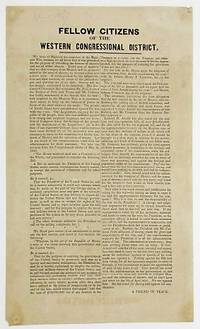
184734353Providence 1847. Broadside 9-1/2" x 16" printed in two columns separated by a rule. Toned and lightly worn. Very Good.<br/><br/> This rare Rhode Island broadside denounces Congressman Lemuel Arnold for supporting the hated War with Mexico. "We all know that it was provoked for the purpose of extending the horrors of slavery and we all abhor slavery. Every acre of territory that we shall conquer from Mexico will be so much added to the area of slavery to convert a free into a slave state. If accomplished by this administration and their abettors the labors of the philanthropist and christian are at an end. Slavery will be too strongly established to be disturbed."<br/> Arnold has voted with the Administration "on all the important acts and measures to carry on this iniquitous war for the conquest of Mexico and the extension of slavery. We are against him. He has voted for slavery and against his constituents."<br/>OCLC 702602214 1- Yale 58787891 2- NYHS AAS as of October 2017. unknown books
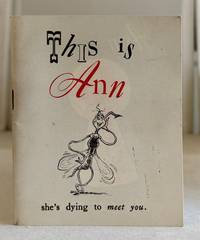
1944A52635Washington D. C. : U. S. Government Printing Office. 1944. Trade Edition. Stapled wraps. Very Good. This is a small format booklet 5.25" x 4.25" with 32 unnumbered pages with illustrated cardstock covers and one staple to the spine. The booklet is in Very Good to Near Fine- condition and was issued without a dust jacket. The book is in mostly clean bright condition. There are three small strips of discoloration to the front cover by the foredge along with a couple of small spots of ground-in dirt to the rear covers. The text pages are clean and bright. This copy has the code: 1944 - O -565454 on the bottom edge of the rear cover - making this a later state / issue than the ones listed in Younger & Hirsch though it bears some markers of the first edition with the single staple to the spine and the variant C illustration to the inside rear cover. "One of the greatest threats to the health and safety of U. S. Soldiers was malaria. Malaria is far less common in the United States than it is in the South Pacific where many soldiers were stationed. These soldiers had not built immunity to the illness and many did not know how to prevent infection. Furthermore Germany had blocked the Allies’ supply of quinine the most effective antimalarial drug of that time. The United States Antimalarial Program was trying to create a new antimalarial drug but they did not have one yet and soldiers were dying. In response the secretary of war ordered a public health brochure explaining malaria and malaria prevention. Geisel was assigned to the project along with Munro Leaf another children’s book writer in the animation department of the first motion picture unit. Geisel and Leaf were not scientists but they were working with information provided to them from scientists. Geisel was concerned that if the materials were dry and boring soldiers would not read them. The materials needed to convey scientific information and convince people to change their behavior and they needed to do it in an entertaining way. It was a matter of life and death. " from the Huntington Library website; Color Illustrations; Unpaginated pages; Pictured 2/14/26 - Valentine's Day. Put with the special items in the basket in Duncan's room where the posters are . U. S. Government Printing Office paperback
1962148877N.p.: N.p. 1962. Vintage borderless reference photograph of Monica Vitti sitting on a sofa and staring into the existential void from the 1962 film. "ROMA's Press Photo" stamp on verso with address in Rome for same. <br/><br/>The third and final chapter of Michelangelo Antonioni's trilogy preceeded by "L'Avventura" 1960 starring Gabriele Ferzetti and Monica Vitti and "La Notte" 1961 starring Marcello Mastrioianni Jeanne Moreau and Monica Vitti.<br/><br/>Vittoria Vitti leaves her fiance Riccardo Francisco Rabal for Piero Alain Delon a young stock broker obsessed with material possessions and wealth.<br/><br/>Awarded the Jury Special Prize and nominated for the Palme d'Or at the 1961 Cannes Film Festival.<br/><br/>Shot on location in Rome and Verona Italy. <br/><br/>8 x 10 inches. Near Fine. <br/><br/>Criterion Collection 278. Rosenbaum 1000. Vogel Film as a Subversive Art. Scorsese My Voyage to Italy. N.p. unknown books
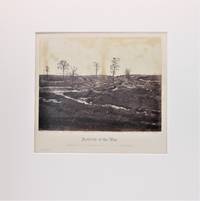
1865W2078Washington D. C.: Philp & Solomons 1865. Original 1865 albumen photograph printed by Alexander Gardner from the negative by Timothy H. O'Sullivan. One of 100 images included in Gardner's Photographic Sketch Book of the War published in Washington in 1865-1866 by Philp & Solomons. Image size exclusive of lettering and margins is 6 7/8" by 8 7/8". Mounted on the original card with letterpress printing of the caption and information about the photograph. Also present is the original text page containing Gardner's description that accompanied this photo. The photograph shows the interior of Confederate lines in May 1865 near Petersburg Virginia. There were two slightly separate versions of the book and this photograph is from the first issue as is demonstrated by the caption "Incidents of the War" on the mount. Rare: fewer than 200 copies of the 2 versions combined were printed for a book that was priced at $150 in 1866. The photograph is in about very good condition with relatively minor display of the browning that is commonly found in albumen prints from the Civil War period. It has been archivally matted and is now ready for framing framing size is 16" by 16". First Edition. Paper. Collectible-Very Good-. Illus. by Timothy H. O'Sullivan. 6 7/8" by 8 7/8". Photo. Philp & Solomons paperback
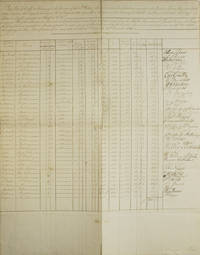
1783303187Minorca 1783. Two single sheets. Folio. Very good copies a little toned old folds. Two single sheets. Folio. Signed in full by every officer. The first is titled: "No. 26 Pay List for additional Subsistence etc to the officers in st. Philips Castle from 25 Dec. 1781 to 23 Feb. 1782." The second has written on the verso: " No. 136 Pay List to make up Subs. to Brevet Officer etc equal to the Rank where in they respectively serve in The Garrison of Fort St. Philips during the Siege Decemb. 24 1781 - Dollars 4350-50." These two officer pay lists are signed by each of the 36 and 44 listed officers. They're a wonderful souvenir of the siege and with a sample of every officer's signature a valuable source for further research. <br/><br/>The five month Siege of Minorca August 19 1781 - February 5 1782 was a vital victory over England in the European theatre of the Revolutionary War. Throughout most of the eighteenth century English possession of the island was of real strategic importance from its deep-water harbor the Royal Navy could launch attacks against the Mediterranean fleets of Spain France and Italy. unknown books
1898List319Massachusetts 1898. The 2nd Massachusetts Volunteers mustered into service in May 1898 and within a month saw significant action in Cuba at the Battle of El Caney. They were one of three volunteer units from Massachusetts to see action on the Santiago Campaign. The regiment was inexperienced - 55% were untrained recruits. The lack of experience combined with their rifles giving off a very visible black smoke led to a heavy casualties in the Battle of El Caney. After an encampment near Santiago de Cuba in which a large number of the soldiers became ill with disease - estimates are as high as 65% - the regiment returned home in August. Historians have noted that soldier demographics changed considerably from the Civil War to the Spanish American war as the smaller number of troops and the lack of a draft led to a more enthusiastic army with higher morale. <br /> <br /> The photographs in this group are interesting as a typological grouping of images of untrained soldiers and also for their historical value as most contain identifications to versos. The highlight of the group is forty-four uniformly mounted portraits of soldiers nearly all identified measuring 3 ¾ x 2 ½ inches each. Other photographs include a large portrait of Captain Frederick E. Pierce with the blindstamp of Goldsmith Studio Springfield Massachusetts and a 3 ¼ x 3 ¼ inch square card of Capt. Pierce in Camp Turner. Also included are two slightly larger photographs on similar mounts. <br /> <br /> Overall an interesting group. Good condition overall with assorted chips and wear. unknown books
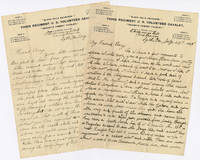
1898WRCAM46791Chickamauga Park Ga 1898. 5pp. Quarto written on "Black Hills Squadron" stationery. Old fold lines. Minor wear. Very good plus. A pair of letters written by Leighton H. Baxter to a friend back home. In his first letter he states that he is "not an enlisted soldier but has a regulation suit.a horse to ride and am fixed up very nicely. He works for the commander of the squadron Major Leigh H. French presumably as a teenage civilian clerk. His duties include "a good deal of writing to do telegrams to send take notes of cases tried in the regiment and a great many other minor duties." He sleeps in the same tent as the Major and takes his meals with the officers. He is well fed but is very glad not to be a private as they "fare badly." It is however "a regular circus to see the boys ride and shoot they beat Buffalo Bill all to pieces." Baxter reports that there are some 40000 to 50000 troops at Camp Thomas with more due to arrive. Some have already departed for "Porto Rico" and he expects his squadron to be going there at any time. In his second letter he notes that the men in his regiment are all "crack shots and fine riders" and all from around Deadwood and the Black Hills. He has been drilling with the men and has learned to handle a sword fairly well. He also mentions practicing "rough riding.such as leaping from a horse while he is running then back again picking up a hat while at full speed etc." <br> <br> The Third U.S. Volunteer Cavalry was mustered into service in May 1898 and commanded by Melvin Grigsby attorney general for the state of South Dakota. The unit was known both as the "Black Hills Squadron" and as "Grigsby's Cowboy Cavalry." Its commander Maj. Leigh H. French was trained as a medical doctor and surgeon and had a practice in Washington D.C. when the war broke out. One of his captains Seth Bullock was the first sheriff of Deadwood. The squadron never saw active duty outside the continental United States spending most of its brief career at Camp Thomas in Georgia. In the crowded camp in the heat of a southern summer typhus measles and other illnesses were rampant and Grigsby's Cavalry lost twenty-seven men to disease. unknown books
1860D130301860s. Hardcover. Very Good. Cloth morocco backstrip; folio 400x260mm; approx. pp. 100 full of manuscript entries by a single hand with permanent instructions and headings in ink and crew member names and station designations in pencil; numerous additional blanks at rear. Nonetheless a trove of information. Lined paper listing the 614 men aboard assigning each a number gun and location Fore Castle Port Main Top Mizzen Top etc.; listing division and stations; and recording details of every situation that might occur on the ship see examples below. The ship is unnamed but it appears to be a ship of the Line or a Frigate which had 3 masts as well as some minimal amount of steam power. There were 6 African-American members of the crew all of whom were Union Sailors during the Civil War Edward Turner Joseph Davis and Thomas Mills from Maryland; Henry Andres from the West Indies; Joseph Gordan from New York; Samuel R. Whittaker from Buenos Aires. Three of these men served on the USS Minnesota which may help identify the ship. Also includes the ship's Fire Bill crew member stations of Making Sail from Single Anchor Mooring and Unmooring and much more. A rich volume worthy of further study. Cloth torn; front hinge cracked; first few signatures loose. Alittle faint waterstaining and soiling but generally nice and clean. <br/><br/> hardcover books
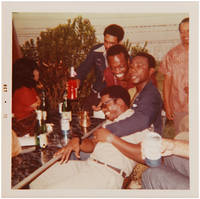
1977WRCAM55443Various places in Thailand perhaps centering on Korat Royal Thai Air Force Base 1977. Seventy-seven Kodak color photographs almost all approximately 3 1/2 x 5 inches a handful slightly smaller and one postcard. Slim quarto. Contemporary glossy purple floral-patterned cloth photograph album gilt- stamped label on front cover. Some images slightly faded. Overall very good. A highly entertaining collection of vernacular photographs capturing the lives of young African-American G.I.s and their romantic interests in a village in Thailand during the latter years of the Vietnam War. The photographs show African-American men in both uniforms and street clothes often posed alone or with Thai locals almost exclusively women. The men are seen at work and play including an image of the gun shop with a sign labeled "Phase Section" on the front and a large military van with a similar sign reading "2 Orange." There is also a great deal of coverage of the locals living in the village including women and children. One photograph of particular interest shows part of a commercial building emblazoned with both a Coca-Cola and a Pepsi sign. The date range of 1972 to 1977 stems from the fact that some of the photographs are date-stamped in the margin "Oct 72" and one later image is stamped July 1977; most images seem to emanate from the earlier date. The single postcard is an image of Wang Not Ten Waterfall in Phitsanulok in north-central Thailand. The album could possibly have been retained by a local Thai person documenting their interactions with the visiting Americans. <br> <br> There were a half dozen active American Air Force bases in Thailand during the 1970s from which over 80% of the air strikes of North Vietnam originated. The American servicemen seen in the present photographs were either airmen performing these strikes or ground crew in support of the pilots. Also given that Korat Royal Thai Air Force Base and Phitsanulok are both in north-central Thailand it is likely the images depict this area. <br> <br> A rare look at African-American servicemen in a strategically important region of Thailand during the Vietnam War. hardcover books
1813260669Burlington: Samuel Mills 1813. First. hardcover. very good. 151 2 pages. Slim 8vo full contemporary mottled calf ex-library with only a few markings; pages just a bit toned. Burlington VT: Samuel Mills 1813. First Burlington edition. Exceedingly scarce military book in very good condition.<br/><br/> The rules and regulations for the War of 1812 including important issues and some more mundane. 60 pages at end are a listing of all the officers in the Army and Navy. Final 2 pages are the three acts of Congress: To raise the pay for enlisted men to fill the ranks of regular army; To raise enlistment period to 5 years for infantry; To raise three additional Regiments of Riflemen. Not in Howes. -- S&S 30373; Gilman p. 236.<br/><br/> Samuel Mills unknown books
Enquête (par un membre de la résistance?) sur le régime pénitentiaire des détenus de droit commun et politiques. Il est question de la nourriture, (confiscation des colis, morts de faim), de l'absence de soins médicaux, d'hygiène même élémentaire, de la discipline sauvage, du "mitard" appliqué aux politiques. L'auteur du rapport décrit également les tortures pratiquées sur les hommes et sur les femmes. Le nom de certains détenus est indiqué ainsi que ceux de quelques tortionnaires. En conclusion, l'auteur de ce rapport souligne que "ces tortures sont infligées par la seule police française dépendant directement de Vichy".
ediz. in lingua italiana, 1940 fasc. 17 / 1941 fasc. 23/24 / 1942 fasc. 23/24 1943 fasc. 24 / 1944 fasc. 19 + 6 supplementi signal extra / 1945 fasc. 1-2-3-4. Ultimo pubblicato in lingua italiana, tutte le annate sono complete delle pagine centrali a colori. 4 annate rilegate in t. tela uniforme, piccoli strappetti ad alcune pagine senza asportazione al n° 4 del 1945 manca l’ultima di cop. non rifilati. Buona conservazione con belle cop. ill. a col.
41 issues bound in one volume. Thick royal quarto. Unpaginated. With hundreds of letterpress maps, many of which are in colour, printed on recto only on 246 leaves of plates. Some photo-plates. Explanatory text to each map. Introductions. Hardcover, bound in handsome brown quarter morocco, bit rubbed and scuffed in places, spine with raised bands, gilt lettering to second compartment, gilt fleuron to each of the others, vellum French corners, marbled endpapers, with original yellow card wrapper of first issue bound-in. In about fine condition. Excellent copy. ~ First edition. Very rare.