LARTEGUY Jean Translated By Xan FieldingBiblio.com
11 490 résultats
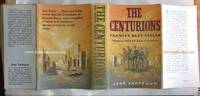
1961010278London: Hutchinson 1961 very rare first edition in near fine DW unclipped minor foxing to edges or folds of DW small area foxing to closed fore edge of pages not written in or marked minor foxing from accumulated dust to closed top edge very scarce with a near pristine DW when the English edition was published it met with controversy and totally different reviews to the blockbuster French edition and is consequentially a rare item 487pp. First Edition. Hard Cover. Fine/Fine. Illus. by Val Biro. 8vo - over 7 - 9 tall. Hutchinson hardcover
19781281651978. First Edition. Signed. ROSHOLT Malcom. Days of the Ching Pao. Amherst Wisconsin: Palmer Publications 1978. Quarto original red paper boards original dust jacket. $2500.First edition of this history of this ""photographic record of the Flying Tigers-14th Air Force in China"" signed by 17 of the Tigers including nine aces.Prior to the United States entry into World War II approximately 15000 Americans joined flying units already engaged in combat. At the request of Madame Chiang Kaishek General Claire Lee Chennault recruited a squadron of fighter pilots in order to throw a small but well-equipped air force into China to attack Japanese supply lines. With the official designation ""American Volunteer Group"" AVG but popularly known as ""The Flying Tigers"" this celebrated group of pilots has been described as ""the most colorful group of warriors in modern times"" and ""the world's most illustrious squadron"" History Channel.Signed next to their photographs by Charlie Bond Joe Rosbert Dick Rossi D.L. Rodewald ""Tex"" Hill Bob Keaton Bob Layher Charlie Mott Ed Rector Eric Shilling ""Duke"" Hedman R.T. Smith Kim Jernstedt C.H. Laughlin Chuck Older P.J. Green and Robert Raines. Of these Rossi Rector R.T. Smith Bond Jernstedt Rosbert Hill Hedman and Older were aces more than five enemy planes shot down. Bond an ace with 9-1/2 victories was the first of the Flying Tigers to paint his Curtiss P-40 Warhawk with the shark mouth on the nose of his plane an iconic decoration that would become characteristic of the Flying Tigers. Fine condition. hardcover
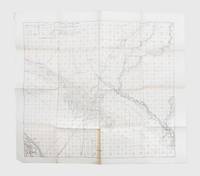
19451139691945. WORLD WAR II. Pre-battle map of Okinawa Island. Washington: Army Map Service 1945. Single sheet measuring 22-1/2 by 20 inches with black-and-white topographical map on Side A and color oceanographic map on Side B. $2500.Official doubled-sided U.S. Army map of Okinawa Island before the Battle of Okinawa labeled ""SECRET.""The Battle of Okinawa code name ""Operation Iceberg"" took place on Okinawa Island between April 1 1945 and June 22 1945. One of the Ryukyu Islands extending southwest of the Japanese mainland Okinawa was of paramount strategic importance. Allied forces needed it to launch Operation Downfall the large-scale on-the-ground invasion of Japan anticipated to take place in November 1945. Allied forces the bulk of which were U.S. Army and marines faced off against the Imperial Japanese Army and conscripted indigenous Okinawan civilians that spring. The Allies launched a multi-pronged amphibious assault of Okinawa and surrounding islands. Although the Allies significantly outnumbered defenders the Japanese brooked their efforts with kamikaze and other extreme defense tactics. Approximately 250000 died from war starvation illness and mass suicide in what would be the bloodiest battle in the Pacific Theater.Side A of this map shows Beach Landing zones coded by color and number extending down the western coast of southern Okinawa Island and corresponding to the area around modern day Yomitan. Kedena Air Base from which Allied forces planned to transport troops in Operation Downfall is located just a little further inland outside of the map limits. The map shows roads airports railroad and radio towers and lighthouses as well as underwater currents obstacles and cables. Gun pill box block house and earth-covered installations are demarcated as are limited topographical features. A Japanese-English glossary of helpful topographical terms underscores the nature of the foreign invasion.Side B shows a composite image of an aerial photo map overlaid with a topographical map also reproduced in February 1945 a few months prior to Operation Iceberg. This map shows landmarks like airports docks and major cities while also giving a sense of water currents and depth.On April 1 1945 Commander of the Tenth Army Simon Bolivar Buckner Jr. successfully launched an amphibious assault against this very coastline. His Army divisions and Marines commanded by Lemuel C. Shepherd Jr. Roy Geiger John R. Hodge and Pedro de Valle among others landed in waves on Hagushi Beaches shown on both sides of this map. Allied forces met such little resistance that they captured Yomitan Air Base shown as ""Yontan Airport"" on Side A and Kedena Air Base within hours. Lieutenant General Buckner was killed by coral shrapnel just days before the battle's conclusion on June 18 1945.This map and scant others like it facilitated the Allied invasion by introducing troops to the topography landmarks and place names of Okinawa Island. Accurate maps depended on military intelligence collected using the latest technology. Maps related to the Battle of Okinawa are significantly scarcer than D-Day maps which are highly coveted. Fine condition. unknown
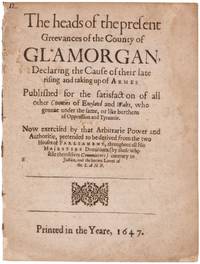
164721028431647. London: n.p. 1647. Small 4to. Disbound pp. 2 6; a little toned a few stains to title light dampstaining to outer margin of A1-2 but overall a very good and crisp copy.First and only edition very rare of this denunciation of the abuses of the Parliamentarian County Committees in Wales issued at the height of the Civil War.By the summer of 1647 one surviving copy is dated in manuscript ""1 July"" the war had dragged on for nearly five years. Parliament was steadily gaining the advantage largely through the network of County Committees manned with loyal supporters. These officials collected the taxes that sustained the war effort requisitioned horses and supplies for the army and carried out Parliament's decrees. Their growing power - together with the ever-heavier burden of taxation to maintain the army - provoked widespread resentment and in turn revived support for the Royalist cause.This pamphlet sets out the grievances against the Parliamentarian committees in Glamorgan South Wales and denounces their exactions and abuses. The rising it encourages was less an expression of loyalty to Charles I than a reaction to Parliament's oppressive rule. Indeed it contains no Royalist propaganda and no expressions of loyalty to Charles. Instead it reads as a near-anarchic denunciation of arbitrary power itself of its arrogance remoteness and disregard for the people.ESTC R201640 recording only five copies BL National Library of Wales Cardiff Central Library Oxford Folger. unknown
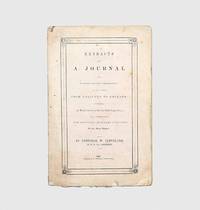
1847189591Deal: Printed by J. Deveson 1847. The battlefields of the Punjab seen from the ranks First and only contemporary edition of this brief but spirited and entirely unembroidered account in the authentic voice of an enlisted man. The 31st were one of the most heavily engaged units of the conflict seeing action at Mudki Ferozeshah Aliwal and Sobraon. Scarce with just two locations traced BL and Boston Public Library unrecorded at auction. Vivid vignettes from the battle front are set within the context of a diary account of an uneventful voyage back from Calcutta to Gravesend. Cleveland opens on 23 October 1846 "weather continues fine and the wind steady" reminiscing of Moodkee "the first battle in which I had even been engaged I have often since endeavoured to imagine what my feelings were on that occasion but the hurry and confusion of that Action prevented the exercise of thought". One thing remains clear in his memory "So confident were our Officers and men that the Sikh Army was composed of nothing but a rebel mob that they did not believe they would hazard an engagement. this entire ignorance of the Sikh Army it is wonderful that all were alike involved even the Governor and Commander in Chief each of whom it should fairly be supposed ought to have been possessed of correct information on so important a subject". Of Ferozeshah he recalls the "lurid flames" of the burning Sikh camp "gleaming through the darkness diffusing sufficient light to make the horrors of our situation more apparent" the shot from the Sikh guns falling "among us by far to thick and fast to be agreeable". The situation only saved by what Cleveland - along with Sikh commander Tej Singh - read as the Commander in Chief's order for the cavalry to make a "false charge" which was in fact the withdrawal of the Horse Artillery desperately short of ammunition to Ferozepur to resupply while under cavalry escort. At Aliwal the 31st were on the extreme right of the British line "When we had arrived within a short distance of the village under heavy fire from the enemy who were waving their swords and cutting a great variety of menacing capers in front of us General Smith galloped up and said 'take that village boys and carry it along with you' when the whole regiment broke into a rapid double which they did not abate until they had cleared the village captured the guns upon its left and caused the whole of the enemy's left flank to run for dear life. We now quietly took possession of the whole of their camp equipage ammunition and stores; and having amply supplied ourselves. we turned in for the night near the banks of the Sutlej". And so to Sobraon "At 9 A. M. the battle had reached its warmest point - shot and shell were then whizzing through the air in rapid succession. on their fearful missions of mischief. from the muzzles of 150 pieces of ordnance - about half past 9 a low rumbling sound was heard resembling distant thunder which was caused by the report of musquetry - as the infantry ad passed the Enemy's breastworks. thus concluded the most severe contest in the annals of Indian warfare and not a second to any fought in Europe with the exception of Waterloo". Following the ratification of the Treaty of Lahore the 31st marched to Calcutta and embarked for home Cleveland composing this very personal and telling NCO's witness to world-changing events while under weigh. Octavo. pp. 24. Original thin paper printed wrappers. Wraps rubbed and soiled with some minor chips and splits at the edges no loss of text creases to the corners; pale toning and some finger-soiling to the text; but a well preserved copy very good. paperback
186058334London War Office 1860-70. All of the large maps are lithographed one signed "lith. James Ferguson" with positions in colour. The measures given are paper sizes comprising: 1. Movements of the two Armies after the Repulse of Marshal Massena's Attack upon the Position of Busaco. 68 x 82 cm.- 2. Battle of Talevera de la Reyna fought on the 27th & 28th July 1809. 113 x 68 cm. - 3. Battle of Busaco. General Position of the French and allied Armies on the 26th September 1810. 68 x 100 cm. - 4-6. Battle of Fuentes D'Onoro Fought on the 3rd and 5th May 1811. Map 1-3. each 68 x 100 cm. - 7-15. all with the heading title Massena's Retreat No. 1-3 and 5-10 each around 51 x 67 cm. At end one untitled map. Some foldings strenghtened with tape. <br/><br/><em>We have been unable to decide whether these maps are a part of a series or just published separately.The Peninsular War was a military conflict between Napoleon's empire and Bourbon Spain for control of the Iberian Peninsula during the Napoleonic Wars. The war began when the French and Spanish armies invaded and occupied Portugal in 1807 and escalated in 1808 when France turned on Spain previously its ally. The war on the peninsula lasted until the Sixth Coalition defeated Napoleon in 1814 and is regarded as one of the first wars of national liberation significant for the emergence of large-scale guerrilla warfare. </em> unknown
1941174371Palestine Egypt and Sudan: 1941-43. With camels and camera in the desert theatre A visual record of the Second World War in the Middle East with superb snapshots of Indian Army personnel members of the camel corps in Egypt and Sudan and the Sudanese household cavalry. Also included is a range of scenic views and images of everyday life. Warner's squadron served in the Middle East 1941-2 and was posted to North Africa in 1943. His most important photographs concern his service and those with whom he served. Alongside photographing military personnel he records their training and excursions and in one image a group of RAF men Warner perhaps among them pose on top of a car belonging to the Palestine Police Force. Eight photographs show the funeral of a British sergeant while one commercial image pictures Winston Churchill visiting soldiers at Tel El Kebir on 9 August 1942. Scenic and tourist views of Palestine show Warner's seaside billet in Haifa a coffee house and street in Acre and Mt Carmel as well as the Sea of Galilee Lake Tiberias and the atmospheric River Nile. The squadron's transfer to Africa is made via troop train. Aerial photographs of Khartoum are positioned alongside snaps of a sandstorm and by the White Nile Bridge he snaps an RAF hydroplane. In North Africa he mingles with soldiers of the Sudan Defence Force and members of the Khartoum police band. The album closes with a trip along the road to the Congo and time spent on duty at Juba. Landscape quarto commercial album. Original blue roan boards black cloth backstrip 17 black card leaves fixed with metal posts 160 mounted gelatin silver photographs snapshot- to postcard-sized and nearly all amateur manuscript captions on laid-down slips; 4 gelatin silver photographs loosely inserted including 3 snapshots and 163 x 215 mm formal portrait of compiler's class at RAF NCO Training School Hereford. Light toning and silver mirroring some images still with strong tones: very good. hardcover
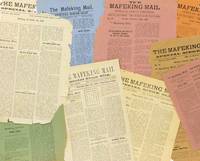
1899142162Mafeking: Townshend & Son 1899. Mafeking Townshend & Son 1899 and 1900. 111 issues various sizes see below printed on paper of many different colours and of varying quality often poor with 43 printed as a broadsheet the balance printed recto and verso with three early numbers folded and issued as bifolia. Unbound as issued; some loss primarily owing to the poor quality of some of the paper; however these extraordinary artefacts produced under siege conditions are of the utmost rarity in any condition. All issues in this run are now housed in individual Mylar pockets sealed on two sides only for easy access. A detailed list including the number date colour of paper length and condition of each issue is included with the lot. Dr Robin Pelteret has published his impressive research notes on 'The Mafeking Mail Special Siege Slips' online. He sets the scene: 'Mafeking lies 1392 kilometres north of Cape Town and 298 kilometres west of Johannesburg. It was first settled in the early 1850s. From the early 1860s it became a centre of squabbling and outright fighting between the Transvaal Republic the Baralong the Goshen Republic the British South Africa Company and the British Empire. <p>By the outbreak of the Anglo-Boer War it was a robust "dorp" with some 1500 European citizens a group of Indian and oriental background and 5000 Baralong. It was a major rail junction with a station and railway workshops; a significant commercial centre and boasted a number of substantial buildings including two schools two churches a Standard Bank a Masonic Lodge a newspaper building a public library the Victoria Hospital and St Joseph's Convent Irish Sisters of Mercy. <p>The Siege of Mafeking was conducted between 14 October 1899 and 17 May 1900 that is 217 days and began 3 days after the declaration of war by the Transvaal Republic. It involved British and Colonial Forces under the command of Brevet-Colonel Robert Stephenson Smythe Baden-Powell the besieged and Boer Forces ab initio under the command General Piet Arnoldus Cronje and later Kommandant Sarel Eloff the besiegers'. <p>The precursor to the siege issues of 'The Mafeking Mail' was the 'Mafeking Mail and Protectorate Guardian' in its infancy when the siege was imposed. Number 22 the last full edition was published on Saturday 14 October 1899 the first day of the siege; a Special Siege Edition Number 23 was dated Saturday 21 October 1899 but headed 'reprinted on 23 October 1899'. <p>On 1 November 1899 a fortnight after the beginning of the siege the first of the famous siege issues was published 'Issued Daily Shells Permitting. Only Terms One Shilling Per Week Payable in Advance'. <p>'They were to be numbered 1 to 152 of which 143 minus Numbers 45 and 56 appeared during the actual siege. The newspaper contained snippets of information - both parochial and national General Orders and advertisements. Actually we have found them to be far more dramatic and engaging than this bland description implies especially reading these issues that were purchased day by day during the siege and have survived to this day. However we digress . In Mafeking there was to exist a fragile peace between the publisher and editor of the "Mafeking Mail Special Siege Slip" G.H.N. Whales and the military authorities. Whales was somewhat acerbic of tongue. He once publicly thanked the press censor for saving his life a boer shell having destroyed his editorial chair whilst he was submitting his newspaper copy for military scrutiny elsewhere in the village. He was to be briefly imprisoned on one occasion for publishing querulous criticism on the conduct of the siege and the restrictions put on the availability of news. In protest he was known to publish empty columns No. 47 and indeed cancelled one whole edition No. 45 as visible disregard and mute testimony to the censor's liberal use of a blue pencil.' <p>Dr Pelteret has established 'there are three different printings which appeared as four "editions"'. He surmises that by the time Number 6 came to press 'the commercial value to the printers of "The Mafeking Mail Siege Slips" had been discerned . and a substantial "overrun" allowed and set aside for later sale'. Indeed in Number 151 dated 30 May 1900 'there was an offer to make up sets at 30/- each of the Nos. 1-147 for "delivery July next" . They were issued soon after the lifting of the siege . cardboard-bound into two books of differing sizes and held together with metal staples'. <p>The current run comprises Numbers 1 and 2 both second issue 'on sale soon after 22 November 1899' 6 with the word 'Only' in the masthead 7-8 10-60 but 45 and 56 were not published 62-68 70 77-79 83-84 97-98 100 102 104 106 107-109 111-127 129-141 and 144-148. Sizes vary considerably: the first 30 or so are approximately 380 × 255 mm; most of the last 40 or so are approximately 340 × 200 mm; for the rest they range from one issue at 255 × 155 mm to several at 375 × 500 mm. There are easily ten different colours of paper often acidic and now prone to brittleness; a handful have peen printed on recycled ledger paper pre-printed with columns in red or blue. <p>'Petticoat in Mafeking. The Letters of Ada Cock' edited and published by John F. Midgley Kommetjie 1974 contains 57 letters now extensively annotated written during the siege. The letters 'were addressed to her elder sister Emily Empy Fuller née Franklin. Emily's husband Harry James Fuller was the owner of the cattle ranch "Oaklands" which was situated a few miles outside of Mafeking and was managed by his brother-in-law Willie Cock Ada's husband. Under the threat of possibly hostilities Willie and his wife moved into Mafeking and its environs with all their stock at the beginning of October 1899. They also took with them four young children Eileen Tooky Liell Vaughan and Baby Ada' introduction page 1. In the earliest surviving letter dated 12 October Ada writes that 'Willie . will . join the B.R. Bechuanaland Rifles' page 23. The basic pencil drawings of several cannon one labelled a '9PR' on the partially blank verso of Number 21 Wednesday 29 November and the blank verso of Number 22 Thursday 30 November are possibly in his hand. <p>Provenance: William and Ada Cock; by descent through their son Alfred Vaughan Cock to their great-grandson the vendor. 111 items. Townshend & Son unknown
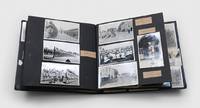
135819First Edition. Hardcover. Very Good. An album 209 × 236 mm containing 199 gelatin silver photographs loosely inserted behind window mounts visible image size 51 × 77 mm four to a page on both sides of 25 card leaves; almost all of them have a small printed caption numbered 1-200 neatly trimmed and mounted on slips of paper loosely inserted in a small window below each photograph. One caption is in pencil a handful don't have captions; some have additional information supplied in pencil; there are numerous dates from Number 1 to 156 5 February to 13 October 1900 and Number 191 is dated 3 January 1901. Nine photographs between numbers 9 and 44 are out of order but all are present; number 111 is the only blank space in the album. Contemporary half leather and cloth worn at the corners with the spine broken and lacking sections; album broken near the centre damaging two window mounts easily repaired; all blemishes are confined to the album and the contents are in excellent condition. The album was compiled by a Dundee volunteer 8934 Private James Proctor Norwell 1st Volunteer Battalion Royal Highlanders Black Watch; the commanding officer was 7727 Lieutenant Alistair Valentine. The first dozen starting with '1. Cleaning Rifles. Perth Ranges' in the snow were taken before Cape Town was reached. The rest were taken in the field; apart from photographs of Indigenous people mainly Basutos and rough camp life there are many graphic images of battle and its aftermath: '15. Cronje's Guns captured at Paardeberg'; '18. An Officer's Funeral'; '33. Group of 1st Section two members of which have since died'; '40. Stretcher Bearers ready for Service'; '61. Preparing for Action - pipes and drums to the rear'; '64. Bringing in Boer Prisoners'; '68. Hector Macdonald giving Orders to carry the Position at Retief's Nek'; '73. Sniping from behind Ant Heap'; '104. Lieutenant Valentine's Mess Room Valentine Kop'; '117. Bringing the Guns into Action Retief's Nek'; '120. Resting after taking Honing Kop'; '124. The Fate of a Spy' and '168. His Last Day' both gallows scenes; '126. Kaffir Prisoners'; '130. Boer Commando in Kroonstadt'; '137. Lieutenant Smith - wounded at Retrief's sic Nek'; '153. Hector and his Staff entering Heilbron'; '159. Boer Prisoners at Schoolhouse De Aar'; '184. One of the 1st V.B.R.H. after 13 months' campaign'; and '192. Cookhouse and Mess Room Swaartlaagte'. Two on the last page are captioned 'St. Vincent - on our way home'. hardcover
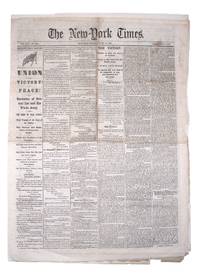
1865351866New York 1865. 8pp. Small illustration of an American flag at the top left. Folio. Old folds minor soiling and staining else very good. 8pp. Small illustration of an American flag at the top left. Folio. An historic issue of the New York Times published the day following Lee's surrender to Grant at Appomattox including the correspondence between the two discussing and accepting terms. unknown
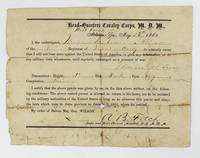
18655990West Point Ga: May 13 1865. About very good. Partially-printed document completed in manuscript docketed on verso. Old folds minor loss at one crossfold some archival reinforcements along fold lines minor creasing and edge wear. A late Oath of Allegiance sworn by Private William M. Lewis Company F of the 8th Confederate Texas Cavalry. William M. Lewis enlisted with the 8th Texas Cavalry better known as Terry's Texas Rangers after its organizer Benjamin Franklin Terry. Although originally intended to serve in Virginia the Rangers were assigned under General Albert Sydney Johnston for service in the West. Colonel Terry was killed early in a skirmish on December 17 1861. Terry's Texas Rangers were reassigned to the Army of Tennessee led by General Braxton Bragg where they were used as shock troops given their high skill level at mounted shooting. The regiment would ultimately fight in nearly 275 engagements distinguishing themselves at the battles of Shiloh Murfreesboro Chattanooga and Chickamauga. During the Atlanta Campaign the regiment continually harassed Sherman's army on its March to the Sea. Although 248 survivors of the 8th Texas Cavalry declined to surrender with the rest of the Army of Tennessee at the end of the war it appears that Lewis was captured. The rest of his regiment fled south to reunite with Confederates who had yet to bend the knee. In the present document Lewis does "solemnly swear that I will not bear arms against the United States of America or give any information or do any military duty whatsoever until regularly exchanged as a prisoner of war." The oath is followed by information on Lewis's physical description describing him as a five-feet-tall with "dark" hair "grey" eyes and a "fair" complexion. The document is signed by Lewis after the oath and at the bottom by Captain and Assistant Provost Marshall Asa B. Fitch of Company H of the 4th Iowa Cavalry which also fought at the Battle of Bentonville. The printed text above Fitch's signature states that he is allowing Lewis "to return to his home not to be molested by the military authorities of the United States as long as he observes this parole and obeys the laws which were in force previous to January 1 1861 where he resided." Loyalty oaths for Confederate Texas soldiers are rare but rarer still from prisoners of war held by Union forces at the end of the conflict and especially rare from members of Terry's Texas Rangers. This document is all three rolled into one. May 13 unknown
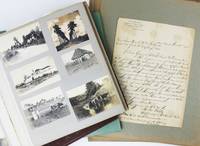
19025176Various locations in Cuba 1902. Very good. Seventeen loose folio scrapbook leaves each with mounted correspondence or other documents; one vernacular photograph album; two scrapbooks; and a small number of loose documents and newspaper clippings as detailed below. An informative archive comprised of material from two generations of the McCook family of Ohio specifically two different military officers -- Major General Alexander McDowell McCook and his son-in-law Brigadier General Chauncey Brooke Baker 1860-1936. Baker was married to McCook's eldest daughter Lucianna "Lucy" McCook Baker who seems to have compiled the various components of the present archive which mostly documents the career of her husband Chauncey Baker. The collection includes seventeen loose folio scrapbook leaves each with mounted correspondence or other documents one photograph album two scrapbooks and a small number of loose documents and newspaper clippings.<br /> <br /> Union Army General Alexander McDowell McCook one of the "Fighting McCooks" continued his army career after the war in the regular Army. He commanded Fort Leavenworth Kansas from 1886-1890 the Department of Arizona from 1890-1893 and the Department of Colorado from 1893-1895. He was joined in each location by his daughter and son-in-law. Chauncey Brooke Baker married Lucy McCook while at Leavenworth and later served as McCook's aide-de-camp and acting engineering officer at Los Angeles and Denver Headquarters Department of Arizona and Colorado. Later promotions and the start of the Spanish-American War led Baker to Cuba in a quartermaster role. It seems his wife accompanied him there and began acquiring the images now housed in the photograph album offered here. Lucy Baker died in 1923 placing the scrapbooks completion date before that time. The material is detailed as follows:<br /> <br /> 1 Seventeen loose scrapbook leaves containing twenty-five pieces of correspondence typed documents and printed documents primarily associated with the later business dealings of Alexander M. McCook while he was stationed in Utah Colorado Kansas. This material dates mostly between 1882 and 1898. Letters are from a variety of correspondents and reflect McCook's post-war military career at frontier installations his involvement in the railroads investments and other personal matters. One of the more informative documents details the history of McCook's military service from his entry to West Point in 1847 through his appointment to the Department of Arizona in 1894. The collection also includes a handful of loose documents and letters as well as an envelope of newspaper clippings documenting McCook's later affairs. One notable item is a four-page offprint of a memorial of McCook written by Col. Horace N. Fisher and first published in the Boston Transcript on Sunday June 13 1903. General McCook had just passed away the previous day at Lucy's house in Dayton Ohio.<br /> <br /> 2 Vernacular Photograph Album Documenting Cuba Under Spanish Occupation and the United States Military Government's Occupation. Various locations in Cuba: ca. 1898-1902. 24 leaves illustrated with 303 silver gelatin photographs from 3.25 x 2.25 to 7.5 x 9 inches. Quarto. Contemporary three-quarter calf and black cloth boards. Spine perished most leaves separated from spine but held to each other by cloth gutter in a few groupings. Leaves worn silvering to some images. Inscribed on front free endpaper "Lucy McCook. Fort Leavenworth Kansas Nov 21st 1888." Lucy likely dated the album in 1888 then never used it as all of the images in the album emanate from Cuba. The photographs depict a mixture of rural and urban scenes featuring native Cubans as well as Americans Cuban and American military personnel landmarks military installations ships recreation building interiors with some images depicting the remnants of war. Notable are three large format photographs at the end of the album: a photograph of armed soldiers and a religious figure exiting a fortress-like structure with handwritten caption below "On the way to the Garote Castillo del Principe - during the Spanish occupation;" a photograph showing a large group of men assembled at tables and chairs in a gallery-style room with a handwritten caption reading "Opening of the Cuban Constitutional Convention - Havana - Nov. 5th 1900 General Leonard Wood Military Governor reading address in full uniform Temporary President on his left;" and a photograph of Havana's large cathedral with a crowd gathered captioned "Governor General Weyler entering Cathedral Havana Spanish Occupation." Captions were likely added by Lucy McCook whose husband was serving at the time as quartermaster chief quartermaster and depot quartermaster in the U.S. Army's Division and Department of Cuba. This album is the most historically-important and useful item in the present archive.<br /> <br /> 3 Scrapbook of Newspaper Clippings and an Original Drawing of an American Military Officer in Indian Territory. N.p.: early 1900s. 11 leaves illustrated with newspaper clippings and one drawing. Quarto. Contemporary brown cloth elaborately tooled in black title in gilt on front cover and spine. Moderate wear rubbing and dust-soiling. Inscribed on front free endpaper "Lucy McCook Baker / Los Angeles - California / April 1892." An interesting collection of mostly newspaper clippings associated with Native American rituals related to the Moqui Indians the Army and articles on General McCook or Lieutenant Chauncey Baker. The album also includes an original pen drawing titled in manuscript "Tent of The Macauley in Camp at Guthrie I.T. 20th June 1889." The drawing features a military figure standing in a road holding a small shovel in the air in front of a sign pointing one way to Oklahoma and the other way to Ft. Leavenworth. The drawing is signed at bottom "Glück."<br /> <br /> 4 Scrapbook of Ephemeral Items Relating to the Military Careers of Alexander McDowell McCook and Chauncey Baker Plus Later Items Related to Another Member of the McCook Family. N.p.: early 1900s. 9 leaves illustrated with telegrams pamphlets invitations and other ephemeral items. Quarto. Contemporary aqua cloth with gilt titles on front cover string tied. The items primarily concern McCook's and Baker's military service including an "In Memoriam" for Alexander McDowell McCook as well as some items relating to the later military career of Alexander McCook Craigshead.<br /> <br /> A diverse collection of materials relating to the careers of two notable military men serving in the American West and in Cuba during the Spanish-American War with a wonderful vernacular photograph album documenting the latter and the whole likely retained and organized by the daughter and wife respectively of the men involved. unknown
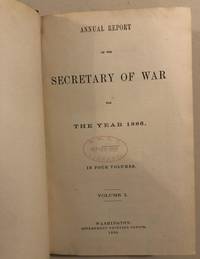
188653657Washington County: Government Printing Office 1886. 1886. First edition. First edition. Thick 8vo. Cloth 837 pp. illustrated plates tables maps index. One foldout Army Organizational chart one large very detailed foldout map of the Field of Operations Against the Apaches and one large foldout map of West Point Military Academy in 1883. Contains General Crook's report of his actions against the Chiracahua Apaches Captain Lawton's report of operations against Geronimo's and Natchez's bands of hostile Indians and mentions Crook being reassigned and Miles assuming command. General Terry's report on the affairs of the Department of the Missouri General Howard's report upon the military operations and condition of the Division of the Pacific General Stanley and his report on activities in Texas to completely patrol and watch the border line between the United States and Mexico General Ruger's report of military operations in the Department of Dakota etc. A great source for the Apache Wars. This is a surplus copy from the Office of the Army's Quartermaster General with their neat bookplate and small stamp else a very good-near fine tight copy of an important book. Government Printing Office, 1886. hardcover
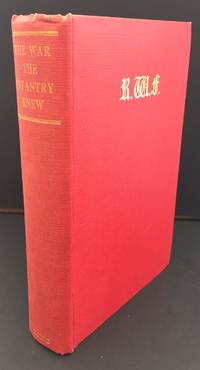
1938biblio214<p>The First UK Printing published by P.S.King and Son Ltd in 1938.The BOOK is in near FINE condition. Original red cloth with gilt titling to the spine and the initials of the regiment gilt to the upper board.Covers are clean apart from a tiny black dot to the spine.Light pushing to the spine ends with a little fading and tiny splitting at the spine tips.A hint of toning to the text block.Free from inscriptionserasures and markings. The endpapers are only very slightly tanned.27 leaves of sketch-maps bound in at the rear.The very scarce First editionbeing one of just 500 copies privately produced by the author.As such this remains an extremely elusive title. The battalion included the authors of two of the most famous literary accounts of the Great War Graves and Sassoon with the latter contributing a chapter to the present work entitled "A Subaltern's Service in Camp and in Action" covering the period from March 12th to April 16th 1917 which is described as "An early draft of pages of Memoirs of an Infantry Officer." Graves offered to contribute but Dunn was not an admirer of Goodbye to all that and declined his offer. Graves is mentioned disparagingly a handful of times in the text. Dunn's is an extraordinary book in the Face of Battle John Keegan described it as "one of the most interesting and revealing books of its type a genuinely truthful and fascinating picture of the war as it was for the infantry." Compiled in diary form from the reminiscences of around 50 members of the Battalion it is without doubt the most authentic account of the experience of the Western Front at Battalion level. Collectible. Ashtonrarebooks welcomes direct contact.</p> P.S.King and Son Ltd hardcover
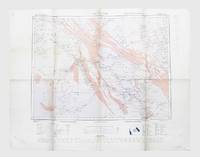
1945165179London: Geographical Section General Staff 1945. A detailed early map of central Arabia Second edition of this pilot's map of Riyadh and the surrounding region reissued by Britain's general staff for the use of the Royal Air Force at the end of the Second World War and annotated by a member of 53 Squadron. Revised from its first publication in 1922 the map was photolithographed in 1942 and then updated in 1945 to include new information on roads airfields landing grounds and seaplane stations. The topographical features that are referenced include all the salient information a pilot might expect such as rivers marshes areas liable to flooding mountains ruins lava flow and sandy desert. A glossary explains the English meanings of the Arabic terms included in the map such as darb road jabal mountain and qasr fort. The owner's inscriptions to the lower corners read "Riyadh" and "E. Skemp" most likely Eric Skemp who "flew Liberators on 53" Squadron Mulder p. 298. Although the squadron spent the war years stationed in Britain and the eastern United States it was assigned to carry troops home to India in 1945. Photolithographed map 630 x 790 mm. General light creasing more marked at head and foot of central fold scuff at top left corner: a very good example. Rob J. M. Mulder The Fokker Fours 2019. unknown
1918175146Baghdad: Map Compilation Section General Headquarters 1918. The decisive conclusion to the Mesopotamian campaign A collection charting strategically significant terrain during the closing stage of the war when Allied forces under Sir William Raine Marshall advanced up the Tigris to Mosul and defeated Ottoman forces at Sharqat - the final Allied-Ottoman engagement. The earliest map a May 1918 survey of the Fat-Hah Gorge showing the Turkish concentration on the western elevation anticipates events a few months later in October when Sir William Raine Marshall ordered a successful attack on the Turkish position. Victory at the gorge opened a pathway for the advance on Mosul which fell in at the end of the month; T.C. 250 compiled in readiness one month before incorporates information from captured Turkish and German surveys. Victory in Mesopotamia was also hastened by Allied control of the pass at Ain Nukhaila which allowed Lieutenant-General Alexander Cobbe to outflank the Turkish lines at Sharqat. The final map shows the environs of the historic city of Erbil. The plans of Ain Nukhailah and Fat-Hah are an early demonstration of the benefits of aerial photographic surveying which was introduced in the Middle East in the second half of the war and widely conducted in the 1920s. Four heliozincograph maps printed in black and red c.500 x 600 mm or reverse folded as issued "Erbil" laid down on linen "Fat-Hah Position" 3 inches to 1 mile others 1 inch to 2 miles. Old lead and colour pencil notations on versos. Small loss in one margin not crossing neatline a few small splits at intersection of folds linen foxed: very good bright maps. unknown
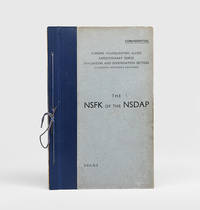
1944184343London: 1944. Allied intelligence on the Nazi flying corps A confidential Anglo-American intelligence report on the Nazi paramilitary aviation organization produced ahead of the Allied advance into Germany. The report provides extensive detail on the organization including illustrations of its uniforms and maps of its bases. The Military Intelligence Research Section MIRS was a joint Anglo-American intelligence agency established in 1943 to analyse and exploit captured Axis documents. MIRS produced a series of handbooks on Nazi military and paramilitary organizations for Allied intelligence officers and military officials. This report charts the origin and development of the corps its ties with the Hitler Youth and Luftwaffe its transformation during the war and its uniforms ranks and insignia. The foreword observes that there is no clear distinction between the Luftwaffe and the NSFK the latter serving as the chief training agency for the former. It notes the special threat the NSFK with its 1000 headquarters and 60 schools will pose to the occupation authorities: "from an occupational counter-intelligence point of view the regional network of the NSFK may well be considered an establishment easily transformed into an organized set-up to function as a source of disaffection. Nazi 'ideological camaraderie' is especially evident in the units of this formation and it is certain the NSFK may boast a particularly strong grip on Germany's youth". Provenance: Evgenii Semenovich Mollo 1904-1985 a military historian specializing in uniforms and insignia with his "Mollo Collection" bookplate to the front pastedown. Folio. With 2 coloured plates folding map folding diagram. Errata slip tipped-in preceding title page. Original dark blue quarter cloth grey boards printed in black string tied. Trivial wear at extremities a few marks to covers contents a little toned with some leaves browned some with nicking or minor chipping at extremities. A good copy. hardcover
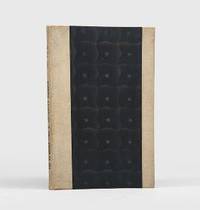
1940190246London: Post No. 5 A. R. P. Cleveland Yard St. James' S. W. 1 1 October 1940 - 30 April 1941. the BIGGEST SALES of any Blitzkrieg News-sheet in Britain Inevitably sole edition of this evocative Home Front journal by and for the crews of a London A. R. P. Air Raid Precautions post as a local morale booster and fund raiser. Numbered 31 of an unknown limitation only the Imperial War Museum lists a set theirs complete in 36 issues through to May 1942. A scarce resource offering genuine insights into London's uncensored mood under the Blitz. This is a typical wartime mix carrying harrowing reports of the impact of war "Calvary in St James'. almost half Jermyn Street was a shambles"; facetious humour "Is it only a rumour that the favourite drink of the Italian Navy is port"; local notes "the oldest lamp post in London. now unfortunately it has suffered at the hand of the Vandal. destroyed"; some dubious recipes "half a pint of Churchill sauce"; occasional reports from "other parts of the field"; appeals for volunteers; incitements to "carry on!"; all alongside not infrequent moments of genuinely moving introspection; "Piccadilly during the People's War at 9 p.m. Traffic lights flashing monotonously green - yellow - red. The noticeable ticking of the automatic lights' machinery. An occasional taxi and car. A rare bus. Perhaps fifty persons in Piccadilly Circus. The Statue of Eros boarded up and protected by rotting sandbags. The hot blast of exhausted air from the underground exits. The rush of fire-engines towards fire. The pleasing gap where the 'Fifty Shilling Tailors' had their shop. The stark picture of the blackened ruins of St James' church opposite. The whispered appeals of 'Hello darling' from mysterious female forms. The whizzing of shrapnel on the street. The criss-cross of searchlight beams in the heavens. Not a single newsboy. A solitary cat crossing the street". Circulation rose rapidly issue 5 claiming 2000 copies and the following number proclaiming five times that "Last week's issue was completely sold out. Although we keep on printing more and more copies we are quite unable to meet the demand. We claim the BIGGEST SALES of any Blitzkrieg News-sheet in Britain. Copies are being sent as historic mementoes to every part of the world". A "Final Notice" in issue 24 notes that there are for sale "a few bound volumes containing the first 24 issues at Six Guineas $30" maybe about £1000 today in real terms. All moneys raised from the Lyre went to the local St James' Bomber Fund "costs of production are borne privately". Folio. pp. 80 spirit-duplicated text in all on variously coloured paper stock. Original three-quarter - spine and fore-edges - greyish yellow buckram spine lettered longitudinally in black attractive matte black patterned paper boards golden stars on a wavy grid pattern. Pictorial masthead. Just a little rubbed and soiled endpapers slightly toned; text with occasional spots of foxing but overall clean and sound very good. hardcover
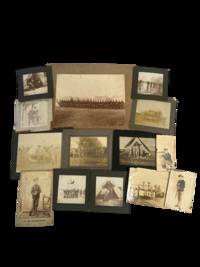
1898226591898. Spanish-American War Military Cuba United States volunteer cavalry photo archive of soldiers in the 1st United States Volunteer Cavalry widely known as Theodore Roosevelt's Rough Riders during and immediately after the Spanish American War ca. 1898-1900. The photographs record the daily life training routines and informal social culture of American volunteer soldiers operating in Cuba following the United States military campaign against Spain. During the operation volunteer regiments composed largely of civilian recruits were deployed overseas in what became the nation's first sustained imperial war. Images of uniformed cavalrymen wearing broad-brimmed campaign hats and field leggings capture the lives of Roosevelt's Rough Riders and the broader volunteer forces who fought in Cuba during the campaign that included the Battle of San Juan Hill.<br /> <br /> Archive of 14 original photographs including albumen and silver gelatin prints ranging in size from approximately 3 x 4 inches to 6 x 8 inches several mounted on original cardstock with one cabinet card produced by photographer J. J. Castro of Plaza de Armas Sagua la Grande Cuba. The photographs depict groups of United States volunteer soldiers in field and camp environments including scenes of tent encampments arranged in rows soldiers standing in formation before their tents and troops moving through rugged terrain. Several images portray informal moments of camp life such as soldiers reading letters outside their tents or playfully tossing a fellow soldier into the air. One photograph shows a group of soldiers wading across a shallow river while carrying their equipment suggesting the difficult marches undertaken by American cavalry units moving through the Cuban countryside. A Spanish inscription on the verso of one mount reads "A favor de Jesus cuartelado numero 106" indicating local Cuban context during the American occupation. Another photograph depicts dockworkers unloading supplies near a harbor installation suggesting logistical activity connected to the military presence on the island.<br /> <br /> The Spanish American War of 1898 marked the emergence of the United States as an overseas imperial power leading to American control or influence in Cuba Puerto Rico Guam and the Philippines. Volunteer regiments including the Rough Riders became widely celebrated in the American press in part due to the leadership of Theodore Roosevelt and the regiment's participation in the assault on San Juan Hill. After Spain's defeat United States forces remained in Cuba during an occupation that lasted until 1902 while new political institutions were established on the island. Photographs produced in this period document both the operational routines of American troops and the broader transformation of Cuba into a site of U.S. military administration. Light surface wear visible to several prints with minor edge rubbing and faint foxing to some mounts; a few photographs show slight fading though images remain clearly legible; overall very good condition. The archive preserves a cohesive visual record of American volunteer cavalry culture and military occupation during the opening phase of United States overseas expansion. unknown
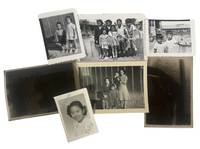
1944206531944. WWIIJapanese American Photo archive of Japanese American families and children confined in United States War Relocation Authority camps during the Second World War. These images taken during the 1940s incarceration of approximately 120000 people of Japanese ancestry following the issuance of Executive Order 9066 capture informal scenes of family life in the camp system that held both immigrants and American-born citizens. More than two-thirds of those imprisoned were United States citizens including thousands of children whose early years were spent inside the camp environment. The photographs show the everyday domestic and social life in incarceration centers recording children parents and small family groups living within the controlled environment established by the War Relocation Authority.<br /> <br /> Archive of seven original photographs including five silver gelatin prints and two photographic negatives dating to the World War II incarceration period. The images depict small groups and individual portraits of Japanese Americans in relocation centers. One group photograph shows six children seated on a wooden fence with rows of barracks-style housing structures visible behind them. Another image depicts two mothers seated on a wooden bench with their toddler-aged sons in front of a wooded camp building; the verso is inscribed identifying the women as "Mrs. Chyoko Okita" and "Mrs. Hayashima." A school-style portrait of a young girl includes her name written on the recto. Two negatives show adult figures outside built environments including one man standing in a suit before a brick building and another image showing a man posed with three women beside an automobile with leafless trees in the background. The photographs range in size from approximately 1.5 × 2.25 inches to 2.5 × 3.5 inches.<br /> <br /> Japanese American incarceration camps held entire family units between 1942 and 1945 producing a social landscape in which children attended school and families attempted to maintain ordinary routines. Approximately 6000 children were born in War Relocation Authority centers during the war years and many young children spent their earliest developmental years entirely within the camp system. Vernacular photographs such as these offer rare glimpses of daily life beyond official government photography preserving personal moments of families and children navigating incarceration under wartime policy. Minor edge wear to several photographs with otherwise clear images and strong tonal contrast; negatives well preserved. Overall very good condition. An evocative record of Japanese American family life during U.S. internment. unknown
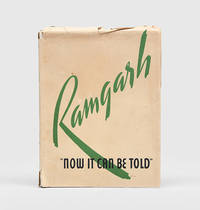
1946181214Ranchi: The Catholic Press c.1946. A modern fighting force which could stand toe to toe with the Japs and slug it out to victory First edition found in eight institutional libraries only telling the story of Ramgarh's top secret Chinese-American Training Center the first training camp run by the US on foreign soil. Conceived by Stilwell following the retreat from Burma the centre drilled and equipped four crack Chinese divisions. These formed the core of Stilwell's hard-fought but successful advance through Burma in 1944. This extensively illustrated publication profiles Brigadier-General Frederick McCabe and other senior figures at the centre as well as its rigorous jungle warfare training regimen and exercises to familiarize Chinese troops with cutting-edge US weaponry. A section at the end describes visits by VIPs including Chiang Kai-Shek Mountbatten Lieutenant-General Sultan and Stilwell himself. Copies are held by the US Army War College US Army Center of Military History Marshall Center for Security Studies Wisconsin Veterans Museum Harvard University of Georgia Norwich University and SOAS. Quarto. Illustrations throughout; some text and decoration printed in brown. Notice from publisher tipped to first page. Original card wrappers front cover lettered in brown and black. With dust jacket. Loss and split at foot of spine odd mark internally; jacket flaps without price as issued losses at spine ends panels toned nicks and creasing at head where jacket oversized: a very good copy in like jacket. unknown
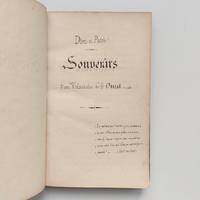
187219726<p><strong>Probably the only surviving copy of this rich account of the enlistment and service of a young volunteer soldier from the West.</strong><br />Entirely autographed and illustrated with a few compositions the author recounts in 24 chapters the war in which he took part his enlistment in the 4th company of the 3rd battalion at Le Mans his Chassepot bayonet rifle his comrades and superiors the Papal Zouaves the descendants of Charette and Stofflet his travels in the West and of course the Prussians.</p><p><em>"My aim is not to invent a novel of pure fantasy; there is no such thing as the simple statement of a fact stripped of all fabulous exaggeration. My intention is therefore to relate very imperfectly no doubt memory is so unfaithful the vicissitudes in the midst of which I lived during four months of a campaign at the height of winter and the impressions I was able to bring back. I wish to preserve in this account an entire truth a character of frankness and authenticity that removes the slightest doubt."</em></p>
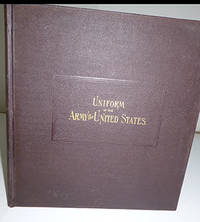
51-3853Philadelphia: Depot of the Quartermaster General1888. Sq. Folio. 42.5 x 37 cm 16½x15" original pebbled brown cloth lettered in gilt fine. . 6 pp. Triple-columned. 12 chromolithographic plates and 13 black and white plates. Compiled by direction of the Secretary of War under the Supervision of the Quartermaster General and Inspector General. Wonderful chromolithographs depicting groups of soldiers in full uniform in army settings. Engraved by G.H. Buek & Co. after paintings by Henry Alexander Odgen. The black and white plates depict helmets caps badges sword belts epaulettes and other accessories.OCLC Number: 10868987 Philadelphia: Depot of the Quartermaster General,1888 hardcover
186988097Washington DC: United States War Department Office of the Chief of Engineers 1869. Presumed First Edition First printing. Hardcover. Fair. RARE SURVIVING COPY IN PRIVATE HANDS. The format for the binding is approximately 18.5 inches by 23.5 inches. The format for the interior pages is approximately 17 inches by 23 inches. This is an oversized book and if sent outside of the United States will require additional shipping charges. This has been rebound with swirled cover and endpapers and leather at spine and corners. Front cover has faded title information. Edges of most sheets reinforced with library tape approximately one half-inch wide on top fore-edge and bottom. Several sheets at the start have insect damage which tails off at the Petersburg map. No insect damage to any map images. Bottoms of each sheet show signs of water staining but all sheets are separate. The photoliths were produced by the N.Y. Lithographing Engraving & Printing Co. Julius Bien Supt. The contents include the title page and two-page maps of Richmond Appomattox Court House The Wilderness Spottsylvania Court House Totopotomoy Petersburg and Five Forks Bermuda Hundred Jetersville and Sailor's Creek Highbridge and Farmville Harper's Ferry Fredericksburg North Anna Chancellorsville Cold Harbor The Gettysburg regions presented in two two-page maps divided top and bottom and Antietam. Many of the maps have red and blue lines indicating the positions of the opposing troops during part of the battle. All maps indicated on the title page are present as well as a map of Harper's Ferry which is not in the collation in Phillips Atlas # 3688. Note at the bottom of the title page: In addition to the Surveys and Maps made previous to and during the Operations extended and detailed surveys were made upon the cessation of hostilities in the several theatres of operations and the Maps partially prepared by order of Lieut.Gen'l U. S. Grant Commanding the Armies of the United States. These Surveys and Maps were executed under the direction of Bvt. Brig. Gen'l N. Michler Major of Engineers and B Bvt. Leiut. Col. P. S. Michie Capt. of Eng'ers. The Maps were subsequently prepared for publication by f Bvt. Brig. Gen'l N. Michler by directions of the Chief of the Corps of Engineers under the authority of the Hon. Secretary of War. The Surveys and Maps relating to the Baattle-fields of the Wilderness Spottsylvania Court House North Anna and Totopotomoy were made by authority of the Hon. Secretary of War under the orders of Brig. & BvtMaj. Gen'l A. A. Humphreys Chief of Engineers and under the direction of Bvt. Brig. Gen'l N. Michler Major of Engineers in 1867. This is the definitive atlas of the course of the Civil War in the East separate from specific maps of the Gettysburg Campaign with maps of the major battlefields in the Virginia from Gettysburg to the end of the war. In addition to maps of those later battles there are also maps of pre-Gettysburg battles of Antietam and Chancellorsville. United States War Department, Office of the Chief of Engineers hardcover
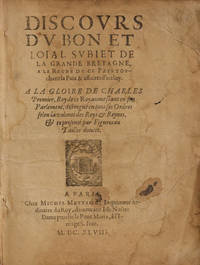
95266Isle Nostre Dame Paris chez Michel Mettaier imprimeur ordinaire du Roy 1648. . First edition; 4to 22 x 17.5cm; 3 folding plates each approx. 35 x 26 cm 2 engraved portraits woodcut initials and decorations throughout the text engraved armorial book-stamp to last leaf verso displaying motto 'light in darKines lumiere dans les tenebres'; one integral blank leaf title page stained and browned some marginal staining and browning throughout creasing to corners one small wormhole affecting 4 leaves; side-stitched contemporary marbled wrappers worn and soiled with extensive loss to upper wrapper; 14 39 1pp.<br /> A curious and rare anonymous English Civil War pamphlet published in Paris by Michel Mettaier sometimes spelt Mettayer in 1648 following the capture of Charles I by parliamentarian forces the previous year. <br /><br />The first part of the work consists of three large folding plates depicting the House of Lords the House of Commons and the Convocation of Canterbury with explicatory notes explaining the history and function of these bodies in the English parliamentary system. The latter part of the book contains an original address to Henrietta Maria Queen of England illustrated with facing engraved portraits of the Queen and the Prince of Wales and signed simply 'le bon et loyal svbiet'. It introduces a short statement in both English and French allegedly translated from an original Latin version which purports to be the words of Liudolf c.930-957 an Ottonian Duke of Swabia and grandson of the German king Henry the Fowler 919-936. The text claims that Liudolf did not die in 957 but rather feigned his death to take exile in Mantua in the hope that his descendants would one day regain his power and prestige. The tale was likely intended by the royalist author to offer hope to the exiled queen and her son who were soon to become widow and orphan to the executed king.<br /><br />Rare. We can trace only 5 copies in institutional collections worldwide: 3 in the UK British Library Durham University and the University of Leeds and 2 in France BnF and Bibliotheque Saint-Genevieve.<br /> Isle Nostre Dame, Paris, chez Michel Mettaier, imprimeur ordinaire du Roy, 1648. unknown