11 490 résultats
193052798NP: NP 1930. Original photographs. poor to very good condition. fair to fine. Oblong Quarto. 23 plates with tissue guards. String bound photo album remains of leather fitting on cardboard. Personal photo-album of Isadore Nebenzahl war correspondent for Agence Havas later: French News Agency in Ethiopia containing 310 b/w original photographs documenting Ethiopia during the Second-Italo-Ethiopean War of 1935. The photographs measure 3 1/2 x 2 1/2" with one measuring 9 x 6" Son of the emperor and one at 3 1/4 x 5 1/4" <br /> <br /> Some 200000 Italian troops invaded Ethiopia in October 1935 under the command of Italian Marshall Emilio de Bono who was soon replaced by General Pietro Badoglio by Mussolini. The Ethiopian forces were defeated and on May 7 1936 the Italian King Victor Emmanuel III was declared emperor and the provinces of Eritrea Italian Somaliland and Abyssinia Ethiopia were united to form the Italian province of East Africa. The fighting between Italian troops and rebels continued until 1939.<br /> <br /> The British war correspondent George Steer had reported on the use of chemical weapons by the Italian forces and subsequently had been deported together with Nebenzahl and other reporters on grounds of anti-Italian propaganda and espionage see original Reuters bulletin of May 18th 1935 enclosed in the album. The Reuters bulletin was covered by several newspapers including the New York Times mentioning Steers and Nebenzahl in their reporting. Several of the photographs included in this album show Isadore Nebenzahl.<br /> <br /> The photographs depict everyday life in Addis Abebba show Nebenzahl and his colleagues in business settings or on portrait photographs construction sites armed patrol activities gatherings and diner settings military personnel official events actions to extinguish fires friends and families airplanes during air raids victims and destruction from air raids army exercises refugees and troops train stations and ships the harbor and navy ships an airfield and scenarios on the ship after being expelled.<br /> <br /> The album includes a small set of documents and photographs loosely laid in:<br /> <br /> 1. Two official press credentials Service des la Presse for Isadore Nebenzahl both with passport photo of Nebenzahl<br /> <br /> 2. A photograph of what seems to be the son of Heila Selassie laid in with two other photographs.<br /> <br /> 3. A formal invitation of the Foreign Ministry of Ethiopia for Isadore Nebenzahl to attend an evening at the "Noveau Palas Imperial".<br /> <br /> The leather padding of the front cover of the album is missing the back padding barely attached with heavy wear along edges. Front cover cardboard with water staining along top edge not affecting album or photographs. Light age-toning. The binding in overall poor photos and interior in good to very good condition. Binding protected in modern mylar. NP unknown
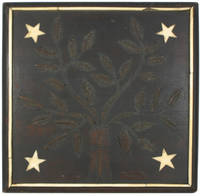
1863List308N.p. 1863. Dark carved wood 11 ½ x 11 ½ x 1 inches with bone border and star inlays in corners an inlaid tree with carved names of Civil War battles as leaves. During the Civil War wounded or captured soldiers would often pass their time waiting to return to duty carving relics. The practice was fairly common with pipes being the most commonly carved object and the quality of the relics varied wildly depending on the talent of the soldier. A.H. Barber from Wisconsin was wounded at Antietam and most likely carved this memorial piece while recovering from his wounds. Each leaf notes a different battle during the 1861-1862 campaigns. Barber enlisted in Company C of the 2nd Wisconsin in 1861 and was discharged in 1863 following wounds suffered at Antietam. The trunk reads Battles for the Union and the four branches read Dept. of the South Army of Virginia & of the Potomac and Dept. of the West with twenty-nine leaves naming battles. <br /> <br /> The resultant plaque is exceptional in timeliness craftsmanship and overall aesthetic beauty. Barber’s metaphorically growing tree is particularly timely for the Union cause as the 1863 failure of the Maryland Campaign would serve as inspiration to Lincoln to issue the Emancipation Proclamation. Wonderfully preserved in excellent condition with no notable flaws. From the collection of Norm Flaydernman the noted Americana dealer who personally collected carved Civil War pipes and had been planning to write a book on the subject at the time of his death. unknown
11091Half-sheep over marbled boards. Spine label: Speeches. Presentation inscription on fly-leaf from James B. Smallwood to the Hon. John P. Hale U.S. Senator dated April 4 1861. Bound volume of 37 individual speeches and 1 folded broadside made between 1860 and 1861 by various elected officials including Hon. Andrew Johnson of Tennessee Hon. Stephen A. Douglas of Illinois Hon. Jefferson Davis of Mississippi William H. Seward and Hon. Milton S. Latham of California among many others. unknown
1865List2438Camp Low 1865. Original partially printed document 26cm x 77cm. Printed on both sides of the sheet completed in manuscript. Darkening at folds from old tape repairs; partial splits to folds and extremities; complete and quite Good. Docketed verso signed in ink by Lieutenant Morgan Owen. Lists twelve enlisted soldiers most with Spanish surnames two with French surnames. Fine. The formation of the California Native Cavalry in 1863 marked a significant chapter in the state's history. Comprising primarily Mexican-American individuals colloquially referred to as "native" Californians the California Native Cavalry unit was formed 1863. Initially commanded by Maj. Andreas Pico a distinguished hero from the Mexican-American War and later under Salvador Vallejo the regiment drew its ranks from diverse backgrounds. Recruitment efforts began with vaqueros from southern California expanding to include individuals from San José and San Francisco. The unit boasted a varied composition encompassing not only Mexican-Americans but also Chilenos California and Yaqui Indians and even French legionnaires.<br /> Company "B" a contingent largely recruited from the northern part of the state is reflected in the existing muster roll. The company assembled at Camp Low near San Juan Bautista in 1865 making a striking entrance into the town. Described as "gay and gallant Spanish lancaroes" the cavalrymen presented a formidable sight with lances in hand and flags flying leaving a lasting impression on the townspeople who had never before encountered soldiers."The gay and gallant Spanish lancaroes sic came dashing through the town with the lances in their hand a flag flying from each of them. I assure you that they presented a war like appearance the people here had never seen a soldier in their lives – Yes Sir!." letter Maj. Michael O'Brien to Gov. Frederick Low January 1865; quoted in Prezelski "Lives of the Californio Lancers: the First Battalion of Native California Cavalry" in Journal of Arizona History v.40 no.1 Spring 1999. <br /> Under the command of Capt. Porfirio Jimeno Company B swiftly engaged in a critical mission: dismantling the notorious Mason-Henry Gang that had terrorized the San Juan region in the preceding months. Despite successfully wounding John Mason in early April 1865 the gang persisted for another month until Mason met his demise at the hands of a miner he sought to kidnap.<br /> However Company B faced challenges including low morale and a high rate of desertions with over 40 men leaving the company in 1865 alone. Transferred to Tubac Arizona Territory to confront the Apaches the company encountered further desertions along the way. The muster roll listing only twelve soldiers alongside Capt. Porfirio Jimeno reflects this tumultuous period. Overall the muster roll provides scarce documentation of the role of Mexican-Americans in the Civil War with few other examples in the trade or institutionally. unknown
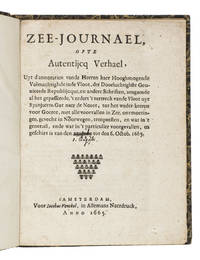
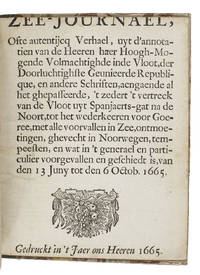
1665ABC_49489Amsterdam 1665. 4to. Jacob Venckel Modern marbled boards. 2 69 pp. Rare pamphlet written by an anonymous author discussing the fascinating Battle of Vågen the main port area of neutral Bergen in Norway in August 1665 during the Second Anglo-Dutch War 1665-1667 including its background and aftermath. The Second Anglo-Dutch war was a war at sea caused by conflicts in colonial territories of the Dutch Republic and England. This naval war consisted mainly of protecting their own merchant ships capturing enemy ships and trying to sink mutual warships. The Battle of Vågen was an important naval battle between a rich treasure fleet of the Dutch East India Company VOC and an English flotilla of warships. Twice a year the Dutch VOC sent a treasure fleet from the East Indies to the Dutch Republic with money and goods. On 24 December 1664 one of the richest-laden fleets in Dutch history departed from Batavia for the homeland with a cargo estimated to be worth millions. This fleet was intended to support the Dutch Republic financially and therefore should not fall into enemy hands. Since the tensions with England were already high in 1664 an experienced officer the rear admiral Pieter de Bitter ca. 1620-1666 was appointed to command this fleet.The present pamphlet gives an account of the events before and after the Battle of Vågen and also in broad lines of the battle itself including all kinds of correspondence and notes from high-ranking figures. The dating in the title is incorrect as the story took place from August 1 to August 20 which is why the title has been corrected by hand in the present copy. The present edition is one of two both printed in 1665 but with a different imprint the present one with the publisher and place of publication and the other with only the year and the alignment of the text. However they were both likely printed by the same printer. The present edition is very rare. We've not been able to find other copies in sales records and only a few in institutions. A highly interesting pamphlet on one of the most important and fascinating 17th-century sea battles in Dutch naval history and in the history of the Dutch VOC.The date "13. Juny" has been crossed out on the title page and replaced by "1. Augusti" in manuscript. The work is slightly browned throughout a small hole in the lower margin of the title-page and an ink drop in the lower margin of page 65. Otherwise in very good condition.l Knuttel 9102; STCN 842169458 8 copies incl. 1 incomplete; Tiele 5265; USTC 1802668 9 copies incl. 1 incomplete; WorldCat 85201870 747664026 4 copies; cf. for Venckel: H.F. Wijnman De Amsterdamsche boekverkooper Jacob Vinckel 1627-1680 in: Vondel-kroniek 5 1934 p. 192. hardcover
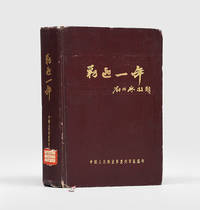
1951173556Guizhou: Junqu zhengzhi bu 1951. Military might. and terror First edition first printing of this internally circulated report on operations undertaken in Guizhou province by the People's Liberation Army. After Chiang Kai-Shek evacuated to Taiwan in early 1949 remnants of his forces in the south-west splintered into different bandit units and mounted a credible threat to the survival of Mao's regime. Of the 1000 copies issued none are located in institutions. In January 1949 Chiang ordered Guizhou's nationalist governor Gu Zhenglun to make the province the final bastion of anti-communist resistance on the mainland. Although Mao proclaimed the founding of a united People's Republic of China in October "the continuing civil war in southwest China pitted ethnic groups local power holders farmers and Nationalist troops against the PLA People's Liberation Army. The occupying army's initial strategy of a rapid military advance leniency and massive grain collection efforts was a recipe for resistance" Brown p. 119. In early 1950 communist cadres and troops withdrew from the majority of the province the party's political control in tatters but a combination of carrot allowing local people to keep more of their agricultural surplus and stick terror eventually brought Guizhou into line. A series of maps demonstrates the oscillating fortunes of anti-communist forces during 1950 Mao's forces being pushed back during the summer months but gaining the decisive upper hand later in the year. Other plans show the grand troop manoeuvres that turned the tide in Beijing's favour. Tables at the end list major battles the names of guerilla organizations and their leaders those leaders killed or captured in the field and those who surrendered. While dated 1950 on the title page the volume was not printed until May 1951. Second and third printings followed in June and July. Octavo. Half-tone portrait photographs of Chairman Mao and Commander-in-Chief Zhu De tipped onto decoratively embossed leaves with tissue guards 5 photographic halftones all with tissue guards showing Liu Bocheng He Long Deng Xiaoping Li Da and Zhang Jichun 15 facsimile calligraphic inscriptions 36 colour maps and battle plans 26 double-page 9 colour bar charts tables in text. Text in Chinese. Original brown cloth spine and front cover lettered in gilt illustrated endpapers green and pink silk bookmarker. Ex-military library with accession stamps on the front free endpaper and title page record card holder on the rear pastedown and "confidential" stamp on the title page; contemporary red pencil marginalia. Extremities rubbed and bumped couple of tips consolidated contents toned as consistent with paper from this period maps plans and graphs well preserved: a very good copy. Jeremy Brown "From Resisting Communists to Resisting America: Civil War and Korean War in Southwest China 1950-51" in Jeremy Brown & Paul G. Pickowicz eds Dilemmas of Victory: The Early Years of the People's Republic of China 2012. hardcover
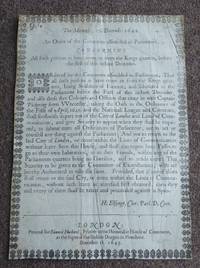
52524<p>London printed for Edward Husband printer to the Honorable House of Commons at the signe of the Golden Dragon in Fleetstreet December 18 1645. BROADSIDE WITH ORNAMENTAL BORDER. Text to recto only 1645 approximately 290 x 205 mm 11½ x 8½ inches 3 small amateur repairs to blank side some folds visible on blank side see attached image old ink hand-numbered "94" to upper lefthand corner zoomable images attached giving the text. Under the text is the printed signature of Henry Elsynge who had spent seven years in foreign travel after which Archbishop William Laud procured him the appointment of Clerk of the House of Commons. His work was significant during the Long Parliament. In December 1648 Elsynge resigned his appointment on a pretext to avoid taking part in the proceedings against Charles I. See: George Thomason Catalogue of the Pamphlets of the Civil War Volume 1 page 410 669.f.9. 48; ESTC R212263 traces 4 copies only world-wide; Wing Short-Title Catalogue 1641-1700 Volume 1 page 555 No. 2643. MORE IMAGES ATTACHED TO THIS LISTING ALL ZOOMABLE FURTHER IMAGES ON REQUEST. POSTAGE AT COST.</p> London, printed for Edward Husband, printer to the Honorable House of Commons, at the signe of the Golden Dragon in Fleetstreet,
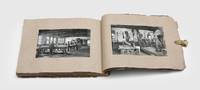
19191881971919. The nuts and bolts of the air war in the desert Superbly detailed visual record of the RAF's central logistical hub for the Middle East theatre serving the region from Egypt to the Hejaz. The depot offered complete servicing from erection out of the crate to scrapping after strike off. Images include personnel groups exteriors and interiors of workshops warehouses hangars and auxiliary buildings: a complete survey of the staffing and facilities of the complex. The prints are of striking quality the images sharply focussed and crisply printed rewarding close examination under a lens with a wealth of detail. Perhaps the most arresting photographically are the shots of the storage spaces unoccupied aisles extending into the distance filled with fastidiously ordered ranks of parts; a touch uncanny but effectively evocative of scale and rigorous organization. Based at RAF Aboukir Abu Qir near Alexandria X AD was the largest such facility in the region part of a complex including an airfield home base for a flight school and several training squadrons - craft where identified Nieuports and SE-5s bear tail numbers assigned to regional trainers - all of which continued in use until the end of WWII. The present copy is uncaptioned but comparison with records of the two copies traced through auction - the only others found - it is possible to identify a number of the images: various groups of personnel HQ staff carpenters fitters stores staff football and gymnastics teams; the headquarters buildings; tool stores; the contents of the parts stores encompassing small fabric pieces aircraft fittings spare wings and planes motor machine-gun engine and balloon spares; the depot's motor transport vehicles mainly Crossley tenders; the base tennis courts; the engine-erecting shop; outdoor engine testing; hangars; the riggers' shop dismantling shop dope shop and salvage hangar. Landscape album 195 x 260 mm containing 66 original official gelatine silver prints including title page 100 x 155 mm some with light sepia toning mounted on 34 leaves of greyish yellow light card. Cord sewn into greyish yellow light card wraps. Covers worn creased and stained with some areas of loss to the extremities; but the contents clean and sound the photographs themselves crisply defined and with great tone; very good. paperback
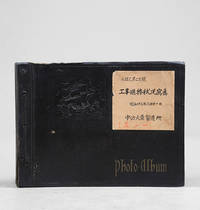
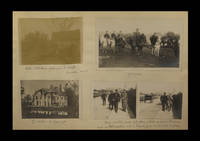
193898082Nanping Manchukuo: Kwantung Army Showa 13 January-October 1938. An historically significant and fascinating album chronicling the progress of the construction of factories at Ningpo near Fuzhou for the manufacture mixing drying and separation of smokeless yellow and brown gunpowder for the Imperial Japanese Kwantung Army during the Second Sino-Japanese War. Following their stunning victory in the Russo-Japanese War Japan obtained control of the Kwantung Leased Area in the Liaodong Peninsula in Manchuria which was occupied by the Kwantung Garrison in 1919 the Kwantung Army. A hotbed of the aggressive expansionist nationalist Imperial Way Faction the Kwantung Army was implicated in a number of attempted coup d'états in Japan and the manipulation of events in Manchuria culminating in the Mukden Incident and invasion of Manchuria in 1931. Presented with a fait accompli on this scale the Japanese Government had little choice but to back up the KA providing reinforcements for the Pacification of Manchuria resulting in the creation of the Japanese province of Manchukuo under the puppet emperor Puyi but in fact ruled over by the local army commander. As over 150000 Japanese settlers surged into Manchuria during the 1930s the Kwantung Army expanded its sphere of operations and by the time of World War II would constitute a force of close to a million and a half men. This remarkable album documents Japanese efforts immensely to increase their munitions production for the Sino-Japanese War 1937-45. The project documented here was a vital part of the second five-year plan drawing on the vast mineral resources of the region. The photographs are without exception clear and sharp evidently the work of a trained photographer who has shot the various buildings from different directions angles and heights - employing the water-tower to offer an over-view - and has carefully docketed captioned and mounted the images in the album in such ways as to produce a comprehensive view of development across the site over time a sort of improvised time-lapse montage. Beginning in February 1938 the photos depict the stages of construction of the bleaching factory the powder pellet factories warehouses military barracks the drying factories fuse construction and storage facilities the mortar shell assembly area as well as the mixing factory with the powder mixing vats. The album follows the progress of the development from the pouring of the foundations through the erection of the scaffolding and the specific construction methods of the full range of brick concrete and timber buildings even down to the creation of the protective earthen berms around the facilities especially the drying factories and storage warehouses. Other parts of the facility shown are the workers' dining hall the silk bag manufacturing plant powder storage areas fire station the power substation hospital and the front gate of the main factory guarded by Japanese soldiers and a military police station. The rapid development of this installation at Ningpo is indicative of the scope of Japan's expansionist ambitions and of the efficiency of her military-industrial complex. The album represents an invaluable historical resource visually compelling heavily documented and comprehensively indexed to this pivotal point in Asian and in world history as this local conflict folded into that which was to envelop the whole globe. Landscape folio 268 x 335 mm. Tipped in at the beginning are 5 leaves of ruled ledger paper with a detailed manuscript index page numbers lettered in red followed by 30 leaves mostly of thick black card stock with a few of lighter black paper interposed with 323 mounted original silver-gelatin photos 115 x 153 mm many mounted on rice-paper hinges as sequential overlays to show the progress of construction work some of these have become detached; almost all have neatly calligraphic captions in Japanese on the page often there are inked annotations and/or date stamps in margins of images themselves or on verso of the hinge-mounted photos; 62 of the photos are mounted side by side or joined together to form double-width panoramic images. Loosely inserted schedule for the Officers for the No. 9 Buntan Division with 18 officers and 23 NCOs overseeing the construction for the Artillery also a small commemorative booklet dated 1931 for Japanese Navy with a few pencil annotations and sketchy diagrams. Contemporary black leather-grain embossed cloth album with cord-tie at spine hand lettered paper title and date label mounted on front cover. Slightly rubbed with some more significant edgewear one leaf neatly cut in half - evidently purposely to use as reference - both parts present and complete a few photos a little dog-eared some detached with occasional minor creasing but remains very good. hardcover
1915273881915. S.l. s.d. 1915. 2 albums au format in-8 oblong 263 x 188 mm rÂŽunissant 345 clichÂŽs originaux. Pleines percalines grÂges fermeture ˆ lacet. Important tout autant qu'ÂŽmouvant tÂŽmoignage photographique rÂŽunissant 345 clichÂŽs originaux en noir et blanc de divers formats 68 x 47 mm ˆ 214 x 163 mm. Tirages argentiques du temps contrecollÂŽs ; lÂŽgendÂŽs ˆ la plume au bas des photos. 13 clichÂŽs volants. L'ensemble donne ˆ voir paysages parfois lunaires scÂnes de ruines portraits de militaires dont Zouaves ainsi que de civils vues d'ensemble ou particuliÂre de villages ÂŽglises ou b‰tisses souvent dÂŽvastÂŽs scÂnes de groupes abris militaires scÂnes prises depuis les tranchÂŽes dont premiÂre ligne de front des gradÂŽs : le GÂŽnÂŽral Joffre le GÂŽnÂŽral Rouquerol le colonel Dechiezelle le Commandant Pruneau le Lieutenant Fournier le Lieutenant Walckemar Raymond PoincarrÂŽ alors PrÂŽsident de la RÂŽpublique Villeneuve Bargemont des engins militaires dont vÂŽhicules blindÂŽs un poste de secours une carriole tractÂŽe par un chien des avions une remise de la Croix de guerre des scÂnes figurant la 1Âre Compagnie du 1er RÂŽgiment de fusillers marins des vues de ports et de littoraux des vues aÂŽriennes un avion accidentÂŽ des piÂces d'artillerie et des munitions une locomotive dans une gare dÂŽvastÂŽe une vue aÂŽrienne d'un bombardement des tombes de soldats des scÂnes de bataille navale un soldat posant le cr‰ne d'un Allemand entre les mains la remise du courrier sur le front l'ÂŽdification d'abris des marins un champ d'aviation un cadavre ''boche'' sic etc. En somme cette exhaustive rÂŽunion offre un ÂŽclairage - unique ! - et trÂs complet sur le quotidien des soldats et les ravages engendrÂŽs par la guerre. En outre : une note manuscrite rÂŽdigÂŽe par un Lieutenant-Colonel contrecollÂŽe avec timbre du ''2Âme RÂŽgiment de zouaves de marches'' et deux tickets de train. Nombre de ces photos - au regard des lÂŽgendes - ont ÂŽtÂŽ prises ˆ Nieuport principalement et YprÂs. Rousseurs affectant les plats. Tirages dans l'ensemble bien prÂŽservÂŽs bien que de rares d'entre-eux prÂŽsentent un ÂŽclat altÂŽrÂŽ. Deux feuillets dÂŽsolidarisÂŽs dont un prÂŽsente un manque angulaire ; sans atteinte ˆ la photo. Blocs feuillets dÂŽsolidarisÂŽs de leur reliure respective. Nonobstant ensemble en belle condition. b42961 unknown
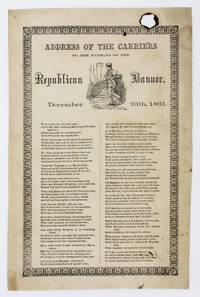
18616140Nashville 1861. Good plus. Small broadside approximately 11 x 7.25 inches. Creased along lower edge; ink burn causing a dime-size paper loss at upper right slightly affecting border plus a few additional stray ink marks. Later faint pencil annotations on blank verso. Moderate tanning and dust soiling. A scarce Confederate carrier's address published on Christmas in Nashville during the first year of the Civil War. The Republican Banner was formed in 1837 from a merger of two other periodicals and was the first permanent daily newspaper to serve the Nashville area as well as the first to operate its presses by steam. Tennessee officially seceded from the Union on June 8 1681 but Nashville surrendered to Gen. Grant's troops on February 23 1862 whereupon the Republican Banner suspended publication for the remainder of the war. As a result the present broadside is only carrier's address issued by the paper that is also a Confederate imprint. The text is printed in two columns with in a decorative border and the title is illustrated with a vignette of a newsboy making a delivery. The verse itself exults in the success of the Confederate rebellion thus far regaling its reader with the progress of secession and naming the recent battles that were Confederate victories including Fort Sumter Bull Run Bethel Lexington Leesburg Springfield Oak Hill and Belmont due to the supposed righteousness of the Southern cause and its superior fighting spirit:<br /> <br /> "'Twas Southern valor won the undying name / Of conqueror o'er the unconquered till that hour. / And when upon Manassas' awful plain / The Federal hordes fled back aghast in woe / Not courage only heaped the field with slain / The majesty of right o'erwhelmed the foe."<br /> <br /> The broadside also mentions somewhat optimistically England’s support of the Confederacy and names specific figures including Generals Lee Beauregard Johnson and President Jefferson Davis among a number of others as emerging Confederate heroes. Parrish & Willingham record a single copy at Vanderbilt and OCLC adds nothing further. A rare example of a Confederate carrier's address. <br /> Parrish & Willingham 6498. unknown
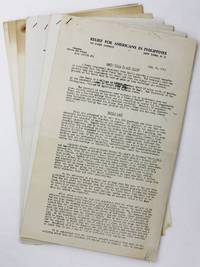
19454668New York 1945. Very good. Sixteen issues totaling 75pp. Legal-size sheets stapled. Previously folded. Light wear and toning. An extensive run of newsletters by a New York-based aid group Relief for Americans in the Philippines. Included here are issues 9 12 14 through 18 and 20 through 28 which were published between 1942 and 1945. The organization was devoted to the support of Americans who were imprisoned at San Tomas Gabuio and other camps after Japan occupied the Philippines during World War II. At the outset of the war the Philippines were a commonwealth of the United States but within three weeks of the attack on Pearl Harbor the Japanese seized control. The 20000 American and 80000 Filipino troops on the ground departed and any remaining American or British citizens were rounded up in Manila and transferred to the University of Santo Tomas where they were left to fend for themselves. The only exceptions were a 7:30 pm roll call each night and the use of room monitors. The background of the captives varied wildly from business executives and retired soldiers to prostitutes. At the end of the war the total number of prisoners liberated was 3785 2870 of which were American.<br />  <br /> Issue 14 remarks on the first anniversary of the non-profit organization: “On May 8th 1942 just a year ago and two days after the fall of Corregidor our organization came into being for furthering plans for the shipment of food medical supplies and other necessities for the internees and also to serve as a clearing house and point of dissemination for information concerning the welfare of these internees.†The monthly newsletter prints news and developments from the camps in the Pacific and documents the efforts of the organization to provide aid to the prisoners there. The issues also print a running list of all those believed to be in the Philippines “solely for the purpose of obtaining names and addresses of the nearest relatives of who we have no record.†A scarce record of this little-known relief effort during World War II. unknown
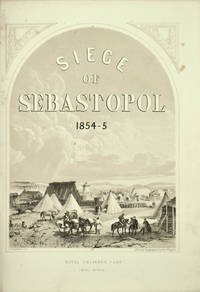
81134George Edward Eyre and William Spottiswoode for the Queen's Stationery Office London 1859. . Three parts in 4 volumes 4to 29.5 x 23.5 cm including a slipcase. Folding lithograph frontispiece by J. Ferguson after Cowell Biddulph and a photograph by Robertson lithographic title by Ferguson after Elphinstone title vi 299 1 pp. 6 lithographed tables by H. James and 6 numbered plates on 5 folding sheets of stronger paper; repeated lithographic title title table of contents 638 pp. 1 l.; vii including title 273 pp. 1 l.; atlas of 16 plates on 12 folding sheets of stronger paper one on thiner -- in all 22 plates plates lithographed by H. James under the direction of Cameron numbered I-XX with XVIa and including a rarer 'Sheet III' on thiner paper some with outline hand-colour; light spotting to text maps with occasional soiling some folds with short tears. Contemporary red cloth covers with blind-stamped panel decoration flat spines lettered in gilt; spines rubbed and faded with shelfmark labels to foot slipcase strengthened.<br /> First edition of this large work: a very good copy complete with the 3 volumes of text and all maps plans and views of Sevastopol - despite the slipcase label showing a somewhat inattentive collation by the H.M. Stationery Office stating "Note.-This Volume is incomplete no perfect copies are available for issue."<br />Sir Elphinstone 1829-90 was born in Livonia now Latvia and was awarded the Victoria Cross in June 1855 for fearless conduct during the Crimean War. At the final assault on Sebastopol on 8 September he was wounded by a splinter on the left side of the head and lost an eye. He later became major-general.<br /> George Edward Eyre and William Spottiswoode for the Queen's Stationery Office, London, 1859. hardcover
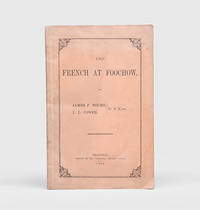
1884173626Shanghai: Printed at the "Celestial Empire" office 1884. China is like a large pie. For many years covetous nations have been nibbling at the edge of the crust First edition of this eyewitness account of clashes between French and Chinese naval forces following the collapse of the Li-Fournier Agreement. Two tables show detail each side's ships and their specifications as well as the damage they sustained. The Tonkin War developed out of a tussle between France and China for influence in Vietnam. Following a number of engagements diplomatic exchanges between Li Hongzhang and Captain Ernest François Fournier produced a tentative agreement that China would withdraw from Tonkin and legally recognize a French protectorate. Negotiations however eventually broke down and the French launched an attack on Fuzhou on 23 August 1884. Foreign military observers including the two American authors of this report saw the engagement as a chance to evaluate the success of recent Chinese attempts to modernize the imperial navy. For the Qing empire the Battle of Fuzhou was a disaster the French fleet eight ships outgunning its eleven vessels all of which were eventually sunk. The defeat "paved the way for the dynasty's downfall" Po p. 206. The eight plates are after sketches made during the battle and show several Chinese ships before and after they were sunk. The final sketch is of a dog which drowned while trying to escape from the Yangwoo the Chinese flagship. Octavo. With 8 plates tables in text. Original light orange wrappers front cover lettered in black within ornamental black frame. Wrappers only lightly creased and marked contents sometime neatly consolidated into covers with adhesive text and plates clean: a near-fine copy. Cordier 2500. Ronald C. Po The Blue Frontier: Maritime Vision and Power in the Qing Empire 2018. unknown
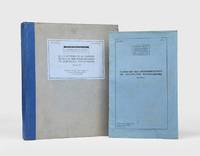
1918166765France: General Staff Intelligence General Headquarters. February 1918. Towards "total knowledge of the battlefield and total control" An impressive exposition of the rarified level reached by fixed-wing aerial reconnaissance and photo interpretation by the last year of the war. Third edition considerably expanded of the slight and fragile text pamphlet first published 1916 paired unusually with the impressive plate volume - both are decidedly uncommon. These were produced in France by Army Printing & Stationery Services and classified "For Official Use Only"; despite a stated print run of 4000 few copies of the pamphlet have survived. The first item contains concise but detailed notes on how to identify various battlefield structures and features - trenches and wire dugouts and mine shafts listening and observation posts batteries concrete structures and so forth - followed by a section on rear organizations - railways dumps billets and aerodromes - noting that from the "enemy's means of supply" and the study of aerial photographs more generally "often his intentions may be deduced". The pamphlet concludes with a brief section of technical notes on the uses of different types of photographs oblique stereoscopic stereoscopic oblique and how these may variously offer enhanced potential for interpreting detail. The substantial atlas contains an exceptionally fine range of high quality photos illustrative of the points made in the accompanying notes. Many of the views are accompanied by maps or sketches to clarify interpretation with locations often identified. Just ten years after the Wright Brothers' epoch-making 12-second flight at Kitty Hawk the aeroplane had become a gun platform duelling in the air and the instrument of accurate distant bombardment; and perhaps most influentially the ultimate mode of reconnaissance profoundly altering the nature of engagement. "At the outbreak of the First World War commanders like British Field-Marshal John French believed that no mechanical platform would ever replace cavalry as a means to conduct reconnaissance. Within months however the horse succumbed to industrial warfare as did traditional methods of cavalry generalship. In the place of cavalry arose the modern military intelligence bureaucracy that employed a Fordist system of photo interpretation in an attempt to achieve total knowledge of the battlefield and total control. The power of photo interpreters in the words of Paul Saint-Amour was 'not in the mere ability to command but in the more rarefied capacity of producing the knowledge that would inform the commanders'" Gettinger. Text foolscap folio. First named with double-folding plate of "Shadow Diagrams" at rear; plate vol. containing around 100 illustrations on 60 silver print photographic plates linen stub-bound on heavy card plate of mark-up symbols and a repeat of the folding plate from the text pamphlet. 11 pp Wire-stitched in light greenish blue printed wrappers: plate vol. folio 360 x 310 mm strong blue cloth-backed greyish-yellow paper-covered boards printed paper label to front board. Touch of foxing to wrappers of text pamphlet and just a little rust to staples top corners of plate volume lightly bumped. Both in very good condition. Dan Gettinger "The Ultimate Way of Seeing: Aerial Photography in WWI" 2014 Center for the Study of the Drone at Bard College online. hardcover
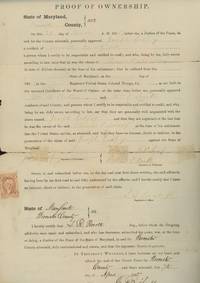
1865List2219Baltimore and Worcester County 1865. Two documents affixed at top edge measuring 9 x 6 ¾ and 14 x 8 ½ inches. Tape repairs at folds some with heavy clear tape else excellent good condition overall. With the embossed stamp of the Board of Claims to first document and two revenue stamps affixed. Good. A pair of documents relating to the emancipation through military service of Thomas Massey of Maryland and compensation to his enslaver Joseph Godrey of Worcester County Virginia. Massey enlisted in the 9th Regiment of the USCT in 1864 and in accordance with Order 329 of the U.S. War Department Godfrey received compensation which was not to exceed $300. The present documents “To facilitate recruiting in the states of Maryland Missouri Tennessee and Kentucky the War Department issued General Order No. 329 on October 3 1863. Section 6 of the order stated that if any citizen should offer his or her slave for enlistment into the military service that person would "if such slave be accepted receive from the recruiting officer a certificate thereof and become entitled to compensation for the service or labor of said slave not exceeding the sum of three hundred dollars upon filing a valid deed of manumission and of release and making satisfactory proof of title." https://www.archives.gov/education/lessons/blacks-civil-war/article.html The order was meant to provide financial incentives to enslavers following the Emancipation Proclamation earlier that year. We find a record of a Thomas Massey from Worcester County born in 1855 which would raise the possibility that he enlisted at age 9 or that the Thomas Massey in question in these documents is not findable in the genealogical references we checked. unknown
186161812New York: W. Schaus; printed by Sarony Major & Knapp 1861. Second Edition. 59 x 76cm open. 19.5x19cm closed. Tinted lithographic map backed in brown silk in black slipcase with printed paper label. Bookseller's ticket of Rev. A. O. Brickman Baltimore. Two ownership inscriptions of "J. M. Deems Maj. 1st MD Cav" and inscribed "Deems" on the slipcase. Trimmed; splits along half of one horizontal fold; minor stains and discoloration to verso not affecting image which is bright and generally Very Good. Hand-made slipcase worn with portion cut out but with manuscript ownership label intact. <br /> <br /> Uncommon Civil War map used by a distinguished Union Army officer. James Monroe Deems 1818-1901 was a composer and music educator from Baltimore who secured a commission as a major in 1861. He was promoted to Lieutenant Colonel in spring 1863; led the First Maryland Cavalry during the Battle of Gettysburg; retired due to rheumatism in November 1863; and was brevetted Brigadier General in 1867. He likely acquired this map in Baltimore near the beginning of his military career and certainly before his promotion in 1863 given the use of "Maj." in his ownership inscriptions. <br /> <br /> The map itself is the second edition of this design by J. Schedler despite the title it is not a bird's-eye view. The more common first edition has two insets showing the Lower Mississippi Valley and the city of Richmond see Stephenson 17.3. This version has only one inset showing the eastern United States. Stephenson describes this edition as having a Washington DC bookseller's ticket; the present copy has a Baltimore bookseller's ticket instead. <br /> <br /> This copy was mounted for use in the field: it was trimmed down to the neatline the captions removed the image cut up into segments and mounted on linen. The printed label on the slipcase appears to be a portion of the original title. This may have been done by the bookseller Brickman possibly at Deems' request. <br /> <br /> Uncommon. OCLC records about 10 similarly titled maps but few listings distinguish between the first and second editions. STEPHENSON LC Civil War Maps 2nd ed 17.35. 61812. [W. Schaus; printed by Sarony, Major & Knapp] unknown
58075Very Good. 417-423; 416pp. 52 numbers averaging 8pp. each. Folio 39 cm Contemporary 1/4 leather binding with limp boards which maintain some of the original marbled paper. Professionally recased. Restoration work to spine ends. Formerly exposed boards skillfully restored with handmade paper at the extremities. Hinges reinforced with Japanese tissue. Missing front front free endpaper. Periodic minor markings to the pages else internally very good. Flake 2822. A complete run of this volume of particular significance due to the historical events embraced by the year 1857-58: the Mormon "War" the Mountain Meadows massacre the incursion of federal troops against Utah the Reformation etc. Included is a major portion of the serialized "History of Joseph Smith" and the beginning of the serialization of Brigham Young's autobiography numerous documents by Young dispatches from the outside press relevant to the situation discourses by Elders etc. Also noteworthy is the printing of Young's December 15 1857 Governor's Message in the Dec. 23 issue; the Memorials to the President of the United States printed in the October 7 issue; and other major items relating to the conflict possibly in their earliest printings as well as much material related to overland travel freighting commerce and more. unknown
1665ABC_46560Amsterdam 1665. 4to. Jacobus Venckel Contemporary half vellum marbled sides. With an ornamental woodcut title-vignette. 35 1 blank pp. Rare pamphlet written by an anonymous author discussing the fascinating Battle of Vågen the main port area of neutral Bergen in Norway in August 1665 during the Second Anglo-Dutch War 1665-1667 including its background and aftermath. The Second Anglo-Dutch war was a war at sea caused by conflicts in colonial territories of the Dutch Republic and England. This naval war consisted mainly of protecting their own merchant ships capturing enemy ships and trying to sink mutual warships. The Battle of Vågen was an important naval battle between a rich treasure fleet of the Dutch East India Company VOC and an English flotilla of warships. The present pamphlet gives an account of the events before and after the Battle of Vågen and also in broad lines of the battle itself including all kinds of correspondence and notes from high-ranking figures.Since Tiele attributes this anonymous edition to Venckel it seems likely to be the first edition which Venckel first published anonymously. In any case the present edition is rare. We find only two records of it at auction in 2005 and 2015 the other copies are all held institutionally. A highly interesting pamphlet on one of the most important and fascinating 17th-century sea battles in Dutch naval history and in the history of the Dutch VOC.A few spots the margins trimmed with no loss of text except that the words "Zee-Journael" on the title-page are slightly shaved. Otherwise in good condition.l Knuttel 9103; STCN 863290108 6 copies; Tiele 5266; WorldCat 5 copies in 4 entries; for Venckel: H.F. Wijnman De Amsterdamsche boekverkooper Jacob Vinckel 1627-1680 in: Vondel-kroniek 5 1934 p. 192. hardcover
18291511300026Roma Tip. della Societa editrice 1829 - 1838. First Edition. Hardcover. Good. 8 volume set. 848 pl. of 850. Folios 46 cm. Bound in contemporary 3/4 green leather. Marbled boards. Top edge gilt. Wear and rubbing to extremities. Library bookplates. Markings to spine and verso of title page. Front board detached to Vols. IVIVII. Front boards starting to Vol. I-III. Chipping and loss to head and tail of Vol. I III and VII. Lacking two plates. Pages clean and unmarked. Brunet IV p. 677. <br>Collated: Vol. I: 304p. 86 pl. complete; Vol. II: 294p. 68 pl. plate LXVII as plate LXVI matching plate list then to pl LXVIII resulting from pl. XI printed as X and number continuously as such complete; Vol. III: 280p. 113 pl. complete; Vol. IV: 279p. 115 pl complete; Vol. V: 230p. 118 pl. complete; Vol. VI: 188p. 106 pl. complete pl 90-100 misbound; Vol. VII: 128p. 98 pl lacking pl 19; Vol. VIII: 170p. 152 pl. lacking pl 92. This is an oversized or heavy book that requires additional postage for international delivery outside the US. Roma, Tip. della Societa editrice hardcover
193064035Enshih Shihnan Hubei China: R.J. Mueller Rev. Gebhardt Miss Simon LCMS ca. 1930-1937. Two vols. 1st - Oblong folio. 11.25 x 15 in. 48 pp unpaginated. thick black paper stock w/ 103 original silver gelatin photographs sized 2.75 x 3.5 in. all neatly numbered in ink MS at corners affixed to the leaves. Contemporary black flexible board post-binder punch-sewn & glued at spine in black paper paper title label partially torn on front cover Building Committee title label affixed to first page minor chipping edgewear to fore-edges some scuffing tidemark to fore-edges still a VG- exemplar w/ all images with bright strong contrast; 2nd - 4to. 8 leaves carbon copy typescript on onion-skin ruled paper some ink annotations corrections 1 pencil MS annotated correction still VG signed by R.J. Mueller on first leaf dated April 24 1937 from the library of David G. Kohl 1946-2025 former art teacher at the Hong Kong International School musician artist and historian. A remarkable photo album with images shot by three different Lutheran Church Missouri Synod LCMS missionaries in China along with the descriptive contents list compiled by Rev. R.J. Mueller detailing the purpose and composition. He writes that the Enshih Shihnan Mission had prepared three albums “one for the Mission Board one for the Building Committee of General Conference and one at the Enshih Station. The numbers all agree. However not all pictures listed appear in all books.†This “Building Committee†album was intended to focus primary on the structures homes chapels of the mission as well as surrounding areas and was intended to aid in speeding up communications for fundraising and building affairs issues as correspondents could then merely refer to the master list of numbers held by all three parties. Enshih China was one of the final mission stations established by the LCMS far from their other missions and when Gebhardt returned to Enshih following the Civil War in 1928 there was significant damage to the mission structures to be repaired. Looting by bandits and marauding soldiers had caused over $ 2000 in damage but was encouraged to find that the Lutheran evangelist Shen had continued the mission chapel school orphanage. He would later be joined by Mueller and others although primarily composed of Chinese Staff. These photos in the album includes views of Mueller’s residence windows frames and gutters looted; screens torn doors boarded up as well as views of the native house and threshing floor adapted into an orphanage at Yao Wan after 1930. Several others show the extent of the protective walls built around the properties farm houses the gates as well as farms bridges and nearby fields at Enshih. Landmarks such as rocks shaped like Elephants in the river and Big and Little Hog creek below farmland. A very nice series of photos depict the Ts’i Ts-ung-fu funeral the blind deaf and other orphans about 1931 as well as textiles drying in the sun. Other photos capture the Ch’i-li-ping market fortune teller temple noodle stand and the T’ai shan shrine at Ch’i-li-p’ing. More photos depict Hu Ping-chih the orphanage secretary Yuen Ye-chih cashier in 1934 Hsieh T’i-ya seminary student who died later in 1937; along with the mission pulpit nearby streets and the rear view of the Yao Wan houses.Of additional interest are the images of the rugged roads to Liang Shui-chin the temple and steep steps drying opium in Kuan-p’e which was a small town between the East Gate and Yao Wan before opium raising was banned in 1934; along with the nearby Ch’ing-Ching Clear River at the high water stage the front of the True Light Chapel in 1934 as well as the gravestone of Mr. & Mrs. Wang Japanese-Lutherans who had died in 1930. The final photo No. 169 again shows the Clear River below the city. Mueller 1905-1998 graduated from seminary in 1929 and left for China with his wife Dorothy for the Evangelical Lutheran Foreign Mission Board returned briefly to the U.S. from 1937-1940 spent 1939-1942 teaching at a Lutheran seminary in China while being bombed by the Japanese and also served in Shanghai where he would supervise the Lutheran Hour and Lutheran Hour offices. Although he and his wife briefly returned to the United States in 1946 following World War II they subsequently served again in Shanghai China into the early years of Communist rule by Mao tse-tung before returning again to the U.S. See: David Kohl Lutherans on the Yangtze: A Hundred Year History of the Missouri Synod in China 2014 pp. 103 124 131 132 166 174 99-131. R.J. Mueller, Rev. Gebhardt, Miss Simon, LCMS, unknown
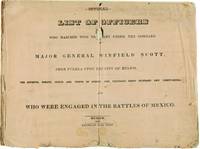
1848247009Mexico: American Star Print 1848. 24pp. plus map. Errata pasted to verso of title leaf. Obling 4to. Original printed wrappers stitched as issued. Contemporary ownership inscription on front wrapper. Wrappers lightly soiled and chipped; small paper loss to front wrapper affecting two letters in the third line of the title. Slight paper loss to same area on title page minutely affecting text; likewise the map and first leaf of text with loss becoming progressively smaller. Light soiling and wear. Still a good copy of a scarce work. In a folding cloth case. 24pp. plus map. Errata pasted to verso of title leaf. Obling 4to. The text in the form of detailed tables lists the officers with Scott where they were employed and whether they were killed or wounded or distinguished themselves. "Printed on the occupying army's own press" - Howes. This copy includes the plan of the battles in the vicinity of Mexico City which is often lacking and it include the extra two lines of errata. This copy has the ownership inscription of Mexican War veteran J.R. Smith of Sackett's Harbor N.Y. Smith is listed on page fourteen of this work; he participated in the battles at San Geronimo and Contreras & Churubusco on August 19th and 20th where he was severely wounded and disabled for the remainder of the campaign.<br /> <br /> A scarce work in original condition made particularly nice through interesting provenance. Howes S243 "aa." Garrett p.131. Haferkorn pp. 53-54 American Star Print unknown
186110065752 folded and docketed uniform manuscript resolutions mostly 4to typically written on one side and docketed on the back includes a contemporary cover sheet that originally held resolutions together two small pictures of Lincoln and Grant included housed in modern photo album. A few with folds at the top and minor chips normal aging and browning; overall in very good condition. These resolutions were passed by the Public Aid Committee which was created by the Newark City Council at the beginning of the Civil War to advance money to soldiers' families. These resolutions would then be given to a clerk for filing. This clerk seems to have had strong anti war or Copperhead sympathies and gradually began editorializing as he wrote out the docketing on the back of each folded document. He titled the 31 March 1862 resolution "For aid to families. in the war to abolish slavery." On 2 September it was "the war for the ruin of the country." On 26 November it became "the Negro War" and 2 December it says "the Army of Abm. Lincoln to subjugate the Southern States." This obscure city clerk took things a step further after the Emancipation Proclamation. On 4 February 1863 he titled a resolution "In aid of families of volunteers. in the Nigger War!" He must have been spoken to after this remark because he drifts into sarcasm rather than outright racism. In a later resolution he states "for the benefit of our coloured fellow citizens of African decent." However by 14 September 1863 he was back to his old tricks again referring to "Lincoln's nigger war." He continued his editorializing through June 1864. These docketed resolutons were found in the included wrapper on which a a Union soldier later wrote: "The name if it can be found out of the miserable traitor who booked the within resolutions should go down in posterity as one who should receive the contempt of loyal men." The name of that Union soldier appears to be Major W. W. Morris.
186458358Various places including Methuen Lawrence Andover Boston and Lowell Massachusetts 1864-1865. modern calf antique with original gilt-lettered label "Company Clothing" laid down on front panel. Folio. Two pages list "Price of Clothing Camp & Garrison Equipage Year 1864." Following are 204 pages one to a soldier listing name company place and date of enlistment articles of clothing issued value itemized date of clothing issue and signature of soldier and witness. In some cases date of discharge desertion or demise is also noted. A "colored" under cook is also listed along with the soldiers. hardcover
186810671New York: Blelock & Co 1868. Hard Cover. near Very Good binding. 12mo. vi 139 1 pp. First edition. As issued in publisher's cloth. Binding has some wear to the spine ends and corners and is slightly sunned at the spine; a few places on the rear board where the cloth is rippled; contents generally toned with occasional and scattered soiling; one leaf with minor loss to the bottom corner affecting the margin only. While this copy has it's minor condition issues it is rarely found in better condition. Generally it is as nice a copy as is typically found of this scarce book. This copy with the contemporary ownership marking of Confederate veteran from Georgia Elisha Thurmond and dated 1869. <br /> <br /> Harwell writes "Robertson in Civil War Books describes this as 'an overly sentimental tribute' but there is a time for sentiment and such a time came to the Reverend Edwards when he was called upon to write about twin brothers one who died at Centreville Virginia June 30 1861 and the other who died on the battlefield of Fair Oaks June 30 1862" In Tall Cotton 51. CWB 1 85. Blelock & Co unknown