[Con Artists - Cartography - War Correspondence - California] De Beaufort, Jack or JacquesBiblio.com
11 490 résultats
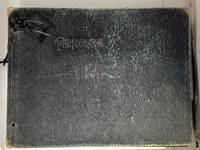
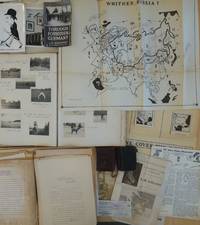
1950List2425Europe and California 1950. Includes two small diaries from 1901 and 1917 with sporadic entries a large photo album measuring 14 x 11 with appx. 400 small photographs from 1906-1909 attached to album pages most measuring 3 x 2 as well as a few larger format images laid in. With 100 plus pages of typed pages including retained correspondence story ideas and various other manuscripts. With eleven maps produced for his “Of Men and Maps†series including five copies of a large map entitled “Whither Russia†in varied states and in large sizes up to 30 by 36 inches and a handful of small ephemeral pieces. Generally near fine condition with the exception of the album which is missing its rear board and has some pages loose and torn. Very Good. J.M. de Beaufort a war correspondent for the London Daily Telegraph and New York American during World War I recounted his wartime adventures in the 1917 book "Behind the German Veil: A Record of a Journalistic War Pilgrimage." Originally arriving in Chicago in 1909 he married a steel magnate's daughter and pursued a career in show business. However by 1912 he had gone through a divorce and transitioned to newspaper work earning the moniker of the "Dude Reporter." Originally born in the Netherlands as Jacques Albert Uilenbroek he was thought to be a deserter. He spent the latter part of his life in the United States apparently jailed in San Francisco for a stint in the 1920s and eventually settled in Los Angeles. <br /> Offered here is an interesting smattering of material from the life of the mysterious De Beaufort which bookends his most unusual career and life with a large visual photographic record of his life in Europe as a young man and over a hundred pages of manuscript material from late in his life with a highlight being several maps in draft form for an apparently unpublished project called “Of Men and Maps.†As a group the material shows the work of an ex-con artist and war correspondent trying to regain his form while living in Los Angeles. He was still writing as a “Special Correspondent†at this point though the title seems to have been fully honorary. Also included are two small pocket journals with sporadic notations from his life in Europe in 1900 and in 1917. In its entirety the group gives an interesting visual and manuscript record of a literary fraudulent and imaginative transatlantic life and intellect. <br /> The cartographic highlight of the group is several iterations of a large map called “Whither Russia†in varied forms which show an interesting interpretation of the sphere of influence of the USSR and its growth from 1939 to 1946. Also included are two drafts of a map of Operation Market-Garden in the Netherlands in 1944 an unidentifed tactical map of a military battlefield a map called “Middle East Jackpot†showing the division of territory between the Allied and Axis powers a map called “Dawn’s Early Light some reproduced small format maps from the De Beaufort’s and a small map called “Gifts from Yalta.†De Beaufort was working on these maps for a column called “Of Men Maps and Memories†that was published in the East Los Angeles Tribune. He also sent the columns out in newsletter form from his address at 1635 N. Ogden Drive in Los Angeles. <br /> The collection of manuscripts drafts and retained correspondence tackle a range of subjects perhaps most interestingly those detailing De Beaufort’s creative process - drafts of stories lists of ideas for stories and letters. His over the top style is on display in a lot of the writings some of which are of unknown origin and purpose. The documents contain correspondence between De Beaufort and Edwin Pauley the oil man and presidential advisor. In one untitled essay he asks himself the question “What has been your most thrilling experience†and his reply is “ Silly questions. Who or at least what newspaperman of some 25 turbulent years standing - and falling - could answer such a question. A reporter’s life has a thousand thrills. There was that rainy day in Marcy 1915 in the fortress of Loetzen when I stood face to face with Hindenburg. Hm yes that was quite a thrill…†De Beaufort was entrenched in the Los Angeles journalistic scene at this point and the documents show the degree to which he relied on his former glories to attempt various career revitalizations endeavors. <br /> The album of photographs from 1906-1909 over 400 in total give a visual record of the young Uilenbroek’s life in Europe. The star of the collection is his bulldog Bob who travels throughout Europe with him and eventually comes to America by 1907. Mary who we presume to be his future wife is featured heavily in the images. It is unclear whether he was working at this point the images show affluent young people and their dog in varied cities and are purely of a personal nature. Other photographs laid in are relics from his war correspondent period. The loose photographs and ephemera are a mix of portraits from different periods from his life including two pictures of Sydney Turing Barlow Lawson one signed by his widow. The journals are sporadically filled and hard to decipher though one legible passage says “drinking all day.â€<br /> Overall the group gives evidence of this intriguing life and is the only extant group of material relating to Beaufort to our knowledge with the exception of a single journal from his time in Belgium during WWI that was sold at Bonhams and is still available in the trade as of this writing. unknown
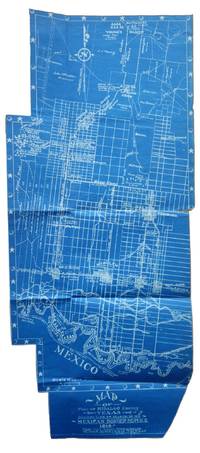
1917List2530VP 1917. Scrapbook measuring 15 ½ x 10 ½ inches. With forty leaves most with newspaper clippings and varied ephemera attached. Boards detached contents generally fine. Laid in is a blueprint map entitled Map of Part of Hidalgo County Texas Showing Line of March in my Mexican Border Service 1916. Made from Survey Notes taken on the march by Corp. C.A. Rice 74 Inf. N.G.U.S. Buffalo N.Y. Armory. Map measuring 33 ½ x 14 ¾ inches irregularly shaped and apparently complete. Very Good. A scrapbook documenting the military service of 1st Sergeant Samuel Gaffney of the 74th National Guard New York in the Mexican Border Service. Gaffney documents the campaign in great detail through printed matter - with each of the forty leaves containing material affixed including panoramic photographs advertisements from local businesses along the routes programs from entertainment offered to the troops military orders and official correspondence and many affixed newspaper articles and photographs. <br /> <br /> The scrapbook is most notable for the inclusion of an unrecorded map by Charles A. Rice the Buffalo native who would eventually map the campaign in larger fashion in a map entitled Map Showing Lines and March and Border Patrols in my Mexican Border Service 1916-1917. The map here just showing the route through Hidalgo County is unrecorded. The larger map - which was produced as souvenirs for the other members of the 74th - is quite scarce as well with five copies known to exist per OCLC with two different numbers. This blueprint map which appears to be complete cartographically and missing only the ornamental border on one portion shows the route taken early in the campaign in 1916. The Buffalo native Rice 1885-1931 who would eventually settle in Texas after the conflict also wrote a history of the 74th during the campaign. Rice published the maps and memoir himself. The map shows the route in great detail showing the location of wells farms roads and identifying landowners. Water quality and abundance is understandably a common theme in Rice’s notes. Some notes show the location of bandits smugglers and the like. We find no other examples of blueprint maps by Rice. <br /> <br /> Other highlights from the scrapbook include seven panoramic photographs of the 74th encamped at Pharr; a broadside advertisement for the shop of Agustin Acevedo in Pharr listing prices of goods; a handbill advertising the 74th’s Minstrels and Great Entertainment show on September 16 1916; an advertisement for a production entitled Glorious Liberty at the National Theatre in Pharr; two circulars instructing troop movement issued by Headquarters Brownsville District; several postcards with songs about the campaign; several snapshots; a mounted albumen photograph of troops at rest with the notation “Corp Frederick Paid†verso; a typed poem entitled “Home Again†and a notebook page describing his activities from January 1917 onward; and a thanksgiving menu for 1916 for the holiday spent at Pharr. The remainder of the scrapbook is composed of affixed newspaper clippings which provide extensive information on the 74th collected in a single volume. <br /> <br /> Overall a significant scrapbook with much information to glean for students of the 74th’s activities with the map providing a unique cartographic reference of the early days of the campaign. unknown
179332480London: Printed for J. Debrett 1793. The Second Edition with Considerable Additions. Three-quarter leather. Good. Octavo. 1 xvi 433 pages 1 page blank 19 page index 1 page errata 2 pages advertisements 1. Recased binding with three-quarter brown leather and marbled paper covered boards. Gilt title and five raised bands on the spine. Newer front and rear end papers and one front blank end sheet inserted. The original rear end sheet is present. The folding frontispiece map is toned on the verso with an old repair made also on the verso. Some light edge wear to the map. The folding view of the Rapids of the Ohio and the State Map of Kentucky are in very good condition with light toning. <br /> <br /> Pages 417-433 includes a "Report of the Secretary of State to the President of the United States of the Quantity and Situation of the Lands not Claimed by the Indians Nor Granted to Nor Claimed by Any Citizens Within the Territory of the United States. Read in the House of Representatives Nov. 10 1791" by Thomas Jefferson. <br /> <br /> Howes I 12; Howes Reference Filson - F 129; Sabin 34355; Streeter III 1523; Clark II 41 "An early account of the western country.which was produced by a man who left Kentucky without settling his obligations who seems to have been involved in efforts to organize a French expedition to take the lower Mississippi Valley and who treated Mary Wollstonecraft Shamelessly. This book was written in the form of letters from Kentucky to a friend in England. In all probability they were written in Europe. Printed for J. Debrett unknown
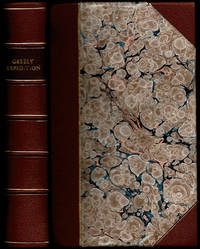
1884E0873<p>21-3101-265 pages with 6 folding maps 7 photo-lithographs on 4 plates and appendix containing correspondence relating to the Lady Franklin bay expedition 1881-83 and index. Royal octavo 9 1/2" s 6 1/4" bound in half leather with five raised spine bands and gilt lettering to spine over marbled boards. Senate Executive Document 100 48th Congress 1st Session. First edition.</p><p>The Lady Franklin Bay Expedition of 1881–1884 a.k.a. the Greely Expedition to Lady Franklin Bay on Ellesmere Island in the Canadian Arctic was led by Lieutenant Adolphus Greely and was promoted by the United States Army Signal Corps. Its purpose was to establish a meteorological-observation station as part of the First International Polar Year and to collect astronomical and magnetic data. During the expedition two members of the crew reached a new Farthest North record but of the original twenty-five men only seven survived to return.</p><p>The Lady Franklin Bay Expedition was led by Lieutenant Adolphus W. Greely of the Fifth United States Cavalry with astronomer Edward Israel and photographer George W. Rice among the crew of twenty-one officers and men. They sailed on the ship <em>Proteus</em> and reached St. John's Newfoundland in early July 1881. <em>Proteus</em> arrived without problems at Lady Franklin Bay by August 11 dropped off men and provisions and left. In the following months Lieutenant James Booth Lockwood and Sergeant David Legge Brainard achieved a new Farthest North record at 83°24′N 40°46′W off the north coast of Greenland.</p><p>By summer of 1882 the men were expecting a supply ship from the south.<em> Neptune</em> laden with relief supplies set out in July 1882 but cut off by ice and weather Captain Beebe was forced to turn around prematurely. All he could do was leave some supplies at Smith Sound in August and the remaining provisions in Newfoundland with plans for their delivery the following year.</p><p>In 1883 new rescue attempts by <em>Proteus</em> commanded by Lieutenant Ernest Albert Garlington and Yantic commanded by Commander Frank Wildes failed with Proteus being crushed by pack ice. In the summer of 1883 in accordance with his instructions for the case of two consecutive relief expeditions not reaching Fort Conger Greely decided to head South with his crew. It had been planned that the relief ships should depot supplies along the Nares Strait around Cape Sabine and at Littleton Island if they were unable to reach Fort Conger which should have made for a comfortable wintering of Greely's men. But with <em>Neptune</em> not even getting that far and Proteus sunk in reality only a small emergency cache with 40 days worth of supplies had been laid at Cape Sabine by <em>Proteus</em>.</p><p>When arriving there in October 1883 the season was too advanced for Greely to either try to brave the Baffin Bay to reach Greenland with his small boats or to retire to Fort Conger so he had to winter on the spot.</p><p>In 1884 Secretary of the Navy William E. Chandler was credited with planning the ensuing rescue effort commanded by Cdr. Winfield Scott Schley. While four vessels—<em>USS Bear USS Thetis HMS Alert</em> and <em>Loch Garry</em>—made it to Greely's camp on June 22 only seven men had survived the winter. The rest had succumbed to starvation hypothermia and drowning and one man Private Henry had been executed on Greely's order for repeated theft of food rations. Of the seven rescued Joseph Elison died on July 8 following multiple amputations. The relief party arrived at St. John's Newfoundland on July 17 1884 from which the news was telegraphed throughout the States and a sketched portrait of the members of the Greely Expedition both living and dead was published. After a stay of ten days the ships left for New York.</p><p><strong>Condition: </strong>Rebound in period binding with refreshed end papers else very good.</p> Government Printing Office hardcover
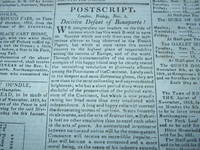
1812012295Northampton: Printed By And for T. E. Dicey W Sutton And R. Smithson 1812. 1812. Saturday January 4th 11th 18th 25th February 1st 8th 15th 22nd 29th March 7th 14th 21st 28th April 4th 11th 18th 25th May 2nd9th 16th 23rd 30th June 6th 13th 20th 27th July 4th 11th 18th 25th August 1st 8th 15th 22nd 29th September 5th 12th 19th 26th October 3rd 10th 17th 24th 31st November 7th 14th 21st 28th December 5th 12th 19th 26th. 1813 Saturday January 2nd 9th 16th 23rd 30th February 6th 13th 20th 27th March 6th 13th 20th 27th April 3rd 10th 17th 24th May 1st 8th 15th 23rd 29th June 5th 12th 19th 26th July 3rd 10th 17th 24th 31st August 7th 14th 21st 28th September 4th 11th 18th 25th October 2nd 9th 16th23rd 30th November 6th 13th 20th 27th December 4th 11th 18th 25th. 1814 Saturday January 1st 8th 15th 22nd 29th February 5th 12th 19th 26th March 5th 12th 19th 26th April 2nd 9th 16th 23rd 30th May 7th 14th 21st 28th June 4th 11th 18th 25th July 2nd 9th 16th 23rd 30th August 6th 13th 20th 27th September 3rd 10th 17th 24th October 1st 8th 15th 22nd 29th November 5th 12th 19th 26th December 3rd 10th 17th 24th 31st. 1815 Saturday January 7th 14th 21st 28th February 4th 11th 18th 25th March 4th 11th 18th 25th April 1st 8th 15th 22nd 29th May 6th 13th 20th 27th June 3rd 10th 17th 24th July 1st 8th 15th 22nd 29th August 5th 12th 19th 26th September 2nd 9th 16th 23rd 30th October 7th 14th 21st 28th November 4th 11th 18th 25th December 2nd 9th 16th 23rd 30th. Complete 4 years. Book measures 54.5x40.cm. Binding heavily worn lacking top board. Internally about 20 issues have some loss of text mainly minor loss or single hole some light browning spotting heavier in places some minor staining. Generally text in good clean condition. . Near Very Good. Folio. Printed By And for T. E. Dicey, W, Sutton, And R. Smithson unknown
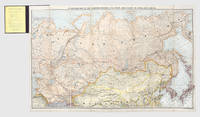
1917170670London: Edward Stanford 1917. Navigating a region in crisis The 1917 edition of this long-running map the working copy of Captain Noël Louis St Pierre Bunbury a member of Major-General Alfred Knox's British Military Mission to Siberia. Bunbury travelled along the Trans-Siberian Railway between April and November 1919 training White Russian officers and soldiers. Important stops along the railway are marked in blue pencil. Appointed by Lloyd George and Winston Churchill Knox was a logical choice being fluent in Russian and having served in St Petersburg in diplomatic posts before the First World War. His mission running parallel to the deployment of British troops arrived in Omsk in October 1918. Knox was tasked with organizing Russian units to fight the Bolsheviks and strategically advising Admiral Kolchak who was installed as Supreme Ruler of Russia at Omsk the following month. Bunbury 1890-1971 served in several campaigns in Waziristan received the DSO in 1937 and earned promotion to brigadier in the Indian Army in 1941. Between 1943 and 1944 he was aide-de-camp to George VI. Colour lithographed map 750 x 1140 mm laid down in sections on linen as issued folding away into octavo cloth covers front board with yellow label lettered in black. Map bright a little soiling more so on verso and to boards spine sunned: a very good example. hardcover
1947188776London: Admiralty Technical Reproduction Branch 1947. Documents from the heart of the Nazi state First edition a complete set of this internally circulated series reproducing the detailed minutes of meetings held between Hitler and his naval commanders in the period 1939-45. The material formed part of a large tranche of the German Naval Archives captured by Allied forces at Tambach Castle in Bavaria in April 1945 the documents having been moved from Berlin in 1943 for safekeeping. After the surrender material with intelligence value was moved to the Admiralty and American intelligence headquarters in London and analysed. These volumes were edited by Admiralty staff from translations made by British and American naval personnel and distribution occurred in three-week intervals per volume in the UK and US. Volume I opens with records of top-secret preparations for war in April 1939 and the series closes with supplementary material from early May 1945 following Hitler's suicide including the German government's final communications with Japan. Loosely inserted in the first volume is a notice dated 15 May 1947 embargoing news of the series until following day. 7 vols quarto. Text printed in duplicated typescript. With 4 maps and plans; tables in text. Original buff card wrappers green cloth backstrips front cover lettered in black. House in original green cloth slipcase with title label. Volumes annotated on spines in white. Wrappers of first and last vols creased and with some old adhesive tape repairs a little wear to spines general light toning to text as expected tan burn on 2 leaves in final vol.: a near-fine set in like slipcase. hardcover
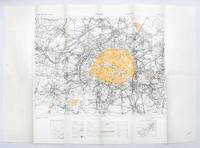
1944156766London: War Office 1944. The liberation of France First of this edition revised from a French map dated 1937 photolithographed in 1942 and corrected to August 1944. Maps such as these were used in the planning and execution of the liberation of Paris from 19 to 25 August 1944. This map intended for use in the field focuses on areas of particular importance for the army. These include good viewing points dangerous areas forest paths practicable in dry weather isolated hotels and buildings hospitals forts radio stations and factories. The heart of the city is highlighted in orange and distances are centred on Notre Dame Cathedral whose Emmanuel bell rang out to welcome the arrival of General Leclerc's division. It was first produced by the War Office in 1941 after a Michelin map of 1937. Photolithographed map 713 x 981 mm printed on one side only highlights in orange and green text lettered in red and black key on recto. Later pen inscription "Paris" outside printed area. Map bright two closed tears to edges sometime repaired with tape light nicks and finger-soiling at edges small stain to verso: a very good copy. unknown
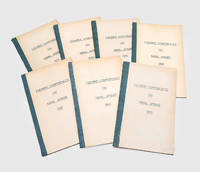
1949136920London: Air Historical Branch Air Ministry 1949. The first attempt to write the history of the war in the air Copy number 8 from a small restricted circulation classified "secret." Drawing on high-level government papers and reports this report follows extensive background with discussion of individual operations and assessments of efficacy tactics and strategy. The only copies traced are in the complete sets held by the Imperial War Museum and the National Archives. The Air Historical Branch was revived in 1941 under the leadership of John Combes Nerney 1890-1973 and immediately began gathering material for a six-volume narrative The R.A.F. in the Bombing Offensive Against Germany. Volume I on the development of Bomber Command up to 1939 was completed by the end of hostilities and the remainder were finalized in the immediate postwar years. In this volume chapters are devoted to major offensives including Operation Pointblank Operation Chastise and the Battle of Berlin as well as the devastation of the industrial city of Hamburg. The text cites large quantities of sensitive information and data. Although there is no stated limitation we have located no volume with a copy number above 17. The narrative formed the basis of The Strategic Air Offensive Against Germany 1939-1945 written by Sir Charles Webster and Noble Frankland and published for the public in 1961. Frankland's 1951 monograph The Planning of the Bomber Offensive and its Contribution to German Collapse was published by the Air Historical Branch as a companion to the original six volumes. Large quarto 340 x 210 mm. With 3 maps 2 folding 1 colour 7 folding tables chart; tables in text. Leaves printed with duplicated typescript. Original brown quarter cloth boards fixed with metal posts front cover with white label printed in black. "Supplied for the public service" ink stamp on inner boards. Covers worn as expected couple of text pages only partly bound in Appendix 13 repaired along fold: very good. hardcover
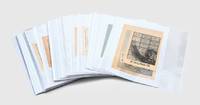
1941191050c.1941-1945. Promising comfortable captivity rather than death on the Eastern Front A substantial collection of Soviet aerial propaganda leaflets in German dropped behind enemy lines to encourage surrender most incorporating safe-conduct passes for presentation upon capitulation. These passes carry wording such as: "I a German soldier refuse to fight against Russian workers and peasants. I voluntarily surrender to the Red Army" translated. Evocative imagery is used such as one leaflet showing a skeleton in SS uniform pointing to a gravestone beneath the warning: "This is your place! You'll be next!" Many employ explicitly socialist appeals urging German workers and peasants not to fight their fellow labourers on behalf of their oppressors. Others claim that numerous German generals have already surrendered insist Germany's defeat is inevitable and warn soldiers not to throw their lives away. Some point to overwhelming American war production as further proof that the war cannot be won. A recurring theme is the favourable treatment allegedly awaiting those who surrender. One leaflet depicts prisoners dining with the caption: "The German prisoners of war are received by the Russians with a tasty fatty and nutritious lunch" alongside the assurance: "All who surrender to the Red Army are guaranteed life good treatment and to return home after the war ends" - an extraordinary claim given that the death rate among German POWs in Soviet captivity has been estimated at roughly one third. 131 leaflets varying sizes. Each leaflet in a removable mylar sleeve housed together in a red cloth solander box. Some toning else in excellent condition. hardcover
19281819931928. The scars of war heal An album signed twice by the editor and photographer W. Donald Wise on the introductory leaf pairing photographs of 100 battlefield scenes of 1918 with the same locations in 1928 commemorating a decade since the end of the war. Hise of Salem Ohio "went to France with the A.E.F. and when the American Army gave up its private battle with the franc he stayed on. For nine years he has been taking before-and-after pictures of the battlefields" Brooklyn Daily Times 5 April 1929. In his introduction he writes "This albumn sic has been edited and issued with two ideas predominating: one to present a comprehensive photographic survey of the battle fields of France and Belgium in their devastated state of 1918; two to visualize the stupendous reconstruction work accomplished Ten Years After in these same regions. In making the present day photographs special care was taken by the editor to find the exact location of the war scene." "These two hundred photographs cover principally the battle fields where the American Expeditionary Forces fought such as the Marne Oiuse-Aisne St. Mihiel Flanders Fields the Somme and the Argonne. But others include some French and British sectors where American soldiers were in training or on detached service. They are shown in sequence of battles from town to town as our men advanced and therefore constitute a complete sketch of the American effort concurrently with the French restoration ten years later." The contrasting images starkly reveal the scale of the destruction and the work done to repair the devastation. They demonstrate the rapid rebuilding of places sometimes in the old style sometimes entirely anew the transformation of provisional and rudimentary graves into well-kept military cemeteries the sprouting of memorials and the forests reclaiming the trenches. The typed captions describe the scenes including the military manoeuvres and encampments and the prior and current state of the locations. The final photograph shows the American Suresnes Cemetery near Paris. The photograph album was evidently produced in a small run - we trace two at auction Heritage 2009 and Waverly 1994; the former was this copy the latter possibly so. None could be traced in institutions. Most of the photographs as far as we can determine are otherwise unpublished. Oblong quarto 329 x 232 mm. With 201 black and white photographs 209 x 154 mm each with a typed caption mounted on grey card leaves prefaced with an introductory text leaf. Original brown morocco. Restored at extremities. Slight rubbing at extremities repair to first leaf fore edge all photographs present and sharp. In very good condition. unknown
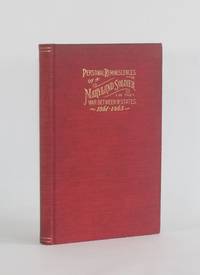
189810826Baltimore: Press of Fleet McGinley & Co 1898. Hard Cover. Very Good binding. Octavo. 177 pp. First edition. Limited to 125 copies. Signed and inscribed by Booth on the first blank. As issued in publisher's red cloth with title in gold on the front cover. A bright copy with very light soiling to the cover; early and short bookseller's description pasted to the bottom of the front pastedown; trivial closed tears to the fore-edge of the first page else clean and sharp. <br /> <br /> Coulter notes that this is more reliable that many of the longer narratives written well after the war because Booth is scrupulous about not including information he couldn't possibly have remembered after so many years Coulter 46. Nevins notes "Written by a young solider who participated in many battled before his capture this work contains so much on affairs both on and behind the lines that it is deserving of republication" CWB I 61. It was eventually reprinted by Butternut Press in the 1980s. This copy signed and warmly inscribed by Booth to Wm. H. Fitzgerald who was in the 12th Virginia until he was wounded in action at the Battle of Malvern Hill in 1862. Fitzgerald was born in Maryland and lived in Baltimore for several decades after the war. This book is remarkably uncommon in commerce particularly in this condition. Howes B-613; Dornbusch II 529. Press of Fleet, McGinley & Co unknown
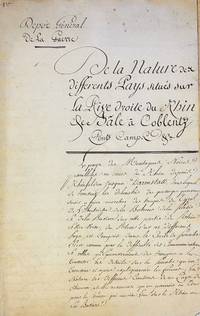
3342France late 18th century. Manuscript on paper. Text in French written in a neat hand. Sewn. Occasional spotting. Overall in fine condition. Manuscript on paper. Text in French written in a neat hand. Sewn. ff. 46 last blank. <p><br /> An important 18th-century manuscript from the Dépôt de la Guerre providing a strategic analysis of the right bank of the Upper and Middle Rhine used for military reconnaissance and planning.<br /> <p><p><br /> This manuscript produced by the Dépôt Général de la Guerre presents a detailed strategic analysis of the right bank of the Rhine from Basel to Koblenz. The Dépôt de la Guerre established in 1688 was the principal institution responsible for French military intelligence cartography and strategic planning. It played a crucial role in gathering and disseminating geographic and strategic data to support military operations. This manuscript is a testament to that work offering valuable insights into potential military routes positions and logistical considerations along the Upper and Middle Rhine—a region of significant strategic importance.<br /> <p><p><br /> The manuscript is divided into four sections each providing specific strategic information.<br /> <p><p><br /> De la Nature des differents Pays situés sur la Rive droite du Rhin de Bâle à Coblentz: The main section offers a comprehensive overview of the nature and strategic value of regions on the right bank of the Rhine from Basel to Koblenz. It discusses the terrain routes suitable for army movements locations favorable for establishing camps and available agricultural resources. Regions such as Baden the Palatinate Worms Mainz Württemberg and others are examined from a military perspective.<br /> <p><p><br /> Positions militaires sur la Rive droit du Rhin de Bale à Coblentz: This section focuses on analyzing potential military positions along the right bank of the Rhine identifying defensible locations natural barriers and strategic points for effectively deploying troops and artillery.<br /> <p><p><br /> Indication des principaux lieux où il seroit possible à l’ennemi de Jetter des Ponts sur la Rive droite du Rhin de Bâle à Coblentz: Identifies key locations along the right bank where an enemy might construct bridges to cross the Rhine highlighting strategic points that could be critical for defense or control to prevent such crossings.<br /> <p><p><br /> Indications des différens lieux entre Bale et Philisbourg où l'on pourrait Jetter des Ponts sur la Rive Gauche du Rhin pour se porter dans les Pays situés sur sa Rive Droite: Discusses potential sites between Basel and Philippsburg on the left bank of the Rhine where bridges could be established to launch operations onto the right bank. This section is essential for planning offensive maneuvers or controlling river crossings.<br /> <p><p><br /> To the best of our knowledge this manuscript was never published in print and was presumably circulated only in a few copies this one bears the inscription “1er†on the first leaf making it a rare and significant example of 18th-century military reconnaissance and planning. Comparable manuscripts are found in the archives of the Service Historique de la Défense such as the Exposé sommaire de la nature des différents pays situés sur la rive droite du Rhin de Bâle à Coblenz entre les montagnes Noires et le Rhin which includes additional reconnaissance reports from 1730 and 1743 1 M 1504. Similarly another version of the Exposé sommaire appears in Louis Tuetey's Catalogue général des manuscrits des bibliothèques publiques de France: Archives de la guerre no. 1941 underscoring the careful documentation and strategic importance of the Rhine region by the Dépôt de la Guerre.<br /> <p><p><br /> Koblenz located at the confluence of the Rhine and Moselle rivers was a critical strategic point during this period. It was occupied by French forces from 1794 to 1814 serving as a key administrative and logistical hub during the French Revolutionary and Napoleonic Wars. The kind of intelligence contained in this manuscript would have been invaluable for controlling the Middle Rhine region and planning military operations.<br /> <p><p><br /> Although this manuscript predates the Napoleonic Wars its detailed geographic and strategic insights regarding potential military positions river crossings and logistical planning would have been highly useful to French commanders. The systematic efforts of the Dépôt de la Guerre in compiling such data were essential for shaping military strategies and ensuring effective operations along the Rhine and beyond. This manuscript remains a significant historical resource for understanding the military geography and strategy of the late 18th century.<br /> <p>. unknown
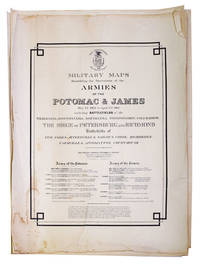
1869267611Washington D.C.: War Department Office of the Chief of Engineers Lithographed by Julius Bien New York 1869. First Edition. Prepared under the direction of Bvt. Brig. Gen. N. Michler Major of Engineers and Bvt. Lieut. Col. P.S. Michie Capt. of Engineers. 16 maps on 17 sheets. All but one double-page. Folio 23-5/8 x 18-1/2 inches. Unbound sheets. Light stains at top edges of several maps title with tape repair. First Edition. Prepared under the direction of Bvt. Brig. Gen. N. Michler Major of Engineers and Bvt. Lieut. Col. P.S. Michie Capt. of Engineers. 16 maps on 17 sheets. All but one double-page. Folio 23-5/8 x 18-1/2 inches. The topographic maps comprise:<br /> 1A. Gettsburg to Appomattox Court House northern<br /> 1B Gettysburg to Appomattox Court House southern <br /> 2. Fredericksburg<br /> 3. Chancellorville <br /> 4. The Wilderness<br /> 5. Spottsylvania<br /> 6. North Anna single page<br /> 7. Totopotomoy <br /> 8. Cold Harbor<br /> 9. Richmond<br /> 10. Bermuda Hundred <br /> 11. Petersburg and Five Forks <br /> 12. Jetersville and Sailor's Creek<br /> 13. High Bridge<br /> 14. Appomattox Court House<br /> 15. Antietam<br /> 16. Harper's Ferry. Phillips Atlases 3688 listing only 15 maps; Civil War Maps 518; Stephenson and McKee "Virginia in Maps" p. 194: "Topographers had already surveyed more than 1300 miles and issued more than 1200 maps prior to the army's passage over the Rapidan River on the night of 3-4 May 1864 the beginning of U.S. Grant's major offensive in Virginia that led from the Battle of the Wilderness on 5 and 6 May to the ten-month siege of Petersburg beginning in mid-June and finally to R.E. Lee's surrender at Appomattox on 9 April 1865. Bvt. Brig.-Gen. Nathaniel Michler's men made more than 1600 photographic sketches between the time of the river crossing and 30 July 1864. The vast number of surveys that Michler directed led to the publication of this atlas. War Department, Office of the Chief of Engineers [Lithographed by Julius Bien, New York] unknown
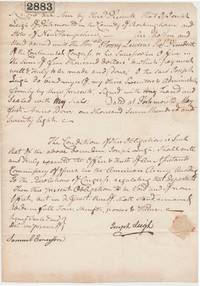
3201DS. 1pg. 7 x 10 . May 1 1778. Portsmouth New Hampshire. A document signed Joseph Leigh and co-signed Samuel Emerson. The important document states Know all Men by these Presents that I Joseph Leigh of Portsmouth in the County of Rockingham and State of New Hampshire are holden and stand bound unto the Honble Henry Laurens Esq. President of the Continental Congress or his Successor in Office in the Sum of Five Thousand Dollars to which payment well & truly be made and done I the said Joseph Leigh do bind myself my Heirs Executors & Administrators firmly by these presents. Signed with my hand and sealed with my seals: Dated at Portsmouth May first Anno Dom: one Thousand Seven Hundred and Seventy Eight. The Condition of this obligation is such that the above bounden Joseph Leigh shall well & truly execute the Office & Trust of an Assistant Commissary Officer in the American Army According to the Resolutions of Congress regulating that Department then this present obligation to be void and of none effect but in default thereof shall stand remain & abide in full force strength power & virtue. A few weeks later the New Hampshire Committee of Safety wrote to Leigh stating that You are hereby appointed Commissary to proceed immediately to that post of the Continental Army where the regiments from this state are stationed - to take charge of & Issue such stores as may be sent there from this state - and you are to observe such orders and instructions as you may from time to time receive from the General Assembly of this state or in the recess thereof from their Committee of Safety - or at any time from the board of war for this State in regard to any matters or things deliver to your care & charge - and you are to render a particular account of your Conduct in and about yr premises and make remittances for the stores delivered to your charge as aforesaid agreeable to the instructions from time to time sent you as aforesaid - and you are to be allowed and paid for your time & expense while in said service such wages as the issuing Commissarys for the other New England States have & receive for similar services. There is a paper seal to the right of the Leigh autograph and a small label on the top margin. An unusual Revolutionary War financial document. unknown
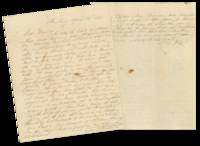
186358199Camp near Brooks Station Saturday April 11 1863. Fine original condition. 15-1/2 x 9-3/4 inches. ".Yesterday I witnessed one of the grandest sights that I ever beheld. Our whole corps was reviewed by the President Generals Hooker McLain Howard Steinway Secretary Seward and an innumerable host of Brigadier Generals and it was a sight that has paid me for coming to war." The spectacle is described in great detail. Private Penfield was soon to be captured at Chancellorsville spending 12 days as a prisoner of war before being exchanged. He survived the war to carry on his father's carriage making business in Monroe Connecticut and later founded a small private academy. unknown
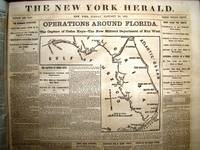
18620078071862. Hardcover. Spine rubbed. Overall a Very Good and fascinating compilation. Large folio 16" x 21-1/2" bound in half sheep and marbled boards. Includes a number of triple sheets. Extensive reportage of the war with numerous maps throughout. In addition to the war news the papers have ads and other news. Bound in at the front is a rather scarce broadside: "The New Year's Address of the Newsmen of the New York Herald" illustrated around the border with portraits of Lincoln and various cabinet members and generals. The broadside has a few small library stamps; otherwise it and the newspapers are generally clean with only occasional browning and a handful of long horizontal tears with no loss. While one occasionally sees individual Civil War issues of this paper offered for sale rarely does a run even this short though more than 2" thick appear on the market. <br/><br/> hardcover
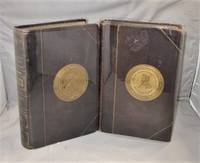
188527459New York:: Charles L. Webster & Company 1885. First Printing of the First US Edition. This is a Near Fine tight set with light wear to the extremities in the publisher's deluxe brown morocco leather over brown cloth boards with gilt circular emblems on the front and rear covers. This set is complete with the facsimile letter of Grant's original terms for Lee's surrender that is often missing. Mark Twain was the publisher of this monumental memoir as well as its editor and proof reader. Twain was extremely fond of and a close friend of Grant and encouraged the President and war hero to write his memoirs. Grant was dying of throat cancer but completed his two volume opus dictating the second volume to a secretary. Twain noted in a letter to his daughter that the manuscript was not even set yet and 20000 sets had been ordered from only two states. "Wait till you hear from the other 37." Grant finished his memoirs on July 18 1885 and died five days later on July 23rd. Following his death advance orders of the memoirs reached 300000 sets realizing close to $450000 for his family which was otherwise penniless. In a 1992 New York Times book review General Schwarzkopf is quoted as using Grant's two-volume work as his model calling it the finest military history of the Civil War. Charles L. Webster & Company, hardcover
1918A43470France: Self Published. Very Good. 1918. Flexible covers. B&W Illustrations; World War I Scrapbook 13" x10" approx with 48 pages from an instructor at the Second Aviation Instruction Center at Tours France 1918. <P> The scrapbook was the property of and photographed by James FFred Chappell who is best known as one of the early photographers at the Lick Observatory and for whom the Chappell Crater on the Moon is named. <P> The scrapbook includes 48 pages of various sized photographs taken by Chappell starting with photographs of shipboard activities on the transport from the US to Tours France candid photos of France and the French rural folk on their travel from the coast to Tours and then to the compound of 2nd AIC Second Aviation Instruction Center which was founded by the French at the Tours Aerodrome and then given over for the use of the United States as a place for instructors in aerial observation and aerial gunnery to teach students. <P> James F. Chappell became an instructor in Aerial Observation -- and ironically because the airplanes were crashing so often and had so many injuries and fatalities Chappell and other instructors were forbidden from flying into combat to keep from having excessive losses in the instructor corps. <P> The latter half of the scrapbook includes many photographs of different styles of airplanes both whole and in pieces the ambulance crew fire brigade the camera guns and aerial photographs and sundry accoutrement dealing with aerial photography gunnery or observation. There are several rank advancement tickets small souvenirs and occasional newspaper clippings associated with the school. <P>Chappell graduated as one of the first classmen of the U. S. Army Aerial Photography class held at Cornell University in Ithaca NY. <P> In all 278 photographs plus other ephemera regarding Chappell's tour of duty starting from his transport in the US to the fields of Tours France. <P> This scrapbook holds an amazing amount of visual information regarding the early days of the Army Air Corps which became the United States Air Force in 1947. . Self Published unknown
47618Various publishers & dates. Extensive photographic archive documenting events on both sides of the U.S.-Mexico Border during the Mexican Revolution focused primarily on the Border Wars in Texas and the Veracruz Incident of 1914 comprised entirely of contemporary images all but a few of which are original vintage prints. The collection includes: <br /> <br /> • Sixty-one commercially-produced real-photo postcards ca. 14cm x 9cm or the reverse; <br /> • Six commercially-printed postcards using non-photographic processes same dimensions;<br /> • Three carte-de-visite portraits ca 9cm x 6cm mounted to cards;<br /> • Eight small-format photographs ranging from 14cm x 8cm to 11cm x 16cm of which three appear to be commercial images; <br /> • Three 8x10 20cm x 25cm photographic prints printed at some later date from original plates but apparently not contemporary; <br /> • One vintage 4x6 10cm x 16cm photograph mounted on board. <br /> <br /> All but a dozen or so images are captioned in the negative and most are additionally captioned in pencil in a later hand on verso. Approximately half the images include no photo credit; of those that do we have identified the following photographers: W.H. Horne D.W. Hoffman Walter P. Hadsell Van Zile & Chalk and L.O. She. <br /> <br /> Condition is generally Very Good. Two of the photo postcards are damaged with abrasions to significant portions of image area; the remainder show various degrees of edge wear aging and creasing but by and large image quality remains excellent. None of the postcards are postally used though a few include brief contemporary notes on verso. The refusal of Mexican President Porfirio Dîaz to cede power to his rival Francisco Madero in the elections of 1910 resulted in a violent large-scale revolt by campesinos and leftists setting off the thirty-year long Mexican Revolution. American involvement in the conflict began in 1911 when President William H. Taft under the guise of heightening border security moved to back Díaz against the rebels. The resulting mobilization - Taft sent more than 20000 American troops nearly a quarter of all American forces to the Mexican border with especially heavy concentrations in Texas and New Mexico - was to that date the largest mobilization of American military forces in peacetime. At the same time many Americans whose sympathies were not aligned with the Díaz dictatorship including anarchists wobblies Native Americans and more than a few soldiers of fortune went south to fight on the side of the rebels. The resulting border conflict which took place over nearly a decade occasionally pitting American insurrectos against American Federal troops resulted in thousands of Mexican and hundreds of American deaths. <br /> <br /> The Border Wars reached their climax around the period 1912-1914 which happened to coincide with a near-hysterical vogue for postcards among the American public. The result is that the Mexican Revolution is perhaps the first major armed conflict to have been extensively photo-documented in real time and certainly the first to have had a significant mass audience for that documentation. At least three hundred commercial photographers have been identified in association with the Mexican Revolution and they produced tens of thousands of images ranging from the relatively innocuous e.g. peaceful street and harbor scenes in Veracruz to the horrific lynchings and sidewalk cremations. <br /> <br /> This entire range of content is represented in the current collection along with portraits of most of the key players on the Mexican side including El Presidente Porfirio Díaz; his primary rival and successor Francisco Madero; Madero's successor by coup Victoriano Huerta; and various military figures including General Juan Navarro Felipe Angeles Ramírez and numerous others. Many of these semi-professional images though produced with commercial intent "professional" remains a guarded term in the context of what was essentially battlefield exploitation photography are valuable for their almost off-hand depictions of violent day-to-day life on the contested border including the casual destruction and acceptance of death from both sides that seemed to define this conflict. Of particular note are numerous of photographs of African-American troops the so-called "Buffalo Soldiers" as well as at least one image depicting Native American soldiers in uniform. Locales represented include Camp Grossmont in California; El Paso and Laredo in Texas and their cross-border sister cities Juarez and Nuevo Laredo; Veracruz site of the American incursion of 1914 known as the "Veracruz Incident"; and various unidentified encampments and battle sites in both Texas and Mexico. <br /> <br /> A wide-ranging and compelling photographic collection documenting not only a key period in U.S. military diplomacy - one which for better or worse set the tone for American-Mexican relations for the succeeding century - but also a tangible manifestation of the first widespread public incarnation in America of the picture-postcard as a vehicle for both propaganda and photojournalism. unknown
1960List3237United States Norway and Germany 1960. 320 items: 276 letters thirty-eight modern photographs five CDVs and one cabinet card; with a large amount of unsorted ephemera. Of the letters 198 are from the nineteenth century with most from the 1840s through 1870s; and seventy-eight are from the twentieth century with most from the 1940s and 1950s. Excellent. A broad archive mainly of letters spanning over 130 years. The letters were mostly sent between members of the Hill family of Pennsylvania and other families Lewis Hosack and Weeks that married in. In the nineteenth century George Hill 1815–1895 his wife Harriet Lewis 1820–1852 and their two oldest daughters Jane Hosack 1842–1878 and Harriet Hill 1844–1928 are the main correspondents; in the twentieth letters are mainly from Cornelia 1863–1948 and Charlotte 1874–deceased Lewis Harriet Lewis’ nieces and the family of Nancy Weeks 1909–1992 her great-granddaughter-in-law. Weeks also had several correspondents in Europe immediately after World War II.<br /> <br /> Earlier letters discuss family affairs temperance societies and church business—George Hill was a Presbyterian minister and writes to his family from trips to the General Assembly. For instance he describes the 1843 Assembly:<br /> <br /> “We have dispatched a good deal of business this week in the Assembly. The question which detained us longest was with regard to the right of Elders to impose hands in the Ordination of Ministers this was discussed for the greater part of two days and finally decided against the right to impose. But of all the questions which have yet come before us none has excited so much interest or called forth half the feeling which the question on the approval of the records of the Synod of Pittsburgh did. The committee on the records took exception to the mention of the Synod on the subject of Temperance . On this I let them know my mind at considerable length and in the course of the proceedings voted down the very same proposition which was adopted by the last Gen. Ass. on the subject of Temperance.†May 27 1843<br /> <br /> At the same time Hill was preaching around Pennsylvania and Ohio to raise funds to start the Blairsville Female Seminary which was open from 1851 to 1913. Among his travel correspondence is an interesting description of antebellum Athens Ohio:<br /> <br /> “On Tuesday morning I rode 6 or 7 miles to Athens . which is wholly given over to abolition. This subject is to that people ‘The one thing needful’. It is the law and the gospel; it is philanthropy patriotism morality and religion. It swallows up everything else and enlists the sympathies & energies of the people to the exclusion of almost everything besides.†January 29 1844<br /> By the outbreak of the Civil War Jane and Harriet are young adults and Harriet gets involved with the war effort. She writes to her stepmother Abigail Hawes:<br /> <br /> “I was in sewing for the Soldiers yesterday. I made a Havelock. I guess there were over thirty ladies there sewing. The Bardstown ladies are making clothing for Capt. S’s company. They leave on next Monday. . I went in early last Monday morning to see our company off. The flag was presented by Mr Beaumin to Capt. Nesbit. Then Mrs Thompson & Luther Martin presented Testaments & ‘Prayer Books’ some of Mrs. McAfee’s work they then marched up to the depot followed by men women & children. Such a sight I never witnessed. Some of the soldiers large men cried like children – bade goodbye to every body – men that I never saw before came up & bade me goodbye & then turned their heads away to hide the tears. . But to go back to our Sewing Society you ask ‘will they really do anything’ I tell you they really have done something. Made seventy five shirts & intend making so many more of blue & red flannel & forty five or fifty Havelocks about thirty five towels eighty pin cushions or needle books. Then when the company went away the ladies supplied them with either a blanket or a comfort apiece . The ladies also intend making bandages or something to fasten tight round their stomachs to keep them from taking dysentery so readily.†June 4 1861<br /> <br /> Harriet notes that Abigail doesn’t “seem to be much disturbed about the war†May 20 though she requests that although “We all admire your patriotism . be sure & dont send us an envelope with ‘Death to Traitors’ on it†June 4.<br /> <br /> Other letters from Harriet and Jane discuss school family and especially health; a number of deadly diseases were rampant throughout the century and many letters read as litanies of dead and dying friends and family. The CDVs from this era mainly taken in studios in Blairsville seem to be mostly family friends or employees at the Female Seminary; many of the subjects are identified verso.<br /> <br /> The family’s letters in the twentieth century are similar though with less sickness and death and from more dispersed locations in the US—seemingly few family members remained in Pennsylvania.<br /> <br /> One particularly interesting thread is Nancy Weeks’ correspondence with several Europeans immediately after World War II. One is Benjamin Molnar a Hungarian living in Munich and in the process of emigrating to the US. Molnar describes himself and continental Europeans generally as “prejudiced and very nationalistic†and explains that he would prefer to live in the American midwest or west as the “types of people†on the east coast “are rather unamerican looking†July 14 1949. He ends up in California and complains to Weeks that:<br /> <br /> “Everybody here seems to be violently pro-negro and pro-Jewish. Jews and negroes are all right I suppose and I have nothing against them but is it a sin for a white man to prefer to live among his own kind†December 27 1949<br /> <br /> On the other end of the spectrum are the Bjelkes a Norwegian family who write a number of times to Nancy. They describe the Nazi invasion:<br /> <br /> “Reidar drove me and the children 7 & 2 years up in the country the first day thinking we would be safe there he had to leave right away to do his duty of course and we were left alone. Not many days later we were in the middle of the whole war shooting and bombing all around then the middle of the nite we had to flee out in the snow two children and no place to go at last I could no more and together with some others we broke the window of a little mountain home and crawled thru finding the house empty. . But the peace was short not long after some soldiers came and said we must off as the germans would soon be there. Well out in the deep snow again and we struggle thru and at last came to a little mountain farm where we were allowed to stay. But they had little food and for four weeks we starved . At last Reidar found us and we wandered our way towards home . to Bygdo. Mother had been there all the time and everything had been fine there.†October 10 1945<br /> <br /> They also tell Weeks about Oslo during the war and their experience of the occupation:<br /> <br /> “We demonstrated our hate as far as we dared to – by not sitting beside any Germans for example on the car it went so far that they put up a ticket saying ‘no seat must stay vacant or we would be arrested.’ The result was that we just stood all the time then a new ticket came up we were not aloud to stand. Well I had to jump off the car several times in order not to seat myself beside a uniform. Then they started taking our red caps & scarfs – we used them as a demonstration you see & they not only took them off us but kept them. They even took our red jackets from us if we dared wear them on the street & so many dared! On our Kings last birthday during the war several hundred were arrested because they wore flowers in their buttonholes– Oh the Germans & Naszi were so childish.†May 11 1945<br /> <br /> They also describe the difficulties of postwar life including the dangers of unexploded ordnance left around the area which stop the ferries from running to Oslo and injure the family’s young son Per.<br /> <br /> Overall the archive is notable for its breadth spanning at least four generations of a family and many historical eras and events. unknown
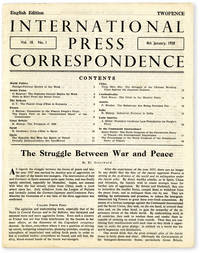
193452881London: H.R.G. Jefferson et al 1934-1939. NOTE: Other identified publishers all London include: Unthanks Bookshop; R. Bishop; William Massey. Beginning in July 1938 title changes to "World News and Views." <br /> <br /> Collection of two hundred forty-nine quarto issues in original staple-bound self-wrappers. Each issue 27cm x 21cm; most issues ca 20pp numbered sequentially. General wear occasional creasing or small losses; some copies marked as "File Copies;" some with red pencil annotations presumably for publication; a few issues with ink pressure stamp of the Los Angeles Workers Library. With the exception of a few issues in 1934 the journal was printed on high-quality newsprint; the run is well-preserved Very Good overall and fully readable.<br /> <br /> The periodical was issued irregularly from one to as many as three issues per week; our run collates as follows: <br /> <br /> Vol. 14 1934: 28-14161719-232629-3234-3638-4043-455760-63 32 issues<br /> Vol. 15 1935: 1-58-3136383944474850555658596163646668-72 49 issues<br /> Vol. 16 1936: 1246-3032-384042-58 53 issues<br /> Vol. 17 1937: 248-242642444547-5355-57 47 issues<br /> Vol. 18 1938: 1-35-81012-2325273031333436-4044-47525456-60 38 issues <br /> Vol. 19 1939: 2-91415181920-2628-3235-4155 30 issues. Beginning in 1918 immediately following the Russian Revolution International Press Correspondence usually called by its acronym INPRECOR became the Communist International's principal international organ for distributing "official" news of the global spread of Marxist ideology. The paper was issued in four languages English French Spanish and German and at its height no fewer than one and as many as three issues per week appeared. The chief audience was the editorial staffs of COMINTERN-aligned newspapers where many of INPRECOR's articles would be republished verbatim. Thus INPRECOR served as a de facto press service for the left-wing media in Europe North and Latin America.<br /> <br /> In our experience cohesive runs of INPRECOR in any size are unusual; this collection represents a veritable treasure-trove of official COMINTERN policy during the Popular Front period especially valuable for its day-by-day coverage and interpretation of events in Spain before during and after the Civil War and for documenting the rise of fascism across the European continent. Our run ends in August 1939 on the eve of Germany's invasion of Poland and the outbreak of the Second World War. Between that date and 1934 despite occasional lacunae the issues offered here provide a clear and compelling narrative of the sweep of world events leading to the World War and an intimate view of the communist left's response to those events. <br /> <br /> Even individual issues are somewhat scarce in commerce. Earlier issues of INPRECOR have been digitized by the Marxist Internet Archive ending in 1934. Much of the run is available in microfiche produced by the Communist Party of Great Britain but the imaging is of legendarily poor quality basically illegible in many places. Holdings for physical issues are spotty per WorldCat with many institutions holding small samples or partial runs. H.R.G. Jefferson [et al] unknown
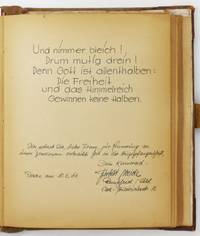
19456431<p>Huntsville Tx 1945. Very good. 84pp. Primarily in German. Quarto. Brown cloth album with leather corners and snap closure. Manuscript initials on front cover. Corners lightly worn. Contents evenly toned. A rare friendship album kept by Franz Kozian a German prisoner of war at the POW camp in Huntsville Texas. The album contains over seventy-five entries from fellow incarcerated soldiers all of them lengthier than just an autograph. Many of them include lengthy expressions of friendship or quotations from famous German-language authors such as one that copies out the text of Rilke's poem "Herbst" "Autumn" with the illustration of a tree with falling red leaves. Most of the entries also include details of the internees' home towns and other camps they've been in. At the end of the album is a detailed list of fellow prisoners with their home addresses. By the end of World War II there were over 425000 enemy prisoners on U.S. soil and Texas had twice as many POW camps as any other state due to space and climate. The Geneva Convention specifies that prisoners must be kept in a climate similar to that of where they were captured and Texas was considered similar to northern Africa resulting in a serious influx. The present item seems to be a relatively unusual survival from the POW camps and is quite detailed in its contents. A valuable research tool for this unusual chapter of American military history.</p>
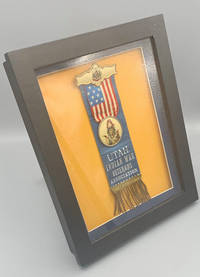
189658334Newark NJ: Whitehead and Hoag and Company 1896. Near fine. Commemorative ribbon in shadow box frame 11 3/4" x 9 3/4". Lacking the original display box. Blue ribbon with the statement "Utah Indians War Association" stamped in silver and a top bar of white enamel bordered in gilt with a Territory of Utah seal at the center. Also attached is an American flag ribbon with a hanging white enamel medallion depicting an American Indian in captivating full headdress. Tassels at the foot. The ribbons and attached medallions are exceptionally well-preserved and bright.<br /> <br /> Given to Indian War Veterans who suppressed hostilities in Utah during the years 1850 through 1872. Remarkably unfaded. A fine very bright example of a ribbon which represents a historically important juncture in Utah and American history. Whitehead and Hoag and Company unknown
194560559Washington DC: Adjutant General’s Office in the Pentagon August 12 1945. 4to. 194 pp sections all separately paginated I-XIII A1-A5. w/ first 4 leaves litho-printed on recto only. Cream-coloured litho-printed softcovers w/ “Released for Publication _________†on lower front cover dittoed notice at lower right corner of “Distributed by Technical Information Section of the Bureau of Aeronautics†stapled at gutter margin as issued minor soiling & spotting to front cover minor rust to staples minor bumping to corners light scuff to fore-edge of textblock printed in multiple grades of paper as issued w/ some sections more toned than others still a VG- copy numbered in ink at lower right corner. First lithoprint edition 3rd printing of 6000 total copies prepared by secretly lithoprinting in the Pentagon NOT 1000 copies as previously posited by Coleman & others in sections from modified dittoed versions which had been distributed under General Groves’s orders to correct the master copies with eventually whole paragraphs deleted or added in some chapters. This copy is entirely complete with none of the often missing pages especially p. VI-12 duplicates or misbound signatures which often appear due to the speed and paper requirements and also bears the colophon 25-56388-2M on page A5-1 at the rear indicating this was one of those printed on the high-sulphide paper often bearing signatures of varying toning. As per Arnold Kramish 1923-2010 nuclear physicist who worked Oak Ridge TN on the Manhattan Project and at the behest of Harry Smyth researched the printing history before 1985 of the original report and determined that there were 2000 copies released initially past the dittoed and mimeograph versions to the press and senior lab people. Due to early complaints of lack of access another 2000 were released followed by the much demanded 3rd release all before Princeton University Press released their published print run less than 1 month later in 1945. The famed Smyth report released to the public just after the United States had obliterated the cities of Hiroshima and Nagasaki using the first two atomic bombs at the end of World War II -- is “a remarkably full and candid account of the development work carried out. . . by the American-directed by internationally recruited team of physicists under the code name of Manhattan District. . . .†The introduction opens with statement that “The purpose of this report is to describe the scientific and technical developments in this country since 1940 directed toward the military use of energy from Atomic nuclei.†As an aside it should be noted that Michael Zinman has the original Arnold Kramish TLS identifying the printing history and an article is being prepared by Brett Tomlinson noted historian of science. See: Printing and Mind of Man 422e; Coleman The Smyth Report: A Descriptive Checklist Princeton University Library Chronicle Vol. 37 No. 3 Spring 1976 No. 3 pp. 206-207; For fuller explication of Linus Pauling’s dittoed version at OSU 1 of 2 known survivor copies see blog by Ann Bahde Serifs and Secrecy: The Smyth Report in SCARC Nov. 2 2021. [Adjutant General’s Office in the Pentagon], paperback