Civil WarABAA
1 575 résultats
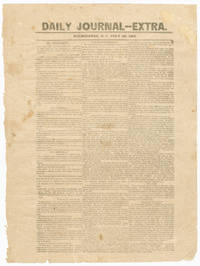
1862WRCAM56479Wilmington N.C. 1862. Broadside 15 1/4 x 11 inches printed in three columns. Moderate toning and foxing. Four-inch closed vertical tear at bottom edge no loss of paper. Very good. A Confederate newspaper extra reporting the failure of the Union's initial Peninsular campaign around Independence Day in 1862. From March to around the time of this newspaper extra General George McClellan launched an offensive campaign against northern Virginia which was intended to capture the Confederate capital of Richmond. Facing a series of crafty Confederate generals including John B. Magruder Joseph E. Johnston J.E.B. Stuart Stonewall Jackson and Robert E. Lee McClellan's tactics proved fruitless in capturing Richmond and he was eventually recalled by President Lincoln to prepare for the Second Battle of Bull Run the next month. This newspaper extra issued by the Wilmington North Carolina DAILY JOURNAL reports the "Yankees in Full Retreat" after receiving news from "a couple of free negroes" that McClellan's forces were headed north. There are also reports of deserters from McClellan's army being captured detailed passages on the path of the Union army's retreat and reports on the movements of other military units. In addition the text relates news on Confederate attempts to gain "early recognition of the Southern Confederacy" from European powers noting that Confederate diplomat John Slidell had "indicated the immediate prospect of recognition by the French Government." There are also passages covering Confederate wounded captured Union soldiers from the 7th Indiana the Confederate government's support "in comfortable quarters of some eleven hundred lazy runaway negroes" and more much of which is reported from other sources. No copies of this extra reported in OCLC. A rare Confederate newspaper extra recording mostly positive results for the Confederacy during a particularly good summer for the southern cause. unknown books
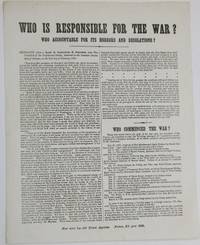
186433660New York 1864. Broadside 9-1/8" x 11-1/2". Printed in two columns light indications at blank top margin of prior matting on blank verso. Near Fine.<br/><br/> The AAS entry for this broadside states that the words at its foot "For sale by all news agents. Price $1 per 100" are identical to the language of several 1864 Republican campaign broadsides published by the National Union Executive Committee Astor House New York. "Presumably this edition was also published by the Republican Party's national committee."<br/> The broadside begins with "EXTRACTS from a Speech by ALEXANDER H. STEPHENS now Vice-President of the Confederate States delivered in the Secession Convention of Georgia on the 31st day of January 1861: 'This step the secession of Georgia once taken can never be recalled; and all the baleful and withering consequences that must follow as you will see will rest on the Convention for all coming time. To attempt to overthrow such a Government as this. is the height of madness folly and wickedness to which I can neither lend my sanction nor my vote'." In his 1868 book 'A Constitutional View of the Late War Between the States' Stephens declared the Speech to be a "fabrication."<br/> There follows an answer to the question 'WHO COMMENCED THE WAR' "Those who would throw the guilt of the war upon the shoulders of Mr. Lincoln are requested to read the following catalogue of 'remarkable events' published in a Southern Almanac all of which occurred during the Presidency of Mr. Buchanan." The "Catalogue" is a list of aggressions committed by the Southern States. "All these were warlike and treasonable acts."<br/>De Renne 1316. Not in Sabin Bartlett Nevins Eberstadt LCP Monaghan. OCLC shows a number of institutional locations. unknown books
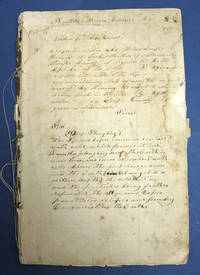
189241503Mecklenburg VA 1892. Sewn gatherings disbound with remanants of perished leather spine. Wear and soiling throughout; some chips occasionally causing minimal textual loss; last leaf quite ragged to inner margin significantly affecting final third of text. Writing in general legible and neat. Good condition withal. 29 leaves of lined wove paper including 4 half-leaves. Lacking first leaf pp 1 - 2 of lecture notes; 4 stubs. Inconsistently hand-numbered throughout.Manuscript notes in ink and/or pencil to recto and verso of leaves with varying amounts of writing per pg. ~1500 words. Some intratextual hand-drawn illustrations and graphs to lecture notes. 11-1/2" x 7-1/2" <br/><br/>A notebook that appears to have been intended for lecture notes kept by Presley Llewellyn Hinton Jr. during a science class at Randolph-Macon College from 1858 - 59 but that was employed for several different purposes by other members of his family during the same period and throughout the Civil War. The Hintons were slaveholders owning at least 13 slaves according to the 1860 slave schedule and longtime prominent members of the community. The lecture notes which comprise hand-numbered pp 3 - 30 and 51 - 55 are from lectures taught by B. Puryear Professor of Chemistry and Natural Philosophy; subjects covered include fairly introductory material regarding dew evaporation electricity elements of chemistry hydrogen and nitrogen gas carbon etc. and the like. Following the first section of lecture notes three pages by one of the Hinton parents we speculate Mrs. Hinton detail Presley’s service in the Confederate Army Company A 3rd Virginia Cavalry as well as that of his brother William from 1861 - 63 largely their leave-taking and visits home: “My Son William Emmet Hinton joind the Confederate Army and left home on the 14th day May 1861 to join his company Mecklinburg Cavalry at Lockets Store near Lombardy Grove. Many relatives and friends met . . . to take leave of their dear sons relations & friends who consented with cheerfulness to leave their quiet and happy homes to battle against our enemy the Yankee who are worse than Indian savages Yea to go through all the hardships privations difficulties and attending a camp life. . . . My Son Presley Lewellyn Hinton joind the Confederate Army and left home on the 26th day May 1861 . . . He would have gone on with his brother William but he was not prepared as he had just returned from the University of Virginia . . .” Approximately 15 remaining pages interrupted by the last section of Presley’s lecture notes are filled with a detailed account record of tuition charged for teaching the daughters and some sons of local families which we speculate was kept by the boys’ sister primarily because of the type of lessons taught. These included piano lessons worsted work and samplers grammar arithmetic geography the history of England and philosophy; fees for ink copy books and other supplies are also included. Another account record follows for bonds of some sort in the same hand as other and a love letter from Presley to a Miss Annie fills both recto and verso of the final leaf. Interspersed with these and sometimes written over top in pencil are the youthful scribblings and pencilled math work of James H. Palmer also of Mecklinberg dated 1892; he appears to have used the manuscript for scrap paper. All in all a uniquely faceted manuscript illustrating many aspects of the life of one Virginia family during the Civil War as well as the paper shortages that likely occasioned such thrift. hardcover books
175623894London: Printed for M. Cooper at the Globe 1756. Small octavo. 7 1/4 x 4 1/2 inches. 100pp. Blindstamp to title and G4 library ink stamp to the verso of the title and p. 48. 20th-century half calf over marbled paper-covered boards rubbed marks from old library label on upper cover.<br/> <br/>The first edition of a scarce but important critical commentary on the British government's handling of the French and Indian war.<br/> <br/>This work relates "to the inefficient conduct of the ministry in the disputes with France especially in America on the Ohio and elsewhere under Washington Braddock etc. For this and later publications Shebbeare was fined and put in the pillory. A change of government brought him a change of sentiment and a pension" Sabin.<br/> <br/>Howes S366; Sabin 80038; ESTC T75830. Printed for M. Cooper, at the Globe unknown books
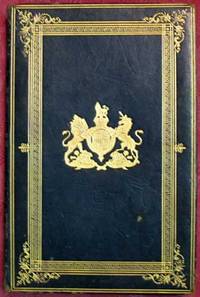
33514n. p. n. d. Ca 1906 - 1910. Custom full-black leather with elaborate gilt stamping with the UK's Royal Coat of Arms gilt stamped to the front board & the Admiralty Seal device gilt stamped to the rear board. Gilt dentelles with silk moire eps. AEG. Modest extremity wear. Spine leather a bit dull and the boards splay slightly. Gutter break prior to last leaf. Still a VG copy of an uncommon item. 17 leaves: 5 of text printed recto only. 12 leaves with tipped-in images 8 photographs & 5 color postcard-type images. 7-3/4" x 5" <br/><br/>The volume segregated into 4 sections: The "Dreadnaught" 2 text pages & 1 photographic image Submarines 1 text page & 5 photographic images Torpedo Boat Destroyers 1 text page & 2 photographic images & The Fleet / Dreadnaught Types 1 text page summarizing the fleet strength including ship types/numbers & 5 color postcard-type images of divers dreadnaught types. In short a custom 'primer' for the Royal English Navy ca 1910 with all indications the book created for the use of a senior Naval official or senior political figure associated with the Royal Navy. hardcover books
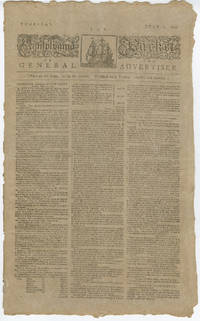
177921556.07Philadelphia PA 1779. No binding. Fine. Pennsylvania Packet or General Advertiser. Newspaper. Pennsylvania Packet or General Advertiser. John Dunlap Philadelphia Pa. July 1 1779. 4 pp. 10 1/2 x 17 untrimmed. Page 1-2 leads with extracts from the Journals of Congress regarding Indian Affairs and New Hampshire land disputes. Extensive content on the Revolutionary War medical department including a lengthy serialized ""Doctor Morgan's Vindication"" regarding the Continental Congress's dismissal of Dr. John Morgan who had great success managing military hospitals for Washington's Army without cause or explanation. Here he obtains testimony from General Nathanael Greene and even Washington himself to defend his reputation.Page 3 reports war news from Pennsylvania as well as a June 29 1779 act of the Continental Congress borrowing $20 million to maintain fiscal solvency.Page 4 includes advertisements for runaway slaves book auctions and stolen horses.Excerpt ""IN CONGRESS June 29 1779.AS Congress are bound by every motive of policy and of public & private justice to maintain the credit of the paper money emitted by their authority on the faith of the United States; so it is their intention not only to avoid further emissions but to diminish the quantity in circulation provided that the respective States by correspondent and vigorous exertions shall put it in their power to raise the necessary supplies.Resolved therefore That twenty millions of Dollars or such a part thereof as shall be brought into the Continental Loan-Offices on or before the first day of October next be borrowed on the faith of the United States at an interest of six per cent. per annum.For facilitating the said Loan Resolved1. That the Loan-Officers in every state do immediately open subscriptions for the said Loan. 2. That the executive authorities of the several states be requested immediately to appoint persons of character and influence in every county town or district to receive subscriptions and transmit the same to the Loan-Officer or Officers in the states respectively. 3. That no subscription be received for less then five hundred dollars. 4. That all subscriptions under ten thousand dollars shall be paid into the Loan-Office where the same shall be subscribed or into the Hands of the person obtaining the subscription within fourteen days after the subscription shall be made. 5. That any person subscribing ten thousand dollars or upwards shall be allowed to pay the same at two periods to wit one half within fourteen days after the subscription the residue on or before the first day of October next; the whole to bear interest from the time of the first payment provided the other payment shall be punctually made. 6. That each lender shall have his election either to receive the principal at the expiration of three years from the date of the Loan or to continue it in the funds on interest until the whole amount of Continental bills in circulation shall not exceed the sum in circulation at the time of the Loan. 7. That interest on all sums which shall be paid into the Loan-Office before the said first day of October or which shall be subscribed and paid agreeably to the terms of the 5th resolution aforesaid shall be payable annually at the Continental Loan-Office of the State in which the money was originally subscribed. 8. That when the interest on Monies which have been or may be placed in the several Loan-Offices on or after the first day of March 1778 shall become due and be paid the same until some more accurate standard of value can be devised shall be increased in proportion to the increase of the sum of Continental paper money which may be in circulation after the date of such Loans respectively.Extract from the MinutesCHARLES THOMSON Sec'ry."" unknown books
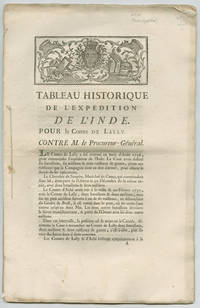
1766WRCAM47801Paris 1766. 51pp. Large folio. Stitched. Minor soiling and foxing. Very good. Defense of the Comte de Lally for his actions in India during the Seven Years' War. This is one of two versions authored by him. Lally head of the French expedition to India reached Pondichery in 1758. Though capable he was extremely unpopular and fell into a series of events which proved fatal to his career and his person. He was unsuccessful in the Siege of Madras and beaten at the Battle of Wandiwash and eventually capitulated from the siege of Pondichery. Taken prisoner by the British he returned to France on parole and was imprisoned for two years before being put on trial and executed. This is his last defence published shortly thereafter or perhaps immediately preceding a publisher's note is dated April 14 and Lally was executed May 6. unknown books
183544071London 1835. Good. Separated at folds edge worn and torn a few chips one affecting a few words at the end of about a dozen lines of text light soiling. 6 pp. with integral address. Folio. 10.5 x 16.5 inches. Manuscript with numerous corrections and additions concerning the failure of the British military in the War of 1812. In late 1835 then Colonel William Francis Patrick Napier 1785-1860 member of the British Army and a military historian gave speech at Bath which the Sunday Times reported claiming he had criticized the British soldiers in the War of 1812 as failing because they "stood as patriots and freemen on less firm and less elevated ground than the Americans themselves" which John Mitchell notes at the very beginning of this article published in the January 1836 issue of "United Service Journal and Naval and Military Service Magazine" pp. 84-92. Defending the soldiers Mitchell goes on to launch an attack on Napier's speech and the British command and their tactics. "The failure of the British troops at New Orleans was as complete as possible; but patriotism or want of patriotism had nothing to do with the business. The military policy of England guided by men ignorant alike of the strength and the weakness of armies swayed besides by the influence of philanthropic and economical patriots whose evil counsel fell like a death-bearing pestilence on the ranks of the army-shone out in all its poor and paltry littleness: in the constant striving to save farthings millions of treasure were wasted and thousands of gallant lives were remorselessly sacrificed. The valour everywhere exhibited by the troops the zeal ability high spirit and devotedness displayed by so many matchless officers the number of gallant blows struck and noble feats of arms performed- were not it must be allowed sufficient to counterbalance the folly ignorance and presumption that marked the official management of that most miserable war. But I repeat the fault was not with the troops" The failure is not just at New Orleans. "The British failed at Sacket's Harbour Platsburgh and New Orleans; to which for argument sake we will add Baltimore. At Sacket's Harbour and Platsburgh the British forces retired from phantom hosts and imaginary foes. At Baltimore something of the same kind happened." After a detailed analysis of the military's failures he ends his unrelenting attack: "But the soldiers of a great nation must know that they are equal to any contest. An American war like every war in which brave men are to be encountered has its difficulties; and it is only by looking those difficulties fairly in the face that they can be overcome. Had we listened to the liberal and patriotic despondency which so long represented us incapable of contending against the French we should at this moment have been crouching beneath the lash of Napoleon or his successor on the throne of the Grand Empire." Needless to say many jumped to the defense of Napier who wrote in his letter to the editor that the Sunday Times report of his speech was pure fiction and that he never criticized the troops; in fact he states he never mentioned the war at all. John Mitchell 1785-1859 was an army officer and writer who served in the West Indies in the Peninsular War and on diplomatic missions for Wellington. He wrote much on the defects of the British army tactics and a number of volumes including "The Fall of Napoleon" and "Biographies of Eminent Soldiers." Postmarked London December 22 1835. Addressed to Major Thomas Henry Shadwell Clerke who was editor of "The United Service Journal and Naval and Military Service Magazine." unknown books
17000Original WW II Poster from 1942 reads "Women in the War We Can't Win Without Them" Extra large size poster 29" x 41" in. Shows a woman factory worker wearing overalls or apron riveting with both hands a weapon that looks like a torpedo. This highly visual poster was promoting women in the wartime workforce it was produced in 1942 by the War Manpower Commission. At the time "Women in the War" was one of the most widely distributed images of a woman laboring in war production. The poster is in red blue and black poster. Publisher was the United States. Government Printing Office. Place of Publication: "Washington D.C." By 1943 when the labor shortage was most acute the two agencies worked together in concerted campaigns targeting employers to hire women and women to become 'production soldiers'" Yellin Our Mothers' War p. 44. Women laboring in factories even in the service of the war effort was controversial. "Despite the tide of public opinion against working wives War Manpower Commission director Paul McNutt concentrated on on patriotism. The campaigns glamorized war work always showing that women could maintain their femininity and still be useful" Yellin pp. 45-46. Examples of this important poster are held at numerous institutions including the Library of Congress and MOMA. At lower left corner of sheet: "War Manpower Commission Washington D.C." Copies in very good condition like this one are uncommon. unknown books
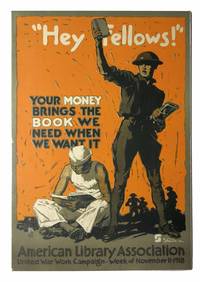
191843834New York: American Lithographic Co 1918. 1st Printing Borkan p. 181; Rawls p. 159. Only minor wear. Colors vibrant. Nr Fine. Single sheet broadside printed in orange brown & black on white paper. Image shows a doughboy with books in hand standing over a seated sailor who is reading a book. 30" x 20" <br/><br/> American Lithographic Co unknown books
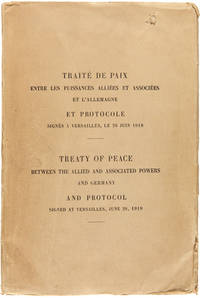
1919WRCAM49707Paris 1919. xv14284pp. printed in French and English on facing pages plus four large folding maps. Folio. Original printed wrappers. Minor edge wear small nick on front cover. Very good. Untrimmed and unopened. In a cardboard chemise and slipcase. Official French printing of the Treaty of Versailles a document of monumental importance in American and world history. The treaty made with Germany at the end of the First World War concluded a war of unrivalled devastation while sowing the seeds for the Second World War just twenty years on the horizon. The United States guided by Woodrow Wilson's vision played a central role in the crafting of the treaty. The U.S. Senate refused to ratify the treaty however based on the objection of several senators to the Covenant of the League of Nations which was included as Part I of the settlement thereby largely removing American influence and involvement from the international scene in the inter-war period. <br> <br> The Treaty of Versailles was a wide-ranging and ambitious document which sought not only to address the immediate postwar settlement but to punish Germany for its actions in starting and prosecuting the war attempted to remake the map of Europe and created a supra-national political organization the League of Nations. The Covenant of the League of Nations comprises the first part of the treaty. The next most famous part is that dealing with reparations which includes Article 231 the infamous "war guilt clause." By this article Germany accepted the responsibility of her and her allies "for causing all the loss and damage to which the Allied and Associated Governments and their nationals have been subjected as a consequence of the war imposed upon them by the aggression of Germany and her allies." The intent of the article was to affix legal and financial responsibility on Germany but it took on moral implications and was used by Hitler during his rise as an example of Allied perniciousness. Germany had to agree to pay reparations to the allies in the sum of 20000000000 gold marks the amount to be modified by a reparations commission in 1921. Germany also had to recognize the independence of Austria and agree not to compromise that independence in the future. Germany's borders were redrawn with Alsace- Lorraine being given to France West Prussia to Poland and other lands such as Danzig and the Saar Basin stripped away. She lost her overseas possessions the Rhineland was occupied and the German army was limited to one hundred thousand men and largely disarmed. Other provisions address issues of tariffs ports labor aerial navigation prisoners of war and more. <br> <br> As has been noted the many punitive measures of the Treaty of Versailles did much to fan the seeds of discontent in post-war Germany and to facilitate the rise of Hitler who publicly flaunted the provisions of the treaty throughout the 1930s. The refusal of the United States to ratify the treaty and participate in the League of Nations was a crucial part in the chain of events that led to the Second World War. A most important document here in an official French printing with the Protocol as a separate signature at the end. unknown books
1918107391New York: National Arts Club 1918. Hardbound. Portfolio case is worn chipped and tattered. Contents generally VG with age toning. Cardboard portfolio with ties and tipped-on facsimile of woman's head. 50 leaves inside contents 46 of 47 called for images 1 duplicate image one uncalled-for image and reproduction of written text by Pennell. "This unique collection of drawings was contributed to the "American Artist's War Emergency Fund" by forty-seven American artists to be disposed of for the benefit of this fund." Second leaf is a lithograph of a handwritten brief essay on lithography by Joseph Pennell. 37th drawing in the portfolio is also by Pennell. This copy has two copies of a contribution by Henry Walker and lacks the contribution listed for Ben Foster. There is however an unlisted contribution by G.H. Buer that is printed on a smaller sized sheet than the rest. Those artists represented in this set include Hugo Ballin Cecilia Beaux Edwin Blashfield Ernest Blumenshein George De Forest Brush G.H. Buer Howard Russell Butler Ercole Cartotto Frederick S. Church B.West Clinedinest Colin Campbell Cooper E. Irving Couse Kenyon Cox Charles C. Curran Eliott Daingerfield Paul Dougherty Ben Foster - lacking Daniel Garber Charles Dana Gibson Philip Leslie Hale Childe Hassam Ernest Ipsen Francis C. Jones Hugh Bolton Jones Arthur I. Keller Paul King Ella Conde Lamb William H. Lippincott Will H. Low Clara Mac Chesney F. Luis Mora H. Siddons Mowbray Ivan G. Olinsky Violet Oakley Maxfield Parrish William Macgregor Paxton Henry W. Parton Joseph Pennell Edward H. Potthast William Ritschel Henry B. Snell Gardner Symons C.Y. Turner Douglas Volk Henry O. Walker 2 copies Harry W. Watrous J. Alden Weir and Irving R. Wiles. An extraordinarily rare item. National Arts Club hardcover books
195180667NY: Scribner 1951. First edition first prnt. Signed by Jones on the title page. Lightly bumped upper board corners and a tiny soil scuff on the bottom edge; the dustjacket has two small chips on the spine topedge minimal wear at the spine bottom edge and touched corners and beginning toning on the flap edges. Tight bright and clean copy in Very Good condition in a Very Good dustjacket with an archival cover. Jones' first novel. . Signed by Author. First Edition. Hardcovers. Near Fine/Very Good. 8vo - over 7¾" - 9¾" tall. Scribner Hardcover books
18571284714Washington: Beverley Tucker Printer 1857. First Edition. 4to. 134p. 85pp. 102pp. 114pp. iv 64pp; VG; dark brown blind-embossed boards faded letters to spine; signs of repair to binding with spine being rebacked chipping to spine where rebacking is visible; some shelfwear and rubbing particularly to corners; bump to middle of upper and lower edges of rear board; title page is misspelled with the 'he' of 'the' missing; pages 51-54 of the botanical report slightly loose; 13 plates/2 woodcuts lacking maps 5 plates complete 16 plates complete plate XXIIa/b XXVa/b XLa XLVI LXII LXVI LXVIII LXX LXXIV XXVI XXXIV I III XXIX complete; Signature of former president Millard Filmore on front pastedown with date of Oct. 25 1859. Filmore January 7 1800 - March 8 1874 was the 13th President of the United States 1850-53. Fillmore and his cabinet rode the first train from New York City to the shores of Lake Erie and was a big proponent of a transcontinental railroad urging Congress to authorize the federal funding for one.; This is the California/Oregon volume with the report by Lieutenant Henry Abbot on the expedition under the command of Lieutenant R.S. Williamson. They were attempting to find routes from the Sacramento Valley to the Columbia River. The first section described the routes and terrain followed by sections on the geology the botany and the zoological report which included fishes birds and mammals of the region.; JC consignment; shelved case 1. 1284714. Shelved Dupont Bookstore. Beverley Tucker, Printer unknown books
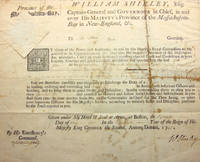
1745313114Boston 1745. 1p partially printed and accomplished woodcut dropped capital printed in four typefaces paper seal at top left with an 1802 hand drawn pen and ink map of Amos Keith's Farm in Bridgewater Massachusetts on the verso. Folio 15-3/4 x 12-1/2 inches. Wear and toning with with tape repairs on back and subsequent glue staining at repaired folds affecting several letters some bleed through from ink drawing on verso else good. 1p partially printed and accomplished woodcut dropped capital printed in four typefaces paper seal at top left with an 1802 hand drawn pen and ink map of Amos Keith's Farm in Bridgewater Massachusetts on the verso. Folio 15-3/4 x 12-1/2 inches. Appointed Cornet in the Regiment of Horse. A commission appointing Seth Alden gentleman "Cornet of the Troop in the Regiment of Horse within the said Province Commanded by Colonel Estes Hatch of which Troop Jonathan Bass Gent. is Captain."<br/><br/>William Shirley 1694-1771 was the longest serving governor of the Massachusetts Bay colony and is best known for his role in organizing the seige and capture of Louisburg during King George's War in 1745 and as commander-in-chief of British forces in the opening years of the French and Indian War.<br/><br/>Seth Alden 1710-1784 was born and died in Bridgewater Plymouth County Massachusetts. He was the 2nd great grandson of John Alden and Priscilla Mullins noted passengers on the Mayflower and original members of the Plymouth Colony.<br/><br/>A hand-drawn boundary map of "Amos Keith's farm 1802" in Bridgewater Massachusetts is done in pen and ink on the verso with deed histories and names of neighboring property owners. A notation reads: "plan among Avery Fobes papers." Fobes purchased the property from Keith on June 28 1802. unknown books
1848236690Washington D.C.: Printed by Wendell and van Benthuysen 1848. United States Congress 30th 1st Session; Senate Ex. doc. no. 1. 16 folding maps of Mexican War battles and 5 folding tables; Index of Indian documents index to Mexican war dispatches. 1369; 249 pp. Appendix. Thick 8vo. Bound in contemporary half brown calf and marbled boards. Fine. United States Congress 30th 1st Session; Senate Ex. doc. no. 1. 16 folding maps of Mexican War battles and 5 folding tables; Index of Indian documents index to Mexican war dispatches. 1369; 249 pp. Appendix. Thick 8vo. Printed by Wendell and van Benthuysen unknown books
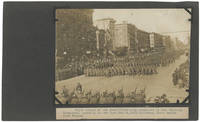
1919CAT0119New York: Underwood and Underwood 1919. First Edition. Gelatin silver prints 7 ¾ x 5 ½ inches each on 11 ½ x 7 inch black paper mounts captioned with affixed text. Very Good. Two WWI-era press photographs related to the Negro 15th Infantry Division of the New York National Guard a.k.a. the 369th US Infantry Regiment and their white commander Colonel William Hayward. One photograph shows the division on parade in New York following their return from combat duty in France in 1919 the other is a well-known image of Hayward who organized the all-black unit and served as its leader. Fighting for a record-breaking 191 consecutive days alongside French troops in the trenches the regiment became known as the "Harlem Hellfighters." <br /> <br /> The opportunity for African-Americans to serve in WWI arose from the Selective Service Act of 1917 which drafted all men between the ages of twenty-one and thirty. Special segregated training camps were established and units were formed. The US National Archives states that 200000 African-Americans served in Europe during WWI but only 42000 saw combat. When the 15th Infantry arrived in France in 1918 Hayward was committed to the idea that his unit would fight on the front lines. After General Pershing refused to integrate them with the full US army Hayward pushed for another assignment under French command. Unlike many other segregated divisions in WWI the 15th aka 369th was eventually sent to the trenches. Its members' distinguished service brought honor and fame. Before leaving the US in 1917 the regiment had not been allowed to participate in the New York National Guard's farewell parade. When they returned victorious Hayward ensured they were publicly honored. <br /> <br /> Both with various press stamps to versos. Small closed tear of about a half inch to upper edge of parade picture good overall. Hayward portrait with some rippling at edges very good overall. Underwood and Underwood unknown books
19462296441The 75th Infantry Division / Army & Navy Publishing Company 1946. First Edition. Large Hardcover. Very Good/No Jacket. Rowe John S. Signed by author. Original platoon photograph signed by dozens of members of the 75th Infantry Division and noting their home towns laid in along with a Remember Pearl Harbor soldier 'diary' detailing the service of a soldier in the division. A couple faint spots to boards otherwise an excellent copy. Soldiers who signed included: Pearson C. Schiller; Sgt. Chitwood; Domenico J. Scatena; George T. Wingard Jr.; Mike Stirling Jr.; Paul Toman; Joe LaPointe; Lowell E. Murphy; 'myself' probably Nathan Hena who signed the Pearl Harbor sheet; Jack M. Reese; Robert N. Dugal; Joseph A. Buzogany; Robert T. Berkebile; Joseph W. Lasley; Grover E. Hardy; Douglas Huff; William C. Woodward; Ivan C. Else; Francis Quinn; G.L. Mae; Calvin W. Hood; Howard L. Marshall; Chester Kalm; Delwyn P. Goodyear; Sgt. Adams; Walter J. Clausius Jr.; John J. Long; Morton L. Plesser; Ridley W. Meek; Richard H. Phillips; Jerry H. Steward; Harry S. Singer; William H. Fleming; Platton Sgt. Smith the sergeants' names are all in pencil in the same hand so they were probably written in by the owner of the book. Some names are numbered to correspond with the photo others are marked as 'not present for picture'. 1946 Large Hardcover. Unpaginated. Black-and-white photographs throughout depicting the service of the 75th Infantry Division toward the end of World War II. The 75th Infantry Division / Army & Navy Publishing Company hardcover books
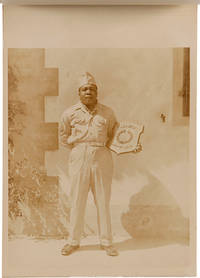
1945WRCAM55486N.p.: Edward D. Biggerstaff Jr. 1945. Seventeen sepia-toned photographs each with captioned tissue guard. Oblong 16mo. Original textured wrappers title printed in dark blue on front wrapper. Minor edge and corner wear front joint creased. Fore-edge of photographs a bit curled but clean. Very good. Pocket-sized photograph album commemorating the members of the 604th Ordnance Ammunition Company a unit of African-American soldiers who served as battle support in Italy during World War II. A small line of text on the rear wrapper reads: "Photographs by 1st Lt. E.D. Biggerstaff Jr." Edward D. Biggerstaff Jr. was the commanding officer of the 604th Ordnance Ammo. Company evidenced by his photograph in the album; he is also pictured with the other white company officers in a separate photograph. <br> <br> The album opens with a photograph of the entrance to the company's "Bivouac Area" and an image of the Villa Traxler in Nugola Italy which is captioned as "Occupied by 604th Ordnance Ammunition Company." Then following the images of Biggerstaff and the senior officers the album features a series of photographs depicting the African-American junior or non-commissioned officers and personnel beginning with First Sergeant Leroy Crosby. After Crosby's photograph the album includes group photographs of Crosby with his other five staff sergeants; the company headquarters personnel; the depot office personnel gathered around a small cannon; kitchen staff; the motor pool with a separate photograph of their vehicles; separate group pictures of the first second and third magazine platoons; the service and supply section; the guard mount; and a photograph of the remaining members of the company who did not appear in the other images. Especially useful in this album are the captioned tissue guards before each photograph which identify each soldier by name and rank. <br> <br> The album was likely made by or at the behest of commanding officer Edward D. Biggerstaff in an unknown quantity. It appears to be quite rare as we can locate no other copies in OCLC auction records or the trade. Edward D. Biggerstaff, Jr. unknown books
191371066Cincinnati: Published by the Society 1913. First Edition. Hardcover. Very good. 33 volumes in 17: I-XVI XXV-XLI. Various paginations with frontispieces most color engravings photographs and folding maps. Octavo seventeen volumes. Original green cloth bindings with beveled edges and decorative gilt and blind stamping. Some creasing to the folding maps. Light staining to the front board of the second volume with minor mottling to some volumes; otherwise very good overall. Formed in late 1861 the Army of the Tennessee was a Union army in the Western Theater of the American Civil War named for the Tennessee River and not to be confused with the similarly named Confederate force. Initially under the command of Major General Ulysses S. Grant in the Union's District of West Tennessee the army survived a severe test at the Battle of Shiloh and played an important role in both the Siege of Corinth and Battle of Vicksburg. Later under William Tecumseh Sherman James McPherson Oliver Howard and John Logan it marched and fought from the Chattanooga Campaign through the Relief of Knoxville the Meridian Campaign the Atlanta Campaign the March to the Sea the Carolinas Campaign and to the end of the war and disbandment. The preliminary meeting for the formation of the Society of the Army of the Tennessee was held in the senate chamber at the state capitol in Raleigh North Carolina on April 14 1865. Membership was restricted to officers who has served with the Army of the Tennessee with Sherman serving as President from 1869 to 1884. This partial record includes transcripts of the speeches and statements of prominent members and guests reminiscences of the war remembrances of the recently deceased a detailed account of the proceedings and information on the society's philanthropic efforts which included the erection of statues and monuments in Washington D.C. Published by the Society hardcover books
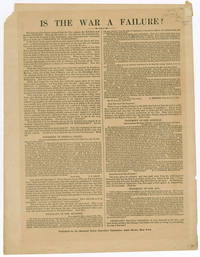
1864WRCAM53826New York 1864. Broadside approximately 11 1/4 x 8 3/4 inches. Small portion of upper left corner torn away short closed at tear at upper right. Tanning light mat burn. Good plus. This scarce broadside rebuts Copperhead claims that the War is a disastrous mistake requiring that "immediate efforts be made for a cessation of hostilities." Issued during the critical 1864 presidential campaign it quotes generals Grant Sherman Seymour and Dix who make clear that the Rebels are on their last legs. In fact "The rebel cause is fast failing from exhaustion." Grant reports: "The rebels now have in their ranks their last man. The little boys and old men" are filling the ranks. "AMERICANS! Read these declarations of your Generals in the field and then decide whether the Chicago Convention was right or wrong in pronouncing the war a failure" unknown books
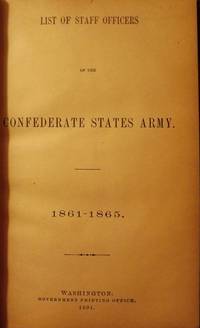
18912671891. CIVIL WAR. LIST OF STAFF OFFICERS OF THE CONFEDERATE STATES ARMY: 1861-1865. Washington: Government Printing Office 1891. Small quarto: brown quarter-morocco leather & marbled boards marbled endpapers & edges. A scarce listing of Confederate officers printed on fragile paper. Very Good front hinge tender small stain page 25 some damage top inner-edge of front endpaper. $750.00. <br/><br/> hardcover books
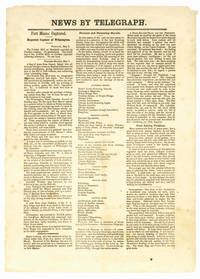
1862262182Rockland Maine: Rockland Gazette 1862. Printed broadside in three columns. 13 x 9-1/4 in. Old folds else fine. Printed broadside in three columns. 13 x 9-1/4 in. Unrecorded Broadside. Broadside reporting events of the Civil War including the surrender of Fort Macon N.C. General Butler's advance on New Orleans and an unfounded report on the fall of Wilmington it would not be captured until 1865. The remainder of the broadside concerns gardening and farming matters. Attributed to the Rockland Maine Gazette based on the similarity to the type faces and layout of the 1861 Rockland Gazette broadside "Important News by Telegraph." There is also news here from Buckfield and Gorham Maine and news of Major Lothrop of Leeds Maine. Rockland Gazette] unknown books
186234184Ogdensburgh NY 1862. Narrow broadside 4-3/8" x 14-3/4". Old folds light dusting Very Good.<br/><br/> The Extra leads with a report from Washington on the battle at Culpeper Virginia on August 9 commonly known as the Battle of Cedar Mountain. The Confederates led by Stonewall Jackson repelled the advance of heavily outnumbered Union troops. "Many are mortally wounded in the arms and legs." Better results for the Union are reported from Hudson Missouri where Porter's Guerillas were routed. "The Confederates scattered in all directions. Some of the prisoners captured had taken the oath and given bonds." <br/> The Extra also reports the news doubtless unwelcome that the Secretary of War has ordered the draft of 300000 men about 60000 of whom will come from New York. Finally the Confederates are reported to have sought a truce in Culpeper in order to bury their dead. "With all their superiority of numbers they were too badly cut up to maintain their position. unknown books
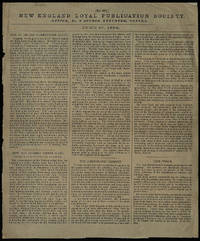
186423626<p><i>"They grinned and pushed on and with a yell that told the southern chivalry their doom they rolled irresistibly over and into the work."</i></p> <b>CIVIL WAR.</b>Broadside. <i>New England Loyal Publication Society No. 200.</i> Boston Mass. June 27 1864. 1 p. 9 x 10¾ in.<p>A New York Tribune reporter praises the performance of the USCT: <i>"I find that in my account of the assault upon the rebel works in front of Petersburg I hardly did the colored troops justice. As before stated they held a position on the Jourdan Point road.They were first directed to assault the earthwork.the charge upon the advanced works was made in splendid style; and as the 'dusky warriors' stood shouting upon the parapet Gen. Smith decided that 'they would do' and sent word for them to storm the first redoubt. Steadily these troops moved on led by officers whose unostentatious bravery is worthy of emulation. With a shout and rousing cheers they dashed at the redoubt. Grape and canister were hurled at them by the infuriated rebels. They grinned and pushed on and with a yell that told the southern chivalry their doom rolled irresistibly over and into the work. The guns were speedily turned upon those of our 'misguided brethren' who forgot that 'discretion was the better part of valor.' </i></p><p><i>Another redoubt was carried in the same gallant style and the negroes have established a reputation that they will surely maintain."</i></p><p>With a discussion on using monies gathered from draft exemption payments to give bonuses when recruiting black troops in the South: <i>"as the government will continue to receive exemption money why should it not devote the sums which are likely to be thus gathered to bounties for soldiers white or black enlisting in the South. In that way the ranks could be kept full."</i></p><p>With reports on how the Southern planter aristocracy hates Lincoln and Johnson as running mate because both rose through the ranks of the <i>"common"</i> people.</p><p><b>Historical Background</b></p><p>The Boston-based New England Loyal Publication Society and the Loyal Publication Society of New York was founded in 1863 to bolster public support by disseminating pro-Union news articles and editorials to newspapers around the country. At first the two groups read newspapers to identify particularly useful articles and editorials and contact the editors to request that additional copies be printed. These items would then be distributed to Union soldiers or to newspapers. As the war progressed the societies began to write and publish their own broadsides.</p><p><b>Condition</b></p><p>Very good. Tape 1 inch on verso at horizontal fold some water stains visible mostly from back. Better than it sounds!</p> books