1 575 résultats
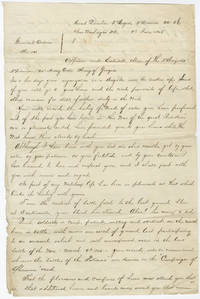
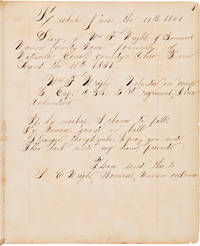
1861WRCAM56124Various places in Iowa and Missouri as described below 1861. 1022pp. approximately 16000 words. Contemporary half sheep and marbled boards. Boards detached but present worn and rubbed. Bookseller stamp on front free endpaper. Pages loosening but all present pages 33-34 with old repairs to a vertical tear running the length of the page. Occasional spots of soiling throughout but overall the text is quite clean and very easily read. Overall very good. An engaging account of the early days of the Civil War in Missouri by William F. Wright a Union volunteer from Somerset Iowa. Missouri was a highly-contested border state with both Union and Confederate supporters. It sent soldiers and arms to both sides was represented with a star on both flags maintained dual governments and featured a vicious intrastate war within the larger national war. William Wright's journal of his service in the first year of the war ably communicates the dangerous and unprecedented nature of guerilla warfare in the western theatre of the Civil War. <br> <br> Wright 1837-1905 enlisted in the 3rd Iowa Infantry Regiment in May 1861 responding to President Lincoln's first call for troops. Much of the diary centers on the months from July to September 1861 as his unit traveled back and forth across Missouri facing a guerrilla enemy with no clear battle lines. Unlike the large armies and massive battles further east Wright's regiment was frequently on the move by rail and foot often splitting off into companies squads and scouting parties prone to ambush by raiding parties with small detachments occasionally getting picked off by snipers. In addition to Confederate soldiers Wright's regiment also faced bands of pro-Confederate irregulars known as "bushwhackers." The war in Missouri was continuous from 1861 to 1865 with conflicts throughout the state. There were over 1200 distinct engagements in the state during the war; only Virginia and Tennessee exceeded this total. <br> <br> Wright is generally stoic throughout though he does admit to occasional homesickness and is justifiably distressed over a case of ague that comes on in August. When not drilling or recounting recent attacks Wright frequently mentions attending church prayer meetings and Bible study though he does not seem overly picky as to where. He attends a Catholic mass and a Presbyterian service on the same day and on another attends Episcopal Methodist and Presbyterian services on the same day. <br> <br> The diary begins on May 27 1861 as Wright puts his affairs in order and travels to Indianola where he "was sworn into the state service for three years" after which he proceeds with other recruits to Keokuk Iowa a major staging area for Union forces. His unit is officially sworn into "United States service" on June 8 receive their rifles on the 23rd and then assemble in camp on the 26th. The next day they receive word that they are heading to Missouri in the morning: "we received orders to cook enough provisions for three meals the drum would beat at 3 in the morning at which time we were to pull up stakes." They march to the docks board several steamships and head south on the Mississippi to Hannibal Missouri. Upon disembarking Wright comes across two men taken prisoner by the home guard "and I had for the first time the privilege of seeing a secession prisoner." <br> <br> The next day July 1 they board trains and head west: "I was surprised to see so many fine residences also quite a number of slaves were to be seen at work in the fields who cheered lustily as we passed.We passed several encampments of soldiers on the way who were all in good spirits. We hauled up at Utica in Livingston Co. slept in the cars." After a couple of weeks of false alarms of pending attack mysterious shots at night low rations and rumors of murdered soldiers the company was on edge. On July 18 Wright and nine other men were detailed to guard the railroad station in Utica after reports "that the enemy was going to burn it." During their watch "a spy came in with the information that from 500 to 800 men on Spring Hill were making preparations for an attack at the bridge and station simultaneously." No attack materialized however: "Daylight came and no enemy we were disappointed as we were well prepared for them and would have been pleased to have seen from 50 to 100 make their appearance." <br> <br> Tensions continued in a similar vein for the next few weeks as they shifted back east to Kirksville. Wright reports of all-night guard duty multiple nights in a row and frequently going without meals due to inadequate rations. On August 19 they received warning of a pending enemy attack which ends up as a small skirmish: "Six of our scouts were surrounded by 25 of the enemy. They killed Corporal Dix. The others made their escape after killing 3 or 4 of the enemy." Not long after they start heading south and while passing through Shelbina Missouri three of their men were shot one died by an enemy squad hidden in the brush. Circling back to Shelbina to rest they find the town partially destroyed by Rebel forces. Wright's unit then finished the task which he describes neutrally: ".the boys were allowed to go where they pleased and they took and destroyed ev'y thing in town. When ever a chicken was heard to crow a dozen men were ready to start for the place. Chickens and pigs were killed women's dresses taken children's playthings &c &c." Passing through Macon Missouri Wright and his comrades "dropped into a Brewery. There were quite a number of the boys there. Some of them were trading their shoes some shirts and others drawers for beer. I do not know whether they were their own clothes or whether they had stolen them. Saw three fights today." <br> <br> Heading west just outside of Kansas City they notice enemy scout activity. After more than two months of skirmishing and sniping the regiment saw its first pitched battle. On September 17 "3 p.m. we started from Liberty about 600 strong in the direction of the river. The enemies scouts were retreating as we went forward. The enemy killed 4 and wounded one of our men. About 4 o'clock we were fired into by the enemy which was the first that we knew of their position. We were within about 100 yds of their lines when we were fired on.We fought about an hour and 20 minutes when we were ordered to fall back as they had three men to our one and were flanking us. Four of the artillery men were kiled & four wounded which did not leave enough to man the gun and she was only fired three times when we had to haul her back by hand.we had 17 killed about 60 wounded and a number missing.it is reported that there were over 100 enemy killed and wounded." This was the Action at Blue Mills Landing also known as the Battle of Liberty. The next day Wright wrote "I have been helping to make coffins for our killed 12 bodies which will be buried in the evening.The most shocking scene that I have ever witnessed is one of the dead men whose face has been skined said to have been done by his brother-in-law." <br> <br> Wright had reported on his unit's tendency to loot earlier in the diary and now makes an interesting clarification: "When in the free State of Kansas the boys behaved very well. But since we have again come into Mo. they have began their old tricks. Last night there were quite a number of chickens stolen and a calf taken out of a man's dooryard." Perhaps in fairness to the Iowa troops they regularly went without rations or were given only flour and because they were often in hostile territory they rarely had permission to hunt or fish for their meals. <br> <br> Until this point Wright does not mention any direct encounters with African Americans but on October 18 as they depart Kansas City he notes they ".took three slaves with us who had run away from Lexington." Upon reaching Quincy Illinois "Will Newton and I went down town and got lodging for the three darkys who came from Kansas City. We left them with the supt. of the Colored Peoples Church." <br> <br> For the remainder of this diary Wright was stationed at the Benton Barracks in St. Louis; some of these entries are slightly out of order chronologically as though Wright inadvertently skipped pages. On December 1 he writes "In the evening one of Co. K was killed by accident. One of his comrades cocked his gun not knowing that it was loaded and shot the top of his head off. It was the most horrible sight that I have yet seen." Not much else happens until the end of the month when they get word that they'll be heading back out soon and start prepping their equipment. Leading up to Christmas he notes many of the men planning a big Christmas dinner: "For my part do not feel like celebrating the day. Think it will not pay here will pass it by as other days for this time." <br> <br> Wright's final entry on Christmas Day is also introspective. Having reflected on his past seven months in the army the things he has seen and how frequently he has been spared he concludes: "I do not like a sol. life. Would be far from following it from choice but believe that it is my duty as we are engaged in a just and noble cause trying to sustain one of the best governments ever formed. Co. G is not drunk to night but slightly inebriated." <br> <br> At the end of the diary Wright has transcribed a letter from a rebel which gives a sense of some the psychological warfare practiced during the conflict. Dated at Fillmore Missouri July 18 1861 it reads in part: "I hope when this letter comes to hand you may have time to read it. And I think that I shal be nearby. And then as soon as it is red I shal be near enough to nock your life out of you. I hope the time may come when the flag of the fifteen glorious states may fly over the free and independent.Instead of one thousand of us there is about 8000 of us and we are coming there as soon as we can get there." <br> <br> Wright reached the rank of sergeant in 1863 and survived to muster out in 1864. After the war he married raised a family and farmed in Kansas and Nebraska. <br> <br> A detailed and informative diary of the brutal and chaotic early months of the Civil War in Missouri. hardcover books
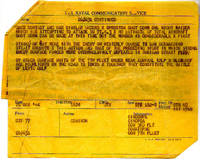
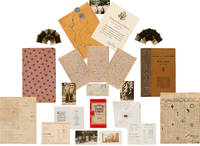
886016 Radio Telegrams including detailed Action Reports Tactical Operation Commands Battle Assessments Damage Reports etc. spanning the full duration of The Battle of Leyte Gulf 24 October - 28 October 1944. Imprinted upon wartime U.S. Communication Service USS Hector - 20M Sets yellow onionskin paper. 8" x 6.5". 7 designated "Secret- Urgent" 4 designated "Operational Priority-Secret" 2 designated "Priority-Secret" 1 designated "Top Secret-Operational Priority" 1 designated "Secret-Op-Op-Op"1 designated "Routine-Confidential". TRANSCRIBED DESPATCHES #240315 10/24/44 06;14 From: CTF 77-Vice-Admiral Kinkaid--7th Fleet - King II Attack Force Action: CTG 77.2 - Rear-Admiral Olendorf - Bombardment & Fire Support Group CTF 78 - Rear Admiral Barbey - Northern Attack Force CTF 79 - Vice-Admiral Wilkinson - Southern Attack Force CTG 77.3 - Rear Admiral Berkey - Close Covering Group CTG 70.1 - Commander S.S. Bowling - MTB Group PREPARE FOR NIGHT ENGAGEMENT X ENEMY FORCE ESTIMATED 2 BB 4 CA 4 CL 10 DD REPORTED UNDER ATTACK BY OUR CARRIER PLANES IN EASTERN SULU SEA AT 09101 24 OCT X ENEMY CAN ARRIVE LEYTE GULF TONIGHT X MAKE ALL PREPARATIONS FOR NIGHT ENGAGEMENT X TG 77.3 ASSIGNED TO CTG. 77.2 AS REINFORCEMENT X CTG 70.1 STATION MAXIMUM NUMBER PT'S LOWER SURIGAO STRAIT TO REMAIN SOUTH OF 10-10N DURING DARKNESS. #240504 10/24/44 06:34 From: CTG 70.1 - Commander S.S. Bowling - MTB Group Action: All TFC 7th Fleet All TGC 7th Fleet AGP 8 Wachapreague EXPECT TOKYO EXPRESS TONIGHT X BEFORE DARK STATION BOATS IN SECTIONS OF 2 OR 3 BOATS EACH AT FOLLOWING POSITIONS X SOUTHWEST TIP PANOAN X SOUTH OF MADILAO POINT X SOUTH OF LIMASAWA ISLAND X 2 SECTIONS PATROL BETWEEN AGIO POINT BOHOL PAST CAMIGUIN ISLAND TO SEPACG POINT MINDANAO X VITAL EASC OSTOKOWSW FILE REPORT CONTACTS AND THAT OTHER SECTION LEADERS AND WACHAPREAGUE RELAY THESE REPORTS TO CODLIVER X 21 BOATS FROM OYSTER BAY STATIONED BY SECTIONS AS FOLLOWS x SOURGDB T TIP PANOAN ISLAND X BILAA POINT MINDANAO X IN SURIGAO STRAIT 5 SECTIONS X 1 OFF SUMILON ISLAND X 1 MEDCHANTRN OFF KANHATID POINT DINAGAT ISLAND X 2 OFF KANIHALN ISLAND X 1 SOUTHEAST AMAGUSAN POINT X WACHAPREAGUE INFORM LCIS LAST STATION X SECTIONS ATTACK INDEPENDENTLY AFTER MAKING CONTACT REPORT X CTG 70.1 SENDS. #240938 10/24/44 From: CTG 77.4 - Rear Admiral T. L. Sprague - Escort Carrier Group - CarDiv22 Action: CTG 77.4 THE SUPERB AIRMANSHIP AND FIGHTING SPIRIT DISPLAYED TODAY WILL LIVE IN HISTORY X IT IS MY OPINION THAT THIS IS THE FIRST DAY OF A RUNNING FIGHT WHICH WILL MARK THE ECLIPSE OF JAPANESE SEA POWER x TO BE EQUAL TO THE TASK IS ONLY TO REPEAT WHAT YOU HAVE DONE TODAY X UNIT COMMANDERS PASS TO THOSE UNDER YOUR COMMAND. #242232 10/25/44 From: CTG 77.4 - Rear Admiral T. L. Sprague - Escort Carrier Group - CarDiv22 Action: CTF 77 Vice-Admiral Kinkaid--7th Fleet - King II Attack Force CTF 78 Rear Admiral Barbey - Northern Attack Force CTF 79 Vice-Admiral Wilkinson - Southern Attack Force All CTG's TF 77 King II Attack Force COMPLETE REPORT OF ESCORT CARRIERS OPERATIONS TWENTY FOUR OCTOBER X ENEMY AIR RAIDS IN FORCE CAUSED CANCELLATION OF VISAYAS STRIKES AND SOME REDUCTION OF SUPPORT AIRCRAFT X OUR REINFORCED COMBAT PATROL SHOT DOWN FORTY EIGHT TWIN ENGINE AND EIGHTEEN SINGLE ENGINE JAP PLANES PLUS EIGHT MORE TWIN ENGINE PLANES PROBABLY DESTROYED IN A WILD MELEE OVER LEYTE ISLAND THE BEACHES AND SHIPPING IN LEYTE GULF X PLANES SHOT DOWN INCLUDED TWENTY LILYS EIGHTEEN SALLYS SEVEN FRANCES AND WIDE ASSORTMENT OF OTHER ARMY AND NAVY TYPES X HIGH SCORE FOR THE DAY WAS MADE BY LT CDR FUNK OF SANTEE WITH FIVE KILLS ON A SINGLE FLIGHT WHILE SAWANNEE PILOTS REPORTED KNOCKING DOWN EIGHT OUT OF EIGHT IN ONE GROUP X OUR LOSSES IN COMBAT WERE TWO PILOTS AND EIGHT PLANES WHICH INCLUDED ONE FOX SIX FOX FOUR FOX MIKE TWO TARE BAKER MIKE PLUS ONE FOX MIKE MISSING X OPERATIONAL LOSSES WERE ONE FOX MIKE WHICH SPUN IN JUST AFTER TAKEOFF DURING DARKNESS WITH THE LOSS OF THE PILOT X SPECIAL STRIKE ON BACOLOD FIELD DESTROYED TWO IRVINGS ONE KATE ONE BETTY AND ONE SINGLE ENGINE PLANE ON THE FIELD DAMAGED ONE IRVING AND ONE TOJO AND SANK ONE LUGGER AND FOUR BARGES X ONE JUDY CAME OUT TO FIND OUT WHAT WE WERE DOING OUTSIDE WAS CHASED FROM FIFTEEN THOUSAND TO FIFTY FEET AND SHOT DOWN BY THE LLERT LOCAL CAP X ALL IN ALL A GRAND DAY X FROM COMTASKFBBUP SEVENSEVEN DOT FOUR. #242348 10/25/44 01:07 From: COM 3RD FLT - Admiral Halsey -Commander 3rd Fleet Action: CTG 38.1 - Vice-Admiral John McCain PROCEED AT BEST POSSIBLE SPEED TO SOUTHWEST STRIKE EARLIEST POSSIBLE ENEMY FORCE REPORTED TO BE 4 BB'S8 CA'S PLUS DD'S IN VICINITY11-20N 127-00E AT 0800 X FROM COM 3RD FLT ACTION CTG 38.1 INFO ALL TGC'S 3RD AND 7TH FLTS CTF 77 ALL TFCS 3RD AND 7TH FLTS. #250615 10/25/44 07:08 From: CTU 77.4.3 - Rear Admiral G.A.F."Ziggy" Sprague -Escort Carrier Group - CarDiv 25 Action: CTG 77.4 - Rear Admiral T. L. Sprague - Escort Carrier Group - CarDiv22 SECOND BATTLE DAMAGE REPORT X KALININ BAY RECEIVED 15 SHELL HOLES IN HULL IN ADDITION TO A FEW SMALL FRAGMENTATION HOLES X MOST HOLES PLUGGED UP AND ONLY LEAKING SLIGHTLY NOW X NUMEROUS HOLES IN FLIGHT DECK BY SUICIDE PLANE BEING REPAIRED X AT01L FLOODED BUT UNDER CONTROL X SMALL FIRE IN FUEL OIL TANK UNDER MACHINE SHOP X GYRO OK BUT HAVING GREAT DIFFICULTY STEERING X ELEVATOR LOWERED AND DECOMMISSIONED X ALL COMMUNICATIONS ON BRIDGE OUT X CAN RECEIVE VHF ONE CANNOT TRANSMIT ON ANYTHING NO RADAR X CANNOT STAND ANY INCREASE IN DRAFT XX 1020 HOEL REPORTED STOPPED TO PLUG HOLE 6 FEET IN DIAMETER 2 FEET BELOW WATERLINE X ONE GUN OUT X SOUND GEAR OUT X 200 ROUNDS OF AMMO LEFT NO TORPEDOES X NOT HEARD FROM SINCE X KITKUN BAY DAMAGE TO SHIP NEGLIGIBLE FROM NEAR BOMB HIT AND CRASH OF ENEMY PLANE X ONE KILLED 16 WOUNDED. #260139 10/26/44 06:05 From: CTF 77 - Vice-Admiral Kinkaid--7th Fleet - King II attack Force Action: None Information: CTF 38 - Vice Admiral Mitscher - Fast Carrier Forces COMAF 5 - Lt. General Ennis C Whitehead COMFEAF - General George Kenney ENEMY CRUISER AND FIVE DD PROCEEDING COURSE 300 FROM BULALAOUI POINT NORTH CEBU X SHIPS 1000 POSITIONS FROM 5 TO 45 MILES NORTH CEBU X CRUISER IN VAN X CVE STRIKE NOW IN PROGRESS BUT ADDITIONAL STRIKES NEEDED. #260427 10/26/44 04:55 From: CTF 77.4 - Rear Admiral T. L. Sprague - Escort Carrier Group - CarDiv22 Action: CTF 77 - Vice-Admiral Kinkaid--7th Fleet - King II attack Force UNDER AIR ATTACK X SUWANNEE HIT BY SUICIDE DIVE FORWARD OF BRIDGE X FIRE UNDER CONTROL. #260551 10/26/44 06:07 From: CTF 77.4 - Rear Admiral T. L. Sprague - Escort Carrier Group - CarDiv22 Action: CTF 77 - Vice-Admiral Kinkaid -7th Fleet - King II attack Force RECOMMEND ESCORT CARRIERS BE RETURNED TO MANUS IMMEDIATELY DUE SHORTAGE FUEL BOMBS TORPEDOES AND LOSS YESTERDAY OF ABOUT TOTAL OF 130 PLANES X DETAILS IN MESSAGE FOLLOWING. #260631 10/26/44 16:24 From: CTF 77 - Vice-Admiral Kinkaid--7th Fleet - King II attack Force Action: COMINCH Admiral Ernest King - Commander-In-Chief U.S. Fleet Information: CINCSWPA General Douglas Macarthur - Commander U.S. Forces Far East CINCPOA Admiral Chester Nimitz - Commander-In-Chief Pacific Fleet COM3RDFLEET Admiral Halsey -Commander 3rd Fleet COMA/RPAC Vice-Admiral John Hoover - Task Force 57 - Forward Area Central Pacific COM7THFLEET Vice-Admiral Kinkaid -7th Fleet - King II Attack Force WITH THE DEEPEST REGRET ITEM REPORT THE LOSS OF 2 CVE'S 2 DD'S AND 1 DE PLUS DAMAGE TO OTHER SHIPS IN A BATTLE FOUGHT TO THE EASTWARD OF SAMAR ON 25 OCT BETWEEN ENEMY AIR AND SURFACE FORCES AND A GROUP OF 16 CVE'S PLUS DD AND DE ESCORTS X THIS GROUP WITH SUPERB DETERMINATION AND SKILL FOUGHT AND DEFEATED A STRONG ENEMY SURFACE FORCE SUPPORTED BY REPEATED ATTACKS BY SHORE BASED ENEMY AIRCRAFT X THEY STRUCK REPEATEDLY WITH ALL MEANS AT THEIR DISPOSAL UNTIL THE ENEMY RETIRED DEFEATED AND CONTINUED TO STRIKE HIS RETREATING FORCES UNTIL DARKNESS X THE REPORT OF THE VALLIANT COMMANDER OF THIS GALLANT GROUP REAR ADMIRAL T.L. SPRAGUE IS TRANSMITTED HEREWITH X QUOTE X CTG 77.4 DESPATCH 25_00 X AS A RESULT OF TODAY SURFACE AND AIR ACTIONS CTU 77.4.3 REPORTS SAINT LO FORMER MIDWAY HIT BY DIVE BOMBER FOLLOWED BY HEAVY EXPLOSION WHICH DESTROYED SHIP X GAMBIER BAY JOHNSON AND ROBERTS MISSING SINCE BOMBARDMENT BY STRONG ENEMY FORCE BELIEVED TO CONTAIN 4 BB 8 CA AND CL 7 OR MORE DD ALL VERY FAST X ALL CARRIER GROUPS WERE UNDER ATTACK THROUGHOUT THE DAY X SANTEE RECEIVED TORPEDO HIT AND SUICIDE CRASH ON DECK WHICH STARTED FIRE AND PENETRATED BOTH FLIGHT AND HANGAR DECK X SANGAMON HAD SUICIDE CRASH ALONGSIDE WHICH PUNCTURED SIDE IN MANY PLACES X FIRES AND DAMAGE WERE BROUGHT UNDER CONTROL AND ALL VESSELS CONTINUED TO LAUNCH STRIKES AGAINST ENEMY FORCE TILL SUNDOWN X VESSELS OF TU 77.4.2 WERE UNHIT UP TO LATE AFTERNOON AND THIS GROUP LAUNCHED A TOTAL OF 6 HEAVY STRIKES ARMED WITH TORPEDOES AND HEAVY BOMBS X NORTHERN GROUP TU 77.4.3 WAS UNDER MORE OR LESS CONTINUOUS FIRE OF ENEMY BATTLESHIPS CRUISERS AND AIRCRAFT THROUGHOUT THE DAY X ALL SURVIVING CARRIERS WERE DAMAGED X WHITE PLAINS FANSHAW BAY AND KITKUN BAY GOT FIRES AND OTHER DAMAGE UNDER CONTROL AND CONTINUED TO LAUNCH ATTACKS UNTIL THE END OF THE DAY X LAST STRIKES FROM ALL SHIPS WERE OVERTAKEN BY DARKNESS AND MANY LANDED ON LEYTE X DAMAGE TO ENEMY CANNOT BE ASSESSED AT PRESENT BUT UNKNOWN DAMAGE INCLUDES 4 TORPEDOES IN BB AND NATORI CLASS CRUISER STOPPED AND SET AFIRE IN MINDANDO SEA X OFF SAMAR 2 BB WERE HIT BY TORPEDOES AND ONE CA STOPPED DEAD X DD AND DE OF SCREEN TU 77.4.3 MADE A GALLANT HEAD ON ATTACK WITH GUNS AND TORPEDOES WHEN THE CARRIERS WERE BROUGHT UNDER FIRE BY THE ENEMY BB X CASUALTIES OF SUNK AND MISSING SHIPS CANNOT BE ESTIMATED X THERE WERE 40 DEAD AND 40 CRITICALLY WOUNDED ON SANTEE X ONE DEAD ON SANGAMON X ONE DEAD ON ROWELL X REPORTS FROM OTHER TASK UNITS ARE NOT YET AVAILABLE X RICHARD S BULL AND EVERSOLE WERE ORDERED TO SCENE OF SINKING TO RECOVER SURVIVORS REPORTED IN WATER X REPORT ON SINKING RECEIVED TOO LATE TODAY BUT SEARCH WILL BE CONTINUED ASSISTED BY AIRCRAFT TOMORROW X DURING RETIREMENT COOLBAUGH GOT WHAT IS BELIEVED TO BE A SUB 11 GROUPS MISSED X SHE WAS ORDERED TO SIT ON HER CONTACT THROUGHOUT THE NIGHT X THE SPROSTON ALSO HAD GOOD CONTACT AND HAS SIMILAR ORDERS X SPROSTON SHOT DOWN ONE NIGHT RAIDER WHICH WAS ATTEMPTING TO ATTACK TU 77.4.3 X NO ESTIMATE OF TOTAL AIRCRAFT SHOT DOWN CAN BE MADE AT THIS TIME BUT THE NUMBER IS CONSIDERABLE X FIRST STRIKES OF THE DAY WERE WITH THE ENEMY ON A WESTERLY COURSE TO SAN BERNARDINO STRAIT UNQUOTE X THIS ACTION AND THAT OF THE PRECEDING NIGHT IN WHICH STRONG ENEMY SURFACE FORCES WERE OVERWHELMINGLY DEFEATED IN SURIGAO STRAIT BY OTHER SURFACE UNITS OF THE 7TH FLEET UNDER REAR ADMIRAL RALP B OLENDORF ARE HIGHLIGHTS ON THE ROAD TO TOKYO X TOGETHER THEY CONSTITUTE THE BATTLE OF LEYTE GULF. #261131 10/26/44 16:53 From: CTF 77 - Vice-Admiral Kinkaid -7th Fleet - King II attack Force Action: CTF 77.4 Rear Admiral T. L. Sprague - Escort Carrier Group - CarDiv22 Information: All TGC & TFC 3rd and 7th Fleets ESSENTIAL THAT SIX OF YOUR CARRIERS REMAIN THIS AREA IF AT ALL POSSIBLE TO PROVIDE FIGHTER COVERAGE REFERRING YOUR 260614 x DESIGNATE SIX THAT ARE IN BEST OPERATING CONDITION TO REMAIN X FILL THEM WITH FIGHTERS RETAINING ONLY SUFFICIENT VT FOR YOUR OWN ASP X SEND REMAINING CVE's TO MANUS WHEN TRANSFER OF PLANES EFFECTED X GROUP REMAINING WILL BE FUELED ACCIPITER 28 OCTOBER X CTF 77 SENDS. REF ATTACHED. #262355 10/27/44 09:43 From: CTU 77.4.3 - Rear Admiral G.A.F."Ziggy" Sprague -Escort Carrier Group - CarDiv 25 Action: CTF 77 Vice-Admiral Kinkaid--7th Fleet - King II attack Force CTG 77.4 - Rear Admiral T. L. Sprague - Escort Carrier Group - CarDiv22 Information: COMINCH - COMINCH Admiral Ernest King - Commander-In-Chief U.S. Fleet CINCPAC - Admiral Chester Nimitz - Commander-In-Chief Pacific Fleet COMAIRPAC -Vice Admiral George Murray - Commander Air Force Pacific Fleet COM3RDFLT - Admiral Halsey -Commander 3rd Fleet COM7THFLT - Vice-Admiral Kinkaid -7th Fleet - King II Attack Force CINCSOWESPAC - General Douglas Macarthur - Commander U.S. Forces Far East NPM PASS TO COMINCH CINCPAC COMAIRPAC FOR INFO X MAIN ENEMY BODY SIGHTED BY ASP AS PER MY CONTACT REPORT AT 0603 ITEM OCT 25 X FOR OVER 2 1/2 HOURS THIS FORCE WAS SUBJECTED TO ENEMY BB CA AND DD GUN AND TORPEDO ATTACK X WE WERE HIT NUMEROUS TIMES X GAMBIER BAY HAD ONE ENGINE PUT OUT OF COMMISSION DROPPED BACK AND MUST HAVE BEEN SUNK BY ENEMY GUNFIRE PLUS HOEL JOHNSTON AND ROBERTS X REMAINING 5 CVE EMERGED FROM THIS DAMAGED BUT ABLE TO MAINTAIN 16 KNOTS X ABOUT 1 HOUR 20 MINUTES LATER 6 SUICIDE BOMBERS ATTACKED X ATTACK HAD TO BE SEEN TO BE BELIEVED X 3 PLANES HIT BY AA NARROWLY MISSED SHIPS X 1 HIT PORT CATWALK OF KITKUN BAY X 1 SKIDDED LENGTH OF KALININ BAY FLIGHT DECK OVER BOW X 1 WENT THROUGH DECK OF SAINT LO WHICH SHORTLY BLEW UP X PRELIMINARY REPORTS FROM SUCH OF OUR PILOTS AS ARE IN COMPANY SHOW FOLLOWING DEFINITE DAMAGE BY OUR PLANES X 1 CA SEEN TO BLOW UP AND SINK X 1 CA HIT BY 2 TORPEDOES AND 20 MINUTES LATER OBSERVED ON ITS SIDE X 3 MORE CA TORPEDOED X 1 BB DAMAGED X THE REST GOT AWAY X THIS UNIT TOGETHER WITH PLANES OF TU 77.4.1 AND 77.4.2 TURNED BACK ENEMY FLEET BEFORE ANY OTHER OFRENBURCPNAO COUOD ATTACK X 3 REMAINING SHIPS OF MY DIVISION REQUIRE EXTENSIVE NAVY YARD REPAIRS BEFORE COMBAT DUTY X PRELIMINARY REPORT OF CASUALTIES OF SHIPS NOW WITH ME X 10 KILLED 59 WOUNDED X I UNDERSTAND 800 SANIT LO SURVIVORS HAVE BEEN PICKED UP X DETAILED REPORT LATER. #270122 10/27/44 03:45 From: CTG 77.4. - Rear Admiral T. L. Sprague - Escort Carrier Group - CarDiv22 Action: CTF 77 Vice-Admiral Kinkaid--7th Fleet - King II attack Force FOR ADMIRAL KINKAID x I DEEPLY REGRET THE EMBARRASSMENT WHICH MY 260614 MUST HAVE CAUSED YOU X YOUR 261328 HAS RELIEVED MY ANXIETY FOR MY SHIPS WHICH HAVE DEMONSTRATED A HOPELESS DEFENSE AGAINST THE CURRENT TECHNIQUE OF SUICIDE DIVES X MY RECOMMENDATION WAS BASED ON ERRONEOUS INFORMATION THAT THE AIR CORPS HAD ARRIVED X SPRAGUE #271147 10/28/44 00:40 From: CTF 77 Vice-Admiral Kinkaid--7th Fleet - King II attack Force Action: COMINCH - Admiral Ernest King - Commander-In-Chief U.S. Fleet Information: CINCSWPA - General Douglas Macarthur - Commander U.S. Forces Far East CINCPAC - Admiral Chester Nimitz - Commander-In-Chief Pacific Fleet COM3RDFLT - Admiral Halsey -Commander 3rd Fleet COM7THFLT - Vice-Admiral Kinkaid -7th Fleet - King II Attack Force All TFC & TGC 3rd and 7th Fleets ON THE 26TH CVE COVERING GROUP TG 77.4 DESPITE BATTLE LOSSES SUFFERED FROM THE PRECEDING DAY CONTINUED TO COVER OUR FORCES IN THE LEYTE GULF AREA AND LAUNCHED STRIKES IN THE CAMOTES SEA X 1 ENEMY CL WAS HIT WITH 4-500 POUND BOMBS AND 1 TORPEDO AND 1 DD CONFIRMED SUNK AFTER STRAFING ATTACK BELIEVE IT OR NOT X OTHER ATTACKS AS YET UNREPORTED X ABOUT 1100 OUR CVES WERE ATTACKED BY ENEMY PLANES X AFTER COMBAT PATROL HAD SHOT DOWN 4 OF GROUP 8-12 PLANES NIPS BEGAN A SERIES OF SUICIDE DIVES X 3 SHOT DOWN BY SHIPS GUNFIRE X 1 LANDED ON FLIGHT DECK SUWANNEE AMONG PARKED PLANES X SEVERE DAMAGE TO SHIP AND PLANES X MANY PERSONNEL CASUALTIES NUMBER UNDETERMINED X DE ROWELL OF CVE GROUP ABOUT 0900 SIGHTED PERISCOPE AND ATTACKED X MUCH OIL AND DEBRIS KEPT RISING DURING THE DAY X CLAIMS SUNK X CTF 77 SENDS ACTION COMINCH INFO CINCSWPA CINCPAC COM3RDFLT COM7THFLT ALL TFC AND TGC 3RD AND 7TH FLEETS X CRUISER AND DESTROYER GROUP HAVING REPLENISHED FUEL AND AMMUNITION AFTER THE SURIGAO STRAIT ACTION IS NOW WITH CVE COVERING GROUP X FAST CARRIERS OF 3RD FLEET ARE NOW PROVIDING CLOSE SUPPORT OF LEYTE AREA X ENEMY AIR RAIDS CONTINUED TODAY BUT WITH REDUCED EFFECTS CONTRIBUTED TO THE EFFECTIVENESS 3RD FLEET FAST CARRIERS AGAINST THE ENEMY AIR FIELDS X MORE ACCURATE INFORMATION IS NOW AVAILABLE ON THE RESULTS OF THE NIGHT BATTLE OF SURIGAO STRAIT STARTING EARLY MORNING OF 25 OCTOBER X 05 THE ENEMY FORCE WHICH ATTEMPTED TO FORCE INTO LEYTE GULF VIA THE SURIGAO STRAIT 2 BB 2CA 2 CL AND 10 DD ONLY 1 CA 1 CL AND 4 DD GOT OUT THE WAY THEY CAME IN X 2 BB IDENTIFIED AS YAMASHIRO AND BUSO 1 CA 1 CL AND 6 DD WERE DEFINITELY SUNK BY THE COMBINED TORPEDO ATTACKS OF OUR PT'S SNF DD'S AND THE NOTE: REMAINDER OF MESSAGE ABOUT 25 GROUPS MISSED ON BOTH MANUS AND BELLS TRANSMISSIONS. #272207 10/28/44 01:08 From: CTF 77.4 Rear Admiral T. L. Sprague - Escort Carrier Group - CarDiv22 Action: CTF 77 Vice-Admiral Kinkaid--7th Fleet - King II attack Force Information: TO WELCOME THE AIR CORPS CTF 78 Rear Admiral Barbey - Northern Attack Force CTF 79 Vice-Admiral Wilkinson - Southern Attack Force ALL TGC OF TF 77 OPERATIONS 27 OCTOBER X COMTASKGROUP 77.4 SENDS X BOTH OPERATING GROUPS WERE REINFORCED BY CRUISERS AND DESTROYERS TODAY AND ALL HANDS BREATHED EASIER TO SEE THE BRISTLING GUNS WHICH SPELL THE ONLY KNOWN REMEDY FOR THE REPEATED SUICIDE DIVES WHICH THE ESCORT CARRIERS HAVE EXPERIENCED X ONE FORMATION OF JAPS ATTACKED IN THE EARLY MORNING BEFORE THE RENDEZVOUS WITH THE CRUISERS BUT WERE BEATEN OFF BY SHIPS GUNFIRE X LATER ANOTHER GROUP OF BOGIES APPROACHED BUT WERE DRIVEN OFF WITH ONE SHOT DOWN BY CAP X SUWANNEE WAS SENT TO KOSSOL TO EVACUATE WOUNDED AND PROCEED MANUS X SANTEE WAS ORDERED TO PROCEED TO MANUS DIRECT X A REDUCED CAP OVER THE LANDING AREA SHOT DOWN 6 ENEMY PLANES AND PROBABLY GOT 3 MORE X 3 WERE SHOT DOWN BY THE CAP OVER THE FORCE WHILE 1 BETTY WAS DESTROYED AND 6 WERE DAMAGED ON LAHUG FIELD X THE LAST FLYABLE PLANES FROM THE LANDINGS OF THE NIGHT OF THE BATTLE OF LEYTE GULF WERE RECEIVED ABOARD X PLANES OF TU 77.4.3 HELPED TO REPLACE LOSSES OF THE OTHER GROUPS X ALL HANDS WERE DELIGHTED. #272351 10/28/44 02:00 From: COMPHIBGROUP 8 Rear Adm. W. M. Fechteler Action: COMINCH - COMINCH Admiral Ernest King - Commander-In-Chief U.S. Fleet CINCSWPA - General Douglas Macarthur - Commander U.S. Forces Far East COM7THFLT - Vice-Admiral Kinkaid -7th Fleet - King II Attack Force CTF 77 Vice-Admiral Kinkaid--7th Fleet - King II attack Force COMCARDIVS 23 25& 26 - Commander Carrier Divisions 23 25 - Rear Admiral G.A.F. Sprague 26 - Rear Admiral Ofstie CINCPAC - Admiral Chester Nimitz - Commander-In-Chief Pacific Fleet SENIOR SURVIVOR CAPT VIEWIG NOW IN FREMONT REPORTS GAMBIER BAY SANK ABOUT 0900/I 25 OCTOBER IN LAT 12-30N LONG 126-30E AS RESULT ABOUT 20 8-INCH HITS FROM NIP HEAVY CRUISERS FINAL RANGE 2000 YARDS X COMPHIB GROUP 8 THROWS ACTION TO COMINCH CINCSWPA COM7THFLT CTF 77 COMCARDIVS 23 25 AND 26 CINCPAC X NO COMPROMISE CLASSIFIED MATTER X 18 FIGHTERS AND 8 AVENGERS AIRBORNE AND PRESENT STATUS UNKNOWN X ABOUT 650 OFFICERS AND MEN RESCUED. Cataloguers Note - No designation for CARDIV 23 appears in "Command Communication Manual for King II" ADDITIONALLY - 1. Communication Manual for King II. 86pps.4.5" x 5.5".Designated TOP SECRET with admonition - " THIS BOOKLET WILL NOT BE TAKEN ASHORE NOR CARRIED IN AIRCRAFT". Copy # 0157 and marked Flag Bridge this is presumably Rear Admiral T. L. Sprague's copy whilst Commanding Taffy 1 Task Group aboard USS Sangamon during the Battle of Leyte gulf. 2. Propaganda Leaflet 2-J-1 - Japanese Soldier In A Rowboat.1944. 8.25" x 5.25". One of the earliest Army leaflets dropped on Japanese troops is 2-J-1 entitled Japanese soldier sitting in a rowboat. The U.S. did not want to antagonize the Japanese so they used a technique they call soft-soaping to point out their predicament without appearing to gloat. The leaflet depicts an unhappy Japanese soldier alone in a rowboat near a barren island. It appears that the 6th Army liked the leaflet so much that they reprinted it and used it in their section of the Philippines. The text on the front translates to: "Left Behind With Only Small Boats an Army Chokes With Grief!" The back is all text and says in part: "Soldiers and Officers of Japan. We wish neither to insult nor make fun of you. Because at Bataan and Corregidor we faced the same miserable conditions you are now facing we cannot but sympathize with you Where are the ships that brought you and your supplies here Where is the Navy which escorted your transportsWhen ships can no longer reach an island garrison do you not realize for the first time that the island has been abandoned" 3. Propaganda Leaflet - 2-F-1 MacArthur Has Returned.1944. 10.5" x 8" Notice that it is MacArthur that has returned and not thousands of American soldiers and sailors. Still the General apparently believed that the Filipinos reacted to his own charisma and personality and perhaps he was correct. The two page bi-fold above shows MacArthur saluting on the front and debarking from an aircraft on the back. There are three black and white pictures of him inside the booklet. It appears that all the F leaflets were to the Filipinos after the American landing. The front of the leaflet depicts General MacArthur saluting. The back of the leaflet depicts the general stepping off an aircraft with the text: "General MacArthur steps out of a plane at an advance airbase somewhere in New Guinea." When the bi-fold is opened there are three black and white photographs inside the leaflet with MacArthur on a warship walking down a Philippine road and in a landing craft. The text is: "General MacArthur keeps his pledge. When General MacArthur left Corregidor under orders from President Roosevelt to proceed to Australia and organize the offensive against Japan his last words were I shall return. From that moment his one driving ambition has been to get back to the Philippines to drive out the Japanese and to restore the legitimate government of the Philippines. Today General MacArthur is back in the Philippines. He has returned as he promised. His great task is now entering its final phase. The forces under his command are assaulting the Japanese invaders throughout the Philippines. With these forces General MacArthur will accomplish the liberation of the Filipino people. But that liberation can be accomplished more quickly and at smaller cost to American and Filipino lives with your help and co-operation. General MacArthur will tell you over the radio in proclamation and by leaflet exactly how and when you can help. Watch closely for these instructions." 4. Propaganda Leaflet 3-F-1 - A Message to Every Filipino.1944. 8" x 5.5" This leaflet bears a Philippine seal on the front and a picture of the president on the back. This leaflet bears no code but my files show that it was 3F1. Some of the text is: President Osmena elected to high office by the Filipino people at the last popular elections held in this country has returned to the Philippines with General MacArthur. He and the members of his government with the complete support and backing of the American government come to assist in the restoration of your freedom. There is a photograph of President Osmena on the back in front of a CBS microphone addressing the Philippine people. The title is: "The Need for Unity". 5. Propaganda Leaflet 4-F-6 - The Yanks Have Landed On your Island.1944. "8.5" x 5.25". Leaflet depicts American soldiers walking ashore. It was prepared on 23 September 1944 to be used on islands where the Americans land from D-Day to D plus 5. The back text is in English and warns the Filipinos to stay away from Japanese military objectives and ends with: "Remember: Planes bombs and shells cannot tell a friend from a foe." 6. Propaganda Leaflet 3-J-1 - Island Hopping.1944. 8.25" x 5.25". Army Psychological Warfare Branch leaflet 3-J-1 seems to be the first in a series of leaflets that depicts Japanese soldiers left behind as General MacArthur advanced using his "Island-Hopping" campaign. Other similar leaflets depicted a lone Japanese soldier standing on an island 6-J-1 or a lone Japanese soldier watching a battle take place on a nearby island 22-J-1. These leaflets all had the basic same message. You are cut off and there will be no resupply. There will be no food no water no ammunition and no reinforcements. Some of the text on this leaflet is: "Before you reach this miserable state which is more than men ought to endure so far from home we want you to keep something in mind. Those who choose to come to an honorable understanding with us will find that we treat them as human beings not as enemies. We shall hold it a duty to see that they gave clothing food shelter and medical care." This leaflet does not ask the Japanese soldier to surrender. To save face it simply asks that he reach an "honorable understanding" with the Americans. 7. Propaganda Leaflet 1bJ1 - I Surrender.1944. 9.5" x 13" Leaflet with English text on front and Japanese text on reverse. Some of the message is: "Officers and Soldiers of Japan The battle you have put up has our sincere respect. We are quite confident however that victory will be ours as in past operations. We have this confidence because of our officers and men our superior scientific equipment our artillery and our bombing. When you left home many thousands of miles away you thought the Japanese would win. You have since learned that your planes and equipment are no match for those of the Allied forces. Through the operations of our Air Force and navy air and sea supremacy on the Pacific south of Taiwan belongs to us. Because of this it is impossible to move raw materials of military importance from the South Seas to Japan. Therefore what is needed on the front line is lacking. For the same reason the very moving of supplies to the front line is difficult. We take it for granted therefore that you know you have no hope of winning. It is clear that your plight is not your fault but the fault of the army and navy staffs. With the battle hopeless what can you do You can come to an understanding with our forces and preserve yourself for the rebuilding of Japan. That was what Japanese officers and men on Guadalcanal and New Guinea did. They realized the futility of bloodshed and came to an understanding with us for the sake of their country after the war ." Propaganda leaflet research and cataloging by- SGM Herbert A. Friedman Ret. The United States PSYOP Organization in the Pacific during World War II. 8. Plan of the Day-U.S.S. Sangamon- for Tuesday 31 October 1944.Marked "Restricted".1 page Ship's Schedule listing activities 0435 - 1800 hours to front page. Reprinting of 3 congratulatory Radio despatches from Battle Commanders CINCPAC Nimitz Kinkaid Sprague to men participating in the Leyte Gulf Battle. 9. Radio Manus NTF Frequency Employment. Official Photograph. Chief of the Bureau of Aeronautics.15 August 1944.Chart depicting tree of radio frequencies disseminated throughout Radio Manus Control. Stamped "Confidential" to front and rear. Marked "CVE. 26" USS Sangamon in ink to rear. 8" x 10.5". 10. Aircraft Radio Frequency Tables and Air Ground Liaison. Official Photograph. Chief of the Bureau of Aeronautics.15 August 1944.Stamped "Confidential" to rear.Stamped USS Sangamon to rear.8" x 10.5". 11. Frequency Chart Task Force 78. Associated Ships and Commands. Appendix I Annex C. n.d. 1944.Stamped "Confidential" to rear. Chart detailing frequency distributions to ships and commands of Task Force 78 Northern Attack Force commanded by RearAdmiral Daniel Barbey at the Leyte Gulf Battle. 8" x 10.5". 12. Army Air Force Cloth Chart - Philippine Series.No. C-40 Luzon Island.Army Air Force Cloth Map - Asiatic Series. No. 34 Southeast China. Folding 2 sided limp cloth.1944. 20.5" x 27". 2 copies. 13. Army Air Force Cloth Map. No. 20 Ambonia. No.21 Halmahera. Folding 2 sided limp cloth. 1944. 28" x 34" . Sporadic Light Foxing. 14. Royal Australian Air Force Silk Map.Halmahera. n.d. c.1944. 31" x 23" Radiograms are beyond Very Good with crisp texture and highly legible text. King II Communication Manual presents wear and soiling to covers as expected. Staples rusted. Some sporadic usual soiling to internals. A Very Good nicely preserved copy. Very Good "I Surrender" propaganda leaflet presents a 1 inch nonintrusive split along mid-line fold crease. All other leaflets Near Fine. Radio Frequency Tables all Near Fine. Cloth and Silk maps present standard creasing from folding. All Fine and bright. Ship's schedule presents repairs to chipped and folded edges with polyethylene adhesive tape. Delicate but Very Good. Radiograms are beyond Very Good with crisp texture and highly legible text. King II Communication Manual presents wear and soiling to covers as expected. Staples rusted.Some sporadic usual soiling to internals. A Very Good nicely preserved copy. Very Good "I Surrender" propaganda leaflet presents a 1 inch nonintrusive split along mid-line fold crease. All other leaflets Near Fine. Radio Frequency Tables all Near Fine. Cloth and Silk maps present standard creasing from folding. All Fine and bright. Ship's schedule presents repairs to chipped and folded edges with polyethylene adhesive tape. Delicate but Very Good. Full Photos of this collection may be found at: http://www.heldfond.com/pages/books/8860/the-battle-of-leyte-gulf-a-gathering-of-original-combat-despatches-and-various-original-ephemera hardcover books
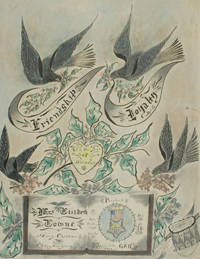
1926List302Massachusetts 1926. Ink on paper 18 ½ x 23 ½ inches. Excellent. Alexander Johnson an African-American musician from New Bedford enlisted in the army at age 16 and was believed for some time to be the first African-American musician in the Union Army. He mustered into mustered into Company "C" of the Massachusetts 54th Infantry under Colonel Shaw. The 54th Massachusetts was the second African-American regiment in the Union army formed only after the 1st Kansas Colored Volunteer Infantry. New Bedford had a large population of escaped slaves and African-Americans from the city enrolled heavily. Johnson had been orphaned at a young age and his adopted father William Henry Johnson strongly advocated for African-American enrollment in the Union army a factor which most likely played a part in the young Alex's enrollment at age sixteen. <br /> <br /> Johnson served in the 54th for the duration of the war including the bloody charge of Fort Wagner on Morris Island on July 18 1863. The 54th lost 272 of its 600 men on that day including Colonel Shaw. Johnson's musical acumen was widely acknowledged and he became known - erroneously it would later turn out - as being the first African-American musician in the Union army. After the conflict ended Johnson settled in Worcester organizing a band called "Johnson's Drum Corps" and instructing young musicians. <br /> <br /> Augustus St. Gaudens famously erected a monument to the 54th at the Massachusetts state house. Johnson visited the monument at a G.A.R. event in 1904 and noted to others in attendance the similarity between his own likeness and that of the drummer boy in St. Gaudens monument. This proved to be pure coincidence as St. Gaudens had based his work on models but the idea persists to this day that Johnson is the drummer boy pictured.<br /> <br /> Johnson painted this memorial to the Ladies of the G.A.R. in 1926 at age seventy-nine four years before his death. The painting shows two birds with banners reading "Friendship" and "Loyalty" over a heart reading "Honor the Boys / of / 1861-1865" with a book open to pages reading "Mrs Elizabeth / Towne / Merry Christmas / and A / Happy New Year" and "President / Of / Gen. / Chas. Deven / Circle / No / 30 / Ladies of the GAR / 1926." Most of his comrades-in-arms were likely dead at this point and we find no record of Elizabeth Towne. A wonderful folk art memorial to the 54th Massachusetts well preserved and attractive in very good condition overall with light normal wear. <br /> <br /> <br /> References: Coddington Ronald. Colonel Shaw's Drummer Boy. New York Times March 5 2013. unknown books
18803009121880. Newspaper clippings maps and illustrations laid down on card stock and bordered in black ink others extracted complete plus some contemporary photographs engravings and other pictorial material. 31 vols. 4to & large 8vo. Half contemporary morocco and marbled boards spines & boards gilt t.e.g bookplate of C.B. Farwell to front pastedowns. Newspaper clippings maps and illustrations laid down on card stock and bordered in black ink others extracted complete plus some contemporary photographs engravings and other pictorial material. 31 vols. 4to & large 8vo. A remarkable collection of newspaper dispatches maps plans portraits and illustrated scenes of battles and views. The maps portraits and illustrations are drawn from a variety of published sources including The New York World but many are coloured or engraved and on heavier stock. This set provides an incredible overview of how the Civil War was not only reported but depicted in a multitude of media. <br/><br/>The bulk of the set consists of fourteen volumes of "Dispatches to the World Newspaper" spanning the period between January 1861 and June 1865. The New York World newspaper commenced publication in 1860 and was ongoing until 1931. It was a major organ for the Democratic Party and Joseph Pulitzer was its head from 1883-1911. In its first years however it was run by Manton Marble. In 1864 the paper was shut down for a short period having printed a document purportedly by Lincoln but obviously forged. <br/><br/>A third of the set is devoted to the Southern Rebellion. The ten volumes illustrating it are as follows: Plans maps and battlefields; Forts and batteries Military uniforms; Battle scenes and incidents; Emblems Arms and Endurance; portraits; war pictures many coloured patriotic covers by Charles Magnus a full page watercolour of greiving soldier2 vols; scenes and views 3 vols. The remainder of the set comprises: Portraits of Army Officers 3 vols; Portraits of US Representatives 2 vols; Portraits of US Senators; and Portraits of Distinguished Men.<br/><br/>The set was formerly owned and likely compiled for C.B. Farwell whose bookplate adorns the front pastedown of each volume. This would be Charles B. Farwell 1823-1903 the former US Senator and Member of the House of Representatives. Farwell was a Democrat and this is certainly the type of set that might be owned by a politician whose philanthropy extended into education. Furthermore the bookplate itself was printed in Chicago and Farwell was a representative for Illinois. He was a major benefactor of Lake Forest College. unknown books
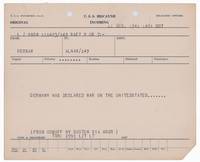
16563World War II U.S. Navy. Navy Original Cable Dispatch declaring "GERMANY HAS DECLARED WAR ON THE UNITED STATES." U.S.S. Biscayne heading The cable was sent from the Secretary of Navy "SECNAV". 8" x 6.5" inches. Dated "11 Dec 1941". Two punch holes along top edge. In near-fine condition. On December 11th 1941 four days after the Japanese attack on Pearl Harbor and the United States' declaration of war against the Japan Nazi Germany declared war against the United States bringing America which had been neutral into WW II. With a single page the fates of hundreds of thousands of Americans currently serving in the US Navy was decided: World War II had officially begun for America. <br/><br/>At the time of this telegram The U.S. Navy was officially neutral but was already attacking German U-boats in the Atlantic. On Thursday 11 December 1941 American Chargé d'Affaires Leland B. Morris the highest ranking American diplomat in Germany was summoned to Foreign Minister Joachim von Ribbentrop's office where Ribbentrop read Morris the formal declaration of war the meeting lasted 3 minutes from 2:18 to 2:21 pm Berlin time. At 3:30 p.m. on December 11 1941 the German charge d'affaires in Washington handed American Secretary of State Cordell Hull a copy of the declaration of war. Roosevelt wrote to Congress on that same day asking them to declare war on Germany and Italy the motion passed through both houses without dissent the declaration was signed by Roosevelt at 3:00 pm EST. This original US NAVY cable dispatch is from the day of the declaration itself and has a Time stamp of 1451 GCT 2:51 PM- Greenwich Civil Time <br/><br/>Hitler's declaration of war against the United Sates is generally seen as an enormous strategic blunder on his part as it allowed the United States to enter the European war in support of the United Kingdom and the Allies without much public opposition while still facing the Japanese threat in the Pacific. Hitler had in fact committed Germany to fight the US while in the midst of a war against Russia and without having first defeated the UK instead of taking the option of putting off a conflict with the US for as long as possible. Hitler's lack of knowledge about the US and its industrial capacity for mounting a war on two fronts probably led him to this fatal decision. unknown books
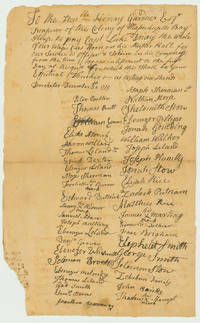
177520781.03<p>A scarce petition for pay listing 44 members of Captain Luke Drury's Company 27 of whom were Grafton Massachusetts-area Minutemen who had marched 36 miles to respond to the Lexington-Concord Alarm on April 19-21 1775. The list includes Fortune Burnee a Minuteman of African American and Native American heritage and his half-brother Joseph Anthony who enlisted on April 29th and died in service. Another of the Minutemen listed is the famous clockmaker Aaron Willard.</p> <b>REVOLUTIONARY WAR.</b>Manuscript Document Dorchester Massachusetts December 30th 1775 addressed to Massachusetts Treasurer Henry Gardner. 1p. 8 x 13 in. Likely Drury's retained copy from the time with the signatures all in one hand though some may be signed with marks & Jonathan Hemenway has signed himself.<p>Petition<i> "to pay Capt Luke Drury the Whole of our Wages as born on his Muster roll for our Services as Officers & Soldiers in his Company from the time of our inlistment to the first Day of August for which this shall be your effectual voucher." </i></p><p>Today the terms <i>minuteman </i>and <i>militiaman</i>are often used interchangeably but there was a distinction in the eighteenth century. Militia were men in arms formed to protect their towns from foreign invasion. They could designate up to one quarter of their force as minutemen a specially trained force required to be highly mobile and able to assemble instantly to a call to arms. It is difficult to categorize specific men into either of the two groups based on the surviving historical record. We apply the term here to all of those militia who responded April 19-21 1775 to the Lexington-Concord Alarm. </p><p>The 27 soldiers and officers listed here who were part of Luke Drury's Grafton Aaron Kimball's Grafton & John Putnam's Sutton April 19-21 Minutemen companies are: 1st Lt. Asaph Sherman Sgt. Nathan Morse Sgt. Shelomith Stow Sgt. Ebenezer Phillips Sgt. Jonah Goulding Cpl. William Walker Cpl. Joseph Leland Drummer Elijah Rice Fifer Zadock Putnam Matthias Rice Isaac Brigham Eliphalet Smith George Smith Peter Butler Thomas Pratt William Evans Elisha Aldrich Aaron Willard Eseck Dexter Moses Sherman Fortinatus Fortune Burnee signed with mark Edward Buttrick Ebenezer Leland Solomon Brooks Ebenezer Melendy Thomas Leland Sr. & Samuel Stearns.</p><p><b>Luke Drury</b>1734-1811 of Grafton Massachusetts joined the militia in 1757 during the French and Indian Wars. As captain of a company of Minutemen and Militamen he responded to the Lexington Alarm and later joined Colonel Jonathan Ward's regiment to fight at Bunker Hill. Drury and his men served in different areas during the war from West Point to Grafton where his company guarded military stores. He also supported the Continentals financially at one point giving £50 fifty pounds to enlist soldiers in Grafton.</p><p>In 1786-1787 Drury became deeply involved in Shays' Rebellion a tax revolt led by farmers in western Massachusetts. The uprising was quashed and Drury imprisoned as "a person dangerous to the state." He was eventually released on good behavior. Drury remained active in state and local politics serving terms as constable deputy sheriff tax collector assessor selectman and state legislator.</p><p><b>Condition</b></p><p>Usual folds small loss at bottom left corner affecting some marginal ciphering else fine condition.</p><p><b>Joseph Anthony</b> and <b>Fortune Burnee Jr.</b> half brothers were both part African-American and Hassanamisco Nipmuc Native American. Compared to records of white New Englanders we know relatively little about them but even so more information exists on these freedmen than is the norm. Several of the Anthonys and Burnees were recorded in the Grafton vital land and probates records the U.S. census neglected to record Native Americans from 1790-1890 and the Burnees have been discussed in recent historical and sociological literature: exploring the relationships both amongst marginalized peoples as well as with their white Yankee neighbors in eighteenth century New England; the definitions of race and identity; social mobility; Indian and black cultures; gender roles; Anglo-Nipmuc land dealings; and the remarkable preservation and history of an 190-acre tract of land in Grafton known as Hassanamesit Woods which is the site of a seventeenth-century "praying Indian" village with Nipmuc habitations that clung on into the mid-nineteenth century.</p><p><b>Joseph Anthony</b>was born in Grafton on December 24 1753 son of Joseph/William Anthony "Negro" and Abigail Printer Abraham "Indian." According to a Nipmuc leader and genealogist Anthony's ancestors include Hassanamisco Nipmuc Chief Anaweakin second in command in King Philip's War in 1675-6; along with Philip/Metacom Anaweakin was killed and his children sold into slavery; his father Noas Sachem of Hassanamesit forced into exile at the same time and died at Deer Island in Boston Harbor; and Nanapashemet Great Sagamore of the Massachuset Federation who was killed in battle in 1619 at Rock Hill Medford the year before Massachusetts was colonized by the English.</p><p>In 1728 seven Indian "Planters" or householders and 33 English re-divided the land at Hassanamesit to incorporate the town of Grafton. In 1739 Abigail Printer married Andrew Abraham Jr. "Indian Planter." Based on Abigail Printer's surname and the very small population left at Hassanamesit in the 1700s it is believed that she is a descendant of Rev. John Eliot's notable contemporary James Printer a Harvard student in 1645-46 who worked for Samuel Green printing Eliot's famous "Indian Bible" in 1663. Abigail and Andrew had three sons before he died in August 1746 after returning from service in the Port Royal Campaign.</p><p>Abigail married second November 14 1752 Joseph/William Anthony. Little is known of him other than his listing in town records as a "Negro." It appears he died circa 1756. Their son the signer of this document <b>Joseph Anthony</b> married Lydia Mercy Johnson. He enlisted in the army April 29 1775 and was reported missing July 6 1777 probably at the Battle of Ticonderoga and dead December 26 1777 possibly a prisoner of war on board an infamous New York City British prison ship. At the time he was a private in Capt. Blanchard's Company of Col. James Wesson's 9th Massachusetts Regiment.</p><p><b>Fortune Burnee Jr.</b> Grafton records spell his name a number of different ways. Dr. David R. Mandell believes there was one man of that name but we find that Electa Kane Tritsch's postulation that there was a father and a son of the same name makes more sense. Abigail again a widow married a third time January 27 1757 to Fortune Burnee Sr. described as "Negro" a veteran of one or more expeditions to Canada during the French and Indian War and widower of another Hassanamisco Sarah Muckamaug Whipple. Mandell writes that Burnee had changed his first name from William to Fortune based on his good luck but does not cite the source or anecdote: Fortune seems more likely a given slave name. He also claims that Burnee abandoned his first wife Sarah before her death but Tritsch has found no evidence for this: that statement may have been compounded with Sarah's first husband Aaron Whipple of Providence Rhode Island. It is thought that Burnee Sr. died about 1771. If so his son <b>Fortune Burnee Jr</b>. is the man who served under Capt. Luke Drury. It is as yet unknown if he is the son of Fortune Burnee Sr.'s second wife Abigail Printer Abraham Anthony Burnee who died in 1776 or his first wife Sarah Muckamaug Whipple Burnee who died in 1751 thus he is either Anthony's younger half-brother or older step-brother. It is interesting to observe that Burnee signs another Drury document with a mark while Anthony was capable of signing in full – whether that hints that Anthony was the younger brother with less responsibilities on the homestead and more opportunity for education is mere speculation. However Tritsch probably by process of elimination finding that Fortune Burnee Jr. does not appear in Sarah's estate papers assigns him as the younger a son of Abigail and half-brother of Joseph Anthony. Fortune Burnee Jr. marched on April 21 1775 in response to the Lexington-Concord Alarm. Marriage records then show that Fortune Burnee Jr. married July 31 1778 "Phylis…negro servant of Rev. Mr. Frost…of Mendon both are listed as "Negroes" and then November 8 1781 Sarah Hector of Sutton again both are listed as "Negroes". He died in 1795.</p><p>Without going into the complex history of Hassanamesit and the Hassanimisco praying Indians Reverend Ezra Stiles's 1761 impressions of the settlement are notable: "At Grafton…I saw the Burying place & Graves of 60 or more Indians. Now not a Male Ind. in Town & perh. 5 Squaws who marry Negroes." By 1770 the town selectmen reported "that there is but one male Indian left" – this man was in fact one of Sarah Muckamaug Whipple's bi-racial children Joseph Aaron. 87 years earlier in 1674 Daniel Gookin had noted that the Indian village had contained twelve families perhaps sixty souls – King Philip's War of 1675-76 and its lingering years of conflict played a major part in this population displacement and decrease.</p><p><b>African Americans & Native Americans in the American Revolution</b></p><p>Of the estimated 100000 men who served in the Continental Army at least 5000 were black. Most black soldiers fought in integrated units as in Massachusetts; some states like Rhode Island had segregated regiments while Connecticut seems to have had both segregated and integrated. Both enslaved and free African-Americans served in the army as soldiers laborers and servants. In some cases slaves were offered freedom for their services as soldiers though others remained enslaved fighting in place of their masters. Many states had been reluctant to arm the black population but had no other countermove to the British Lord Dunmore's offer of freedom to Southern black enlistees. A significant number of colonial blacks at this time were also partly of Native American ancestry – to take once state Massachusetts's eighteenth-century Indian population had two females to one male while the majority of the imported African slave laborers were male. Those figures coupled with their removal to neighboring outskirts of colonial society as well as the enslavement of many Indians in New England after King Philip's War did much to comingle the two ethnic groups.</p> books
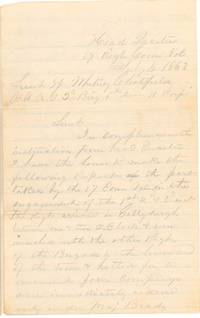
186321808<p>A field report from the Battle of Gettysburg by Major Allen G. Brady commander of the 17th Connecticut Regiment written on the 4th of July 1863 the day after the battle ended in a great victory for the Union.</p><p><i>"We had not more than time to form before the enemy were discovered advancing rapidly upon us on our right & a full Brigade obliquely towards our left….our fire was so destructive it checked their advance the troops on our left giving way the enemy came in behind us but we still remained firmly at the stone wall until the rebels were driven back."</i></p> <b>CIVIL WAR – GETTYSBURG.</b>Allen G. Brady Autograph Manuscript Gettysburg Pennsylvania July 4 1863. 6 pp. in pencil an unsigned draft or retained copy.<p>With: <b>ANDREW JOHNSON.</b> Officer's commission of brevet Lieutenant Colonel to Allen G. Brady <i>"for gallant conduct at the Battle of Chancellorsville Va to date from March 13 1865"</i> March 20 1866 signed with stamp not in ink; and</p><p>With: <b>ALLEN G. BRADY.</b>Autograph Letter Signed to the Adjutant General U.S. Army May 19 1877 seeking a copy of the military record of General Hugh Brady who had fought in the War of 1812; and</p><p>With: <b>WHARTON J. GREEN.</b> Autograph Letter Signed to Allen G. Brady December 13 1885.</p><p><b>Complete Transcript</b></p><p><i>Head Quarters 17 Regt Conn Vol. </i></p><p><i>July 4 1863</i></p><p><i>Lieut. H. Whitney Chatfield </i></p><p><i>A.A.A.G. 2d Brig. 1st Div. 11 Corps</i>.</p><p><i>Lieut.</i></p><p><i> In compliance with instructions from head quarters I have the honor to make the following report the part taken by the 17 Conn Vol in the engagement of the 1st 2d & 3d inst. The Regt. arrived in Gettysburgh between one & two O'Clock & were marched with the other Regt. of the Brigade to the lower end of the town & halted for a moment. Four companies were immediately ordered out under Maj Brady </i>2 <i>two of the four Companys under Maj. Brady were deployed from the bridge to the right as skirmishers the other two held in reserve. The remainder of the Regt under the Command of Lieut Col. Fowler advance with the rest of the Brigade to the front & left of the village. Directly in rear of the 107 Ohio Vol. - who were closed in mass by Division & were ordered to the front Deployed & advanced at Double quick our men held their ground notwithstanding they rushed to the rear of troops directly in advance until ordered by the Brigade Commander to fall back. </i></p><p><i>This order was obeyed the men loading & firing as they were retreating it was <b>about this time Lieut Col. Fowler was killed. Upon reaching the village the four companys</b> </i>3 <b><i>still skirmishing briskley with the enemy </i></b><i>& retiring in good order & ordered by the Comdg Genl to rejoin the Regt. <b>Maj. Brady immediately taking command after deploying & firing in several streets running to the left of the main street of the town on account of the rapid advance of the enemy we were ordered to fall back out of the town & while retreating through the main street the Regt was halted & faced to the rear & poured several destructive vollys into the enemy.</b> We then fell back out of the town & formed in front of the battery <b>pursuant to order from Maj. Genl. </b></i>Oliver Otis <b><i>Howard we then advanced to the stone wall in rear of the village </i></b><i>& remained a few moments there again advanced to a rail fence still further to the front & then remained until </i>4 <i>late in the evening when the whole Regt was sent out on picket & performed that duty <b>until late in the afternoon of 2d when we were relieved & took our old position behind the rail fence w</b></i>h<b><i>ere we remained exposed to fire of the enemy's battery & sharp shooters until about 7 o'clock P.M. were ordered to the extreme right of the Brigade behind a stone wall on each side of the lane below the battery opposite the cemetery entrance one company was advanced to the grain field near the woods we covered the wall on each side of the land by compelling 200 straggling soldiers to fall into our line. We had not more than time to form before the enemy were discovered advancing rapidly upon us on our right & a full Brigade obliquely towards our left. The Regt were ordered to fire obliquely to the left upon the Brigade our fire was so destructive it checked their advance the troops on our left giving way the enemy came in behind us but we still remained firmly at the stone wall until the rebels were driven back.</i></b></p><p><i>It was during this engagement that Maj. Brady was wounded </i>5 <i>by a fragment of shell hitting his right shoulder blade. </i></p><p><i>After the enemy had been driven back & the firing ceased except occasional shots from their sharpshooters. We were relieved by the 4 Ohio Vol. and were ordered to change front to the left behind a wall running at right angles with the fence we had occupied and fronting the town where the rebels entered on our left. During that night & the 3d inst. exposed to a cross fire of the rebel batterys & to the fire of the sharp shooters who were watching our movements. </i></p><p><b><i>When the Regt entered the engagement on the 1st inst it numbered 17 officers & 369 enlisted men. We report at the present time 9 officers & 120 enlisted men. </i></b><i>Capt. Wilson French is the </i>6 <i>only officer known to have been taken prisoner he was wounded in the engagement of the first inst & we are not aware of his being paroled</i>"</p><p><b>Historical Background </b></p><p>The Battle of Gettysburg fought July 1-3 1863 was a major turning point in the Civil War. Over the course of three grueling days Union Major General George G. Meade's Army of the Potomac beat back desperate attacks by Confederate General Robert E. Lee's Army of Northern Virginia including the ill-fated "Pickett's Charge" on July 3. The Union victory ended Lee's short-lived invasion of the North.</p><p>Many soldiers of the 17th Connecticut had been stung by criticisms leveled at their unit after the Battle of Chancellorsville where the corps was surprised and driven from the field with a flank attack by Stonewall Jackson. As Brady reports here events on the first day of the Battle of Gettysburg were eerily similar to Chancellorsville. On July 1 their regiment was again divided outnumbered and outflanked by the same Confederate unit as it had been at Chancellorsville although this time under command of Richard Ewell. As he drove the Connecticut soldiers from the field and through the streets of Gettysburg on the first day of fighting Union Lieutenant Colonel Douglas Fowler was killed. In a disciplined retreat that evening the 17th Connecticut fell back and was posted near the center of the Union line on Cemetery Hill near a stone wall. Their position where the Union lines' "fishhook" curved southeastward toward Culp's Hill exposed them to murderous crossfire from Confederate artillery on three sides. The unit sustained high casualties for the next two days; of the unit's 386 men at Gettysburg 20 were killed 81 wounded and 96 reported missing. Brady himself was wounded by a shell fragment on July 2.</p><p>The regiment performed heroic service on the second day of the battle protecting Cemetery Hill from the attacks of Jubal Early's division specifically Harry Hays's brigade of "Louisiana Tigers." The 17th Connecticut then withstood the Confederate bombardment of July 3 spending much of the day trading shots with sharpshooters in town. Brady's report in slightly revised and expanded form is reprinted in <i>Official Records</i> Series 1 Vol. 27 Chap. 39 Part 1 pp. 716-719. In closing there Brady said "The regiment behaved gallantly. No troops in the world behaved better. Both officers and men are deserving of great credit for their coolness and bravery throughout the entire three days' battle."</p><p><b>Allen G. Brady </b>1822-1905 was from Torrington Connecticut. He enlisted in May 1861 as part of the 3rd Connecticut Infantry Regiment. In August 1862 he was commissioned into the 17thConnecticut Volunteers. Brady was brevetted Lieutenant Colonel for his valor at the Battle of Chancellorsville just two months before Gettysburg. There Brady assumed command after the colonel and lieutenant colonel of his regiment each fell. Brigadier General Charles Devens commended Brady in his official report stating "The Seventeenth Connecticut under command of Major Brady – its colonel having been wounded and lieutenant-colonel killed – was in fact rallied and reformed in their positions." In October 1863 Brady was discharged for disability presumably from his wound suffered at Gettysburg three months previous. He was mustered into the Veteran Reserve Corps and served as Provost-General at the Point Lookout Union Prison Camp in 1864. He was brevetted Colonel in August 1865.</p> books
1919WRCAM55901Various locations including Ohio Georgia France Luxembourg Germany and Belgium 1919. Folio manuscript diary 153pp. one printed book and various family papers certificates dog tags photographs and more. In very good condition overall. An important and informative World War I archive belonging to Wilson Kappel of Bolivar Ohio including a phenomenal starkly-written and uncensored diary kept by him throughout his service detailing war deaths mustard gas attacks and the notable Meuse-Argonne offensive near the end of the war. Kappel 1893-1979 served as a mechanic with Company C of the 6th Infantry of the United States Army. He registered for the service on June 5 1917 was drafted in July shipped out to training in October and served until his return from Europe on July 31 1919. Kappel spent significant time in France Luxembourg Belgium and Germany during his service all of which he details here. <br> <br> By far the most significant item in the present archive is Kappel's manuscript diary which covers in amazing detail every aspect of his service from home to Europe and back again. The diary which Kappel titles in manuscript on the first page DIARY OF THE WORLD WAR is large format and closely written for over 150 pages in an eminently readable and uncensored style. It is likely that he either wrote out this diary from notes made during the war or wrote it out from memory shortly after the war. The text conveys a sharpness that immediacy that would likely have been slightly dulled by the passage of time. The diary begins with the line "I registered June 5th 1917" and takes Kappel first to the mobilization camp at Camp Sherman in Chillicothe Ohio and thenceforth to basic training at Camp Forrest in Georgia. Kappel writes in unhurried detail about training on the rifle range in Georgia traveling to Hoboken New Jersey to board a troop ship to Europe and writes extensively about his experiences overseas. <br> <br> Kappel's European diary entries begin with his arrival at the "sorting yards" at Brest France. He continues to various locations in France namely Barsubaube Soulaine Pagny- Sur-Meuse Remiremont and Le Tholy before arriving at the front and the front line trenches near Gerardmer in mid-June of 1918. At the front Kappel and his unit experience their first encounter with enemy shellings and the types of activity faced by soldiers near the front lines: <br> <br> "We all got scared as none of us ever heard a shell before and we thought they were going to hit us but they went way above our heads and went crashing against the hill side we could hear it echo many times. We got orders to lay in the ditch along the road till they stopped shelling. I and Corporal Fox of Massillon was together in the ditch he said to me 'I wish we would be back in Massillon Ohio instead of being in this ditch.' As soon as they stopped shelling we went on again. When we got within about two miles of the front line trenches the Germans must have heard us walk as they had a powerful search light on top of a high hill and they shined that down direct on us for about ten minutes and then it went out again." <br> <br> Kappel spent almost a month at the front where he writes about getting shot at by German snipers cooking clandestinely in the basement of a French church encountering a private who shot off his own finger while on guard duty firing on German patrols encroaching into the American side a strange incident in which a corporal intentionally blew his own hand off with a grenade presumably in order to avoid further service and much more in often astonishing detail. <br> <br> On July 16 Kappel and his unit left the front lines near Gerardmer continuing to St. Die and then arriving again at the front lines this time at St. Claire. On August 15 Kappel and his unit were caught in a mustard gas attack which he recounts in excruciating detail. The Germans in the area "shot over a large number of mustard gas shells all along the front.I and about fifty more soldiers all ran down in a dugout that was gas proof but the gas came in through the cracks of the door and we all had to wear our gas masks for about an hour.The gas was so strong that it got in between our shoes and leggings and many of us got blisters on our ankles." <br> <br> Two days later Kappel participated in the attack on the German border town of Frappell. Kappel writes that "The American barrage started Aug 17th 1918 at three-fifty a.m." and was met with a German response that "killed many Americans." As usual Kappel's recounting of the battle is unusually detailed and affecting ranging over several pages and including meticulous accounts of the horrors of battle. He writes in part: "At one place four American soldiers carried a wounded soldier on a stretcher in a trench. The trench was not wide enough around a corner so they had to lift him up out of the trench. Just as they were doing this a German shell came and killed all five of them." Later he writes: <br> <br> "The first shell that the Germans fired on his headquarters made a direct hit on the closet and was all blown to pieces with several soldiers in it and a few standing out around the building. I was half asleep in my dugout at the time. I had my pack rolled in the morning but I jumped up when the first shell hit. Mechanic White was with me he told me 'It is time to go' we both ran out of our dugout because it was not shell proof and just as we got outside of the door Private Raymond Barmos was rolling his pack. We both jumped over him and that was the last that was ever seen of him. He was blown to pieces a few seconds after we had jumped over him." <br> <br> Kappel's diary continues in much the same manner and with the high level of detail throughout the remainder of the text. He and his unit continue to Pouxeux St. Nicolas St. Christophe Martin Court Saint Mihiel Avirinville Rigny and Verdun. Just north of Verdun Kappel participates in the historic Meuse-Argonne offensive from September to November 1918. Kappel's account of the Meuse-Argonne offensive occupies ten pages of his diary and is typically thorough in relating the specific brutalities heaped upon the young soldiers during the Great War. A few excerpts will relay the flavor of Kappel's narrative of the offensive: <br> <br> "When we started over the top we had to cross a valley this was full of gas. The Captain told us to put on our gas masks. I put my gas mask on quick and started to walk away a German shell came and exploded to the right side of me and a piece of shrapnel went through my gas mask. I pulled my gas mask off quick and walked back a little ways and took a gas mask off a dead American soldier and put that over my face. The Germans were only a few rods away from us. We started to shoot at them they did the same. We killed some and captured a few the rest ran over the hill. We kept going after them the whole day. One German shell came and made a direct hit on Lieutenant Roche of our company. He was blown to little shreds." <br> <br> "The Germans had many barbwire entanglements here. It was a common sight to see from six to ten American soldiers lay on a pile dead. They shot a German spy at this front. He was in the American Artillery and was always shooting short. The Artillery Sergeant killed him with his revolver." <br> <br> "We stayed here for one day and night. We dug our shelter trenches two soldiers for each shelter trench.The bullets were flying thick. We had to stop digging several times and crawl behind the fresh dug grounds for safety. When Private Pike of our company was done digging his little shelter trench he reached up with his hand to tear some weeds off so he could see out better a bullet came and went right through the middle of his hand.From this place when we looked back we could see the canal river railroad and the city of Brieulles. It was nice to watch the German big shells explode. Some would hit right in the river. It would throw the water up about forty feet in the air. Some shells would hit the buildings at Brieulles and tear them all to pieces." <br> <br> "We went past a cabbage patch. We made out that in coming back that we were going to take some cabbage along with us. When we got down into Brandyville the Germans started to bombard the town. I gave the message to an officer. It took him about one hour to write out another message for me to take back. I was looking every minute for the house to get hit by a shell.I finally got my message and we all ran out of town till we got to the cabbage patch. There we stopped. Just as each one of us was going in the patch a big German shell hit right in the center and surely did make the cabbage heads fly. I got one big head and some of the others got two heads a piece. This we took back to our company and at midnight we all had raw cabbage to eat." <br> <br> After the Meuse-Argonne offensive Kappel moved on to Liny Brandeville Louppy Marville and Rehon in France then spent a short time in Luxembourg Belgium and Germany before shipping back to the States. <br> <br> In the final eighteen pages of his diary Kappel records a short history of the USS America; a couple of poems; a detailed list of Army pay with title and monthly pay; a list of Army divisions with enlistments casualties captures wounded and more; a complete roster of Company C from March 1918 "just a few days before we started for France" which includes a list of all the men who were in the unit from March 1918 to March 1919 and what happened to them during the course of the war; a list of divisions to which each unit belonged; and ending with four small color drawings and descriptions of the principal airplane markings belonging to England France the United States and Germany during the war. <br> <br> In addition to his diary the present archive is rounded out with a batch of personal papers and other material kept by Kappel and his family. These additional items include a war-dated letter from Wilson Kappel to his brother Owen sent home from France in September 1918; five early Kappel family photographs showing Wilson and Owen; a printed certificate from President Jimmy Carter honoring Kappel's service sent to Owen after Wilson's death; Kappel's dog tags; twenty-two later small photographic negatives; a Civil War bullet passed down through the family and with a note by William Kappel; a portion of the January 17 1919 issue of STARS AND STRIPES; Kappel's 8th and 9th grade report cards; his address book; Kappel's funeral notice indicating he died on Oct. 22 1979; and a hardcover book entitled THE OFFICIAL HISTORY OF THE FIFTH DIVISION U.S.A. Washington D.C.: The Society of the Fifth Division 1919 with original shipping box addressed to Wilson Kappel. <br> <br> An historically important and uncensored firsthand account of the First World War that reads like an undiscovered classic from the Lost Generation rounded out with a small selection of the soldier's personal war- related material. hardcover books
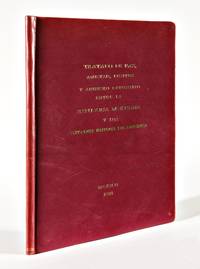
1848319879Mexico: Imprenta de I. Cumplido 1848. 55pp. printed on facing pages in parallel Spanish and English. Original printed green wrappers bound into modern red limp polished Mexican calf gilt. Light toning occasional minimal foxing small tear in upper outer corner of page 19/20 affecting just six words. Overall very good. 55pp. printed on facing pages in parallel Spanish and English. Official Mexican Printing of the Treaty of Guadalupe Hidalgo. The official Mexican printing of the final text of the landmark Treaty of Guadalupe Hidalgo ending the Mexican War and delivering to the United States its current territory in the Southwest. This printing closely follows the Queretaro edition produced just a few months earlier but contains added protocols excluded from that earlier printing. The full text appears here in both English and Spanish on facing pages. Pages 46-49 contain the text of amendments made to the treaty by the United States Senate followed by a statement of Pena y Pena dated May 30 1848 accepting the modifications and concluded by a Protocol dated May 26 attempting to put the best light on the treaty from the Mexican point of view. The Treaty of Guadalupe Hidalgo which ended the war between the United States and Mexico resulted in the formal cession of the entire Southwest and California to the United States. Agreements were reached for the withdrawal of American troops from Mexico the payment of Mexican claims and the formal cession of territory the U.S. had already occupied all of the land. The theoretical boundaries were set out and arrangements for boundary commissioners were made. By this treaty the United States obtained an addition of land equalled in size only by the Louisiana and Alaska purchases. <br/><br/>A fundamental piece of Western Americana here in the official Mexican edition of the complete treaty and scarce on the market. Streeter Sale 282; Palau 339389; Garrett p.91l; Cowan p.252; Howes M565"aa"; Eberstadt 162:847; Malloy p.1107; Reese Best of the West 104 Imprenta de I. Cumplido unknown books
177734560Hartford 1777. Small printed broadside oblong 4" x 2-3/4". "Christopher Sherman" is inserted in manuscript as the name of the volunteer. An "X" for "his mark" is in ink at the end over an attempt to sign his name. For the year "177" is in type and the final "7" in manuscript. "Date" at the bottom is in manuscript along with the month probably "janry". Outer margin closely trimmed but text unaffected. Very Good. <br/><br/> An unrecorded form of Revolutionary War enlistment engagement exceedingly interesting for its reference to "the United States of America." Recorded enlistment engagements from this era-- all of them rare-- refer to the "United Colonies of America" "America" the "Colony of Massachusetts" the "Colony of Massachusetts-Bay". We have handled an unrecorded Massachusetts enlistment engagement from this period which refers to the "United States of America." Enlistment engagements from Connecticut referring to the "United States of America" from this era are unrecorded.<br/> The Continental Congress renamed the Nation "United States of America" on September 9 1776 ordering that "In all continental commissions and other instruments where heretofore the words 'United Colonies' have been used the stile be altered for the future to the 'United States'."<br/> Christopher Sherman was a Private under Captain William Richard's Company in the First Regiment of the State of Connecticut commanded by Lieut. Col. Samuel Prentice Esq. in 1777. A manuscript notation on the payroll sheet for the period January to June 1777 states that he deserted on January 10th or 18th. Revolutionary War Rolls 1775-1783; National Archives Microfilm Publication M246 138 rolls; War Department Collection of Revolutionary War Records Record Group 93; National Archives Washington. D.C. accessed at Ancestry website. <br/>Not located on NAIP ESTC OCLC as of November 2020. unknown books
1916List1025Siberia Petrograd et al. 1916. First Edition. Various documents and letters most legal format roughly 200 pages in total with three publications and several newspapers on the subject and thirteen hand drawn architectural plans for a new camp at Omsk measuring between 25 x 17 and 13 x 8 inches. During World War One a staggering number of prisoners - roughly 2.4 of the five million in total who were sent to the Eastern Front - ended up as prisoners of war in Russia. Of that number roughly two million were from Austria-Hungary. Though often neglected by historians due to the attention given to the Russian Civil War and the atrocities of World War Two the subject has drawn increased historical interest with the historian Gerald H. Davis and others calling attention to its importance in the 1980s. Davis and others have written on the relationship between the large prisoner population and the dissolution of their nations as well as the abhorrent conditions many were forced to endure partially due to hierarchical structure of treatment due to differing attitudes by their Russian hosts toward different nations and ethnicities and partially due to the lack of appropriate infrastructure and resources to support such a large prisoner population. <br /> <br /> Offered here are the papers of Herbert H.D. Pierce the Special Aide to Embassador George T. Marye in Petrograd containing a substantial amount of firsthand accounts of prison conditions from the early years of the war as well as a striking series of manuscript architectural plans for a new prison camp that was built in Omsk. Pierce a diplomat who was most famously involved with a case involving seal fishing in the Berings Strait was appointed as a Special Aide out of his retirement and served until his death in 1916. It is possible that he was assigned the task of dealing with the prisoner of war situation as nearly all of his papers that we recovered from his estate from this period deal with the subject. Pierce was involved specifically with the disbursal of relief funds received from the German and Austro-Hungarian governments that were to be disbursed to their citizens. <br /> <br /> The highlight of the collection is a series of hand drawn architectural plans for a series of POW camp structures in Omsk bearing the signature of a N. Alexandrow architect. It is unclear what Pierce's exact relationship was to this project. The plans are translated into English in ink. Of particular interest are the separate officers' barracks plans as one of the violations of POW laws in Russia was the varying levels of treatment given to different prisoners in particular in their recognition of German and Austro-Hungarian ranking officers. There were twenty-eight prison camps in Omsk this one is not identified specifically. The Siberian camps often held up to 35000 prisoners this one shows plans for 10000. There were 128 camps in the Moscow region where camps typically housed 2000-5000 prisoners. The conditions of the camps were generally abysmal with camp capacities routinely exceeded by roughly 50-100%. Frequent disease outbreaks killed thousands of prisoners during the conflict in Omsk Novo-Nikolaevsk Sretensk and Totskoe specifically. <br /> <br /> The group includes letters written to Marye describing conditions in the camps as well as reports of the Americans' own observations in Siberia Moscow and elsewhere. Most are in English though several original documents in German are included. Also included are Pierce's working copies of the Second Hague Convention guidelines of 1907 Order 697 of the War Department that established the regulations regarding prisoners of war in 1914 and a copy of the agreement made between Germany and Russia in August of 1914 which allowed for all women and all men over 45 years and younger than 17 to leave the country unheeded. Some of the letters document violations of this agreement for example a fifty-five year old Austrian man writing to the embassy stating that he had been detained. The authorship of some of the reports is often unclear - one report is credited to "A Russian Lady" another from Krasnaya-Ratchka near Khabaraovsk is an uncredited 18 page description of prisoner conditions. One uncredited report nineteen pages long on the conditions of prisoners in the Moscow Circuit may have been written by Pierce himself and is addressed to Marye. Another 44 page report on Siberian prison conditions is uncredited and likely produced by the embassy itself. A portion - perhaps 25% or so - of the reports are incomplete or unclear in origin though there is much to glean from them regardless. <br /> <br /> Also included are three printed publications. The first is entitled Rapport du Conseiller Prive E.G. Chinkevitch Membre du Comte special de secours aux prisonniers de guerre sur la visite des camps des prissoniers Austro-Hongrois dans l'arrondissement militair d'Omsk printed in 1915. OCLC locates a single copy in France. The report outlines the observed conditions and includes twenty-six photographs of prisoners. The second is a forty-three page report addressed to James Gerard the American ambassador in Berlin by an unidentified author which outlines the prisoner of war conditions in England written in February of 1915. The third is a scarce map of Russian prisoner of war camps printed by L. Friederichsen in Hamburg in 1915 entitled Karte vom Europäischen und Asiatischen Russland mit Angabe der hauptsächlichsten Orte in denen sich Kriegsgefangene und zurückgehaltene Zivilpersonen befinden sowie mit Bestimmungen über den Postverkehr nach diesen Orten. The map shows locations of prison camps throughout the Russian Empire and also shows the mail routes. It is in fine condition overall and we locate six copies in OCLC. <br /> <br /> Overall a scarce survival of primary source material on a somewhat overlooked but important period in Russian history with relevance to diplomatic historians as well worthy of further study. <br /> <br /> Works cited: <br /> <br /> Grekov N. V.: Germanskie i avstriiskie plennye v Sibiri 1914-1917 German and Austrian prisoners in Siberia 1914-1917 in: Vibe P. P. ed.: Nemtsy. Rossiia. Sibir' Germans. Russia. Siberia Omsk 1997 p. 159.<br /> <br /> Nachtigal Reinhard: Seuchen unter militärischer Aufsicht in Rußland. Das Lager Tockoe als Beispiel für die Behandlung der Kriegsgefangenen 1915/16 in: Jahrbücher für Geschichte Osteuropas 48/3 2000 pp. 367-368; Brändström Kriegsgefangenen 1922 pp. 41-48.<br /> <br /> Nachtigal Reinhard; Radauer Lena: Prisoners of War Russian Empire. In: 1914-1918 Online. https://encyclopedia.1914-1918-online.net/article/prisoners_of_war_russian_empire Accessed 5/21. unknown books
186523320<p>Brigadier General William Cogswell offers a dramatic farewell message to the troops under his command in the Army of Georgia. A Salem Massachusetts lawyer Cogswell turned his law office into a recruiting station after learning the 6th Massachusetts had been attacked in Baltimore. He was first in last out in his Civil War service: In 24 hours he raised the first full company of the war Company C 2nd Massachusetts Volunteers and his brigade fought in the final battle of the war in Bentonville North Carolina. Despite his relative obscurity Cogswell's eloquence rivals the great farewell messages in military history.</p> <b>WILLIAM COGSWELL. CIVIL WAR.</b>Manuscript Document Signed. General Orders No. 14. Farewell to the Army of Georgia Near Washington D.C. June 9 1865. 1 p. 7¾ x 12 in.<p><b>Complete Transcript</b></p><p><i> Head Quarters 3rd Brigade 3d Div. 20th Army Corps </i></p><p><i> Near Washington D.C. 9th June 1865</i></p><p><i>General Orders</i></p><p><i>No. 14</i></p><p><i>Officers and Enlisted Men of the 3rd Brigade 3rd Division 20th Army Corps Army of Georgia.</i></p><p><i>In a few days your organization will be broken up. Some of you will go to your homes and the civil pursuit of life while others remain for still further duty in the West. </i></p><p><i>Your noble record the history of the deeds of valor you have performed and of the part you have taken in this "War of the great Rebellion" now so gloriously ended have preceded you to your homes while the West knows them already by heart. </i></p><p><i>Although I have been with you but six short months yet by your valor by your patience by your fortitude and by your courtesies I have learned to love and respect you and I shall part with you with sorrow and regret. </i></p><p><i>No part of my military life has been so pleasant as that which links its history with yours. </i></p><p><i>From the earliest of battle fields to the last grand blow at Bentonville N.C. your blood has stained Alas! too many a sod. </i></p><p><i>Quick soldierly in camp patient willing and obedient on the march brave in battle with never an inch of ground lost participating to an unusual extent and with unsurpassed valor in the last battle of the War – March 19 1865 – your record will be remembered wherever the "battles of the Potomac" are known or the "Campaign of Sherman" read. </i></p><p><i>That the pleasures and comforts of home may attend you that go that additional honor and laurels may await you that remain that an Almighty and good God may forever lead you in ways of pleasantness and paths of peace that industry and virtue may crown you with their rewards that all that good brave men deserve may be yours that those who remain may shortly be sent to home and friends and that the blessings of a kind heaven may always be with you wherever you go is the last best wish of your Brigade Commander.</i></p><p><i> Wm Cogswell</i></p><p><i> Bvt. Brig Gen Commanding</i></p><p><b>Historical Background</b></p><p><b>William Cogswell</b> 1838-1895 was the son of the founder of the Massachusetts Republican party. He left Dartmouth College and spent two years on a square-rigger sailing around the world. When he returned he attended Harvard Law School and became a lawyer in Salem Massachusetts. When word reached Salem that the 6th Massachusetts had been attacked in Baltimore on April 19 1861 Cogswell turned his law office into a recruiting station and raised Company C of the 2nd Massachusetts Volunteer Infantry in 24 hours. He went on to become its commander.</p><p>Though the regiment suffered heavy losses Cogswell's company distinguished themselves well at the Battle of Antietam. Cogswell was promoted from company to regimental commander. During the Battle of Chancellorsville Cogswell was seriously wounded which resulted in his missing the Battle of Gettysburg where the 2nd Massachusetts lost another commander resulting in Cogswell's promotion to colonel. Cogswell was brevetted brigadier general on December 15 1864 and took command of the 3rd brigade 3rd division of the 20th Corps a part of the Army of Georgia that participated in Sherman's Savannah Campaign better known as the March to the Sea.</p><p><b>Condition</b></p><p>Very good. Lower half of left margin somewhat tattered affecting only one word go edge wear at upper right half some toning. Superb for display.</p> books
194344248Baghdad: S.i. ca.1943-44. Original illustrated poster offset printed in five colors on beige stock measuring 56.75cm x 72.75cm 22.25" x 28.5". Signed "FAIK H" in plate at lower left corner. Two old folds smoothed out trivial wear to intersection of folds at center with a handful of short marginal tears and attendant creases; unbacked; Very Good. Superb example of this agricultural-themed wartime propaganda poster designed by Iraqi painter Faeq Hassan 1914-1992 widely heralded as "the father of Iraqi modern art." Born poor in Baghdad Hassan showed an early aptitude for art. When he was 12 he visited his uncle a gardener in the royal palace for King Faisal I; when the King saw his drawing of a horse drinking from a river he recognized his talent instantly and offered him a scholarship. Faisal died in 1933 while Hassan was still in high school though his successor King Ghazi carried out his father's will and send him to the École des Beaux-Arts Paris in 1935. After returning from Paris Hassan founded Al-Ruwad The Pioneers Group a group of Iraqi artists who eschewed the traditional studio atmosphere; while engaging with nature and choosing the chronicle the daily realities of Iraqi life through their art the group played a critical role in bridging the gap between heritage and modernity. <br/><br/>Little scholarship exists regarding Hassan's activities or artistic output during World War II though the present example suggests he put his talents to some use creating home front propaganda after the Anglo-Iraqi War. The poster depicts a male laborer in traditional garb digging in a field with a bag of seeds tied at his waist beneath the slogan "If You Plant You Will Win" flanked by twin V's. Despite the traditional Iraqi setting the message is similar in tone to the American propaganda campaign encouraging the populace to plant victory gardens to help the war effort. A notably early work by Hassan and a rare survival with no examples found in the auction record and none found in the holdings of any OCLC member institution. cf."Profile: Faik Hassan." Al Jazeera 30 October 2005. S.i. unknown books
194119803Various Fort Lewis WA and The Pacific Theatre ca. 1941-1944. Four reels of 8mm film stock. Majority color with some black and white. Approximately 800ft. total. Metal reels in two-piece outer cans. Cans with etched titles and dates and mounted labels. Stock clean playback clear. Very good overall. A preliminary digitization of the films is available. <br/><br/>Freshly-discovered 8mm color film footage of World War II service shot by Montana-native Charles W. Hash b. 26 May 1910 d. 26 Feb 1998 of the 41st Infantry Division. Spread across four approximately 200-foot reels of film totaling some 45 mintues the action covers Hash’s stateside training at Fort Lewis and combat duty with the 41st in Australia near Rockhampton Hollandia New Guinea Biak and The Philippines. Highlights include: the immediate aftermath of the Battle of Biak with soldiers walking around the smoldering ruins of bombed villages; ground advancement and rural airstrip scenes of The Philippines with views of period planes nose art and the like; a beach landing and other troop and operations maneuvers; soldiers climbing among the wreckage of several crashed combat planes; intimate and candid footage of fellow soldiers drinking eating cooking bathing and shaving; and extended scenes of Pacific-Island natives. The second of the four reels could be mistaken for more pedestrian tourist scenes of Australia though the remaining three are all of service footage with majority of that in-theater. Throughout Hash displays a strong cinematic eye: filming for example the advance of ships presumably toward action in the Philippines through an unusual vantage point tucked behind a ship’s rope with the sea and ships in a soft focus. He often seems to be constructing scenes and/or directing others to either humorous or in the case of a young Filipino woman alluring effect. And the footage is creatively titled using homemade screens of white pegboard letters laid over a standard G.I. wool blanket to mark dates locations and settings. He was clearly an avid hobbyist with a strong documentarian instinct that belies what must have been his normal day-to-day responsibilities. Hash enlisted in the Army in 1930 served in World War II Korea and Vietnam — earning multiple decorations including the Silver Star for actions in the Papuan Campaign. He was commissioned as a captain during WWII commanding Company H a rifle division of the 163rd Infantry Regiment of the Montana National Guard. He later commanded the entire Army Reserve Forces of Northern California and retired a Colonel in 1965. Despite his clear interest and skill we find no evidence that Hash was officially involved in film at any point in his long and distinguished military career. Therefore the footage here offered represents an unfiltered vernacular look into the daily lives of ordinary combat soldiers. This is especially noteworthy because strict censorship regarding photography was in place during the War. And while many GIs captured snapshots of combat and wartime service only a handful of similar moving picture footage is known. A motion picture camera would have been much more difficult to conceal than a standard film camera though Hash’s advanced rank perhaps made this less of an issue and shooting in color would have been both prohibitively expensive and techincally difficult for most soldiers of the era. Indeed it wasn't until the 1990s when dramatic 16mm European Theatre footage shot by Hollywood director-turned-G.I. George Stevens was discovered that color film of the war by Allied forces was even known to exist this footage was later condensed into a short documentary GEORGE STEVENS: D-DAY TO BERLIN. Since then several troves of official color footage have emerged. The National Archives holds thousands of reels of news and officially captured footage of the War much of it mined for the recent epic documentaries THE SECOND WORLD WAR IN COLOUR 1999 and THE WAR 2007. And in 2016 the Marine Corp unearthed and subsequently donated a large collection of sanctioned color war films to the University of South Carolina for preservation. Nevertheless primary soldier-level film is almost unheard of. Indeed at the time Stevens' was thought to be the only soldier-shot wartime color footage known; and only a handful of later discoveries including a trove of German-shot film seem to have surfaced since. As Stevens' son said in the wake of the discovery of his father's footage: "World War II was a black-and-white war. That's how we see it. That's how we saw it. And suddenly to see it in colour it just took on a whole other dimension." Skillfully and intimately captured Hash's footage vividly documents the ground-level reality of wartime soliders in the tropics. Quite possibly the only entirely amateur WWII color footage by an American soldier extant. Rare important and worthy of preservation prominent institutional placement and further study. unknown books
1862WRCAM46982ARichmond: West & Johnston 1862. Lithographed map 25 1/2 x 36 3/4 inches with ornamental border and inset view of Richmond. Sheet trimmed to just outside the ornamental border and mounted on modern linen. Old folds now flattened. Small chip in upper right corner just touching the ornamental border. Separations at a cross-folds with a few instances of small paper loss stabilized by the linen backing. Good plus. This impressive Confederate map of Virginia was originally based on work done by Ludwig von Bucholtz in connection with his updating the famed Herman Boye map of Virginia in 1858. Bucholtz was hired to re-engrave the copperplates for maps of Virginia originally made by Herman Boye in 1826. The ultimate products of his work were the very large maps of Virginia called the Boye-Bucholtz maps. Using knowledge from his work on this project Bucholtz issued his own map in 1858 lithographed and published by Ritchie & Dunnavant in Richmond. This map was vastly superior in detail and accuracy to Bucholtz's revision of the Boye map. <br> <br> In 1862 with Confederate officers in need of good maps of the region Richmond publishers West & Johnson re-issued the Bucholtz-Ludwig 1858 map of Virginia reprinted from the original stone with minor alterations including the removal of the cartographer's name. "There are minor geographic changes from Map 1 the original 1858 Bucholtz map on Map 2 the West & Johnson issue. For example on Map 2 Jerusalem in Southampton Co. has been moved a little to the northwest of its Map 1 location near the Seaboard and Roanoke Railroad and the road between the two points imperfectly erased the remaining shadow is additional evidence that the Map 1 stone was involved. Still for the most part Map 1 and Map 2 are the same map" - Wooldridge "The Bucholtz- Ludwig Map of Virginia and its Successors" in THE PORTOLAN 68 Spring 2007 pp.26-39. A second edition of the West & Johnson issue would be published in 1864. <br> <br> The map shows all of Virginia West Virginia Maryland Delaware and parts of Pennsylvania and New Jersey and includes an inset view of Capitol Square in Richmond. A chart below the view lists all the railroads and the length of each line. <br> <br> "In stark contrast to the large often colored maps pouring out of Northern presses the Confederate imprints are few in number modest in scale and more often than not black and white printed on poor paper. Long before the war was over they weren't being printed at all" - Wooldridge. PARRISH & WILLINGHAM 6204. SWEM 971. Wooldridge "The Bucholtz-Ludwig Map of Virginia and its Successors" in THE PORTOLAN 68 Spring 2007 pp.26-39. STEPHENSON 475.5. WOOLDRIDGE 254. West & Johnston unknown books
1761319882Great Britain 1761. 2pp. plus integral blank. Docketed on verso "King's Warrant / Province of Massachusetts / Bay £60634 in part / of £200000 Granted for / the North American / Provinces." Signed by George III at the head of the first page countersigned on the second page by William Wildman Barrington James Oswald and Gilbert Elliot. Folio 14 1/4 x 9 1/2 inches. Usual folds. 2pp. plus integral blank. Docketed on verso "King's Warrant / Province of Massachusetts / Bay £60634 in part / of £200000 Granted for / the North American / Provinces." Signed by George III at the head of the first page countersigned on the second page by William Wildman Barrington James Oswald and Gilbert Elliot. Folio 14 1/4 x 9 1/2 inches. Towards the end of the French and Indian War William Pitt started a specie grant program to reward colonies for raising troops thus putting the colonies in competition with each other for a share of an annual 200000 pounds. With specie scarce in the colonies the colonial assemblies were thus incentivized to raise troops to fight against the French. The present document authorizes Henry Fox to make payment to Massachusetts via their colonial agent William Bollan for their share of the annual grant. Although successful the policy was abandoned in favor of direct taxation after 1762 leading to the Sugar Act and most notably the Stamp Act. <br/><br/>This undated document -- the space for the date being left blank suggesting it to possibly be a draft -- is countersigned by William Wildman Barrington Chancellor of the Exchequer 21 March 1761 to 8 May 1762; Sir Gilbert Elliot third Baron Minto Lord of the Treasury 1761-62 and James Oswald Commissioner of the Treasury 1759-63. The date would therefore appear to be 1761 or early in 1762.<br/><br/>George III documents relating to North America from the early years of his reign are particularly scarce. unknown books
1863WRCAM49849New York 1863. Fifty engraved portraits each 9 1/4 x 11 3/4 inches. Each stored inside its own paper sleeve and housed together in two contemporary brown leather portfolios stamped in gilt. Portfolios worn and rubbed. Images in excellent condition. A wonderful contemporary collection of Civil War-related engravings. Featured personalities are mostly Union generals colonels commodores and other officers and figures of note plus presidents Abraham Lincoln and George Washington. Also includes an engraving of William Gannaway Brownlow the anti-secessionist Tennessee newspaper editor and later governor of Tennessee immediately after the end of the Civil War. At the time of the publication of this set Brownlow was a celebrity in the North for his ardent anti-secessionist stance. <br> <br> Due to the portrait poses on which the engravings are based as well as the stated ranks of the military leaders and the general selection of personalities chosen for the set it must have been published in late 1862 or 1863. Of particular note is the image of Ulysses S. Grant who was still so relatively unknown in comparison to some of the other military leaders that the publisher either erred and used the likeness of another man or could not find a suitable portrait and used a different subject. Also the portrait of Lincoln is early as it shows the president without his trademark beard. While we have seen some of these engravings before we have never seen the full set in the original leather portfolios. All engravings include the facsimile signature of the subject and credits the engraver as J.C. Buttre of New York with many also crediting the original artist or photographer whose image the engraving is based on most by Brady with others by Fredricks Appleton German Silsbee et al; the Washington image is based on a Stuart painting. This is a very rare wartime-published collection of Union officers. <br> <br> The following is a full list in alphabetical order: <br> <br> 1 Anderson Brig. Gen. Robert <br> <br> 2 Baker Col. Edward <br> <br> 3 Banks Nathaniel P. <br> <br> 4 Blenker Maj. Gen. Louis <br> <br> 5 Brownlow William G. <br> <br> 6 Buell Maj. Gen. Don Carlos <br> <br> 7 Burnside Brig. Gen. Ambrose E. <br> <br> 8 Butler Maj. Gen. Benjamin F. <br> <br> 9 Carr Col. Joseph B. <br> <br> 10 Clay Maj. Gen. Cassius M. <br> <br> 11 Corcoran Col. Michael <br> <br> 12 Cox Brig Gen. J. Dolson <br> <br> 13 Curtis Maj. Gen. Samuel R. <br> <br> 14 Dix Maj. Gen. John A. <br> <br> 15 Doubleday Brig. Gen. Abner <br> <br> 16 Du Pont Com. Samuel F. <br> <br> 17 Ellsworth Col. Elmer E. <br> <br> 18 Foot Capt. John <br> <br> 19 Foote Com. Andrew H. <br> <br> 20 Fremont Maj. Gen. John C. <br> <br> 21 Grant Maj. Gen. Ulysses <br> <br> 22 Halleck Maj. Gen. Henry W. <br> <br> 23 Hawkins Col. Rush C. <br> <br> 24 Heintzelman Brig. Gen. Samuel P. <br> <br> 25 Hunter Maj. Gen. David <br> <br> 26 Lander Brig. Gen. Frederick W. <br> <br> 27 Lincoln President Abraham <br> <br> 28 Lyon Brig. Gen. Nathaniel <br> <br> 29 Mansfield Brig. Gen. J.K.F. <br> <br> 30 McCall Brig. Gen. George A. <br> <br> 31 McClellan Maj. Gen. George B. <br> <br> 32 McDowell Brig. Gen. Irvin <br> <br> 33 Meagher Col. Thomas Francis <br> <br> 34 Mitchel Maj. Gen. O.M. <br> <br> 35 Mulligan Col. James A. <br> <br> 36 Pope Maj. Gen. John <br> <br> 37 Rosecrans Brig. Gen. W.S. <br> <br> 38 Scott Lieut. Gen. Winfield <br> <br> 39 Shields Brig. Gen. James <br> <br> 40 Sigel Maj. Gen. Franz <br> <br> 41 Slemmer Maj. Adam J. <br> <br> 42 Sprague Maj. Gen. & Gov. of Rhode Island William <br> <br> 43 Stringham Com. S.H. <br> <br> 44 Wallace Maj. Gen. Lewis <br> <br> 45 Wallace Maj. Gen. W.H.L. <br> <br> 46 Washington President George <br> <br> 47 Weber Col. Max <br> <br> 48 Wilkes Capt. Charles <br> <br> 49 Wilson Col. Henry <br> <br> 50 Wool Maj. Gen. John E. <br> <br> There is only one similar item in OCLC a collection called PORTRAITS OF CIVIL WAR OFFICERS calling for 110 plates including Lincoln's cabinet and an engraving of his childhood home also by Buttre located at the Public Library of Cincinnati & Hamilton County. That collection is bound and was likely issued as a slightly different item by the publisher than the collection presented here. OCLC 20140615. hardcover books
1945WRCAM55330Concordia Ks.: Camp Concordia 1945. Two volumes. Vol. 1: Nos. 34-35 1944 2. Jhrg. Nos. 1-3 6 8-13 1945; Vol. 2: Nos. 1-12 1945. Two-sided sheet laid into Vol. 1 with an essay on peace from Karl Teufel on one side and an anonymous reflection on the German occupation of Holland on the other. Folio. Original three-quarter green cloth and paper-covered boards manuscript title in green on cover of Vol. 1. Minor wear and spotting to covers tidelines to front cover of Vol. 1 stain to upper corner of Vol. 2 reaching corners of about half the pages no text affected. Trimming to lower margins with slight loss of text to a few pages. Tight binding partially obscures inner margin in a few issues. Many issues have purple ink stamp and initials of the camp censor; occasional manuscript annotations including translations. Front free endpaper of Vol. 2 is a dedication page: "To Captain Karl C. Teufel as Souvenir for the Time from June to September 1945 signed Dr. Georg Graf Kesselstatt Editor DER AUSBLICK." Occasional tanning. Very good overall. Collected issues of a German prisoner-of-war camp weekly newspaper which began as NEUE STACHELDRAHT NACHRICHTEN LAGER CONCORDIA NEW BARBED WIRE NEWS CAMP CONCORDIA. With issue number eight in the second year March 11 1945 the title changed to DEUTSCHE LAGERZEITUNG: ORGAN DER DEUTSCHEN LAGERFÜHRUNG CONCORDIA "GERMAN CAMP NEWSPAPER: ORGAN OF THE GERMAN CAMP COMMAND CONCORDIA" likely to align with titles of newspapers at other prisoner-of-war camps. After the war ended the title changed again to DER AUSBLICK: ZEITUNG DER DEUTSCHEN KRIEGSGEFANGENEN LAGER CONCORDIA THE OUTLOOK: NEWSPAPER OF GERMAN PRISONERS OF WAR. This collection contains some two dozen issues from the final years of World War II. <br> <br> The layout and printing of all versions of the newspaper is sophisticated. The title piece of NEUE STACHELDRAHT is hand-designed possibly a linocut featuring an image of a watch tower. The article text was initially produced on a typewriter but the rest of the paper's contents - illustrations maps titles and captions - are all hand-drawn and then reproduced along with the typed content via offset printing. The issues are inconsistently paginated and most articles are unsigned unless reproduced from external sources; translators are sometimes noted. The editorial staff is not mentioned in earlier issues although some articles are signed "Hrg." "Ed.". The issue for April 1 1945 is the first to name an editor "Schriftleitung: Oblt. Walberg". <br> <br> The U.S. agreed to construct P.O.W. camps initially to support the British who were running out of room for prisoners. The U.S. camps grew quickly; by the end of the war there were some 400000 German prisoners held in the U.S. Camp Concordia operated from 1943-1945 and primarily housed German Army prisoners captured in North Africa including Rommel's notorious "Afrika Korps." Concordia was the largest P.O.W. camp in Kansas averaging 4000 prisoners during its operation. The camp's aptly-named assistant executive officer and head of indoctrination Capt. Karl C. Teufel Teufel can mean "devil" in German described the prison population as follows: "For the most part they were members of the crack German Afrika Korps which had fought under Rommel and had nearly won the North African Campaign.No better German soldiers existed anywhere and these men came to this country still proud of their accomplishments still assured of the coming victory of National Socialism over the rest of the World still confident and arrogant in their own strength and fully prepared to make things as difficult for their custodians as safely possible. There were a thousand Officers among them ranging from second lieutenants to Colonels two of whom were later promoted to General rank and hence some of Hitler's best military brains were here also." Healthy enlisted prisoners were required to work mostly on neighboring farms. Non-commissioned officers could only work in supervisory positions and while officers could not be forced to work they could volunteer. All prisoners were paid for their work in scrip which could be spent in the camp canteen or used to buy newspapers like these books and magazines. <br> <br> The first issue in these volumes is the "Christmas Issue" No. 34 December 24 1944 which calls on the prisoners to rebuild their physical strength and mental toughness in order to continue the struggle against the Allies. It also reproduces an article from the Associated Press exaggerating the impact of the V-2 rocket attacks on England. Later articles criticize the Allied bombing of German cities for the loss of German civilian lives and historic buildings. Also included are updates about battles and German military advances. But then there are schedules for Christmas services for both Catholics and Lutherans Christmas hymns and stories announcements of concerts including Rossini and Tchaikovsky updates on camp sports mainly soccer and handball upcoming film screenings and a list of birthdays for the week. Nevertheless keeping the peace in the camps was challenging. One of Capt. Teufel's main jobs at Concordia was weeding out the hardcore Nazis from the merely patriotic soldiers and then relocating them to Camp Alva in Oklahoma a maximum security facility specifically for uncompromising Nazis. This not only served to maintain peace in the camps for the American guards but also kept average German soldiers safe from more extreme soldiers. <br> <br> The newspaper content was inspected and censored before publication. Blatantly pro- Nazi messages were prohibited though oblique references slip in but patriotic sentiment is allowed. Subsequent issues have similar recurring content as in the Christmas issue especially pro-German material such as uplifting passages to stay strong in the "Kampf" and slanted articles highlighting German successes in contrast to Allied laziness and incompetence. For instance in a recurring section "Kultur und Leben" Culture and Life in the issue from January 14 1945 there are several articles on Heinrich von Kleist 1777-1811 a Romantic poet who had been appropriated by the Nazis for his nationalistic leanings. Included is a passage from Kleist: "Was gilt es in diesem Kriege.Eine Gemeinschaft gilt es deren Wurzeln tausendästig einer Eiche gleich in den Boden der Zeit eingreifen; eine Gemeinschaft.in deren Schoss die Götter das Urbild der Menschheit reiner als in irgendeiner aufbewahrt hatten." What is important in this war.It is a community whose roots branch into the soil of time like an oak; a community.in whose lap the gods had kept the archetype of humanity more pure than in any other. The article concludes: "Uns hat dieser Krieg reif und hart gemacht auch für ein letztes Begreifen jener Kleistschen Welt." This war has made us ripe and ready for a final realization of that Kleistian world. <br> <br> There are regular updates from the Pacific front but also a wide variety of general interest articles and stories including: oilfields in the Middle East and the evolving "concession areas" in Saudi Arabia Iran Iraq et al.; German history; the Chinese Civil War; Japanese culture; astronomy historical and contemporary; U.S. politics and history along with feature articles on various states; economics and biographies of important industrialists; health concerns; and reviews of local beers. There are also lists of new books purchased or donated to the camp library on topics from German history to agricultural engineering to quite surprisingly Aaron Copland's WHAT TO LISTEN FOR IN MUSIC in English; and crossword puzzles and other games. <br> <br> The April 15 1945 issue is the first to acknowledge that the Nazis may not in fact be winning the war after all. The cover features the first stanza "Daimon" of Goethe's ominous poem "Urworte Orphisch" Orphic Primal Words: "Wie an dem Tag der Dich der Welt verliehen/Die Sonne stand zum Grusse der Planeten/Bist alsobald und fort und fort gediehen/Nach dem Gesetz wonach Du angetreten./So musst Du sein Dir kannst Du nicht entfliehen/So sagten schon Sibyllen so Propheten;/Und keine Zeit und keine Macht zerstückelt/Geprägte Form die lebend sich entwickelt." As on the day you were granted to the world/The sun stood to greet the planets/You likewise began to thrive forth and forth/Following the law that governed your accession./You must be so you cannot flee yourself/Thus sibyls long ago pronounced thus prophets/And neither time nor any power can dismember/Characteristic form living self-developing. There is no editorial acknowledgement of Germany's occupation but there are several translated excerpts from TIME magazine noting Gen. Lucius Clay's appointment as "der Spitze der Zivilverwaltung" "Head of Civil Administration" for occupied Germany. <br> <br> The final iteration of the camp newspaper DER AUSBLICK: ZEITUNG DER DEUTSCHEN KRIEGSGEFANGENEN LAGER CONCORDIA inlcudes a monthly insert on current affairs entitled QUERSCHNITT CROSS-SECTION along with a less regular insert on arts and culture entitled SYMPOSION SYMPOSIUM. A brief editorial introduction to the new newspaper sets forth a stark assessment of the prisoners' situation: "Wir beurteilen unsere Lage nüchtern und haben nur ein Ziel: alle Kraft so rasch wie möglich unserem deutschen Vaterland zur Verfügung stellen zu können. Wenige in der Heimat werden den kommenden Aufgaben körperlich und geistig so gut gewachsen sein wie wir. Est ist unsere Pflicht unsere Leistungsfähigkeit immer weiter zu steigern.Möge sie dazu beitragen unsere Lagergemeinschaft sachlich und klar zu unterrichten und zum Nachdenken anzuregen." We assess our situation soberly and have only one goal: to be able to provide all our strength as quickly as possible to our German Fatherland. Few at home will be as physically and mentally up to the tasks ahead as we are. Thus it is our duty to keep enhancing our abilities.This paper will help keep our camp community objectively informed and will stimulate thought. The introduction goes on to note that they really do intend to provide objective information without aligning to any particular party. After all: "Denn jeder von uns ganz gleich wie er zur Vergangenheit eingestellt sein mag muss in voller Klarheit erkennen dass das System des Nationalsozialismus mit seiner Staatsform nicht mehr besteht." Because each of us no matter how he feels about the past must recognize with complete clarity that the system of National Socialism no longer exists as a form of government. Not much has changed with the paper otherwise all features about camp life etc. are still included. The QUERSCHNITT features reprinted and translated articles from major publications NEW YORK TIMES MAGAZINE BUSINESS WEEK TIME FOREIGN AFFAIRS et al. but there is very little editorial comment. <br> <br> Interestingly in the June 17 1945 issue of DER AUSBLICK there is a full page letter from the Senior German Spokesman Col. Eduard Waltenberger: "Ich bin überzeugt im Sinne des Lagers zu sprechen wenn ich folgendes festelle: Die durch den vorgeführten Film und die uns vorgelegte amtliche Broschüre belegten Grausamkeiten und Massenmorde in den Konzentrationslagern erfüllen uns mit tiefstem Abscheu gegen jeden der in irgend einer Form schuldhaft an ihnen beteiligt war. Wir sind der Auffassung dass die Täter und ihre Auftraggeber den deutschen Namen auf das schändlichste befleckt und sich für immer aus der Gemeinschaft aller ehrenhaften Deutschen ausgeschlossen haben. Wir deutschen Soldaten des Kriegsgefangenenlagers Concordia haben offen und anständig unter Einsatz des eigenen Lebens für unsere Heimat gekämpft. Weder wir an der Front noch unsere Angehörigen haben gewusst dass gleichzeitig in den deutschen Konzentrationslagern ein Verbrechertum der niedrigsten Art am Werk war. Wir halten es für ein Gebot unserer Soldatenehre zu erklären dass wir mit ihm nichts gemein haben." I am convinced that I speak for the whole camp when I set forth the following: The atrocities and mass murders in the concentration camps documented by the film shown and the official brochure presented to us fill us with the deepest disgust towards anyone who was guilty of them in any form. We are of the opinion that the perpetrators and their associates have stained the German name in the most shameful way and have forever excluded themselves from the community of all honorable Germans. We German soldiers from the Concordia Prisoner of War Camp risked our own lives fighting honorably for our homeland. Neither we on the front line nor our relatives knew that at the same time there was a crime of the lowest kind going on in the German concentration camps. We think it is imperative to our soldier's honor to declare that we have nothing in common with them." There is no mention of Jews however there is an article on mass movements and mass psychosis later in the issue. <br> <br> One month later in the July 15 1945 issue there is a brief article in German and English from Capt. Teufel. Attempting to calm prisoners' anxiety about repatriation timelines Teufel explains that he simply does not know what the repatriation procedure will be: ".it is my opinion that repatriation may not come for many months. This is only a personal opinion and not to be construed as an official statement. The fact that some men are being transferred out of this camp is not proof that they are being repatriated immediately. The fact that you have not been transferred out is equally not an indication that you will be repatriated later than those who have been transferred nor that there is necessarily a prejudice against you." Of course while the war was over in Europe at this point the war in the Pacific continued. The August 5 1945 issue included extended treatment of the Potsdam Conference and Declaration and then the August 12 1945 issue begins with the article "Am Ende des 2. Weltkrieges." At the End of the Second World War. A few pages later there is a brief article inset titled "Heimkehr der PoW" Homecoming of the P.O.W. which begins: "Am letzten Donnerstag gab Unterstaatssekretär im Kriegsministerium Patterson in Washington bekannt die Amerikaner beabsichtigen 400000 deutsche und italienische Kriegsgefangene so bald als praktisch möglich - aus den Vereinigten Staaten nach Europa zurückzuführen." Under- Secretary of State Patterson at the Department of War announced in Washington last Thursday that the Americans intend to return 400000 German and Italian prisoners of war from the United States to Europe as soon as it is practical. <br> <br> The postwar articles tend to focus on rebuilding in Germany and speculation on when the prisoners will finally return but most continue the regular content of reproduced news articles and so forth. However some policy developments have immediate repercussions in the camp. As is usually the case in POW camps the Nazi soldiers continued to wear their uniforms during their detention with American uniform manufacturers providing replacements as time went on. In the August 30 1945 issue there is a brief inset article announcing updates to the uniform regulations: "Durch Verordnung der letzten noch zu Recht bestehenden Deutschen Regierung unter Gross- admiral Dönitz wurde die Einheit von Partei und Staat sowie von Partei und Wehrmacht aufgelöst. Da das mit dem Hakenkreuz versehene Hoheitsabzeichen auf den Uniformstücken kein militärisches Abzeichen sondern das Symbol der Einheit Partei- Wehrmacht darstellt entspricht das Tragen dieses Abzeichens zumindest aber des daran befindlichen Hakenkreuzes weder der entsprechenden Verordnung der letzten Deutchsen Regierung noch den inzwischen eingetretenen Verhältnissen." By decree of the final legitimate German government under Grand Admiral Dönitz the unity of party and state as well as the unity of the party and the armed forces has been dissolved. Since the sovereign swastika is not a military symbol but the symbol of the Wehrmacht Nazi armed forces party unit wearing uniform devices with the swastika on it does not correspond to the decree of the last German government or the current conditions. In the same issue is the announcement that the U.S. government will start returning German P.O.W.s to assist with reconstruction as soon and as quickly as is feasible. However no timeliness are provided. <br> <br> The final issue in this collection as possibly the last one produced is that of September 9 1945. On the first page is an announcement from the editor: "Mit dem Grossteil unserer Kameraden haben von vierzehn ständigen Mitarbeitern des "Ausblick" elf in dieser Woche Concordia verlassen. Die heutige Ausgabe kann daher nur in gekürzter Form gebracht werden." Along with the majority of our comrades eleven out of the fourteen permanent employees of AUSBLICK left Concordia this week. Today's edition can therefore only be published in abbreviated form. Indeed the issue is less than half the size of previous issues. The sole article on the first page is titled "Courage" which means the same in German and English and includes encouraging words about rebuilding a broken Germany. The rest of the issue includes similar articles and updates but with much less flourish as one would expect with a diminished staff. Nevertheless there's one more soccer game announced before all the prisoners departed in October and the camp finally closed in November. <br> <br> This newspaper is rare with most institutional holdings being incomplete and then often only in microfilm. The Deutsche Nationalbibliothek holds almost the same physical copies as found here starting with No. 34 suggesting there may have been additional similar collections assembled. We were unable to identify any complete physical collections with the possible exception of the Kansas Digital Newspapers program at the Kansas Historical Society. OCLC 15160000 84823569 Deutsche Nationalbibliothek 15155315 15155342. Karl C. Teufel "The History of Camp Concordia from Site Survey to Deactivation." Record Group 389 Box 1612 Washington D.C.: National Archives 1945. Mark P. Schock "Bloodied Kansas: Nazi Retribution in a Kansas POW Camp" in FAIRMOUNT FOLIO JOURNAL OF HISTORY Vol. 7 2005: pp.45-56. Kirk Wetters DEMONIC HISTORY: FROM GOETHE TO THE PRESENT Evanston Il.: Northwestern University Press 2014. [Camp Concordia] hardcover books
51493Some wear throughout the archive some poor quality typing paper browned but a very good archive important as reporting and analysis by an actor in the events covered.<br/> For the archive 1 Uhl Alexander. Spain's Cry for Freedom. Madrid nd ca. 1975. Ribbon-copy typescript with some pages in carbon for an unpublished work of non-fiction exploring the effects of the Spanish Civil War on Spanish Society. 4to. 8 379 pp. rectos only with a dozen pages of manuscript and numerous manuscript corrections additions and deletions many substantive. The manuscript portions are in several hands presumably Uhl's and perhaps his wife's or editors.<br/>2 Uhl Alexander. Gates of the Sun. NP 1938. Carbon typescript for an unpublished novel set during the Spanish Civil War. 4to. 477 pp. rectos only with occasional simple overtype corrections to punctuation and missed strikes. First leaf with tears resulting in loss of a number of words next few leaves rumpled.<br/>3 Uhl Alexander. Not Thy Hate. Tuckahoe NY nd ca. 1960. Ribbon-copy typescript for an unpublished novel set during the Spanish Civil War a substantially reworked manuscript of Gates of the Sun. 4to. 2 371 pp. rectos only with occasional simple overtype corrections to punctuation and missed strikes. <br/>4 Uhl Alexander. Notes - April 18 - May 31 1944 for John P. Lewis Managing Editor Newspaper PM. Various troop planes and ships en route from the United States to North Africa with the American Army 1944. Ribbon-copy typescript. 4to. 3 86 pp. rectos only with several manuscript deletions corrections and additions. With a "Field Press Censor" stamp on the title page and a note in red pencil "These notes must not be published in part of whole without re-submission to War Dept." Vivid reports and analysis by a veteran war correspondent.<br/>5 Uhl Alexander. Notes - June 1 - July 18 for John P. Lewis Managing Editor Newspaper PM. Various places in North Africa and Italy with the invading American Army 1944. Ribbon-copy typescript with some pages in carbon copy. 4to. 1 159 3 pp. rectos only with several manuscript deletions corrections and additions. With a "Field Press Censor" stamp on the title page and a note in red pencil "These notes must not be published in part of whole without re-submission to War Dept." Vivid reports and analysis by a veteran war correspondent.<br/><br/>6 Uhl Alexander. Notes - July 19 - October 1 1944 Property of Alexander H. Uhl Newpaper PM. Various places in Italy and France 1944. Carbon-copy typescript. 4to. 1 41 pp. rectos only with several manuscript deletions corrections and additions. Vivid reports and analysis by a veteran war correspondent.<br/>7 Uhl Alexander. Notes - October 2 - December 4 Property of Alexander H. Uhl Newpaper PM. Paris 1944. Ribbon-copy typescript with several pages in carbon. 4to. 1 7 pp. rectos only with several manuscript deletions corrections and additions. Vivid reports and analysis by a veteran war correspondent.<br/>8 Three folders of notes telegrams newspaper clippings and other printed material primarily from correspondents to Uhl mostly from the immediate post-World War II era dealing with the events in Spain and France and with a small archive concerning the role of "activist" newspaper reporters. Approximately 250 pages.<br/><br/>Uhl a native of New York City graduated from City College of New York and studied at Columbia University's School of Journalism before embarking on a career in newspaper work. After serving on a number of east coast papers he joined the AP press service working for that organization before being named bureau chief for its Madrid office a post he held during the Spanish Civil War 1935-1938. From 1940 until 1948 Uhl was foreign editor of PM newspaper and covered the European theatre during World War II being award the French Legion Of Honor for his service. He died in Madrid while working on the first manuscript described above. <br/><br/> unknown books
1943260152Tokyo: Dai Nihon Kaiyo Bijutsu Kyokai Greater Japan Pacific Art Association 1943. 35 mounted color plates with captioned tissue-guards. 1 vols. Oblong folio. Publisher's blue cloth boards printed paper label on cover. Fine. 35 mounted color plates with captioned tissue-guards. 1 vols. Oblong folio. The Japanese Bomb Lower Manhattan. "The purpose to publish this book is nothing but to let the people in Japan understand well the bravery and activity of the Japanese Navy. Every picture contained in this book signifies how vigorous and brave our Navy is fighting a desperate battle in the Pacific ." translated from the Preface. An imposing and colorful work of WWII propaganda by Imperial Japan illustrating events both true and wished-for. In the former category are the bombing of Pearl Harbor the sinking of the British Prince of Wales and Repulse at the Battle off Molaya the Japanese occupation of Singapore the Japanese assault on Wake Island showing captured Allied soldiers stripped to their briefs and waving a white flag and the Japanese landing on the Alaskan Aleutian Islands. In the latter category a Japanese plan to attack New York City showing Japanese bombers assaulting lower Manhattan. Dai Nihon Kaiyo Bijutsu Kyokai [Greater Japan Pacific Art Association] unknown books
1865222651865. Hardcover. Very Good. Book. Bound collection of separately printed General Orders from the Adjutant General's office for 1865. Containing 168 of 175 consecutive orders and a 94-page index at front. Bound for Major General William Scott Ketchum with his name in gilt on the spine and his markings or wartime notes on numerous pages. 4 3/4 x 7 in. Early resolutions concern the rates of pay for officers' servants equal clothing allowances for commissioned and non-commissioned officers and widow's rights to prize money and equal pay for both black and white volunteers Order No. 31/Public No. 57 and freedom for the wives and children of any army or navy volunteer Order No. 33/Public Resolution No. 25. Also includes several orders relating to the assassination of President Lincoln: Order No. 66 announcing the assassination; Order No. 67 announcing Andrew Johnson's ascent to President; and Order No. 69 announcing the closing of military bases in observance of the funeral of Abraham Lincoln with the official Order of the Procession for the ceremony on April 19th; also includes a Special Order regarding the transportation of President Lincoln's remains to Springfield Illinois and Order No. 72 assigning the Honor Guard to accompany the casket.Orders signed in type by Andrew Johnson concern ending the blockade and restrictions on internal commerce with the exceptions of weapons and gray cloth.Lacking order numbers 15 97 128 133 140 148 & 168 apparently never bound in.Condition Very good. Minor rubbing some staining to top of index pages. Later ink stamps of the Office of the Chief of Finance on front endpapers.William Scott Ketchum 1813-1873 graduated from West Point in 1834. He served in the Seminole Wars and on the Western frontier. As a captain he fought in the 1857 Expedition against the Cheyenne and the Battle of Solomon's Fork where he commanded the 6th Infantry Regiment. During the Civil War in February 1862 he was appointed brigadier General of Volunteers serving in Washington DC. hardcover books
186327010Washington: Coastal Survey Office 1863. Folding map 24 x 25 1/2 inches mounted in twenty-four sections on linen. Original card covers with printed paper label. Contemporary ownership inscription on label. Light wear. Minor foxing and wear to map. Rare field operations map of Mississippi.<br/> <br/>This rare Civil War map was created by the Coast Survey office the main cartographic arm of the Union Army for use in the Union campaigns into the South. This copy was owned and used by Colonel Joseph Corson Read the Chief Commissary of the Army of the Cumberland. In November 1863 the Union armies captured Chattanooga the "Gateway to the South" enabling them to stage a prolonged offensive into the Southern heartland. Grant moved very quickly to overwhelm the South and immediately ordered Sherman to move against Atlanta and its vital railroad supply lines at the same time as he sent Nathaniel Banks to attack Mobile Alabama. Joseph Corson Read 1831-1889 was one of the first wave of men to take up Abraham Lincoln's call for volunteers to put down the rebellion in April 1861. He remained continuously in the army serving first on General Jesse Reno's staff and rising to the rank of Chief Commissary for the Army of the Cumberland commanded by George H. Thomas. Thomas was impressed with Read and on May 1 1864 with the spring campaign against Atlanta imminent Thomas named Read Chief Commissary of the Army of the Cumberland in the Field. This meant that although Colonel A.P. Porter was the Army's overall chief Read would serve alongside Thomas in the field and had the responsibility to supply the entire army as it moved South. During the long and arduous Atlanta campaign he was the man on the ground making the supply side work. Read developed a close relationship with Thomas one with both personal and professional aspects. This map scaled at ten miles to the inch shows Mississippi and Alabama from Jackson to Montgomery starting about fifty miles north of those two points and continuing south to New Orleans and the Gulf of Mexico. Rivers roads and rail lines and all the towns they connect are detailed with waterways printed in blue. Two of the railroads the Mobile & Pensacola and the Mobile & Great Northern construction and removal dates during the war. An important map that would have been used by the Union Army in the field specifically by the Chief Commissary of the Army of the Cumberland.<br/> <br/>Library of Congress Civil War Maps 260.1; Library of Congress Railroad Maps 140. Coastal Survey Office unknown books
1625WRCAM39163Madrid: Bernardino de Guzman 1625. 4pp. In Spanish. Decorative woodcut initial on first page. Small folio. Dbd. Light contemporary annotations in margins of each page. Early folds. Loss repaired in silk to gutter and outer margins and along one fold affecting a few characters of text on p.4. Overall very good. Rare Spanish newsletter reporting on recent victories by the Portuguese against the Dutch the Persians and others throughout Asia in 1624. The early 17th century saw the Dutch begin to present a serious threat to Portuguese power and commerce in the East and by the mid-1620s the Portuguese were beleaguered by constant attacks by the Dutch navy and its various Asian allies. The present Spanish newsletter celebrates one of the last great series of Dutch defeats by the Portuguese who are lauded here by their Iberian partners as worldwide defenders of the Catholic faith holding their ground against overwhelming odds. Within a few years the Dutch would clearly gain the upper hand in Asia both militarily and commercially and by 1663 would control much of the Malabar Coast Ceylon Indonesia Malacca and European trade with Japan leaving Portugal only with bases at Macao East Timor and Portuguese India. <br> <br> The newsletter discusses several naval battles off the coast of Persia down the Malabar Coast to Ceylon to Malacca China and Macao. A significant portion of the pamphlet describes the heavy Portuguese losses sustained by repeated attacks on Macao by the Dutch who by this time had established a base in the Pescadores Islands. In the last paragraph attention is turned to the activities of the Jesuits in Ethiopia described here as the "Realm of Prester John" and the recent conversion of Ethiopian King Suseynos to Roman Catholicism. Palau records four printings of the text assigning priority to the present document and locating one copy at the National Library in Madrid. Palau also notes that a copy of this printing was sold by Maggs Bros. for £5 5s in 1927 and by Melchor GarcÃÂa for 35 pesetas in 1934. OCLC locates four copies at the Bavarian State Library in Germany the University of Amsterdam the Newberry Library and the University of Chicago. PALAU 257729. Bernardino de Guzman unknown books
1901303348VP including Ladysmith Geluk Farm Vluchfontein et al. 1901. Nine ALS three TLS eight carbons. 64 pp in total. Folio & 4to. Very good some tiny chips to carbons and one two spots of minor dampstaining not affecting legibility. In manilla folder. Nine ALS three TLS eight carbons. 64 pp in total. Folio & 4to. FIRST-HAND ACCOUNT OF THE SIEGE OF LADYSMITH. A fine group of letters by an English intelligence officer steadily rising through the ranks. In 1899 he is "sleeping in the open air only one blanket & one waterproof sheet." Within a year he was Lord Roberts' private clerk and in December 1900 he is stationed at the Commander-in-Chief's Office Kitchener's doing "confidential military work for the Military Secretary to Lord Kitchener." <br/><br/>Although part of the intelligence service Carter saw more than his share of fighting. He describes the march to Ladysmith and the action at Elands Laagte Station noting "a bullet going through the top of my helmet and cutting off some of my hair but without even scratching the skin."<br/><br/>The next four letters were written from Ladysmith and provide a full account of the siege. "The Boers had big siege guns mounted on the hills around Ladysmith which quite outclassed our light field guns . They'd completely invested Ladysmith & cut the telegraph lines & pulled up the Railway . Then began the long dreary siege." Carter reports using "a lot of pigeons" and the cost of Kaffir and Zulu runners to get letters out of Ladysmith and at least one of his letters not here was published in the Hamilton Spectator.<br/><br/>The siege is depicted much like a holiday camp citing football matches swimming races water polo cricket. "We got so indifferent to the Boer 'snipers' that you would see most of our chaps having an afternoon siesta behind their trenches while bullets would be chipping the stones around them. We also used to organise pools when we could see some of the Boers and have a long range shooting match the man who bowled the first Boer over taking the pool." Yet there is also much on troops movements information on the Boers the conditions of Ladysmith accounts of engaging the enemy and reflections on the experience of combat: "the actual fighting is all right as the excitement deadens your faculties but after a battle when . you see your poor companions who a few hours before were joking with you lying dead or else writhing in the agonies of pain caused by frightful wounds then you feel your courage leaving you and your nerves getting like wax." <br/><br/>The remaining correspondence includes three letters as Carter's regiment treks across the Transvaal through August and September 1900. These too are full of detail of life in the field bivouacking scouting enemy positions and action: "There was a grand opportunity for our Field Artillery. They simply pumped shrapnel into them the Artillery Officers going mad at the sight and shrieking to the gunners 'fire! fire! hurry up you b----- fools you never had such a chance fire!' . You could see at every discharge of the guns the Boers falling and at the same time our splendid Infantry running for all they were worth trying to get at them with the bayonet . It is very seldom the Boers leave any wounded or dead behind them and it proves how hard we pressed them . It was like a shambles . one two or more bodies horribly mutilated by the effects of the Lyddite."<br/><br/>The final group commences with Carter being stationed at the Commander-in-Chief's office and he wastes no opportunity to use the special mail service for his own correspondence. He describes Kitchener at work and provides insight to life in the office. Yet beneath this is a yearning for the war to end and a frustration that it can't be done in one swift battle: "We cannot get a good fight out of the beggars they simply have a few shots at us and as soon as we get near enough to do some damage off they go helter-skelter." <br/><br/>This group were all addressed to Carter's long time friend we know only by the name of Jose. Given the warmth and detail included here it's possible that he was using these letters as a substitute for a diary. Carter served with some distinction in 1st Manchester Regiment and was mentioned in the despatches. unknown books
1881WRCAM50270Various locations 1881. Manuscript map; three autograph letters signed; and five related documents. All three autograph letters are accompanied by full typed transcriptions. Usual mailing folds. Generally very good. An interesting archive relating to Capt. James Cooke's experiences in the Civil War. Cooke mustered in on Sept. 5 1861 and eventually served as captain in Company "F" 52nd Regiment Pennsylvania Volunteers. He served in several battles most notably the Battle of Seven Pines in Virginia and resigned on Oct. 21 1863. The individual items included in the archive are as follows: <br> <br> 1 Manuscript map of the Seven Pines Battlefield. 15 3/4 x 12 1/2 inches. Some fold separations with minor loss of paper noticeable stain in the middle of the map straddling the vertical fold. A wonderful hand-drawn map by Cooke showing the area around Fair Oaks Station. He has designated the positions of both the 52nd and 104th Pennsylvania infantries marking places such as "Fight commenced here" "Fighting all through here" "52 Pennsylvania in line of Battle" and "the way the Rebs came." He also has marked topographical details such as roads a railroad track woods and the Chickahominy River. He has written a short explanatory note on the verso initialed by him to the same recipient as the following letter. <br> <br> 2 Autograph letter signed to "Dear Friend Joe." Camp Near Bottoms Ridge. June 18 1862. A wonderful sixteen-page letter with details regarding the Battles of Williamsburg and Seven Pines. The Union army had laid siege to Yorktown Virginia from April 5 1862 until Confederate forces silently withdrew in the night hours of May 3. Cooke was there as Federal troops entered the town the following morning and describes the scene: "We went through the woods cautiously with our skirmishers in advance but we could see no signs of life in any of the Forts and our men went along without any opposition.we had no idea that it was a general evacuation of the whole place." The rebels however had not left the place totally unguarded: <br> <br> "I was just agoing sic when I heard a stunning report behind me.and the men in my company falling down.I supposed right away that it was a masked battery on the opposite side of the road.I then went to the rear of the company and found.a deep hole in the ground showing it was one of those infernal machines near Williamsburg Virginia the first known use of modern land mines that the Black Hearted Traitors planted all along the roads leading to Williamsburg." <br> <br> The next day May 5 Cooke and his men found themselves held in reserve near the fighting at the Battle of Williamsburg. They advanced and "as we were going up I could hear the roar of the musketry and the yells of the boys when they made the charge." The men of the 52nd never joined the fight since when they reached the field "the fight was over for that day and.as the rebels still occupied a large fort we would go at them in the morning." <br> <br> Two days after arriving at Williamsburg they "struck out for Richmond" and reached the Chickahominy River on May 19 meeting some light resistance along the way: "Our men.drove the pickets of the enemy.and skirmished up to the bank of the river in the face of a severe fire of infantry and artillery by the Rebs." On Saturday May 31 they "took the advance toward Richmond.and uncovered the enemy in force in front of us." <br> <br> The Battle of Seven Pines was about to commence. Cooke writes about it in great detail: <br> <br> "Skirmishers from the 52nd.were sent out and soon drew the fire of the enemy's pickets and.a battery that was hid behind a woods. The 104th Pennsylvania Infantry was sent forward on our left.and we were ordered to advance along the road.the balls went howling over our heads like something mad. This being the first time many of the boys had heard a ball scream.it made a good many look white.but not a man flinched." <br> <br> The men advanced over the hill "the Rebels.gave us the full benefit of three or four guns.We filed off to the right.to get out of range but they followed us with their shots which fell all around us." After assuming line of battle the men "marched directly toward the rebel guns." Help arrived when "One of our batteries.came up and commenced answering the speeches that had been made on the other side. It soon silenced their guns." They experienced very little action after that and two days later June 2 they "took possession of the railroad at Fair Oaks Station." He does add that he "was not with my Regt in the fight nor did I see any of our Brigade in the fight Cooke had been separated and used as a skirmisher as where they were fighting was at the real seven pines and.I was at Fair Oaks a half mile to the right." He concludes by giving an account of the 52nd's action during the battle as he knows it. <br> <br> 3 Autograph letter signed to "Dear Brother." Virginia Fairfax Seminary. Aug. 20 1861. A friendly letter to his brother with some military content. Cooke writes that he is currently "quartered about 2 1/2 miles from Alexandria" near the house where Gen. Kearney is headquartered. The Virginia Seminary where he is staying was abandoned after the Union troops took Alexandria according to Cooke. He then relates information about working the picket lines "about 2 miles from the camp then Rebel Scouts came down some days inside our pickets" a potential court- martial of one of the Union colonels related to Cooke's division and news that Cooke expects "another battle in about two weeks but there can be nothing definite about it there is any quantity of reports about but if they the government are only prepared for it the sooner it comes the better as I would like to see the thing ended and not be kept in suspense." <br> <br> 4 Autograph letter signed to "Dear Sister." Camp Dodge. Dec. 14 1862 Cooke writes that he is well having gotten over a "light touch of Intermitent Fever." He send $10 from a fellow soldier for his sister to give to the soldier's wife. Cooke spends the last portion of the letter writing about army pay. <br> <br> 5 Retained copy of a Return of Ordnance Form for Company "F" 52nd Pennsylvania Regiment for the quarter ending Dec. 31 1862 mismarked 1863. <br> <br> 6 Fair copy of Special Orders No. 149 May 18 1862 regarding the sick and surplus arms and baggage. <br> <br> 7 Military Appointment for Cooke as captain of Co. "F" Nov. 5 1862. Fold separations. <br> <br> 8 Passaic Falls Manufacturing Company Stock Certificate May 30 1866. <br> <br> 9 James Cooke's passport Jan. 10 1881 giving a detailed physical description of Cooke. <br> <br> A wonderful archive relating a Pennsylvania captain's experiences during the Civil War most notable for the manuscript map of the Seven Pines battlefield and an enthralling letter to a friend regarding battle experiences. unknown books