1 575 résultats
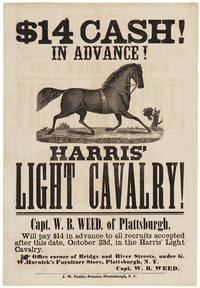
1861WRCAM54022Plattsburgh N.Y. 1861. Printed broadside 13 3/4 x 20 inches. Matted. Mild offsetting of text from being previously folded minor restoration in left margin light folds and toning. Very good. A rare Civil War recruitment broadside stating that Captain W.B. Weed will pay $14 in advance to all Union recruits accepted after October 23 in the Harris' Light Cavalry. Signed in type by Captain Weed who enlisted with the 2nd New York Cavalry in September 1861 only to be discharged less than a year later on June 24 1862. The broadside includes a large and well-executed engraving of a cavalry horse. <br> <br> Named in honor of Senator Ira Harris of Albany Harris' Light Cavalry the 2nd New York Cavalry was organized at Scarsdale New York during the summer of 1861 and over the course of four years' service earned one of the most illustrious records in the Army of the Potomac. The 2nd Cavalry lost heavily during Pope's Campaign in the late summer of 1862 and again before and after Gettysburg losing almost 50 at Aldie alone with equal losses later in the year at Liberty Mills and Buckland Mills. During the summer of 1864 the regiment took part in Wilson's raid on the South Side and Danville Railroads and it fought in the Shenandoah Campaign when the tide was finally turned against the Confederates. The 2nd New York Cavalry is one of the 300 fighting regiments mentioned by Colonel Fox and ranks eighth in the list of mounted regiments which lost the most men killed and fatally wounded in action during the Civil War. unknown books
1864WRCAM53096Richmond 1864. Broadside 18 x 12 inches. Printed in three columns. Previously folded with a couple small separations along old fold lines. Light toning and foxing. About very good. A very scarce and quite interesting broadside circular printing of the act which allowed slaves and free blacks to be used in certain tasks by the Confederate Army during the Civil War as well as instructions for the conscription and induction of those men into the armed forces. The Confederacy was loath to arm any of its slave population but by 1864 could not spare any further manpower from their infantry to perform menial tasks and the government therefore passed a law allowing slaves to be used "in certain capacities" such as the construction of fortification the production of arms and the transport of materiel. The first column of this broadside comprises a full printing of that law while the remainder sets forth the rules for the impressment of slaves into military service for their care while in service and for the compensation of their owners. <br> <br> A fascinating piece that lays bare the desperation of the Confederacy for labor and supplies in early 1864. Not in Parrish & Willingham. unknown books
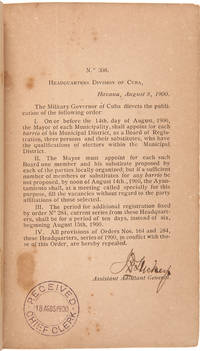
1900WRCAM51843Havana 1900. Approximately 520; 600pp. including several folding charts. Over 200 separate imprints. Original half leather and brown cloth boards spine gilt. Corners and edges worn spine rubbed boards scuffed. Initial leaves of first volume torn away but present. Several other leaves chipped and torn throughout. With many official signatures and docketing stamps. Good. Two volumes of orders promulgated in 1889 and 1900 by the American military government of Cuba after the cessation of hostilities in the Spanish-American War. Under the terms of the Teller Amendment to the Congressional Joint Resolution for war with Spain in 1898 the United States denied the intention of using the conflict as a pretext for the annexation of Cuba and promised to leave the island following the termination of the war. The American military therefore oversaw the creation of the new independent Cuban government before departing in 1902. The documents contained in this collection consist of over two hundred orders in both English and Spanish from the Headquarters Division of Cuba that helped to shape the emerging civilian government. They include instructions for the running of elections the organization of the courts and school system the appointments for various government offices provisions for tax regulations and many other critical issues facing Cuba at its independence. The directives cover two periods from January to July in 1899 and from July to September in 1901. Many of the orders are signed in manuscript by the assistants to the military governor for the island Gen. Leonard Wood including assistant adjutant generals J.B. Hickey and L.W.V. Kennon and Brig. Gen. Chief of Staff Adna R. Chaffee. An interesting documentation of the first American occupation of Cuba. hardcover books
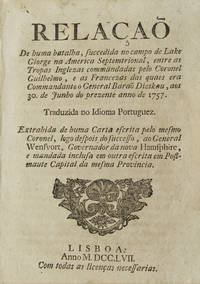
1757303318Lisboa: Domingos Rodrigues 1757. First edition. Woodcut vignette to title-page. 7 blank pp. Small 4to. A very good copy some very faint dampstaining. First edition. Woodcut vignette to title-page. 7 blank pp. Small 4to. THE BATTLE OF LAKE GEORGE. A Portuguese translation of General William Johnson's "Letter to the Governours of the Several Colonies who raised Troops on the Present Expedition" signed in the text "Wilhelmo Gonson." <br/><br/>Not long after the commencement of the Seven Years' War Johnson was appointed British agent to the Iroquois. On 28 August 1755 he renamed Lac Saint Sacrement Lake George in honor of the British monarch and proceeded north as part of a four-pronged attack on the French specifically to capture the French-held Fort St. Frédéric at Crown Point. <br/><br/>"It was not the greatest battle of the French and Indian War but it came when a victory was needed and the results were momentous. It retrieved both the glory and morale so badly depleted when Braddock fell at the forks of the Ohio the previous July. It blunted a French drive which menaced Albany and the northern frontier set up a new English outpost in that area and the capture of a distinguished French general Dieskau was triumph for the victors and humiliation for the enemy" Hamilton.<br/><br/>The publication of this letter was of course a remarkable source of propaganda for the English and boosted Johnson's career signficantly. The letter was reprinted in London an engraved plan of the battle was produced as well as portrait. This Lisbon printing is however very rare and little known. It's not in COPAC there wasn't a copy in the Streeter Sale. In fact the last copy on the market we can find was in 1928. Not in Church; Sabin 38661; Maggs "Biblioteca Americana" IV 2998; Milton W. Hamilton "Battle Report: Genreal William Johnson's Letter to the Governors Lake George September 9-10 1755" in Proceedings of the American Antiquarian Society April 1964 pp 19-36 [Domingos Rodrigues] unknown books
186427011Washington 1864. Folded map 24 x 33 inches in thirty-two segments mounted on linen. Original card covers with printed paper label. Contemporary ownership inscription on label. Some light wear and minor soiling. Detailed field map for the Union Army in Northern Mississippi and Alabama.<br/> <br/>A highly detailed map of the northern half of Mississippi and Alabama showing the border with Tennessee and all points south to Vicksburg and Montgomery produced to support the operations of the Union Army there in 1864. This is one of several maps compiled by the U.S. Coast Survey in an attempt to adequately map the South during the Civil War for military purposes. A note on the map indicates that the present map was compiled from various sources including "campaign maps and information furnished by Capt. O.M. Poe Chief Engineer Military Division of the Mississippi and by Capt. W.E. Merrell Chief Engineer Department of the Cumberland." Merrill was Sherman's chief topographical engineer and he contributed to several important maps of the area including one of Northern Georgia produced in Chattanooga following the vital capture of that city. With the beginning of the Civil War the United States Army found itself scrambling to obtain adequate field maps for military operations in the South. The most established cartographic branch of the Government the Coast Survey was pressed into service to provide these maps some with a coastal component but mainly for landlocked locations. The cartographers of the Coast Survey reviewed all of the existing cartography available but also drew on military and scouting reports and covert agents to assemble the most detailed possible maps of places roads railroads natural features. The topography is illustrated with hachured and shaded relief and railroads shown in red. The circulation of these maps was controlled and only officers ranking major or higher were supposed to control copies. As a result they are rare today. Two key figures in the Coast Survey effort during the War were Henry Lindenkohl and his brother Adolph who were responsible for actually drawing many of the field maps. The Lindenkohls were born in Germany but emigrated to the United States as teenagers and became American citizens. Adolph had already worked at the Coast Survey before the War began and Henry joined in 1861. Together they made a huge contribution to the war effort through their superb cartographic work producing and revising maps of different theatres of operations through 1865. Both continued with the survey for the rest of their lives; Adolph died in 1904 after fifty years on the job and Henry in 1920 after fifty-nine. This map has the ownership inscription of Col. Joseph Corson Read 1831-1889. Read was one of the first wave of men to take up Abraham Lincoln's call for volunteers to put down the rebellion in April 1861. He remained continuously in the army serving first on General Jesse Reno's staff and rising to the rank of Chief Commissary for the Army of the Cumberland commanded by Gen. George H. Thomas. Thomas was impressed with Read and on May 1 1864 with the spring campaign against Atlanta imminent Thomas named Read Chief Commissary of the Army of the Cumberland in the Field. This meant that although Col. A.P. Porter was the Army's overall chief Read would serve alongside Thomas in the field and had the responsibility to supply the entire army as it moved South. During the long and arduous Atlanta campaign he was the man on the ground making the supply side work. Read developed a close relationship with Thomas one with both personal and professional aspects. An important map of Northern Mississippi and Alabama particularly interesting as part of the greater project undertaken by the Coast Survey to map out the South during the Civil War and with excellent provenance and associations. unknown books
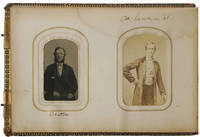
1860CAT0140Massachusetts 1860. 9 x 6 inches. Polished calf decorative covers. Nineteen pages with 55 Carte-de-Visite portraits. Good. A carte-de-visite portrait album kept by Billings during the Civil War. Notation before index reads: "This album was sent me at my order from Philadelphia and was received while our army lay at Brandy Station in the winter of 1863-1864. I think! Many of the pictures I carried with me throughout nearly my whole term of service. This is true of these on the first 17 pages. The others have been inserted since the war." <br /> <br /> A particularly noteworthy artifact. Hardtack and Coffee is one of few books on soldiers' everyday life and this album would have been quite significant for Billings. He discusses photographs twice in the book as being among the dearest objects soldiers kept with them. Per Billings' own note on the endpapers there are seventeen portraits present that he personally kept with him during the first part of the war before adding them to this album in 1863. These include: his parents several cousins and various acquaintances. The remainder of the portraits were added later. Notable subjects include two portraits of Billings himself and two portraits of his future wife Mary Phillips Cotton Whitney. <br /> <br /> Unfortunately portraits of Billings' compatriots are missing. Several portraits of members of the Massachusetts 10th were removed in the 1980s by an unknown person and framed with the subjects' identities and the photos removals noted on the mounts. Several other pages lack portraits though it is unclear whether or not each space in the album was originally filled. The photographs that remain are in very good condition. The album itself is worn with tears and chips to spine and general wear. First leaf repaired with crude tape. Still a significant piece despite the flaws. unknown books
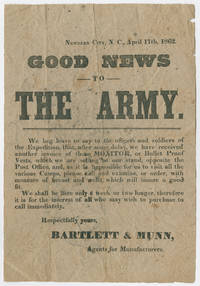
186221777<p>A remarkable broadside advertising the sale of bulletproof vests to Union forces in North Carolina in the wake of the occupation of much of coastal North Carolina by General Ambrose Burnside's Expeditionary Force.</p> <b>CIVIL WAR.</b>Broadside. <i>"Good News to the Army."</i> Bartlett & Munn Agents for Manufacturers. Newbern N.C. April 17 1862. 1 p. 9¾ x 6 ½ in.<p><br /></p><p>"<i>We beg leave to say to the officers and soldiers of the Expedition that after some delay we have received another invoice of those Monitor or Bullet Proof Vests which we are selling at our stand opposite the Post Office and as it is impossible for us to visit all the various Camps please call and examine or order with measure of breast and waist which will insure a good fit. We shall be here only a week or two longer therefore it is for the interest of all who may wish to purchase to call immediately.</i>"</p><p><b>Historical Background</b></p><p>Several firms attempted to sell such bullet proof vests during the war with ads for body armor even appearing in <i>Harper's Weekly</i>. According to historian Byron Farwell "G. & D. Cook & Company of New Haven Connecticut offered to Union soldiers a 'soldier's bullet proof vest' in two models a seven-dollar model for officers and a five-dollar one for enlisted men and for a time early in the war the Atwater Armor Company also in New Haven produced two hundred per day. Although they were nonregulation in both Civil War armies a few volunteer regiments were quipped with them. They proved too heavy to be practical and the increased efficiency of weapons destroyed any value they may have had."</p><p>It is not known which company <i>"Bartlett & Munn"</i> represented. Advertising to Ambrose Burnside's troops who had occupied New Bern N.C. on March 14 1862 they name their vests "Monitors" in obvious reference to the Union ironclad who had stood toe to toe with C.S.S. <i>Virginia</i> in the Battle of Hampton Roads on March 8-9 1862.</p> books
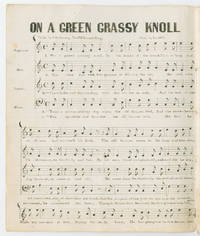
1864248261864. No binding. Condition: Fine. Manuscript Pen and Ink Folk Art Song Book ca. 1864. 24 pp. 6 5/8 x 8 in. This hand-sewn booklet contains eight songs popular during the Civil War era with music and lyrics in calligraphy. Songs include "On a Green Grassy Noll" by J. D. Canning with music by Ira Odell; "The Old Mountain Tree" by James G. Clark; "Harmonian Waltz"; "Year of Jubilee or Kingdom has Come!"; "Squire Jones's Daughter"; "The Sweet Birds Are Singing"; "Lament of the Irish Emigrant"; and "Soon and For Ever" by J. B. Monsell. The last page of the booklet is dated February 21 1864. Partial Transcript: Year of Jubilee or Kingdom has Come! I come up Norf on a little bender Left Missus at home wid no one to tend her Ole Massa's gone I dun-no what to; Sambo pretty sure he don't much care to. Chorus: Den sound de horn beat de drum Sound de horn and beat de drum De year ob jubilee am come Sound de horn and beat de drum De year ob jubilee am come. Met genral Bloaregard on my way here He told me dat I had better stay dere He said up Norf dey would skin and eat me Dat was a yarn dat a little heat me. He said he had just whipp'd Gen-ral Bu-el Grant and Wallace All three in a duel. I axed him den why he was running away Sam-bo says he dat question aint fair play. Oh times down Soth am getting quite rotten He's so berry scarce they have to burn cotton I left dat land ob oppression and gas And roam de free Norf without nary pass. Molasses Junction was a big scarecrow Nigh its wooden guns nobody didn't dare go; But when McClellan got a good ready De Southern Gentry seemed quite unsteady. Abraham Lincoln and Emancipation De two tallest tings in dis tall nation; Hurrah den boys let us still be merry Kingdom has come boys we've good times berry. Historical Background: Music played a prominent role in the American Civil War. On the battlefield and in the camps it boosted morale and released tensions. On the homefront it helped individuals and families express political sentiments grief and longing. Music entertained and often carried political religious and social messages. "The Year of Jubilee or Kingdom has Come!" was written by "Sambo" and first published in 1862 by H. M. Higgins in Chicago. "Squire Jones's Daughter" tells of the virtues of "The prettiest girl in the State of Maine" and was copyrighted by New York publisher Henry De Marsan in 1860. "The Sweet Birds Are Singing" is a cheerful pastoral duet about springtime that dates to at least 1836. "On a Green Grassy Noll" by J. D. Canning was first published in Boston in 1852 and is an elegy for a nameless old farmer who has "ploughed his last furrow." "The Old Mountain Tree" is a ballad in the form of a quartet by James G. Clark first published in 1854. It expresses longing for an old homestead. Clark 1829-1897 enlisted in the 35th New York as a 1st lieutenant and was detailed to remain in the recruiting service. He used music in his efforts to enlist soldiers in the cause and was dubbed "The People's Poet." "Lament of the Irish Emigrant" is a ballad by Helen Blackwood 1807-1867 with music by William R. Dempster 1808-1871 first published in Boston around 1840. It tells the story of an Irish emigrant who has buried his wife Mary and their child. Blackwood Baronness Dufferin and Claneboye was a British songwriter composer poet and author. Dempster a Scottish singer was very popular in the United States. "Soon and For Ever" is a sentimental hymn by J. B. Monsell about the Christian's union with Christ in Heaven. Rev. James Samuel Bewley Monsell 1811-1875 was an Irish Anglican clergyman and poet. He wrote the poem in 1853 or earlier.Condition: Very minor soiling else near fine.<br /> books
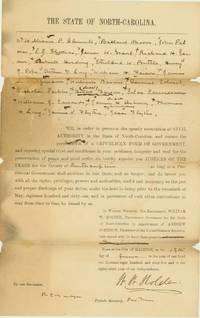
1865218141865. No binding. Fine. Archive of materials relating to the administering of loyalty oaths in North Carolina after the Civil War during presidential Reconstruction. 1865-1866. 21814.01. William H. Bagley Autograph Letter Signed as private secretary of Governor William Holden to William Barrow John Odom and others. Raleigh N.C. July 10 1865 1 p. quarto on State of North Carolina Executive Department lettersheet.Excerpt""Your Memorial . has been received at this office and the Governor directs me to say in reply that the matter therein referred to will be attended to at the earliest possible moment. This however cannot be done until the Enrolling Boards shall have accomplished their work in the different counties in administering the oath of amnesty to the people - separating the loyal from the disloyal. In the meantime the preservations of the Public peace will devolve upon the Justices of the Peace in the several counties who have the right on all occasions to control the Local Police and posses the power to increase the same to such a number as they may deem necessary to meet any emergency which may arise in which they may think is likely to arise .""21814.02 W.W. Holden Printed Letter Signed in Type as Provisional Governor to Col. David A. Barnes with matching cover addressed ""To the Clerk of the County Court of Northampton County Jackson N.C."" Entitled ""Directions for Qualifying Magistrates and Organizing the County Courts."" Raleigh N.C. July 8 1865 1 p. quarto on State of North Carolina Executive Department lettersheet.Excerpt"".If necessary you will call on the officers of the Local Police to notify the Justices to meet at the Courthouse on a day to be appointed by you. And said officers are hereby commanded to aid you in notifying the Justices to attend. When the Justices shall have assembled you will administer to them first the oath of amnesty; secondly the oath to be found in the Revised Code chapter 76 page 434 to maintain the Constitution of the State not inconsistent with the Constitution of the United States; thirdly the oath of office to be found in Revised Code chapter 76 page 441. No Justice or other officer who is included in any of the fourteen excluded classes of the President's amnesty proclamation will be permitted to take the oaths prescribed or enter on the performance of duty until a pardon shall have been received by him from the President. And the oath of amnesty is not to be administered to any one who is not disposed to take it willingly and cheerfully. If any Justice named in the commission hesitates to take the oath it will be your duty to withhold it from him . The Clerk will make a full and complete record on his books of the proceedings of the Justices a copy of which you will at once transmit to this office.""21814.03 W.W. Holden Printed Letter Signed in Type as Provisional Governor. September 15 1865 1 p. quarto on State of North Carolina Executive Department lettersheet.Excerpt""You are hereby directed to retain the Amnesty Oath books until further orders as they will be kept open to allow the people to take said oath up to the time of voting for Governor members of Congress & c.""21814.04 Manuscript Document Oath. Northampton County N.C. August 15 1865. 1 p.21814.05 Printed Document Oath of Allegiance 1865 unissued. 1 p.21814.06 W.W. Holden Partly Printed Document Signed appointing twenty-two men 2 of whom are identified as dead as Justices of the Peace. Raleigh N.C. June 19 1865. 1 p.Excerpt""WE in order to promote the speedy restoration of CIVIL AUTHORITY in the State of North-Carolina and ensure the perpetuation of a REPUBLICAN FORM OF GOVERNMENT and reposing special trust and confidence in your prudence integrity and zeal for the preservation of peace and good order do hereby appoint you JUSTICES OF THE PEACE for the County of Northampton as long as a Provisional Governor shall conti. See website for full description books
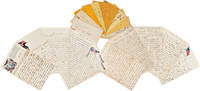
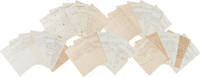
1865WRCAM55678Various locations including Washington D.C.; City Point Va.; Petersburg Va.; Brandy Station Va.; Annapolis Md.; and others 1865. Thirty-two war-date letters totaling approximately 95pp. plus ten retained transmittal covers and assorted post-war family papers. Original folds minor wear creasing and toning. A few letters slightly clipped likely to retain the patriotic letterheads. Overall very good. In mylar sleeves within a modern three-ring binder. An interesting Civil War collection of thirty- two letters spanning the length of the war almost all addressed to Mary H. Winant of Staten Island along with ten original transmittal covers and other documents and family papers. Many of the letters are from Mary's family members serving in the war including her brother James her cousin George F. Rezeau and her uncle James E. Rezeau as well as a few other friends. The letters present the experiences of war from numerous different perspectives showing how the conflict affected extended families and whole communities all of them sent to the same woman back home a beloved sister relative and friend. <br> <br> James Winant writes to his sister on November 10 1861 after his unexpected enlistment. It appears that he had not intended to join the army but was swept up in the fervor after many of the young men from their hometown answered the call. He writes to Mary from Camp Campbell in Washington D.C.: <br> <br> "I was expecting to come down the first of November but Mr. Alfred Dart was getting up a Company of cavalry & quite a number of the Herrick boys put their names to the list & wanted me so I did not mean to back out. I put my name to the list the 15th of October & started for Harrisburg the 23. I had but a little time to get reddy sic to go with that company as I should have come to see.I have been in to the Capital & I saw a site the city is well surrounded by our northern troops we expect to hear of a battle every day on the other side of the Potomac. There was about 20000 soldiers left since Friday." <br> <br> Despite having seemingly joined the Union Army on a whim James Winant took his duty very seriously. Two weeks later James tells his sister in a November 23 letter: "I should like to see you but I do not know when that will be but I shall not leave without orders if I was shure that I would never be found out I never would. I will die in the battlefield before I be a Diserter sic never. I came to Fite sic for my country and I shall if called on and never flinch in that course." However that did not mean that James was thrilled with life in the army. His January 15 1862 letter reads in part: ".I hope you enjoy your new year well although I did not enjoy mine very well for I had to stand on guard and that is the worst part of soldiering we have to be out in all kinds of weather and the weather is very changeable. One day it is almost like summer and the next day it is cold enough to freeze a person.It takes 104 men to guard our camp." Moreover by February 25 James was thoroughly restless and tired of being at Camp Campbell writing: <br> <br> "Our Regiment is No.1 & it is referred for the City Provost Guards. There is two Companys out of our regiment guarding the city now & we expect to go in a week. We expect to get our horses this week. I would rather be in the army acrost sic the Potomac for I am getting tird sic of guarding this old camp. When we get to the city we will have better times. There has been quite a move for the last two weeks. The federal troops has got a strong hold of the rebels & I hope they will keep on crossing it." <br> <br> Interestingly in one of the only letters not addressed to Mary James writes his father with much of the same information he includes in this letter. It reads in part: "Our troops is doing good business in the South they have taken the most important places & a large number of prisoners & they will soon take the rest. I wish our company was in the army acrost the Potomac. I should like to see a fight with the rebels for I am getting tired of guarding this camp." <br> <br> In the only response from Mary retained in the collection she writes back to James trying to offer her brother some comforting words although she was worried about him being sent into battle. In a letter written on April 28 Mary writes to James to beg him to put his faith in God. She included a poem to let him know she was always thinking of him. The letter reads in part: <br> <br> "O James how it cheers my Lonely Heart to hear from you.that you would not be cald sic to the battlefield but since I read your last letter wich sic informs me that you have been ordered to march in pursuit of the Enemy. My hope is well nigh expired though I know Dear Brother that you have Enlysted sic in a noble cause and given your heart and hand to your Country and now there is one step more noble for you to take and that is give your heart and head to God and you will be indeed a brave soldier." <br> <br> Mary also received a couple letters from her cousin George Rezeau in Pennsylvania and a few from her uncle James Rezeau. George does not appear to be serving in the military yet when he first writes to Mary though he would enlist shortly. By November 1862 George writes to check in on Mary from Camp Simmons and Camp McClellan. He signs off the former letter "Your naughty cousin G.F. Rezeau." <br> <br> George's father Uncle James Rezeau is also a Union man. He writes to Mary from Annapolis in August 1862 that he is anxious for his regiment to join the battle and that "if our regiment don't go on soon I will leave it and go into York State and join some other one and go down South for I enlisted to fight for my Country.I want to see the Elephant Old Jeff Davis and feed him some cold lead or else about twelve inches of cold steel." <br> <br> The latest letter in the archive is also from James Rezeau dated March 3 1865 to Mary written from the 67th Regiment Headquarters near Petersburg Virginia. Here a month before the war's end Mary's uncle writes to her check on her as he had heard she was sick. Uncle James also writes about war wages and sending money home to various family members including Mary whom he sends seventy-five cents. He also writes a letter to Mary's parents his own brother- in-law and sister from Brandy Station in early February 1864. He talks about his various health ailments including dysentery and diarrhea "It seems almost as bad as consumption for it reduces a man to almost a Skeleton" how he can't keep down any real food the bitterness of the cold and muddy Virginia winter and how he looks forward to seeing "all of you when this cruel War is over." <br> <br> There are also a handful of letters between family members i.e. a letter to Mary from her mother Eliza and some from friends and other soldiers. One letter dated August 26 1864 is from a friend "M. McPherson" who writes to Mary with news of her wounded cousin George: <br> <br> "G.F. Rezeau started for the Hospital this morning. He was wounded yesterday in a Battle between Shepherds Town and Winchester his wound is through the left hand the ball passed through his hand and spoiled the pocket in his shirt his glasses and his pocket combs beside bruising his side right smart. His wounds were very Lucky ones if there is any such. At the time George was wounded we were just going to charge he went to the Rear the Regt charged and we received a Perfect Shower of Rebel Compliments. There was a whole Brigade of Reb Infantry lying in ambush when we charged upon the Hill. They raised up there position was such they had a cross fire upon us." <br> <br> Included at the end of the archive are a number of documents and forms from after the war and as late as the turn of the century. They appear to be unrelated to Mary Winant although they could have belonged to her family or descendants. There are also ten original transmittal covers addressed to Mary Winant. <br> <br> An informative and research-worthy collection of Civil War and Civil War-era family correspondence. unknown books
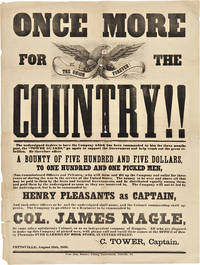
1861WRCAM54027Pottsville Pa 1861. Broadside approximately 24 x 18 inches. Minor separations at crossfolds some edge wear and short closed tears at edges somewhat toned. Good. Framed. A rare Civil War recruitment broadside calling for troops to join the Tower Guards in Pennsylvania during the first year of the conflict. The broadside is illustrated with a large open-winged eagle holding a banner in his beak which reads: "The Union Forever!" The body of the broadside reads in part: <br> <br> "The undersigned desires to have the Company which has been commanded by him for three months past the 'Tower Guards' go again to support the Government and help crush out the great rebellion. He therefore offers A bounty of five hundred and five dollars to one hundred and one picked men." <br> <br> The text explains that the company will be commanded by Henry Pleasants as captain and will be part of a Regiment commanded by Col. James Nagle "Or some other satisfactory Colonel or as an independent company of Rangers." The broadside directs any interested men to call and enroll their names at the Office of Henry Pleasants. Signed in type by "C. Tower Captain." Charlemagne Tower organized a company of Union soldiers from Pottsville in a three-month enlistment during the Civil War. Before the war Tower worked in law specifically moving to Schuylkill County to get involved in claims to large coal and mineral deposits there. Tower was able to build wealth and prominence for himself in the area through his work in land dispute cases most prominently the Munson-Williams case. <br> <br> When the Civil War began at Fort Sumter Tower took notice. Within ten days of that first conflict on April 12 1861 Tower had recruited around 270 men from his county to join the Union Army under a three-month enlistment provision. Tower's unit who became known as the "Tower Guards" entered the Union Army as Company H of the 6th Pennsylvania Regiment part of a brigade commanded by Maj. Gen. Robert Patterson. Tower commissioned captain of his unit provided uniforms and arms for his men at his own expense. The unit saw action most famously in the engagement at Falling Waters in July of 1861 a Union victory in name but with its own failings that led to the defeat at the First Battle of Bull Run. It would seem that Tower's efforts were not exhausted on this first unit because the featured broadside is dated just after his unit mustered out of service and asks for more men to take up the cause and fight for the Union. It would seem that Tower himself funded the bounty offered in the broadside but this is not certain because much less is known about this second attempt to recruit men for the Union Army. <br> <br> After his service in the war Tower was later named U.S. Provost Marshal for Pennsylvania's 10th Congressional District from 1863-64 and continued working at his Pottsville practice until moving to Philadelphia in 1875. A master land negotiator Tower held property in North Dakota and Minnesota that would help develop those states and the United States as a whole. His holdings in North Dakota became Tower City a promising town arranged and planned by George Ellisbury in 1879. Tower's land in the Vermilion Range in Minnesota proved to be rich with iron ore necessitating a mine and a direct railroad line both of which contributed to the local state and inter-state economies. <br> <br> Though Tower died on July 25 1889 his legacy was carried on by the towns across state lines that were named after him his son who became the minister to Austria- Hungary under President William McKinley and the unit of "Tower Guards" who fought for the Union Cause in the Civil War. <br> <br> A visually-striking artifact from the early period of the Civil War with no copies recorded in OCLC. unknown books
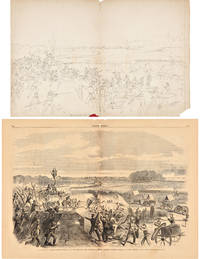
1862WRCAM48438Corinth Ms 1862. Pencil drawing 13 1/2 x 21 inches. Small tears at right and left edges lower right corner torn away. Small red ink stain on lower edge. Central vertical fold. Light soiling and wear. About very good. An original pencil sketch depicting a crucial moment in the Second Battle of Corinth which took place on October 3-4 1862 probably by war correspondent Alexander Simplot. This drawing was engraved for HARPER'S WEEKLY where its caption puts it in context as depicting the battle's key moment. A single three-cannon Union battery led by Lieut. Henry Robinet had been inflicting heavy casualties on the attacking Confederates. Here the Confederates have stormed the battery and are attempting to take it in hand- to-hand combat. The Federals recaptured the battery later that day leading to a Union victory and a Confederate retreat. The engraving from HARPER'S is included which attributes the sketch to Alexander Simplot though the drawing itself is unsigned. Simplot a native of Iowa was a schoolteacher and artist turned war correspondent. Early in 1862 Simplot began traveling with the army of U.S. Grant which in October was stationed in Tennessee near the Mississippi border. unknown books
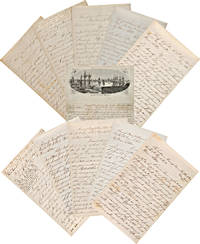
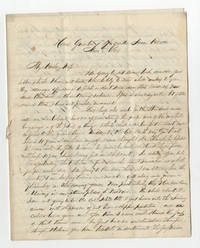
1862WRCAM55290Manchester N.H. Boston Ma. Ship Island off the coast of Mississippi and locations in Louisiana as detailed below 1862. Eleven autograph letters signed ten with envelopes totaling 36pp. Later transcriptions accompany the letters. Old folds occasional light staining and/or tanning one letter with small tears repaired with archival tape. In very good condition. A small but rich collection of early Civil War letters written by Private Aaron A. Smith of Wilton New Hampshire to his sweetheart Adaline "Addie" D. Jones of West Wilton. The letters describe Smith's training at bases in New Hampshire and Massachusetts time spent at Ship Island off the Mississippi Coast and his service in Louisiana as part of the Union occupying force in the summer and fall of 1862. Smith eventually served as a musician with his company giving an interesting perspective on his brief Civil War service. The letters continue until Smith's death in Louisiana from typhoid fever just over a year into his service. Letters from the western theater of the Civil War especially at such an early point in Union advances are uncommon. <br> <br> Smith's letters are especially informative of the conditions at Ship Island describing the poor health conditions there and the Confederate prisoners and escaped slaves he encountered. He also gives valuable information on Louisiana and New Orleans just after the Union retook the region describing the ongoing resistance efforts of Confederate soldiers and civilians. Smith also transmits his love for his hometown sweetheart and his hopes that they will meet again. <br> <br> Aaron Smith 1837-1862 enlisted on October 28 1861 and mustered into Company "B" of the 8th New Hampshire Volunteer Infantry under Col. Hawkes Fearing Jr. The 8th left Camp Currier Manchester N.H. on January 24 1862 en route for Fort Independence in Boston where they trained and drilled until transport south was available. They departed Boston for Ship Island Mississippi on February 15 aboard the E. WILDER FARLEY and finally arrived on March 15. Smith served the entirety of his comparatively brief enlistment in the Department of the Gulf as part of Gen. Benjamin Butler's Expedition. In his letters Smith details his transport to Ship Island and the conditions there and then gives descriptions of New Orleans. Smith remained at Camp Parapet just upriver from New Orleans through September before joining Gen. Godfrey Weitzel's brigade and participating in the Battle at Georgia Landing Labadieville an engagement he describes briefly in his final letter of December 10. Aaron Smith then fell seriously ill and succumbed to typhoid fever on December 22 1862 according to the REGISTERS OF DEATHS OF VOLUNTEERS. The letters are described individually below: <br> <br> Camp Currier: January 22 1862. 2pp. With envelope. Smith writes just days before he leaves for Boston. His tone is light and focuses on the personalities in his and Addie's choir in Wilton. In fact Smith writes that he's just received her letter as "Sargent sic Marshall Abiel Livermore and myself were spending the evening in singing." Smith also asks about which regiment a friend of theirs has joined in hopes that he can locate him later. <br> <br> Fort Independence: February 10 1862. 2pp. Smith is now in Boston waiting to for the ship south and his thoughts have turned more serious. He writes that he hopes his and Addie's feelings for each other will not dim since "when we shall meet again I cannot tell as separations must occur on Earth I must reconcile myself to it." He then veers into a religious vein: "The hand of God can protect us from all harm and guide us safe through many dangers I wish I had more faith in Him and more love for Him. Addie it is my deep desire and has often been my prayer that you may seek and find if not the love of God and I hope live a more consistent christian life than I have." Nevertheless no one seems to know or will tell where they are headed: "where we shall go to I think that no officer under Gen. Butler knows those that put confidence in reports believe we shall go to Ship Isl. but I do not put so much confidence in them as I did by doing so have been obliged to contradict a part of some of my letters." Smith mentions the wreck of a troop ship and marvels that more lives were not lost. Towards the end of the letter perhaps to lighten the tone upon closing Smith seems to allude to a joke between him and Addie and his mother that he was married before he was not: "I am some forgetful perhaps I never was married if I have been and you should see her his mother tell her to be of good cheer.I must close now. I send a kiss for you.As we all are past furloughs I think I shall not try to go home again to see my wife." <br> <br> On Board E. WILDER FARLEY: February 16 1862. 2pp. With envelope. This is a brief letter letting Addie know that they are almost underway to Ship Island: "We are in the greatest state of confusion possible. I am now down on the second deck trying to write a few letters or what I shall have to pass as such. There are scarcely five rays of light that can get to my paper can find a better place in our cellar or in the barn than this to write in." Still Smith is optimistic about this war: "I hope and expect not to stop more than a year as the prospects are that the war will not last long and if spared think will be back within that time." <br> <br> Ship Island: April 22 1862. 4pp. With envelope and three small seashells. Smith has arrived at Ship Island and paints a vivid picture of the pestilent sand the soldiers in camp and the various inhabitants including Confederate prisoners of war: "Our Sothern sic prisoners run about at their leisure appear to enjoy themselves very well.the ladies frequently take their work and sit out on the shady side of a building and talk with the men. Some appear to be quite friendly to the union a lady told a man in our squad.that there are one half in N. Orleans that are union people if they dare to be." But then he heard from a girl who "said she wished she could put out the eyes of the northerners with those guns with bayonets she thought the northerners were not any better than the n__s." Nevertheless illness is already a problem: "Two have died in our Reg. since we have been here it is considerable sickly.last Friday I raised some blood from my stomach but the next day I went on duty feeling as well as usual." Smith attributes this to the sand in the food but Ship Island proved to be a very unhealthy place. By the end of the war 153 Confederate prisoners and 232 Union soldiers had died due to contaminated water and related fevers and infections. Smith closes the letter somberly: "I hope and trust we shall be spared to meet again.I think I realise the danger before me hope I shall be prepar sic to meet it." <br> <br> Ship Island: May 8 1862. 4pp. With envelope. "We are here still on this desert." Things are no better on Ship Island. Smith includes some brief accounts of the Union battles in Mobile and Baton Rouge and continues his descriptions of the heat and the sand. The heat has gotten worse: "It is not very healthy from nine to three o'clock.A great many are having very bad eyes caused by the white sand reflecting to the sun's rays.Some have lost their sight and been discharged." He insists his health is fine but notes that he avoids going outdoors whenever possible. Smith also records some fascinating interactions with escaped slaves. He reports that they "frequently come over here and are quite tickled to get here. I heard one say that their masters represent us to be very cruel and tell them we will cut off an arm starve and whip them if we get them.This one said if they should get him they would hang him for the negroes were planning an insurrection and he was at the head. He said he could not get much to eat and the soldiers do not have much either his master he said was in the army and hoped we will kill him." He closes morosely with a count of the graves in the cemetery 79 as of writing ".brothers husbands sons and fathers killed and buried in such hast sic that no one can tell where they lay this is the result of war and still for one side it is just." <br> <br> Camp Parapet: May 24 1862. 4pp. With envelope. Smith is finally on the move detailing his departure from Ship Island as part of the Union occupation of New Orleans. He notes the defenses in particular the "parapet" built up by the Confederates who anticipated the Union invading from the north rather than coming up river from Fort Jackson. He also describes the efforts of locals to destroy military equipment and foodstuffs that would be of value to Yankee invaders. They even attempt to befoul the waterways by dumping sugar and molasses into the river. Smith writes "When they heard we had taken Ft Jackson and only a few gun boats had got up to N. Orleans the soldiers at this place ran in every direction some even over the parapet into the ditch of water some took off their equipments and burnt them then put on citizens clothes to prevent them being caught with soldiers uniform on.The carriages of the guns were burnt by the women the guns spiked the equipments and every thing that the soldiers left that would fall into our hands were burnt and all done by the women." Smith also includes observations on the poverty he has seen: "The destitution of the people white and black in this state and Miss. is not a fable but a reality there are not but a very few that had money enough to live comfortable.I hardly know where to stop there is so much to write about." Smith closes with some notes for his mother and chaste love for Addie. <br> <br> Camp Parapet: July 9 1862. 4pp. With envelope. This letter is less focused on combat and troop movements and is more conversational with casual thoughts about the civilian world and life in camp. Smith writes that the "4th of July was so rainy here that the Reg.'s could not appear in parade at noon and night while the 'Star Spangled Banner' and 'Hail Columbia' was to be played." in which Smith had prepared to perform. Smith is a Musician now so he has been spared the discomfort of guard duty during the heat and the rain though not the boredom of inaction in camp. He reassures Addie about his health reiterating "The blood I spit on the Isl. was caused by the sand that I had eaten and drank. It came from my stomach and was only what I spit out in three or four times. I guess my lungs are well enough now as I have got over the horid colds I caught." Smith mentions election day but does not mention much about politics focusing instead on Addie's "election cake" and how much of it he would eat if he was there. The main problem for Smith in this letter is the numerous untrustworthy peddlers selling junk at exorbitant rates and giving phony currency in change. Perhaps inspired by these experiences Smith also has some strong language about the locals: "The people here are a mixed set from most every nation in the world but those called Creoles are the most numerous ignorant and degraded.The people have not much good principals sic are much inferior to the Northerners in interlectual sic cultivation." <br> <br> Camp Parapet: August 5 1862. 4pp. Folded with envelope. Curiously Smith wrote this letter on stationery featuring an engraved view of the port of New Orleans produced by Louis Schwarz New Orleans publisher and bookseller. Prussian-born Schwarz 1819- 1893 emigrated to New Orleans and by the 1850s had a monopoly on German-language literature. By the time of Smith's letter Schwarz had helped form the mostly-German Hansa Guards Battalion which was absorbed into the 4th Regiment European Brigade of the Louisiana Militia detailed to defend New Orleans. Schwarz was made captain of Co. "B." Upon the Union victory Gen. Butler used the European Brigade briefly as a police force but then dissolved them in May 1862. For some reason in this letter Smith addresses Addie as "Addia" both in the letter and on the envelope. He begins with pleasantries about home but then shifts to discussing the draft apparently in response to Addie: "I do not care if they do have to draft I hope they will and not be so long getting the Reg.'s ready waiting for them to enlist." He continues putting a brave face on things: "I presume there are many young men now in N. Hamp. with long faces fearing they may be drafted. I should like to see them and I guess I would plague them I would laugh at them any way. The worst part is thinking about it soldiers will feel quite at home when they have been in the army six months or a year Smith has been in about ten months. Some get homesick and it wears and worries them most to death some pine away and get discharged on that account but there are not many such." Smith also reports that there have been Confederate guerrilla attacks and that they have located weapons concealed in houses in Carrollton. Units were dispatched from his regiment to assist in securing the area. Once again his role as a Musician proves to be an advantage: ".if I was not a fifer probably I should had to have gone." <br> <br> Camp Parapet: August 15 1862. 2pp. With envelope. This letter is chiefly camp news with Smith in apparently good spirits. Things are quiet however: "We soldiers are getting to be quite lazy. Particularly I am as I am a musician they cannot detail me to do work which is called policing. I have no guard duty to do so I am not up nights and exposed to the rain and heat daytimes. The musicians have to do what the major says but he very seldom has any thing for us to do out of the regular course of duty." Aside from some rambunctious officers the rest of Smith's update is quite peaceful as he and his comrades spend their days catching up on letters to friends and families baking beans and hoping for more music to sing. <br> <br> Camp Parapet: September 8 1862. 4pp. With envelope. Another quiet letter although there are rumblings of potential combat. Even so Smith muses about Addie traveling down to visit him although he's not quite sure how that could be arranged. He returns to the topic of the draft and how those avoiding the draft make it sound worse than it is: "I think folks are apt to be more scart sic than hurt. But this war is an awful occurrence. I sincerely hope it will soon end in order to have it we must have the men. Sisters must be willing to part with their brothers fathers and mothers with their sons and none try to restrain those whose duty it is to go." Smith closes with several unsettling items including news that "there are quite a large force of guerrillas very near us on the south side of the river.A few Regs. have been sent after them. I do not think we shall stop here all winter but by three or four weeks we shall be on the march after the rebels. The government have neglected to furnish the musicians with swords as the 'Army Regulations' require so I bought me a revolver to protect myself by." <br> <br> Thibodaux Camp Stevens La.: December 10 1862. 4pp. With envelope. Smith wrote this letter approximately ten days before he died. He begins by apologizing profusely for the substantial delay since his last letter; it had been over two months. Smith's regiment has relocated to Thibodaux about 70 miles from New Orleans after fighting in the Battle at Georgia Landing. Smith is definitely sick at this point: "The march was very hard for me and camping out I caught a very bad cold. At the time of the battle I was most sick but the excitement kept me along very well." Smith describes how he assisted in the hospital all night attending to Union as well as Confederate soldiers. He is less sanguine about combat now that he has seen it: "War is awful if anyone don't think so let them be in a battle and try it to have shells exploding about you and grape and canister shot and bullets whistleing about your head makes any one feel most indescribable." <br> <br> From Smith's account he seems to have contracted several of the numerous diseases that plagued soldiers on both sides. In fact two out of three deaths during the Civil War were caused by disease. Every soldier had dysentery at some point and many suffered from one or more of any number of other ailments. He writes "I have the fever and ague some so do most all." "Ague" was malaria and afflicted about 20 percent of troops. Smith would have first developed a high fever along with the "shakes" followed by debilitating weakness that would leave him bedridden for days or even weeks. The symptoms would gradually subside and he could return to duty but the fever periodically returned and the process was repeated. Smith writes that he was sick again during their stop in Tigersville and then notes that "There is a good deal of shaking among the soldiers the shakes this season I have been told by the people are very bad among all." He closes the letter hoping "I can write often now.I have several letters to answer perhaps they will think I am very sick or dead. Changes take place in the army so any one cannot be always prompt in writing." A final page of text in a different hand Addie's is added after Smith's letter. The ink is faint and the hand is difficult to read but it is dated December 27 from West Wilton N.H. and starts by explaining that Smith's mother had been by to see how his health was suggesting that his friends and family did not know yet that he had died. <br> <br> A detailed and intimate account from a soldier in the early days of the Civil War with significant content on life at Ship Island and the early days of the Union occupation of Louisiana. Andrea Mehrländer THE GERMANS OF CHARLESTON RICHMOND AND NEW ORLEANS DURING THE CIVIL WAR PERIOD 1850-1870 Berlin/New York: Walter de Gruyter 2011. REGISTERS OF DEATHS OF VOLUNTEERS 1861-1865. RECORDS OF THE ADJUTANT GENERAL'S OFFICE 1780-1917. Record Group 94. ARC ID: 656639. National Archives. Washington D.C. hardcover books
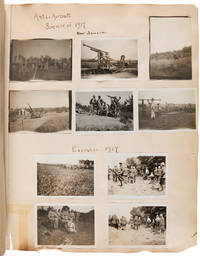
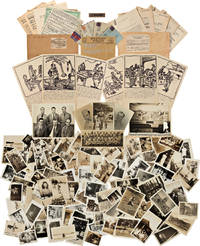
1919WRCAM55818France 1919. Three photograph albums one small framed photograph one small portfolio one book. 1115 photographs most mounted in albums ranging from 1 3/4 x 2 1/2 to 7 1/2 x 5 inches; 162 pieces of ephemera most mounted in albums. Two photograph albums: Folio. Olive green buckram both with burgundy morocco labels on front board and spine with gilt initials "WBO JR" and volume number. Minor wear to extremities some leaves slightly cockled due to photo mounting small chips and closed tears to margins of leaves. Third photograph album: Oblong octavo. Black limp cloth boards with black cord binding. Some wear to extremities some closed tears to leaves a few photographs cut out. Framed photograph: Glass cracked some tarnishing to frame. Portfolio: Tan leather with a snap clasp. Pocket partially torn well worn. Book: Publisher's half red cloth with illustrated paper boards inscription on front free endpaper. Front board and spine starting to detach from text block first few leaves detached but present. The archive in very good condition overall. An engaging and carefully assembled collection of photographs recounting the World War I service of 1st Lt. William B. Olmsted Jr. along with a substantial collection of ephemera and letters described below. The photographs document all aspects of his war service showing the aftermath of important battles American soldiers French soldiers and civilians scenes of the countryside and devastated towns and villages moments of calm and recreation and images in France from the period of the Armistice and in the months after. The ephemera provides a detailed paper record of Olmsted's service in France. <br> <br> William Olmsted Jr. 1893-1948 was born in Southboro Massachusetts. His father the Rev. William B. Olmsted was the Headmaster of Pomfret School in Connecticut. Olmsted was Yale Class of 1915 and also did graduate work at Trinity College. After the war he joined the staff of American Viscose Corporation and was Vice-President in Charge of Sales and a director at the time he died. Olmsted volunteered for the American Field Service formerly the American Ambulance Field Service in France in June 1917 and then enlisted in the American Expeditionary Forces later that year. He attended French Officers' School at Meaux and was commissioned Second Lieutenant in February 1918. Olmsted served in the Réserve Mallet a French army unit made up of American volunteers who transported ammunition and trench equipment and anything else that needed transporting wherever it was most needed. <br> <br> The first olive green album begins with a large page in manuscript recording Olmsted's service in France. The next page has "Volume 1 1917-1919" in manuscript and Olmsted's Registration Certificate i.e. draft card June 1917 affixed below. Photos begin on the following page starting with "Chevigny Farm" in August 1917. Olmsted annotates some photos individually but there are also titles and dates for each section which are grouped geographically but not chronologically. The subjects are wide- ranging - Olmsted's photos feature fellow American and French soldiers including the Army of Africa French civilians scenes of the countryside as well as ruined buildings and landscapes military encampments and cemeteries. There are also photos of airplanes both ready to fly and shot down a gas alarm and a Fourth of July gathering. <br> <br> Many of Olmsted's photos are candid and some can be haunting as well. One set chronicles the devastation following the Battle of Montdidier. Part of the second phase of the larger Battle of Amiens the conclusion of this offensive was later known as "the black day of the German Army" and was a major turning point in the war. Nevertheless hardly a structure is left standing in Olmsted's photos. Happier scenes are featured at La Capelle for the Armistice on November 11 1918 including cars that ferried German delegates there to negotiate the peace. The photos feature German as well as French and American troops. Even after the peace was signed however Olmsted still has much devastation to document. He also includes a series of photos he acquired from German soldiers depicting a funeral for a fallen aviator and German soldiers "at play." At this point Olmsted's combat travels take him to Paris and then this sequence ends. <br> <br> The next series of photos begins with the heading "Trip in Ford. 16 days - Cost of car rent gas oil $137.50." Accompanied by his wife Margaret this is clearly a tourist trip albeit a somber one beginning in Soissons and ending in Argentan. Olmsted includes photos of cathedrals and repairs to cathedrals cafés the American cemetery at Belleau Woods as well as French and German graveyards shots of trenches and forts near Rheims and friends and families he meets along the way. This sequence ends with scenes aboard a ship. <br> <br> The second olive green album "Volume 2 1917-1919" begins with "French Tanks Going into Action." Photos in this album are often annotated but there are fewer locations noted. There are some apparent combat scenes in this album as well as more devastation from shelling and bombing and a short sequence of airplanes including a downed German fighter. A sequence titled "Pictures taken by Capt. F.O. Robinson" finishes the photo section. Robinson's pictures do not vary substantially in form or content but add areas not covered by Olmsted particularly in and around Bazoches. <br> <br> The last two-thirds of this album is titled "Volume 3 1917-1919" and consists of ephemera and letters. It begins with a comic sketch of Olmsted and a cloth insignia of his unit the Réserve Mallet. Then follows all of the official documentation of Olmsted's military service including his commission and promotion and ultimately his discharge papers. Also included are Olmsted's folio sheet-size passport with photograph and a substantial collection of orders leave permissions and other administrative documentation from both French and American forces issued to Olmsted. In the midst of these materials he has mounted his American Field Service Medal and Victory Medal with battle clasps: Somme-Defensive Aisne Montdidier-Noyon Aisne-Marne Somme- Offensive Oise-Aisne Defensive Sector along with an envelope labeled "From Cathedral at Rheims" holding pieces of broken blue glass and a small card wishing him happy new year from the superior and sisters at Crecy-en-Brie. Olmsted also preserved a few watercolors one depicting a soldier possibly Olmsted himself with the sisters at Crecy-en-Brie another of a man in a horse-drawn carriage and a larger one of Olmsted standing next to a monument displaying an American eagle and shield and with a truck in the background. There are several sketches by the same artist included as well. Towards the end Olmsted has mounted his dog tags and two pamphlets about the Réserve Mallet. <br> <br> The smaller black photo album seems to overlap somewhat timewise but features photos primarily in the United States many of which are annotated in white pencil in a hand different from that of Olmsted. It may have been created by his wife Margaret. There are several photos taken in the Bay Area of northern California including the campus of the University of California and Golden Gate Park. Interspersed are photos from an apparent road trip including "Dallas" "New Orleans Docks" "Camp Sheridan" Nebraska and "Montgomery" Alabama. <br> <br> Final material relating to Olmsted's life include a small leather portfolio of clippings of his obituary printed in papers around the country and other ephemera. Among this material is an envelope labeled "Bearers at my funeral." with notes inside from Olmsted on whom he wants to conduct his funeral hymns to be included and so forth; an enveloped labeled "Lily from my Wedding bouquet June 23 1917" and a condolence letter to his widow Margaret. Included loose are a menu from a restaurant in Paris 1917 a portion of a letter on teaching military strategy that begins in code and two documents related to Margaret being named a Chevalier of the Légion d'Honneur by the French government for her work directing overseas activities of the American Aid to France foundation during World War II. Finally there is a well-worn dedication copy of "I WAS THERE": WITH THE YANKS ON THE WESTERN FRONT 1917-1919 by C. Leroy Baldridge New York: G.P. Putnam's Sons 1919 given to the Olmsteds by the commandant of the Réserve Mallet. <br> <br> A truly impressive collection chronicling an American's service in France. hardcover books
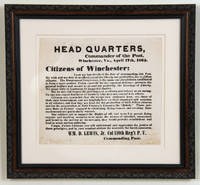
186222128<p>Broadside describing the first occupation of Winchester Virginia during the Civil War.</p> <b>CIVIL WAR.</b>Broadside signed in type by Colonel William D. Lewis Winchester Virginia April 17 1862 1 p. 12½ x 11 in.<p><b>Partial Transcript</b></p><p><i>"HEAD QUARTERS </i></p><p><i>Commander of the Post </i></p><p><i>Winchester Va. April 17 1862. </i></p><p><i>CITIZENS OF WINCHESTER: </i></p><p><i>Upon me has devolved the duty of commanding this Post. My wish and my duty is to afford you all the </i>liberty<i> and </i>protection<i> due to </i>fellow citizens<i>. The </i>Government<i> I represent is </i>the same our forefathers established <i>to form a more perfect </i>Union<i>. . . promote the </i>general welfare<i> and secure to </i>us and our posterity<i> the blessing of </i>Liberty<i>. We mean truly to represent its impartial </i>Justice.</p><p><i>But no one can expect the privileges of a </i>citizen<i> and behave as an </i>enemy<i>. No one can expect kindness . . . who does not extend it to others. </i></p><p><i>Citizens are reminded that the troops now stationed here are those of </i>their own Government<i> and are </i>lawfully<i> here on their </i>country's soil<i>. . . they are here for the </i>protection<i>of their fellow citizens and for the prosecution of their Country's Enemies the 'Rebels.' Those persons Male or Female engaged in circulating flying rumors and creating false excitements are particularly warned. </i></p><p><i>Our soldiers are to support the </i>Rights of all<i> and were I to permit flying reports and insulting remarks to be made the means of mischief annoyance and insult to the service or its servants they would provoke retaliations and lead to much useless suffering. </i></p><p><i>I trust Fellow Citizens you will understand and appreciate the justice of these principles and by your conduct obviate the necessity for harsh measures"</i></p><p><b>Historical Background</b></p><p>Colonel William D. Lewis issues a warning to the citizens of Winchester Virginia imploring them to submit to his occupation or face <i>"harsh measures."</i> This was the first official occupation of a town that would change hands nearly seventy times during the war. Union General Nathaniel Banks entered the Shenandoah Valley in March 1862 occupied Winchester on March 12 and defeated the Confederates at the battle of Kernstown on March 23. On May 25 Union forces were defeated by Stonewall Jackson at the first battle of Winchester and forced to withdraw from the town towards Harper's Ferry thus ending the first Federal occupation of Winchester.</p><p><b>Condition</b></p><p>Very good</p> books
194019884Various ca. 1940s. Thirteen brown paper leaves loose from a presumably perished scrapbook holding 57 black and white silver print photographs and dozens of ephemeral articles clippings postcards documents etc. tape-mounted to rectos and versos. Prints ranging in size from approximately 1.5” square to approximately 8” x 10” 42 of the 57 photos approximately 1.5” square contact prints. WITH Two ALS totaling approximately 650 words. Letters good to very good. WITH About 35 pieces of loose ephemera: military correspondence personal clippings and photographs etc. Scrapbook pages worn flaking at edges loose contents often with tape remnants or residue from previous mounting. Contents overall about good. Pearl Harbor letter very good with folds from mailing light toning and a small chip from right margin. <br/><br/>A small archive of World War II service and personal materials belonging to a Gerald Maynard Watkins of Memphis Tennessee highlighted by a monumental Pearl Harbor eyewitness letter written by Watkins to his mother less than 2 weeks after the Japanese attack. <br /> <br />Watkins was stationed at the Kanehoe Naval Air Station on the East side of the island of O’ahu site of the first Japanese attack carried out just minutes prior to Pearl Harbor approximately 30 miles to the West. His approximately 575 word letter of December 20 1941 describes the surprise onslaught in vivid and revealing detail exceprt: <br /> <br />"Then it happened. Never til my dying day will I forget. Bombers. They came from nowhere – Seemed to just be there. I looked up just in time to see them drop their eggs. For one startling second the world stood still as I followed the bombs line of drop with my eyes. I couldn’t help it. Fascinated by it all I watched until thy hit. That broke the spell. Courage – Every man there was a hero. <br /> <br />I rushed over to the hangar after the debris had settled. The first person I saw was Lawrence. He was just lying there kind of white looking and awful still. My throat tightened until it was hard to swallow. I knew he was dead." <br /> <br />This remarkable eyewitness account one of the best pieces of World War II correspondence we’ve seen is certainly the highlight of the group and its remaining contents are largely typical of World War II-era scrapbooks and archival material with several dozen photographs of his later service in the War many from Canton Island airfield in the Pacific with the decorated Patrol Bombing Squadron VPB-52. The balance of contents consist of personal clippings marriage photographs 3 pages seeming to be the fitful beginnings of an attempt at an early draft of a memoir of his Pearl Harbor Day experience and a second wartime ALS written on Christmas Eve 1941 in which he follows up his December 7 experience with a report on a mild injury he suffered during the attack: “Now that I am well and health once more I can tell you this. I had a very small piece of shrapnel from one of the bombs that were dropped here hit me in the shoulder. I didn’t even have to go to bed. I feel like a veteran now.” <br /> <br />Watkins left the Navy in 1946 after six years of service and went on to a career as a commercial airline pilot. His 2006 obituary notes he entered the University of Miami Law School at 67 years old passing the Florida Bar at 70 to become a practicing lawyer in retirement. <br /> <br />A handful of primary written accounts of the Pearl Harbor attack are known notably the diary of George Macartney Hunter whose family privately holds the manuscript but have made it available in multiple venues including for use in the 2003 PBS documentary THE PERILOUS FIGHT. The offering of similar materials in commerce appears to be rare with a significantly less impressive letter by a civilian witness to Pearl Harbor several miles from the battle itself making approximately $1200 nearly tripling its high estimate at a small regional auction in 2011. <br /> <br />A rare thoughtful and exceptionally revealing participant account with important supporting documentation lending additional context of arguably the defining event of the 20th century. unknown books
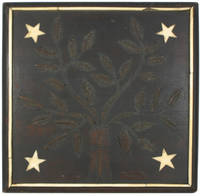
1863List308N.p. 1863. Dark carved wood 11 ½ x 11 ½ x 1 inches with bone border and star inlays in corners an inlaid tree with carved names of Civil War battles as leaves. During the Civil War wounded or captured soldiers would often pass their time waiting to return to duty carving relics. The practice was fairly common with pipes being the most commonly carved object and the quality of the relics varied wildly depending on the talent of the soldier. A.H. Barber from Wisconsin was wounded at Antietam and most likely carved this memorial piece while recovering from his wounds. Each leaf notes a different battle during the 1861-1862 campaigns. Barber enlisted in Company C of the 2nd Wisconsin in 1861 and was discharged in 1863 following wounds suffered at Antietam. The trunk reads Battles for the Union and the four branches read Dept. of the South Army of Virginia & of the Potomac and Dept. of the West with twenty-nine leaves naming battles. <br /> <br /> The resultant plaque is exceptional in timeliness craftsmanship and overall aesthetic beauty. Barber's metaphorically growing tree is particularly timely for the Union cause as the 1863 failure of the Maryland Campaign would serve as inspiration to Lincoln to issue the Emancipation Proclamation. Wonderfully preserved in excellent condition with no notable flaws. From the collection of Norm Flaydernman the noted Americana dealer who personally collected carved Civil War pipes and had been planning to write a book on the subject at the time of his death. unknown books
1862WRCAM54585Washington D.C.: War Department Adjutant General's Office 1862. Three volumes with over 300 individual imprints. 12mo. Uniformly bound in contemporary three- quarter roan and marbled boards gilt leather labels. Wear to leather and edges boards somewhat rubbed front hinges tender. Contemporary ownership inscriptions and binder's tickets on front endpapers of second and third volumes; later bookplate on front pastedown of first volume. Light toning in places otherwise internally clean. Very good. A uniformly-bound set of General Orders issued by the Adjutant General's Office of the War Department in Washington D.C. previously owned by Brig. Gen. John Pope Cook. The orders cover 1861 and 1862 and comprise a nearly complete run of orders for the Union Army during the first two years of the Civil War. Undoubtedly the most significant General Order in this collection is a preliminary printing of the Emancipation Proclamation. <br> <br> A handful of the orders are signed in ink by the various adjutant generals. The Emancipation Proclamation bound in the third volume is as follows: <br> <br> GENERAL ORDERS No. 139. THE FOLLOWING PROCLAMATION BY THE PRESIDENT IS PUBLISHED FOR THE INFORMATION AND GOVERNMENT OF THE ARMY AND ALL CONCERNED: BY THE PRESIDENT OF THE UNITED STATES OF AMERICA A PROCLAMATION caption title. Washington D.C.: War Department Adjutant General's Office ca. September 24 1862. 3pp. This work is one of the earliest printings of the Preliminary Emancipation Proclamation issued to regimental commanders in the field during the Civil War in the week after President Lincoln's official manuscript version was finished. Here the third paragraph rings out with Lincoln's timeless words: "That on the first day of January in the year of our Lord one thousand eight hundred and sixty- three all persons held as slaves within any State or designated area of a State the people whereof shall then be in rebellion against the United States shall be then thenceforward and forever free." <br> <br> Following the Seven Days Battle and Gen. McClellan's retreat from the Peninsula at the end of June 1862 President Lincoln realized that there would be no early end to the war and found himself "as inconsolable as it was possible for a human to be and yet live." Anxious for news from the army and needing to escape the constant interruptions at the White House he frequently visited the telegraph office in the War Department building to await dispatches. It was during one such visit early in July that he asked the chief of the telegraph staff Maj. Thomas Thompson Eckert for some paper to "write something special" and began the first draft of the Emancipation Proclamation completing it in a few weeks. <br> <br> Lincoln had long hoped to resolve the slavery issue through a congressional act of emancipation compensating slave owners for their loss of "property" but that approach was roundly rejected by representatives from the border states leaving the President who had decided upon the necessity of emancipation with a presidential proclamation as the only option. The extraordinary document he conceived would announce the liberation on January 1 1863 of all slaves in those states still in rebellion against the Union and promised compensation to slave owners in those states that returned to the fold before that time if they adopted "immediate or gradual abolishment of slavery." This proclamation would be followed by a final proclamation issued on the 1st of January identifying those states still in rebellion and confirming the liberation of all slaves therein. <br> <br> On Tuesday July 22 Lincoln presented his draft to the Cabinet telling them that he had resolved firmly upon the course of action it specified and asking them not for advice but suggestions. The only observation he had not anticipated came from Secretary of State Seward who proposed that it might be best to wait for a military victory before issuing the Proclamation as it could otherwise seem like "the last measure of an exhausted government." Immediately recognizing the wisdom of the suggestion Lincoln held back. On September 17 after an anxious wait of nearly two months he received the victory he needed at the bloody Battle of Antietam. Completing his final draft Lincoln presented it to his cabinet for refinement on September 22. Following the meeting Seward took the amended draft with him to the State Department where a formal manuscript copy was made then signed by Lincoln and Seward. <br> <br> The first edition of the Preliminary Emancipation Proclamation Eberstadt #1 a small three-page circular intended for distribution within the government and to the local press was likely printed on September 22. At the time that Charles Eberstadt published his study of the Proclamation 1950 he was able to locate only one copy which he himself owned and as nearly as we have been able to determine no other copies have come to light since then. <br> <br> Eberstadt #2 is a supposed second edition no copy of which Charles Eberstadt was able to locate whose existence he inferred from the standard State Department practice of printing a folio edition consisting solely of the text of the proclamation followed by another printing consisting of the text of a letter of transmittal from the Secretary of State as well as the text of the proclamation. While there may be a copy of Eberstadt #2 in the National Archives as he speculated it is not recorded in their online catalogue nor have we been able to find a copy in any other online catalogue including OCLC the Library of Congress and the Abraham Lincoln Library. <br> <br> Eberstadt's third printing of the Preliminary Emancipation Proclamation is without a doubt the earliest obtainable printing. It consists of Secretary of State Seward's one-page letter of transmittal addressed "To the Diplomatic and Consular Officers of the United States in foreign countries" and the text of the proclamation. Eberstadt located a total of only five copies in institutions at the Library of Congress the National Archives Yale the Clements Library and Brown. OCLC does not record any additional copies nor is it recorded in Monaghan. This firm sold a copy several years ago. <br> <br> The present copy of GENERAL ORDERS No. 139 is Eberstadt's fourth printing of the Preliminary Emancipation Proclamation dated in print on September 24. Charles Eberstadt surmises that this field order printing could have been accomplished as late as September 29 or 30 and produced in as many as 15000 copies. It is however rather uncommon in the market and this is the first copy of this printing of the Preliminary Emancipation Proclamation offered by this firm. <br> <br> "From the first days of the Civil War slaves had acted to secure their own liberty. The Emancipation Proclamation confirmed their insistence that the war for the Union must become a war for freedom. It added moral force to the Union cause and strengthened the Union both militarily and politically. As a milestone along the road to slavery's final destruction the Emancipation Proclamation has assumed a place among the great documents of human freedom" - National Archives. "The proclamation has been called by responsible persons one of the three great documents of world history ranking with Magna Carta and the Declaration of Independence" - Eberstadt. <br> <br> Besides including about 300 orders on all manner of Union military activity at the outset of the Civil War the present collection also contains the 1861 printing of REGULATIONS FOR THE UNIFORM AND DRESS FOR THE ARMY OF THE UNITED STATES. Set out in GENERAL ORDERS No. 6 this twenty-four-page printing of the Army dress regulations was the first to set out uniform requirements for the Union during the conflict. The first sentence of the first section requires officers to "wear a frock coat of dark blue cloth." Thus the Blue and the Gray begins. <br> <br> This set was collected and bound by John Pope Cook who began the Civil War as a colonel in command of the 7th Illinois Volunteer Regiment. He was promoted to brigadier general after his troops played a key role in the Union victory at Fort Donelson early in 1862. After his promotion he was transferred to a command in the Department of Iowa and Dakota Territory where he remained until early 1863 conducting campaigns against the Sioux from his base in Sioux City Iowa. These orders must have been bound near the end of this period since contemporary labels note the binder one William F. Kiter as being from relatively close by Council Bluffs. <br> <br> A very early printing of one of the most important political acts in the Civil War and indeed in American history contained in a set of General Orders contemporaneously assembled by a significant Union Army commander. EBERSTADT LINCOLN'S EMANCIPATION PROCLAMATION 4. War Department, Adjutant General's Office hardcover books
181536137Portland Maine: Argus Office 1815. Letterpress broadside approximately 15 1/2 x 10 inches. Wide margins with deckle edges. Rare Maine broadside announcing the signing of the Treaty of Ghent which ended the War of 1812.<br/> <br/>This broadside announcement begins with a statement by the publishers of the Argus newspaper office in Portland: "At eleven o'clock last evening an express arrived in this town in Thirteen Hours from Boston with the following letter and Handbill to Capt. William Webb &c. containing the joyful tidings of Peace. By the favor of an esteemed friend we are enabled thus early to lay them before the Public." This is followed by a letter from Thomas Motley in Boston forwarding the hand bill from the Boston Centinel quoting New York publisher Jonathan Goodhue's 11 February announcement of the arrival of H.M.S. Favorite in New York with American commissioner Carroll aboard with a signed treaty in hand. Maine sat on the front lines of the War of 1812 making this news of the Treaty of great significance. By the fall of 1814 the British had invaded and occupied eastern Maine and formally brought all of the District east of the Penobscot River back into the British Empire. Much to the ire of Maine's citizens Massachusetts did nothing to defend its eastern District which in turn led directly to Maine's seeking separation and statehood following the war. Although the Treaty of Ghent ended the War of 1812 in December 1814 Moose Island remained under British control since the issue of ownership of the islands in Passamaquoddy Bay was in dispute until settled in June 1818. A rare Maine broadside: OCLC locates only the Indiana University copy; American Imprints locating only the Massachusetts Historical Society copy.<br/> <br/>Shaw & Shoemaker 36115; Williamson 9913. Argus Office unknown books
186335961Richmond: West and Johnston 1863. 8vo. 546pp. 33 plates. Contemporary leather upper cover tooled in gilt rebacked.<br/> <br/>Provenance: General William Preston binding<br/> <br/>A substantial Confederate military manual covering all aspects of ordnance from artillery and transport to small arms and gunpowder. With distinguished provenance from Confederate General and Ambassador William Preston.<br/> <br/>"Adopted with some necessary changes omissions and alterations from the Ordnance Manual of the United States service of 1861. . It may be added that the labor of Ordnance officers has contributed to this new edition" Preface. Kentucky-born William Preston 1816-1887 studied at Yale and Harvard law school and led a regiment of Kentucky volunteers in the Mexican American war. He was a one-term U.S. Congressman and was named Envoy Extraordinary and Minister Plenipotentiary to Spain by Buchanan in 1858. In 1861 he resigned his post and returned to the U.S. He was from a prominent Kentucky family with close ties to many Confederate officials and officers. He help organize the Confederate state government of Kentucky which fell in December 1861. Preston joined the C.S. Army and rose to the rank of major general. In 1864 he was appointed Envoy Extraordinary and Minister Plenipotentiary from the Confederacy to Maximilian Emperor of Mexico. After the Civil War he served two terms in the Kentucky state legislature.<br/> <br/>Parrish & Willingham 2491. West and Johnston unknown books
186423878<p>"<i>Just make up your mind that negro nature & human white nature are very near alike.</i>"</p><p>"<i>Every now & then it is proclaimed with great joy that Mr So & so some northern nabob or speculator has purchased some rebel plantation & prepares to work the same. … It's of more consequence locally & nationally thus the negro should buy & toil as he surely will on his acre of land than that princely men in Illinois should have inserted his loose change in a southern plantation.</i>"</p><p>Connecticut native William H. Noble writing to his wife responds to rumors of the fountain of youth vilifies northerner plantation renters who continued the Southern system as new feudal barons and calls for the redistribution of plantations to former slaves to ensure national stability. Jacksonville Florida was occupied and then abandoned by the Union four times. The result was a broken skeletal city at the Civil War's conclusion.</p><p>Noble reflects on how the African Americans' freedom will change Southern and national life and that regardless of race he believed human nature was the same. Further the former slaves needed an interest in and responsibility for their own advancement. Presaging Booker T. Washington he thinks developing industry more important than carpetbaggers coming south offering education. With a detailed sketch of headquarters in Jacksonville including tents stables and the brigade flagstaff.</p> <b>CIVIL WAR. WILLIAM H. NOBLE.</b>Autograph Letter Signed to his wife Jacksonville Fla. April 8 1864. 16 pp. 8 x 10 in. on 4 folding sheets stitched together.<p><b>Excerpts</b></p><p>"<i>An artillery officer told me yesterday that there is a spot down the coast somewhere at which people never die. I am going to live down there. I want to see how this country I am helping to save and remake gets along and grows & flourishes in the coming years.</i></p><p>"<i>The truth is there are but very few men as old as I really am in point of years in the army and I have no doubt I look old to them. But I am not in point of the elements of youth & age & their manifestations more than half the years…. <b>I think very likely however that the change in the Status of the negro will show that race to occupy the place now accorded to the Irish and push up the Irish girls a peg or two. That is just what the Irish did for the American help. When I was young there were no Irish field or house servitors. All were Yankeys.</b></i></p><p><b><i> Well the irish are dreadfully down on the negroes. American laborers used to be very hard on the Irish. But</i></b><i><b> God works wonders in spite of mans blindness</b> <b>and I have no doubt in more ways than one he will do so with the Negro. But I see but very few contrabands. My Regiment has never yet penetrated into a virgin Ethiopian place. In fact wherever we have been the yanks have one time & another been before us and culled them out for soldiers or Sambo has taken his chance and gone north.</b></i></p><p><i> The fact is the quicker Sambo learns to take care of himself and is made so to do the better. But it wont by apprenticeing him to some one who only cares to get the most possible out of him. Forcing him to work for set wages to remain in a fixed place & to toil for a man who buys of the government his industry is but a mockery of Freedom. Sambo has the same right & must be treated like any other human & not as if his skin hid under its somber hue a different nature or a soul governed by different impulses passions & motives.</i></p><p><i> <b>Who cares whether the world has cotton princes or not. Let the production run out if need be. Don't bother yourself about obtuse fancies on the negro question & his industry. Take no thought about large Estates going to waste & without culture.</b> <b>Have no anxiety but that human nature & niger nature will work out its own salvation if you give it a chance. Sambo wont work if you feed him a plumb pudding and send down a lot of infatuated people who should make little nigs. fully acquainted with general geography the distribution of offices universal History in 24 lessons</b>.</i>"Additional excerpts below</p><p><b>Historical Background</b></p><p>Jacksonville Florida suffered mightily as it changed hands several times during the Civil War. With the Union Navy blockading the port for most of the war the army alternately occupied and abandoned the city deeming its defense too costly and non-essential. Despite the blockade the city remained a key Confederate supply point becoming the "breadbasket" of the Confederacy and shipping large quantities of pork beef molasses corn potatoes and other supplies to troops via rail. In an attempt to take the railroads and stop the flow of foodstuffs and supplies on February 7 1864 Union soldiers occupied Jacksonville for a fourth time. Politically Lincoln hoped to establish a Unionist government after cutting the Confederate supply lines. He even sent John Hay one of his personal secretaries as his representative. But Union troops suffered a devastating loss 45 miles away at the Battle of Olustee on February 20 and veteran soldiers on both sides remarked that they had never experienced such terrible fighting.</p><p>As the Union forces were still retreating the 54th Massachusetts US Colored Troops USCT was ordered to march back to a broken-down train carrying wounded Union soldiers. When the USCT troops arrived the men attached ropes to the engine and cars and manually pulled the train approximately three miles to camp where horses then helped pull the train the ten miles back to Jacksonville.</p><p><b>Additional Excerpts </b>Full Transcript Available</p><p>"<i>…<b>Just make up your mind that negro nature & human white nature are very near alike.</b> Find out its appetites & fancies & give them play. <b>The negro has toiled as the chattel & possession of some body who </b></i><6><b><i>owned him & his toil & the soil on which he lived. He has never known the manhood & the anchorage which comes of the ownership deep down & high as heaven of a little piece of Gods footstool.</i></b><i>He longs for this purchase next after the freedom for himself & his household. Till he has this he does not feel himself fastened any where but still a moveable whom the whim of the white man may tote about. <b>But once let him have his little fast anchored piece of mother Earth and you will find him planting therein his faith not only in being free but in the reality of that freedom which has no seeming substance for him but in calling a little piece of land his own & the home of him & his.</b> When he has got the time he will toil to get that which he also covets the beasts to help his tillage. The negro saves they are found to get & keep money. At Hilton Head they have more cash than any body else. Let him plant it in a home.</i>"</p><p> "<i>What are you keeping these immense plantations leased out to farmers to whom you have the impudence & effrontery to lease freed men whom you would fasten to the soil. The terrible horror is manifested lest Estates should go uncultivated. <b>Every now & then it is proclaimed with great joy that Mr So & so some northern nabob or speculator has purchased some rebel plantation & prepares to work the same. You had proclaimed a more welcome fact if you could tell me that you had cut up our Rebel hosts plantations & that his chattels had bought it in pieces with cash or with </b></i><b><7><i> the right of prescription which they proposed to make secure & perfect by their toil & its products. </i></b><i><b>It's of more consequence locally & nationally thus the negro should buy & toil as he surely will on his acre of land than that princely men in Illinois should have inserted his loose change in a southern plantation.</b> As an item of national health as an element of Public currency the latter has to my mind much the less significance. <b>Give me the divided & subdivided proprietorship of the soil as the best element of national strength and the surest index of national happiness & prosperity. The small proprietors of the lands make no rebellions they are looking for no exclusive privileges. They have no schemes to enhance the importance & consequence of a big landed aristocracy.</b></i></p><p> "<i>Then <b>cut up their big possessions. Parcel out the sugar & the cotton land into small proprietorships. Let the poor white man or the poor negro have the chance. If they cannot pay to day let them have the chance to earn their living & the money to do so at a more convenient season.</b> Confiscate every rebel Estate down to a certain amount to be reserved for him & his family Declare forfeited the possesses of every one who cant prove his loyalty especially of all who have aided and abetted the Rebellion turning only a small proportional account for the innocent of his own household. <b>Render no man but a willful arrant rebel in arms homeless.</b> But open up his rich possessions to the part of the white & the negro in such limited quantities as the </i><i>population</i> <i>& the desire to purchase seem to demand</i></p><p> "<b><i>The Ethiopian will then see in the ownership of the soil his interest in the government & the reality of freedom which without this is only in airy theory & which this makes solid and practical.</i></b></p><p> "<i>You need not trouble yourself then about what to do with the freedmen. They will take care of themselves exceptions there will be. <b>Poor miserable lazy wretches there will be wearing both white & black skins. These can be taken care of by wise laws if found necessary.</b></i></p><p> "<i>But enough if you will watch you will find among wise men there is a great deal of tomfoolery & very little common sense when you try to render their wisdom practical. Genl </i>George Henry <i>Gordon told me he had known of all men first class legislators & lawyers come out & utterly break down in the care of a Regiment. They were <u>old</u> dogs & could not learn new tricks. They had a great deal of uncommon but a very little common sense</i>."</p><p><b>William H. Noble </b>1813-1894 was born in Connecticut and graduated from Yale University with a law degree in 1836. He established a practice in Bridgeport and helped the city secure its charter. He served as state's attorney in the late 1840s and when his father died he entered into an agreement with P. T. Barnum to develop land in East Bridgeport that Noble had inherited. A conservative Democrat but strong Unionist Noble obtained a commission as colonel of the 17th Connecticut Infantry on July 23 1862. He led his regiment in the Battle of Chancellorsville where his horse was killed under him and he was severely wounded. Before completely recuperating at Bridgeport Noble rejoined his regiment and led it at the Battle of Gettysburg and later in the sieges of Fort Wagner and Fort Sumter. In February 1864 the regiment transferred to Jacksonville Florida where Noble served as commander of the first brigade of Adelbert Ames's division. On December 24 1864 Noble was captured while traveling between Jacksonville and St. Augustine Florida and sent to the prisoner-of-war camp at Andersonville Georgia where he was the highest ranking officer. Exchanged early in 1865 he returned to the service before mustering out in July 1865. After the war General Ulysses S. Grant brevetted Noble as a brigadier general. Returning to his law practice Noble lived in Bridgeport until his death. In 1870 his family had an African American domestic servant named Anthony Seymour b. 1835 who was born in South Carolina and had likely been a slave.</p><p><b>Harriet J. Brooks Noble</b> 1818-1901 was born in Bridgeport Connecticut. She married William H. Noble in October 1839. They had five children born between 1840 and 1859.</p><p><b>Condition</b></p><p>Fine.</p> books
1861WRCAM55931Charleston & Morris Island S.C. 1861. Twenty-nine manuscript documents a few on Confederate military stationery the remainder on plain paper totaling 37pp. Original folds. Minor edge wear chipping to four letters resulting in minor loss. Overall very good. An uncommonly-early collection of Confederate manuscript military correspondence from the opening moments of the Civil War. The orders emanate from all levels of the Confederate military - Provisional Army Battalion and Brigade. Ten of the present orders come from Gen. P.G.T. Beauregard the commander of Confederate troops at Charleston in the spring of 1861. Beauregard led the Confederate attack on Fort Sumter on April 12 a decisive victory for the Confederacy in the first battle of the Civil War. Especially interesting are the first few orders dated between April 6 and April 11. These orders concern the movement of troops to Morris Island in Charleston harbor in anticipation of the attack on nearby Fort Sumter. <br> <br> The first order on April 6 is marked "Secret" and instructs Colonel Hagood to "establish signals for the assembling of each company in the shortest possible time and necessary arrangements made for prompt transmission of orders.Arms and equipments will be furnished on your arrival here with your command.In order to keep down any excitement consequent upon this order you are directed to execute it in as secret and quiet a manner as the nature of the case will admit of." The secrecy of the order itself and the call for swiftness and quiet movements of the troops clearly indicates an imminent attack. <br> <br> Some of the later orders also focus on the management and positioning of Confederate military units on Morris Island along with issues such as additional appointments troop inspections including the German Hussars commanded by Capt. Theodore Cordes and later in April the troops at Fort Sumter permissions for furloughs and removals movements and command transfers of officers regimental organizations and reports on troop organization and conduct. An April 23 order instructs Colonel Hagood's regiment to report to General Simons for posting "to the best advantage for the defence of the north End of the Island and Batteries from Vinegar Hill to Cummings Point." <br> <br> Most of the orders are addressed to Colonel Johnson Hagood who enlisted in the South Carolina troops as a thirty-two-year-old lawyer from Barnwell County. He was commissioned colonel of the 1st South Carolina Infantry earned a promotion to Brigadier General in July 1862 and was present at the surrender of the Confederate Army at Appomattox Court House. Besides those by Beauregard the other orders were issued by South Carolina Adjutant General States Rights Gist son of Nathaniel Gist General Simons and General Nelson. All of the orders are signed by adjutants or aides to these various officers. Still they represent a significant and important source for early Confederate military concerns around Charleston at the outset of the war. <br> <br> A typed note dated March 1956 indicates that these were found among the papers of Dr. H.M. Bassett by his descendants but there was no record of how he acquired them. <br> <br> An uncommon collection of Confederate manuscript artifacts from the opening moment of the "War for Southern Independence." unknown books
16296EAST GERMANY. Die Kaserne. Bonn: Verlag „Ganz offene Worte" 1957-1963. 26 issues of an East German propaganda magazine. 1957 Heft 3; 1958 Heft 1-5; 1960 Heft 7; 1961 Heft 4-10 12; 1962 Heft 1-7 9-11; 1963 Heft 2. 7 ½ x 5 ½ in. Three smaller format. Staplebound. All have color covers and illustrations throughout. "Die Kaserne" was an East German magazine targeted specifically for young men in the West German military; the main object of the magazine was a disinformation campaign aimed at creating distrust of the West.<br/><br/>Kaserne English translation Barracks was created with the goal of creating dissent within the West German military by targeting conscripts. Some articles explicitly question the validity of required military conscription service which the West instituted in 1956; while others expose Nazi histories of West German leaders such as ambassadors; and many issues have strong criticisms for BRD politicians one even calls Willy Brandt who later became Chancellor of West Germany an American boot-licker Stiefelputzer. Most of the content was not overtly controversial and sought to establish common ground with low-ranking drafted soldiers. The issues are filled with jokes about military life and references to shared German culture i.e. Goethe They also feature notable East Germans such as cosmonaut Yuri Gagarin and include stories about the high quality of life for workers women and families. Appealing to their target audience of young men over a dozen of the issues feature models or pinup girls on the covers.<br/><br/>Rather than try to explicitly convert soldier to full East German ideology the objective of these magazines was to create loyal readers who would disrupt overall West German military strategy. In the ideal situation this would be the first step in converting these Bundeswehr soldiers to East German political ideology and possibly becoming a Communist spy.<br/>Pristine information cards in several issues encourage readers to subscribe to the free publication and to share copies with their fellow West German soldiers. Light reading wear. All in very good condition. unknown books
1948WRCAM54508Various places including North Carolina San Francisco but mostly Hawaii 1948. 225 photographs; thirteen photographic negatives; six letters and telegrams; two folders of Brotherton's military paperwork; three original pencil sketches; eight large- format ink and pencil captioned cartoons of the 551st Ordnance H.M. Co.; Brotherton's wife's identification card for Fort McPherson Georgia; a small nameplate for "Lt. Henry Brotherton"; and a Nov. 27 1948 issue of the ARMY TIMES newspaper listing Brotherton as a major under the "Warrant List." Some insect damage to the pencil sketches and one cartoon otherwise generally very good or better condition. A nice collection of material on the wartime experiences of Maj. Henry Alton Brotherton 1920-86 a Warrant Officer from Iredell North Carolina. The numerous photographs feature a variety of settings and subjects. The majority of the photographs emanate from Hawaii showing Brotherton and his wife who apparently joined him at some point after his assignment there either to live for a while or visit other officers and soldiers at work and play studio portraits of Brotherton a handful of 8 x 10-inch press photos and a 4 x 10-inch panorama of the 551th Ordnance Company. Over thirty of the photographs are annotated mostly identifying Brotherton his wife or military subjects in Hawaii in 1945 with three photographs showing the 551st at a "Beer Party." <br> <br> Among the letters and telegrams are a small handwritten note by Brotherton to his wife in North Carolina wishing her congratulations on their wedding anniversary and a Western Union telegram wishing the same dated a day apart from each other; a Dec. 31 1945 telegram from Brotherton to his wife saying that he expects to "be home soon." <br> <br> A Dec. 22 1944 five-page letter from Brotherton's wife Polly includes extremely romantic and borderline racy content from a homefront wife to her husband while he was in training in San Francisco: "My Darling Husband I'm wanting you so terribly much tonight I hardly know how to begin my letter.If I dared put all my emotions on paper this letter would be scorched with passion Brother. I love you I love you I love you!!" <br> <br> The folders of documents include official army service forms rosters reports etc. Notable among the papers are a packet of documents relating to the visit of the President of Mexico to Kansas City in 1947 which Brotherton was tasked with coordinating; a certificate of training for "Mess Management;" a 1946 application for commission in the regular army as well as one for extended active duty; a list of Brotherton's ordnance depot bowling league in which Brotherton is listed near the top with a 163.1 average; and a snarky letter from Brotherton's superior commenting on a traffic citation received by Brotherton: "If all officers had the same attitude as Lt. Brotherton toward parking rules this post would have to have an M.P. on every street and intersection which is neither feasible nor desirable." <br> <br> Perhaps the most notable portion of the archive lies in the nine large black-and- white ink and pencil cartoons on eight sheets. They depict soldiers performing various ordnance tasks on a base presumably somewhere in the central Pacific accompanied by humorous commentary. Six of the cartoons directly reference either the Pacific or California. One cartoon pictures "the men most commonly called as the Bull Gangers who work on the big weapons which give Japs lead poisoning." A few cartoons picture palm trees or reference pineapples. Another cartoon shows two soldiers in conversation with a thought bubble above them showing the Golden Gate Bridge; the caption reads: "I figure that my new tool will speed this war up so fast that we will see the Golden Gate in forty eight." One of the cartoons includes a sign reading: "551st Ord. H. M. Co" Heavy Maintenance Company. These pieces are unsigned so it is unclear if they are Brotherton's work but some of the soldiers depicted are named e.g. Eddie Blackford Mullins and "Big Joe" Galecki. <br> <br> An unusually dense and diverse World War II archive with photographs military documents and original artwork relating to the Pacific Theater of the war. unknown books
181425448<p>"<i>Mercy! mercy on me. What fellows those Baltimoreans are. After the example of the Alexandrians I thought I had nothing to do but enter the Town and carry off the Booty. And here is nothing but Defeat and Disgrace!!</i>"</p><p>A masterpiece of design and composition.</p> <b>WAR OF 1812. WILLIAM CHARLES.</b>Print. <i>John Bull and the Baltimoreans</i>. Satirical engraved aquatint cartoon. Philadelphia Pennsylvania October 1814. 1 p. 12½ x 9 in.<p><br /></p><p>Per Wikipedia's extensive entry on these prints "Charles despite being a native Scot had no compunction in displaying Scots accents out of the mouths of the enemy in the dialogue here perhaps for humorous reasons as well as accuracy." Italicized text is a transcript from our print.</p><p><b>Transcript</b></p><p>American soldier prodding John Bull: "<i>Oh! hoh! -- Johnny you thought you had Alexandrians to deal with did you -- But we'll teach you to know what a flogging is!!!</i>"</p><p>John Bull: "<i>Mercy! mercy on me -- What fellows those Baltimoreans are -- After the example of the Alexandrians I thought I had nothing to do but enter the Town and carry off the Booty -- And here is nothing but Defeat and Disgrace!!!</i>"</p><p>Mounted officer possibly Admiral Cockburn urging the British on: "<i>What's the Matter! you Cowardly rascals! Back back and execute the orders of your Government --We must attack every point that's assailable!</i>"</p><p>a Highlander replies: "<i>In gude troth Admiral I think ye are as mad as our government Dinna ye ken the General's kilt -- ye must only attack sie places as Hampton Havre de Grace & Alexandria.</i>"</p><p>an American sniper in the background firing at General Robert Ross: "<i>Now for this Chap on Horseback with the plaid Bonnet on -- There – there's a Rifle pill for you -- Thats a quietus.</i>"</p><p>Ross: "<i>Deil sic tak that Republican rascal wi his Rifle gun for he's blawn my brains out.</i>"</p><p><b>Historical Background</b></p><p>Having burned the Capitol and captured Alexandria without a fight the British sailed up the Chesapeake. On September 12 their army and navy attempted a combined assault on Baltimore. Thanks in part to a storm likely a hurricane that hit the fleet right after the burning of Washington and in part due to the foray into Alexandria the Americans had just enough time to strengthen critical American defenses and organize resistance. The bombardment of Fort McHenry in Baltimore harbor failed and General Ross was killed by an American sniper. The British retreat provided America with a major morale boost after the destruction of Washington.</p> books