1 575 résultats
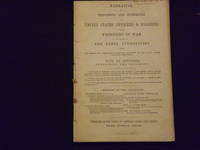
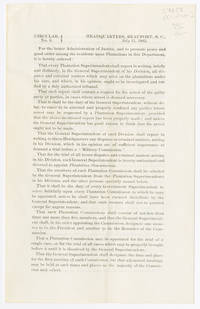
1863WRCAM54050N.p. likely Beaufort S.C. 1863. 3pp. Single folded sheet. Soft vertical center crease light wrinkling. Clean and very good. An interesting circular written by Union Brigadier General Rufus Saxton and printed on a military field press laying out the procedures for prosecuting "all disputes and criminal matters which may arise on the plantations" under his authority. At the time he issued this decree Saxton was the military governor of the Department of the South. Later during his term Saxton would direct the recruitment of the first regiments of black soldiers to serve in the Union Army. The present circular sought to "promote peace and good order among the residents upon Plantations in this Department." Perhaps bringing order and justice to the plantations was Saxton's first step towards recruiting the slaves on those plantations to fight against their captors. Rare with no results at all in OCLC. unknown books
191844564Washington DC: GPO 1918. <p>United States War Department Air Service Division of Military Aeronautics. Air Service medical manual. 38pp. 31 plate leaves. Washington DC: Government Printing Office 1918. 261 x 178 mm. Original cloth spine a bit faded small split in inner front hinge. Small marginal tear in one plate leaf but very good. Government stamp on front pastedown.</p> <p> . 1 First Edition. "The first U. S. work dedicated to the medical aspects of military pilot selection. According to the National Museum of Health and Medicine this manual was written by William Holland Wilmer 1863-1936 then director of the Medical Research Laboratory at Mineola Long Island. This placed Wilmer at the forefront of training for flight surgeons and in the classification of pilot candidates as they used novel devices and instruments to simulate high-altitude conditions. He pioneered efforts to produce oxygen delivery systems to pilots" Garrison-Morton.com 8107. </p> <p>First Edition. Wilmer also authored the Manual of Medical Research Laboratory a longer and more detailed work "intended for the information and instruction of those who are interested in the medical problems of aviation" p. 5. Garrison Morton.com 95957. </p> . GPO unknown books
1739WRCAM41544London: T. Gardner 1739. 256pp. Dbd. very good. A pamphlet published shortly after the beginning of the War of Jenkins' Ear apparently addressed to Sir Robert Walpole. Walpole's lengthy diplomatic efforts eventually came to naught and he bowed to popular sentiment in October and commenced the War of Jenkins' Ear. This work includes numerous references to American commerce. One of two issues noted by ESTC; this issue not in EUROPEAN AMERICANA. ESTC N10777. EUROPEAN AMERICANA 739/210 ref. KRESS 4452. SABIN 56464. T. Gardner unknown books
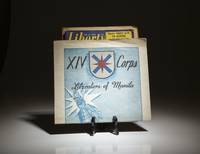
19452479South Pacific Theater: Armed Forces 1945. First Edition. Paper Documents. Near fine. A collection of military newspapers magazines clippings and maps from a member of the Australian Military Forces Abroad. Includes the following items: Table Tops Magazine Final Edition - 10 September 1945; Moro'tiser Magazine by Captain James Paterson September 1945; XIV Corps Liberators of Manila broadside; Moro'tiser: Magazine Of 13 Aust Advanced Workshop 1945; Japan's Shipwreck Alley - United States Air Force 1944; Liberty Magazine Jan. 27 1945; Various newspaper clippings. A unique collection of World War II ephemera. [Armed Forces] unknown books
194646302Camp Cooke CA 1946. 1st printing of the divers issues. Printed self-wrappers. Modest wear with the occasional chip/short split along a fold. Age-toning to paper. Folded into quarters. Overall Very Good. 30 issues 2 duplicates ~ 4 pages each 8 columns per page. Illustrated with half-tone b/w photographic images. Comics ~ 3 strips p. 4. 22" x 17-1/2" <br/><br/>In 1941 the United States Army sought more and better training centers for the rapid development of its armored and infantry forces. In March 1941 the Army acquired approximately 86000 acres of open ranch lands along the Central Coast of California between Lompoc and Santa Maria. Most of the land was purchased. Smaller parcels were obtained either by lease license or as easements. With its flat plateau surrounding hills numerous canyons and relative remoteness from populated areas the Army was convinced it had found the ideal training location. Construction of the Army camp began in September 1941. Although its completion was still months away the Army activated the camp on 5 October and named it Camp Cooke in honor of Major General Phillip St. George Cooke a decorated cavalry officer whose career spanned 50 years 1827 - 1873. Although the construction of Camp Cooke continued well into 1942 troop training did not wait. The 5th Armored Division rolled into camp in February and March and the steady roar of its tanks and artillery soon became part of the daily scene. From then until the end of the war other armored and infantry divisions kept up the din before they too left for overseas duty. Besides the 5th Division the 6th 11th 13th and 20th Armored Divisions as well as the 86th and 97th Infantry Divisions and the 2d Filipino Infantry Regiment were all stationed at Cooke at varying times during the war. Also trained at Cooke were an assortment of anti-aircraft artillery combat engineer ordnance and hospital units. Over 400 separate and distinct outfits passed through Camp Cooke. A maximum security army disciplinary barracks was constructed on post property in 1946. Confined to the facility were military prisoners from throughout the Army. When Camp Cooke closed in June 1946 From August 1950 to February 1953 Camp Cooke served as a training installation for units slated for combat in Korea and as a summer training base for many other reserve units. On 1 February 1953 the camp was again inactivated. The disciplinary barracks meanwhile was transferred to the U.S. Bureau of Prisons to house civilian offenders in August 1959. Today it is known as the United States Penitentiary Lompoc. Wiki An invaluable source for local history at the end of World War II. the copy has the usual camp activities but also includes such informative pieces as "Camp Cooke History . Here's Chapter 2" Vol V - Number 3 March 29 1946. unknown books
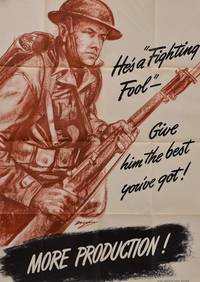
WRCLIT70196Washington DC War Production Board / GPO. 1942. Folio color photolithographic broadside 40 x 28" 102 x 72 cm. Folded as issued. Faint tanning to folds on blank verso a bit of foxing to verso a few minuscule breaks at junctions of folds otherwise a very near fine fresh unused copy. One of at least two War Production Board posters captioned thus in this case produced after a drawing by "Moxon" of a helmeted combat soldier leaning forward into the poster from the left with his M1 with bayonet mounted. The original drawing on which it is based appears to have been executed in reddish brown conte crayon. Full identification of the artist seems to have eluded references including OCLC etc. Washington, DC unknown books
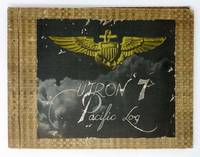
194545041Photographic Laboratory of Utility Squadron Seven 1945. 1st Printing. Basket-weave patterned paper-wrapped boards brass screw post binding. Photographic onlay to front board with large Navy gold aviator wings at top of onlay. General shelf wear with scraps and nicks to paper especially along edges. Board showing at tips. Overall Very Good. Unpaginated though 120 pp. 3 pages of muster rolls. Profusely illustrated primarily with b/w photographic images accompanied by some drawings. Oblong format: 12-1/2" x 17-1/4" <br/><br/>"This book has been prepared especially for shipmates of Utility Sqadron Seven their families and friends". "VU-7 was commissioned on 4 December 1942 at Alameda CA with the mission of providing utility aircraft services to units in the Pacific Fleet such as towing of aerial targets and launching of self-propelled drone targets for surface-to-air and air-to-air gunnery and missile firing; providing airborne targets for the fleet anti-aircraft warfare training center electronic countermeasure exercises inflight refueling and other utility and administrative services within the capabilities of the assigned aircraft which were F-8 Cruisers and A-4 Skyhawks." aviation-museum blogspot Quite uncommon with OCLC recording just one institutional holding. Photographic Laboratory of Utility Squadron Seven hardcover books
186523553No Place Listed: Not Published 1865. Image showing hundreds of tents guardhouses at perimeter a few soldiers and guards visible appearing to be in Union Army Civil War era uniform hilly landscape and river in background; skillfully spliced from three panels to create a panoramic view; overall approx. 5 1/4" x 22" size; dark brown cardstock mount approx. 10" x 27" no photographer or place listed; some edge tips wear to cardstock; image with spotting browning; still with plenty of detail and in good condition. Photograph. Not Bound. Good. Not Published Paperback books
191722926New York - London: Fotocraft 1917. Panoramic photograph showing parts of the camp with many completed barracks buildings in the distance with other areas in the foreground that are cleared for streets and further development; closest to the camera are seen structures with lumber strewn in front still under construction - streets & parking areas with vehicles pedestrians; Camp Upton was established in 1917 in order to train U.S. soldiers for service in World War I; approx. 6 1/2" x 49" size; identified in the photo and giving the photographic studio name of Fotocraft Inc. 206 W. 34th St. N.Y.; prev. owner pencil name on back; some crinkling to paper especially towards ends one end with old discoloration; couple of short closed tears at the other; little edgewear; image especially in foreground very good with fade-out to the distance; very good condition and interesting Long Island military history photography. Photograph. Not Bound. Very Good. Fotocraft Paperback books
1861100124Pamphlet removed 941 pp. Some foxing especially title page. This pamphlet provides a glimpse of the Confederate States making ready for war. Through resolutions and acts outlined here they establish many of the functions they will need as a sovereign state. Including setting up a post office taxes and raising an army. Parish & Willingham 27. Enquirer Book And Job Press, books
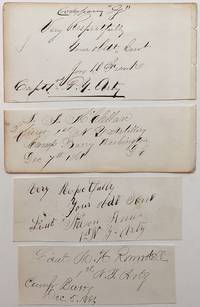
1861267089New York 1861. unbound. Excellent group of signatures with rank and command on various sized paper the largest measuring 2.5 x 5 inches comprising the earliest known autographs of the founding three officers of Battery G First New York Light Artillery along with the last Captain to take command through attrition. Includes: J.D. Frank "Very respectfully - Your Obdt. Servt. - Captain 1st N.Y. Artillery"; M.H. Rundell "Lieutenant - 1st N.Y. Artillery - Camp Barry - Dec. 5th 1861"; Nelson Ames "Lieutenant - Very Respectfully - Your Obdt. Servt. - 1st N.Y. Artillery" and S.A. McClellan "2nd Lieutenant - 1st N.Y. Artillery %u2013 Camp Barry - Washington D.C. - December 7th 1861." Battery G was engaged with the enemy in every battle the Second Army Corps participated in during the war and never was driven by the enemy's fire from a position it was ordered to hold. They also hold the distinction of never falling back until ordered and never losing a gun or carriage of any kind during its term of service. This is an almost impossible-to-assemble group of signatures that are all boldly signed and in very good condition.<br/><br/> Battery G First New York Light Artillery: Originating from New York they distinguished themselves at Gettysburg whereby a monument was erected and dedicated in their honor on July 3 1893. First recruited at Mexico Oswego County New York in September 1861. It joined the regiment at the general rendezvous at Elmira and was there mustered into United States service for three years September 24 1861 with the following officers: Captain J.D. Black First Lieutenant Nelson Ames Second Lieutenant Marshall H. Rundell. The battery remained at Elmira engaged in drilling with the rest of the regiment for a short time and then went by rail to Washington D.C. arriving on October 31. On January 13 1863 Captain J.D. Frank left the battery on sick leave and was shortly afterwards discharged on surgeons certificate. First Lieutenant Nelson Ames was promoted to Captain and took command. On October 15 1864 Captain Nelson Ames was discharged as his terms of service three years had expired. In his place First Lieutenant S.A. McClellan was promoted to Captain and took command of the battery and remained in command until the battery was mustered out.<br/><br/> unknown books
1862102018One folded sheet two pages of text illustrated red and blue lettersheet depicting George B. McClellan with slogan "WE HAVE BEAT OUR LAST RETREAT" includes matching postally canceled envelope. Minor folds one small hole at center fold not affecting text normal aging and toning. Overall in very good condition. James Rikert who enlisted in 1861 was discharged in 1862 for disability. He joined as a 21 year old private at Fort Wayne Michigan and mustered into Company G of the MI 5th Infantry. He sent this letter to Celia Gibson as a follow-up to a letter he sent a week earlier concerning their march on Manassas. He reports heavy rains that postponed the march but expects to march the next day. While he mentions his sadness at the loss of his grandmother he makes a point of telling Celia this could be his last letter. "This may be the last letter perhaps that you will ever get from me but if I live through the battle you will son hear from me again and if not you will know that I have gone to my lovely home and that I died as a Christian." Historical Data Systems Civil War Research and Genealogy Database. books
1864105586Washington: Government Printinng Office 1864. hardcover. very good. 2 illustrations one folding. 1259pp. very thick 8vo full contemporary calf leather labels. Washington: GPO 1864. First Edition. Very good.<br/><br/> Naval documents for the year 1864 including the Union blockade. 38th Congress 2d Session House of Rep. Ex. Doc. No. 1.<br/><br/> Government Printinng Office unknown books
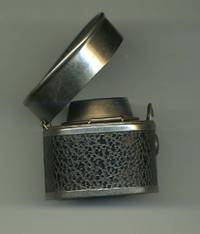
12726Civil War Antique Traveling Inkwell. The Inkwell measures 2" in diameter by 1 ½" tall and is marked on the inside lid with a double Eagle Head. The leather piece in this Civil War traveling Inkwell is in very good condition as is the glass inkwell itself. The Nickel Plated Brass Case is also very good condition including the leather. unknown books
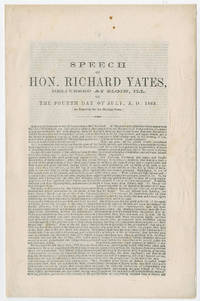
186524904<p>"<i>The American revolution was begun and fought through for an idea—to establish that man is a man—to vindicate the right of every man to equal rights and to equal citizenship…. Every boy imbibes the genius of our free institutions. The poor friendless rail splitter rises to the proudest pinnacle of human power. Cheers The poor tailor boy becomes and is now our President cheers the ferry boy the Chief Justice of our Supreme Court cheers and the humble tanner boys become the great commander who marshals a million of veteran warriors in the great cause of union and liberty and holds up the flaming symbol of emancipation to a whole race of mankind. Applause.</i>" p1/c2 – p2/c1</p><p>"<i>And yet for Jeff Davis who has been a wholesale murderer who has struck at the life of the whole nation and rolled the red wave of bloody civil war over the land they say we must be magnanimous. Sensation. We shoot the poor deserter and the poor soldier who is found sleeping at his post on guard but the nation must be magnanimous and not execute Jeff Davis!</i>" p6/c1</p> <b>CIVIL WAR & RECONSTRUCTION. RICHARD YATES.</b>Printed Pamphlet. <i>Speech of Hon. Richard Yates Delivered at Elgin Ill. on the Fourth Day of July A.D. 1865</i>. Jacksonville IL: Ironmonger and Mendenhall 1865. 8 pp. 6⅛ x 9½ in.<p><b><br /></b></p><p><b>Excerpts:</b></p><p>"<i>We celebrate the 4th day of July 1776 because then commenced the great experiment whether man is capable of self-government. Our fathers boldly announced to the world in the great and immortal charter of freedom the Declaration of Independence the bible of the rights of man which has just been read to you.</i>" p1/c1</p><p>"<i>The American revolution was begun and fought through for an idea—to establish that man is a man—to vindicate the right of every man to equal rights and to equal citizenship not by virtue of his birth or fortune or of his nativity or color but by virtue of his intrinsic God-created manhood.</i>" p1/c2</p><p>"<i>Every boy imbibes the genius of our free institutions. The poor friendless rail splitter rises to the proudest pinnacle of human power. Cheers The poor tailor boy becomes and is now our President cheers the ferry boy the Chief Justice of our Supreme Court cheers and the humble tanner boys become the great commander who marshals a million of veteran warriors in the great cause of union and liberty and holds up the flaming symbol of emancipation to a whole race of mankind. Applause.</i>" p2/c1</p><p>"<i>The system of slavery existing in our Southern States fostered interests tastes opinions manners and prejudices at war with the genius of our institutions and necessarily divided our people.</i>" p2/c2</p><p>"<i>I feel highly honored to-day that I have the opportunity of meeting so many of our returned officers and soldiers here for somehow I cannot divest myself of the feeling that I have been in the war myself and am a returned soldier although I have only on one or two occasions smelt the gunpowder of the enemy. Laughter. Yet under my administration the State of Illinois has sent nearly two hundred thousand brave volunteers to the field.</i>" p3/c1</p><p>"<i>Your brave comrades have died and you have risked your lives that the nation and the Union might live and you have proclaimed at the point of the bayonet the divine right of all men to be free.</i>" p4/c2</p><p>"<i>But thanks to you the accursed blot of human slavery which has divided and distracted us at home and sullied our name abroad is wiped out and every man in America is free.</i>" p5/c1</p><p>"<i>peace prevails in the land yet peace brings with it the most complicated questions. We are not safe until the great questions in dispute for which we have fought have been definitely and forever settled and upon such a basis as to prevent the recurrence of another war to mar our peace and endanger the safety of the Union.</i>" p5/c2-p6/c1</p><p>"<i>And yet for Jeff Davis who has been a wholesale murderer who has struck at the life of the whole nation and rolled the red wave of bloody civil war over the land they say we must be magnanimous. Sensation. We shoot the poor deserter and the poor soldier who is found sleeping at his post on guard but the nation must be magnanimous and not execute Jeff Davis!</i>" p6/c1</p><p>"<i>As a Senator of the United States certainly I could consider no State Government Republican in form which was at variance with the fundamental principles of our republican institutions</i>; <i>which denied the equality of all men before the law; which set aside the principle that governments justly exist by the consent of the governed and that taxation and representation must go together. And I am here to-day to say that I could approve of no State government whose constitution or bill of rights does not deny in express words this right of a State to secede from the Union and which does not provide that slavery shall be finally and forever abolished and prohibited so that not even a root seed or grease spot shall remain of this sum of all villainies the accursed system which has been the fountain of all our troubles and of the fratricidal and bloody war which has desolated the land.</i>" p7/c1</p><p>"<i>I thank God that I have never cast a vote or uttered a sentiment against human freedom; and no loud alarums of popular applause no shining height of human power shall ever seduce me to give up the God-given sentiments of my heart in favor of freedom and humanity.</i>" p7/c2</p><p><b>Historical Background</b></p><p>Fourth of July celebrations in the nineteenth century often began with artillery at dawn a parade and a speech at a courthouse or church for an hour or two. After the speech men often went to a tavern to drink thirteen toasts for the number of the original states while the women and children went home. Bonfires and fire-crackers carried the festivities into the evening. Typically a speech blended a sermon with a political address promoting patriotism. Readings of and orations on the Declaration of Independence or Washington's Farewell Address were also common.</p><p>Early during the Civil War celebrations often included sham battles to portray the real ones occurring on the battlefields. By the middle of the war fundraisers for widows and orphans of soldiers who had died in military service replaced the sham battles. After the war celebrations turned away from the community toward smaller gatherings of families and friends though many smaller communities continued the pre-war tradition.</p><p>The city of Elgin Illinois was established as a village in 1835 on the Fox River thirty-five miles northwest of Chicago. Chartered as a city in 1854 Elgin in 1865 had a population of 4000-5000 people. Four days after Yates delivered this address the city's first major fire swept the entire north side of Chicago Street in the business district.</p><p>Thousands of people from Elgin and the surrounding area celebrated the Fourth of July in 1865 with an artillery salute at dawn a "huge procession" at 10:30 a.m. of "returned soldiers civilians societies and other citizens" who marched from the Waverly House to Colby's Grove. The singing of "America" opened the exercises followed by a prayer by a local minister and a choir concert. Col. Edward S. Joslyn an Elgin attorney who served in the 36th Illinois Volunteer Infantry read the Declaration of Independence. State Adjutant General Allen C. Fuller delivered an address welcoming the returned soldiers then the choir sang "Battle Cry of Freedom." Gen. J. F. Farnsworth responded to Fuller on behalf of the soldiers followed by another choir performance. Former Governor and current Senator Yates followed with his oration and the singing of the "Battle Hymn of the Republic" concluded the formal program. A dinner for the soldiers who were present and a general picnic followed. The city concluded the day's festivities with a ball at the Waverly House.</p><p>The <i>Daily Illinois State Journal</i> proclaimed Yates' speech at Elgin "not only the best effort of his life but one of the most forcible and eloquent among the many able and patriotic addresses which our recent National Anniversary occurring at a juncture in our history of so much interest has called forth."</p><p><b>Richard Yates</b> 1815-1873 was born in Kentucky and graduated from Illinois College in Jacksonville in 1835. He studied law in Jacksonville and at Transylvania University in Lexington Kentucky. Yates began practicing law in Jacksonville in 1837 and served as a Whig in the Illinois House of Representatives from 1842 to 1846 and from 1848 to 1850. He represented Illinois in the U.S. House of Representatives from 1851 to 1855. He joined the Republican Party and supported John C. Fremont for president in 1856 and Abraham Lincoln for U.S. senator in 1858. In 1860 he was elected governor as a Republican and strongly supported the Lincoln administration's conduct of the war. When the Democratic state legislature proved uncooperative Yates dissolved the legislature on June 10 1863 and governed the state on his own. At the end of his term in 1865 Yates won election to the U.S. Senate where he served from 1865 to 1871. He supported radical reconstruction and the conviction of President Andrew Johnson.</p> Ironmonger and Mendenhall books
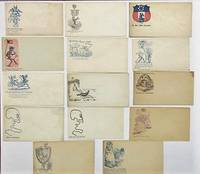
186533980n.p. 1865. All uncancelled generally 3" x 5-1/2". Occasional light wear occasional light dustsoiling. A few have glue remnants on flaps from having been mounted; most do not. Very Good. The following postal covers listed by Weiss citation: <br/><br/> C-D-7. Image of the devil depicted as a gnarled tree root. Caption below reads "The Root of Treason. Found in the 'Sacred Soil' of Virginia." Imprint below "S.C. Upham 310 Chestnut St." Printed in blue ink.<br/> C-D-8. Gentleman in tattered clothing holding a bottle of alcohol in his hand hangs on a pole with a banner in Confederate style variation chains and shackles hang from either side and a devil's head is perched upon the top. Caption below reads "'Success shall perch upon our banner.' - J.D." Printed in black ink. <br/> C-D-11. Confederate shield with image in the center stripe of the devil sitting on a bail of cotton. Caption below reads "J.D. his Crest." Printed in blue and red inks. <br/> C-D-15. The devil dances along paying a flute with his nose and tapping on a drum with a Confederate flag flying high at the end of his pointed tail. Caption below reads "The Standard Bearer of the C.S.A./ A H--- of a feller." Imprint printed vertically to left "Wm. Edenburgh 140 Nassau Street N.Y." Printed in red and blue inks. <br/> C-D-19. The devil depicted tree-like leads Confederate troops pointing down the road they travel with trees surrounding it. Caption below reads "Trees - on a hard road to travel." Imprint below image "S.C. Upham 310 Chestnut St. Phila." Printed in blue ink. <br/> C-D-24. Uncle Sam holds an ax ready to chop down a Palmetto tree with a Confederate flag flying from its trunk. The devil stands behind the tree saying "WOODMAN SPARE THAT TREE." Caption below reads "Uncle Sam cutting down the 'Secession Tree' just as it is in fall bloom against the wishes of the planter." Imprint below caption "S.C. Upham 310 Chestnut St." Printed in blue ink.<br/> C-D-25. Jefferson Davis J.D. and Gen. Beauregard Gen. B being carried away by two running devils. Caption below reads "JEFF AND BEAUREGARD on their LAST RIDE./ Traitor Jeff and his Vice Cotton. Stephens Are now driven to their last kick.- First by the night-mare of secession And then by the imps of Old Nick." Printed in blue ink.<br/> C-D-40. Image of Jefferson Davis at the end of a large spit with the devil poking him with a pitchfork pushing him into a furnace or hell. A black man watches from overhead and says "De Debil Claims His Own." Printed in black ink.<br/> C-SK-4. "Vanity Treachery & Death" over images of a peacock plume a snake and a skull. Caption below reads "SECESSION EMBLEMS." Imprint printed vertically to left "D. Murphy's Son Print. 65 Fulton & 372 Pearl-sts. N.Y." Printed in black ink.<br/> C-SK-6. A long rope twisted to resemble a skull. Caption below reads "End of Secession." Printed in blue ink.<br/> C-SK-7. Variation of the previous cover with a slightly thicker rope twisted to resemble a skull. Caption below reads in all uppercase letters" END OF SECESSION." Printed in black ink.<br/> C-SK-14. Image depicts an eye in the sky and a disembodied hand holding scales upon which the skull & crossbones of the Confederacy is outweighed by the battle-axe of the Union. Caption below reads "Weighed and found wanting." Printed in violet ink.<br/> C-SK-17. Image of a skeleton standing outside of a large wine glass in which a Confederate soldier is slumped and sleeping inside holding a small Confederate flag in his hand. Caption below reads "SECESSION WHISKEY. One dose warranted to kill at 40 rod." Imprint printed vertically to left "D. Murphy's Son Print. 65 Fulton & 372 Pearl Street N.Y." Printed in gray. Weiss has VI for violet with a note "really Lilac." <br/> C-SK-19. Image of woman wearing a bonnet and aproned dress being surprised by a skull coming up out of her teapot. Caption below reads "Virginny Mother of 'Old Dominion' Presidents and other Wise things is asked by Mrs. Davis to try a cup of Secession tea - and finds DEATH in the pot!" Imprint printed vertically to left "D. Murphy's Son Print. 65 Fulton & 372 Pearl-sts. N.Y." Printed in blue ink. unknown books
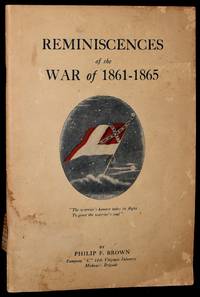
1917276187Richmond: Whittet and Shepperson 1917. Second Printing. Stapled Pamphlet. Very Good binding. Signed. Roberston writing in the Nevins Bibliography notes that "The bulk of these recollections treat of the author's experiences while a clerk in a Richmond hotel; his prior service as a soldier ended with a wound at Antietam". First printed in Roanoke in 1912 this Richmond edition was 5 years later -- both are uncommon. This copy is signed by "the Author" with a personal inscription to Rev. J. Murray Taylor. The front panel has scattered silverfishing. It has a an indentation as to the first few leaves that does not actually puncture the paper. Nevins I 64. Very Good binding. Whittet and Shepperson unknown books
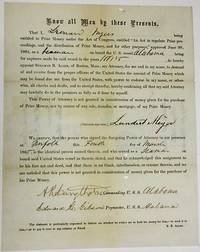
186535624Boston 1865. Broadside 7-1/2" x 9-1/2" docketed on verso. Printed form completed in ink manuscript. Signatures of Leendert Meyer A.R. Hawthorne and Edward A. Gibson. Old folds a few short splits at fold edges light toning three very small punch holes no loss. Very Good. <br/> offered with KNOW ALL MEN BY THESE PRESENTS THAT I JOHN M. LINBERG. Identical form for another seaman from the U.S.S. Alabama completed in manuscript. Old folds a few splits one repaired with archival tape on verso minor light staining where something was spilled on it three very small punch holes two letters slightly affected. Good to Very Good. <br/><br/> Prize laws authorized ship personnel to receive a portion of the value of goods seized from enemy ships. Pursuant to the Act of June 30 1864 the goods of vessels legally seized by the U.S. Navy would be inventoried appraised and auctioned. The proceeds after costs would be distributed to the Government for disabled veterans to squadron commanders and the rest divided among officers and crew<br/> Leendert Meyer born about 1843 in Holland enlisted in the Navy in New York on May 28 1864. He is described as being 21 years old with brown hair hazel eyes and a scar on his right wrist. John Johan M. Linberg born about 1837 in Norway enlisted in the Navy in New York on June 4 1864. He was 27 years old with brown hair blue eyes and dark complexion. <br/> Amos R. Langthorne 1832-1877 born in Nova Scotia settled in Maine with his wife and became an American shipwright and mariner. He enlisted in the Navy in December 1861 was promoted to Acting Volunteer Lieutenant in January 1863. During his career he served as Master of the C.P. Williams of Porter's Mortor Flotilla served with the Mississippi Squadron was the first commander of the U.S.S. Rattler was Acting Volunteer Lieutenant and commander of U.S.S. "Mound City" and participated as commander of the U.S.S. Alabama during the attack on Fort Fischer. Smith Myron J. Jr.: IRONCLAD CAPTAINS OF THE CIVIL WAR McFarland: 2018 pp. 122-123. <br/> Edward R. Gibson was Acting Assistant Paymaster of the U.S.S. Alabama 3d rate. REGISTER OF THE COMMISSIONED WARRANT AND VOLUNTEER OFFICERS OF THE NAVY OF THE UNITED STATES Washington: 1865 p.244.<br/> Stillman B. Allen 1830-1891 was born and educated in Maine and admitted to the state's bar in 1853. He moved to Boston in 1861. Allen was a trial attorney with a reputation for winning the largest verdicts against railroads and corporations in the country. unknown books
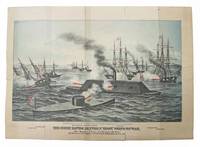
186241961n. p. 1862. 1st printing presumed. Vertical & horizontal fold-lines with short splits along one fold edge. Age-toning & dusting with old repair to left edge. An About VG example. Single sheet lithograph printed recto only. Image size: 10-1/2" x 17-5/8". Entire: 14" x 19-5/8" <br/><br/>The lithograph shows the Monitor and the Merrimack firing at each other during their historically important battle of 9 March 1862 with other named ships Cumberland -- Newport News -- Jamestown & Yorktown -- Congress -- Sewell's Point -- Minnesota in the background with the Cumberland sinking on the left the first ship sunk by the Merrimack i.e. CSS Virginia the two having engaged the day prior. OCLC records 3 holding institutions: LoC Boston Athenaeum & AAS. Rare in the trade. unknown books
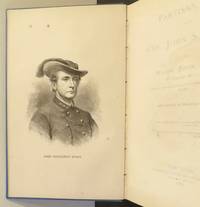
18670000404New York: Harper and Brothers 1867. Few faint spots to cloth; scattered foxing to prelims and title page brief unobtrusive numbers in red ink at rear pastedown still a tight attractive copy in the original publisher’s binding Very Good or better. Tall 8vo xix 20-492 pages; three frontispiece plates; folding map; numerous plates and text illustrations. Publisher's original blue cloth boards lettered in gilt on spine. Eicher/ The Civil War in Books: An Analytical Bibliography 293. <br/><br/>". an early highly partisan account of life with the cavalry raider who was transformed into legend by this and other works. Endorsed by Mosby himself this authorized biography sets forth the life story of the Confederate partisan ranger through the Civil War ." Harper and Brothers hardcover books
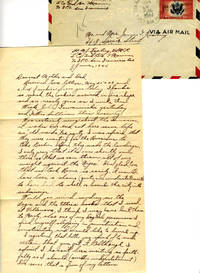
9510On June 6 1944 Allied forces commanded by Dwight Eisenhower landed on five Normandy beaches. This began the invasion of Europe and the end of World War II less than a year later. Handwritten Autograph Letter Signed 2 pages 5 x 8" dated June 7 1944 San Francisco. An American soldier writes to his parents "'Was certainly news about the Invasion it makes our end out here seem like an old maids tea party. I was afraid that they were waiting for the Russians to take Berlin before they made the landing I only pray that it is over shortly over there so we can throw all of our weight against the 'Nips'. I'm glad too that we took Rome so easily it would have been a shame quite an understatement to had had to shell or bomb the city into submission." Signed "Maurice". In excellent condition. unknown books
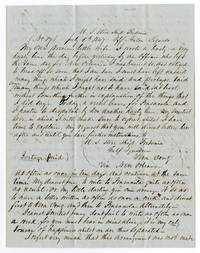
1847WRCAM42138U.S. Store Ship Fredonia off Anton Lizardo 1847. 4pp. Quarto on a folded folio sheet. Old fold lines. Central fold running the horizontal length of the sheet reinforced with tape. Minor soiling else fine. A very affectionate letter from a sailor to his wife back home full of pining declarations of love and devotion. The sailor Gregory notes that he is safe and likely to stay that way as they are at a good anchorage and the coast has been entirely secured. He indicates that she should direct her letters both to Vera Cruz and Pensacola and that either way they will surely find him with the Gulf Squadron. He also mentions a possible posting to the Naval Observatory which would bring him home to his dearest Jenny. <br> <br> "The frigates 'Potomac' & 'Raritan' have both sailed for home some days ago but we had no opportunity of writing by them as the former sailed from Sacrificios & the latter from Tobasco. You will doubtless have heard long ere you receive this all about the taking of Tobasco. The whole coast is now in our possession and there remains not the slightest chance of any more fighting for the squadron. I must not omit to mention my sweet little wife the Gibbon Edwards Kennard & myself have received an answer from Mr. Maury respecting our application for the Observatory. He says he is very anxious to have us all back again and that he would that day 22d of April go to see the Honl. Secretary and try to get us ordered; but he said he had but faint hopes of success for it was known at the same time at the Dept. that we were very short of officers in this squadron." unknown books
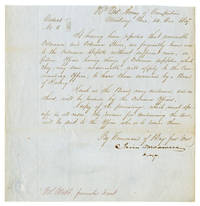
1847WRCAM42125Monterey Mexico 1847. 1p. plus integral docketing leaf. Quarto on a folded folio sheet. Old folds. Minor soiling else very fine. A fair copy of orders from U.S. Army Headquarters issued at the command of General Wool ordering that no ordnance be condemned as unusable without proper review first; signed by Irvin McDowell a member of General Wool's staff. The order reads: "It having been reported that serviceable ordnance and ordnance stores are frequently turned over to the Ordnance Depots without sufficient cause in future officers having charge of ordnance supplies which they may deem unserviceable will apply to the commanding officer to have them examined by a Board of Survey. Such as the Board may condemn and no others will be received by the Ordnance Officers. A copy of the proceedings which must specify in all cases the reasons for condemning the stores will be sent to the Officer who is to receive them." unknown books
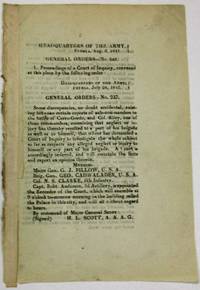
184735509Puebla Mexico 1847. 5-1/4" x 8". 4pp. Signed in ink by H.L. Scott A.A.A.G. "By command of Major-General Scott." Disbound spine reinforced else Very Good. <br/><br/> This is the report of the Court of Inquiry whose President was Gideon Pillow; its Recorder was Robert Anderson. The Court concludes that the "movements of Col. Riley's brigade had an important influence in the achievement of that brilliant victory that Col. Riley had an active participation in them and that his conduct and that of his command should be suitably noticed in the Official Report of his superiors. unknown books
184533897San Luis Potosi Mexico 1845. First Edition. 1p. quarto broadside 31.5 x 21.5 cm. No copies in OCLC. Seeking volunteers for the Army who "quieren ser defensores de la independencia y de leyes". Quotes are established for each locality. The lists of men were to be turned in by local authorities in two weeks. In early August Taylor had moved his forces to Corpus Christi and war fears were clearly rising in Mexico. unknown books