1 575 résultats
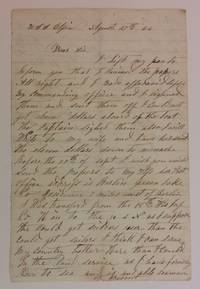
18642833371864. unbound. fine. Union Navy A.L.S. 8vo. 2 pages August 27th 1864 Aboard the USS Elfin. Just three months before she would be destroyed by bombardment while in service on the Tennessee & Cumberland Rivers. Letter from a sailor who is trying to get his Land Grant application to Wisconsin but he can't raise the $11.00 application fee on his ship. In part: "I received the papers alright and I signed an affidavit before my Commanding Officer - and I signed them and sent them off but could not get $11.00 aboard of the boat. The Captain signed them also. Write to my wife and have her send the eleven dollars down to Menasha before the 20th of September. I was transferred from the 18th Wisconsin Infantry Co. into the United States Navy as I suppose they could get Soldiers easier than they could get Sailors. I think I can serve my country better here than I could in the land service as I have formerly been to sea and I am an able seaman at present." Fine condition.<br/><br/> unknown books
1865WRCAM54371Vicksburg Ms 1865. 4pp. on a small bifolium. Slight chips at upper right corner two slits at gutter margin for intended binding. Faint foxing at edges. About very good. A brief report on the courts-martial of two officers in the 58th Colored Infantry in Vicksburg two months after the surrender of the Confederacy. Col. Simon M. Preston the commanding officer of the regiment was convicted of several charges relating to a false muster roll and intentionally reporting another officer as absent with leave; he was cashiered. Lieut. W.B. Brinkerhoff was found not guilty of drunkenness on duty and joining an expedition without authority. Not located in OCLC. unknown books
1864WRCAM54372Washington 1864. Three sheets each 7 1/4 x 5 inches. Loose sheets. Two slits at gutter margins for intended binding. A couple of small creases at corners. Very good. Three interesting General Orders from the War Department at the end of 1864 relating to freedman and the organization of black troops in the Union Army. Two of the orders authorize transportation of supplies and books by the United States Army on behalf of the United States Commission for the Relief of the National Freedmen as well as for the American Freedmen's Friends Society and the Executive Committee for the Relief of Freedmen of Iowa. The third order reorganizes black troops in the Union Army from Virginia and North Carolina into the 25th Corps. unknown books
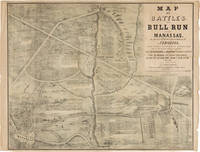
1861WRCAM48993Richmond: West & Johnston 1861. Sheet map 19 3/4 x 26 inches. Old fold lines. Some separation at two folds on the right edge. Light wear minor toning. Very good. A handsome and historic map depicting the First Battle of Manassas or Bull Run depicting troop positions and movements roads railroads houses and other significant geographical features. First Manassas was the first significant engagement of the Civil War and the place where Thomas J. Jackson became "Stonewall" Jackson when his brigade stood their ground against disorganized Union forces. The Confederate troops won the battle raising hopes in the South and signaling to the North that the war would not be won so easily. The map indicates that it was "made from observation" by Solomon Bamberger and lithographed by the firm of Hoyer & Ludwig in Richmond. <br> <br> It appears that at least two issues of this map exist this being the most vividly pictorial that we have found and thus perhaps the later of the two. Rather than a simple plan of the battle the present map lays out the same information augmenting the background with shading and pictorial scenery. The title is likewise enclosed in a simple border setting it off from the rest of the map and though the title is the same the typeface of some of the title lettering has been changed slightly. Parrish & Willingham do not indicate any differentiation of issues but the details and graphics make this by far the most desirable. <br> <br> A rare and interesting map of this important battle and one of the most dramatic graphics produced in the Confederacy. Without the means to produce suitable paper few pieces on a comparable scale were created. PARRISH & WILLINGHAM 6148. West & Johnston unknown books
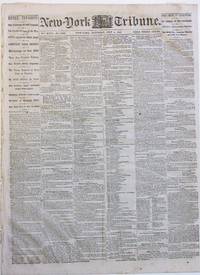
186336673New York 1863. Elephant folio 8pp. Disbound and lightly worn. Each page printed in six columns. Upper blank corners of last page with remnants of old matting. Very Good. <br/><br/> Exciting material on the "Rebel Invasion" and "The Fighting at Gettysburg" is printed with "The Rebels still Desperately Contesting" the Siege at Vicksburg. General Order No. 5 prohibiting Copperhead "Secret Societies" is also printed; as is material on "Colored Enlistments. unknown books
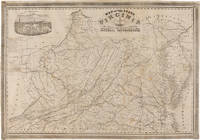
1862WRCAM46982ARichmond: West & Johnston 1862. Lithographed map 25 1/2 x 36 3/4 inches with ornamental border and inset view of Richmond. Sheet trimmed to just outside the ornamental border and mounted on modern linen. Old folds now flattened. Small chip in upper right corner just touching the ornamental border. Separations at a cross-folds with a few instances of small paper loss stabilized by the linen backing. Good plus. This impressive Confederate map of Virginia was originally based on work done by Ludwig von Bucholtz in connection with his updating the famed Herman Boye map of Virginia in 1858. Bucholtz was hired to re-engrave the copperplates for maps of Virginia originally made by Herman Boye in 1826. The ultimate products of his work were the very large maps of Virginia called the Boye-Bucholtz maps. Using knowledge from his work on this project Bucholtz issued his own map in 1858 lithographed and published by Ritchie & Dunnavant in Richmond. This map was vastly superior in detail and accuracy to Bucholtz's revision of the Boye map. <br> <br> In 1862 with Confederate officers in need of good maps of the region Richmond publishers West & Johnson re-issued the Bucholtz-Ludwig 1858 map of Virginia reprinted from the original stone with minor alterations including the removal of the cartographer's name. "There are minor geographic changes from Map 1 the original 1858 Bucholtz map on Map 2 the West & Johnson issue. For example on Map 2 Jerusalem in Southampton Co. has been moved a little to the northwest of its Map 1 location near the Seaboard and Roanoke Railroad and the road between the two points imperfectly erased the remaining shadow is additional evidence that the Map 1 stone was involved. Still for the most part Map 1 and Map 2 are the same map" - Wooldridge "The Bucholtz- Ludwig Map of Virginia and its Successors" in THE PORTOLAN 68 Spring 2007 pp.26-39. A second edition of the West & Johnson issue would be published in 1864. <br> <br> The map shows all of Virginia West Virginia Maryland Delaware and parts of Pennsylvania and New Jersey and includes an inset view of Capitol Square in Richmond. A chart below the view lists all the railroads and the length of each line. <br> <br> "In stark contrast to the large often colored maps pouring out of Northern presses the Confederate imprints are few in number modest in scale and more often than not black and white printed on poor paper. Long before the war was over they weren't being printed at all" - Wooldridge. PARRISH & WILLINGHAM 6204. SWEM 971. Wooldridge "The Bucholtz-Ludwig Map of Virginia and its Successors" in THE PORTOLAN 68 Spring 2007 pp.26-39. STEPHENSON 475.5. WOOLDRIDGE 254. West & Johnston unknown books
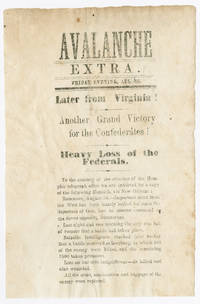
1861WRCAM54583Memphis Tn 1861. Broadside 6 1/2 x 4 1/4 inches. Mild toning and edge wear minor expert tape reinforcements on verso. Very good. A very rare broadside extra of the MEMPHIS AVALANCHE containing a telegraph dispatch from Richmond via New Orleans announcing a Confederate victory in the Western Virginia Campaign. The text of the handbill reads: <br> <br> "Important news from the West has been hourly looked for since the departure of Gen. Lee to assume command of the forces opposing Rosencranz. Last night and this morning the city was full of rumors that a battle had taken place. Reliable intelligence reached here to-day that a battle occurred at Leesburg in which 300 of the enemy were killed and the remaining 1500 taken prisoner. Loss on our side insignificant - six killed and nine wounded. All the arms ammunition and baggage of the enemy were captured." <br> <br> The news of the battle at Leesburg was erroneous. False reporting of battles never actually fought was a more common occurrence than one might think during the Civil War. This example stands naturally as one of the earliest examples of this type. <br> <br> We know of only one other copy of this very rare handbill a much inferior copy sold at Swann in 2013 for $375. Unrecorded otherwise with no copies in OCLC and in none of the standard Confederate reference works. unknown books
1861WRCAM55931Charleston & Morris Island S.C. 1861. Twenty-nine manuscript documents a few on Confederate military stationery the remainder on plain paper totaling 37pp. Original folds. Minor edge wear chipping to four letters resulting in minor loss. Overall very good. An uncommonly-early collection of Confederate manuscript military correspondence from the opening moments of the Civil War. The orders emanate from all levels of the Confederate military - Provisional Army Battalion and Brigade. Ten of the present orders come from Gen. P.G.T. Beauregard the commander of Confederate troops at Charleston in the spring of 1861. Beauregard led the Confederate attack on Fort Sumter on April 12 a decisive victory for the Confederacy in the first battle of the Civil War. Especially interesting are the first few orders dated between April 6 and April 11. These orders concern the movement of troops to Morris Island in Charleston harbor in anticipation of the attack on nearby Fort Sumter. <br> <br> The first order on April 6 is marked "Secret" and instructs Colonel Hagood to "establish signals for the assembling of each company in the shortest possible time and necessary arrangements made for prompt transmission of orders.Arms and equipments will be furnished on your arrival here with your command.In order to keep down any excitement consequent upon this order you are directed to execute it in as secret and quiet a manner as the nature of the case will admit of." The secrecy of the order itself and the call for swiftness and quiet movements of the troops clearly indicates an imminent attack. <br> <br> Some of the later orders also focus on the management and positioning of Confederate military units on Morris Island along with issues such as additional appointments troop inspections including the German Hussars commanded by Capt. Theodore Cordes and later in April the troops at Fort Sumter permissions for furloughs and removals movements and command transfers of officers regimental organizations and reports on troop organization and conduct. An April 23 order instructs Colonel Hagood's regiment to report to General Simons for posting "to the best advantage for the defence of the north End of the Island and Batteries from Vinegar Hill to Cummings Point." <br> <br> Most of the orders are addressed to Colonel Johnson Hagood who enlisted in the South Carolina troops as a thirty-two-year-old lawyer from Barnwell County. He was commissioned colonel of the 1st South Carolina Infantry earned a promotion to Brigadier General in July 1862 and was present at the surrender of the Confederate Army at Appomattox Court House. Besides those by Beauregard the other orders were issued by South Carolina Adjutant General States Rights Gist son of Nathaniel Gist General Simons and General Nelson. All of the orders are signed by adjutants or aides to these various officers. Still they represent a significant and important source for early Confederate military concerns around Charleston at the outset of the war. <br> <br> A typed note dated March 1956 indicates that these were found among the papers of Dr. H.M. Bassett by his descendants but there was no record of how he acquired them. <br> <br> An uncommon collection of Confederate manuscript artifacts from the opening moment of the "War for Southern Independence." unknown books
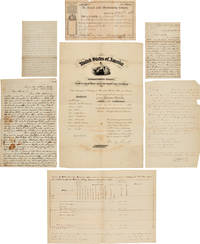
1881WRCAM50270Various locations 1881. Manuscript map; three autograph letters signed; and five related documents. All three autograph letters are accompanied by full typed transcriptions. Usual mailing folds. Generally very good. An interesting archive relating to Capt. James Cooke's experiences in the Civil War. Cooke mustered in on Sept. 5 1861 and eventually served as captain in Company "F" 52nd Regiment Pennsylvania Volunteers. He served in several battles most notably the Battle of Seven Pines in Virginia and resigned on Oct. 21 1863. The individual items included in the archive are as follows: <br> <br> 1 Manuscript map of the Seven Pines Battlefield. 15 3/4 x 12 1/2 inches. Some fold separations with minor loss of paper noticeable stain in the middle of the map straddling the vertical fold. A wonderful hand-drawn map by Cooke showing the area around Fair Oaks Station. He has designated the positions of both the 52nd and 104th Pennsylvania infantries marking places such as "Fight commenced here" "Fighting all through here" "52 Pennsylvania in line of Battle" and "the way the Rebs came." He also has marked topographical details such as roads a railroad track woods and the Chickahominy River. He has written a short explanatory note on the verso initialed by him to the same recipient as the following letter. <br> <br> 2 Autograph letter signed to "Dear Friend Joe." Camp Near Bottoms Ridge. June 18 1862. A wonderful sixteen-page letter with details regarding the Battles of Williamsburg and Seven Pines. The Union army had laid siege to Yorktown Virginia from April 5 1862 until Confederate forces silently withdrew in the night hours of May 3. Cooke was there as Federal troops entered the town the following morning and describes the scene: "We went through the woods cautiously with our skirmishers in advance but we could see no signs of life in any of the Forts and our men went along without any opposition.we had no idea that it was a general evacuation of the whole place." The rebels however had not left the place totally unguarded: <br> <br> "I was just agoing sic when I heard a stunning report behind me.and the men in my company falling down.I supposed right away that it was a masked battery on the opposite side of the road.I then went to the rear of the company and found.a deep hole in the ground showing it was one of those infernal machines near Williamsburg Virginia the first known use of modern land mines that the Black Hearted Traitors planted all along the roads leading to Williamsburg." <br> <br> The next day May 5 Cooke and his men found themselves held in reserve near the fighting at the Battle of Williamsburg. They advanced and "as we were going up I could hear the roar of the musketry and the yells of the boys when they made the charge." The men of the 52nd never joined the fight since when they reached the field "the fight was over for that day and.as the rebels still occupied a large fort we would go at them in the morning." <br> <br> Two days after arriving at Williamsburg they "struck out for Richmond" and reached the Chickahominy River on May 19 meeting some light resistance along the way: "Our men.drove the pickets of the enemy.and skirmished up to the bank of the river in the face of a severe fire of infantry and artillery by the Rebs." On Saturday May 31 they "took the advance toward Richmond.and uncovered the enemy in force in front of us." <br> <br> The Battle of Seven Pines was about to commence. Cooke writes about it in great detail: <br> <br> "Skirmishers from the 52nd.were sent out and soon drew the fire of the enemy's pickets and.a battery that was hid behind a woods. The 104th Pennsylvania Infantry was sent forward on our left.and we were ordered to advance along the road.the balls went howling over our heads like something mad. This being the first time many of the boys had heard a ball scream.it made a good many look white.but not a man flinched." <br> <br> The men advanced over the hill "the Rebels.gave us the full benefit of three or four guns.We filed off to the right.to get out of range but they followed us with their shots which fell all around us." After assuming line of battle the men "marched directly toward the rebel guns." Help arrived when "One of our batteries.came up and commenced answering the speeches that had been made on the other side. It soon silenced their guns." They experienced very little action after that and two days later June 2 they "took possession of the railroad at Fair Oaks Station." He does add that he "was not with my Regt in the fight nor did I see any of our Brigade in the fight Cooke had been separated and used as a skirmisher as where they were fighting was at the real seven pines and.I was at Fair Oaks a half mile to the right." He concludes by giving an account of the 52nd's action during the battle as he knows it. <br> <br> 3 Autograph letter signed to "Dear Brother." Virginia Fairfax Seminary. Aug. 20 1861. A friendly letter to his brother with some military content. Cooke writes that he is currently "quartered about 2 1/2 miles from Alexandria" near the house where Gen. Kearney is headquartered. The Virginia Seminary where he is staying was abandoned after the Union troops took Alexandria according to Cooke. He then relates information about working the picket lines "about 2 miles from the camp then Rebel Scouts came down some days inside our pickets" a potential court- martial of one of the Union colonels related to Cooke's division and news that Cooke expects "another battle in about two weeks but there can be nothing definite about it there is any quantity of reports about but if they the government are only prepared for it the sooner it comes the better as I would like to see the thing ended and not be kept in suspense." <br> <br> 4 Autograph letter signed to "Dear Sister." Camp Dodge. Dec. 14 1862 Cooke writes that he is well having gotten over a "light touch of Intermitent Fever." He send $10 from a fellow soldier for his sister to give to the soldier's wife. Cooke spends the last portion of the letter writing about army pay. <br> <br> 5 Retained copy of a Return of Ordnance Form for Company "F" 52nd Pennsylvania Regiment for the quarter ending Dec. 31 1862 mismarked 1863. <br> <br> 6 Fair copy of Special Orders No. 149 May 18 1862 regarding the sick and surplus arms and baggage. <br> <br> 7 Military Appointment for Cooke as captain of Co. "F" Nov. 5 1862. Fold separations. <br> <br> 8 Passaic Falls Manufacturing Company Stock Certificate May 30 1866. <br> <br> 9 James Cooke's passport Jan. 10 1881 giving a detailed physical description of Cooke. <br> <br> A wonderful archive relating a Pennsylvania captain's experiences during the Civil War most notable for the manuscript map of the Seven Pines battlefield and an enthralling letter to a friend regarding battle experiences. unknown books
1892WRCAM52035Rockland Me.: First Maine Cavalry Association 1892. Nine issues several with plates plus two supplements. Original printed wrappers mostly detached and chipping heavily. A few chips to initial leaves of one issue otherwise internally very good. A significant run nine of fourteen total issues with two additional supplements of a periodical for Civil War veterans of the First Maine Cavalry. "Published four times a year and will contain the proceedings of the yearly reunions of the First Maine Cavalry matters of historic value to the regiment and items of personal interest to all the members." The volunteer cavalry regiment served with the Army of the Potomac for the duration of the war and participated in many of the critical battles including Brandy Station the largest cavalry engagement of the entire Civil War. First Maine Cavalry Association unknown books
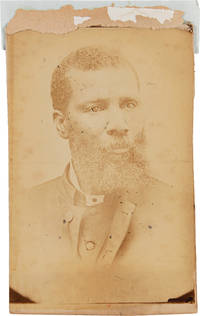
1865WRCAM55438N.p. likely Boston 1865. Albumen photograph 8 3/4 x 5 3/4 inches mounted on card. Moderate fading a bit of spotting in the image. Verso darkened from exposure to wooden backing now removed from backing and period frame backing tape still attached to verso along top edge. Remnants from previous mat at top edge. Good and a worthy candidate for professional conservation. An apparently unrecorded image of Rev. Samuel Harrison a former slave and fierce abolitionist who served as Chaplain of the 54th Regiment Massachusetts Volunteer Infantry the famous Civil War regiment of U.S. Colored Troops. Colonel Robert Gould Shaw led the 54th Mass. Regiment the second unit of colored troops formed by the Union Army but ultimately the most famous all-black infantry unit to fight in the Civil War as seen in the film GLORY. After Shaw was killed at the Battle of Fort Wagner Massachusetts Governor John A. Andrew recommended that Rev. Samuel Harrison serve as Chaplain to help the unit's morale. Harrison accepted and was also instrumental in getting equal pay for black soldiers. Harrison's demand that he receive the same pay as white chaplains led Gov. Andrew and United States Attorney General Edward Bates to write letters to President Lincoln to end the discriminatory practice of unequal pay among white and black soldiers in the Union army. In June 1864 legislation requiring equal pay for black units retroactive to January 1864 was passed in the Army appropriations bill. <br> <br> Images of Rev. Samuel Harrison are rare and online exemplars seem to vary widely. The present example appears to be a much younger version of Rev. Harrison compared to the image of him at age eighty-one held by the Samuel Harrison House. Here he also appears to be wearing a chaplain's uniform indicating this is a wartime or near-wartime image of him. The verso of the photograph has a penciled note reading: "Rev Samuel Harrison 54th Mass." unknown books
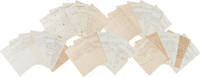
1863WRCAM54557Kentucky; Tennessee; Georgia 1863. Fourteen manuscript letters most on small bifolia two to four pages in length. Previously folded. Light wear at folds. Light tanning; an occasional patch of soiling. Very good. A group of fourteen letters written home by Union Pvt. Henry D. Isbell of the 1st Ohio Light Artillery. The letters addressed to his mother and father as well to his sister and brother-in-law date from just after his enlistment in August 1862 to the eve of the Battle of Chickamauga in September 1863. <br> <br> In August and September 1862 just after Henry Isbell enlisted Battery A of the 1st Ohio Light Artillery was on its way to Louisville Kentucky in pursuit of Confederate General Bragg. Isbell's first letter in this collection is written on September 6 1862 from New Parks Barracks in Louisville to his brother-in-law John Howland. Isbell was very satisfied with his new barracks where he drilled three times per day and averred that his squad "is the best one in the field." Isbell also shared with his brother-in-law the exciting news that Confederate Raider John Hunt Morgan is in the area: <br> <br> "Morgan took a place called Brandon night before last about twenty-five miles south of here on the rail rode so our communications with the boys is cut off for the present.There is a great deal of excitement here Morgan is reported within twenty miles of here and every one thinks he will take the place with in a week. I hope he will. It is full of secesh." <br> <br> After a march to Nashville the 1st Ohio Light Artillery was reviewed by General Rosecrans who Isbell described in a letter of November 15 1862 as "a fine looking man and a fighting one two." Rosecrans and Isbell's 1st LA were just weeks away from a major engagement the Battle of Stones River which was fought December 31 1862 through January 2 1863. It was one of the costliest battles of the Civil War and Isbell experienced fierce fighting. In a letter to his sister from Camp Sill in Murfreesboro on February 15 1863 he described part of the action thus: <br> <br> "Every gun had left the park before we had started our ceysone and then we stopped out in the open field and was going to hitch our horse on but we could not for theywere within six nods of us and we could not hold our horse after my horse was shot I went to the gun but it had gon up for most of the horses was shot and there was no one there but Lieut. C and L. Coe John Whitney and one other canoneer.then I went with Lieut. C. to Dick Rogers brass guns and we went to working it as fast as we could but the horse got shot and the limbe nocked to peaces and we had to leave it." <br> <br> Isbell relocated to Nashville in the summer of 1863 as part of the occupation of middle Tennessee and then moved into Georgia as part of the Chickamauga Campaign. The last letter in this collection was written by Isbell on September 11 1863 to his mother from "Camp between Lookout and Bear Mountain." One week before the Battle of Chickamauga Henry hastily informs her that "We have marched about twenty five miles since I wrote to father and we came twenty of it yesterday the wether is very hot and the dust is about a foot deep. I shall have to write you a short letter this time but I thought you would like to know where we was and that we are all well." <br> <br> A week later during the battle he was mortally wounded and died in another month's time. A small but informative archive of letters from an Ohio artilleryman who saw intense action in the Tennessee campaigns and who was killed after just over one year of service. unknown books
1862WRCAM54585Washington D.C.: War Department Adjutant General's Office 1862. Three volumes with over 300 individual imprints. 12mo. Uniformly bound in contemporary three- quarter roan and marbled boards gilt leather labels. Wear to leather and edges boards somewhat rubbed front hinges tender. Contemporary ownership inscriptions and binder's tickets on front endpapers of second and third volumes; later bookplate on front pastedown of first volume. Light toning in places otherwise internally clean. Very good. A uniformly-bound set of General Orders issued by the Adjutant General's Office of the War Department in Washington D.C. previously owned by Brig. Gen. John Pope Cook. The orders cover 1861 and 1862 and comprise a nearly complete run of orders for the Union Army during the first two years of the Civil War. Undoubtedly the most significant General Order in this collection is a preliminary printing of the Emancipation Proclamation. <br> <br> A handful of the orders are signed in ink by the various adjutant generals. The Emancipation Proclamation bound in the third volume is as follows: <br> <br> GENERAL ORDERS No. 139. THE FOLLOWING PROCLAMATION BY THE PRESIDENT IS PUBLISHED FOR THE INFORMATION AND GOVERNMENT OF THE ARMY AND ALL CONCERNED: BY THE PRESIDENT OF THE UNITED STATES OF AMERICA A PROCLAMATION caption title. Washington D.C.: War Department Adjutant General's Office ca. September 24 1862. 3pp. This work is one of the earliest printings of the Preliminary Emancipation Proclamation issued to regimental commanders in the field during the Civil War in the week after President Lincoln's official manuscript version was finished. Here the third paragraph rings out with Lincoln's timeless words: "That on the first day of January in the year of our Lord one thousand eight hundred and sixty- three all persons held as slaves within any State or designated area of a State the people whereof shall then be in rebellion against the United States shall be then thenceforward and forever free." <br> <br> Following the Seven Days Battle and Gen. McClellan's retreat from the Peninsula at the end of June 1862 President Lincoln realized that there would be no early end to the war and found himself "as inconsolable as it was possible for a human to be and yet live." Anxious for news from the army and needing to escape the constant interruptions at the White House he frequently visited the telegraph office in the War Department building to await dispatches. It was during one such visit early in July that he asked the chief of the telegraph staff Maj. Thomas Thompson Eckert for some paper to "write something special" and began the first draft of the Emancipation Proclamation completing it in a few weeks. <br> <br> Lincoln had long hoped to resolve the slavery issue through a congressional act of emancipation compensating slave owners for their loss of "property" but that approach was roundly rejected by representatives from the border states leaving the President who had decided upon the necessity of emancipation with a presidential proclamation as the only option. The extraordinary document he conceived would announce the liberation on January 1 1863 of all slaves in those states still in rebellion against the Union and promised compensation to slave owners in those states that returned to the fold before that time if they adopted "immediate or gradual abolishment of slavery." This proclamation would be followed by a final proclamation issued on the 1st of January identifying those states still in rebellion and confirming the liberation of all slaves therein. <br> <br> On Tuesday July 22 Lincoln presented his draft to the Cabinet telling them that he had resolved firmly upon the course of action it specified and asking them not for advice but suggestions. The only observation he had not anticipated came from Secretary of State Seward who proposed that it might be best to wait for a military victory before issuing the Proclamation as it could otherwise seem like "the last measure of an exhausted government." Immediately recognizing the wisdom of the suggestion Lincoln held back. On September 17 after an anxious wait of nearly two months he received the victory he needed at the bloody Battle of Antietam. Completing his final draft Lincoln presented it to his cabinet for refinement on September 22. Following the meeting Seward took the amended draft with him to the State Department where a formal manuscript copy was made then signed by Lincoln and Seward. <br> <br> The first edition of the Preliminary Emancipation Proclamation Eberstadt #1 a small three-page circular intended for distribution within the government and to the local press was likely printed on September 22. At the time that Charles Eberstadt published his study of the Proclamation 1950 he was able to locate only one copy which he himself owned and as nearly as we have been able to determine no other copies have come to light since then. <br> <br> Eberstadt #2 is a supposed second edition no copy of which Charles Eberstadt was able to locate whose existence he inferred from the standard State Department practice of printing a folio edition consisting solely of the text of the proclamation followed by another printing consisting of the text of a letter of transmittal from the Secretary of State as well as the text of the proclamation. While there may be a copy of Eberstadt #2 in the National Archives as he speculated it is not recorded in their online catalogue nor have we been able to find a copy in any other online catalogue including OCLC the Library of Congress and the Abraham Lincoln Library. <br> <br> Eberstadt's third printing of the Preliminary Emancipation Proclamation is without a doubt the earliest obtainable printing. It consists of Secretary of State Seward's one-page letter of transmittal addressed "To the Diplomatic and Consular Officers of the United States in foreign countries" and the text of the proclamation. Eberstadt located a total of only five copies in institutions at the Library of Congress the National Archives Yale the Clements Library and Brown. OCLC does not record any additional copies nor is it recorded in Monaghan. This firm sold a copy several years ago. <br> <br> The present copy of GENERAL ORDERS No. 139 is Eberstadt's fourth printing of the Preliminary Emancipation Proclamation dated in print on September 24. Charles Eberstadt surmises that this field order printing could have been accomplished as late as September 29 or 30 and produced in as many as 15000 copies. It is however rather uncommon in the market and this is the first copy of this printing of the Preliminary Emancipation Proclamation offered by this firm. <br> <br> "From the first days of the Civil War slaves had acted to secure their own liberty. The Emancipation Proclamation confirmed their insistence that the war for the Union must become a war for freedom. It added moral force to the Union cause and strengthened the Union both militarily and politically. As a milestone along the road to slavery's final destruction the Emancipation Proclamation has assumed a place among the great documents of human freedom" - National Archives. "The proclamation has been called by responsible persons one of the three great documents of world history ranking with Magna Carta and the Declaration of Independence" - Eberstadt. <br> <br> Besides including about 300 orders on all manner of Union military activity at the outset of the Civil War the present collection also contains the 1861 printing of REGULATIONS FOR THE UNIFORM AND DRESS FOR THE ARMY OF THE UNITED STATES. Set out in GENERAL ORDERS No. 6 this twenty-four-page printing of the Army dress regulations was the first to set out uniform requirements for the Union during the conflict. The first sentence of the first section requires officers to "wear a frock coat of dark blue cloth." Thus the Blue and the Gray begins. <br> <br> This set was collected and bound by John Pope Cook who began the Civil War as a colonel in command of the 7th Illinois Volunteer Regiment. He was promoted to brigadier general after his troops played a key role in the Union victory at Fort Donelson early in 1862. After his promotion he was transferred to a command in the Department of Iowa and Dakota Territory where he remained until early 1863 conducting campaigns against the Sioux from his base in Sioux City Iowa. These orders must have been bound near the end of this period since contemporary labels note the binder one William F. Kiter as being from relatively close by Council Bluffs. <br> <br> A very early printing of one of the most important political acts in the Civil War and indeed in American history contained in a set of General Orders contemporaneously assembled by a significant Union Army commander. EBERSTADT LINCOLN'S EMANCIPATION PROCLAMATION 4. War Department, Adjutant General's Office hardcover books
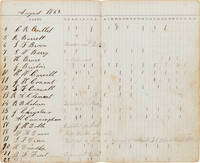
1862WRCAM55597Various locations mostly Louisiana 1862. 120pp. Contemporary sheep later leatherette backstrip title stamped in dark brown on front board reading "GUARD BOOK D. CO. 12TH. REG. MAINE." Some edge wear mild chipping and light scuffing to boards. Front hinge detached spine cracked. Occasional thumb-soiling to text. Still very good. A manuscript record book documenting an entire year of guard duty worked by various members of Company D 12th Maine Infantry Regiment Volunteers during the early part of the Civil War. The majority of time recorded in this book emanates from Louisiana while the 12th Maine Regiment was attached to Butler's Expeditionary Corps from January to March 1862. On their way to Louisiana the regiment travelled on the Steamship Constitution to Ship Island Mississippi serving there until May 4 1862. The Regiment then traveled to New Orleans for guard duty at the U.S. Mint until October 1862. While in New Orleans the Regiment took part in the expedition to Pass Manchaca from June 16 to 20 and the expedition to Ponchatoula from September 13 to 18. In October the Regiment moved slightly north to Camp Parapet in Shrewsbury Louisiana and served there until November 19 1862; the record book ends here. <br> <br> Each two-page opening of the ledger is pre- printed with a large column on the left for names and thirty-one numbered smaller columns for marking days served on guard duty. Most days have just one or two tick marks for any particular soldier indicating just one or two men were on active patrol mostly privates but also sergeants corporals musicians wagoners and others. The number of guard shifts worked by the regiment increased dramatically in May 1862 when they arrived at the U.S. Mint in New Orleans before falling off again the next month presumably after some relief arrived. In addition to guard duty service notations indicate reasons for absences such as "died at" "sick" "in confinement" "permanent detail" "enlisted for cook" "light duty" "in the woods" and "hospital." Notations from February 1862 indicate that James H. Andrews died onboard the Constitution on February 14 and two other soldiers caught sickness at Fortress Monroe. Another entry shows that S.G. Tracy "Died at Ship Island 12 of April 1862." Later in July Capt. H.W. Dunn is detailed for daily duty at the "Reding Press" in New Orleans. In August G.F. Drown is "Detailed as Nurse in General Hospital St. James Hotel N.O." <br> <br> Material from the Trans-Mississippi West is rare this early in the Civil War and also usually not as thorough as the present record book documents an entire year of service. A unique record of Civil War service for a peripatetic Maine volunteer infantry regiment serving in the Bayou State. hardcover books
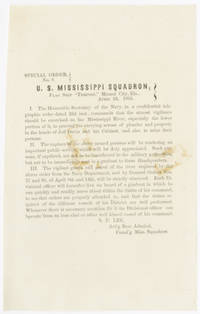
1865WRCAM54141Mound City Il 1865. 1p. Two older tape stains else clean. Very good. A rare U.S. Mississippi Squadron Special Order from Rear Admiral Samuel Lee on the Flag Ship Tempest passing along a confidential telegraph order from Gideon Welles Secretary of the Navy. Admiral Lee conveys the order that "the utmost vigilance should be exercised on the Mississippi River especially the lower portion of it to prevent the carrying across of plunder and property in the hands of Jeff Davis and his Cabinet and also to seize their persons." Davis and other Confederate leaders had fled Richmond and the oncoming Union Army; they had hoped to find sanctuary outside the United States. At one point they hoped to cross the South and reach Mexico. Davis his family and entourage were captured in Georgia on May 10. unknown books
1863WRCAM48378ASt. Louis: Wiebusch und Sohn 1863. Four volumes bound in one. 2208; 200 of 208; 4208 lacks pp.137-144; 2200pp. Vol. 17 lacks issue 26. Vol. 18 lacks issue 18. Folio. Half morocco and marbled boards. Spine and corners heavily worn front cover detached. Titlepage of first volume torn; second and third leaves heavily torn with some minor loss. Light to moderate foxing and wear. Else good. Lutheran German-language newspaper founded in 1844 by Carl Ferdinand Wilhelm Walther 1811- 87. The paper and its founder were key components in introducing the idea of an umbrella church for Lutherans in America and the Midwest founding in 1847 the German Evangelical Lutheran Synod of Missouri Ohio and Other States. In the 1840s and '50s Germans were the largest immigrant group in America settling heavily in the Midwest. Wiebusch und Sohn hardcover books
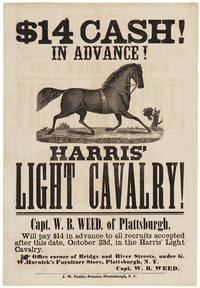
1861WRCAM54022Plattsburgh N.Y. 1861. Printed broadside 13 3/4 x 20 inches. Matted. Mild offsetting of text from being previously folded minor restoration in left margin light folds and toning. Very good. A rare Civil War recruitment broadside stating that Captain W.B. Weed will pay $14 in advance to all Union recruits accepted after October 23 in the Harris' Light Cavalry. Signed in type by Captain Weed who enlisted with the 2nd New York Cavalry in September 1861 only to be discharged less than a year later on June 24 1862. The broadside includes a large and well-executed engraving of a cavalry horse. <br> <br> Named in honor of Senator Ira Harris of Albany Harris' Light Cavalry the 2nd New York Cavalry was organized at Scarsdale New York during the summer of 1861 and over the course of four years' service earned one of the most illustrious records in the Army of the Potomac. The 2nd Cavalry lost heavily during Pope's Campaign in the late summer of 1862 and again before and after Gettysburg losing almost 50 at Aldie alone with equal losses later in the year at Liberty Mills and Buckland Mills. During the summer of 1864 the regiment took part in Wilson's raid on the South Side and Danville Railroads and it fought in the Shenandoah Campaign when the tide was finally turned against the Confederates. The 2nd New York Cavalry is one of the 300 fighting regiments mentioned by Colonel Fox and ranks eighth in the list of mounted regiments which lost the most men killed and fatally wounded in action during the Civil War. unknown books
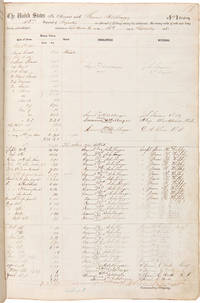
1865WRCAM55621Various locations in Pennsylvania Virginia and South Carolina 1865. 21987pp. Large folio. Contemporary three-quarter maroon calf and black cloth boards gilt spine titles reading: "PENN. CLOTHING BOOK COS. C & D 52nd INFANTRY P. & P. OFFICE." Spine partially split chipped and rather worn; boards soiled edges and corners worn. Binding a bit tender and bowed. Scattered occasional soiling and foxing to text. Good. A voluminous manuscript account book used to track the clothing and equipment transmitted to the soldiers of two companies of the 52nd Pennsylvania Infantry Regiment between 1861 and 1865. The meticulous records herein provide significant research material on the outfitting of Civil War troops and show that an army marches not just on its stomach but on its shoes and clothing as well. <br> <br> The majority of the entries relate to clothing including shorts pants coats caps blouses shoes socks and other materials needed by the Civil War foot soldier on the move during the conflict. Equipment listed here includes haversacks and blankets among other items. Each page is dedicated to a single soldier whose name company enlistment location and enlistment date are all recorded in the pre-printed form at top with various line items their costs the rank of the soldier and his signature recorded in the body of the ledger-like account book. Often accounts are noted as settled either before discharge or by death or desertion. Over two-thirds of the entries pertain to Company C of the 52nd Infantry. <br> <br> Importantly in addition to equipment and clothing the account book also records transfers death discharges and desertions. The first five entries for example provide a snapshot of the fates of various soldiers. The first soldier is noted as discharged with the last date of equipment listed as February 28 1862. The second and third soldiers were both "Killed in action at Fair Oaks Va." aka the Battle of Seven Pines May 31 - June 1 1862. The fourth soldier was discharged sometime after June 1862. And the fifth soldier "Died from wounds" after May 18 1862. Others here are noted as "Died from Disease" "Died of wound received by accident" and "Supposed to be killed by the explosion of the Gun Boat Mound City." <br> <br> The 52nd Pennsylvania Infantry Regiment was an important unit during the Civil War. The regiment formed in the late summer and early fall of 1861. They were assigned to the Peninsula Campaign in March 1862 and swiftly saw action at the Battle of Williamsburg and the Battle of Seven Pines also known as the Battle of Fair Oaks which is the name used for the soldiers recorded as dying there in the present account book. The regiment then moved to South Carolina at least one soldier in the present account book enlisted there and by mid-summer they were in Charleston to witness the ill-fated Battle of Fort Wagner. For the remainder of 1863 and most of 1864 the regiment moved around South Carolina until participating in the occupation of Charleston in February 1865. Afterwards the regiment joined Sherman's march through the South and some of the regiment ended the war in North Carolina where they witnessed the final surrender of Gen. Joseph E. Johnston. <br> <br> A valuable and research-worthy record of Civil War service covering the span of the conflict filled with unique information on the ground level needs of the Union foot soldier. hardcover books
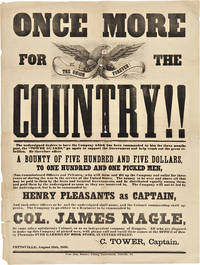
1861WRCAM54027Pottsville Pa 1861. Broadside approximately 24 x 18 inches. Minor separations at crossfolds some edge wear and short closed tears at edges somewhat toned. Good. Framed. A rare Civil War recruitment broadside calling for troops to join the Tower Guards in Pennsylvania during the first year of the conflict. The broadside is illustrated with a large open-winged eagle holding a banner in his beak which reads: "The Union Forever!" The body of the broadside reads in part: <br> <br> "The undersigned desires to have the Company which has been commanded by him for three months past the 'Tower Guards' go again to support the Government and help crush out the great rebellion. He therefore offers A bounty of five hundred and five dollars to one hundred and one picked men." <br> <br> The text explains that the company will be commanded by Henry Pleasants as captain and will be part of a Regiment commanded by Col. James Nagle "Or some other satisfactory Colonel or as an independent company of Rangers." The broadside directs any interested men to call and enroll their names at the Office of Henry Pleasants. Signed in type by "C. Tower Captain." Charlemagne Tower organized a company of Union soldiers from Pottsville in a three-month enlistment during the Civil War. Before the war Tower worked in law specifically moving to Schuylkill County to get involved in claims to large coal and mineral deposits there. Tower was able to build wealth and prominence for himself in the area through his work in land dispute cases most prominently the Munson-Williams case. <br> <br> When the Civil War began at Fort Sumter Tower took notice. Within ten days of that first conflict on April 12 1861 Tower had recruited around 270 men from his county to join the Union Army under a three-month enlistment provision. Tower's unit who became known as the "Tower Guards" entered the Union Army as Company H of the 6th Pennsylvania Regiment part of a brigade commanded by Maj. Gen. Robert Patterson. Tower commissioned captain of his unit provided uniforms and arms for his men at his own expense. The unit saw action most famously in the engagement at Falling Waters in July of 1861 a Union victory in name but with its own failings that led to the defeat at the First Battle of Bull Run. It would seem that Tower's efforts were not exhausted on this first unit because the featured broadside is dated just after his unit mustered out of service and asks for more men to take up the cause and fight for the Union. It would seem that Tower himself funded the bounty offered in the broadside but this is not certain because much less is known about this second attempt to recruit men for the Union Army. <br> <br> After his service in the war Tower was later named U.S. Provost Marshal for Pennsylvania's 10th Congressional District from 1863-64 and continued working at his Pottsville practice until moving to Philadelphia in 1875. A master land negotiator Tower held property in North Dakota and Minnesota that would help develop those states and the United States as a whole. His holdings in North Dakota became Tower City a promising town arranged and planned by George Ellisbury in 1879. Tower's land in the Vermilion Range in Minnesota proved to be rich with iron ore necessitating a mine and a direct railroad line both of which contributed to the local state and inter-state economies. <br> <br> Though Tower died on July 25 1889 his legacy was carried on by the towns across state lines that were named after him his son who became the minister to Austria- Hungary under President William McKinley and the unit of "Tower Guards" who fought for the Union Cause in the Civil War. <br> <br> A visually-striking artifact from the early period of the Civil War with no copies recorded in OCLC. unknown books
1862WRCAM52914New York 1862. xxii385pp. Early 20th-century buckram gilt leather spine spine labels. Cloth somewhat dust soiled spine labels slightly chipped. Paper shelf label on spine institutional blind and ink stamps on titlepage. Light tanning. Good plus. Rare report on the trial of the prisoners taken from the Confederate privateer Savannah. The schooner Savannah having been fitted as a privateer sailed from Charleston on June 2 1861 for the purpose of intercepting United States commercial ships. On the following day after capturing the brig Joseph the Savannah was herself captured by the brig-of-war Perry and her crew taken prisoner. The arduous deliberations of the trail ended in gridlock as the jury could not agree on a verdict. The appendix contains various proclamations by President Lincoln including one declaring a naval blockade of the South. hardcover books
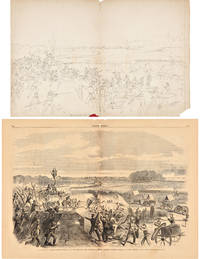
1862WRCAM48438Corinth Ms 1862. Pencil drawing 13 1/2 x 21 inches. Small tears at right and left edges lower right corner torn away. Small red ink stain on lower edge. Central vertical fold. Light soiling and wear. About very good. An original pencil sketch depicting a crucial moment in the Second Battle of Corinth which took place on October 3-4 1862 probably by war correspondent Alexander Simplot. This drawing was engraved for HARPER'S WEEKLY where its caption puts it in context as depicting the battle's key moment. A single three-cannon Union battery led by Lieut. Henry Robinet had been inflicting heavy casualties on the attacking Confederates. Here the Confederates have stormed the battery and are attempting to take it in hand- to-hand combat. The Federals recaptured the battery later that day leading to a Union victory and a Confederate retreat. The engraving from HARPER'S is included which attributes the sketch to Alexander Simplot though the drawing itself is unsigned. Simplot a native of Iowa was a schoolteacher and artist turned war correspondent. Early in 1862 Simplot began traveling with the army of U.S. Grant which in October was stationed in Tennessee near the Mississippi border. unknown books
1864WRCAM53096Richmond 1864. Broadside 18 x 12 inches. Printed in three columns. Previously folded with a couple small separations along old fold lines. Light toning and foxing. About very good. A very scarce and quite interesting broadside circular printing of the act which allowed slaves and free blacks to be used in certain tasks by the Confederate Army during the Civil War as well as instructions for the conscription and induction of those men into the armed forces. The Confederacy was loath to arm any of its slave population but by 1864 could not spare any further manpower from their infantry to perform menial tasks and the government therefore passed a law allowing slaves to be used "in certain capacities" such as the construction of fortification the production of arms and the transport of materiel. The first column of this broadside comprises a full printing of that law while the remainder sets forth the rules for the impressment of slaves into military service for their care while in service and for the compensation of their owners. <br> <br> A fascinating piece that lays bare the desperation of the Confederacy for labor and supplies in early 1864. Not in Parrish & Willingham. unknown books
1863WRCAM55392N.p. but likely St. Louis 1863. Broadside 13 3/4 x 4 1/4 inches. Remnants of tape at top edge and ink mark in top margin. Slight tanning and spotting old folds. Very good. A rare Civil War broadside recounting Confederate General John S. Marmaduke's second raid into Missouri. It gives detailed news of battles between Union and Confederate troops in southeast Missouri an area that saw bloody battles between Unionists and Bushwhackers throughout the Civil War. <br> <br> Marmaduke aided by other Confederate units led by Joseph O. Shelby and Sterling Price and others attempted to lay claim to Missouri in 1861; they were unsuccessful but did not acknowledge defeat. Marmaduke planned his return for spring of 1863 confident that secessionist-minded Missourians would rally to his banner and he could make a decisive move on Jefferson City and even St. Louis. He needed the help: at the beginning of the raid Marmaduke had about 5000 troops of which 1200 were unarmed and 900 were unmounted and he hoped to resupply at Patterson and Bloomfield. He divided his forces and sent 2000 against Patterson the furthest south in a string of fortified outposts in southeastern Missouri. Marmaduke's troops had the element of surprise initially approaching Patterson and its small garrison of about 400 troops commanded by Col. Edwin Smart. Marmaduke's men captured Smart's pickets but revealed themselves soon after as over-eager artillery troops started firing before the infantry could get into place. Smart sent out a battalion under Major Wood to hold off the Confederates while he prepared his troops and supply trains for retreat. <br> <br> In the text of this broadside Smart reports that Wood "held them in check and skirmished them into town.Before I left the town I destroyed what stores I could not bring away. Nothing fell into the hands of the enemy." Marmaduke pursued them to Big Creek about eight miles west of Patterson and Smart writes that: "The engagement was severe in the extreme often fighting hand to hand. At Big Creek they got in my front and attempted to cut off my retreat but I forced my way and formed on this side of the Creek. The enemy did not renew the engagement." Smart lost about fifty troops including Major McConnell. Marmaduke failed to obtain any military stores at Patterson or during his subsequent raid at Bloomfield and no sympathetic Missourians joined his cause; the raid was a failure and confirmed that while Missouri was no Union stronghold neither was it interested in furthering the Confederate cause. <br> <br> This broadside bears no imprint and the place of printing is unknown but the tone of the text and the fact that the news arrived so quickly indicates that it might have been printed in St. Louis. No copies of this broadside are listed in OCLC. Such broadsides bearing news of the Civil War in the Trans-Mississippi West are rare and shine an important spotlight on an often- neglected aspect of Civil War history. unknown books
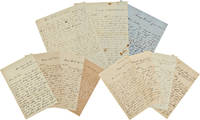
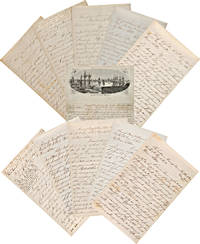
1862WRCAM55290Manchester N.H. Boston Ma. Ship Island off the coast of Mississippi and locations in Louisiana as detailed below 1862. Eleven autograph letters signed ten with envelopes totaling 36pp. Later transcriptions accompany the letters. Old folds occasional light staining and/or tanning one letter with small tears repaired with archival tape. In very good condition. A small but rich collection of early Civil War letters written by Private Aaron A. Smith of Wilton New Hampshire to his sweetheart Adaline "Addie" D. Jones of West Wilton. The letters describe Smith's training at bases in New Hampshire and Massachusetts time spent at Ship Island off the Mississippi Coast and his service in Louisiana as part of the Union occupying force in the summer and fall of 1862. Smith eventually served as a musician with his company giving an interesting perspective on his brief Civil War service. The letters continue until Smith's death in Louisiana from typhoid fever just over a year into his service. Letters from the western theater of the Civil War especially at such an early point in Union advances are uncommon. <br> <br> Smith's letters are especially informative of the conditions at Ship Island describing the poor health conditions there and the Confederate prisoners and escaped slaves he encountered. He also gives valuable information on Louisiana and New Orleans just after the Union retook the region describing the ongoing resistance efforts of Confederate soldiers and civilians. Smith also transmits his love for his hometown sweetheart and his hopes that they will meet again. <br> <br> Aaron Smith 1837-1862 enlisted on October 28 1861 and mustered into Company "B" of the 8th New Hampshire Volunteer Infantry under Col. Hawkes Fearing Jr. The 8th left Camp Currier Manchester N.H. on January 24 1862 en route for Fort Independence in Boston where they trained and drilled until transport south was available. They departed Boston for Ship Island Mississippi on February 15 aboard the E. WILDER FARLEY and finally arrived on March 15. Smith served the entirety of his comparatively brief enlistment in the Department of the Gulf as part of Gen. Benjamin Butler's Expedition. In his letters Smith details his transport to Ship Island and the conditions there and then gives descriptions of New Orleans. Smith remained at Camp Parapet just upriver from New Orleans through September before joining Gen. Godfrey Weitzel's brigade and participating in the Battle at Georgia Landing Labadieville an engagement he describes briefly in his final letter of December 10. Aaron Smith then fell seriously ill and succumbed to typhoid fever on December 22 1862 according to the REGISTERS OF DEATHS OF VOLUNTEERS. The letters are described individually below: <br> <br> Camp Currier: January 22 1862. 2pp. With envelope. Smith writes just days before he leaves for Boston. His tone is light and focuses on the personalities in his and Addie's choir in Wilton. In fact Smith writes that he's just received her letter as "Sargent sic Marshall Abiel Livermore and myself were spending the evening in singing." Smith also asks about which regiment a friend of theirs has joined in hopes that he can locate him later. <br> <br> Fort Independence: February 10 1862. 2pp. Smith is now in Boston waiting to for the ship south and his thoughts have turned more serious. He writes that he hopes his and Addie's feelings for each other will not dim since "when we shall meet again I cannot tell as separations must occur on Earth I must reconcile myself to it." He then veers into a religious vein: "The hand of God can protect us from all harm and guide us safe through many dangers I wish I had more faith in Him and more love for Him. Addie it is my deep desire and has often been my prayer that you may seek and find if not the love of God and I hope live a more consistent christian life than I have." Nevertheless no one seems to know or will tell where they are headed: "where we shall go to I think that no officer under Gen. Butler knows those that put confidence in reports believe we shall go to Ship Isl. but I do not put so much confidence in them as I did by doing so have been obliged to contradict a part of some of my letters." Smith mentions the wreck of a troop ship and marvels that more lives were not lost. Towards the end of the letter perhaps to lighten the tone upon closing Smith seems to allude to a joke between him and Addie and his mother that he was married before he was not: "I am some forgetful perhaps I never was married if I have been and you should see her his mother tell her to be of good cheer.I must close now. I send a kiss for you.As we all are past furloughs I think I shall not try to go home again to see my wife." <br> <br> On Board E. WILDER FARLEY: February 16 1862. 2pp. With envelope. This is a brief letter letting Addie know that they are almost underway to Ship Island: "We are in the greatest state of confusion possible. I am now down on the second deck trying to write a few letters or what I shall have to pass as such. There are scarcely five rays of light that can get to my paper can find a better place in our cellar or in the barn than this to write in." Still Smith is optimistic about this war: "I hope and expect not to stop more than a year as the prospects are that the war will not last long and if spared think will be back within that time." <br> <br> Ship Island: April 22 1862. 4pp. With envelope and three small seashells. Smith has arrived at Ship Island and paints a vivid picture of the pestilent sand the soldiers in camp and the various inhabitants including Confederate prisoners of war: "Our Sothern sic prisoners run about at their leisure appear to enjoy themselves very well.the ladies frequently take their work and sit out on the shady side of a building and talk with the men. Some appear to be quite friendly to the union a lady told a man in our squad.that there are one half in N. Orleans that are union people if they dare to be." But then he heard from a girl who "said she wished she could put out the eyes of the northerners with those guns with bayonets she thought the northerners were not any better than the n__s." Nevertheless illness is already a problem: "Two have died in our Reg. since we have been here it is considerable sickly.last Friday I raised some blood from my stomach but the next day I went on duty feeling as well as usual." Smith attributes this to the sand in the food but Ship Island proved to be a very unhealthy place. By the end of the war 153 Confederate prisoners and 232 Union soldiers had died due to contaminated water and related fevers and infections. Smith closes the letter somberly: "I hope and trust we shall be spared to meet again.I think I realise the danger before me hope I shall be prepar sic to meet it." <br> <br> Ship Island: May 8 1862. 4pp. With envelope. "We are here still on this desert." Things are no better on Ship Island. Smith includes some brief accounts of the Union battles in Mobile and Baton Rouge and continues his descriptions of the heat and the sand. The heat has gotten worse: "It is not very healthy from nine to three o'clock.A great many are having very bad eyes caused by the white sand reflecting to the sun's rays.Some have lost their sight and been discharged." He insists his health is fine but notes that he avoids going outdoors whenever possible. Smith also records some fascinating interactions with escaped slaves. He reports that they "frequently come over here and are quite tickled to get here. I heard one say that their masters represent us to be very cruel and tell them we will cut off an arm starve and whip them if we get them.This one said if they should get him they would hang him for the negroes were planning an insurrection and he was at the head. He said he could not get much to eat and the soldiers do not have much either his master he said was in the army and hoped we will kill him." He closes morosely with a count of the graves in the cemetery 79 as of writing ".brothers husbands sons and fathers killed and buried in such hast sic that no one can tell where they lay this is the result of war and still for one side it is just." <br> <br> Camp Parapet: May 24 1862. 4pp. With envelope. Smith is finally on the move detailing his departure from Ship Island as part of the Union occupation of New Orleans. He notes the defenses in particular the "parapet" built up by the Confederates who anticipated the Union invading from the north rather than coming up river from Fort Jackson. He also describes the efforts of locals to destroy military equipment and foodstuffs that would be of value to Yankee invaders. They even attempt to befoul the waterways by dumping sugar and molasses into the river. Smith writes "When they heard we had taken Ft Jackson and only a few gun boats had got up to N. Orleans the soldiers at this place ran in every direction some even over the parapet into the ditch of water some took off their equipments and burnt them then put on citizens clothes to prevent them being caught with soldiers uniform on.The carriages of the guns were burnt by the women the guns spiked the equipments and every thing that the soldiers left that would fall into our hands were burnt and all done by the women." Smith also includes observations on the poverty he has seen: "The destitution of the people white and black in this state and Miss. is not a fable but a reality there are not but a very few that had money enough to live comfortable.I hardly know where to stop there is so much to write about." Smith closes with some notes for his mother and chaste love for Addie. <br> <br> Camp Parapet: July 9 1862. 4pp. With envelope. This letter is less focused on combat and troop movements and is more conversational with casual thoughts about the civilian world and life in camp. Smith writes that the "4th of July was so rainy here that the Reg.'s could not appear in parade at noon and night while the 'Star Spangled Banner' and 'Hail Columbia' was to be played." in which Smith had prepared to perform. Smith is a Musician now so he has been spared the discomfort of guard duty during the heat and the rain though not the boredom of inaction in camp. He reassures Addie about his health reiterating "The blood I spit on the Isl. was caused by the sand that I had eaten and drank. It came from my stomach and was only what I spit out in three or four times. I guess my lungs are well enough now as I have got over the horid colds I caught." Smith mentions election day but does not mention much about politics focusing instead on Addie's "election cake" and how much of it he would eat if he was there. The main problem for Smith in this letter is the numerous untrustworthy peddlers selling junk at exorbitant rates and giving phony currency in change. Perhaps inspired by these experiences Smith also has some strong language about the locals: "The people here are a mixed set from most every nation in the world but those called Creoles are the most numerous ignorant and degraded.The people have not much good principals sic are much inferior to the Northerners in interlectual sic cultivation." <br> <br> Camp Parapet: August 5 1862. 4pp. Folded with envelope. Curiously Smith wrote this letter on stationery featuring an engraved view of the port of New Orleans produced by Louis Schwarz New Orleans publisher and bookseller. Prussian-born Schwarz 1819- 1893 emigrated to New Orleans and by the 1850s had a monopoly on German-language literature. By the time of Smith's letter Schwarz had helped form the mostly-German Hansa Guards Battalion which was absorbed into the 4th Regiment European Brigade of the Louisiana Militia detailed to defend New Orleans. Schwarz was made captain of Co. "B." Upon the Union victory Gen. Butler used the European Brigade briefly as a police force but then dissolved them in May 1862. For some reason in this letter Smith addresses Addie as "Addia" both in the letter and on the envelope. He begins with pleasantries about home but then shifts to discussing the draft apparently in response to Addie: "I do not care if they do have to draft I hope they will and not be so long getting the Reg.'s ready waiting for them to enlist." He continues putting a brave face on things: "I presume there are many young men now in N. Hamp. with long faces fearing they may be drafted. I should like to see them and I guess I would plague them I would laugh at them any way. The worst part is thinking about it soldiers will feel quite at home when they have been in the army six months or a year Smith has been in about ten months. Some get homesick and it wears and worries them most to death some pine away and get discharged on that account but there are not many such." Smith also reports that there have been Confederate guerrilla attacks and that they have located weapons concealed in houses in Carrollton. Units were dispatched from his regiment to assist in securing the area. Once again his role as a Musician proves to be an advantage: ".if I was not a fifer probably I should had to have gone." <br> <br> Camp Parapet: August 15 1862. 2pp. With envelope. This letter is chiefly camp news with Smith in apparently good spirits. Things are quiet however: "We soldiers are getting to be quite lazy. Particularly I am as I am a musician they cannot detail me to do work which is called policing. I have no guard duty to do so I am not up nights and exposed to the rain and heat daytimes. The musicians have to do what the major says but he very seldom has any thing for us to do out of the regular course of duty." Aside from some rambunctious officers the rest of Smith's update is quite peaceful as he and his comrades spend their days catching up on letters to friends and families baking beans and hoping for more music to sing. <br> <br> Camp Parapet: September 8 1862. 4pp. With envelope. Another quiet letter although there are rumblings of potential combat. Even so Smith muses about Addie traveling down to visit him although he's not quite sure how that could be arranged. He returns to the topic of the draft and how those avoiding the draft make it sound worse than it is: "I think folks are apt to be more scart sic than hurt. But this war is an awful occurrence. I sincerely hope it will soon end in order to have it we must have the men. Sisters must be willing to part with their brothers fathers and mothers with their sons and none try to restrain those whose duty it is to go." Smith closes with several unsettling items including news that "there are quite a large force of guerrillas very near us on the south side of the river.A few Regs. have been sent after them. I do not think we shall stop here all winter but by three or four weeks we shall be on the march after the rebels. The government have neglected to furnish the musicians with swords as the 'Army Regulations' require so I bought me a revolver to protect myself by." <br> <br> Thibodaux Camp Stevens La.: December 10 1862. 4pp. With envelope. Smith wrote this letter approximately ten days before he died. He begins by apologizing profusely for the substantial delay since his last letter; it had been over two months. Smith's regiment has relocated to Thibodaux about 70 miles from New Orleans after fighting in the Battle at Georgia Landing. Smith is definitely sick at this point: "The march was very hard for me and camping out I caught a very bad cold. At the time of the battle I was most sick but the excitement kept me along very well." Smith describes how he assisted in the hospital all night attending to Union as well as Confederate soldiers. He is less sanguine about combat now that he has seen it: "War is awful if anyone don't think so let them be in a battle and try it to have shells exploding about you and grape and canister shot and bullets whistleing about your head makes any one feel most indescribable." <br> <br> From Smith's account he seems to have contracted several of the numerous diseases that plagued soldiers on both sides. In fact two out of three deaths during the Civil War were caused by disease. Every soldier had dysentery at some point and many suffered from one or more of any number of other ailments. He writes "I have the fever and ague some so do most all." "Ague" was malaria and afflicted about 20 percent of troops. Smith would have first developed a high fever along with the "shakes" followed by debilitating weakness that would leave him bedridden for days or even weeks. The symptoms would gradually subside and he could return to duty but the fever periodically returned and the process was repeated. Smith writes that he was sick again during their stop in Tigersville and then notes that "There is a good deal of shaking among the soldiers the shakes this season I have been told by the people are very bad among all." He closes the letter hoping "I can write often now.I have several letters to answer perhaps they will think I am very sick or dead. Changes take place in the army so any one cannot be always prompt in writing." A final page of text in a different hand Addie's is added after Smith's letter. The ink is faint and the hand is difficult to read but it is dated December 27 from West Wilton N.H. and starts by explaining that Smith's mother had been by to see how his health was suggesting that his friends and family did not know yet that he had died. <br> <br> A detailed and intimate account from a soldier in the early days of the Civil War with significant content on life at Ship Island and the early days of the Union occupation of Louisiana. Andrea Mehrländer THE GERMANS OF CHARLESTON RICHMOND AND NEW ORLEANS DURING THE CIVIL WAR PERIOD 1850-1870 Berlin/New York: Walter de Gruyter 2011. REGISTERS OF DEATHS OF VOLUNTEERS 1861-1865. RECORDS OF THE ADJUTANT GENERAL'S OFFICE 1780-1917. Record Group 94. ARC ID: 656639. National Archives. Washington D.C. hardcover books
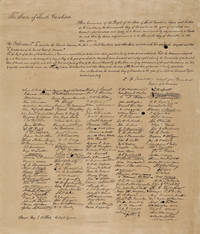
1861WRCAM52380Charleston: Evans & Cogswell 1861. Lithographic broadside 33 3/4 x 26 1/2 inches. Mild creasing toning and spotting. Very minor repaired marginal tears small chip in lower left corner. Near fine. Matted and framed. The very rare lithographic facsimile of the South Carolina Act of Secession which precipitated the beginning of the Civil War and is thus one of the earliest Confederate imprints. One of only 200 copies printed this copy was found among the papers of William Dunlap Simpson a prominent South Carolina legislator and governor. Simpson was a lawyer who served two terms in the South Carolina House of Representatives and one in the state Senate. He acted as a lieutenant colonel during the Civil War and was a delegate to the Confederate State House in 1863. After the Civil War Simpson was elected lieutenant governor then governor for a brief time before serving ten years as chief justice of the South Carolina Supreme Court. <br> <br> This large format contemporary engraving of the original engrossed and signed manuscript document presents the Act of Secession as it was passed and signed in the South Carolina State House. It was so faithfully executed that it also reproduces the ink blots present on the original document. The document features the text of the secession ordinance and the signatures of D.F. Jamison president of the Convention and 169 delegates to the Secession Convention called by Gov. Francis W. Pickens. <br> <br> The historic resolution which revoked South Carolina's ratification of the United States Constitution was largely the work of Robert Barnwell Rhett editor of the CHARLESTON MERCURY which printed a well-known secession broadside of its own proclaiming: "The Union Is Dissolved!" The secession resolution was passed unanimously at 1:15 p.m. on December 20 after which Jamison said "The Ordinance of Secession has been signed and ratified and I proclaim the State of South Carolina an Independent Commonwealth." <br> <br> Shortly after passage of the ordinance Evans & Cogswell printers to the convention were asked to prepare a copy for use by the members. The convention reconvened in March 1861 to address issues related to the coming war. According to the report of Paul Quattlebaum Chairman of the Committee on Printing published as an appendix to the March 28 1861 entry in the JOURNAL OF THE CONVENTION OF THE PEOPLE OF SOUTH CAROLINA the printing was "in a style creditable to the art; and by a careful comparison with the original the Committee find it to bear a very notable similarity to it." The convention delegates immediately authorized Evans & Cogswell to print 200 lithographic copies of the Ordinance to be distributed at the direction of D.F. Jamison. Evans & Cogswell likely printed the 200 copies including the present copy in the days that followed and probably before the Battle of Fort Sumter on April 12. The copies were then most likely distributed to the convention delegates and other prominent state officials such as William Dunlap Simpson. <br> <br> An exceedingly rare and important Civil War document once belonging to a South Carolina governor and Civil War officer with only eleven copies known in institutions according to Parrish & Willingham and even fewer in auction records. PARRISH & WILLINGHAM 3794. CRANDALL 1887. SABIN 87444. JOURNAL OF THE CONVENTION OF THE PEOPLE OF SOUTH CAROLINA pp.204 543. Evans & Cogswell unknown books