1 575 résultats
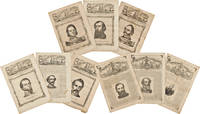
1864WRCAM54026Richmond: Ayres & Wade 1864. Forty-four issues of 110 most 8pp. each. Folio. Old fold lines and light wear. Separations along gutter vertical folds. Some light tanning and soiling scattered foxing and wear. Some issues lightly dampstained. Many issues trimmed at gutter margin creating loose sheets. Still very good overall. THE SOUTHERN ILLUSTRATED NEWS was the Civil War South's answer to northern publications such as HARPER'S WEEKLY. A pictorial paper it printed portraits and biographies of important military leaders political cartoons mocking President Lincoln and other northern figures as well as literary tidbits. The paper ran from Sept. 13 1862 to Feb. 4 1865 and was published weekly. Through 1863 issues were eight pages in length but into 1864 issues were more often four pages or sometimes skipped entirely and only published every other week. <br> <br> The quality of the publication and its illustration were rather crude by comparison with the North's offerings. The publishers advertised several times for expert engravers but never seem to have found any to take up the job. Nevertheless each issue contains cartoons and portraits of famous generals and officers along with literary works a few advertisements theatre and literature critiques and the news of the day though often several days behind. The back page of each issue advertises literary works now available or recently off the press maps of the war and different plays and shows coming up. One cartoon shows a downcast President Lincoln as Julius Caesar with a black Brutus; another shows the pleasant conditions for Union soldiers at Belle Isle Confederate Prison as opposed to the isolation and unhappiness of Confederate soldiers imprisoned in Ohio. Still a further illustration shows a dead man sprawled across a coffin captioned: "The Fate of a Deserter." The NEWS not surprisingly published with a pro-southern bias even to the point of declaring the Battle of Gettysburg to be a great Confederate victory. <br> <br> Publication only became more difficult as the months passed. Legend has it that in 1864 several issues were printed with shoe polish rather than proper printing ink due to shortages not borne out by an examination of existing copies. Paper was also in short supply resulting in shortened or skipped issues. By 1865 with the Union Army occupying major southern cities and marching further into the heart of the Confederacy the paper's circulation plummeted and distribution outside of Richmond became next to impossible. Richmond fell to the Union on April 2 1865 which is when the periodical effectively ceased. <br> <br> This excellent run consists of issues spanning from Sept. 20 1862 No. 1:6 through March 5 1864 No. 3:9. The NEWS published forty-two issues in its first volume Sept. 13 1862 to June 27 1863 twenty-five in its second volume June 27 1863 to Dec. 26 1863 and thirty-eight issues in its third Jan. 2 1864 to Dec. 24 1864. There is some confusion about how many issues appeared in 1865. Some sources record the paper running until September 1865 though that is almost certainly wrong; others say the end of March. The Library of Congress website devoted to historical newspapers "Chronicling America" indicates an end date of Sept. 3 1865 but gives the final issue as Volume 4 issue 5 which was published on Feb. 4 1865. Emory University holds a 4:5 dated Feb. 4 1865 the latest we can find listed anywhere and thus probably the actual end of the publication. Assuming this is correct the present run contains forty-four of one hundred ten issues. <br> <br> Issues are rare and representative runs even more so. A wonderful resource for Civil War history. Ayres & Wade unknown books
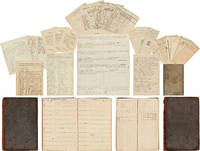
1864WRCAM54525Various places including Ohio Kentucky and Georgia but mostly Tennessee 1864. Five cloth-bound manuscript ledgers two printed books and over 100 documents letters and related forms either wholly manuscript printed or partially printed. Some soiling and staining to bound volumes some bindings partially perished. Typical folds some edge wear and soiling to documents. Overall fair to very good condition. A valuable collection of ledger books and documents recording the Civil War service of Company H of the 40th Ohio Volunteer Infantry. This archive contains five manuscript ledger books two printed volumes and more than 100 documents and letters relating to the unit. The 40th Ohio Volunteer Infantry was organized at Camp Chase Ohio in December 1861. They saw action at Chickamauga the Siege of Chattanooga Lookout Mountain the Siege of Atlanta and the Battle of Franklin. While some of the regiment was mustered out in October 1864 the remainder was mustered out in Nashville in December 1864 with the exception of veterans who were consolidated with the 51st Ohio Infantry. <br> <br> These materials were preserved by 1st Lieut. George Day Stone whose reports and letters can be found in this archive. Lieutenant Stone served in Company H of the 40th Volunteer Infantry from Oct. 9 1861 until Dec. 6 1864. He enlisted as a 2nd lieutenant and was promoted to 1st lieutenant on April 25 1862. He served under two company captains - William Cunningham through 1862 and whose account book is present here and John C. Meagher who is referenced throughout the archive. <br> <br> The 40th Ohio regiment lost over 200 men during service with six officers and ninety- six enlisted men killed or mortally wounded and one officer and 134 enlisted men who died of disease. A healthy number of these casualties are recorded here in the Company H ledger books. <br> <br> The bound volumes chronicle important service details and include: <br> <br> 1 Folio account book of Capt. William Cunningham of the 40th Regiment Ohio Infantry 109pp. September 1861 to August 1862. The ledger records pertinent details regarding moneys issued to various members of Company H throughout the first years of the war. <br> <br> 2 Folio ledger book 57pp. listing commissioned and non-commissioned officers along with a one-page detailed listing of thirty soldiers killed and a descriptive roll of the company with detailed remarks on desertions mustering in and out soldiers taken prisoner and more. <br> <br> 3 Folio ledger book with 16pp. of furlough lists descriptive roll notes and manuscript general orders. <br> <br> 4 Folio volume of Morning Reports 50pp. dated November 1861 to October 1864 listing number of troops with about twenty full reports and a dozen pages of remarks. <br> <br> 5 Oblong folio ledger book 190pp. dated 1862-1864 recording soldier pay and supplies for Company H with notes. <br> <br> 6 INSTRUCTIONS FOR MAKING QUARTERLY RETURNS OF ORDNANCE AND ORDNANCE STORES. Washington: Government Printing Office 1863. 140pp. Publisher's pebbled cloth gilt. Captain Meagher's copy with his ownership signature on the front endpapers. <br> <br> 7 A volume of printed General Orders dated 1863-1864 variously paginated but approximately 150 pp. reporting rolls of officers and men assigned to various units including those judged unfit for duty or removed to invalid units. <br> <br> A sampling of the loose letters and documents is as follows: <br> <br> 1 Lieutenant Stone's report Nov. 15 1863 detailing the capture of John Meagher at Chickamauga and stating that he "was placed in command of said company." Stone then relates the inventory of supplies he found among the remaining men in the company. <br> <br> 2 Two letters addressed to Brig. Gen. Montgomery C. Meigs one dated June 4 1864 and one Sept. 13 1865 being letters of transmittal of men and materials. <br> <br> 3 Letter dated Dec. 5 1864 reporting on David Holmes a private who was "captured and taken prisoner by the enemy while in the line of Duty on or about the 22nd day of September 1864." <br> <br> 4 Several partially-printed "Quarterly Returns of Deceased Soldiers" from 1864 completed in manuscript. <br> <br> 5 Manuscript report from Sept. 25 1863 2pp. reporting on soldiers taken prisoner and supplies lost to the enemy at Chickamauga and Missionary Ridge Tennessee. The report reads in part: "I certify.at Chickamauga.The Regt. to which my company belongs was directed to advance under the fire of the enemy to take a certain position; in so doing one private was killed two severely wounded & two taken prisoner." The report then lists the material lost to the Confederates and a similar report follows detailing prisoners taken and material lost at Missionary Ridge. <br> <br> 6 Two manuscript field orders from the Army of Kentucky dated in the Spring of 1863. The first dated March 20 gives directions on uniform regulations and then instructs officers and soldiers "now quartered at dwelling houses will at once remove to their tents or such hospital as the Regimental Surgeon or Medical Director shall direct." The second field order instructs all soldiers to carry "forty rounds of cartridge in their cartridge boxes." <br> <br> 7 Commissioned officer list for Company H from October 1863 listing thirty-two officers including Stone a sergeant a corporal the wagoner and twenty-eight privates along with detailed remarks on recent movements of everyone but Stone. Most of the privates are listed as either absent or sick. <br> <br> 8 Commissioned officer list for Company H from December 1863 listing thirty-eight officers taken prisoner by the Confederates at the Battle of Chickamauga on Sept. 21 1863 including the aforementioned Captain Meagher and David Holmes. <br> <br> 9 Various blank report forms including morning reports inspection reports receipts for ordnance volunteer descriptive lists and more. <br> <br> An important collection from the 40th Regiment Ohio Infantry providing insight into the various day-to-day activities experiences and duties of the unit during its Civil War service. hardcover books
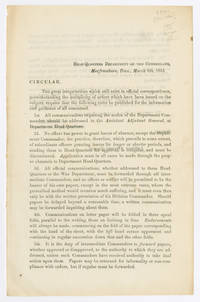
1863WRCAM53711Murfreesboro Tn 1863. Small broadsheet 8 x 5 inches. Light tanning and dust soiling a couple of marginal fox marks. About very good. Gen. William Rosencrans commander of the Union Army of the Cumberland in 1863 asks that the multiplicity of orders and the resulting variations thereof be addressed and the attendant confusion in the ranks be resolved and orders various measures be taken to ensure proper communications. Grant replaced Rosencrans with Gen. George H. Thomas near the end of this year after a series of failures in Tennessee. Not in Allen or OCLC. unknown books
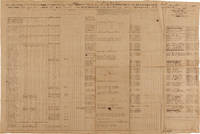
1863WRCAM54505Richmond 1863. Printed form approximately 24 x 36 inches completed in manuscript. Folded. Light wear and a few small separations along folds. Slightly wrinkled at right edge. Moderate tanning scattered foxing. Still very good. A rare example of a Civil War muster roll for a Confederate unit. This roll is for for Company E of the 2nd Battalion Georgia Sharpshooters commanded by Maj. J.J. Cox as they mustered on Feb. 28 1863 near Chattanooga shortly after the battle of Fort Donelson. Although it was a Georgia Battalion the vast majority of men in Company E were from Montgomery Alabama. As a part of Gen. J.K. Jackson's Brigade in the Army of Tennessee the unit fought at Murfreesboro Chickamauga and Missionary Ridge and later as a part of Gen. Gist's Brigade participated in the battle for Atlanta and Hood's Tennessee operations. The roll lists all officers and enlisted men records two deaths in the company a number of absentees through sickness and desertion and even notes two instances of substitution. Civil War soldier substitutions were a controversial tactic in which men of means bought their way out of service. A fine copy of a scarce Confederate military document. unknown books
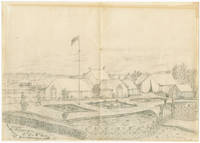
1864WRCAM56141Petersburg Va 1864. Pencil sketch 10 x 14 1/4 inches. One vertical and two horizontal folds. Residue from previous mounting and old repair to verso minute separation at two cross- folds. Lightly tanned. Very good. A large and well-executed pencil sketch of a field hospital toward the end of the Civil War. The artist only identified him- or herself as "W.M.C." in the lower left corner along with the caption: "Field Hospital of the 3rd Div. 6th Corps near Petersburg Va. Pencil Sketch made 1864." In the foreground are the well-tended grounds of the hospital including a flagpole flying the hospital "H" flag with the Greek cross insignia of the VI Corps all surrounded by a wooden fence and trimmed hedge. A complex of semi-permanent tents dominates the majority of the image with two men in uniform in conversation to the left of the tents. In the background are two covered ambulance wagons decorated with medical crosses; trees and small houses are visible further in the background. <br> <br> The VI Army Corps was created in 1862 and assigned to the Army of the Potomac although in 1864 it was temporarily assigned to the Army of the Shenandoah under the command of Maj. Gen. James B. Ricketts. Although the VI Corps faced heavy fighting throughout the Civil War 1864 was particularly violent - this field hospital was undoubtedly packed throughout the year. In the wake of the Battles of the Wilderness and Spotsylvania during the Overland Campaign to the close fighting near Mule Shoe also known as the "Bloody Angle" the assault at Cold Harbor and the Shenandoah Valley campaigns the VI Corps saw nearly two-thirds of its 24000 soldiers killed or wounded. In December 1864 the VI Corps returned to the Army of the Potomac and in April 1865 played an important role in the final assault on the fortifications of Petersburg. unknown books
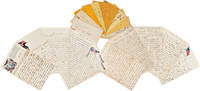
1865WRCAM55678Various locations including Washington D.C.; City Point Va.; Petersburg Va.; Brandy Station Va.; Annapolis Md.; and others 1865. Thirty-two war-date letters totaling approximately 95pp. plus ten retained transmittal covers and assorted post-war family papers. Original folds minor wear creasing and toning. A few letters slightly clipped likely to retain the patriotic letterheads. Overall very good. In mylar sleeves within a modern three-ring binder. An interesting Civil War collection of thirty- two letters spanning the length of the war almost all addressed to Mary H. Winant of Staten Island along with ten original transmittal covers and other documents and family papers. Many of the letters are from Mary's family members serving in the war including her brother James her cousin George F. Rezeau and her uncle James E. Rezeau as well as a few other friends. The letters present the experiences of war from numerous different perspectives showing how the conflict affected extended families and whole communities all of them sent to the same woman back home a beloved sister relative and friend. <br> <br> James Winant writes to his sister on November 10 1861 after his unexpected enlistment. It appears that he had not intended to join the army but was swept up in the fervor after many of the young men from their hometown answered the call. He writes to Mary from Camp Campbell in Washington D.C.: <br> <br> "I was expecting to come down the first of November but Mr. Alfred Dart was getting up a Company of cavalry & quite a number of the Herrick boys put their names to the list & wanted me so I did not mean to back out. I put my name to the list the 15th of October & started for Harrisburg the 23. I had but a little time to get reddy sic to go with that company as I should have come to see.I have been in to the Capital & I saw a site the city is well surrounded by our northern troops we expect to hear of a battle every day on the other side of the Potomac. There was about 20000 soldiers left since Friday." <br> <br> Despite having seemingly joined the Union Army on a whim James Winant took his duty very seriously. Two weeks later James tells his sister in a November 23 letter: "I should like to see you but I do not know when that will be but I shall not leave without orders if I was shure that I would never be found out I never would. I will die in the battlefield before I be a Diserter sic never. I came to Fite sic for my country and I shall if called on and never flinch in that course." However that did not mean that James was thrilled with life in the army. His January 15 1862 letter reads in part: ".I hope you enjoy your new year well although I did not enjoy mine very well for I had to stand on guard and that is the worst part of soldiering we have to be out in all kinds of weather and the weather is very changeable. One day it is almost like summer and the next day it is cold enough to freeze a person.It takes 104 men to guard our camp." Moreover by February 25 James was thoroughly restless and tired of being at Camp Campbell writing: <br> <br> "Our Regiment is No.1 & it is referred for the City Provost Guards. There is two Companys out of our regiment guarding the city now & we expect to go in a week. We expect to get our horses this week. I would rather be in the army acrost sic the Potomac for I am getting tird sic of guarding this old camp. When we get to the city we will have better times. There has been quite a move for the last two weeks. The federal troops has got a strong hold of the rebels & I hope they will keep on crossing it." <br> <br> Interestingly in one of the only letters not addressed to Mary James writes his father with much of the same information he includes in this letter. It reads in part: "Our troops is doing good business in the South they have taken the most important places & a large number of prisoners & they will soon take the rest. I wish our company was in the army acrost the Potomac. I should like to see a fight with the rebels for I am getting tired of guarding this camp." <br> <br> In the only response from Mary retained in the collection she writes back to James trying to offer her brother some comforting words although she was worried about him being sent into battle. In a letter written on April 28 Mary writes to James to beg him to put his faith in God. She included a poem to let him know she was always thinking of him. The letter reads in part: <br> <br> "O James how it cheers my Lonely Heart to hear from you.that you would not be cald sic to the battlefield but since I read your last letter wich sic informs me that you have been ordered to march in pursuit of the Enemy. My hope is well nigh expired though I know Dear Brother that you have Enlysted sic in a noble cause and given your heart and hand to your Country and now there is one step more noble for you to take and that is give your heart and head to God and you will be indeed a brave soldier." <br> <br> Mary also received a couple letters from her cousin George Rezeau in Pennsylvania and a few from her uncle James Rezeau. George does not appear to be serving in the military yet when he first writes to Mary though he would enlist shortly. By November 1862 George writes to check in on Mary from Camp Simmons and Camp McClellan. He signs off the former letter "Your naughty cousin G.F. Rezeau." <br> <br> George's father Uncle James Rezeau is also a Union man. He writes to Mary from Annapolis in August 1862 that he is anxious for his regiment to join the battle and that "if our regiment don't go on soon I will leave it and go into York State and join some other one and go down South for I enlisted to fight for my Country.I want to see the Elephant Old Jeff Davis and feed him some cold lead or else about twelve inches of cold steel." <br> <br> The latest letter in the archive is also from James Rezeau dated March 3 1865 to Mary written from the 67th Regiment Headquarters near Petersburg Virginia. Here a month before the war's end Mary's uncle writes to her check on her as he had heard she was sick. Uncle James also writes about war wages and sending money home to various family members including Mary whom he sends seventy-five cents. He also writes a letter to Mary's parents his own brother- in-law and sister from Brandy Station in early February 1864. He talks about his various health ailments including dysentery and diarrhea "It seems almost as bad as consumption for it reduces a man to almost a Skeleton" how he can't keep down any real food the bitterness of the cold and muddy Virginia winter and how he looks forward to seeing "all of you when this cruel War is over." <br> <br> There are also a handful of letters between family members i.e. a letter to Mary from her mother Eliza and some from friends and other soldiers. One letter dated August 26 1864 is from a friend "M. McPherson" who writes to Mary with news of her wounded cousin George: <br> <br> "G.F. Rezeau started for the Hospital this morning. He was wounded yesterday in a Battle between Shepherds Town and Winchester his wound is through the left hand the ball passed through his hand and spoiled the pocket in his shirt his glasses and his pocket combs beside bruising his side right smart. His wounds were very Lucky ones if there is any such. At the time George was wounded we were just going to charge he went to the Rear the Regt charged and we received a Perfect Shower of Rebel Compliments. There was a whole Brigade of Reb Infantry lying in ambush when we charged upon the Hill. They raised up there position was such they had a cross fire upon us." <br> <br> Included at the end of the archive are a number of documents and forms from after the war and as late as the turn of the century. They appear to be unrelated to Mary Winant although they could have belonged to her family or descendants. There are also ten original transmittal covers addressed to Mary Winant. <br> <br> An informative and research-worthy collection of Civil War and Civil War-era family correspondence. unknown books
1864283340Springfield 1864. unbound. very good. Interesting Home-Front A.L.S. 4to. 2 pages Springfield Illinois September 7th 1864 concerning happenings in and around Wisconsin. In part: "I am glad to hear of your recovery from your wounds. Where did your father leave you when he went to Nashville after you Mr. Hill says he left you part way home. I was in hopes that you would come down and see me before you went into the Army again but you did not say anything again about it in your letter. Andrew - you sent me your picture before you went to the War and I gave it to Harry's girls when I was out there.and Libby gave me another one when I was at your place. Charley Gilbert's corpse was brought home Saturday I believe from Memphis.he was in the 40th Regiment. His family did not know he was dead until his corpse arrived home. He died with Dysentery. PS - Tell your Mother that butter is 35 to 40 cents here. Condition: Visual folds as expected from the passing of the letter from one relative to another - otherwise in very good condition.<br/><br/> unknown books
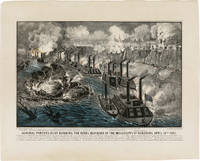
1863WRCAM56146New York: Currier & Ives 1863. Handcolored lithograph 12 x 15 inches. Tiny chip in upper left corner well away from the image. A clean near fine copy. A colorful and dramatic depiction of Admiral David Dixon Porter's Mississippi River Squadron running the Confederate blockade at Vicksburg during the siege of the city by Union forces in 1863 an important strategic victory in taking control of the river. Captions identify Porter's flagship the U.S.S. Benton in the right foreground leading the Lafayette and General Price which are followed by the Louisville Mound City Pittsburg Carondelet Silver Wave Forest Queen Henry Clay and Tuscumbia. A barrage of cannons fire from both the squadron and the Confederate batteries on the embankments overlooking the river. Union cannonballs are hitting both the batteries and the buildings on the bluffs of Vicksburg further in the background. Clouds of smoke billow from the ships the burning buildings and one of the floats of flammable material set out by the Confederates. <br> <br> Initially Grant had asked only for a few gunboats to shield his troops but Porter persuaded him to use more than half of the Squadron. Six nights later April 22 they made a similar run past the batteries to give Grant the transports he needed for crossing the river. Grant first tried to attack the Rebels through Grand Gulf south of Vicksburg and had Porter's gunboats eliminate the two forts there so his troops could cross. Despite intense shelling the upper fort held; Grant called off the assault and moved downstream to Bruinsburg where he crossed unopposed. Afterwards Porter's ships remained in place securing the Mississippi and Yazoo Rivers and guaranteeing the success of the siege. Grant was effusive in his praise Porter's actions and for his contribution to the victory Porter's appointment as acting rear admiral was made permanent. <br> <br> The additional printed caption describes the event thusly: "At half past ten P.M. the boats left their moorings & steamed down the river the Benton Admiral Porter taking the lead - as they approached the point opposite the town a terrible concentrated fire of the centre upper and lower batteries both water and bluff was directed upon the channel which here ran within one hundred yards of the shore. At the same moment innumerable floats of turpentine and other combustible materials were set ablaze. In the face of all this fire the boats made their way with but little loss except the transport Henry Clay which was set on fire & sunk." <br> <br> The Union victory at Vicksburg was the second major blow to the Confederacy in the spring and summer of 1863. On July 3 Lee's invasion of the North foundered at Gettysburg and on July 4 the U.S. flag rose over Vicksburg. This print is surprisingly uncommon in the market. CURRIER & IVES: CATALOGUE RAISONNÉ 0058. PETERS CURRIER & IVES 1180. Currier & Ives unknown books
18652285Petersburg VA: Eden & McCreery 1865. First edition. framed. EXTREMELY RARE FIRST ISSUE OF "GRANT'S PETERSBURG PROGRESS" PRINTED BY UNION SOLDIERS ON A CONFEDERATE PRESS THE DAY PETERSBURG AND RICHMOND WERE SEIZED SIX DAYS BEFORE LEE'S SURRENDER. "When on that famous Monday the third of April 1865 the advance line of attack on Petersburg found the city evacuated by the Confederate troops almost the first Federal soldiers to enter her doors took possession of the office of the Express and before the day was over from its presses there issued number one volume one of Grant's Petersburg Progress. It was a single sheet twelve by twenty inches in size printed on one side of the paper. Its cry was 'We are here!' Major Eden 37th Wisconsin Volunteers was editor assisted by Captain Charles H. McCreery 8th Michigan Veteran Volunteers and Chaplain D. Heagle. They proposed 'to publish a live paper as ling as circumstances will permit; that is as long as we can steal the paper and get men detailed to set the type.' Ten cents was the price. 'We are not particular as to the medium of exchange; and will take Hardtack Greenbacks Cigars postage stamps and in fact most any available currency Confederate Bonds and Contrabands always excepted.'" Nellie P. Dunn "General Lee in Grant's Petersburg Progress" South Atlantic Quarterly vol. 12. This first issue from the day of the fall of Petersburg was followed by only four other issues April 5 7 10. <br /> <br /> The paper is full of joy and wit providing a wonderful window into the mood of the soldiers now that the end of the war was near. <br /> <br /> Some highlights from the text:<br /> <br /> "For nearly six months the army of the United States has kept watch and ward over the City of Petersburg. Since last June the roar of shells and the whistle of bullets have disturbed the silence of the woods in the vicinity and today the old flag waves from the Court House. The United States armies and U.S. Grant have foreclosed and entered in possession and Petersburg is ours. And throughout the length and breadth of the land the joyful tidings will spread that another deadly blow has been struck at the fast dying Southern Confederacy. Slowly and miserably it yet drags on a lingering existence but its days are numbered and the end is at hand. The bright rays of the sun and the pleasant fresh breeze of this fair spring morning kiss the folds of the stars and stripes as it waves from the tower and hill the streets wear a lovely and animated appearance thronged with soldiers and citizens the cause of Liberty and truth is triumphant."<br /> <br /> Under the heading "LATEST NEWS":<br /> <br /> "RICHMOND TAKEN. -Just as we are about going to press we are reliably informed that the city of Richmond came into the possession of the Union forces at a quarter past eight o'clock this morning."<br /> <br /> Under "WE US AND CO":<br /> <br /> "We believe in the UNITED STATES one and indivisible; in Abraham Lincoln our adopted Father; in U.S. GRANT Captain of the Host; and ourselves as the principle sojourners in the Army of the Potomac and the Freedom of the Contraband the speedy extinction of the Rebellion and the perdition of Jeff. Davis here and here after."<br /> <br /> Under "FASHIONABLE ARRIVALS":<br /> <br /> "April 3d Gen. Grant and Staff and the Army of the Potomac generally."<br /> <br /> Under "AUCTION SALES":<br /> <br /> "To be sold very cheap if not badly sold already all the singularly ineligible and worthless property known as THE SOUTHERN CONFEDERACY. For particulars apply to Jefferson Davis Richmond Va. N.B. Liberal terms to agents of Maximillian Louis Napoleon or Victoria."<br /> <br /> Petersburg VA: Eden & McCreery April 3 1865. Broadside printed on recto only approx. 12x19.5 inches. Framed to an overall size of 17x24 inches. Some small holes at folds and edges; a few words of bleed-through from hand-written ink on verso. A wonderfully evocative piece of Civil War history. SCARCE. Eden & McCreery unknown books
186263800Raleigh NC 1862. Folio. One page countersigned by Pulaski Cowper the governor's private secretary. Henry Clark 1808-1874 a native of Tarboro gradated from U.N.C. in 1826 and read law before taking over the management of his father's plantation and other business affairs in the early 1830s entering politics with election to the state senate in 1850 rising to the speakership and taking over as governor when John Ellis died in 1861 preparing the state for war during his year in office Zebulon Vance became governor in September 1862. Pulaski Cowper 1832-1901 a native of Murfreesboro graduated from U.N.C. read law and practiced with Thomas Bragg and served as Bragg's private secretary when he was elected governor in 1855 returning to that position when Clark assumed the post in 1861. Andrew A. Hill a native of Iredell County and a student as the war began served as commander of Co. G 7th N.C. leading it through battles in 1862 and 1863 until wounded twice during Pickett's Charge at Gettysburg never fully recovering and being discharged on permanent disability in early 1865. Very good. Folded. 10313. <br/><br/> unknown books
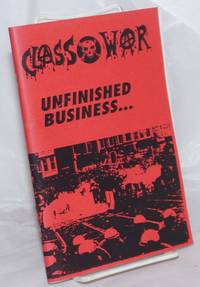
1992257175Great Britain: Class War 1992. pp15-95 11p. stapled wraps 5.5x8.5 inches very good zine-style photocopied reproduction of the book published in 1992 by Class War and AK Press not including the introduction or afterword. Class War unknown books
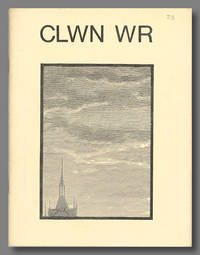
1981WRCLIT77181Brooklyn NY 1981. Whole number 23 of 31 published. Pictorial wrapper. 12mo. Very good to fine. Edited by Bob Heman. Devoted to short experimental poems/prose-poems and innovative graphics Clown War was distributed for free after issue #12. This number is devoted to short poems including work by Corman McInerney Perlman Hejinian McCauley Tarachow and Hemen. ANDERSON & KINZIE p.692. CLAY & PHILLIPS p.269. unknown books
198713906Paris: Roger Dacosta 1987. 1st edition. Roger Dacosta unknown books
200416013Urbana: University of Illinois Press 2004. First Edition. Octavo. Cloth boards; dustjacket; 227pp; illus. Fine and unmarked in unworn jacket; near-new. University of Illinois Press unknown books
16296EAST GERMANY. Die Kaserne. Bonn: Verlag „Ganz offene Worte" 1957-1963. 26 issues of an East German propaganda magazine. 1957 Heft 3; 1958 Heft 1-5; 1960 Heft 7; 1961 Heft 4-10 12; 1962 Heft 1-7 9-11; 1963 Heft 2. 7 ½ x 5 ½ in. Three smaller format. Staplebound. All have color covers and illustrations throughout. "Die Kaserne" was an East German magazine targeted specifically for young men in the West German military; the main object of the magazine was a disinformation campaign aimed at creating distrust of the West.<br/><br/>Kaserne English translation Barracks was created with the goal of creating dissent within the West German military by targeting conscripts. Some articles explicitly question the validity of required military conscription service which the West instituted in 1956; while others expose Nazi histories of West German leaders such as ambassadors; and many issues have strong criticisms for BRD politicians one even calls Willy Brandt who later became Chancellor of West Germany an American boot-licker Stiefelputzer. Most of the content was not overtly controversial and sought to establish common ground with low-ranking drafted soldiers. The issues are filled with jokes about military life and references to shared German culture i.e. Goethe They also feature notable East Germans such as cosmonaut Yuri Gagarin and include stories about the high quality of life for workers women and families. Appealing to their target audience of young men over a dozen of the issues feature models or pinup girls on the covers.<br/><br/>Rather than try to explicitly convert soldier to full East German ideology the objective of these magazines was to create loyal readers who would disrupt overall West German military strategy. In the ideal situation this would be the first step in converting these Bundeswehr soldiers to East German political ideology and possibly becoming a Communist spy.<br/>Pristine information cards in several issues encourage readers to subscribe to the free publication and to share copies with their fellow West German soldiers. Light reading wear. All in very good condition. unknown books
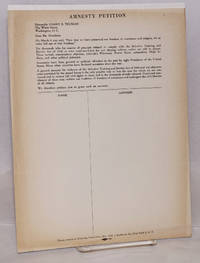
1946209546New York: Amnesty Committee 1946. 8.5x11 inch sheet printed one side toned around edges. Upper 1/4 is text the lower portion left blank for signatories. A petition to president Truman seeking amnesty for conscientious objectors sentenced for resisting the draft during the second World War. Chairman of the Committee was A.J. Muste. Amnesty Committee unknown books
179837New London CT: CNVA WRL 196-. Imitation banknote printed both sides with Thoreau portrait and text opposing Vietnam War 3.5x7.5 inches; very good. Denomination given as "1 peace yen." Text on the reverse outlines opposition to taxes paying for the Vietnam War. The CNVA merged with the War Resisters League in 1968 so this was issued sometime between 1966 and 1968. The design was executed by Mark Morris of San Francisco and printed at the Grindstone Press in New London. "This money is as phony as the 'security' the US 'defense' dollar buys. CNVA, WRL unknown books
1918140941439Washington D.C.: Committee on Public Information Division of Women's War Work 1918. Approximately 450 mostly mimeographed press releases spanning from February 1918 until July that same year many of which are 8.5" x 11" or 14" others of which are newspaper column-size 3" x 21" or varying lengths. Three groupings of the releases are claspbound the rest are loose. Includes Bulletins Nos. 1 & 2 both printed in January 1918 by the Government Printing Office folded in half vertically with reply card. Includes a TLS from Guy Stanton Ford Director of Civic and Educational Publications later President of the University of Minnesota to the President of Rice University. Very Good overall lightly toned with age a little chipped along edges folded horizontally two or three sheets torn in half.<br /> <br /> <p>A collection of pieces attempting to mobilize domestic support for the US in World War I issued by the women's division of the Creel Committee an independent agency in the Wilson administration. The Creel Committee attempted an unprecedented full court press of propaganda aiming to reach every stratum of American society. Many a budding public relations figure cut his teeth in the agency including Edward Bernays and Carl R. Byoir. The particular division from which all these pieces were issued focused on American women: variously promoting the work of journalist Ida Tarbell and the YWCA soliciting women to become Morse code telegraphers spreading anti-German and pro-Ally stories trying to get women of any number of religious denominations or ethnic groups to directly contribute to the war effort. This archive illuminates how American war propagandists saw women at the twilight of WWI. Specifically it reveals how civic participation technology military service and information theory were gendered in mass society-- or at least as observed and molded in that society by a particular body of elites. Committee on Public Information, Division of Women's War Work unknown books
1921546New York: Association Press 1921. viii 296p. Association Press unknown books
1966175189Madison: Committee to End the War in Vietnam 1966. Single issue of the mimeographed newsletter printed two sides of an 8.5x14 inch sheet with the mimeographed statement by the University of Wisconsin Student-Faculty Committee stapled to it folded for mailing with address label on back. Reply to Johnson ends "The Great Society cannot be built on the blood of the Vietnamese people. Committee to End the War in Vietnam unknown books
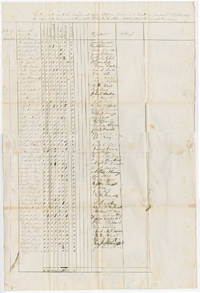
186223879.02<p><b>COMPANY D 1st VERMONT CAVALRY. CIVIL WAR.</b> Manuscript Document Signed June 1862: List of clothing distributed to 54 men including 25 caps 24 blouses 50 trousers 66 flannel shirts 15 drawers 19 bootees 69 stockings and 3 blankets. <b>Each row signed by the soldier who received the items</b>. 1 p. 15½ x 23¾ in. </p><p>"<i>We the undersigned Non Commissioned Officers Artificers Musicians & Privates of Company 'D' 1st Vt Cavalry do acknowledge to have received of Capt. A. W. Preston the articles of Clothing set oposite our respective names</i>"</p><p><b>Soldiers included:</b></p><p>Jacob Trussell Rodney Eames</p><p>Harrison B. Michell James Esdon</p><p>Josiah H. Moore Samuel L. Higgins</p><p>George P. Blair Orin S. Hendrick</p><p>George C. C. Clemment Azro H. Kinerson</p><p>Horace Ide Harvey A. Marckres</p><p>Barney Decker Arthur Murray</p><p>George A. Austin John Morse</p><p>Dan Adams Henry A. Moore</p><p>Harvey Bickford Kyron Morrill</p><p>William Buck Warren Norris</p><p>B. H. Bard Elijah C. Page</p><p>Bartlett S. Bard Francis Rowell</p><p>John A. Beaton L. S. F. Reed</p><p>George F. Bennett Curtis L. Stacy</p><p>Austin A. Bailey Edwin W. Southworth</p><p>C. W. Clifford Martin V. B. Vance</p><p>Ansen L. Chandler John Woodard</p><p>Loren Chase Jr. William Woodard</p><p>Antipas H. Curtis signed with mark John Woodbury</p><p>Milo J. Corliss Fernal H. Webber</p><p>Consealer F. Durlam William Wheaton</p><p>John S. Coombs Mark M. Wheeler</p><p>James Davis James Wright</p><p>John C. Gracy Darwin J. Wright</p><p>Joseph W. Gordon Died J. Hale Powers</p><p>Patrick C. Gilligan Charles Knapp</p> books
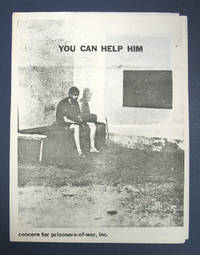
40018San Diego: Concern for Prisoners-of-War Inc n. d. Ca. early 1970s. White printer paper printed with black ink. Moderate wear to paper age-toning. An about VG example. 3 leaves two printed both sides. 3 B/w photographic images. 10-5/8" x 8" <br/><br/>No holdings located on OCLC. Rare in the trade. Concern for Prisoners-of-War, Inc unknown books
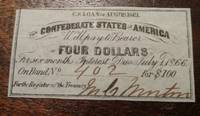
16784Confederate 1866 Civil War Bond Coupon 8634. A bond is a document of title for a loan. Confederate war finance involved the various means fiscal and monetary through which the Confederate States of America financed its war effort during the American Civil War. Bonds are a loan and are issued by national state or city governments or businesses. They are normally repayable within a stated period of time. Bonds earn interest at a fixed rate. Those payment are done by returning the coupon in exchange of payment. Of course here the Confederate government lost the civil war and all investors and lenders lost all their money. So no one one could collect on this coupon. unknown books
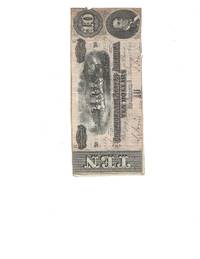
16791Confederate States of America $10 Note of 1864. When the Civil War broke out the newly-formed Confederate States of America needed to create a monetary system to finance the government and the war effort. The Confederate Treasury printed bank notes The Confederate States dollar was first issued just before the outbreak of the American Civil War by the newly formed Confederacy. It was not backed by hard assets but simply by a promise to pay the bearer after the war on the prospect of Southern victory and independence. As the Civil War progressed and victory of the South seemed less and less likely its value declined. After the Confederacy's defeat its money had no value and most notes were destroyed. In very good condition. unknown books
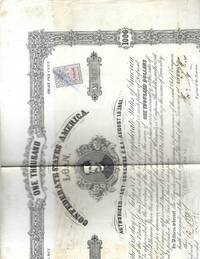
16794Confederate States of America $ 1000 loan Bond with Coupons Richmond 1862. Original Loan with 23 coupons first 8/1865 With elaborate engraving and ornate boders Richmond October 1862. When the Civil War broke out the newly-formed Confederate States of America needed to create a monetary system to finance the government and the war effort. To raise money to finance its government the Confederate States of America issued bonds. This bond dates from late in the Civil War when printing too much paper money had created rampant inflation. The Confederacy began issuing bonds. After the Confederacy's defeat the U.S. government refused to cover Confederate debts making the bonds worthless as debt instruments or market securities. its bonds had no value and this bankrupted many confederate families. Over the following decades most of the worthless bonds were destroyed. Very good example complete with fully attached redemption coupons in very good condition. unknown books