[CHINA -- SINO-JAPANESE WAR].Biblio.com
11 490 résultats
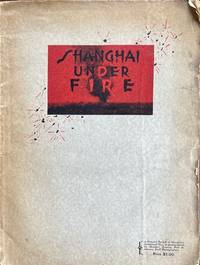
193760087Shanghai China: Post-Mercury Co. 17-21 Avenue Edward VII Shanghai Evening Post & Mercury 1937. 4to. 9 x 12 in. xv 1 88 pp. With 100s of text photo illustrations on gray-blue tinted paper. Colour-illustrated softcovers cover art photo of red & black tinted smoking skyline of Shanghai w/ bomb bursts illustrated on front cover “Shanghai Area War Maps†on endpapers -- surprisingly light interior toning to the XV pp. of text on light-gray tinted paper bumping & wear at covers some dustsoiling chipping head & foot of spine still G copy stapled as issued. First edition 1st printing of this scarce illustrated pro-China work documenting the opening campaigns by the Imperial Japanese Army Air Force and Navy during the Second Sino-Japanese War. Hostilities had increased throughout the 1930s following the first Sino-Japanese War in which Japan had conquered and absorbed Manchuria into the Japanese Empire. Chiang Kai-shek’s nationalist forces joined with the warlords of Hunan and Szechwan provinces to fight the Japanese after a number of provocations in the summer of 1937. Chiang Kai-shek believed that by initially attacking and bombing Japanese naval installations and troops in and around Shanghai he would force the foreign powers to ally with China to fight against Japan to protect their enormous investments in southern China. The Nationalist Chinese armies held out for three months against ferocious bombardment and shelling by the Japanese from planes based in Taiwan and ships on the Huangpu River inflicting huge numbers of casualties on the Chinese and eventually forcing the Chinese to retreat from Shanghai to Nanking with Japanese reinforcements constantly decimating them. These images show victims at the South Station bombings caring for Chinese wounded Chinese women training as soldiers and nurses in the aftermath of the North Station Area shelling and bombing bitter retreat by Chinese soldiers the advances and marching of Japanese forces in Shanghai and beyond. This would later be revised and reissued in March 1938; See: Dorothy Perkins Japan Goes to War: A Chronology of Japanese Military Expansion 1997 pp. 127-135; Crittall in Shanghai -- Some Photos Unearthed December 22 2008. Post-Mercury, Co., 17-21 Avenue Edward VII, Shanghai Evening Post & Mercury, paperback
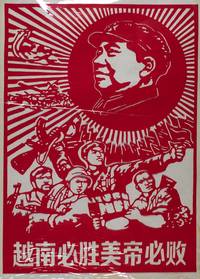
160398No publication details. No date. Late 20th Century. Large Chinese Vietnam War papercut on red paper with paper backing. Lower section features four soldiers in uniform looking fiercely towards the enemy while carrying weapons like machine guns and grenades. Upper right section Mao's head and collar portrait the sun with its bold rays extending behind him red flags flying underneath the beaming sun military aircrafts and a tank also featured next to Mao's portrait. Very good. Text in Chinese reads "Vietnam Must Win and US Imperialism Must be Defeated" sheet measures 70 x 50.3cm. . No publication details. unknown
194164256New York NY John Day Co. 1941. 8vo. 240 pp. Blue publisher’s cloth gilt Chinese lettering front cover black lettering on spine in English & Chinese Chinese writing on endpapers for Longevity & Luck minor edgewear light uniform toning minor tidemark head of spine minor soiling rear joint w/ d.j. cover art photo of war damage from Japanese bombing illustration of three girls on back cover chipping & tears head & foot of spine minor closed tears edgewear still G/G- copy from the library of David Kohl 1946-2025 former art teacher at the Hong Kong International School musician artist and historian. First edition of this very scarce original memoir of Lin Yutang’s three daughters memoir of their pilgrimage to China following up their “Our Family†considered the first nationally printed diary/autobiography of children in America and published nationwide. They write about crossing the Japanese lines during the Second Sino-Japanese War experiencing over 40 bombing air raids over three months and finally being repatriated back to the U.S. with their father Lin Yutang who had returned stateside to advocate for Wartime aid and support for China. Adet Lin 1923-1971 wrote under the pen name of Tan Yun and by this publication date had written “Girl Rebel†and later worked for the American Bureau for Medical Aid to China. Anor Lin 1926-2003 wrote the 1943 War Tide and would later become Editor in Chief for Reader’s Digest in Hong Kong for 33 years and Hsiang Ju Lin the youngest would become a Ph.D. in biochemistry and later cancer and AIDS researcher. John Day Co., hardcover
186732581New York: James O'Kane 1867. "Fourth Edition" but actually the fourth printing of the first edition. With frontispiece and three other engraved plates by F. O. C. Darley. Small 8vo publisher's original plum cloth the upper cover and spine gilt lettered and decorated. 263pp. A beautifully preserved copy the text is fresh and clean a little uniform mellowing to the plates but no spotting at all the binding firm and strong with hinges in fine order the cloth in nice shape and unfaded but with a little expected rubbing and mellowing the gilt on the spine dulled. In all a very good and attractive copy. THE AUTHOR'S FIRST BOOK AND A VERY NICE COPY INDEED. Dodge would create an instant classic with HANS BRINKER. THE IRVINGTON STORIES were her first published works she would be the recognized leader in American juvenile literature for almost a third of the nineteenth century.<br> THE IRVINGTON STORIES were very successful and would lead to her later fame. The work is composed of eight short stories. The first of which "The Hermit of the Hills" is a Christmas tale. There is also a story of the Civil War and an Indian tale.<br> The earlier issues of IRVINGTON STORIES are very rare on the market. James O'Kane hardcover
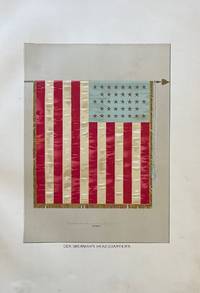
188759523Philadelphia: Burk & McFetridge Lithographers U.S. Army 1887. Folio. 11.5 x 15.5 in. 87 leaves unnumbered. 87 chromolithograph plates for title and flags throughout all mounted on linen hinges as issued. Brown pebbled publisher’s cloth gilt lettering front cover decorated endpapers front inner hinge starting very faint tidemark & bubbling to cloth of fore-edges of front cover minor wear & bumping to corners still a VG bright copy w/ plates quite sharp. First edition of this lavish work reproducing the flags carried by U.S. Army infantry cavalry and artillery units during the Civil War featuring headquarters flags battle flags corps flags pennants and guidons. Following the Civil War both Sherman and Sheridan attempted to regularize unit flags and recommended that battle names be omitted from the flag and unit registers. This work compiled by US Army Brig. Gen. Holabird 1826-1907 was carried out towards the end of his service as Quartermaster which ended June 16 1890. William Burk ca. 1857-1905 and John McFetridge 1844-1903 launched their company in 1877 by purchasing William Harding’s printing house and specialized in chromolithographic trade cards advertising book illustrations calendars and other material until about 1900. Burk & McFetridge, Lithographers, U.S. Army, hardcover
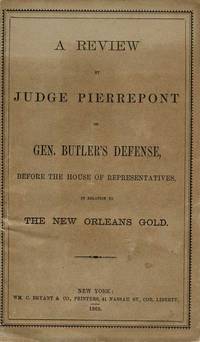
186521232New York: Wm. C. Bryant & Co 1865. Very good condition. Review concerning the Union General Benjamin Butler notorious for issuing "The Woman Order" General Order No. 28 during the 6 months May - October 1862 he was the military governor of New Orleans. It essentially ordered that any woman showing contempt for a Union soldier "shall be regarded and held liable to be treated as a woman of the town plying her avocation" in other words a prostitute. Butler nicknamed "The Beast" was also charged with looting gold and other valuables from New Orleans mansions and banks the subject of this review. 8vo 27pp. Tan printed wrappers title in black at front wrapper. Wrappers a bit sunned. OCLC: 5728749. Wm. C. Bryant & Co unknown
186223685New York: G. Savage 1862. Fine. Civil War era addenda to the Municipalist a New York magazine published following the "Separation of the United States". The first sentence reads "Since the preceding Letters have been published the United States of America have been dissevered and a new federation under the name of Confederate States of America formed". The Municipalist was first published in 1858; the second edition in 1859. <br /> <br /> Contents include secession enforced union convention of the states Abolitionists Shay's Rebellion the United States a great people no nation; and more.<br /> <br /> Plain paper wrappers. 16mo 303-348pp 1pp "Some Private Opinions". Stitched. Sabin 51330. OCLC: 950932219 one copy at the American Antiquarian Society. G. Savage unknown
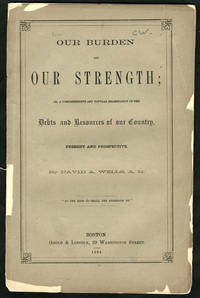
186423679Boston: Gould & Lincoln 1864. Very good - condition. Civil War era publication assessing the resources and debt paying capacity of the US "Can we pay our present and prospective National Debt . p1 written by American economist and advocate of low tariffs David Ames Wells.<br /> <br /> Wells 1828 - 1898 was a strong supporter of Abraham Lincoln during the war writing pamphlets reassuring investors on Lincoln's financial policies. <br /> <br /> 'Our Burden and Our Strength' established Wells' reputation as a political economist. Wells' analysis attracted the attention of Lincoln who in 1865 appointed him chairman of the National Revenue Commission. In this role Wells was the first to collect economic and financial data for government use; the Commission's recommendations became law in 1866.<br /> <br /> 8vo 39pp. Original printed paper wrappers with chips around the edges wrappers loose but present. OCLC: 12120949. Gould & Lincoln unknown
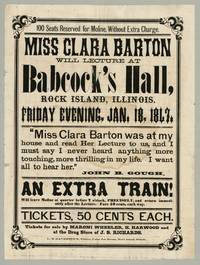
186713091Rock Island IL: L.M. Haverstick Printer Union Job Rooms 1867. Broadside 24 x 18 inches. Old folds minor creasing a few small chips short closed tear to left edge near the "B" in "Babcock's" faint circular dampstain in center minor scattered foxing. Withal very good condition. A visually appealing and seemingly unique surviving broadside advertising a January 18 1867 lecture by Clara Barton. At the time Barton was touring with her lecture entitled "War & Incidents of Army Life" part of a popular post-Civil War series of talks she delivered across the United States. Barton spent two years touring and recounting her battlefield experiences which helped popularize her and fund her subsequent efforts to locate missing soldiers. The present lecture was delivered at Babcock's Hall in Rock Island Illinois. In addition to the bold title containing the relevant information on the lecture and the information on obtaining tickets at the bottom the middle portion of the broadside prints a quote by noted temperance lecturer John B. Gough praising Barton's lecture: "Miss Clara Barton was at my house and read Her Lecture to us and I must say I never heard anything more touching more thrilling in my life. I want all to hear her." Below this quote is a notice that although Moline and Rock Island are only a few miles apart "An Extra Train" on the famed Rock Island Railroad will be provided to transport attendees of the lecture from Moline for a ten-cent fare. Typographically the broadside is interesting for employing several sizes and types of fonts likely wooden type which provides multiple opportunities for catching the eye of the observer. This includes a rather Gothic-style font when printing the date of the lecture.<br /> <br /> Clara Barton 1821-1912 was a noted educator and humanitarian who helped distribute needed supplies to the Union Army during the Civil War and later founded the American Red Cross. Barton garnered nationwide recognition for her efforts during the war and quickly became known as the "Angel of the Battlefield." After the war Barton's lecture tour brought her in contact with other notables of the day including Susan B. Anthony and Elizabeth Cady Stanton and also Frederick Douglass who involved her in the suffrage and civil rights movements respectively. In the Fall of 1866 Barton began to lecture on her Civil War experiences in lyceum halls churches town halls and schools. Though she never felt comfortable in front of an audience wherever she spoke Barton was well received. Her contemporary biographer Percy Epler wrote that "a tear-stained multitude thronged everywhere to hear her" as she had made it her mission to show not "the glories of conquering armies but the mischief and misery they strew in their tracks; and how while they march on.some one must follow closely in their steps crouching to the earth faces bathed in tears and hands in blood. This is the side which history never shows."<br /> <br /> From 1866 through 1868 Barton delivered over 200 lectures throughout the northeast and midwest regarding her Civil War experiences. She shared platforms with other prominent figures including the aforementioned Douglass as well as Ralph Waldo Emerson William Lloyd Garrison and Mark Twain. She often earned $75 to $100 per lecture. Original broadsides advertising her lectures are exceedingly rare to say the least. We could locate just a single result in auction records of a much smaller example and OCLC reports just one institutional holding of any Barton lecture broadside again much smaller for an 1867 event in New Haven located at the Library of Congress. L.M. Haverstick, Printer, Union Job Rooms unknown
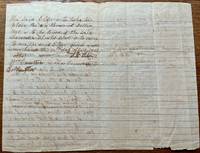
186233742Pocotaligo: n.p. 1862. Letter. Good. Letter. Approx. 8" x 5". 3 pages of manuscript. No envelope or stampless mark on the paper. Paper has three folds. Paper is in very good condition with light edge wear to a couple of spots. The following transcription is a best guess. The legibility of letter is difficult to transcribe and some words are omitted and other words spelled as they appear.<br /> <br /> Pocotaligo Feb 1 1862<br /> Mr E Ward Rock Island Tenn<br /> <br /> Dear Sir<br /> <br /> I find myself seated with yours of January 19th before me. I was very glad to hear from you I had wrote four letters to you and heard from you once in the time I dont think that you ought to quit writeing to us if I do belong to Jeff Davis traveling hog hay stealing 16th regiment I want you to write to me start your letter and I will get them for they will fallaw ten us and we will get them. I have had your letter for several days but I did not have the chance to answer it E We have to stand Pickett Cal Ful and Savages Regiments take it times a we go have and stand twelve days and then they stand twelve days. We have to go about twelve milds miles from the camps to stand. Darien is the Part Rail river and the yankees an on the Island of the same name I stand in sight of plenty of the damn yankees. We was yesterday and came to camps last night. We expect to have a fight hear with the yankees before long for there is plenty of yankees hear. You wanted to know about the fight that was hear on New Years day our regiment was not in it. We it for ten mild mile but it was over before we got thear. Wen we say our men we men mean the Dixaboys the yankees killed our men and we killed some of there and made them take again. We would nat have lost any men at all if our men had nat were two brave and run there up under the canans at the yankees and they Burned them and killed some men. I want you to write to me as soon as you get this gets to hand Tell Nancy that I am as fit as she ever saw me. E I get same good letter from my mama. This leaves me in good health. I remain yours till N.B. Hamrick. The Battle Mr. Hamerick referenced in this letter January 1st 1862 was probably part of the Union Army's Port Royal campaign. A battle took place along the Coosaw River near the Port Royal Ferry in Beaufort County South Carolina. From the Beaufort County Library: <br /> <br /> In late December 1861 the Union forces recognized that the Confederates recently removed to the mainland had been building batteries along the Coosaw River near the Port Royal Ferry. Union Commanding General I.I. Stevens ordered components of the 8th Michigan Infantry 47th and 48th New York Infantries 1st New York Engineers and the 50th Pennsylvania to destroy the Confederate breastworks capture the guns and force the retreat of some companies of the 12th South Carolina Infantry into the interior of Beaufort District. The Union forces accomplished their mission on New Year’s Day January 1 1862 with minimal casualties.<br /> <br /> The first Battle of Pocotaligo took place May 28th 1862. The Union army goal was to tear up the railroad between Charleston and Savannah. The second Battle of Pocotaligo took place October 22 1862. In the first battle the Union moved to destroy a bridge and having reached their objective retreated back to Hilton Head. both armies suffered a few casualties. In the second Battle the Union's goal was again to tear up the Railroad between Savannah and Charleston. After pushing the Confederates back to Pocotaligo the Union initiative stalled and the Union army retreated before nightfall. <br /> <br /> An interesting side note on the future fate of N. B. Hamericksp during the War comes from articles collected in The Spencer Times and the Sparta Exhibitor titled "Recollections of the War From Carroll H. Clark" Transcribed with all the commas dashes and lack of capitalization from Memorial and Biographical Record of the Cumberland Region An Illustrated Compendium of Biography. Geo. A. Ogle & Co. Chicago 1898. pp.253 and 254.<br /> <br /> Carroll Clark was from McMinnville Tennessee. In one of the several articles Clark makes a reference to a "N. B. Hamericksp" possibly the same soldier who wrote this letter. An excerpt from article 25 ".I have left untouched very many interesting events for instance the Battle of Franklin Tennessee in which many brave commanders and soldiers were killed of whom was Genl. Cleburne Genl. Carter and others. My dear friend and schoolmate N. B. Hamrick was killed there. His father and family lived out two miles from here at the place now called the Hill place on the road to Farris Griffiths. N.B. had three brothers in the war and all came through alive. The family came from North Carolina a few years before the war and it has been said brought the first yellow horse to this country. I yet remember the names of the whole family as follows: Uncle Billy Aunt Polly Jeroam Napoleon Bonapart killed at Franklin Jereboam Zorobabel Doctor Cortez and Don Pedro were the boys and two girls named Martha Salena and Mary Boston. All except Jeroam were my schoolmates."<br /> <br /> This letter was addressed to Mr. Ward in Rock Island Tennessee. Carroll Clark's war reminiscences was written in Tennessee. It is possible this is the same N. P. Napoleon Bonaparte Hamericksp who wrote the letter that was later killed at the Battle of Franklin in 1864. Information found regarding casualties at Franklin include variant spelling in the last name. A listing from the Civil War Talk web site states "1st Sgt. Napoleon B. Hambrick Co. I Killed." Another site Home dot Freeuk dot com lists "Sgt Napoleon Bonaparte Hanmbrick n.p. unknown
186331605Columbus Georgia 1863. Letter. Very good. Letter. Approx. 9.5" x 7.5" lined sheet of paper. Letter is one page long. Folded. Addressed to "Dear Cousin George" <br /> <br /> Hargraves writes "My sister received the following Telegram from Mobile: Have you any information of Martina Lucketts father. If not take her home immediately from the Sisters of Visitation in Mobile." George continues "I suppose from above that Martina is at school and the Superior not hearing from Mr. Luckett wants to get rid of her. What shall be done" Hargraves mentions that he could contact Mr. Jno Forsyth to help Martina and that Aunt Sophia probably would take her in. Written below the Hargraves signature - "I have not been able to hear from any Mississipian about Mr. Luckett. - G H" At the bottom of the letter possibly written in a different hand is a note - "Miss Singleton from Canton saw the Luckett six weeks in two months ago - his children were all with him Miss Martina also. He was not then in the Army." <br /> <br /> The writer of this letter George Hargraves was married to Virginia Forsyth daughter of famous Georgian John Forsyth. "Mr. Jno Forsyth" mentioned in this letter could quite possibly be the son of John Forsyth. John Forsyth Jr. who resided in Columbus before moving to Mobile. unknown
186333624Tullahoma Tennessee 1863. Document. Fair. Manuscript Document. Approx. 12.5" x 8". General Order No. 18 written on the front side and signed by the Assistant Adjutant General H. W. Walter. Also located on the lower left corner of the document is written "Maj Genl Wheeler a' g Wheeler's Cav Corps." On the verso is a handwritten summary of the order. The paper has dried water stains. The ink is light in spots. This handwritten General Order was reprinted in the Official Records of the War of the Rebellion War of the Rebellion Records Series I. Vol. XXIII Part II Correspondence Etc. Chapter XXXV pages 858 859. The signature at the bottom of the document is not legible but it is not in the hand of General Wheeler. The document reads:<br /> <br /> The enemy has seen fit to expel from his lines and send to our midst not only those supposed to be guilty of crimes but non-combatants found in their homes in the peaceful pursuits of life. In the perpetration of these outrages on humanity and these violations of civilized warfare he has prostituted the flag of truce to the base purpose of protecting the guards who drive forth these exiles. Hereafter that flag will not protect those guards but they will be seized and sent forward to be treated as spies or prisoners of war as the circumstances in each case may require. By Command of General Bragg. unknown
186336642Hamilton County Tennessee: n/a 1863. Document. Good. Document. Folded sheet of paper. 9" x 5". Paper has blue lines and multiple folds. 4 pages with 2 pages of content. Some fading to the ink and light toning to the paper. Chattanooga Tennessee is the seat of Hamilton County. Hand written document transcribed here: "State of Tennessee Hamilton County I Sam Elder of said County and State have this day hired Thomas Cavender as a substitute to serve as a Private in Capt J B Kings company or Capt Lyness for which I agree to pay the said Cavender one thousand dollars in hand & the other thousand dollars to be paid in three months from this date and to be loned at interest for twelve months two years is the time of service I have hired the said Thos Cavender now if the said Cavendar serves faithful as a substitute for the time of two years and at the expiration of that time the said Elder to take his place the one thousand dollars that is to be loned if the said Cavender should desert is to come to me the said Elder given under our hands this 30th day of April 1863 attest Wm Caruthers and Bob Caruthers signed seal S. H. Elder signed seal Thos Cavender." A Confederate soldier who paid another person to take his place is often referred to as a "substitute" soldier. During the American Civil War individuals who were drafted or conscripted into military service had the option to hire a substitute to serve in their place if they could afford it. These substitutes were typically individuals who were either unemployed or seeking financial gain. The practice of hiring substitutes was more prevalent among wealthier individuals who could afford to pay for someone else to take their place in the military.<br /> <br /> The Elder family were pioneers in Tennessee. Some of the family settled in Hamilton County. This excerpt is copied from Chattanoogan dot com: "The children of Robert S. Elder included Samuel Houston Sarah Jane Minerva Jane Robert and James B. Sarah married Thomas Monger a Unionist who was on the County Court. Minerva married James Clifford Allen who fought for the Union and was in the Legislature from Bradley County. Samuel H. was on the Confederate side joining 2nd Co. K of the First CSA Cavalry on Sept. 23 1862. He married Sarah J. White. Their daughter Mary A. married Aaron E. Smith. Samuel H. and his brother Robert had a "store boat'' that made calls at the various river landings and they also had a general store at Snow Hill. Samuel H. was postmaster at Long Savannah. He died in 1910 of a heart attack while walking from Avondale to Snow Hill."<br /> <br /> A record for Benjamin Franklin Cavendar from Hamilton County was found. However no mention of Confederates in Hamilton County for Thomas. Although a "Reader's Comment" from the Chattanoogan dot com states this: CAVENDER Benjamin Franklin Co. B 1TN Cav. Carter's Born 1839 in TN son of Henry Cavender. Farmer in Ooltewah. 1860 HC Census Reader Comment; Henry Cavender by his first wife did have a son named Benjamin S. Cavender b. ca. 1806 in NC living in Hamilton in 1850 but d. March 14 1858 in Dade Co. MO. By his 2nd wife Henry Cavender had a son named Franklin b. ca. 1839 in Hamilton Co. TN. However Henry Cavender relocated with several of his married and unmarried children after the 1860 census but prior to the War to Pitman Randolph Co. AR. In service with nephews in Company A of the 12th Missouri Infantry is Henry's son Francis Marion Cavender and an F.N.C. Cavender who I assume may be Henry's son Franklin. I cannot say for certain since there are no enlistment dates on this post but this Benjamin Cavender may be the son of Henry's son Thomas Cavender who remained in Hamilton Co. Thomas' son Benjamin J. Cavender was b. ca. 1844 in Hamilton Co. relocating after the War to Jeffersonville IN. I would be interested in hearing how the authors pegged this solder as Benjamin Franklin Cavender as Civil War soldiers database only lists him as Benjamin. I regret I cannot say anything more definitive than to cast some doubts. Kendall Sparkman.<br /> <br /> According to a record found in familysearch dot org: Captain J. B. King mentioned in the document was an officer for for Company B of the 1st Regiment Tennessee Cavalry Carter's. This regiment was organized in November 1862 using the 3rd Tennessee Cavalry Battalion as its nucleus. This company was active in the Vicksburg Campaign and was captured July 1863. By exchanged it was attached to Waul's Texas Legion then returned to the regiment. It surrendered with the Army of Tennessee.1<br /> <br /> The Caruthers individuals who attested this document were not found in a brief internet search. However there are other possible spellings of the name such as CARRUTHERS CARETHERS CAROTHERS. Some of the individuals named in the site Chattanoogan dot com were near the Chattanooga area during the Civil War. n/a unknown
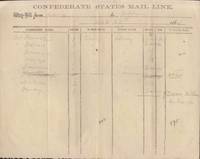
186436185Quincy: Confederate States 1864. Paper. Good. Paper. Approximately 9.5" x 6.5". Folds. Printed and written manuscript form that is dated December 28th 1864. Form lists 7 passenger names taking 8 seats. Likely this route was between Quincy Florida and Albany Georgia. This form was used late in the Confederacy after the fall of Atlanta and Savannah. Paper is in good condition. Confederate imprint. Confederate States unknown
186435361San Francisco: William Alvord & Co 1864. Paper. Good. Paper. Approx. 14" x 9". Single sheet folded with hand written quantity amount description and price on the receipt. Light toning edge wear and a few small edge tears to the paper. William Alvord & Co unknown
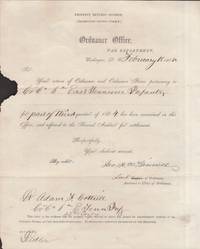
186535417Washington DC: War Department 1865. Paper. Good. Document. Approx. 10" x 8". 1 page. Document is dated February 18 1865. Contents relate to return of ordinance distributed in 1864. It is signed by Jno R. McGuiness. Below his order is the signature of Lt. Adam F. Cottrell Co "C" 6th E. Tenn Infty 23rd Corps. Document has a chip on the center left edge. War Department unknown
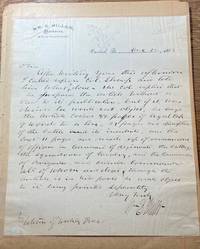
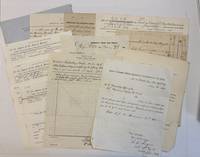
188736643Philadelphia: n/p 1887. Letters. Good. Letters. Lot of 10 letters possibly disbound from a larger collection. These letters were written in response to requested articles by the Editor of the Philadelphia Weekly Press. Letters written on good paper are pasted down on brown paper that is fragile with small edge tears and chips. Later short abbreviated notes written in pencil on the letters. Content of the replies are varied and provide additional primary source information and insights for the Editor of the Weekly Press. Contents are mostly legible. A summary of the letters follows:<br /> <br /> First letter is dated December 12 1885 and signed by William E. Miller. The letter is one page and written on his hardware store letterhead in Carlisle Pennsylvania. Letter reads: . "After writing you this afternoon I called upon Col. Sharp and told him What I done - the Col. replied that he the article without a view to its publication but of it was desired he would not object he says the article covers 32 pages of legal of words to a line - 21 pages are descriptive of the battle and its incidents and the last 11 pages are made of reminiscences of officers in Command of Regiments the battery the squadron of Calvary and the Commanders of Brigade and Division Commanders all of whom are dead though the article is in two parts he would object to it being printed separately. Very truly signed Wm. E. Bell To Editor of Weekly Press."<br /> <br /> Second letter is one page and dated Dec. 28th 1885. The correspondence is written on "Humboldt Safe Deposit & Trust Co" letterhead and signed by John C. Hilton at the bottom. Hilton writes the editor "In the matter of writing a history of the 145th P.V. during the battle of Gettysburg I must inform you I hardly feel competent to undertake it. The Gen would be the proper person had he been in the action and as for myself I was severely wounded at the time and cannot give as good a discription as one who passed through the engagement unscathed."<br /> <br /> Third letter is one page and a back and correspondence written on the Philadelphia Weekly Press letterhead dated December 31 1885. The editor of the paper requests of W. Hayes Grier "Can you prepare for publication in the weekly press the war article as indicated in a invitation sent to you some months ago If so please indicate when we may expect the manuscript Yours Truly Editor "Weekly Press". W. Hayes Grier response ."I will prepare the article and forward it in February."<br /> <br /> Fourth letter is one page and dated Jan 2d 1886. Correspondence is signed by "Wm. H. Grovinger." Written neatly from "Port Royal Juanita Co. Penna Grovinger writes "Mr. Editor Dear Sir I have in my possession a very interesting manuscript relating to the life of one of the brave defenders of the Union his trials and hardships while in Southern Prisons his several escapes from the same with his reasons for Sustaining the actions of the Government in its exchange policy it is written in good style but I think as it was intended for the use of his family some parts would not be suited for the general reader I will carefully compile it for publication Please give me your plan of publication and whether I will I would be compensated for my trouble I can vouch for the entire truthfulness of the manuscript."<br /> <br /> Fifth letter is 2 pages and written on United States Treasury Department letterhead and dated January 7 1886. The letter is signed at the bottom of page 2 by "A M Judson late Capt Co. E. 83 PV". Judson writes I answered the first letter Dec 10 85 stating in substance that in 1865 I wrote & published the "History of the 83d Regt P.V." when all the events therein detailed were fresh in my memory & when I was much more in the humor for description then than & that if the description of the Gettysburg fight there given would suit your purpose you are at liberty to use it." Judson points the editor to getting a copy of his book for the purpose of placing an article in the paper. <br /> <br /> Sixth letter is one page and dated February 11 1886. Letter has a blue ink stamp upper left corner from "J. Merrill Linn Attorney-At-Law Lewisburg Penna" and signed by Linn at the bottom. Linn writes of another regimental officer "Gobins Regiment saved Bancks Army on the Red River - is Pa Reg't took Stone Bridge at Roanoke - A Pa. Reg't captured by assault the first at New Berne.". He also writes "If it won't interfere with Gen Hartranft I would like to write the Battle of New Berne. We planted the old Fourth Pa. Flag first in the earth works."<br /> <br /> Seventh letter is two separate pages written on "D. R. P. Hibbs. Attorney At Law." letterhead in Albert Lea Minn. and dated February 20 1886. Hibbs writes "to the prep of an article for "The Press of the 104" P Vols. in the war I would say that Gen. Davis as an a war hero published a history of the 104" Hibbs is asking to the editor to give some advice on how Hibbs can add more to the unit history. <br /> <br /> Eighth letter is 2 pages long and dated May 17 1886. Written on "J. H. Longnecker Attorney at Law" letterhead and signed by Longnecker at the end. He writes "I rec'd yours of April 29 in regard to writing a sketch of the 101 Pa. Regt. I delayed writing in reply hoping to see you personally in Phila. last week while attending the Supreme Court." Longnecker states that he has other commitments including a Congressional nomination that keeps him from "gathering up facts and writing such a paper."<br /> <br /> Ninth letter is a second letter signed by W. Hayes Grier on "Office of Superintendent of Public Printing. Harrisburg Pa." letterhead and dated January 10 1887. Hayes updates the editor on his delayed article is a result "that I had lost the most important one issued by Gen. Cameron on Dranesville. I wrote to the Sec. of War and asked him to send me a copy giving him the date. Today I received it and I will at once prepare the orders and send them to you with remarks explanatory of each."<br /> <br /> The tenth and final letter in this group is dated May 23 1887. Letter written from Brookline Mass and signed by Theodore Lyman at bottom. The correspondence is very short and written in a shaky hand - "Dear Sir As I joined Gen Meade's staff after Gettysburg it would not be possible for me to write the paper you ask for." Officers that replied the editor's request include Captain William E. Miller. <br /> <br /> From wikipedia: Miller received his country's highest award for bravery during combat the Medal of Honor for actions taken on July 3 1863 during the Battle of Gettysburg. While ordered to keep his company stationed on a hill he disobeyed these orders to lead a surprise attack against a Confederate charge. On July 3 Miller was given orders to hold his company "at all hazards"9 in the woods north of the Lott house and assist the 1st New Jersey Cavalry Regiment in repelling Brigadier General Wade Hampton's advance.5 When the enemy brigade advanced Miller noticed a large contingent led by Confederate Brigadier General Fitzhugh Lee threatening to break through a main section of the Union line.8 From his flank position he decided to disobey his orders and attack the Confederate from the side and stated to his adjutants "I have been ordered to hold this position but if you will back me up in case I am court-martialed for disobedience I will order a charge."810 With full company agreement Miller led his men into the flank of the Confederate advance causing confusion among the rebels who believed their retreat path was about to be cut off.9 Because of Miller's surprise attack the Confederate rear line was dispersed511 and the Union line saved.310<br /> <br /> John C. Hilton writes in his letter that he was severely injured in his correspondence. From find a grave dot com - "Case 454. — Captain John C. Hilton Co. K 145th Pennsylvania aged 22 years was wounded at Gettysburg July 2 1863 by a conoidal ball which fractured the right femur in its upper third. He was carried to the field hospital of the 1st division of the Second Corps where Surgeon C. S. Wood 66th New York reports: "The bone was extensively comminuted. I amputated the thigh about one inch below the trochanter major. The operation was not performed until eleven days after the receipt of the injury yet the patient at this date August 2d is rapidly improving." The patient entered Camp Letterman hospital August 5th where Acting Assistant Surgeon B. F. Butcher notes: "He is doing very well; the treatment consists of stimulants and nourishing diet with water dressings to the stump. August 20th still improving all ligatures were removed the stump healing rapidly. On the 25th the stump had entirely healed and on September 1st he left the hospital on leave of absence." This officer was discharged December 19 1863 entered the Veteran Reserve Corps February 5 1804 was mustered out of service June 30 1866 and pensioned. His pension was paid June 4 1879." -- The Medical and Surgical History of the War of the Rebellion. Part III Volume II. 3rd Surgical volume by U.S. Army Surgeon General's Office."<br /> <br /> W. Hayes Grier was a printer soldier and politician. He served in Co. A. 5th Pennsylvania Reserves. Summarized from Pennsylvania Reserve Volunteer Corps Historical Society William Hayes Grier apprenticed as a compositor in the office of the Jersey Shore “Vidette†from 1856 to 1858. Grier later removed to Akron Ohio and entered the office of the “Democrat†remaining there until 1861 when owing to the impending war he returned to Jersey Shore and resumed work in the office of the “Vidette†where he had learned his trade. There he remained until Fort Sumter was fired upon when he enlisted April 18 1861 becoming a private in the Jersey Shore Rifles known as Company A 5th Pennsylvania Reserve Regiment. They were assigned to the Army of the Potomac and passed through all the battles of that division from Dranesville to Cold Harbor with the exception of Chancellorsville. On June 27 1862 our subject was wounded in the leg at the battle of Gaines Mills and was laid up for six weeks in a hospital at Washington. He rejoined his regiment in time to participate in the second battle of Bull Run. In March 1863 he was promoted to first sergeant and on June 4 1864 was commissioned second lieutenant." On the expiration of his term of enlistment in 1864 Lieut. Grier returned home and became foreman of the printing department and associate editor of the “Columbia Spy†remaining with that paper until October 1866 when he was nominated by his party Democratic for the State Senate against his old Colonel Joseph W. Fisher but was defeated because his party was in the minority."<br /> <br /> A. M. Judson writer of the the fifth letter wrote a history of the Eighty Third Pennsylvania Regiment.<br /> <br /> Theodore Lyman writer of the last letter Theodore Lyman III August 23 1833 – September 9 1897 was a natural scientist military staff officer during the American Civil War and United States Representative from Massachusetts. n/p unknown
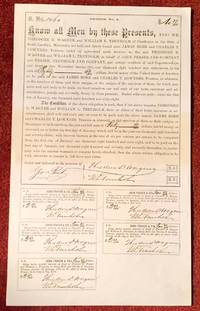
1868255England London or Liverpool: John Fraser & Co 1868. First Edition. Parchment paper. Fine. Description: 1 January 1868 6 % Bond for US-$ 40.27 Series 4 #B1460 35.2 x 21.2 cm black white browned signed by Theodore D. Wagner and William Trenholm; signed on back by William Trenholm & Jos. Wileman. Issued by John Fraser & Co. the overseas and mainly English banking branch of George Trenholm's financial empire. Scarce signature and bond. George Trenholm was a prominent Confederate States of America financier with major interests in blockade-running. As the Confederacy collapsed he was called upon to become Treasurer in the government of Jefferson Davis between 18 July 1864 and 27 April 1865. His son William was one of his most important surrogates and signed for his extremely busy and often ill father. Most blockade runners of the American Civil War were seagoing steam ships that were used to make their way through the Union blockade that extended some 3500 miles along the Atlantic and Gulf of Mexico coastlines and the lower Mississippi River. By 1860 the company Fraser Trenholm & Company had five seagoing vessels making shipping runs from Liverpool to New York and Charleston and back again. It has been argued that wealthy blockade-runner George Trenholm provided a good deal of the blockade-running background for Margaret Mitchell's famous novel Gone With the Wind. See the episode in which Rhett Butler is kept prisoner in the stable of a Fire Engine House when his Union captors--and soon Scarlett O'Hara--hope to win some of Captain Butler's wealth which he has secreted in Liverpool. In EXCEPTIONAL CONDITION--unfolded--with minimal age-toning and very clear signatures! John Fraser & Co unknown
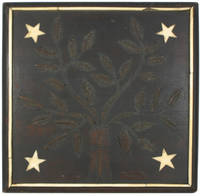
1863List308N.p. 1863. Dark carved wood 11 ½ x 11 ½ x 1 inches with bone border and star inlays in corners an inlaid tree with carved names of Civil War battles as leaves. During the Civil War wounded or captured soldiers would often pass their time waiting to return to duty carving relics. The practice was fairly common with pipes being the most commonly carved object and the quality of the relics varied wildly depending on the talent of the soldier. A.H. Barber from Wisconsin was wounded at Antietam and most likely carved this memorial piece while recovering from his wounds. Each leaf notes a different battle during the 1861-1862 campaigns. Barber enlisted in Company C of the 2nd Wisconsin in 1861 and was discharged in 1863 following wounds suffered at Antietam. The trunk reads Battles for the Union and the four branches read Dept. of the South Army of Virginia & of the Potomac and Dept. of the West with twenty-nine leaves naming battles. <br /> <br /> The resultant plaque is exceptional in timeliness craftsmanship and overall aesthetic beauty. Barber’s metaphorically growing tree is particularly timely for the Union cause as the 1863 failure of the Maryland Campaign would serve as inspiration to Lincoln to issue the Emancipation Proclamation. Wonderfully preserved in excellent condition with no notable flaws. From the collection of Norm Flaydernman the noted Americana dealer who personally collected carved Civil War pipes and had been planning to write a book on the subject at the time of his death. unknown
188110857Lynchburg VA 1881. Half Leather. Very Good binding. Octavo. 19 1 pp. Backed in morocco with corners. Binding is quite sharp without appreciable wear; the pamphlet self is worn soiled foxed but is much better presented in this Sangorski & Sutcliffe binding. <br /> <br /> A series of correspondence between the two generals related to John Watts De Peyster's biography 1871 of Mahone and Mahone's military record. A glimpse into the prevailing friction of the post-war South. From the library of notable Civil War and Americana collector Charles Sanders Jr with his bookplate on the rear pastedown. A difficult pamphlet to find. Dornbusch notes it was published in 1871 while Nicholson identifies the date as 1881. While Dornbusch was very thorough it is likely his suggested date is based on the date of Peyster's biography. We feel more confident in Nicholson's assessment coupled with Sanders' own note on the rear pastedown corroborating Nicholson. Nicholson p. 262; Dornbusch II 2705. unknown
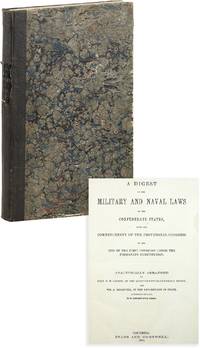
186489239Columbia S.C.: Evans and Cogswell 1864. First Edition. Octavo 21cm. Publisher's cloth-backed marbled paper-covered boards with printed paper spine label; x11-329. Mild rubbing and wear at board edges and to spine label; expected darkening to endpapers with a few inconspicuous marginal stains to text - in all a tight clean Very Good copy. <br /> <br /> A quite nice copy of this important collection noted by Nevins as "extremely scarce" perhaps less true today than in 1969 and "a starting point for any study of Confederate millitary law." We trace only a single copy at auction this century. NEVINS II:174. PARISH & WILLINGHAM 44. Evans and Cogswell unknown
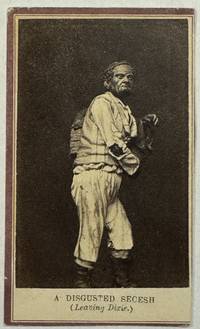
186240248New York: E. Anthony 501 Broadway 1862. CDV of a man in tattered worn clothes grimacing getting out of Dixie. The man is dark-skinned but considering the theme is probably Caucasian. Applied paper label on verso bears the imprint of Wm. Abbott & Co. Boston. Very Good.<br /> Not located on OCLC or online sites of AAS and Library of Congress. The item has however occasionally been offered on and at auction. E. Anthony, 501 Broadway unknown
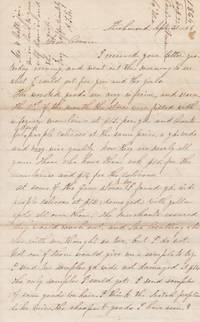
1864List2722Richmond Virginia 1864. Single letter measuring 8 x 5 inches one double-sided sheet. Excellent condition. A letter written by “Cousin Amanda†of Richmond Virginia detailing the price and quality of cloth cotton spools and flour available to her late in the American Civil War. The Confederacy was under a blockade and Union forces were destroying anything deemed valuable to the Confederate cause including cotton fields and textile mills causing prices to skyrocket even for inferior goods. Amanda writes that moldy cloth was being sold for what today would be well over $200 per yard:<br /> <br /> “At some of the Jews stores today I found yard wide purple calicoes at $12 damaged with yellow spots all over them. The merchants assured they would wash out and Sue Coulling who was with me thought so too but I do not. Not one of them would give me samples to try. . Cotton is from $4 to $5 for a spool.â€<br /> <br /> Most shocking is the cost of flour; Amanda thanks her cousin for “letting us have†some flour “so cheap†as “It is $350 here and we certainly expected to pay that.†A little over a year earlier in April of 1863 an armed mob of women in Richmond had marched on the governor’s office in protest of the untenable cost of food storming and looting storehouses in what came to be known as the Richmond Bread Riot.<br /> <br /> Of interest for those studying civilian life during the American Civil War and especially textile history. unknown
1865Cat322Sycamore DeKalb County Illinois 1865. Two autograph letters signed “Rosa†docketed on rear likely in Everell Dutton’s hand 4 and 5 pages 8 x 5 inches. Folded at center else fine. Two letters written in the final weeks of the Civil War by Rosina Adelpha Paine Dutton of Sycamore Illinois to her husband Everell Fletcher Dutton then lieutenant colonel of the 105th Illinois Infantry engaged in the closing campaigns of the war. The couple had met through their mutual friend Helen Barns Woodmanse and began an unusually close correspondence at the outset of the war at times exchanging two or three letters a day through 1863. They married in Sycamore on December 31 1863 and spent several months together in Nashville while Dutton was detailed to the Examination Board residing at Mrs. Jernigan’s boarding house before Rosina returned to Illinois and Dutton rejoined his regiment in the field. Rosa wrote a considerable amount of letters to her husband during the war some of which were collected by the Sycamore History Museum for the exhibition General Dutton’s America. <br /> <br /> The two letters here written a week apart show Rosina’s fears and the general mood in the days prior to Lincoln’s assassination with a focus on a mysterious favor done for an unsavory character. The April 2 letter reflects Rosina’s anxiety as she awaits news from the regiment:<br /> <br /> “Five hours later. I got to feeling so badly I could not write. I will now resume my chat. I know dear one you are tired of receiving dark gloomy letters from me but you must not hope for better while you remain in the army. Love you know is always strongly anxious when the loved one is absent. I would give everything we possess in the world if it would but bring you safely home. I am in hopes we will hear something definite from the Regt. tomorrow. I am so anxious and yet I tremble to hear from the Regt… O my Husband if you should be taken from me.†<br /> <br /> She searches the newspapers repeatedly—“no list of casualties in the Tribune … sent Ida after the Times … sent Winnie & Mary … for the Evening Journalâ€â€”but finds “no relief of mind.†The strain is constant: “whenever I spoke … the tears would come†and even at church “I could not keep the tears from my eyes.†She notes that the 105th “could not have been through so severe a contest without losing very many men.â€<br /> <br /> The April 12 letter is dominated by Rosina’s pointed suspicion toward a man she calls “Gerret†who appears to have entrusted Dutton with a valuable object: <br /> <br /> “Gerret said you had in your valise for him said it was worth $500.00. If I were in your place I would get rid of it if I had to burn it. I wouldn’t carry anything five miles for that miserable scamp. No one scarcely believes his story about being captured &c. They think he made his way home as best he could & I would not be at all surprised if that were the case. He has told half a doz different stories already about his capture. He ought to have learned his story before he came home and then told it. Such conflicting ones create suspicion. Father said if he were in your place he would turn it over to Government & then bid it in.â€<br /> <br /> No individual of this name appears in the rosters or known correspondence of the 105th Illinois and the tone of the letter suggests he was not a member of Dutton’s regiment. <br /> <br /> She closes: “My darling husband do come and thereby make me the happiest woman in the world . try dear one. I don’t believe but that they will accept resignation now before long. May the good Father of us all take care of you is my constant prayer. Devotedly yours for all eternity. Rose.†<br /> <br /> Overall an interesting pair of letters from a well documented and significant correspondence. unknown