[Civil War]. [Mississippi]Biblio.com
11 490 résultats
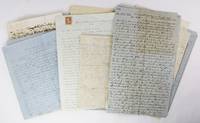
18656242Various locations 1865. About very good. Forty letters approximately 96pp. Many with original envelopes. Light wear and soiling old folds. In a legible hand. Together with twelve additional family letters and two military commissions. A wonderful archive of correspondence written home from the Confederate lines by William Henry Tabb of the 14th Mississippi Infantry. William Henry Tabb 1837-1864 was the son of a minister at the Choctaw Agency in Oktibbeha County Mississippi. In April 1861 he was commissioned as a lieutenant in the Agency Guards which were soon absorbed as a company in the 14th Mississippi Infantry. He was captured at Fort Donelson exchanged reached the rank of captain and was with his regiment when he suffered a fatal wound in the defense of Atlanta on August 5 1864. <br /> <br /> Tabb begins his letters with optimism. On August 1861 after training in Corinth Mississippi the regiment met with a parade in Huntsville en route to eastern Tennessee: "The women men and children were down to see us and a regiment turned out to do us honor. Such cheering from beautiful young ladies all along our way is enough to make men brave." On October 22 1861 he recounts the recent death by disease of his brother Thomas Tabb in Marion Alabama also of the 14th Mississippi calling him "my dearest friend on earth."<br /> <br /> Tabb was captured at Fort Donelson in February of 1862. Two of these letters were written from the Union prison at Johnson's Island near Sandusky Ohio. In May 1862 he writes: "We are not allowed to write what nor as much as we please. I have no friends to work for me see no indications of a general exchange or parole and it is almost impossible to escape from this island. It is amusing to see men one day Confederate officers and the next day cooking or around the wash tub. We have no servants. I am well treated have a plenty not a variety of food and clothing that we need issued to us." By September 24th he was back with his regiment in Mississippi: "The Yankees stole my shoes and I am wearing an old pr of boots. It appears that my conduct at Donelson has been very highly spoken of. Well I.tried to do my duty but I am sure I did nothing extra. Indeed our regt in my opinion fell little short of disgracing itself." He adds a word on the troubled home front situation: "Am sorry to hear that the Negroes have commenced stealing. I would very much like to see all that have behaved themselves and wd thrash those who have been stealing."<br /> <br /> On April 11 1863 he describes the recent Battle of Ponchatoula which other companies in his regiment participated in: "Rollins was sent out with ten of the company on our right wing to try to flank them. As soon as he commenced firing on them we attacked their center and they broke to run. They were zouaves red pants we never could catch them." He lamented the loss of his enslaved servant on June 7th near Yazoo City: "I expected John to come to me. I have become attached to John and don't know how to get along without him. I look for him every day now." Tabb had some great stories about Grant's efforts to take Jackson the Mississippi capital from which Johnston's Confederates performed a stealth evacuation. On the 19th and 20th of July 1863 he wrote: "All of the boys wanted to stay and fight but Grant had 80000 men and we had only 30000. It is true we were behind breastworks but they were not good and the place could be easily flanked. Johnson prepared to evacuate the place from the time we got there. The Yankees knew it. Not a word was spoken not a command given. The Yankees knew nothing of our leaving. Some of our men did not know we had left and were left behind but overtook us. I hear that the Yankees commenced shelling the town the other morning after we left and kept it up til 9 o'clock when some of the citizens hoisted the white flag and surrendered the place. They were vexed to know that we had left them without their knowing anything about it."<br /> <br /> Tabb had been away from the regiment for the start of the Atlanta campaign and on July 9 1864 he wrote: "I reached the command the evening of the 5th and found my company.8 miles from Atlanta. I found the men dirty and many of them with worn out clothes and not very good rations but all in good spirits and glad to see me. The people of Atlanta are leaving rapidly. They think the place will be evacuated. Do not be surprised if you hear it. We will not be whipped if we do leave it." This is Tabb's final letter in the collection. He was shot a month later. The group concludes with nine condolence letters and memorials. An October 1864 memoriam copied in 1894 recounted his death: "At the time he received the fatal shot he was commanding the brigade skirmishers & was just forming the line to proceed to the front. Though terribly mangled & in great pain he was calm & collected." He survived long enough to send farewell thoughts to his family and to regret "that I was not spared to see my country through her troubles." Also included are two of Tabb's military commissions in the Agency Rifles from the State of Mississippi: as Second Lieutenant on 24 April 1861 and as First Lieutenant on 25 December 1861. Both are signed by Governor John J. Pettus. In all a wonderful archive from a Confederate soldier who saw significant action and imprisonment during the war. unknown
34328Washington DC: House of Representatives. Wraps. Fair. Disbound wraps. xvi 607 pages. Illustrated with three folding plans a few maps and illustrations. Missing spine. Pages 593-607 are detached. Interior contents are clean. This is a detailed report on the Union use of Armored vessels around Charleston Mississippi River and Vicksburg from 1861 to early 1864. House of Representatives unknown
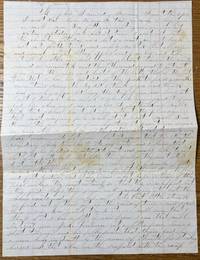
186335352Memphis: n.p. 1863. Letter. Good. Letter. Approx. 11.5" x 8.5". 2 pages written on lined paper. Folded creased with light toning. "Hutton & Co. Prs" located in small print top left corner of the front page. <br /> <br /> Soldier writes; "At Present our armies are lying still or nearly so for the weather is too hot to make any heavy movements just now but it seems that the Southern Confederacy fairly trembles to its very center and I know that many of her soldiers are satisfied to quit and would like to get out of it pretty well but like the Yankees they must stick to it until their officers become convinced of a similar fact.they must certainly see they are whipped but their pride keeps them from acknowledging it." He also writes about a man hanged back home for stealing horses. He mentions the loss of a steamboat named "Alice Dean." This steamboat operated on the Mississippi and was captured and burned by the Confederates. n.p. unknown
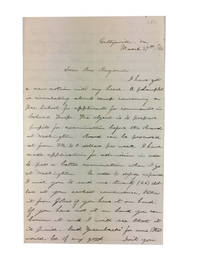
88757Very Good. 2 1/2 page Letter on a single lightly-ruled 8 x 10 inch sheet folded to form four pages. Later folds probably for mailing in a small envelope. Austin writes that he wants to attend the Free School for applicants seeking commands in colored troops. He asks Benjamin to send him $20 in greenbacks to cover the cost of attending the school and opines that even if: ". I get refused an appointment the schooling I get won't harm me in the least." He also mentions not hearing from two women Nellie Gilman and Eunice. unknown
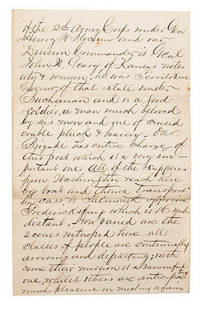
021546Letter. Near Fine. Four-page letter on a 10-1/2" x 8-1/4" sheet folded in fours. It appears that this is the last four pages of a longer letter of unknown length SIGNED by Lieut. J. Glendinning to an unknown recipient. Much content including discussion about the 12th Army Corps under Union General Henry W. Slocum. In part: "All of the supplies from Washington reach here by boat and thence transport by cars to Falmouth opposite Fredericksburg which is 16 miles distant." He speaks of the variety of people--some happy some sad--that he sees here: "Twas the other night whilst having in charge a detail of men working on the Dock a lad came forward & wanted the assistance of 4 or 5 men to help him on the boat with a box-- he had been to Fredicksburg sic and was now returning with his deceased Father and this is what the box contained. Poor boy! I thought how sad must be the home to which you are going." He describes empty coffins piled high on the wharf. "Nothing keeps me in the army but a sense of duty I feel. The associations of the army are anything but congenial to the Christian-- every action every feeling in fact everything seems to be done regardless of Christianity. Profanity & wickedness are exibited sic to an alarming extent. Never have I felt the need & use of religion anywhere like in the army." He concludes by saying that he would like to see Bloomington again apparently where the recipient his friend lives and will do so once he is home. <br/><br/> unknown
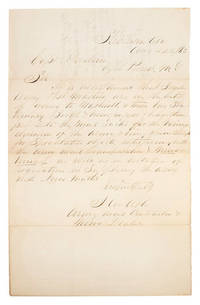
1863021545Stevenson AL 24 August 1863. Letter. Creases from folding; ink a bit light. Very Good. One-page letter on a 7-3/4" x 12-1/4" sheet addressed to a Capt. Goodwin and SIGNED "J. W. Able" "Army Mail Contractor & News Dealer." The writer seems to be proposing a way of "simplifying the army with news matter." The verso is docketed "Hdqrs. Department Cumberland Office. Respectfully referred to Lieut. Bracken A. Chf Army Police who will make a thorough examination of the mails tonight and report By Command of Maj. Gen. Rosecrans" and SIGNED "R. M. Goodwin." <br/><br/> unknown
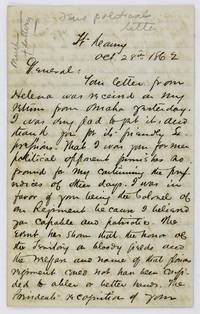
18623449Fort Kearny Ne: October 28 1862. Very good plus. 4pp. on a single folded sheet of lined paper. Light wear and toning old folds. An interesting manuscript letter written by Dr. George Lorin Miller 1839-1920 a leading Nebraska pioneer and instrumental figure in establishing Fort Kearny. Miller also served as the fort's sutler during the Civil War and helped to recruit the First Nebraska Regiment. Miller was a physician politician editor and land owner who arrived in Omaha in 1854 the year the city was founded. Miller himself founded the Omaha Herald which later became the Omaha World-Herald and was. staunch Democrat who became adept at harnessing the power of the press.<br /> <br /> Here Miller writes to an unnamed general in Helena Arkansas who was most likely Samuel Ryan Curtis. Miller's letter is well-written providing insights into and details of the politics war news and other information of the period. He is friendly to his correspondent noting that the two men had been political opponents in the past but Miller states that he supported the candidacy of his correspondent as "Colonel of our Regiment because I believed you capable and patriotic." Miller praises him for being recognized by no less than the President for "gallant services authenticated as they were by the best officers of the service" and then bemoans the fact that the correspondent was denied an appointment by the Senate due to the "mendacious meanness" of a Nebraska politician named Samuel G. Daily who apparently worked against his confirmation. Then Miller notes that Daily had to answer for his denial of the correspondent's appointment on the recent campaign trail where Daily "had to meet your case in the canvass at every turn -- apologized lied and smoothed it over as he best could. Denying everything and admitting nothing saved him by about 100 votes." He continues to encourage his correspondent with supportive language and then closes with a short appraisal of their shared hometown in the Nebraska Territory: "Omaha is changing much but it will not outrun your recollection of it. When you return you will see as I see that it is a real home after all however changed its appearance. October 28 unknown
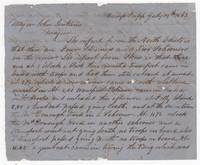
186345200Camp Fripp Fripp Island; Johns Island SC 1863. Very good extremities worn torn along folds few repairs light soiling and ink bleed through. 2 blue sheets. 8x10 inches and 8 x 6 1/2 inches. Johns Island like its neighbors Folly Island and Edisto Island was reinforced by several South Carolina cavalry units throughout the Civil War. Among the commanders stationed there were Captain John Legare Walpole Captain Moses Benbow Humphrey and Captain John Jenkins who was promoted to Major in October of 1862 when he took command over all of Johns Island's regular forces Johns Island Conservancy: The Battle of Haulover Cut.<br /> <br /> The first of these documents is a July 19th 1863 report signed by Acting Adjutant Paul J. Gervais at Camp Fripp by order of Captain Walpole and submitted to Major John Jenkins. The report details the comings and goings of Union vessels along the surrounding rivers. "The report from the North Edisto is that there are Four Steamers and Two Schooners in the river. The report from Stono is that at 8 o'clock a black three masted transport came in loaded with troops and had them still on board at sunset." Gervais proceeds to give a detailed chronicle of ships arriving throughout the evening including the transport Delaware the McDonough and a series of other unnamed schooners and gunboats. In his post script Gervais notes that there is at least one Regiment at Folly Island. <br /> <br /> The Union may have been sending these vessels to support the effort of their South Atlantic Blockading Squadron as nearby Charleston Harbor was one of the only remaining ports that remained open at this time. It was during the summer of 1863 when the Union staged a successful seige of the port in the Second Battle of Charleston Harbor.<br /> <br /> The second document is an unsigned copy of a report presumably from John Jenkins from Johns Island December 1863 which lists the companies under Jenkins' command. Jenkins reports "five companies effective total 272 Mounted Riflemen." unknown
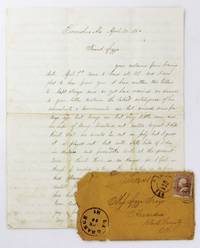
18646361Brownsville Al: April 20 1864. Very good. 4pp. Quarto. Old folds light wear and soiling. In a legible hand. With original envelope. A letter written by a Union soldier stationed in Alabama to a friend back home in Missouri. Signed only as "Jo" the letter is quite familiar and written to Elizabeth Frazee of Alexandria Missouri. There is some initial mention of "Capt. Frazee" whom we presume to be Morris Frazee Elizabeth's brother who was in the 10th Missouri Infantry. The author writes of a longing for home and a good drink being stationed in a dry county. "Our Col. arrived some few days ago but brings us but very little news and no hope of being mustered out until August. I did think that we would be out in July but I guess it is played out but will still hope. I would like to stay until June and then go north. Every thing down here looks bright flowers are in abundance and the trees look quite green. and if the rebs don't bother us any we will not harm them. All we dread now is a forward movement which I expect we will have to join but there is no use of lamenting untill the time comes. We have had no alarms lately but are wishing for one or two so as to make it appear that there is some danger in leaving this place unguarded. Our brigade could not be of much force at present no how for the regiments are so scattered one in Huntsville one home on furlough and the two others ten miles apart and the one at Huntsville leaves for home soon as they can be mustered as veterans." He goes on to mention empty liquor bottles stashed at home writing "I wish the bottle was full and I had it here this evening. I think I could enjoy it hugely for this is a great temperance country the reason for it is that Uncle Sam has stopped the sale of it so you see it is a dry season with us at this time but we expect to make up for this when we get home or at St. Louis." He continues with personal news and some flirtatious talk including about kissing and sending her his photograph. April 20 unknown
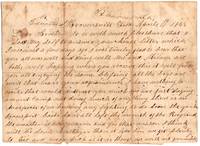
186313099Brownsville TX: April 4 1863. 2pp. Old mailing folds moderate foxing and toning. Overall about very good. An interesting letter from Samuel Gallatin a Confederate soldier stationed in far south Texas during the middle of the Civil War. Gallatin writes that there is not much going on but his categorization of Brownsville and his brief discussion of the value of money provide important details of a soldier's life on the Gulf of Mexico during the war. The text of his letter in full is as follows with spelling corrected:<br /> <br /> "It is with much pleasure that I seat myself to answer your kind letter which I received a few days ago. I was truly glad to hear that you all was well and doing well. Me and Milam are both well hoping when you receive this it will find you all enjoying the same blessing. All the boys are well that bears your acquaintance. I have nothing to write that would interest you much. We are just laying around Camp not doing much of anything. There is no prospects of us having any fighting to do soon. The Yankee transport boats have all left the mouth of the Rio Grande. The weather is very warm and for that reason I think will be some healthier than it has been. We get plenty to eat and wear such as it is though we will not grumble.<br /> <br /> Ed Pace received a letter from his father the other day. He stated that Albert was sick but was not dangerous. There is a great deal of talk about peace being made pretty soon in this country but I expect that has got to be a by word with you all down there. We are in one of the last places in the world to get news of any kind and would be glad that you would write oftener and let us know what all is going on down there. Money is tolerably plenty in this country. Paper money is only worth twenty to thirty cents on the dollar. With silver or gold we can get things as cheap as we used to or near about it. April 4 unknown
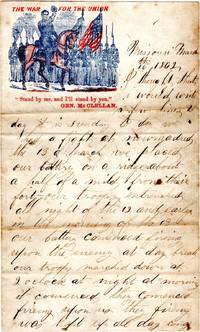
186213109Near New Madrid Missouri: March 16 1862. 4pp. on patriotic stationery headed "The War for the Union" with a vignette of McClellan on horseback above his quote "Stand by me and I'll stand by you." Old folds a few small tape repairs to folds minor dust soiling. Overall about very good. An astounding battle content letter from Ohio Private Charles H. Bayles describing a fierce altercation in Missouri early during the Civil War. Bayles enlisted on December 9 1861 in Company H 43rd Ohio Infantry for a term of three years. Private Bayles wrote this letter shortly after the Battle of New Madrid in March 1862. Here he gives a stark summary of the artillery duel on March 13 between Pope's army and the Confederate gunners at New Madrid a duel that lasted most of the day. Meanwhile Pope's infantry forces were slowly advancing their trenches in the normal pattern for a formal siege slowly getting closer to the Confederate defensive lines. That night the Confederate defenders of New Madrid abandoned the town and withdrew to Island No. 10. A transcription of Bayles letter is as follows:<br /> <br /> "I thought that I would write a few lines today. It is Sunday today. We had a fight at New Madrid the 13th of March. We placed our battery on a ridge about a half of a mile from their fort. Our troops entrenched all night of the 12th and early in the morning of the 13th our battery commenced firing upon the enemy at day break. Our troops marched down at 2 o'clock at night. At morning it commenced. They commenced firing upon us. The firing was kept up all day long.<br /> <br /> The firing was kept up from daylight till dark and then the firing ceased. Our infantry laid back a half a mile from our battery. The cannon balls struck all round us. We was in a small piece of woods. They steered at us. The cannon balls cut trees a foot through right in two. They throwed shells at us and balls and canister shot. The ground was covered with cannon balls. Our Lieutenant-Colonel's horse was shot through the body with a piece of shell. The Lieutenant stood holding him by the halter. There was not one of our company hurt at all but the cannon balls whizzed through the air like thunder. They dropped on our right and on our left. A cannon ball struck one of the boys in the company to our right in the breast. It cut him in two. The firing ceased at night. Our company was sent out on picket at night. The next morning we calculated to go into them again but that same night they left the town. Everything was left. About 20 cannons was left in the fort. They had a strong fort.<br /> <br /> They killed eight of our army and wounded 8. They cut part of their town down to get range on us. We throwed shells into the fort. It is thought that we killed 2 or 3 hundred of the Secesh. They throwed them from the gunboats into the river as fast. We killed them. About one hundred was found in their entrenchments. They had some guns 12 feet long besides four or five gunboats. I should thought that they would never left such a fort as that. I guess the war is about to a close."<br /> <br /> A great content battle letter. Unfortunately his prediction of the imminent end of the war was very very premature. March 16 unknown
186358199Camp near Brooks Station Saturday April 11 1863. Fine original condition. 15-1/2 x 9-3/4 inches. ".Yesterday I witnessed one of the grandest sights that I ever beheld. Our whole corps was reviewed by the President Generals Hooker McLain Howard Steinway Secretary Seward and an innumerable host of Brigadier Generals and it was a sight that has paid me for coming to war." The spectacle is described in great detail. Private Penfield was soon to be captured at Chancellorsville spending 12 days as a prisoner of war before being exchanged. He survived the war to carry on his father's carriage making business in Monroe Connecticut and later founded a small private academy. unknown
500989of A.H. Perry to W.P. Burrall Esq. on Hartford and New Haven Railroad Office letterhead Springfield MA February 22 1864. Small 4to 1 page. Signed by Authors. F. Soft cover. paperback
500990text of a telegram on printed form of the American Telegraph Company from Captain William M. McKim to agent George P. Greer of the Hartford and New Haven Railroad Boston ca. 1864. 8vo 1 page with additional Autograph Letter Signed of S.R. Conner on verso for certification. Signed by Authors. F. Soft cover. paperback
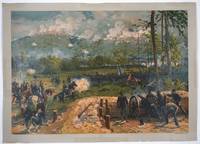
189029029Boston: American Lithographic Co. 1890. One of the 18 images from Prang’s War Pictures published 1886-1887 reissued by the American Lithographic Co. <br /> <br /> A detailed print of the Battle of Kenesaw Mountain in Georgia on 27 June 1864 the last general engagement made between troops under Sherman and Johnston prior to the battles around Atlanta. <br /> <br /> A print from a striking series of images of the rare and important Civil War series originally issued by Louis Prang between 1886 and 1888 and later reissued later by the American Lithographic Co. In the early 1880s Century Magazine and Kurz & Allison had both issued popular works pictorializing Civil War battles. Prang the foremost lithographer in the United States commissioned watercolors for the prints. Prang got testimonials on their accuracy from prominent veterans focusing on heroes who were still living creating a patriotic nostalgia about the war. <br /> <br /> Copyright Prang & Co Boston 1887 in the center margin American Lithographic Co. on the right. 14 3/4 x 21 5/8" plus margins. Sml. marginal tear in the lower right margin archivally repaired. Very bright copy. American Lithographic Co. unknown
1889229827New York Dodd Mead and Company Publishers 1889. 1889. First edition. Frontispiece; 27 illustrations by W.C. Jackson; 8 maps. 2 pages introduction by author. Original blue cloth stamped in gilt with gilt stamped cream banner on the front cover. Very good. 356 pages. No dust jacket No signatures or bookplates. Provenance: from the estate of director Delbert Mann. 1st Edition. Hardcover. Very Good/No Jacket. New York, Dodd, Mead and Company Publishers [1889]. hardcover
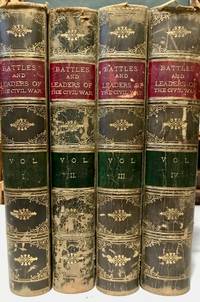
188835374New York: The Century Company. The De Vinne Press 1888. Hardcover. Fair. Tall quartos. 4 volumes. Illustrated with drawn portraits sketches and maps. Volume I: xxiv 750 pages 2. Volume II: xx 760 pages 1. Volume III: xx 752 pages 1. Volume IV: xx 835 pages 1. Reddish marbled paper covered boards with brown leather corners and spine. Gilt designs and leather title labels on the spines. All edges gilt. Volume II pages 759 760 and the rear end sheets cleanly detached. Slight crack to the rear hinge of volume 2. Leather is rubbed on the corners joints and spines all volumes. Edge wear to the head and base of spines. Light edge wear to the boards. Bindings are sturdy. Contents are clean. All 4 volumes have a previous owner's illustrated bookplate on the right front fly leaves Allan P. Geddes. Set is in fair condition. The Century Company. The De Vinne Press hardcover
191310787Washington: Government Printing Office 1913. Hard Cover. Very Good binding. Octavo. x 1140 pp. Third edition. Rebound in 20th century imitation leather over boards; all textblock edges marbled. Gilt spine titling is a little dulled but the binding is handsome without appreciable wear; a date stamp at the head of p. iii and a few pencil notations on the title/copyright pages otherwise the contents are clean. Government Printing Office unknown
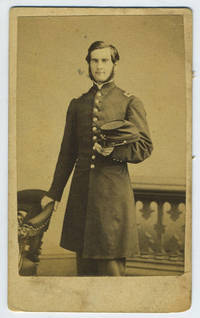
186328070New York: Bogardus 1863. Photography. Good overall. Two identical Bogardus images but with slightly formats - different Bogardus stamps on the verso and one with round corners the other squared. The pencil names on the verso of one card say "David Foster Israel Peopus Miss Logan " The portrait has the lieutenant in uniform holding his hat in left hand his right hand on a chair. <br /> <br /> Two identical images. 2 3/8 x 4" image on card. Photographer was Bogardus at 363 Broadway in New York NY. Faintly foxed. Bogardus unknown
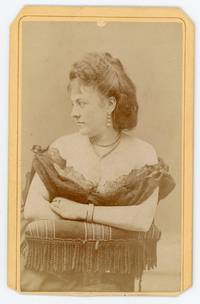
1867List309Virginia City: Sutterley and Co 1867. Albumen photograph on mount 4 x 2 ½ inches. Pauline Cushman was an actress and one of the most successful spies for the Union Army. She ingratiated herself with the Confederate army by toasting Jefferson Davis after one of her performances. She was eventually caught and sentenced to death by hanging. She was spared only due to the arrival of the Union Army. <br /> <br /> After the war she toured the country giving lectures and performances recounting her experiences as a spy. She eventually headed west marrying in 1872 in San Francisco and eventually working a range of jobs in Arizona Territory Texas and eventually back in San Francisco where she died in 1893 at age 60 from a morphine overdose. <br /> <br /> We find no record of this portrait which was taken by the Sutterley brothers James and Clement in their Virginia City Nevada studio somewhere between 1864 and 1867. The Sutterleys operated out of their studio on the Union block of Virginia City for five years before dissolving their partnership in 1867. It is likely that the portrait was taken during one of Cushman’s tours throughout the region during these years. <br /> <br /> A beautifully preserved example in very good condition with a small chip to upper margin and some fading. Though Cushman ostensibly would have sold cartes-de-visite in support of her touring few survive on the market today. Sutterley and Co unknown
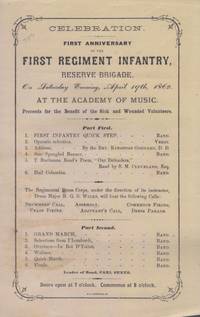
186230491Philadelphia: H. G. Lesenring Printer 1862. Broadside. Good. Broadside. Approximately 8.5" x 5.5". Light toning to the paper. Obscure. No copies found in digiatal or trade sources. H. G. Lesenring Printer unknown
1960221155New York Thomas Yoseloff 1960. 1960. First edition. Small folio. Foreword and acknowledgments by Pakula; introduction by Ryan and Rothstein. 20 color plates; 108 b/w portrait drawings by Pakula. Bibliography. Dust jacket unclipped; small chips nicks. Very good. No signatures or bookplates. F. Hardcover. New York, Thomas Yoseloff [1960]. hardcover
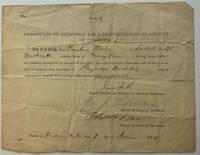
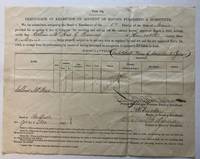
186437086Belfast Maine 1864. Printed document completed in ink manuscript oblong 10-1/4" x 8." Very Good. Signed in ink by the Provost Marshal and President of the Board of Enrollment; A.G. Crocker a member of the Board of Enrollment; and the Surgeon of the Board of Enrollment.<br /> <br /> Collins's Substitute who is not named agreed to a "term of Service 3 Years. unknown
186437087Frederick 1864. Printed document completed in ink manuscript oblong 6-1/2" x 8-1/2." Old folds light dusting Very Good. Signed in ink by the Provost Marshal and President of the Board of Enrollment; Jno. J. Thomas a member of the Board of Enrollment; and the Surgeon of the Board of Enrollment. unknown
186435416Charleston South Carolina: n.p. 1864. Letter. Good. Letter. Approx. 7.75" x 4.75." Folded paper. 4 pages of content. Tissue repairs to splits along folds. Ink stain on page 4. Good condition. <br /> <br /> Ms. Burke responds to Mr. Dreker's letter and thanks him with glowing compliments. She remarks about current events and friends. "Cecile's brother has just arrived from Columbia. He laughs at the dull dreary appearance of Charleston and gives an animated description of the life and gaiety in Columbia." Ms. Burke laments the miserable weather in Charleston and is hoping for a break in the "darkness." Regarding the War she writes "Mr. Westmore says he heard this morning from very good authority that the 5th Cavalry would NOT be removed from their present scene of service. Ms Burke is sad to see her friend leave and writes "I would be really sorry to have you leave now especially as our intercourse was becoming so and friendly. I regret very much to have it interrupted but wish that Distance will not break a friendship which has been so pleasant thus far." Ms. Burke encourages her friend to write as conditions permit and to be safe and quickly return. She states "Hope points her beacon light so the happy day not very distant when you shall return to your native state covered with laurels and enjoy the blessing of peace purchased through much suffering. Our prospects are so bright at present. I cannot but think that the summer roses fade or the leaves of autumn wither the of War will ease its thunder and the glad notes of Peace shall re-sound once more through our Southern land. n.p. unknown