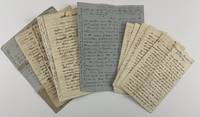
[Civil War] Stonebraker, Joseph RBiblio.com
11 490 résultats
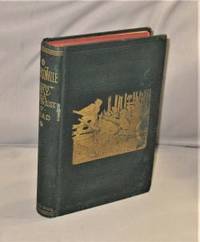
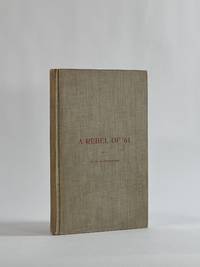
189910825New York and Albany: Wynkoop Hallenbeck Crawford Co 1899. Hard Cover. Very Good binding. Octavo. 116 pp. frontis plates ports folding table. First edition. Signed and inscribed by Stonebraker. In publisher's cloth with title in red on the front cover; more than three dozen inserted illustrations are present as called for as well as the folding genealogical table at the rear. Binding is a trifle edgeworn and moderately soiled; gentle fold to the bottom corner of much of the textblock; a very nice copy. <br /> <br /> An exceptional copy of a rare Confederate memoir. This copy inscribed by Stonebraker to L. Victor Baughman. Stonebraker was a member of Co. C First Maryland Cavalry; Baughman served in Co. D of that regiment. CWB I 164; Dornbusch II 522. Wynkoop Hallenbeck Crawford Co unknown
186634908Philadelphia: J.B. Lippincott & Co. 1866. 2 volumes. First Edition. 8vo publisher’s original brown cloth gilt lettered and gilt ruled on the spines. xii 392; 480 pp. An unusually nice set in the publisher’s original cloth binding. A fine and bright copy beautifully preserved Internally sturdy and sound. SCARCE FIRST EDITION AND AN UNUSUALLY FINE COPY THE BEST WE HAVE SEEN. With recommendations from influential southerners including a memorial from John Tyler and members of the Virginia secession convention to Jefferson Davis Jones was able to secure employment as a high-ranking government clerk in the Confederate States War Department at the first Confederate capitol in Montgomery. When the Confederate government moved to Richmond Virginia his family joined him. From the first day of his flight from the North Jones kept a diary to preserve the details of these eventful times for future publication.<br> After the war Jones and his family returned to his home in Burlington New Jersey and prepared his manuscript for publication. In 1866 it was published as A Rebel War Clerk's Diary at the Confederate States Capital. <br> The published diary is one of the best sources of everyday life in Richmond during the war; also with details concerning the inner workings of the War Department. James I. Robertson Jr. has called him "The Civil War's Most Valuable Diarist." <br> John Beauchamp Jones 1810 –1866 was a novelist particularly of the American West and the American South whose books enjoyed popularity during the mid-19th century. He was also a well-connected literary editor and political journalist in the two decades leading up to the American Civil War. During the war he served as a senior clerk in the Confederate War Department and is today remembered for his diary as offered here. J.B. Lippincott & Co. hardcover
186954043Washington D.C.: Government Printing Office 1869. 4to. 9.75 x 11.25 in. 141 3 pp. With table of contents printed on verso of last leaf tipped-in errata slip. With 3 lithograph engravings taken from photographs by E.J. Ward and William Bell lithographed by Julius Bien 71 text engravings. Original printed softcovers very minor chipping head & foot of spine couple minor closed tears dustsoiling w/o rear wrapper still a G mostly uncut & unopened copy. First edition of this in-depth report on surgeries carried out during the Civil War on 270 Union and Confederate soldiers detailing the data and case histories collected by him while detailing the primary intermediate and secondary excisions. The two appendices include tables which summarize the various excisions by Otis as well as providing an extensive bibliography of similar hip surgeries. E.J. Ward and William Bell were photographers at the Army Medical Museum charged with documenting the injuries and results of surgeries by military personnel until 1869. This work is among the earliest examples of engravings taken directly from photographs in a surgical text. Bien 1826-1909 was an outstanding lithographer and cartographer responsible for 1000s of maps issued during the 19th-century as well as a pioneer in chromolithography. Rutkow History of Surgery in the United States Vol. I OR23; Treadwell & Darrah Photographers of the United States of America 2003. Government Printing Office, paperback
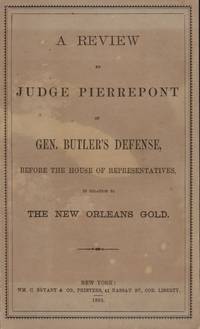
186531540New York: Wm. C. Bryant & Co. Printers 1865. First Edition. Wraps. Very good. Octavo. 27 pages. Brown printed stitched wraps with title on front. Light fading and damp-stains to the covers. Interior contents in very good condition. <br /> <br /> From the initial statement made before the Speaker of the House Schuyler Colfax Pierpoint states - "My attention has been called to the defense of Gen. Butler before the House of Representatives in relation to the New Orleans gold. That defense as published in the Globe I purpose to review and leave you to say whether it is not an audacious sham which ought to be exposed." <br /> <br /> Sabin 62784. Wm. C. Bryant & Co., Printers unknown
18612786np: np 1861. First edition. Original leather covers. Good. A REMARKABLY EXTENSIVE ARCHIVE OF A UNION SOLIDER INCLUDING DIARIES FROM 1861-1865 SPANNING HIS ENTIRE CIVIL WAR CAREER.<br /> <br /> THE SOLDIER CHARLES E. SMITH PARTICIPATED IN SOME OF THE MOST CRITICAL CAMPAIGNS OF THE WAR INCLUDING THE SEIGE OF VICKSBURG THE FALL OF ATLANTA AND SHERMAN'S MARCH TO THE SEA. Background:<br /> <br /> Charles E. Smith 1836-1905 was born in Berlin Township Ohio. He worked as a farmer and country schoolteacher in Alum Creek Delaware County Ohio. He enlisted in the 32nd Ohio Volunteer Infantry at the age of 25 on September 3 1861 and mustered in September 7 1861. He was promoted to the rank of corporal in Company I of the regiment on January 30 1864. He was slightly wounded on July 29 1864 during the Atlanta Campaign. He mustered out of the service on July 20 1865 at Louisville Kentucky.<br /> <br /> The 32nd Ohio Infantry was organized at Mansfield Ohio on August 20-September 7 1861 and mustered in for three years' service under the command of Colonel Thomas H. Ford. The regiment was involved in several important engagements and operations during the Civil War including the Battle of Greenbrier River the Battle of McDowell the Battle of Harpers Ferry the Battle of Champion Hill the Siege of Vicksburg the Atlanta Campaign the Battle of Jonesborough Sherman's March to the Sea the Carolinas Campaign and the Battle of Bentonville. The 32nd Ohio Infantry mustered out of service at Louisville Kentucky on July 20 1865.<br /> <br /> The Collection:<br /> <br /> The collection consists of 26 dairies dating from 1859 to 1866. Except for four volumes covering a period from 1856 to April 1861 and one covering the period September 18 1865 to December 5 1866 the remaining dairies 21 volumes span his entire Civil War career in the 32nd Ohio Volunteer Infantry covering the period September 3 1861 the date of his enlistment to the date of his mustering out of the service on July 20 1865. The diaries of various sizes average approximately 100 pages with few blank pages.<br /> <br /> His daily entries in his Civil War diaries many of which are detailed consist of descriptions of the weather diet geographical locations his devotion to the Union camp activities military news and description of engagements. He also included several drawings in the diaries some in color. He described his day of enlistment of September 3:<br /> <br /> "Enlisted at Lewis Center between 8 and 9 oclock in Captain Dyre's company of 3 years volunteers. I bid good bye to all my folks and started having resolved to assist in sustaining the Government. But the feelings which came over me when I left home friends and all that seemed dear to me I cannot describe."<br /> <br /> The new enlistees moved to Camp Dennison and Smith records the daily activities in camp as his company prepared for their first movement. From Camp Dennison the 32nd Ohio was ordered to western Virginia present-day West Virginia to assist in driving Confederate forces out of the region. On October 3 1861 the 32nd Ohio participated in the inconclusive Battle of Greenbrier River. Smith records in his diary beginning on September 29 through October 3:<br /> <br /> "In the evening we received orders to march to make an attack on Greenbrier about 12 miles distant. Our company numbered 86 men. Our regiment probably numbered 900 men present and able to perform duty. The 32nd. Went in advance and cleared out the road and took one prisoner. Our regiment stopped at the cross roads within four miles of Greenbrier and stopped. We expected there that the battle commenced. but they Confederate troops did not come and we. crept into the thick laurel bushes to lay till morning. When I awoke it was daylight and other regiments were passing. The artillery was hurrying along as fast as possible each gun was drawn by six horses and about nine oclock the canons began to roar. It was kept up till two oclock on both sides when our communication failed and our men withdrew from the field without losing any guns. The canons roared very loud and the sound rolled over the Mountains and valleys and made everything ring once more. Our loss was including those that were killed on the field and those that died of wounds after the battle about 12 men. We took 13 prisoners." <br /> <br /> Smith describes an engagement with Confederate forces around Beverly Virginia on December 18 1861:<br /> <br /> "The rebels came out and met our forces and a bloody fight ensued. The 32nd fought bravely and drove the enemy back. The 25th were in the advance and were cut up dreadfully. They fell back and the 32nd stood their ground and fought them like tigers. Our men made two or three gallant charges and drove them out of their entrenchments and were forced out themselves. Our boys could not drive them out again and after a desperate and bloody struggle our troops retreated. having lost about one hundred men."<br /> <br /> After spending the winter in Beverly Virginia the 32nd Ohio participated in the Shenandoah Campaign of 1862 where they engaged Stonewall Jackson's Confederate force at the Battle of McDowell Virginia on May 8 and were defeated. On that day Smith recorded the following:<br /> <br /> "We formed into line and gave three cheers to the cavalry and were waiting to welcome the infantry when a dispatch came for us to report immediately at headquarters armed and equipped. We went forthwith and formed into line of battle on an open field. The rebels came down on the hills & tried to pick a spot to plant a gun and our boys threw shell amongst and drove them out. The rebels gathered on a mountain at the right of town about 4000 men. Our boys did not find out what they were at or where they were till late in the afternoon. Two regiments went up the mountain and the ball was opened. The battle lasted till after 8 oclock at night when our boys withdrew bringing the wounded and mostly all the dead from the field. The fight lasted about 4 hours."<br /> <br /> The 32nd Ohio retreated to Franklin Virginia where they joined General John C. Fremont's command. Fremont followed the Confederates into the valley and engaged a Confederate force at Cross Keys Virginia on June 8 1862 but Smith's company did not participate in the action. The 32nd Ohio move on to Winchester Virginia where they performed garrison duty for the remainder of the summer.<br /> <br /> In September 1862 the 32nd Ohio was dispatched to Harper's Ferry. The regiment again faced Stonewall Jackson participating in the Battle of Harper's Ferry September 12-15 1862. In this engagement Jackson captured the town and nearly twelve thousand Union soldiers including the 32nd Ohio subsequently paroling them after confiscating their supplies. In his entry for September 15 Smith describes the last day of the battle:<br /> <br /> "At sunrise the ball opened with a heavy cannonade from both sides. Our men were nearly out of ammunition for artillery and the enemy was mowing down our ranks. The shells and shot came down like hail all around and amongst us and many of our officers and soldiers were mortally wounded. Our artillerists run out of ammunition and there was no other way for us to do than surrender or be slaughtered on the field. At about 8 oclock the stripes and stars were hauled down and the white flag waved as a signal for surrender. The rebel cavalry and officers were soon riding through our camp. They hoisted the bars and stars where an hour before our glorious old star spangled banner floated proudly in the breeze. O how my heart beat and my bosom heaved to see that corrupt flag raised in defiance over us."<br /> <br /> The surrender of the 32nd Ohio resulted in a revolt in the ranks of the enlisted men against the regiment's officers which Smith later discusses in a January 15 1863 entry in his diary stating: "we were obliged to surrender 11500 men to the Rebels General A.P. Hill. It was the opinion of nearly all of our men that Colonel Miles of Baltimore betrayed us into the hands of the Rebels. It was said that he got 15 cents per head for us. Our Col Thomas H. Ford was examined by a committee and dismissed from the service for blame that was unjustly laid against him for the evacuation of the Maryland Heights. Since we were paroled a hard feeling was created between the officers of the regiment." Smith and his regiment eventually rejoined General Ulysses Grant's Army of the Tennessee in Memphis on January 25 1863. The regiment was involved in Grant's Siege of Vicksburg beginning in April 1863.<br /> <br /> A pivotal engagement in Grant's Vicksburg Campaign was the Battle of Champion Hill which occurred on May 16 resulting in a Union victory. Smith's entry for that day records the fighting:<br /> <br /> "A battle had begun on the left the firing seemed to be from large guns and the line seemed to be several miles long. We halted to await orders. Soon they came & we went forward & laid behind a ridge where we could see the fighting. The scene was grand but terrible. The heavy fighting was on the left & center at first. Our brigade charged on a rebel battery and took it & hauled it off. The 32nd did a noble part charging on the hills & ravines and out the battery driving the enemy before them killing a large number."<br /> <br /> The siege of Vicksburg ended on July 4 1863 when the Confederate forces surrendered and the Union troops under Grant including the 32nd Ohio entered the city. Smith recorded the events of July 3 and 4 in his diary. On July 3 he wrote: "This is the 46th day of the Siege. The rebels have sustained at this place and nobly and bravely have they defended it but General Grant has been too much for them." The next day's entry detailed the surrender. "At nine oclock it was announced that Vicksburg was surrendered. What a thrill of joy ran through every heart. The boys all seem lively and jubilant over the success which has crowned our arms. At half past ten oclock the rebels march out of their forts and rifle pits. and form in line outside their works and stuck arms."<br /> <br /> After Vicksburg the 32nd Ohio joined an expedition to Monroe Louisiana and then participated in General James McPherson's expedition to Brownsville Mississippi. In addition to his daily entries Smith also drew a number of pencil and ink sketches that reflected what he described in on a particular day such as sketching images that depicted the sleeping arrangements in the soldiers' tents maps of terrains and a two-page spread showing the capture of a Confederate battery in Mississippi. He also wrote down poems whether written by him or others. For example on January 31 1864 he added a six-stanza poem possibly written by him entitled "Evening Thoughts" to that day's entry. A partial transcription reads: "I'm weary and I'm lonely//As I'm sitting in my tent//And I'll take my leaden pencil//And give you my feelings sent// O would this war be over//And these bloody strivings cease//And our country now distracted//Return with lasting peace."<br /> <br /> In February 3 to March 6 1864 the 32nd Ohio was involved in General William T. Sherman's Meridian Expedition which resulted in the capture of Meridian Mississippi. On March 3 Smith recorded a diary entry that detailed the destruction rendered by the campaign:<br /> <br /> "I cannot fully give the amount of damage done to the Southern Confederacy while on this Expedition but the result foots up about as follows. About 200 miles of railroad running east & west was destroyed. About 60 miles of the Mobile and Ohio railroad was destroyed and about 40 miles of the Central Mississippi road destroyed. There were about 25 Locomotives and a considerable number of cars together with Confederate railroad houses machine shops and foundries manufacturing establishments of arms ammunition. A large amount of cotton was burned."<br /> <br /> On June 10 1864 the 32nd Ohio joined Sherman's Atlanta Campaign. In the campaign the 32nd fought in the Battles of Kennesaw Mountain Atlanta Ezra Church and Jonesborough. The campaign ended on September 2 1864 when Union forces occupied Atlanta. Smith's diary entry for June 27 mentions the engagement at Kennesaw Mountain:<br /> <br /> "We were aroused at early dawn. and then ordered to pile our knapsacks and be ready to move. A battery had been brought up and was shelling the Rebels lively for a while. Our division having formed a line of battle came to a right shoulder shift arms and then we advanced in line through the woods toward the enemy. The skirmishers engaged the enemy who replied by volleys of musketry which whizzed overhead and sounded hideous. The rebels brought several batteries down and opened upon us. Moved up a little higher and laid down again and the rebels opened with shot and shell which came whizzing overhead. Some of them sung like an old spinning wheel under the control of a northern farmer's wife. Our loss in this engagement was considerable. We fell back learning that the rebels were massing their force to right and formed a new line of battle in front of our new breastworks and behind the skirmishers. Skirmishing was kept up lively along the lines and many had hair breadth escapes. We made our demonstration to draw as much rebel force away from the right as possible."<br /> <br /> His diary entry for September 3 1864 reported the good news concerning the fall of Atlanta:<br /> <br /> "Atlanta was evacuated yesterday morning at daylight the rebels having blown up large magazines of ammunition destroyed government stores and eighty carloads of ammunition. The Twentieth Corps under General Slocum marched into and took possession of the city of Atlanta an eleven oclock. We have last caused the rebels to evacuate what they called the 'Gate City' or 'Key' to the southern Confederacy and that without a very general battle. The rebels have made many boasting speeches and declared that they would fight for Atlanta till the last man woman and child was sacrificed before they would give it up. Where is their vain boasting where are their prophesies"<br /> <br /> The capture of Atlanta had a major impact on the presidential election of 1864 and helped President Lincoln's chances for reelection enormously. On election day November 8 the 32nd Ohio voted in the field. Smith's diary entry for the day reads "This being election day the polls were opened and we voted for President. Abe Lincoln carried the day."<br /> <br /> In mid-November 1864 the 32nd Ohio participated in General Sherman's "March to the Sea." The command engaged in no noteworthy battles or skirmishes until reaching Savannah Georgia. On December 10 1864 the regiment was among the lead Northern units that drove the Confederate garrison into the confines of city. Upon the Union Army's capture of Savannah on December 21 1864 the 32nd entered and encamped in the city.<br /> <br /> Within a week of the fall of Richmond the capital city of the Confederacy the news of President Lincoln's assassination and death on April 15 spread slowly to the soldiers in the south including the 32nd Ohio. On Monday April 17 Smith recorded in his diary:<br /> <br /> "An order said to have come from Secretary Stanton to General Howard was announced to the soldiers. That President Lincoln Secretary Seward and son were assassinated and that the President was killed. Whether this be true or not it caused sadness in many hearts and was believed to be reliable."<br /> <br /> The next day's entry was in response to the confirmation that Lincoln was dead:<br /> <br /> "News of the death of our President Abraham Lincoln causes a gloom over our minds. We feel that in losing him we have lost one of the best men our nation ever produced. In losing him we lose a wise and intelligent statesman a great and good counsellor a lover of freedom and humanity and the deliverer of our nation from the curse of slavery."<br /> <br /> In addition to the dairies there are several documents and papers relating to Smith and his family including the following: 1 An autograph manuscript entitled "The Vicksburg Campaign from Millikens Bend Louisiana. From March to July 4th 1863" 81 pages one side only in a bound copy book cover missing 8.5" x 11.5" n.p.; n.d.<br /> <br /> 2 An autograph manuscript entitled "The Siege of Vicksburg Continued" 34 pages one side only in a bound copybook 6.75" x 8.25 n.p.; n.d.<br /> <br /> 3 Autograph manuscript signed entitled "Diary of Events Transpiring between the United States and Spain over Cuban affairs." 117 pages in bound copy book 5.75" x 9" n.p.; circa 1901.<br /> <br /> 4 Autograph manuscript signed entitled "Closing Scenes of the Rebellion. An Original Poem" Six pages one side only in bound copybook 8" x 10" n.p.; May 30 1895. Poem was recited on Decoration Day at Cheshire Ohio on May 30 1895.<br /> <br /> 5 An autograph manuscript entitled "The Great Three Days Battle of Gettysburg Fought July 1 2d & 3d 1863. The Greatest and Most Decisive Conflict of the Great Struggle for American Independence" 28 pages one side only in bound copy book missing front cover 8" x 10" n.p.' n.d.<br /> <br /> 6 Autograph manuscript part 2 of number 4 above 27 pages one side only in bound copy book 8" x 10" n.p.; n.d.<br /> <br /> 7 Autograph manuscript entitled "Original Poem Written for the 49th anniversary of the birth of Mrs. Louisa Rolson Smith" Five pages one side only 8" x 10" n.p.; June 22 1895.<br /> <br /> 8 Autograph manuscript signed entitled "Incidents in the war of the rebellion from 1861 to 1865. Poetical Effusions from the pen of Charles E. Smith late of Co. F. 32d Ohio veteran volunteer Infantry" 68 pages one side only in bound copybook missing front and back cover 8.5" x 11.75" n.p.; n.d.<br /> <br /> 9 Photograph of Charles E. Smith 3.5" x 4.75 oval albumin print mounted on board n.p; circa 1894. <br /> <br /> 10 CDV of George Smith brother of Charles E. Smith 2.5' x 4" T.Beach photographer Delaware Ohio; circa 1860s. <br /> <br /> 11 Medal with badge for 32nd National Encampment GAR Cincinnati 1898.<br /> <br /> 12 Photograph of residence of Charles E. Smith West Berlin Ohio an 9.25" x 7.5 albumen print on a 10.25" x 8.5" mount Acme View Company McAlisterville Pennsylvania; 1894. <br /> <br /> 13 A Confederate envelope "captured on the battle field of Raymond Miss. May 12 1863 by C. E. Smith. <br /> <br /> 14 Discharge of Charles E. Smith from the service one page 6" x 8.5" Columbus Ohio; July 28 1865.<br /> <br /> 15 Two pencil sketches by Smith of "A residence near camp of 20th Ohio sketched by C. E. Smith Dec 3d 1863" on front and "A scene in co. D. 20th O.V.I. Thursday evening Nov 26th 1863. A Thanksgiving oyster supper. Sketch by C. E. Smith Nov 27th 1863." <br /> <br /> 16 A pencil sketch of the "View of The Court House at Vicksburg. Drawn by C.E. Smith Nov 4th 1863."<br /> <br /> 17 Pencil sketch of the Rock House inside the Confederate fortifications at Vicksburg "Sketched by C.E. Smith Nov 2d 1863." On verso is sketch by Smith of the city vault in Vicksburg November 2 1863.<br /> <br /> 18 Photocopy of will of Charles E. Smith Two pages West Berlin Ohio; December 18 1901. <br /> <br /> Condition: The 26 diaries all have leather covers over boards which in most cases are worn but intact. The front cover of volume #9 has separated. Most have flaps. Overall the dairies are in good condition. The other items in the collection are overall good; numbers #1 and #7 manuscripts are brittle and fragile. Foxing and toning to letters along with creasing and light tearing at edges. Wear and staining to the exterior of diaries.<br /> <br /> Note: The text of the collection has been published as "A View From the Ranks: The Civil War Diaries of Corporal Charles Smith" in a very limited printing by the Delaware County Historical Society 1999. A copy of the book is included with the collection. <br /> <br /> A REMARKABLE UNBROKEN RUN OF DIARIES OFFERING A HIGHLY LITERATE FIRST-HAND ACCOUNT OF THE CIVIL WAR EXPERIENCE THROUGH THE EYES OF A UNION SOLDIER. np unknown
190864038Madison WI: Wisconsin History Commission August 1908. 8vo. xii 104 pp. Frontisp. portrait 1 large folding map. Quarter-cream-coloured cloth over gray-tan boards black lettering on front cover gilt lettering on spine minor toning to spine minor edgewear scuffing still VG copy. First edition of this first-hand memoir of the events up to the siege including the battle of Vicksburg by Vilas 1840-1908 who served as a captain in the 23rd Wisconsin Volunteer Infantry Regiment and later rose to Lieutenant Colonel and served as professor and regent of the University of Wisconsin-Madison. Wisconsin History Commission, hardcover
192746211Philadelphia: Penn Publishing Co. 1927. 8vo. 213 1 pp. Frontisp. 2 plates. Brown ribbed cloth colour plate by Nora Sweeney mounted on front cover w/ d.j. minor chipping head & foot of spine old tape repair to small closed tear at lower fore-edge F/G- copy. First edition early printing of this 7th title in the scarce Yankee Girl series. This title about the heroine as an inadvertent spy for the Union amongst the Confederates of Virginia was set against the backdrop of the famed naval battle between the two Ironclads the Monitor and the Merrimac Penn Publishing Co., hardcover
1861100124<p>Pamphlet removed 941 pp. Some foxing especially title page. This pamphlet provides a glimpse of the Confederate States making ready for war. Through resolutions and acts outlined here they establish many of the functions they will need as a sovereign state. Including setting up a post office taxes and raising an army. Parish & Willingham 27.</p> Enquirer Book And Job Press,
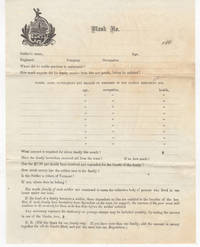
186044818Vermont 1860. Very good soiled along edges and folds. 1 sheet. 7.5 x 9.75 inches. Blank form to be completed by families of Union soldiers requesting funds and other types of aid during wartime. The form contains the Vermont seal on the upper left corner. Asks such questions as: <br /> What amount is required for above family this month<br /> Have the family heretofore received aid from the town<br /> Has the $7.00 per month been received and expended for the benefit of the family<br /> How much money has the soldier sent to his family Is the Soldier a citizen of Vermont <br /> If not where does he belong<br /> And more. unknown
187210708Mongomery AL: Barrett & Brown 1872. Hard Cover. near Very Good binding. Octavo. 712 pp. First edition. As issued in publisher's cloth with title in gilt on the spine. Some rippling to the cloth; minor fraying at the spine ends and corners; early 20th century shelf label on the spine institutional bookplate on the front pastedown and penciled library number on the verso of the title page otherwise clean but for some very minor foxing. <br /> <br /> A remarkable history and one that Howes calls the "best general history of the state" Howes B-755. Owen in his Bibliography of Alabama echoes Howes writing "This book must be regarded as the most valuable general contribution to the history of the State yet made" Owen p. 842. Brewer offers of a county by county history of Alabama that comprises the lion's share of the book. The final hundred pages is dedicated to Alabama's role in the Civil War. In his assessment of important Alabama books Rucker Agee writes "With a dearth of complied source material Brewer undertook the stupendous task of organizing a brief sketch of each regiment of infantry and cavalry-with the names of their field officers and staff officer the names of each captain and the counties from which their companies came plus similar information as to each battery. . . . affording valuable reference material" Agee Twenty Alabama Books p. 81-2. Uncommon in commerce. Brannen 87. Barrett & Brown unknown
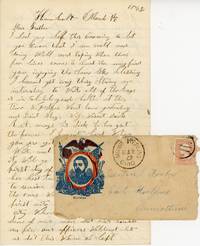
186245189Humbolt Camp; Mount Sterling OH 1862. Very good letter folded minor soiling envelope about very good moderate soiling and edge wear verso split apart contains a series of penciled-in numbers. 3 pp. Bifolium pictorial envelope. 5.5 x 9 inches. March 10th 1862. First portion of letter is from E.M. Simmons to his brother and second portion to A.W. Morgan. The pictorial envelope is addressed to Edwin Forbes of East Hartford CT with a engraved color portrait of Union General George B. McClellan and was posted from Mount Sterling Ohio Mar. 12. <br /> <br /> Simmons wrote: "We left Columbus the first day of this month and got her last Tuesday nite We walked to Union City and then got on the cars We stade at the Moscow the first nite and the 2 at Union City when we left Columbus some of our men Sat our houses on fire our officers wouldn't let us set this. When we left the town was burnt when our Soldiers left so I will drop the Subject." Simmons later mentions the fighting taking place at New Madrid at The Battle of Island Number Ten. "We have herd that the yankees was in 4 miles of Madrid and tha had fought ther a littel. I cant tell how long we will stay her I dont think that we will leve her without tha is a fite at Madrid this is a good place to Reinfors any way."<br /> <br /> McClellan was designated the first commander of the Department of the Ohio though he was reassigned and the Department disbanded the day this letter was posted.<br /> <br /> The Battle at New Madrid ended the Confederates' hold on the bend in the Mississippi River that had been an excellent site to impede Union efforts to invade the South by the river. unknown
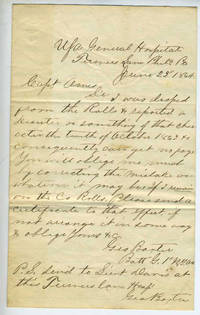
186428546Philadelphia 1864. Letters. Very good condition. Turner's Lane Hospital was founded in 1863 and is considered the first US neurological research center. George Baxter of Battery G 1st NY Artillery writes to Capt. Ames that he has 'been droped sic from the Rolls reported a Deserter or something of that character the tenth of October 1863 consequently can get no pay. You will oblige me much by correcting the mistake or whatever it may be.' He asks for a certificate to be sent to 'Lieut. Davis at this Turners Lane Hospital.' One might wonder if Mr. Baxter was being treated at the hospital. Small note on the back page "Answered July 4th 1864".<br /> <br /> Bifold 4 7/8 x 8" manuscript on lined paper original folds. unknown
186345190Newport News VA 1863. Very good closed tear along one fold light soiling contents faded but clean. 2 pp. 8 x 10 inches. February 15th 1863. R.H. Irwin of Company E 51st Regiment 2nd Division 2nd Brigade 9th Army Corps. of the Pennsylvania Infantry. Irwin writes to his uncle & aunt and after commenting on his march from Fredericksburg tells them of the improved camping conditions at Newport News and of his seeing the a monitor. "I caught cold changing camp at Fredericksburg . We had a pretty nice time coming down but very much crowded.The camp is much pleasanter. There is know mud at all here.<br /> I saw the Monitor yesterday but was not close to it they fire a shot know and then. I do not know wat at they tell me some of the . boats come down with in 3 miles of this place. I look for navle engagements before long I may be mistaken."<br /> <br /> Most likely Irwin saw one of the new monitor class ships: the Passaic the Montauk the Nahant or Weehaukin all of whom were completed and launched before February and headed South.<br /> <br /> R.H. Irwin of St. Clair Schuylkill County Pennsylvania. seems to have survived the War. He is listed as School Treasuredr in Saint Clair in 1865. See: Wallace: Memorial of the patriotism of Schuylkill county in the American Slaveholdefs Rebellion Pottersville: Banyon 1865 p.64; Pennsylvania School Journal 1864 Volume 13; Page 196. unknown
1918104188<p>Oblong 8vo cloth gilt title on top cover and spine illustrated. Top hinge a little weak but firm some extremity wear and back cover wear normal aging; otherwise very good plus. This little work includes a short history of political caricature from James Gillray to Thomas Nast. This is a charming collection of political humor that includes views on major events to those that have long been forgotten. The themes are of course relevant to the day and express sentiments at that time. Some are racist like a cartoon of Abe Lincoln sitting on a woodpile labeled the 'Republican Platform' showing a black person under the pile and with a caption "The Nigger in the Woodpile." Another cartoon features a general representing the Union hitting various Southern leaders linked to secession with a club. </p> Brentano's,
1918101435Oblong 8vo cloth illustrated. Minor edgewear some minor water staining along the bottom of first few pages not affecting images front endpaper with small chipp back cover stained or marked; contents very good overall. Illustrations provide a useful record of political humor during the Civil War years. Not surprisingly many feature Lincoln including one of him leading the Republican Party into an insane asylum. Brentano's,
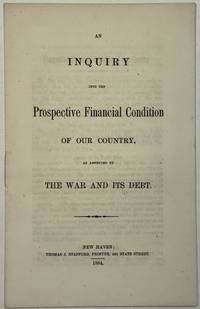
186440305New Haven: Thomas J. Stafford Printer 1864. 13 1 blank pp. Stitched Very Good with light dusting.<br /> <br /> Citing "the vast resources of our country and the unparalleled ratio of increase both of population and property" the author concludes that of course the United States has the ability to liquidate its war debt. Suggestions of bankruptcy or repudiation are "absurd."<br /> Copperheads are guilty of making "the poor believe that they are oppressed by the Government for the benefit of the rich. What a responsibility rests upon those men who for base party ends by means of financial falsehoods are doing their utmost to evoke the spirit of the demon mob!"<br /> OCLC 887121042 1- Yale as of July 2024 one of a number of imprints apparently bound together as "Economic Tracts. No. 41." Not located in Sabin Bartlett or anywhere else. Thomas J. Stafford, Printer unknown
1860CAT0150New York 1860. An unusual image of a Zouave soldier in an outdoor setting holding a horse. During the Civil War roughly 95 Zouave regiments formed adopting the names uni-forms and sometimes fighting styles of the North African Zouave brigades. The bulk - about 70 of the regiments - fought for the Union cause. We were unable to determine anything else about this soldier though the image was found in a New York estate. New York was home to two of the most famous Zouave brigades the 5th New York Volunteer Infantry and the 11th New York Volunteer In-fantry. A nearly fine image with a slight crease housed in a full case. unknown
187963669Toledo OH: D.R. Locke 1879. Thick 8vo. xxx 31-654 pp. Woodcut-engraved frontisp. text woodcut engravings plates tables diagrams. Publisher’s full speckled calf gilt & black spine label brown clay sized endpapers spine rebacked w/ original laid-back down repairs & head & foot still a sound VG- copy. First edition of this gripping personal narrative of the terrible conditions in Andersonville as prisoner during the Civil War by a soldier in the 16th Illionois Cavalry captured during a skirmish near Jonesville VA in January 1864 by Confederate troops commanded by William E. Jones. McElroy 1846-1929 was an apprentice printer before the war and after his release following the end of the Civil War eventually became a reporter and editor of the Toledo Blade in Toledo OH. By 1884 he became editor and cow-owner of the National Tribune in Washington D.C. and was active in the local G.A.R. D.R. Locke, unknown
188327966Cincinnati:: Douglass Brothers & Payne 1883. Second Printing of the First Edition. A Fine tight copy in green cloth binding with bright gilt to cover and spine. John L. Ransom was born in 1843. He joined the Union Army during the American Civil War in November 1862 and served as Quartermaster of Company A 9th Michigan Volunteer Cavalry. In 1863 Ransom was captured in Tennessee and taken to Andersonville Georgia. During his imprisonment he kept a diary of his experiences. On the 6th July 1864 he wrote: "Boiling hot camp reeking with filth and no sanitary privileges; men dying off over 140 per day. Stockade enlarged taking in eight or ten more acres giving us more room and stumps to dig up for wood to cook with. Jimmy Devers has been a prisoner over a year and poor boy will probably die soon." Of the 49485 prisoners who entered the camp nearly 13000 died from disease and malnutrition. This is Ransom's stunning first-hand account of stay in Andersonville. Douglass Brothers & Payne, hardcover
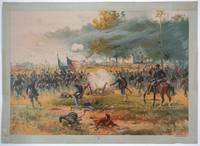
189029185Boston: American Lithographic Co. 1890. One of the 18 images from Prang’s War Pictures published 1886-1887 reissued by the American Lithographic Co. <br /> <br /> A detailed print of the Battle of Antietam Maryland the fighting near Dunker Church on September 17 1862. It was the first field army-level engagement in the Eastern Theater of the Civil War to take place on Union soil. It remains the bloodiest day in American history. <br /> <br /> A print from a striking series of images of the rare and important Civil War series originally issued by Louis Prang between 1886 and 1888 and later reissued later by the American Lithographic Co. In the early 1880s Century Magazine and Kurz & Allison had both issued popular works pictorializing Civil War battles. Prang the foremost lithographer in the United States commissioned watercolors for the prints. He obtained testimonials on their accuracy from prominent veterans focusing on heroes who were still living creating a patriotic nostalgia about the war. <br /> <br /> Copyright Prang & Co Boston 1887 in the center margin American Lithographic Co. on the right. 15 x 21 3/8" plus margins. Very bright copy. American Lithographic Co. unknown
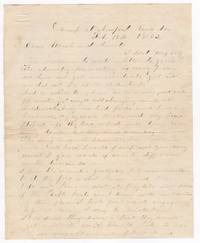
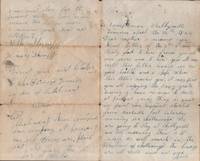
186435325Shelbyville Tennessee: n/a 1864. Letter. Good. Letter. Paper sheet measures 8" x 10". Folded three times. 4 pages of written content. A few spots and toning to the paper. Good condition. Transcription of contents is slightly difficult with several misspelled words. Letter reads:<br /> <br /> Camp Near Shelbyville Tennessee april the 14th 1864 <br /> Dear Mother i recived your kind letter of the 3th a was truly glad to here from you all once more and to here you all was well this letter leaves me in good health and i hope When this letter reachs you it may find you all enjoying the same grate Bessing i have no news to Write at present every thing is quiet in front our regiment started from nashville last Saturday morning for Chattanooga We are going to stay at Shelbyville un till morning then i supose we will march in the Direction of chattanooga the buoys are all well and in good spirits their is no rebel army nearer than richmond their will be the next big fight and i hope the last one during this war We have got one hundred thousand troops in front ready to march in the direction of richmond if our men should have luck to take richmond i think the War would close soon after words Whether it closes or not i am coming home just as soon as my time it out if uncle Sam give us our furlow time i will be at home some time in June if not i will be their in September if i have the luck to get out safe mother tell the old man to put in a good crop of corn and i will be their to help him gather it tell uncle nathan graves i have not forgoton him tell him i would like to here how he is geting a long also give my love to him mother i have received your minature at last Witch you sent by gery paddock i think it favers you very mutch tell nancy mays i have not herd from Will for some time i saw colonel Wharton at nashville a few days a go. he said the Buoys were all well and was campt near chattanooga tenn mother tell me haydon i think he is two work brickel slce i Would here oftener from him give all mr haydons my love and respets and keep a dieu family portion for your self give aunt lucy ana family my love and respets I now must close for the preasant this So no more i remain your son un till Death signed Stith Stumpff addressed To mary Stumpff Direct your next letter to chattanooga Tennesee in care of lieutenant Keen lieutenant keen commands our company at preasant our old officers are plaid out So fare the well for a while." Ancestry dot com record found for Stith Stumpff age 18 birth date about 1844 enlistment date into the Union Army October 4 1862. Stith Stumpff enlisted at Lebanon Kentucky as a Private in the Fifth Kentucky Cavalry other U.S. archive records indicate the Kentucky Fourth through Sixth Cavalry. The Fifth Kentucky Cavalry fought in the Atlanta Campaign summer of 1864. n/a unknown
186535324Boston: n/a 1865. Letter. Good. Paper. Printed letterhead. 8" x 5" folded paper makes 4 pages. Paper is split top and bottom of the center fold. Light staining to the paper. Two pages of hand written content by John Albion Andrew to William Schouler 1814 – 1872. Schouler was a journalist politician and Adjutant General of Massachusetts during the American Civil War. Congratulatory letter reads - "Brig. Genl' Wm. Schouler Adjutant General General: I have the pleasure to acknowledge the receipt of the copies of your Report and to congratulate you on the completion of so great a task. I thank you most sincerely for your constant zeal and ability and for the kind terms in which you have spoken of myself in the concluding sentences of the Report. Reciprocating its expressions of repeat and cordial good will I am General faithfully your friend and servant signed John Albion Andrew. From wikipedia: John Albion Andrew May 31 1818 – October 30 1867 was an American lawyer and politician from Massachusetts. He was elected in 1860 as the 25th Governor of Massachusetts serving between 1861 and 1866 and led the state's contributions to the Union cause during the American Civil War 1861-1865. He was a guiding force behind the creation of some of the first African-American units in the United States Army including the 54th Massachusetts Infantry. n/a unknown
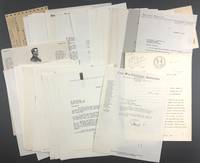
197246101New York; Northridge CA 1972. Near fine collection folded occasional faint soiling or staining. 52 items. Mostly 8 1/2 x 11 inches. Mostly typed letters signed by radio broadcasting pioneer and First president of Broadcast Music Inc BMI Carl Haverlin 1899-1985 who was also a renowned authority on Abraham Lincoln & the Civil War the majority concerning the Civil War Round Table of New York matters. Most of the letters are to Arnold Gates 1914-1993 noted Civil War scholar. The New York chapter was founded in late January 1951 with Haverlin as President Frederick Hill Meserve as Honorary President and with Allan Nevins on the Executive Committee.<br /> <br /> Includes: 48 TLS by Haverlin plus one postcard and one telegram; TLS on letterhead for Lincoln Association of Jersey City NJ; and A copy of Proposed Constitution and By-Laws of the National Association of Civil War Round Tables 6 pp. 1958. Unless noted all items are 1 page typed letters signed by Haverlin on Broadcast Music Inc. letterhead later BMI from Haverlin to Gates:<br /> <br /> 1.1950.11.27. Judge Stanton T . Lawrence of NJ invitation.<br /> 2.1951.02.21. Thanks Gates for putting organization name on Freeman list.on letterhead for Civil War Round Table<br /> 3.1951.11.29. Follow up regarding Confederate material. Contacted Mr. Black and learned it had been sold. on letterhead for Civil War Round Table<br /> 4.1952.11.03. Letter of enclosure from Abe Geldhof of the Chicago Round Table.<br /> 5.1952.11.26. Letter of enclosure that he'd forwarded to Boyd Stutler.<br /> 6.1953.11.11. Suggests printing might be done at Broadway Music Inc would save them some money.<br /> 7.1953.11.24. Circular."Looking for suggestions for a gift for Dr. Frederick Meserve. and a contribution check; for the Civil War Round Table"1 pp.typed<br /> 8.1953.11.25. Letter of Enclosure containing the list of officers from the newly organized Kentucky Civil War Round Table.<br /> 9.1955.09.01. Congratulations on Round Table booklet.<br /> 10.1955.11.25. Letter of enclosure containing names of individuals expected to attend upcoming meeting.<br /> 11.1957.02.07. Letter of enclosure for two copies of his review for "As They Saw Him".<br /> 12.1957.02.14. "Mention of review in "Lincoln Herald" ; thanking him for sending Lincoln photo and booklet".<br /> 13.1957.02.26. Announcement / invitation to annual banquet for The Lincoln Group of the District of Columbia.<br /> 14.1958.01.17. Letter of enclosure for the agenda / notes from the meeting of the National Assembly of the Civil War Centennial Commission.<br /> 15.1958.04.17. "Thanks Arnold for a plaque. Reiterates offer for Round Table members to join the Civil War Centennial Association".<br /> 16.1958.04.23.Arnold Gates; Carl Haverlin."From Civil War Round Tables Headquarters. Virginia; Copy of Proposed Constitution and By-Laws of the National Association of Civil War Round Tables".6 pp.copy; unsigned<br /> 17.1958.08.26. Myron Luke."Enclosure of letter from Karl Betts. executive director of the Civil War Centennial Commission".<br /> 18.1958.10.10. Arnold Gates; E.B. Long ; Ralph G. Newman ; John Magruder.Letter of enclosure for the Long-Gates-Reiter program for upcoming helicopter tour.on Civil War Centennial Association letterhead<br /> 19.1958.10.13. Life Magazine did not think enough celebrities signed up for helicopter tour to warrant coverage.<br /> 20.1959.09.01. Mr. Catton ; Gates ; Long ; Newman ; Stern."Letter of enclosure for Civil War Series at Bronxville school. hopes Ralph Newman to officiate".<br /> 21.1959.09.09. Arnold Gates ; E.B. Long. Request for a picture and brief bio for Bronxville series.<br /> 22.1959.09.14. Cannot attend a meeting.<br /> 23.1959.09.15. Info pertaining to the Bronxville Adult School series; attached names of speakers.<br /> 24.1959.09.18. Regarding Gates' upcoming appearance for the Bronxville.<br /> 25.1959.11.03. Talk about the most recent Bronxville session; the conference at Gettysburg; upcoming dinner.<br /> 26.1959.11.10. Enclosure for Civil War Round Table membership fees from Noel Rhys.<br /> 27.1959.11.13. Mr. Steets; copy to "Copy of letter regarding upcoming dinner at Hereford House; small handwritten note to Arnold added to bottom. signed Jane". with envelope"<br /> 28.1960.02.02. "Will attend upcoming Round Table meeting. Trying to convince Carl Sandburg to attend".<br /> 29.1960.03.17. "Forward of enclosure from Denton Walker. concerning General Shields' son".<br /> 30.1960.09.16. "Expresses concern that advertisers fear a good Civil War series would offend southerners. but believes this fear is unfounded".<br /> 31.1960.11.11. Pricing the Smyser Catalog.<br /> 32.1960.11.25. Karl Betts' request for a speaker.<br /> 33.1960.11.29. Schedule meeting with Bruce Catton.<br /> 34.1960.12.07. "Enclosed check for upcoming meeting for himself Samuel Vaughan and Michael Sterne".<br /> 35.1961.01.09. Letter of enclosure; Thanking for kind comments about Lincoln book.<br /> 36.1961.05.02. "Cannot attend 100th meeting of Civil War Round Table. will be at the National Association of Broadcasters instead".<br /> 37.1961.06.01. "Cannot attend final meeting of season. will be at BMI event; post script handwritten".<br /> 38.1961.11.10. Talk of Round Table award for publishers.<br /> 39.1962.01.22. Thanking Gates for 100th meeting medal; asks about Gates' personal matters.<br /> 40.1962.02.05. Compiling music for Civil War Centennial Commission.<br /> 41.1962.09.25. "Happy to see him briefly in Washington. asks about request from First Presbyterian Church in Ossining to speak about Lincoln".<br /> 42.1962.09.28. Sorry for missed meeting in Washington.<br /> 43.1963.01.30. Upcoming meeting naming General Grant honorary president.<br /> 44.1963.05.02. "Lost some research material during recent move. asking Gates to send replacements".<br /> 45.1963.05.15. Congratulations on the Civil War Round Table yearbook.<br /> 46.1963.05.22. "Edwin Hughes wish to become member. asks for forwarding of materials".<br /> 47.1963.06.07. Enclosure of check for Hughes' attendance; handwritten note from Jane along bottom.<br /> 48.1963.10.08. Hudson Strode.Notice that he will be unable to attend the evening's meeting.Western Union Telegram.1 pp.typed; no signature<br /> 49.1964.02.08. "Notifies Gates he will not be in New York often for the coming year will forward ideas for Lincoln Herald quarterly"."Carl Haverlin Letterhead; Northridge. California".<br /> 50.1972.07.24. "No Lincoln Club where he has relocated; loans his Lincoln collection to University encloses contact info for Justin Turner. still active in Civil War Round Table and working on book"."Carl Haverlin Letterhead<br /> 51.1952.03.18. Allan Nevins to give preview of George Templeton Strong diary at their upcoming Civil War Round Table meeting.1 pp."typed postcard. unsigned"<br /> 52.1952.01.11. From A.D. Hirsch to Miss Carroll. Regarding Haverlin's attendance at their annual dinner meeting."on letterhead for Lincoln Association of Jersey City. NJ." unknown
18656112Mainly South Carolina but also Massachusetts and Florida 1865. Very good. Fifteen autograph letters signed totaling approximately fifty-six pages and about 7000 words. Original mailing folds minor overall wear. An insightful collection of original correspondence from Joshua Giddings Dodge written to his brother-in-law Samuel Douglas Wilson with information on family business matters in the South Civil War news his postwar life in Iowa and most importantly Dodge's work with the Freedmen's Bureau in South Carolina. Joshua Giddings Dodge 1813-1904 was born and raised in Massachusetts worked as a farmer in Illinois for awhile then returned to Massachusetts to work as a gilder and dealer in fine art. At the age of just 19 Dodge met William Lloyd Garrison and shortly thereafter became an important figure in the Boston abolitionist movement serving in leadership positions for the Middlesex New England and Massachusetts anti-slavery societies as well as the Boston Vigilance Committee. During the Civil War Dodge served as a superintendent in the Freedmen's Bureau in South Carolina and Florida where he was also appointed as supervisor of Mitchelville a town built for former slaves on Hilton Head Island. Following the war Dodge farmed in Iowa for a while before returning to Massachusetts to live out his remaining years.<br /> <br /> Dodge's critical work for African Americans in South Carolina is covered in some depth in five letters in the present collection which also reveal his opportunistic business dealings in South Carolina and Florida. His earliest letter is dated November 8 1863 from the Graham Plantation on Hilton Head. Here Dodge discusses possible investment for himself and Wilson on Hilton Head should they wish to purchase the plantations for sale on the island. Dodge informs Wilson that "the Graham plantation contains 2000 acres appraised 4000 dolls & will be sold if no more than 2000 is bid but not less." He also discusses the value of buildings and "pine land." Dodge then details a long selection of items he wants Wilson to send to him noting that he "can always sell to the negroes what I dont want although the gov't does not allow me to make money out of them."<br /> <br /> Dodge's next South Carolina letter here comes later on February 17 1865. In fact the final four of Dodge's South Carolina letters are dated between February 17 and April 21 1865 and contain critical information on his work with the Freedmen's Bureau and his business activities in the South. His February 17 letter is datelined from Atwood on Hilton Head; here Dodge discusses the fact that he has recently returned from Florida as he worked for the Freedmen's Bureau there too during this period. He also advises against opening a family business in Savannah in light of the impact of General Sherman's activities there: "Shermans Army has left in consequence that market is shattered & many are now suffering serious losses. Good I am told can be purchased for less there than here." Dodge discusses much about his business activities namely land purchases recently made in Florida. He notes that "Negroes are now at work in our cotton field to which I shall turn my attention for a little." Dodge's letter of March 13 is the shortest here at two pages and the first of two datelined "Office Supt. Freedmen;" in it he follows up with Wilson on expected shipments to him on Hilton Head and again mentions Sherman: "Business grows dark here as SHerman with his great army recedes & the Sect. of War is changed. Think business in my office is more lively perhaps than in any other."<br /> <br /> Dodge's last two letters from South Carolina are easily the most important and content-rich letters present here. His penultimate letter dated March 27 is again datelined from the Freedmen's Bureau's Superintendent's Office. Dodge opens with detailed information on some sent letters that were apparently lost in the mails noting that he had written previously to Wilson about various matters including a meeting with General Rufus Saxton in Savannah and "His offer of an Island on which to colonize negroes" as well as another letter where Dodge informed Wilson of the sale of their cotton plantation and "my appointment as Gen'l Superintendent of Freedmen." Dodge writes that he has his hands full with superintendent duties and mentions that General Saxton has issued him a "free pass throughout the 'department of the South'" which he hopes to use more. Dodge concludes the letter with an important notice: "Today have been to Beaufort with Gen. Littlefield to see Saxton & get things fixed to our minds allowing me to be supervisor of Mitchelville as well as Superintendent of Hilton Head Island." Mitchelville was a town created in 1862 for former slaves. Residents of Mitchelville supported themselves largely through manual labor for the Union Army and eventually died out after northern authorities left during Reconstruction.<br /> <br /> Dodge's final letter from South Carolina is dated April 21 1865 and contains the most content regarding his duties for the Freedmen's Bureau. He writes: "My hands are full of various matters. The care of the negroes here & at Mitchelville requires much time. Held court for them at the latter place today calling to my aid as associate judges two of the negroes. Since that adjournment have been riding about with Provost Marshall trying to secure justice for half dozen negroes who have been dispossessed of their lands." He also notes that he "purchased an entire island for 250 dolls" and deems it a great bargain; whether the island was purchased for personal enrichment or for the Freedmen's Bureau is unclear. Dodge then proceeds to discuss the "mixture of terribly sad & gloriously good news" received lately namely the assassination of President Lincoln the surrender of Lee and Johnson and the capture of Mobile. He wishes that "For the latter let us thank the Lord & Gen. Sherman. For the former invoke the wrath of the Almighty on the head of the Confederacy."<br /> <br /> The present collection also includes two war-date letters from Dodge written from Florida during his brief sojourns there while working for the Freedmen's Bureau but also pursuing his own business interests. His first letter is datelined from Fernandine Florida on December 28 1864 with an additional letter written in pink ink between the lines of the earlier letter and dated December 30. In this letter Dodge relates to Wilson his attempts to purchase land in Florida for himself or the Atwood plantation. He also remarks on Fernandine: "It is a pretty town built on an Is. & considered a healthy location. The winter weather here is charming. Much like what we had in N.Y. in Sept. Gardens here look green & flourishing. Some are planting while others are gathering the fruit of their planting in the fall. Green peas are now being picked from some & notice peach trees in blossom. Flowers also of various kinds are not scarce. Water fowl of different kinds are abundant & birds are met with wheresoever we journey." He thereafter provides a detailed description of Dungeoness Dungeness Castle on Cumberland Island Georgia which he had recently visited. One of the aspects of the castle he describes are "a long row of brick chimneys marking the spot where the slaves were quartered" and he also mentions the Butler Plantation: "But little distance from Cumberland is the island on which was situated the cotton plantation of Pierce Butler made famous a few years since by the Tribune's account of the auction sale of the slaves & still more so since by the published letters of his wife Fanny Kemble Butler." Dodge's December 30 letter beginning on the third page here and written between the lines of the December 28 letter relates his reception of war news including Sherman's capture of Savannah the "glorious victory" at Nashville and the supposed death of Jefferson Davis.<br /> <br /> Dodge's second letter from Florida emanates from St. Augustine about a month later on January 20 1865. He spends a great deal of the initial part of the letter expressing his sympathies and offering advice regarding a disastrous fire that happened at Wilson's premises in New York. He then swiftly turns to his recent experiences in St. Augustine describing the area thusly: "The house is a very good one. Comfortable & pretty but not extravagant. The grounds surrounding however are charmingly beautiful. Within reach of my hand at the window where I sit hang large golden oranges which barrels of them may be seen hanging on the trees in various parts of the grounds. Other fruit bearing trees are in reach of my eyes such as lime lemon citron olive date pomegranate guava fig grape peach banana plum & others while flowering shrubs add beauty to the picture & fragrance to the atmosphere."<br /> <br /> The collection also includes five earlier letters written between August 9 and September 13 1863 when Dodge was still living in West Cambridge Massachusetts. These letters provide fuller context and greater detail regarding the family's mercantile business in the South. Notably in his first letter of August 27 1863 Dodge comments on his later position in South Carolina: "Am expecting letter this morning from a Boston Committee assigning me a position as servant to the darkies in S.C. Probably superintendent of plantations. Shall keep you fully advised." In his next letter Dodge comments on the impact of their business based on "whether Charleston is taken or not." In his last three letters Dodge writes about the family turpentine business Indian rubber "Boston spirits" and other goods commenting in his last letter that he plans to take to South Carolina "a lot of various trinkets cheap kinds for the darky children which may be distributed from time to time to my advantage." He then remarks that his "mission south is of course but an experiment & may soon reach a termination."<br /> <br /> The final three letters in the archive were written by Dodge during his brief years as a farmer in Iowa. The first two letters are addressed from Dodge's residence in Grinnell Iowa and written to Wilson in the summer of 1868. He writes about personal finance matters harvesting "some 16 or 18 acres" of wheat local railroad matters his investments in South Carolina and more. His final letter is also written from Grinnell but addressed to Wilson's wife and his own sister Susan Wilson Dodge in December 1869. He discusses various family health education and business matters and most notably mentions a recent situation regarding a family member's flirtation with women's suffrage: "Am greatly pleased at what you say of Auntie in relation to the Women's Rights meeting. Hope she will become a confirmed convert & identify herself with the movement make acquaintance with its advocates & labors in its behalf."<br /> <br /> An excellent archive containing vital information on Dodge's business activities some might call them profiteering amid his work for the Freedmen's Bureau in the South during the Civil War with much to mine for further researchers. unknown
186412722Various locations in Virginia Maryland and Washington DC 1864. Occasionally soiled foxed and toned. Minor closed tears along old folds. One letter separated along central horizontal fold. Overall very good. An extensive archive of approximately ninety letters consisting of sixty-four letters from Dr. Charles T. Simpers occasionally signed "Sempers" to his wife Elisa along with eighteen of her replies and eleven letters from assorted friends and family. Dr. Charles T. Simpers 1821-1903 enlisted into service from North East Maryland on August 21 1862 as an Assistant Surgeon. He served with General Grant in the Wilderness campaign and was captured at the Second Battle of Winchester on June 13 1863 while tending to the wounded. There is a gap in the present archive from June to December of 1863 while he spent six months in Libby Prison. After his release he was promoted to Surgeon and served as an Executive Officer of the military hospital at Camp Parole before fighting in the Overland Campaign at the Battle of the Wilderness; he was discharged October 26 1864.<br /> <br /> Dr. Simpers' letters average in length from two to four pages and begin a few days after his enlistment. The first is dated August 25 1862 with the bulk of Simpers' letters ending on July 31 1864 though a handful of letters from family continue past that point until July 1865. His letters offer a glimpse into the daily life of a Civil War hospital camp life and military news. While Maryland stayed loyal to the Union there were many Confederate sympathizers within the state. Though staunch Unionists themselves Charles and Elisa write extensively to each other about the sympathetic feeling to the Confederacy amongst other citizens of the state offering a unique glimpse into life within a border state at a time of war.<br /> <br /> A few weeks after enlisting Simpers writes to Elisa about the damage to crops and bridges throughout the countryside created by the retreating Confederates. On September 21 he writes: "the residents of this section of Maryland hailed our arrival with unmistakable evidence of joy as they do the arrival of all the federal troops they do not desire a second visit from such deliverers as Jeff but amongst them they found that instead of being delivered from Lincoln's tyranny they were delivered of their property." He was placed in charge of a hospital after another surgeon was injured in October of 1862; he wrote to Elisa to complain that "I much prefer living in camp and sharing the fortunes of my regiment than to be pent up in a noisome hospital." Despite his preference he excelled during his time at the "Brigade Hospital" in Williamsport. On November 8 he writes that the Sanitation Commission informed him he had the best-regulated brigade hospital they had examined so far and that the patients "ask to come to the hospital they say they know I will attend to them but them other fellers they think don't care wheather sic they get well or not and they try to get under my care" but despite his diligence "Typhoid Fever is the dominant disease in hospital &.there is a sprinkling of everything else from the mumps down we have not had any small pox yet and I trust may not have."<br /> <br /> By the following February Simpers was back with the regiment at Harper's Ferry however the trials of the first six months of service had begun to wear on him. On February 1 he writes to Elisa that "this soldering business tests the material of which men are made. Some improve under it while others become broken down." By March 25 his patience with the enemy had worn thin and he writes a harshly open letter to his wife venting his frustrations: ".If I have betrayed the feelings I entertain for Rebbels.no reasonable minded person would wonder at it if they could come to this part of accursed rebeldom and see as I have the true character of those engaged in the Rebellion.were I in command of the federal armies I would burn every town and house where Rebels are. I would execute or transport or expatriate or consign to close confinement in prisons.all not avowedly loyal I would totally exterminate them both in person and property not only in this country but in the north and any one that enters your house and talks treason or speaks favourably of the Rebbel cause tell them your husband is in the service of the Federal Government endeavoring to aid in sustaining the only Republican Government on earth."<br /> <br /> On May 29 1863 while in Berryville Virginia Simpers witnesses the devastation in the countryside and ruminates on the cost of such widespread loss: "I write you more in detail of the country through which I have passed and the condition of the suffering inhabitants of Old Virginia. Virginia has paid dearly for her error and will require years of patient toil to restore her to her former prosperous condition but what is the loss of property in comparison to the slaughter of her sons.what is the slaughter of her sons in armed rebellion compared to the sacrifices of the lives of patriots upon her soil battling for the preservation of the best Government on the Earth It is dust in the balance - of no value whatever. I feel as if this blessed Government of ours must be preserved at every cost - if need be to the last dollar and the last man." On June 13 General Lee attacked the brigade at Berryville capturing Simpers at the Second Battle of Winchester while he tended to the wounded. He was sentenced to six months in Libby Prison and the archive picks back up in December of 1863 upon his release and promotion to Surgeon. While in prison their infant son Harry passed away in the northeast and Simpers's health took a significant downturn. He was placed at Camp Parole to serve at a military hospital while he recovered.<br /> <br /> Simpers recovered enough to be present for the Wilderness Campaign in the Spring of 1864. He writes to Elisa describing the losses they'd sustained at the Battle of the Wilderness on May 10: "Having an opportunity to send you word by mail of my safety and preservation through the perilous days that have passed recently. I have been.constantly employed with little time for sleep & none for rest. I came on to this place with a large number of wounded & arrived here yesterday and have established hospitals & have the worst cases under shelter. Our dear old flag is pressing on gloriously the enemy feels the valorous arms that now are dealing to them blows heavy and which must subdue them. Maj. J.C. Hill of our Regt is wounded though not seriously a flesh wound of the thigh. Capt Martin & Lieut Myers of the 6th Md are killed & all the officers of our Regt except the Col. One Capt and three Lieuts are wounded our Regimental loss is heavy it opened the fight was in the front for three days during the fighting & then took its turn. After three days fighting our regt surrendered about one hundred and fifty men."<br /> <br /> Just days before the Battle of Cold Harbor Simpers wrote to his wife that they were a handful of miles from Richmond: "I am again with the Hospital of the 3rd Division of the 6th Corps which I enjoined on Tuesday night last. Our position at present is on the south side of the Pamunkey River & near Hanover Court House we are about from 12 to 15 miles from Richmond and expect in a few days to be knocking at its gates for admission." He does not write again until his final letter in the archive on July 15 when the regiment was near Baltimore in order to aid in repulsing General Early from Washington. He writes to Elisa that he intends to resign as soon as possible and was summarily discharged on October 26 1864. After the war he returned home to Cecil County Maryland where he practiced medicine until his death in 1903.<br /> <br /> An example of his wife's responses reads as follows from her letter on "New Year's Night" 1864: "I have been very busy all day preparing eatibles to send tomorrow to you in a box & have just got through at this late hour. Asbery is sick and have no one to assist me but got along very well. The cakes I send you I think will keep and carry better than crullars & hope they will please your taste. The fruit cake I fear is baked too much. Our cow does much better. I send you some butter. Would send more but used part of the churning in your cakes & butter is not to be obtained here often."<br /> <br /> The present collection of Dr. Simpers' war-date letters as well as the smaller collection of his wife's homefront responses provide a detailed picture of Civil War medical and military life over the course of the conflict's first two years with ample opportunities for deeper research. unknown