11 490 résultats
186135049Washington DC: House of Representatives 1861. First Edition. Wraps. Good. Stitched wraps. 18 pages. Title on page 1. Light soiling to the title page. Interior contents very clean. This contents of this report range in date from April 10 to April 25 1861. The first letter dated April 10th Welles gives an order to get the steamer "Merrimack" ready for voyaging from Norfolk to Philadelphia Navy Yard for safety. House of Representatives unknown
1862106481<p>Pamphlet 16mo original printed wrappers 64 pp. Light wear and a couple of very minor edge chips or folds covers a little faded and aged slight foxing; otherwise very good plus or better. Somewhat scarce day-by-day accounting of the first year of the Civil War published in 1862. The title indicates this is the pocket edition but it's unclear if it was issued in another format. The pamphlet includes a day-by-day account of the war taken from "Official Reports" and daily newspapers. Nice little contemporary account of the war. Sabin 19960.</p> Bixler & Winchester,
1236Philadelphia: Druck von H. B. Ashmead 1863. . 8vo printed buff wrappers front pictorial small loss to front bottom outer corner; bottom outer corners of text slightly dog-eared A collection of articles on northern sedition against the Union and foreign intervention culled from leading newspapers. There is also a signed declaration by the officers of 150th Pennsylvania Volunteer Regiment scorning northern traitors who were trying to harm the efforts of the army. Funk is credited with the section "Rede eines braven alten Patrioten" and Rousseau with "Die Worte eines patriotischen Soldaten". Includes a quote from Oliver Cromwell and a call by a Democrat for both Republicans and Democrats to join together to defeat traitors to the Northern cause Philadelphia: Druck von H. B. Ashmead, 1863. unknown
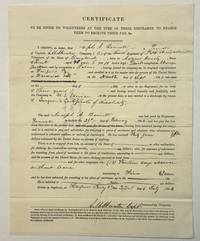
41070n.p. 186. Broadside 8" x 10". Printed document completed in ink manuscript. Old folds clean. Signed at end by Capt. Albert Hunter; endorsed on verso "Deduct $2 85/100 from fare to Balto - Discharged D.S. Miles Col. 2d Inf." Very Good. <br /> <br /> Dixon Stansbury Miles 1804-1862 was a veteran or the Indian Wars and the Mexican War. Promoted to Captain in 1836 he fought in the Seminole Wars in Florida from 1839-1852. He was promoted to Major in the Mexican War for "gallant and distinguished conduct" in the defense of Fort Brown Texas. He fought at Monterrey and the Siege of Veracruz after which he was appointed Brevet Lieut. Col. for "gallant and meritorious conduct in the several conflicts at Monterrey Mexico." During the Civil War he was given command of the U.S. arsenal at Harpers Ferry where his garrison held Confederate General Lee's supply line through the Shenandoah Valley. Despite a gallant war record he ended his life in infamy. He was killed in battle in September 1862 after having foolishly positioned his troops. Wikipedia writes "Some historians have concluded that Miles was struck by artillery deliberately fired by his own men but there is no conclusive proof. The resulting surrender of 12419 men was the largest number of U.S. soldiers surrendered until the Battle of Bataan in World War II. The court of inquiry into the surrender denounced Miles for "incapacity amounting to almost imbecility."<br /> Albert Maxwell Hunter 1833-1911 of Adams County Pennsylvania enlisted with Co. B 1st Maryland Potomac Home Brigade Cavalry on 9 September 1861 as a bugler. He was elected second lieutenant of Company C quickly promoted to first lieutenant and then to captain at the end of three years' service. He was discharged 3 July 1865 He settled in Gettysburg after the war.<br /> Joseph A. Bennett c.1822-1918 was born in Adams County Pennsylvania. He was mustered in Co. C 1st Maryland Potomac Home Brigade Cavalry later unit referred to as 3rd as a wagoner on 9 September 1861 and was discharged as a private after ten months and 13 days on 22 July 1862 due to a Surgeon's Certificate of Disability. He reenlisted 25 July 1863 in Gettysburg as a private with Warren's Independent Cavalry Militia Company but discharged 15 September 1864 to enlist the following day with Co. I 15th Pennsylvania Cavalry 160th Pennsylvania a volunteer cavalry unit. He was honorably discharged 21 June 1865. He was a farmer and laborer. unknown
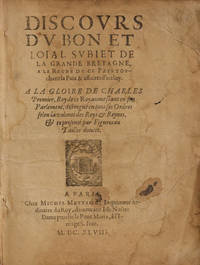
95266Isle Nostre Dame Paris chez Michel Mettaier imprimeur ordinaire du Roy 1648. . First edition; 4to 22 x 17.5cm; 3 folding plates each approx. 35 x 26 cm 2 engraved portraits woodcut initials and decorations throughout the text engraved armorial book-stamp to last leaf verso displaying motto 'light in darKines lumiere dans les tenebres'; one integral blank leaf title page stained and browned some marginal staining and browning throughout creasing to corners one small wormhole affecting 4 leaves; side-stitched contemporary marbled wrappers worn and soiled with extensive loss to upper wrapper; 14 39 1pp.<br /> A curious and rare anonymous English Civil War pamphlet published in Paris by Michel Mettaier sometimes spelt Mettayer in 1648 following the capture of Charles I by parliamentarian forces the previous year. <br /><br />The first part of the work consists of three large folding plates depicting the House of Lords the House of Commons and the Convocation of Canterbury with explicatory notes explaining the history and function of these bodies in the English parliamentary system. The latter part of the book contains an original address to Henrietta Maria Queen of England illustrated with facing engraved portraits of the Queen and the Prince of Wales and signed simply 'le bon et loyal svbiet'. It introduces a short statement in both English and French allegedly translated from an original Latin version which purports to be the words of Liudolf c.930-957 an Ottonian Duke of Swabia and grandson of the German king Henry the Fowler 919-936. The text claims that Liudolf did not die in 957 but rather feigned his death to take exile in Mantua in the hope that his descendants would one day regain his power and prestige. The tale was likely intended by the royalist author to offer hope to the exiled queen and her son who were soon to become widow and orphan to the executed king.<br /><br />Rare. We can trace only 5 copies in institutional collections worldwide: 3 in the UK British Library Durham University and the University of Leeds and 2 in France BnF and Bibliotheque Saint-Genevieve.<br /> Isle Nostre Dame, Paris, chez Michel Mettaier, imprimeur ordinaire du Roy, 1648. unknown
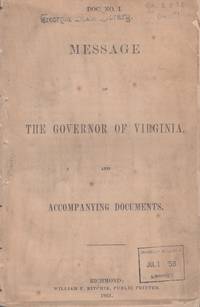
186135021Richmond: William F. Ritchie Public Printer 1861. First Edition. Wraps. Fair. Disbound wraps. 1-lv 1 blank. Ex-institutional copy with "Georgia State Library" stamped at the top "University of Georgia Libraries Jul1 '58" stamp on page i. 'Beinecke Library 1982." and some pencil numbers written bottom of the rear blank cover. Covers worn and chipped. Front cover detached. Rear cover torn chipped and detached. Fair only. <br /> <br /> Speech was given early January 1861 before Virginia formally seceded from the Union in April 1861. Governor Fletcher favored mediation before committing to leaving the Union. William F. Ritchie, Public Printer unknown
500995printed completed in holograph of the Selectmen's Office Phillips September 15 1864. Signed by 3 Phillips selectmen with stamps of the U.S. Internal Revenue totaling 7 cents. Oblong 8vo 1 page. with holograph annotations on verso. Document authorizing payment of $100.00 and interest to one William B. Wheeler for enlistment "to fill the quota of this town.". Signed by Authors. F. Soft cover. paperback
500999printed completed in holograph monthly report form of Douglas Hospital Washington March 31 1865 signed by Assistant Surgeon William F. Aims. 4to sheet folded to form 3pp. 1 1/2pp. recto and verso. Report on the physical condition and pay account of one Ed. Burckhouse of the 131st Company 2nd Battalion: ".is a Patient here and is unfit for duty with his Regiment.". Signed by Authors. F. Soft cover. paperback
500997holograph "Official Copy" in the hand of 1st Lieutenant William Stone of "General Order No. 1" on "Office Act. Ass't. Pro. Mar. Gen'l" letterhead Philadelphia April 9 1864. Order routing information in red ink at bottom in another hand. 4to 1 page. Signed by Authors. F. Soft cover. paperback
500996printed completed in holograph transportation requisition " To New Jersey Rail Road and Trans. Co." New York February 18 1864. Legal size sheet 1 page. Signed by Authors. F. Soft cover. paperback
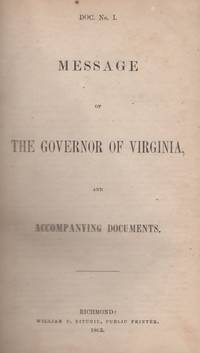
186335875Richmond: William F. Ritchie 1863. First Edition. Hardcover. Incomplete. Octavo. Brown paper covered boards. Blue cloth spine. Title label on spine missing. Light toning to the trimmed text. The first title page is for Document 1 followed by 13 separate title pages without the printer information on the pages. There is no index or table of contents in this book. All documents are complete and in very good condition. Hinges and text block are firm and tight. The following 14 documents of 34 as follows:<br /> <br /> 1. Message of the Governor of Virginia: xxiv 18 pages;<br /> 2. Biennial Report of the Auditor of Public Accounts 1862 & 1863: 37 pages 1 page blank 1;<br /> 3. Report of the Treasurer of Virginia 1862 & 1863: 27 pages 1 page blank;<br /> 4. Second Auditor's Report to the General Assembly of Virginia Transmitting The Accounts of the Fund for Internal Improvement of the Sinking Fund and of the Debt and Resources of the State 1861-62 & 1862-63: 55 pages 1 page blank;<br /> 5. Second Auditor's Report of the State of The Literacy Fund For the Years 1862 & 1863; 24 pages; <br /> 6. Report of the Commissioners of the Sinking Fund: 10 pages; 10 pages; <br /> 7. Report of the Adjutant General Year Ending September 30 1863: 10 pages;<br /> 8. Report of the Captain in Charge of the Ordnance Department. November 1863: 16 pages; <br /> 9. Annual Report of the Board of Directors of the Penitentiary Institution Year ending September 30 1863: 32 pages;<br /> 10. Report of the Rector and Visitors of the University of Virginia. 1863: 10 pages;<br /> 11. Report of the Dean of Faculty of the Medical College of Virginia. 1863: 11 pages 1 page blank;<br /> 12. Report of the Board of Visitors of the Deaf Dumb and Blind Institution for the Years Ending September 30 1862 & 1863: 22 pages 1;<br /> 13. Report of the President and Directors of the Central Lunatic Asylum for the Fiscal Years ending September 30 1863: 42 pages;<br /> 14. Report of the Weighmaster of Live Stock. 1863. 3 pages 1 page blank 1. <br /> <br /> Documents contain much data and information on the finances and information for the military educational and State institutions of Virginia during the Civil War. <br /> <br /> See Parrish & Willingham #4399 This copy has 14 documents compared to 34 total listed under the P & W imprint #4399. William F. Ritchie hardcover
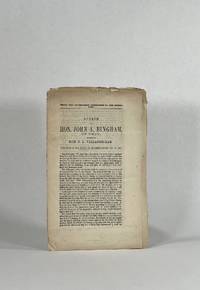
186399091863. Original Wrappers. near Good binding. Octavo. 16 pp. First edition. As issued unsewn in self-wrappers. First and last leaf detached; top margin of the first and last few leaves is a bit ragged; even toning throughout. <br /> <br /> Bingham was a staunch Unionist and supporter of Lincoln. This is assertive speech condemning Vallandingham call to end the war. Bingham responds: "Hence it is that the gentleman comes here to-day and tells us that the war ought to stop; that it should not continue a day nor an hour. His is for the Union he tells us and against the employment of the only means by which the Union can be this day maintained the armed power of the people themselves." Rare in commerce. Institutionally uncommon with only 17 libraries recording ownership according to OCLC. Sabin 5448. unknown
1862106861<p>Folio newsprint eight columns 4 pp. Folds some staining a couple of dark stains chips and tears in margins a tear or two goes into print but no losss of text some soiling and aging overall fair to good. Contains some coverage of the Civil War including The Battle of Chambersburg PA in October 1862.</p> John M. Adams & Co.
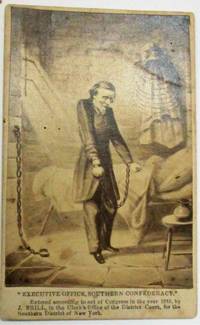
186539061New York: J. Brill 1865. 2-3/8" x 3-7/8" illustration of a despairing Jefferson Davis now a prisoner in handcuffs standing in the middle of his small cell. Mrs. Davis's dress and crinoline in which he was allegedly captured hangs on a wall in his prison cell. A stool and a pitcher are by his bed. A chain for shackling is on another wall. The verso is blank. Very Good with light wear.<br /> Not located on OCLC as of January 2023. J. Brill unknown
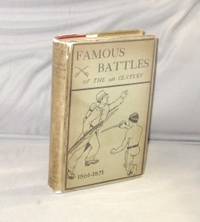
190329023<p>A Near Fine copy in a Good dust jacket that is separated along the rear fold but complete. Some of the battles included here are: The First Battle of Bull Run Shiloh Morgan's Raid Sherman's March to the Sea The Downfall of the Empire of Sudan and others. In 1848 William Sprague joined the Providence Rhode Island Marine Artillery Company as a private and eventually worked his way up to colonel. In 1860 he won the gubernatorial race which he held with the outbreak of the Civil War. Sprague was known as the "War Governor" because he personally led his troops to the front as soon as Lincoln asked for volunteers. He was in the battle of Bull Run on July 21 1861 when his horse was shot out from under him. He was given a commission as a Brigadier General but was unable to continue his military service without giving up his governorship.</p> A. Wessells Co, hardcover
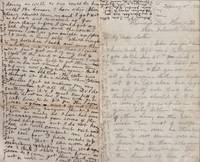
186235353Falmouth VA: n.p. 1862. Letter. Good. Letter. 4 pages of content. Paper is folded and creased and measures 8" x 10". All available space used for writing a lengthy letter to the soldiers mother. Letter written in pencil and pen. Soldier identifies himself with a very small signature located in the bottom left corner of the first page which appears to be R M Dun. Last name spelling is difficult to decipher. Mother is not identified. No envelope. <br /> <br /> Contents of the letter mostly concern the Soldier's health and the medical treatment he has received. He tells his mother not to worry but gives details on his condition which includes severe diarrhea and rheumatism. The soldier served under David B. Birney who became a Brigadier General later in February. n.p. unknown
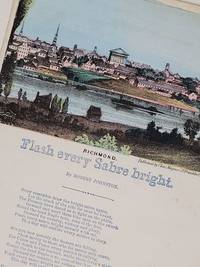
18641367New York: Charles Magnus 1864. Single leaf approximately 5" x 8. Near fine condition with a small chip to top right corner. Hand-colored lithograph headpiece. Patriotic Union Civil War song sheet with three verses beginning: <br /> <br /> "Draw comrades draw the bright sabre again<br /> Let the crack of rifle for ever be heard."<br /> <br /> The hand-colored headpiece is a view of the City of Richmond from across the James River with the Confederate Capitol prominently in the center Magnus 61 per Wolf. <br /> <br /> Charles Magnus was a German immigrant printing entrepreneur who produced city views as well as views of camps and hospitals during the Civil War. He is well known for his postal covers and song sheets as well. <br /> <br /> Ref. WOLF 656. Charles Magnus unknown
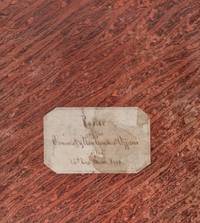
186434331n.p.: n/a 1864. Ledger. Fair. Folio. Manuscript. Approx. 16" x 10.25". 192 hand numbered pages. Orangish marbled paper covered boards with leather corners and spine. A paper label with the hand written title is pasted down center on the front cover. Damp stains to the title label. Blue front and rear end sheets. Pages 106-192 blank. Dried water stains persist from the rear end sheets and back pages gradually diminishing by page 160. The rear cover is slightly warped. Front joint is split upper edge. <br /> <br /> The majority of the first 105 pages contain hand written names with rank date of commission discharge cause of vacancy for the Field Staff non commissioned staff; Captains First Lieutenants Second Lieutenants and non commissioned officers of Companies A-K. Page 6 has the written name at the top of Colonel Edward F. Jones first commander of the 26th Regiment. He was Commissioned August 1861 and discharged July 28 1862 on account of disability. Dates of records range from August of 1861 to June 1st 1864 with the majority of recorded dates in 1862 and 1863. The 26th Regiment saw action in the Gulf operations and New Orleans up until 1863. The unit later moved to Virginia and participated in Sheridan's Shenandoah Campaign. The unit mustered out in Savannah Georgia 1865. n/a unknown
186358198Virginia; various places including City Point 1863-1865. Fine original condition. 8vo. With a brief signed note describing the finding of these letters on a farm near Albany New York. Two letters from Charles Seaver to his sister describe a night-time call to arms arrival on the Rapidan coming under battery fire and forcing the enemy infantry across the river; hoping to relocate to Washington rather than South Carolina; effecting the surrender of "five Rebble sentenals" and the destruction of a railroad bridge by axe and fire. To his mother from City Point he writes of religion; of money due him and how to collect it in case he is killed; and a temporarily successful Rebel capture of 2500 cattle. Merrill Flint writes to his sister on April 6th 1865 from Virginia about walking the streets of Petersburg "it looks very rough"; and not expecting to see Richmond for some time "for we are following Old Lee as fast as the Army can march.the Confederate Army is on its last pins." With one original addressed envelope. unknown
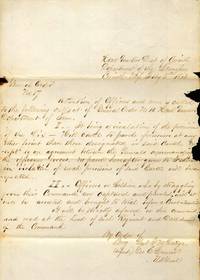
186331612Corinth Mississippi 1863. Document. Fair. Manuscript document. Approx. 12.5" x 8." Folded. 1 page. A few edge chips and small splits at the folds to the paper. Very slight loss of content. <br /> <br /> Contents of the order include rules to parole prisoners and the arrest of "Officers or Soldiers who by straggling from their Commands are captured and paroled will at once be arrested and brought to trial before a court-martial. It will be strictly enforced in this command and read at the head of Each Regiment and Detachment of Command. By Order of Brig. Genl G M Dodge signed Geo E Spencer A A Genl." Spencer also signed the verso of this document. unknown
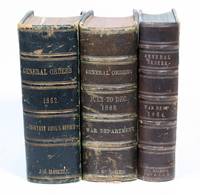
18622923Washington D.C.: War Department 1862. Calf marbled boards. Very Good. FIRST OBTAINABLE PRINTING OF THE PRELIMINARY EMANCIPATION PROCLAMATION setting a date for the freedom of more than three million enslaved in the United States and reframing the Civil War as a fight against slavery. Issued by the War Department to regimental commanders in the field during the Civil War in the week after the completion of President Lincoln’s official manuscript version. Contained is a set of three volumes of General Orders covering the full year 1862 July-Dec 1863 and the full year 1864. History of the Emancipation Proclamation:<br /> <br /> “The proclamation has been called by responsible persons one of the three great<br /> documents of world history ranking with Magna Carta and the Declaration of<br /> Independence†– Eberstadt<br /> <br /> “From the first days of the Civil War slaves had acted to secure their own liberty. The Emancipation Proclamation confirmed their insistence that the war for the Union must become a war for freedom. It added moral force to the Union cause and strengthened the Union both militarily and politically. As a milestone along the road to slavery’s final destruction the Emancipation Proclamation has assumed a place among the great documents of human freedom†– National Archives<br /> <br /> Following the Seven Days Battle and General McClellan’s retreat from the Peninsula at the end of June 1862 President Lincoln realized that there would be no early end to the war and found himself “as inconsolable as it was possible for a human to be and yet live.†Anxious for news from the army and needing to escape the constant interruptions at the White House he frequently visited the telegraph office in the War Department building to await dispatches. It was during one such visit early in July that he asked the chief of the telegraph staff Major Thomas Thompson Eckert for some paper to “write something special†and began the first draft of the Emancipation Proclamation completing it in a few weeks. Lincoln had long hoped to resolve the slavery issue through a congressional act of emancipation compensating slave owners for their loss of “property†but that approach was roundly rejected by representatives from the border states leaving the President who had decided upon the necessity of emancipation with a presidential proclamation as the only option. The extraordinary document he conceived would announce the liberation on January 1 1863 of all slaves in those states still in rebellion against the Union and promised compensation to slave owners in those states that returned to the fold before that time if they adopted “immediate or gradual abolishment of slavery.†This proclamation would be followed by a final proclamation issued on the 1st of January identifying those states still in rebellion and confirming the liberation of all slaves therein.<br /> <br /> On Tuesday July 22 Lincoln presented his draft to the Cabinet telling them that he had resolved firmly upon the course of action it specified and asking them not for advice but suggestions. The only observation he had not anticipated came from Secretary of State Seward who proposed that it might be best to wait for a military victory before issuing the Proclamation as it could otherwise seem like “the last measure of an exhausted government.†Immediately recognizing the wisdom of the suggestion Lincoln held back. On September 17 after an anxious wait of nearly two months he received the victory he needed at the bloody Battle of Antietam. Completing his final draft Lincoln presented it to his cabinet for refinement on September 22. Following the meeting Seward took the amended draft with him to the State Department where a formal manuscript copy was made then signed by Lincoln and Seward. The formal official “Emancipation Proclamation†was of course issued on January 1 1863 the day it became the law of the land.<br /> <br /> Printing History:<br /> <br /> This printing in the War Department’s official “General Orders†is the fourth printing overall but realistically the first obtainable printing. It is preceded by:<br /> <br /> -The first printing Eberstadt #1 a small three-page circular intended for distribution within the government and to the local press likely printed on September 22. At the time that Charles Eberstadt published his study of the Proclamation 1950 he was able to locate only one copy which he himself owned and as nearly as we have been able to determine no other copies have come to light since then.<br /> <br /> -The second printing Eberstadt #2 may be a phantom printing. Charles Eberstadt was not able to locate a copy but he inferred its existence from the standard State Department practice of printing a folio edition consisting solely of the text of the proclamation followed by another printing consisting of the text of a letter of transmittal from the Secretary of State as well as the text of the proclamation. While there may be a copy of Eberstadt #2 in the National Archives as he speculated it is not recorded in their online catalogue nor have we been able to find a copy in any other online catalogue including OCLC the Library of Congress and the Abraham Lincoln Library.<br /> <br /> -Eberstadt’s third printing is of legendary rarity. It consists of Secretary of State Seward’s one-page letter of transmittal addressed “To the Diplomatic and Consular Officers of the United States in foreign countries†and the text of the proclamation. Eberstadt located a total of only five copies in institutions at the Library of Congress the National Archives Yale the Clements Library and Brown. OCLC does not record any additional copies nor is it recorded in Monaghan. There has been one copy at auction $400000 in 2021 and that was described as the only copy in private hands. <br /> <br /> -The present copy General Orders No. 139 is Eberstadt’s fourth printing of the Preliminary Emancipation Proclamation dated in print on September 24. Eberstadt surmises that this field order printing could have been accomplished as late as September 29 or 30. Although it may have been printed in as many as 15000 copies it is very rare in commerce likely due to the ephemeral nature of the printing and distribution.<br /> <br /> Additional General Orders and Provenance:
<br /> <br /> The three volumes once belonged to John G. Haskell A.Q.M. Chief Quartermaster and contain the General Orders for the year 1862 July-December only for the year 1863 and for the full year 1864. John Gideon Haskell 1832-1907 was a resident of Kansas and joined the Union Army when the war broke out. He enlisted with the 14th Kansas Volunteer Cavalry Regiment and later served as Assistant Quartermaster General of Kansas as quartermaster of the Third Kansas and the Tenth Kansas Volunteers as Captain and Assistant Quartermaster on the staff of General James G. Blunt and as Chief Quartermaster of the Army of the Frontier. After the war Haskell was named official state architect and worked on the state house the capitol the State University and more.<br /> <br /> In addition to the preliminary Emancipation Proclamation the three volumes also contain the Acts of Congress on many other subjects including pay discharge recruitment handling of troops etc.<br /> <br /> Washington D.C.: War Department Adjutant General’s Office 1862-64. Three volumes. Small octavo contemporary three-quarter brown morocco two volumes with cloth boards one with marbled boards. Some rubbing and wear to bindings pencil notations on endpapers with collation and highlighting certain orders and some internal pages. Dampstaining to general title of 1862 volume; internal text and Emancipation Proclamation generally fine. RARE AND IMPORTANT.<br /> <br /> References:<br /> <br /> Charles Eberstadt. “Lincoln’s Emancipation Proclamation.†New York: 1950. War Department unknown
1863366292Boston: Commonwealth of Massachusetts 1863. Good. A printed order establishing the Massachusetts Volunteer Militia on July 31 1863. <br /> <br /> 4 pages. 8 by 10-1/2 inches. A single sheet folded to make four pages. Two works redacted in ink; rear panel tanned. Generally good. With the pencil signature of Lieut. Bradford D. Davol a textile executive who briefly served in the volunteers in 1864. Commonwealth of Massachusetts unknown
1862102059Pamphlets small 8vo disbound 2 1 1 2 4 5 pp. Completely disbound series of orders removed some chipping where removed normal aging and browning. A series of six General Orders from the Adjutant General's Office L. Thomas concerning the treatment of prisoners. The first orders relates to the process of handling and treatment of prisoners of war including appropriate documentation on transfers to prison depots. The final order 191 includes a list of prisoners of war Union soldiers exchanged with Southern soldiers on November 11 1862 at Aiken's Landing.
186263687Philadelphia: Wm. A. Stephens n.d. c.1862. Sonsheet or lettersheet; bifolium 9" x 5-1/2" overprinted on ruled paper top page only. Hand-colored engraved portrait of Gen. George B. McLellan beside his horse above title; text in five stanzas below. Advertisement at lower margin for "Stephens' Colored Album Drolleries.photographs illustrated army ballads and envelopes." Old folds; creased at upper and lower margins with some soil and toning; Very Good. <br /> <br /> Songsheet promoting General George B. McLellan's return to command in 1862. Following his perceived tactical errors in the Seven Days Battles and the Battle of Antietam in 1862 McLellan was relieved of his command as General-in-Chief of the Union exacerbating the already strong mutual antipathy between himself and Abraham Lincoln; despite popular appeals for his reinstatement and despite being as this song argues "a perfect man" he never held another field command during the Civil War. In an effort to unseat his now bitter rival McLellan ran as a Democrat for the presidency in 1864 but lost in a landslide winning only 21 electoral votes. This song was originally composed by Septimus Winner and published as sheet music under his own imprint in 1862. Wolf notes thirteen variations on this sheet some with slightly different titles from at least six different publishers. Wolf American Song Sheets 754l. Wm. A. Stephens unknown
1862100852Pamphlet 8vo original green printed wrappers 17 pp. Wrappers chipped and torn with a few small pieces missing from the margins back wrapper almost detached vertical tear on cover repaired on verso a few pages with tears at extremities light toning; else very good.This is a scarce and unusual item that gives a different political message from the Civil War period. The author who calls himself Green-Back seems to object to the failures of politicians of his day and in fact this is an open letter to the 37th Congress. Sounds like he has Copperhead leanings but his key message is that it was time for the Representatives and represented come to an understanding. He seems to think that Congress is too busy or distracted with the needs of slaves and related issues to take care of other business. According to Green-Back Congress doesn't seem to have much time for other affairs because of their plans "for the full development of their much admired and more beloved Congo men". He also seems dissatisfied with the press who he suggests instigated or helped cause the war and whom only present a one sided view of the war.