11 490 résultats
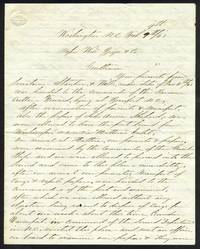
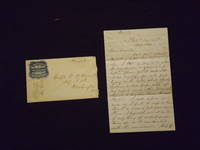
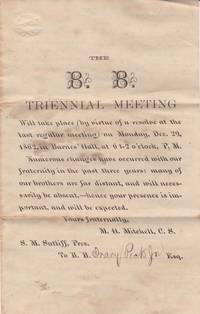
1869List2723United States Germany and others 1869. Seven letters approximately twenty-six total pages most about 8 x 5 inches. One letter dated 1862; one dated 1863; two dated 1864; one dated 1869; two without date. Two of the letters are written in French untranslated. Generally very good or better with one showing water damage though legible. Tracy Peck 1838–1921 was born in Bristol Connecticut to a family who had been in the Hartford area since the 17th century. According to his obituary in The Classical Journal Vol. 17 No. 6 Peck studied at Yale and then abroad in Germany returned to the United States to teach Latin at Cornell and Yale and then went back to Europe again where he served as the Director of the American School of Classical Studies in Rome until his death.<br /> <br /> Offered here is a group of letters from friends and family to Peck mainly written during the American Civil War when Peck was studying in Germany. The letters update Peck on the war politics and the activities and fortunes of various friends.<br /> <br /> Many of Peck’s friends were academics and avoided involvement in the Civil War nearly as well as Peck himself did. Not all were so lucky though. A friend probably a Yale classmate writes from Massachusetts “with a notice of the death of F.S. Davisâ€:<br /> <br /> “He died poor fellow in the hospital at Chattanooga about the middle of April. After leaving college he spent the first winter at home joined the ‘Memphis Southrons’ in March ‘62 He was at many battles and suffered untold hardships for one year when he died the first martyr of our class.†August 17 1863<br /> <br /> Another friend Sheldon had just completed his service:<br /> <br /> “He had been in several severe battles had been captured and taken to Richmond. While in service he met Bob Stiles who wouldn’t shake hands with him but tried to prove that unionism was oppressionâ€.<br /> <br /> Though the war would continue for several more years the friend writes that zeal for it is already waning:<br /> <br /> “The war goes on languidly. The enthusiasm has died out. Everyone expects the war to close by the south yielding to reasonable conditions. There is no apprehension felt as to the final issue. It has about ceased to be talked of.â€<br /> <br /> That same friend would later travel abroad as well though his aspirations would be less intellectual than were Peck’s. He writes from Egypt where it is so hot that “Except for some luscious oranges which we got of a lightly-clad nymph we should have perished of thirst†about a comical scene:<br /> <br /> “A tall muselman at one of the intermediate train stations had lain down his silk mantle and turning to the east gave through the prostrations prayers of his religion with great fervor and to the intense satisfaction of the ladies. Suddenly he touched his forehead to the ground leaped up. Their interest redoubled their attention with it when to my great amusement he squatted down unbuttoned his trousers began to pump ship in full view. The abrupt descent from prayer to pissing was too much for the females while I stifled a laugh in a cough my jacket handkerchief.†No Date<br /> <br /> A later comment in the same letter where he describes being escorted up one of the pyramids and then “shouting ‘be quiet’ to the clamoring Egyptiansâ€â€”whom he also describes as a “rapacious broodâ€â€”is likewise revealing of his attitude towards the locals.<br /> <br /> The latest letter in the group from Richard Harck is more high-minded. Harck inquires whether as Peck’s “foot . again walks on hallowed native soil†he has “acquired such a situation among the lumina of your country as your knowledge and learning deserve†July 30 1869. Harck is in Germany where there “is an utter stagnation in politics†as they approach the unification:<br /> <br /> “The particularities and sectional ideas of the southern population and their sovereigns the antagony of the there powerfull clergy and the partly illiberal constitution and laws of the North German Union. Bismarck may be a great statesman and minster for foreign affairs but not a fit man to rule the interior of a constitutional state. . But he cannot stop the progress of the ever advancing ideas of liberalism and freedom; the powerful public opinion overwhelms him .â€.<br /> <br /> Overall a look at the effects on ordinary lives of several important political upheavals of the mid-19th century. unknown
1863291781863. Very good condition. Two Civil War letters describing problems the Schooner Anna Shepard had delivering cargo. Schooner was stopped in North Carolina with Letter from War Department 1863.<br /> <br /> According to the January 1863 letter from the War Department the Schooner Anna Shepherd sic bearing cargo for US Troops now detained at Beaufort N.C. has permission to discharge cargo at any port held by the United States in North Carolina.<br /> <br /> The February 1863 letter from William Thomas describes the Schooner Anna Shepard sic journey through Beaufort NC to Washington NC via Hatteras Inlet to the Sound. After 1 week Commodore Davenport in command of the Sound Department in NC visited the Schooner then docked in Washington NC and were told to remove their cargo from the dock and threatened with double irons. They were left without transport to Newbern for 5 days until they could charter a lighter. He notes that they violated no regulations in their conduct and had seen other lighters discharge merchandise from private parties. <br /> <br /> War Dept. letter: 1pp 7 3/4 x 9 3/4" manuscript on letterhead embossed stamp in upper left corner "Congress Owen & Hurleut" and image of Capitol dome; Thomas letter: 4pp 7 3/4 x 9 3/4" manuscript stamped "P&P" with locomotive in top left corner. unknown
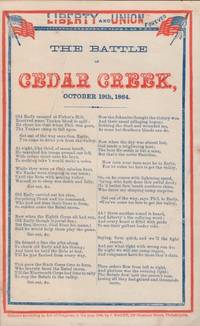
186433562Philadelphia: J Magee 1864. Broadside. Very good. Broadside. Approx. 8" x 5". Paper with red white and blue borders and patriotic heading illustrated with two American flags. Verse printed in blue. Light wear to the broadside. The content contains thirteen verses about Union General Sheridan's victory over Confederate General Jubal Early at the Battle of Cedar Creek Virginia October 19 1864. "Entered according to Act of Congress in the year 1864 by J. Magee 316 Chestnut Street Philadelphia" printed in red at the bottom of the sheet. J Magee unknown
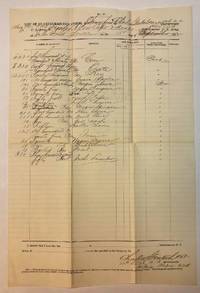
186537141Texas 1865. Folio 11" x 16". Printed broadside completed in ink manuscript. Signed by Charles Gentsch as quartermaster. Docketed on verso. Contains columns listing number quantity name of articles and condition when delivered. Old folds very clean. Near Fine. <br /> <br /> The 51st Ohio Infantry Regiment was organized at Camp Meigs in Ohio beginning September 17 1861 and mustered into service on October 26 1861. The regiment was attached to several different units of the Army of Ohio the Army of the Cumberland and the Department of Texas. The Regiment participated in an expedition down the Ohio River in February 1862 to reinforce General Grant and then took part in the Occupation of Nashville. They marched to Louisville and pursued Bragg from late August to late October 1862 participating in the Battle of Perryville. They later fought at Stone's River Middle Tennessee or Tullahoma Campaign Chickamauga Chattanooga Atlanta Nashville and others. <br /> Charles Gentsch 1842-1914 of New Philadelphia Ohio was mustered in as 1st Sergeant of Company K 51st Ohio Infantry in October 1861. He was promoted to 2nd Lieutenant in January 1863; 1st Lieutenant in April 1863; and to Quartermaster in February 1865 at which time he was also transferred to Company S of the same regiment. After the war he attended Georgetown University. By 1872 he was practicing as a physician in Cleveland as well as a director in the Guardian Savings and Trust Company the United Banking & Savings Company the Lorain Street Savings Bank Company and in several manufacturing companies. He lived out his life in Cleveland and was a member of the Cleveland Academy of Medicine the Chamber of Commerce Chamber of Industry Army and Navy Post of the G.A.R. and other local clubs. His two brothers Daniel C. and Frank H. Gentsch were also physicians. In 1907 he wrote and read a paper before the Ohio Commandery of the Loyal Legion called "Instantaneous Rigor-Mortis Occasionally occurring and observed upon the Battlefield" based on his war experiences.<br /> Leander Alonso Poor 1833-1910 of Vienna Maine graduated from Bowdoin College and was a principal at a high school in Massachusetts when the war began. He joined Company C U.S. Engineers Battalion at Worcester Massachusetts but was discharged for medical reasons. In 1864 he was commissioned Captain in the United States Volunteers and assigned to the Union Army's First Division Fourth Army Corps. His unit was ordered to Texas to reestablish federal authority spending from September 1865 to June 1866 at Indianola and later Port Lavaca to oversee the rebuilding of the San Antonio and Mexican Gulf Railway. He returned to Maine in 1866 and was given the rank of Brevet Major. After the war he was a school teacher and administrator. "Capt. Leander A. Poor U.S.V. in Port Lavaca 1865-1866" by Charles D. Spurlin 2003 THE JOURNAL OF SOUTH TEXAS 16 169-194; military records at website Fold3. unknown
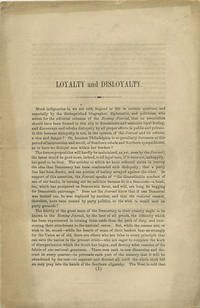
186336453Philadelphia: Ringwalt & Brown Printers 1863. First edition. Self wrappers. A very good copy with sunned wrappers. 8 pp. 8vo. Anonymous piece calling for national unity especially in Pennsylvania. OCLC locates ten copies. Not at AAS. Sabin 42566. Samuel J. May Anti-slavery Collection: 34907118. Ringwalt & Brown, Printers unknown
189352224New York: D.H. Anderson 1893. One large original albumen photograph sized 17.5 x 21 in. mounted on 21 x 25 in. board minor chipping & damage to fore-edges of board some very minor staining still a VG image. First edition of this very scarce and early attempt at art photography of the patriotic sort and often referred to as reenactment photography. While the image of Sheridan is indeed from a photographic negative the backdrop of galloping horse and battlefield have all been supplied via lithography. This was an unusual and labor-intensive special effects process of which Anderson developed most of his skills during the Civil War in the Richmond VA area. Anderson 1827-1905 began his career as a daguerreotype photographer in Paducah KY in 1855 and moved throughout the South and Midwest before landing in Richmond during the Civil War. In 1879 he sold his business there to George Cook and purchased and refitted Mathew Brady’s historic studio at 785 Broadway in New York adorning the walls with life-sized crayon drawings and pastels a la Sarony and was one of the first adopters of Charles Bennet’s gelatin dry plate process requiring very little exposure time for excellent photographic images. He would often engage the original participants to reenact their historical actions and events which may have inspired the very popular Wild West shows at the time reenacting recent events in the Indian Wars using the actual participants in their performances. He specialized in mammoth and gargantuan photographic prints. No copies located in Worldcat: See: David H. Shields David H. Anderson Time Period 1855-1905 Broadway Photographs 2013. D.H. Anderson, unknown
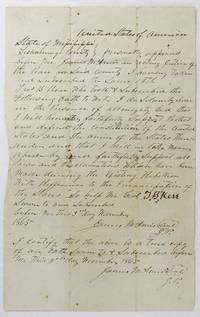
18655112Tishomingo County Ms: November 3 1865. Very good. 1p. of manuscript on a folio sheet. Old folds minor wear and soiling. A manuscript true copy of a loyalty oath taken by Thomas B. Kerr of Tishomingo County Mississippi following the end of the Civil War. The oath itself reads: "I do solemnly swear in the presence of almighty God that I will hereafter faithfully support protect and defend the Constitution of the United States and the Union of the states thereunder and that I will in like manner abide by and faithfully support all laws and proclamations which have been made during the Existing Rebellion with reference to the Emancipation of the Slaves. So help me God." The document is signed by Kerr as well as the Justice of the Peace James M. Amis and docketed on the verso "Thos. B. Kerr amnesty oath." Amnesty oaths from Mississippi are increasingly more rare in the market especially those directly referencing the Emancipation Proclamation and the end of slavery. November 3 unknown
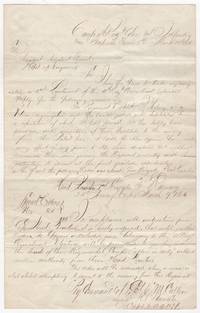
186545197Chapin's Farm Chaffin's Farm VA 1865. Very good light creasing closed tear along centerfold minor soiling and ink staining contents clean. 2 pp. Bifolium. 8 x 12.5 inches. Even before the secession of the southern states the people of Connecticut were divided regarding their views of the war effort. Throughout the military conflict the social and political tensions were consistently exacerbated by incongruous perspectives on abolition and emancipation.<br /> <br /> This document demonstrates how even in the final weeks of the war northern sympathy for the Confederacy remained prevalent. Dated March 11th 1865 Charles H. Winter tenders his resignation as 2nd Lieutenant of the 11th Regiment of the Connecticut Volunteer Infantry due to the increased instances of desertions by substitutes. He tells the Assistant Adjutant General "The Regiment to which I belong is a Veteran organization and has until filled with Substitutes borne a reputation of which I felt proud It has lately been troubled with desertions of these Substitutes to the enemy from the Picket Line. I with the other officers have made every effort in my power to stop these desertions but without success these men joined the Regiment evidently with the intention to desert at the first available opportunity." Below Winter's explanation is the transmission of Special Order No. 201 issued by Colonel Edgar M. Cullen 1843-1922 of the 24th Army Corps March 9th 1865. Cullen's orders prohibit any of the men belonging to the 11th Regiment to leave the confines of the encampment the written permission from his Head Quarters.<br /> <br /> In his closing Winter places blame elsewhere noting that "these restrictions are placed upon us for a fault which clearly belongs to the authorities sending these Substitutes and for the character of whom I do not deem I can be held responsible." unknown
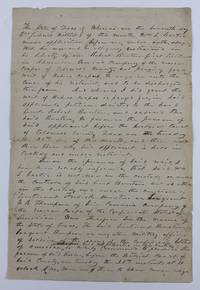
18655062March 14 1865. Very good. 2pp. on a folio sheet. Old folds some abrading in the margins minor edge wear. A Confederate Texas legal document in which Judge A.D. McGinnis of the "2nd Judicial District" orders those parties holding William L. Carter to report to court for a hearing on a matter "on a writ of habeas corpus." A month before the end of the Civil War Carter alleges that he was "illegally restrained in his liberty" by Lt. Robert Burton of "Alexander Cowan's Company of the Reserve Corps of Caldwell County of the Confederate States of America." Judge McGinnis states that Carter is now apparently being held by another officer of Cowan's Company and orders that said officer "is hereby commanded to produce the person of said Carter before the district court of said county.and there to show cause why he is held in custody and under restraint." Confederate habeas corpus documents are quite uncommon in the market. March 14 unknown
1861104033<p>Folded letter sheet 2 1/2 pages of text with original mailing envelope no stamp. Light wear normal aging legible hand; overall near fine. General Andrew Porter 1820-1872 was born in Pennsylvania and was the grandson of Revolutionary War General Andrew Porter. Porter was also related to Mary Todd Lincoln. He served in the Mexican War and was a Brigadier General at the Battle of Bull Run. Porter was appointed Provost Marshall General of the Army of the Potomac in 1862 and left the service in 1864 for health reasons. This letter to Captain William Averell appears to be written in somewhat secretive style. He tells Averell to mail a letter to a Mrs. P. that is under a newspaper. " I will return when it is safe to leave Mrs. P. or sooner if pub." He tells the captain to "please telegraph me at once if anything of importance turns up or I am needed with the command." He goes on to tell Averell keep the s pol.service with us. Much reputation is to be gained by carrying it on or aiding it successfully. This is probably a reference to the Secret Police that was headed by Allan Pinkerton at that time and who were very busy hunting down Confederate spies at that time. He also talks a little about other military matters including a troop build-up in Philadelphia. find a grave website.</p>
18621019014 pages on one leaf 4to with original envelope and typed transcript. Normal aging and browning slight separation at folds. The letters were written by George Roden who was born in 1841 from Newark New Jersey who was the son of English immigrants and served in the 2nd New Jersey Infantry regiment. He was a corporal when this letter was written. The letter is addressed "Dear Folks at home" and tells his family how happy he was to receive their letters after waiting so long but he also includes a description of the Battle of Gaines' Mills; 'Our four companies left as they were without any support whatever to contend with over a brigade of the enemy surrounding us on three sides they poured in an awful cross fire but even amid that and their insane yells our boys rallied around the dear old flag three times. Once They were taken but as the fellow a Lieut. grasped it from our wounded color sergeant a ball went through his heart and again they were retaken." He also adds an interesting account of his company's reserve role in the Battle of White Old Swamp. See guide to Roden family papers at the William L. Clements Library.
1863101903<p>One plain brown lettersheet 8 1/2 x 5 1/2 in folded format about 2 1/2 pages of text. Creased a small hole only affecting one letter some aging; otherwise very good. Includes a typed transcript. This is a letter from Frederick Steubing a Confederate soldier to J.H. Williams another Confederate soldier describing various events and combat in a humorous way. Steubing tells of a very merry Christmas parted that ended with most of the company getting drunk. "We had a jolly time of it Christmas here the biggest part of the company got drunk and we throwed in with them I got as drunk as a fool and you bet I was sick the next day." Steubing asks Williams for news of his friends and tells him about some of the action he saw on the Mississippi. "I got a good look at the old gunboats and you bet I heard them belch several times at us whenever we would shoot at the transport with our cannon and small arms. the cannon balls would cut down trees as big as anybody and you bet that the cannon balls would make boys hug the levy and eat sand." The rough brown paper used for this letter would seem to reflect the scarcity of supplies among Confederate soldiers.</p>
1718101905Letter sheet 8x10 4 pages 3 1/2 pages of text. Some very minor bends at edges a couple of very minor nicks creased a little slight aging and browning; otherwise in really nice condition. This highly legible letter to a father from his son talks about more than the "usual" life in an army camp. There are certainly routine matters covered like receiving letters from family members and requests for money but he also talks about his legal misfortunes. While it is unclear what issues are involved it is clear he has some military legal problems which he hopes to resolve by the time his regiment is 'mustered." The letter makes it sound like it is something important and probably related to his military standing. His father appears to suggest that he should take his case to Washington but the son decides to wait it out. The son Jon indicates that while he feels badly over his misfortunes he really feels badly for his friends and relatives. This suggests along with a comment about handling the impact on public opinion that this case was a visible one. He also complains about the cost of living in the South which he says is twice what it is in the North and indicates he pays $10 per week for boarding. That would seem to be very high when measured at a soldier's pay during this period. He does throw in a couple of comments about the war including that "Sherman too is still in successful pursuit." he also states that nothing is heard from General Smith "but his safety and success is a thing assured."
17181019044 page lettersheet 9 3/4x 8 1 1/2 pages of text with docketing and commentary by several officials on the 4th page. Some soiling and aging to the last page a little toning; otherwise very good or better. The letter from Woods attempts to resolve what must have been a common problem in the Union Army during the Civil War which was the red tape involved in battle field promotions. Woods 'was mustered into the Service of the United Sates as an enlisted man. on the 29th day of July 1861 at Washington City D.C. by Lieut. Jno. Elwood. On the 14 day of Decbr. I was promoted to the 2nd Lieutenancy in said Co. vice Lieutenant Donaldson died May 15th 1862 but did not receive my Commission as such until 5th day pf March 1863 since which time I have actually performing the duty of 2nd Lieut. in said company and as such I have been on the muster and pay rolls for March and April. I would respectfully ask the Order mustering me out as an enlisted man being 2nd Serge. of said Company when I received my commission and ordering my muster in as 2nd Lieut. to date from March 5 1863. I have made efforts to be mustered but without success. " Perhaps even more interesting are the comments by several officials on the forth page trying to cut through the 'red tape'.
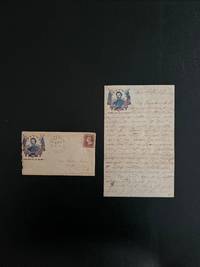
1862102018<p>One folded sheet two pages of text illustrated red and blue lettersheet depicting George B. McClellan with slogan "WE HAVE BEAT OUR LAST RETREAT" includes matching postally canceled envelope. Minor folds one small hole at center fold not affecting text normal aging and toning. Overall in very good condition. James Rikert who enlisted in 1861 was discharged in 1862 for disability. He joined as a 21 year old private at Fort Wayne Michigan and mustered into Company G of the MI 5th Infantry. He sent this letter to Celia Gibson as a follow-up to a letter he sent a week earlier concerning their march on Manassas. He reports heavy rains that postponed the march but expects to march the next day. While he mentions his sadness at the loss of his grandmother he makes a point of telling Celia this could be his last letter. "This may be the last letter perhaps that you will ever get from me but if I live through the battle you will son hear from me again and if not you will know that I have gone to my lovely home and that I died as a Christian." Historical Data Systems Civil War Research and Genealogy Database.</p>
18631002017<p>Four pages on one leaf. Light folds text slightly faded on first page normal aging and browning minor wear at folds. Overall in very good condition. This letter offers a graphic account of the Battle of Liberty Mills. The Bostwick brothers both served in the 2nd New York Cavalry for most of the war. George 1836-1913 was a private and his brother Orramell 1840-1922 was a sergeant. After the war both brothers returned to their home town of Stillwater Saratoga County New York. George wrote this letter while his brother was recovering from wounds he received at Culpeper Court House on September 13th and updates him in great detail of the regiment's recent actions at Liberty Mills. In part "It was hand to hand part of the time. A. Laugholm shot a captain in neck he drop dead as a stone. I was hit with a sabre but it did not mont to eney thing. It was a fight for dear life you can bet." Henry A Bostwick: Genealogy of the Bostwick Family; New York 1901.</p>
1818100123Letter sheet 9 ¼ x 7 ½ 3pp. on 4 pp. lettersheet. Folded with nicks on folds minor soiling else very good. White was stationed near Washington D.C. and he provides a fair sketch of camp life and soldierly concerns during the first year of the conflict. His wants are few and he goes to some lengths to let his wife know he is taking good care of himself. I wash all my clothes regularly once a week keep my hair cut very close and wash myself clean every morning. I have no fear of getting dirty or lousy. Camp life is described as quite restrictive with lots of work. Duty is very hard we have to drill nearly eight hours every day except when we are on the move. He gives his wife advice on finances and other matters and admonishes her that above all I do not want you to believe any stories about men being shot for disciplinary reasons. hardcover
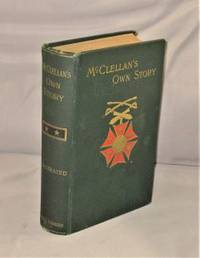
188728005New York:: Charles L. Webster & Company 1887. First Printing of the First US Edition. A Near Fine bright copy previous owner stamp on front pastedown in green cloth binding with the Army of the Potomac Society emblem in gilt and red on the front board. General George Brinton McClellan is one of the most controversial figures of the American Civil War. He was beloved by the soldiers of the Army of the Potomac insubordinate to his commander in chief a master at preparing for war but cautious about engaging Criticized throughout the remainder of his life he never publicly defended his actions as commander of the Union army. Here however his posthumously-published memoir provides his answers to the critics.Using a combination of military documents his own field records and letters to his beloved wife Nelly McClellan does not attempt a full autobiography but instead focuses on his short time as general in chief of the army. Charles L. Webster & Company, hardcover
188726797New York:: Charles L. Webster & Company 1887. First Printing of the First US Edition. A Fine bright copy previous owner name on flyleaf in green cloth binding with the Army of the Potomac Society emblem in gilt and red on the front board. General George Brinton McClellan is one of the most controversial figures of the American Civil War. He was beloved by the soldiers of the Army of the Potomac insubordinate to his commander in chief a master at preparing for war but cautious about engaging Criticized throughout the remainder of his life he never publicly defended his actions as commander of the Union army. Here however his posthumously-published memoir provides his answers to the critics.Using a combination of military documents his own field records and letters to his beloved wife Nelly McClellan does not attempt a full autobiography but instead focuses on his short time as general in chief of the army. Charles L. Webster & Company, hardcover
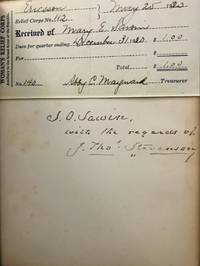
186433762Cambridge Mass: Welch Bigelow & Co 1864. First Edition. Hardcover. Good. Octavo. 129 pages 1. Illustrated with a mounted CDV Carte-de-visite photograph portrait of General Stevenson in uniform. Pebble grain brown morocco leather binding ruled in blind on the covers. 5 raised bands on the spine. "Gen. Stevenson" lettered in gilt on the front cover. Gilt doublure inner ornamental linings inside the leather covers gilt board edges and gilt text edges. Reddish marbled end papers. No title page - as issued. Frontispiece CDV and protective tissue starting to pull loose from the binding. Light rubs to the leather on the edges and spine. Although the author's name is not provided the signed inscription various intimate details on Stevenson's life and letters and tributes addressed to J. Thomas Stevenson in the book makes it probable that this Memoir was a project completed by his father after the death of General Stevenson in 1864. <br /> <br /> On page 1 the writer records "Thomas Greely Stevenson the second child and elder son of J. Thomas and Hannah Hooper Stevenson was born at Boston on the third day of February A. D. 1836." The first 46 pages cover Stevenson's life and service in the Civil War up to May 1864 when General Stevenson was shot and killed at Spottsylvania Court House Va. The remaining pages are letters and tributes addressed to J. Thomas Stevenson after his son's death by General Burnside fellow soldiers Regiments various newspapers etc. <br /> <br /> Inscribed on the front blank end paper - "J. O. Sawin sp. with the regards of J. Tho' Stevenson." Approximate 8" x 5" broadside poem titled "On the Death of Brigadier General Thomas C. Stevenson Killed in Spottsylvania Court House VA on Tuesday morning May 10th 1864" by Mrs. C. M. Sawyer. Broadside is folded toned at the top edge with light creases and edge wear. Laid next to the inscription is a loose dues receipt from the Woman's Relief Corps with the name of Mary E. Sawin sp. and the date of May 25 1920.<br /> <br /> Scarce. Not in Nevins. OCLC locates 3 copies Newberry West Point and Bibliomation Inc. From find a grave dot com:<br /> <br /> Civil War Union Brigadier General. A pre-Civil War Massachusetts Militia officer he was Major of the 4th Massachusetts Militia Infantry Battalion at the outbreak of the conflict. When it became apparent that the conflict would not be over quickly he was detailed to raise a regiment which became the 24th Massachusetts Volunteer Infantry its core was the men from his old militia battalion. Commissioned its Colonel and commander he led his men in 1862 operations in North Carolina. His unit participated in the capture of Roanoke Island and New Bern and the lifting of the siege at Washington North Carolina. Advanced to brigade commander he led his new command in the operations against Kingston and Goldsboro. Promoted to Brigadier General US Volunteers on December 24 1862 his commission was not acted upon by Congress and it expired by law. However he was reappointed Brigadier General and in April 1863 it was duly confirmed. He directed his brigade designated the Third Brigade Terry’s Corps in the Union siege and attempt to invest Charleston South Carolina his men stood in reserve as the assaults on Battery Wagner were attempted and repulsed. His time in the swamplands of South Carolina brought him a severe case of malaria which forced him to go on extended sick leave in the Winter of 1863 to 1864. <br /> <br /> When he recovered sufficiently enough to resume field command he was given command of the Firs Division in Maj. General Ambrose Burnside’s independent IX Corps which was attached to the Army of the Potomac in the Spring of 1864. During the May 1864 operations against Confederate positions at Spottsylvania County House Virginia he has his division placed in entrenchment's along the Ni River near the Gayle House. On the morning of May 10 while conferring with fellow officers he was shot in the back of his head by a Confederate sharpshooter and instantly killed. His younger brother Robert Hooper Stevenson served as Lieutenant Colonel of the 24th Massachusetts Infantry and was brevetted Brigadier General for his war service. Fort Stevenson on the Missouri River in North Dakota was named in his honor. Today the region lying on the shores of Lake Sakakawea is known as Fort Stevenson State Park. A sculptor of him exists today in the Massachusetts State House. Bio by: Russ Dodge. Welch, Bigelow, & Co hardcover
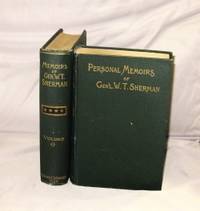
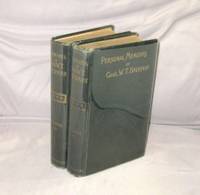
189028555New York:: Charles L. Webster & Company 1890. Fourth Edition. Revised Corrected and Complete. A Very Good plus set in green cloth binding with gilt stamping to the front cover and the spine. Two volumes complete with the fold out maps present. Hailed as a prophet of modern war and condemned as a harbinger of modern barbarism Sherman is the most controversial general of the Civil War. "War is cruelty you cannot refine it" he wrote in fury to the Confederate mayor of Atlanta and his memoir is filled with dozens of such wartime exchanges and a fascinating eerie account of the famous march through the Carolinas. Charles L. Webster & Company, hardcover
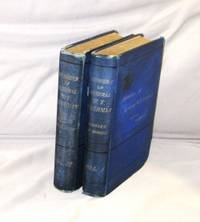
187528634New York:: D. Appleton and Company 1875. First Printing of the First US Edition. A Very Good plus set in blue cloth binding with gilt stamping to the front cover and the spine. Owner stamp on flyleaf. Both volumes have minor wear to the spine ends. Two volumes complete with the fold out map present. Hailed as a prophet of modern war and condemned as a harbinger of modern barbarism Sherman is the most controversial general of the Civil War. "War is cruelty you cannot refine it" he wrote in fury to the Confederate mayor of Atlanta and his memoir is filled with dozens of such wartime exchanges and a fascinating eerie account of the famous march through the Carolinas. D. Appleton and Company, hardcover
189229280New York:: Charles L. Webster & Company 1892. Fourth Edition. Revised Corrected and Complete. A Very Good plus set in green cloth binding with gilt stamping to the front cover and the spine. Bookplate present on front pastedown. Two volumes complete with the fold out maps present. Hailed as a prophet of modern war and condemned as a harbinger of modern barbarism Sherman is the most controversial general of the Civil War. "War is cruelty you cannot refine it" he wrote in fury to the Confederate mayor of Atlanta and his memoir is filled with dozens of such wartime exchanges and a fascinating eerie account of the famous march through the Carolinas. Charles L. Webster & Company, hardcover
186488825Cincinnati: C.F. Vent & Co 1864. First Edition. 12mo 19.5 cm. Publisher's brown cloth; gilt spine-title; x11-389pp; frontispiece; colored lithographic title page. A generally straight and sound copy evenly but not heavily foxed throughout; Very Good. Neat ink ownership signature to front endpaper "W.R. Shackleford" dated 1912. <br /> <br /> Somewhat uncommon but according to Nevins "an unbalanced scissors-and-paste account largely of Morgan's 1863 raid." The author an Indiana clergyman was also the author of what one historian has called "the most worshipful" of biographies of W.T. Sherman Rodney Earl Walton "William Tecumseh Sherman and his Biographers" in Journal of America's Military Past Fall 2016. NEVINS I:157. DORNBUSCH III:3125. C.F. Vent & Co unknown
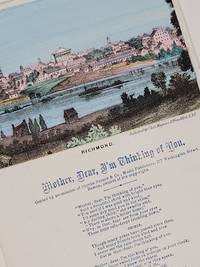
18641368New York: Charles Magnus 1864. Single leaf approximately 5" x 8. Fine condition. Hand-colored lithograph headpiece. A sentimental Union Civil War song sheet with three verses and a chorus. .<br /> <br /> The hand-colored headpiece is a view of the City of Richmond from across the James River with the Confederate Capitol prominently in the center Magnus 61 per Wolf. <br /> <br /> Charles Magnus was a German immigrant printing entrepreneur who produced city views as well as views of camps and hospitals during the Civil War. He is well known for his postal covers and song sheets as well. <br /> <br /> Ref. WOLF 1463a. Charles Magnus unknown