[Civil War]Biblio.com
11 490 résultats
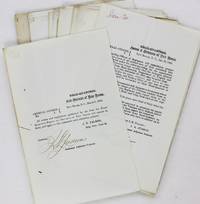
18643409New Berne N.C. 1864. Very good. Twenty printed general orders totaling 24pp. Original plain or lined paper single or folded sheets. Minor overall wear some dust-soiling especially to final order. A collection of twenty Union general orders issued in North Carolina during the penultimate year of the Civil War. The orders run from January 25 to May 3 1864 and were issued by the Sub-District of New Berne the Forces and Defences and the District of North Carolina. The orders were all issued by or by the command of Brigadier General Innis N. Palmer whose leadership was instrumental for the Union forces' defense of New Berne in 1864 or Colonel T.I.C. Amory. Palmer's orders here naturally pertain to a wide range of issues namely internal procedures and organization military discipline and pay various military appointments modifications made to the General Regulations the maintenance of ordnance stores and more. All but four of the orders are signed by the relevant adjutant general. One of the more notable orders prints the charges circumstances verdicts and sentences for various courts martial conducted in New Berne in early May 1864. The third soldier charged in the order Private Charles Alberts of the 12th New York Volunteer Cavalry was accused of assaulting "Jacob Tucker a colored man" and also of assault and battery as well as the rape of "Emeline Tucker a colored woman." Alberts was acquitted of all charges. The final order here is a long diatribe by Brigadier General Palmer lambasting his troops for razing the town of Washington North Carolina; Palmer refers to this incident as "an outrage against humanity which brings the blush of shame to the cheek of every true man and soldier." The seige and burning of Washington North Carolina occurred during the last few days of April as Confederate troops took over the town. Before they left several Union troops set fire to the settlement and practically destroyed the entire town. Such a collection of field-printed general orders from North Carolina are scarce in the market. unknown
186128557New York: Van Nostrand 1861. First edition. Hardcover. Good -. 'There are at this moment in the United States 3000000 of organized troops. many of them have been drilled in military tactics. but few have of them have been in actual service and are unacquainted with the duties of camp and garrison life. These pages have been prepared to avoid .useless labor unnecessary privation personal suffering that would come with. life in the field.' "With this knowledge. volunteers have in many respects the advantage over regular troops."<br /> <br /> With chapters such as the Recruit Company Regiment March Camp Guards and Guard Mounting Rations and Mode of cooking them Field Fortifications Ammunition.<br /> <br /> Contemporary pencil ownership signature of 'Edwin D. Brown' written in pen and pencil at the end blank endpaper with what looks like a family crest of a stag's head. There is also a lovely pencil portrait of an older man on the front free endpaper with the top half of the page torn out.<br /> <br /> In an article in the Geneva Courier newspaper for 10th September 1862. 'The following are the names age and residence of each member of Capt. Clapp's Company from the Town of Phelps. ---- NAME Edwin D. Brown AGE 21 ---' Phelps is a small town in upstate New York above Lake Geneva.<br /> <br /> Small 8vo 252pp10 tipped in plates. Red cloth binding with the cover featuring a gold stamped image of a Zouave soldier standing in front of a tent with drums on his right and rifles standing in a pyramid formation. Spine darkened rubbed and unreadable. Spine cracked and fragile but holding. Internally slt foxing otherwise vg. Van Nostrand hardcover
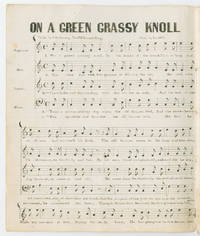
1864248261864. No binding. Condition: Fine. Manuscript Pen and Ink Folk Art Song Book ca. 1864. 24 pp. 6 5/8 x 8 in. This hand-sewn booklet contains eight songs popular during the Civil War era with music and lyrics in calligraphy. Songs include "On a Green Grassy Noll" by J. D. Canning with music by Ira Odell; "The Old Mountain Tree" by James G. Clark; "Harmonian Waltz"; "Year of Jubilee or Kingdom has Come!"; "Squire Jones's Daughter"; "The Sweet Birds Are Singing"; "Lament of the Irish Emigrant"; and "Soon and For Ever" by J. B. Monsell. The last page of the booklet is dated February 21 1864. Partial Transcript: Year of Jubilee or Kingdom has Come! I come up Norf on a little bender Left Missus at home wid no one to tend her Ole Massa's gone I dun-no what to; Sambo pretty sure he don't much care to. Chorus: Den sound de horn beat de drum Sound de horn and beat de drum De year ob jubilee am come Sound de horn and beat de drum De year ob jubilee am come. Met genral Bloaregard on my way here He told me dat I had better stay dere He said up Norf dey would skin and eat me Dat was a yarn dat a little heat me. He said he had just whipp'd Gen-ral Bu-el Grant and Wallace All three in a duel. I axed him den why he was running away Sam-bo says he dat question aint fair play. Oh times down Soth am getting quite rotten He's so berry scarce they have to burn cotton I left dat land ob oppression and gas And roam de free Norf without nary pass. Molasses Junction was a big scarecrow Nigh its wooden guns nobody didn't dare go; But when McClellan got a good ready De Southern Gentry seemed quite unsteady. Abraham Lincoln and Emancipation De two tallest tings in dis tall nation; Hurrah den boys let us still be merry Kingdom has come boys we've good times berry. Historical Background: Music played a prominent role in the American Civil War. On the battlefield and in the camps it boosted morale and released tensions. On the homefront it helped individuals and families express political sentiments grief and longing. Music entertained and often carried political religious and social messages. "The Year of Jubilee or Kingdom has Come!" was written by "Sambo" and first published in 1862 by H. M. Higgins in Chicago. "Squire Jones's Daughter" tells of the virtues of "The prettiest girl in the State of Maine" and was copyrighted by New York publisher Henry De Marsan in 1860. "The Sweet Birds Are Singing" is a cheerful pastoral duet about springtime that dates to at least 1836. "On a Green Grassy Noll" by J. D. Canning was first published in Boston in 1852 and is an elegy for a nameless old farmer who has "ploughed his last furrow." "The Old Mountain Tree" is a ballad in the form of a quartet by James G. Clark first published in 1854. It expresses longing for an old homestead. Clark 1829-1897 enlisted in the 35th New York as a 1st lieutenant and was detailed to remain in the recruiting service. He used music in his efforts to enlist soldiers in the cause and was dubbed "The People's Poet." "Lament of the Irish Emigrant" is a ballad by Helen Blackwood 1807-1867 with music by William R. Dempster 1808-1871 first published in Boston around 1840. It tells the story of an Irish emigrant who has buried his wife Mary and their child. Blackwood Baronness Dufferin and Claneboye was a British songwriter composer poet and author. Dempster a Scottish singer was very popular in the United States. "Soon and For Ever" is a sentimental hymn by J. B. Monsell about the Christian's union with Christ in Heaven. Rev. James Samuel Bewley Monsell 1811-1875 was an Irish Anglican clergyman and poet. He wrote the poem in 1853 or earlier.Condition: Very minor soiling else near fine.<br />
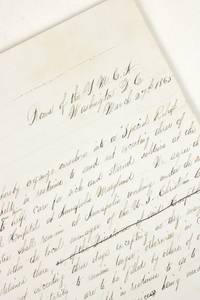
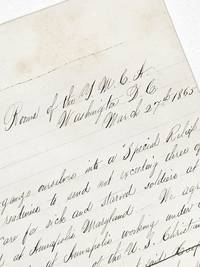
18651986Washington DC: Rooms of the Y.M.C.A. 1865. Single sheet folded to 7 1/4" x 9 3/4. Document shows two old horizontal fold creases else fine. Ink remains clean and legible. Dated March 27th 1865 at the Rooms of the Y.M.C.A. in Washington D.C. this document reads as follows: <br /> ____________<br /> <br /> "The undersigned hereby organize ourselves into a 'Special Relief Corps' to be held in readiness to send not exceeding three of our members at one time to help care for sick and starved soldiers at the U.S. General Hospital at Annapolis Maryland. We agree that our delegates shall remain at Annapolis working under the supervision of either the local manager of the U.S. Christian Commission stationed there or of the Directress of said hospital for a time not exceeding three days excepting as they may be able or willing voluntarily to remain longer. Otherwise in cases of special emergency their places are to be filled by others of our number all of whom are to be held in readiness to go to Annapolis upon notification by telegram or otherwise of such services being needed. <br /> <br /> signed Geo. May Powell / Warren Choate / A. K. Browne / Alex. A. C. Klaucke / John S. Polen / Levi Beardsley / Wm. A. Thompson / B. H. Stinemetz"<br /> <br /> words in brackets above stricken through.<br /> ____________<br /> <br /> The U.S. General Hospital mentioned in this document occupied a substantial area of the grounds of the U.S. Naval Academy in Annapolis. It was the primary receiving point for Union soldiers wounded in the eastern theatres of the war as well as those being returned from Confederate prisons such as Libby and Andersonville. The former prisoners were in shockingly poor health due to the conditions in which they were held with many dying on the transports to Annapolis and those who survived needing much attention. Rooms of the Y.M.C.A. unknown
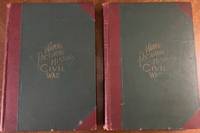
189435945Chicago: The Puritan Press Co 1894. Later printing. Hardcover. Good. Folios. Two volumes. 4 398 pages; 1. pages 399-836 pages. Illustrated. Green cloth hardcovers with red leather corners and spines. Gilt titles on the front covers. Faded titles on the spines. Green end papers. Covers are scuffed and worn in spots. All hinges have been reinforced at an earlier period. A repair made to 2 index pages in front of volume 1. Internal contents are sturdy and clean. First copyrighted 1866. The Puritan Press Co hardcover
1718106614<p>Folio newspaper extracted illustrated 369=384 pp. Disbound some pages separated double page illustration torn and separated a bit at the center with some loss tear at left side; normal aging; otherwise about good. This issue features Secretary of State William H. Seward on the cover. This issue contains a short article on the capture of Jefferson Davis. Also double page panoramic view of Richmond based on a photograph of Alexander Gardner. Included is an almost full-page picture of Major General William T. Sherman.</p> Harper's
190235224Knoxville: Gaut-Ogden Co. Printers and Binders 1902. Hardcover. Fair. Octavo. 335 pages. Illustrated. Light blue cloth hardcover with gilt title on the spine. This copy appears to be a former institutional copy or from a private library. A faded spot to the cloth lower spine where a label appears to be removed. The front paste down and right front flyleaf are newer. The paper covering the the original front paste down obscures an illustrated label and has been partially peeled back. The original front blank end sheet is chipped and missing a large piece on the left edge. The frontispiece portrait is present. A note on the copyright page in pencil states "Copy to come from C.A.P." The rear paste down and rear flyleaf is also covered with newer paper. The blank page preceding the rear end papers is chipped in the same manner as the front. Light shelf wear to the cloth binding. A small ink spot located at the top edge of the front cover. The internal contents and illustrations are in very good condition. <br /> <br /> Nevins I page 67 "A unique and quite revealing unit study of a Unionist regiment from Tennessee; exceedingly scarce. Gaut-Ogden Co., Printers and Binders hardcover
190210674Anniston AL: Norwood 1902. Hard Cover. Good binding. Octavo. 2 89. 1 pp. First edition. In original cloth with title in gilt on the front cover. Binding is worn at the head of the spine with small loss to cloth; likewise the bottom corner of the front board is worn; binding is generally darkened and somewhat soiled; a solid copy with light to moderate foxing/toning to the contents. Despite its faults this is a better copy than one usually sees. Laid in is a tattered reproduction of: "Pages from History & The Men from Pickens County Who Wore the Gray" compiled by Mrs. T. R. Spell Jr. with a short history of Pickens County veterans in attendance at past U.C.V. events the roll of Company B and a list of those killed and wounded from J. H. Pepper's diary about the Battle of Vicksburg<br /> <br /> The diary was largely taken directly from Captain Elbert D. Willett's daybook while in the war. His son Joseph Jackson Willett edited this book and remarks on its merits in a short preface: "It is not expected or contended this book will shed any additional light on that momentous struggle known as the War between the States about which so many volumes have been written . . . . but that diary now well thumb worn which faithfully records the movements engagements and casualties of Company B and the 40th Alabama Regiment C.S.A. Willett's notes have the advantage however of being written at the same time yes on the same day the narrated facts occurred. No matter how long the march or how fierce the battle the author of the diary on each day recorded the doings of Company B." An interesting contemporary account which given the immediacy with which events were recorded probably does "shed additional light" contrary to J. J. Willett's suggestion to the contrary. The final 5 pages are taken from the diary of J. H. Curry. Additionally several pages of rosters are included. Rare in commerce. Howes W-437 "aa"; Dornbusch II AL-76; Wright W-685. Norwood unknown
186788823Cincinnati: Miami Printing and Publishing Company 1867. First Edition. First printing. Octavo 23cm. Publisher's green cloth; gilt spine title; viii9-578pp; eight maps in text reckoned in pagination. A straight tight generally clean copy but with scattered foxing mostly marginal throughout; mild rubbing to cloth at base of spine; still an attractive Very Good copy in the publisher's binding. Contemporary ownership inscription J. Shackleford Richmond KY dated 1867. <br /> <br /> The standard work on Morgan's campaigns in Kentucky Ohio and Tennessee written by his brother-in-law who was also Morgan's brigadier. ".Valuable for Duke's eyewitness recollections recorded soon after the war" Eicher. NEVINS I:82. EICHER 1060. DORNBUSCH III:1229. Miami Printing and Publishing Company unknown
18729402N.p.: Privately Printed 1872. First edition. 8vo 20x14cm 3 98pp with 50pp consisting of 13 separately printed Pike poems and "In Memoriam Albert Pike" from 1898 bound in at rear. Lengthy presentation inscription from Pike to Capt. Fayette Hewitt and dated in 1872 Washington on separate leaf in front; and opposite a lengthy presentation inscription from Hewitt to a J.H. Johnson in 1896 Frankfort KY memorializing his friendship with Pike and gifting the book. Additionally Pike has briefly inscribed 2 of the poems bound in at rear to Hewitt one dated in 1870. Bound for Hewitt in full gilt-ruled black morocco binding spine and turn-ins tooled in gilt gilt lettering on spine marbled endpapers g.e. Spine ends joints and corners rubbed. Few of the poems at rear with light transmittal folds. <br /> <br /> Tremendous presentation copy of this privately printed collection of mythological poems from the Confederate General and architect of the Southern Scottish Rite Albert Pike 1809-1891. This copy presented to his close friend and subordinate Captain Fayette Hewitt 1831-1909 who served under Pike during the Civil War including the period of Pike's treaty negotiations in Indian Territory. Contemporary accounts from Pike on Hewitt illustrate the foundations of their relationship:<br /> <br /> "He daily deserved praise and won the love and admiration of all who knew him. He became as dear to me as my own sons. Brave courteous amiable unassuming obliging and kind to every one firm in the performance of duty—a nobler gentleman or better soldier never lived."<br /> <br /> <br /> This association is further deepened by the volume itself which Pike inscribed to “Capt. Fayette Hewitt†and which Hewitt preserved for over two decades before presenting it onward in 1896. Expanded with a substantial group of privately circulated poems including one inscribed in 1870 the volume documents a longstanding association between the two men later reinforced by Hewitt’s memorial presentation.  L. Boyden in his Bibliography of the Writings of Albert Pike 1921 records many of these bound-in poems as separately issued printings spanning from 1859 through the early 1870s with titles including "Cruiskeen Lan" "The Light of Days Long Past" "After the Midnight Cometh Morn" "The Fine Arkansas Gentleman" and others.  <br /> <br /> In all this volume represents a singular object at the intersection of the Civil War Southern fraternal culture and the personal legacy of Albert Pike preserved through his wartime friend and subordinate Fayette Hewitt.<br /> <br /> <br /> <br /> <br /> <br /> . Privately Printed unknown
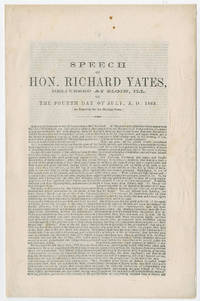
186524904<p>"<i>The American revolution was begun and fought through for an idea—to establish that man is a man—to vindicate the right of every man to equal rights and to equal citizenship…. Every boy imbibes the genius of our free institutions. The poor friendless rail splitter rises to the proudest pinnacle of human power. Cheers The poor tailor boy becomes and is now our President cheers the ferry boy the Chief Justice of our Supreme Court cheers and the humble tanner boys become the great commander who marshals a million of veteran warriors in the great cause of union and liberty and holds up the flaming symbol of emancipation to a whole race of mankind. Applause.</i>" p1/c2 – p2/c1</p><p>"<i>And yet for Jeff Davis who has been a wholesale murderer who has struck at the life of the whole nation and rolled the red wave of bloody civil war over the land they say we must be magnanimous. Sensation. We shoot the poor deserter and the poor soldier who is found sleeping at his post on guard but the nation must be magnanimous and not execute Jeff Davis!</i>" p6/c1</p> <b>CIVIL WAR & RECONSTRUCTION. RICHARD YATES.</b>Printed Pamphlet. <i>Speech of Hon. Richard Yates Delivered at Elgin Ill. on the Fourth Day of July A.D. 1865</i>. Jacksonville IL: Ironmonger and Mendenhall 1865. 8 pp. 6⅛ x 9½ in.<p><b><br /></b></p><p><b>Excerpts:</b></p><p>"<i>We celebrate the 4th day of July 1776 because then commenced the great experiment whether man is capable of self-government. Our fathers boldly announced to the world in the great and immortal charter of freedom the Declaration of Independence the bible of the rights of man which has just been read to you.</i>" p1/c1</p><p>"<i>The American revolution was begun and fought through for an idea—to establish that man is a man—to vindicate the right of every man to equal rights and to equal citizenship not by virtue of his birth or fortune or of his nativity or color but by virtue of his intrinsic God-created manhood.</i>" p1/c2</p><p>"<i>Every boy imbibes the genius of our free institutions. The poor friendless rail splitter rises to the proudest pinnacle of human power. Cheers The poor tailor boy becomes and is now our President cheers the ferry boy the Chief Justice of our Supreme Court cheers and the humble tanner boys become the great commander who marshals a million of veteran warriors in the great cause of union and liberty and holds up the flaming symbol of emancipation to a whole race of mankind. Applause.</i>" p2/c1</p><p>"<i>The system of slavery existing in our Southern States fostered interests tastes opinions manners and prejudices at war with the genius of our institutions and necessarily divided our people.</i>" p2/c2</p><p>"<i>I feel highly honored to-day that I have the opportunity of meeting so many of our returned officers and soldiers here for somehow I cannot divest myself of the feeling that I have been in the war myself and am a returned soldier although I have only on one or two occasions smelt the gunpowder of the enemy. Laughter. Yet under my administration the State of Illinois has sent nearly two hundred thousand brave volunteers to the field.</i>" p3/c1</p><p>"<i>Your brave comrades have died and you have risked your lives that the nation and the Union might live and you have proclaimed at the point of the bayonet the divine right of all men to be free.</i>" p4/c2</p><p>"<i>But thanks to you the accursed blot of human slavery which has divided and distracted us at home and sullied our name abroad is wiped out and every man in America is free.</i>" p5/c1</p><p>"<i>peace prevails in the land yet peace brings with it the most complicated questions. We are not safe until the great questions in dispute for which we have fought have been definitely and forever settled and upon such a basis as to prevent the recurrence of another war to mar our peace and endanger the safety of the Union.</i>" p5/c2-p6/c1</p><p>"<i>And yet for Jeff Davis who has been a wholesale murderer who has struck at the life of the whole nation and rolled the red wave of bloody civil war over the land they say we must be magnanimous. Sensation. We shoot the poor deserter and the poor soldier who is found sleeping at his post on guard but the nation must be magnanimous and not execute Jeff Davis!</i>" p6/c1</p><p>"<i>As a Senator of the United States certainly I could consider no State Government Republican in form which was at variance with the fundamental principles of our republican institutions</i>; <i>which denied the equality of all men before the law; which set aside the principle that governments justly exist by the consent of the governed and that taxation and representation must go together. And I am here to-day to say that I could approve of no State government whose constitution or bill of rights does not deny in express words this right of a State to secede from the Union and which does not provide that slavery shall be finally and forever abolished and prohibited so that not even a root seed or grease spot shall remain of this sum of all villainies the accursed system which has been the fountain of all our troubles and of the fratricidal and bloody war which has desolated the land.</i>" p7/c1</p><p>"<i>I thank God that I have never cast a vote or uttered a sentiment against human freedom; and no loud alarums of popular applause no shining height of human power shall ever seduce me to give up the God-given sentiments of my heart in favor of freedom and humanity.</i>" p7/c2</p><p><b>Historical Background</b></p><p>Fourth of July celebrations in the nineteenth century often began with artillery at dawn a parade and a speech at a courthouse or church for an hour or two. After the speech men often went to a tavern to drink thirteen toasts for the number of the original states while the women and children went home. Bonfires and fire-crackers carried the festivities into the evening. Typically a speech blended a sermon with a political address promoting patriotism. Readings of and orations on the Declaration of Independence or Washington's Farewell Address were also common.</p><p>Early during the Civil War celebrations often included sham battles to portray the real ones occurring on the battlefields. By the middle of the war fundraisers for widows and orphans of soldiers who had died in military service replaced the sham battles. After the war celebrations turned away from the community toward smaller gatherings of families and friends though many smaller communities continued the pre-war tradition.</p><p>The city of Elgin Illinois was established as a village in 1835 on the Fox River thirty-five miles northwest of Chicago. Chartered as a city in 1854 Elgin in 1865 had a population of 4000-5000 people. Four days after Yates delivered this address the city's first major fire swept the entire north side of Chicago Street in the business district.</p><p>Thousands of people from Elgin and the surrounding area celebrated the Fourth of July in 1865 with an artillery salute at dawn a "huge procession" at 10:30 a.m. of "returned soldiers civilians societies and other citizens" who marched from the Waverly House to Colby's Grove. The singing of "America" opened the exercises followed by a prayer by a local minister and a choir concert. Col. Edward S. Joslyn an Elgin attorney who served in the 36th Illinois Volunteer Infantry read the Declaration of Independence. State Adjutant General Allen C. Fuller delivered an address welcoming the returned soldiers then the choir sang "Battle Cry of Freedom." Gen. J. F. Farnsworth responded to Fuller on behalf of the soldiers followed by another choir performance. Former Governor and current Senator Yates followed with his oration and the singing of the "Battle Hymn of the Republic" concluded the formal program. A dinner for the soldiers who were present and a general picnic followed. The city concluded the day's festivities with a ball at the Waverly House.</p><p>The <i>Daily Illinois State Journal</i> proclaimed Yates' speech at Elgin "not only the best effort of his life but one of the most forcible and eloquent among the many able and patriotic addresses which our recent National Anniversary occurring at a juncture in our history of so much interest has called forth."</p><p><b>Richard Yates</b> 1815-1873 was born in Kentucky and graduated from Illinois College in Jacksonville in 1835. He studied law in Jacksonville and at Transylvania University in Lexington Kentucky. Yates began practicing law in Jacksonville in 1837 and served as a Whig in the Illinois House of Representatives from 1842 to 1846 and from 1848 to 1850. He represented Illinois in the U.S. House of Representatives from 1851 to 1855. He joined the Republican Party and supported John C. Fremont for president in 1856 and Abraham Lincoln for U.S. senator in 1858. In 1860 he was elected governor as a Republican and strongly supported the Lincoln administration's conduct of the war. When the Democratic state legislature proved uncooperative Yates dissolved the legislature on June 10 1863 and governed the state on his own. At the end of his term in 1865 Yates won election to the U.S. Senate where he served from 1865 to 1871. He supported radical reconstruction and the conviction of President Andrew Johnson.</p> Ironmonger and Mendenhall
196762610New Milford CT: N. Flayderman & Co. Inc. 1967. 4to. 6 153 15 pp. Frontisp. illustrated title 100’s of illustrations throughout. Brown publisher’s cloth decorative black lettering front cover & spine minor shelfwear w/ d.j. minor scuffing edgewear rubbing still VG/VG- copy. Second printing of this invaluable facsimile printing of the famed Schuyler Hartley & Graham catalogue offering an essential reference for Civil War era arms & ammunition uniforms horse equipment flags guidons Masonic goods and coats of arms. N. Flayderman & Co., Inc., hardcover
190962258Albany NY: J.B. Lyon State Printers 1909. 4to. 2 106 2 pp. Engraved frontisp. 4 large folding colour battlefield maps numerous plates. Green publisher’s buckram gilt lozenge seal for New York front cover gilt lettering front cover & spine minor scuffing edgewear still VG copy. First edition of this memorial volume dedicated to General George Sears Greene and his New York Troops at the dedication of a monument to their actions at Culp’s Hill during the Battle of Gettysburg. Referred to as “Old Man†or “Pap†Greene as he had re-enlisted at the age of 61 in the Union Army whose troops assaulted and cracked Stonewall Jackson’s defensive lines at the Battle of Antietam near the Dunker Church and his decision to build breastworks atop Culp’s Hill during the Battle of Gettysburg against General Meade’s orders were essential to holding the position. J.B. Lyon, State Printers, hardcover
1916229837Albany J.B. Lyon Company Printers 1916. 1916. First edition. 4to. Frontispiece and 16 plates. Original red cloth stamped in gilt. Very good. 121 pages. No dust jacket. Cover title reads: "Major General James S. Wadsworth at Gettysburg and Other Fields." Presentation inscription on the front free endpaper: "With compliments & best wishes of Frederick B. Maerkle To my friend Col. William C. Griffith dated September 21 1916." Provenance: from the estate of director Delbert Mann. 1st Edition. Hardcover. Very Good/No Jacket. Albany, J.B. Lyon Company, Printers, 1916. hardcover
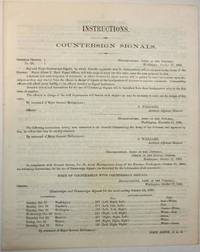
186139281Washington 1861. 4to 8-1/2" x 10-3/4." Caption title as issued. 6 2 pp. Old vertical fold. Very Good plus. Page 7 has the following manuscript "Note- - This Circular is in so far confidential that the Officer receiving it will not make its contents public; nor will he reveal them unless in the discharge of Signal duty to others than officers actually in the Service of the United States." <br /> with The oversized envelope of Office of the Signal Officer "Official Business" addressed to Lt. Col. Connor & Major Hyde of the 7th Maine Infantry.<br /> <br /> This scarce General Order No. 29 issued "By command of Major General McClellan" lists elaborately detailed "Countersign and Countersign Signals for the week ending October 24 1861"; "Day Countersign Signals"; "Night Countersign Signals";"Countersign Signals by Sound"; and General Instructions. <br /> OCLC 43312441 4- Duke Huntington DLC NYHS as of May 2023. unknown
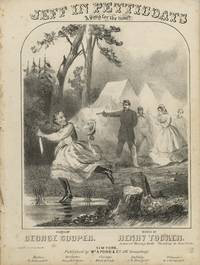
1865List3646New York: Wm. A. Pond & Co 1865. Folio sheet music lithographed pictorial cover. 6 pp. including cover. 9.5 x 12.25 inches. Typical light age toning and minor edge wear; very good example with strong impression remnants of string at spine removed from a larger volume. A vivid piece of end-of-war political satire commemorating the capture of Confederate president Jefferson Davis whose attempted escape in May 1865 quickly became the subject of popular ridicule in Northern newspapers and song sheets. The cover lithograph depicts Davis fleeing through a wooded encampment while dressed in women’s clothing a reference to widely circulated reports that he attempted to evade Union troops by donning a shawl or petticoats; in truth he had borrowed a shawl from his wife. Behind him a Union soldier points in recognition while onlookers react with amusement. The music was written by Henry Tucker a prolific mid-nineteenth-century songwriter known for sentimental and topical pieces with lyrics by George Cooper one of the most active American lyricists of the period and collaborator with composers such as Stephen Foster and J. R. Thomas. Together they produced a number of patriotic and topical songs during the Civil War years. The myth of Davis in women’s clothing was represented a few different ways though this large lithographic illustration done by Henry C. Eno is possibly the most iconic. Wm. A. Pond & Co unknown
186341236New York: Currier & Ives 1863. Folio lithograph broadside oblong 18" x 13-1/4." A few vertical folds with a closed tear along the end of one fold no loss; expertly repaired on verso with archival tape. Light spotting and wear Good.<br /> <br /> John Bull representing Great Britain holds a large clump of cotton in one hand. He grabs a kneeling slave by the hair i.e. "wool" with his other hand exclaiming "Well yes! it is certain that Cotton is more useful to me than Wool!" Two other black men stand in the back left; one covers his face crying. A man in a wide-brimmed hat with a goatee stands to the back right smiling at the scene. A large bail of cotton stands to the right of Bull.<br /> "Racist cartoon reflecting the Northern fear that Britain's economic ties with Southern cotton growers would cause the British government to relinquish its abolitionist stance in order to support the Confederacy. Depicts a plump John Bull representing Great Britain centered between a kneeling enslaved African American man and a bale of cotton in a storage shed. Bull touches the hair of the African American man with his right hand and holds a piece of the cotton from the bale in the other. He declares 'it is certain that Cotton is more useful to me than Wool!!/ In the left background two African American men stand and cry. In the right background a Southern white man plantation owner looks on and smiles" LCP description on line.<br /> Conningham 3257. Weitenkampf 133. Reilly 1861-40. OCLC 191119968 2 191908779 1 as of August 2025. Currier & Ives unknown
1932197555New York Minton Balch & Company 1932. 1932. First edition. 8vo. Author's foreword. Frontispiece and 7 b/w illustrations. Original black stamped brick red cloth. Dust jacket unclipped; few small chips. Very good. Bookplate of Edna Spennetta on the front free endpaper. F. Hardcover. New York, Minton, Balch & Company, 1932. hardcover
186111526St. Louis: George Knapp & Co. 1861. FIRST EDITION. Original cloth-backed boards with paper spine label; small cancelled stamp on title scattered foxing but overall an excellent copy of this item in the delicate original binding. First edition. A fascinating view of the proceedings at which the State of Missouri considers its relationship with the federal government of the United States. George Knapp & Co. unknown
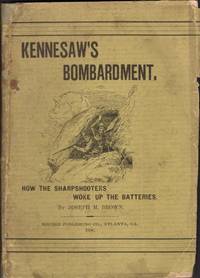
189034729Atlanta: Record Publishing Company 1890. Wraps. Fair. Stapled wraps. Approx. 7" x 5". 172 pages. Illustrated. Yellow illustrated paper covers with title printed on the front. Restored. Fragile paper covers and end sheets reattached. Paper tears repaired with mulberry paper. Text is lightly damp stained in the middle portions. A few pages with insect damage on the corners and edges. No loss of print. A few small pencil margin notes inside. <br /> <br /> The author Joseph Makay Brown was the son of the Georgia's Civil War Governor Joseph Emerson Brown. Joseph M. Brown was elected Governor of Georgia twice serving 1909-11 and 1912-13. This book is historical fiction. <br /> <br /> Scarce in the trade. One copy currently held in OCLC Rice. Not in Georgia Derenne catalog and not in Nevins. Record Publishing Company unknown
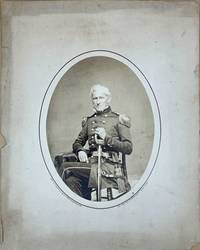
186266984New York: Chas. D. Fredricks & Company Photographers 1862. Photograph. Very Good . Large format print measuring 35 cm by 27.5 cm. Actual image is oval and measures 20 cm by 15 cm. Image is near fine. Mount has a few minor losses at the extremities. Image is undated. The view shows Thomas sitting in a wooden chair in uniform with a sword in his left hand. Lorenzo Thomas 1804-1875 was a general during the American Civil War and later served as Secretary of War under President Andrew Johnson. Chas. D. Fredricks & Company Photographers unknown
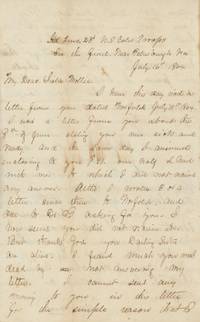
1864List2721Petersburg Virginia 1864. Single letter four 5 x 8 inch pages folded. Toning and some tears at folds overall excellent condition. M. Herbert Wood c. 1839–deceased was an officer of the 23rd Regiment United States Colored Infantry during the American Civil War. This regiment which consisted of African-American enlisted men with white officers was part of the 4th Division of the IX Corps organized at Camp Casey Virginia. Wood may also have served in the 25th Ohio regiment. A newspaper account from the time alleges that Wood a Mainer had married an Alabama woman who owned a considerable number of enslaved people and then “sold the negroes pocketed the proceeds turned abolitionist abandoned his wife and child and went back to Maine†before joining the Union army.1 Following the Civil War Wood purportedly asked President Andrew Johnson for a position but was denied after testifying that he would side with Congress over the President presumably concerning Reconstruction.<br /> <br /> This letter to Wood’s sister Mollie is dated July 16 1864 after the Battle of Spotsylvania Court House and shortly before the Battle of the Crater in which the 23rd suffered significant casualties. Wood describes the Regiment’s dire financial situation apparently having gone months without pay:<br /> <br /> “I cannot send any money to you in this letter for the simple reason that I have not any myself. We have not been paid since the last day of Feb and there is not an officer in the Regt that has 5 dollars but we shall be paid I hope soon it cannot be very long and I will then send you as much as you need.â€<br /> <br /> He also informs Mollie of some sad intelligence about her husband:<br /> <br /> “I do not wish or would not say one single word to injure your feelings but I very much fear that what I told you when we last met at New Berne has proved true. And that you are now a deserter’s wife. I have enquired of a great many officers who know him and to some who are Bro. Masons & have stated circumstances omitting name & place and all agree in saying that you will probably never hear from him again. We may all be mistaken however I hope we are.â€<br /> <br /> The Civil War saw quite a high desertion rate on both sides though many men eventually returned to their posts voluntarily or otherwise.<br /> <br /> 1 “A Specimen of the Impeachment of Witnesses†The Louisville Daily Journal April 15 1868. unknown
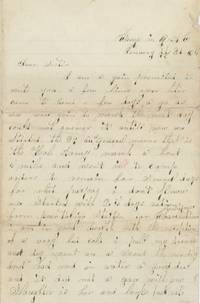
1865List2724South Carolina 1865. Single letter measuring 7.5 x 10 inches folded one double-sided sheet with stampless envelope. Near fine with light normal wear. George Harpole Vannada 1844–1928 was a private promoted to corporal in Company I of the 25th Indiana Infantry Regiment during the Civil War. The 25th Infantry was a volunteer regiment mustered in August 1861 and mustered out in July 1865. At the time of Vannada’s writing the Regiment was involved in the Campaign of the Carolinas – led by General Sherman this campaign would culminate in the Army of the South’s unconditional surrender and effectively end the war.<br /> <br /> Vannada writes that his regiment had “started with 25 days rations from pocotaligo staton for i supose Charleston.†On the way they had encountered:<br /> <br /> “a few Johneys i.e. Confederates not far off i have heard sevrel cannons to day we will be botherd with them all the way to Charleston between here and Buford they had a fort a bout evry 3 miles they wood stop and fire a few shots and then get up a bug for the next fortâ€.<br /> By “Buford†Vannada probably means Beaufort South Carolina which had been occupied by Union forces since November 1861. At this point the Savannah area had been essentially a refugee camp for freed people for several years and Sherman’s Special Field Orders No. 15 which settled them in the nearby South Carolina Sea Islands—the “forty acres and a mule†order—came in response to their request for stewardship over the land. Vannada remarks on Sherman’s order:<br /> <br /> “Gen Foster has been on Buford Iland for 2 years and now Sherman has comand of his troops i think they will get off now this Iland they have to give to the Niggars to setle on that is all that have famlies 40 acre to the manâ€.<br /> <br /> Vannada also accurately forecasts despite the fact that “we don’t often get any papers here to see what is goin on†that there “is some talk of peace down here but i think it is sevrel months off yetâ€. unknown
186515721865. Single sheet folded in half to 7 3/4" x 9 3/4. Fine condition with some mild browning light stains and two horizontal mailing folds. Original handwritten letter dated March 27 1865 from the "Rooms of the Y.M.C.A." in Washington DC. The letter organizes a "Special Relief Corps" of short term nurse volunteers standing ready to travel from Washington DC to Annapolis to assist in the care of soldiers in the U.S. General Hospital there. The text of the letter is as follows: <br /> <br /> "The undersigned hereby organize ourselves into a 'Special Relief Corps' to be held in readiness to send not exceeding three of our members at one time to help care for sick and starved soldiers at the U.S. General Hospital at Annapolis Maryland. We agree that our delegates shall remain at Annapolis working under the supervision of either the local manager of the U.S. Christian Commission stationed there or of the Directoress of said capital for a time not exceeding three days excepting as they may be able or willing voluntarily to remain longer. Otherwise in cases of special emergency their places are to be filled by others of our members all of whom are to be held in readiness to go to Annapolis upon notification by telegram or otherwise of such services being needed."<br /> <br /> The "starved soldiers" referred to in the letter were Union prisoners of war recently released from Confederate prison camps. Annapolis was the receiving station for prisoners returning from Andersonville Belle Isle Libby Prison and other Confederate prisons.<br /> <br /> The document is signed by eight men including George May Powell notable Y.M.C.A. activist Lincoln supporter and Treasury Dept statistician and Benjamin Stinemetz national vice-president of the Y.M.C.A. unknown
186488936Washington DC: Government Printing Office 1864. First Edition. First printing. Octavo 23cm; publisher's brown cloth ruled in blind with gilt spine title; 242pp. Some foxing to endpapers and text block edges else a fresh straight copy solidly Very Good.<br /> <br /> A very nice copy of this oft-cited sourcebook for Civil War historians. An early owner has annotated this copy in pencil: "Read this carefully and see if you don't think little Mac the candidate for the White House" initialed "W.J.B." identity unknown. McClellan was indeed the Democratic Party's candidate for the Presidency in 1864 losing in a landslide to Lincoln. NEVINS I p.10. Government Printing Office unknown