11 490 résultats
1945WORLDWAR014310Resurgam Books London. 1945. First edition. Octavo. 47 pages. The author's first book containing forty-seven poems some of which are concerned with the war. He was an R.A.F. corporal at the time.Presentation copy from the author to a fellow writer inscribed by him on the front free endpaper: ''Presented to Henry Treece - Brother Air Force Poet & lover of Shropshire and Cleobury Mortimer - in memory of a delightful and unexpected meeting in Waterford June 7th 1946. Patric Stevenson.'' Six minor corrections to the text by the author.Some offsetting from the dustwrapper flaps to the endpapers. Very good indeed in very good rubbed chipped and partially faded dustwrapper. Resurgam Books, London. unknown
1917WORLDWAR013528Hodder and Stoughton London. 1917. First edition thus: illustrated with six tipped-in colour plates by an uncredited artist. Quarto. pp 55. Original purple cloth decorated in black and gilt.Small gift inscription on front free endpaper. Spine slightly faded. Corners of covers a bit bumped. Very good. Hodder and Stoughton, London. hardcover
1945WORLDWAR013572The Fortune Press London. 1945. First edition. Octavo. 24 pages. Half of the poems deal with the war.Near fine in very good indeed very slightly chipped dustwrapper. Scarce. The Fortune Press, London. unknown
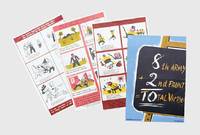
1942184571London: Communist Party of Great Britain 1942-43. Four wartime posters issued by the Communist Party of Great Britain. i "Let's sock the fascist on the jaw": cartoons depicting a German soldier fervent in Nazi ideology going to war before being beaten back by "Uncle Joe" and Montgomery. January 1943. ii "This is a tale that's perfectly true it shows what getting together can do": cartoons illustrating the efficiency gained when joint production committees are established. January 1943. iii "It's more important now than ever For workers all to stand together": cartoons showing "dismal Jim" trying to spread bad feeling against the Communists and sowing dissension among the workers. March 1943. iv "8th Army 2nd Front = 10 total victory": demanding that the Allies open a second front in the west to divert German troops from the Eastern Front a strategy promoted by Stalin. December 1942. Offset lithographs each approximately 347 x 224 mm. A few tiny nicks and light creasing at extremities one with small patch of tape repair on verso. In very good condition. unknown
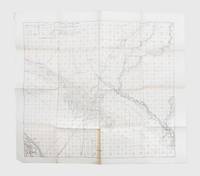
1918175146Baghdad: Map Compilation Section General Headquarters 1918. The decisive conclusion to the Mesopotamian campaign A collection charting strategically significant terrain during the closing stage of the war when Allied forces under Sir William Raine Marshall advanced up the Tigris to Mosul and defeated Ottoman forces at Sharqat - the final Allied-Ottoman engagement. The earliest map a May 1918 survey of the Fat-Hah Gorge showing the Turkish concentration on the western elevation anticipates events a few months later in October when Sir William Raine Marshall ordered a successful attack on the Turkish position. Victory at the gorge opened a pathway for the advance on Mosul which fell in at the end of the month; T.C. 250 compiled in readiness one month before incorporates information from captured Turkish and German surveys. Victory in Mesopotamia was also hastened by Allied control of the pass at Ain Nukhaila which allowed Lieutenant-General Alexander Cobbe to outflank the Turkish lines at Sharqat. The final map shows the environs of the historic city of Erbil. The plans of Ain Nukhailah and Fat-Hah are an early demonstration of the benefits of aerial photographic surveying which was introduced in the Middle East in the second half of the war and widely conducted in the 1920s. Four heliozincograph maps printed in black and red c.500 x 600 mm or reverse folded as issued "Erbil" laid down on linen "Fat-Hah Position" 3 inches to 1 mile others 1 inch to 2 miles. Old lead and colour pencil notations on versos. Small loss in one margin not crossing neatline a few small splits at intersection of folds linen foxed: very good bright maps. unknown
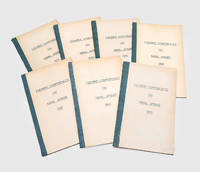
1947188776London: Admiralty Technical Reproduction Branch 1947. Documents from the heart of the Nazi state First edition a complete set of this internally circulated series reproducing the detailed minutes of meetings held between Hitler and his naval commanders in the period 1939-45. The material formed part of a large tranche of the German Naval Archives captured by Allied forces at Tambach Castle in Bavaria in April 1945 the documents having been moved from Berlin in 1943 for safekeeping. After the surrender material with intelligence value was moved to the Admiralty and American intelligence headquarters in London and analysed. These volumes were edited by Admiralty staff from translations made by British and American naval personnel and distribution occurred in three-week intervals per volume in the UK and US. Volume I opens with records of top-secret preparations for war in April 1939 and the series closes with supplementary material from early May 1945 following Hitler's suicide including the German government's final communications with Japan. Loosely inserted in the first volume is a notice dated 15 May 1947 embargoing news of the series until following day. 7 vols quarto. Text printed in duplicated typescript. With 4 maps and plans; tables in text. Original buff card wrappers green cloth backstrips front cover lettered in black. House in original green cloth slipcase with title label. Volumes annotated on spines in white. Wrappers of first and last vols creased and with some old adhesive tape repairs a little wear to spines general light toning to text as expected tan burn on 2 leaves in final vol.: a near-fine set in like slipcase. hardcover
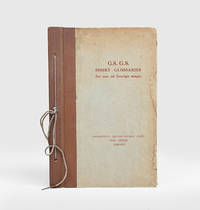
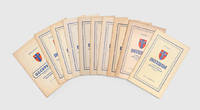
1945188972London: Geographical Section General Staff January 1943 - February 1945. A collection of official short-lists of topographical and descriptive terms to assist in the interpretation of Geographical Section General Staff maps. The glossaries in this group include either provisional or first editions. The longest of the eight guides is that for China. 8 works bound in 1 folder octavo each pp. 12-30. Original printed boards backed with brown cloth tied through punch holes with brown cord front cover lettered in brown printed explanatory sheet on inner boards each work wire-stitched in original colour card wrappers. Chinese glossary numbered on front cover; Romanized Annamese glossary with June 1945 military ink stamp on front cover. Rubbing and toning tidemark on front board: a very good collection. hardcover
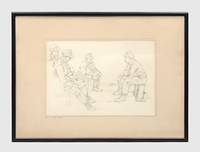
19421366441942. Original artwork from the Western Desert executed by Rommel's Kriegsmaler Wilhelm Wessel Three fine studies by Wilhelm Wessel Rommel's war artist Kriegsmaler executed in the field while serving as an officer with the Afrikakorps. Wessel 1904-1971 studied briefly with Kandinsky at the Bauhaus and then with Kurt Schwitters in Berlin. In 1924 he began a four-year journey through Turkey Greece Palestine and Egypt. From 1927 to 1931 studied Sumerian and Byzantine archaeology at the University of Berlin at the same time studying under expressionist painter Karl Hofer whose work was later branded as degenerate by the Nazis and included in their entartete kunst exhibition. Between 1931 and 1939 he taught art in Berlin and Westphalia. He served throughout the Second World War in France Russia North Africa and Italy initially as an officer with a Panzergrenadier regiment. In 1941 he was severely wounded during the opening of Operation Barbarossa and after recuperating joined Rommel in North Africa as a Kriegsmaler. His book Mit Rommel in der Wüste With Rommel in the Desert was published at Essen in 1943. At the conclusion of hostilities he was briefly a prisoner of war before resuming his career as an artist. "As a promoter of abstract art Wessel organized the first post-war German art exhibition at the Stedelijk Museum in Amsterdam. and took part in a number of group exhibitions" from Venice to Tokyo and "had solo exhibitions in Berlin Wüppertal Wiesbaden Vienna Stuttgart Munich Paris and elsewhere" Benezit. He was the first chairman of the West German Artists' Federation and as such sponsored an early exhibition of American art in Düsseldorf in 1956. Some of his war prints were loaned to NATO in Brussels. Provenance: acquired in 1975 from the artist's widow Irmgard Wessel-Zumloh 1907-1980 herself an accomplished artist by an American army veteran J. William Keithan Jr. 1925-2010. Keithan served with the 42nd "Rainbow" Division and after the war had a long career as an executive with the Westin Hotel chain in charge of the design and construction of over 50 hotels around the world. He has provided a 3-page typed account of the acquisition of this group in which he says: "We talked of many things. Of how General Rommel and Wessel were good friends and how after World War II Frau Rommel and son Manfred were frequently visitors to her home in Iserlohn. She was adamant in her refusal to sell or contribute any of Wessel's work to the German people or the German government". Together with a substantial album comprising 39 photographs of Wessel's war images acquired from the Canadian War Museum and Archives of New Zealand. Auction records for Wessel's post-war work are plentiful but we have not found a single example of any of his original war art appearing at auction or being otherwise offered for sale. Charcoal pastel and pencil drawings. The group comprises: a Original black-and-white charcoal drawing on pale grey paper signed "Wih. Wessel 42" measuring 460 x 590 mm; inscribed lower left corner in pencil "Hinter den Stützpunkten bei Eluel El-Aggara" "Behind the bases at Eluel El-Aggara"; Al 'Aqqarah Libya lies some 100 km west of Tobruk. An attractive and atmospheric evocation of the Libyan desert at dusk: against a low horizon a column of German lorries negotiates hills and scrubby terrain plumes of smoke billow in the distance. Reproduced in Mit Rommel in der Wüste colour plate 15. b Original coloured pastel drawing unsigned and untitled; image: 330 x 465 mm mounted overall: 500 x 620 mm. A striking image of a desert dawn patrol by three German armoured vehicles two Sd. Kfz. 222 scout cars and a Sd. Kfz. 231 armoured car their wheels kicking up sand; the low horizon line rising sun and big sky with flaring white cloud make for a most dramatic picture. Not reproduced in Mit Rommel in der Wüste and presumably unpublished. c Original pencil drawing signed "Wessel 42" entitled "German Soldiers Talking" inscribed in pencil on mount; image: 235 x 350 mm mounted framed and glazed overall: 410 x 570 mm. Label on verso noting its purchase from Wessel's widow in 1975. Reproduced as a half-page illustration in Mit Rommel in der Wüste p. 45. All pieces in excellent condition. unknown
194472872Pearl Harbor Oahu Hawaii: CinCPac--CinCPOA Bulletin no. 126-44 August 1944. 8vo pp. 124; 10 delightful maps in the text 1 double-page and tables in the text; very good in original pictorial blue wrappers printed in red and black. At the head of the title page: "Restricted. CinCPac--CinCPOA Bulletin no. 126-44, August unknown
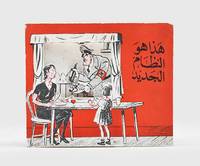
1942176681Probably Britain: c.1942-43. Pop-up anti-Nazi propaganda in Arabic A rare example of anti-Hitler propaganda in Arabic produced likely in Britain during the North Africa campaign. We have traced no other copies or any other examples of Arabic pop-up satire from the Second World War. As the Arabic text displays grammatical features typical of the Tunisian colloquial this pop-up was likely produced for the Tunisian campaign of 1942-43. The opening scene shows Hitler stealing food and wine from a family's dinner table while in the pop-up scene he handles the loot to a German soldier who is walking out of a house. The text at rear denounces how the German "locusts" and their leader "the pig Hitler" - a phrase used in contemporary anti-Nazi European satire here acquiring additional overtones within a Muslim context - stole food from all the countries they crossed to feed themselves while letting the local people starve. It concludes stating that this is how the new system works: everything is carried out for the sole benefit of the Germans. Oblong octavo folds into 100 x 150 mm. Paper engineered "pop-up" propaganda card Arabic title on the front and Arabic text on the back. Extremities a little rubbed and dust-soiled very slight foxing: a very good example. unknown
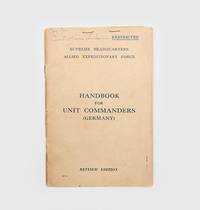
1519181162Likely Versailles or Rheims: Supreme Headquarters Allied Expeditionary Force 15 February 1945. Revised edition issued near the end of the war for unit commanders engaged in the occupation of Germany. The handbook sets out guidance on military government civil administration and the early processes of denazification. It includes maps of "Greater Germany" and of the "Gaue of the NSDAP" illustrating the Nazi administrative divisions. Provenance: Ink inscription to the front wrapper "Copy for: Civil Affairs Division" the SHAEF branch charged with restoring local administration and public order in occupied Germany. A further inscription to the rear wrapper "The Adjutant General Washington D.C." together with the stamp "SHAEF AG M & D" links the copy to the Manpower & Demobilization division responsible for personnel administration and demobilization - Stephen C. Massey. Small octavo. With 2 folding maps. Wire-stitched in original brown wrappers front wrapper lettered in black. Two staples to head of front cover with rust marks to facing page one wire stitch detached but holding couple of marks to rear cover. A very good copy. unknown
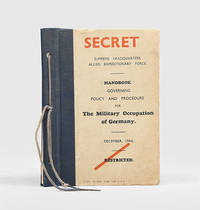
1944152575Perhaps Versailles: Supreme Headquarters Allied Expeditionary Force December 1944. The Allies prepare to take over Germany First edition initially classified "restricted" but subsequently stamped as "secret" on the front cover. Chapter VI concerns the control disarmament and disbandment of "para-military and police organizations" including the SS and other forces of the Nazi Party. It outlines Allied plans to ban the wearing of Nazi insignia detain implicated personnel and co-opt commanders of military districts Wehrkreis to take over the administration of liberated concentration camps and preserve vital evidence. Other chapters address the disarmament of Wehrmacht forces the seizure of communications infrastructure and relations with civilians as well as intelligence work the broader preservation of German state and army documents and the repatriation of Allied POWs. The two maps record the proposed division of Berlin into three international zones and the boundaries of the Wehrkreis. Chapter XIII correctly anticipates that the Nazi leadership will fight on even amid a hopeless situation and stresses the importance of capitalizing on any brief window between the final collapse of Hitler's regime and the emergence of an organized resistance to occupation. Distribution was ultimately intended to be as follows: "Army down to lieutenant-colonel's commands; Navy down to Commanders in Command on shore and all Commanding Officers of Men of War under the orders of the Supreme Commander; Air Forces down to Unit Commanders of the occupying Air Forces and of the air disarmament organization" p. 1. A revised edition appeared in April 1945. Octavo. With 2 folding colour maps at rear. Original black half cloth boards tied through punch holes with black cord as issued front cover lettered in black and red. Light wear and bumping brown mark at head of title page a little creasing to second map: very good. hardcover
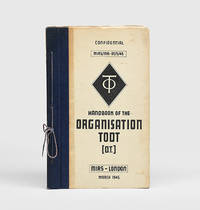
1945184356London: 1945. OT is indispensable in any protracted resistance the Nazis may offer A confidential Anglo-American intelligence report on the Organization Todt produced in the final few months of the war in Europe highlighting its central role in the Nazi war effort and the threat it could pose as a force of last resistance. The Military Intelligence Research Section MIRS was a joint Anglo-American intelligence agency established in 1943 to analyse and exploit captured Axis documents. MIRS produced a series of handbooks on Nazi military and paramilitary organizations for Allied intelligence officers and military officials. This report charts the history of the organization from its founding in 1933 through to the war where it assumed under the control of Albert Speer vast control over engineering and wartime infrastructure. It includes details on the organization's activities uniforms and insignia. There is respect for the organization - "It has carried out in the space of a little over five years the most impressive building programme since Roman times. It has developed methods of standardisation and rationalisation in construction to an extent and on a scale heretofore unattempted". However "OT is indispensable in any protracted resistance the Nazis may offer. Its officials are with few exceptions not only early and ardent Nazis belonging to either the SS or SA but have been leaders of men for many years. Their connections with high officials of the SS and SA are both intimate and of long standing. Above all their standing in the Party combined with their technical qualifications will earn them the confidence of Nazi leaders in any plans for a last-ditch resistance". Provenance: Evgenii Semenovich Mollo 1904-1985 a military historian specializing in uniforms and insignia with his "Mollo Collection" bookplate to the front pastedown. Folio. With 7 plates of which 4 coloured 11 folding plates folding map. Original dark blue quarter cloth cream boards printed in blue string tied. Very minor wear at extremities slight soiling to boards short closed tear to title page contents a little toned. A very good copy. hardcover
191846108Note reads "Dear Allie:The other day thru Miss B. Macdonald I heard you & Bill & the Baby had met with some misfortune due to the disaster at Halifax. I do wish you would let me hear from you thru some source. I wrote ages ago to you but do not know whether you ever received it. I so often think of you & of the many pleasant times you & I spent together. And to think I am here in France & Caring for the British Tommies too. Pecks of love .Write soon. E.A. MacDonel #1 General Hospital B.E.F. France PresbyU.S.A.". E.A. may be an American nurse as the hospital she refers to was originally No.1 General Hospital BEF at Etretat on the Normandy coast. In 1917 it was taken over by the US Army mainly with Doctors and nurses from The Presbyterian Hospital of New York and Columbia University to help in the war effort. It thus became Base Hospital No.2. The "B.Macdonald" may well be Beatrice Macdonald who was Canadian . She was severely wounded at Ypres in 1917 ; returned to action at this hospital and received the Distinguished Service from the US Gov't. amongst other medals and decorations. unknown
1946WORLDWAR012900The Fortune Press London. 1946. First edition. Octavo. 28 pages. Includes a number of war poems.Free endpapers faintly tanned. Very near fine in very good indeed slightly nicked dustwrapper. Scarce. The Fortune Press, London. unknown
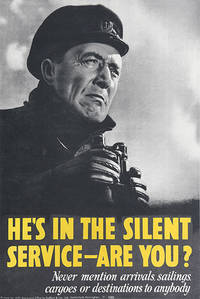
1942173606Nottingham: Printed for H.M. Stationery Office by Stafford & Co. Ltd 1942. One of the series of "careless talk" posters produced by the British government during the Second World War presenting a tight-lipped heroic sailor with the appeal to "never mention arrivals sailings cargoes or destinations to anybody". The British government feared both that enemy agents may hear vital secrets and that rumours may spread and undermine the war effort. Offset lithograph 370 x 249 mm. In fine condition. unknown
02-0176ca. 1940. Original gouache painting. Design for a poster. Red and black on white. Framed. Image: 23.5 x 10.5 cm. Frame: 36.5 x 24.5 cm. One of a pair. ca. 1940. unknown
1941WORLDWAR014092George Allen & Unwin London. 1941. First edition. Octavo. pp 130 4 adverts. Illustrated by Maurice McLoughlin. The inspiration for Dad's ArmyContemporary 1941 gift inscription on front free endpaper. Near fine in very good slightly nicked and rubbed price-clipped dustwrapper. Uncommon. George Allen & Unwin, London. unknown
1929WORLDWAR001958Heinemann London. 1929. First edition. Octavo. pp iv 34. Cloth-backed Japanese paper boards. Top edge gilt. A First World War story.One of 525 numbered copies on Large Paper signed by the author. Fine in very near fine dustwrapper with a small crease to the spine. Heinemann, London. hardcover
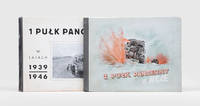
1946179661Hannover: Wydawnictwo Polskiego Zwi zku Wychod ctwa Przymusowego w Hanowerze 1946. For our freedom and yours First editions of these bilingual regimental histories. They feature many illustrations of tanks in training and combat and show both regiments's participation in the Normandy landings. We have only traced six copies of First and three of Second on WorldCat. The first and second Polish armoured regiments were formed in exile before joining the effort to liberate France on 1 August 1944. These volumes provide a snapshot of soldiers's daily lives battlefield casualty statistics route maps through occupied France and even contain the sheet music for the first regiment's official march. 2 Pu k Pancerny focuses on photographs taken during the campaign showing the remains of German ordnance soldiers digging trenches and their tanks in action. Conversely 1 Pu k Pancerny is a thorough description of their history accompanying battlefield images with those taken during training and in liberated villages. 2 works oblong folio. With many half-tone photographic illustrations in text some in colour; text in Polish and English. Original paper-covered boards black cloth backstrips half-tone photographic illustration mounted to front board of First colour illustration to front board of Second. Title page of First inscribed "To my very dear Scotch parents. Faucke". Spine of First split at foot both repaired at head inner hinges starting in both vols but firm boards lightly soiled and creased: a very good collection. Biega ski & Koz owski 4348 4349. hardcover
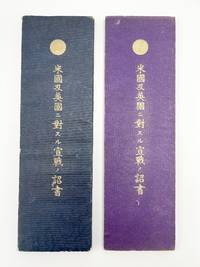
408713Light rubbing to cloth boards and slipcase text lightly browned. Lithographic document in Japaneseaccordion form 14 x 4 inches 350 x 105 mm. The formal announcement of a state of war delivered to the Japanese people comprising title panel and 8 pages. Purple boards upper cover with Imperial chrysanthemum device and titled edges lightly rubbed; matching original blue/green card slipcase. Laid-in: mimeograph translation in English presumed contemporary. The document provides Japan's reasons for declaring war in December 1941 stating Japan's position in Asia as a supporter of peace accusing the United States and Great Britain of aiding Nationalist groups in China. This is a contemporary reissue of the declaration for use in military academies. The Declaration of War was generally republished on the anniversary of Pearl Harbor throughout the War to reinforce to the people the Japanese Right for the war. unknown
1941WORLDWAR016015Count Potocki Little Bookham Surrey. c 1941. First edition. Octavo. pp 11 1 adverts. Wrappers. A poem written in response to the sinking by a submarine of a Royal Navy ship.Staple rusted. Covers a bit creased and marked. Very good. Scarce. Count Potocki, Little Bookham, Surrey. unknown
1945162758Europe: Printing and Stationery Services 21 Army Group later British Army of the Rhine 1945-46. An informative classified military publication First and only editions classified "secret" up to Issue 12 of Interim and "confidential" thereafter. The scope encompasses conditions in Germany and broader current affairs discussion of military strategy and tactics in the war and findings from the interrogation of German prisoners or seized enemy documents. The volumes of Interim include numbers 5 13 August 1945 6 27 August 1945 8 24 September 1945 10 22 October 1945 11 5 November 1945 12 19 November 1945 14 17 December 1945 17 5 February 1946 and 19 4 March 1946. The earliest two were issued in the name of Montgomery's 21st Army Group before its reorganization as the British Army of the Rhine in August 1945. The issue of Occupation is dated 1 May 1946. The Australian War Memorial Library appears to have a complete run of both titles in total 23 issues published between June 1945 and July 1945. One or more issues are also held by the German Army's Militärgeschichtliches Forschungsamt at Potsdam the Konrad-Adenauer-Stiftung and Edinburgh University Library. 10 issues octavo. With 13 maps 11 folding. Original buff card wrappers wire-stitched as issued front covers lettered in blue and with army group badge in red and blue. A little toned and creased more so to one issue: a very good collection. unknown
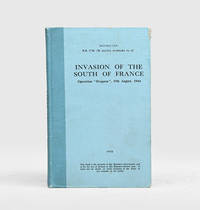
1950186864London: Tactical and Staff Duties Division Historical Section Naval Staff Admiralty 1950. First edition classified restricted. Operation Dragoon marked the first participation by a French army in the liberation of the country. Naval support including amphibious lift minesweeping and aerial bombardment was provided by the US Eighth Fleet and the Royal Navy's Mediterranean Fleet both under the overall command of Vice-Admiral H. Kent Hewitt. "From the tactical point of view there is no doubt that Operation 'Dragoon' was a resounding success. Between 15th August and 25th September a great army consisting of 324069 men with vehicles were disembarked. All this was done with very small loss. The Seventh Army swept aside all opposition. and advanced some 400 miles in 27 days to join forces with General Eisenhower" p. 56. Of the 500 copies printed we have traced only one in the UK National Museum of the Royal Navy and a further four worldwide US Navy Department Library University of Calgary National Library of Israel and the Dutch Defensiebibliotheken. Octavo. With 4 folding plans. Original blue quarter cloth title to spine in black blue sides lettered in black. Binding lightly worn one plan slightly proud: near-fine. hardcover
1930WORLDWAR000162Victor Gollancz London. 1930. First edition. Octavo. 285 pages. Vellum-backed cloth. Adapted from Sherriff's successful play of the same title which was also turned into a Hollywood film under the direction of James Whale.Number 377 of 600 copies signed by both authors.Nameplate on front pastedown. Front endpapers tanned. Small mark to spine. Corners of covers slightly rubbed. Very good indeed. Victor Gollancz, London. hardcover