WORLD WAR II; JAPANBiblio.com
11 490 résultats
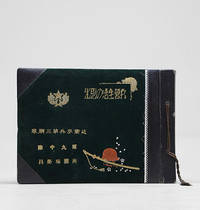
194098081Japan: 1940. Superb personal photo album portraying the training of a Japanese infantry officer cadet at the junior division of the Rikugun Yonen Gakko - Imperial Japanese Army Academy - at Asaka in Saitama province at the outset of World War II. Images show his family and friends; his well-appointed room with stacked arms; group portraits of cadets; the buildings on campus and locally interiors of a mess hall lecture theatre and of a barrack-room; parades and drill on the drill square; training exercises with firehoses and with howitzers and attack training under live fire with smoke drifting across the parade ground; jukenjitsu or kendo-style bayonet training; sumo wrestling and a traditional dance performance. A highly evocative visual document which is further enhanced by the fact that is has the marks of having been captured and passed as legitimate "loot" with the ink-stamp "Examined in the field. passed by Joint Intelligence". It was taken by U.S. Marine Sergeant Michael Kolesar of Ironwood Michigan serving with A Co. 6th Tank Battalion 6th Marine Division and has his ownership inscription to the front free endpaper datelined Okinawa April 1945. The 6th Marine Division was the only U.S. Marine Division formed and disbanded overseas never setting foot as a Division in the United States. It was formed on Guadalcanal in the Solomon Islands in September 1944 composed of the 4th 22nd and 29th Marines and assorted Engineering Medical Tank Headquarters and service battalions. They landed on Okinawa 1 April 1945 as part of III Amphibious Corps swept through the northern Ishikawa Isthmus and then engaged in heavy fighting against the Shuri Line located in hills honeycombed with caves and passages across the southern Coastline fighting for over a week and then advanced through Naha. Kolesar's tank battalion was involved in the campaign through Naha and then the Oroku peninsula sustaining heavy losses. For its part in an operation which came to be known as the "Typhoon of Steel" for the sheer intensity of the fighting the 6th received a Presidential Unit Citation for "extraordinary heroism in action". The Division was prepared for the invasion of Japan which never took place so they were sent to Tsingtao China in October 1945 disbanding in April 1946. Kolesar was evidently back home before the unit reached China the Ironwood Daily Globe of 24 October 1945 recording his presentation of a Japanese rifle that he had brought back as a trophy to the local Conservation Club he evidently retained possession of this attractive and fascinating album. Landscape quarto 215 x 282 mm. Title page with "calligraphic inscription" extolling the five codes of the Imperial Precepts to Soldiers and Sailors - Loyalty Propriety Valour Fai8thfulness and Righteousness and Valour - 75 original photographs of various formats - ranging from 100 x 70 mm to 115 x 155 mm - neatly mounted on 48 black card leaves tissue-guards remaining intact and to verso of the free endpapers some with carefully written captions in Japanese on shaped paper labels beneath. Original silk cord-backed album of black half morocco-grain cloth bottle green velvet boards the front deeply stamped with title in gilt together with Japanese Army Cadet insignia of a star within wreath and motif of a steel helmet in red with gilt katana in a flurry of cherry blossom petals. A little rubbed at the extremities but overall very good. hardcover
1919WORLDWAR013070Sidgwick & Jackson London. 1919. First edition. Octavo. pp 66 2 adverts. Portrait frontispiece with tissue guard. Boards with title-label. The author was a pilot who was killed in action in 1918. The frontispiece shows him in uniform and looking about twelve years old. Twenty-page Memoir by ''E.H.Y'' who served with the author.Fine in very good dustwrapper with some tanning to spine and front panel. Sidgwick & Jackson, London. hardcover
1918WORLDWAR000381George Allen & Unwin London. 1918. First edition. Small octavo. 112 pages. Card wrappers. Includes poems by A.E. W.W. Gibson Siegfried Sassoon Iris Tree E.H. Visiak et al. Introduction by the editor.Some spotting. Covers slightly marked. Spine darkened. Very good. George Allen & Unwin, London. unknown
1944166205Likely United States: no stated publisher c.1944. If the enemy or puppet troops come please help conceal me First edition first printing of this unusual septilingual handbook focused on interactions in Chinese but with Burmese French Annamese Thai Shan Lolo and Lao also catered for. We have traced four copies all in US institutions. In the Chinese section a special chapter concerns "Material for Use in North China" where Chinese Communist Party forces were the dominant military presence. Downed pilots are given the means to get a message to US commanders via Yan'an and the New Fourth Army. Copies can be found at Yale Brown the University of Washington and the Library of Michigan. Duodecimo. With 7 colour illustrations. Text in English and other languages. Original laminated tan card wrappers front cover lettered in black. Front inner hinge sometime consolidated with adhesive else a fine copy. unknown
19451139691945. WORLD WAR II. Pre-battle map of Okinawa Island. Washington: Army Map Service 1945. Single sheet measuring 22-1/2 by 20 inches with black-and-white topographical map on Side A and color oceanographic map on Side B. $2500.Official doubled-sided U.S. Army map of Okinawa Island before the Battle of Okinawa labeled ""SECRET.""The Battle of Okinawa code name ""Operation Iceberg"" took place on Okinawa Island between April 1 1945 and June 22 1945. One of the Ryukyu Islands extending southwest of the Japanese mainland Okinawa was of paramount strategic importance. Allied forces needed it to launch Operation Downfall the large-scale on-the-ground invasion of Japan anticipated to take place in November 1945. Allied forces the bulk of which were U.S. Army and marines faced off against the Imperial Japanese Army and conscripted indigenous Okinawan civilians that spring. The Allies launched a multi-pronged amphibious assault of Okinawa and surrounding islands. Although the Allies significantly outnumbered defenders the Japanese brooked their efforts with kamikaze and other extreme defense tactics. Approximately 250000 died from war starvation illness and mass suicide in what would be the bloodiest battle in the Pacific Theater.Side A of this map shows Beach Landing zones coded by color and number extending down the western coast of southern Okinawa Island and corresponding to the area around modern day Yomitan. Kedena Air Base from which Allied forces planned to transport troops in Operation Downfall is located just a little further inland outside of the map limits. The map shows roads airports railroad and radio towers and lighthouses as well as underwater currents obstacles and cables. Gun pill box block house and earth-covered installations are demarcated as are limited topographical features. A Japanese-English glossary of helpful topographical terms underscores the nature of the foreign invasion.Side B shows a composite image of an aerial photo map overlaid with a topographical map also reproduced in February 1945 a few months prior to Operation Iceberg. This map shows landmarks like airports docks and major cities while also giving a sense of water currents and depth.On April 1 1945 Commander of the Tenth Army Simon Bolivar Buckner Jr. successfully launched an amphibious assault against this very coastline. His Army divisions and Marines commanded by Lemuel C. Shepherd Jr. Roy Geiger John R. Hodge and Pedro de Valle among others landed in waves on Hagushi Beaches shown on both sides of this map. Allied forces met such little resistance that they captured Yomitan Air Base shown as ""Yontan Airport"" on Side A and Kedena Air Base within hours. Lieutenant General Buckner was killed by coral shrapnel just days before the battle's conclusion on June 18 1945.This map and scant others like it facilitated the Allied invasion by introducing troops to the topography landmarks and place names of Okinawa Island. Accurate maps depended on military intelligence collected using the latest technology. Maps related to the Battle of Okinawa are significantly scarcer than D-Day maps which are highly coveted. Fine condition. unknown
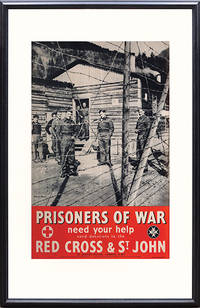
194167150London: Red Cross & St. John n.d. after 1941. A visually and one would hope financially appealing wartime fund-raiser. The poster must post-date July 1941 when British POWs from Greece began to arrive at the camp at Wolfsberg one of the largest camps in Austria. Up to 48000 prisoners were incarcerated either there or in one of the many Arbeitskommandos in its orbit the great majority of them French. An interesting insight into the nature of war-time regulation of materials is given by the instruction at the foot of the poster stipulating that; "By order of the Paper Control this Poster must not be affixed within 100 feet of another Red Cross Poster of any description." Sheet size: 790 x 506 mm. Large two colour poster red and black on wove paper. Slight fourway creasing but otherwise in excellent condition. Presented in black frame with conservation mount. IWM PST 8779 unknown
1949136920London: Air Historical Branch Air Ministry 1949. The first attempt to write the history of the war in the air Copy number 8 from a small restricted circulation classified "secret." Drawing on high-level government papers and reports this report follows extensive background with discussion of individual operations and assessments of efficacy tactics and strategy. The only copies traced are in the complete sets held by the Imperial War Museum and the National Archives. The Air Historical Branch was revived in 1941 under the leadership of John Combes Nerney 1890-1973 and immediately began gathering material for a six-volume narrative The R.A.F. in the Bombing Offensive Against Germany. Volume I on the development of Bomber Command up to 1939 was completed by the end of hostilities and the remainder were finalized in the immediate postwar years. In this volume chapters are devoted to major offensives including Operation Pointblank Operation Chastise and the Battle of Berlin as well as the devastation of the industrial city of Hamburg. The text cites large quantities of sensitive information and data. Although there is no stated limitation we have located no volume with a copy number above 17. The narrative formed the basis of The Strategic Air Offensive Against Germany 1939-1945 written by Sir Charles Webster and Noble Frankland and published for the public in 1961. Frankland's 1951 monograph The Planning of the Bomber Offensive and its Contribution to German Collapse was published by the Air Historical Branch as a companion to the original six volumes. Large quarto 340 x 210 mm. With 3 maps 2 folding 1 colour 7 folding tables chart; tables in text. Leaves printed with duplicated typescript. Original brown quarter cloth boards fixed with metal posts front cover with white label printed in black. "Supplied for the public service" ink stamp on inner boards. Covers worn as expected couple of text pages only partly bound in Appendix 13 repaired along fold: very good. hardcover
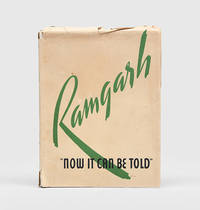
1946181214Ranchi: The Catholic Press c.1946. A modern fighting force which could stand toe to toe with the Japs and slug it out to victory First edition found in eight institutional libraries only telling the story of Ramgarh's top secret Chinese-American Training Center the first training camp run by the US on foreign soil. Conceived by Stilwell following the retreat from Burma the centre drilled and equipped four crack Chinese divisions. These formed the core of Stilwell's hard-fought but successful advance through Burma in 1944. This extensively illustrated publication profiles Brigadier-General Frederick McCabe and other senior figures at the centre as well as its rigorous jungle warfare training regimen and exercises to familiarize Chinese troops with cutting-edge US weaponry. A section at the end describes visits by VIPs including Chiang Kai-Shek Mountbatten Lieutenant-General Sultan and Stilwell himself. Copies are held by the US Army War College US Army Center of Military History Marshall Center for Security Studies Wisconsin Veterans Museum Harvard University of Georgia Norwich University and SOAS. Quarto. Illustrations throughout; some text and decoration printed in brown. Notice from publisher tipped to first page. Original card wrappers front cover lettered in brown and black. With dust jacket. Loss and split at foot of spine odd mark internally; jacket flaps without price as issued losses at spine ends panels toned nicks and creasing at head where jacket oversized: a very good copy in like jacket. unknown
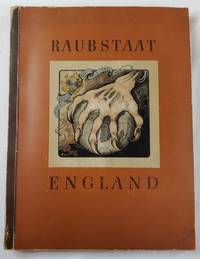
1941043313Hamburg-Bahrenfeld: Cigaretten-Bilderdienst 1941. In German. World War II era German propaganda providing an illustrated history of the British as a predatory and often brutal state. Numerous illustrations in color and black and white mounted on pages throughout. Softcover with front cover illustration 12.25 inches tall map endpapers 129 pages. Edges heavily rubbed with some corner creasing rear cover scuffed sound binding age-toned but clean pages no names or other markings. First Edition. Soft Cover. Good. Folio - 12" - 15" Tall. Cigaretten-Bilderdienst Paperback
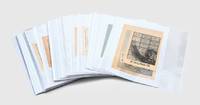
1941191050c.1941-1945. Promising comfortable captivity rather than death on the Eastern Front A substantial collection of Soviet aerial propaganda leaflets in German dropped behind enemy lines to encourage surrender most incorporating safe-conduct passes for presentation upon capitulation. These passes carry wording such as: "I a German soldier refuse to fight against Russian workers and peasants. I voluntarily surrender to the Red Army" translated. Evocative imagery is used such as one leaflet showing a skeleton in SS uniform pointing to a gravestone beneath the warning: "This is your place! You'll be next!" Many employ explicitly socialist appeals urging German workers and peasants not to fight their fellow labourers on behalf of their oppressors. Others claim that numerous German generals have already surrendered insist Germany's defeat is inevitable and warn soldiers not to throw their lives away. Some point to overwhelming American war production as further proof that the war cannot be won. A recurring theme is the favourable treatment allegedly awaiting those who surrender. One leaflet depicts prisoners dining with the caption: "The German prisoners of war are received by the Russians with a tasty fatty and nutritious lunch" alongside the assurance: "All who surrender to the Red Army are guaranteed life good treatment and to return home after the war ends" - an extraordinary claim given that the death rate among German POWs in Soviet captivity has been estimated at roughly one third. 131 leaflets varying sizes. Each leaflet in a removable mylar sleeve housed together in a red cloth solander box. Some toning else in excellent condition. hardcover
4924mounted a remarkable attack engaging five German destroyers in darkness off the Dutch coast. During the encounter Evans sunk one destroyer by ramming it and another following hand-to-hand fighting on the deck of H.M.S Broke a third was also sunk. A fuller description can be emailed upon request. unknown
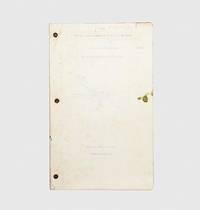
1944190894Likely London: c. 1944. The largest airborne landing in military history Classified "secret" with a contemporary red pencil notation on the cover page recording this as the copy of Headquarters Royal Artillery. This report written in terse style appears to predate the longer 47-page official report issued by Major-General Roy Urquhart commander of the 1st Airborne Division during Market Garden in January 1945. We have traced no other copies. The contents are divided into three sections dealing with planning and execution observations for future reference and comments on air support. Compared to the Urquhart report significant space is devoted to organizational and practical failures in communication including delays in using a common slidex insufficient sharing of call signs and codes and frequencies not being checked leading to different set operators employing frequencies too close. The diagrams record the Royal Artillery communications structure and the wireless network used during the first lift. A laid-down label on the cover page states that the document has not been approved by the Major General Royal Artillery 21st Army Group at the time Major-General Meade Edward Dennis 18931963 - further evidence that the text is an early evaluation of the 1st Airborne Division's part in the operation. Together 22 sheets of duplicated typescript 330 x 205 mm each printed one side only two full-page diagrams on similar sheets folding sketch map cover page with laid-down label all fixed with three metal butterfly pins. A few contemporary annotations. Housed in contemporary manilla folder pencil annotation on front. General creasing a few stains and marks final sheet detached from pins: very good. Imperial War Museum "The Story of Operation 'Market Garden' in Photos". unknown
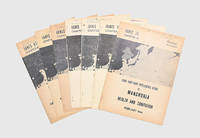
1944188792Washington DC: Joint Intelligence Study Publishing Board 1944-46. The lead compiler's copies Classified material from the first significant US joint-intelligence programme each with the lead researcher's ownership signature "Capt. H. Kuhlenbeck" at the head of the front wrapper and all but the first identified as a "contributor's advance copy" in his hand. Established in 1943 the JANIS programme produced comprehensive reports on different strategic theatres and involved personnel from military naval and air intelligence as well as the Office of Strategic Services and the Office Chief of Engineers. For each area either a country or a subregion JANIS operatives compiled briefings on geography climate demographics communications military facilities and health and sanitation. By the end of the war the reports had become the model for all strategic intelligence work and long-term planning. In 1947 the programme was absorbed into the CIA. A naturalized American citizen Hartwig Kuhlenbeck 1897-1984 was recruited into the US Army Medical Corps in 1944 at the rank of captain. Having travelled in Asia and been a visiting professor in Tokyo in the 1920s he was assigned to the Office of the Surgeon General as an expert in health and sanitation in East Asia. His reports here on Manchuria China and parts of Japan provide assessments and recommendations concerning environmental conditions public health facilities and the spread of major diseases. For the China East Coast volume he was assisted by Dr E. A. Struthers a British medical officer in Malaya. Kuhlenbeck remained with JANIS until 1946 returning to his successful academic career shortly after a promotion to major. Loosely inserted in three of the works are memoranda from the Joint Intelligence Study Publishing Board that list the programme's participating personnel. Kuhlenbeck is identified as the lead for the health reports and reachable on a War Department landline. 7 works folio. With folding maps in 2 works illustrations and tables in text; 3 works with loosely inserted memorandum. Original buff card front covers printed in black hole-punched as issued. Housed in custom green cloth portfolio spine lettered in gilt. General signs of handling some wrappers toned: a well-preserved collection. hardcover
D4424France early 20th century. WWI ephemera -- aircraft. Silhouettes d'Avions Illustrated manuscript on paper in French. France: c. 1915-1925. 16 leaves pocket-sized: 135 x100mm. 15 hand- colored illustrations depicting three views of planes; two in profile and one birds eye view all are labeled for early French English and German aircraft models. Original paper wrappers titled Silhouettes dAvions with later tape reinforcing hinge; somewhat brittle leaves loose but present. This skillful manuscript perhaps created by a younger person as an admirer of the craft represents sixteen popular models of biplane and monoplane patterns. This interesting piece of ephemera is inextricably linked to the three great European production centers of World War I-era aircraft: representing France England and Germany. World War I was the first walrus in which aircraft were deployed on a large scale. The sky had become another battlefield no less important than the battlefields of land and sea. Initially planes were used mostly for reconnaissance over the North Sea and strategic bombing raids. Then at the onset of war pilots and engineers learned from experience and developed many specialized models; including fighters bombers and ground-attack airplanes. These evolving flying machines were recognized to be not just toys but weapons. In addition fighter pilots were venerated as modern knights and many became popular heroes. All well represented are the French military aviation exercises of 1911 through 1913 that pioneered production of the Farman Caudron Voisin Breguet Nieuport fighter models. Listed for both French and English aircraft are the Bleriot and Morane models. England had started late and had initially relied largely on the French aircraft industry especially for engines. The English planes represented here are the Airco B.E. 2 and Vickers models. Notably the British Vickers was the first experimenting with mounting machine guns. Perhaps best represented by the whimsical drawings are the German planes of the variant Taube models including the Albatros Aviatik D.F.W. Jeannin Stahltaube and Rumpler Taube. The Rumpler Taube was a pre-World War I monoplane aircraft. It was the first mass-produced military plane in Germany and was the most common having two seats. Imperial Germanys first practical military aircraft the Taube dove was used for virtually all military aircraft applications as a fighter bomber surveillance aircraft and trainer from 1910 until the start of World War I in August 1914. At least five versions of the Taube models are named and illustrated in this contemporary manuscript model book. With: French World War I Colonels Ledger an autograph note c. 1899-1904 and transcribed letters of 1914 from a certain E. Henry while stationed in Lorraine. Manuscript booklet on graph paper written in pencil in French 165 x 110mm. France: Sept.-Oct. 1918. Original blue wrappers with paper label no. 10. 15 leaves. Text consists of dated entries with brief daily descriptions of regiment activities one poignant line translated beaucoup du cadavres sur le terrain many corpses on the ground. Laid-in is 1 page autograph note listing eight men their death dates and a brief biographical description stained at edges and 4 page autograph manuscript signed E. Henry to Ma cherie femme of three different letters transcribed and docketed by the wife of Henry. Letters all dated August 1914 with content updating his wife on his news while stationed in Lorraine. He writes on 27th August 1914 translated You cannot imagine the suffering I endured at my unfortunate wounds and goes on about his Lieutenants death although Henry finally says Je suis en bonne posture Im in good shape. Madame Henry seemingly transcribed the letters on to one large folding bifolia to maintain their content. Interesting pieces of World War I era ephemera consisting of personal reflections and unofficial recordings of military operations in French regiments. <br/><br/> unknown
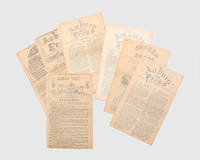
1945185980Pacific theatre: 1945. Iwo Jima's first American newspaper Scarce examples of this American naval publication. In 1945 Auburn participated in the assault on Iwo Jima allowing the editors to bill the Auburn Press as "Iwo Jima's first American newspaper". We have traced physical copies at the Wisconsin Veterans Museum Research Centre and the University of Wisconsin-Madison only. According to the 4 March 1945 instalment the circulation numbered 700 copies. As typical for the genre each number combines news with lighter-hearted and recreational content including at times a crossword. That for 16 March proudly proclaims "Iwo Secured" on its special front page while under the headline "Jap Suicides Becoming Popular" the 15 September number describes the abolition of Japan's Imperial General Headquarters and the drastic measures taken by some senior military and government officials to escape accountability for the war. A separate notice issued in late September gives the current newspaper staff and surveys the ship's contribution to the Allied victory. a Volume III Number 4 4 March 1945 8 pp. 1 page blank. b Volume III Number 16 16 March 1945 12 pp. c Volume III Number 17 17 March 1945 8 pp. d Volume III Number 19 19 March 1945 8 pp. e Volume IX Number 15 15 September 1945 10 pp. f Volume IX Number 21 21 September 1945 10 pp. g Single-sheet notice c. 28 September 1945. 6 issues and single-sheet notice c. 330 x 200 mm. Text mimeographed across 57 sides in total. Issues wire-stitched top-left. For a full inventory see note. Couple of contemporary annotations. Generally in well-preserved condition toning and printing inconsistencies as expected one sheet detached from wire stitching old creasing and occasional short closed tears: very good. unknown
1930WORLDWAR014160The Soncino Press London. 1930. First edition. Foreword by William Rothenstein. Introduction by H.M. Tomlinson. Quarto. pp 16 sixteen plates with captioned tissue guards. Green buckram covers with gilt decorative design to front. The images are of an unremitting bleakness and come from sketches made by Percy Smith while he served as an artilleryman on the Somme. They could have led to a court martial as such things were expressly forbidden. The etchings are reproduced in collotype and printed at the Curwen Press.Out of a total edition of 167 numbered copies this is one of 145 on a Dutch mould-made paper.Some slight spotting to prelims. Covers a bit rubbed at the edges. Bottom corners of covers bumped. Very good. The plates are all fine. Scarce. The Soncino Press, London. hardcover
1915WORLDWAR013073Burns & Oates London. 1915. First edition. Octavo. 52 pages. Wrappers. Several of his poems were set to music by the British composers John Ireland and Cyril Scott.Edges and endpapers spotted. Spine a bit tanned and rubbed. Very good. Very scarce. Burns & Oates, London. unknown
1919WORLDWAR013069John Lane The Bodley Head London. 1919. First edition. Octavo. pp xii 152. Linen-backed boards. The sonnets were written at Rastatt and Hesepe Prisoner-of-War camps. Free endpapers faintly tanned. Fine in near-fine slightly nicked dustwrapper slightly tanned at the spine. A very bright copy. John Lane, The Bodley Head, London. hardcover
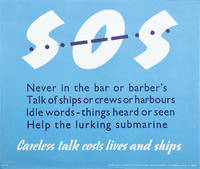
1939173607London: Printed for H.M. Stationery Office by Lowe & Brydone Printers Ltd 1939. One of the series of "careless talk" posters produced by the British government during the Second World War appealing for the public to avoid discussing shipping: "Never in the bar of barber's talk of ships or crews or harbours. Idle words things heard or seen help the lurking submarine". Offset lithograph 298 x 252 mm. Very light rubbing and creasing. An excellent copy. unknown
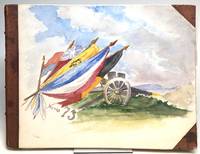
93771Belgium: Privately Printed. hardcover. very good. Rare scrapbook of war memorabilia from the war including 42 photos many of wounded Belgian soldiers as well as poems pressed flowers war hospitals' rubberstamps and numerous autographs. 31 pages oblong 4to 3/4 morocco with hand-painted boards. Belgium circa 1918. Very good .<br/> <br/> Privately Printed unknown
1919WORLDWAR021912Heinemann London. 1919. First edition. Octavo. pp viii 104. The title piece is a speech delivered on St. George's Day 1918 and is followed by a lecture the author gave in America in 1918.Free endpapers faintly tanned. Very good indeed in very good dustwrapper faded at the spine and slightly nicked. Heinemann, London. unknown
19281819931928. The scars of war heal An album signed twice by the editor and photographer W. Donald Wise on the introductory leaf pairing photographs of 100 battlefield scenes of 1918 with the same locations in 1928 commemorating a decade since the end of the war. Hise of Salem Ohio "went to France with the A.E.F. and when the American Army gave up its private battle with the franc he stayed on. For nine years he has been taking before-and-after pictures of the battlefields" Brooklyn Daily Times 5 April 1929. In his introduction he writes "This albumn sic has been edited and issued with two ideas predominating: one to present a comprehensive photographic survey of the battle fields of France and Belgium in their devastated state of 1918; two to visualize the stupendous reconstruction work accomplished Ten Years After in these same regions. In making the present day photographs special care was taken by the editor to find the exact location of the war scene." "These two hundred photographs cover principally the battle fields where the American Expeditionary Forces fought such as the Marne Oiuse-Aisne St. Mihiel Flanders Fields the Somme and the Argonne. But others include some French and British sectors where American soldiers were in training or on detached service. They are shown in sequence of battles from town to town as our men advanced and therefore constitute a complete sketch of the American effort concurrently with the French restoration ten years later." The contrasting images starkly reveal the scale of the destruction and the work done to repair the devastation. They demonstrate the rapid rebuilding of places sometimes in the old style sometimes entirely anew the transformation of provisional and rudimentary graves into well-kept military cemeteries the sprouting of memorials and the forests reclaiming the trenches. The typed captions describe the scenes including the military manoeuvres and encampments and the prior and current state of the locations. The final photograph shows the American Suresnes Cemetery near Paris. The photograph album was evidently produced in a small run - we trace two at auction Heritage 2009 and Waverly 1994; the former was this copy the latter possibly so. None could be traced in institutions. Most of the photographs as far as we can determine are otherwise unpublished. Oblong quarto 329 x 232 mm. With 201 black and white photographs 209 x 154 mm each with a typed caption mounted on grey card leaves prefaced with an introductory text leaf. Original brown morocco. Restored at extremities. Slight rubbing at extremities repair to first leaf fore edge all photographs present and sharp. In very good condition. unknown
1940SKU1019756Privately Published 1940. Hardcover. Good. Privately Published; city not noted 1940. Graphic world war I dead soldier photographs. Hardcover. Good to Very Good Paperback binding worn at spine clear taped reinforced stapled binding first and last 2 pages slightly detaching from binding interior and extremities tidy and unmarked hardcover re-bound for reinforcement of paperback binding blue cloth binding with title on spine minimal handling wear without Dust wrapper. A nice clean unmarked copy. 8vooctavo or approx. 6 x 9 inches 32pp. b&w illustrations. We pack securely and ship daily with delivery confirmation on every book. The picture on the listing page is of the actual book for sale. Additional Scans are available for any item please inquire. Privately Published hardcover
1919WORLDWAR027595Chatto & Windus London. 1919. First edition. Octavo. pp viii 248. 32-page publishers' catalogue dated 119 at rear. According to the blurb Galsworthy published the book anonymously in order to be able to ''picture with free satire certain contradictions and whimsicalities of modern life''.Fore-edge a bit spotted. Covers slightly bumped at the edges. Very good indeed in very good slightly chipped dustwrapper with several nicks. Chatto & Windus, London. unknown
196234997London: privately printed 1962. Folio. 12 1/2 x 7 7/8 inches. Typescript. 1 18 20 19 3 leaves. Color folding map of central Africa with additions in manuscript. Modern red morocco backed cloth.<br/> <br/> Provenance: Sir John Marriott presentation inscription from Platt on the front endpaper<br/> <br/> Unpublished typescript of three lectures given by the commander of the Sudan Defence Force during the East African Campaign.<br/> <br/> Platt's lectures given in 1951 reviews the problems facing the British in East Africa in the years leading to 1940 and gives a very detailed account of the campaign against the Italians the British victory and aftermath. This copy inscribed by Platt to Sir John Marriott the commander of the 29th Indian Infantry during the campaign. privately printed] unknown