1 575 résultats
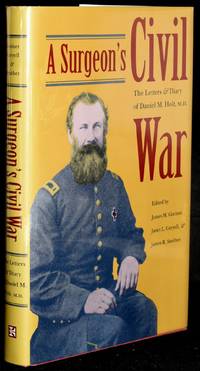
1994218379Ashland Ohio U.S.A.: Kent State Univ Pr 1994. First Edition. Hard Cover. Very Good binding/Very Good dust jacket. Signed. Illustrated; Some underlining in text. Signed by editor. Pink cloth binding. Light wear at top of dj spine; DJ protected with Mylar Cover. Very Good binding / Very Good dust jacket. Kent State Univ Pr unknown books
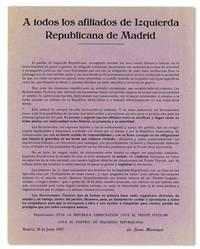
193738496Madrid: Partido Izquierda Republicana 1937. First Edition. Broadside 27.5cm x 21.5cm; printed recto-only in black on purple stock. Paper a bit faded at margins still a clean presentable copy Very Good. Broadside to the citizens of Madrid calling on all Republican forces to join under the banner of the Izquierda Republicana historically the main-line leftist party of pre-Revolutionary Spain. Dated June 30 1937 some ten days after the fall of Bilbao to Nationalist forces. Fragile and scarce; not separately catalogued in OCLC. Partido Izquierda Republicana unknown books
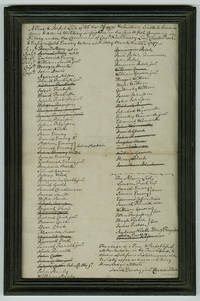
1757WRCAM51214Kittery Me 1757. Broadside 12 x 7 1/2 inches. Old folds mild toning. Very good. In frame. Appears to be docketed on verso but not examined outside frame. A manuscript roll-call for a company of Maine military personnel organized to participate in the French and Indian War. The document lists over seventy names of regulars in two columns plus an additional dozen names under "The Alarm List" essentially a reserve list of soldiers appointed to defend the homefront. Below the Alarm List is the following text: "The above is a True & Perfect list of all the soldiers in the Train'd band & Alarm List from sixteen years old to sixty as far as has come to my knowledge. Attest Daniel Emery jun. Clerk und. Oath." The Emery family supplied seven members of this list of officers and soldiers with others such as the Furbush Ferguson and Wamouth families also providing more than one man for the army. Several names are crossed out about half of which belong to a family supplying more than one member to the list. Most of the men on the Alarm List are also identified by profession such as deacon miller or sailor among others. Such lists of colonial American military personnel for the French and Indian War are exceedingly rare in the market. An important colonial Maine and military document. unknown books
194913690Glendale CA: The Barbe Associates 1949. 1st edition. White cloth with blue spine lettering. Dust jacket. VG/VG some age toning to jacket. 470 pp. 8vo. <br/><br/> The Barbe Associates hardcover books
186222500<p>Mainer Edgar Alphonso Burpee describes the Battle of Fredericksburg providing previously-unknown details regarding order of battle Union movement through city streets <i>"unbecoming"</i> ransacking of civilian property and Confederates shelling Union-occupied parts of their city. He also includes drawings of the city's streets.</p> <b>CIVIL WAR. EDGAR A. BURPEE.</b>Autograph Letter Signed to Alexander Burpee. Fredericksburg Va. December 15 1862 12 pp. 5 1/8 x 7¾ in.<p><b>Partial Transcript</b></p><p><i>"Being our orderly I summoned the company at 4 o'clock and gave them my orders.a report of a gun was heard that sounded like thunder. It was a signal gun and to us indicated that something was in process of being done. Then another was heard and immediately after that musketry and some other guns.we stacked arms and lay down waiting the order to move forward.waiting for the pontoon bridges to be laid so we could pass.guns of both forces were constantly being fired and such a roar I never heard before. It seems as if the very heavens were filled with thunder and it was very stirring that our forces were engaged in shelling the city.Then later at double quick we crossed the pontoon bridge and set foot in the doomed city for our first time. We filed into the street that runs along the river bank having the honor of being the first regiment of our brigade in. As we entered marched up the street some 5 or 6 rods in front of us skirmishing and the bullets of the rebels came whistling thickly over our heads and around our ankles.</i></p><p><i>The streets are laid out in regular squares I shall draw you a plan. Because skirmishing was going on in the next street above us we were protected from the rebel shots. the rebel sharpshooters were about six rods away in the houses.their sharpshooters rapidly picked off our men.Our batteries too poured into the rebels showers of shells so that they completely riddled the homes nearby killing a large number of the enemy.By this time 7 o'clock the firing had ceased.our men commenced.ransacking the houses and stores tearing down fences & out buildings.It was alarming to see the scenes of unbecoming behaviors around us.All this time the dead and wounded were being brought down the street. The surgeons were busy attending to those badly wounded.On going up the street we would stumble over the dead of both sides some shot in the heads with shells still there were others killed by bullets. Some wounded would crawl off to some place of shelter.It was indeed a sad scene.</i></p><p><i>Morning came.we formed into line of battle.We were ordered to lie low or march in a stooping position.The ambulance corps were also engaged in carrying off the dead & wounded.In the street where we were two or three rebels lay. One had his whole side and his arms shot off. Another had the top of his head and brains carried away.Towards morning December 13 when it became light enough for the rebels to see our men they began to shell us and the pieces would fly.About 12 o'clock skirmishing commenced on our left.The streets were now filled with moving lines of soldiers.We could see and hear nearly the whole field and our brave men as they advanced under heavy fire from the enemy's batteries and musketry fire.Gen Howard marched often along our line & encouraged us by his words and presence. A balloon was in the rear of the city to observe all movements.About 4 o'clock our brigade was ordered in and down the street with a rush we went.bang went the rebel guns and whiz came their shells at us.Our regiment remained firm.Gen. came along after dark and said 'men of the 19th reg. you have done nobly. Your consistency deserves great praise.' To be continued - Ed."</i></p><p><b>Edgar A. Burpee</b> 1839 – 1919 of Rockland Maine mustered into the 19th Maine Infantry on August 25 1862. He rose to captain's rank was wounded at Gettysburg and was captured at the Battle of Jerusalem Plank Road Virginia in June 1864. He returned to Rockland married Annie Farwell and eventually joined his family's funeral business.</p><p><b>Condition</b></p><p>Fine. Written in light pencil. With some separation at edge of folds.</p> books
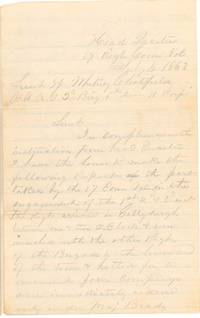
186321808<p>A field report from the Battle of Gettysburg by Major Allen G. Brady commander of the 17th Connecticut Regiment written on the 4th of July 1863 the day after the battle ended in a great victory for the Union.</p><p><i>"We had not more than time to form before the enemy were discovered advancing rapidly upon us on our right & a full Brigade obliquely towards our left….our fire was so destructive it checked their advance the troops on our left giving way the enemy came in behind us but we still remained firmly at the stone wall until the rebels were driven back."</i></p> <b>CIVIL WAR – GETTYSBURG.</b>Allen G. Brady Autograph Manuscript Gettysburg Pennsylvania July 4 1863. 6 pp. in pencil an unsigned draft or retained copy.<p>With: <b>ANDREW JOHNSON.</b> Officer's commission of brevet Lieutenant Colonel to Allen G. Brady <i>"for gallant conduct at the Battle of Chancellorsville Va to date from March 13 1865"</i> March 20 1866 signed with stamp not in ink; and</p><p>With: <b>ALLEN G. BRADY.</b>Autograph Letter Signed to the Adjutant General U.S. Army May 19 1877 seeking a copy of the military record of General Hugh Brady who had fought in the War of 1812; and</p><p>With: <b>WHARTON J. GREEN.</b> Autograph Letter Signed to Allen G. Brady December 13 1885.</p><p><b>Complete Transcript</b></p><p><i>Head Quarters 17 Regt Conn Vol. </i></p><p><i>July 4 1863</i></p><p><i>Lieut. H. Whitney Chatfield </i></p><p><i>A.A.A.G. 2d Brig. 1st Div. 11 Corps</i>.</p><p><i>Lieut.</i></p><p><i> In compliance with instructions from head quarters I have the honor to make the following report the part taken by the 17 Conn Vol in the engagement of the 1st 2d & 3d inst. The Regt. arrived in Gettysburgh between one & two O'Clock & were marched with the other Regt. of the Brigade to the lower end of the town & halted for a moment. Four companies were immediately ordered out under Maj Brady </i>2 <i>two of the four Companys under Maj. Brady were deployed from the bridge to the right as skirmishers the other two held in reserve. The remainder of the Regt under the Command of Lieut Col. Fowler advance with the rest of the Brigade to the front & left of the village. Directly in rear of the 107 Ohio Vol. - who were closed in mass by Division & were ordered to the front Deployed & advanced at Double quick our men held their ground notwithstanding they rushed to the rear of troops directly in advance until ordered by the Brigade Commander to fall back. </i></p><p><i>This order was obeyed the men loading & firing as they were retreating it was <b>about this time Lieut Col. Fowler was killed. Upon reaching the village the four companys</b> </i>3 <b><i>still skirmishing briskley with the enemy </i></b><i>& retiring in good order & ordered by the Comdg Genl to rejoin the Regt. <b>Maj. Brady immediately taking command after deploying & firing in several streets running to the left of the main street of the town on account of the rapid advance of the enemy we were ordered to fall back out of the town & while retreating through the main street the Regt was halted & faced to the rear & poured several destructive vollys into the enemy.</b> We then fell back out of the town & formed in front of the battery <b>pursuant to order from Maj. Genl. </b></i>Oliver Otis <b><i>Howard we then advanced to the stone wall in rear of the village </i></b><i>& remained a few moments there again advanced to a rail fence still further to the front & then remained until </i>4 <i>late in the evening when the whole Regt was sent out on picket & performed that duty <b>until late in the afternoon of 2d when we were relieved & took our old position behind the rail fence w</b></i>h<b><i>ere we remained exposed to fire of the enemy's battery & sharp shooters until about 7 o'clock P.M. were ordered to the extreme right of the Brigade behind a stone wall on each side of the lane below the battery opposite the cemetery entrance one company was advanced to the grain field near the woods we covered the wall on each side of the land by compelling 200 straggling soldiers to fall into our line. We had not more than time to form before the enemy were discovered advancing rapidly upon us on our right & a full Brigade obliquely towards our left. The Regt were ordered to fire obliquely to the left upon the Brigade our fire was so destructive it checked their advance the troops on our left giving way the enemy came in behind us but we still remained firmly at the stone wall until the rebels were driven back.</i></b></p><p><i>It was during this engagement that Maj. Brady was wounded </i>5 <i>by a fragment of shell hitting his right shoulder blade. </i></p><p><i>After the enemy had been driven back & the firing ceased except occasional shots from their sharpshooters. We were relieved by the 4 Ohio Vol. and were ordered to change front to the left behind a wall running at right angles with the fence we had occupied and fronting the town where the rebels entered on our left. During that night & the 3d inst. exposed to a cross fire of the rebel batterys & to the fire of the sharp shooters who were watching our movements. </i></p><p><b><i>When the Regt entered the engagement on the 1st inst it numbered 17 officers & 369 enlisted men. We report at the present time 9 officers & 120 enlisted men. </i></b><i>Capt. Wilson French is the </i>6 <i>only officer known to have been taken prisoner he was wounded in the engagement of the first inst & we are not aware of his being paroled</i>"</p><p><b>Historical Background </b></p><p>The Battle of Gettysburg fought July 1-3 1863 was a major turning point in the Civil War. Over the course of three grueling days Union Major General George G. Meade's Army of the Potomac beat back desperate attacks by Confederate General Robert E. Lee's Army of Northern Virginia including the ill-fated "Pickett's Charge" on July 3. The Union victory ended Lee's short-lived invasion of the North.</p><p>Many soldiers of the 17th Connecticut had been stung by criticisms leveled at their unit after the Battle of Chancellorsville where the corps was surprised and driven from the field with a flank attack by Stonewall Jackson. As Brady reports here events on the first day of the Battle of Gettysburg were eerily similar to Chancellorsville. On July 1 their regiment was again divided outnumbered and outflanked by the same Confederate unit as it had been at Chancellorsville although this time under command of Richard Ewell. As he drove the Connecticut soldiers from the field and through the streets of Gettysburg on the first day of fighting Union Lieutenant Colonel Douglas Fowler was killed. In a disciplined retreat that evening the 17th Connecticut fell back and was posted near the center of the Union line on Cemetery Hill near a stone wall. Their position where the Union lines' "fishhook" curved southeastward toward Culp's Hill exposed them to murderous crossfire from Confederate artillery on three sides. The unit sustained high casualties for the next two days; of the unit's 386 men at Gettysburg 20 were killed 81 wounded and 96 reported missing. Brady himself was wounded by a shell fragment on July 2.</p><p>The regiment performed heroic service on the second day of the battle protecting Cemetery Hill from the attacks of Jubal Early's division specifically Harry Hays's brigade of "Louisiana Tigers." The 17th Connecticut then withstood the Confederate bombardment of July 3 spending much of the day trading shots with sharpshooters in town. Brady's report in slightly revised and expanded form is reprinted in <i>Official Records</i> Series 1 Vol. 27 Chap. 39 Part 1 pp. 716-719. In closing there Brady said "The regiment behaved gallantly. No troops in the world behaved better. Both officers and men are deserving of great credit for their coolness and bravery throughout the entire three days' battle."</p><p><b>Allen G. Brady </b>1822-1905 was from Torrington Connecticut. He enlisted in May 1861 as part of the 3rd Connecticut Infantry Regiment. In August 1862 he was commissioned into the 17thConnecticut Volunteers. Brady was brevetted Lieutenant Colonel for his valor at the Battle of Chancellorsville just two months before Gettysburg. There Brady assumed command after the colonel and lieutenant colonel of his regiment each fell. Brigadier General Charles Devens commended Brady in his official report stating "The Seventeenth Connecticut under command of Major Brady – its colonel having been wounded and lieutenant-colonel killed – was in fact rallied and reformed in their positions." In October 1863 Brady was discharged for disability presumably from his wound suffered at Gettysburg three months previous. He was mustered into the Veteran Reserve Corps and served as Provost-General at the Point Lookout Union Prison Camp in 1864. He was brevetted Colonel in August 1865.</p> books
5084CIVIL WAR - BATTLE OF COLD HARBOR. The Battle of Cold Harbor was a Civil War battle that took place in Mechanicsville Virginia from May 31 – June 12 1864. A major Union defeat in which thousands of Union soldier died it was one of the bloodiest battles in American history. ALS. 2pgs. June 25 1864. Camp near Petersburg Virginia in a field near a Barn. An autograph letter signed “Charles†by a Union soldier. Charles wrote home to his family shortly after the disastrous Union defeat at Cold Harbor and references the carnage he saw: “My Dear Parents Brothers and Sisters Once more I write you a few lines. I am still alive and well more than every line that reaches parents will read. So think you all ought to feel thankful if you read a line from me these days. I never saw so many men killed in my life as have seen through this campaign awful hard fighting so far harder than ever was known I think. Did you get my box or rather my things I sent with Johnsons box if you did keep my coat for I shall want to see it when I come home. I got Harrisons letter he says you are having quite dry times there cannot be any moreso than we have had no rain since we came into the field dusty as can be. I wish we could have a little rain for it would be much more pleasant marching thru so much dust. Our Regiment still stays at the front only a few of them left – 2 of our musicians have gone one wounded and one killed. I am glad to learn of you all being well. Mother have you not written me since I left Point Lookout have not had any from you. I hope you will write me soon and often tell Georgey to write me often and also Father you know I cannot write so often as I could last winter. I will not write to any one only you. Tell Lizzie and Addison to write me I will not write any more this time write soon and often goodby sic from your true son. Charles I think I shall not be able to come home until next spring as the Colonel is wounded and gone home and cannot help me.†The letter is in fair condition; the writing is very light and there is a part of the blank third page missing that affects no text. A typed transcript is included. unknown books
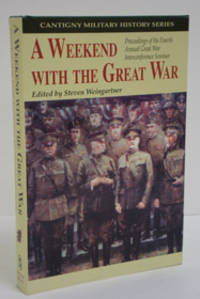
19971773588Cantigny 1997. First Edition. Hard Cover. Near Fine/Near Fine. First edition. 1997 Hard Cover. 296 pp. This volume examines the crisis of 1914-18 in papers and related texts presented at a 1994 seminar jointly sponsored by the Great War Society and the Western Front Association. The contributors from the United States Canada Great Britain France Belgium and Russia explore a range of topics including the mysterious death of German fighter ace Manfred von Richthofen the "Red Baron" and the even more mysterious life of British master spy Sidney Reilly; American heroes and Canadian prisoners; German soldiers; French fortifications at Verdun; the doomed cause of Russian liberals; the Western Front as a bizarre parody of urban life and the war itself as a radical expression of cultural modernism. The book features excerpts from panel discussions and question-and-answer sessions in which the seminar's attendees took part. The result is a work that sheds much light on a dark but fascinating chapter in twentieth-century history. Cantigny hardcover books
1865223991865. No binding. Fine. Six letters to his wife Libby approx. 15 pp. in all. ""There will be an awful hot time if our Brigade is engaged. I dont think anything can restrain the men if they once get started. I am in hopes to come out alive but no one can tell but the Almighty"" The white officer of the USCT Captain Richard Andrews wrote to his wife about the sieges of Petersburg and Richmond and the impending Appomattox campaign. Union forces including African American soldiers captured Richmond on April 3rd and Lee would be forced to surrender at Appomattox just over two weeks after Andrews wrote. In other letters he details his health concerns his transfers after the war's end and possibilities of land ownership. His final letter details an anticipated transfer to the Freedmen's Bureau in Galveston Texas.RICHARD ANDREWS. Autograph Letter Signed ""Richard"" to his wife Libby before Richmond Va. March 25th 1865 4 7/8 x 8 1/8 in. 4 pp. #22399.01"".I received a month's pay yesterday bought a sword belt for 7.00 a pair of pantaloons for $12.00 pair of gloves for $2.00 paid $25.00 towards the present to Genl. Draper.As soon as I sell my horse I will send you more if I had sold her three days ago I could have got over $100.00 for her but now she is very lame so much so that no one can use her. I fear I shall have to dispose of her at a loss. We shall move in a very short time.Things are coming to a crisis. Lee will have to skedaddle or there will be a terific fight. Our brigade is practicing charging every day. There will be an awful hot time if our Brigade is engaged. I dont think anything can restrain the men if they once get started. I am in hopes to come out alive but no one can tell but the Almighty. My health is pretty fair now and I trust I may not even get wounded for I am anxious to gain strength this summer.""Historical BackgroundFrom Salem Massachusetts Lieutenant Richard F. Andrews fought in the Battle of Chaffin's Farm September 29-30 1864. Just two months earlier he was so sick that he was excused from duty but he volunteered for service and helped lead the 36th Regiment of U.S. Colored Troops to victory. The performance of the USCT at Chaffin's Farm New Market Heights put an end to any doubts of their bravery or fitness for service. There Andrews was shot in the leg and for his bravery he was promoted to Captain.The 36th Regiment of USCT was organized in February 1864 out of the 2nd North Carolina Colored Infantry. In addition to Chaffin's Farm it saw service toward the end of the Siege of Petersburg the single greatest concentration of African American troops during the war at Richmond and its occupation and in the Appomattox Campaign.The United States Colored Troops USCT were regiments of the United States Army during the American Civil War composed of African American soldiers. First recruited in 1863 by the end of the Civil War the men of the 175 regiments of the USCT constituted approximately 10% of the Union Army. The United States War Department issued General Order Number 143 on May 22 1863 establishing a ""Bureau of Colored Troops"" to facilitate the recruitment of African-American soldiers to fight for the Union Army. Regiments including infantry cavalry engineers light artillery and heavy artillery units were recruited from all states of the Union and became known as the United States Colored Troops USCT. USCT regiments were led by white officers and rank advancement was limited for black soldiers. Approximately 175 regiments composed of more than 178000 free blacks and freedmen served during the last two years of the war. Their service bolstered the Union war effort at a critical time. RICHARD ANDREWS. Autograph Letter Signed ""Richard"" to his wife Libby near City Point Va. May 9th 1865 7 ¾ x 9 ¾ in. 4 pp. #22399.02"".I had quite a nap-fell asleep just after dinner and snoozed away for over two hours something unusual for. See website for full description unknown books
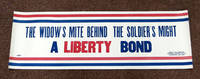
41028New York: Liberty Loan Committee n. d. Ca. 1917. Not found in Borkan or Rawls. White paper printed in red and navy ink. Modest wear to paper slight age-toning and scuffing. A VG example. Single sheet printed recto only. Oblong format: 10" x 30" <br/><br/>Only 1 institutional holding located on OCLC LoC. Liberty Loan Committee unknown books
2007SKU1026168Living Life Publishing Co 2007-10-31. CARD BOOK. New. 0976877333 New! Living Life Publishing Co unknown books
188258456Fort Laramie WT 1882. 4to. Three pages approximately 275 words in part: "There is not to my mind outside of Divine Writ so convincing an evidence of the immortality of the soul as is furnished by the growth and development of the mind and character of this greatest of American Presidents to meet the exigencies of the direction and control of a great Revolution on the successful issue of which depended the happiness of one fifth of the world . as his career differed from that of the other heroes of history in that he lived and strove for reforms that would benefit mankind though his own life should be the price in so far is Abraham Lincoln the greatest of Reformers the noblest of Patriots the ablest of men." This essay was published along with other tributes to Abraham Lincoln in The Lincoln Memorial NY 1882. Very good. Folded. #6317. Wesley Merritt graduated from West Point in 1860 serving briefly in the West before returning east for Civil War service in the Union cavalry attached to the Army of the Potomac participating in its major campaigns and battles through Appomattox ending the war commanding a division as a Major General. Following the war he commanded the 9th Cavalry in Texas for eight years; promoted to colonel in 1876 he took command of the 5th Cavalry in Wyoming participating in the Custer campaign and other actions against the Indians and serving in that capacity until 1882 when he was appointed to a five-year posting as superintendent of West Point. He commanded the 1898 expedition to the Philippines during the Spanish-American War. <br/><br/> unknown books
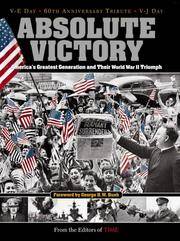
2005255933New York: Time Books 2005. First. hardcover. good/fine. By the Editors of Time. Many Illus. 4to black boards d.w. back cover bumped on bottom edge near spine. New York: Time Books 2005. Very good<br/><br/> Time Books unknown books
1830289928Boston. : Hilliard Gray Little & Wilkins 1830 . Contemporary full leather. . Good hinges split but holding lacks spine label pages lightly foxed light dampstain to preliminaries. . 19x11 cm. . Important American military manual for instruction of the militia. weight: 0.4 lb. 30 engraved plates 2 folding. Hilliard Gray Little & Wilkins hardcover books
194138962South Africa 1941. Quarto. Unnumbered title plus 32 numbered leaves recto only. Signed by Bostock on the upper wrapper. Publisher's stapled wrappers.<br/> <br/>Provenance: Humphrey Winterton booklabel<br/> <br/>A very rare WWII "regimental history" of a South African battery in the East African Campaign.<br/> <br/>Written by Bostock with contributions by others in the regiment the introduction below the title describes the work: "These few sketches of our life principally in Abyssinia but to some extent in Kenya from October 1940 to May 1941 started as a personal record which I thought might be of interest to friends in South Africa and Overseas. Our Battery Commander however was good enough to take the view that somewhat expanded they might constitute a kind of interim battery record of those interesting months." Organized alphabetically entries include both serious and humorous contributions. OCLC records but a single extant example. unknown books
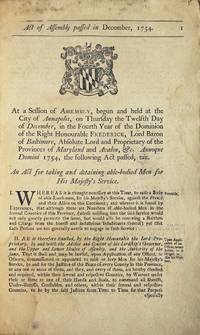
1755319725Annapolis: Jonas Green 1755. 2pp. Bound with: Acts of the province of Maryland made and passed at a session of Assembly begun and held at the city of Annapolis on Saturday the twenty-second day of February in the fourth year of the dominion of the Right Honourable Frederick Lord Baron of Baltimore absolute lord and proprietary of the provinces of Maryland and Avalon &c. Annoque Domini 1755. Published by authority. 8pp. Folio. Period wrappers restitched some losses to the blue sugar paper old repairs at head of each leaf with minor losses old dampstaining. 2pp. Bound with: Acts of the province of Maryland made and passed at a session of Assembly begun and held at the city of Annapolis on Saturday the twenty-second day of February in the fourth year of the dominion of the Right Honourable Frederick Lord Baron of Baltimore absolute lord and proprietary of the provinces of Maryland and Avalon &c. Annoque Domini 1755. Published by authority. 8pp. Folio. Recruiting for Braddock's Campaign. Passed in December 1754 "to raise a Body of able Land-men for his Majesty's Service against the French and their Allies on this Continent" this separately-printed session law essentially authorizes a draft system for forcing "all and every able-bodied Freeman who live idle and do not follow or exercise some lawful Calling" to be enlisted as soldiers. Given the timing it is believed that the troops being raised were intended for service on the Braddock expedition against Fort Duquesne.<br/><br/>Bound together with the above is a second session printing of Maryland laws including acts relating to the French and Indian War: "An Act to Prevent the People of this Province from Supplying the French or their Indian Allies with Ammunition Warlike Stores or Provisions of any Kind" and "An Act for Regulating the Rates of Carriage and Quartering Soldiers in Public Houses within this Province for His Majesty's Service." Also included are acts on currency courts and tobacco.<br/><br/>Both session printings are rare with ESTC recording only five copies in four institutions and eight copies in six institutions respectively. Bristol B1727 and Evans 7458; Wroth 179 and 180; ESTC W33246 and W7078 Jonas Green unknown books
1861100124Pamphlet removed 941 pp. Some foxing especially title page. This pamphlet provides a glimpse of the Confederate States making ready for war. Through resolutions and acts outlined here they establish many of the functions they will need as a sovereign state. Including setting up a post office taxes and raising an army. Parish & Willingham 27. Enquirer Book And Job Press, books
1757WRCAM9300AAnnapolis: Jonas Green 1757. 213pp. Contemporary plain front wrapper rear wrapper renewed. Small ink library stamp on verso of titlepage tape repairs to edges of each leaf mostly small and inconsequential minor foxing. Very good. In a black cloth slipcase. A rare Annapolis imprint comprising the session laws for Maryland in early 1757. In the midst of the French and Indian War naturally there is significant content related to the war. Namely there are three acts: "An Act for his Majesty's Service and the more immediate Defence and Protection of the Frontier Inhabitants of this Province" encompassing the first four-and-a-half pages "An Act for the Relief of sundry Inhabitants of this Province who have had their Servants Enlisted into his Majesty's Servants" and "An Act to prevent the Exportation or Carrying out of this Province Ammunition Warlike Stores or Provisions of any Kind towards supplying the French or their Allies." The first of these acts calls for the raising of 500 men to be organized into companies to protect the frontier and for the manner of their deployment and use. Most of the others laws are continuing acts relating to slaves "languishing Prisoners" debtors and other issues. Rare with ESTC recording only three copies in two institutions AAS has two. EVANS 7935. WROTH 197. ESTC W7081. Jonas Green hardcover books
194366216n.p. 1943. Paperback. Very Good. 46p. Wrapper. Stapled mimeo. File Reference: AG 370.5 6 Aug. 43 OB-S-AF-M. <br/><br/> paperback books
194366215Washington: GPO 1943. 2nd ed. Paperback. Very Good. 34p. Wrapper. Three holes punched along left side for insertion in a notebook. File Reference: AG 370.5 6 Aug. 43 OB-S-AF-M. <br/><br/> GPO paperback books
181211299np 1812. 16pp caption title as issued. Disbound some loosening moderately worn. Good to Good. Federalists from New England led by George Sullivan assert they "could not consider the war into which the U.S. have in secret been precipitated as necessary or required by any moral duty or any political expediency." They document the muzzling of debate on the question of the Declaration of War the war's disastrous effect on commerce the unreasonable bias of the Madison Administration toward France; and they mourn the loss of American security. Quite scarce. Not in AI Sabin which records an 1812 response to this Address Eberstadt Decker or evidently NUC. unknown books
181212948np Boston 1812. Caption title as issued 8pp. Untrimmed and uncut lightly foxed and worn. Very Good. A meeting at Concord Mass. on July 15 1812 protesting "the momentous and calamitous state of our country" and denouncing the national government for having "unnecessarily declared an offensive war." Congress has "trifled away our dearest privileges and annihilated our fondest hopes." President Madison has sought to shore up his "sinking" popularity by a war policy; he and his allies seeking to stigmatize their opponents as "tories" and traitors have "an ambitious design to continue the power in the hands of our present rulers." FIRST EDITION. AI 26074 2. Not in Sabin Eberstadt Decker. unknown books
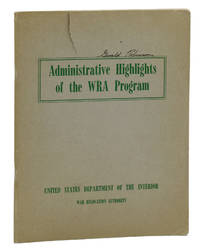
1946140941066Washington D.C.: U.S. Government Printing Office 1946. First Edition. Good. First edition. iv 82 pp. Gray stapled wraps. Good with closed tear to top of front wrap and first page very slightly to following page; wraps toned and lightly worn; former owner's name written on front cover. A rare history of the War Relocation Authority which managed the forced confinement of people of Japanese ancestry in America during World War II as well as their return to civilian life with the commencement of the war. U.S. Government Printing Office unknown books
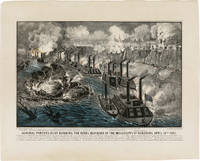
1863WRCAM56146New York: Currier & Ives 1863. Handcolored lithograph 12 x 15 inches. Tiny chip in upper left corner well away from the image. A clean near fine copy. A colorful and dramatic depiction of Admiral David Dixon Porter's Mississippi River Squadron running the Confederate blockade at Vicksburg during the siege of the city by Union forces in 1863 an important strategic victory in taking control of the river. Captions identify Porter's flagship the U.S.S. Benton in the right foreground leading the Lafayette and General Price which are followed by the Louisville Mound City Pittsburg Carondelet Silver Wave Forest Queen Henry Clay and Tuscumbia. A barrage of cannons fire from both the squadron and the Confederate batteries on the embankments overlooking the river. Union cannonballs are hitting both the batteries and the buildings on the bluffs of Vicksburg further in the background. Clouds of smoke billow from the ships the burning buildings and one of the floats of flammable material set out by the Confederates. <br> <br> Initially Grant had asked only for a few gunboats to shield his troops but Porter persuaded him to use more than half of the Squadron. Six nights later April 22 they made a similar run past the batteries to give Grant the transports he needed for crossing the river. Grant first tried to attack the Rebels through Grand Gulf south of Vicksburg and had Porter's gunboats eliminate the two forts there so his troops could cross. Despite intense shelling the upper fort held; Grant called off the assault and moved downstream to Bruinsburg where he crossed unopposed. Afterwards Porter's ships remained in place securing the Mississippi and Yazoo Rivers and guaranteeing the success of the siege. Grant was effusive in his praise Porter's actions and for his contribution to the victory Porter's appointment as acting rear admiral was made permanent. <br> <br> The additional printed caption describes the event thusly: "At half past ten P.M. the boats left their moorings & steamed down the river the Benton Admiral Porter taking the lead - as they approached the point opposite the town a terrible concentrated fire of the centre upper and lower batteries both water and bluff was directed upon the channel which here ran within one hundred yards of the shore. At the same moment innumerable floats of turpentine and other combustible materials were set ablaze. In the face of all this fire the boats made their way with but little loss except the transport Henry Clay which was set on fire & sunk." <br> <br> The Union victory at Vicksburg was the second major blow to the Confederacy in the spring and summer of 1863. On July 3 Lee's invasion of the North foundered at Gettysburg and on July 4 the U.S. flag rose over Vicksburg. This print is surprisingly uncommon in the market. CURRIER & IVES: CATALOGUE RAISONNÉ 0058. PETERS CURRIER & IVES 1180. Currier & Ives unknown books
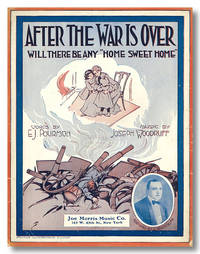
1917WRCLIT79148New York: Joe Morris Co. 1917. 4pp. Folio 35 x 27 cm. Pictorial upper wrapper. Short edge tears and slight fraying partial split to spine but a good copy. OCLC: 20120465. Joe Morris Co. unknown books