119 846 résultats
Modena, Associazione Nazionale Combattenti e Reduci, 1985. In 8vo (cm. 24); brossura originale illustrata con titoli al piatto e al dorso; pp. 342, (2). Con XXXVI illustrazioni nel testo. Ottima copia. PAx
199375938Fayard, 1993, in-8°, 382 pp, 9 cartes, documents, index, broché, couv. illustrée, bon état
Berlino, 1941, in-4. br. edit. figurata, pp. (30). Con numerose illustrazioni.
Disegno originale in penna raffigurante probabilmente un deputato, ufficiale degli Alpini, visto di profilo. Non firmato ma sicuramente di Musacchio. Su foglio di taccuino. Cm. 9x7. Timbro per la censura: L'ufficiale Capo Gruppo: P. Schiarini. (Comanducci, II, pag. 518).
194314624Londres, His Majesty’s Stationery Office, 1943, pt in-8°, 100 pp, 24 photos sur 16 pl. hors texte, un schéma et une photo sur les gardes, broché, couv. illustrée, état correct
Milano, (Stab. Stucchi Ceretti e C.), 1917, in-4, br. edit. figurata, pp. 37. Con la riproduzione a piena pagina, anche a colori, di proclami e fogli murali in lingua francese con traduzione italiana a fronte. Una piegatura centrale.
Roma, 1962, 7 ottobre, copertina illustrata a colori in fascicolo originale completo di pp. 40 de "La Tribuna illustrata" .
Roma, Editrice IACICO, 1981, in-8, br. editoriale, pp. 157, (3). Con numerose illustrazioni in b.n. relative al passaggio della guerra a Firenze (luglio-agosto 1944). Macchia alla copertina posteriore, ma ottime condizioni. Omaggio della Cassa di Risparmio di Firenze.
Milano-Mursia, 1983 in 8° pp. 223 con 36 ill. b.n. f.t. Contiene: L’Albo d’oro (con Ricompense al valor militare ai Reparti e ai singoli combattenti); Bollettini di guerra; Composizione della Divisione Trieste; Comunicati e Relazioni. Leg. cartoné edit. Sovracop. ill.
16°, tela edit., pp. 244. Timbro omaggio al front.
35860aafLeipzig, G. Hirzel, 1914, gr. in-8°, Original-Broschüre.
25566‘Lisbon 16 March 1811’. He receives the briefest of obituaries in the Gentleman's Magazine July 1840: 'May 10. At Exeter aged 81 Col. Thomas Abernethie K.H. on the retired list of the Royal Marines.' 3pp 4to. Bifolium. On aged and discoloured paper with the usual damage to the second leaf from the breaking of the seal. Addressed on reverse of second leaf with postmark to ‘Messrs Cox & Son / 20 Bartletts Buildings / Holborn / London’. Signed ‘Thos. Abernethie’ and docketed ‘Maj: Abernethie / 16 March 1811’. Begins: ‘Gentlemen / I have requested a Cap. Falcon of the Navy to purchase for me a Qr cask of Madeira - should he and to draw upon you per the Amt. which you will please to honor -’. He continues: ‘Lord Wellington is in full pursuit of the French - but I scarcely think he will follow them further than the confines of Portugal - should they escape thither - we have no certain intelligence of the Armies till we receive it in an official shape from England - Cap. Cox is well - we rode together yesterday to see the palace of Queluse sic about 8 miles from Lisbon - a very charming spot -’. ‘Lisbon 16 March 1811’. unknown
24437‘His Majesty’s Ship Arethusa / Corunna 18th. August 1810’. See his entry and that of Stuart in the Oxford DNB. 3pp 4to. On bifolium. Sixty-six lines of neatly-written text signed ‘R Mends’ and addressed ‘To / The Honble Chas. Stuart / His Majestys Envoy / Lisbon’. A vivid and substantial historical document. Of his activities around this time the Oxford DNB writes: ‘In the summer of 1810 in command of a squadron on the coast of Spain Mends destroyed several French batteries for which service in addition to a formal letter of thanks from the junta of Galicia he received the order of the Cross of Victory of the Asturias and the nominal rank of major-general of the Spanish army.’ He begins by osberving that the ‘Correspondence with Biscay has been kept so profoundly abstracted’ from his knowledge that he really knows ‘nothing of the matter beyond having directed every Ship on the Station to attend to it in preference to every other object. ie to receive on board any Agent who might present himself as so employ’d’. He continues with reference to ‘the mode of carrying on this correspondence’ ‘the Deputy Commissary Mr. White’ ‘Arana’ ‘the Blockaded Ports’ ‘the Nimrod cutter’ ‘the House of Mr. Dickinson’ ‘Don Raymond de Castro the late Captain General of Galicia’ ‘the Ifegena’ ‘Santona’ ‘General Renovales’. He concludes: ‘I am now getting under weigh for Bermio sic with a large Quantity of Ammunition on board for Biscay & Navarra and shall immediately return here to conduct the Expedition which I make no doubt will succeed in a very extensive degree - God grant that we may receive such accounts from your side of the Country as we hope soon to send from this’. ‘His Majesty’s Ship Arethusa / Corunna 18th. August 1810’. unknown
2467728 August no year. On embossed letterhead of Les Sapins Boulevard Thiers Fontainebleau S & M’. Macready’s entry in the Oxford DNB states that he destroyed his diary and personal papers after the publication of his memoirs in 1924. If the present gossipy specimen is anything to go by the loss of this material is most regrettable. The ODNB entry for his father notes that he dealt with William Charles Macready's ‘copious and uninhibited diaries’ in similar fashion in 1914 - two years after the appearance of Toynbee’s edition. See also the entry for Millicent Duchess of Sutherland 1867-1955. 2pp 4to. In good condition lightly aged and folded for postage. Signed 'C F N Macready' and addressed to 'My dear Toynbee'. He begins by explaining that he has been confined to his room since ‘a sharp attack of Bronchial Influenza’: ‘The bore of it is that it touches up the lungs & that entails care for some weeks.’ Turning to the English papers he writes: ‘I see by this mornings Daily Mail that Almeric Fitzroy has apparently disturbed the Empire with his book!’ Fitzroy’s memoirs were published in 1925 and quickly went through a further five editions. There follows a long assessment of Millicent Duchess of Sutherland and her three marriages she had divorced the third Col. George Ernest Hawes as a result of his homosexuality earlier in the year prompted by her book ‘That Fool of a Woman and four other Sombre Tales’ 1925 which according to the Oxford DNB revealed ‘much about her marital misadventures’. ‘I saw a notice of Millicent Sutherland’s book but that is all. I knew the lady well. She has traces of great beauty and during the War ran a hospital first at La Panne for the Belges & later as an annexe to one of our hospitals at Calais. She tried to work old Johnnie French to let her & her nurses roam about the battle front and I was called in to anchor her which I did effectually at Calais. Her husband the Duke was much older than her & in love with his library & it is well known that she “kept†the FitzGerald man & gave him a good allowance. No one could understand why she married him on the Duke’s death as he drank like a fish & was a notorious waster. Having divorced him it was equally incomprehensible why she married Hawes. Of course her stock - the Rosslyn - is queer & may account for much! I don’t know Hawes but did hear that he had a tendency towards the Dead Sea fruits.’ He ends by asking Toynbee’s opinion of Sinclair Lewis and by explaining that ‘this grippe of mine will delay my trip to London for a bit. If we get a St. Martin’s summer I may venture’. 28 August [no year]. On embossed letterhead of Les Sapins, Boulevard Thiers, Fontainebleau S & M’. unknown
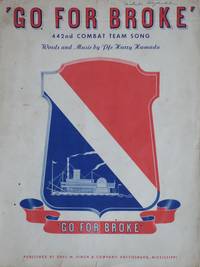
1944List2436Hattiesburg: Earl M. Finch 1944. Sheet music measuring 12 x 9 inches 4 pp. Signature of a Nabuko Hayashida on front cover. Slight tears at fold some toning two small pinholes very good overall quite attractive. Very Good. In Hawaii in May 1942 a battalion of Nisei volunteers was assembled for service in World War Two despite earlier failures of efforts to recruit Japanese-Americans due to the Army’s labeling of Nisei recruits as 4-C enemy aliens. Designated as the 100th Infantry Battalion they were deployed to North Africa in June 1943 integrating with the 34th Division in active combat. Their subsequent deployment to Italy in September 1943 exposed them to intense warfare earning them the moniker of the "Purple Heart Battalion" due to their notably high casualty rate.<br /> <br /> In January 1943 the U.S. War Department officially declared the establishment of the segregated 442nd Regimental Combat Team RCT which was comprised of Nisei volunteers originating from Hawaii and the mainland. The culmination of this initiative transpired in June 1944 when the 442nd RCT merged forces with the 100th Infantry Battalion in Europe subsequently absorbing the latter into its structure. The notable achievements of Nisei soldiers in combat operations prompted the reinstatement of the draft in January 1944 specifically targeting Nisei detainees to augment the ranks of the 442nd. Over time the 442nd RCT expanded to encompass the 2nd 3rd and 100th Battalions; the 522nd Field Artillery Battalion; the 232nd Engineering Company; the 206th Army Band; Anti-Tank Company; Cannon Company; and Service Company. <br /> <br /> Offered here is a very scarce piece of sheet music entitled “Go For Broke†which was written by the Hawaiian musician Harry Hamada reflecting the slogan of the 442nd and performed by Shelby and others during the war as part of efforts to boost morale. Hamada would feature in the 1951 movie “Go For Broke†as Masami alongside several other veterans of the 442nd. This publication of “Go For Broke†is from 1944 seven years before the movie’s release. The piece is dedicated to Colonel C.W. Pence. Hamada was a Hawaiian musician who performed with a band called the Shelby Hawaiians or the Shelby Serenaders. They performed as early as 1943. The Hattiesburg Mississippi merchant Earl M. Finch who ran an Army and Navy store close to Camp Shelby befriended Hamada and other members of the 442nd and acted as a sponsor for the group and eventually published this version despite his business being a dry goods merchant house and not a publishing house. The group with the support of Finch performed throughout the country to lift morale. At some point Hamada penned this composition likely in 1944 as we find no reference to it in 1943 articles and Finch published it - Hamada’s composition would become the theme song of the 442nd and Hamada would perform at the Halloran General Hospital in New York and the Walter Reed Hospital in Washington D.C. in 1944 likely performing this composition. Another composition called “Go For Broke†exists as well and it is unclear to what degree Hamada’s work caught on among the regiment. <br /> <br /> We find two records of Finch’s published version of the composition one listed as part of an online remembrance of the 442nd by the Smithsonian Institution https://americanhistory.si.edu/explore/stories/day-remembrance-70-years-after-executive-order-9066 which appears to have been on loan from the National Japanese American Historical Society and another copy held at Stanford though not listed in OCLC. Finch’s story is also interesting and is the subject of a remembrance on a 100th Battalion History page online https://www.100thbattalion.org/history/stories/earl-finch/. We find no copies listed in OCLC. Overall a very scarce piece of Japanese-American wartime history. Earl M. Finch unknown
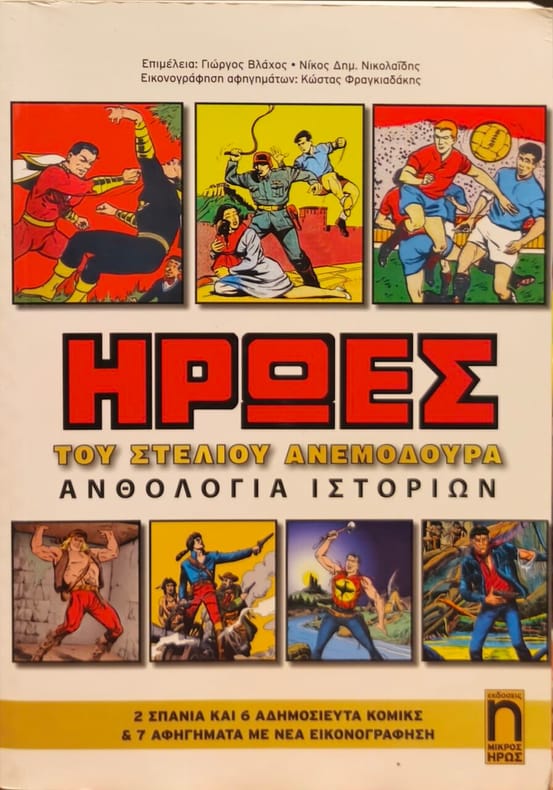
20164108Μικρος Ηρως 2016 361 pages grand in8. 2016. Broché couverture rempliée. 361 pages. Le livre "Ηρωες" (Héros) de Stelios Anemodouras est une anthologie d'histoires publiée par les éditions Mikros Iros. Il met en scène les aventures de jeunes héros grecs notamment le personnage du "Mikros Iros" (Petit Héros) pendant l'Occupation (Seconde Guerre mondiale) où ils combattent les forces de l'Axe (Allemands Italiens Bulgares) et parfois des Japonais. Les récits souvent illustrés mêlent aventure patriotisme et résistance
Fine English Paperback., Very good., 24 x 17 cm, In English and Turkish, 2 volumes set: ([xv], 600 p.; [xv], 601-919, [112] pp., "Üçüncü Uluslararasi Atatürk Sempozyumu 3 - 6 Ekim 1995 - Gazi Magusa Kuzey Kibris Türk Cumhuriyeti, 2 volumes set:. [= The Third International Symposium on Atatürk October 3 - 6 1995 - Gazi Magusa Turkish Republic of Nothern Cyprus], ATATÜRK ARASTIRMA MERKEZI, Atatürk Arastirma Merkezi, Ankara, 1998"
19353289452München, 1935. 40 S. Mit 4 Skizzen. OKart.
19153304714Zürich, Orell Füssli, 1915. 47 S. OKart. (Namenszug auf Titel).
191989208Hannover, Paul Steegemann, 1919. 14 S., 5 Bll. Verlagsanzeigen. (= Die Silbergäule, Bd. 12). 22,3 cm. Illustr. OKart.
191698759Remscheid, 1916. 90 S. MIt 2 Tafeln (von 3) u. 1 gefalt. Glückwunschrede, [8] S. "Kurzgefaßte Ergänzungen im September 1941". 22 cm. OHLn.
Soria, Imprenta Provincial, 1971. 4to.mayor; 175 pp., 1 h. y ocho láminas fotográficas. Cubiertas originales.
1929MILI0903(Hall i. Tirol, 1929). 252 S., mit 1 Portr., 1 Farbtaf., 1 gef. Karte sowie zahlr. Abb. u. Zeichn. im Text, OLdr. m. gldgepr. Tit. u. kl. Deckelvign., leuicht berieben, einige schwache Kratzspuren, Kanten u. Ecken etwas bestoß., Titelbl. fehlt, papierbed. gebr., am vord. Vors. Klebezettel m. Inv.-Nr., Büchereistemp. u. hs. Verm., am vord. Spiegel tlw. überklebte Stampiglie, flieg. Vors. schwach fingerfl.
198957047ABWien, Österreichischer Bundesverlag, 1989. 4° (28x20), 182 S., mit dokumentarischen Aufnahmen und Faksimiles, ill OKart (Brosch), Kanten etwas berieben, sonst fest und sauber,