1 575 résultats
196940032Washington D.C.: Fifth Avenue Vietnam Peace Parade Committee 1969. 1st printing presumed. White printed paper. Light wear slight age-toning to back of paper. A VG example. Single sheet folded once. B/w photographic image of diapered Vietnamese children marching printed to front. 8-1/2" x 5-1/2" <br/><br/>"The New Mobilization Committee to End the War in Vietnam is mounting a FALL OFFENSIVE TO STOP THE WAR STOP THE WAR MACHINE STOP THE DEATH MACHINE. It will culminate on November 15 in Washington and San Francisco in what we can make the most significant anti-war demonstrations in American history. Our efforts to end the war in Vietnam have reached a crossroads -- it must be ended or it will rise to new heights of horror and murder." OCLC only shows 1 institutional holding University of Kansas. Rare in the trade. Fifth Avenue Vietnam Peace Parade Committee unknown books
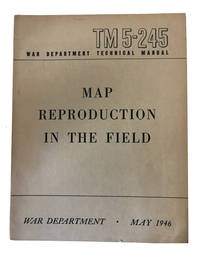
194689912Washington: GPO 1946. Paperback. Very Good. photos illustrations index iii 161p. Softcover in original wrappers. 26cm. Cover slightly darkened around edges. Text double-columned. War Department Technical Manual TM 5-245. <br/><br/> GPO paperback books
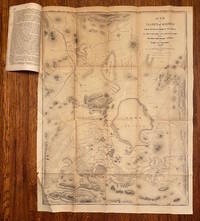
18503517Washington DC 1850. First Edition. Very good. Large folding lithograph map with U.S. Army routes in red 659 x 500 mm. Splits at folds on left where attached to text light browning. Text: 8vo 224 x 140 mm. 14 2 pp. including final blank leaf extracted from a larger volume and repaired. First edition of this excellent map illustrative of both the Mexican-American War and the cartography of Mexico prepared by members of the U.S. Army Topographical Engineers. Our map is accompanied by the essential text which is not always present. Herein "cartographer M.L. Smith Lieutenant of the Topographical Engineers writes to J.J. Abert Colonel Corps Topographical Engineers paying homage to the accuracy of Baron Humboldt's map of the Valley of Mexico and stating that it was the only one in which they placed confidence for moving troops in to capture the city. He remarks however that he believes that the present map is the first survey of the valley ever made by triangulation. His colleague E.L.F. Hardcastle supplements the report with memoirs of the march made in his journal as events occurred. This sparse but pithy report has excellent details on military engineering." Dorothy Sloan Auction 24a lot 242. The present example comes from Dorothy Sloan's own Americana collection which was purchased by us in 2020.<br/><br/>Garrett & Goodwin The Mexican-American War pp. 296 430-431. Haferkorn p. 31. Tutorow 1632. unknown books
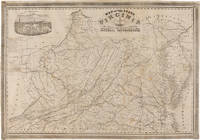
1862WRCAM46982ARichmond: West & Johnston 1862. Lithographed map 25 1/2 x 36 3/4 inches with ornamental border and inset view of Richmond. Sheet trimmed to just outside the ornamental border and mounted on modern linen. Old folds now flattened. Small chip in upper right corner just touching the ornamental border. Separations at a cross-folds with a few instances of small paper loss stabilized by the linen backing. Good plus. This impressive Confederate map of Virginia was originally based on work done by Ludwig von Bucholtz in connection with his updating the famed Herman Boye map of Virginia in 1858. Bucholtz was hired to re-engrave the copperplates for maps of Virginia originally made by Herman Boye in 1826. The ultimate products of his work were the very large maps of Virginia called the Boye-Bucholtz maps. Using knowledge from his work on this project Bucholtz issued his own map in 1858 lithographed and published by Ritchie & Dunnavant in Richmond. This map was vastly superior in detail and accuracy to Bucholtz's revision of the Boye map. <br> <br> In 1862 with Confederate officers in need of good maps of the region Richmond publishers West & Johnson re-issued the Bucholtz-Ludwig 1858 map of Virginia reprinted from the original stone with minor alterations including the removal of the cartographer's name. "There are minor geographic changes from Map 1 the original 1858 Bucholtz map on Map 2 the West & Johnson issue. For example on Map 2 Jerusalem in Southampton Co. has been moved a little to the northwest of its Map 1 location near the Seaboard and Roanoke Railroad and the road between the two points imperfectly erased the remaining shadow is additional evidence that the Map 1 stone was involved. Still for the most part Map 1 and Map 2 are the same map" - Wooldridge "The Bucholtz- Ludwig Map of Virginia and its Successors" in THE PORTOLAN 68 Spring 2007 pp.26-39. A second edition of the West & Johnson issue would be published in 1864. <br> <br> The map shows all of Virginia West Virginia Maryland Delaware and parts of Pennsylvania and New Jersey and includes an inset view of Capitol Square in Richmond. A chart below the view lists all the railroads and the length of each line. <br> <br> "In stark contrast to the large often colored maps pouring out of Northern presses the Confederate imprints are few in number modest in scale and more often than not black and white printed on poor paper. Long before the war was over they weren't being printed at all" - Wooldridge. PARRISH & WILLINGHAM 6204. SWEM 971. Wooldridge "The Bucholtz-Ludwig Map of Virginia and its Successors" in THE PORTOLAN 68 Spring 2007 pp.26-39. STEPHENSON 475.5. WOOLDRIDGE 254. West & Johnston unknown books
186426136Chattanooga 1864. Lithographed folding map sectioned and linen-backed as issued. Original card covers printed paper label. In a modern folding morocco-backed box. A remarkable Union Army field map printed for Sherman's operations in Georgia.<br/> <br/>A highly detailed map of the northern part of Georgia made under the direction of Capt. W. E. Merrill Chief Topographical Engineer of the Army of the Cumberland. The map shows all the major roads and rail lines in addition to natural topographical features in northern Georgia. The map extends as far north as Chattanooga near the Georgia/Tennessee state line and far enough south and east to include the northwest sixth of the state. The capture of Chattanooga in November 1863 gave the Union the foothold they needed to cut off supply lines and advance into the deep South. In the spring of 1864 the forces under Gen. William T. Sherman were poised to strike. As soon as Chattanooga was taken Sherman's chief topographical engineer Capt. William E. Merrill "the most innovative and conscientious exponent of mapping during the Civil War" began to compile a map of northwest Georgia. Merrill had his own complete establishment for map production -- a printing press lithographic presses and draughtsmen. Equally importantly Merrill's assistant Sgt. N. Finnegan developed an extraordinary body of intelligence drawing on spies prisoners refugees peddlars itinerant preachers and scouts what Merrill called "his motley crew". All of this information was digested by Merrill day by day until he was notified that the campaign would begin within the week. At this point the topographers finished their work and two hundred copies were produced mounted on linen for field use and distributed to field commanders down to the brigade level. In five months Merrill and his men had produced a remarkably accurate map of country that lay mostly behind enemy lines. The Merrill map was a critical aid to Sherman's campaigns in Georgia. Five days after the map was completed on May 7 Sherman's army left Chattanooga and began its hard-fought push to the southeast slowly driving the Confederates back to the railroad hub of Atlanta which is in the lower right quadrant of this map. In a campaign of continual attempts by both armies to outflank each other the understanding of the ground it would have brought the Union commanders was invaluable. Sherman took possession of Atlanta in September and used it as a base of operations for the next two and a half months while he raided in every direction all within the boundaries of this map. On November 15 the Federal forces burned the city cut loose from their rail communications with Chattanooga and began the famous March to the Sea heading east toward Savannah burning and pillaging everything in their path. About a week later they moved off the east edge of this map. An examination shows why this map would have been an invaluable aid to the Union commanders in the Georgia campaign. It details topography rivers existing roads and railroads towns and other features on a very small scale of four miles to the inch. Conveying the latest in Union military intelligence and combining new and existing information it would have guided Sherman and his officers through eight months of the hardest-fought campaigning of the entire Civil War. A triumph of coordinated intelligence and map-making it is one of the most remarkable cartographic productions of the Civil War. Indeed it might be called the "Holster Atlas" of the Georgia campaign.<br/> <br/>Stephenson Civil War Maps in the Library of Congress S28-29; Miller Great Maps of the Civil War p.39. unknown books
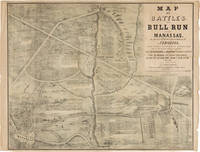
1861WRCAM48993Richmond: West & Johnston 1861. Sheet map 19 3/4 x 26 inches. Old fold lines. Some separation at two folds on the right edge. Light wear minor toning. Very good. A handsome and historic map depicting the First Battle of Manassas or Bull Run depicting troop positions and movements roads railroads houses and other significant geographical features. First Manassas was the first significant engagement of the Civil War and the place where Thomas J. Jackson became "Stonewall" Jackson when his brigade stood their ground against disorganized Union forces. The Confederate troops won the battle raising hopes in the South and signaling to the North that the war would not be won so easily. The map indicates that it was "made from observation" by Solomon Bamberger and lithographed by the firm of Hoyer & Ludwig in Richmond. <br> <br> It appears that at least two issues of this map exist this being the most vividly pictorial that we have found and thus perhaps the later of the two. Rather than a simple plan of the battle the present map lays out the same information augmenting the background with shading and pictorial scenery. The title is likewise enclosed in a simple border setting it off from the rest of the map and though the title is the same the typeface of some of the title lettering has been changed slightly. Parrish & Willingham do not indicate any differentiation of issues but the details and graphics make this by far the most desirable. <br> <br> A rare and interesting map of this important battle and one of the most dramatic graphics produced in the Confederacy. Without the means to produce suitable paper few pieces on a comparable scale were created. PARRISH & WILLINGHAM 6148. West & Johnston unknown books
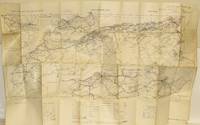
1942287301London: War Office 1942. First Edition. Very Good binding. A stated First Edition Africa Road Map for the northern coast of Africa Morocco Algeria and Tunisia. Text in French and English prepared by the U.K. War Office in 1942. Late that same year British and American troops would land in Morocco and Algeria beginning a new phase of WWII in Africa. A large road map of the region measuring 49 x 108 cm on a 67 x 115 cm folding sheet. A 'Carte Michelin' revised in 1939 and photolithographically copied for use by the Army and Navy Departments. Notation at the top in pencil mentioning Herbert Casey the Director of the American Red Cross Club in Bizerte Tunisia in 1943. Beginning of separation at some of the folds though generally in Very Good condition. Very Good binding. War Office unknown books
1872380601872. 104 numbered leaves; written in in on folded sheets with text on right-hand side notes and corrections on left. With numerous corrections and deletions. 1 vols. Oblong 8vo 6 x 8 inches0. Fine. 104 numbered leaves; written in in on folded sheets with text on right-hand side notes and corrections on left. With numerous corrections and deletions. 1 vols. Oblong 8vo 6 x 8 inches0. A very early and well-written analysis by an amateur historian shortly afer the cessation of hostilities.<br/><br/>The author begins: "It is but a few months since Europe saw the end of a struggle of which history affords so example. There have been fiercer battles fought larger territories involved in the conflict but never was there witnessed a more futile pretext for war blind imprudence in the aggressor or more consummate generalship & complete success on the opposite side ."<br/><br/><br/>Possibly by an American given references to Abraham Lincoln the American Revolution "the freest nation in the world" etc. A good candidatate might possibly be Henry Percy Litchfield see OCLC 10644238 of Long Island whose papers are in George Washington U with the Litchfield family papers and whose privately printed book THE FRANCO-GERMAN WAR OF 1870 Gracehill Brooklyn L.I. 1872 was among the earliest studies of the war. unknown books
1813WRCAM41998Sackets Harbor N.Y. 1813. 1p. manuscript letter signed docketed on verso. Folio. Old fold lines. Some separation at folds; one tear closed with archival tape. Lightly soiled. Good. An eyewitness account of the second battle of Sackets Harbor on the shores of Lake Ontario from the commander of the American forces there Gen. Jacob Brown to his friend Joshua Hatheway quartermaster general and formerly the commander of the defenses at Sackets Harbor. The town situated near the entrance to the St. Lawrence River at the far eastern end of Lake Ontario and opposite the Canadian town of Kingston was a vital defensive point for the Americans challenging British control of the St. Lawrence and the lake and preventing a British thrust into New York State. If either side could control both sides of the entrance to the St. Lawrence they could control the Upper Great Lakes. Taking advantage of the American action against York which drew troops away to the western end of the Lake the British decided to strike. On May 28 1813 the British Great Lakes squadron under the command of James Yeo appeared off Sackets Harbor carrying troops under the command of the governor-general Lieut. Gen. George Prevost. Having been forewarned by several men who escaped the Battle of Henderson Bay the previous day the Americans had some time to reinforce their defenses before the British could attack. The British landed on the 28th but launched their main attack the next morning. They easily routed the American militia but the regulars under Brown were able to fight off repeated attacks on their fortifications. Prevost fearing the arrival of more American troops ordered a retreat which nearly became a rout. Brown was the hero of the day and was later rewarded with a commission as brigadier general. He must have immediately written this letter describing the action. This appears to be written in a secretarial hand and signed by Brown himself. The letter states: "Dr. Sir I received an order some days since from Genl Dearborn to take comm. at this Post. Comd. Chauncey is up the lake. We were this morning attacked as day dawned by Sir George Prevost in person who made good his landing with at least a thousand picked men. Sir James Yeo commanded the fleet after loosing some distinguished officers and of course some gallant men. Our loss is very severe as to the quality of those who have fallen. The enemy left many of their wounded on the Field - but I have no doubt carried off many more. We shall probably be again attacked as Sir George must feel very sore. All I can say is whatever may be the result we will not be disgraced." A superb battlefield letter reporting on one of the most significant military actions of the War of 1812. unknown books
17181019044 page lettersheet 9 3/4x 8 1 1/2 pages of text with docketing and commentary by several officials on the 4th page. Some soiling and aging to the last page a little toning; otherwise very good or better. The letter from Woods attempts to resolve what must have been a common problem in the Union Army during the Civil War which was the red tape involved in battle field promotions. Woods 'was mustered into the Service of the United Sates as an enlisted man. on the 29th day of July 1861 at Washington City D.C. by Lieut. Jno. Elwood. On the 14 day of Decbr. I was promoted to the 2nd Lieutenancy in said Co. vice Lieutenant Donaldson died May 15th 1862 but did not receive my Commission as such until 5th day pf March 1863 since which time I have actually performing the duty of 2nd Lieut. in said company and as such I have been on the muster and pay rolls for March and April. I would respectfully ask the Order mustering me out as an enlisted man being 2nd Serge. of said Company when I received my commission and ordering my muster in as 2nd Lieut. to date from March 5 1863. I have made efforts to be mustered but without success. " Perhaps even more interesting are the comments by several officials on the forth page trying to cut through the 'red tape'. books
1863101903One plain brown lettersheet 8 1/2 x 5 1/2 in folded format about 2 1/2 pages of text. Creased a small hole only affecting one letter some aging; otherwise very good. Includes a typed transcript. This is a letter from Frederick Steubing a Confederate soldier to J.H. Williams another Confederate soldier describing various events and combat in a humorous way. Steubing tells of a very merry Christmas parted that ended with most of the company getting drunk. "We had a jolly time of it Christmas here the biggest part of the company got drunk and we throwed in with them I got as drunk as a fool and you bet I was sick the next day." Steubing asks Williams for news of his friends and tells him about some of the action he saw on the Mississippi. "I got a good look at the old gunboats and you bet I heard them belch several times at us whenever we would shoot at the transport with our cannon and small arms. the cannon balls would cut down trees as big as anybody and you bet that the cannon balls would make boys hug the levy and eat sand." The rough brown paper used for this letter would seem to reflect the scarcity of supplies among Confederate soldiers. books
18621019014 pages on one leaf 4to with original envelope and typed transcript. Normal aging and browning slight separation at folds. The letters were written by George Roden who was born in 1841 from Newark New Jersey who was the son of English immigrants and served in the 2nd New Jersey Infantry regiment. He was a corporal when this letter was written. The letter is addressed "Dear Folks at home" and tells his family how happy he was to receive their letters after waiting so long but he also includes a description of the Battle of Gaines' Mills; 'Our four companies left as they were without any support whatever to contend with over a brigade of the enemy surrounding us on three sides they poured in an awful cross fire but even amid that and their insane yells our boys rallied around the dear old flag three times. Once They were taken but as the fellow a Lieut. grasped it from our wounded color sergeant a ball went through his heart and again they were retaken." He also adds an interesting account of his company's reserve role in the Battle of White Old Swamp. See guide to Roden family papers at the William L. Clements Library. books
1818100123Letter sheet 9 ¼ x 7 ½ 3pp. on 4 pp. lettersheet. Folded with nicks on folds minor soiling else very good. White was stationed near Washington D.C. and he provides a fair sketch of camp life and soldierly concerns during the first year of the conflict. His wants are few and he goes to some lengths to let his wife know he is taking good care of himself. I wash all my clothes regularly once a week keep my hair cut very close and wash myself clean every morning. I have no fear of getting dirty or lousy. Camp life is described as quite restrictive with lots of work. Duty is very hard we have to drill nearly eight hours every day except when we are on the move. He gives his wife advice on finances and other matters and admonishes her that above all I do not want you to believe any stories about men being shot for disciplinary reasons. hardcover books
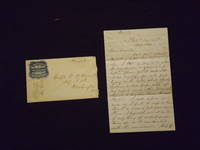
1862102018One folded sheet two pages of text illustrated red and blue lettersheet depicting George B. McClellan with slogan "WE HAVE BEAT OUR LAST RETREAT" includes matching postally canceled envelope. Minor folds one small hole at center fold not affecting text normal aging and toning. Overall in very good condition. James Rikert who enlisted in 1861 was discharged in 1862 for disability. He joined as a 21 year old private at Fort Wayne Michigan and mustered into Company G of the MI 5th Infantry. He sent this letter to Celia Gibson as a follow-up to a letter he sent a week earlier concerning their march on Manassas. He reports heavy rains that postponed the march but expects to march the next day. While he mentions his sadness at the loss of his grandmother he makes a point of telling Celia this could be his last letter. "This may be the last letter perhaps that you will ever get from me but if I live through the battle you will son hear from me again and if not you will know that I have gone to my lovely home and that I died as a Christian." Historical Data Systems Civil War Research and Genealogy Database. books
18631002017Four pages on one leaf. Light folds text slightly faded on first page normal aging and browning minor wear at folds. Overall in very good condition. This letter offers a graphic account of the Battle of Liberty Mills. The Bostwick brothers both served in the 2nd New York Cavalry for most of the war. George 1836-1913 was a private and his brother Orramell 1840-1922 was a sergeant. After the war both brothers returned to their home town of Stillwater Saratoga County New York. George wrote this letter while his brother was recovering from wounds he received at Culpeper Court House on September 13th and updates him in great detail of the regiment's recent actions at Liberty Mills. In part "It was hand to hand part of the time. A. Laugholm shot a captain in neck he drop dead as a stone. I was hit with a sabre but it did not mont to eney thing. It was a fight for dear life you can bet." Henry A Bostwick: Genealogy of the Bostwick Family; New York 1901. books
1861104033<p>Folded letter sheet 2 1/2 pages of text with original mailing envelope no stamp. Light wear normal aging legible hand; overall near fine. General Andrew Porter 1820-1872 was born in Pennsylvania and was the grandson of Revolutionary War General Andrew Porter. Porter was also related to Mary Todd Lincoln. He served in the Mexican War and was a Brigadier General at the Battle of Bull Run. Porter was appointed Provost Marshall General of the Army of the Potomac in 1862 and left the service in 1864 for health reasons. This letter to Captain William Averell appears to be written in somewhat secretive style. He tells Averell to mail a letter to a Mrs. P. that is under a newspaper. " I will return when it is safe to leave Mrs. P. or sooner if pub." He tells the captain to "please telegraph me at once if anything of importance turns up or I am needed with the command." He goes on to tell Averell keep the s pol.service with us. Much reputation is to be gained by carrying it on or aiding it successfully. This is probably a reference to the Secret Police that was headed by Allan Pinkerton at that time and who were very busy hunting down Confederate spies at that time. He also talks a little about other military matters including a troop build-up in Philadelphia. find a grave website.</p> books
1718101905Letter sheet 8x10 4 pages 3 1/2 pages of text. Some very minor bends at edges a couple of very minor nicks creased a little slight aging and browning; otherwise in really nice condition. This highly legible letter to a father from his son talks about more than the "usual" life in an army camp. There are certainly routine matters covered like receiving letters from family members and requests for money but he also talks about his legal misfortunes. While it is unclear what issues are involved it is clear he has some military legal problems which he hopes to resolve by the time his regiment is 'mustered." The letter makes it sound like it is something important and probably related to his military standing. His father appears to suggest that he should take his case to Washington but the son decides to wait it out. The son Jon indicates that while he feels badly over his misfortunes he really feels badly for his friends and relatives. This suggests along with a comment about handling the impact on public opinion that this case was a visible one. He also complains about the cost of living in the South which he says is twice what it is in the North and indicates he pays $10 per week for boarding. That would seem to be very high when measured at a soldier's pay during this period. He does throw in a couple of comments about the war including that "Sherman too is still in successful pursuit." he also states that nothing is heard from General Smith "but his safety and success is a thing assured." books
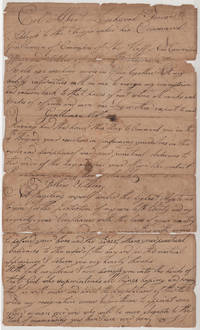
1816443051816. Torn and separated along the folds affecting a few lines of text scattered soiling and ink smudging contents otherwise legible. 1 sheet. 7.5 x 12.5 inches. Signed by Barnabas Allen who recorded this farewell address of Colonel Albert Lockwood of the 4th Regiment from Connecticut. The address was some time after the conclusion of the War of 1812 as Barnabas Allen served in that war. "Gentlemen of Commission of the Staff non commission officers and soldiers of the 4th Regiment. My old age my long service in office together with any bodily infirmities call me to resign my commission and return back to that places of rest where all ranks and grades of officers and men one day or other expect to meet. Gentlemen Officers- Having had the honor this day to command you in the 4th brigade your escertions in informing yourselves in the rules and discipline of war your punctual obedience to the order of the day and for your officer-like conduct I return you my hearty thanks Fellow Soldiers- Not forgetting myself under the highest obligations to you for the protection of own life liberty and my property. Your compliance with the laws of your country cut hereequipping yourselves with arms to defend your lives and the lives of others. Your punctual obediences to the order of the day and for the martial appearance I return to you my hearty thanks. With full confidence I now dismiss into the hands of that God who superintends all things hoping and praying that he will order and direct the Legislature of this state when my resignation comes before them to appoint some officer or man over you who will be more adequate to the task of commanding you than I have ever been. I have my hand my heart and my aid with you. Farewell gentle officers and Soldiers of the 4th regiment." Most likely Albert Lockwood b. 10 Apr. 1757 d. 16 Feb. 1846 married to Grace Godfrey of Weston Ct. see Revolutionary War Records of Fairfield Connecticut Volume 3. Lockwood served in the American Revolution and the War of 1812. unknown books
175738668Newtown NJ 1757. 1p. Signed by Henry Simson Joseph Byram John Anderson Thomas Woolverton and Joseph Parry. The French and Indian War on the New Jersey "Front Tears."<br/> <br/>In the wake of Braddock's defeat with tensions with the Delaware Valley Indian tribes rising and with a perceived threat that the tribes of the Delaware Valley would invade into New Jersey at the end of November 1755 Governor Belcher detached hundreds of West New Jersey troops to the New Jersey/Pennsylvania border and into Pennsylvania many under the command of Colonel Abraham van Campen. The present document concerns the death of a resident of Sussex County who evidently travelled with Van Campen and Colonel Jacob Ford to the "front tears" to "parley or hold a treaty with the Indians there" but "hath never returned & by report was near about that time killed." The document advocates for his bereaved wife and suggests that his eldest son be appointed heir and estate administrator. Another copy of this document addressed to "Your Honour" appears in the Documents Relating to the Colonial History of the State of New Jersey first series vol. xxxii p. 326. unknown books
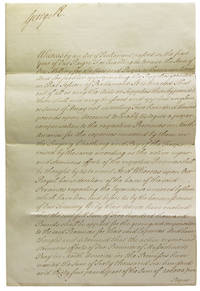
1761319882Great Britain 1761. 2pp. plus integral blank. Docketed on verso "King's Warrant / Province of Massachusetts / Bay £60634 in part / of £200000 Granted for / the North American / Provinces." Signed by George III at the head of the first page countersigned on the second page by William Wildman Barrington James Oswald and Gilbert Elliot. Folio 14 1/4 x 9 1/2 inches. Usual folds. 2pp. plus integral blank. Docketed on verso "King's Warrant / Province of Massachusetts / Bay £60634 in part / of £200000 Granted for / the North American / Provinces." Signed by George III at the head of the first page countersigned on the second page by William Wildman Barrington James Oswald and Gilbert Elliot. Folio 14 1/4 x 9 1/2 inches. Towards the end of the French and Indian War William Pitt started a specie grant program to reward colonies for raising troops thus putting the colonies in competition with each other for a share of an annual 200000 pounds. With specie scarce in the colonies the colonial assemblies were thus incentivized to raise troops to fight against the French. The present document authorizes Henry Fox to make payment to Massachusetts via their colonial agent William Bollan for their share of the annual grant. Although successful the policy was abandoned in favor of direct taxation after 1762 leading to the Sugar Act and most notably the Stamp Act. <br/><br/>This undated document -- the space for the date being left blank suggesting it to possibly be a draft -- is countersigned by William Wildman Barrington Chancellor of the Exchequer 21 March 1761 to 8 May 1762; Sir Gilbert Elliot third Baron Minto Lord of the Treasury 1761-62 and James Oswald Commissioner of the Treasury 1759-63. The date would therefore appear to be 1761 or early in 1762.<br/><br/>George III documents relating to North America from the early years of his reign are particularly scarce. unknown books
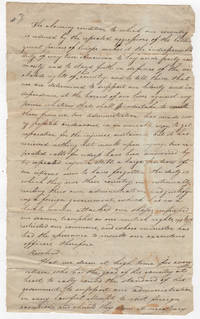
181044417NY 1810. Very good folded few edge tears one obscuring a small portion of text light soiling & ink bleed contents legible. 2 pp. 7.5 x 13 inches. Unsigned and unpublished manuscript draft of a series of resolves supporting the Madison administration's policy towards Britain and ending with support for the nomination of Daniel Tompkins for Governor of New York and John Broome for Lt. Governor for the election of 1810. "The alarming condition to which our country is reduced by the repeated aggressions of the belligerent powers of Europe makes it the indispensable duty of every true American to lay aside party animosity and to stand forth in defiance of the violated rights of his country. and to tell them that we are determined to support our liberty and independence at the hazard of our lives against my power whatever. therefore Resolved: That we deem it high time for every citizen who has the good of his country at heart to rally around the standard of his government to support our administration in every lawful attempt to resist foreign aggressions and should they deem it necessary to have recourse to arms we will cheerfully sacrifice our lives in defiance of our liberty Resolved: That we approve the conduct of the President in dismissing Frances James Jackson otherwise Copenhagen Jackson for insulting our government in charging it with a falsehood Resolved: That we highly approve of the just rebuke of Thomas Sammons in defense of Jackson's conduct Resolved: That we concur in the nomination of Daniel Tompkins for Governor and John Broome for Lt. Governor as fit persons for those offices & whose capacity has been tried to our satisfaction & that we will support them to the utmost of our power. A wonderful document elucidating the issues and emotions driving the country apart and leading to the War of 1812. unknown books
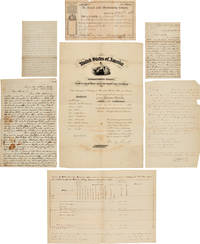
1881WRCAM50270Various locations 1881. Manuscript map; three autograph letters signed; and five related documents. All three autograph letters are accompanied by full typed transcriptions. Usual mailing folds. Generally very good. An interesting archive relating to Capt. James Cooke's experiences in the Civil War. Cooke mustered in on Sept. 5 1861 and eventually served as captain in Company "F" 52nd Regiment Pennsylvania Volunteers. He served in several battles most notably the Battle of Seven Pines in Virginia and resigned on Oct. 21 1863. The individual items included in the archive are as follows: <br> <br> 1 Manuscript map of the Seven Pines Battlefield. 15 3/4 x 12 1/2 inches. Some fold separations with minor loss of paper noticeable stain in the middle of the map straddling the vertical fold. A wonderful hand-drawn map by Cooke showing the area around Fair Oaks Station. He has designated the positions of both the 52nd and 104th Pennsylvania infantries marking places such as "Fight commenced here" "Fighting all through here" "52 Pennsylvania in line of Battle" and "the way the Rebs came." He also has marked topographical details such as roads a railroad track woods and the Chickahominy River. He has written a short explanatory note on the verso initialed by him to the same recipient as the following letter. <br> <br> 2 Autograph letter signed to "Dear Friend Joe." Camp Near Bottoms Ridge. June 18 1862. A wonderful sixteen-page letter with details regarding the Battles of Williamsburg and Seven Pines. The Union army had laid siege to Yorktown Virginia from April 5 1862 until Confederate forces silently withdrew in the night hours of May 3. Cooke was there as Federal troops entered the town the following morning and describes the scene: "We went through the woods cautiously with our skirmishers in advance but we could see no signs of life in any of the Forts and our men went along without any opposition.we had no idea that it was a general evacuation of the whole place." The rebels however had not left the place totally unguarded: <br> <br> "I was just agoing sic when I heard a stunning report behind me.and the men in my company falling down.I supposed right away that it was a masked battery on the opposite side of the road.I then went to the rear of the company and found.a deep hole in the ground showing it was one of those infernal machines near Williamsburg Virginia the first known use of modern land mines that the Black Hearted Traitors planted all along the roads leading to Williamsburg." <br> <br> The next day May 5 Cooke and his men found themselves held in reserve near the fighting at the Battle of Williamsburg. They advanced and "as we were going up I could hear the roar of the musketry and the yells of the boys when they made the charge." The men of the 52nd never joined the fight since when they reached the field "the fight was over for that day and.as the rebels still occupied a large fort we would go at them in the morning." <br> <br> Two days after arriving at Williamsburg they "struck out for Richmond" and reached the Chickahominy River on May 19 meeting some light resistance along the way: "Our men.drove the pickets of the enemy.and skirmished up to the bank of the river in the face of a severe fire of infantry and artillery by the Rebs." On Saturday May 31 they "took the advance toward Richmond.and uncovered the enemy in force in front of us." <br> <br> The Battle of Seven Pines was about to commence. Cooke writes about it in great detail: <br> <br> "Skirmishers from the 52nd.were sent out and soon drew the fire of the enemy's pickets and.a battery that was hid behind a woods. The 104th Pennsylvania Infantry was sent forward on our left.and we were ordered to advance along the road.the balls went howling over our heads like something mad. This being the first time many of the boys had heard a ball scream.it made a good many look white.but not a man flinched." <br> <br> The men advanced over the hill "the Rebels.gave us the full benefit of three or four guns.We filed off to the right.to get out of range but they followed us with their shots which fell all around us." After assuming line of battle the men "marched directly toward the rebel guns." Help arrived when "One of our batteries.came up and commenced answering the speeches that had been made on the other side. It soon silenced their guns." They experienced very little action after that and two days later June 2 they "took possession of the railroad at Fair Oaks Station." He does add that he "was not with my Regt in the fight nor did I see any of our Brigade in the fight Cooke had been separated and used as a skirmisher as where they were fighting was at the real seven pines and.I was at Fair Oaks a half mile to the right." He concludes by giving an account of the 52nd's action during the battle as he knows it. <br> <br> 3 Autograph letter signed to "Dear Brother." Virginia Fairfax Seminary. Aug. 20 1861. A friendly letter to his brother with some military content. Cooke writes that he is currently "quartered about 2 1/2 miles from Alexandria" near the house where Gen. Kearney is headquartered. The Virginia Seminary where he is staying was abandoned after the Union troops took Alexandria according to Cooke. He then relates information about working the picket lines "about 2 miles from the camp then Rebel Scouts came down some days inside our pickets" a potential court- martial of one of the Union colonels related to Cooke's division and news that Cooke expects "another battle in about two weeks but there can be nothing definite about it there is any quantity of reports about but if they the government are only prepared for it the sooner it comes the better as I would like to see the thing ended and not be kept in suspense." <br> <br> 4 Autograph letter signed to "Dear Sister." Camp Dodge. Dec. 14 1862 Cooke writes that he is well having gotten over a "light touch of Intermitent Fever." He send $10 from a fellow soldier for his sister to give to the soldier's wife. Cooke spends the last portion of the letter writing about army pay. <br> <br> 5 Retained copy of a Return of Ordnance Form for Company "F" 52nd Pennsylvania Regiment for the quarter ending Dec. 31 1862 mismarked 1863. <br> <br> 6 Fair copy of Special Orders No. 149 May 18 1862 regarding the sick and surplus arms and baggage. <br> <br> 7 Military Appointment for Cooke as captain of Co. "F" Nov. 5 1862. Fold separations. <br> <br> 8 Passaic Falls Manufacturing Company Stock Certificate May 30 1866. <br> <br> 9 James Cooke's passport Jan. 10 1881 giving a detailed physical description of Cooke. <br> <br> A wonderful archive relating a Pennsylvania captain's experiences during the Civil War most notable for the manuscript map of the Seven Pines battlefield and an enthralling letter to a friend regarding battle experiences. unknown books
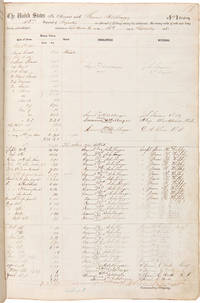
1865WRCAM55621Various locations in Pennsylvania Virginia and South Carolina 1865. 21987pp. Large folio. Contemporary three-quarter maroon calf and black cloth boards gilt spine titles reading: "PENN. CLOTHING BOOK COS. C & D 52nd INFANTRY P. & P. OFFICE." Spine partially split chipped and rather worn; boards soiled edges and corners worn. Binding a bit tender and bowed. Scattered occasional soiling and foxing to text. Good. A voluminous manuscript account book used to track the clothing and equipment transmitted to the soldiers of two companies of the 52nd Pennsylvania Infantry Regiment between 1861 and 1865. The meticulous records herein provide significant research material on the outfitting of Civil War troops and show that an army marches not just on its stomach but on its shoes and clothing as well. <br> <br> The majority of the entries relate to clothing including shorts pants coats caps blouses shoes socks and other materials needed by the Civil War foot soldier on the move during the conflict. Equipment listed here includes haversacks and blankets among other items. Each page is dedicated to a single soldier whose name company enlistment location and enlistment date are all recorded in the pre-printed form at top with various line items their costs the rank of the soldier and his signature recorded in the body of the ledger-like account book. Often accounts are noted as settled either before discharge or by death or desertion. Over two-thirds of the entries pertain to Company C of the 52nd Infantry. <br> <br> Importantly in addition to equipment and clothing the account book also records transfers death discharges and desertions. The first five entries for example provide a snapshot of the fates of various soldiers. The first soldier is noted as discharged with the last date of equipment listed as February 28 1862. The second and third soldiers were both "Killed in action at Fair Oaks Va." aka the Battle of Seven Pines May 31 - June 1 1862. The fourth soldier was discharged sometime after June 1862. And the fifth soldier "Died from wounds" after May 18 1862. Others here are noted as "Died from Disease" "Died of wound received by accident" and "Supposed to be killed by the explosion of the Gun Boat Mound City." <br> <br> The 52nd Pennsylvania Infantry Regiment was an important unit during the Civil War. The regiment formed in the late summer and early fall of 1861. They were assigned to the Peninsula Campaign in March 1862 and swiftly saw action at the Battle of Williamsburg and the Battle of Seven Pines also known as the Battle of Fair Oaks which is the name used for the soldiers recorded as dying there in the present account book. The regiment then moved to South Carolina at least one soldier in the present account book enlisted there and by mid-summer they were in Charleston to witness the ill-fated Battle of Fort Wagner. For the remainder of 1863 and most of 1864 the regiment moved around South Carolina until participating in the occupation of Charleston in February 1865. Afterwards the regiment joined Sherman's march through the South and some of the regiment ended the war in North Carolina where they witnessed the final surrender of Gen. Joseph E. Johnston. <br> <br> A valuable and research-worthy record of Civil War service covering the span of the conflict filled with unique information on the ground level needs of the Union foot soldier. hardcover books
191761797Washington: G. P. O. Very Good. 1917. Hardcover. Small blue cloth manual complete in 350 pages. With 2 folding plates. Good binding sound. . G. P. O. hardcover books
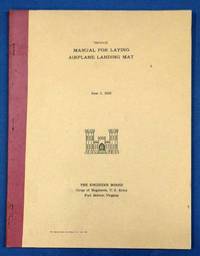
194215847Fort Belvoir VA: The Engineer Board 1942. Red cloth spine with printed buff wrappers stapled. VG minor wear. 53 leaves. Text printed on versos only. Profusely illustrated with diagrams schematics & from photographs. Royal 8vo. <br/><br/> The Engineer Board hardcover books