McKee, AlexanderAntiquariat.de

30 333 résultats
198356107Wien; Hamburg: Zsolnay 1983. 328 S.: Ill., Kt.; 22 cm Gewebe 0
236508Ll. dd., 1790 - 1794 78 pièces in-4, brochées sous couvertures modernes de papier bleu imprimé.
1798AUST1276Wien, o. A. 1798. 4. 7 nn. auf Büttenpapier gedruckte S.; Titelbl. mit Numerierung u. Datierung v. alter Hand. Ohne Einband, Rücken mit Papierstreifen geklebt. Ecken leicht eselsohrig, altersbedingt leicht gebräunt, sonst sehr gut erhalten.
19382086Berlin, Vier Falken Vlg. (1938). [1.Aufl.]. M. 16 Abb. a.Taf. 442 S. OLwd.
Very Good Turkish, Ottoman (1500-1928) Original 110 autograph letters (ALS) and several autograph postcards with almost all their original envelopes, one signed cabinet photograph, and one photograph album including Pertev Pasha's funeral photos which shows many famous politicians and soldiers beside his daughter Nevin Demirhan [Bengisu] and his wife Leman Demirhan. Various sizes. All material in Ottoman script. Most of letters addressed to his daughter Mrs. Nevin. His funeral album includes one newspaper clipping contains his short life, six newspaper obituaries, 20 b/w photos, of his funeral and famous people attending the funeral, one telegraph of condolences by Kazim Orbay, (1886-1964) and his wife Mrs. Orbay. Sait Pertev Demirhan, (1871-1964), was a Turkish soldier and politician. He is a graduate of Erkân-i Harbiye. He was an author, intellectual, Erkân-i Harbiye School teacher, 6. Army chief of staff, Harbiye Undersecretariat, 3rd Army Chief of Staff, 1st Corps and 4. Corps Commands, Military Schools Inspector, Member of History and Geography Councils, Member of Military Appeals Court, a deputy of Erzurum. He was the son of Yanyali Mustafa Pasha. He graduated from Harbiye as a staff captain (1892). In 1894 he was sent to Germany to advance his military education. After being a colonel, he was appointed to the Staff School as a teacher (1904). He was sent to the Russian-Japanese War as an observer. So, he written a book titled 'Japonlarin asil kuvveti: Japonlar niçin ve nasil yükseldi?' [i.e. The principal power of Japan: Why and how did Japan rise?] printed in 1937 in Turkish. He returned to Istanbul in 1906 and was promoted to "Pasha", and was appointed as the 6th Army Chief of Staff. He participated in the Balkan Wars (1912-1913) and was on the Caucasian front during the First World War. He was sent to Vienna as a military diplomat. Upon his return, he moved to Anatolia to participate in the Turkish War of Independence. He died in Moda district of Kadiköy. A fine and rare collection.
Very Good Turkish, Ottoman (1500-1928) Paperback. Oblong large roy. 8vo. (17 x 25 cm). In Ottoman Turkish. [287] p., unnembered b/w plates. 395 members with his photos and descriptive texts. First 20 pages include a history of Grand National Assembly of Turkey from Ottoman Empire to the Republic (1923). TBMM Library: 1262. Not in OCLC. Not in Özege. Extremely rare.
Very Good Turkish, Ottoman (1500-1928) Original illustrated wrappers. Chipping on top edge and front cover. Occasional foxing on pages. Overall a good copy. Roy. 8vo. (23 x 15 cm). In Ottoman script (Old Turkish with Arabic letters). 103 p., b/w plates (19 unnumbered b/w plates and 1 map). First edition of this extremely rare first-hand and historically significant eyewitness account of the Syrian and the Suez Canal Operations during the Great War by an Ottoman soldier and statesman. Erden describes in this book his return to Istanbul after his military attaché duty in Paris and his departure to Damascus to join the 4th Army in Syria under the command of Cemal Pasha (1872-1922). He then discusses the Arab Revolt in Hejaz and its possible effects on the Ottoman Empire (The Arab Uprising was initiated by Sharif Hussein bin Ali in June 1916 during the Great War with the aim of creating an independent and united Arab state comprising of Aden in Yemen and Aleppo in Syria against the Imperial Ottoman). After disclosing his views and the actions of the army in the region, he goes on to describe Jerusalem, the Suez Canal, and the wars that took place there. Erden gave new information on the reasons and results of the Canal operation, the condition of the Turkish army along Palestine and Syria fronts, the relations among the Turkish staff, and the nature of the Arab revolt through his views and observations in Egypt, Palestine, and Syria fronts accumulated as he was Cemal Pasha's chief of staff. Erden was a Turkish soldier and war historian. After graduating from the Military Academy in 1903, he worked in the units and headquarters in Yemen, as the staff of the 3rd Corps in the Balkan War and as the Paris Military Attaché. During the Great War, he served as the Chief of Staff of the 4th Army within the entourage of Admiralty Minister Cemal Pasha in Syria. Özege 16174. Kursun p. 51.
237822(1838) in-8 à l'italienne, 77 gravures, demi-toile rouge (reliure de l'époque). Qqs taches, déchirure aux 3 premières gravures.
19743963(Berlin), Militärverlag der DDR (1974). 2.Aufl. (= 5.-8. Tsd.). M. 28 Abb. a.Taf. 404 S. OLwd. m. OSchutzumschl. M. ausführl. Anhang.
Very Good Turkish, Ottoman (1500-1928) Original autograph letter handwritten signed by Mahmud Sevket. (33x21 cm). In Ottoman script. 1 p. Case and its response by Mahmud Sevket when he was the governor of Kosovo. Document has 17 lines including the case of 'comitadjis' in Gjilan region of Kosovo. Report says that several comitadjis have been arrested and for them the court was expected to issue a death sentence. In his response, Mahmud Sevket Pasha has ordered that the death penalty should be converted to life rowing (hard labour). Mahmud Sevket's text: "Mabeyn-i Humayun Cenâb-i mülûkâne-i bas kitâbet celilesinden (?) celileden teblîg buyurulan telgrafane-i âlîsi sureti bilâde nakl-i (?) müebbeden kürek cezasi ile mahkûm edilerek idamlari cihetine gidilmemenin azâ-yi muhakemeye ettirilmeyeek ve muamelât-i muhakeme-i te'dib etmekte olan memuriye mucibiince dahi anlasilamayacak surette muhakeme-i fevkalâde re'isine bizzat sifâhen teblîg buyurulmus ve isbu muharebenin nezd-i âlîsinde hifz-i (?) müsarinileyhin emriyle müstesnâdir. Yevm-i muhakeme gayr-i mâlûm ise de bunun yarisinin bile icrâ olunmasi mahtumun bulunduguna göre teblîgâtin ihtiyâten teblîgi (?) baskaca beyân olunur efendim. Kosova Vâlisi Birinci Ferik Mahmud Sevket.".
209580S.l., s.d. (vers 1810) petit in-folio oblong (27 x 52 cm), 14 dessins in-folio (33 x 22 cm), contrecollés, séparés chacun par un f. vierge, chagrin cerise, dos lisse orné de filets à froid, encadrements de filets à froid sur les plats, tranches dorées, dentelle intérieure, gardes doublées de papier blanc gaufré (reliure du XIXe). Bel exemplaire.
1866010747Kassel, A. Freyschmidt, 1866. XX, 164 S. Privater Halbleinenband der Zeit mit goldgeprägtem Supralibros der Königlichen Kriegsakademie. Prinz Karl von Hessen-Kassel (1744-1836) war Feldmarschall in dänischen Diensten und dänischer Statthalter der Herzogtümer Schleswig und Holstein. Den Titel "Landgraf von Hessen-Kassel" erhielt er am 25. Januar 1805, nachdem der regierende Landgraf Wilhelm 1803 im Reichsdeputationshauptschluss zum Kurfürsten erhoben worden war. In der Freimaurerei seiner Zeit spielt er eine führende Rolle. Demandt II, 218. Ehemaliges Bibliotheksexemplar, das Titelblatt mehrfach gestempelt, insgesamt handelt es sich jedoch um ein ordentliches, noch gut erhaltenes Exemplar mit nur leichten Gebrauchsspuren.
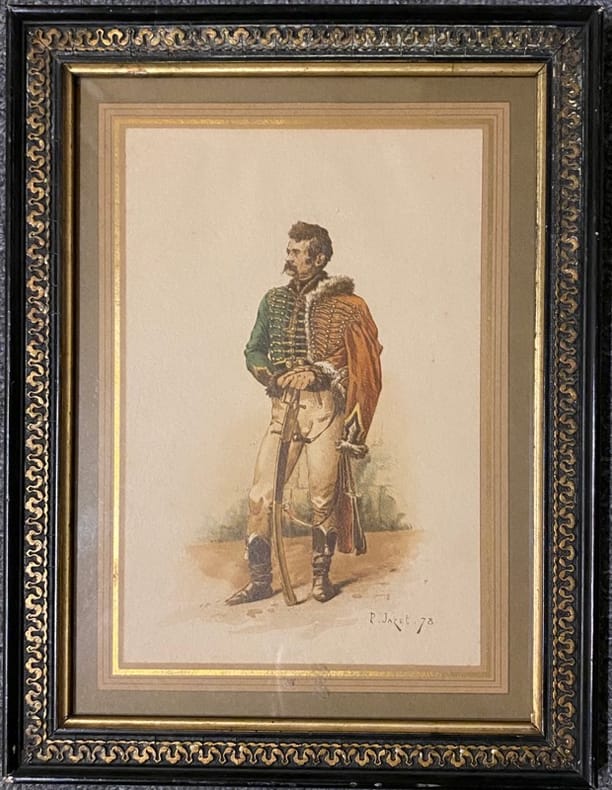
209562S.l., 1878 in-4 (25 x 18 cm), En feuille sous verre et baguettes de bois noir à décor doré.
4to., Sole Edition, with very numerous portraits and illustrations (a number in colour) in the text, and pictorial endpapers; regimental cloth, a very good, clean copy. Profusely illustrated review of staff, headquarters, personnel and activities. Includes a summary history of 10th Division. Uncommon; distribution was restricted to officers, enlisted personnel and families
Very Good Turkish Original wrappers. Roy. 8vo. (23 x 15,5 cm). In Turkish. 117 p. Uncommon enlarged second edition of this account of the Russo-Japanese War in 1905 describing rising Japanese nationalism at the beginning of the 20th century, by Demirhan (1871-1964), sent with reference of Goltz Pasha (Colmar von der Goltz, 1843-1916) to Manchuria to observe the war in the ranks of the Japanese army as a Turkish colonel. He stayed for two months in Japan and more than a year in Manchuria. In addition to writing down his observations in the field of war in detail, he also took on the duty of ambassador due to the Ottoman Empire's lack of diplomatic relations with Japan and contributed to the development of relations between the two countries. He received a medal from the Japanese Emperor Meiji and returned home with the gifts that Emperor Meiji presented to Sultan Abdulhamid. His account was published first in 1937 in book form. Sait Pertev Demirhan, (1871-1964), was a Turkish soldier and politician. He is a graduate of Erkân-i Harbiye. He was an author, intellectual, Erkân-i Harbiye School teacher, 6. Army chief of staff, Harbiye Undersecretariat, 3rd Army Chief of Staff, 1st Corps, and 4. Corps Commands, Military Schools Inspector, Member of History and Geography Councils, Member of Military Appeals Court, a deputy of Erzurum. He was the son of Yanyali Mustafa Pasha. He graduated from Harbiye as a staff captain (1892). In 1894 he was sent to Germany to advance his military education. After being a colonel, he was appointed to the Staff School as a teacher (1904). He was sent to the Russo-Japanese War as an observer. He returned to Istanbul in 1906 and was promoted to "Pasha", and was appointed as the 6th Army Chief of Staff. He participated in the Balkan Wars (1912-1913) and was in the Caucasian Theater during the First World War. He was sent to Vienna as a military diplomat. Upon his return, he moved to Anatolia to participate in the Greco-Turkish War (1919-1922). Only three copies are located in OCLC, two copies are in Turkish libraries, and one is in a German library; not in the US libraries. OCLC 60522483.
214524S.l., 1859 in-16, [7] ff. n. ch., couvertes d'une écriture très fine et lisible (environ 30 lignes par page), 3 ff. vierges, en feuilles.
222998S.l., s.d. (1796) in-folio, [468] pp. n. ch., couvertes d'une écriture moyenne, régulière, assez lisible (environ 40/45 lignes par page), vélin souple, dos lisse muet, tranches marbrées (reliure moderne). Gardes refaites.
Original Poster. 1 print. 84 x 56 cm. Lithograph, color. Poster showing a soldier reaching out above the chaos of battle. Civilians, when we go through this we need all the help and comfort you can give - The Jewish Welfare Board. United War Work Campaign - Week of November 11, 1918. The National Jewish Welfare Board, founded on April 9, 1917, played a central role in providing for both the spiritual and material needs of Jewish troops in World War I. Later renamed the Jewish Welfare Board, this organization trained both rabbis and lay leaders to serve as aids for the Jewish military. The Jewish Welfare Board supplied soldiers with kosher food, Passover meals, holiday services, and trans-denominational prayer books. Important Jewish leaders such as Dr. Cyrus Adler expedited these efforts. The Jewish Welfare Board also organized secular activities for the soldiers. By 1918, the Board extended its effort to the Jewish troops overseas. This classic poster shows a soldier who implores civilians to help with the war. Subjects: National Jewish Welfare Board - 1910-1920. World War, 1914-1918 - Economic & industrial aspects - United States. War bonds & funds 1910-1920. Soldiers - 1910-1920. Lithographs Color 1910-1920. War posters - American - 1910-1920. Original Poster. Copies held at the Library of Congress and Temple. Edge wear; slight tear to center, previously repaired with tape, otherwise clean and fresh. Good + condition. (AMR-46-44)
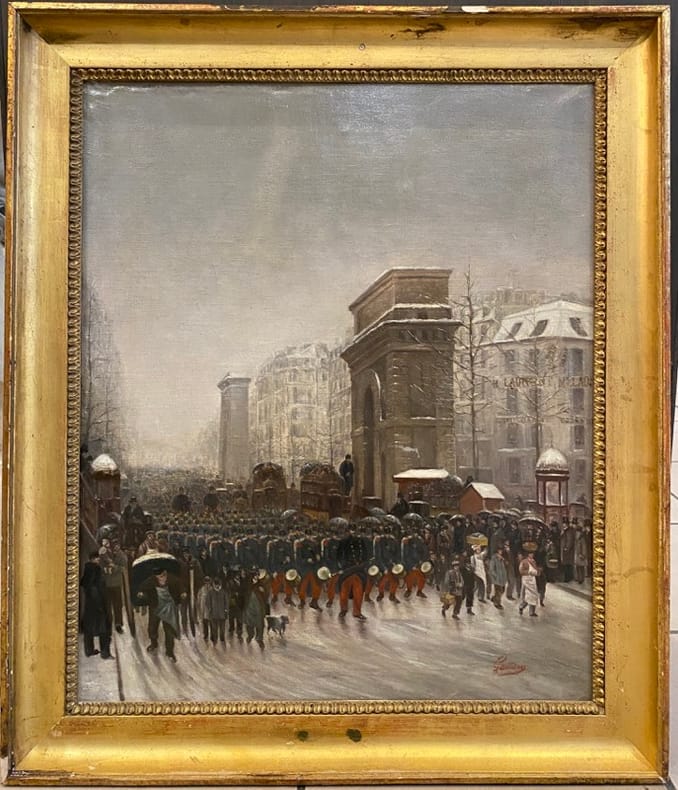
211908S.l., 54.5 x 46 cm, huile sur toile sous cadre de bois doré de l'époque. Manques au cadre.
237476[Berlin], [Ferdinand Dümmler] W. Moeser, s.d. (1878) 2 vol. in-8, XIV pp., 544 pp. ; un f. n. ch de table, 544 pp., avec deux portraits-frontispices, manquent les deux feuillets de titre, demi-toile cerise à coins, têtes grises (reliure moderne).
Very Good Russian Original color lithograph print. Split on folding places. Should be repaired. Folio. (51 x 32,5 cm). In Russian. From a book published by R. Golicke in St. Petersburg. Print signed by artist. [LITOGRAPH PRINT PAINTING of COSACKS] Dozv[onit'sia] Tsenzur. 28 Yuliia 1890, S[ankt] P[etersburg]. 1890, 162 written at the right bottom corner of original print. This is 162nd lithographic plate of the book. It shows soldier holding rifle with bayonet in his hand, and another soldiers who are attacking all together. Shipov was a Russian painter, a master of military portrait. Born in the province of Kostroma, Russia. Since 1875 was an auditor of Petersburg Academy of Arts. In 1880 he entered the military service. Studied painting without leaving military service. In 1883 he graduated from the training in the Corps of Pages. Since 1904 - the Commander of the East Siberian strelets regiment. In 1909 he was transferred to Suites, since 1915 - Lieutenant-General. In 1904-1915 received numerous awards for his military honor and courage, among them Golden Arms. He painted portraits of soldiers, watching them in battles and having rest. He did pencil sketches and watercolor portraits. One of the main representatives of the Russian military portrait of the edge of the century.
187024646Paris 1870 -in-8 demi chagrin un Manuscrit ORIGINAL relié, reliure demi-chagrin violet in-octavo (binding half shagreen in-octavo), RELIURE D'ÉPOQUE, dos à nerfs (spine with raised bands)(dos insolé), décoré "or" et à froid (gilt and blind stamping decoration), titre frappé "or", entre-nerfs à fleurons fleur de Lys "or", filet à froid de part et d'autre des nerfs, papier marbré marron foncé, marron clair et rouge aux plats, tête lisse dorée (gilt top edge), gouttière et tranche de queue non-rognées, Ex-Libris gravé en noir par Dan Lailler sur papier blanc collé au dos du 1er plat : aux armes de RICHELOT [de la Bibliothèque de René RICHELOT (1895-1969), un des derniers Grands Bibliophiles Bretons, ancien président de la Société archéologique d'Ille et Vilaine ], extrait découpé du catalogue de la Librairie Durand-Noël collé au dessus de l'Ex-Libris aprés l'achat de celui-ci, Texte Autographe Manuscrit à l'encre brune par V. BONHIOL (tampon de V. Bonhiol, Paris en bleu en bas du titre + Préface signée V.B.), Manuscrit orné d'une photographie albuminée en noir : Portrait de Mme la Duchesse de Berry en frontispice + 2 Photographies albuminées en noir "Portrait de Mme la Duchesse de Berry" différentes en hors-texte (dont une à la fin de sa vie) + 2 dessins originaux à la plume en noir à l'encre de chine ( dessin du Chateau de la Pénissière + dessin avec Femmes en costume d'époque lisant l'affiche "ETAT DE SIEGE" devant l'entrée du Château des Ducs de Nantes) + une grande planche hors-texte dépliante : "Intérieur et plan de la mansarde ou S.A.R. la Duchesse de Berry à été arrêtée"d'aprés un dessin de PLOUAYS DE CHANTELOU, lithographié en noir par Charpentier à Nantes + un Fac-Similé de lettre Autographe de Marie-Caroline Duchesse de Berry à Mr Meyer consul de Naples à Bordeaux, fait à Paris en Aout 1870,
228628Paris, Goupil, Vibert & Cie [Imprimé par Lemercier], s.d. (1848) grand in-folio (50 x 39 cm), 12 planches lithographiées sur papier teinté, et rehaussées de couleurs, montées sur onglets, manque le feuillet de titre, demi-chagrin havane, dos à nerfs fleuronné, tête dorée (Lemardeley). Dos uniformément insolé.
1900910794CG[Um 1900]. Federzeichnung 25 x 35 cm.
207106S.l., s.d. (1915-18) in-8, [68] ff. n. ch., réglés (cahier scolaire), écriture large et lisible, et [39] ff. volants, toile Bradel grise modeste, dos muet (reliure de l'époque).