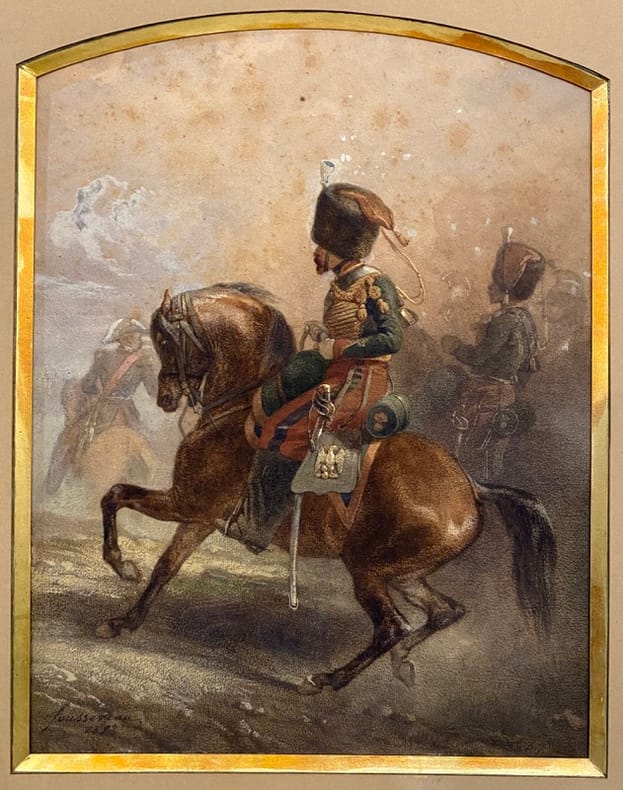
[SECOND EMPIRE] FOUSSEREAULivre Rare Book
30 333 résultats
208701S. l., 1853 36 x 47 cm, technique mixte (pastel, aquarelle et gouache) sur papier fort, fixé sur support cartonné, sous marie-louise à bords dorés, Rousseurs.
Rebound in half black cloth with gilt lettering and banding with brown marbled boards. Former owner's name on ffep. Pp 4-6 have brown spots (coffee? ). Browning to endpapers. Light foxing. Top of spine edgeworn. Edgewear to 1 corner. Pages tanned. ; Text in Ancient Greek; with latin introduction. Li, 63 pp. Onasander's Strategikos is one of the most important treatises on ancient military matters and provides information not commonly available in other ancient works on Greek military tactics, especially concerning the use of the light infantry in battle. ; Bibliotheca Scriptorum Graecorum Et Romanorum Teubneriana TEUBNER; 12mo 7" - 7½" tall; 63 pages
238432Paris, 1818 - 1824 9 pièces en un vol. in-8, déreliées. Trois dernières pièces détachées.
Very Good Turkish, Ottoman (1500-1928) Original manuscript autograph document signed by Mehmed Said Pasha sent to Trabzon Vilayat, Ordu Kaza, Hasbamane Nahiya local manager, faziletlu 'Mehmed Ali Sevki Beyefendi'. 33,5x20 cm. Folded. 1 p. In Ottoman script. Mehmed Said Pasha was an Ottoman monarchist, senator, statesman and editor of the Turkish newspaper Jerid-i-Havadis. He supported the CUP, the political party which came to power after the Ottoman coup d'état of 1913. His origin comes from 'Sebazâde family' from Ankara. He became first secretary to Sultan Abdul Hamid II shortly after the Sultan's accession, and is said to have contributed to the realizations of his majesty's design of concentrating power in his own hands; later he became successively minister of the interior and then governor of Bursa, reaching the high post of grand vizier in 1879. He was grand vizier seven more times under Abdul Hamid II, and once under his successor, Mehmed V. He was known for his opposition to the extension of foreign influence in Turkey. n 1896, he took refuge at the British embassy in Constantinople, and, though then assured of his personal liberty and safety, remained practically a prisoner in his own house. He came into temporary prominence again during the revolution of 1908. On 22 July he succeeded Mehmed Ferid Pasha as grand vizier, but on the 6 August was replaced by the more liberal Kâmil Pasha, at the insistence of the Young Turks. Also during 1908, Mehmed Said Pasha bought the famed Istanbul arcade in the Beyoglu (Pera) district, today known as Çiçek Pasaji ("Flower Passage"). The modern name became common in the 1940s; during Mehmed Said Pasha's ownership in the 1900s and 1910s, the arcade was known as Sait Pasa Pasaji ("Said Pasha Passage"). During the Italian crisis in 1911-12, he was again called to the premiership. He was again removed from power by the Savior Officers (who backed the Freedom and Accord Party (Liberal Union) against the Committee of Union and Progress) and replaced by a new cabinet supported by the Officers and the Freedom and Accord Party. The CUP would return to power, however, the next year after the Ottoman coup d'état of 1913. (Source: Wikipedia). Seven lines on special paper with watermark 'Joynson Superfine'. Letter of request to provide teaching for some students in the region.
Very Good Turkish, Ottoman (1500-1928) Original paper autograph letter handwritten signed by Mahmud Sevket, Izzeddin Çalislar. (33x21 cm). In Ottoman script. 2 p. Repaired back side. Request of a surgical operation by 'Said bin Mehmed' (Siroz Redif Taburu Efrâdindan) and Mahmud Sevket Pasha and Izzeddin's confirmations. Signed by Mahmud Shevket Pasha as "commander of Turkish countercoup of 1909 (Hareket Army)" and by Izzeddin [Çalislar] as "Erkân-i Harb Kolagasi (Batallion commander)". The Ottoman countercoup of 1909 (13 April 1909) was an attempt to dismantle the Second Constitutional Era of the Ottoman Empire and replace it with an autocracy under Sultan/Caliph Abdul Hamid II. Unfortunately for the advocates of representative parliamentary government, mutinous demonstrations by disenfranchised regimental officers broke out which led to the collapse of the Ottoman government. Characterized as a counterrevolution, chaos reigned briefly and several people were killed in the confusion. It was instigated by some parts of the Ottoman Army in a large part by a certain Cypriot Islamic extremist. Dervish Vahdeti reigned supreme in Istanbul for 11 days. The Countercoup was put down in the 31 March Incident, on 24 April 1909 by the Army of Action (Hareket Ordusu) which was the 11th Salonika Reserve Infantry Division of to the Third Army (Ottoman Empire) commanded by Mahmud Shevket Pasha. Extremely rare.
Very Good Turkish, Ottoman (1500-1928) Original color map of Eastern Anatolia, Dogu Beyazit, Bayazid, Bargiri, Nakhchevan, Karakilise, Van, etc. 50x60 cm. In Ottoman script (Enverî). 1 p. Scale: 1:200.000. Slightly toned, several small holes on paper. Otherwise a very good copy. Enverî script is the war minister Enver Pasha's alphabet and writing amendment, which he tried to implement within the Ministry of War between 12 March 1914 and 10 August 1914. Starting from the Tanzimat (Westernization) period in the Ottoman Empire, the discussions on simplification in language, writing, alphabet and reading-writing had increased and at the end of the 19th century, military necessities also became one of the concerns. The problems such as the low rate of literacy among the recruited soldiers, the need to teach the soldiers how to read and write in a short time, and their misconceptions about the spelling of proper nouns led Enver Pasha to add the writing problem to his reform agenda, once he took office. Enver Pasha's reform is based on the principle of writing the Ottoman letters, which take different forms in the beginning, in the middle and at the end according to their unification with the other letters, separately in their original state without merging them. While this new alphabet was being created, the existing 32 letters in the Ottoman were preserved. The 8 vowels in the Turkish language, which could not be written with the old letters, was shown by placing small marks on the existing vowels and by doing so a new alphabet consisting of a total of 40 letters was created. With this alphabet, officially called 'Ordu Elifbasi', rules were adopted such as writing of the letters without merging them, writing the words as they are pronounced. At first glance, Enver Pasha's writing reform, which appeared as a definite solution to the theory of the solution of the ongoing debates on the alphabet and the spelling, formed a wide experiment field in the military. It was not possible to use Ordu Elifbasi, which essentially is a transliteration alphabet that allows transferring the sounds of these three different languages (Turkish, Arabic, Persian) to a single alphabet, in the daily life. Thanks to this new alphabet and spelling, learning to read and write were accelerated to some extent. However, it was seen that the literacy rate of the well-educated, literate people fell to the spelling and did not even progress. This alphabet and spelling reform, which Enver Pasha thought of spreading to the whole country, caused much more problems as it was experienced in the army. Although it was postponed until the end of the mobilization period following the declaration of the mobilization, Ordu Elifbasi, which remained in force for 152 days, eventually failed to be realized. (Source: Karakus: Enver Pasha's Alphabet And Spelling Attempt: Ordu Elifbasi (Army Alphabet)).In this extremely rare document, there are some articles and thoughts on a case. This is one the serie of the Bonn projection maps which are the first map series in modern techniques in Turkey and the Ottoman Empire. In order to produce these maps covering Turkish territory, Reconnaissance Branch was incorporated into The Mapping Commission. The maps were produced in the datum based on the latitude and longitude of Ayasofya Mosque in equal area Bonn Projection. The field works for the 123 sheets covering the country were conducted by 76 staff. The production was completed in 18 years starting from east west. Field works continued without stopping except in years 1914 and 1920. This map series called also reconnaissance maps contributed a lot to producing 1:25.000 scale maps. Extremely rare. KW: "Harfleri Islah Cemiyeti" Hurûf-i munfasila Reform Turkish Letter revolution First World War WW 1 Map Geography Military maps.
Very Good Turkish, Ottoman (1500-1928) Original color map. Elephant folio. (59x75 cm). In Ottoman script. [OTTOMAN MILITARY MAP of PATAGONIA and FALKLAND ISLANDS: ROUTE of DRESDEN] Alman kruvazörü Dresden'in takîbi ve tahrîbi. SMS Dresden cruiser's routes between 1913-1915 (World War 1) on the Patagonian shelf; western shores of South America, Patagonia and Falkland Islands. Dresden spent much of her career overseas. After commissioning, she visited the United States in 1909 during the Hudson-Fulton Celebration, before returning to Germany to serve in the reconnaissance force of the High Seas Fleet for three years. In 1913, she was assigned to the Mediterranean Division. She was then sent to the Caribbean to protect German nationals during the Mexican Revolution. In mid-1914, she carried the former dictator Victoriano Huerta to Jamaica, where the British had granted him asylum. She was due to return to Germany in July 1914, but was prevented by the outbreak of World War I from doing so. At the onset of hostilities, Dresden operated as a commerce raider in South American waters in the Atlantic, then moved to the Pacific Ocean in September and joined Maximilian von Spee's East Asia Squadron. Dresden saw action in the Battle of Coronel in November, where she engaged the British cruiser HMS Glasgow, and at the Battle of the Falkland Islands in December, where she was the only German warship to escape destruction. She eluded her British pursuers for several more months, until she put into Robinson Crusoe Island in March 1915. Her engines were worn out and she had almost no coal left for her boilers, so the ship's captain contacted the local Chilean authorities to have Dresden interned. She was trapped by British cruisers, including her old opponent Glasgow. The British violated Chilean neutrality and opened fire on the ship in the Battle of Más a Tierra. The Germans scuttled Dresden and the majority of the crew escaped to be interned in Chile for the duration of the war. The wreck remains in the harbor; several artifacts, including her bell and compass, have been returned to Germany.
224453S.l., s.d. (vers 1880) 2 bifeuillets in-8 (20 x 13,5 cm), en feuilles, à rebords gaufrés ou ajourés, dont l'une contrecollée sur carton souple moderne.
181314Paris, 1796 in-8, 1 p., en feuille.
181364Paris, 1796 in-8, 1 p., en feuille.
181271Paris, 1796 in-8, 1 p., en feuille.
181217Paris, 1796 in-8, 1 p., en feuille.
181358Paris, 1796 in-8, 1 p., en feuille.
181163Paris, 1796 in-8, 1 p., en feuille.
181168Paris, 1796 in-8, 1 p., en feuille.
181286Paris, 1796 in-8, 1 p., en feuille.
238169Paris et Milan, 1800 - 1801 7 pièces en deux vol. in-8, demi-veau fauve, dos lisses ornés de dent-de-rat et filets dorés, pièces de titre crème, coins en vélin (reliure un peu postérieure). Des mouillures claires au premier volume.
1904904351BG[1904]. Blattmaß: 28 x 35 cm (quer).
1911904599BG1911. Blattmaß: 50 x 65 cm (quer).
193016729Revue militaire française, sd (1929, 1930) 1930 In-8 demi-basane à coins, près de 100 pp. Croquis. Reliure frottée.
192516723sd. 1925 In-8 demi-toile à coins, 178 pp. Recueil factice de 7 fasc.
1884904364BGDresden:, 1884. Blattmaß: 38 x 27 cm.
1376660Paris: , 1870-1887 réunion de 5 textes reliés en un voi. in-8: 51 pages et 6 planches; 14 pages; 40 pages; 30 pages; 206 pages et 3 cartes se dépliant. Demi chagrin, dos à 4 nerfs, caissons dorés, petites usures, qq rousseurs, autrement bel exemplaire.
Roy. 8vo., First Edition, with very numerous photographs throughout; pictorial boards, a near fine copy.
19891207141Göttingen : Vandenhoeck u. Ruprecht, 1989. 180 S. ; 19 cm kart.