Judith Le SoldatBiblio.com
224 résultats
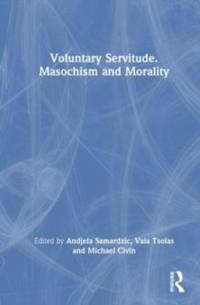
ria9781032666235_inpHardcover. New. New Book; Fast Shipping from UK; Not signed; Not First Edition; Le Soldat’s Voluntary Servitude. Masochism and Morality presents an extraordinary analysis of masochism the subject death drive and sexual discourse inspired by Freudian drive theory philosophy gender theory political science and hardcover
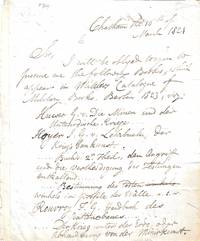
26808Chatham 16 March 1824. Three pages cr.8vo bifolium small closed tear at fold aging text clear and complete. See Image for partial Image of titles listed ordered from Mittler's "Catalogue of Military Books 1823" adding a postscript as follows: "NB I am not anxious to have the Books very soon and will therefore wait your usual period of important German Books if more convenient to you than ordering the immediately."Note: Wikipedia "soldier and military engineer who wrote the defining text on the role of the post-American Revolution British Empire: An Essay on the Military Policy and Institutions of the British Empire published in 1810. This text changed how Britons thought their empire should relate to the rest of the world. He warned that Britain could not keep its Empire by its "splendid isolation". Britain would need to fight to gain its empire and by using the colonies as a resource for soldiers and sailors it grew by an average of 100000 square miles 260000 km2 per year between the Battle of Waterloo and the American Civil War. Serving in the Royal Engineers in the Napoleonic Wars he was Europe's leading demolitions expert and siege warfare specialist." Chatham, 16 March 1824. unknown
19982Docketed as from Stratton Street with date 31 January 1803. . 2pp. 4to. Bifolium. In fair condition lightly aged. Written in a difficult hand. Docketed on reverse of second leaf in a neat hand explaining the context: 'Genl Thomas Graham Stratton Street 31 Janry 1803 wrote him first febry that Peers could not be Commssrs of Supply 1803 3 Febry wrote Lord Keith.' Graham's letter reads: 'There is the list – except two names wch. Lord Keith wishes to have inserted & the memorandum. Of wch. I have mislaid – one is the Baillie of Kinkardine sic for the time being I think – but it wd. be best to apply to him for the proper designations & if necessary afterwards to write to Mrs. Paton abt. them – I think it wd. be worth while to have this list printed - & carefully examin'd & any errors corrected – I will be at the expense & then no mistake can take place in the names or designations in the act of parliament. Transcribing them from this printed list'. He ends by asking to be advised on the matter. [ Docketed as from Stratton Street, with date 31 January 1803. ] unknown
22140Woodthorp nr Wakefield 27 March 1826. Five pages 12mo a little grubby with selltape securing the bifolium text clear. P.4 docketing with details of contents. Text: He thanks Wilson for his letter but says he can't "render you any efficient Service in facilitating your arduous and most interesting remarks. I certainly used my best Andeavours to obtain for you the Distinction which you conceived and seem still to imagine could have been useful to you I was not o fthat opinion. But as it was clear that it could do you no harm if it did you no good and that you wished it I very much regretted to find an obstacle in my Way as immoveable as any of the Mountains you have ascended. What you have already given to the publick and done me the Honor of sending to me And the Letters you favored me with during your Travels gave to the Ladys sic of my Family in particular Lady Cathcart and to myself the greatest delight." He then thanks his for sedning a copy of his latest book in wnich he gives "a most interesting Survey of the Nations and Countreys sic under the usual heads of Observation But to have collected particular and very interesting Details and Documents in Regard to military means . and Civil constitutions which are not of very easy Attainment and most of which as far as I recollect have not yet appeared in any Publication of authority in the English Language. ." He concludes with emphasising his current address and giving instructions for posting the book. In a postscript he passes on Lady Cathcart and his daughters' compliments. Note: Wilson published "Travels in Norway Sweden Denmark Hanover Germany Netherlands & c." in 1826. Woodthorp, nr Wakefield, 27 March 1826 unknown
232805 Grand Parade Eastbourne Sussex 27 June 1860. Two pages 12mo bifolium. good condition. Text: "Herewith I return the Proofs corrected to the best of my ability. The speech is wonderfully well reported I think. I have not touched any speech but my own. Lady Edwardes joins me in kind regards to Mrs. Phillips & yourself; & I assure you we look back with pleasure to our stay under yur roof. ." He is perhaps referring to his speech at the Church Missionary Society's Meeting in London in May 1860. 5 Grand Parade, Eastbourne, Sussex, 27 June 1860. unknown
23270Unknown Newspaper 1930 or 1931. Substantial Article extracted from a newspaper 38 x 29cm good condition in which Wilkins discusses his project of taking a submarine the "Nautilus" of course under the Arctic. His signature "Hubert Wilkins" appears top left probably in pencil. Unknown Newspaper [1930 or 1931] unknown
20228Place indecipherable. 15 August <1809>. 1p. 16mo. In fair condition on aged and worn paper. Reads: Dear Sir - I am directerd by the Commander of ther Forces to request that you will pay the enclosed on account of the Extraordinaries of th Army.' Torrens was Military Secretary between 1809 and 1820. Place indecipherable. 15 August <1809?>. unknown
25450Both on revolutionary letterheads. Secretarial letter: ‘Valence le 20 frimaire an 12 de la République française. i.e. 12 December 1803’ Printed decree: ‘Valence le 7 brumaire an 12 de la République française. i.e. 30 October 1803’. The two items are on variations of the revolutionary letterhead of the Prefect of the Drôme Department with oval medallion illustration of a seated liberty with a phrygian cap on a stick forearm leaning on the fasces and the words ‘Libérté’ and ‘Égalité’. The printed decree is in good condition lightly aged with slight foxing and discoloration. The secretarial letter is in fair condition with darker patches of discoloration. ONE: Eighteen-line official communication in a secretarial hand from ‘ Préfet du Département de la Drome / Au maire de la Commune de propiac’ ‘sur les points limitatifs du territoire et sur l’étendue du secrétaire’. Addressing the mayor as ‘Citoyen’ and signed ‘Marie D’escorches’ note the apostrophe. 2pp 4to. TWO: Printed decree from ‘LE PRÉFET du Département de la Drome/ Aux Ecclésiastiques et aux ci-devant Religieuses du Département’. 2pp 4to on first leaf of bifolium. Signed in type ‘MARIE DESCORCHES’. Begins: ‘CITOYENS / Je vous préviens que le gouvernement a par son arrêté du 7 thermidor dernier dont extrait m’est parvenu aujourd’hui donné un extension au terme fixé pour que ceux d’entre vous qui n’ont pas encore présenté leurs titres puissent le faire.’ See Image heading of one text of the other. Both on revolutionary letterheads. Secretarial letter: ‘Valence, le 20 frimaire, an 12 de la République française. [i.e. 12 unknown
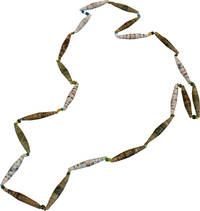
191821085London: St. Thomas' Hospital 1918. Very Good. London: St. Thomas' Hospital ca. 1918. Original necklace of twenty-one hand-made wallpaper beads each approx. 4cm. in length interspersed with colored glass beads. Wallpaper beads a bit browned else a fine piece of vernacular jewelry. <br /> <br /> Slightly later manuscript card attached to necklace stating "Necklace made of wall paper by a wounded soldier / In St. Thomas' Hospital London. 1914 - 1918 War." The hospital located on London's South Bank would indeed have seen many convalescing soldiers though we have been unable to find mention of other similar examples of soldier-made wallpaper beads this example possibly made to be sold at a local fundraiser or bazaar. St. Thomas' Hospital unknown
13770Both letters on letterhead of 12 The Leas Folkestone Kent England. 17 and 28 December 1896. Printed flier: Wightman & Co. "The Westminster Press" 104 Regency Street London SW. Undated. The two letters and flier are in good condition on lightly-aged paper; the cutting is on aged newsprint separated into two parts along a crease line. Letter One 17 December 1896: 2pp. 12mo. Bifolium. He informs the recipient that as the review list for the book is closed its publishers Wightman & Co have sent on the reviewer's letter to Musgrave. 'We are following this course as much interest exists between the North Country & West Africa. In fact the deadly colonies of the coast would soon come to a standstill were it not for the labours of numbers of Scotchmen who brave the climate in a way that makes "Southerners" wonder'. He describes his book as 'an unpretentious little volume of more interest perhaps for its side lights than the account of the expedition which has been so fully dealt upon in Major Baden Powell's Diary "The Downfall of Prempeh".' Baden Powell's book is 'a well produced & expensive work . beyond the reach of ordinary readers whilst its interest is mainly military rather than general'. Letter Two 25 December 1896: 3pp. 12mo. Bifolium. He discusses a photographic reproduction which the recipient would like to accompany his review in the Figaro. Musgrave gives the details of the printer J. Lesley 17 Charlotte Street Portland Place and explains how to obtain and return the 'fair block taken from a small snap shot enlargement' which the recipient wishes to accompany the review. Musgrave is 'sailing to Cuba in the course of a few days' and lists four people to whom he would like copies of the review sent. Printed flier: 4pp. 12mo. Bifolium. Good on lightly-aged paper. Headed 'Now Ready. To Kumassi with Scott. A new & popular edition of a work on West Africa and the Ashanti Expedition. By George C. Musgrave'. The last page prints three endorsements: the first from H. M. Stanley the second from the Daily News the third from 'An Officer who served with the Force'. The cutting is headed: 'The occupation of Kumasi. sic King Prempeh a prisoner. Arrest of the envoys. Official despatches.' Both letters on letterhead of 12 The Leas, Folkestone [Kent, England]. 17 and 28 December 1896. Printed flier: Wightman & Co., " unknown
22048The first of the four letters on letterhead of Little Parkhurst Abinger Common Nr Dorking Surrey; the other three without place. One from 1940 two from 1941 one from 1943. The recipient Simon Nicholson was a colonial civil servant and a neighbour of Lugard at Tallboys in Abinger Hammer. He and his wife Molly were a cultured couple and were friends of Edith Wharton and Bernard Berenson. The four letters are in good condition lightly aged and worn and each is 2pp 12mo. Each folded once. The first three are signed 'Lugard' and the last to Molly Nicholson 'Fred Lugard'. In the first letter 23 September 1940 after expressing pleasure at seeing Nicholson again and having 'a talk' he begs him 'not to postpone your week-end here. Molly needs it – badly – She did not say so – quite the contrary but I did not need to be told.' He asks him to come the following Saturday adding: 'You can bring papers & have the drawing-room to yourself.' He asks to be informed 'as much in advance as is convenient as I may have Reg Brackenbury & his wife any week-end'. Lugard's brother 'was disappointed that you forgot to hand me some papers you had for him'. The second letter 21 March 1941 concerns arrangements for a meeting with Lugard stating that 'it is a monstrous long time since I have seen you'. He also expresses regret that Nicholson is 'selling Tallboys'. The third letter 9 May 1941 begins: 'My brother & I are both delighted to hear that you are coming back to Tallboys & selfishly hope that you will continue to fail in your attempts to sell it. If Little Parkhurst can be of any use to you in the transition don't fail to make use of it.' He has 'been much engrossed with Abyssinia of late' and looks forward to talking to Nicholson about it. In a postscript he names two individuals who 'are coming “to talk over old timesâ€'. In the final letter to Molly 22 January 1943 he regrets that it is so long since he has seen her and her husband 'for though so comparatively close the lack of petrol has as you say placed a gulf between us. Simon wrote me a most welcome letter from his office & I enclose this little note to you in my reply.' He find the 'news from Russia … very cheering - & wonderful' and does not suppose it will be 'very long now before our turn comes to face the Nazis in Europe'. He ends in the hope that 'some obliging friend' will give the Nicholsons 'a lift over'. The first of the four letters on letterhead of Little Parkhurst, Abinger Common, Nr Dorking, Surrey; the other three without pla unknown
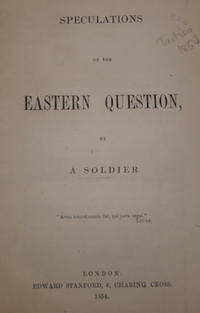
63-9505London UK: Edward Stanford 1854. 8vo. Bound Section 15 pp. Good with Boards & Spine Missing. Scarce.PROVENANCE: Collection of Books from the Library of Hugh Small author of Florence Nightingale: Avenging Angel.Hugh Small as a child lived above his surgeon father's consulting rooms in Harley Street almost opposite Florence Nightingale's first hospital. He graduated from Durham University in 1966 with honors in physics and psychology and worked in the US Chile and France before becoming a partner in a multinational management consultancy based in London. He is also the author of The Crimean War Tempus 2007. Hugh is widowed with two daughters and four grandchildren. London, UK: Edward Stanford, 1854. hardcover
19262110502150306340Treasure Museum 1926. Soft Cover. Fine. Volume: 1 Treasure Museum paperback
1855004467London: H.G. Collins 22 Paternoster Row 1855. 12mo pp 25 3 4pp publisher's adverts. Double-page map of Sebastopol Harbour double page map showing the Crimea relative to the seat of war 9 engraved plates of which three are double page showing the exterior of a casemated battery plan of a modern fortress with siege works profile view of a bastion 24 pounder siege gun an embrasure a 15 inch french mortar shell case-shot grape-shot & round shot a fascine & a gabion Minie rifle & patent revolver. All the plates are waterstained the contents are very slightly weak neat stamp of a former owner T.W. Pickard who was the estate manager at Glynde in three places including the title page and very faintly on the upper cover large inscription of original owner Frederick Prodger on verso of front endpaper original orange glazed and printed boards rubbed and slightly worn original blue cloth spine a little worn. EXTREMELY RARE. First Edition. Boards. Good. H.G. Collins, 22 Paternoster Row Hardcover
22285'A Anteuil ce 25 floreal an 11'. i.e. 15 May 1803. An interesting letter casting light on bibliographic and book trade practices in Consulate Paris. 2pp 12mo. Forty-two lines of closely-written text on the first leaf of a bifolium the recto of the second leaf being addressed 'Au Citoyen Firmin Didot Rue du Regard A Paris'. In good condition lightly aged with white paper stub of mount adhering to second leaf. 'L'Aristote' is written in the left-hand margin of the first page and he begins by giving the results of the collation of the various editions of du Val's Aristotle finding that 'l'edition de 1619 et celle de 1629 sont la meme et la plus belle; et que celle de 1639 inferieure pour l'execution est la Seule qui contienne les dernieres additions de du Val – dont je suis curieux'. He notes the printers of the three editions. In the light of his discoveries he discusses the purchases of the 1639 edition from 'la personne que vous charges de ces commission' asking him 'de vouloir bien recompenser pour moi cet agent car voila bien des peines que je luie donne et bien des emplettes difficiles et qu'il fait pour moi et si bon marche qu'il est impossible qu'il y ait le moindre benefice ce qu n'est pas juste'. A long postscript concerns 'notre bon ami Cabani' and his 'pauvre camarade Heimebart' In a second postscript he states that he has had to abandon his intention of calling on Didot for 'l'exemplaire en question' as he is 'un peu souffrant'. 'A Anteuil ce 25 floreal an 11'. [i.e. 15 May 1803] unknown
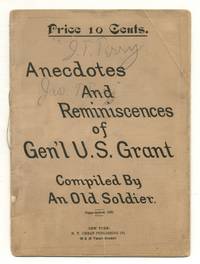
1885558564New York: N. Y. Cheap Publishing Co 1885. Softcover. Good. First edition. 16mo. Stitched printed buff wrappers. Early owner name "Jas. T. Terry" vertical crease with a bit of splitting some old penciling on front wrap a good copy. OCLC locates only six copies. N. Y. Cheap Publishing Co unknown
100968The full-length albumen paper studio portrait 92 × 55 mm is mounted as issued on the printed card of W.H. Schroeder 649 George Street Haymarket 'and at Princes Street Grafton'. The firm was definitely active at that address from 1867 to 1879 but the image appears to be earlier rather than later in this period. The uniform is that of the NSW Volunteer Artillery from the 1860s. Very similar caps are also to be found in a Tasmanian photograph in the collection of the Australian War Memorial A04784 'ten men of the Hobart Town Volunteers Artillery and ten men from the First Rifles' dated October 1863. unknown
19486818Madrid: La Arcadia 1948 Imp. en Gráficas Ultra.- XIII65 p. 4 h.: Va ilustrado con la reproducción facsímil de la portada de la obra original; 4º 255 x 175 cm; Portada a dos tintas; Intonso; Fina impresión sobre excelente papel ahuesado verjurado con todas sus barbas; Enc. original en Cartulina Ed.- Publs. de La Arcadia. 6.- Tirada de 110 ejemplares numerados. En excelente estado de conservación. Reimpresión de la rarísima edición de: "Zaragoza en las prensas de Jorge Coci hacia 1504". La obras nos relata de un modo directo y popular la conquista de Nápoles por el Gran Capitán Don Gonzalo Fernández de Córdoba. RARA EDICION DE BIBLIOFILO. HISTORIA DEL SIGLO DE ORO ESPAÑOL Libro en español La Arcadia paperback
1875052767Westminster: Manuscript ALS. ca. 1875 1875. No Binding. Very Good. Original autograph letter signed ALS 'W. Gifford Palgrave' to "Dear Joseph" regretting he is unable to make the journey William Palgrave Gifford. Speaker's Court the Palace Westminster undated. 15x10 cm. In English. 2 pp. in good condition with a separate photographic portrait of Palgrave. William Gifford Palgrave was an English priest soldier traveller and Arabist author of A Personal Narrative of a Year's Journey through Central and Eastern Arabia 1862-1863. Palgrave was born in Westminster. He was the son of Sir Francis Palgrave and Elizabeth Turner daughter of the banker Dawson Turner. His brothers were Francis Turner Palgrave Inglis Palgrave and Reginald Palgrave. He was educated at Charterhouse School then occupying its original site near Smithfield and under the head-mastership of Dr Saunders afterwards Dean of Peterborough. Among other honours he won the school gold medal for classical verse and proceeded to Trinity College Oxford where he obtained a scholarship graduating First Class Lit. Hum. Second Class Math. 1846. He went straight from college to India and served for a time in the 8th The King's Regiment of Foot Bombay Native Infantry H.I.C. Shortly after this he became a Roman Catholic was ordained a priest and joined the order of the Jesuits Society of Jesus and served as a member of the order in India Rome and in Syria where he acquired a colloquial command of Arabic. He convinced his superiors to support a mission to the interior of Arabia which at that time was terra incognita to the rest of the world. He also gained the support of the French emperor Napoleon III representing to him that better knowledge of Arabia would benefit French imperialistic schemes in Africa and the Middle East. Palgrave then returned to Syria where he assumed the identity of a travelling Syrian physician. Stocking his bags with medicines and small trade goods and accompanied by one servant he set off for Najd in north-central Arabia. He travelled as a Christian. The service he would do for the Society of Jesus and the French empire would be as a spy not a missionary. Palgrave became friendly with Faisal bin Turki bin Abdullah Al Saud while in Riyadh Saudi Arabia. Faisal's son Abdul Rahman bin Faisal asked Palgrave to get him strychnine. Palgrave believed that Abdul wanted to poison his father. Palgrave was accused of espionage and was almost executed for his Christian beliefs. <br/> <br/> Manuscript ALS., [ca. 1875] unknown
23284Osborne 2 January 1862. Black-bordered three pages 12mo bifolium fold marks good condition. Text: "I have not failed to lay before Her Majesty the Queen the purport of your letter of the 31st Ult. Her Majesty was well assured that the University of Cambridge was not likely to be backward in any expression of Sympathy with Herself in Her overwhelming grief or to be wanting in any mark of respect for their Chancellor. In the constant association for which my office afforded me the highly valued opportunities I have ofter heard my beloved Master express the feelings of Pride with which he viewed His position as Chancellor of your great University and the deep interest which he took in its Welfare. I have the Honor .". Osborne, 2 January 1862. unknown
19812111902158500119Tsugu Village Office Aichi Prefecture 1981. Soft Cover. Fine. Number of pages: 184p. Size: 27cm Tsugu Village Office (Aichi Prefecture) paperback
2601323 June 1796. 'Entered in the Office for Auditing the Public Accounts the 9th of February 1797'. See his entry in the Oxford DNB. 1p folio. Text clear and entire on worn and grubby paper with chipping to edges and slight loss to one corner with one closed tear repaired with archival tape. Embossed tax stamps at head. Good firm signature at bottom right ‘David Dundas.’ beside small seal in red wax with crumbling impression. At bottom left: ‘Signed Sealed and Delivered being first duly stampt in the Presence of us / John Landon / M King’. Downwards in left-hand margin: 'Entered in the Office for Auditing the Public Accounts the 9th of February 1797 / Thos Gibbes’. Begins: ‘Know all Men by these Presents that I David Dundas Esqr. Major General of His Majestys Forces and Colonel of the Twenty Second Regiment of Foot for and in Consideration of Clothing furnished and delivered by Alexander Adair Esqr. of Pall Mall to and for the Use of the said Regiment .’. The document concerns ‘the Offreckonings or Clothing Money of Twenty Serjeants Twenty Corporals Eight Drummers Two Hundred Privates Ten Contingent Men and Eight Warrant Men’. 23 June 1796. 'Entered in the Office for Auditing the Public Accounts the 9th of February 1797'. hardcover
24038Ten of the poems dated to 1912; one from Burnham Beeches. Prose piece without date or place. Archaeologist poet soldier writer of crime fiction - it seems extraordinary that such a man should not have been accorded an entry in the Oxford DNB. In 2001 Napier University in Edinburgh published twenty-one of her father’s ‘Poems from the Great War’ transcribed from his notebook by his daughter Lady Jennifer MacLellan. At least ten of the eleven poems present here date from before the war. The are conventional in structure and somewhat immature in tone: the influence of Francis Thompson is apparent. The prose piece is altogether more successful. In choosing as his subject a fictitious individual with an almost primal connection with rock and stone Casson could almost be writing about himself. He was the author of ‘The Technique of Early Greek Sculpture’ 1933 and ‘Sculpture of To-day’ 1939 and carefully oversaw the transportation of the two and a half tons of sculptured marble and iron railings of Rupert Brooke’s monument to the remote olive grove where he is buried. All eleven poems present here are fair copies in autograph nor has the typescript prose piece any manuscript emendations. There is no indication that any of the items were ever published. The eleven poems are grouped over two bifoliums and two loose leaves each of the four groups dating from a different time. ONE: Six poems on a bifolium headed ‘Sept. 1912. M. F.’ 3pp 12mo. The first lines of the six poems are as follows. First poem twelve lines: ‘Little Brothers of the Grasses / Let me stay awhile with you.’ Second poem five lines: ‘On the warm stones beside the sea I lie’. The last four poems appear to have the collective title ‘Sea Sorrow.’ Third poem four lines: ‘Wild waves that fling their foam & fall’. Fourth poem eight lines: ‘O passionate waves that never tire!’ Fifth poem eight lines: ‘’Tween grey of the sea & grey of the sky’. Sixth poem four lines: ‘Over the downs at dusk of day’. TWO: Three poems on a single leaf headed ‘Burnham Beeches. / Oct. 1912. M. F.’ 1p 4to. First poem twelve lines: ‘Deep down in the woods when the leaves are falling’. Second poem six line: ‘A cold gold moon climbed up a steely sky’. Third poem sixteen lines: ‘Life like leaves that were green & now are sere’. THREE: Single poem twenty-one lines on bifolium headed ‘MÆSTITIA DIERVM NON REVOCANDARVM QUIA CONFECTARVM. / Nov. 1912.’ First of three stanzas: ‘Amind the singing of the stars / Amid the singing of the sea / The old dead days from devious ways / Came drifting drifting up the / hilltop still and secretly. / All grey the earth and grey the sky / As the ghosts of days went drifting by.’ FOUR: Single poem ten lines on one side of torn piece of paper. 1p landscape 12mo. Begins: ‘What has been and what is to be / Surges around and covers me.’ FIVE: Mimeographed typescript of a prose piece titled ‘THE MAN FROM THE HILLS’ with the author’s name given at top right as ‘S. CASSON.’ 5pp 4to. Printed on one side each of five leaves held together with a brass stud. Neatly folded twice. Reminiscences and assessment of the character of a almost certainly fictional departed friend of the narrator’s an otherworldly figure with a ‘close friendship of inanmate things’ and in particular stone ‘He told me once that the grandest feeling he had ever experienced was when he was crossing the Aegean and knew he was near Paros and its marble quarries.’. First paragraph reads: ‘His senses told him of the proximity of mountains just as we of cruder sensibility know when we are near the sea. He was not endowed with the more abnormal gifts of those in whose hands hazel twigs bend at the knowledge of flowing water or who can tell without enquiry what sort of men they were who scarred the hilltops with trenches or carved the slopes into lynchets. He was just an ordinary man but his capacities had bever been blunted with the trivialities of routine or the banal things of everyday existence.’ Ten of the poems dated to 1912; one from Burnham Beeches. Prose piece without date or place. unknown
0MV327New Market Virginia VA CIVIL WAR - VIRGINIA holograph letter written by Union solider from New Market VA. 4 pages unsigned so possibly incomplete but interesting content. To his father; ".I said I did not know whether I should ride my horse or get sent through by rail as far as Winchester / I saddled my horse and rode out about two miles / went to captain to see if I would be sent my rail - he said no because bridge was gone / railroad bridge at the ferry across the Potomac was washed away by heavy rain / must ride my horse or stay behind / packed my duds & mounted my horse in a drizling rain / passed through Charlestown where John Brown was tried and hung 8 miles from the Ferry & stopped about 4 miles from Berryville / took quarters in old deserted tavern with Marve / started for Woodstock where regiment was / orders - no women companions / took off my overcoat and rolled it and strapped my saber and pitol haversack & canteen to saddle this lightened my load / we did not pass near enough to the field of battle this side of Winchester to get sight of it though I saw where the skirmishing commenced on the road & our men drove them back onto the hill about a mile and a half before they made a stand behind the stone wall / some trees by the road were all picked up by rebel bullets and they probably sheltered some of our men and an old house was burnet down by a shell from our guns that sheltered them." Very good decscriptive letter. Very Good. 16mo - over 5¾" - 6¾" tall. Manuscript. unknown
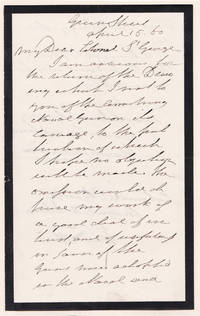
186034086Green Street London: April 15 1860. 1860. Very good. - Letter penned in black ink filling most of both sides of a sheet of cream paper approximately 8 inches high by 6 inches wide bordered in black. The letter is tipped onto a slightly larger piece of card stock. Signed "Howard Douglas". There is a tiny chip to the left edge of the black border. Folded twice for mailing. Very good <p>Howard Douglas writes to Colonel John St. George 1812-1891 Director of Ordnance at the War Office asking for the return of a drawing of a gun which he wants to include in his upcoming book "Treatise on Naval Gunnery" fifth edition revised published in 1860. "I am anxious for the return of the drawing which I sent to you of the Armstrong Naval Gun on its carriage.The omission would deprive my work of a good deal of interest.I have stopped the Press waiting for your reply".<p>General Sir Howard Douglas 3rd Baronet 1776-1861 was a British military officer and Member of Parliament for Liverpool from 1842-1847. After entering the Royal Military Academy Woolwich he was commissioned Second Liutenant in the Royal Artillery in 1794 becoming Lieutenant a few months later. He served as Governor of New Brunswick from 1823-31 and had to deal with the Maine boundary dispute with the United States of 1828. He also founded Fredericton College now known as the University of New Brunswick and was its first Chancellor. From 1835 to 1840 he was Lord High Commissioner of the Ionian Islands where he introduced a new code of laws known as "the Douglas code". The code infuriated the Greek Orthodox patriarchate in that it included innovations affecting family life especially marriage and divorce. Abused or abandoned women could more easily obtain a divorce. Further it legalized marriage between step-siblings and second cousins. Douglas was the author of several important military and naval treatises including the "Treatise on Naval Gunnery" of which the fifth edition is referred to in this letter. It became a standard text book and was the first publication to draw attention to its subject. Green Street [London]: April 15, 1860. unknown