224 résultats
2117726 April 1829. No place. 1p 4to. On recto of first leaf of bifolium the verso of the last leaf of which is addressed by Daru 'à monsieur F. Didot père & fils rue jacob No 24 Paris'. In good condition lightly aged with stub from mount adhering. Sixteen lines of text. The text is in French and concerns 'la Copie des vers que j'ai lus à l'institut pour imprimés avec les autres pièces lues a cette place' which he discussed with 'M Raynouard' François Just Marie Raynouard the night before. 26 April 1829. No place. unknown
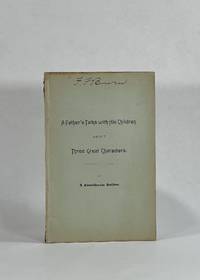
189210676Lynchburg VA: J. P. Bell Company Book and Job Printer 1892. Original Wrappers. Very Good binding. Octavo. 36 pp. First edition. As issued in printed wrappers. Wrappers a trifled toned some light abrasion to the top edge of the rear wrappers; contemporary previous owner name at the top of the front wrapper; similarly early editorial correction in the margin of one page. <br /> <br /> The three parts each are presented as a dialog between young children and the author and discuss Robert E. Lee Stonewall Jackson and J.E.B. Stuart in turn. Uncommon. Dornbusch III 50. J. P. Bell Company, Book and Job Printer unknown
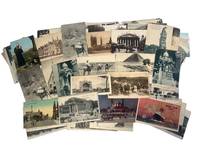
1915207331915. Australian Imperial Force soldiers postcard correspondence Archive 1915 to 1916 documents ANZAC service during the Gallipoli campaign and subsequent deployments across the Mediterranean theater through sustained communication with a civilian recipient in Sydney. The archive centers on letters addressed to a woman identified as Olga written by multiple soldiers including her brother Eric and another correspondent George. The material records trench conditions troop movement and the transmission of news from the front including the report of Eric's death. The correspondence situates individual experience within the Gallipoli campaign where Allied forces sustained heavy casualties in operations against Ottoman defenses and traces the continuation of service across France Egypt and Greece following the withdrawal.<br /> <br /> Archive of 54 handwritten postcard letters. Europe North Africa and the Mediterranean 1915 to 1916. Each message is written on the verso of a period postcard most measuring approximately 5.5 x 3.5 inches with photographic views of cities and towns including London French villages Cairo and locations in Greece. Several images depict damaged urban environments. One postcard bears a censorship marking with portions of text obscured. The correspondence includes multiple authors primarily Eric and George. In one letter from France George writes "Thank you for the pose.We are having beautiful weather at present. Just like an Australian spring. Love from George." Eric writing from Egypt on April 16 notes "We are once again in the trenches where we have had a very lovely time for a few days." A later letter reports Eric's death stating "You need have no fear that he was decently buried" while subsequent correspondence reflects diminished communication and shifting personal relationships including George's inquiry "Do you ever write to me Olga. I wish a few letters from you would turn up."<br /> <br /> The Gallipoli campaign fought from April 1915 to January 1916 resulted in extensive casualties and became central to the development of ANZAC identity commemorated annually as Anzac Day. Following the evacuation of Gallipoli Australian forces were redeployed across multiple theaters including the Western Front and Middle Eastern campaigns reflected in the geographic range of these postcards. The archive documents the function of wartime correspondence under censorship and the role of letters in conveying both military experience and personal loss to the home front. Light wear consistent with handling; overall very good condition. unknown
25043Paris 7 October 1821. Three pages 4to bifolium good condition. An elegant handwriting. Allow me to present yo you Mr Grattan my country man - the author of Philibert a gentleman and a scholar. He has resided some time in France and is going to London perhaps more to ascertain what he can do there thro' the medium of his literary invocations for the benefit of his Wife and young Family than with any fixed object or well arranged plan. Should he happen to be in London during the Session of Parliament Mr Grattan may probably wish to offer himself to you as a reporter for which situation from his information and habits I should suppose him to be well qualified and should he make any such application will you have the kindness to recollect this letter. I am quite aware how rarely it can happen to find you without a long list of applicants for a connexion with your highly popular and valuable Establishment and I know also the praise-worthy anxiety with which you so liberally protect and give the preference to your old acquaintance - your faithful and talented assistant but yet with this knowledge as there must be occasional vacancies and changes in all such extensive concerns I give Mr Grattan this introduction which from your polite and friendly attention to me at all times I venture to hope will dispose you to receive kindly his visit tho' it should not at once procure for him that connexion with you he would naturally be so desirous to establish should he happen to determine upon residing in London. .". Note: a. Wikipedia Grattan 1792 – 1864 was an Irish novelist poet historian and diplomat. " It was here Bordeaux that he started as a writer beginning with Philibert 1819 an octo-syllabic poem in six cantos. Soon after he moved to Paris where he made met Thomas Moore Washington Irving Adolphe Thiers Béranger Lamartine and other distinguished literary men and became a steady contributor to the Westminster Review Edinburgh Review the New Monthly Magazine and other periodicals."; b. a very substantial obituary appeared in the New Monthly Magazine 1826 pp.517-520 for what it's worth. Paris, 7 October 1821. unknown
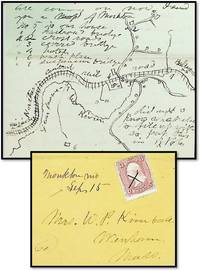
21451Very Good. HAND-DRAWN MAP OF MONKTON MD - UNION SOLDIER DESCRIBES GUARDING THE NORTHERN CENTRAL RAILROAD AND A CHAOTIC 'CHICKEN RAID' DURING THE FINAL YEAR OF THE CIVIL WAR.<br /> <br /> An original Civil War manuscript letter dated September 14 1864 written by a Union soldier stationed in Monkton Maryland. The letter features a remarkable hand-drawn map of the town and military outposts documenting the regiment's duty guarding the vital Northern Central Railroad bridges and a humorous incident involving a 'liberated' flock of chickens.<br /> <br /> Key Features:<br /> Visuals: The final page features a detailed pen-and-ink hand-drawn map of Monkton MD. It identifies the 'Northern Central Rail' 'River' Gunpowder Falls 'Covered Bridge' 'Hotel' and 'Our House' Barracks.<br /> Content: The soldier details life on guard duty at the 'Covered Bridge' building a brick stove for warmth and sleeping on straw. He recounts a a vivid and informal account of an improvised 'chicken raid' following a rail stop illustrating camp life food scarcity and soldierly opportunism late in the war. where a train passed carrying chickens; eight chickens "got off" escaped or were pulled off leading to a chaotic chase by the soldiers and the Captain to secure 'soup for dinner.' Full transcription available<br /> Postal History: Includes the original envelope addressed to Mrs. W.P. Kimball in Wenham Mass featuring a 3-cent George Washington stamp 1861 issue and a Monkton MD postmark.<br /> The envelope features a 3-cent George Washington stamp 1861 Issue tied by a Monkton MD postmark. Please Note: A previous owner noted this as a 'Scott #64' on the protective sleeve; however it has not been expertized and is sold as the more common Scott #65 Rose variety. We leave the final determination of the shade to the buyer.<br /> Transcription: A previous owner has handwritten the letter onto one page in attractive cursive. We also has a typed transcript available.<br /> <br /> Physical Specs:<br /> Date: September 14 1864<br /> Dimensions: Standard bi-fold letter sheet approx. 5x8 inches folded; Envelope included.<br /> Format: Handwritten ink on period writing paper.<br /> <br /> Condition: Very Good - The handwriting is legible and ink remains dark. Paper shows standard age-toning and fold lines consistent with mailing. The map is clean and sharp. This letter offers a specific window into the defense of the Northern Central Railroad NCR a critical supply line for the Union Army connecting Baltimore to Harrisburg. In 1864 regiments like the 8th Massachusetts Infantry were stationed along this line to protect bridges from Confederate raiders Gilmor's Raid had struck this area just months prior in July 1864. <br /> <br /> The mention of the 'Covered Bridge' at Monkton is historically significant as this was a key infrastructure point. The soldier's map provides a rare first-hand topographical view of the encampment layout relative to the rail line.<br /> <br /> Keywords: Civil War Letter Monkton MD Northern Central Railroad Hand Drawn Map Soldier Art 8th Massachusetts Infantry Wenham MA Covered Bridge Military Correspondence 1864. unknown
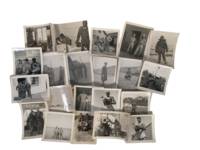
1957193551957. Vernacular photograph archive of African American soldiers in integrated U.S. Army units circa 1950s documents the early implementation of military desegregation following Executive Order 9981 and provides visual evidence of Black and white soldiers serving together during and after World War II including the Korean War. The photographs place African American servicemen within the first generation of formally integrated military units preceding broader civil rights gains in civilian society. Scenes of joint training transport and daily life show Black soldiers operating alongside white counterparts in contexts ranging from shipboard movement to antiaircraft defense positions indicating the practical realities of integration in active and post-conflict environments. The archive captures both structured military activity and informal moments offering a record of service that contrasts with the segregated conditions that had defined earlier periods of U.S. military history.<br /> <br /> United States and Korea circa 1950s. Archive of 21 silver gelatin vernacular photographs with several images bearing manuscript captions on the verso identifying individuals and locations including one noting Korea 1957-1958. Photographs depict a range of settings including military bases in Korea stateside camps shipboard scenes and antiaircraft gun emplacements in snowy terrain. Multiple images show interracial groups of soldiers posing with rifles and submachine guns while others capture informal activities including one sequence featuring a soldier holding an inflated puffer fish aboard a ship. One photograph includes a note written in Italian on the verso indicating cross-cultural contact or circulation. Composition and subject matter vary from posed group portraits to candid operational and leisure scenes.<br /> <br /> Created during the first decade of enforced military integration these photographs align with the transitional period in which desegregation policies were implemented unevenly across the armed forces with fuller integration not realized until the mid-1950s. The Korean War served as a critical testing ground for integrated units accelerating changes in military structure and social dynamics within the ranks. This archive provides a ground-level view of those developments documenting both the normalization of interracial military service and the persistence of shared routines duties and environments across racial lines. Light wear from handling with minor surface marks and occasional verso annotations; overall very good condition. unknown
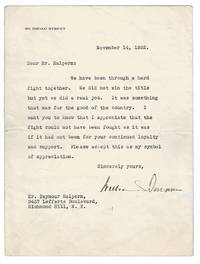
1932100747<p>New York November 14 1932. 1932. Very good. - Over 85 words typed on his 8-5/8 inch high by 6-1/2 inch wide "90 Broad Street" stationery. Addressing the young campaign volunteer Seymour J. Halpern William J. Donovan the future head of the Office of Strategic Services writes "We have been through a hard fight together. We did not win the title but we did a real job." He goes on to show his appreciation to the young autograph collector "I want you to know that I appreciate that the fight could not have been fought as it was if it had not been for your continued loyalty and support. Please accept this as my symbol of appreciation." Signed in full "William J. Donovan". Donovan ran for Governor of New York State to succeed FDR in 1932. A Republican he lost to Herbert Lehman. Folded in half for mailing the edges are soiled and there are tears to the edges of the fold. Very good.</p><p>To house his law firm in March of 1932 Colonel William J. Donovan leased a large suite of offices in the Stone & Webster Building at 90 Broad Street in New York City.</p><p>The American attorney diplomat soldier and intelligence officer William J. Donovan 1883-1959 is best known as the head of the OSS the Office of Strategic Services which was the war time precursor to the CIA. A veteran of World War I Donovan was awarded the Medal of Honor the Distinguished Service Cross the Distinguished Service Medal and the National Security Medal. In 1941 FDR established the Office of the Coordination of Information with Donovan as its director. Once the U.S. entered the war the COI became the OSS in June of 1942 with Donovan now a major general as its head. Donovan created the OSS as a military psychological warfare service to include both psychological and unconventional warfare. The service would soon include elements that would be called "special operations" the first phase of which would be intelligence penetration including research and analysis and propaganda followed by a second stage incorporating sabotage and subversion. This second stage would be followed by guerilla action commando raids and support of resistance movements.</p><p>An avid autograph collector in his youth the then 19-year old campaign volunteer the future Queens New York Republican Congressman Seymour Halpern 1913-1997 started his political career as a campaign aide to New York's powerful mayor Fiorella La Guardia and first served in New York's State Senate for 14 years before seeking a seat in the U.S. Congress. In Albany Halpern sponsored 279 bills that became law including measures on schools housing civil rights nutrition and mental health. A Liberal he was something of an anomaly as the lone Republican representative from New York City and generally garnered support from Labor Unions and endorsement from the Liberal Party. Yet he never even considered switching parties as he considered membership in the Republican Party a family tradition and commitment. While he found ample time for his private pursuits including painting and collecting autographs he took his legislative duties very seriously. Of these he was proudest of his co-sponsorship of the 1964 Civil Rights Act and of the original 1965 Medicare legislation.</p> [New York], November 14, 1932.
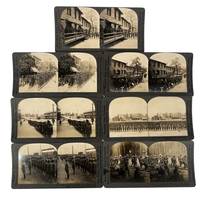
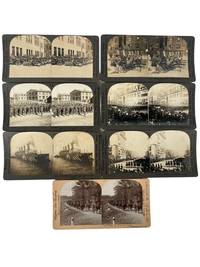
1918205031918. Keystone View Company. Buffalo Soldiers stereoview photographs World War I era document African American military service in the American Expeditionary Forces and place segregated Black troops within the broader Allied war effort in Europe. The images identify units of "Colored Troops" including engineers of the Signal Corps and depict formations logistical organization and moments of assembly such as soldiers "lined up for democracy." These photographs situate African American soldiers-many of whom descended from the Buffalo Soldier regiments established after the Civil War-within a transnational military environment that included French British and colonial forces. Scenes showing interaction with Moroccan and Indian troops on French roads reflect the multinational composition of Allied armies during the final phases of the war while the presence of Black American troops underscores their continued participation in major military operations despite segregation within the U.S. Army.<br /> <br /> France and possibly other European locations circa 1917-1919. Archive of seven stereoview photographs published by the Keystone View Company. Images depict African American soldiers in formation including lines for mess and organized ranks as well as mixed Allied groupings on roadways and near encampments. Stereographic format intended for three-dimensional viewing with printed captions identifying subjects and units. Photographs emphasize both structured military order and the varied roles occupied by Black troops particularly in engineering and support divisions.<br /> <br /> Produced during the final years of World War I these stereographs align with the expanded deployment of African American soldiers overseas and the broader visibility of Black troops within global conflict. While their service contributed to Allied operations these soldiers returned to a United States that maintained racial segregation and limited civil rights situating the archive within the larger history of African American military participation and postwar inequality. As visual records the images support research into race military organization and the international dimensions of the war. Light handling wear; overall very good condition. unknown
16269Grant Cottage King's Road Sloane Square London. 21 January 1813. 2pp. cr.8vo 30 x 18.5cm. In fair condition aged and worn with slight damage to one corner resulting in loss of one word of text. 62 lines of text with deletions and emendations and the thirteen lines of the conclusion largely rewritten. Headed: 'To the Right Honorable the Earl of sic Bathurst His Majestys Principal Secretary of State for the Colonial & War Department &c &c &c the Memorial of Major General Charles Viscount Grant de Vaux Shewest sic'. The first paragraph reads: 'That your memorialist although a french Emigrant is descended from two ancient and noble British families both by his father and mother and holds at present the rank of major general in the British Service - having resided in England since the year 1790 during which period after his services in the Emigrants Army became unnecessary he devoted his attentions to objects of Science and has published several works on Astronomy Navigation History &c tending to discoveries particularly on Nautical Science and on the history of Mauritius; which having met the approbation of men of talents and the patronage of Government your memorialist humbly hopes that his labours will ultimately prove beneficial to this country and to his unfortunate and numerous family.' The second paragraph concerns 'a large tract of Land in Canada' granted to him in 1794 'with a view to remove to that country a considerable number of french Emigrants who were to be conducted by him'. The third paragraph concerns 'the island of Mauritius where your memorialist was born' where his father 'the late Baron Grant &c commanded the troops' which has been 'conquered by his majesty's arms and is a valuable colony of Great Britain' The fourth paragraph concerns his family he having married 'a native of this country by whom he has eight children not provided for all born in England'. In the fifth paragraph he stresses his 'loyalty and integrity'. In conclusion he prays that 'your Lordship be pleased to issue an order that his Grant of land may be conferred to him in the isle of France 'the Isle of France' was another name for Mauritius his native country in lieu of the grant in Canada which was extensive according to his rank and numerous family'. Biographical/Historical NoteCharles Grant vicomte de Vaux was the descendant of a family of nobles who had emigrated from Scotland to France in the 14th century. Vaux was born in 1749 on the island of Mauritius where his father Louis-Charles Grant the Baron de Vaux served as governor. As a youth Vaux sailed to France to be educated and settled at Vaux-sur-Seulle in Normandy and eventually became an army officer. During the American Revolution he sided with the colonists and earned money selling supplies to the colonies and investing in ships to engage in privateering. The majority of the ships were lost and after the war Vaux petitioned the United States Congress for compensation. Though Vaux considered emigrating to North America he remained in France until forced by the revolution in France to flee to Great Britain in 1790. During his time as a refugee Vaux became interested in the prospect of starting a settlement in Canada and much of his energy during the next decade was focused on gaining permissions and raising money for the expedition. In the mid-1790s Vaux attempted to support himself as an army officer after being granted the position of colonel and permission to recruit a regiment which he formed with other French émigrés; it was stationed temporarily in Holland. This pursuit failed however and the regiment was dispersed after France invaded Holland during the French Revolutionary wars. Vaux then turned to writing to support himself publishing numerous books which included History of Mauritius and Introduction to Four New Maps of the Four Quarters all the while still attempting to plan a Canadian settlement. Despite his constant petitioning planning and pleas for aid Vaux was never able to realize his dream of moving to Canada. Little is known of the last two decades of his life but he is thought to have died in France around 1818." Grant Cottage, King's Road, Sloane Square [London]. 21 January 1813. unknown
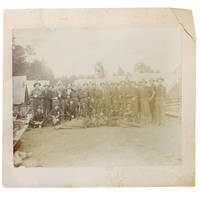
1890187391890. African American soldier photographed among members of a United States Army camp unit in the American West during the late nineteenth century providing visual documentation of Black participation within the military environment during the era of segregated service. African American soldiers served in the United States Army throughout the nineteenth century most prominently in units known as the Buffalo Soldiers which were formally organized after the Civil War. While Black soldiers were typically assigned to segregated regiments images occasionally record their presence in mixed military environments such as camps labor details or logistical units. The photograph captures a group of soldiers gathered in a temporary camp setting and includes a seated Black soldier identified by a contemporary handwritten note on the verso reading "Notice 'Black Soldier.'"<br /> <br /> Albumen sepia tone photograph mounted on photographer's board showing a group of American soldiers posed within a military encampment. Photograph measuring approximately 8.5 x 10 inches mounted on a photographer's board measuring approximately 10.75 x 10 inches. The men are dressed in clothing typical of western military and frontier settings of the late nineteenth century including dark buttoned shirts trousers supported by suspenders and boots. The African American soldier appears seated among the group with a cigarette in his mouth. The soldiers are gathered in a clearing surrounded by trees where rows of tents are arranged on raised wooden platforms suggesting an organized encampment. Cooking equipment stacked blankets plates and tankards are visible indicating a communal meal or informal gathering. One soldier holds what appears to be a long rifle with a visible barrel and wooden stock. Several soldiers sit or recline on the ground in the foreground while others stand behind them creating the appearance of an informal group portrait taken during daily camp life rather than a formal military arrangement. Handwritten note on the verso reads "Notice 'Black Soldier.'" Top right corner of the board cracked with tape repairs on the verso; slight water staining at the top left corner and damp staining at the lower left corner with partial cracking at the lower right corner. Image itself remains clear and largely unaffected. Overall condition good. The photograph preserves a visual record of African American presence within the late nineteenth century U.S. Army camp environment during a period when the armed forces remained formally segregated. unknown
6252EDWARD ALLEN GOODWIN unknown-1862. Goodwin was the Sergeant in Company K of the 23rd Regular Massachusetts Volunteers. This is the diary of Edward A. Goodwin Co. K 23rd Regt. M. of. M. This diary is THE AMERICAN UNION DIARY FOR 1862 an annual published diary accessible and likely provided to Union soldiers during the Civil War. After a few pages that include a calendar and interest tables the diary provides space for each day of the year 1862. Goodwin wrote entries every day from January 1st to April 7th and none thereafter. At the time Goodwin was serving in the 23rd Massachusetts Infantry Regiment which was a part of the Coast Division under General Ambrose Burnside. Entries are handwritten in either pencil or black ink. Notable entries include: aFriday 7: Naval engagementplace lasting from noon till sunset. Troops were landedin the afternoon and evening. Bivouacked on Roanoke Island in the rain. b Saturday 8: Captured a rebel battery in a swamp. Took 3000 rebel provisions and the whole island wasSergt. Howard hurt his foot. W.S. Clark missing. Both entries describe the Battle of Roanoke Island fought February 7th and 8th 1862. Part of General Ambrose Burnsides expedition to capture key ports in the Outer Banks the battle first saw Union gunboats first firing on Confederate forts under the command of Henry Wise until Burnsides soldiers could land ashore unopposed. and the forts on shore engaged in a gun battle with occasional contributions from the Mosquito Fleet. The next day the Union soldiers successfully flanked the Confederate artillery and infantry defenders on both sides forcing a retreat into the Confederate forts. The forts were then individually taken with the Union suffering only 264 casualties and capturing 2500 Confederate defenders. c Friday 14: Fought the battle of New Bern. Took over 100 pieces of artillery ammunitioncamp equipment &c. I arrived at night in the tents of the enemy. This entry describes the Battle of New Bern fought on March 14th 1862. After first advancing up the Trent River General Burnside had his soldiers exploit the weakened center of the line of the defending Confederates under Lawrence O'B. Branch. This allowed the Union Navy to shell Fort Thompson forcing its abandonment and shortly thereafter the city of New Bern too. 90 Union soldiers were killed and 64 Confederates were killed and 413 were captured. d Monday 31: Sick all day. Took horses.e Monday 7: Saw Amoat the hospital. DeceasedRain in the afternoon. These two entries foreshadow Goodwins ultimate fate including his last entry on April 7th 1862. Goodwin would pass away in New Bern on April 16th. Having survived two major battles unscathed at least according to his diary Goodwin most likely succumbed to disease. It is estimated that 2/3 of Civil War soldiers who died during the war died of disease not in battle. His body was ultimately returned to Massachusetts and is buried in Mansfield. The pages of the journal are in good condition but the exterior of black leather is frayed and partially torn. It should be handled very delicately but its value as a lens into the mindset of a Civil War soldier is immense. hardcover
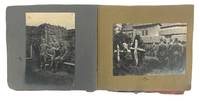
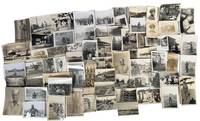
1917200631917. Czechoslovak Legion soldiers photographed during World War I document the participation of Czech and Slovak troops fighting alongside Allied forces in campaigns across Europe. Approximately seventy eight photographs record military life among soldiers associated with the Czechoslovak armed formations that emerged during the war as nationalist units seeking independence from the Austro Hungarian Empire. The images depict trench warfare troop encampments drills and daily life among soldiers whose political objective was the creation of an independent Czechoslovak state. The photographs illustrate the conditions and routines experienced by these soldiers during the conflict that ultimately contributed to the establishment of Czechoslovakia at the end of the war in 1918.<br /> <br /> Photographic album containing approximately seventy eight photographs measuring about 4.75 x 6.5 inches mounted on album leaves. The images depict soldiers in trench positions infantry movements across terrain and group formations during drills. Additional photographs show military camps outdoor meals mess areas and group portraits including one of a military band. Several photographs capture village architecture including houses courtyards and churches encountered by the soldiers during the campaign. The album also contains images of wartime medical care including a medic working with wounded soldiers a funeral scene with graves and cemetery crosses and a horse drawn wagon train traveling along a mountain road. Other photographs depict staged performances and theatrical scenes presented outdoors for soldiers.<br /> <br /> During World War I Czech and Slovak nationalist leaders organized volunteer military formations known collectively as the Czechoslovak Legions composed of soldiers drawn from prisoners of war and expatriate communities who sought to fight alongside the Allied powers against Austria Hungary. Their participation in the war strengthened international support for the creation of an independent Czechoslovakia which was established following the collapse of the Austro Hungarian Empire in 1918. Photographs of trench systems encampments and military drills in this album illustrate the entrenched character of warfare that dominated much of the conflict as armies constructed extensive defensive systems while attempting to break enemy lines through periodic assaults. Album containing approximately seventy eight photographs measuring about 4.75 x 6.5 inches. Album boards show chipping along the edges while photographs remain clear with strong contrast. Overall condition very good. unknown
19154227France Belgium England 1915. Good. Oblong 8vo. Small "Walker's Service Notebook" 154 x 94 mm lined 26 pages filled with neat entries in pencil and pen final page of diary loose the remaining portion of the notebook i.e. about 2/3 blank. Original limp cloth covers worn. § Extraordinary manuscript diary of an anonymous British soldier beginning April 12th 1915 and ENDING ABRUPTLY IN THE TRENCHES AFTER A GAS ATTACK. The final entry was dated December 19th 1915 which was THE FIRST DAY PHOSGENE GAS WAS USED AGAINST BRITISH SOLDIERS. The short diary is rich in detail of life at the front. The anonymous soldier belonged to the 49th West Riding Division which had a large number of gas casualties when soldiers in reserve lines did not receive a warning in time to put on their helmets. A study by British medical authorities arrived at a figure of 1069 gas casualties 120 of which were fatal. It is very possible that the present manuscript was written by one of those men. It seems probable that with access to the right regimental records the identity and fate of the soldier could be learned and his story told in full; however even as an anonymous diary the interest and poignancy of this personal record is clear.<br /> <br /> The events recorded span just nine months. On April 12th the soldier leaves Edenthorpe near Doncaster and crosses the channel to Le Havre that evening "packed like herrings" and accompanying horses and wagons. Over the next few months he records laying lines opening signal offices handling horses towns and villages visited billets and meals injuries regiments encountered names of comrades and O.C.s shelling rain and mud. He sees the Northumberland Hussars the Indian Corps and Royal Horse Artillery. On May 9th he records the Battle of Aubers Ridge: "Off duty at 7am. Attack began at 5am by Artillery. Signal thro' during day showed heavy losses in E. Lancs Lincolns. 13th London and other Batts. Had coffee in Fleurbaix and then to bed in barn. Off duty 3pm. Attack still proceeding without much impression on our line. French said to be doing well. At night we have the two windows in our Signal Office made up with corrugated iron & sandbags."<br /> <br /> For the entry dated May 12th our author notes that the name of the Division has been "altered to the 49th" thereby confirming the identity of his Division. On May 24th: "The Allamands dropped about 6 shrapnel in our vicinity."<br /> <br /> From a period of steady work and periodic pleasures "had tea & cakes at a patisserie & and then back after buying some books" "glorious day" the situation deteriorates with the weather "torrential rain dugouts leaking & 18" water on my floor".<br /> <br /> They move to Chateau de Trois Tours and on July 13th there is "rather an exciting night" with a bombardment from 7.30 to 10.30. On the 14th "The whole place is being encircled by barbed wire & trenches & the furniture is being moved out of the chateau." On the 15th "At 12.45pm about 12 shells fell round the chateau made a dive for the Signal Office Billy Edwards & Gus Harris wounded in thigh and ankle." They were shelled again on the 16th.<br /> <br /> On December 1st he travels back to Sheffield on leave returning on December 8th. The company are now holed up near Ypres at Hospital Farm the name given to a farm building used as a dressing station. The final entry reads "Dec 19th 'S.O.S.' Gas attack 5.30 am things lively until 8.30am. 146 & 148 des. 148 soon repaired from chateau". The cemetery at Hospital Farm contains 115 Commonwealth burials of the First World War.<br /> <br /> On the significance of the 19 Dec. 1915 battle at Wieltje Belgium northeast of Ypres see the long Wikipedia entry "German Phosgene Attack of 19 December 1915." <br /> <br /> The diary contains many clues that could help identify our writer in military records. It is not certain that he was one of the first British casualties to Phosgene gas but it seems tragically likely. As it stands the final entry in the diary marks an important milestone in the war: phosgene gas would eventually be responsible for about 85% of the 90000 deaths caused by chemical weapons during World War I. unknown
265131959 . 'If he survives he may well be a great man at 40':Glubb Pasha gives his assessment of King Hussein of Jordan in 1959Three autograph documents by 'Glubb Pasha' giving a detailed and perceptive assessment of the character and situation of his erstwhile master King Hussein of Jordan 1935-1999 written to assist John Freeman 1915-2014 in preparing the interview with King Hussein broadcast in the BBC series 'Face to Face' on 1 January 1960. From the papers of the programme's producer Hugh Burnett 1924-2011. The first item is a long letter from Glubb to Burnett giving a thoughtful and perceptive assessment of Hussein's character and situation including a discussion of relations between Jordan and Britain and a comparison between Hussein and President Nasser of Egypt. The second item is a series of 34 potential questions which Glubb suggests be put to the king. The third item is the covering letter to the second describing the questions in it as 'ideas which I hope may be useful' and offering to involve himself in the preparation for the interview 'we have lots of time'. The fourth item is the printer's copy of the transcript of the interview as published in Burnett's 1964 book of the series.Sir John Bagot Glubb 1897-1999 is described in his entry in the Oxford DNB as 'servant of both Britain and Jordan' and 'the last in the long line of powerful British proconsuls'. In 1939 Glubb took command of the Arab Legion subsequently the Jordan Royal Army transforming it into the best-trained and most effective military force in the Arab world and himself leading it across the River Jordan to occupy the West Bank during the 1948 Arab-Israeli War. According to the ODNB Glubb 'was greatly reliant on King Abdullah's support which vanished when the king was assassinated on 20 July 1951. His son Talal reigned only a few months before abdicating and was succeeded by his son Hussein still only sixteen and a schoolboy at Harrow. Although Hussein respected Glubb the gap between their ages proved impossible to bridge and they soon fell out. Military and political developments were rapidly outgrowing Glubb and the influential foreign adviser to an oriental monarch was becoming an anachronism.' In 1956 Glubb was dismissed from his command and given 24 hours to leave the country. He returned to Britain with only £5 and did not receive a general's pension from either Britain or Jordan. Despite the manner of Glubb's dismissal the two documents present here reflect the 'exemplary dignity' with which the ODNB notes he always acted thereafter.The four items are in fair condition lightly aged and worn all four with punch-holes for binding.ONE: Autograph Letter Signed with Glubb's stylised curling signature. Mayfield Sussex; 5 December 1959. 6pp. foolscap 8vo. With Televsion Registry date stamp.A thoughtful assessment of King Hussein's character Addressed to 'Dear Burnett' and written 'In continuation of my previous notes on King Husain sic.'The letter covers:Hussein's 'extremely democratic & informal' nature on first coming back from England to assume the Jordanian throne: 'He liked jumping alone into his car without a hat and driving into the Town - perhaps to go to the cinema. The police the officials & the escort used to be in a frenzy looking for him. … I don't think he can do that so much now there seems to be too much risk of his being assassinated.'Hussein's 'attitude to everything' which is 'in schoolboy language' 'flat out': 'In 1953 1954 & 1955 there were several ugly incidents on the Jordan Israeli frontier villages being raided by the Israeli army & many people killed. In every case the king's first instinct was to jump into a car and drive himself to the frontier to see in person what was happening. … He was most anxious to meet the people and would get out of his car in the villages to talk with villagers and get their first hand knowledge.'His love of risk: 'He delighted to drive his car at breakneck speed along the roads at imminent risk to himself & the public. I do not know if he still does that.'His headstrong nature: 'Although however he was then 18 19 or 20 years old all the cabinet ministers & officials were afraid of him & unable to control him. … he always won. Thus although he did a great many foolish things from lack of experience there was no doubt that he had a remarkably strong & independent personality and was full of initiative.'How he was 'deceived by politicians into thinking that Britain was the enemy of his country' resulting in a breaking-off of relations between Jordan & Britain'. Of Hussein's dismissal of 'all the British officers' including Glubb himself he writes: 'He did this entirely on his own initiative using his own courage & will-power. The extremists merely gave him the ideas but he carried all the responsibility. Now he has discovered that he was deceived and is drawing near to Britain again - once more on his own responsibility.'His political position. Jordan has 'a parliament almost in theory like Britain' and 'The influence of his grandfather King Abdulla & his own power are not due to an "Oriental despotic constitution but to the personalities of their two characters.' Although Hussein 'now thinks Britain can be his helper he is an enthusiastic Arab nationalist.'The contrast between Hussein with President Nasser of Egypt. 'Nasser likes to brand everybody who does not bow to his personal leadership as being a traitor and a "colonialist tool" etc. This is a local political line. Hussein is as nationalist as Nasser but his personality will not allow him to be a subordinate of Nasser. Nasser is inclined to want only subordinates. King Husain also feels strongly about Israel and is of course bitterly opposed to the present Iraqi regime which began by murdering all his family - King Feisal of Iraq was his cousin.'Glubb sums up his opinion of Hussein's character: 'In brief the picture is one of a young man of considerable character still retaining a strong streak of teenage enthusiasm for jet aircraft and fast motor cars. He came to the throne at 17 and was swept off his feet by the usual anti-imperialist propaganda. Now gaining first hand experience he is becoming wiser.'Glubb concludes the letter: 'If he survives he may well be a great man at 40'.TWO: Autograph List by Glubb of thirty-three suggested questions for Freeman to pose to King Hussein. Without date place or signature but sent with Item Three below dated 3 December 1959 as its covering letter stating that Glubb is sending 'some ideas which I hope may be useful'. 13pp. foolscap 8vo. With slip carrying a further question numbered 8A. With a few minor emendations. Topics include: Hussein's time at Sandhurst his view on the British boarding school and military service; his activities as a pilot and 'driving in car races'; military affairs; ceremonial and recreation; King Abdulla. The first question indicates the respectful tone that Glubb considered the interviewer should adopt: '1. The people of Britain emended from 'England' admire the personal courage which Your Majesty has shown in facing your difficulties in Jordan. May I ask how you sir feel towards the British people' A number of questions concern military matters and the following reflects Glubb's personal knowledge: '12 Everybody expects Arabs to fight but many people are surprised that the Jordan Army is so completely mechanized and has its own workshops and technical services. In England such units are possible because the technicians exist in factories in civil life and the army can draw on them Is not this difficult in a largely agricultural country like Jordan' The conclusion of the document demonstrates Glubb's attempt to 'prime' the interviewer: "Thank you very much Sir and may I wish you every success to BREAKS OFF HERE Insert further back somewhere. 33. I am afraid that I am not very experienced in Arab affairs but we have the idea in Britain that King's sic in "The East" live in great state but rather isolated from their subjects. I think that perhaps this does not apply to Arab countries. Does Your Majesty succeed in getting about and meeting the people of the country Note. He is very keen on doing this.' Question 30 reads: 'Is it true sir that you were actually standing beside King Abdulla when he was assassinated'THREE: Typed Letter Signed from Glubb to Burnett. On letterhead of West Wood St. Dunstan Mayfield Sussex. 3 December 1959. 2pp. 12mo. With Television Registry date stamp. Covering letter to Item Two above. 'Here are some ideas which I hope may be useful. As it is not until 1st January we have lots of time. Please ring up or write or send my draft back with marginal notes or anything else you like which will help you.' In a postscript he explains that he has not typed Item Two 'to save time'.FOUR: Typed text prepared for publication of the section on 'KING HUSSEIN' in the book 'Face to Face Edited and introduced by Hugh Burnett' Jonathan Cape 1964. 2pp. foolscap 8vo. With instructions to the typesetter in pencil and red ink. Corresponding to the text as published on p.30 of the book. [ 1959 ] unknown
1918205021918. Buffalo Soldier regiments depicted in stereoview photographs from the World War I era document African American cavalrymen and infantry units serving in segregated formations of the United States Army during the early twentieth century. These images record soldiers from several historically significant Black military units including the 9th U.S. Cavalry the 10th Cavalry and the 369th Infantry Regiment. African American soldiers served in large numbers during World War I despite segregation in the armed forces and the war marked a turning point in public recognition of Black military service. The photographs capture cavalry movement machine gun training and celebratory returns from the European front preserving visual evidence of the military presence and public visibility of Buffalo Soldiers during the conflict.<br /> <br /> Archive consists of seven stereoview photographs published by the Keystone View Company during the World War I period. The views depict soldiers from the 9th U.S. Cavalry the 8th Regiment of Colored Troops the 10th Cavalry the Chicago Regiment of Colored Troops and the 15th Regiment of the 369th Infantry. Two stereoviews show Black machine gun companies operating Lewis guns one of the principal light machine guns used on the Western Front during the war. Another view shows Troop K of the 10th Cavalry moving on horseback at Camp Chickamauga in Georgia. Additional stereoviews depict African American soldiers returning from European service and marching in public celebrations including scenes of troops parading along major boulevards such as Fifth Avenue in New York.<br /> <br /> The Buffalo Soldier regiments had already established a long military record before the First World War. Units such as the 10th Cavalry formed part of the segregated Regular Army created after the Civil War and served in campaigns across the western United States during the Indian Wars later participating in the Spanish American War the Philippine American War and operations during the Mexican Revolution. World War I marked one of the final periods in which cavalry units remained visible in American military organization as mechanized armor and motorized vehicles soon replaced mounted troops. At the same time Black soldiers who returned from service were celebrated in wartime parades yet continued to face segregation and racial discrimination within American society. Stereoview cards remain well preserved with light age wear typical of early twentieth century photographic prints. Very good condition overall and a visually compelling record of Buffalo Soldiers during the World War I era. unknown
194544498Okayama: Photographed in many Japanese Locations with most of the loose photographs taken in Okayama Japan n. d. ca 1945. 1945. WORLD WAR II JAPAN. First edition. Blue cloth photograph album 124 silver gelatin photographs mostly 2 1/4" x 3 1/4" with 106 of them in corner mounts. A fascinating vernacular photograph album capturing scenes in American-occupied Japan just after the Second World War. Most of the photographs are captioned in white ink on the black album pages and organized in sections such as "Landmarks" "The People" "The Cities" “The Military” and “Personalities.” “Landmarks” include views of sites in Kokura Yakata Okayma Prefecture picturing shrines country homes water works the "International Military Tribunal Far East" and more. "The People" shows Japanese residents of all ages some in Western dress others in traditional Japanese garb standing in front of structures on the streets at a military checkpoint playing "yakkyu national game" baseball swimming and other activities. The section on the cities comprises street views in Okayama Kokura Fukuoka Hiroshima Yakata Tokyo Kyoto and Yokohama. Surprisingly the four shots of Hiroshima do not contain much evidence of destruction and provide a rare contemporary glimpse of areas of the city not leveled by Little Boy. Views of Tokyo include the Dai Ichi Building the Imperial Museum and an image of an American soldier "on the Ginza." The various views in the other cities show Japan's largest steel works a partially-demolished department store temples and the Yokohama wharf. The military section includes photographs of Okayama Post the "A.G. Office" barracks headquarters of the 24th Division in Kokura Kyushu the Kokura Arsenal and Post Exchange Fukuoka's 118 Station Hospital and more. The "Personalities" section is comprised of shots of American soldiers in and out of uniform almost all of them identified by their first names or nicknames. This section also includes photographs of "A.G. Girls" a few Japanese people identified by name American soldiers at the War Ministry Hotel in Tokyo U.S. soldiers at the "4th Repl. Depot" in Sobudai" and more. A handful of the captions and some of the loose photographs are captioned in Japanese. Some of the loose photographs are stamped on the verso "Jack Woytych" with his Wisconsin address though it is unclear whether this refers to the owner/photographer of the album or the printer of the photographs. Most of the loose photographs emanate from Okayama. A noteworthy collection of personal images from an American serving in Japan at the end of World War II. Moderate wear to the spine ends and spine panel light edge wear and rubbing to the extremities else a very good copy. Photographed in many Japanese Locations, with most of the loose photographs taken in Okayama, Japan, n. d. (ca 1945). hardcover
1930000769CAIRO EGYPT JERUSALEM ISRAEL. Very Good. 1930. On offer is a large oblong photo album circa 1935 to 1945 with over 180 mounted pictures and photographs providing a visual diary of one soldier's tour through Egypt and the Holy Land. Unique photos beautifully presented in a well kept cloth cover 10 x 13 inch album. ; Folio - over 12" - 15" tall; HANDWRITTEN MANUSCRIPT DOCUMENT LETTER AUTOGRAPH DIARY JOURNAL LOG KEEPSAKE WRITER HAND WRITTEN DOCUMENTS SIGNED LETTERS MANUSCRIPTS HISTORICAL HOLOGRAPH WRITERS DIARIES JOURNALS LOGS AUTOGRAPHS PERSONAL MEMOIR MEMORIAL PERSONAL HISTORY TRAVEL PHOTOGRAPHY INDIA ILLUSTRATED antiquité contrat vélin document manuscrit papier Antike Brief Pergament Dokument Manuskript Papier oggetto d'antiquariato atto velina documento manoscritto carta antigüedad hecho vitela documento manuscrito Papel PALESTINE ISRAEL BRITISH MANDATE BETHLEHEM EGYPT HOLY LAND JUDEA SAMARIA WEST BANK CAIRO JERUSALEM PHOTO ALBUM PHOTOGRAPHIC ALBUM . hardcover
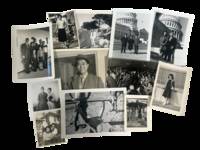
1940226451940. Japanese AmericanWWII Japanese American military service and postwar life photograph archive documenting Nisei participation in the United States armed forces and the reintegration of Japanese American families into public life after World War II 1940s-1960s. The photographs capture Japanese Americans in military uniform as well as family gatherings and civilian travel throughout wartime incarceration and postwar recovery and reintegration. The images document the lives of a generation of Nisei soldiers who served in units such as the 442nd Regimental Combat Team and the Military Intelligence Service whose wartime service occurred while more than 120000 Japanese Americans were forcibly removed and incarcerated under Executive Order 9066. The archive encapsulates the complex relationship between patriotic service and racial discrimination during WWII and the reintegration of Japanese Americans into civilian life during the mid twentieth century.<br /> <br /> Archive of 12 black and white photographs produced between the 1940s and 1960s. The images range in size from approximately 2 x 3 inches to 3.5 x 5 inches and include several photographs of Japanese American men in United States military uniform. Other photographs depict Japanese American families posed together in domestic and social settings including women dressed in fashionable postwar clothing typical of the 1950s. A small group of photographs shows Japanese American visitors standing in front of the United States Capitol building in Washington D.C. Several photographs bear numbers dates or personal names written on the verso in both Japanese and English.<br /> <br /> Japanese American military service during World War II was a central element in the broader struggle for Asian American civil rights after the war. Nisei soldiers serving in the 442nd Regimental Combat Team and the Military Intelligence Service played significant roles in combat operations in Europe and in intelligence translation work in the Pacific theater. At the same time their families and communities endured forced removal and incarceration under federal wartime policy. In the decades following the war Japanese American families rebuilt social networks reestablished businesses and professions and increasingly participated in civic life across the United States. Photographs documenting travel to symbolic national locations such as the United States Capitol reflect this period of renewed public presence and political engagement among Japanese Americans in the 1950s and 1960s. Minor edge wear and handling visible to several photographs with occasional annotations on the versos in Japanese and English; overall very good condition. This archive provides visual documentation of Japanese American wartime service and the reestablishment of civic identity during the postwar era. unknown
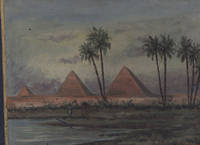
194045303Egypt & The Sudan: Photographs Taken By Donald Stone 1940-1944. 1940-1944. WORLD WAR II. First edition. 12" x 16" cloth string-tied album with an original color oil painting on the front cover of the Pyramids. Photographs by British soldier Donald Stone who was part of the RAF's 203 Group 1940-1944 headquartered in Khartoum. The album has 276 neatly mounted photographs with captions on both sides of 17 leaves each with a tissue guard. Additionally there are 23 loose photographs including 19 photographs of British planes in an envelop. These military photographs of aircraft were strictly forbidden during the War years. Also there are 2 pieces of printed ephemera including a menu for the 203 Group Xmas dinner in 1942 signed by the entire membership. An interesting album of people and places visited by this British airman throughout Egypt and the Sudan. Most of the photos are 2‑1/2" x 3-1/2" but many are larger. Laid-in is a three-page history of RAF Squadron 203. Very good with photographs in fine condition. Photographs Taken By Donald Stone, 1940-1944. hardcover
1941196921941. African American Army Transportation Corps photo archive depicting Black enlisted men and noncommissioned officers in wartime transport service occupation duty and domestic training between 1941 and 1952. The strongest identified material centers on the 3528th Transportation Corps Truck Company active from 1943 to 1946 and its successor the 551st Transportation Corps Truck Company active from 1946 to 1947. A captioned portrait places Joseph Galloway "somewhere in Belgium" on December 6 1944 ten days before Germany opened the Ardennes offensive that became the Battle of the Bulge. President Harry S. Truman issued Executive Order 9981 on July 26 1948 requiring "equality of treatment and opportunity" in the armed services but Army integration unfolded gradually through the occupation years and into the 1950s.<br /> <br /> Photo archive of 100 silver gelatin photographs ranging from 1.75 x 2.25 inches to 3.75 x 5.5 inches United States Belgium Japan and West Germany circa 1941-1952. More than half show Black soldiers in uniform including studio and outdoor portraits weapons training field scenes recruits and senior noncommissioned officers. Galloway poses with a pistol in Belgium; transport trucks appear in operation and maintenance; unit facilities domestic training camps interregimental competitions a 155 mm howitzer and soldiers beside a Sherman tank marked "Barbra" extend the record beyond portraiture. Occupation-era scenes include bombed urban landscapes in Japan locations identified as Osumi and Kyoto Black troops with Japanese civilians Buddhist monks at a temple and later service in West Germany including Bonn and Karlsruhe. Approximately one quarter bear manuscript captions identifying individuals dates or locations.<br /> <br /> In WWI many Black troops were denied combat roles and assigned to stevedore work labor battalions butchery companies road work hauling unloading ships and other manual support duties. The National Archives specifically notes that many Black units were kept from front-line fighting and "relegated to support duties." These Black soldiers served heavily in transportation engineering construction and supply roles during World War II making Army logistics one of the central places where African American military labor sustained Allied movement while the armed forces remained segregated. Several scenes place Black and White soldiers working alongside one another preserving the transitional military culture between wartime segregation and the uneven implementation of Truman's desegregation order. Light edge wear occasional creasing and minor surface abrasions to several prints; manuscript captions legible where present; no significant losses observed. Overall in very good condition. The archive gives named faces unit evidence vehicles weapons occupation landscapes and manuscript identifications across the decade when Black military service moved from segregated wartime labor toward formal integration. unknown
19620001450KOREA. Very Good. 1962. Manuscript. On offer is a super manuscript relic of Canada's Korean War participation being a handwritten day book diary pages of a soldier with the famed French Canadian regiment the 'Van Doos'. The 2-ring 6 x 4 inch pages record terse fact filled sometimes intimate personal notations of this soldier's duties and life in the Korean Theatre. Some pages are missing but from April 2nd 1952 through November 3rd 1952 he notes 216 days in Korea at this point this serviceman provides an intimate picture of a support soldier laying cables building rafts laying out minefields and many times under attack. June July August and September are the most filled months and in roughly 137 pages one reads the day to day mundane and of course the definitely not mundane entries - how he was driving a jeep with a Sergeant and a military officer and the jeep was under mortar fire and it rolled over down an embankment. Other entries include: May 17th 1952 29 years old; check Vandoos reg. 2000 mine A/P minefield. Got shelled in the valley. 18 - 75 mm came in on us in ½ hour. No casualties; received letters from patootie. Wrote letter to patootie; started booby trap MF mine field; Sgt. Jackson went to battle school in Japan; attended class pontoon raft demonstration at Widgeon bridge; June 25th 7th Wedding Anniversary; mention of Operations Buster and Buckingham Noahs Ark; went over to Sgt's mess a HQ. Tied one on; constructed & operated close 50/60 raft all day; buffet lunch @ Vandoos HQs; took 5 L/Cpls up to Black Watch; almost got clobbered by a heavy mortar which landed 25' behind jeep and much more. One online source provides: BACKGROUND NOTES: The Royal 22e Régiment is an infantry regiment and the most famous francophone organization of the Canadian Forces. The regiment comprises three Regular Force battalions two Primary Reserve battalions and a band making it the largest regiment in the Canadian Army. The ceremonial home of the regiment is La Citadelle in Quebec City where the regimental museum is housed. The regiment is nicknamed the Van Doos an anglicized mispronunciation of vingt-deux "twenty-two" in French. The regiment's regimental headquarters is located in Quebec City with all three of its regular battalions stationed at various bases in the province of Quebec. The regiment serves as the "local" infantry regiment for Quebec. During the Korean War 1951-1953 the regiment expanded to three battalions each serving in turn as part of the Canadian brigade in the 1st Commonwealth Division. Thus the "Van Doos" represented one-third of Canada's infantry contingent throughout the war. Overall in very good condition save for one page chewed as noted by 'Kibbles'.; 12mo - over 6¾" - 7¾" tall; KEYWORDS: CANADIANA FRENCH CANADIAN REGIMENTS VAN DOOS VANDOOS 22ND REGIMENT KOREAN WAR SEOUL PYONG YANG OPERATION NOAHS ARK OPERATION BUCKINGHAM MINE FIELDS BLACK WATCH CANADA Personal Memoir Handwritten hand written autograph autographs signed letters document documents manuscript manuscripts writers writer author holograph personal ANTIQUITÉ CONTRAT VÉLIN MANUSCRIT PAPIER ANTIKE BRIEF PERGAMENT DOKUMENT . unknown
030103No Binding. Good. two letters two pages folio paper tanned some staining old folds some nicks and chips at edges with some minor loss separations at fold joints else in good legible condition. Inscribed on laid paper water-marked "OCR" a mark not found in Gravell. This pair of letters from General Philip Schuyler to Major Yates contains orders for the troops including preparations and various actions to be undertaken in the field issued in late June the week before the Siege of Fort Ticonderoga the first week of July 1777. The 1777 Siege of Fort Ticonderoga occurred between July second and sixth 1777 near the southern end of Lake Champlain in the state of New York. Lieutenant General John Burgoyne's 8000-man army occupied high ground above the fort and nearly surrounded the defenses. These movements forced the occupying Continental Army an under-strength force of 3000 under the command of General Arthur St. Clair to withdraw from Ticonderoga and the surrounding defenses. Some gunfire was exchanged and there were some casualties but there was no formal siege and no pitched battle. Burgoyne's army occupied Fort Ticonderoga and Mount Independence the extensive fortifications on the Vermont side of the lake without opposition on 6 July. Advance units pursued the retreating Americans. The uncontested surrender of Ticonderoga caused an uproar in the American public and in its military circles as Ticonderoga was widely believed to be virtually impregnable and a vital point of defense. General St. Clair and his superior General Philip Schuyler were vilified by Congress. Both were eventually exonerated in courts martial but their careers were adversely affected. Schuyler had already lost his command to Horatio Gates by the time of the court martial and St. Clair held no more field commands for the remainder of the war. Saratoga June 26 1777 "Sir As a body of the Enemy are encamped at Gilliland's creek on Lake Champlain from whence they will probably send parties to harass us I entreat you to keep a good Look out to send scouts continually Distance to the West and North West of your Garrison to make discoveries and lest an attempt should be made to burn our vessels on Lake George I have ordered Commodore Wynkoop to get the guns in the vessel already launched that he may be in a condition of Defence. Please to send the Letter to General St. Clair by the first Boat together with the Horses which the Bearer will deliver you to be forwarded to General Fermois. I am sir Your most obedient Humble servant Ph. Schuyler" Albany June 29 1777 "Sir The Necessity of forwarding any more Batteaus or provisions to Tyconderoga for the present being superseded you will please to desist from sending any until further orders from General St. Clair or me. Cause all the spades shovels axes & pick-axes to be helved and make as many cartridges as you possibly can - Continue to keep out scouts to the westward as to intersect the Road from Jesups towards Crown Point. I am Sir Your very humble Servant Ph Schuyler" Philip John Schuyler was born into the prominent family of New Yo <br/> <br/> unknown
18990012049Donsol Pilar Manila Philippines New York Malta. Poor with no dust jacket. 1899-1901. Other. On offer is an unbelievable handwritten account of 19 months of action on the frontlines of the Philippine Insurrection the Philippine-American War between November 1899 and June 1901. An unknown American soldier writes of his experiences in a level of detail that cannot be overstated. This diary places the reader in the Philippines with shocking realism making this diary exceedingly rare. The 139 pages of this journalled account of events have been removed from a larger document and someone has pinned these loose pages together. This writing begins at the end of a sentence penned on presumably November 17 1899 and concludes half way through a sentence written on June 23 1901. There seem to be very few missing pages from within the journal and it reads very smoothly. The content is outstanding. The diary opens with our soldier diarist sailing from New York to the Philippines via the British Naval base at Gibraltar and the Suez Canal. He describes his experiences sailing sharing about a stop ashore in Malta a Thanksgiving spent at sea a concert enjoyed aboard the gunboat Nashville on the way to Manila and more. He arrives with his regiment in Manila on Dec 22 1899. The troops explore Manila and meet Filipino locals. In early January of 1900 they receive orders to head to southern Luzuon on the Kobbe Expedition which refers to General William Kobbes Expedition to Bicolandia. This expedition was in response to an urgent order from Washington to open up hemp ports of Southern Luzon due to an American hemp shortage. The problem was the port towns were largely controlled by Filipino Insurgents. Our diarist provides absolutely remarkable detail about Americas role in defeating the Insurgents and the tragedy of the Filipino peoples experience. Context indicates that our diarist was possibly a member of the 43rd Volunteer Infantry Regiments USV Company A. An excerpt that provides a sense of how our soldier explains the circumstances in the Philippines follows: Jan 16th we got the order to pack up and get ready to leave Mikata and to proceed to the Southern part of Luzon we were put aboard the transport Hancock which was at anchor in the Bay of Manila All combined we were named the Kobbe Expedition to the Southern Luzon to open up the Hemp ports and protect the natives from the Insurgents down there On the 21st of Jan 1900 our boats dropped anchor in a bay named the bay of Sorsogon in the Province of Albay All over this province there are large gangs of Insurgents holding the towns so at many towns our boys had a hard fight with the Insurgents before they could take the towns and the gun boat had to shell many of the towns. Our Regt. Occupied nine towns. Our detachment of A and D. Co. Were taken to a town named Donsol the gunboat Helena took us ashore from the Hancock On their arrival ashore they were met by a crowd of Philippinos. They had an order from the officers of the Insurgents it read saying that they would not haul down their colors nor surrender for three days. So our Major returned to the gunboat and a short conversation was held with the officers of the gun-boat and it was decided to prepare the gun boat for action and land all of us. If the Insurgents fired one shot at us the gun-boat would shell the town The hills were full of fleeing people. A detail of men were sent out on the hills at once then the Insurgents fired their first shot at us. Our boys had a warm fight for 15 minutes. They found the hills well entrenched and also found one big cannon. Lots of spears Bolas and wooden guns. They returned to town bringing in a few prisoners. A scouting party was seent and they saw a lot of Philippinos fleeing to the mountains. This town had a population of 10000 and three hundred were Insurrectors. The next thing we done was to find ourselves some good houses to live in. Outposts were put out all around the town. A few natives came across our post for a few nights and on the 22th Jan the Insurgents paid our town a visit setting fire to one of the big houses where our men were sleeping. Our men got out of the house without anyone being hurt. We surrounded the town fired a few volleys . Later in January our soldiers regiment goes on the first of many missions all of which he describes in glaring detail. On this mission the troops attempt to leave Donsol for Pilar when they run into trouble as the connecting bridge was destroyed by Insurgents. They make it to Pilar and find the town has been deserted. As they march back to Donsol they find someone has lit the bridge ablaze: Jan 28th We had a very hard time crossing the bridge burning our shoes and legs but we got safely on the Donsol side before the bridge fell with a crash into the river. We marched on we heard several shots from the Mauser and Remington rifles. Next we discovered a big fire and a call to arms and fire call was sounded The fire of the Insurgents got heavier. Our Major gave an order not to fire. He was going out in the front of our lines. He went out with a detail of men and discovered that our town was surrounded and the hills were full of Insurgents. He fired a few volleys then he came into town. The Insurgents answered him by firing a cannon. Then the Insurgents gave a yell and started to advance and we kept quiet and let them get close to our lines. Then we got the order to commence firing and the boys opened up all around the town and we soon put the Insurgents to flight firing a few shots as they ran. Next morning we discovered a few dead Insurgents close to our lines. The Insurgents almost always carry their dead and wounded along with them in their flight Our soldier does an absolutely phenomenal job of describing not only the day-to-day in Donsol where he spends majority of his time but also the various missions in which he participates. His words paint a fulsome picture of the war: 21st Feb at noon our Major asked for a detachment of men to volunteer to go up the river on a scouting expedition. I along with 12 more men went out of our company and 12 out of D. Co. Along with Capt. Hart of D. Co. And our Major left Donsol in a hard paddle boat and one white boat in tow On our way up the river we could see high hills on each side and the river was very narrow. There were many Insurgents outposts in the high trees all the way up and we fired at every one we saw. We went up a distance of 8 miles before we thought of coming home as it was getting late We had traveled one mile on our homeward way when the Insurgents fired on us from the left hand ashore. Our men in the rear boat fired a volley into the two Insurgents and were taking good aim for a second volley when the hills fairly echoed with the yells from the Insurgents. They then opened up on the right hand side which was aimed at the white boat hitting one of our men our company in the head and he was killed instantly. Then we answered their shots from each of our boats and from that time until we got back to Donsol we were under the hot fire of the Insurgents we could see the hills full of Insurgents and we had plenty to shoot at. We made every shot count. The insurgents even fired rocks at us from the high hills . More texture is added when our soldier discusses aspects of the war that dont involve active fire. Some examples follow: March 5th Gen Kobbe of the 8th Army Cor was here on a visit and he said these two companies were a very industrious lot of men and that the building of the stocade and trenches was a very sensible work he also brought us 17 of the Battery G 3rd Artillery men and one Hotch Kiss gun for reinforcements. April 10th the mail boat was here bringing the report of Gen. Pawa likely Jose Ignacio Paua an Insurgent Gen in Command of the Insurgent troops through this province. He surrender to our Colonel in Legaspi Legazpi and was sent to the Military Prison in Manila. April 21st We took a long march across the hills in a round about manner to a town named Sevilla merely an Insurgent camp. The town was deserted on our arrival. Fires were still burning in the houses. Everything was just as they had dropped it in their flight. We passed through the town and discovered many traps laid in the roads for us. One trap was an arrow trap on each side of the path in the bushes and by pulling a strong the arrows would stick into anyone going down the path. None of their traps caught us. Our soldier writes frequently about expeditions for which he volunteers. He describes a mission to Banningaran sic. En route the men captured Captain Hernandiz sic; possibly Adriano Hernández y Dayot and his family before being caught unprepared by the Insurgents who severely injured one of the American sargeants. On their hike back to Donsol they are again attacked by the Insurgents this time caught off guard as they attacked from the rear. And so it goes for many more months. Our author describes the movements of the men with whom he is stationed his commanding officers and the various wins and setbacks of both the Americans and the Insurgents. In May of 1901 our soldier and his regiment begin the process of boarding a ship to return to America. There is of course never a straightforward path and there are many bumps in the road. However our soldier does eventually board a ship and begins again to describe his journey in detail. The diary cuts off abruptly mid-sentence on June 23 1901 as our soldier is describing being at sea with nothing but a sailboat in sight for miles. While we do not know our soldiers identity we do know he was safely heading home at the conclusion of his diary. We know he was a highly motivated volunteer soldier who displayed total buy-in to the mission of the Americans in the Philippines and we know he was a gifted writer penning his experiences with such texture and realism that the reader feels as though they too have been on the front lines of a bloody wet miserable war in the Philippines - fighting for America and for the displaced Philippino people forced to flee from the Insurgents to the mountains. This journal measures 8x5 inches and contains 139 single-sided sheets. The pages were all loose so the author has pinned them together with a single round-headed fastener post. There are no covers to this journal. As a result the first and last few pages show obvious and significant wear and tear including a large corner of the first page being completely ripped off obstructing the text. The handwriting is quite legible. Overall Fair to Poor. ; Manuscripts; 8vo 8" - 9" tall; 139 pages . unknown
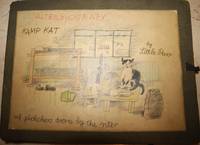
19430072801943. Hardcover. Cloth Box. Very Good. Inimitable and disarming tales that represent the pinnacle of outsider art and folk art with the naive drawings richly full of life as they speak of the daily routine at a British army camp during the Second World War from the point-of-view of a camp mascot cat who excels at mangling English in its creative attempts at phonetic spelling. Folios are oblong 41 by 30 cm each. The first folio contains "The Alterbyografy" a 56 pages long unpaginated with 54 illustrations including the folio cover 28 of which are full page 24 of which are half page. The second folio is entitled "Kamp Karacters" . This is 51 leaves with 92 illustrations including the cover 51 of which are full page 40 a third page generally with the area above entirely blank. Illustrations are rendered with colored pencil and crayon. The first manuscript is a continuous narrative of army life its humdrum rhythms and routines its various inanities its social life sports and other activities etc. while the second part is more character sketches. The second folio is even more visually driven than the autobiography. Another distinction between the two is that the autobiography is done with the leaves oblong while the character studies are applied with the leaves vertical. While one part isn't exactly a sequel to the other the two parts are truly complementary. The two folios are of a rough burlap material with a large title sheet mounted on their front cover. The folios have three flap folds to hold the loose sheets in plus ribbon ties on their right sides. hardcover