606 résultats
12135Montreuil-Sur-Mer, Imprimerie Notre-Dae des Près, 1892, troisième édition. 1 volume in-12,124 pp., reliure moderne plein cuir brun, couvertures imprimées conservées mais brunies, jaunissement uniforme du papier, et rousseurs pâles, illustré de quelques gravures et surtout d'un grand plan dépliant de la rade d'Hong Kong en 1892.
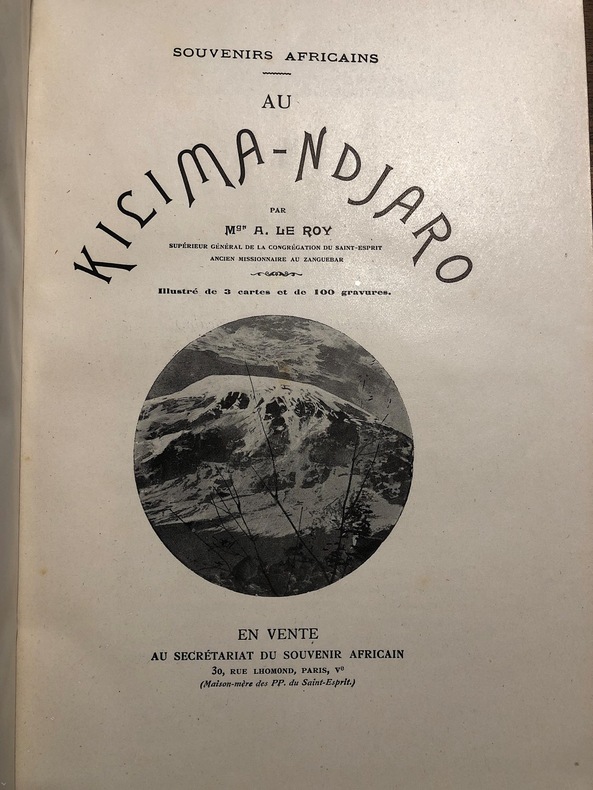
191414061914 1914 ( 1914 ) illustré de 100 gravures et 3 cartes in et hors texte. 1 volume in 8. cartonnage percaline éditeur vert. 1er plat illustré d'un guerrier africain, lettres or ,fers dorés , argentés et noir. 3 tranches dorées. portrait + 487 pages.2ème édition. ( cf préface ) En vente au secrétariat du souvenir africain .Mgr Le Roy était ancien missionnaire au Zanguebar , supérieur général de la congrégation du saint esprit.PARFAIT ETAT.
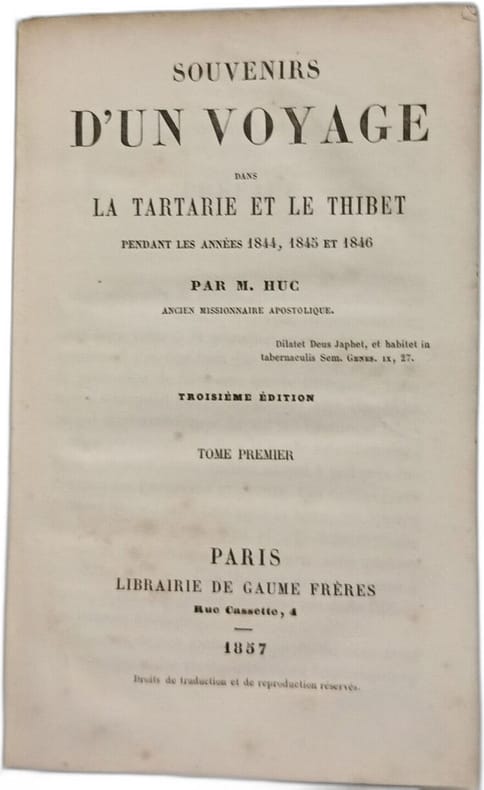
1857100151580Librairie de Gaume Frères 1857 in12. 1857. Relié. 2 volume(s). Récit de voyage du missionnaire Évariste Huc qui accompagné de Joseph Gabet a traversé la Tartarie et le Tibet entre 1844 et 1846. Ils ont atteint Lhassa avant d'en être expulsés par un mandarin chinois. L'ouvrage est un classique du genre mêlant observations ethnographiques et aventures
1857100152090Librairie de Gaume Frères 1857 in12. 1857. Cartonné. 2 volume(s). Évariste Huc missionnaire lazariste français relate son voyage en Tartarie et au Tibet dans les années 1840. Expulsé du Tibet avec son compagnon Gabet il décrit leur retour à Macao et fournit des informations détaillées sur les régions traversées
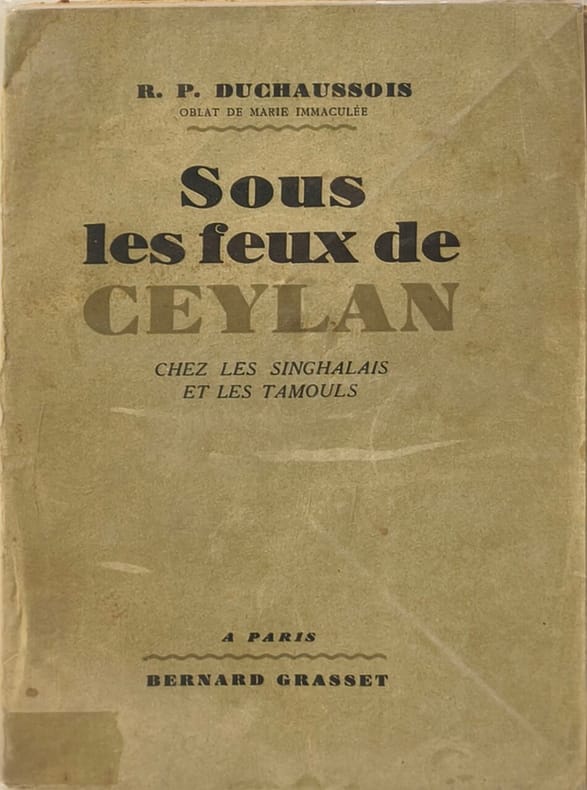
19293831Bernard Grasset 1929 380 pages in8. 1929. broché. 380 pages. Ouvrage publié en 1929 par le père missionnaire Pierre Duchaussois décrivant son séjour de cinq ans à Ceylan (actuel Sri Lanka). Le livre mêle le récit des activités des missions catholiques oblates avec des observations sur la vie quotidienne les cultures singhalaise et tamoule dans le contexte colonial de l'époque
VOY810MLe Livre de Poche, 1962. In-12, broché, 511 pages. Épidermures sur pages de garde. Couverture gondolée. Intérieur agréable. Exemplaire de témoignage.
voy801mLibrairie d'Adrien Le Clere et cie, Paris, 1850. Par M. Huc, prêtre-missionnaire de la congrégation de Saint-Lazare. TOME 1 DE L'ÉDITION ORIGINALE. In-8, reliure de l'époque, demi-veau lisse, fleurons estampés, caissons titre et tomaison maroquin grenat, filets dorés, 426p. Exemplaire complet comprenant la carte dépliante. Dos très bon, Plats bons, quelques infimes frottements, coins très légèrement émoussés, toutes tranches très bonnes. Intérieur très agréable, quelques épidermures éparses sans incidence.
188811884Bourg, Imprimerie J.M. Villefranche, 1888 ; in-8, broché ; (1) f. blanc, 20 pp., (1) f. blanc, couverture verte.
0260882844.Ghardcover. Good. Access codes and supplements are not guaranteed with used items. May be an ex-library book. hardcover
71p., illus. PAMPHLET Ex-library, Very good condition
1971WRCAM56376Mostly various locations in Tennessee and Virginia plus Salt Lake City 1971. 240 letters various paper stocks and sizes including some Mormon-related stationery most letters at least three pages in length each stapled plus a handful of clippings postcards assorted photographs and an appointment book. Neatly organized chronologically and by sender in labeled manila folders and stored in a single document box. Minor tears to a few letters else mostly clean and very good overall. An important archive of correspondence centering on Mormon missionary activities in the American South during the Great Depression and the years of World War II. All of the letters were written to Ruby Marion a Mormon woman from Virginia. The most significant letters come from Ralph Horrock a Mormon missionary operating mostly out of Tennessee but also Virginia. Horrock's letters to Marion number almost eighty and are filled with interesting information on Mormon missionary efforts. Other important letters were written to Marion by Mormon Elder Gaell Lindstrom from both Virginia and Salt Lake City her husband William "Bill" Tragdon and Ruby Marion's mother and sister. The letters from Marion's husband mother and sister mostly concern family matters but the letters from Horrock and to a lesser degree from Lindstrom are highly significant for their voluminous content on Mormon missionary activities in the American South. <br> <br> Ralph Horrock was sent to Tennessee to spread the Mormon faith at the end of 1934. He and a companion were ordered to travel throughout the countryside and preach the tenets of Mormonism. Horrock is reserved in his letters at first writing that he would have preferred to stay in Virginia where Marion was located. He is clearly smitten with Ruby Marion however and writes more and more about his love for her as his correspondence continues. Marion visited Horrock in Tennessee in the summer of 1935 and their correspondence continues to January of 1936 but their romantic relationship clearly did not flourish. Marion would eventually marry William Tragdon some time after 1948. <br> <br> Often traveling by foot through the South Ralph Horrock and his companion elders visited both the cities and the small country towns they found preaching the Mormon faith at local town halls and school houses sometimes finding challenging audiences. They established Sunday school classes held prayer meetings preached at funerals of deceased Mormons living in Tennessee and more. Horrock mentions proselytizing to some of the country people and even holding river baptisms. Inevitably he also relates to Marion various gossip about the inner workings of the Mormon Church in Tennessee and Virginia asks Marion for gossip she might know and also asks about the movements of other missionaries in the region. Horrock finds much joy in his work for quite a long time - at one point a local community in Tennessee asks him to build a church and stay there as their preacher - but by the conclusion of his letters to Marion the joy seems to have faded. A handful of brief excerpts of Horrock's letters to Marion reveal the compelling and informative nature of his correspondence: <br> <br> March 23 1934. Marysville Tn.: "I don't think I will have any more lonesome and blue spells for a while now because I am too busy what I mean they sure do the Missionary work here in Tenn. We get in about six hours tracting per day and I sure love to tract here for people love to talk with you on religion and no fooling some of them are sure interested. Since I came here I sure have had plenty of opportunities to preach. We hold cottage meetings three and some times four times a week. There is one thing I can say about this state of Tennessee - it sure is a land of opportunity for a missionary. I am now really learning to be a preacher you ought to hear me some time but I better shut up for self praise is not very good is it" <br> <br> May 30 1935. Silver Point Tn.: "We had a swell meeting at Knoxville but I guess I told you about it in my last letter. We are now away out in the sticks right out with the good old hill billies I think we are about forty miles from Nashville. We are having wonderful success out here we are holding cottage meetings most every night so you can see we are getting plenty of preaching.We would have been in McMinnville last Sunday but at the last moment before we left Knoxville the D.P. changed his mind and sent us to Silver Point. They are holding a big memorial celebration here next Sunday and they wanted two Elders here to preach for them so here we are. I have to go about five miles to a little old country post office to mail this letter so I will have to hurry to get it there before the afternoon mail arrives." <br> <br> June 25 1935. Spencer Tn.: "I am glad to say I am still all together and healthy even though we are in a somewhat hostile section. The people here would like to be tough but after all they are only wind bags. You recall I told you we were going to hold some meetings in the County Court House at Spencer and I thought that we might meet up with some opposition. Well we held our first one last night and we had the building almost full. No one caused us a bit of trouble rather they were all ears and I am sure they heard something last night they had never heard before. The thing that gets the best of these people is this - even though we do present strange doctrine to them we have scripture to prove each point we bring out. People might come to hear us with the intention of giving us trouble. But after they hear us prove our points so clearly from the Bible the only thing they can do is take it and keep still. I feel that the Lord has greatly blessed us in our work here and if we have succeeded in doing a good work I do not want to take the honor to my self.We are having more success here than any other place I have been in since I came to Tennessee. We held an open air meeting here Sunday and almost a hundred people came to hear us. Tonight we are holding services again at the Court House and I am expecting the House to be full." <br> <br> July 21 1935. Smithville Tn.: "You said something about the Elders going to Harrisonburg to Baptize those people over there. Do you know whether or not they did I would really like to know of them coming into the Church because I had such a large part in bringing them to a knowledge of the Truth. If they are Baptized then I can look back and with the assurance that I really did accomplish something while I was there.Who is the new D.P. in Virginia or do they know yet I really pity the poor fellow who gets the job.Virginia is the best District in the Mission in lots of ways but when it comes to getting real practical experience then give me Tennessee. I have ten chances to preach here where I get one there. And another good thing the people like to hear the Gospel here and they come out in such large crowds we have to hold our meetings outside. Whenever we held cottage meetings in Va. we never did get over twenty people out but here it is nothing at all to get over a hundred. You know it is really some difference. Are the Elders still laboring in the cities yet I really would hate to do that. The city don't provide half the fun and experiences that the country does. I would go wild if I had to stay in the city. We held a baptism the other day and after the services we went swimming and some also went wading so you see we have some real fun too once in a while." <br> <br> September 2 1935. Spencer Tn.: "We really have so much work to do we really don't have time to stop and see if we are well or sick. I can say though that I am really enjoying myself more than words can tell. There is one thing about missionary work that makes it better than any thing I have ever done before and that is the more you work the better you like it. I really did not know what real missionary work was until I came to Tennessee. Over in Virginia it was just easy come easy go and we only got to preach about once or twice in a week and even at that I thought I really was doing something. But since I came here I am fully convinced that I only wasted time in Va. We get to preach somewhere here every night and twice on Sunday and we get many other experiences that goes to make this the greatest work in the world." <br> <br> September 7 1935. Spencer Tn.: "As usual we are having wonderful success in presenting the Gospel before the people and we have made lots of friends which I am very thankful for. We have just come today out of a back woods country which is so far out of the way the Elders haven't visited it for years. The people there sure did turn out to hear us preach. We used the School House to hold our meetings in and so many people came there wasn't room for them so they had to sit outside and listen. I wish we could stay there longer but it was impossible for we had to come into Spencer and get our mail. I have a job ahead of me that is going to be hard to do. There is an old woman that lives in the county that has a husband that is dead and he has been dead for about ten years. When he died she could not get any Elders to preach his funeral so she buried him without holding a funeral with the intention of having the first Elders that came hold it at his grave. We happened to be the first ones to come so the job is ours. It's going to be hard to do but I guess we will have to do it. There is no other way out. Well you know this Missionary work is not all sunshine and roses if we didn't get the bitter once in awhile we would not enjoy the sweet." <br> <br> December 2 1935. Morristown Tn.: "I am not enjoying my work here in the least. I never was in such a dirty hole as this little town is. We haven't a friend or a member within fifty miles. I haven't preached for so long I really believe I have forgotten how. I never was so divested of spiritual will power in my life as I am right now and I don't mind saying I am getting sick of it. Every other Elder in this District is laboring in a city where there is a brand that will provide them some place to work where they can at least see where they are accomplishing something. Still I suppose I shouldn't bother you with my troubles no doubt they do not interest you." <br> <br> Horrock concludes his correspondence the next month by relating that he is getting transferred to Chattanooga where he "will have plenty of good work to do." He writes to Marion for the last time that he does not know what his address will be so he asks Marion "not to write until you hear from me again." Perhaps Marion never heard from Horrock again. <br> <br> Other letters in the archive are written to Ruby Marion from another Mormon Elder named Gael Lindstrom who also appears to have served as a missionary in Virginia and West Virginia. In his fifty-two letters Lindstrom writes sparingly about his experiences as a Mormon missionary but when he does he provides interesting details. For instance on July 30 1943 in Huntington West Virginia Lindstrom writes: <br> <br> "We have spent a few days of this week in Huntington W.Va. as we are not so very far from there. It seemed good to return to the place where I had spent about seven months before coming into Virginia. Elder Price's father will be here in about ten days to work the rest of his mission with him. That will leave Elder Bray and I as the only Elders left in the district. Your guess is as good as mine as to what will happen then. He is coming down to Home Creek next Tuesday to do a little traveling with us in this section. He can't take us out of here too soon for me. This is really woods. Last nite we held a meeting in a small miner's union hall which was dimly lit by three gas lamps. There were about 35 present but I'm afraid all they came for was the novelty of it as they have a complete lack of amusements around here of any description." <br> <br> He also writes frequently of other elders or members of the church other church activities and leadership changes his travels to Mirror Lake and more. Lindstrom spent about six months in Louisville Kentucky where he was assigned in early 1944; two of his letters from Louisville are written on LDS stationery. By June 1944 he is back in Salt Lake City where he misses "being back in the mission field." The bulk of his letters emanate from Salt Lake City during the rest of 1944 and through mid-1947. Many of his letters concern his activities in the antiques trade which Marion may have been involved with as well. The two apparently corresponded about opening an antiques shop in Salt Lake City. Lindstrom's correspondence concludes with news that he is opening his own photography studio after working some time in the camera department at Auerbach's Department Store in Salt Lake City. <br> <br> The archive also includes correspondence from Ruby Marion's husband William Tragdon and Marion's mother and sister. Tragdon worked in the aeronautical engineering field and traveled extensively throughout the country. He was quite smitten by Marion evidenced by his thirty-seven letters home to "Kitten" from February to September 1948. Tragdon's letters are deeply personal missives to his wife and eventually to both his wife and son Howard in the late-1950s with occasional information on larger family matters. His two somber letters from 1970 and 1971 indicate that he and Marion had divorced. <br> <br> The letters from Marion's mother and sister are also mostly concerned with family matters. One interesting letter from Marion's sister Evelyn dated 1946 mentions a recent banquet where she "saw quite a few of the old missionaries that we once knew." Evelyn's letter also mentions Mormon presidents Tew and Doxey and a few other church colleagues she encountered at the banquet. <br> <br> There is also a folder containing ten letters from various correspondents to Marion from the 1930s to the 1970s. Some of these letters concern missionary matters from Virginia to as far away as the Dutch East Indies. The latter are written by a correspondent who signs his name as "Dee." Dee writes on Dec. 23 1944 that "We hold L.D.S. services on the island & have 100 present each Sunday." This folder also contains a selection of unused photo postcards from two photographs of Mormon Church elders one inscribed to Marion by Elder Clark O. Thompson and the other inscribed to "Dear Sister Ellinger" from Elder Frank Miller. <br> <br> The archive is rounded out by a small appointment book presumably kept by Marion or a family member from 1955 to 1960. The book is almost entirely comprised of appointments notes and schedules of Masonic meetings. The final folder contains several letters sent to Ruby Marion by V-Mail during World War II. The various letters appear to come from family friends named Jesse Terry Sgt. D. Sanders and H. Kenneth Coburn who also sent a signed photograph to Marion. All of these letters were sent to Marion at her address in Waynesboro Va. <br> <br> An engaging and far-ranging collection of correspondence to a Mormon woman from Virginia with illuminating information on Mormon missionary activities in the American South during the Great Depression. unknown books
230 p. plates, ports., fold. col Hardcover Good condition
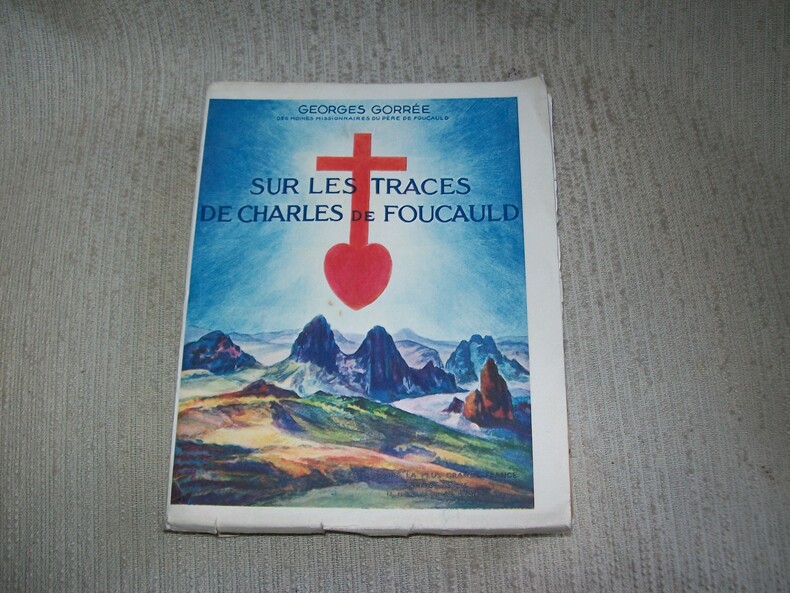
1936GITe535Paris Lyon Les Editions de la plus Grande France 1936. Grand in-8 carré broché belle couverture illustrée en couleurs 206pp. Portrait du Père de Foucauld en frontispice, 3 fac simile d'autographes hors texte recto verso (l'un d'eux replié), 19 photographies hors texte, 4 cartes hors texte (2 d'entre elles repliées). Petites coupures sans manque au bas de la couverture, nom d'un précédent propriétaire en tête d'un feuillet. Bel exemplaire frais et bien complet du texte, des illustrations, des cartes.
195397956La Colombe 1953 In-12 broché 21 cm sur 14. 325 pages. Très bon état d’occasion.
195038524Couverture souple. Broché. 160 pages.
gu3375Editions de l'apostolat de la prière Broché In-8 (13,5 x 21 cm.), broché, couverture illustrée, 160 pages, illustrations noir et blanc hors-texte ; dos plissé et incurvé, plats un peu défraîchis, coiffes, mors et coins un oeu frottés, assez bon état. Livraison a domicile (La Poste) ou en Mondial Relay sur simple demande.
ORD-7791Société des Missions Évangéliques. 1931. In-12 br. couverture illustréepetit manque au coin inférieur droit), 311pp. Carte de la Mission du Cameroun en frontispice, Portrait couleurs d'un chef Bamoum et 25 planches photo h.-t. (souvent 2 photos par page).
1938gm4077Maison Aubanel Père Broché 1938 In-12 (12 x 19,7 cm), broché, 145 pages ; pliures au dos de biais, rousseurs sur les plats, un coin corné, papier bruni, par ailleurs assez bon état général. Livraison a domicile (La Poste) ou en Mondial Relay sur simple demande.
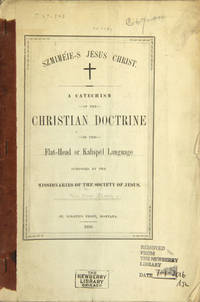
188049586St. Ignatius Montana: St. Ignatius Print 1880. 8vo pp. 4 45 1; original paper wrapper perished reinforced in stiff brown library card; pages toned and worn at edges good. An Ayer Linguistics duplicate with release stamp on title page. "These works were put in type and printed by the Indian school boys at St. Ignatius. About 225 copies of each were printed." Pilling identifies the author as Giorda per his correspondence with a superintendent of the school Father Leopold Van Gorp. Pilling Salishan p. 28; Pilling Proof-sheets 1558; Schoenberg 7. St. Ignatius Print unknown
188049586St. Ignatius Montana: St. Ignatius Print 1880. 8vo pp. 4 45 1; original paper wrapper perished reinforced in stiff brown library card; pages toned and worn at edges good. An Ayer Linguistics duplicate with release stamp on title page. "These works were put in type and printed by the Indian school boys at St. Ignatius. About 225 copies of each were printed." Pilling identifies the author as Giorda per his correspondence with a superintendent of the school Father Leopold Van Gorp. Pilling Salishan p. 28; Pilling Proof-sheets 1558; Schoenberg 7. <br/><br/> St. Ignatius Print unknown books
204 p. Memoirs of his boyhood in China. Hardcover Very good condition good
260pp. Hardcover Very good condition good
40056Fayard.1984.In-8 relié,cartonnage éditeur.369 p. TBE.
195332746Plon 1953 exemplaire non coupé
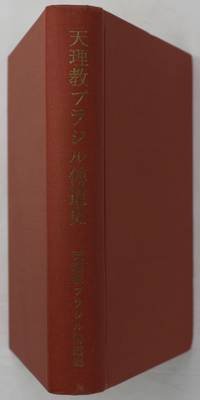
19585047Sao Paulo: Tenrikyo Brazil Mission 1958. Very good. 52162511pp. including 32pp. of photographically-illustrated plates. Original orange cloth gilt spine titles housed in original cardboard slipcase with black spine lettering. Very minor wear internally clean. Some chipping and toning to slipcase. An unrecorded history of the Japanese immigrant Tenrikyo Mission in Brazil providing valuable information on many Tenrikyo churches across the country. Tenrikyo was a new Japanese religion founded in the 19th century in Japan by Nakayama Miki and spread to Hawaii Brazil and other regions where Japanese immigrants moved over the course of the first few decades of the 20th century. The photographic plates contain portraits of some mission members views of churches scenes from church life and more. The text is almost wholly in Japanese save for occasional listings of Spanish names and other information. Not reported in OCLC. Tenrikyo Brazil Mission unknown