Steinbeck, JohnBiblio.com
17 205 résultats
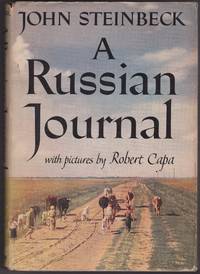
19482521New York: The Viking Press 1948. First Edition First Printing. <br /><br />Small Quarto 9 3/4 x 6 3/4 inches; 247 x 167 mm 220 pages in green and tan cloth in an unclipped illustrated dust jacket hard cover accompanied by four photographic prints. <br /><br />An account of a trip to the Soviet Union in 1947 by author John Steinbeck and photographer Robert Capa who visited while the country was attempting to recover from the devastation of World War II. They traveled to Moscow Stalingrad and other cities as well as to Ukraine and Georgia meeting numerous ordinary people while accompanied by a minder from the government. <br /><br />The New York Herald Tribune financed the trip and along with some other newspapers published articles by Steinbeck and photos by Capa. Indeed included here are three photographs that were used by one of the newspapers as indicated by layout instructions on the versos of the photos. There's also a later publicity photo of Steinbeck. One of the photos from the trip showing a Georgian restaurant in Moscow appears on page 47 of the book. Two of the trip photos are stamped on the versos with the notice that their reproduction could be used only with the "1948 Steinbeck-Capa articles on Russia" along with "Copyright 1948 by John Steinbeck." <br /><br />Our copy is a first printing of the first edition with "Printed by the Viking Press in April 1948" on the copyright page. The dust jacket carries a price of $3.75. <br /><br />A fascinating look at ordinary people in the Soviet Union as the country tried to rebuild following World War II accompanied by three photographs of scenes from the country and a publicity photo of Steinbeck. <br /><br />CONDITION: Book slightly cocked rear hinge loose corners rubbed spine ends bumped end papers slightly toned a couple of pages with vertical creases possibly a production error. Nearly Very Good in a Good dust jacket that has some loss to both spine ends as well as a few tears nicks toning foxing and stains. The four photographs have some nicks creases and soiling to the edges. The versos contain notes stamped instructions and captions pasted on the photo of Steinbeck has an article pasted to the verso. Some discoloration to two photos resulting from pasting of newspaper captions to the versos. The Viking Press hardcover
19990008049Boulder CO: Westview Press 1999. First English language edition. Hardcover. As New/issued without. 8vos; xxxiv 562; ix 389 pages maroon cloth in original shrinkwrap. Not x-library. Scarce. O.P. <br/><br/>This English translation contains an autobiography by Mironov which was not in the Russian edition. It details his anti-Marxism philosophy while a student in Leningrad. "The author has assimilated a large body of foreign scholarship primarily "new social history" produced by Anglo-American authors along with a sprinkling of more broadly European economic and demographic history from the 1970s and 1980s which is effectively incorporated into his own very deep empirical knowledge. . The reader does not find in this extensively researched account the standard Soviet answers to specific historical questions. Mironov has abandoned most Soviet cliches though he still assumes that laws of Russian history can be identified based on social science theory and quantitative analysis Elise Kimerling Wirtschafter." "This is a massterful work that provides other scholars with a wealth of useful information while confrontimg them with an argument that compels a response - William G. Wagner." Maps. Westview Press hardcover
1922219350Stuttgart, Dietz u. Singer, 1887-1922. OLwd., Hlwd. u. in Heften. Teils berieben u. etwas stockfl. OU. Teils angerissen, einige lose. Teils m. Rsign. u. St. sowie Sign. Fehlt: Bd. 8 3 Beil.; 13 Rücken.
In-4 p., mz. tela coeva, 33 fascicoli di pp. 8/12 ciascuno + 1 numero speciale, con illustrazioni in b.n. nel testo. Di questa importante rivista settimanale - organo centrale della gioventù socialista tedesca - pubblicata il mercoledì (i primi 12 numeri) e poi ogni sabato, offriamo la rara prima annata completa: dal n. 1 (27 novembre 1918) al n. 35 (23 agosto 1919) + il Numero Speciale (di 16 pp., con copertina a colori) pubblicato il 1° Maggio 1919. La numerazione subisce un “salto”: dal n. 17 (19 Aprile 1919) si passa al n. 20 (10 Maggio 1919), ma la rivista è completa poiché i nn. 18 e 19 non vennero pubblicati editorialmente. Su questo periodico apparve in originale anche un breve scritto di Rosa Luxemburg (sul n. 2, 4 Dicembre 1918) dal titolo “Die Sozialisierung der Gesellscahft” (”La Socializzazione della Società”) - “one of Luxemburg’s fullest discussion of the nature of post-capitalist society”. Esemplare ben conservato.
1883Arm218Paris Imprimerie Nationale 1883 2 tomes en 2 volumes In4 - reliures de l'époque en demi-vélin vert - pièces de titres - tranches jaspées - légères taches aux plats - 2ff + 376 pages et 2ff + 568 pages - Ex libris de Barante . Rapports , propositions de loi et compte-rendus des 18 séances concernant les associations ouvrières : facteurs de pianos de Paris , menuisiers , ébénistes , charpentiers , peintres en bâtiments , cimentiers , sculpteurs , paveurs , opticiens , lunetiers , facteurs d'instruments de musique , ferblantiers , sellerie , jardiniers de Paris , ouvriers tailleurs , vanniers de la Seine , peintres décorateurs , ouvriers typographes , ouvriers en limes , bijoutiers , teinturiers en soie , ouvriers lithographes , mécaniciens et chauffeurs de chemin de fer , papeterie d'Agoulème , fonderie de fer , Compagnies d'assurances , Maison Chaix , fonderie Deberny , Magasins du bon-Marché , Compagnie du canal de Suez , Imprimerie nationale , familistère de Guise Godin , Constructeurs du Havre , etc.. Commission instituée en vue de rechercher le moyen de faciliter l'adjudication de travaux d'état aux associations ouvrières et afin d'étudier la participation des ouvriers aux bénéfices des entreprises ; La commission fut composée de 25 membres issus de différents ministères . Les dépositions des différentes associations eurent lieu d'Avril à Juin 1883 .Une mine de renseignements sur le travail des ouvriers , leur rémunération , leurs horaires , leur formation , sur le travail des femmes , le type de machines employées , l'immigration des ouvriers étrangers , l'importation des produits finis , la politique patronale , l'organisation des associations ouvrières , etc....
1883Arm218Paris Imprimerie Nationale 1883 2 tomes en 2 volumes In4 - reliures de l'époque en demi-vélin vert - pièces de titres - tranches jaspées - légères taches aux plats - 2ff + 376 pages et 2ff + 568 pages - Ex libris de Barante . Rapports , propositions de loi et compte-rendus des 18 séances concernant les associations ouvrières : facteurs de pianos de Paris , menuisiers , ébénistes , charpentiers , peintres en bâtiments , cimentiers , sculpteurs , paveurs , opticiens , lunetiers , facteurs d'instruments de musique , ferblantiers , sellerie , jardiniers de Paris , ouvriers tailleurs , vanniers de la Seine , peintres décorateurs , ouvriers typographes , ouvriers en limes , bijoutiers , teinturiers en soie , ouvriers lithographes , mécaniciens et chauffeurs de chemin de fer , papeterie d'Agoulème , fonderie de fer , Compagnies d'assurances , Maison Chaix , fonderie Deberny , Magasins du bon-Marché , Compagnie du canal de Suez , Imprimerie nationale , familistère de Guise Godin , Constructeurs du Havre , etc.. Commission instituée en vue de rechercher le moyen de faciliter l'adjudication de travaux d'état aux associations ouvrières et afin d'étudier la participation des ouvriers aux bénéfices des entreprises ; La commission fut composée de 25 membres issus de différents ministères . Les dépositions des différentes associations eurent lieu d'Avril à Juin 1883 .Une mine de renseignements sur le travail des ouvriers , leur rémunération , leurs horaires , leur formation , sur le travail des femmes , le type de machines employées , l'immigration des ouvriers étrangers , l'importation des produits finis , la politique patronale , l'organisation des associations ouvrières , etc....
231439Paris, Auguste Mie, et chez tous les marchands de nouveautés, 1832 in-8, faux-titre, xiiij pp., 389 pp., un f. n. ch. d'errata, demi-veau cerise, dos à nerfs orné de filets et doubles caissons dorés, motif de casque, flèche et épée entrelacés dans les entre-nerfs, coins en vélin vert (reliure de l'époque). Coiffes frottées, abondantes rousseurs.
35602130, Paris, Prault, 1775 ; In-12, basane fauve, dos orné, tranches marbrées. (Reluire de l'époque) "XXIV pp., 501 pp., 3 pp. n. ch. - EDITION ORIGINALE. C'est le traité le plus important de François Dareau, une célébrité de la Creuse qui vit le jour à Guéret en 1736 et mourut à Paris en 1784. Dans sa jeunesse, il s'amusa à faire des vers et des pièces fugitives qui ont été publiées dans l'Almanach des Muses. Il fit carrière comme avocat à Guéret puis à Paris. Ce livre est le premier aussi étendu sur ce sujet. Après avoir donné au mot injure une acceptation très large et défini les diverses espèces d'injures, il traite successivement des injures par écrit, par action, par omission ; des injures publiques envers Dieu (Blasphème, sacrilège, sortilège, hérésie), des injures envers le souverain, contre les bonnes moeurs, des injures du monde envers les ecclésiatiques et vice-versa, injures envers les militaires, juristes, écrivains (intéressantes anecdotes sur le plagiat et autres escroqueries littéraires), bourgeois, femmes, parents, maîtres et domestiques, jeunes gens...Carriat. Auteurs creusois p.134."
185041205Paris, Gustave Sandré, 1850. In-12 de (4)-732-VIII pp., table, portrait, demi-chagrin vert, dos lisse orné, super-libris "G. Bordillon" en pied (reliure de l'époque).
210106Paris, Pagnerre, 1840-1846 4 vol. in-8, [3] ff. n. ch., XXXII-415 pp. ; [2] ff. n. ch., 452 pp. ; [2] ff. n. ch., 484 pp. ; [2] ff. n. ch., 468 pp., veau havane, dos à nerfs ornés de filets, pointillés et guirlandes dorés, ainsi que de larges fleurons à froid, pièces de titre et de tomaison noires, double encadrement de triple filet à froid puis triple filet doré sur les plats, pointillé doré sur les coupes, tranches mouchetées (reliure de l'époque). Rousseurs, parfois prononcées. Bon exemplaire, dans une condition rare pour ce titre.
182553Paris, Perrotin, 1840 2 vol. in-8, [4]-XXII-[2]-1008 pp. en numérotation continue, demi-veau cerise, dos lisse, filets dorés gras et maigres (rel. de l'époque). Rousseurs.
232951Paris, V. Giard & E. Brière, 1900 - 1902 3 forts vol. in-8, [2] ff. n. ch., XXII pp., 591 pp. ; [2] ff. n. ch., XXIV pp., 521 pp., 16 pp. de catalogue Giard & Brière ; [2] ff. n. ch., [496] pp. mal chiffrées 596, demi-chagrin cerise, dos à nerfs ornés de filets dorés, tranches mouchetées, couvertures conservées (reliure de l'époque). Léger accroc en coiffe inférieure du vol. II, coins abîmés.
213249Paris, Charles Gosselin, 1840 in-12, XXIV-366 pp., [2] ff. n. ch. d'errata, demi-veau bleu, dos lisse orné, tranches marbrées (reliure de l'époque). Important manque au dos et au plat supérieur
229962Paris, Pilhes, Guillaumin, 1848 in-8, 119 pp., demi-basane noire, dos lisse orné de fleurons dorés, tranches mouchetées, première couverture citron conservée (elle sert de titre) (reliure de l'époque). Coiffes légèrement rognées, rousseurs.
19364011DBMünchen, M. Schmidt & Söhn., 1936. Mit überaus zahlreichen montierten Originalphotographien und Reproduktionen nach alten Vorlagen sowie 1 Farbtafel. Braune Leinwand mit montierter Bronzeplakette auf dem Vorderdeckel. + Wichtig: Für unsere Kunden in der EU erfolgt der Versand alle 14 Tage verzollt ab Deutschland / Postbank-Konto in Deutschland vorhanden +, A|B|C|D [4 Warenabbildungen]
193386894S. n. | Lucerne 18 Août1933 | 14 x 21.50 cm | une page recto verso
15742Bruxelles, F. van Meenen et Cie., 1859. With portrait and 1 folding plate. 3 volumes. (4), cxii, 264 pp.; 455, (1) pp.; 388 pp. 8vo. Original green cloth, spine gilt in compartments, gilt lettering. Walch 103; Einaudi 4952; Mazzone 5. This is the second publication of the works of Saint-Simon, after the publication of the Oeuvres by Rodriques in 1841. Very good and important edition, edited by the able and dedicated saint-simonist Ch. Lemonnier, containing all the important texts by Saint-Simon, among which: Lettres d'un Habitant de Genève a ses contemporains - Introduction aux travaux scientifiques du dix-neuvième siècle - Mémoire sur la science de l'Homme - De la réorganisation de la Société Européenne - Du système industriel - Catéchisme des Industriels - Opinions litteraires, philosophiques et industrielles. Nouveau Christianisme, and other texts.
17143Paris, En vente aux Bureau du Père Duchêne et chez tous les libraires, 16 ventôse, an 79-3 prairial an 79 (6 mars - 22 mai 1871). 68 numbers of 8 pages each bound in 1 volume. 8vo. Contemporary half calf, marbled boards, spine gilt in compartments, gilt lettering, a bit rubbed. Del Bo, Comune di Parigi, p. 41; Maillard, pp. 156 ff.; Le Quillec, 1946. All published. Edited by E. Vermersch, A. Humbert and M. Vuillaume. Complete collection of this immensely popular journal, which had a very substantial distribution.
17144Paris, En vente aux Bureau du Père Duchêne et chez tous les libraires, 16 ventôse, an 79-3 prairial an 79 (6 mars - 22 mai 1871). 68 numbers of 8 pages each bound in 1 volume. 8vo. Modern half morocco, spine gilt with raised bands and gilt lettering, marbled boards, corners, top edge gilt. Del Bo, Comune di Parigi, p. 41; Maillard, pp. 156 ff.; Le Quillec, 1946. All published. Edited by E. Vermersch, A. Humbert and M. Vuillaume. Complete collection of this immensely popular journal, which had a very substantial distribution.
Original Paper Wrappers, 8vo, ca. 100 pages. Monthly Bundist periodical ran from Vol. I, Nr, 1 (Oct. 1927) to 1932. 23 cm. In Yiddish. Unobtrusive Bund rubber stamp. Levin (1977) reports that it was in UNZER TSAYT that the very first reports of the Bund's split over the National Question with the Russian Social Democrats were published (in 1927). The Bund in Poland, here providing its unique Polish Jewish Socialist anti-Zionist perspective. The General Jewish Labour Bund in Lithuania, Poland and Russia (Yiddish: algemeyner yidisher arbeter-bund in lite, poyln un rusland), generally called The Bund or the Jewish Labour Bund, was a secular Jewish socialist party.... founded in Vilnius on October 7, 1897 ..In 1917 the Polish part of the Bund, which dated to the times when Poland was a Russian territory, seceded from the Russian Bund and created a new Polish General Labor Bund which continued to operate in Poland in the years between the two world wars .The Bund sought to unite all Jewish workers in the Russian Empire into a united socialist party, and also to ally itself with the wider Russian social democratic movement to achieve a democratic and socialist Russia. The Russian Empire then included Lithuania, Latvia, Belarus, Ukraine and most of present-day Poland, areas where the majority of the world's Jews then lived. They hoped to see the Jews achieve a legal minority status in Russia. Of all Jewish political parties of the time, the Bund was the most progressive regarding gender equality, with women making up more than one-third of all members. The Bund actively campaigned against anti-Semitism. It defended Jewish civil and cultural rights and rejected assimilation. However, the close promotion of Jewish sectional interests and support for the concept of Jewish national unity (klal yisrael) was prevented by the socialist universalism of the Bund. The Bund avoided any automatic solidarity with Jews of the middle and upper classes and generally rejected political cooperation with Jewish groups that held religious, Zionist or conservative views. Even the anthem of the Bund, known as "the oath" (di shvue in Yiddish), written in 1902 by Sh. An-ski, contained no explicit reference to Jews or Jewish suffering. At the heart of the vision of the future of the Bund was the idea that there is no contradiction between the national aspect on the one hand and the socialist aspect on the other. As a strictly secular organization, the Bund renounced the Holy Land and the sacred language (Hebrew) and chose to speak Yiddish .In its early years the Bund had remarkable success, gaining an estimated 30,000 members in 1903 and an estimated 40,000 supporters in 1906, making it the largest socialist group in the Russian Empire . the Bund was a founding collective member at the RSDLP's first congress in Minsk in March 1898. For the next 5 years, the Bund was recognized as the sole representative of the Jewish workers in the RSDLP, although many Russian socialists of Jewish descent, especially outside of the Pale of Settlement, joined the RSDLP directly .The Bund generally sided with the party's Menshevik faction led by Julius Martov and against the Bolshevik faction led by Vladimir Lenin during the factional struggles in the run-up to the Russian Revolution of 1917 .In the Polish areas of the [Russian] empire, the Bund was a leading force in the 1905 revolution. At that time the organization probably reached the height of its influence. It called for an improvement in living standards, a more democratic political system and the introduction of equal rights for Jews. At least in the early stages of the first Russian Revolution, the armed groups of the "Bund" were likely the strongest revolutionary force in Western Russia. During the following years, the Bund went into a period of decay .The Bund eventually came to strongly oppose Zionism, arguing that emigration to Palestine was a form of escapism. The Bund did not advocate separatism. Instead, it focused on culture, rather than a state or a place, as the glue of Jewish nationalism. . The Bund also promoted the use of Yiddish as a Jewish national language and to some extent opposed the Zionist project of reviving Hebrew. The Bund won converts mainly among Jewish artisans and workers, but also among the growing Jewish intelligentsia. It led a trade union movement of its own. It joined with the Poalei Zion (Labour Zionists) and other groups to form self-defense organisations to protect Jewish communities against pogroms and government troops. During the Russian Revolution of 1905 the Bund headed the revolutionary movement in the Jewish towns, particularly in Belarus and Ukraine ..In 1921, the Communist Bund [in the USSR] dissolved itself and its members sought admission to the Communist Party....Many former Bundists, like Mikhail Liber and David Petrovsky, perished during Stalin's purges in the 1930s. The Polish Bundists continued their activities until 1948. During the latter half of the 20th century the Bundist legacy was represented through the International Jewish Labor Bund, a federation of local Bundist groups around the world .Among the exiled Bundists who went on with Socialist politics in America was Baruch Charney Vladeck (18861938), elected to the New York Board of Aldermen as a Socialist in 1917 [and] 1937 [and] manager of The Jewish Daily Forward Moishe Lewis (18881950)....the father of David Lewis (19091981), a leader of the New Democratic Party in Canada .David Dubinsky (18921982), though never formally a member of the party, had joined the bakers' union, which was controlled by the Bund, and was elected assistant secretary within the union by 1906 ..He later became a member of the Socialist Party of America, helped found the American Labor Party in 1936 and was from 1932 till 1966 the leader of the International Ladies' Garment Workers' Union ..under the name Max Goldfarb, David Petrovsky (18861937) was a member of the Central Committee of the Jewish Socialist Federation of America, a member of the Socialist Party of America, and the labor editor of The Forward (Wikipedia). SUBJECT(S) : Jews -- Poland -- Periodicals. Jewish labor unions -- Periodicals. Socialism and Judaism -- Periodicals. Yiddish literature -- Poland -- Periodicals. OCLC Number: 642969688. OCLC lists only runs (Arizona State, Stanford, LOC, U of Washington), all of which appear to be incomplete. Very light wear, a beautiful set! Very Good Condition. (Y-1-12) xx
Ensemble relié en 2 volumes in-8, plein veau havane marbré, dos à 5 nerfs ornés de compartiments fleuronnés et cloisonnés, pièces de titre et de tomaison de maroquin, tranches rouges (reliure maçonnique de l'époque). Rare ensemble réunissant le premier écrit du "Philosophe Inconnu" et sa "Suite" dans une reliure maçonnique de l'époque. 1- Edition originale sous page de titre de remise en vente. Le premier livre de L.-C. de Saint-martin, qu’il rédigea alors qu’il suivait l'enseignement de Martinès de Pasqually. "L’auteur, indigné de lire, dans Boulanger, que les religions étaient nées de la frayeur causée par les catastrophes de la nature, composa ce livre pour montrer, dans la nature même de l'homme, la connaissance sensible d'une cause active et intelligente, véritable source des allégories, des mystères, des institutions et des lois" (Gence, ‘Notice biographique sur L.-C. de Saint-Martin’, 1824) Cette édition aurait été imprimée par Jean-André Périsse-Duluc, député du tiers état aux États généraux de 1789 pour Lyon. Franc-Maçon, il fit partie de la maçonnerie mystique lyonnaise. 2- Edition originale de cette "suite" apocryphe de l’ouvrage de Saint-Martin qui serait l'œuvre de Charles de Suze. Réaction au rationalisme des Lumières, l'oeuvre de Saint-Martin exerça une influence majeure sur la génération romantique. (Caillet, III, 9762 et 9770. Dorbon, 4308. Guaita, 931. Chateaurhin, ‘Bibliographie du martinisme’, p. 17). Bel exemplaire, frais, très bien relié à l’époque, grand de marges. L’exemplaire est conservé dans une reliure maçonnique comportant 2 fois trois étoiles placées symétriquement dans les pièces de tomaison, rappelées par deux fois trois grains placés dans les caissons.
39021In-8 (196 x 127 mm), plein veau raciné de l'époque, dos lisse orné de compartiments garnis d'une roulette dorée en place de nerfs et d'un fer spécial répété au centre, pièce de titre de veau noir, viij, 416 p. S.l., Se vend chez les Marchands de Nouveautés, 1817.
1st edition. Original green cloth with gilt, and decorated boards 12mo. 130 pages. Singerman 3622. A thoughtful, conservative Rabbi's interpretation of Judaism on the conditions of Labor, poverty, and Socialism. Berkowitz was an American rabbi and author, head of Rodeph Shalom congregation in Philadelphia. He was the founder and chancellor of the Jewish Chautauqua Society since 1893, one of the board of governors of the Hebrew Union College, and a member of the publication committee of the Jewish Publication Society. (JE) Singerman 3622. SUBJECT(S) : Labor and laboring classes -- History. Labor and laboring classes -- United States. Jews -- Politics and government. Jews -- Social conditions. OCLC: 2343238. Front blank endpaper stuck to pastedown, all text pages very clean and good, Very good condition, very attractive copy. (MX-33-29-XLB-'de)
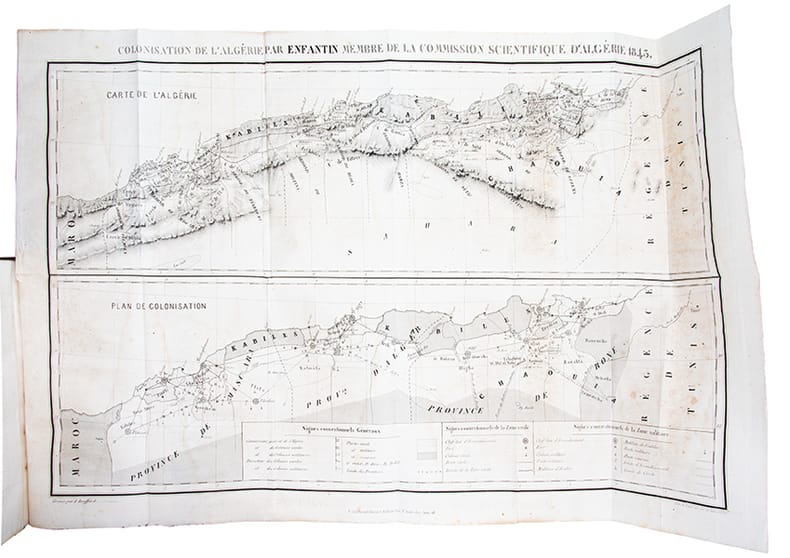
39394In-8 (225 x 142 mm), demi-chagrin bordeaux, pièce de titre de veau bronze (rel. moderne), (4), 542 pages, 4 pages de catalogue, grande carte (42 x 66 cm) et tableau statistique dépliants. Paris, P. Bertrand, 1843.
FT) Original Newspaper. Folio. Issues are between 8-12 pages. In Russian. Title translates to English as, The Social Democrat. Subtitle: Tsentralnyy Organ Rossiyskoy Soctsialdemokraticheskoy Rabochey Partii [The Central Organ of the Russian Social Democratic Labour Party]. Contributing authors include Lenin, Trotsky and Martov. Includes supplement to number 19-20. The Social-Democrat was an illegal Russian newspaper, Central Organ of the R. S. D. L. P. , published from February 1908 to January 1917. Altogether 58 issues appeared. The first issue was put out in Russia, but further publication was arranged abroad, first in Paris, then in Geneva The Editorial Board was made up of representatives of the Bolsheviks, the Mensheviks and the Polish Social-Democrats. The paper was largely run by Lenin, [who] fought for a consistent Bolshevik line on the Editorial Board. From December 1911 Sotsial-Demokrat was edited by Lenin Lenin's articles published in Sotsial-Demokrat during the war played an important part in helping to apply the strategy and tactics of the Bolshevik Party on the questions of war, peace and revolution, in denouncing social-chauvinists, and uniting the internationalist forces in the world labour movement (Encylopedia of Marxism) . CONTENTS INCLUDES: Tsel' Bor'by Proletariata v Nashey Revolyutsii [The purpose of the Struggle of the Proletariat in our Revolution] Rabochaya Gruppa na Zhenskom Syezd [The Worker's Group at The Women's Congress] Itogi Syezda Fabrichno-Zavodskikh Vrachey [The results of the congress of factory physicians] Kont-Revolyutsiya I Burzhuaziya [Counter-revolution and Bourgeois] Klassy I Partii v ikh Otnosheniy k Religii I Tserkvi [Classes and parties in their relations to religion and Church] Vopros' o Professional'nykh Soyuzakh v 3-oy Dume [Questions on trade unions in the Third Duma] O Fraktsii "Vperedovtsev" [About the Faction "Vpered"] Fraktsiya Trotskogo I Partiynoe Polozhenie [Trotsky's faction and party position] Mezhdunarodny Sotsialisticheskiy Syezd v Kopengagen [The International Socialist Congress in Copenhagen] Krestyanskaya Reforma I Proletarski-Krestyanskaya Revolyutsiya [Peasant Reform and the Proletariat-Peasant Revolution]. Many pages darkened with rubbing and edgewear, creases throughout. Some markings in header and top margin, but all text is clear. Good Condition. (RUS-11-1a) xxxxxxxx