17 205 résultats
1932219352Berlin, Verlag der sozialistischen Monatshefte, 1898-1932. Verschieden geb. u. in Heften. St. u. Sign. a. einigen Tit. Einbde. bzw. Rücken teils fleckig bzw. angestaubt, berieben u. bestoßen. Einige leicht wasserwellig. Hefte teils eingerissen, m. Randläsuren u. Fehlst. a. Umschlag, angestaubt.
61188Du N°1, Première année, 16 décembre 1893, au N°59, Troisième année, 26 janvier 1895, soit 59 numéros en un volume très grand in folio, relié demi-toile beige, dos lisse, étiquette rouge ; infimes fentes sans manque à quelques numéros ; cachet de bibliothèque sur le premier numero ; frottis sur les plats, coins émoussés, toile un peu fanée.
1978168819Frankfurt/M. Eigendruck, 1978-79. 4°.Typoskript. 12 einheitl. rote Lwdbde. m. Deckel- u. Rtit. Bibl.-St. a. Vorsatz u. 2 Ergänzungsbde. katon. Zustand tadellos.
Varsha [i. E. Warsaw]: Di Welt, 1927-37. Paper Wrappers or Cloth, 4to (tabloid format) , 16 pages each issue. Partially Bound in Cloth. Many with photos or Socialist Realism illustrations on cover. This Yiddish Socialist bi-monthly newspaper for Young people ran from Dec. 1, 1922 until sometime in 1948, in various formats at different times. In addition to these issues from 1922-1937 out of Warsaw, the journal was later published instead in Lodz and Paris, and was edited, in succession, by L. Hechtman, J. Mendelsohn, J. Gutgold, & L. Blit. Issues present here are: 1927 [1(38) - 24(60) ]; 1928[1(61) - 24(84) ]; 1929 [ 2(86) -5(89) , 7(91) -10(94) , 12(96) , 13(97) , 16(100) , 18(102) , 19(103) , 21(105) , 22(106) , 25(109) ]; 1930 [2(111) -14(123) , 20(129) ]; 1934 [21(232) ]; 1931[7 (141) , 16(15) , 17(151) ]; 1937[6 (299) ]. SUBJECT(S) : Jewish socialists -- Poland -- Periodicals. Jewish youth -- Poland -- Periodicals. Jews -- Poland -- Periodicals. OCLC lists only 1 holding (NYPL) . Bound volume (1927-1928) has heavily worn boards. All are printed on newsprint, so paper is brown, sometimes fragile, sometimes not, generally not split at the binding but sometimes so. In any case, all wear is at the extreme margins, with, remarkably, no text loss whatsoever. (Y-28)
39401In-12 (180 x 97 mm), broché, couverture dattente en papier bleu de lépoque, sous boîte moderne de toile beige, 188 pages, (1) feuillet derrata et (1) feuillet blanc. Turin, 1794 [i.e. Lausanne, Isaac Hignou, 1795].
165791Bruxelles, à la Librairie romantique, 1828 2 tomes en 1 vol. in-8, VIII-325 pp. et 327-[4] pp., demi-chagrin rouge, dos à nerfs orné (reliure postérieure). Rousseurs.
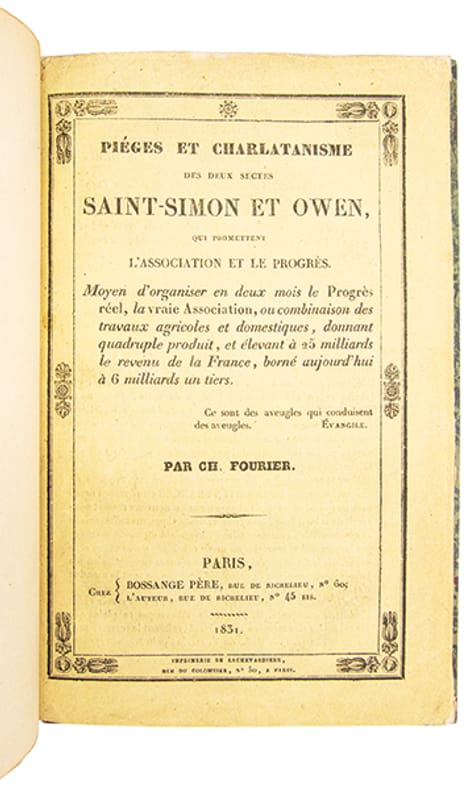
39409In-8 (214 x 133 mm), demi-veau vert sapin de lépoque orné dun décor romantique, dos à 4 faux-nerfs plats guillochés or, orné de compartiments garnis dun fer spécial au noir au centre et deux petits fleurons estampés en tête et pied, auteur et titre dorés, viij, 72 pages, couverture imprimée conservée, non rogné. Paris, Bossange Père, 1831.
15359Paris, Librairie Sociétaire, 1841-1845. 6 volumes. 8vo. Contemporary half calf, marbled boards, spines richly gilt with gilt lettering, a very nice copy. Del Bo, Fourier, p. 8; Del Bo-Gerits, Supplement, p. 16. Second edition, scarce. 1. Théorie des quatre mouvements et des destinées générales. Deuxième édition. With 1 folding table. (4), xxxvi, 484 pp. 2-5. Théorie de l'unité universelle (Traité de l'association domestique-agricole). Deuxième édition. With 1 folding table. (4), lxviii, (2), xlii, 243, (1), 107 pp.; xv, 451 pp.; viii, 593, (1) pp.; xii, 603 pp. 6. Le nouveau monde industriel et sociétaire. Deuxième édition. With two plates. (2), xvi, 489 pp. Del Bo does not mention the plates in vol. 6.
193386772S. n. | Villeneuve (Canton de Vaud) 11 Décembre 1933 | 14 x 21.50 cm | une page recto verso
39406In-8 (190 x 125 mm), demi-veau havane, dos lisse orné dun riche décor de compartiments garnis des doubles filets en place des nerfs, fer spécial répété au centre et palettes en tête et pied, pièces dauteur et de titre de maroquin havane et bronze (rel. Devauchelle dans le goût de lépoque), xviij, 19-112 pages. Paris, Adrien Égron, Delaunay, 8bre 1814.
In-8, demi-maroquin bleu nuit, dos à 4 faux-nerfs filetés or, auteur et titre dorés, daté en pied, couverture conservée (rel. moderne dans le goût de l'époque), lj, (3), 412 p. Edition originale, couverture de premier tirage et page de titre de remise en vente comportant une mention fictive de "deuxième édition". "À la faveur d'un quatrième séjour à Londres (mai-août 1839), Flora Tristan actualisa la vaste enquête sur l'Angleterre industrielle. Elle montrait l'Angleterre comme le laboratoire de la civilisation qui ne tarderait pas à gagner l'Europe; elle mettait en garde contre un modèle de développement où l'homme était sacrifié à la tyrannie du profit. Les 'Promenades dans Londres' approfondissaient sa vocation d'enquêtrice sociale" (S. Michaud, in Maitron cd-rom). Du point de vue de la composition et du style, certainement le meilleur des livres de Flora Tristan, où elle donne toute la mesure de son intelligence, de sa sensibilité et de sa lucidité politique. La parution de l'ouvrage en mai 1840 coïncida avec une crise économique majeure, une grève quasi-générale des corporations parisiennes et une structuration de l'organisation ouvrière à un niveau jamais encore atteint. "Les Promenades" obtinrent, dans ce contexte, un accueil élogieux de la presse républicaine et socialiste et un important retentissement populaire. "Au fond, à scruter de près les 'Promenades dans Londres', on peut dire que trois livres s'y trouvent superposés : une enquête de science sociale, une didactique révolutionnaire, un Evangile romantique" (François Bedarida). (J. Puech, 'Vie et oeuvre de F. Tristan', p. 489, n° 9. Maitron, Cd-rom). Quelques rousseurs éparses. Très bon exemplaire, très bien établi dans une reliure de maître.
Original Paper Wrappers. 4to. issues are 16-20 pages each. 28cm. In Russian. Title translates to English as, "The Banner of Struggle." Published sporadically, and eventually annually, from 1924-1930. CONTENTS: Budet Burya! [A Storm is Coming!] --- V Zaschitu Russkikh Revolyutsionerov [In Defense of Russian Revolutionaries] --- Sotsial-Bessarabtsy [The Social Bessarabians] --- Mezhdunarodnoe Revolyutsionnoe Dvizhenie [International Revolutionary Movement] --- Kultura i Revolyutsiya [Culture and Revolution] --- K Godovschine Iyul'skikh Dney [The Anniversary of the July Days] --- K Desyatiletniyu "Velikoy Voyny" [On the Decade of the "Great War"] --- Krovavyye Maski [Bloody Mask] --- V Godovschinu Dekabr'skoy Boyni 1923 goda [On the Anniversary of the December 1923 Massacre] --- O Veilkom Krizise v Marksizme, Sotsializme, Demokratizme i Rabochem Dvizhenii [The Great Criss in Marxism, Socialism, Democracy and the Labor Movement] --- Vashi Voprosy i Nashi Otvety [Your Questions and Our Answers] --- Golos Revolyutsionerov iz Rossiyskikh Tyurem [The Voice of Revolutionaries from Russian Prisons] --- O Natsional'nykh Men'shinstvakh na Ukraine [On the National Mensheviks in Ukraine] --- Manifest k Trudyaschimsya Goroda I Derevni [Manifest to the Workers of Cities and Villages] --- S'ezd Mezhdunarodnago Byuro Rev.-Sots. Partiy [Congress of the International Bureau of the Rev.-Soc. Party] --- Stalin, Trotskiy ili Revolyutsiya [Stalin, Trotsky or Revolution] --- Nelegal'nye Dokumenty RKP [Illegal Documents of the RCP (Russian Communist Party)] --- Desyat' Let Oktryabr'skoy Revolyutsii [Ten Years From the October Revolution] --- Na Poroge Dvenadtsatogo Goda [On the Eve of the Twelfth Year] --- Osnovnye Prichiny Krizisa Sotsializma [The Main Causes of the Crisis of Socialism] --- Na Poroge Trinadtsatogo Goda [On the Eve of the Thirteenth Year]. The "Union of Socialists-Revolutionaries Maximalists was a political party in the Russian Empire, a radical wing expelled from the Socialist-Revolutionary Party in 1906. The Union united agrarian terrorists, the 'Moscow Opposition' and other radical dissidents from the PSR in an independent party. The Maximalists officially split off from the PSR at its Second Congress in Imatra in 1906. Maximalists played a role in both the Revolution of 1905 and the Revolution of 1917. Many former SR Maximalists eventually joined the Russian Communist Party (Bolshevik) .Maximalists were so called because they demanded the full implementation of the 'maximum programme' in the expected revolution: full socialisation of the land, factories and all other means of production. The orthodox Socialist-Revolutionaries wanted to start with land reform but defer socialisation of other means of production. The Maximalists also rejected the PSR's version of a 'two-stage' revolution, a theory associated with V.M. Chernov. According to Chernov, the coming revolution in Russia would not be purely 'bourgeois-democratic' as the Social-Democrats claimed, but would include social and economic as well as political reforms. It would be a 'popular-democratic' revolution, and would transition into a full-blown 'labour-socialist' revolution later on. The Maximalists rejected this as Social-Democratic 'attentism' and argued that the coming Russian revolution would not be able to stop half-way; it was the two-stage theory, not Maximalism, that was unrealistic if it thought the toiling masses, once liberated, would content themselves with a bourgeois republic and gradual reforms." (Wikipedia, 2012) OCLC lists 9 copies. Publisher's typo on final page of No. 20/21: issue listed as "No. 20-25". Pages darkened but not fragile; some edgewear. Issue no. 24-26 worn with minor closed tears along gutter margin. Issue no. 8 outer wrappers detached but present. No 12/13 with small loss of paper and a few words. Overall, in Very Good Condition, a scarce complete run of this important journal. (RUS-11-37)
46401979, Londres, Nourse ; Paris, Desaint, 1767 ; 2 vol. in-12, veau fauve marbré, dos ornés, tranches bleues marbr. (Reliures de l’ép.). 1 f. blanc, faux-titre, titre, puis paginé de VII à XVI, 353 pp.- 2 ff., 547 pp.EDITION ORIGINALE in-12 parue en même temps et chez les mêmes éditeurs qu’une édition in-4. Dupont de Nemours a qualifié ce livre « d’ouvrage sublime ». C’est Le Mercier de La Rivière qui réussit à enthousiasmer Diderot pendant quelques mois pour la Physiocratie : « Il est le premier qui m’ait éclairé, qui m’ait instruit…Il est le seul qui m’ait donné des idées claires, nettes et vraies du commerce tant intérieur qu’extérieur, et de la nature du commerce en général » (Lettre à Damilaville 1767). « Subjugué par la cohérence de la doctrine exposée par l’auteur, qui avait été intendant des Antilles de 1759 à 1764, Diderot le recommanda chaleureusement à Catherine II puis l’invita en Russie. L’entente ne fut guère parfaite et Le Mercier séjourna seulement à Saint-Pétersbourg d’octobre 1767 à mars 1768. Adepte du despotisme légal qui n’est autre que celui de l’ordre naturel, Le Mercier donna un fondement philosophique à la doctrine économique de Quesnay. Le monarque physiocrate dispose à la fois des pouvoirs législatifs et exécutifs ; il est absolu, mais ce despotisme n’est nullement en contradiction avec l’indispensable liberté économique car le souverain n’est pas là pour faire des lois, mais appliquer les lois naturelles ; faire respecter la propriété et la liberté, telles sont les missions de l’Etat. L’ouvrage se termine par une théorie de l’impôt : le souverain héréditaire est le co-propriétaire foncier du royaume et l’impôt constitue une co-jouissance indispensable des revenus du Domaine » Hasquin. Diderot et son temps n°178 - Lavergne p.183.- INED 2794.- Einaudi 3307.- Kress-Goldsmith 10269.- Janet II p.637.Bel exemplaire avec un ex-libris manuscrit du XVIII e S. « Préau ». Cet ex-libris est rayé et remplacé par celui d’un certain N. Boussé ( ?) qui en avril 1846 a rédigé une note critique sur la garde du tome I. Notes au crayon par le même, dans plusieurs marges de l’ouvrage.
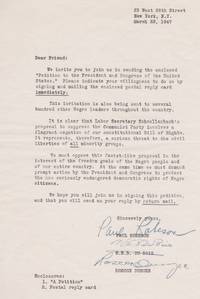
19471474<p>Robeson Paul W.E.B. Du Bois and Roscoe Dungee.</p><p>To the President and Congress of the United States of America Petition and Typed Letter Bearing Signatures of Robeson Du Bois and Dungee. New York: Communist Party USA 1947.</p><p><br />Single-page typed letter and two-page petition printed on rectos only. Each page 8 1/2 x 11 inches 215 x 280 mm.</p><p>A rare typed letter bearing signatures of Paul Robeson W.E.B. Du Bois and Roscoe Dungee asking recipients to sign a petition against banning the Communist Party USA. <strong>We believe the signatures were printed as does an autograph expert we consulted.</strong></p><p>In any case the three African-American leaders sprang into action after President Truman's Labor Secretary Lewis B. Schwellenbach told Congress that the Communist Party should be outlawed. Schwellenbach was concerned about Communist control and infiltration of labor unions and thought no Communist should be allowed to lead a union.</p><p>The letter is dated March 22 1947 and carries the address of 23 West 26th Street New York the Communist Party's headquarters at the time. The letter is aimed at African-American recipients: "This invitation to sign the petition is also being sent to several hundred other Negro leaders throughout the country."</p><p>According to the letter "It is clear that Labor Secretary Schwellenbach's proposal to suppress the Communist Party involves a flagrant negation of our constitutional Bill of Rights. It represents therefore a serious threat to the civil liberties of all minority groups." The authors urge recipients to mail back a postal reply card confirming they would sign the petition. The card is not present probably because it was mailed back to the Communist Party.</p><p>The petition which is also rare is addressed to the President and Congress urging them to reject Schwellenbach's "fascist-like proposal" to ban the Communist Party. The Party was not banned but the government regularly harassed and imprisoned its leaders in the 1940s and '50s.</p><p>Even though we believe the signatures on the letter were printed these materials are nonetheless rare. We have not found any institutional holdings of the letter or petition. None in commerce.</p><p>CONDITION: Pages lightly creased for mailing staple on petition badly rusted. A Very Good set. <strong>RARE</strong>.</p> [Communist Party USA]
90 pages. "Communist plotters, in the United States as elsewhere, are preparing for the conquest of political power. The discerning student, however, should consider how interventionism, under various enticing labels, is setting the stage for the final overthrow of the voluntary society, the market economy and constitutional government. [This work], by a world-famous expert, will prove a valuable aid to understanding in this field. It will help to explain the errors of those who believe a system based on individual freedom can be 'mixed' with socialism." - Foreword. Prior owner's details upon toned front free endpaper. Another person's name inside front board, otherwise contents clean and unmarked. Binding tight. Average wear to publisher's green cloth. Dust jacket not included. Greaves & McGee B-14. Book
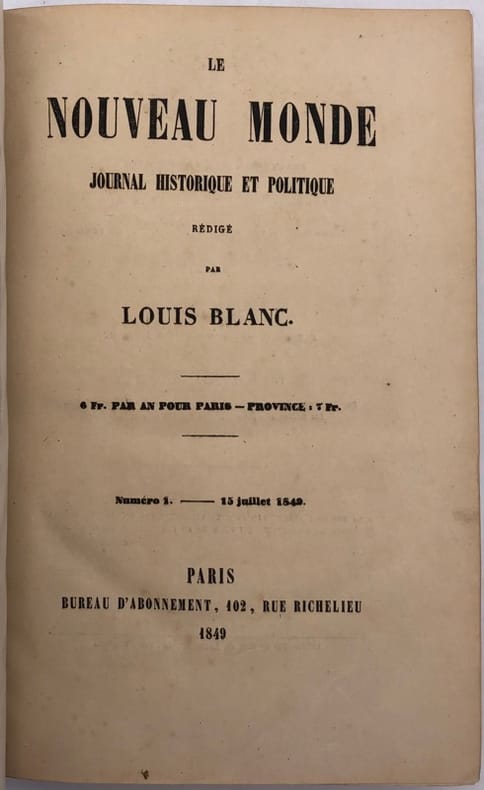
138417Paris, Imprimerie de Mme Lacombe, 1849-1851 18 livraisons en 1 vol. gr. in-8, demi-chagrin rouge à coins de percaline, dos à nerfs, caissons à froid (rel. de l'époque).
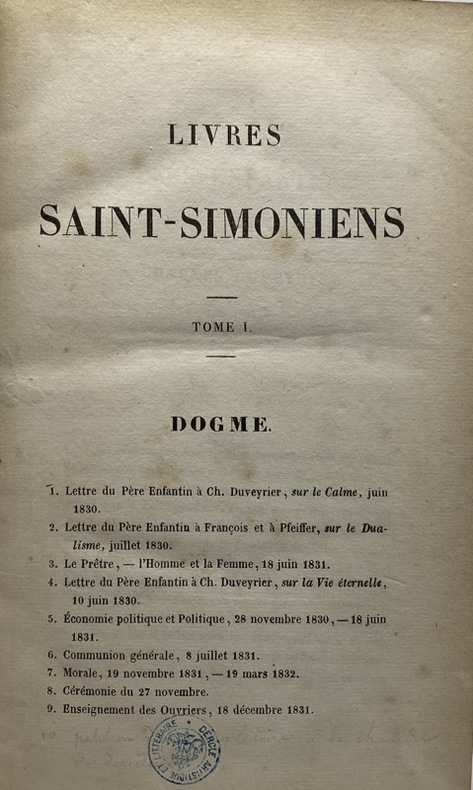
15529(Paris, Everat, 1832). 14 pieces bound in 1 volume. 70 pp.; 40 pp.; (2), 22 pp.; 10 pp.; 32 pp.; 13 pp.; 16 pp.; 8 pp.; (4), 105 pp.; 23 pp.; 8 pp.; (4), 207, (4) pp.; (2), 18 pp.; (2), 40 pp. 8vo. Modern half morocco, spine gilt with gilt lettering, marbled boards. First work: Walch 811; Goldsmiths 26607; Einaudi 5723; not in Kress.Second work: Walch-Gerits, Supplement, 319; Kress C.2795; Goldsmiths 27192; Einaudi 4670.Third work: Walch 319; Kress C.2795; Goldsmiths 27192; Einaudi 1745.Fourth work: Walch 813; Kress C.3359; Goldsmiths 27812; Einaudi 5724.Fifth work: Walch 814; Goldsmiths 27813; not in Kress; not in Einaudi.Sixth work: Walch 301; not in Kress; not in Goldsmiths; not in Einaudi.Seventh work: Not in Walch; not in Walch-Gerits, Supplement; not in Kress; not in Goldsmiths; Einaudi 4674 (states M. Chevalier to be the author). Eighth work: Walch-Gerits, Supplement, 80; Einaudi 1048; not in Kress; not in Goldsmiths.Ninth work: Walch-Gerits, Supplement, 309; Kress C.3262; Goldsmiths 27795; Einaudi 4389.The pages 83-105 contain: Projet de Banque présenté le 4 septembre 1830 par MM. Péreire. Both Walch and Walch-Gerits, Supplement, list this title under Isaac; Kress lists it under Jules but both attributions are incorrect, the author is Jacob-Émile Péreire.Tenth work: Walch-Gerits, Supplement, 356; Kress C. 2931; Goldsmiths 27221; not in Einaudi.The original title was printed on the cover which has not been preserved. The first page has a Drop-head title: Missions saint-simoniennes. Mission du Midi.Eleventh work: Walch-Gerits, Supplement, 438; not in Kress; not in Goldsmiths; not in Einaudi. Twelfth work: Walch-Gerits, Supplement, 175; Kress C.3132; Goldsmiths 27774; Einaudi 1749. The text of Les trois familles was written by E. Barrault. The saint-simonians Enfantin, Chevalier and Barrault were prosecuted for this work. Thirteenth work: Walch-Gerits, Supplement, 127; Kress C.3119; Goldsmiths 27766; Einaudi 1468. Fourteenth work: Not in Walch; not in Walch-Gerits, Supplement; Kress C.3297; Goldsmiths 27798; Einaudi 1073.Signed at end: M(ichel) C(hevalier). All first separate editions from previously published articles in Le Globe and other saint-simonian journals.
In-12, plein cartonnage ivoire à la Bradel, dos lisse orné de filet au noir en place des nerfs (reliure Laurenchet), 236, (4) p. de tables. Edition originale de cet ouvrage longtemps attribué à Diderot dans la deuxième moitié du XVIIIe siècle, jusqu'à être intégré aux éditions de ses oeuvres complètes. "Un des livres les plus importants du XVIIIe siècle. Reconnu comme tel par les historiens des doctrines politiques (...), il a été proclamé par le marquis d'Argenson comme "le livre des livres", Babeuf s'en réclama au cours de son procès, Fourier s'en inspira de façon évidente, Tocqueville, dans 'l'Ancien Régime', y retrouva 'plusieurs des théories politiques qui ont le plus effrayé la France…'" (Chinard, 'Code de la Nature', p. 7). "'Le code de la nature' est aussi le premier programme socialiste de l'histoire de France: l'ouvrage se termine sur un plan de législation idéale destiné à assurer le bonheur du genre humain, sur la base de l'abolition de la propriété privée et de l'avènement d'une société fraternelle" (Stéphanie Roza, 2011). (Chinard, p. 81. Einaudi, 4031. Hartig & Soboul, 'Utopies', p. 55. Higgs, 1594. Kress, 5457. Maffey, 'L'utopia della ragione', p. 230, n°8). Petit trou marginal. Bon exemplaire.
232686[Paris], Impriméries d'Éverat, de Carpentier-Méricourt ou de Guiraudet, s.d. (1830-1834) 19 pièces en 3 vol. in-8, [2] ff. n. ch. de faux-titre et de titre en début de chaque volume, puis pagination séparée, demi-basane bleue, dos à nerfs, tranches mouchetées (reliure de la fin du XIXe). Dos passés, rousseurs, coins abîmés.
1st edition. Original boards. 8vo. [576 pages], 27 cm. In Yiddish. Title translates to The Friend: Official Organ of the Workmens Circle. A complete year run of Fraynd, founded in 1910, printed monthly, then, at a later juncture, bimonthly. Formed in 1900 by Yiddish-speaking Jewish immigrants from Eastern Europe, The Workmen's Circle at first acted as a mutual aid society, helping its members to adapt to their new life in America. It provided life insurance, unemployment relief, healthcare, social interaction, burial assistance and general education through its branches throughout the US as well as through its national office. Soon, the organization was joined by more politically focused socialist Bundists who advocated the anti-assimilationist idea of Yiddish cultural autonomy, led by education in Yiddish and socialist ideals. The Circle formed the Folksbiene Yiddish theatre troupe and promoted Jewish arts and music, Yiddish school programs for children and Yiddish summer camps. It became influential in the American labor movement and grew to serve more than 84, 000 members through hundreds of branches around North America. It also became involved with the Yiddish newspaper The Forward and operated old-age homes, medical clinics and other services. Politically, the Circle moved away from socialism towards liberalism by the time of the New Deal (Wikipedia, 2018) . SUBJECTS: Jews -- United States -- Periodicals. Fraternal organizations -- United States -- Periodicals. OCLC lists 18 holdings, but most are for partial runs starting after 1917. Binding starting. Half of page one, Jan. 1914 is missing. Otherwise Very Good Condition. (YID-30-38)
46400421, Dublin, 1785; in-8, demi-bas. blonde, tr. jasp. ( Rel. de l'époque). 8 pp., 277 pp. EDITION DE TOUTE RARETÉ, parue un an après l'originale d'Amsterdam. Elle contient en EDITION ORIGINALE les Remarques d'un Républicain, texte très important qui occupe les pp. 135 à 277, soit la moitié du volume. Le même républicain (que nous n'avons su identifier) a signé la lettre préface à l'éditeur, Monsieur H.F.A., lettre datée de Dublin, 31 janvier 1785. Mably avait suivi avec intérêt et sympathie la naissance des Etats-Unis. Ses observations cependant sont sévères le jeune Etat risque d'être bientôt en proie aux divisions à cause de son caractère trop exclusivement commerçant. Voir Teyssendier de la Serve p. 17.- Sabin 42923 ( qui ne dévoile pas l'identité du Républicain)- Inconnu de Tchemerzine, Cioranesco, Leclerc, Barbier, Quérard, Ined, Goldsmiths-Kress, Einaudi, etc. ECONOMIE POLITIQUE AMERIQUE.
228826Bruxelles, à la Librairie romantique, 1828 2 tomes en 1 vol. in-8, VIII-325 pp. et 327-[5] pp., demi-veau fauve, dos lisse, flets dorés, tranches marbrées (reliure pastiche). Rousseurs, parfois prononcées.
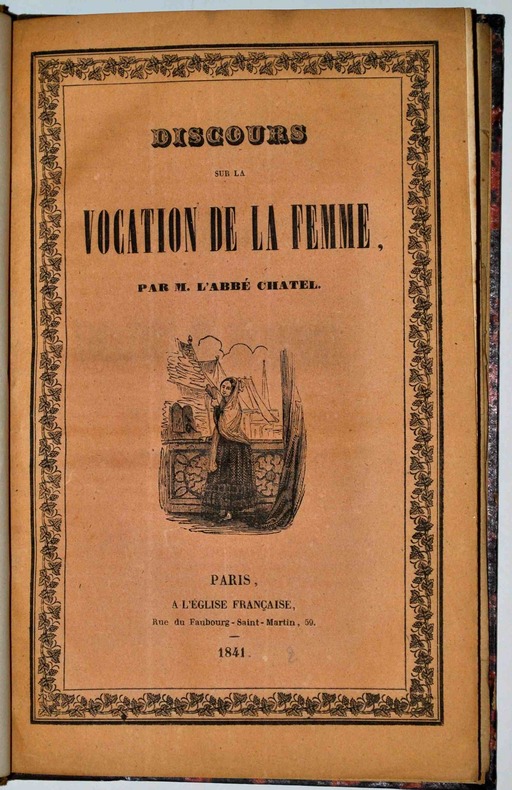
18417485Paris, à l'Eglise française, 1841. 16 p.Discours sur la vocation de la femme. Paris, A l'Eglise française, 1837. 16 pp.Loi du culte selon l'Église française et la loi sociale nouvelle. Paris, au siège provisoire de l'Eglise, 1848. 16 pp.Discours sur la charité. Paris, chez l'Auteur, 1846. 16 pp.Discours dur l'hypocrisie. Paris, chez l'Auteur, 1846. 16 pp.Discours sur la Cène fraternelle. Paris, chez l'Auteur, 1846. 19 pp.Discours sur l’apostasie. Paris, à l'Église française, 1841. 15 pp. Liberté, égalité, fraternité. Aux citoyens et ministres de l'Église française. Paris, Imp. de Boule, 1848. Placard grand in-folio replié.Lettre pastorale et Profession de foi sociale, politique et religieuse de l'Église démocratique, radicale française. Paris, Imp. Pollet, 1848. Placard grand in-folio replié.Ensemble 9 pièces reliées en 1 vol. in-8, demi-basane, couvertures conservées (reliure de l'époque).
6 volumes in-8, plein veau porphyre de l'époque, dos lisses ornés de compartiments fleuronnés et cloisonnés, plats encadrés de triples filets dorés, coupes filetées, tranches jaspées, 3 frontispices et 22 planches gravées. Première édition collective des oeuvres de Diderot publiée sous l'adresse sans doute fictive de Marc Michel Rey à Amsterdam, alors que ce dernier n'était pas parvenu à un accord avec l'auteur pour l'édition de ses oeuvres (cf. Wilson, p. 515). L'illustration comporte 3 frontispices et 22 planches gravées hors texte. Selon Adams, cette édition aurait été imprimée dans les Pays-Bas autrichiens, alors que pour D. Droixhe ('Diderot et son temps', n° 226): "un des tout premiers recueils des écrits de Diderot, sinon le premier, qu'il est permis de considérer comme liégeois". Elle renferme à côté des oeuvres de Diderot, trois textes qui ne sont pas de lui: 'Code de la Nature' (de Morelly), 'Mémoire pour Abraham Chaumeix' (de Morellet) et 'A MM. les Esprits forts'. (Adams, A2. Tchemerzine-Scheler, II, 957. Cat. expo. B.N., n° 517. Cohen, p. 303). Dorure légèrement passée. Quelques accrocs aux coiffes et quelques rousseurs. Très bon exemplaire, grand de marges, bien relié à l'époque.
171095Paris, Bossange, l'auteur, 1835-1836 2 vol. in-8, pagination multiple numérotée de façon hautement fantaisiste, demi-chagrin brun, dos à nerfs, filets dorés, tranches dorées (reliure récente). Cachet des Pères Dominicains au faux-titre du tome 1.