17 205 résultats
233955Genève, 1864 - 1885 12 pièces in-8, en feuilles.
1st edition. 4to, Original Paper Wrappers, 8 pages each issue, 13 numbers in 12 separate issues, as published. In Yiddish. Title translates as Bulletin of the Bund. Complete run of this early post-Holocaust iteration the Bunds monthly newsletter (also serving Kindred Jewish Socilaist Organizations), reflecting the concerns of its membership of secular Polish Holocaust survivors as well as pre-war immigrants to the US. Full of interesting articles including: Reports and declarations from the World Bund Conference in Brussels, including declarations on Antisemitism the workers movement, etc; The 1947 Socialist conference in Zurich; Bund activity in postwar-Poland, Belgium, Italy, France, Brazil, and Argentina; Jewish Socialists in Rumania; Bund Resolutions on the Camps; German Socialists and the Jewish Question; Professor Hirsh and Palestine; Discussion in the Bun on the Status of Palestine; On the Bundist Youth Movement in Poland; Special Camps; The Bulletin of the Bund [ie this periodical] in the [DP] Camps; Five Years in the Warsaw Ghetto, by Bernard Goldshtein; Bundist Academy in the Gan Eden Camp in New York; A Memorial for the Bund at the Congress of the French Socialists; etc. The General Jewish Labour Bund in Lithuania, Poland and Russia (Yiddish: algemeyner yidisher arbeter-bund in lite, poyln un rusland), generally called The Bund or the Jewish Labour Bund, was a secular Jewish socialist party.... founded in Vilnius on October 7, 1897 ..In 1917 the Polish part of the Bund, which dated to the times when Poland was a Russian territory, seceded from the Russian Bund and created a new Polish General Labor Bund which continued to operate in Poland in the years between the two world wars .The Bund sought to unite all Jewish workers in the Russian Empire into a united socialist party, and also to ally itself with the wider Russian social democratic movement to achieve a democratic and socialist Russia. The Russian Empire then included Lithuania, Latvia, Belarus, Ukraine and most of present-day Poland, areas where the majority of the world's Jews then lived. They hoped to see the Jews achieve a legal minority status in Russia. Of all Jewish political parties of the time, the Bund was the most progressive regarding gender equality, with women making up more than one-third of all members. The Bund actively campaigned against anti-Semitism. It defended Jewish civil and cultural rights and rejected assimilation. However, the close promotion of Jewish sectional interests and support for the concept of Jewish national unity (klal yisrael) was prevented by the socialist universalism of the Bund. The Bund avoided any automatic solidarity with Jews of the middle and upper classes and generally rejected political cooperation with Jewish groups that held religious, Zionist or conservative views. Even the anthem of the Bund, known as "the oath" (di shvue in Yiddish), written in 1902 by Sh. An-ski, contained no explicit reference to Jews or Jewish suffering. At the heart of the vision of the future of the Bund was the idea that there is no contradiction between the national aspect on the one hand and the socialist aspect on the other. As a strictly secular organization, the Bund renounced the Holy Land and the sacred language (Hebrew) and chose to speak Yiddish .In its early years the Bund had remarkable success, gaining an estimated 30,000 members in 1903 and an estimated 40,000 supporters in 1906, making it the largest socialist group in the Russian Empire . the Bund was a founding collective member at the RSDLP's first congress in Minsk in March 1898. For the next 5 years, the Bund was recognized as the sole representative of the Jewish workers in the RSDLP, although many Russian socialists of Jewish descent, especially outside of the Pale of Settlement, joined the RSDLP directly .The Bund generally sided with the party's Menshevik faction led by Julius Martov and against the Bolshevik faction led by Vladimir Lenin during the factional struggles in the run-up to the Russian Revolution of 1917 .In the Polish areas of the [Russian] empire, the Bund was a leading force in the 1905 revolution. At that time the organization probably reached the height of its influence. It called for an improvement in living standards, a more democratic political system and the introduction of equal rights for Jews. At least in the early stages of the first Russian Revolution, the armed groups of the "Bund" were likely the strongest revolutionary force in Western Russia. During the following years, the Bund went into a period of decay .The Bund eventually came to strongly oppose Zionism, arguing that emigration to Palestine was a form of escapism. The Bund did not advocate separatism. Instead, it focused on culture, rather than a state or a place, as the glue of Jewish nationalism. . The Bund also promoted the use of Yiddish as a Jewish national language and to some extent opposed the Zionist project of reviving Hebrew. The Bund won converts mainly among Jewish artisans and workers, but also among the growing Jewish intelligentsia. It led a trade union movement of its own. It joined with the Poalei Zion (Labour Zionists) and other groups to form self-defense organisations to protect Jewish communities against pogroms and government troops. During the Russian Revolution of 1905 the Bund headed the revolutionary movement in the Jewish towns, particularly in Belarus and Ukraine ..In 1921, the Communist Bund [in the USSR] dissolved itself and its members sought admission to the Communist Party....Many former Bundists, like Mikhail Liber and David Petrovsky, perished during Stalin's purges in the 1930s. The Polish Bundists continued their activities until 1948. During the latter half of the 20th century the Bundist legacy was represented through the International Jewish Labor Bund, a federation of local Bundist groups around the world .Among the exiled Bundists who went on with Socialist politics in America was Baruch Charney Vladeck (18861938), elected to the New York Board of Aldermen as a Socialist in 1917 [and] 1937 [and] manager of The Jewish Daily Forward Moishe Lewis (18881950)....the father of David Lewis (19091981), a leader of the New Democratic Party in Canada .David Dubinsky (18921982), though never formally a member of the party, had joined the bakers' union, which was controlled by the Bund, and was elected assistant secretary within the union by 1906 ..He later became a member of the Socialist Party of America, helped found the American Labor Party in 1936 and was from 1932 till 1966 the leader of the International Ladies' Garment Workers' Union ..under the name Max Goldfarb, David Petrovsky (18861937) was a member of the Central Committee of the Jewish Socialist Federation of America, a member of the Socialist Party of America, and the labor editor of The Forward (Wikipedia). SUBJECT(S): Jews -- United States -- Periodicals. Jewish socialists -- New York (State). Jewish labor unions. OCLC: 234327189. OCLC: 234327189. OCLC-Worldcat lists 6 holdings worldwide (NYPL, NLI, YIVO, Harvard, Yale, USHMM), though some listings may be for partial runs. Light wear, Very Good Condition. Rare and important complete set. (Yid-33-51)
186588031s. n. | Paris s.d. [1865] | 13.50 x 21 cm | deux pages sur un double feuillet
16718Paris, 4 mars 1803 et Besançon, 12 octobre 1842. 1 p. sur 1 double f. in-12 et 1 p. sur 1 double f. in-12 (petites déchirures marginales, petites rousseurs ou taches).
2 tomes reliés en un volume in-8, demi-toile havane chagrinée de l'époque, dos lisse orné d'un décor de filets dorés, titre doré, viii, 458 p. et (4), 451 p. Edition originale de cet ouvrage, "l'un des grands livres sociaux du XIXe siècle" (cf. M. Leroy, II, p. 381-390) et l'une des étapes décisives dans l’histoire du développement de la sociologie, de la démographie et de la statistique sociale en France. Médecin hygiéniste, Villermé fut chargé par l’Académie des Sciences morales et politiques de "constater aussi exactement que possible, l’état physique et moral des classes ouvrières". Accompagné par Benoiston de Châteauneuf, il commença son voyage à travers la misère ouvrière par Mulhouse puis le Haut-Rhin. Recueillant minutieusement les informations sur le terrain, il décrit en un style neutre la situation des ouvriers, l’exploitation des femmes et des enfants, les conditions de travail et de vie quotidienne de ces "nègres blancs". Le retentissement de cette enquête fut d’autant plus grand que les faits étaient présentés de façon objective, et analysés dans une interprétation libérale. Ce rapport joua un rôle déterminant dans l’élaboration de la loi du 22 mars 1841 sur le travail des enfants. Par la qualité et le sérieux des recherches sur lesquelles il reposait, il donna matière à une fructueuse réflexion sur la condition ouvrière, suscita de multiples travaux du même ordre et ouvrit la porte aux grandes réformes sociales qui suivirent. (En Français dans le Texte, 256. Dada, 292. Einaudi, 5914. Goldsmiths, 31731. Kress, C.5352. M. Perrot, 'Enquêtes sur la condition ouvrière', 63). Cachets et cotes de bibliothèques. Bon exemplaire.
1923186359Berlin-Wilmersdorf, Vlg. Die Aktion, 1923. 4°. M. zahlr. Ill., darunter Holzschnitte u.a. von: A. Schröder, E. Maetzel, Felixmüller, F.M. Jansen, F.W. Seifert. 578 Sp. Spät. schlichter Hlwdbd. Einbd. fleckig. Jeweils m. Orig.-Titelbl. M. einigen Buntstiftunter- bzw. anstreichungen. 1 Titelbl. m. kl. Eckabriß.
2 volumes in-12 (162 x 93 mm), plein veau marbré de l'époque, dos à 5 nerfs fleuronnés et cloisonnés, pièces de titre et de tomaison de veau, roulette sur les coupes, tranches rouges, (2), xli, (1), 216 p. et (4), 307 p., planche gravée allégorique en frontispice du tome I, vignettes de titre gravées, page de titre imprimée noir et rouge. "Véritable édition originale" selon Valette, probablement imprimée en France. Le portrait gravé en frontispice (qui regarde à gauche) et les vignettes seraient en premier tirage. Selon P. Versins, ce serait la seconde édition. "Sous une forme allégorique, Morelly dépeint une société fondée sur des principes communistes, morcelée en petits groupes économiques indépendants. Morelly nous présente une société sans vices, gouvernée par des lois naturelles et atteignant le bonheur grâce à la destruction des 'isles flottantes' c'est-à-dire des préjugés frivoles" (Hartig & Soboul). Raymond Trousson souligne, avec raison, qu'il agirait, qu'il s'agirait plutôt d'un projet anarchiste: rejet de la propriété individuelle cause de tous les maux, violente attaque contre le commerce capitaliste, mais aussi abolition des institutions politiques et juridiques, autorégulation d'une société sans police, ni armée, ni d'églises, célébration d'un érotisme socialisé et union libre, "toute la vie sociale y est décrite comme une fête".. "Au point de vue socialiste, c'est la plus importante des utopies du XVIIIe siècle" (Lichtenberger. 'Le socialisme au XVIIIe s.', p. 106-113). (Hartig & Soboul, 'Pour une histoire de l'utopie', p. 54. INED, n°3319. Maffey, 'L'Utopia della Ragione', n°7. Valette, 'Utopie', n°230. Versins, 'Sur une seconde édition…', "Ailleurs", n°0, oct. 1963, p. 17-20). Quelques infimes traces de restauration à la reliure. Ex-libris gravés et armoriés. Bel exemplaire, frais, bien relié à l'époque.
193436091934. Paris Librairie internationale 1934 - 4 vol. 24 cm x 32 cm 2893 pp. à pagination continue demi-chagrin noir dos à nerfs (reliure de l'éditeur) - Bon état - Sous la direction de Sébastien Faure - Textes de : Aigueperse Charles Alexandre Archinoff E. Armand Lucien Barbedette Camillo Berneri Ixigrec Manuel Devaldès Sébastien Faure Hem Day Jeanne et Eugène Humbert Robert Jospin Lacaze-Duthiers André Lorulot Malatesta Victor Méric Han Ryner Max Nettlau Raoul Odin Charles Rapoport Madeleine Verney Vigné d'Octon Georges Yvetot etc
184944785Paris, Propagande démocratique et sociale, Imprimerie Desoye, 1849. 5 livraisons in-folio de 2 pp. chacune, en feuilles.
209218Paris, Editions de la revue Fontaine, 1947 in-8, 42 pp., [3] ff. n. ch., avec des illustrations dans le texte par Frederick John Kiesler (diagrammes et figures géométriques), en feuilles sous chemise illustrée et rempliée.
224046Paris, Imprimerie de Bajat, 1842 in-8, 166 pp. en numérotation continue, demi-basane noire, dos lisse orné (reliure de l'époque). Coupes et coins usés. Rousseurs, tache brune aux premiers feuillets.
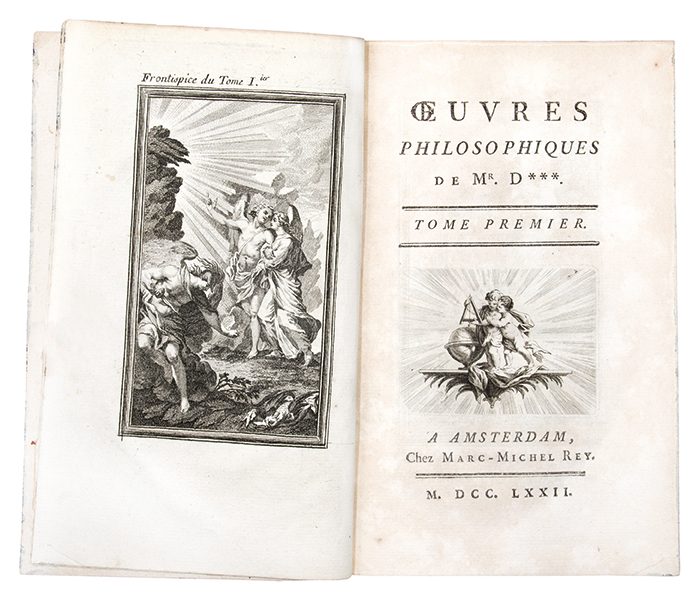
1772381111772 6 volumes in-8, plein veau porphyre de l'époque, dos lisses ornés de compartiments fleuronnés et cloisonnés, plats encadrés de triples filets dorés, coupes filetées, tranches jaspées, 3 frontispices et 22 planches gravées. Amsterdam, Jean Michel Rey, 1772.
96 pages. 14.3" x 10.5". Text in German. Large photo portrait of Hitler upon front cover. Profusely Illustrated with reproductions of photos of Hitler from 1916 through 1936. Includes considerable text submitted by many prominent contributors in addition to those we have listed. One need not be able to read German to fully appreciate that this work was compiled for the express purpose of boosting the image of Adolph Hitler in the eyes of his countrymen in the days leading up to WWII. Above-average but not excessive external wear. Binding intact. Unmarked. Small chips from lower corner of front cover. A sound vintage copy of this ominous work. Hold history in your hands. Book
288 pages. Upon front free endpaper is hand-written in ink: "To David, With Best Wishes, From Tommy Douglas." In November 2004 a nation-wide vote by over one million Canadians selected Mr. Douglas as "The Greatest Canadian of all Time." "This collection of Tommy Douglas' speeches, anecdotes, and parables illustrates the essential features of the democratic left in Canada, the CCF/NDP." - from dust jacket. Black and white photographic plates. Book clean and unmarked with light wear. Average wear to dust jacket which bears several short closed tears and is now preserved in a glossy new archival-grade Brodart cover. Book
1919219622Berlin, Vlg. Vorwärts, 1914-1919. Fol. In 12 Hlwdbdn. Einbde. u. Rücken meist fleckig u. beschmutzt, teils bestoßen o. verblichen. Ecken teils bestoßen. Fehlen: Jg. 32 Nr. 169; 34 Nr. 62, 63; 36 Nr. 493.
1904195707Hamburg, Meissner, 1903-1904. Hldrbde. m. Rsch., Rverg. u. marmor. Schnitt. Rücken berieben. Kanten etwas bestoßen, sonst gutes Exemplar.
15971Paris, Lacroix et Cie., 1875. With a very nice portrait-frontispiece in volume 14. 14 volumes. Large 8vo. Contemporary half calf, spines gilt in compartments with gilt lettering, marbled boards. Nettlau, p. 21. The correspondence with Pauthier, Ackermann, Huguenet, Bergmann, Tissot, Darimon, but also with De Girardin, Michelet, Louis Blanc, Manzini, Dentu, etc., and even with the prince Napoléon, giving a clear insight in the course of a life and the making of an 'oeuvre' of one of the most famous and important theorists of anarchism in the 19th century.
1931223BBZürich, Leipzig, Orell Füssli Verlag, 1931. 8°. 8 S., (english), 7 S. (hebrew). Mit 65 Abb. nach Photos von M. Vorobeichic. Illustr. Orig.-Halbleinenband + Wichtig: Für unsere Kunden in der EU erfolgt der Versand alle 14 Tage verzollt ab Deutschland / Postbank-Konto in Deutschland vorhanden +, 223BB (berieben und bestossen). = "Schaubücher", Bd. 27.
1931223BBZürich, Leipzig, Orell Füssli Verlag, 1931. 8°. 8 S., (english), 7 S. (hebrew). Mit 65 Abb. nach Photos von M. Vorobeichic. Illustr. Orig.-Halbleinenband (berieben und bestossen). = "Schaubücher", Bd. 27.
In-12 (170 x 110 mm), demi-chagrin acajou de l’époque, dos lisse orné de filets gras à froid soulignés de doubles filets, titre doré, (2), 229, (1) p. Edition originale de cet ouvrage prophétique, relation d'un songe fait sous l'emprise du haschich qui transporte l'auteur en 1943. "Il raconte les faits nouveaux survenus depuis cent ans. Et ceux-ci sont nombreux: citons la substitution de l'électricité au charbon, la propulsion des bateaux par hélices, le percement du canal de Suez et de Panama, les tunnels sous les Alpes et les Pyrénées, la prééminence des États-Unis sur l'Angleterre, la perte, par celle-ci, de l'Inde et des deux Canada, la confédération des pays latins d'Europe, l'union monétaire, etc." (cf. Louis Dulieu in Rev. Hist. Sci., 1975, XXVIH/2, p. 136-137). Mais aussi: la Révolution de 1848, ce qui valut à l'ouvrage un regain de popularité lors de cet événement, l’émancipation des femmes, les moyens de transport mus à l'électricité… Originaire de Metz, élève de Dupuytren, de Bichat et Broussais, C.-Fr. Lallemand devint chirurgien et professeur de médecine aux facultés de Paris et de Montpellier. Disciple de Pierre Leroux, il fut destitué de sa chaire en raison de son engagement aux côtés des républicains radicaux sous la monarchie de Juillet. (Cf. Maitron CD-Rom. Morel, ‘Dict. biogr. de la psychiatrie’, p. 149). Le faux-titre n'a pas été conservé. Quelques rousseurs sporadiques. Très bon exemplaire, bien relié à l'époque.
1905168486Odessa, Knigoizdatel'stvo "Bukrev'stnik' ", 1905. 49 S. OU. Umschl. etwas beschäd. (Randläsuren u. kl. Beschäd. an d. Heftung. Name a. Tit.
3 volumes in-12 (159 x 93 mm), plein veau fauve glacé de l'époque, dos à 5 nerfs guillochés or, ornés de compartiments richement garnis d'un décor d'encadrement, fleurons centraux, filets et palettes dorés, pièces de titre et de tomaison de maroquin, roulette sur les coupes, tranches rouges, (30), 451 p.; (8), 447 p. et (8), 438 p., portrait frontispice gravé par P. Bouttats, titres rouge et noir. Première édition de la traduction française. Produite dans les milieux du refuge huguenot, cette traduction assura la diffusion européenne et le succès de ce livre. Très lu, réédité à plusieurs reprises, ce "catéchisme des républicains", constitua une source fondamentale de la pensée des Lumières comme des révolutionnaires de 1789. Algernon Sidney y étudie avec précision les mécanismes du pouvoir personnel, expose ses vues sur la nécessaire liberté politique des Nations et argumente autour de la primauté d’un parlement représentatif sur l’exécutif. Impliqué dans un complot contre Charles II d’Angleterre, l’auteur a été décapité pour trahison en 1683 et son ouvrage ne fut publié en anglais qu'à titre posthume en 1698. "L'une des plus puissantes théories républicaines des débuts de l'époque moderne" (C. Hamel). Cf. P. Carrive, ‘La pensée politique d’A. Sidney’, Paris, 1989. (Brunet, V, 373). Petits défauts aux coiffes et petites fentes aux mors. Ex-libris gravé ancien: "La Houssaye". Bel exemplaire, très frais, très bien relié à l’époque.
Due volumi in 8o piccolo di X-359 e VIII-352 pagine. Il primo tomo è in 4ta edizione; il secondo è in 3za edizione. Ottima legatura coeva in mezza pelle rossa, sorso a nervi ornato e dorato. Il primo volume porta la dizione al titolo di quarta edizione. La Table des matieres, posta in testa al volume, indica però una paginazione che non corrisponde a quella del volume. Il secondo volume è in terza edizione. Non è stato rilegato al termine il catalogo delle opere della Librairie sociétaire, che di solito era aggiunto nelle brossure. L’opera è completa. Un terzo volume apparve alla data del 49, ma venne poi ristampato a parte sotto il titolo “Theorie de l’éducation naturelle attrayante…”.
1951902Praha Prague: Nakladatelstvi Mir Drustevnà Práce 1951. First Edition. <br /><br />Small Quarto 10 7/8 x 9 1/4 inches; 275 x 235 mm 124 pages in illustrated boards. <br /><br />A collection of anti-Hitler and anti-U.S. cartoons by the great Soviet cartoonist Boris Efimov 1900-2008 whose name is rendered in Czech as Boris Jefimova. The anthology starts in the 1930s with the rise of Hitler and carries forward to the late 1940s attacking the Marshall Plan Wall Street fat cats the Western alliance and the U.S. position in Korea.<br /><br />By contrast and not surprisingly the Soviet Union is portrayed heroically having single-handedly defeated Hitler. Given the preponderance of Wall Street financiers in the cartoons Wall Street appears to be behind Western imperialism and belligerence and even abetted the rise of Hitler. The book opens with a quote from "J. Stalin" and contains 60 cartoons mostly in black-and-white but some containing deep red representing of course the supposed nobility of the Soviet Union and its allies. <br /><br />Copies of this Czech-language book are uncommon. OCLC lists just three institutional holdings: the College of William and Mary the National Library of the Czech Republic and the University of Leipzig. <br /><br />A very good striking example of Czech-Russian agitprop during the dark days of the Cold War. <b>SCARCE</b>. <br /><br />CONDITION: Light soiling and wear to the boards but the pages are clean and bright. Very Good or better. Nakladatelstvi Mir – Družzstevnà Práce hardcover books