MARX, Karl, & Friedrich EngelsBiblio.com
9 494 résultats
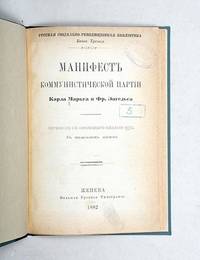
1882136584Geneva: Volnaja Russkaja Tipografija 1882. By far and away the best of all the foreign language translations First complete Russian translation of the Communist Manifesto declared by Engels to be "by far and away the best of all the foreign language translations he knew" Andréas. Translated by Georgi Plekhanov with a new preface written in January 1882 by Marx and Engels as well as their preface to the edition of 1872 it was this translation that played an important role in the development of the Russian socialist movement. The original Russian translation of 1869 probably by Nechayev contained a number of serious mistakes and omitted several sections of the German original. Octavo 168 x 112 mm x 50 pp. Sometime separated into individual leaves now guarded in gutter re-sewn and bound in recent quarter blue morocco and blue-grey boards spine ruled and lettered in gilt. Library stamp to title page and ownership stamp "Bolan. 6. June. 1940" to page iii perforated library stamp of New York Public Library to lower margin of page 3. Cut close at head with occasional loss of pagination. Short closed tear to title repaired on blank verso leaf edges somewhat brittle with occasional chipping pages iv vi viii x 2 3 5 7 9 12 and final leaf with tiny marginal strengthening repairs; withal a very good copy of a very scarce edition. Andréas 135; Die Erstdrucke der Werke von Marx und Engels p. 15; Draper ME33 ST/ME34; Rubel 757. hardcover
184358875Zürich & Winterthur, Literarischen Comptoirs, 1843. 8vo. Bound in one nice later half calf binding in contemporary style with gilt title and blindstamped ornamentation to spine. Faded inscription of ""Eigenthus des Literar. Museum"" to both title-pages and last leaf of bot volumes. Stamps of the same Litarary Museum to volume 1, at both title-page, last leaf and a few leaves inbetween. Neat pencil annotations to a few leaves of volume 1. Neatly washed and with a few tiny closed tears to second gathering. A small spot to lower blank margin of pp. 195-8 of vol. 1. Contents generally clean and crisp. All in all a evry nice copy. IV, 320 + IV, 288 pp. [Marx' paper: Vol. I, pp. 56-88].
184358875Zürich & Winterthur Literarischen Comptoirs 1843. 8vo. Bound in one nice later half calf binding in contemporary style with gilt title and blindstamped ornamentation to spine. Faded inscription of "Eigenthus des Literar. Museum" to both title-pages and last leaf of bot volumes. Stamps of the same Litarary Museum to volume 1 at both title-page last leaf and a few leaves inbetween. Neat pencil annotations to a few leaves of volume 1. Neatly washed and with a few tiny closed tears to second gathering. A small spot to lower blank margin of pp. 195-8 of vol. 1. Contents generally clean and crisp. All in all a evry nice copy. IV 320 IV 288 pp. Marx' paper: Vol. I pp. 56-88. <br/><br/><em>Extremely scarce first edition of this two-volume periodical which contains the first printing of Marx' first newspaper article being the first political article written by Marx for publication namely his "Comments on the Latest Prussian Censorship Instruction". This important debut work which constitutes the foundation of Marxian dialectic and his formulation of Critical Hegelianism was written between January 15 and February 10 1842 but due to censorship restrictions it first appeared here in Ruge's "Anekdota" in Switzerland in 1843 to avoid German censorship. "The young Marx and the young Engels ridiculed the Prussian Censorship Law of 1841. The attack of the young Mark "Comments on the Latest Prussian Censorship Instruction" was written in 1842 but published a year later in Ruge's "Anekdota"."Comments on the Latest Prussian Censorship Instruction" is an early exercise by the young Marx in the application of the categories of Hegelian critique. In this essay the young Marx employed the Hegelian modalities of substance and essence to demonstrate the authoritarian nature of the Prussian Censorship Instruction. The young Marx utilized the concepts of substance and essence in the defence of free press. "Comments on the Latest Prussian Censorship Instruction" defines the essence of a free press as free mind or the essence of reason as freedom. The young Marx argues that it was impossible for reason to act in accordance with its essence unless it was totally free because without absolute freedom reason cannot follow its own insights to their logical conclusion. Consequently when the Prussian Censorship Instruction limits the freedom of reason when it sets boundaries beyond which reason cannot go the Prussian Government annihilates the essence of reason. The strategy of the young Marx is his essay is to adopt Hegelian logic in the cause of liberalism. He wished to show how Hegelian categories could be adjusted could be transformed into weapons in the cause of political reform. In this essay the young Marx proved two things that he interpreted Hegel as a critical Hegelian and that he himself continued this Critical Hegelian tradition. In 1842 the young Marx explored experimented with the use of Hegelian categories essence and appearance as devices by which to advance the cause of political progressivism and this was the meaning of Critical Hegelianism in the generation of Gans." Norman Levine: Divergent Paths: Hegel in Marxism and Engelsism pp. 142-43."Karl's i.e. Marx politics had closely followed those of Ruge ever since the end of the 1830s. In 1842 and 1843 their responses to immediate events not least the "frivolous diatribes of the "Free" had remained very close. An established author and in the possession of independent means "Papa Ruge" - as Jenny called him - was clearly the senior partner in this collaboration. The banning of the "Deutsche Jahrbücher" in January 1843 as the result of Prussian pressure together with the suppression of the "Rheinische Zeitung" meant the effective silencing of Young Hegelianism within Germany. The aim of the criticism as it was applied among Young Hegelians was to highlight the gap between the demands of reason and the behavior of the government but its failure to make any significant headway against the Prussia of Friedrich Wilhelm IV had also pushed them both towards an open criticism of Hegel's political philosophy. Gareth Steadman Jones: Karl Marx Greatness and Illusion p. 142.Although another anonymous essay "Luther als Schiedsrichter zwischen Strauß und Feuerbach" Vol. II pp. 206-208 has long been attributed to Marx the preface to MECW I now states that "recent research has proved that it was not written by Marx Draper register p. 58. The piece might be by Feuerbach himself. </em> unknown
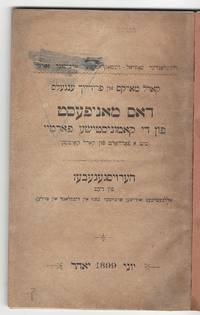
18991926Geneva: Heroysgegeben fun dem Allgemeynem Idishen arbeyṭer Bund in Russland un Poylen 1899. First Yiddish book edition. First edition of this translation. In somewhat later paper wrappers. Shelfmark vignette on the front cover. Possessor's stamp on the title page shelfmark on its verso. Possessor's stamp on p. 3 11 and 15. A tear on the title page with amateur restoration. Corners damaged with no loss of text. Pp. 93-4 torn at side edge and damaged at the lower corner with no loss of text. The last leaf slightly damaged at side edge affecting only the margin. Pages yellowed due to the acidic paper. Overall in very good condition. First Yiddish book edition. First edition of this translation. In somewhat later paper wrappers. <p><br /> First Yiddish edition in book form of the Communist Manifesto the greatest piece of revolutionary propaganda the first edition of Blumshteyn's translation prefaced by Karl Kautsky.<br /> <p><p><br /> The book was published by the General Jewish Labour Bund in Russia and Poland as a publication of the movement's party the Russian Social Democratic Labor Party. The Yiddish translation was initiated by Chaim Zhitlovsky a prominent member of the Bund in Switzerland. The Manifesto was eventually translated by Y. Blumshteyn with Yitskhok Toymin and published in 1899 in Geneva with Karl Kautsky's preface.<br /> <p><p><br /> There were some earlier attempts to interpret the first program of the international Communist movement for the Yiddish readers an adaptation of the first two sections appeared in the London-based Jewish anarchist paper "Der Arbeiter Freint" in 1890 later Abraham Kahan's translation appeared in installments in "Di Tsukunft" in New York in 1897. The present version is the first complete Yiddish translation to be published in a book form.<br /> <p><p><br /> Extremely scarce we could trace only four copies with identical collation in institutional holdings at Florida Atlantic University; Yivo; University of Wisconsin - Madison missing the last three pages and the back cover; and at the National Library of Israel. The Brandeis Library and Harvard College Library cite an 1899 edition with 122 p. the copy at the International Institute of Social History Amsterdam comprises 97 p. the copy at the Friedrich-Ebert-Stiftung is a photocopy.<br /> <p>. Heroysgegeben fun dem Allgemeynem Idishen arbeyṭer Bund in Russland un Poylen unknown
188360072London, The Modern Press, 1883. Royal8vo. Entire volume present, in the original olive green full cloth binding with gilt lettering to spine. Front board with black line-borders, black vignette, gilt lettering and gilt ornamentation depicting the sun. Spine with small mark and professional repairs to head and tail of spine. Light occassional brownspots to first leaves, otherwise a fine and clean copy. (Capital:) Pp. 57-68" 145-150. (Entire volume:) IV, 600 pp. Housed in a cloth clamshell box with gilt lettering to spine.
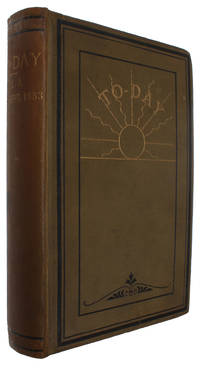
188360072London The Modern Press 1883. Royal8vo. Entire volume present in the original olive green full cloth binding with gilt lettering to spine. Front board with black line-borders black vignette gilt lettering and gilt ornamentation depicting the sun. Spine with small mark and professional repairs to head and tail of spine. Light occassional brownspots to first leaves otherwise a fine and clean copy. Capital: Pp. 57-68; 145-150. Entire volume: IV 600 pp. Housed in a cloth clamshell box with gilt lettering to spine. <br/><br/><em>The exceedingly rare first British translation of any part of ‘Das Kapital’ and the first English translation of any part of the work to be published in Britain. When Karl Marx was finalizing the first volume of “Das Kapital†he was already planning an English translation; British socialism was dominated by trade unionism and Marx wanted to propagate his ideas among the British working class. It would take 16 years however before the present translation was published and a full 20 years before the first full translation of the first volume of Das Kapital was published. The present work is of the utmost scarcity and we have not beeen able to find a single auction record of it. Marx' research for ‘Das Kapital’ was in large part carried out in the reading room of the British Library and the British working class during the industrial revolution in the late 18th century and early 19th century was highly important to Marx' class analysis. Consequently Marx was eager to have an English translation published and for years Marx and Engels tried to find an English translator and an editor for “Das Kapitalâ€. While several unauthorized translations were planned and even begun nothing came of it in Marx’s lifetime. The present book is the first volume of a journal edited by Ernest Belfort Bax & James Leigh Joynes which specialized in the publication of free-thinking and radical works. It was published from 1883 to 1889 and To-Day's guiding principle was to 'shake itself free from all fetters save those of truth and taste'. Its political stance is indeed bold and not entirely unfitting for a first translation of ‘Das Kapital’: 'the equal rights of every human being to health wealth wisdom and happiness shall be our watchword'. Two sections of ´Das Kapital´ namely: I. The Serfdom of Work; II. The Lordship of Wealth. According to the heading the second installment is being translated from the French edition of 1872 but a footnote states: “this chapter is translated from the second and third sections of chapter X of the original". The first complete English book edition appeared in 1887 under the title Capital: A Critical Analysis of Capitalist Production. It was translated by Samuel Moore and Edward Aveling the partner of Karl Marx's daughter Eleanor overseen by Engels. </em> hardcover
188160211The Hague, Liebers & Co, (1881). 8vo. Uncut in the original printed wrappers. Spine missing some of the paper and upper part of front wrapper and lower part of back wrappers detached. Wrappers brownspotted and previous owner's name in pencil to upper margin of front wrapper. Pp. 37-40 missing some of the paper in upper margin - far from affecting text, otherwise internally fine and clean. VII, 82 pp.
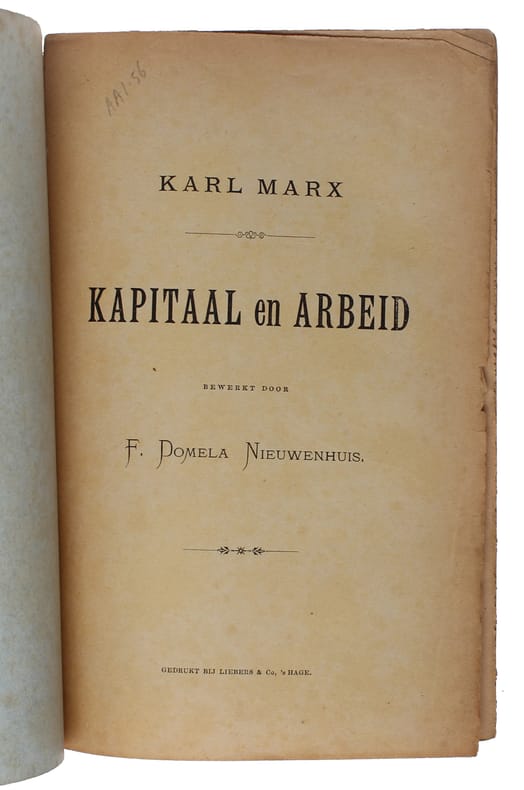
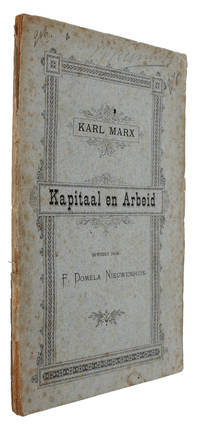
188160211The Hague Liebers & Co 1881. 8vo. Uncut in the original printed wrappers. Spine missing some of the paper and upper part of front wrapper and lower part of back wrappers detached. Wrappers brownspotted and previous owner's name in pencil to upper margin of front wrapper. Pp. 37-40 missing some of the paper in upper margin - far from affecting text otherwise internally fine and clean. VII 82 pp. <br/><br/><em>The rare first Dutch translation of Marx’s “Lohnarbeit und Kapital†i.e. "Wage Labour and Capital" here in the exceedingly rare printed wrappers presumably being the only known copy in wrappers. This seminal work by Karl Marx which due to its aim to be a popular exposition of his central theories of capitalism and the economic relationships between workers and capitalists became one of the most generally influential and widely read of Marx' works. It is widely considered the precursor to Das Kapital. "Wage Labour and Capital" was originally written as a series of newspaper articles in 1847 and was first published however only fragmentarily in the form of five articles in April 1849 in the "Neue Rheinische Zeitung". Because of the political conditions the printing of the series had to be ended and thus only these five articles appeared as there was no sign of the rest of it between the papers of Marx that were found after his death. The work did not appear again until 1881. In 1891 Engels published a re-worked version of the article which took into account Marx' later developments in his economic theory for instance Engels inserted the distinction between "labour" and "labour-power" which Marx did not make in the original version and during the 1890'ies the work appeared in numerous languages and in an enormous amount of editions. Marx' seminal theories that are made easily accessible in this important publication include his Labour Theory of Value his Theory of Concentration of Capital his Theory of Alienation etc. which were all later developed in the "Capital" three fundamental theories that have influenced all later economical-political thought. Ferdinand Domela Nieuwenhuis 1846-1919 a Dutch socialist. "Originally a Lutheran pastor 1870-1879 he left the church founded the socialist weekly Recht voor Allen 1879. He played a leading part in developing the Social-Democratic movement in the Netherlands; was elected to parliament for a term 1881-1891; disappointed in legislating social reform he turned to anarchism 1890s. He authored a number of propaganda brochures." Draper: The Marx-Engels Glossary p. 154. </em> unknown
1867120907Geneva: Verlag der Association 1867. First edition of Marx's announcements for Capital part of a complete run of Der Vorbote from the library of anarchist Johann Most First edition of Marx's formal announcements of the publication of the first volume of his magnum opus Das Kapital in the uncommon revolutionary socialist journal Der Vorbote with an exceptional provenance from the library of the German radical journalist and agitator Johann Most who played a part in Capital's publication history and with whom Marx had a turbulent relationship. When the first volume of Capital was finally published on 14 September 1867 Marx and Engels "set about breaking through the silence of the German press" Draper I 1867.1 by placing notices in various international papers with limited success. Marx had written to Johann Philipp Becker the founder and editor of Der Vorbote in April 1867 to pre-emptively ask for his help; as a result the first advance announcement appeared in Der Vorbote's issue of the same month with two further pre-publication announcements printed in the June and July issues. The official announcement of Capital's publication was printed in the September issue and successive notices printed in October and November. These were some of the earliest notices to be printed after Capital's publication and are all included in this volume along with other highly valuable contributions from most of the major figures of 19th-century international communism. Johann Most is best known for his later anarchist period in America but his reputation as an agitator was established in Germany as the editor of a series of social-democratic papers. Most was responsible for the first abridgement of Capital volume 1 published in 1873 under the title Kapital und Arbeit. Taking issue with some of Most's abbreviations Marx revised the abridgement but stipulated that his name not be used in connection with it because it remained imperfect. After being expelled from Berlin in 1878 Most emigrated to London where he repeatedly visited Marx but despite his attempts to sway Marx to his more radical opinions Most only succeeded in distancing himself further. Despite their disapproval when Marx and Engels were informed of Most's arrest in the wake of Alexander II's assassination they immediately sent a letter to the London Daily News in his defence and Marx even contributed to the fund against his prosecution. Most fled to America in 1882. On the news of Marx's death he gave a speech at the memorial meeting held in New York. Octavo 204 x 122 mm a complete run 72 monthly issues from 1866 to 1871. Recent purple half morocco and marbled paper boards new endpapers retaining the original front free endpaper see note. Spine lettered and dated in gilt with the title misspelled as "Der Verbote". Contemporary ownership inscription of "J. Most" - Johann Most 1846-1906 - in blue pencil a second inscription to title page of April 1869 issue and occasional annotation to the text. Contents generally clean with occasional spotting and dampmarks some stab-holes visible at gutters a few issues trimmed in the binding process those printed on inferior paper stock fragile at the margins and with a few short tears and more toning than others 1 full leaf April 1868 and 1 half-leaf January 1870 cut away and 4 other instances of excised portions clipped from the text by a previous owner; a rare survival. Andréas 55. See Draper The Marx-Engels Cyclopedia 1985. hardcover
193025262ELondon: Heinemann 1930. First Edition. First Issue. Signed presentation copy from Maugham to Harpo Marx. Inscribed by the author: “For Harpo Marx W. Somerset Maugham this book which I like myselfâ€. From the library of Harpo Marx the great clown of the Marx Brothers comedy team and his wife actress Susan Fleming Marx former member of the Ziegfeld Follies and star of early talking films like Million Dollar Legs with W.C. Fields. Near fine copy with a hint of edge wear in a near fine dust jacket with some minor repair to the top edge by an expert paper conservationist. With a charming bookplate illustrated by Susan Marx with a drawing of Harpo in his comic character which reads: “FROM THE LIBRARY OF HARPO & SUSAN MARX.†Harpo Marx first became friends with Maugham in the late 1920s when Alexander Woollcott took Harpo to Maugham’s home the Villa Mauresque on the French Riviera. Heinemann unknown
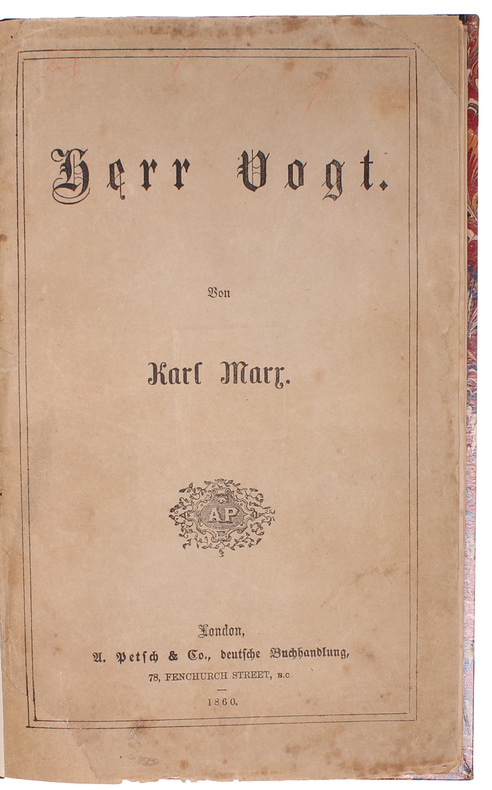
1860177307London: A. Petsch & Co. deutsche Buchhandlung 1860. First edition of the work that Marx took the best part of a year away from the writing of Capital to complete. It is an answer to the slanders against himself Engels and their supporters that appeared in Karl Vogt's 1859 pamphlet Mein Prozess gegen die Allgemeine Zeitung. "Herr Vogt is Marx's 'forgotten' work. Mentioned in passing - if at all - in biographical studies and scarcely at all in discussions of his writings it has remained for over a century largely neglected. Marx knew before its publication that many 'clever men' would be 'completely unable to grasp how I could squander my time on refuting such infantile nonsense'. What the clever men and their successors over the years could not or would not understand is that for Marx in 1860 as for Marxists today the defence and security of the revolutionary party was of paramount concern Vogt had taken the side of the petty-bourgeois democrats in 1848. Now he reached for the foulest slanders against Communists alleging that they engaged in secret and violent conspiracies and that Marx acted among them like a dictator. In this book Marx answers Vogt line for line and charge for charge. In the first chapters he holds up to ridicule Vogt's assertion that the Communists constituted a secret conspiratorial gang producing evidence from German emigrés which leaves the slanderer's arguments in tatters. Marx spares neither wit nor invective in demolishing his opponent" R. A. Archer. in the preface to his English translation of Herr Vogt 1982. Karl Vogt was "quietly teaching in Switzerland when an obscure German refugee newspaper in London accused him of being a paid agent of Napoleon III. The matter might have been forgotten if Liebknecht had not sent the accusation to the Allgemeine Zeitung which was published in Augsburg. Liebknecht was the London representative of the German newspaper. The Allgemeine Zeitung published the story. Vogt was incensed sued the newspaper for libel and although the case was dismissed he was able to claim a technical victory. He suspected quite wrongly that Marx was behind the attack. In fact Marx found little pleasure in the affair which dragged on for many weeks and was relieved when it was over. Matters might have rested in the peace of exhaustion but late in 1859 the bitterness flared up again. A small book appeared in Germany bearing the title Mein Prozess gegen die Allgemeine Zeitung. It was Vogt's account of his lawsuit against the Allgemeine Zeitung with a stenographic record of the court proceedings and whatever explanatory and contributory documents the author could lay his hands on. Vogt was a scientist and he took care that the documents should be quoted with exemplary accuracy. Occasionally he would give initials rather than full names but he was careful not to tamper with anything else. Here finally was the full evidence for Marx's treachery and duplicity as revealed in precise and objective testimony. There were no appeals to the gallery only the documents. Vogt's presentation was masterly and no one reading the book casually could imagine that it would be possible to rebut the evidence" Payne Marx a biography p. 318. Marx outraged at the attack replied in 1860 with Herr Vogt in which he denounced Vogt for intrigue slander and double-dealing. Octavo 226 x 149 mm printed in Gothic type. Original publisher's printed wrappers. Housed in a custom cloth box. Spine ends restored short tear at foot of rear joint corners a little dog-eared; a very good copy. Draper ST/M 51; Rubel 567. R. A. Archer Herr Vogt 1982. See Francis Wheen Karl Marx p. 238ff. hardcover
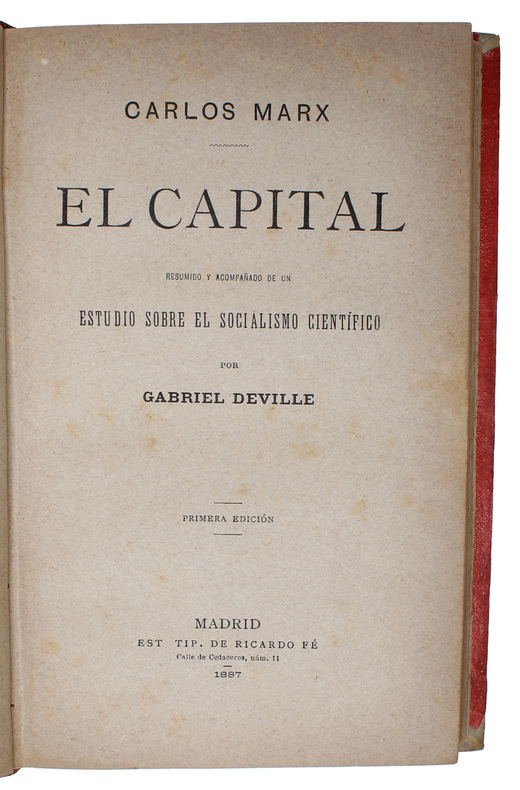
188758427Madrid, Ricardo Fé, 1887. 8vo. Contemporary brown half calf with gilt lettering and ornamentation to spine and red paper covered boards. Most leaves evenly browned (due to the quality of the paper) and some brownspotting to last few leaves. Overall a very good copy indeed of this otherwise fragile book. [Socialismo Utopico... :] pp. (1)-91, (1) + frontispiece of Engels" [La Ley de Los Salarios... :] pp. (1)-44 + frontiespiece of Guesde" [El Capital:] pp. (I)-LVI, 263 pp.
186056420London, 1860. 8vo. Bound partly uncut with the original wrappers in a nice recent half calf pastiche binding with four rasied bands and gilt lettering to spine. Front wrapper with marginal repairs and back wrappers with repairs with minor loss of text. Light brownspotting to first and last leaves. A fine copy. VI, (2), (1)-191, (1, -errata) pp.
187260281S.-Peterburg, N.I. Poliakov, 1872. Large 8vo. In a nice recent half calf binding with gilt lettering to spine and five raised bands. First few leaves with light soling and a closed tear and a few marginal repairs to title-page. pp. 11-18 with repairs to upper outer corner. Closed tears to last leaf, otherwise a fine copy. XIII, (3), 678 pp. (wanting the half-title).
188758427Madrid Ricardo Fé 1887. 8vo. Contemporary brown half calf with gilt lettering and ornamentation to spine and red paper covered boards. Most leaves evenly browned due to the quality of the paper and some brownspotting to last few leaves. Overall a very good copy indeed of this otherwise fragile book. Socialismo Utopico. : pp. 1-91 1 frontispiece of Engels; La Ley de Los Salarios. : pp. 1-44 frontiespiece of Guesde; El Capital: pp. I-LVI 263 pp. <br/><br/><em>The exceedingly scarce first Spanish edition of the most important abridged version of Marx's Capital ever to have appeared published in the same year as what is generally accepted as the first Spanish edition of "Das Kapital" Zafrilla's abridged version - defectively translated from Roy's French version - which was published in newspaper installments 1886-87.This Spanish translation was made from the French of Gabriel Deville 1854 -1940 the great French socialist theoretician politician and diplomat who did more than almost anyone else to raise awareness of Karl Marx's theories of the weaknesses of capitalism - most effectively through the present work which came to have a profound influence upon the spreading of Marxist thought throughout the Spanish speaking part of the world. "The epitome here translated was published in Paris in 1883 by Gabriel Deville possibly the most brilliant writer among the French Marxians. It is the most successful attempt yet made to popularize Marx's scientific economics. It is by no means free from difficulties for the subject is essentially a complex and difficult subject but there are no difficulties that reasonable attention and patience will not enable the average reader to overcome. There is no attempt at originality. The very words in most cases are Marx's own words and Capital is followed so closely that the first twenty-five chapters correspond in subject and treatment with the first twenty-five chapters of Capital. Chapter XXVI corresponds in the main with Chapter XXVI of Capital but also contains portions of chapter XXX. The last three chapters-XXVII XXVIII and XXIX-correspond to the last three chapters-XXXI XXXII and XXXIII-of Capital." ROBERT RIVES LA MONTE Intruductory Note to the 1899 English translation.The Spanish translator of the work is Antonio Atienza a typographer and translator at the press of Ricardo Fé who in 1886 volunteered his work at the newly founded "El Socialista" the Spanish flagship publication of Marxist socialism. It was also in 1886 that Atienza translated the present work with the publication following in 1887. This translation happened almost simultaneously with the "translation" by Zafrilla which appeared in weekly installments in the rival newspaper "La Républica" and the two first versions of "Das Kapital" to appear in Spanish tell the story of more than just the desire to spread Marx's ideas in Spain. Both versions were part of an ongoing struggle between political parties vying for the loyalty of Spain's workers see more below. THE WORK IS OF THE UTMOST SCARCITY WITH MERELY THREE COPIES LISTED ON OCLC two in Bristish Library and one in Bibliothèque Nationale and none at auction over the last 40 years at least.Backgrund for the publication:Among the numerous nascent political organizations that sprouted in the last half of 19th century Spain many of them as a result to the tumultuous years after the so-called "Glorious Revolution" of 1868 was the Partido Socialista Obrero Español PSOE. The party was founded by Pablo Iglesias in 1879 and it was the second socialist party in Europe preceded only by the Sozialdemokratische Partei Deutschlands SPD. Notably of the original twenty-five founding members sixteen were typographers. March of 1886 was a turning point for the PSOE as they began to publish a weekly newspaper "El Socialista" in order to reach a wider audience throughout Spain and thus advance the Marxist socialist agenda of which the paper became the flagship. To this day it is the official paper of the PSOE the present ruling party in Spain although it was suppressed during the years of Franco's dictatorial regime and published sporadically in exile in France or clandestinely in Spain. It was again published regularly since 1978. The PSOE gave up Marxism in 1979 in favor of Democratic Socialism.In 1886 the translator of the present work Antonio Atienza was a typographer and translator at the press of Ricardo Fé. At the same time he volunteered his work at the newly founded El Socialista as the PSOE funds were quite limited-he wouldn't have a paid position in the paper until 1913. He translated articles by Engels Guesde and Buechner among others."Das Kapital" had been published twenty years earlier. That it took so long to reach Spain in book form reveals among other things that up to that moment most of Marx's thoughts had filtered through to the workers' unions and parties by way of the writings of his followers as they were interpreted and explained by the intellectuals in charge of these organizations. It is also evident that the complexity of the book wouldn't be of much use to the average worker factory and otherwise. Enter Deville's abridged version which was more accessible in that some of the most basic ideas of Marx were digested and re-explained. The point was not to publish a book that could only be only be understood by economists and philosophers but one that could be given to the workers. A rival party leftist party considered by the PSOE as bourgeois was the Partido Republicano Federal. One of its members Pablo Correa y Zafrilla undertook the task of translating the first volume of Das "Kapital". Quite usual for Spain at the time the translation was published in weekly instalments to subscribers of their newspaper "La República" starting in 1886 and ending in 1887. The paper then sold the cloth binding to its subscribers and offered to collect the installments to have the book bound for its customers. According to the ad in "La República" 22/1/1886 the translation is purportedly from the German original but it has been clearly demonstrated that it is a defective translation from the French translation of Roy Ribas. It seems very plausible that when the PSOE found out that someone else in Spain was beginning to publish a translation of the first volume of "Das Kapital" El Socialista decided to publish Deville's translation. In fact the publication of El Capital by "La República" was briefly mentioned once in "El Socialista" and not in flattering terms 7/10/1887. That a Marxist newspaper disparaged against the first Spanish publication of "Das Kapital" reveals among other things that they were not terribly excited about some other party's publication producing a defective rendering of their guiding principles. On the other hand that "La República" had decided to publish the book was probably brought about by the foundation of "El Socialista" as they saw that the PSOE now had the means to spread their ideas throughout the country. It is in no small way possible that the haste to publish the book brought about the many defects in the translation from the French of Roy as Correa hurried to finish it.José Mesa y Leompart a typographer translator and Marxist ideologue and activist had experienced the upheavals of the Commune of Paris during his exile after the 1868 revolution. He developed a friendship with Marx's son in law Paul Lafargue and his wife Laura Marx-who themselves had been in exile in Spain during 1871-72- as well as with Engels with whom he shared much correspondence and many other figures of the Marxist movement. He also met both Marx and Engels during their exile in London. His friendship with Pablo Iglesias was a major driving force behind the formation of the PSOE and he collaborated with El Socialista both as a writer and as a financial supporter. Mesa writes to Engels in April of 1887 lamenting that some Spanish thinkers were using Marx's theories and the policies of the German Socialist Party to deny the concept of class struggle despite the fact that "we have … proven to them that you and Marx have always said the opposite and having quoted to them the very clear statements of the German Socialist Party; but they remain unmovable and at some point they even wanted to publish the abridged Capital by Deville without the preface and with notes interpreting the meaning in their own way-which we have impeded-the Resumen abridgement of Deville will soon be published faithfully translated into Spanish."Therefore as early as April of 1887 the present translation was already in progress and in fact according to Mesa soon to be published so it was apparently very advanced. It is then quite possible that Antonio Atienza was commissioned to translate the Deville's abridgement a few months earlier and not unlikely as far as 1886 when "La República" was still publishing installments of the Correa translation. The PSOE is obviously trying to obscure and minimize Correa's translation by publishing the Deville book as the task of translating "Das Kapital" from the original would be lengthy and costly and it would have come out too late to ascertain their political hold on Marx's ideas. This translation of Deville then sees the light is in the very midst of the bickering between leftist parties and is in fact a product of the confrontations between leftist ideologies. It was finally published about nine months after Mesa's letter to Engels. The first announcement in "El Socialista" appears in their November 11th 1887 issue. The price is four pesetas or about the cost of an entire year's subscription to the paper although subscribers could purchase it at half price. Still given that many subscribers were workers of scarce means less than three hundred copies were sent out to the main Spanish cities and that the total edition was probably about a thousand copies at most.The scarcity of this book can be underlined if one considers the virulent war that was waged against all socialist and Marxist literature during and after the Spanish Civil War by the dictatorial regime of Francisco Franco. Book purges and burnings were considerable throughout Spain since the onset of the war in 1936. It is not that books were burnt sporadically and occasionally but rather they were destroyed in a systematic and terrifyingly efficient manner. As early as September of 1936 official orders were given to all civil governors mayors school inspectors in the nationalist areas to purge all "harmful" books such as pornography and books of a communist or Marxist content. Teachers librarians and private citizens often purged their own libraries public or personal of such works in order to comply with the official orders. Countless people were summarily executed for owning certain books that revealed their political tendencies. Obviously owning actual edition of a book by Marx was reason enough to be deemed guilty and likely executed. As the war advanced many other such official orders were issued and unfathomable numbers of books were burnt. To this is added that many libraries were burnt down during the bombardments that took place throughout the country and that all the libraries of the leftist parties were systematically destroyed. The end of the war in 1939 only made it official throughout the entire country that communist and socialist literature was banned. So even the few copies that might have survived the fires and the purges were surely disposed of by their owners. It is no small wonder that this particular copy did manage to survive.Withbound in the present volume is the first Spanish translation of Engels' "Socialism: Utopian and Scientific" and Jules Guesde's work on the Law of Wages. See:Ribas Pedro. "La primera traducción castellana de El capital 1886 - 1887" in Cuadernos Hispanoamericanos Madrid junio de 1985 pp. 201-210.Castillo Santiago. "Marxismo y socialismo en el siglo XIX español" in Movimiento sociales y estado en la España contemporánea Manuel Ortiz et al coord. Universidad de Castila-La Mancha 2001Boza Puerta Mariano and Sánchez Herrador Miguel Ãngel. "El martirio de los libros: una aproximación a la destrucción bibliográfica durante la Guerra Civil." In BoletÃn de la Asociación Andaluza de Bibliotecarios. Año nº 22 Nº 86-87 2007 págs. 79-96Tur Francesc. https://serhistorico.net/2018/04/04/el-bibliocausto-en-la-espana-de-franco-1936-1939/ </em> hardcover
186056420London 1860. 8vo. Bound partly uncut with the original wrappers in a nice recent half calf pastiche binding with four rasied bands and gilt lettering to spine. Front wrapper with marginal repairs and back wrappers with repairs with minor loss of text. Light brownspotting to first and last leaves. A fine copy. VI 2 1-191 1 -errata pp. <br/><br/><em>The rare first edition of Marx' landmark defense against defamation a seminal work in his struggle for a new human society. Written in the midst of his writing of "The Capital" "Herr Vogt" constitutes the work that took precedence over this most important critique of political economy and the work that gives us one of the most profound insights into the mind of the great Marx. "Herr Vogt" is furthermore the work that we have to thank for the influence that "The Capital" and Marxist socialism did come to have upon our society. "In 1857 Karl Marx resumed work on his critique of political economy a process that culminated in the publication of "Capital" a decade later. He wrote a rough draft the "Grundrisse" in 1857 and 1858 parts of which he then reworked into the "Contribution to the Critique of Political Economy" which was published in June 1859. Then in 1861 through 1863 he wrote a revised draft of the whole of "Capital" which was followed by a more polished draft written during 1864 and 1865. Finally he revised the first volume yet again during 1866 and 1867. It appeared in September 1867.The careful reader will have noticed a rather lengthy gap in this chronology. From the second half of 1859 through 1860 Marx was not working on his critique of political economy. What was he doing instead What was so important so much more of an urgent priority than his theoretical workThe answer is that Marx was fighting back against Carl Vogt's defamatory attack. He fought back in order to defend his reputation and that of his "party." . " Herr Vogt" the book Marx wrote in order to set the record straight." Klimann Marx' Struggle Against Defamation.Vogt was a prominent radical German politician and materialist philosopher who had immigrated to Switzerland where he served in parliament and was also a professor of geology. His position on the 1859 war over Italian unification had a pro-French tilt which resulted in the publication of a newspaper article and an anonymous pamphlet that alleged correctly that Vogt was being paid by the French government. Vogt believed Marx to be the source of the allegation and the author of the pamphlet.Vogt fought back by attacking Marx. He published a short book that described Marx as the leader of a band of blackmailers who demanded payment in return for keeping quiet about their victims' revolutionary histories. The book also contained a number of false and harmful allegations against Marx and Vogt did everything in his power to destroy Marx' reputation. Not only did he attack Marx personally he also falsified facts and made up untrue allegations to libel the Communist League portraying its members as conspirators in secret contact with the police and accusing Marx of personal motives.There is no doubt that this work of slander put both Marx' own future as well as that of the Communist League at stake. "Ferdinand Lassalle warned Marx that Vogt's book "will do great harm to yourself and to the whole party for it relies in a deceptive way upon half-truths" and said that "something must be done" in response quoted in Rubel 1980 p. 53. Frederick Engels also urged Marx to respond quickly and he provided a good deal of assistance when Marx wrote "Herr Vogt".Carl Vogt and the circumstances that gave rise to his defamatory attack against Marx and his "party" are dead and gone. But "Herr Vogt" and Marx's battle against defamation remain living exemplars of how one responds in a genuinely Marx-ian way-i.e. the way of Marx. Do not separate theory from practice or philosophy from organization. Do not retreat to the ivory tower or suffer attacks in silence; set the record straight. Use the bourgeois courts if necessary. Enlist the assistance of others." Klimann."Marx's Herr Vogt almost entirely unknown in the English-speaking world. It is nevertheless one of the most brilliant of his writings. Engels considered it better than the Eighteenth Brumaire; Lassalle spoke of it as "a masterpiece in every respect"; Ryazanov thought that "in all literature there is no equal to this book"; Mehring rightly wrote of its "being highly instructive even today"." Karl Marx on Herr Vogt - from The New International Vol. X No. 8 August 1944 pp. 257-260. Transcribed & marked up by Einde O'Callaghan for ETOL. </em> unknown
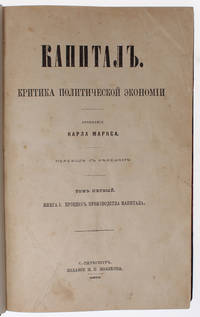
187260281S.-Peterburg N.I. Poliakov 1872. Large 8vo. In a nice recent half calf binding with gilt lettering to spine and five raised bands. First few leaves with light soling and a closed tear and a few marginal repairs to title-page. pp. 11-18 with repairs to upper outer corner. Closed tears to last leaf otherwise a fine copy. XIII 3 678 pp. wanting the half-title. <br/><br/><em>First Russian edition first issue with the issue-pointers being the first translation into any language of Marx' immensely influential main work probably the greatest revolutionary work of the nineteenth century.Marx' groundbreaking "Das Kapital" originally appeared in German in 1867 and only the first part of the work appeared in Marx' lifetime. The very first foreign translation of the work was that into Russian which considering Russian censorship at the time would seem a very unlikely event. But as it happened "Das Kapital" actually came to enjoy greater renown in Russia than in any other country; for many varying reasons it won a warm reception in many political quarters in Russia and it enjoyed a totally unexpected rapid and widespread success. The first Russian translation of "Das Kapital" came to have a profound influence the economic development of of Russia. It was frequently quoted in the most important economic and political discussions on how to industrialize Russia and the essential points of the work were seen by many as the essential questions for an industrializing Russia. " "Das Kapital" arrived in Russia just at the moment that the Russian economy was recovering from the slump that followed Emancipation and was beginning to assume capitalist characteristics. Industrialization raised in the minds of the intelligentsia the question of their country's economic destiny. And it was precisely this concern that drew Mikhailovsky and many of the "intelligenty" to "Das Kapital"." Resis p. 232.The story of how the first printing of the first translation of "Das Kapital" came about is quite unexpected. As the "triumph of Marxism in backward Russia is commonly regarded as a historical anomaly" Resis p. 221 so is the triumph of the first Russian edition of "Das Kapital". The main credit for the coming to be of the translation of "Das Kapital" must be given to Nicolai Danielson later a highly important economist in his own right. The idea came from a circle of revolutionary youths in St. Petersburg including N.F. Danielson G.A. Lopatin M.F. Negreskul and N.N. Liubavin all four of whom participated in the project. Danielson had read the work shortly after its publication and it had made such an impact on him that he decided to make it available to the Russian reading public. He persuaded N.I. Poliakov to run the risk of publishing it. "Poliakov the publisher specialized in publishing authors Russian and foreign considered dangerous by the authorities. Poliakov also frequently subsidized revolutionaries by commissioning them to do translations for his publishing house. Diffusion of advanced ideas rather than profit was no doubt his primary motive in publishing the book." Resis p. 222. Owing to Danielson's initiative Poliakov engaged first Bakunin and then Lopatin to do the translation. Danielson himself finished the translation and saw the work through press. It was undeniably his leadership that brought Marx to the Russian reading public. In fact with the first Russian edition of "Das Kapital" Danielson was responsible for the first public success of the revolutionizing work. "Few scholars today would deny that "Das Kapital" has had an enormous effect on history in the past hundred years. Nonetheless when the book was published in Hamburg on September 5 1867 it made scarcely a stir except among German revolutionaries. Marx complained that his work was greeted by "a conspiracy of silence" on the part of "a pack of liberals and vulgar economists." However desperately he contrived to provoke established economists to take up "Das Kapital"'s challenge to their work his efforts came to nought. But in October 1868 Marx received good news from an unexpected source. From Nikolai Frantsevich Danielson a young economist employed by the St. Petersburg Mutual Credit Society came a letter informing Marx that N. P. Poliakov a publisher of that city desired to publish a Russian translation of the first volume of "Das Kapital"; moreover he also wanted to publish the forthcoming second volume. Danielson the publisher's representative requested that Marx send him the proofs of volume 2 as they came off the press so that Poliakov could publish both volumes simultaneously. Marx replied immediately. The publication of a Russian edition of volume 1 he wrote should not be held up because the completion of volume 2 might be delayed by some six months in fact it did not appear in Marx' life-time and was only published ab. 17 years later in 1885; and in any case volume 1 represented an independent whole. Danielson proceeded at once to set the project in motion. Nearly four years passed however before a Russian translation appeared. Indeed a year passed before the translation was even begun and four translators tried their hand at it before Danielson was able to send the manuscript to the printers in late December 1871." Resis pp. 221-22. This explains how the book came to be translated but how did this main work of revolutionary thought escape the rigid Russian censors "By an odd quirk of history the first foreign translation of "Das Kapital" to appear was the Russian which Petersburgers found in their bookshops early in April 1872. Giving his imprimatur the censor one Skuratov had written "few people in Russia will read it and still fewer will understand it." He was wrong: the edition of three thousand sold out quickly; and in 1880 Marx was writing to his friend F.A. Sorge that "our success is still greater in Russia where "Kapital" is read and appreciated more than anywhere else." PMM 359 p.218. Astonishingly Within six weeks of the publication date nine hundred copies of the edition of three thousand had already been sold."Under the new laws on the press "Das Kapital" could have been proscribed on any number of grounds. The Temporary Rules held for example that censorship must not permit publication of works that "expound the harmful doctrines of socialism or communism" or works that "rouse enmity and hatred of one class for another." The Board of Censors of Foreign Publications was specifically instructed to prohibit importation of works contrary to the tenets of the Orthodox Church or works that led to atheism materialism or disrespect for Scriptures. Nor did the recent fate of the works of Marx and Engels at the hands of the censors offer much hope that "Das Kapital" would pass censorship. As recently as August 11 the censors of foreign works had decided to ban importation of Engels' "Die Lage der arbeitenden Klassen in England" and according to Lopatin the censors reprimanded Poliakov for daring to run announcements on book jackets of the forthcoming publication of "Das Kapital". By 1872 the censors had prohibited the importation and circulation of all works by Marx and Engels except one - "Das Kapital". The book as we shall see had already won some recognition in Russia shortly after its publication in Germany. Not until 1871 however did the censors render a judgment on the book when the Central Committee of Censors of Foreign Publications on the recommendation of its reader permitted importation and circulation of the book both in the original language and in translation. The official reader had described the book as "a difficult inaccessible strictly scientific work" implying that it could scarcely pose a danger to the state. . The length and complexity of the book prompted the office to divide the task of scrutinizing it between two readers D. Skuratov who read the first half of the book and A. De-Roberti who read the last half. Skuratov dutifully listed objectionable socialist and antireligious passages taking special note of Marx's harsh attack on the land reforms General Kiselev had instituted in the Danubian Principalities. But in his report Skuratov dismissed these attacks as harmless since they were imbedded in a "colossal mass of abstruse somewhat obscure politico-economic argumentation." Indeed he regarded the work as its own best antidote to sedition. "It can be confidently stated" he wrote "that in Russia few will read it and even fewer will understand it." Second he said the book could do little harm. Since the book attacked a system rather than individual persons Skuratov implied that the book would not incite acts threatening the safety of the royal family and government officials. Third he believed that the argument of the book did not apply to Russia. Marx attacked the unbridled competition practiced in the British factory system and such attacks Skuratov asserted could find no target in Russia because the tsarist regime did not pursue a policy of laissez faire. Indeed at that very moment Skuratov stated a special commission had drafted a plan that "as zealously protects the workers' well-being from abuses on the part of the employers as it protects the employers' interests against lack of discipline and nonfulfillment of obligations on the part of the workers." Repeating most of Skuratov's views De-Roberti also noted that the book contained a good account of the impact of the factory system and the system of unpaid labor time that prevailed in the West. In spite of the obvious socialist tendency of the book he concluded a court case could scarcely be made against it because the censors of foreign works had already agreed to permit importation and circulation of the German edition. With the last barrier removed on March 27 1872 the Russian translation of "Das Kapital" went on sale in the Russian Empire. The publisher translators and advocates of the book had persevered in the project for nearly four years until they were finally able to bring the book to the Russian reading public." Resis pp. 220-22. The Russian authorities quickly realized however that Skuratov's statement could not have been more wrong and the planned second edition of the Russian translation was forbidden; thus it came to be published in New York in 1890. That second edition is nearly identical to the first which can be distinguished by the misplaced comma opposite "p. 73" in the table of contents replaced by a full stop in the 2nd ed. and the "e" at the end of l. 40 on p. 65 replaced by a "c" in the 2nd ed. A third edition translated from the fourth German edition appeared in 1898. Volumes 2 and 3 of "Das Kapital" appeared in Russian translation also by Danielson in 1885 and 1896.See: Albert Resis Das Kapital Comes to Russia in: Slavic Review Vol. 29 No. 2 Jun. 1970 pp. 219-237. </em> hardcover
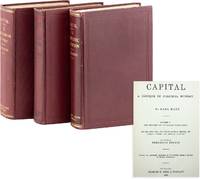
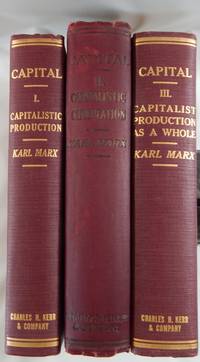
190688451Chicago Ill: Charles H. Kerr & Co. London: Swan Sonnenschein & Co. 1906 1907 1909. First Editions First Printings. Three Volumes. Octavo. 22.5cm. Publisher's deep maroon ribbed cloth titled in gilt to spines and ruled in blind to boards. 869pp.; 618pp.; 1048pp. Generally strong and tight; mild scuffing and to spine ends and corners and a few minor exterior stains. Spine gilt is significantly oxidized to Vol II as is usually seen on the first printing; internally clean and fresh some very light spotting in places mainly confined to the page edges. A very good handsome set of first printings. <br /> <br /> A full set of first printings of this bibliographically complex edition issued over the course of three years. Marx published the first volume of his epic analysis of capitalism in German in 1867. The first translation into English was of Volume 1 only and was accomplished by Edward Aveling and Samuel Moore in 1887 based on the revised 4th German edition as edited by Engels. The 1906 first American printing under the Charles Kerr impint as here largely follows this translation with the subsequent translation work for Volumes II and III being performed by Ernest Untermann. Thus the earliest printings of the Kerr edition comprise the first complete edition of Capital in the English language. The printing was done in Chicago by James Higgins Kerr's printer of choice making this also the first complete edition of Capital to be printed entirely by a union-run print shop. Untermann did most of his translation work from remote Florida beginning the effort in 1905 discovering in the process a number of indices footnotes and at least ten pages of text that Aveling and Moore had not included in their London edition - making the Kerr edition the most complete up to its time. <br /> <br /> Kerr burned through the first two-thousand copy print run of Volume I almost immediately and rushed to get Volume II out by July 1907. It's very possible that financial constraints were already making themselves known by Volume II as Kerr was selling the books at a loss to encourage sales; the almost ubiquitous oxidation of the gilt on Vol II is likely a result of experimental economy that swiftly failed. Vol III returns to the higher standards of the first volume. The bindings on the first printings also feature a triple blind rule to the ribbed cloth boards with subsequent printings having double rules. Kerr's reprint system seems to have incorporated dates on the title pages for some length of time with the dates on the copyright pages remaining unchanged; after a certain point around the early 1920's reprints were issued without dates to the title pages and any volume without a date can safely be deemed a post-1920s reprint. Issues of Kerr's International Socialist Review from the period of printing recount in detail some of his problems and concerns publishing and selling the work with detailed data on dates numbers of copies and the firm's hopes for the completed book. <br /> <br /> Genuine first printing sets of this important edition are tremendously scarce in commerce. The lack of any real bibliographical authority for the American edition combined with Kerr's generally lax approach to differentiating printings has over the years led to frequent errors and misjudgments on the part of cataloguers including in full disclosure ourselves. After a good deal of research most in the advertising pages of the International Socialist Review we're confident we've finally got it right. Charles H. Kerr & Co. [London: Swan Sonnenschein & Co.] unknown
190918341Chicago: Charles H. Kerr & Company 1909. First US editions. Hardcover. Very good. Three volumes 8vo. Red cloth blocked in gilt on the spines. Volume I is the 1906 US firs tprinting; Volume II is the 1907 US first printing; and Volume II is the 1909 US first printing. Volume II spine gilt dulled a comon issue with this volume some rubbing to the spine and inner hinges neatly repaired. Volumes I and II are in very good condition. Inner hinges of volume I neatly repaired; spine of Volume III is rubbed in places else this is a very good set.<br /> <p><br /> The Kerr edition is the first US edition of Marx's complete three volume work usually known by its German title Das Kapital. Only the first volume was published in Marx's lifetime; it appeared in the US in 1890. Engels completed the work using Marx's notes and published them in Germany in 1885 and 1894 respectively. This American issue was translated from the third German edition by Samuel Moore and Edward Aveling and revised and amplified from the fourth German edition by Ernest Untermann.Vol. I from the second German edition by Ernest Untermann Vol II and from the first German edition by Untermann Vol III. <br /> <p><br /> A PMM selection.<br /> <p>. Charles H. Kerr & Company hardcover
1881137927The Hague: Liebers & Co 1881. The rare first Dutch edition First appearance in Dutch of Marx's Lohnarbeit und Kapital with a flattering dedication to Marx by the translator and compiler Ferdinand Domela Nieuwenhuis 1846-1919 a Dutch socialist. "Originally a Lutheran pastor 1870-1879 he left the church founded the socialist weekly Recht voor Allen 1879. He played a leading part in developing the Social-Democratic movement in the Netherlands; was elected to parliament for a term 1881-1891; disappointed in legislating social reform he turned to anarchism 1890s. He authored a number of propaganda brochures." Draper: The Marx-Engels Glossary p. 154. Nieuwenhuis sent a copy of the work to Marx on 8 January 1881 Marx replying in a letter of 22 February in which he expresses a desire to make a list of changes and corrections for a second edition but regrets that personal difficulties prevent him from so doing. A second edition was published in 1889. Octavo 204 x 126 mm. viii 82 pages. Disbound preserved in a glassine wrapper under acetate. Housed in a black cloth flat-back box by the Chelsea Bindery. Spine re-glued. Paper stock lightly browned a few small marginal chips occasional pencil markings; a very good copy. WorldCat locates 5 copies in the Netherlands 3 in Germany and 1 in the USA. hardcover
1933188698Chicago: Charles H. Kerr & Company 1933. Hardcover. All 3 Volumes Near Fine in red cloth. Vol. I printed 1906. Vol. II printed 1933. Vol. III printed 1909. Charles H. Kerr & Company hardcover
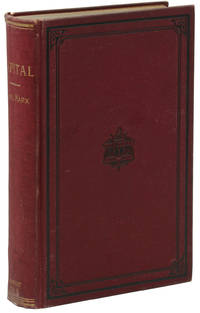
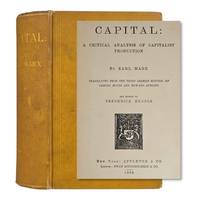
1889140942049New York: The Humboldt Publishing Company 1889. First American Edition. Near Fine. 1889. First American edition translated from the third German edition by Samuel Moore and Edward Aveling and edited by Frederick Engels. Two editions were published in America in 1889 the other by Appleton with the priority undecided. Bound in publisher's original maroon buckram tripple-ruled in black spine lettered in gilt patterned endpapers. Near Fine with light rubbing and soiling to cloth light fading to spine small water droplet to top edge of textblock. Front inner hinge exposed but binding firm front free endpaper is detached and laid in and with a single-digit number inked to the top corner. Pages toned. Marx's groundbreaking work of political economy Das Kapital a spark which would eventually ignite many of the largest conflagrations of the 20th century. The Humboldt Publishing Company unknown
1889694 - 650 - 736<p><em>First American edition preceding the later Humboldt text in America by twenty months</em></p><p><strong>Publisher and Year</strong>: New York: Appleton & Co. 1889</p><p><strong>Edition</strong>: First American edition one of just 500 copies published in January 1889.1-4 Translated from the third German edition by Samuel Moore and Edward Aveling. The present work consists of the first and only volume to be fully written by Marx with the next two installments completed by Engels and published in English in 1907 and 1909.</p><p>Other than the title page the text of the 1889 Appleton edition is identical to the first British edition London: Swan Sonnenschein & Co. 1887 and was bound from sheets printed in the U.K. but was issued in one volume rather than two. For this edition the British firm printed and sold 500 sets of sheets to Appleton & Co. marking the first time that an American firm was listed as a publisher on the printed sheets. Note that in 1887 about half of the 500 copies of the first British edition were exported and bound in the United States but the sheets were not printed with credit to the two American distributors though both firms did make later alterations to advertise their involvement.1</p><p>The next appearance of the book in America came a full twenty months after the Appleton edition New York: The Humboldt Publishing Company 1890. Though the Humboldt edition was the earliest to be physically printed in the United States the text was an unauthorized piracy of the Moore-Aveling translation.1 The Humboldt edition was issued in serialized wrappers from September to October in 1890 and then in cloth by November of that year at the latest ~5000 copies were ultimately printed.15-8</p><p><strong>Condition and Description</strong>: Thick octavo publisher's ochre cloth stamped in gilt and blind pale-yellow endpapers 816 pp. Boards soiled with some rubbing and handling wear. Tips bumped and exposed. Gilt still legible. Some stains to the edges of the text block not intruding upon the text except for in one small instance on the upper part of the final blank. Hinges loose but holding with splits to the endpapers at the gutters but the webbing remains intact a common fault given the considerable weight and thickness of the text block. The text itself remains firmly bound with all pages attached. Tanning to the first two blanks from something that had been laid in. Previous owner's name in ink to the third blank page Louis Walldorf a member of the Socialist Labor Party in the 1890s. No other writing or underlining. A few scattered instances of light foxing and finger smudging. Without any restoration or repair. An 1899 card from The Labor Lyceum a socialist organization based in Rochester N.Y. is laid in. The card advertises an event "The 'People's Parliament'" consisting of a series of lectures and open debates concerning questions "vital.to the working people." The card in addition to ownership by a member of the Socialist Labor Party reflects the use of this copy in the American socialist movement in the late nineteenth century.</p><p><strong>Provenance: </strong>Louis Walldorf b. 1832 a German immigrant watchmaker and socialist political activist. In March of 1892 Walldorf was nominated by his ward to be an executive board member of The Socialist Labor SLP party in Rochester N.Y. where he resided. Later that year the SLP nominated their first candidates for president and vice president of the United States even though the official party platform was to abolish both offices. Walldorf remained a resident of Rochester throughout the 1890s and The Labor Lyceum card was plausibly his given where the advertised event was held.</p><p><strong>References:</strong></p><p>1. "Karl Marx Capital First American Editions." Article issued by the Karl Marx Library in Luxembourg.</p><p>2. The Publisher's Weekly 1888 Dec 29. Vol 34 Issue 26. Appleton's edition listed under "Will publish next week."</p><p>3. The Publisher's Weekly 1889 Jan 12. Vol 35 Issue 2. Appleton's edition listed under "Just published"</p><p>4. The Daily Inter Ocean 1889 Jan 12. Appleton's edition listed under "Books Received"</p><p>5. The Humboldt Library of Science issues of Marx's The Capital 135-138. Parts were dated Sep 1 Sep 15 Oct 1 and Oct 15 of 1890 on the front wrappers. Refer to the example sold by Swann Galleries on May 5th 2022.</p><p>6. Copies in wrappers were reprinted monthly from January 1891 to April 1891 with such copies bearing those dates on the front wrappers. Refer to the set listed by Antiquariat Inlibris.</p><p>7. The Nation 1890 November 6 Vol 51 Issue 1323. Humboldt edition advertised at $1.20 four parts in wrappers and $1.75 cloth</p><p>8. The Nation 1890 November 12 Vol 51 Issue 1324. Humboldt edition advertised at $1.20 four parts in wrappers and $1.75 cloth</p><p>-<br />Inventory ID: 694 - 650 - 736</p> Appleton & Co. hardcover
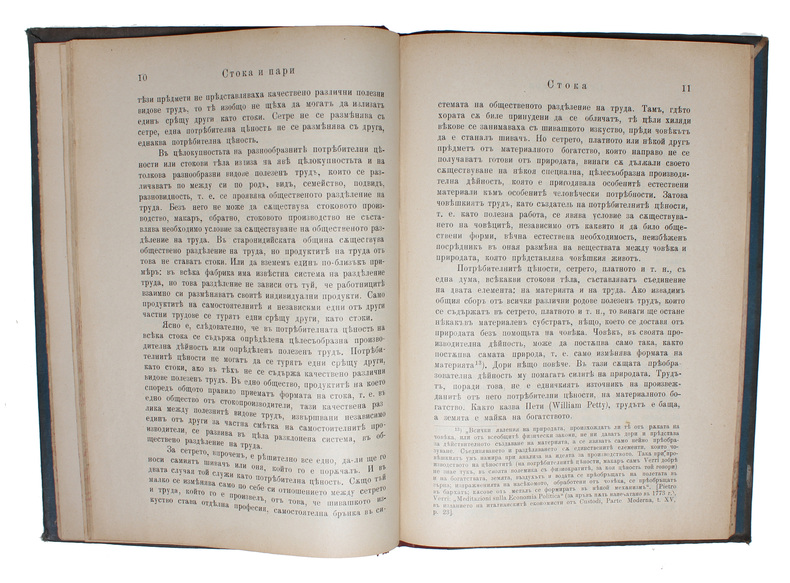
191057297[Blagoev-translation:] Sofia, [presumably 1910 but august 1909 stated on last leaf of preface] & [Ba [Blagoev-translation:] 8vo. In a contemporary full cloth binding with red leather title-label with gilt lettering to spine. Spine with wear and light soiling to extremities. Hindges a bit weak First 10 leaves with stain in margin, otherwise a good copy. (6), XXXI, (1), 675, (1) pp.{Bakalov-translation:] 8vo. In contemporary half calf with five raised bands and gilt lettering to spine. Wear to extremities and hindges a bit weak Repair to inner margin of title-page. Internally fine and clean. XXX, (2), 598, (2) pp. + frontiespiece of Marx. Withbound is ""Karl Marx and His Time"": (1)-180 pp.
190558543[Kapitalut:] Balchik, Izdanie na Krist'o Ivanov, 1905. [Speech On the Question of Free Trade:] Sofia 8vo. In contemporary red half calf. Extremities with wear. Previous owner's name in contemporary hand to upper part of both title-pages. Light browning throughout and a few occassional underlignings in text, mainly in ""A speech on free trade"". [Kapitalut:] XXXVIII, 122 pp. [Rech za...:] 27, (1).