9 494 résultats
65731London: Swan Sonnenschein 1896. Political Economy / Marxism FIFTH UK EDITION. Octavo 23 x 16cm pp.xxxii; 816. Half title present. Publisher's dark olive cloth with gilt titles to spine ruled to crown and tail in gilt blind ruling to top and bottom edges of upper cover publisher's tan foliate/monogrammed patterned endpapers. Contents clean without signs of ownership. Some light spotting within inside paper joint lightly cracked at front covers with a few minor marks and a little rubbing/wear to spine ends. A near fine copy. A foundational theoretical text in materialist philosophy and one of the most influential works in modern political and economic thought. This is the fifth British edition January 1896 reprinting the text of the first which was issued in two volumes in 1886. This edition is also the final British printing of the nineteenth century and is desirable thus. London: Swan Sonnenschein, 1896 unknown
1885152862Hamburg: Otto Meissner 1885. The second volume of Das Kapital finished by Engels First edition of the second volume of Das Kapital. Only the first volume of Das Kapital was published in Marx's lifetime in 1867. Following Marx's death in 1883 the second and third volumes were edited from Marx's manuscripts and seen through the press by Friedrich Engels with the present second volume published in 1885 and the third volume in 1894. Together they form the most significant and influential critique of capitalism ever published with Das Kapital becoming the bible of Marxist movements and governments in the following century. "The history of the twentieth century is Marx's legacy. Stalin Mao Che Castro - the icons and monsters of the modern age have all presented themselves as his heirs. Whether he would recognise them as such is quite another matter. Nevertheless within one hundred years of his death half the world's population was ruled by governments that professed Marxism to be their guiding faith. His ideas have transformed the study of economics history geography sociology and literature. Not since Jesus Christ has an obscure pauper inspired such global devotion - or been so calamitously misinterpreted" Francis Wheen in his introduction to Karl Marx 1999. Octavo 219 x 139 mm. Twentieth century blue cloth spine lettered in gilt red speckled edges. Binding rubbed stamp of "The Adam Smith Class Library" on p. iii and 25 some leaves unopened stain at fore edge encroaching into margin but not into text 4 cm closed tear to pp. 301/2 just impinging on text and at head of 409-12 not affecting text terminal imprint leaf chipped round extremities. A good copy. Einaudi 3772; Mattioli 2284; Rubel 635; Sraffa 3867. hardcover
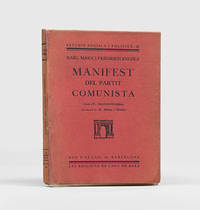
1930163928Barcelona: Les Edicions de l'arc de Bara 1930. Marxism in Catalonia in the years before the Civil War First edition in Catalan of the Communist Manifesto limited issue number 6 of 17 numbered copies on Guarro paper three further copies were issued on Japanese paper and three others were for presentation; the size of the rest of the edition is unstated. Emili Granier Barrera 1908-1997 was a Catalan nationalist jailed for his role in the 1928 "Garraf plot" to assassinate Alfonso XIII. After his release he became general secretary of the Unió Socialista de Catalunya was elected councillor in Barcelona and fled Spain after the Civil War. He returned in 1978 following the re-establishment of Spanish democracy. His translation was based on the 1872 French translation of Laura Marx; the first direct translation from the German was published in 1936 by Pau Cirera i Feliu. Octavo. Original red stiff paper wrappers spine and front panel lettered in black. Neat repair to front joint repaired short closed tear to half-title short closed tear at foot of pp. 115/6 contents otherwise fresh. A very good copy. unknown
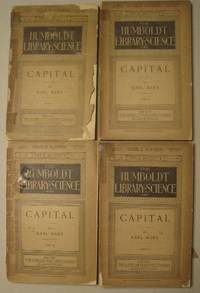
189046The Humboldt Publishing Co.: The Humboldt Publishing Co. 1890. First American edition. Wraps. Good. Wrappers. Translated from the third German edition & edited by Frederick Engels. Four issues in the Humboldt Library of Science Series. These issues are 135 136 137 and 138 and are dated September 1 1890 - October 15 1890. This is a pirated edition and is the first edition printed in America of the first volume of Capital. The first "official" American edition was published 1889 by Appleton & Co. NY as a re-issue of the 1887 London edition with sheets supplied by a London company with a new title page and was actually printed in Scotland. There was also a hardcover edition published around the same time precedence unknown. Spines and covers are taped and have chips missing. The third issue has three small holes through the cover and the first 21 pages of text which has done some damage to text. A rare set in any condition. The Humboldt Publishing Co., unknown
1846450418Published by the Brook Farm Phalanx. New York: Burgess Stringer and Company. Boston: Redding and Company 1846. Hardcover. Very Good. Two volumes. Quartos 8¼" x 11¼". Both volumes are complete with 26 weekly issues. Vol. II: pp. iv 412 December 13 1845 – June 6 1846; Vol. III: pp. iv 412 June 13 1846 – December 5 1846. Bound in contemporary half morocco and marbled paper over boards gilt spines edges lightly sprinkled. Contemporary ownership signature of “W.B. Brown†on the front free endpaper of each volume. <br /> <br /> Both volumes are in very good condition with overall rubbing and some scuffing on the spine of vol. II scattered foxing and two early stitched repairs: on the lower corner of one leaf in vol. II pp. 201-202 and diagonally across one leaf in vol. III pp. 399-400.<br /> <br /> Two well-preserved volumes of George Ripley’s pioneering and important radical magazine. Published and printed at the utopian Brook Farm community in West Roxbury Massachusetts the magazine was well ahead of its time particularly in its advocacy of women's rights and featured in its pages many of the country's best critical and literary figures.<br /> <br /> As noted in a recent exhibition at Yale University America and the Utopian Dream the Brook Farm community was founded by George and Sophia Ripley in 1841 and “began as a product of the transcendentalist movement and a showplace for Christian socialism. The commune had more than 120 members at its highest point†including a young Nathaniel Hawthorne “and was widely regarded as an intellectual center. After four years of existence however the members changed its purpose to that of a Fourierist phalanx. When the headquarters of Fourierism moved from New York City to Brook Farm in 1845 the Fourierist Magazine the Phalanx was renamed the Harbinger to be published on the Brook Farm printing press.â€<br /> <br /> The Harbinger received the full-time attention of Ripley and his associates Charles A. Dana and John S. Dwight. Dana later achieved celebrity as editor of the New York Sun and Dwight went on to become one of the earliest and foremost music critics in the United States. The magazine offered an alternative to transcendentalists who admired Emerson’s romantic perfectionism but rejected his belief in renovation through individualism and self-culture. The contributors to the Harbinger instead emphasized social reform and cooperation which would elevate the individual while benefiting the entire community; the magazine quickly became the most important "Associationist" journal in America.<br /> <br /> Also included among the many notable contributors in addition to Ripley Dana and Dwight are Albert Brisbane who first introduced the theories of Charles Fourier in the United States; William H. Channing a key figure in the early years of the woman's rights movement; and M.E. Lazarus an important American individualist anarchist who advocated for free love.<br /> <br /> The original owner of both volumes “W.B. Brown" was related to John Stillman Brown a Unitarian minister and member of Brook Farm who acted as instructor in Theosophical and Practical Agriculture. J.S. Brown was the husband of Mary Ripley George Ripley's cousin. Volume three has two additional small owner's signatures written in light pencil on the outer margin of p. 70: "Mary G. Brown"; and p. 68: "E.H. Brown".<br /> <br /> An attractive scarce set of two consecutive volumes in the original bindings. Published by the Brook Farm Phalanx. New York: Burgess, Stringer, and Company. Boston: Redding and Company hardcover
192756714Tokyo, Kaizosha, 1927-1928. Small4to. 5 volumes all in publisher's original full red cloth with gilt lettering to spine, all five volumes house the original slipcases. Free end-papers browned and only very light sporadic brownspots throughout. A very fine and clean copy.
192756714Tokyo Kaizosha 1927-1928. Small4to. 5 volumes all in publisher's original full red cloth with gilt lettering to spine all five volumes house the original slipcases. Free end-papers browned and only very light sporadic brownspots throughout. A very fine and clean copy. <br/><br/><em>Rare first complete Japanese translation of Marx's 'Das Kapital'. In response to the Russian October Revolution young Marxists produced in rapid succession partial translations of Marx's works and secondary accounts of the same. Japanese translations of Marx's works were comparatively late compared to those in Europe. Japanse translations however did exercise a great influence in Asia and especially in China where several of the early translations were made from the Japanese. "Similarly Takabatake Motoyuki the first to produce a complete Japanese translation of the three volumes of 'Capital' created a system of Marxist national socialism. Asserting the "Marxism was originally statism" Takabatake cited Thomas Hobbes and other western state theorists to support the notion that the state preceded class society and would not wither away after a proletarian revolution. To guard against external threats and to organize economic activity at home - against the possibility of proletarian imperialism on the part of Soviet Russia for eksample - a socialist Japan would require a powerful state" Hoston Marxism and the Crisis of Development in Prewar Japan. </em> hardcover
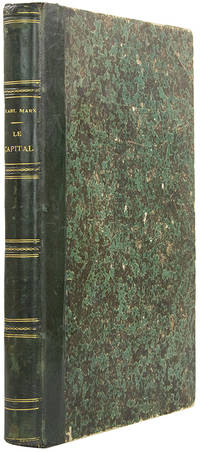
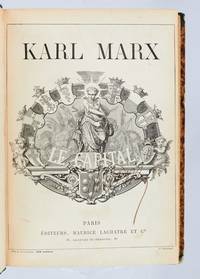
105094Paris Maurice Lachâtre 1872-1875. . First edition in French first issue; folio 29 x 20 cm; two title-pages with engraved vignettes engraved portrait facsimile letter from Marx and from the publisher stamp of previous bookseller on title-page ownership inscription in pen to front free endpaper; contemporary green half calf decorated boards some wear to the extremities; 351pp.<br /> First edition in French of the first volume of Das Kapital. The second and third volumes of Das Kapital were published after Marx's death edited by Engels in 1885 and 1894 and were first published in French in 1900 and 1902.<br /><br />The first issue with the publisher Lachâtre's imprint. The book was published in parts from August 1872 to November 1875 and then bound in total upon completion. Originally published in German 1867 this French edition was the second translation preceded only by the Russian translation of 1872. Marx collaborated greatly with Lachâtre and he felt that this translation was more important than the Russian and his extensive work on the project means 'Le Capital was not a mere translation but rather an original work relevant from a textual point of view' Books that Made Europe p.248. <br /><br />Maurice Lachatre 1814-1900 was a Parisian radical bookseller publisher and collaborator of Félix Pyat's with whom Marx butted heads over the growth of the International Working Men's Association in France. Lachatre's projected publication of the anarchist newspaper "La Commune" nearly cost him his life after the fall of the Paris Commune when his bookshop was attacked with murderous intent by the Versaillaise army. It was while exiled first in Belgium and then Switzerland that Lachatre began work on publishing the present edition though he was not free to return to Paris until 1879.<br /><br />The signature 'G. See' could belong to Germain Sée 1818- 1896 a well known French doctor who specialised in the study of lung and cardiovascular diseases.<br /> Books that Made Europe p.248. Paris, Maurice Lachâtre, 1872-1875. hardcover
1933143060Istanbul: Sirketi Mürettibiye Matbaasi 1933. First edition in Turkish of Das Kapital First appearance in book form of Marx's Das Kapital in Turkish being the first edition of Haydar Rifat's translation and the first book-length translation preceded only by Bohor Israel's summary translation in a 1912 journal. The translation is of Gabriel Deville's abridgement of the first volume of Das Kapital originally published in Paris in 1883. Internationally acclaimed Deville's abridgement "did more to disseminate the arguments of Marx's revered but unread magnum opus than did any other publication before or since" Stuart Marxism at Work p. 25. The translation was undertaken by Haydar Rifat 1877-1942 later known as Yorulmaz one of the most prominent translators of the late Ottoman and early Republican periods. Particularly associated with the formation of the leftist discourse in Turkey his 1910 translation of George Tournaire's Le Socialisme is held to be the first socialist book published in Turkish see Konca p. 81 86ff. The translation was preceded only be a short summary of Das Kapital in Turkish by the socialist Bohor Israel in 1912 which was published as an article in the first and only issue of his journal Ceride-i Felsefiye Philosophical Newspaper under the title "Iktisad-i Içtimaiye" Social Economics. However this was described by Israel himself as less a translation than a "summary of the summary" Savran & Tonak p. 2; this is therefore the first sustained translation as opposed to a summary and the first appearance of Das Kapital in Turkish in book form. Rifat's translation came suprisingly late long after the founding of the Turkish Communist Party in 1920. It immediately provoked controversy among Turkish socialist intellectuals sparking a series of critiques regarding accuracy of translation and conformity to Marxist orthodoxy. It prompted two rival translations in 1936 by Turkish Communists: a 32 page summary by Nevzat Cerrahlar under the pseudonym Kerim Sadi drawn from Paul Lafargue's 1893 French abridgement and a more substantial attempt by Suphi Nuri Ileri based on Carlo Cafiero's 1879 Italian abridgement. Another Turkish abridgement by Hikmet Kivilcimli was serialized in 1937. "The rather feverish activity of translating Kapital into Turkish albeit in abridged form. ended abruptly in 1938. Turkey had been moving for some time away from the Soviet Union and towards Nazi Germany a trend that would last until the final years of World War II. This culminated in a series of attacks on the Turkish Communist movement. In 1938 the one-party regime proceeded to ban certain Marxist works that had been published in preceding years. Kapital was among the list of prohibited works" Savran & Tonak p. 4. No doubt due to the suppression of socialist literature in Turkey from 1938 the translation is rare - no institutional copies are located by WorldCat. Small octavo. Original wrappers printed in red and black. Housed in a red cloth flat-back box by the Chelsea Bindery. Spine backing and foot of rear joint reglued with minor loss to lettering a couple of gatherings neatly reinserted soiling and light wear to wrappers with chip at head of front cover and foot of rear cover contents unopened from second gathering onwards. A good copy. See Konca "The Turkish Retranslations of Marx's Das Kapital as a Site of Intellectual and Ideological Struggle" in Studies from a Retranslation Culture ehnaz and Gürça lar 2019; Savran & Tonak "Marx's Capital in Turkey" Routledge Handbook of Marx's Capital: A Global History of Translation Dissemination and Reception forthcoming. Not in Draper The Marx-Engels Register. hardcover
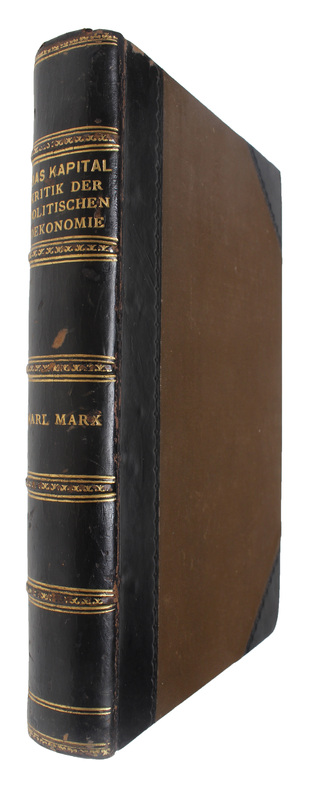
1903140947745Hamburg: Otto Meissners Verlag 1903. Very Good. Complete in three volumes. A mixed set: fifth edition of Volume I third edition of Volume II and first edition of Volume III. xxxii 739; xxvii 500; xxviii 422 pp. Bound in half navy morocco over blue paper-covered boards morocco title labels and gilt stamping to spines all edges speckled and stained blue. Very Good with moderate rubbing and soiling to covers; leather leaves residue. Contents lightly toned and overall clean with very occasional penciled underlining binding firm. <p>Early editions of the book that altered the course of human history. Only the first volume of Das Kapital was published in Karl Marx's lifetime in 1867; the second and third volumes were prepared from Marx's notes by his longtime friend and collaborator Friedrich Engels. This set bound to order for a previous owner combines the first edition of the third volume with the fifth and third editions of the first and second volumes respectively. Otto Meissners Verlag unknown
18968387London: Swan Sonnenschein & Company. Good with no dust jacket. 1896. First English Edition; Fifth Printing. Hardcover. Original green cloth cover is frayed at corners and spine caps with light scuffing but clean and in good condition. Boards and spine are straight. Book is shaken. Page edges toned with very modest soiling. Split between patterned paste downs and end papers but hinges still strong. Former owner name and address on front patterned end sheet. Pages are lightly toned but clean and very good. . . Swan Sonnenschein & Company hardcover
1887129653Madrid: Ricardo Fé 1887. First edition in Spanish of Deville's summary of Capital with his introduction first published in French in 1883 by Flammarion in Paris. The French socialist Gabriel Deville 1854-1940 "is less known than either Guesde or Lafargue but the role he played in the early diffusion of Marxism in France should not be underestimated" Llobera p. 221. In August 1882 he began discussions with Marx about a popularized abridgement of Capital - in his introduction Deville states that Marx himself proposed the idea to him. By August 1883 Engels had received a manuscript of which he was highly critical. He felt that it had serious defects and argued that Deville's main fault was that "he poses Marx's propositions as absolute whereas in Marx they hold only under conditions which Deville omits and hence come out false" Draper Chronology 84:11. However Engels's suggested modifications were never implemented. By January 1887 Kautsky was already requesting to oversee a German version of Deville's abridgment a concept towards which Engels was not supportive. Nevertheless Deville's summary was translated into many languages and widely read until very recently. It did much to quicken interest in Marx's works both in France its first country of publication but also across Europe as evidenced by the present Spanish translation. Small octavo 176 x 113 mm. Rebound in modern burgundy faux morocco spine lettered and ruled in gilt. Bound without half-title; title leaf and subsequent four leaves expertly reattached using hand-coloured Japanese tissue hinges. Contents somewhat brittle using two kinds of cheap paper stock some of the whiter heavier paper foxed the other evenly toned; occasional neat ink marginal marks; publisher's paper flaw to fore edges of pp. 17 193 and 199 resulting in slightly shorter fore-margins not affecting text. Overall a very good copy of this rare volume. See Rubel 633 note for the original French edition and Josep R. Llobera "Durkheim the Durkheimians and their Collective Misrepresentation of Marx" in Joel S. Kahn & Josep R. Llobera The Anthropology of Pre-Capitalist Societies Macmillan 1981. unknown
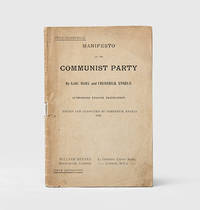
1927170285London: William Reeves 1927. A spectre is haunting Europe - the first authorized English translation of the Communist Manifesto - "undoubtedly the most important one of all" Draper First edition stated sixth impression of the first authorized English translation of the Communist Manifesto. Engel's role in the translation was extensive; he personally chose the translator Samuel Moore who had earlier translated Marx's Das Kapital and also negotiated with the publisher. The preface is the longest and the most important of any that Engels wrote for the Manifesto and this is the only translation edited by him with additional notes. The translation was edited by Engels with a four-page preface specially written by him for this translation as well as eight footnotes. It includes a large number of modifications of expression omissions and minor additions. First published by Reeves in March 1888 based on the German edition of either 1872 or 1883 it is the second edition of the Communist Manifesto to be distributed in bookshops preceded only by the Swedish translation of 1848 all earlier publications being either in periodicals or distributed by socialist organisations. According to an exchange between Andréas and William Arnold Reeves the stereotype plates made in 1888 were used for pages 3-31 of all the English editions of the Manifesto published by Reeves this "sixth impression" being published in 1927 Andréas notes further impressions - his description in his entry for 495 places this as the ninth. "Of exceptional importance was the authorized English translation of 1888 by Samuel Moore translator of Marx's Das Kapital the only translation personally edited and annotated by Engels although he edited and prefaced a German text published in London in 1890" PMM. Octavo 32 pages. Wire-stitched as issued in self-wrappers preserved in a cloth slip case. Small tear around staple to first and last leaves; a very good copy. Andréas 237. See Printing and the Mind of Man 326. Hal Draper The Adventures of the Communist Manifesto 2004. hardcover
1933143061Istanbul: Sirketi Mürettibiye Matbaasi 1933. First edition in Turkish of Das Kapital First appearance in book form of Marx's Das Kapital in Turkish being the first edition of Haydar Rifat's translation and the first book-length translation preceded only by Bohor Israel's summary translation in a 1912 journal. The translation is of Gabriel Deville's abridgement of the first volume of Das Kapital originally published in Paris in 1883. Internationally acclaimed Deville's abridgement "did more to disseminate the arguments of Marx's revered but unread magnum opus than did any other publication before or since" Stuart Marxism at Work p. 25. The translation was undertaken by Haydar Rifat 1877-1942 later known as Yorulmaz one of the most prominent translators of the late Ottoman and early Republican periods. Particularly associated with the formation of the leftist discourse in Turkey his 1910 translation of George Tournaire's Le Socialisme is held to be the first socialist book published in Turkish see Konca p. 81 86ff. The translation was preceded only be a short summary of Das Kapital in Turkish by the socialist Bohor Israel in 1912 which was published as an article in the first and only issue of his journal Ceride-i Felsefiye Philosophical Newspaper under the title "Iktisad-i Içtimaiye" Social Economics. However this was described by Israel himself as less a translation than a "summary of the summary" Savran & Tonak p. 2; this is therefore the first sustained translation as opposed to a summary and the first appearance of Das Kapital in Turkish in book form. Rifat's translation came suprizingly late long after the founding of the Turkish Communist Party in 1920. It immediately provoked controversy among Turkish socialist intellectuals sparking a series of critiques regarding accuracy of translation and conformity to Marxist orthodoxy. It prompted two rival translations in 1936 by Turkish Communists: a 32 page summary by Nevzat Cerrahlar under the pseudonym Kerim Sadi drawn from Paul Lafargue's 1893 French abridgement and a more substantial attempt by Suphi Nuri Ileri based on Carlo Cafiero's 1879 Italian abridgement. Another Rukish abridgement by Hikmet Kivilcimli was serialized in 1937. "The rather feverish activity of translating Kapital into Turkish albeit in abridged form. ended abruptly in 1938. Turkey had been moving for some time away from the Soviet Union and towards Nazi Germany a trend that would last until the final years of World War II. This culminated in a series of attacks on the Turkish Communist movement. In 1938 the one-party regime proceeded to ban certain Marxist works that had been published in preceding years. Kapital was among the list of prohibited works" Savran & Tonak p. 4. No doubt due to the suppression of socialist literature in Turkey from 1938 the translation is rare - no institutional copies are located by WorldCat. Small octavo 177 x 117 mm. Contemporary green cloth. Contemporary ownership signatures to title and half-title. Complete with errata leaf. Spine lightly sunned slight wear at extremities recoloured at tips slight soiling contents toned. A good copy. See Konca "The Turkish Retranslations of Marx's Das Kapital as a Site of Intellectual and Ideological Struggle" in Studies from a Retranslation Culture ehnaz and Gürça lar 2019; Savran & Tonak "Marx's Capital in Turkey" Routledge Handbook of Marx's Capital: A Global History of Translation Dissemination and Reception to be published in 2021. Not in Draper The Marx-Engels Register. hardcover
18892203008Humboldt 1889. 1st. hardcover. very good. First edition published and printed in the US. Very good condition gutters have tape first free end paper also has tape along inside to previous page as well as in back. Humboldt unknown
18912204033London: Sonneschein 1891. Fourth. hardcover. A very good fourth edition in the original cloth. The fourth edition. Very good in original cloth housed in a supplied slipcase. Sonneschein unknown
172018New York: Humboldt Publishing Co N.D. First Edition Thus; First Printing. Hardcover. Good in boards. Owner printed stamp on front pastedown and contents page. Both hinges cracked. Light damp staining on top text block edges. Rubbing along panel edges. Corners bumped. Humboldt Publishing Co hardcover
188655015Torino, Unione Tipografico-Editrice, 1886. Royal8vo. Bound in a contemporary half vellum binding with red and green title label to spine with gilt lettering and ornamentation to spine, forming six compartments. In ""Biblioteca dell'Economista"", Third Series, volume 9. wear to extremities and light brownspotting throughout, especially to first and least leaves. e copy. Il Capitale: 685 pp. [Entire volume: (4), 903, (1) pp.].
188557044Hamburg: Otto Meissner, 1885. 8vo. Very nice contemporary black half calf with gilt spine. A bit of wear to extremitoes. Inner front hinge a little weak. Title-page a littel dusty, but otherwise very nice and clean. Book-plate (Arnold Heertje) to inside of front board. XXVII, (1), 526 pp. + 1 f. With pp. 515-16 in the first state (""Consumtionsfonds"" with a C) and with the imprint-leaf at the end.
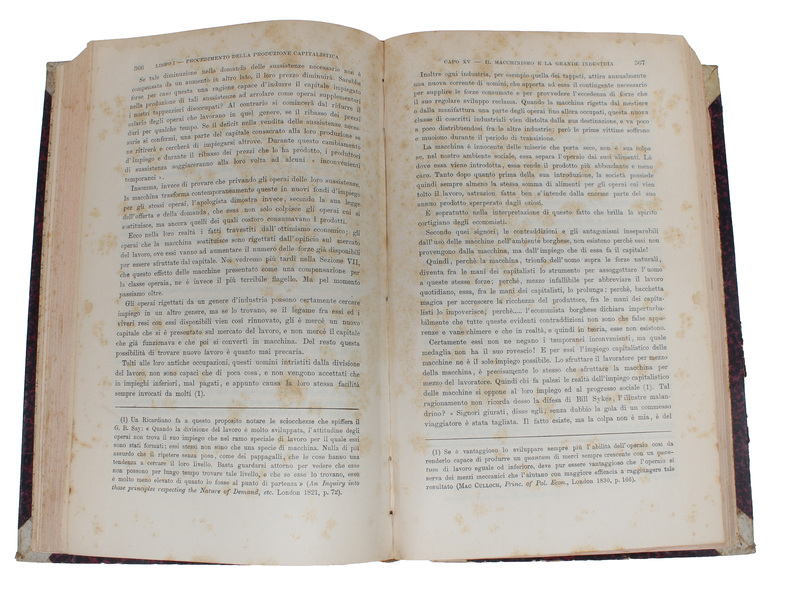
188655015Torino Unione Tipografico-Editrice 1886. Royal8vo. Bound in a contemporary half vellum binding with red and green title label to spine with gilt lettering and ornamentation to spine forming six compartments. In "Biblioteca dell'Economista" Third Series volume 9. wear to extremities and light brownspotting throughout especially to first and least leaves. e copy. Il Capitale: 685 pp. Entire volume: 4 903 1 pp. <br/><br/><em>First full Italian translation of Marx' landmark work constituting what is arguably the greatest revolutionary work of the nineteenth century. The work proved immensely influential in both communist and fascist circles. Antonio Gramsci founding member and one-time leader of the Communist Party of Italy PCI based much of his theoretical and practical work on the present translation of Marx' work and Ezra Pound read this Italian translation which is among the most heavily marked annotated volumes in his personal library and was horrified by the accounts of the exploitation of labor given by Marx which eventually grew into his sympathy for fascism and Mussolini's socialist roots. Rainey Textual Studies in the Cantos.The translation was done in nine installments beginning in 1882 but was not published until 1886. The translation however remained relatively unknown: "It was difficult in Italy during that period late 19th century to obtain Marx's works. With the exception of Cafiero's hard to find summary and some other summarizing pamphlets published by another Southern scholar Pasquale Martiguetti of Benevent those Italians who sought to consult Marx were forced unless they could read the original German to have recourse to the French translation of the first volume of 'Capital' published in 1875. True in 1886 Boccardo had published in Biblioteca dell'Economista an Italian translation of 'Capital' but this was inaccessible to those of modest means." Piccone Italian Marxism.The first edition of the work originally appeared in German in 1867 and only the first part of the work appeared in Marx' lifetime.Bert Andréas 154Einaudi not numbered between no. 3769 and 3770Mattioli 2287 a reprint from 1916. </em> hardcover
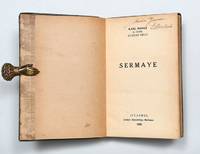
188557044Hamburg: Otto Meissner 1885. 8vo. Very nice contemporary black half calf with gilt spine. A bit of wear to extremitoes. Inner front hinge a little weak. Title-page a littel dusty but otherwise very nice and clean. Book-plate Arnold Heertje to inside of front board. XXVII 1 526 pp. 1 f. With pp. 515-16 in the first state "Consumtionsfonds" with a C and with the imprint-leaf at the end. <br/><br/><em>Scarce first edition of the second volume of "The Capital" edited from Marx's manuscripts by Friedrich Engels and with a 20 pages long preface by Engels. The second volume constitutes a work in its own right and is also known under the subtitle "The Process of Circulation of Capital ". Although this work has often been to as referred to as "the forgotten book" of Capital or "the unknown volume" it was in fact also extremely influential and highly important - it is here that Marx introduces his "Schemes of Reproduction" here that he founds his particular macroeconomics and here that he so famously distinguishes two "departments" of production: those producing means of production and those producing means of consumption - "This very division as well as the analysis of the relations between these departments is one of the enduring achievements of Marx's work." Christopher J. Arthur and Geert Reuten : The Circulation of Capital. Essays on Volume Two of Marx's Capital. P. 7.The work is divided into three parts: The Metamorphoses of Capital and Their Circuits The Turnover of Capital The Reproduction and Circulation of the Aggregate Social Capital and it is here that we find the main ideas behind the marketplace - how value and surplus-value are realized. Here as opposed to volume 1 of "The Capital" the focus is on the money-owner and -lender the wholesale-merchant the trader and the entrepreneur i.e. the "functioning capitalist" rather than worker and the industrialist. "it was here in the final part of this book i.e. vol. II of Das Kapital that Marx introduced his "Schemes of Reproduction" which influenced both Marxian and orthodox economics in the first decades of the twentieth century." Arthur & Reuten p. 1.The first volume of "Das Kapital" was the only one to appear within Marx' life-time. It appeared 1867 followed by this second volume 18 years later which Engels prepared from notes left by Karl Marx. </em> unknown
187585992Paris: Librairie du Progrès - Directeur Maurice Lachatre & Cie 1875. Fine. Librairie du Progrès - Directeur Maurice Lachatre & Cie Paris s. d. 1875 19.50 x 28 cm relié First edition in French translated by Joseph Roy partly previously unpublished with corrections and additions by Karl Marx. Complete with the two title pages addressed to Lachatre a frontispiece portrait of Karl Marx the facsimile of his letter to the publisher and his reply on the verso removed from later editions. Simple contemporary bronze half-cloth binding smooth spine framed in gilt gilt title bookbinder's ticket at foot of the pastedown ""Buchbinderei Schey & Co Zürich"". This first French edition of 'Das Kapital' was published in parts between 1872 and 1875 but met with no success as the publisher writes in a letter to Marx dated 24 December 1873: ""Sales are nil on your book . The print run is 1100 copies almost all still in store"". Unsold quires were partly reassembled and offered in bound paperback volumes in early 1876. As the book was barely finished booksellers were already sabotaging distribution. In June 1879 La Châtre wrote to Marx: ""There are still three hundred copies left of the last parts printed at a thousand copies. We would therefore have sold only 600 or 700 copies in a span of six years. It is a very sad result."" This was a major disappointment for Karl Marx who had put a great deal of effort into this French edition the only translation he personally edited and last one published in his lifetime. Marx ""wished to leave a mark with Le Capital in French theoretical and political debates strongly influenced by the legacy of Proudhon in a country where the International was more effectively organized than anywhere else and whose capital had 'set itself up as a Commune'. In France Le Capital was in a way the epilogue to a long theoretical and political debate begun in French twenty years earlier with the first polemic against Proudhon. . In 1872 Marx simultaneously corrected and revised Joseph Roy's translation and reworked the first German edition in preparation for the second edition published by Meissner. This twofold work constantly intersecting with each other is partly responsible for the many differences that remain between German texts of the 2nd and even later editions and the French version which Marx was correcting separately and simultaneously. At each stage of the process preparation of the original text for Roy correction of the proofs for Meissner correction of the translation sent by Roy correction of the proofs sent by the printer Marx made changes much to the despair of the printers. For many authors this division of labor into different phases would result in a large number of small variants. For Marx it encouraged a tendency that didn't need encouraging the tendency to perpetual rewriting to palimpsest."" Jean-Pierre Lefebvre introduction to the 1983 reprint of Le Capital published by Editions Sociales. On 28 April 1875 Karl Marx makes additions to a notice to the reader that would appear in the last issue on p. 348 stating his involvement in this French version and its importance within his work: ""M. J. Roy's scrupulous translation has forced me to modify the wording with the aim of making it more accessible to the reader. Since the book was published in separate parts these changes were made one after the other and were carried out with uneven attention to detail resulting in stylistic discrepancies. Having once undertaken this revision work I was led to apply it also to the substance of the original text the second German edition to simplify some developments to complete others to give additional historical or statistical material to add critical insights and so on. Whatever the literary imperfections of this French edition it has a scientific value independent of the first edition and should be read even by readers familiar with the German language"". Our copy was undoubtedly acquired by a fellow countryman Librairie du Progrès - Directeur Maurice Lachatre & Cie paperback
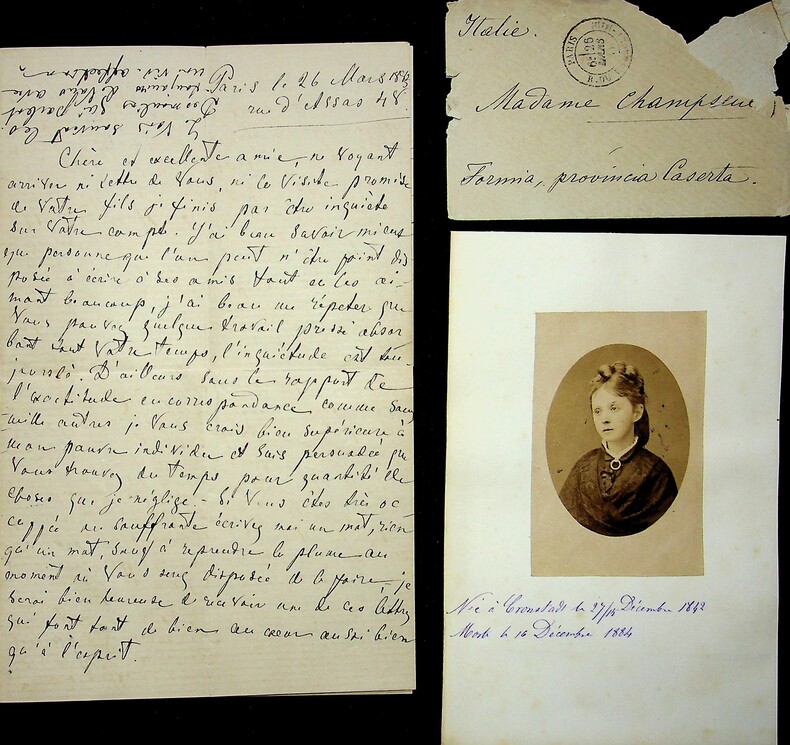
018555Varvara Nikolayevna Nikitina [Nikitine] dite Barbe Gendre (1842-1884), journaliste, écrivain socialiste. L.A.S. + enveloppe + photographie originale, 26 mars 1883, 4p in-8. Magnifique lettre à Victoire Léodile Bera, dite André Léo (1824-1900), militante féministe, appelée ici « madame Champseix », du nom de son mari Grégoire qu'elle épousé en 1849 et dont elle fut veuve dès 1863 : « Chère et excellente amie, ne voyant arriver ni lettre de vous, ni de visite promise de votre fils je finis par être inquiète sur votre compte. J'ai beau savoir mieux que personne que l'on peut n'être point disposée à écrire à ses amis tout en les aimant beaucoup, j'ai beau me répéter que vous aurez quelque travail pressé absorbant tout votre temps, l'inquiétude est toujours là. D'ailleurs sans le rapport de l'exactitude en correspondance comme sans mille autres je vous crois bien supérieure à mon pauvre individu et suis persuadé que vous aurez du temps pour quantité de choses que je néglige. Si vous êtes très occupée ou souffrante écrivez moi un mot, rien qu'un mot, sauf à reprendre la plume au moment où vous serez disposée de la faire, je serai bien heureuse de recevoir une de ces lettres qui font tant de biens au coeur aussi bien qu'à l'esprit. Ne sachant rien de ce qui vous touche si ce n'est de vous entretenir de moi même, de ce moi "haïssable" selon Pascal, mais que, je le crois, n'est pas sans intérêt pour ceux qui nous aiment. Ma vie est toujours la même, entièrement consacrée au travail et à la société de quelques amis intimes, société qui me suffit amplement puisque j'ai le bonheur d'en posséder quelques avec qui on peut faire le tour du monde de la pensée et remuer tous les problèmes sociaux ou psychique faits pour passionner l'être humain. Ce dernier temps j'ai eu le chagrin de voir rompre un des chainons de cette chaine d'affection qui m'est si précieuse. ma chère Marie, celle que j'appelais mon rayon de soleil a été rappelée subitement en Russie par la mort de sa mère et je doute qu'elle revienne. Certes l'absence ne détruit pas ce lien de sympathie, mais dans certains cas, surtout, elle la relâche beaucoup quand, comme ici par ex : cette sympathie est un élément de la vie quotidienne, une habitude affective plutôt qu'une liaison fondée principalement sur la communauté d'idée et d'opinions. Cette dernière, grâce à son caractère plus intellectuel résiste mieux à l'épreuve du temps et de l'absence. Pour le reste, mon entourage est le même et tous mes amis qui sont aussi les vôtres me chargent de vous dire mille choses affectueuses. Je suis en train de finir la traduction du Voyage de [Ernst] Haeckel à Ceylan et comme j'en ai une autre sur les bras et que j'ai fait ce temps quelques articles, je me sent un peu fatiguée. Ma santé est toujours détestable et j'attends le printemps pour pouvoir respirer un peu et m'aérer davantage. A présent nous avons des froids si vifs qu'on ne sort pas impunément quand on tousse, surtout on ne sort pas pour longtemps. Il est donc dit que chaque fois que je vous écrierai il y aura la mort de quelques hommes illustres sur le tapis. Celle de Marx a douloureusement frappé ses disciples et ses amis. C'était un des hommes pour lesquels je nourrissais une vive admiration - je crois que c'est une des intelligences les plus puissantes de notre siècle et tout ce que j'ai entendu dire de lui par ceux qui l'ont connu de près n'a fait qu'augmenter mon enthousiasme. Lav [i.e. Piotr Lavrov], très sévère dans ses appréciations parce qu'il est très exigeant, soutient qu'il n'a jamais rencontré une telle réunion de qualités qui s'excluent souvent : Vaste intelligence, érudition énorme, esprit pétillant et vif, coeur ardent dans ses amours comme dans ses haines. Cet homme d'un esprit si hardi, si réel, ce terrible révolutionnaire a été abattu du coup que lui a porté la mort de sa femme, l'indispensable compagne de ses travaux et de ses lettres, - et n'a pu le relever. Je trouve quelque chose de très touchant da
194858682Los Angeles:: Cal Interests May 7 1948. Single sheet printed on both sides. Hole-punched at top edge and with an old staple at one corner; signatures fine. 11 x 8-1/2 inches. Cal Interests, unknown
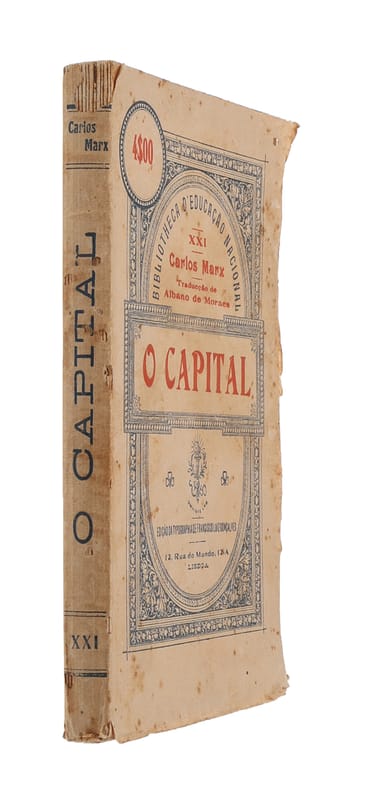
191263248Lisboa, De Francisco Luiz Goncalves, 1912. 8vo. Uncut in the original printed wrappers. Wrappers brownpostted and with a few minor nicks and tear. Upper part of spine with loss of paper. Internally fine and clean. A fine and well preserved copy of an otherwise fragile book. 240 pp.