34 338 résultats
Good Turkish, Ottoman (1500-1928) Original wrappers. Taken from a volume. Wear on spine and pencil note on front cover. Overall a good copy. Foolscap 8vo. (17 x 12 cm). In Ottoman script (Old Turkish with Arabic letters). First edition of this exceedingly rare and early utopian work containing the future vision of Sabahaddin (1879-1948), who was a prince to the Ottoman Palace and sociologist, in search of a just and sustainable order in the last years of the state. Prens Sabahaddin was born in Istanbul in 1879. His mother was Seniha Sultan, daughter of Ottoman Sultan Abdülmecid I, and Nalan-î Dil Kadin Efendi. His father was Mahmud Celaleddin Pasha. Prince Sabahaddin, nephew of Sultan Murad V, Abdul Hamid II, Mehmed V, and the last Sultan Mehmed VI, had a versatile education at the Ottoman palace and is considered the founding father of Ottoman liberalism. Sabahaddin fled in late 1899 with his brother and father, who had fallen out with Abdul Hamid II, first to Great Britain, then to Geneva, the center of opposition to the Ottoman Sultan.[citation needed] After a warning by the Federal Council in Geneva in 1900, they left and went to Paris and London. Sabahaddin advocated revolutionary violence and led the opposition in exile. During the first phase of his career in political opposition (1900-1908) he sought unity between Christians and Muslims and met with Muslim and Christian leaders. He received support for the cause of the Young Turks. During this time he met Edmond Demolins and became a follower of the school of social sciences. Sabahaddin advocated liberal economic policies in his Tesebbüs-ü Sahsi ve Adem-i Merkeziyet, which became a rival to Ahmed Riza's Committee for Union and Progress. This division plagued the Young Turk movement before 1908 and would provide the central dispute in the more institutionalized political discourse of the Second constitutional era. After the Young Turk revolution and the seizure of power by the Committee of Union and Progress in 1908, he returned to the Ottoman Empire. His Liberal Party was banned in 1909 and in 1913 he had to flee again. In the first World War I, he spent as head of the enemy in western Switzerland. In 1919 Sabahaddin returned in the belief back to realize his political vision, to Istanbul, but was ultimately banned in 1924 by the victorious Nationalists under Mustafa Kemal (Atatürk). His project of a democratic Turkey contained means of decentralization and private initiative, elements of the social theories of Frederic Le Play and Edmond Demolins. In 1924, after the establishment of the new Republic of Turkey, he was exiled from Turkey by law which expelled all the living members of the Ottoman Dynasty on March 3rd, 1924, and thus, from 1924, Sabahaddin had to live in retirement in Switzerland. In his autobiography "The Witness" (1962, first edition; 1974, revised and enlargened the second edition), John G. Bennett notes that in his later years, he had become an alcoholic because of his frustrations, disappointments, and exile out of Turkey and had died in great poverty and oblivion. He died in 1948, his body was kept in a metal coffin for four years in Switzerland. Özege 21840.; OCLC 682781253, 948961828, 78949090. (Utopias from the Middle East 11).
Very Good Turkish, Ottoman (1500-1928) Original cloth bdg. with marbled boards. Cr. 8vo. (20 x 13,5 cm). In Ottoman script (Old Turkish with Arabic letters). 176, [1] p. Lithographed edition. Extremely rare first and only edition of this guide to the distances and meridian calculations of some cities from Batumi located on the shores of Black Sea, Europe until Great Britain, Asia, and Africa shores, prepared for Turkish naval officers, mariners, and vessels, describing the shores of the countries located on these routes. ABOUT THE AUTHOR: Ibrahim Edhem Pasha was an Ottoman statesman, who held the office of Grand Vizier at the beginning of Abdul Hamid II's reign between 5 February 1877 and 11 January 1878. He resigned from that post after the Ottoman chances of winning the Russo-Turkish War (1877-1878) had decreased. He furthermore served in numerous administrative positions in the Ottoman Empire including minister of foreign affairs in 1856, then ambassador to Berlin in 1876, and to Vienna from 1879 to 1882. He also served as a military engineer and as Minister of Interior from 1883 to 1885. In 1876-1877, he represented the Ottoman Government at the Constantinople Conference. He was born in Chios of Greek ancestry, in a Christian Greek Orthodox village on the island of Chios. Strangely, his connection to Chios is not well-documented: his son Osman Hamdi Bey claimed that he was a member of the Scaramanga family, but Edhem Pasha himself tried to efface his Greek connections. As a young boy in 1822, he was orphaned and captured by Ottoman soldiers during the massacre of the Greek population of Chios. He was sold into slavery, brought to Constantinople, and adopted by the (later) grand vizier Hüsrev Pasha. Lacking his own children and family, Hüsrev Pasha raised about ten children who had been orphaned or bought as slaves, many of whom ascended to important positions. The child, now named Ibrahim Edhem, quickly distinguished himself with his intelligence and after having attended schools in the Ottoman Empire, he was dispatched along with a number of his peers, and under the supervision of his father, then grand vizier, and of the sultan Mahmud II himself, to Paris to pursue his studies under state scholarship. There he returned with a Bachelor of Arts and was one of the top pupils at the École des Mines. He was a classmate and a friend of Louis Pasteur. He thus became Turkey's first mining engineer in the modern sense, and he started his career in this field. Edhem Pasha was the father of Osman Hamdi Bey, a well-known archaeologist, and painter, as well as the founder of the Istanbul Archaeology Museum and the Mimar Sinan Fine Arts University. Another son, Halil Edhem Eldem took up the archaeology museum after Osman Hamdi Bey's death and has been a deputy for ten years under the newly founded Turkish Republic. Yet another son, Ismail Galib Bey, is considered the founder of numismatics as a scientific discipline in Turkey. Later generations of the family also produced illustrious names. The architect Sedat Hakki Eldem, a cousin, is one of the pillars of the search for modern architectural styles adopted by the Republic of Turkey (called the Republican style in the Turkish context) in its early years and which marks many important buildings dating from the period of the 1920s and the 1930s. A great-grandson, Burak Eldem, is a writer while another, Edhem Eldem, is a renowned historian. More names include Erol Eldem, Tiana Eldem, Levent Eldem, and Ercan Eldem, an architect. (Source: Wikipedia). Özege 4522.; Only one copy in OCLC: 162837008 (Bayerische Staatsbibliothek).
Very Good Turkish Paperback. Roy. 8vo. (24 x 17 cm). In Turkish. 240, [12] p. Halid Ziya was born in Izmir, Tire. He went to Istanbul and continued to Hendese-i Mülkiye and Engineer Mekteb-i Âlîsi for seven years. After starting with "Aydin Province Umur-i Nafia Third Class Engineering", Halid Ziya Bey, who continued to work as a deputy chief engineer on 14 March 1910, left Aydin and returned to Istanbul after continuing this duty for about six and a half months. As a teacher, he taught Accounting, Algebra, Geometry, and Topography at Halkali Ziraat Mekteb-i Âlîsi and Darussafaka. Halid Ziya Bey, who was appointed as a teacher of Hendese and Cosmography in Kabatas High School, started to practice the profession of engineering and cadastral, which was his main specialty in 1327. After the First World War, the Istanbul Government started its activities in order to capture and neutralize Halid Ziya Bey and his friends. Upon the harsh measures taken, Halid Ziya Bey had to live as a fugitive in the Hasirci Mountains of Eskisehir for a while with the armed force attached to him. Halid Ziya Bey, who was involved in the movement in Anatolia until the end of the National Liberation Struggle, returned to his engineering duty after the proclamation of the Republic and was included in the cadastral works again. In 1925, Halid Ziya Bey was appointed as the Head of the Science Committee of the new cadastre organization. He wrote 5 books on cadastre, photogrammetry, trigonometry, and cadastral tools in 1928 and 1929. In addition, as a result of personal work in 1928, the road between the provincial division of the Republic of Turkey with cities has prepared a comprehensive map to show up in the forest and mining. (Source: Kadastro ne idi, nedir, ne olacaktir, Kadioglu - Yildirir. From Preface.). This rare book includes the collection of Türkkan's early topography lessons. Signed and inscribed by Halid Ziya. Not in OCLC.; MK (Turkish National Library) 000187218.
Very Good Turkish, Ottoman (1500-1928) In contemporary aesthetics 1/3 leather bdg. with five compartments on spine. Third and fourth compartments have lettered gilt title and a personal name (Fikri) in Ottoman script. Other ones have decorated gilts. Cr. 8vo. (20 x 14 cm). In Ottoman script. 359 p. Tesalya'da bir cevelân ve dört aylik seyahâtim. Süleyman Tevfik's, who participated in the Turco-Greco War in 1897 as a war correspondent, travels to Thessaly to watch the Thessaly War. First Edition. Özege 20762.; OCLC: 65794449 / 775132812.
Very Good Turkish Original color map. 52x65 cm. In Turkish. Scale: 1: 800,000. Showing shores from Latakia to Haifa; Lebanon , Beyrouth, North Palestine, Syria, Saudi Arabia and borders, Orontes river, deserts. [TURKISH MAP of BEYROUTH, DAMASCUS, JORDAN] Sam, Beyrouth, Lebanon, Jordan.
Very Good Tatar Original wrappers. Demy 8vo. (21 x 14,5 cm). In Crimean Tatar in Arabic script. 25 p. Chipped on extremities, wear on spine, slightly stained and dusty covers. Overall a good copy. First and only edition of this first regulations consisting of 87 articles under 11 main headings, of the parliamentary (qurultai) of the Crimean People's Republic, which was the first Turkic and Muslim democratic republic in the world, existed from December 1917 to January 1918 in the Crimean Peninsula, a modern day Ukrainian territory currently occupied by the Russian Federation. The Crimean People's Republic was declared by the initiative of the Qurultai of Crimean Tatars, which stipulated the equality of all ethnicities within the peninsula. Noman Çelebicihan (1885-1918) was chosen as the first President of the nascent Republic. The Qurultai, in opposition to the Bolsheviks, published a "Crimean Tatar Basic Law", which convened an All-Crimean Constitutional Assembly, established a Board of Directors as a provisional government, and erected a Council of National Representatives as a provisional parliament. The Board of Directors and the Central Council of Ukraine both mutually recognized each other. This attempt to build a new nation was quickly defeated by the Bolshevik- and anarchist-dominated Black Sea Fleet. Already on 16 December 1917, the Bolsheviks captured Sevastopol where the headquarters of the Black Sea Fleet was located and dissolved the local council of deputies. The power in the city was transferred to the local revkom. The Bolsheviks were supported by some ships of the Black Sea Fleet. To defend itself, the Crimean government created a United Crimean Headquarters on 19 December 1917, that had at its disposal two cavalry and one infantry regiment of Crimean Tatars as well as some Ukrainian and Russian formations that amounted to some thousand people. Several armed incidents took place during January 1918. On 14 January 1918, the Bolsheviks captured Simferopol where they managed to arrest former President of Crimea (Head of Directorate) Noman Çelebicihan who had just resigned on 4 January 1918. He was transferred back to Sevastopol and interned until 23 February 1918, when he was executed without trial. The body of Çelebicihan was thrown into the sea. On the initiative of Çelebicihan on 10 January 1918, the Qurultai created a special commission that conducted talks with the Bolsheviks to stop the armed conflict in Crimea. On the initiative of Çelebicihan on 10 January 1918, the Qurultai created a special commission that conducted talks with the Bolsheviks to stop the armed conflict in Crimea. By the end of January 1918, the Bolsheviks had captured the whole of Crimea and dissolved both the Kurultai as well as the Council of National Representatives. The Red Terror engulfed the peninsula. With Çelebicihan in the Reds' custody, another leader of the Crimean Tatars, Cafer Seydamet Qirimer, managed to escape to the Caucasus across continental Ukraine. Many Crimean military formations retreated to the mountains. The government of Ukraine blockaded Crimea while trying to re-establish control over the Black Sea Fleet and the city of Sevastopol. Any Muslim supporting military formations on the way to Crimea was stopped. That, in turn, triggered a protest from the All-Russian Muslim military council. By the end of January 1918, the Ukrainian government itself was forced to declare war on the Russian SFSR due to the advancement of the Red Guard forces of Moscow and Petrograd into Ukraine without explicit notification. The Bolsheviks briefly established the Taurida Soviet Socialist Republic on Crimean territory in early 1918 before the area was overrun by forces of the Ukrainian People's Republic and the German Empire. Some officials of the national government, such as Seydamet Qirimer who managed to escape the Bolsheviks' terror sought political asylum in Kyiv and petitioned for military help from the advancing Ukrainian Army as w
Very Good Turkish, Ottoman (1500-1928) Paperback. Demy 8vo. (21 x 15 cm). In Ottoman script. 21 p. This tractate has no date, printing house, and not in any catalogues and libraries. Cover has a long title contains the name of the book and a notification on further two books will be published titled 'Abidin Pasha in Ankara' and 'Abidin Pasha in Adana'. Book started with an introduction by Vakkas Ali El-Buvâkî. Any biographical information could not be found about El-Buvâkî. Tractate includes thoughts of Abidin Pasha about the last Ottoman Imperial problems, degeneration in Turkish bureaucracy, international Balkan question, etc. Abidin Pasha was an Albanian patriot, politician, ideologue and diplomat; and the governor of Rhodes, Aden, Algeria, Ankara, and Adana. As a rilindas involved in the Albanian National Awakening, he was one of the founders of the League of Prizren and its chief representative for Epirus (1878). Dino was one of the main promoters in the need for the creation of the Autonomous Albanian Vilayet under the Ottoman suzerainty, and later a contributor in the Albanian independence. Abedin Dino was from Chameria and he was born in Preveza on March 23, 1843, to one of the most notable and noble families of the city (the Dino family). During the Great Eastern Crisis Dino was one of ten signatories to a memorandum addressed to Berlin Congress hosts chancellor Bismarck and Count Andrassy on 20 June 1878 calling for reforms and Albanians to remain in the Ottoman state with their rights, desires, interests, and traditions being respected. Dino strongly supported the territorial integrity of Albanian inhabited lands remaining within the Ottoman state. Together with Abdul Frashëri, Vesel Dino, and Mehmet Ali Vrioni he established local League branches of the Albanian Committee of Janina and Assembly of Preveza. On 11 January 1879, a meeting in Preveza of Albanian notables and leaders at Dino's house agreed to oppose Epirus joining Greece, even though military force if an unsatisfactory agreement was imposed by the Great Powers and to express that view to the Berlin Congress. The free movement of Dino in Preveza and his appointment as a commissioner for delineating the border was representative of the support the Ottoman Empire gave to the League during this time. From 10 June - 12 September 1880 Dino briefly served as the Minister of Foreign Affairs of the Ottoman Empire for four months and was elevated to the rank of Pasha, becoming known as Abedin Pasha. Abdul Hamid II appointed Dino as he wanted to strengthen the Ottoman position during negotiations about the border with Greece. [.] In part due to his efforts and activities, the Vilayet of Janina did not join Greece and remained within the Ottoman Empire until 1912. He became a wâli (governor) of Aden and from 1904 Vizier (minister) in the Ottoman government headed by fellow Albanian Avlonyali Mehmed Ferid Pasha. Abedin Bej Dino was also an evaluated poet, publisher, writer, and translator. He wrote many songs, including the famous one "Këngë për Shqipërin" (alb. "Song for Albania", in 1879), "Të nxiturit e Shqipërisë duke përpjeturë" (1880), "Poema e Shenjtë" (Poema of Saint, 1884), "Poetry" (1888). He translated on Albanian language poems of a 13th-century Persian poet, and Sufi mystic Rumi. His son, Rasih Abidinpasazâde Dino (who has a book titled 'Üç Mektup') was a co-founder of the first Albanian school in the city of Preveza and in 1913 he was the head of the delegation of Albania that signed the Treaty of London that recognized Albania an independent state. Abidin Pasha is the grandfather of famous Turkish painter Abidin Dino, (1913-1993). Not in Özege.; Not in OCLC.
Very Good Turkish Original wrappers. 12mo. (16 x 12 cm). In Turkish. 16 p. First and only edition of this extremely rare pamphlet written by Turkish Islamist-Nationalist journalist Eygi, who criticizes the understanding of Islam in the 1960s, through the symbol of the first fictional utopian land and vision in Turkish literature called "Darürrahat" [i.e. The Door of Peace] in Ismail Gaspirinskiy (1851-1914)'s book "Darürrahat Müslümanlari" [i.e. The Muslims of Darrürrahat] published in 1887, in Kazan. Mehmed Sevket Eygi was a Turkish journalist, writer, columnist, and Holocaust denier. He had Islamist-nationalist views. After graduating from university in 1956, he worked as a translator at the Directorate of Religious Affairs for two years. Eygi began publishing the daily Bugün newspaper and its publishing house in 1966, where this book will also be published as the third book of the publishing house. While making this criticism, he used the first utopia text of Turkish literature called "Darürrahat Muslims" by Gaspirinskiy as a symbol. Ismail Gaspirinskiy (or Gaspirali) was an ideologist, author, journalist, publisher, educator, and major. Gaspirali's work called Muslims of Darurrahat (Comfortable Country) was published in 1891 after the first issuance in Tercuman Newspaper as the continuation of Letters of Frengistan. Cannot be found in any data as well as OCLC. (Utopias from the Middle East 1).
Very Good Turkish, Ottoman (1500-1928) Original handsome 1/3 leather bdgs. with attractive decorations at spines. A chipped on the second, and a period label on the first volume's spines. Spines are not homogeneous in their artistic style. Roy. 8vo. (24 x 17 cm). In Ottoman script (Old Turkish with Arabic letters). 2 volumes set: (412 p.; 398 p.). Extremely rare first printed Turkish edition of this first-hand account with a compilation of period sources of 150 dynasties from 1000 AH to c. 1655, self-translated from Arabic by the author, of his Arabic work titled "Fadhlakat al-Tawarîh" [i.e. The report of history] with an addendum for the Ottoman readers by adding what he had seen since 1653. In the book, the events starting from 1592 are told in accordance with the classical Islamic historiography tradition, and short biographies of the viziers, scholars, sheikhs, poets and famous people who died in that year are given at the end of each year. Hadji Khalifa influenced the Arab and Turkish historiographers, who succeeded him in terms of methodology. Hadji Khalifa was the celebrated Ottoman-Turkish polymath and leading literary author of the 17th-century Ottoman Empire. Franz Babinger hailed him "the greatest encyclopaedist among the Ottomans." OCLC lists only three sets: 1030930786, 1030930787 (One is complete in Orient-Institut in Istanbul); 634635343, 634635657 (Two are complete in Berlin and München).; Özege 5707.
New English Paperback. Demy 8vo. (21 x 13,5 cm). In English. 213 p. Ills. The 1877-78 Russo-Turkish War, known in Turkish sources by its Rumi date: '93 Harbi, has been thoroughly studied through political and military lenses. The mass exodus of hundreds of thousands of Ottoman subjects before the advancing Russian armies was a major humanitarian calamity, one with possibly more long-term historical consequences than the mere shifting of borders. Despite its significance, it has received relatively humble attention in the pages of history. This book attempts to illuminate a lesser known aspect of this subject, in particular, the general voluntary relief efforts on the part of the British people for the Ottoman refugees (the '93 Refugees). This book covers the activities of both the institutions and the prominent figures of this endeavor, against the background of humanitarian diplomacy. In doing so, it provides the reader with an intimate look into a "compassionate" episode in late 19th century Anglo-Ottoman history.
19979763Wiesbaden : Bund d. Steuerzahler, BdSt, 1997. 336 S. 8°. Stand: April 1997. OBroschur.
2014000999Lake Clark National Park and Preserve/Alaska Association for Historic Preservation 2014. Softcover. Very Good/no jacket. 264 pages many illustrations 21cm tall octavo bibliography and index. DVD included pocket is affixed to inside rear cover. The emphasis of this book is the impact of the Euroamerican settlers on the native Dena'ina people and of the Lake Clark Dena'ina on the Euroamericans. Lake Clark National Park and Preserve includes the isolated Twin Lakes area where Richard Proenneke filmed his daily life and the construction of his log cabin. Covers show minor wear otherwise a fine copy sound and clean. Lake Clark National Park and Preserve/Alaska Association for Historic Preservation paperback
1956220870<p>First edition so stated. Octavo. 16 illustrations. Dust jacket unclipped. Very good. Bookplate revomed from front pastedown. Six Guns 1095. Herd 1112.</p> University of Oklahoma Press hardcover books
1997040863Staten Island NY: Maurizio Martino 1997. Reprint. Hardcover. Fine. pp: xxxvii 279 26chronological index 28title and subject index 1errata. Bound in blue cloth gilt spine lettering on red block. 8.5" x 5.5" "This reprint is strictly limited to 150 copies. Maurizio Martino hardcover
0267101821.Ghardcover. Good. Access codes and supplements are not guaranteed with used items. May be an ex-library book. hardcover
1333335679.Gpaperback. Good. Access codes and supplements are not guaranteed with used items. May be an ex-library book. paperback
1944040872Chicago: Wright Howes 1944. First Edition. Hardcover. Fine. 112pp; illustrations depict 17 broadsides and title-pages. Bound in blue cloth gilt lettering on spine; title-page and headpieces printed in blue. 9.75" x 6.5" Contains 227 entries. "Of this edition there have been printed in June 1944 two hundred copies only. Wright Howes hardcover
1944040909Chicago: Wright Howes 1944. First Edition. Hardcover. Fine. 112pp; illustrations depict 17 broadsides and title-pages. Bound in red cloth gilt lettering on spine; title-page and headpieces printed in blue. 9.75" x 6.5" Contains 227 entries. "Of this edition there have been printed in June 1944 two hundred copies only. Wright Howes hardcover
1969001586Emporia Kansas: Kansas State Teachers College 1969. Hardcover. Near Fine/None. This is a two volume set. Black covers with white lettering on the spine and the facsimile signature of William Allen White on the front cover. This bibliography was prepared in recognition of the 1968 centennial anniversary of the birth of William Allen White. It is a listing of all manuscripts and articles by or about Mr. White that are preserved in the White Collection in the William Allen White Library of the Kansas State Teachers College. The volumes themselves are protected in archival quality covers. A nice two volume set. Available for immediate shipment carefully packed in a sturdy box! <br/> <br/> Kansas State Teachers College hardcover
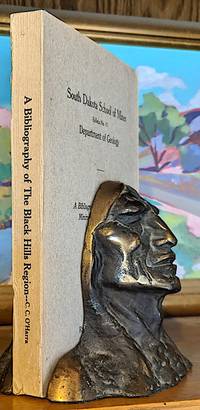
19179734Rapid City: South Dakota School of Mines 1917. Edition Not Stated. Original wraps. Very good . Tall 8vo. 316pp. plus 7pp. index to names of authors and collectors. Nice fold out map of the Black Hills Region. -- Minimal light wear to the extremities. -- At Least:. South Dakota School of Mines paperback
1390317226.Gpaperback. Good. Access codes and supplements are not guaranteed with used items. May be an ex-library book. paperback
1396226478.Ghardcover. Good. Access codes and supplements are not guaranteed with used items. May be an ex-library book. hardcover
19580000711Chapel Hill: University of North Carolina Press 1958. viii 597 pages. Original blue cloth with gilt spine lettering. 23.5 x 16 cm. A fine fresh copy. FIRST EDITION. Based on the North Carolina Collection at U.N.C. the work contains over 15000 entries and remains a standard reference for North Carolina books. It is the companion volume to Thornton's Official Publications of the Colony and State of North Carolina 17491939 1954. Mary Lindsay Thornton 1891-1973 was the first curator of the North Carolina Collection 1917-1958.� University of North Carolina Press hardcover