[ABU DHABI STATE VISITS TO PAKISTAN].Biblio.com
34 309 résultats
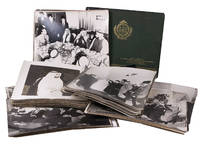
1967L2SFGIMNES3FPakistan 1967. Original black half morocco album green cloth sides with title and emblem of the United Bank Limited Pakistan on the front board. An archive of 183 photographs: 133 loose black and white photographic prints ca. 30 x 25 cm 30 smaller ones ca. 5 x 6 cm numbered and mounted together on a single sheet of paper and 20 additional prints in the album. Further with numerous rolls of original medium format negatives. A trove of unpublished photographs depicting two official visits to Pakistan by HH Sheikh Zayed bin Sultan Al Nahyan. The earlier visit in 1967 is documented by a separate photo album containing images of the visit to Lahore the second largest city of Pakistan from 16 to 28 November 1967. The album opens with a picture of HH Sheikh Zayed arriving in his car; later pictures show him being honoured and presented with an album very similar to the present one and in the company of officials representing Pakistans United Bank Limited UBL. Almost 20 years later in 1986 Sheikh Zayed would donate a hospital to the city now the "Shaikh Zayed Medical Complex" one of the leading medical institutions in Pakistan.The 30 small photographs show an audience with Sheikh Zayed as well as a banquet in his honour attended by various Pakistani dignitaries including Agha Hasan Abedi 1922-1995 the illustrious founder of UBL. These photos apparently clipped from a set of medium format contact prints are mounted on a sheet of coated black photographic paper.The largest set in size and number shows the state visit that took place on 20-22 January 1970 at the invitation of President Yahya Khan 1917-1980. It provides extensive documentation of the large Abu Dhabi delegation being formally received by Yahya Khan who served as president of Pakistan from March 1969 to December 1971. Many show HH Sheikh Zayed shaking hands with and speaking to President Yahya; others show the airport reception formal dinners speeches but also informal conversations members of the delegation handling falcons and numerous high-ranking Abu Dhabi retainers. Among the persons depicted is again Agha Hasan Abedi but there are also several pictures of Butti bin Bishr secretary to Sheikh Zayed and Ahmed bin Khalifa Al Suwaidi the first Minister of Foreign Affairs of the UAE and personal representative of Sheikh Zayed. President Yahya Khan had been "one of the very first international leaders to reach out to Sheikh Zayed after the UAE had been founded and had prior to this in July 1970 been instrumental in creating an agreement to provide technical assistance to the then Trucial States. With the December 1971 union agreement approaching Pakistan was quick to forge even closer ties and Khan had been one of the first foreign leaders to offer his congratulations and reiterate his countrys support when the UAE was born. Full diplomatic ties were then quickly established and Pakistan became one of the first to extend recognition to the new country . All his life Sheikh Zayed had held a personal affinity for Pakistan. He had hunted there extensively came to know the people its culture and lands and enjoyed close ties with leaders" Wilson.From the estate of Azhar Abbas Hashmi 1940-2016 Pakistani financial manager and eminent literary patron with close ties to Karachi University. Hashmi served the UBL for many years becoming its vice-president before founding several important cultural organisations and becoming known as a man of letters in his own right. Thanks to his close connections with the Gulf states Abu Dhabi provided funds to build Karachi Universitys faculty of Islamic studies as well as its Sheikh Zayed Islamic Centre and it mosque Jamiya Masjid Ibrahim.The majority of the photographs are entirely unmarked but they occasionally show an Arabic inscription or stamp on the reverse. Some of the loose photographs slightly scuffed along the edges with an occasional nick or small tear but otherwise in fine condition. Binding of the album slightly rubbed. An important collection of at least largely unpublished photographs concerning the Sheikh of Abu Dhabis visits to Pakistan in the last years before the formation of the UAE entirely unknown and without counterparts in the UAEhistory Keystone or Hulton/Getty press photo archives.l Cf. G.H. Wilson Zayed: man who built a nation pp. 111-112. hardcover
1979mon0000031013The Pennsylvania State Universit 1979. Paperback. Good. in x in x in. The Pennsylvania State Universit paperback
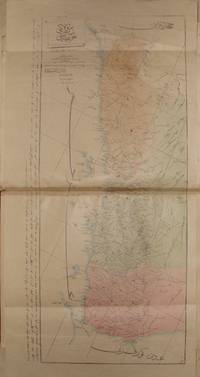
000444<p>Üsküdar: Mühendishane-i Berr-i Hümâyun<br />Imperial / Royal School of Military Engineering<br />c. 1840s</p><p>Rare Ottoman administrative atlas produced at the Mühendishane-i Berr-i Hümâyun in Üsküdar the principal Ottoman military and cartographic institution of the 19th century.</p><p>Folio 40 × 28 cm later hard cover binding.<br />Illustrated by Yümnî with thirty-nine 39 hand-colored double-page maps most signed in the stone by Yümnî. The maps are titled dated and carry printing details with the majority accompanied by Ottoman Turkish descriptive text.<br />Printed in the 1840s shortly after the establishment of the Ottoman telegraph network this atlas is possibly the earliest comprehensive administrative atlas printed in Üsküdar reflecting the modern vilayet system of the Tanzimat era.<br />Condition: Very good. All maps complete and well preserved. Scarce.</p><p>List of Maps 39</p><p>Arabistan Arabian Peninsula – 56 × 47 cm<br />Trablusgarb ve Tunus Libya and Tunisia – 56 × 39 cm<br />Trablusgarb Libya – 56 × 40 cm<br />Mısır Eyalet-i Mumtazası Territory of Egypt – 56 × 46 cm<br />Yemen – 69 × 33 cm<br />Hicaz Hejaz – 56 × 39 cm<br />Ankara<br />Sivas<br />Ma'mûretülaziz<br />Diyarbakır<br />Bitlis<br />Erzurum<br />Van<br />Musul Mosul – 56 × 39 cm<br />Bağdad Baghdad – 56 × 39 cm<br />Basra – 55 × 39 cm<br />Zor Mutasarrıflığı part of Mesopotamia<br />Halep Aleppo<br />Adana<br />Konya<br />Kıbrıs Cyprus<br />Cezâ'ir-i Bahr-i Sefîd Aegean Islands Vilayet<br />Aydın<br />Biga Mutasarrıflığı<br />İzmit Mutasarrıflığı ve Hüdavendigâr Vilayeti<br />Trabzon<br />Kastamonu<br />Bulgaristan Eyalet-i Mumtazası Territory of Bulgaria<br />Rumeli-i Şarkî Eastern Rumelia – 56 × 39 cm<br />Bosna Bosnia<br />Kosova Kosovo<br />Manastır Monastir / Bitola<br />İşkodra Vilayet of Shkodër<br />Yanya Janina / Ioannina<br />Selanik Thessaloniki<br />Edirne<br />İstanbul<br />Bahr-i Siyâh Boğazı Black Sea Strait<br />Kal'a-i Sultâniyye Boğazı Dardanelles</p><p>Significance<br />A highly important and scarce example of Ottoman state-sponsored military and administrative cartography documenting the Empire's territorial organization across Anatolia the Arab provinces North Africa the Balkans and the Straits during a key phase of modernization and infrastructural reform.<br />This atlas stands alongside the earliest telegraph-era Ottoman mapping projects and represents the mature output of the Mühendishane cartographic tradition.</p> MuhendisHane-i Berr-i Humatun (The Royal school of military engneering) hardcover
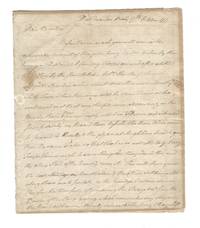
1777BB002<p>CLINTON George First Governor of New York State 1777-1795 1801-1804; also 4th Vice-President of the United States 1805-1812 under Thomas Jefferson and James Madison.<br /></p><p>"Kingston laid in ashes by the Enemy" . <br /></p><p>8vo 7-3/4 x 6-1/2 inches 1-1/2 pages on laid paper with integral address leaf remnants of wax seal some fading to text and signature scattered minor<br /></p><p>It should be noted that Clinton was sworn in as New York's first governor on 9th July 1777 shortly after Kingston was established as its first capitol 20th April 1777. Thus the burning of Kingston and change of capitol to eventually Albany was a consequence of the War for Independence. <br /></p><p>Remarkable handwritten manuscript explaining that the British troops arrived at Kingston before his own re-enforcements whereupon 1000 men burned the town and immediately returned to their ships warning that a similar fate awaits the settlements along the shore and that forage and property should be moved from the path of the enemy reminding him to take the sleigh from the barn as it is all the personal property that remains to him after the destruction in Kingston noting that the enemy is advancing up the river to Saugerties with Tryon commanding on the east side and Vaughn on the west.<br /></p><p>Transcript</p><p><i>Head Quarters Hurley 17th October 1777</i></p><p><i>Dear Brother</i></p><p><i>"Before this can reach you you will receive the – disagreeable account of Kingston being laid in ashes by the Enemy. They landed before my troops arrived after a little opposition by the few militia Cols Pawling & Snyder could collect and marched about 1000 Men immediately up to Town - where they were told by some Tories who continued in it that my People were advancing on the Hurley Road & they immediately set it in Flames and extracted precipitately on Board their Vessels tho their Orders were to proceed to Hurley & the adjacent Neighborhoods to give them the same Fate so that tho I was not able to get my Troops Time enough to save Kingston they saved this and the other Parts of the Country near it. This will show you the Fate New Windsor & the other settlements along shore are to partake on the Enemy's Return down. Therefore the Necessity of removing the Forage &c from the Banks of the River among which remember my Slay in the Barn as it is now the only moveable Property I have left the Best being removed to Kingston shared its Fate tho indeed a great share of Property has been saved out of Town. The enemy sailed up the River this Morning as high as Saghertyes burning along Shore as they go. When they go a little higher I will follow them. They have Parties on both Sides of the River. Tryon commands those on the East & Vaughan on the West Side of the River.</i></p><p><i>Yours Sincerely</i></p><p><i>Geo Clinton</i></p><p>On Friday evening 16 October 1777 a British fleet commandeered by James Wallace and John Vaughn the latter on board the 'Friendship' which had anchored near Easopus Island the day before came into the mouth of Rondout Creek and engaged the gallery "Lady Washington". Shortly after noon the British landed on Rondout Creek and the Cove above Columbus Point. Vaughn personally led the march capturing and forcing a negro to lead them into town without meeting resistance. The troops went through the streets in parties led by Tories setting the whole place on fire in response to the occasional resistance lodged by residents from within their houses. There was looting and vandalism. Meanwhile part of the fleet went a bit up the River and creek to destroy landings and sloops. By the time George Clinton arrived into Kingston the whole town was ablaze and the British party had set out to return to their ships.</p><p>In a letter on 18 October penned at Little Britain NY in response to this letter his brother B. Genl. James Clinton writes:</p><p><i>D'r Brother</i></p><p><i>Yours of yesterday's Date I have just received. I am sorry for the Loss of Kingston &c. </i><i>Five of the Enemy's Shipping Returned Down the River last night without Doing any Damage Except fireing Some Cannon and small arms at our men and wounding one of ours on Board of a Ferry Boat…"</i></p><p>The war became personal for the governor specially after what had happened to Kingston. In a letter to William Smith @ 31 October 1777 his sentiments and commitment are laid bare:</p><p><i>"The Cruelties as well Cowardice with which this Warr has been conducted ag't us must I think be sufficient at this late Hour to convince every Man that all connection with Great Britain is at an End…"</i></p><p>Reference: <b><i>Public Paper of George Clinton</i></b> First Governor of New York War of the Revolution Series. New York: Wynkoop Hallenbeck Crawford Co. 1900. Volume II pp. 457-459. Our letter of 17 October 1777 appears to be unknown to the editors of the Clinton papers although they do list and transcribe the 18th October response by his brother James. Consequently our letter appears to be the only firsthand account by the governor of New York on the actual burning of Kingston an event historically reenacted locally each year within Ulster County.</p> Autograph Letter Signed, “Geo Clintonâ€, written to his brother Gen. James Clinton in New Windsor (“Dear Brotherâ€), from books
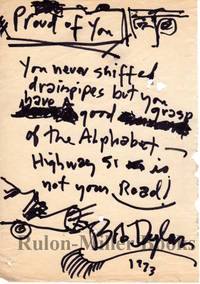
197342792n.p. 1973. Small 8vo approx. 8½ x 6 inches in black Flair pen and apparently torn from a notebook; 3 small holes not significantly affecting any legibility otherwise very good. A typically enigmatic inscription: "Proud of you" in a hand-drawn box at the top to the right of which is a small drawing of a face / "You never sniffed drainpipes but you two words crossed out have a good one word crossed out grasp of the alphabet - Highway 51 one word crossed out is not your road!" Signed boldly at the bottom "Bob Dylan / 1973" to the left of which signature is another drawing by Dylan of the rear end of an automobile depicting smoke coming from the tailpipe. Partly drawn from the lyrics of one of his masterpieces Desolation Row: "Einstein disguised as Robin Hood / With his memories in a trunk / Passed this way an hour ago / With his friend a jealous monk / He looked so immaculately frightful / As he bummed a cigarette / Then he went off sniffing drainpipes / And reciting the alphabet." <br/><br/> unknown books
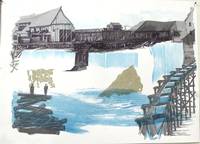
201854594Saint Paul: Midnight Paper Sales 2018. Edition limited to 40 copies actually 41 large oblong folio 36 leaves 16 color illustrations mounted on handmade paper with text printed on verso and interleaved with protective translucent blank sheets; printed colophon sheet mounted to final leaf of handmade paper; bound in suminagashi paper over boards sewn on 10 cords with uncovered spine revealing sewing structure. The images were printed using blocks made from material collected along the banks of the Mississippi River where the waterfall traveled up the river gorge. The blocks also include wood cuts wood engravings and the occasional photo polymer plate. Images were printed on Mohawk Superfine paper and text on handmade Cave paper from handset ATF Bernhard Gothic foundry type. The suminigoshi cover art was created by Amanda Degener. Issued in a cloth-covered clamshell box 61 x 71 x 6 cm. A text for children but not a children's book about the 12000-year journey of Saint Anthony Falls from St. Paul to its current home in Minneapolis." <br/><br/> Midnight Paper Sales hardcover books
54594Saint Paul: Midnight Paper Sales 2018. Edition limited to 40 copies actually 41 large oblong folio 36 leaves 16 color illustrations mounted on handmade paper with text printed on verso and interleaved with protective translucent blank sheets; printed colophon sheet mounted to final leaf of handmade paper; bound in suminagashi paper over boards sewn on 10 cords with uncovered spine revealing sewing structure. The images were printed using blocks made from material collected along the banks of the Mississippi River where the waterfall traveled up the river gorge. The blocks also include wood cuts wood engravings and the occasional photo polymer plate. Images were printed on Mohawk Superfine paper and text on handmade Cave paper from handset ATF Bernhard Gothic foundry type. The suminagashi cover art was created by Amanda Degener. Issued in a cloth-covered clamshell box 61 x 71 x 6 cm. A text for children but not a children's book about the 12000-year journey of Saint Anthony Falls the only major waterfall on the entire Mississippi River from Saint Paul to its current home in Minneapolis. Midnight Paper Sales unknown
19432091502135500694Not Available 1943. Soft Cover. Fine. The book is in fine condition. Not Available paperback
19432091502135500781Not Available 1943. Soft Cover. Fine. The book is in fine condition. Not Available paperback
In-folio (mm 298 195). Carte [250], con la prima bianca; [52]. Collazione: a-G8 H10 i-U8 x10 A8 B12 C-I8; AA-DD8 EE FF10. Spazio delle iniziali vuoto con suggerimento di lettere. Carattero romani (R 94) su 55 righe. Copia con ampie ma leggere macchie di umidità alle pagine iniziali, alcune più marginali alla fine. Legatura in pelle coeva su tavole di legno, con motivi arabeschi impressi sui piatti, dorso con titolo manoscritto su carta; con difetti. Ex-dono del XVI secolo sulla pagina del titolo, alcune glosse dalla stessa mano nel testo.
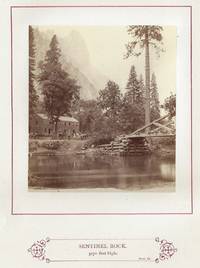
187224393Boston and New York: Alexander Moore and Lee Shepard & Dillingham 1872. Hardcover. Very good. Third edition revised and enlarged; second printing. Small quarto pp. v-x xi-xii 13-98 with two maps and 20 original mounted albumen photographs credited to Boston photographer John Soule. In publisher's green cloth with beveled edges; front board decorated in gilt black and rose; all edges gilt; each text page and each photograph bordered in red. A very good copy with rubbing and fraying to corners and spine ends bookplate of Canadian bookseller and collector G. Ducharme on front pastedown handwritten date of December 15 1872 on front free endpaper evidence of an erased ink stamp on title page. Lacks tissue guard over plate facing p. 35 all others present. Contents sound and clean. This is the rarest and most desirable edition of this work as it is the only one to contain 20 rather than 10 mounted photographs. Kneeland 1821-1888 was a physician naturalist and Professor of Zoology and Physiology at MIT. This book is based on his first visit to the Yosemite Valley in 1870 and includes a narrative of his trip from and return to Boston. "Kneeland made every effort to obtain current and accurate information and each of the later editions of the guide incorporates new material.Weston J. Naef in his book Era of Exploration the Rise of Landscape Photography in the American West 1860-1885.comments that the photographs 'are curious because there is no evidence that Soule a talented landscape photographer was ever in California.which suggests that he might have purchased the negatives from a California photographer not an uncommon transaction'" Currey & Kruska 225. Eadweard Muybridge and Martin Hazeltine are both considered strong candidates to have been the actual photographer. Farqhuar #10; Cowan p. 333. Only two copies of this edition have appeared at auction in the past 30 years and there are no others on the market as of September 2025. Alexander Moore [and] Lee, Shepard & Dillingham hardcover
1551London: Printed by Thomas Purfoot and Thomas Creede for Henrie Tomes and are to be sold at his shop at Graies Inne Gate in Holborne 1605. Hardcover. Very Good. Quarto. In two parts. 1 45 118 i.e. 121ff. A4-L4; M2; Aa4-Ggg4; Hhh2. First edition. Blank leaf present but two errata leaves absent. C4r with the first state reading 'maniable.' Contemporary vellum repaired by Bernard Middleton. From the library of C.R. Lowell with his bookplate and his rubber stamp on each title-page. Also on first title-page an ownership inscription: "bibca Williams Scptio 1813." Pforzheimer 36; Gibson 81; Grolier Langland to Wither 12; Grolier/Horblit 8a; Norman 97; STC 1164. Bound with: Sandys Edwin. A relation of the state of religion . <br/> <br/> London: Printed [by Thomas Purfoot and Thomas Creede] for Henrie Tomes, and are to be sold at his shop at Graies Inne Gate in Ho hardcover
192893831928 1 Aquarelle et mine de plomb, signée en bas à droite et titrée dans la partie inférieure, projet pour la State Bank de Chicago, 1928, 35.5 x 22.5 cm., cadre argenté.
19392091502135500739Not Available 1939. Soft Cover. Fine. The book is in fine condition. Not Available paperback
Signed and inscribed by author upon front free endpaper to Swedish journalist Arvid Fredborg, dated 1982 in Berlin. 570 pages. A National Review Panel ranked this work as the ninth best non-fiction book of the twentieth century. "A positive statement of the principles of society that in scope and breadth is more like a new Wealth of Nations... A thorough exposition of a social philosophy which ranges from ethics and anthropology through jurisprudence and the history of ideas to the economics of the modern welfare state." - Publisher. Moderate wear to clean and unmarked book. Binding sound. Dust jacket in poor condition with numerous defects.. Book
181052825Philadelphia: C. & A. Conrad & Co. Somerville & Conrad Petersburgh. Bonsal Conrad & Co. Norfolk and Fielding Lucas Jr. Baltimore 1810. First edition 8vo pp. 5 3 105 10 41-65 1 53 1 107-277 5 40 87 1; the appendices for parts 1 and 2 are bound out of order but the book is complete; engraved frontispiece portrait 6 maps 5 folding 3 folding tables; contemporary marbled boards neatly rebacked in quarter calf gilt-lettered direct on gilt-paneled spine; good and sound the maps generally in a nice state of preservation. With an 1892 ownership signature of Louis G. Carpenter at the top of the title page. Carpenter 1861-1935 was a college Professor and later the Dean of Engineering & Physics at Colorado State University formerly known as the Colorado Agricultural College. He was also a mathematician and an irrigation and consulting engineer. See Wikipedia for an account of his life. Pike's personal journal of the earliest U.S. government expedition to the southwest. Even before Lewis and Clark had returned in 1806 Lieutenant Zebulon Pike was sent to explore the southern reaches of the Louisiana Territory. Pike traveled to Colorado and down the Front Range looking for the Red River. His party failed to find it and instead wandered into New Mexico where the Spanish caught him and escorted him home. His expedition returned with valuable information about the northern provinces of colonial Mexico. He explored the headwaters of the Arkansas and Red Rivers and reported on the Spanish settlements in New Mexico as well as his account of his expedition to the upper Mississippi in Minnesota. The maps "were the first of this entire region to display knowledge derived from actual exploration and are of outstanding historic interest" Wheat Trans-Mississippi West Maps II pp. 20-21. Field 1218; Graff 3290; Howes P-373; Sabin 62836; Shaw & Shoemaker 21089; Streeter 3125; Streeter Texas 1047; Wagner-Camp 9. <br/><br/> C. & A. Conrad, & Co. Somerville & Conrad, Petersburgh. Bonsal, Conrad & Co. Norfolk, and Fielding Lucas, Jr. Baltimore hardcover books
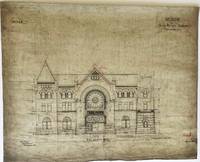
1886010275Pittsburgh PA: Thomas Rodd 1886. Paper. Very Good. Unbound. A set of four original architect's plans on translucent white architectural paper for the construction of the Indianapolis Union Railway Station. The plans are 1. Front Elevation North 24 2/8" w x 30 1/4" w. 2. Design A. 1st Floor Plan22" h x 33 5/8" w 3. Design A. 2nd Floor Plan 22" h x 33 1/2" h. and 4. Showing Elevation of Interior Pier 1/2 Elevation 1/2 Section and Plans of A.A. B.B. C.C. D.D. F.F.29 3/4" h x 25" w. The Front Elevation and the 4th plan with "Tho's. Rodd Engr. & Arch.t Pittsburgh PA" lower left the 1st and 2nd Floor Plans unsigned. Overall a Very Good set general soiling and wrinkling small chips at edges. Front Elevation North plan with red ink "Note: The Red Lines Show Corrected Grades Oct. 20th 1886". All four plans with red ink additions the 2nd Floor plan with blue ink additions as well. The Indianapolis Union Railway Station was built in 1888 to replace the 1853 station which was the first "union" station ever built and its red brick and granite Grand Hall is renowned as one of the finest Romanesque Revival-styled structures in America. It was restored beginning in 1983 and today houses the Crowne Plaza Hotel which features thirteen 1920's Pullman cars converted into hotel suites. London-born Pittsburgh architect and engineer Thomas Rodd 1849-1929 later became a Chief Engineer for the Pennsylvania Railroad West of Pittsburgh. He was responsible for the design and construction of many buildings in western Pennsylvania and the Midwest. A wonderful set of plans encompassing American architectural railroad and Indiana history. . Thomas Rodd unknown
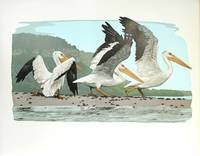
46592Stockholm WI: Midnight Paper Sales 2015. Edition limited to 119 copies this being one of 100 bound in quarter leather over marbled paper-covered boards 19 copies remain in sheets; folio approx. 15½" x 10¼" pp. 6 9-11 1 15-25 1 29-31 1 35-37 1 41-43 1 47-66 5; large folding wood-engraved map and 8 multi-color wood engravings on 7 sheets 5 folding depicting pelicans fish and river scenes inserted; 31 other zinc engravings of fish in the text; introduction by Patrick Coleman; title page and box label printed from specially made wood type based on tracings by Russell Maret from Aldus Manutius's Hypnerotomachia Poliphili; the binding is by Craig Jensen Book Lab II using hand-made marbled paper by Jemma Lewis based on photographs of wet stones along the shores of Lake Pepin. As new at the published price in the original leather-backed clamshell box with pelican label on the spine. Seven years in the making this homage to Schanilec's second home Lake Pepin - that great widening of the Mississippi River between St. Paul Minnesota and La Crosse Wisconsin - was his most ambitious project to date. The book is now out-of-print. Midnight Paper Sales unknown
201546592Stockholm WI: Midnight Paper Sales 2015. Edition limited to 119 copies this being one of 100 bound in quarter leather over marbled paper-covered boards 19 copies remain in sheets; folio approx. 15½" x 10¼" pp. 6 9-11 1 15-25 1 29-31 1 35-37 1 41-43 1 47-66 5; large folding wood-engraved map and 8 multi-color wood engravings on 7 sheets 5 folding depicting pelicans fish and river scenes inserted; 31 other zinc engravings of fish in the text; introduction by Patrick Coleman; title page and box label printed from specially made wood type based on tracings by Russell Maret from Aldus Manutius's Hypnerotomachia Poliphili; the binding is by Craig Jensen Book Lab II using hand-made marbled paper by Jemma Lewis based on photographs of wet stones along the shores of Lake Pepin. As new at the published price in the original leather-backed clamshell box with pelican label on the spine. Seven years in the making this homage to Schanilec's second home Lake Pepin - that great widening of the Mississippi River between St. Paul Minnesota and La Crosse Wisconsin - was his most ambitious project to date. <br/><br/> Midnight Paper Sales hardcover books
Very Good Arabic Original autograph document/letter sealed by Ahmad I of Tunisia. 54x42 cm. 1 p. 6 long lines. The letter includes full of poetic praise. It must be sent after successful diplomatic intercourse with Naples. Ferdinand II (Ferdinando Carlo) was King of the Two Sicilies from 1830 until his early death in 1859. It starts with 'Thank God alone', and goes on 'From poor Ahmad Pasha to Lord Almighty Field Marshal Amîr [ruler]. Sealed by the seal of Ahmad Basha Beg including an impressive qasidah in Arabic. Ahmed I (ibn Mustafa), born 2 December 1805 in Tunis died May 1855 at La Goulette, was the tenth Husainid Bey of Tunis, ruling from 1837 until his death. He was responsible for the abolition of slavery in Tunisia in 1846. He succeeded his father Mustafa Bey on 10 October 1837. He had grand ambitions - to expand his army and create a modern navy; to build a new royal residence, a mint and modern institutions of education but neither he nor his brother-in-law the young Mustapha Khaznadar who served as his finance minister, had a clear idea of what such initiatives would cost. As a result, many of his projects became expensive failures which damaged the financial health of the country. Soon after his accession, Ahmad Bey received the traditional Firman from the Sublime Porte which formally invested him with authority to rule from the Ottoman Empire and furnished him with the insignia of office. The Ottoman envoy, Osman Bey, arrived in la Goulette on 15 May 1838 onboard a frigate. The following day, Osman Bey made his official entry into Tunis on horseback, preceded by all the ministers of the beylical cabinet who went before him until he was two leagues from the city. Before he were carried the sword of honor and the caftan to be presented to the Bey. He was escorted by spahis and followed by a large contingent of regular troops an Arab cavalry. Three days after his official entry into the city, the envoy presented himself at the Bardo Palace to formally invest Ahmad Bey with his insignia of office and present gifts. Named as a Divisional General in the Ottoman army in May 1838, he was later promoted by the Sultan to the rank of Marshal on 14 August 1840. This was the first time that a Bey of Tunis had held a rank higher than Divisional General. The purpose of these honors was to emphasize the supremacy of the Ottoman Empire over the Regency of Tunis. Under a treaty with France signed in 1830 by Hussein Bey, a piece of land in Carthage had been ceded to allow the erection of a monument to Louis IX of France who had died there during the Eighth Crusade. On 25 August 1840, the first stone was laid in the cathedral of Carthage. Ahmad Bey also permitted the Christian community of Tunis, consisting mainly of European merchants, to enlarge their small church near the Bab el Bhar. In June and July 1846 the Duke of Montpensier, son of King Louis Philippe of France visited Tunis and Carthage. He was received with great solemnity by Ahmad Bey. According to the Tunisian historian Mohamed Bayram V, Bey's reforms were focused on state structures, the army, and education. He established a modern structure of government and gave his high officials the title of 'minister'. His senior ministers were his Grand Vizier Mustafa Sahib at-Taba'a, Mustapha Khaznadar, Minister of Finance and of the Interior, Mustafa Agha as Minister of War, Mahmoud Khodja as Minister of the Navy and Giuseppe Raffo as Foreign Minister. At certain times Mahmoud Ben Ayed also served as Trade Minister, Kuchuk Muhammad in the honorific post of Minister in charge of the security home of Ahmad Bey's reforms wasted money, such as the large frigate built at La Goulette that could not make it through the channel to the sea. of Tunis and Mohamed Lasram IV as Minister of the Pen. The historian Ibn Abi Dhiaf was the Bey's private secretary. Among Ahmad Bey's successes may be counted as the abolition of slavery in January 1846. To this may be added the formation of the military academy at...
1851008968Philadelphia: Lippincott Grambo & Company 1851. "Collected and prepared under the direction of the Bureau of Indian Affairs per Act of Congress of March 3d 1847." Presentation Copies of Parts I III and IV only each part a First Edition 1851 1853 and 1854 published by Lippincott Grambo & Company Philadelphia . Part I SIGNED AND INSCRIBED "Prof. George Howe with respect of H.R. Schoolcraft" at front paste down in tidy secretatial hand. Parts III and IV SIGNED AND INSCRIBED alike "Rev. George Howe with respects of H.R. Schoolcraft". George Howe 1802-1883 was an ordained minister and professor at Presbyterian Theological Seminary in Columbia S.C. and the author of History of the Presbyterian Church in South Carolina published 1870-1883. Provenance: Part I additionally SIGNED AND INSCRIBED at front paste down "Presented to Joseph Hyde Pratt by Prof. George Howe University of North Carolina". Prof. George Howe 1876-1936 was the grandson of George Howe and was a longtime professor of Latin and the Classics at UNC. He was also the nephew of President Woodrow Wilson. Joseph Hyde Pratt 1870-1942 was State Mineralogist and State Geologist of North Carolina a longtime professor at UNC and a WWI hero. Parts III and IV with Pratt's ownership signature at front end page. The three volumes are complete with all plates. Part I xviii 13-568 p. 76 plates; Part III xviii 19-635 p. 45 plates 3 of which are listed as appearing in Vol. IV; Part IV xxvi 19-668 p. 41 plates. A good set in unsophisticated original decorative cloth bindings Part I with damping at fore edge margins worn at corners cloth at spine torn and separating from front joint cloth chipped at head of spine. Part III cloth torn and peeling from top and bottom of spine corners worn; Part IV rear hinge starting corners worn holes in cloth along top half of front joint 1/4" loss of cloth at head of spine. Scattered toning and end papers soiled throughout the set Presentation Copy with distinguished provenance. of three of the first four volumes of Schoolcraft's six volume massive contribution to the history of Native Americans. SIGNED. First Edition. Decorative Cloth. Good. Folio - over 12" - 15" tall. Presentation Copy. Lippincott, Grambo & Company Hardcover books
193058880Saint Paul: Brown & Bigelow 1930. Large heavy 50 lbs. oblong folio approx. 18" x 24" containing approx. 718 samples of color lithographs on approx. 115 linen-coated leaves including trade cards advertising cards calendar specimens etc. each primarily measuring 10" x 4.5" some slightly varied; a few instances of items being removed some miscreased some loose but an extraordinary array of commercial color lithography featuring a number of themes including camping fishing baseball golf polo architecture the American west scenic landscapes Indian maidens movie stars Aesop's Fables Boy Scouts anthropomorphic animals stained glass cars fashion cowboys and Indians beautiful women etc. While there is much to be said about the stereotyping of men children and women especially Native American women there remains a remarkable beauty to the artwork much of it done by known artists and illustrators of the day. Among the artists represented are: Henry Hintermeister 1897-1970 a painter and illustrator who painted in the Golden Age of Illustration under the signature Hy Hintermeister. He painted as team with his father John Henry Hintermeister and together they created more than 1000 works. He is best known today for his "American themed paintings." Henry's earliest published works featured family images of women and children dogs horses and recreation. He also painted fantastic scenes with Indian maidens and scantily clad Romans and Egyptians. In later years he created ionic and semi-comical works with subjects including the multiple dangers of crossing the street children and grandparents fishermen policemen boy scouts and hunters. Hal Runyon 1907-1993 was active in Hollywood during the early 1930s as a portraitist for the movie colony. His forte was nudes of beautiful young women. He lived in San Francisco for many years before his death in Sonoma CA on July 11 1993. William Herman Schmedtgen 1862-1936 an American illustrator and painter known as a pioneer in Chicago newspaper illustrating. Born in Chicago he studied at the Art Institute of Chicago. His first work was with the Chicago Mail in 1883 he then spent two years in St. Louis and New York doing commercial art. He was chief of the art department at the Chicago Record from 1886 to 1901; and later on staff of the Chicago Record-Herald. He was a field artist for the Record during the Spanish-American War stationed with U.S. troops in Cuba. He died at his home in Wilmette aged 74. Milo Winter 1888-1956 was an American book illustrator who trained at Chicago's School of the Art Institute. He lived in Chicago until the early 1950s when he moved to New York City. From 1947 to 1949 he was the art editor of Childcraft books and from 1949 was the art editor in the film strip division of Silver Burdett Company. John G. Scott 1887-1975 who designed over 2500 juvenile valentines during his 30 year career with the Gibson Company from 1924 to 1953. These efforts are meticulously recorded in his work journal which covers his entire commercial artwork career from 1910 to 1953. Robert Bernard Robinson 1886-1952 American illustrator and originator of the Saturday Evening Post's "Slice of Life" style of cover art later popularized by Norman Rockwell shared his talents with the Hearst Corporation and their Motor Magazine monthly publication from 1926 to 1952. Clara Miller Burd 1873-1933 was an American stained glass designer and children's book and magazine cover illustrator. Robert Atkinson Fox 1860-1935 an American-Canadian illustrator and naturalist painter best known for his paintings of rural subjects especially cattle in pastures. As a commercial artist Fox was commissioned by calendar companies and print publishers to make work for posters postcards and advertisements. Florence Mary Anderson 1874-1930 was an English artist book illustrator wood engraver and children's author who flourished between 1914 and 1930. She also illustrated under her maiden name of Molly MacArthur or Florence Mary MacArthur. Her work was influenced by the British school of Fairy Art. Philip R. Goodwin 1881-1935 was an American painter and illustrator who specialized in depictions of wildlife the outdoors fishing hunting and the Old American West. He provided illustrations for numerous books and magazines as well as for commercial items such as posters advertisements and calendars. He is perhaps best known for illustrating Jack London's The Call of the Wild and for providing the cover art for many issues of Outdoor Recreation / Outdoor Life Magazine during the 1920s and early 1930s. Charles Marion Russell 1864-1926 also known as C. M. Russell Charlie Russell and "Kid" Russell was an American artist of the American Old West. He created more than 2000 paintings of cowboys Native Americans and landscapes set in the western United States and in Alberta Canada in addition to bronze sculptures. He is known as "the cowboy artist" and was also a storyteller and author. Also Alfred Davenport Cookson 1888-1963; John D. Waters; William Steeple Davis American 1884-1961 Tod Hart 20th century was active/lived in Minnesota and many others. While many of the examples are pro-forma printed art work and design but without company names or details added others represent a broad swath of American business from Los Angeles to Boston Gulfport Mississippi to Saskatchewan. Among the Twin Cities' businesses represented are Holm & Olsen Florists; Brantjen Motor Car Co.; Day's Prest-o-Service Co.; Security Mercantile Agency; A. E. Dale Auto Painting Co.; St. Paul Milling Co.; Pearson-Wilcox Electric Co.; S. Hoffman Tailors; St. Paul Cadillac Co.; Northland Milk & Ice Cream Co.; St. Paul Battery Co.; Minnesota Phonograph Co.; Chaix Co.; Field Schleck Co.; Wood & Gille Co.; Rice Street Motor Car Co.; and the Wells-Dickey Trust Co. Many other representative businesses from Iowa Wisconsin and the Dakotas as well. Brown & Bigelow unknown
194348523n.p. Minneapolis 1943. Original corrected 229-page typescript of Manfred's first novel likely used as the setting copy by the publishers Webb Publishing Company of Saint Paul with numerous typographical notes as to typesize fonts picas etc. and also containing many what we assume to be last minute corrections to the text proper by Manfred himself - a couple of hundred instances where the typescript differs from the work as published. Also a 6-page corrected typescript of the copy used for the dust jacket also a setting copy but with no corrections by Manfred. Also page proofs for the same tall 8vo 129 leaves printed on rectos only with extensive annotations throughout by the editior and printer including the amending of a number of words and phrases in the text. Also a first edition of the book 8vo pp. 8 226; fine copy in a near fine dust jacket. This copy inscribed "For Paul C. Hillestad 'our' first book together. Frederick Feikema Manfred." Hillestad was Manfred's editor at Webb. <br/><br/> unknown books
194348523N.p. Minneapolis 1943. Original corrected 229-page typescript of Manfred's first novel likely used as the setting copy by the publishers Webb Publishing Company of Saint Paul with numerous typographical notes as to typesize fonts picas etc. and also containing many of what we assume to be last minute corrections to the text proper by Manfred himself - a couple of hundred instances where the typescript differs from the work as published. Also a 6-page corrected typescript of the copy used for the dust jacket also a setting copy but with no corrections by Manfred. Also page proofs for the same tall 8vo 129 leaves printed on rectos only with extensive annotations throughout by the editior and printer including the amending of a number of words and phrases in the text. Also a first edition of the book 8vo pp. 8 226; fine copy in a near fine dust jacket. This copy inscribed "For Paul C. Hillestad 'our' first book together. Frederick Feikema Manfred." Hillestad was Manfred's editor at Webb. unknown
19802080202102900002Honpo shoseki 1980. Soft Cover. Fine. Books: 14 books Honpo shoseki paperback