(BINDINGS - 19TH CENTURY GILT AND INLAID). (EXTRA-ILLUSTRATED BOOKS). [BOYLE, ELEANOR VERE]Biblio.com
8 059 résultats
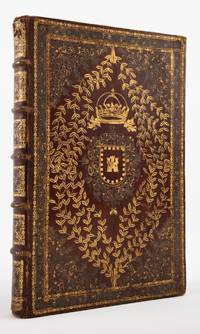
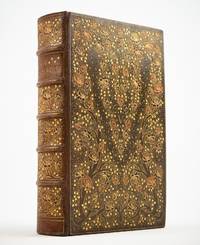
1885ST20626-1London: Printed at the Chiswick Press for Elliot Stock 1885. FIRST EDITION. 181 x 111 mm. 7 1/8 x 4 3/8". xxvi ii 274 i.e. 276 including text leaf marked as pp. 223-224 2 pp. <br/> ANIMATED CONTEMPORARY OLIVE BROWN MOROCCO ELABORATELY GILT AND INLAID covers with two climbing roses with 70 gilt and inlaid blossoms of wine red or salmon pink morocco and dozens of tiny heart-shaped leaves rising from the lower corners and winding up the sides before curving toward the center of the board in a heart shape the branches on a pointillé ground accented with tiny droplets upper cover with monogram of Eleanor Vere Boyle raised bands spine panels with rose branch featuring three inlaid blooms on a pointillé ground gilt lettering wide turn-ins with gilt rose sprays at corners yellow watered silk endleaves top edge gilt. With original front wrapper bound in at rear. Front joint replaced with great skill. With floral vignettes on title and half title decorative headpieces and initials and 11 full-page wood engravings by Boyle EXTRA-ILLUSTRATED with 28 engravings by Eisen Mariller Gravelot and many others. Spine lightly sunned to a hazel brown some extra-illustrations a little foxed occasional light to moderate offsetting from plates but the contents in excellent condition clean and bright throughout and the binding with only the most negligible signs of wear.<br/> <br/> The subject here is roses--on the extremely charming and exuberant binding in the text and in the illustrations. They were the favorite flower of author and illustrator Eleanor Vere Boyle 1825-1916 who planted them on a large scale in her garden at Huntercombe Manor. The popular illustrator of 14 children's books Boyle used most of her income to support charitable works in the parish where her husband was vicar. In her 50s she turned from illustrating to writing focusing primarily on nature and gardens as her subjects. Here she has collected English poems as well as translations in English of excerpts from poems in Greek Latin Persian Italian and French all of them celebrating the rose. Her illustrations show either close-ups of a flower or an adorable cupid accompanied by the flower of Venus. The press work in the present volume is first rate as one expects from the Chiswick Press and the binding is a riot of floral glimmering. Although the binding is unsigned the animated unconventional design is reminiscent of the work of the Guild of Women Binders while the execution is of exceptional quality equal to the productions by leading London workshops like Riviere and Zaehnsdorf. [Printed at the Chiswick Press for] Elliot Stock unknown
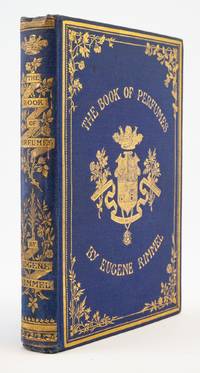
1865ST20314London: Chapman and Hall 1865. FIRST EDITION. 206 x 142 mm. 8 1/8 x 5 5/8". xx 266 pp. <br/> Very pretty publisher's royal blue cloth stamped in gilt upper cover with thick-rule frame central panel with floral spray cornerpieces central coat of arms designed by the author smooth spine with gilt title banners and sprays of flowers all edges gilt. With one chromolithograph 11 full-page engravings and 250 illustrations in the text.<br /> Front free endpaper with ink ownership signature dated 1865. Negligible wear to corners spine ends pushed in as almost always but still quite a fine copy--clean bright and fresh inside and out.<br/> <br/> In an attractive and extremely well-preserved publisher's binding this is an excellent copy of an extensive treatment of perfumes including their history uses around the world materials and modern production techniques. With the aid of copious illustrations the author describes the use of scents in Egyptian mummification Jewish rites Greek and Roman cosmetics Turkish baths Hindu worship and rituals of "uncivilized nations" and describes other cosmetics hairstyles and beauty practices across many cultures and time periods. He ends the volume with chapters on perfume manufacturing and the principal materials used in perfumery noting that most materials grow best in warmer climates--particularly the south of France. He also describes adopting novel scents found in Australia such as eucalyptus which had hitherto only been used in paint. Eugène Rimmel ca. 1820-87 was born to a French parfumier family and at a very young age established his own premises in London in 1834. According to DNB "In his laboratory Rimmel developed some of the earliest commercially manufactured beauty products" including "the first factory-made non-toxic mascara." A talented businessman and promoter he built a sizeable fortune by exporting his cosmetics and perfumes around the world. Rimmel cosmetics is still in operation today. Copies of this first edition are around but they seem all to be in unpleasant condition. Chapman and Hall unknown
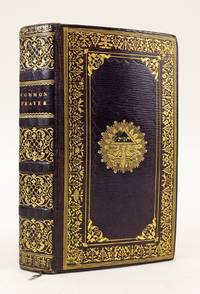
1820ST15600London: Printed by George Eyre and Andrew Strahan 1820. 142 x 80 mm. 5 5/8 x 3 1/8". 510 pp.; 80 2 pp. <br/> VERY FINE CONTEMPORARY STRAIGHT-GRAIN PURPLE MOROCCO ELABORATELY GILT covers with frame of gilt rules and anthemion-and-flower roll central panel with arabesque corners central sunburst medallion containing the Tetragrammaton within a triangle from which the dove of the Holy Spirit descends raised bands spine panels gilt in a floral and arabesque design gilt titling turn-ins with zig-zag gilt roll orange endpapers all edges gilt. Front pastedown with large morocco bookplate of Louisa Smyth dated 25th Dec. 1821 and signed with the initials E. P. Front flyleaf inscribed: "Harriet E. Thorpe / From her affectionate / Brother-- / As a remembrance of / her dear Aunt L. Dickens. / Nov. 1841." Griffiths p. 246. ◆A breath of rubbing to corners but A BEAUTIFUL COPY with no signs of use--clean fresh and bright internally and in a sparkling ORNATE binding.<br/> <br/> Bound in somber purple but with religious imagery in bright gilt this pretty little prayer book is very typical of an era in which such luxurious volumes were popular gifts among the moneyed classes as was the case here. Miss Louisa Smyth must have treasured this Christmas gift from "E. P." as its condition clearly indicates it was seldom if ever used for daily devotions. It likely served as a perfect accessory for Louisa's Sunday finery and perhaps she carried it at her 1831 wedding to Lt. Col. Thomas Mark Dickens of the Royal Engineers. After Louisa's 1841 death the book passed to Harriet E. Thorpe wife of Louisa's nephew Rev. William Smyth Thorpe. Both families are well documented in the county of Norfolk where their eminent lineage goes back generations. Whoever inherited our prayer book from Harriet continued to care for it assiduously as it appears little changed from the days when Louisa first held it in her hands. Printed by George Eyre and Andrew Strahan unknown
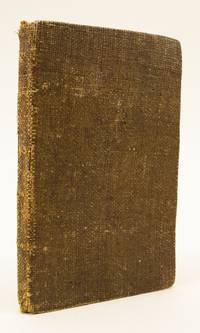
1797ST15599London: Printed for T. Longman B. Law F. & C. Rivington R. Baldwin G. & T. Wilkie and J. Walker 1797. 21st Edition. 150 x 93 mm. 5 7/8 x 3 5/8". viii 123 1 ads pp. <br/> Contemporary brown burlap flat spine. With allegorical vignette on title page and 25 half-page woodcuts illustrating items from the vocabulary lists. Pastedowns with traces of book label removal. ◆Spine slightly cocked short split to cloth on rear joint a little fraying at ends of spine but the insubstantial binding surprisingly solid. Two small stains to each pastedown where labels removed title page lightly browned leaves a shade less than bright due to paper quality other minor imperfections but an excellent copy internally clean and fresh with comfortable margins. All in all remarkably well preserved.<br/> <br/> First issued around 1711 this is the best-selling work of James Greenwood 1683-1737 an influential grammarian and a proponent of women's education. Arranged into 33 chapters the book divides vocabulary lists by topic beginning with "things" and proceeding through minerals plants animals humans and diseases to everyday items affairs of church and state the law the military and finally to the various parts of speech from verbs to conjunctions. Widely used the work was revised and reprinted until at least 1828. At about the time this work was originally issued Greenwood had founded a school in Essex where he accepted girls as well as boys as pupils; he was later recruited to serve as assistant headmaster at St. Paul's School in London. This volume is of particular interest because of its rarely seen utilitarian period binding. We would have expected it to have been worn to shreds long ago but against the odds it has withstood hard use by young pupils remarkably well and it gives us a glimpse of an important element of the English schoolroom at the turn of the 19th century. Printed for T. Longman, B. Law, F. & C. Rivington, R. Baldwin, G. & T. Wilkie, and J. Walker unknown
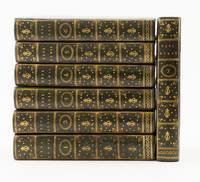
1775ST17825Paris: Joseph-Gérard Barbou rue Mathurins 1775. 163 x 96 mm. 6 3/8 x 3 3/4". Seven volumes. Edited by J. N. Lallemand; preface by Jean Baptiste Louis Crévier. <br/> EXTREMELY ATTRACTIVE CONTEMPORARY GREEN ARMORIAL MOROCCO perhaps by Derome covers with triple gilt rule border central gilt coat of arms of the Blanche family featuring a seated fox with one paw raised above it a row of three five-pointed stars smooth spine divided into compartments containing a gilt lyre surrounded by stars and dots floral sprigs at corners volume number within a laurel wreath gilt lettering marbled endpapers all edges gilt. With printer's two-swans device on title pages volume I with frontispiece portrait engraved by L. J. Cathelin after J. C. Philips. With pencilled note on front flyleaf attributing the binding to Derome. Brunet III 1108 "Edition estimée"; Dibdin II 171. For the binding: Olivier Pl. 2279. ◆Spines slightly and uniformly sunned very light shelf wear to bindings occasional faint foxing in volume IV but A SUPERB SET almost entirely absent of any signs of use.<br/> <br/> This is a fine-paper copy in a binding both charming and handsome of what Dibdin deems "a truly beautiful and accurate edition" of Livy's Roman history. Brunet called it an "esteemed edition" and notes that fine paper copies like the present set sold for twice what regular copies cost. First printed by Sweynheym and Pannartz in 1469 the "Histories" of Titius Livius Patavani 59 B.C. - 17 A.D. follow the rise of Rome from the founding of the city through its triumphs in the Punic Wars and up through the reign of the author's contemporary emperor Augustus. His account is notable for its emphasis on the glorious triumphs and accounts of heroism of the Romans stemming in his eyes from their virtue; his history is intended not just to inform but also to elevate the reader. The present edition according to Dibdin builds on the fine editions edited by Crevier and Drakenborch incorporating their useful notes and additions. It was beautifully printed by Joseph-Gérard Barbou 1723-90 scion of a family that had begun printing in Lyon in 1529 moving to Paris in 1540. Joseph apparently specialized in Latin classics producing editions of Cicero Lucretius Pliny Caesar and Martial among others. The fine binding here does not have Derome's ticket but is well executed enough to make the attribution written in at front plausible. There were no fewer than 18 members of the Derome family not to mention workshop associates who made their livings as binders in Paris from the middle of the 17th century until the first quarter of the 19th. Our binding is tasteful--perfect for a scholarly edition of a classic--and conceivably the work of one of the Deromes or of an extremely competent associate. Olivier attributes our armorial stamp to the 18th century Blanche family of Burgundy and he finds it on a copy of Barbou's 1771 Sallust in the library of Madame la Comtesse de Cossé. The "country house" condition of the present set suggests an aristocratic owner more concerned with owning fine books than with reading them. [Joseph-Gérard] Barbou, rue Mathurins unknown
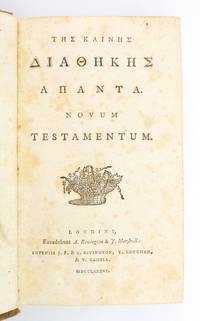
1786ST20133London: Excudebant A. Rivington & J. Marshall: Impensis J. F. & C. Rivington T. Longman & T. Cadell 1786. 175 x 105 mm. 7 x 4 1/4". 368 pp. 1 leaf ads. <br/> Contemporary brown "school cloth" rough linen raised bands. Front flyleaf with owner inscription of John Cutler dated Sept 21 1789 four lines of Latin doggerel threatening anyone who steals the book with hanging and two large copperplate trials of Cutler's signature. ESTC N63834. Not in Darlow & Moule. A little fraying at top and bottom of joints light foxing and toning throughout due to paper quality a couple of small ink stains but a surprisingly appealing copy the text extremely clean and the unsophisticated makeshift binding--remarkably--with no significant wear.<br/> <br/> This is an almost startling survival: an 18th century New Testament in Greek in its original utilitarian binding preserved in condition far better than what could be anticipated given the audience of generally uncareful pupils for which it was intended. Considering the usual depredations of school children the rough school cloth should have been worn to shreds long ago but against the odds it has fortuitously escaped hard use and now gives us a glimpse of an important element of the English schoolroom very close to its original condition. One particularly delightful aspect of our copy is the flamboyant declaration of ownership by a pupil called John Cutter who inked his name no fewer than four times in different styles and with calligraphic flourishes across the flyleaf. Cutter's neatly penned book curse threating any would-be thieves with hanging may have helped to preserve the book as it now exists. In fact there are few signs of use by any owner rightful or unlawful. The leaves are free from any markings and the insubstantial binding appears to have rarely left the shelf. Excudebant A. Rivington & J. Marshall: Impensis J. F. & C. Rivington, T. Longman, & T. Cadell unknown
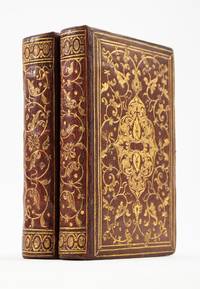
1568ST20921Lutetia Paris: Robert Estienne II 1568. 128 x 87 mm. 5 x 3 1/2". Two volumes. <br/> LOVELY CONTEMPORARY RED MOROCCO GILT covers with large central azured arabesque surrounded by curling vines with azured leaves smooth spines with similar vines head and foot of spines with egg-and-dart roll similar to one used by Claude de Picques second volume with faint blind lettering to spine all edges gilt perhaps with some minor early restorations but if so then done with such care as to preclude certainty. Housed in modern suede-lined calf-backed clamshell boxes with magnetic closures. Printer's device on titles and final page decorative initials and headpieces. Front pastedown of volume I with ex-libris of Georgios Arvanitidis. Renouard 171:1; Schreiber 239; Darlow & Moule 4633; Adams B-1670. See: Verron "Les Reliures de l'Entrée de Charles IX à Paris 1572 . . . réalisées par Claude Picques" in Bulletin du Bibliophile 2014 no. 2 pp. 282-98. Just a touch of rubbing to extremities front hinge of second volume open but everything quite tight text with occasional mild browning small spots trivial smudges or tiny worm trails but A BEAUTIFUL COPY clean and fresh internally and the bindings tight and lustrous with very bright gilt<br/> <br/> With exceptional visual appeal these two precious volumes shining with gilt and containing the Greek New Testament from the renowned Estienne family of printers are of special interest because of their typography their bindings and their provenance. With the expressed goal of printing Greek texts from manuscripts in the royal library at Fontainebleau François I established the post of royal printer in Greek in 1539 appointed Robert Estienne I 1503-59 to the position in 1542 and commissioned the renowned Claude Garamond to cut a new Greek font for this project. To design the type the King called on his own celebrated calligrapher Angelo Vergecio who produced in collaboration with Garamond three different sizes of what came to be called the Royal Types or "grecs du roi." According to Schreiber "These cursive Greek types are universally acknowledged as the finest ever cut." In 1548 and 1549 Robert Estienne issued the press' first Greek Testament known as the "O mirificam" edition for the opening of the dedication to the king in 16mo or "pocket" format using the smaller font of Garamond's "grecs du roi." In 1550 Robert a Protestant moved to Geneva while his son Robert II 1533-70 a Catholic remained in Paris and took over as the royal printer in Greek. Our 1568 Testament--the only one issued by the son--is a reprinting of the "O mirificam" edition but expanded with the critical apparatus from the 1550 folio edition issued by the father. Schreiber notes that our edition is interesting from a typographical point of view as it contains an even more minute version of the already small grecs du roi type for the Table of Chapters. The exceptionally pretty volumes are done in the style of royal binder Claude Picques fl. 1539-78 and employ a decorative roll very similar to one that appears on the spine of the vellum bindings Picques did for "L'Entrée de Charles IX à Paris" 1572. Our volumes once graced the library of Constantinople collector Georgios Arvanitidis 1876-1953 whose library included a number of Estienne Greek editions. They were later in the distinguished library of Frederick B. Adams 1910-2001 director of the Pierpont Morgan Library from 1948-69 and then president of the prestigious Association Internationale de Bibliophilie from 1974-83. And they were featured in the celebrated 1929 Gumuchian catalogue of 398 historically exceptional bindings as item #71. Robert Estienne II unknown
1581ST20964Geneva: Excudebat Henrius Stephanus 1581. Second Estienne Edition. 320 x 212 mm. 12 1/2 x 8 1/2". 6 p.l. 584 76 pp.Edited and with annotations by Henri Estienne. <br/> FINE 17TH CENTURY SPRINKLED CALF PRIZE BINDING covers gilt with French fillet border oblique fleur-de-lys at corners SUPRA LIBROS OF CARDINAL MAZARIN AT CENTER raised bands spine compartments with fleurs-de lys at center and corners edges gilt over marbling old repair to head of spine. Printer's device Schreiber 18 on title. WITH 1692 COLLÈGE MAZARIN PRIZE PRESENTATION to Laurence Thibault for Greek oratory signed by the head of College P. J. Le Chapelier with seal of the college attached tipped onto title page. Main text in Greek dedication to James VI of Scotland and Estienne's annotations in Latin. Renouard 149.6; Hoffmann III 577; Dibdin II 567; USTC 450908. Lower corner of back board somewhat bumped leather slightly marked other very modest exterior wear but the stately binding in nearly fine condition. First five quires with two tiny wormholes to tail margin final signature with a little creasing other insignifcant imperfections but AN ESPECIALLY FRESH CLEAN AND BRIGHT COPY INTERNALLY the leaves crackling when you turn them.<br/> <br/> This copy of what Renouard calls the "far superior" Estienne Xenophon is offered in a very attractive binding that was used as a prize for a student at the Collège Mazarin near the close of the 17th century. Best known to his contemporaries as an historian and general as well as an opponent of Athenian democracy Xenophon ca. 430-354 B.C. was a student of Socrates and aside from Plato's his works contain the only surviving examples of Socratic dialogues. Although born in Athens Xenophon greatly admired Sparta and its political structure and he eventually went to war for Sparta against the Athenians this earned him land in Sparta but unsurprising exile from Athens. Xenophon's philosophical writings found popularity in the Renaissance and some scholars have suggested that Machiavelli was particularly influenced by Xenophon's more "practical" i.e. ruthless approach to politics. The present 1581 printing is among the most highly regarded Renaissance editions of Xenophon's works. The printer and scholar Henri Estienne II 1528-98 was a brilliant classicist best known for producing "Thesaurus Graecae Linguae" 1572 a standard reference for 300 years. He produced his first Xenophon in 1561 but fully revised the text for the present edition. Dibdin tells us that "the edition of 1581 has more intrinsic value than the preceding one" and Renouard notes that it is "not as pretty as the 1561 edition but far superior." Our copy fittingly was presented as a prize for Greek oratory to a student at the Collège Mazarin founded by a bequest from the former first minister of France Jules Cardinal Mazarin 1602-61. Mazarin was not just a prince of the Church and an advisor to the Sun King but one of the greatest bibliophiles of his day with a library of 40000 volumes that became the foundation of the Bibliothèque Mazarine. Our book is bound in a style appropriate to that famed collection with Mazarin's personal supralibros at the center of each board. The partly printed award certificate bound in at the front indicates that Laurence Thibault had won second prize for Greek oration in the college's "solemn games" honoring the royal recognition of the college. It is signed by the head of the college Pierre-Jean Le Chapelier de Mauron who held a doctorate from the Sorbonne and simultaneously served as abbot of the Abbey of Ste Marie-de-Boquen in Brittany. Excudebat Henrius Stephanus unknown
11645London: George Newnes Limited N.d. but ca. 1910. Reprint. Small quarto green cloth stamped in deep green and gilt with Hodder & Stoughton imprint at base of spine pp. 31; illustrations include a sepia tone gravure frontispiece followed by a section of black and white plates tipped onto heavy sage green stock rectos only numbered I-LVII. With a 21 page essay by Malcolm Bell re-set but the same text as in the 1907 edition. Covers are unevenly faded slight wear to head of spine and corner tips else very good plus. No dust jacket. Fredeman 42.72. London: George Newnes Limited, [N.d., but ca. 1910]. Reprint. hardcover
12587London: George Bell & Sons 1910. "Cheap Re-issue". Hardcover. Very Good. Octavo half bound in brown cloth and smooth calf attractively designed art nouveau spine top page edge gilt pp. xii 151; numerous illustrations. Despite the publisher's designation of this as a "cheap re-issue" this is a nicely produced book and is well printed on good paper. Many pages un-opened some darkening to edges of the free endpapers light scuffs to calf else a lovely book in a very attractive period binding. <br/> <br/> London: George Bell & Sons, 1910. "Cheap Re-issue". hardcover
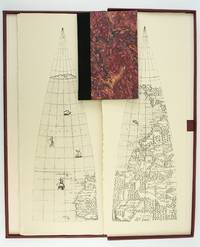
1987ST20505-11Madison Wisconsin: The Juniper Press 1987. No. 116 OF 150 COPIES. 632 x 250 mm. 25 x 9 3/4". 2p.l. 19 1 pp. <br/> Black quarter buckram over maroon marbled paper boards spine lettered in gilt. In a custom maroon buckram clamshell box. WITH 24 FACSIMILE GLOBE GORES. Signed by Woodward on the limitation page. Just a hint of use to the box booklet corners just a touch rubbed otherwise as new.<br/> <br/> This sizable attractive publication reproduces one of the largest complete sets of 16th century globe gores. Dating from around 1574 the original gores which when assembled would make a globe measuring just under 70 centimeters in diameter have been attributed to brothers Livio and Giulio Sanuto Venetian cartographers and engravers. Little is known about the gores' origin; the accompanying essay suggests they may have never made it to the final stages of publication and production possibly stopped by an outbreak of plague. This facsimile was created from the only extant set in the collection of Arthur Holzheimer 1932-2025 and was produced by his research foundation along with the Newberry Library. The gores are accompanied by a booklet by noted cartography scholar David Woodward 1942-2004 which provides background and the evidence supporting the attribution of the gores to the Sanuto brothers. The Juniper Press unknown
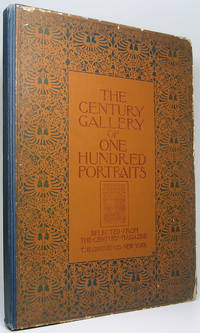
189749506New York: The Century Co 1897. Folio. Blue cloth and decorative paper over boards portfolio housing full set of 10" X 13½" glossy prints. Near fine/very good. Images are largely superb and without edgewear while the four-flap portfolio shows mild edgewear. Incredibly uncommon complete set of this large grouping of reproductions of steel-engraved portraits of a wide array of mostly 19th century world notables -- mainly head-and-shoulders some half-length most with facsimile signature underneath many based on photographs and many engraved by noted English-American artist Timothy Cole. Subjects include random assortment Thomas Bailey Aldrich Bismarck Eleanore Duse U.S. Grant Nathaniel Hawthorne Thomas Jefferson Leo XIII Mozart Florence Nightingale Louis Pasteur P.H. Sheridan Leo Tolstoy John Greenleaf Whittier. see "Alphabetical Index of Plates" image for complete list. A complete set of these is exceptionally scarce -- especially in such bright exceptional condition and with the rarely-present portfolio in nice condition -- and would be nearly impossible to assemble. The Century Co unknown
a88117New York 1885 Century Co. This volume includes: Many articles on "Battles and Leaders of the Civil War" including articles on The Battle of Gaines's Mill General Grant's Last Days Incidents of the Battle of Manassas; lengthy article on "The New Orleans Exposition" by Eugene Smalley with numerous illustrations; "North Borneo" by Joseph and Frank Hatton; and much more. Covers not included. Hardcover. Sm.4to. 976p. double column text illustrations embossed brown cloth with gilt-speckled end papers.Top edge gilt. Good light wear spine ends worn. Binding secure no ownership marks. . hardcover
1781ST13831Venice: Giovanni Gatti 1781. 214 x 147 mm. 8 1/2 x 5 3/4". Four volumes. <br/> Attractive contemporary limp paper boards patterned with yellow red and black inks paper manuscript labels on spines deckle edges. With four folding engraved plates at the end of volume IV. Pastedown of volume I with a small square of paper with some inscrutable pencil notations glued down. Bolton p. 646; Cole 893; Partington III pp. 80-90. ◆Edges just a touch bumped a few pages with some very light foxing one page with a small hole affecting a word or two of text plates a little browned along the fold and one plate partially torn along the fold but still A SUPERB COPY exceptionally fresh and clean inside and out.<br/> <br/> Offered here in very pleasing contemporary paper boards this is the first combined edition in Italian of two of Macquer's most popular works: "Élémens de chymie-théorique" 1749 and "Élémens de chymie-pratique" 1751. Coherently written in a straightforward manner primarily with the classroom in mind Macquer himself was a highly respected teacher these works became instantly successful as university-level textbooks. Partington tells us that they replaced Lemery's rather outdated "Cours de Chymie" as the favored text for teaching and they were eventually translated into English German Russian and Italian. Macquer 1718-84 made a few modest chemical discoveries but his chief contributions to the science were his applications of chemistry in particular to the porcelain industry and most importantly his writing. In addition to the present work he also penned "the first dictionary of chemistry in the modern sense" according to Partington. Given that Macquer's works were often destined for the hands of students our copy is a fortunate survival indeed not to mention enormously charming with its original deckle edges clean contents and vibrant pattern. This edition also appears to be quite rare. OCLC locates only 10 copies worldwide with just one in the US Huntington and one in the UK Wellcome. Giovanni Gatti unknown
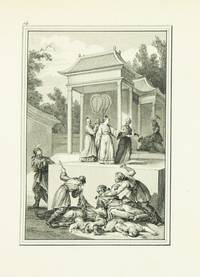
1788ST20889Paris: Chez l'Auteur 1788 1788. FIRST EDITION. 565 x 400 mm. 22 1/4 x 15 3/4". 50 leaves. Two separately published works bound in one. <br/> Modern retrospective calf-backed tan paste paper boards smooth spine profusely gilt with a repeating pattern of grape vines red morocco label lettered in gilt vellum tips. ENGRAVED THROUGHOUT WITH A TOTAL OF 48 FULL-PAGE ILLUSTRATED PLATES each accompanied by either one or two plates of engraved text. SHEETS UNCUT AND UNFOLDED the first work printed only on the recto; the second with three sheets printed on both sides. Reed and Dematté China on Paper 20 21; Cohen-de Ricci 479. Edges and lower corners slightly worn but the binding with only just minor signs of use; free endpaper in front and back with vertical crease one sheet with an early marginal repair isolated inconsequential faint spotting but still AN EXTREMELY FINE COPY the wide-margined sheets exceptionally fresh and bright and with strong impressions of the engravings.<br/> <br/> This pair of lavishly illustrated fully engraved works produced by a talented French engraver after earlier Chinese artworks are here presented in an enormous volume made up of uncut and unfolded sheets. According to Benzit Parisian engraver and print seller Isidore Stanislas Henri Helman 1743 - ca. 1809 "stands out among the engravers of the end of the 18th century" and his skill is evident in the two works bound together here. The first is a pictorial history of the Chinese emperors from the earliest mythical rulers to the Northern Song dynasty 960-1126. It is based on the Dijian Tushuo composed in 1573 to educate the Ming-dynasty Wanli Emperor 1563-1620 who had ascended to the throne at the age of nine. In accordance with its didactic aims it presents the very best and worst of imperial behavior and the original handwritten album was published as a block-printed book to great popularity. Two centuries later the Qing-dynasty Qianlong Emperor 1711-99 commissioned a Western-style edition of the famous work which was executed by two French artists the Jesuit painter Jean-Denis Attiret and the engraver Charles-Nicolas Cochin II. The enterprising Helman was able to see the Attiret-Cochin book in the collection of French statesman Henri Léonard Jean Baptiste Bertin 1720-92 and having had great success with a previous reproduction of a Chinese work Conquêtes de l'Empereur de la Chine ca. 1783 he created the present reproduction. The second work the life of Confucius was also reproduced from plates in Bertin's collection. The source material in this case was the biography of Confucius assembled by the Jesuit Joseph-Marie Amiot 1718-93 as part of his informational series on China meant to educate missionaries. Amiot was a correspondent of Bertin and had sent him the biography and accompanying album of drawings which were based on the Shenji tu Illustrated Traces of the Sage a popular Confucian work throughout the Ming and Qing dynasties. Helman selected 24 scenes from each creating books that balance serene scenes of mountainous landscapes and temples with dramatic fight scenes and dragons. The quality of the engravings is excellent with delicate linework creating faint wisps of smoke and subtle shadows. These two works apparently both published in 1788 were released in several formats. The format here with the engravings laid out on the recto of large uncut sheets appears at auction very infrequently: we have been able to trace only two copies of both works in this format since 2004 and neither in such fine condition as the present example. Chez l'Auteur unknown
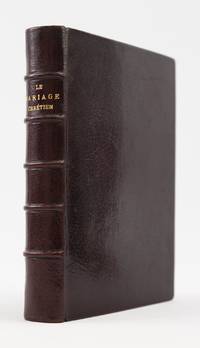
1882ST19567-178Paris: Jules Gervais 1882. Sixth Edition. 160 x 115 mm. 6 1/4 x 4 1/2". 400 pp. <br/> Pleasing deep brown morocco by Fonteney stamp-signed on the verso of the front flyleaf raised bands spine lettered in gilt wide turn-ins gilt tooled patterned endleaves all edges gilt. Engraved frontispiece depicting St. Elizabeth by Friedrich Ludy after Friedrich Overbeck; each page with a decorative figural border. Minor foxing to preliminary leaves very slightly foxed elsewhere otherwise a fine copy the text quite clean bright and fresh and the binding unworn and exceptionally lustrous.<br/> <br/> Decoratively printed and attractively bound this volume on Christian marriage and family life is a delightful example of late 19th century French book production. Its author Félix-Antoine-Philibert Dupanloup 1802-78 was the bishop of Orléans and a proponent of liberal Catholicism in France throughout the 19th century. Alongside teaching and pastoral duties he authored several works on religious matters throughout his career. Initially published in 1869 the present work on "Christian Marriage" went on to become a very popular work remaining in print into the second decade of the 20th century. One wonders if its popularity was as much due to the beauty of the work as its contents: each page is graced with detailed engraved borders laden with scrolling foliage and rich Christian imagery executed with delicacy and panache. This copy is pleasing in its highly polished morocco exterior its lacy inner dentelles and its attractive patterned endleaves. Jules Gervais unknown
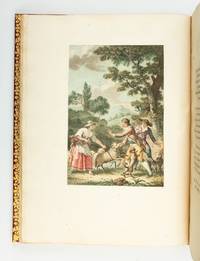
1793ST20474Paris: Defer de Maisonneuve 1793. First Edition with these Illustrations. 350 x 262 mm. 13 3/4 x 10 1/4". 125 pp. <br/> VERY PRETTY 19TH CENTURY CRIMSON MOROCCO ELEGANTLY GILT covers framed with floral tools raised bands spine panels filled with rows of flower-and-lozenge roll gilt lettering gilt turn-ins top edges gilt. FOUR FINE STIPPLE-ENGRAVED PLATES by Colibert and Cazenave after Monsiau PRINTED IN COLORS. A Large Paper Copy. Cohen-de Ricci 400; Furstenberg 122; Lewine p. 188; Maggs 1930 Catalogue of French Illustrated Books 84; Ray p. 145. Occasional minor foxing the margins of one plate foxed a bit more otherwise a fine copy clean and fresh internally with immense margins the plates with pleasing colors and the unworn binding bright with gilt.<br/> <br/> This is an especially tall copy of Florian's pastoral romance in imitation of Cervantes one of the grander French books to be printed in colors when the vogue for such productions took hold during the last years of the 18th century. Ours is one of six such books all printed after 1786 that Ray singles out for praise as "handsome and imposing volumes." A noted painter of both classical and modern subjects Monsiau 1754-1837 was also an illustrator whose "abundant and interesting work in this line" is underrated even though it has the merits of being simple natural lively and piquant. Ray Monsiau's obscurity says Ray may be owing to the fact that he most often worked as a secondary collaborator on major illustrated works; the present book is one of the few he did on his own and it is among his best. Publisher Defer de Maisonneuve did not originate the technique of stipple engraving on copper plates but he did perfect the process which allowed for gradual tonal changes in hues and intensities of color rather than the "stained glass" effect of separately printed patches of color. Given the turmoil of the period when this book was published it is quite likely that it did not have an especially decorative original binding and may have remained in publisher's boards as was often the case. Happily a later owner supplied a period-appropriate binding here that matches the opulence of the contents. While our copy has the engraver's name just visible beneath the plates perhaps disqualifying them as the "avant la lettre" versions used in the Large Paper Copies per Cohen-de Ricci the size of the margins here and the quality of the paper certainly argue for that designation. Defer de Maisonneuve unknown
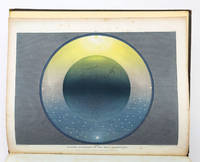
1846ST19286London: Printed by Catchpool & Trent for Simpkin Marshall & Co 1846. FIRST EDITION. 320 x 255 mm. 12 1/2 x 10". xiii 3 96 pp. <br/> Publisher's original blind-decorated dun-colored cloth gilt titling to upper cover smooth spine newer endpapers. WITH 11 COLOR ENGRAVINGS after Frost by W. P. Chubb & Son printed in oil colors by George Baxter all with original tissue guards. Front free endpaper with small ink signature of John Hill. See: Francis Reid "Isaac Frost's 'Two Systems of Astronomy' 1846: Plebeian Resistance and Scriptural Astronomy" in "The British Journal for the History of Science" Vol. 38 No. 2 Jun. 2005 pp. 161-177. Cloth rather spotted corners bumped but the binding solid with no wear to joints or hinges. A few spots of foxing to title page half of the tissue guards with overall very faint foxing/browning the illustrations with minor foxing at edges and in margins but the images themselves clean and bright and all in all a really excellent copy the text wide-margined and quite clean and fresh and the plates with rich coloring.<br/> <br/> Illustrated with beautiful color plates this anti-Newtonian work promotes a view of the universe based on the backward-looking beliefs professed by a Protestant sect known as the Muggletonians. Named after co-founder Lodowicke Muggleton the Muggletonians emerged in London in 1651 based on the claims of two tailors who professed to be the "Last Witnesses" described in the Book of Revelation. Rejecting the new directions in philosophical reason Muggletonians believed in a purely scriptural interpretation of the universe. According to E. P. Thompson's 1994 "Witness Against the Beast" the Muggletonians had curious notions quite contrary to other Protestant denominations: they believed that the soul is mortal that Jesus and God are one and the same that Heaven was left without divine supervision from Jesus' death until the day of judgment that Heaven resides six miles above the Earth that God stands between five and six feet tall and other unconventional things. Although the sect initially avoided both worship and evangelizing during the 19th century some followers became more outspoken about their beliefs and even published books appealing to the general public. Our author Isaac Frost 1793-1858 was a prominent Muggletonian and successful owner of a brass foundry who along with his brother Joseph invested large sums to promote their belief system--the present work being an especially notable example. Divided into two main sections the text first describes the Newtonian system of heliocentric astronomy and then turns to Frost's scriptural interpretation and geocentric views. As Reid tells us "According to Frost Scripture clearly states that the Sun the Moon and the Stars are embedded in a firmament made of congealed water and revolve around the Earth that Heaven has a physical reality above and beyond the stars and that the planets and the Moon do not reflect the Sun's rays but are themselves independent sources of light. Our book was apparently written as a reaction against the lecturers who expressed Newtonian astronomy--which was often for them and their audiences simply shorthand for heliocentrism." The 11 plates that illustrate these extraordinary ideas are the work of George Baxter a pioneering printer who revolutionized color printing techniques by combining metal engravings with woodblock printing using oil-based inks to produce high-quality affordable prints. The plates here are appropriately ethereal and otherworldly utilizing a beautiful palette with subtle gradations and esoteric figures to create memorable pseudo-scientific imagery. Although this work appears at auction with some regularity it is almost always incomplete no doubt because the attractiveness of its plates encourages harvesting. Useful price comparisons include a complete copy said to be in fine condition selling for £7500 in 2016 and six loose prints from the book fetching £6875 in 2015. [Printed by Catchpool & Trent for] Simpkin, Marshall, & Co unknown
07477Chicago: The Bookfellows 1920. First edition one of four hundred copies printed. Hardcover. Very Good. 8vo. cloth-backed paper-covered boards with spine and cover labels pp. 72; illustrated with a reproduction of one page of manuscript. Printed by The Torch Press of Cedar Rapids Iowa. Pastedown endpaper has a Bookfellows' bookplate and a related inscription slight wear to extremities else a very good copy. <br/> <br/> Chicago: The Bookfellows, 1920. First edition, one of four hundred copies printed. hardcover
a103530Five original treaties - all published in seventeenth century. Each bound fairly recently in hardcover small octavo matching bindings of mottled papercovered boards with leather spines raised bands and gilt spine lettering. Professional binding. Binding and new covers are Fine; treaties are VG occasional light spotting . Guaranteed original printings. Each treaty has an engraved vignette - the royal crowed standing lion - approx 3 x3 inches in middle of each titlepage. Treaty titles: 1 Traicte de la Paix a La Haye 1648 30p. In French and in Dutch 2 Tractaet von Vrede Beflooten den vertighften 1648 s'Graven-Hage in Dutch 25p. 3 Articuli Pacis Unionis & Confoederationis 1654 Hage-Comitis in Latin and French 22p. 4 Over-gheset uyt de Latijnsche Tale Articulen van Vrede 1654 s'Grave-Hage. 16p. In Dutch 5 Articles de Paix d'Union & de Conderations 1654 a La Haye. 20p. in French. Peace of Westminister ending the Anglo-Dutch War of 1652-1655 between Oliver Cromwell and United Netherlands was signed April 5 1654. No owner marks. Overall Near Fine. Collection of 5 treaties. Pictures available on request. . hardcover
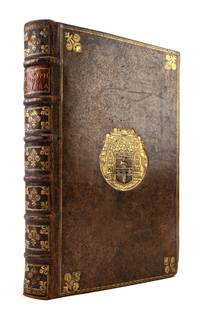
1714ST20995Naples: Bernardo-Michele Raillard 1714. 343 x 223 mm. 13 1/2 x 8 3/4". 6 p.l. CCLXIX 15 pp. <br/> IMPOSING CONTEMPORARY BROWN MOROCCO EXUBERANTLY GILT covers with painted and gilt frames of floral rolls central panel with elaborate volute cornerpieces large central lozenge formed by myriad leafy gilt vines enclosing a coat of arms containing a three-turreted castle topped by a crown held up by two putti raised bands spine compartments framed by floral roll painted and gilt daisy centerpiece tulip cornerpieces all edges gilt. The Academy's engraved device on title page and 75 ENGRAVED PLATES of scientific instruments and experiments. DSB 9:3; Dibner Herald of Science 82 first edition. Joints with modern wear one short crack at top of rear joint head of spine a bit wormed corners and extremities somewhat rubbed gilt a bit rubbed in spots difficult to tell if some of the decoration is dark because painted or is now missing gilt a couple of leaves slightly browned in the text bed occasional minor foxing more pronounced on a couple of quires other trivial imperfections but an excellent copy--quite clean and fresh internally--in a solid binding still bright with gilt.<br/> <br/> Given its binding and provenance this is a uniquely desirable copy of a significant scientific work: our stately Neapolitan edition of the "Essays on Natural Experiments" is offered here in very animated morocco bearing the arms of the man who paid for its printing and to whom the book is dedicated. That remarkable patron Caesare Michelangelo d'Avalos Marquis of Pescara and Vasto prince of Isernia and Francavilla 1667-1729 was a true Renaissance man who took Machiavelli's "The Prince" as inspiration. He was both a wily political conspirator and a generous patron of the arts and sciences. His palace at Vasto was renowned for the beauty of its furnishings for its splendid art gallery and for its impressive library overseen by the humanist scholar Alessandro Berti. The present volume was a worthy addition to that library with its glowing dedication and its regal binding extravagantly gilt but so tastefully composed that it never crosses the line into ostentatious. <br /> First printed in 1666 "Essays" was produced by the Accademia del Cimento the most significant expression of post-Galilean scientific progress in Italy. Founded in 1657 as the first organization formed for the sole purpose of making scientific experiments the Accademia occupies a singular position in the history of the development of science. Prince Leopold of Tuscany the last exceptional member of the Medici family and his brother Ferdinand who followed the Medici family tradition of patronizing the arts and sciences provided the support free-thinking direction and financial patronage for the Academy. A well-equipped laboratory and an apparently inexhaustible supply of apparatus and materials helped to make the work of the 10 scientists associated with the Academy more sustained and broader in scope than anything that had come before it. W. E. K. Middleton "The Experimenters" According to Thorndike among many other subjects the experiments described here "were concerned with air pressure and freezing; or they aimed to prove that water was incapable of compression and that there was no such thing as lightness or positive levity. Some experiments were magnetic and others electric the latter being chiefly performed with amber. Other subjects investigated were the change of colors in fluids the motion of sound and projectiles." Although no author is given by name the title page of the 1666 first edition indicated that this account was written by the secretary to the academy Lorenzo Magalotti 1637-1712. A pupil of Viviani and a friend of Boyle Magalotti was celebrated for his highly finished colorful almost dramatic descriptions of experiments. DSB notes "He has the distinction . . . of having written the best scientific prose in Italian after that of Galileo.". Bernardo-Michele Raillard unknown
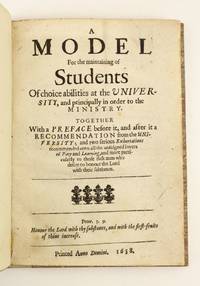
1658ST16442s.l.: s.n. Printed Anno Domini 1658. FIRST EDITION. 190 x 135 mm. 7 1/2 x 5 3/8". 3 p.l. 14 pp. complete. <br/> 20th century vellum-backed marbled boards flat spine with vertical titling. Front pastedown with bookplate of the Fox Pointe Collection. Wing P-2842B; ESTC R207754. ◆Text lightly washed and pressed but still crisp faint foxing to lower edge of title page otherwise a fine fresh copy in an unworn binding.<br/> <br/> Written by an opinionated English cleric this is an extraordinarily rare pamphlet proposing an unusual fund to support young 17th century scholars. According to DNB the scheme outlined in the present work was meant "to support the university studies of young men of promise seeking entry into the ministry." The plan "was approved by John Worthington and Anthony Tuckney and had the support also of John Arrowsmith DD Ralph Cudworth William Dillingham DD and Benjamin Whichcote. The fund raised about £900 and it appears that William Sherlock afterwards dean of St Paul's received assistance from this fund during his studies at Peterhouse Cambridge until 1660 when he graduated BA. Those entrusted with administering the fund sent Poole regular reports on students interviewed and the ratings they had received in philosophy logic and languages. The scheme was abandoned at the Restoration." Poole 1624 - 79 was the author of a number of controversialist pamphlets on subjects ranging from Unitarianism to preaching by lay persons before undertaking his major work: a synthesis of critical biblical commentaries "Synopsis criticorum aliorumque sacrae scripturae interpretum." This is one of his scarcest writings: ESTC lists seven copies two in North America while ABPC and RBH record just two copies at auction. s.n. Printed Anno Domini unknown
a32442NY 1981-1995. AMS. All Hardcover; all first editions. 11 volumes of this series Nos.4 1978 through 14 1988. 8vo. and Lg.8vo. about 500-700pp. per volume annotated. Different color bindings: blue black and red . No owner marks. Almost all are Near Fine a few are VG a few are Fine. no dj. Set of 11 volumes: . hardcover
a32443NY 1984-1992. AMS. All first edition all hardcover. Different color cloth . 6 volumes of this series. Nos. 6 1980 7 1981 8 1982 10 1984 11 1985 and 12 1986. 8vo. and Lg.8vo. about 500-700pp. per volume annotated. Blue black and red bindings. Most Near Fine a few Fine a few VG. no djs. no owner marks. Group of 6 volumes: . hardcover
1651ST19567-214Paris: Chez F. Mazot 1651. 172 x 110 mm. 6 3/4 x 4 1/4". 3 34 leaves 35-39 1 pp. 12 leaves. <br/> Fine old contemporary red morocco covers panelled with gilt fillets with flowering urn cornerpieces raised bands the spine densely gilt in compartments with scrolls and dots two clasps marbled endpapers all edges gilt. ENGRAVED THROUGHOUT WITH 38 FULL-PAGE ILLUSTRATIONS consisting of one portrait two allegorical religious scenes including title and 35 illustrations of the Holy Eucharist plus 44 PAGES OF ENGRAVED TEXT 37 of these with text flanked by full-length figures of saints accompanied by other religious symbols at head and foot of page six framed with vignettes of angels the Madonna or scenes from the life of David one page with text only. Contemporary ink inscription to the lower margin of the title page reading "In Archui. vitr." Endleaf with engraved armorial bookplate of Viscount Strathallan; front pastedown with the bookplate of John Evelyn. Duportal pp. 244-45; Brunet V 624; Graesse VI 4. Trivial rubbing to the extremities leather straps slightly worn but holding strong but A SUPERB COPY exceptionally clean fresh and bright internally and in its solid and unsophisticated and still very pleasing binding.<br/> <br/> This is a particularly attractive copy of a sumptuously illustrated prayer book in its especially appealing original 17th century binding. According to Duportal it is "One of three important publications whose engravings reveal the trend characteristic of religious illustrations in France between 1601 and 1660." The work opens with a dedication to Charles d'Aubespine Marquis de Châteauneuf 1580-1653 with a full-page portrait by Guillame de Gheyn b. 1610. Then the bulk of the book is made up of two groups of plates. Those in the first group appear primarily on the rectos and contain prayers in Latin and French flanked by pairs of saints; gaps in the prayers are filled by naturalistic flowers insects and birds. Many of these plates also include a scene or two in miniature depicting the life of the saints or a vignette of angels. Just two of these engravings are signed "J. Collin" but they all appear to be in the same hand and demonstrate an impressive level of finesse and delicacy with emotive graceful saints depicted with sure light lines. Duportal notes that our artist had a "talent charmant" and that well-executed dry-points of this type are quite rare in French books of the period. The second group of engravings appear on the versos and depict the performance of a part of the Mass beneath a cloud in which appears a relevant scene from the life of Christ. They are all unsigned and clearly by a different hand with more rustic features--possibly "copies of originals published abroad" according to Duportal. The book concludes with text framed by gamboling putti and scenes from the life of Christ and facing full-page bust portraits followed by the Penitential Psalms each with elaborate illustrated frames depicting scenes from the life of David. Copies of this work can be found with varying numbers of leaves and engravings but the present item seems to be an early edition as it contains the earlier state of the engravings on the versos before they were substantially reworked and it does not contain the "Privilege du Roy" with the date 1652 or 1653. Our copy comes from the books assembled by the famous diarist John Evelyn 1620-1706 a library that Quaritch's dictionary of English book collectors calls "a noble collection." De Ricci says that the finest books from the library bear Evelyn's monogram as ours does and this bookplate brings with it the expectation of remarkably fine contemporary condition. This copy also has the bookplate of Viscount Strathallan possibly William Drummond 1810-86 Conservative MP and the second to hold the family title following the reversal of the attainder put in place after his family's participation in the Jacobite uprising. Chez F. Mazot unknown