93 447 résultats
Berlin, 1913. Royal 8vo. Uncut and partly unopened in original printed wrappers. A bit of spotting to original printed spine, but overall in magnificent condition. Completely original and as fresh as can be wished for. (8), 446, (2).
Torino, Unione Tipografico-Editrice, 1886. Royal8vo. Bound in a contemporary half vellum binding with red and green title label to spine with gilt lettering and ornamentation to spine, forming six compartments. In ""Biblioteca dell'Economista"", Third Series, volume 9. wear to extremities and light brownspotting throughout, especially to first and least leaves. e copy. Il Capitale: 685 pp. [Entire volume: (4), 903, (1) pp.].
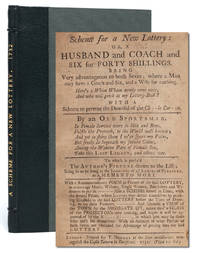
17326120London: Printed for T. Dormer 1732. First edition. Modern quarter morocco over cloth with gilt to spine. Measuring 180 x 111mm and collating complete including frontis folding game board and concluding woodcut: 2 62 2. From the collection of stage magician Ricky Jay with his bookplate to upper pastedown. Top margin trimmed close with consistent loss to running headers and occasional loss to page numbers with no other text effected. Pages somewhat toned with minor marginal chips but otherwise unmarked. A scarce satire playing both on the rising popularity of get-rich-quick schemes and on the economics of the marriage market the present is the only example to appear in the auction record. OCLC locates only twelve institutional copies. The present is the only example currently in trade.<br /> <br /> A Scheme for a New Lottery warns readers against the dangers posed by get-rich-quick schemes targeting large-scale scams like the recently burst South Sea Bubble sometimes called the world's first Ponzi scheme and the pawn-broking swindle of the so-called Charitable Corporation. These scams were appealing to ordinary people at a time when few were "successful in using wealth from trade to found a landed family" Rapp. Mocking both the conmen and the conned A Scheme satirically proposes "Another Lottery which may prove a general benefit to all concern'd; as there is no better Remedy for a Bite from a Mad Dog than the Liver of the Dog that bit." The proposed lottery filled with abstruse rules and convoluted promises ensures that the cycle continues.<br /> <br /> A Scheme also mocks marriage as a scam in which women could either make a wise match in a rich man or lose it all by marrying down. The lottery provides "Fifty Thousand tickets to be deliver'd to Maids or Widows or any that appear to be such" in the hopes of winning a financially stable husband represented by the tickets drawn. Such a match could be a good one: "A Ware-House Keeper with the Salary of a Hundred Pounds" or "the Governour." It could also by virtue of lottery be a loss: "2 Scotchmen both Pedlars 500 Broken Booksellers" and a range of other ruinous bounders are also listed as prizes. For those who desire an advance attempt the folding game bound in the book invites blindfolded women to stick a pin in the board to claim their prize. The present copy was played gently with pin marks revealing a Blacksmith and a Valet de Chambre among those husbands won<br /> <br /> The popularity of A Scheme resulted in a reissue the same year with a canceled title page as The Ladies Lottery and falsely attributed to Swift.<br /> <br /> ESTC N20921. Printed for T. Dormer unknown
200233Paris, chez Mr. Aubry de Saint-Vibert, 1787 11 parties en un volume in-folio, [2] ff. n. ch. (titre gravé, avertissement), x pp. d'introduction, puis pagination multiple, avec 6 cartes hors-texte, dont 5 à double page, vélin vert, dos lisse, pièce de titre cerise, tranches rouges (reliure de l'époque). Charnière supérieure fendue, coins abîmés.
... particulièrement à la fin du règne de Louis XIV, et au moment de la Révolution ; le tout appuyé de notes et tables raisonnées authentiques, sur le commerce et la navigation, la population, le produit territorial et de l'industrie, le prix du Bled, le numéraire, le revenu, la dépense et la dette publiques de la France, à ces deux époques. Avec la valeur de ses importations et exportations progressives depuis 1716 jusqu'en 1788 inclusivement. Tre tomi in due volumi di (4)-XVI-335pp; VIII-304 pp e 4nn (faux-titre et titre) + 16 tabelle ripiegate più volte su carta forte. I primi due tomi riuniti in un volume in 8° in mezza pelle coeva, dorso liscio ornato con iniziale G in coda (mancanza alla cuffia superiore e all’angolo posteriore). il terzo tomo in un volume in 4° in mezza pelle coeva, dorso liscio con la tassello Atlas. Prima edizione, eccezionalmente completa dei tre tomi. Il terzo volume, che è l’Atlas de tableaux in 4°, è infatti rarissimo (l'Ined sostiene che ne esistono tre sole copie conosciute) e manca perfino alle principali biblioteche specializzate, come Kress o Einaudi. Magis (Cat 99) afferma senza mezzi termini che “non si trova mai”. L’importanza dell’opera di Arnould è capitale per lo studio del commercio nel XVIII secolo, per l’analisi dei prezzi delle materie di import-export, per le ricerche sulla parabola inflazionistica. Nessun testo è così ampio e rigorosamente attendibile, raccogliendo tra l’altro il meglio della produzione statistica del secolo. Blanqui ne da un giudizio un po’ ingeneroso (“tenere i dati, buttare le teorie”), perché anche le analisi di Arnould non sono assolutamente trascurabili nel pensiero economico degli anni della Rivoluzione.
24256In Firenze, Appresso Andrea Bonducci, 1751. Titles printed in red and black, large folding table, engraved vignette on title of first volume. Two volumes in one. xxxiii, (1, blank), 191 (misnumbered 189), (1, blank) pp.; xxiii, (1, blank), 316, (2), 116 pp. 4to. Contemporary Italian vellum boards, label with gilt lettering to spine, a very nice copy. Einaudi 3476; Goldsmiths 8635; Higgs 115; Yolton 164 (only four copies); Attig 507; Kress, Italian Economic Literature, i, 275. First Italian edition, rare. A very good copy of this handsomely printed book translating John Locke's Some Considerations of the Consequences of the Lowering of Interest and Raising the Value of Money (1692) and Further Considerations concerning Raising the Value of Money (1695), the only early translation of Locke's papers on money, based on the folio Works of 1740, and is furnished with extensive footnotes by the translators Giovanni Pagnini and Angelo Tavanti. At the end of the second volume is a 116 pages essay by Pagnini on the correct price and value of money entitled Essay on the just price of things, the correct value of money and on the trade of the Romans. Pagnini was destined to become one of the major economic historians in the eighteenth century with the publication of his History of the tithe in 1765-66.The year of publication of this translation, and the translation itself, represent an interesting moment in time: 1751 is also the year Galiani's famous and important Della Moneta was published. Galiani's roots were firmly planted in the southern culture which had been rekindled by the work of Locke and Newton. One of Galiani's first intellectual undertakings had been the translation of Locke's essay on financial problems, which he dropped when he heard that in Florence another version was being produced, edited by Pagnini and Tavanti (the present work) (Carpanetto and Ricuperati, Italy in the Age of Reason 1685-1789, p. 250). - Front paste-down with a few wormtracks, an old bookplate verso of the front blank, a very fine large paper copy, printed on heavy paper.
[8]-330-[6] pages cartonnage d'attente gris de l'époque 1766, 1766, in-4, [8]-330-[6] pages, cartonnage d'attente gris de l'époque, Édition originale rare de cet ouvrage de démographie qui contredit les théories de Mirabeau et de Quesnay sur la dépopulation de la France : "La plupart des auteurs politiques, dont les écrits ont été publiés depuis quelques années, ont assuré une dépopulation dans le royaume, & n'en ont apporté aucune preuve", juge t-il en avertissement. Les Recherches, rédigées entre l'été 1763 et les premiers mois de 1765, poursuivent les travaux de dénombrement des naissances, mariages et décès entrepris par La Michodière, dont Messance fut le secrétaire de Cabinet en 1759, pour ses généralités d'Auvergne, de Lyon et de Rouen. Plus tard, lorsqu'il publie ses Nouvelles Recherches (1788), Messance réaffirme le caractère pionnier de son travail et se targue d'avoir été à l'origine du recensement annuel, ordonné par le gouvernement aux intendants dans leurs généralités : ses Recherches auraient abattu le "système de la dépopulation", "comme le jour chasse la nuit, et la lumière les ténèbres" (Nouvelles recherches, p. 1). A la vérité, c'est surtout à Morand et à Condorcet que l'on doit la victoire définitive qui mettra un terme au système de Quesnay, avec leurs travaux publiés dans les Mémoires de l'Académie des sciences en 1774. Arithméticien politique tombé dans l'oubli, Louis Messance est né à Clermont-Ferrand en 1734 ; à l'âge de 25 ans, il entre au service de La Michodière à Lyon. Juste après avoir achevé la rédaction des Recherches sur la population, il obtient la charge de receveur dans l'élection de Saint-Etienne. Il ne publie plus rien jusqu'en 1788, date où paraissent des Nouvelles Recherches (Lyon, Perisse) qui mettent en doute, cette fois-ci, l'ouvrage de Necker sur l'Administration des finances (1784). Au moment de la Révolution, Messance perd sa charge de receveur. Il se rend à Paris en 1790, où il tente de se mettre au service de l'Assemblée nationale en publiant une petite plaquette d'Hommage (Paris, Pottier) qui propose un remède à la crise financière grâce à un projet de "tontine perpétuelle", mais qui passe inaperçu. En 1791, il rencontre Lavoisier qui lui suggère quelques idées pour la rédaction d'un ouvrage sur la nouvelle fiscalité ; il lui en envoie le manuscrit, le Plan d'un bureau, qui ne sera jamais publié. Messance meurt à Montrouge en 1796. Bel exemplaire, intérieur frais. INED, 3152. Éric Briansem et Christine Thérésem, "Fortune et infortunes de Louis Messance (2 janvier 1734-19 avril 1796)", in Population, 1998, Volume 53, Numéro 1 pp. 45-69
176585Paris, Pierre Ménard, 1643 in-folio (4 x 27 cm.), (14))-(titre avec belle vignette de libraire, table des chapitres), 1019 pp., (72) pp., avec un portrait-frontispice, lettrines et culs-de-lampe, veau acajou glacé, dos à nerfs orné, décor à la Du Seuil sur les plats, roulette dorée sur les coupes, tranches dorées (reliure de l'époque). Discrètes restaurations aux coiffes.
In-8 p. (mm. 221x146), brossura orig., 50 volumi. Importante collana di economia, curata da Pietro Custodi, e composta di due serie: "Parte Antica" tomi I-VII - "Parte Moderna" tomi I-XLI + 1 vol. di “Supplimento” (n. IL) + 1 vol. di “Indici generali” (n. L). E' questa la prima raccolta completa di notizie e studi sull'economia, l'agricoltura, i tributi e la moneta, nonchè appendici legislative, del Sette e Ottocento. La "Parte antica" raccoglie i seguenti autori: Serra, Turbolo (1 vol.) - Davanzati, Scaruffi (1 vol.) - Montanari (1 vol.) - Broggia (2 volumi) - Neri (2 volumi). La "Parte moderna": Bandini, Algarotti (1 vol.) - Belloni, Pagnini (1 vol.) - Galiani (4 volumi) - Genovesi (4 volumi) - Beccaria (2 volumi) - Carli (2 volumi) - Verri (3 volumi) - Zanon (2 volumi) - Paoletti (1 vol.) - Ortes (7 volumi) - Briganti (2 volumi) - D'Arco (2 volumi) - Filangeri (1 vol.) - Vasco (3 volumi) - Mengotti (1 vol.) - Palmieri (2 volumi) - Delfico, Coriani, Solera (1 vol.) - Cantalupo, Caracciolo, Scrofani (1 vol.) - Ricci (1 vol.). Cfr. "Catalogo della Biblioteca Einaudi",5193. Nel ns. esemplare una ventina di brossure con piccoli strappi o piccole manc., un vol. ingiallito e con aloni sulle ultime 18 carte, altrimenti tutti i testi (con barbe) sono ben conservati.
180752195Altona, J.F. Hammerich, 1807. Contemp. hcalf. Gilt spine, titlelabel in leather (letters worn). Light wear to top of spine and corners. Spine rubbed. Some wear to edges of covers. A stamp on title-page. XVI, 368" VIII, 358, (2) pp. A few leaves in the first quire disbound. Scattered brownspots and a few marginal underlinings on the first 20 leaves.
Altona, J.F. Hammerich, 1807. Contemp. hcalf. Gilt spine, titlelabel in leather (letters worn). Light wear to top of spine and corners. Spine rubbed. Some wear to edges of covers. A stamp on title-page. XVI, 368 " VIII, 358, (2) pp. A few leaves in the first quire disbound. Scattered brownspots and a few marginal underlinings on the first 20 leaves.
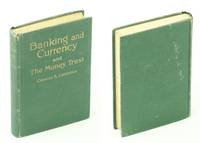
1913426j0468Washington D.C.: Charles A. Lindbergh / National Capital Press Inc. Good. 1913. First Edition. Hardcover. In the hysteria of wartime 1918 federal agents forced the destruction of this book's printing plates. per page 7 of Lindbergh's "Your Country At War". "The market prices of commodities vary from day to day and often several times a day despite no radical difference in the proportion of the supply and the natural demand. This fact is conclusive proof that our system is controlled by manipulators and fundamentally wrong. I have sought to elucidate this problem within this volume and have suggested a plan which if adopted would make the people the master of the world instead of the present master - THE MONEY TRUST." - page 3. "A populist classic on the nature of so-called 'panics.' Lindbergh claims he was offered millions in bribe money not to publish this book." - A Populist Bibliography p.163. "Charles August Lindbergh 1859-1924 was a United States Congressman from Minnesota's 6th congressional district from 1907 to 1917. He opposed American entry into World War I as well as the 1913 Federal Reserve Act. In 1917 he brought articles of impeachment against Federal Reserve Board of Governors including Paul Warburg and William P. G. Harding charging that they were involved 'in a conspiracy to violate the Constitution and laws of the United States'." - Wikipedia. 318 pages. Average wear to original green cloth boldly lettered in gilt. Binding intact. Rusty paperclip impressions atop pages 29-38. Rubber stamp of prior owner atop front free endpaper which is creased at top. Dust jacket not included if one was issued. A sound copy of this rare and important piece of American monetary history. Weems p.163; Sm 8vo . Charles A. Lindbergh / National Capital Press, Inc. hardcover
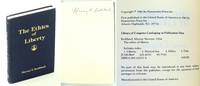
1982566j0533Atlantic Highlands New Jersey: Humanities Press. Good with no dust jacket. 1982. First Edition. Hardcover. 0391023713 . Signed without inscription by Murray Rothbard atop front free endpaper. "Economics can help supply much of the data for a libertarian position but it cannot establish that political philosophy itself. For political judgements are necessarily value-judgements political philosophy is therefore necessarily ethical and hence a positive ethical system must be set forth to establish the case for individual liberty." - Preface. "Rothbard 1926-1995 was a central figure in the 20th-century American libertarian movement and a founder and leading theoretician of anarcho-capitalism" - Wikipedia. Clean and unmarked with moderate peripheral wear to original dark blue cloth brightly lettered in gilt. Binding tight. Light foxing to edges. No dust jacket apparently as issued. A quality signed copy of this fascinating study. ; Sm 4to; Signed by Author . Humanities Press hardcover
186957295St. Petersburg: N.P. Polyakova, 1869. 8vo. In a later modest half calf binding. Previous owner's name to top of front free end-paper and half title. Internally lightly spottet and soiled. Dampstain to top corner and lower part of book. Restauration to upper outer corner of Pp. 109-110 and pp. 111-112. A closed tear to map. (6), II, 494 pp. + 1 map.
159150430Coloniae, Ioannem Gymnicum, 1591. 4to. Bound in a very nice contemporary full calf with five raised bands, rebacked with the contemporary spine. Richly gilt spine and gilt lines to edges of boards. Contemporary handwriting to top of pasted down front free end paper. Pp. 777-798 with wormholes in margin, not affecting text. A very fine and clean copy. (76), 798 pp.(As usual with the typopgraphical errors: pp. 139, 234, 267,353, 685, 768 are numbered as 339, 202, 263, 343, 645, 778. These errors are to be found in all published copies. See Einaudi 737).
179548221Bath, R. Cruttwell, 1795. Large 4to. Contemporary boards, beautifully re-backed in contemporary style, with five raised bands, gilt lines, and gilt red leather title-label to spine. A few light marginal pencil-annotations, small library stamp to lower part of title page, otherwise a very fine copy. 8, 200 pp. + the errata slip inserted after the title-page.
190958833Lund, C. W. K. Gleerups förlag, 1909 & 1911. 8vo. Both volumes in the original printed wrappers. Light wear to spines, otherwise a very fine and clean set. XVI,191, (4), 179 pp.
St. Petersburg: N.P. Polyakova, 1869. 8vo. In a later modest half calf binding. Previous owner's name to top of front free end-paper and half title. Internally lightly spottet and soiled. Dampstain to top corner and lower part of book. Restauration to upper outer corner of Pp. 109-110 and pp. 111-112. A closed tear to map. (6), II, 494 pp. + 1 map.
Coloniae, Ioannem Gymnicum, 1591. 4to. Bound in a very nice contemporary full calf with five raised bands, rebacked with the contemporary spine. Richly gilt spine and gilt lines to edges of boards. Contemporary handwriting to top of pasted down front free end paper. Pp. 777-798 with wormholes in margin, not affecting text. A very fine and clean copy. (76), 798 pp.(As usual with the typopgraphical errors: pp. 139, 234, 267,353, 685, 768 are numbered as 339, 202, 263, 343, 645, 778. These errors are to be found in all published copies. See Einaudi 737).
Bath, R. Cruttwell, 1795. Large 4to. Contemporary boards, beautifully re-backed in contemporary style, with five raised bands, gilt lines, and gilt red leather title-label to spine. A few light marginal pencil-annotations, small library stamp to lower part of title page, otherwise a very fine copy. 8, 200 pp. + the errata slip inserted after the title-page.
Yerûsalayim [Jerusalem], Sifriyyat Pôalîm, 1947 & 1954. Large8vo. Two volumes both in publisher's original printed cloth with the original dust-jackets. 763 pp." " 516 pp.Vol. 1: A bit of misolocured to spine and front board. Front dust-jacket detached from the spine and back-part. Spine lacking a third of the paper. Very fragile.Vol. 2: Upper and lower part of spine miscoloured. Dust-jacket missing upper and lower part of spine. Both volumes internally very fine and clean.
Lund, C. W. K. Gleerups förlag, 1909 & 1911. 8vo. Both volumes in the original printed wrappers. Light wear to spines, otherwise a very fine and clean set. XVI,191, (4), 179 pp.
1944039964Chicago: University of Chicago Press 1944. First American Edition 1st Printing. Blue Cloth. Good/No DJ. Xi 250 Pp. Blue Cloth Gilt. First Printing 1944. Light Wear With A Single Tiny Point Of Fraying At Base Of Spine; Spine Gilt All Present And Lettering All Clear Spine Cloth A Little Faded. Covers Clean With Some Loss Of Color In A Thin Line And In A Small Spot On Front Cover. Publisher's Red Top Stain Without Spotting. Pages Just A Little Aged Even Aging To Endpapers No Foxing. No Names A Few Pencil Marks In Text.The Ultimate Academic Statement That Government Will Not Offer Protection Against Commercial Bullies Polluters Liars And Sociopaths Of All Kinds Arguing That This Passivity Is Somehow In The Best Interests Of The People; Also The Ultimate Statement That Academic Economists Are Somehow Experts In The Determination And Evaluation Of What Those Best Interests Are Otherwise They Could Not Make This Recommendation For Passivity! The Epitome Of Specious Reasoning Of Immense Appeal To Those For Whom Specious Reasoning In The Public Sphere Is Very Much In Their Best Personal Interests. However The Book Also Rightfully Directs Attention To The Sociopathy Of Government Itself And Its Pervasive Ignorance Immorality And Incompetence Which Any Review Of 10000 Years Of Human History Will Fully Support. Unfortunately Hayek Cannot Escape His Own Role As A Sophistic Academic Interpreter Of Economics For The Masses Promoting The Sole Interest Of The Ruler As Has Occurred Also For 10000 Years. <br/> <br/> University of Chicago Press hardcover
Milano, presso Giovanni Silvestri, 1804, parti 4 legati in due volumi, in-4, brossura originale, pp. 288, 287. Esemplare a pieni margini, con barbe. Collaborarono a questa interessante rassegna: A. Verri, B. Baillon, C. Beccaria, S. Fransi, G. Visconti, C.G. Colpani, A. Longhi, N.L. Lambertenghi, P. Verri, P. Secchie P. Frisi. Prima edizione in volume di questa rara opera. Einaudi, 6161. Kress, B. 4775. Melzi, p. 160.
In-8, brossura orig. Di questa famosa rivista mensile illustrata, ca. 100 pagine ogni numero, offriamo una raccolta di 48 annate complete, dal 1952 (Anno I della “Nuova Rivista di Cucina”) al 1999. Segnaliamo inoltre che 10 annate hanno in più un “Numero Speciale” e precisamente: 1986 (Supplemento al n. 10) - 1988 (Speciale di Primavera) - 1990, 1991, 1992, 1993, 1994, 1995, 1998 (Speciale di Natale) e 1999 (Speciale di Natale + un ulteriore Supplemento). "La Cucina Italiana" è dal 1929 il più autorevole mensile di gastronomia e di cultura alimentare, e di più lunga tradizione in Italia e nel resto del mondo. E’ ricchissimo non solo di ricette ma anche di rubriche, segnalazioni di nuove tendenze, novità di cucina e consigli per la casa. In questa importante raccolta, solo pochi fascicoli hanno lievi mancanze al dorso, altrimenti è tutta ben conservata, e 11 annate (dal 1952 al 1963 - tranne il 1958) sono contenute in un cofanetto editoriale in tela rossa.