GROTIUS, (HUGO).Livre Rare Book
93 488 résultats
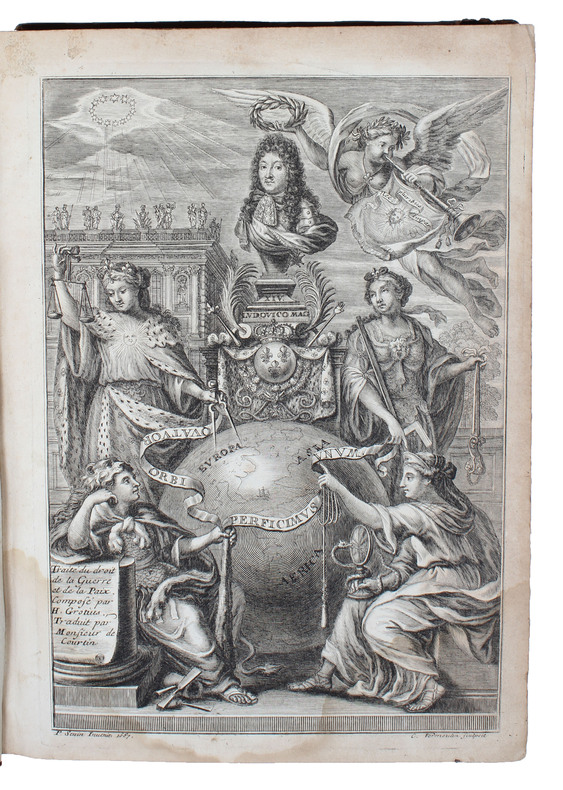
168751671Paris, Arnould Seneuze, 1687. 4to. Two contemporary uniform full calf bindings with five raised bands to richly gilt spines. All edges of boards gilt. Hinges and capitals worn, with some loss, but still tight. A damp stain to first and last leaves of both volumes (affecting about 17 leaves in all, mostly marginal). Otherwise a nice and clean copy with just the occassional brownspotting. Engraved frontispiece in vol. 1, engraved title-vignettes, large engraved vignette to verso of title-page of vol. 1, engraved portrait in vol. 1, woodcut vignettes and initials. Printed on good paper and with wide margins. (48), 621, (3) pp. + frontispiece and portrait" (4), 197, (3) pp.
Moscow, Izdanie Vladimira Bonch-Bruevicha, 1896. 8vo. In a later modest black half calf binding with marbled boards. Traces of stamp to verso of front and back board. Title-page slightly rubbed. Occassional underlignings in text and margins. Pp. 145-146 reinforced in margin. Otherwise a fine copy. XII, (4), (1)-160 pp.
Philadelphia & London, 1837-1840. 3 volumes lex 8vo. Bound in three absolutely lovely, contemporary, uniform moiré-impressed dark brown full cloth bindings. The impressed pattern of the cloth varies on the three bindings, contributing to the charm of the set. Gilt lettering to spines. Very neatly and gently re-backed, barely noteceable, laying down the original cloth spines. Some brownspotting, mostly to end-papers and first and last leaves in each volume. (2), XVI, 342 VI, pp. (9) - 466 " (6), 270 pp. - Fully complete, collation in accordance with Einaudi.
Paris, Arnould Seneuze, 1687. 4to. Two contemporary uniform full calf bindings with five raised bands to richly gilt spines. All edges of boards gilt. Hinges and capitals worn, with some loss, but still tight. A damp stain to first and last leaves of both volumes (affecting about 17 leaves in all, mostly marginal). Otherwise a nice and clean copy with just the occassional brownspotting. Engraved frontispiece in vol. 1, engraved title-vignettes, large engraved vignette to verso of title-page of vol. 1, engraved portrait in vol. 1, woodcut vignettes and initials. Printed on good paper and with wide margins. (48), 621, (3) pp. + frontispiece and portrait " (4), 197, (3) pp.
Un volume in folio grande (26x40 cm) composto da Frontespizio satirico inciso; pagina di titolo; 26pp.; 52pp.; 32pp; 8nn. + 74 tavole satiriche (76 considerando due doppie), molte a doppia pagina o ripiegate. Mezza pelle del tempo, dorso a sei nervi, con dorature e tassello rosso. Provenienza: bollo della biblioteca Paul Adam sul frontespizio e nel retro di alcune delle tavole. Si tratta del più famoso e bel volume di satira attorno al Sistema di Law e alle sue imitazioni olandesi ed inglesi (South Sea Bubble) del 1720. All’opera è stato dedicato uno studio specifico da Arthur H. Cole, “The Great Mirror of Folly. Het Groote Tafereel... An economic-bibliographical study” (Boston, 1949), nel quale si sottolinea come “so strange was the mode of issuance thet no two specimens are exactly the same. In a sense, each copy of the Tafereel is unique”. Ciò spiega perché il numero delle tavole inserite nel volume sia sempre diverso. Nella nostra copia, per esempio, ne compaiono dieci in più rispetto all’elenco indicato nel testo. Alcune di queste incisioni , come il Carro della Follia speculativa, ebbero un successo enorme, e furono copiate e diffuse clandestinamente in Francia e in altri paesi. Varie illustrazioni sono di grande pregio decorativo. Tra le incisioni più significative e rare, la serie di carte da gioco con personaggi della vicenda del Sistema di Law. Ma tutto il Tafereel viene considerato come il più bel libro illustrato di satira economica mai apparso. Kress 3217. Manca all’Einaudi.
1835PHO-1982Paris, Bellizard, Barthes, Dufour et Lowell ; Londres, Bossange, Barthes et Lowell ; Saint-Petersbourg, Fd. Bellizard et Cie, 1835-1844. 18 volumes de texte in-8 et un atlas in-folio. TEXTE : 18 volumes in-8, relié demi basane et coins moderne, dos lisse orné avec pièces d’auteur, titre et tomaison noires, frottements et épidermures, défauts d’usage, rousseurs dans le texte, tampon et étiquette du relieur. ATLAS : Paris. Bellizard, Dufour etc. 1844. Imprimé chez Thierry Frères. Demi basane et coins à long grain grenat, dos à nerfs avec titre et auteur, In-folio (520x345mm), IV-82pp.-40 planches, il est composé du Commentaire sur l’Atlas de l’Empire Ottoman, d'une liste des cartes, d'une carte générale de l'Empire Ottoman (690x550mm), de 22 cartes particulières (dont une sur 2 feuilles) (815x850), de 13 plans de batailles ou de siège, et de 4 plans de villes dont un grand plan dépliant de Constantinople (690x670mm), le plan de Vienne est en 2 états, par G. Heck et Plée et gravé par U. Muschani, roussurs éparses, 2 cartes uniformément brunies avec réparations, mouillure claire en marge, tache sur les 16 premiers feuillets en tête et en fin d’ouvrage en pied. Provenance : collection de S.A.R. le Prince Osman Ibrahim d'Égypte (1951-2025), fils de S.A.R. le Prince Amr Ibrahim d'Égypte et de S.A.I. la Princesse Nejla Hibetullah Sultan (Necla Osmanoğlu) de Turquie, petite-fille du dernier calife Abdulmejid II et du sultan Mehmed VI, avec sa marque au tampon.
Sonderabdruck aus "Archiv für Sozialwissenschaft und Socialpolitik" Band 46 Heft 1 und 2, 1 brochure in-8, Verlag von J. C. B. Mohr (Paul Siebeck), Tübingen, 1919, 76 pp. Edition originale. Exceptionnel exemplaire du tiré-à-part, enrichi d'un envoi autographe non signé de Joseph Schumpeter au Dr.Bousquet, Amitiés de l'Auteur". Etat moyen (couverture abîmée et débrochée, annotations de Georges-Henri Bousquet). Dans cette étude, Schumpeter pose une définition liminaire, en refusant de considérer comme impérialisme la disposition agressive d'un Etat en vue de la poursuite d'intérêts concrets, mais en entendant par là la disposition, sans objet précis, d'un Etat à l'expansion violente sans qu'aucune limite puisse être assignée à cette expansion (Cf Perroux, La Pensée économique de Joseph Schumpeter, 23). Il y étudie un certain nombre de cas historiques historiques concrets, puis dans un dernier et fort long paragraphe, il traite de la question "Capitalisme et Impérialisme". Le dédicataire, qui devient plus tard professeur d'Université à Alger et Bordeaux, Georges-Henri Bousquet (1900-1978), était juriste de formation initiale (docteur en droit en 1923 avec une thèse sur "L'évolution sociale en Hollande 1914-1922"). Mais il reste surtout connu comme un économiste proche de Pareto (son maître en sociologie) et de Schumpeter, ainsi que comme un islamisant de l'école de Goldziher et Snouck-Hugronje. On peut signaler que le Professeur Bousquet est l'un des rares économistes français contemporains à être plusieurs fois cité dans la monumentale Histoire de l’Analyse Economique écrite par Joseph Schumpeter à la fin de sa vie. Les deux hommes se connaissaient personnellement depuis une première rencontre à Vienne en septembre 1923. A cette époque, G.-H. Bousquet fut présenté à Joseph Schumpeter, à Vienne, par Paul Lazarsfeld. Comme Bousquet le raconte lui-même : "A ce moment, Schumpeter avait 40 ans. Il était alors totalement ignoré en France, mais connu aux Etats-Unis où il avait été invité à professer quelque temps, et en Angleterre, où il avait eu également l'occasion de se faire entendre". Les deux hommes, qui deviendront amis, se rencontreront beaucoup plus longuement en 1933-1934 à Harvard, où Schumpeter sera devenu professeur. Georges Bousquet y effectuera en effet un long séjour de recherche, financé par la fondation Rockfeller. Toute sa carrière, Georges Bousquet sera fasciné par l'oeuvre de Schumpeter, qu'il fera notamment découvrir, tant par ses articles que par les discussions, à l'économiste François Perroux. Allemand
9272Moulins, Imprimerie de P.A. Desrosiers, 1843 - 1847 ; cinq tomes grand in-folio (47 x 31) dont un Atlas ; demi-chagrin vert foncé, dos à nerfs, caissons à froid, titre doré en caractères gothiques, tête dorée (reliure de l'époque) ; (4), XXVIII, 448 ; 484, (2) ; VI, 264, (4) ; (4), 338 (mal chiffrées 336) ; atlas de 144 planches (complet) lithographiées dont 6 en chromolithographie, dessinées par V. Beauce, E. Tudot, H. Durand, E. Sagot, E. Thibaud, A. Dauvergne, Ch. Vallet, etc., gravées par Bayot, Mathieu, V. Petit, Meusson, Monthelier, Ph. Benoist, Berthet, Schaal, etc. ; certaines sont tirées en camaïeu avec un fond beige ; les quatre tomes de texte sont illustrés de 20 bandeaux, 86 lettrines, 50 vignettes ou culs-de-lampe, 6 reproductions de monnaies et 3 plans ou carte par E. Sagot (en majorité), Chenavard, Tony Johannot, etc., gravés sur bois, la vignette de titre est identique pour les quatre volumes.
x, [2], 423 pages. Index. "There is no man living who, from the beginning or in the progress or at the ending of federal reserve legislation, was more closely or constantly than I privy to and identified with the consideration and enactment of the law under which the federal reserve banking system was set up. Ever since the enactment of the federal reserve law it has been my intention to write, some day, a story of the many inside events, word of which never reached beyond a closely restricted circle and had no such thing as current newspaper attention. Very likely my desire to tell the dramatic story would have abated if not for the recent publication of the 'Intimate Papers' in which the paternity of the Federal Reserve Act and its particular management are placidly ascribed to Colonel E.M. House." - Introduction. Accordingly, Chapter III of this book is devoted to a scathing critique of the veracity of 'The Intimate Papers of Colonel House', first published in 1926. Colonel House was an intimate confidant of Woodrow Wilson, President when the Federal Reserve Act was passed. Latter day conspiracy researchers argue House successfully advocated for the interests of the House of Rothschild during the development and passage of the Federal Reserve Act. In response to Glass's book, Paul Warburg, also instrumental in the founding of the Federal Reserve, was "impelled to lay down in black and white my recollections of certain events in the history of banking reform." - Preface to his two-volume work The Federal Reserve System, Its Origins and Growth - Reflections and Recollections, published in 1930. Commenting on Glass's book, James Grant, of Interest Rate Observer fame, notes "the story of the creation of the Fed by its chief progenitor, Carter Glass, makes you doubt he would recognize today's Federal Reserve, were he brought back to life to inspect it. He explodes in indignation at any who would impugn the proposed Federal Reserve note as mere fiat money. In fact, he considered the currency to be as good as gold - or better." Clearly, Glass's recollections herein represent a profoundly important chronicle of the origins and founding of the Federal Reserve System. Frontispiece photo portrait of Woodrow Wilson. Former university library copy with usual markings. Sturdily rebound in navy buckram. Book
Signed and inscribed by author upon front free endpaper. 552 pages. Index. Black and white photographic plates. "One of the most important autobiographies of the post-war period, for there can be few personalities still alive who have been so intimately connected with the march of world events for so many years... His first great triumph was to rescue the German Mark from the inflation of 1921... As the Nazi avalanche swelled, Hitler persuaded him to occupy the Presidential chair at the Reichsbank... but (Schacht) soon saw that the Fuhrer was driving relentlessly towards war. A quarrel resulted and he left the Government, remaining under a cloud until he was arrested towards the close of the regime." - from dust jacket. Schact was aquitted of war crimes at Nuremberg. Moderate wear to book. Binding intact. Several patches and touch-ups to dust jacket which is now preserved in archival-grade Brodart. Kehr & Langmaid 1217, Aldcroft & Rodger p.83. Book
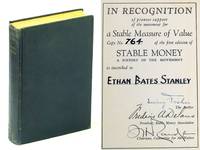
1934169H5168New York: Adelphi Company Publishers. Good. 1934. First Edition. Hardcover. Stable Money Association gift bookplate inside front board is signed by Irving Fisher James Rand Jr. and Frederic A. Delano. Delano 1863-1953 was uncle to FDR President of the Stable Money Association and was appointed to serve on the first Board of the Federal Reserve by Woodrow Wilson. James Rand Jr. 1886-1968 was Chairman of the Committee For the Nation and a prominent American businessman. This copy inscribed to Ethan Bates Stanley who was President of the American Laundry Machinery Company. pp. vi vii-xxiii 484. Selected bibliography. Index. Extensive footnotes. "The present book is intended to be not so much a history of monetary catastrophes due to unstable money and endured by unsuspecting millions subject to the money illusion but rather a history of the efforts of a few to remedy or prevent such catastrophies." - xxi. Pages 443-484 constitute a lengthy list of Stable Money Pioneers individuals who supported the movement. Corporate affiliations are included for most of these names thus the list reads like a corporate Who's Who of America. Dust jacket not included. Average wear to publisher's pebbled navy cloth. Binding sound. Bookseller ink stamp inside front board. 21 x 14.5cm. Rist p.379 Cohen p.186 Fisher M-2058; 8vo - over 7¾" - 9¾" tall; Monetary Policy Irving Fisher Frederic A. Delano Ethan Bates Stanley Stable Money Movement Committee For the Nation Stable Money Federal Reserve System Gold Standard London Economic Conference Weimar Hyperinflation Wiemar Stable Money League; Signed by Authors . Adelphi Company Publishers hardcover
1977429H2943Germany: J.C.B. Mohr Paul Siebeck Tubingen. Fine in Fine dust jacket. 1977. First German Edition. Hardcover. 3163402720 . Signed and inscribed by Nobel laureate Hayek to prominent German legal scholar E.W. Ernst-Wolfgang Bockenforde atop front free endpaper. XIII 1 136 1 ad pages. Text in German. Argues government monopolization of the printing and circulation of money leads to its excessive creation thus inflation. Proposes private businesses be allowed to issue their own currency. Perhaps Satoshi Nakamoto was spurred in part by this work to introduce Bitcoin to the world. It is intriguing to contemplate what Dr. Hayek would think of cryptocurrencies. Clean bright and unmarked with negligible wear. A splendid copy. Bibliographic Reference: Pressman pages 177 and 180; 8vo - over 7¾" - 9¾" tall; Entnationalisierung des Geldes: Eine Analyse der Theorie und Praxis konkurrierender Umlaufsmittel Denationalisation Denationalization of Money; Signed by Authors . J.C.B. Mohr (Paul Siebeck) Tubingen hardcover
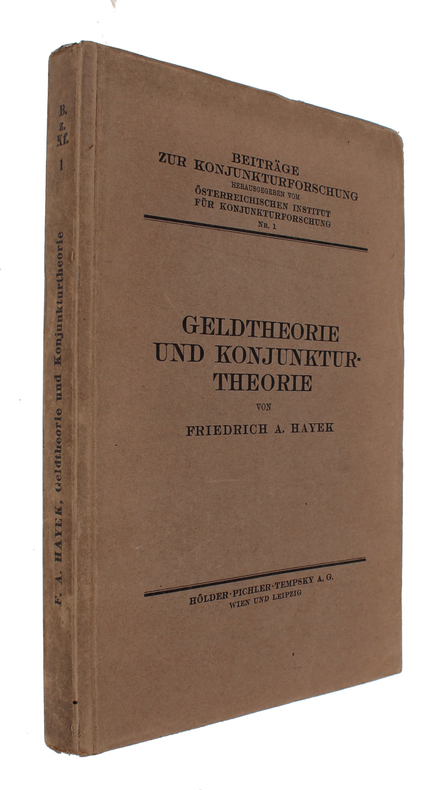
192957751Wien & Leipzig, Hölder-Pichler-Tempsky, 1929. 8vo. In the original printed wrappers. Very light wear to extremities. First and last leaf with light brownspotting. A very fine and clean copy. XII, (1)-147, (1), [Blank] pp.
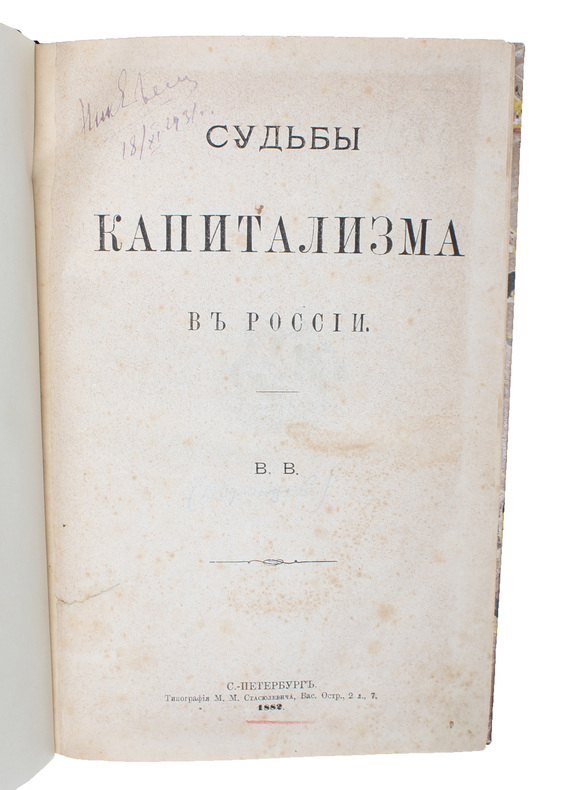
188248766S.-Peterburg, Typografiya M.M. Ctasiulevitsa, 1882. 8vo. Bound in an elegant recent red half calf binding, in pastiche, with five raised bands and gilt lettering to spine. Heavily underlined thoughout in blue and red. Title-page repaired at inner hinge, far from affecting text. No stamps. (4), 312 pp.
Wien & Leipzig, Hölder-Pichler-Tempsky, 1929. 8vo. In the original printed wrappers. Very light wear to extremities. First and last leaf with light brownspotting. A very fine and clean copy. XII, (1)-147, (1), [Blank] pp.
Tokyo, Kaizosha, 1927-1928. Small4to. 5 volumes all in publisher's original full red cloth with gilt lettering to spine, all five volumes house the original slipcases. Free end-papers browned and only very light sporadic brownspots throughout. A very fine and clean copy.
S.-Peterburg, Typografiya M.M. Ctasiulevitsa, 1882. 8vo. Bound in an elegant recent red half calf binding, in pastiche, with five raised bands and gilt lettering to spine. Heavily underlined thoughout in blue and red. Title-page repaired at inner hinge, far from affecting text. No stamps. (4), 312 pp.
191952651Sonderabdruck aus "Archiv für Sozialwissenschaft und Socialpolitik" Band 46 Heft 1 und 2, 1 brochure in-8, Verlag von J. C. B. Mohr (Paul Siebeck), Tübingen, 1919, 76 pp.
2081502111904681social science literature N.A. Soft Cover. Fine. The book is in fine condition. social science literature paperback
1950324H5247Glencoe Illinois: The Free Press/Macmillan. Good in Fair dust jacket. 1950. First English Edition. Hardcover. "Ranks with Smith's Wealth of Nations Ricardo's Principles Marx's Capital Marshall's Principles and Keynes' General Theory as one of the six most important books ever written in its influence upon the development of modern economic theory. Menger's influence was not however confined to theoretical economics. The Austrian School of which he was the founder was a fountainhead of classical liberalism in the European continent. The ideas of the school and its founder are therefore relevant to the modern debate between socialism and liberalism. Since many of the staunchest modern advocates of laissez faire such as L.M. Mises and F.A.V. Hayek find their intellectual roots in Menger's Principles the translation of his work is of interest to those concerned about the relations between government and business as well as to economic theorists." - dust jacket. The long overdue first English edition of the 1871 German first edition. Menger 1840-1921 "attacked the half-decayed fabric of economics and is to be ranked among those who have torn down the structure of a science and placed it upon entirely new foundations." - Joseph Schumpeter. "Menger's Principles are the best introduction to the understanding of the theory of value which we possess." - F.A. Hayek. Former library copy with usual markings and moderate wear to original black cloth lettered in silver. Above-average wear to undulating dust jacket which is patched on spine and now preserved in archival-grade Brodart. A sound copy of this economic tour de force. Fundaburk 9739 Hutchinson 347 Hazlitt p.115 Blaug p.160-162 Pressman p.89-94.; 8vo - over 7¾" - 9¾" tall; Economics Carl Menger Marginalist Revolution Value Theory Austrian School Marginal Utility Theory Price Theory Marginal Utility . The Free Press/Macmillan hardcover
1756PHO-4862 Volumes in 4°de 1 titre ,XIV pp, 463 pp, 4pp pour le tome I et 1 titre ,513 pp, 2pp, veau marbré époque, dos à nerfs ornés avec pièce de titre et de tomaison ,tranches rouges, coins usés,charnières fendues Édition originale. UN DES RARES EXEMPLAIRES CONTENANT LES 7 FEUILLETS SUPPLEMENTAIRES (437*- 450*) dans le premier volume intitulé Découvertes des Hollandois dans l'Australasie.
Titolo completo: Traité / d’Agriculture. Considerée tant en elle meme que dans / ses rapports d’économie politique. Avec les preuves, tirées de la comparaison de / l’Agriculture, du Commerce et de la Navi/gation de la France et de l’Angleterre. Par M. de Fresne. Principes sur lesquels on doit établir la / répartition des impots et des dépenses pu/bliques, pour encourager la Culture et le / Commerce, dans la situation où la France / se trouve. -Tome premier, première partie. Impositions, Dépenses et Economies des / Campagnes. Agriculture, Commerce d’Economie, pre/miere source de notre richesse. … Tome premier, seconde partie. Impositions, Dépenses et Economies des / Villes. Arts, Spectacles, Commerce de luxe et d’hos/pitalité, seconde source de notre richesse. … -Tome second. Plan général. Principes d’économie, fondés sur le succés / des Peuples qui se sont les plus enrichis. Application de ces principes à la situation / actuelle de la France. (A Paris. Chez De Bray, Libraire, au Palais Royal, Galeries de bois, N°235. Les Libraires qui tiennent des Nouveautés. Il se trouvera incessement dans les Capitales. 1788. Avec Approbation et Privilege du Roi). –- Tre parti in due volumi in 8° (133x217). Primo volume: (12, con una pag. di Avis, sigillo e firma autografa dell’Autore)-XCVI-143pp.(1)-(4 per Table)-una tavola ripiegata fuori testo; (4)-XXXI-(1)-riprende alla numerazione 133 fino a 492pp.-X- 2ff per Planches I e II- «Errata» con numerazione 399-400. Secondo volume: (6)-350pp, con 337-38 in doppia numerazione. Due Planches III e IV, (2)-VIII per «Extrait»-(2). Una grande tavola ripiegata fuori testo. Brossura verde del tempo. Mancanza di carta al dorso del 1° volume. In barbe. Firma di appartenenza all’occhiello “Desfroments». (///Un altro esemplare Tre parti in due volumi (120x200). Mezza pelle del tempo, dorso liscio dorato con titolo iscritto per orizzontale. Qui mancano le tavole fuori testo ripiegate al termine del primo e del terzo volume e manca la planche III. Qualche altra differenza rispetto all’esemplare precedente (manca per esempio l’Avis con il sigillo e la firma del De Fresne al primo volume) lascia credere che questo sia un esemplare di contraffazione. La presenza di simili esemplari viene indicata dallo stesso autore: «...j’ai appris qu’on en avoit fait à la hate une contrefaçon»). //// Edizione originale di uno dei più straordinari trattati di economia del XVIII secolo, che è nello stesso tempo anche un saggio di futurologia, di urbanistica e perfino di ecologia. «Je vais essayer de jeter les premières bases d’un nouveau plan de culture et d’économie». E in effetti de Fresne descrive una vera e propria «economia di piano», che ha alla sua base un riequilibrio dei rapporti tra città e campagna. Primo elemento, una drastica riduzione dei cavalli (delle automobili, si direbbe oggi) nella città di Parigi. «On peut diminuer le nombre des chevaux des villes de plus de moitié...». I cavalli vanno rispediti in campagna per fare i lavori agricoli, destinando così i buoi ad altro uso: si possono cioè macellare a tre anni, procurando sei o sette volte più produzione di carni e di materie prime (pelli). Risultato: un popolo meglio nutrito, un terreno più coltivato, più grano, ecc. Un circolo economico virtuoso che non serve solo alle campagne ma anche alle città. La ristrutturazione delle grandi città, in pratica di Parigi, è l’aspetto più sorprendente delle tesi di de Fresne. Il suo piano urbanistico prevede la concentrazione degli «spettacoli» nel centro della città, vicino alla reggia (il re dovrebbe lasciare Versailles); particolare attenzione viene riservata alla viabilità, con lo sviluppo dei trasporti sull’acqua, con delle gondole, e la costruzione di canali; nuove strade più larghe e soprattutto dotate di marciapiede e di fogne laterali, che permettono un migliore transito e di tenere la città più pulita. Propone la costruzione di case alte, a più piani, per contenere l’espansione delle città; tetti piatti per risparmiare sulle spese; serbatoi d’acqua sui tetti, che permettono di avere l’acqua corrente nelle case, che poi finirebbe nelle fogne. Anche i problemi di occupazione sono affrontati: il dimezzamento dei cavalli e delle carrozze rischia infatti di lasciare numerose persone senza lavoro: «On employra les conducteurs des chariots aux travaux d’utilité et d’embellement des villes, quand ils n’auront pas d’ouvrages». Soluzione keynesiana alla fine del 700! Vengono previsti servizi pubblici urbani: trasporti in comune a basso prezzo, su itinerari e ad ore prefissate, per trasportare i cittadini, soprattutto negli orari degli spettacoli. Strade più pulite e spettacoli ben organizzati attireranno il turismo, che viene visto come una delle fonti di ricchezza. Al richiamo del turista servirebbe anche il divieto di esportare vino: se si vuole bere il vino francese, si deve venire in Francia. I lavori pubblici vengono pagati con una ristrutturazione delle imposte, in particolare sui passi carrabili, di modo da scoraggiare l’uso delle carrozze private. Ebaudy de Fresne si lancia anche in alcune ipotesi futuristiche per i trasporti: carrozze trainate da palloni aerostatici. «Si on pouvait se procurer du gaz à peu de frais, il serait possible de se servir des aérostats dans les pays de pleines, pour transporter de trés gros fardeaux avec un seul cheval ou meme sans chevaux, pour trainer des bateaux...». Meglio ancora «si l’on parvenait à rendre un balon plus léger de l’aire par le vide...». Gli ingredienti di utopia o di futurologia sono però marginali in de Fresne, rispetto ad opere contemporanee come «L’An 2440» di Mercier. Né vi sono tendenze verso concezioni «comunistiche» come in Mably o Morelly. Il piano economico di de Fresne è assolutamente «realistico e realizzabile», anticipando soluzioni ed idee che si imporranno nel secolo successivo. Da qui la singolare e finora misconosciuta importanza del «Traité d’Agriculture» nel quadro delle proposte economiche della fine del XVIII secolo. /// FRESNE, François Ebaudy de Economiste francais, né à Langres en 1743, mort à Vesoul en 1815. Il se rendit à Paris, où il s’occupa surtout d’étudier les questions agricoles et industrielles, puis visita, pour complèter ses études, L’Angleterre et l’Hollande. Au début de la Révolution, il se montra un adversaire declaré des idées de Necker, et proposa de créer un banque territoriale qui, d’aprés lui, dévait faire affluer l’argent dans les caisses de l’Etat et permettre de rembourser les capitalistes, qui absorbaient la meilleure partie des revenus du royaume. Vers la fin de sa vie, il devint l’admirateur et le disciple de Saint-Martin. /// Opere: -Plan de restauration et de libération, analyse d’un nouveau plan de culture, de finance et d’économie... Paris, Debraye, (sd), in 8° di II-132pp. -Plan de restauration et de libération fondé sur les principes de la législation et de l’économie politique, proposé aux Etats Generaux par m. de Fresne. Comparaison du plan de libération des proprietaires et de celui des capitalistes. (Sl); 1789; in 8° di 170pp. Del Traité d’Agriculture: sul Catalogo BN (edizione 1900) n° S19035-37. Un autre exemplaire du Tome II n° S19038. Per la British Library: n° 41a1. -Traité d’agriculture et d’économie de la culture et des arts... Paris, de Bray, 1788. In 8° di 50pp. «Analyse de l’ouvrage précédent». Nessuna copia censita al Sbn delle Biblioteche italiane.
"Transforms the dry economic subject of inflation into a white-knuckles kind of blood-chiller... Concludes by charting out all the possible prognoses for the American inflation, none easy but some much less catastrophic than others. Not for the timid. Spares no tender sensibilities. The conclusions it reaches are shocking" - replica dust jacket. [3]-372 pp. including over forty pages of highly-informative footnotes. Ronald H. Marcks, a New England lawyer, adopted the pen name Jens O. Parsson to avoid any discomfort to his clients or associates which might stem from his alarming forecast. Former library copy with usual markings. Tight and square with moderate wear to publisher's green cloth. Replica dust jacket preserved in archival-grade Brodart. One of only a thousand copies in the first edition of this profoundly important and most timely treatise. Book
183189320Las viudas de Arazoza y Soler | La Havane 1831 | 17.7 x 23.5 cm | Relié
180736928Altona, J.F. Hammerich, 1807. 8vo. Bound in the two nice cont. uniform cardboardbindings w. marbled paper. Gilt lines and gilt title-labels to spines. Some wear w. minor loss of paper to capitals, hinges and corners. Small hole to paper as well as to leather title-label of spine of volume two. Some brownspotting, but overall a nice and atrractive copy. Lacking the half-tilte for the first book (merely stating ""Erstes Buch""). XVI, 368"" VIII, 358, (1) pp.