224 résultats
183836058Boston 1838. Hardcover. Fair. Octavo. Marbled paper covered boards with leather corners and spine. Red leather title label on the spine. Covers are worn. Toning to the end papers. Blind embossed stamp of the previous owner "Library of KJT Kevin John Twit" on the right front flyleaf. Incomplete: title page and issues for June October and December were not bound inside. Collation as follows: pages 1-240; pages 289-432; pages 481-528; 18 pages "A Sermon Occasioned by the Loss of the Harold and the Lexington Delivered at the Odeon January 26 1840 by William M. Rogers Pastor of the Franklin Street Church." Book and contents in fair condition. <br /> <br /> Articles include: "Contributions to Religious and Charitable Societies From Holders of Slaves"; "Triumphs of the Gospel in the South Sea Islands"; "Religious Notions of the North American Indians"; "The Cherokees"; "The Sandwich Islands" and more. hardcover
DADAX1538102684Rowman & Littlefield Publishers 2017-10-06. Second. hardcover. New. 6.21x0.95x9.34. Buy with confidence. Excellent Customer Service & Return policy. Rowman & Littlefield Publishers hardcover
2499523 November 1939. On letterhead of the National Council for Civil Liberties London. See his entry in the Oxford DNB. 1p 4to. A very good facsimile of a typed letter with the main text in black some in red and the facsimile signature 'Henry W. Nevinson' in light blue. Names of Nevinson as President E. M. Forster as Past-President and dozens of Vice-Presidents in left-hand margin including Aldous Huxley A. A. Milne J. B. Priestley H. G. Wells and Rebecca West. Addressed to 'Dear Sir' the letter sets out the history of the organization appealing for 'support for its activities'. In sending a copy of its monthly journal 'the Council makes an appeal not only because it stands for all those things upon which we as a free people pride ourselves but also because it is a live energetic body and shows practical results'. There is a reference to 'these critical days' and the letter ends by stating that 'it is in your interest to use its services and to see that it is strong and efficient to protect your liberties'. 23 November 1939. On letterhead of the National Council for Civil Liberties, London. unknown
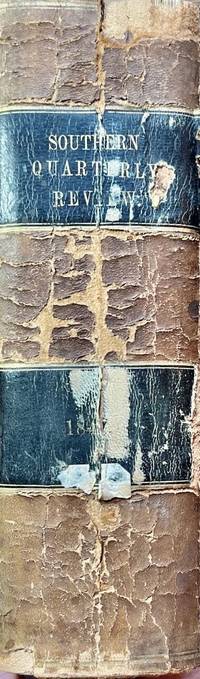
184736797Charleston: Burges & James 1847. Hardcover. Poor. Thick octavo. Two volumes. v index 1 page blank 524 pages; 536 pages v index 1 page blank 1. Ex-library copy with perforated stamp from "The University of The South Library" on the title page. Faded purple stamp page 101. Binding is in poor condition. Front cover is missing. Spine is dry cracked and chipped. Toning and light scattered foxing to the contents. <br /> <br /> Contents include articles on Adam Smith's Wealth of the Nations; Labor The Wilmot Provisio; China and the Chinese Life of Zachary Taylor; Carolina Sports; Slavery in the United States; Fanny Kemble and more. Poor to fair condition. Burges & James hardcover
185740445Boston: John Wilson and Son 1857. Paperback. Small 4to. Self-cover. 12pp. Very good. Outer wrappers only faintly age toned. Clean attractive first edition of this lengthy diatribe against President James Buchanan's handling of the slavery issue in Kansas which they considered weak and ineffective followed by his reply and their response to it. "They fervently hope "that you may yet see that in this respect one false principle if adhered to must prove a principle of weakness and decay -- a sure prelude to the end of all our greatness happiness and glory -- a death-spot in the tree of liberty whose leaves like those of the tree of life are for the healing of the nations." Signed in type at the conclusion by these Connecticut congressmen in order: Nathaniel W. Taylor Theodore D. Woolsey Henry Dutton Charles L. English John H. Brockway Eli W. Blake Benjamin Stilliman Jr. Thomas A. Thacher J.A. Davenport Worthington Hooker Philos Blake Amos Townsend James Brewster Eli Ives S.G. Hubbard John A. Blake William H. Russell A.N. Skinner Charles Robinson Joel Hawes G.A. Calhoun Leonard Bacon H.C. Kingsley Benjamin Stilliman Sr. Charles Ives Josiah W. Gibbs James F. Babcock and Alfred Walker. OCLC cites 20 copies. SABIN 52997. John Wilson and Son paperback
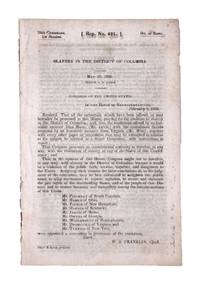
1836346520Washington D.C. 1836. 24th Congress 1st Session House Rep. No. 691. 24pp. 8vo. Disbound. 24th Congress 1st Session House Rep. No. 691. 24pp. 8vo. Many of the early anti-slavery efforts focussed on the abolition of slavery in the District of Columbia as Congress had full control over the laws within the District thus obviating any argument over state's rights. Until "retroceded" back to Virginia in 1846 the city of Alexandria and its notorious slave market was considered part of the District of Columbia making slavery in the District of particular importance. Inundated with petitions calling for the abolition of slavery in the District in 1836 Congress passed the so-called Pinckney Resolution which asserted that Congress "ought not" to consider slavery in the District and created a gag rule whereby all petitions memorials or other resolutions on the subject would be automatically tabled. unknown
185562372Boston: Bela Marsh 1855. Second printing. Frontispiece portrait. 122 pp. 1 vols. Small 8vo. Brown cloth stamped in blind and gilt. Upper half of spine shaky else a nice tight copy. Second printing. Frontispiece portrait. 122 pp. 1 vols. Small 8vo. The author was convicted of aiding slaves to escape from Washinton D.C.--Blockson. Sabin 20912 Blockson 9838 for first ed. Bela Marsh unknown
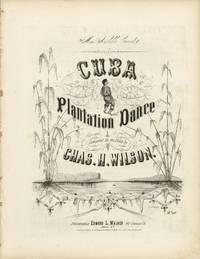
1855List3682Philadelphia: Edward L. Walker 142 Chestnut St. above 6th 1855. Folio sheet music pictorial lithographed cover approximately 13.5 × 10.5 inches. Light edge wear and minor toning; very good with a strong impression of the cover illustration. An antebellum piano dance reflecting the plantation imagery that circulated widely in mid-nineteenth-century American popular music. “Cuba Plantation Dance†was composed by Chas. H. Wilson a little-documented composer whose name appears chiefly in connection with this work and issued in Philadelphia during the early 1850s by Edward L. Walker the predecessor firm to the major publishing house Lee & Walker. A copy is recorded in the Levy Collection at Johns Hopkins which dates the publication to 1855.<br /> <br /> The cover presents a stylized plantation landscape framed by tall stalks of sugar cane with a small central vignette of a dancing Black figure. The use of Cuban plantation imagery reflects contemporary American fascination with the Caribbean sugar economy and with plantation life beyond the United States. During the 1850s Cuba was one of the largest slave societies in the Atlantic world. By the midcentury the island’s sugar plantations relied on hundreds of thousands of enslaved Africans and the enslaved population of Cuba was estimated at roughly 400000 people in the 1840s–1850s working primarily in the rapidly expanding sugar industry. Although Spain formally agreed to end the Atlantic slave trade in 1820 illegal importations of enslaved Africans into Cuba continued for decades supplying labor for the island’s plantations well into the 1850s. American publishers frequently borrowed such imagery for plantation-themed dance music marketed to the parlor trade. Pieces labeled “plantation dances†or “Ethiopian dances†formed part of the broader culture of minstrel and plantation entertainment. The title page bears a dedication to “Miss Arabelle Conrad†typical of mid-century sheet music addressed to amateur pianists. Along with the aforementioned copy in the Levy collection we find copies at Michigan and Temple. Edward L. Walker, 142 Chestnut St., above 6th unknown
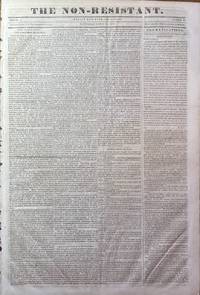
183936794Boston: N. E. Non Resistant Society 1839. Newspaper. Very good. Newspaper. 4 pages. Complete. Approximately 11.75" x 17". Slightly irregular at the blank spine. <br /> <br /> Several articles and letters inside pertaining to "Consequences of War" with Great Britain and other similar pieces. This paper was also an anti-Slavery paper. <br /> <br /> From wikipedia: The New England Non-Resistance Society was an American peace group founded at a special peace convention organized by William Lloyd Garrison in Boston in September 1838.1 Leading up to the convention conservative members of the American Anti-Slavery Society and the American Peace Society expressed discomfort with Garrison's philosophy of "non-resistance" and inclusion of women in public political activities. After conservative attendees opposing Garrison walked out of the convention in protest those remaining formed the New England Non-Resistance Society.citation needed<br /> <br /> The Society condemned the use of force in resisting evil in war for the death penalty or in self-defense renounced allegiance to human government and because of the anti-slavery cause favored non-union with the American South.citation needed The New England Non-Resistance Society was one of the more radical of the many organizations founded by William Lloyd Garrison adopting a Declaration of Sentiments of which he was the principal author pledging themselves to deny the validity of social distinctions based on race nationality or gender"2 refusing obedience to human governments and opposing even individual acts of self-defense.3 In the Society's Declaration of Sentiments Garrison wrote "any person without distinction of sex or color who consents to the principles of this Constitution may become a member and be entitled to speak at its meetings."1 The Society rejected loyalty to any human government; one historian has described the Non-Resistance Society's "basic outlook as that of philosophical anarchism".45. N. E. Non Resistant Society unknown
1851106835<p>Pamphlet 8vo wrappers 36 pp. Archival tape repair to back of front cover slight edgeware normal aging and browning; otherwise very good. Follows the general tone of a good deal of the abolitionist literature of the period. However while the author acknowledges the critical importance of slavery to America he suggests the issue needs to be debated with "calmness and candor" interestingly he indicates that the climate for these discussions appears to be improving.</p> Charles C. Little and James Brown,
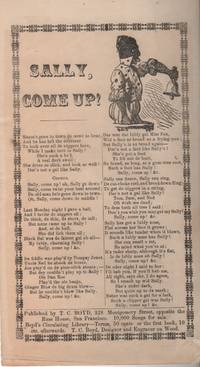
186043380San Francisco: T.C. Boyd 1860. Near fine. Racist slavery-era broadside printed and designed by one T.C. . Boyd featuring a drawing and lyrics to a ballad which begins: "Massa's gone to town de news to hear / And he has left the overseer / To look over all de nrs here / While I make love to Sally!" Boyd notes he had 10000 such sheets for sale at his shop. Broadside 8.5" by 4.5". Printed from type and wood engraving. Very near fine with trivial crease to edges. T.C. Boyd unknown
24264ONE: ‘Coloured Emigrants from United States’ Downing Street 16 October 1850. TWO: ‘Immigration’ Downing Street 30 October 1850. Two interesting items from the period leading up to the American Civil War. Both items are scarce: no other copy of either traced. In good condition lightly aged. Extracted from a volume of Parliamentary Circulars with the ownership signature "Frederick Peel" Member of Parliament from Feb. 1849 dated 1839-1851 very good condition. The context makes it plain that this Circular was sent to all Colonial Governors a gap in the text indicating where the name of a specific Governor would appear in MS. Disbound from a volume and paginated in manuscript.Both printed in copperplate font. ONE: Printed ‘Circular’ dated from Downing Street 16 October 1850. Headed in manuscript ‘Colonial Emigrants from United States’. In manuscript at end not in Grey’s hand ‘/sd/ Grey’. 2pp 8vo. Paginated in manuscript 239-240. Begins: ‘Sir / I have to acquaint you that it has been suggested to me that a desirable Class of Emigrants for the West India Colonies might be induced to come to them from among the Black and Colored Population of the United States whose arrival and location if they chose to come would I have no doubt be advantageous to themselves and to the Colonies.’ TWO: Printed ‘Circular’ dated Downing Street 30 October 1850. Headed in manuscript ‘Immigration’. In manuscript at end again not in Grey’s hand: ‘/sd/ Grey’. 7pp 8vo. Not paginated in type; paginated in manuscript 239-245. Divided into eleven numbered sections the first of which reads: ‘In the course of the long correspondence which it has devolved upon me to conduct with the Governors of the Sugar Colonies and others on the subject of the Immigration of Labourers it has been my endeavour to promote the establishment of such laws and regulations respecting Immigrants introduced at the public expence as should make the Immigration most conducive to the well being of the Immigrants themselves of the Colonists by whom their labour was required and of the Populations at large of the Colonies in which they were to be placed.’ The chief ‘descriptions of Immigrants’ discussed in the correspondence are: ‘1st Coolies brought or about to be brought from the East Indies to some of the West Indian Colonies by the aid of Colonial Revenues or Loans raised by the Colonies and guaranteed by this Country. - 2nd. Kroomen or Africans from Sierra Leone and those parts of Africa where Slavery does not exist brought to the West Indies by the same means. - 3rd. Africans taken from captured Slavers liberated under sentences of the Mixed Commission Courts and brought to the West Indies at the sole cost of this Country.’Printed ‘Circular’ dated from Downing Street 16 December 1842. Headed in manuscript ‘Crime in the high Seas’. At bottom in manuscript not Stanley’s hand: ‘/sd/ Stanley’. Twenty-nine lines in copperplate font. The first of four paragraphs reads: ‘The attention of Her Majesty’s Government has been recently called to various Laws enacted in the British Colonies for the prevention regulation or punishment of acts done in the High Seas as on the Seas within one League of the Shore of the Colonies in which such Laws have originated. After consultation with the Queen’s Advocate and the Attorney and Solicitor General Her Majesty’s Government have adopted the following conclusions on the subject.’ ONE: ‘Coloured Emigrants from United States’, Downing Street, 16 October 1850. TWO: ‘Immigration’, Downing Street, 30 Oc unknown
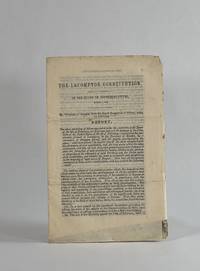
18589866Washington 1858. Unbound. near Very Good binding. Octavo. 16 pp. First edition. Unbound folded sheet forming 8 leaves. Old folds with some closed tears/silverfishing along a couple the creases; staining to the bottom margin of a a few leaves not touching text; otherwise generally a very good copy. <br /> <br /> Circumstances surrounding Kansas's Lecompton Constitution brought the tension surrounding the confluence of statehood and slavery to a new level. A pro-slavery document the Lecompton Constitution and subsequent votes on it were a fraught and dishonest affair complete with subterfuge false choices boycotted votes and more all in service of establishing a pro-slavery constitution in a state that's populace had a clear and before the end demonstrable antislavery majority. This report before the House by Georgia's Alexander Stephens soon to be Vice President of the Confederate State of America defends a December election that was widely boycotted by antislavery voters because the options presented to the electorate both allowed for slavery to persist in Kansas despite the misleading language of the referendum. By August of this same year 1858 a new vote would be held to keep or toss out the Lecompton Constitution. In a vote that demonstrated the antislavery sentiment of Kansas residents the Constitution would be thrown out by a 7 to 1 margin. Leaving space for a constitution to be drafted and ratified prohibiting slavery in Kansas. Krdlicka James F. Colonists Citizens Constitutions: Creating the American Republic. Sabin 91261. unknown
1839106839<p>Pamphlet 8vo original blue wrappers 40 viii 7 1 pp. Very slight edgewear normal aging otherwise excellent condition. The Massachusetts Anti-Slavery Society was founded in 1835 but it appears to be the successor to the New England Anti-Slavery Society founded a few years earlier in 1831. This installment gives a glimpse of the organization's membership and finances. The pamphlet also presents some of the group's resolutions including their strong rejection of the Colonization Society which wanted to send slaves back to Africa. Interestingly the society discusses "the women question" which appears to have been settled by a vote to include women as members.</p> Isaac Knapp,
1862127191862. Front Page Headline reads "The Bill Abolishing Slavery in the District of Columbia Passed the House." Newspaper "The Detroit Free Press" April 12 1862. 19" x 26" 2 pages. Has a blow by blow account of the debate among the members of the House and the various amendments associated with the bill. It concludes "The bill was passed 93 agains 39." Also includes local national and international news as well as "News From the South." Some small tears at the left hand margin not affecting text. A diagonal crease runs across the top half of the paper and a small piece of yellow tape has adhered to the top margin. Overall in very good condition. unknown
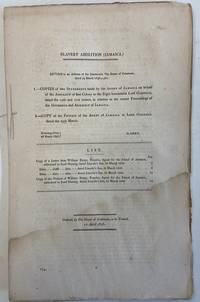
1836175381836. This pamphlet is a return to an Address of the House of Commons from March 25 1836 whereby the Agent of Jamaica William Burge protests against the unilateral abolition of slavery in the British Empire. Ordered to be printed by the House of Commons in London April 1836. 13 pages. 13" x 8.25" inches. Included within is a copy of three letters from the Agent to Lord Glenelg the British colonial secretary as well Burge's protest to Glenelg. Burge states: He is desirous that His Majesty's Government should understand that this Protest is made not as the performance of a formal act of official duty but from his conviction that the proposed legislation for Jamaica is a direct violation of the constitutional rights of that Colony rights coeval with its establishment and which have hitherto been respected." The Agent was a colonial official who was the official representative of a British colony who was based in London and acted as lobbyists and trade negotiators for the affairs of the colony. While Burge had at other times claimed to "hate" slavery he employs the British analogue of the "states rights'" argument that many moderate politicians in the United States used to signal personal distaste for slavery but to nonetheless protect the institution's existence on the basis of constitutionality. When the institution of slavery died out in the British Empire after 1836 the abolitionist movement in the US gained tremendous momentum despite the protests of our own William Burge's. This piece is overall in very good condition. unknown
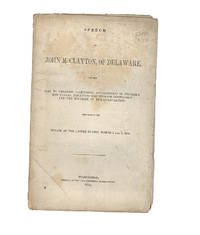
185426154Washington: Printed at the Congressional Glove Office 1854. First edition. pp. 22. 1 vols. 8vo. Self wrappers unsewn as issued. Some browning and spotting wear along spine and edges but a very good copy. First edition. pp. 22. 1 vols. 8vo. Primarily concerning the issue of slavery in the territories this speech was part of the debates for the Kansas-Nebraska Act. The act initiated by Douglas ultimately repealed the Missouri Compromise allowed the local residents to determine whether the area was free or slave territory allowed for "the doctrine of popular sovereignty of the two territories" and laid the way for a transcontental railroad. The Kansas-Nebraska Act was passed in the Senate on the 3rd of March. Clayton was a lawyer noted agriculturist and long-time member of Congress who was Secretary of State under President Taylor. As Secretary of State he is best remembered for having negotiated the Clayton-Bulwer treaty with Great Britain which provided for a neutral international canal across Central America and "contained pledges which ultimately forced Great Britain to withdraw from large tracts of territory which.it had been occupying on the Isthmus." DAB. Sabin 13576n Printed at the Congressional Glove Office unknown
1856257105Washington D.C.: Globe Office 1856. Signed by Kelsey ordering 2500 and by James Livingston for 100 and another. Old folds. Blind embossed " Platner & Porter Cobngress" staionary. Signed by Kelsey ordering 2500 and by James Livingston for 100 and another. Globe Office unknown
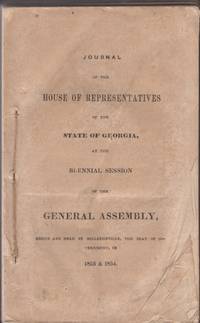
185335359n.p.: Georgia 1853. Wraps. Fair. String bound wraps. 1011 pages 1 page blank 1 37 page Index 1 page blank 1. Title page is page 1. Page 1 is toned and creased. Rear wrap is lightly toned with a few spots. Text block is not trimmed and the pages are uncut at the top edge. Moderate toning and foxing to the contents. <br /> <br /> Contents include a section on Slave and Free Persons of Color laws. Printer information or location not provided on the title page. A similar copy held by Emory University states the 1853 & 1854 Journal was printed in Savannah by S. T. Chapman. Emory's copy is has 904 pages while this copy has 1011 pages. Also Emory's copy does not have the hyphen in the word Biennial on the printed title page. Georgia unknown
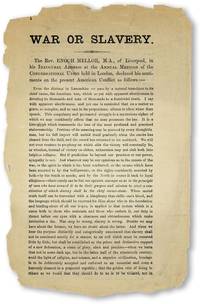
186346597Manchester: Union and Emancipation Society n.d. ca. 1863. First Edition. Original broadsheet handbill 22x13.5cm.; extremities chipped with shallow losses not approaching text the whole rather dust-soiled and unevenly toned else Good or better overall. Text reproduces an address delivered by the Rev. Enoch Mellor of Liverpool "in his INAUGURAL ADDRESS at the ANNUAL MEETING of the CONGREGATIONAL UNION held in London" in which he "declared his sentiments on the present American Conflict." Mellor 1823-1881 was the life-long minister of the non-conformist Square Congregational Church in Halifax West Yorkshire with the exception of a five-year period coinciding with this address when he succeeded the abolitionist Congregational minister Thomas Raffles 1788-1863. Mellor's argument begins with reference to the Lancashire Cotton Panic an economic depression caused by a dearth of baled cotton imports following the start of the American Civil War. Mellr goes on to say that "War /may/ be wrong slavery /is/ wrong" comparing its presence on the American continent with that of the propagation of polygamy "carefully and resolutely laid as a foundation-stone in the territory of Utah. Union and Emancipation Society unknown
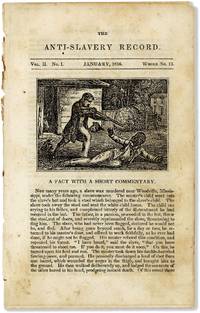
183682919New York: American Anti-Slavery Society 1836. 12mo 19cm. Stitched self-wrappers; pp.1-12. Removed; first and final leaves detached but present; light soil scattered faint foxing; tear to bottom inch of bound edge away from text; complete and Good. Woodcut decoration at head of text a strikingly violent image depicting the murder of a Black man by his enslaver in Woolville Mississippi.<br /> <br /> Single issue of this monthly abolitionist periodical that ran from 1835 to 1837 published by the American Anti-Slavery Society under the direction of Elizur Wright. It was "a small magazine with excellent woodcuts containing principally extracts from other publications" that was "distributed freely without charge" and "found its way into the schools and colleges everywhere" Dumond p.267. Wright stated that in September 1835 the Society published 25000 copies of the Record p.267. BLOCKSON 9174. LCP AFRO-AMERICANA 622. American Anti-Slavery Society unknown
185633708Philadelphia 1856. 24pp disbound three small binding holes in blank left margin. Two early signatures of Wm. Thompson Shafer on title page. Light spotting throughout. About Good. <br /> <br /> This scarce pamphlet says the "great issue" is whether "Slavery shall be allowed to overspread a territory of greater extent than that of the whole United States" and "whether the policy of our government is to continue to be that of Slavery Extension or Slavery Restriction." All the power of the presidency is "being used to force the withering and blighting scourge of Slavery upon the National domain." Pursuing this tyrannical course our government "shall lend its aid in striking a deathblow to the freedom of speech the liberty of the press and the security for life personal liberty possession and peace." <br /> LCP 4300. OCLC 22829199 4- LCP No. IL U Haverford Detroit Pub. Lib. as of April 2017. unknown
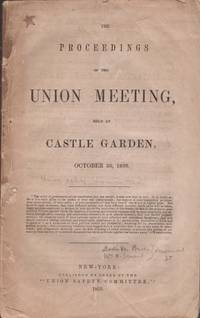
185034470New York: Joseph D. Bedford Printer 1850. Wraps. Fair. Wraps. Approximately 9" x 5.5". 62 pages. Rear cover blank and detached. Stitched contents with title on the outer wrap page 1. Paper is folded vertically. Stitching is mostly gone and the remaining stitching is frayed and loose. Light edge chips on the left edge front cover. Ink stamp upper left corner back cover "From Dusenbury & Odgen". Light toning and occasional stray pencil marks in the margins. Fair or better condition. <br /> <br /> The contents are in support of the Fugitive Slave Acts and the writer believes all Northern States should defend it even if they do not like it. The writer strongly criticizes Martin Van Buren and William Seward in the proceedings referring to them as traitors ".I refer to Martin Van Buren and William H. Seward. I know their history and their acts. I know that you would order that the name of traitor should be branded on their brows in characters so permanent as to be indelible except at the torch of the Creator on judgment day." <br /> <br /> A list of the Union Safety Committee printed on page 38. "Signatures Attached to the Call For the Union Meeting of the Citizens of New York found on page 39. Joseph D. Bedford, Printer unknown
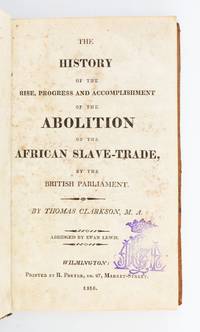
1816ST19567-131<p>Wilmington: Printed by R. Porter 1816. Abridged Edition. 180 x 115 mm. 7 x 4 1/2". 348 pp.Abridged by Evan Lewis. <br />Contemporary tree calf smooth spine with double gilt rules tan leather label with gilt lettering. With one small illustration of a seal in text. Title with crowned monogram stamp in purple ink. Sabin 13486. Calf with significant wear front hinge exposed but the binding very tight; text as expected with varying sometimes noticeable degrees of foxing and browning because of quality of paper.<br /><br />First published in two volumes in 1808 this important work on the history of the slave trade is an "invaluable" resource and "contains much essential autobiographical and other information." DNB The present edition was condensed into one volume in order to "be more generally diffused among the people of the United States" where slavery would not be abolished for another half a century. Thomas Clarkson 1760-1846 was a leading English abolitionist who advocated for an end to slavery world-wide and was an original founder of the Committee for the Abolition of the Slave Trade as well as the pacifist Society for the Promotion of Permanent and Universal Peace.</p> Printed by R. Porter
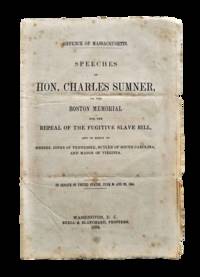
1854176351854. Abolition African Americana SUMNER Charles. Defence of Massachusetts. Speeches of Hon. Charles Sumner on the Boston Memorial for the Repeal of the Fugitive Slave Bill and in Reply To Messrs. Jones of Tennessee Butler of South Carolina And Mason of Virginia in the Senate of the United States June 26 and 28 1854. Washington D.C.: Buell & Blanchard Printers 1854. At the time that this description is being written just three copies are recorded in American institutions. OCLC search results are at best an estimate and can vary over time. The Memorial referred to in the title was a request by 2900 undersigners chiefly men of Boston Mass. to repeal the Fugitive Slave Bill of 1850. What follows is a transcription of Massachusetts Senator and famous abolitionist Charles Sumner's speeches in the ensuing debate: "Mr Jones. asks 'Can anyone suppose that if the Fugitive Slave Act be repealed this Union can exist' To which I reply at once that if the Union in any way be dependent on an Act-- I cannot call it a law-- so revolting in every regard as to that which he refers then it ought not to exist." Sumner goes on to argue amongst other things that the Fugitive Slave Act is parallel to the hated Stamp Act that sparked the Revolutionary War as well as to make spirited rebukes against the pro-slavery Senators Butler Mason and Jones: "The veteran Senator from Virginia Mr. Mason complained that I had characterized one of his "constituents" a person who went all the way from Virginia to Boston in pursuit of a slave as a Slave-Hunter. Sire I choose to call things by their right names. White I call white and black I call black. And where a person degrades himself to the work of chasing a fellow man who under the guidance of the north star has saught a freeman's home far away from the cofle and the chain that person whomsoever he may be I call a Slave-Hunter." Eight sheets folded to make one sixteen-page signature which is stitched along the left edge. Foxing throguhout pages chipped along margins. Dampstaining along two page edges. Delicate but in good condition. <br /> <br /> Charles Sumner January 6 1811 - March 11 1874 was an American statesman and United States Senator from Massachusetts. As an academic lawyer and a powerful orator Sumner was the leader of the anti-slavery forces in the state and a leader of the Radical Republicans in the U.S. Senate during the American Civil War. During Reconstruction he fought to minimize the power of the ex-Confederates and guarantee equal rights to the freedmen. During the war he was a leader of the Radical Republican faction that criticized President Lincoln for being too moderate on the South. Sumner specialized in foreign affairs and worked closely with Lincoln to ensure the British and the French refrained from intervening on the side of the Confederacy during the Civil War. As the chief Radical leader in the Senate during Reconstruction Sumner fought hard to provide equal civil and voting rights for the freedmen on the grounds that "consent of the governed" was a basic principle of American republicanism and to block ex-Confederates from power so they would not reverse the gains made from the Union's victory in the Civil War. unknown