[Slavery]Biblio.com
224 résultats
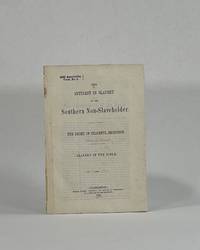
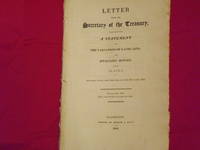
1816100537Pamphlet formate folio disbound first pamphlet 3 leaves printed on recto only second 7pp. third 6 pages and folding chart. Pamphlet extracted from larger volumne chipping along spine and edges not affecting text second papmple completely disbound paper browned and somewhat dry These pamphlets are rare and represent an important source of information on the numbers and values of slaves in early 19th century America. The first title presents the value assigned to slaves in 11 states including New York. The second lists the number and values of slaves in the various counties in the state of Maryland. The final pamphlet presents real estate values and values on dwellings including slaves in the counties of Pennsylvania. The information in these reports was compiled by Alexander James Dallas 1759-1817 who was the Secretary of the Treasury. Dallas born in Kingston Jamaica settled in Pennsylvania and practiced law there. Eventually he would become Secretary of the Treasury in 1814 when the nation was almost bankrupt. He managed to reorganize the department get the country out of debt created a surplus and even helped promote what would become the Second Bank of the United States. ANB. William A. Davis,
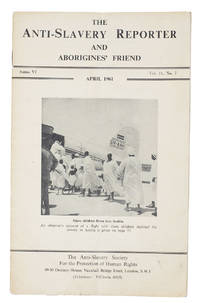
1961ABC_45244London: Anti-slavery and Aborigines Protection Society 1961. Original pictorial wrappers. Vol. 2 no. 7 April 1961. Pamphlet journal which includes obituaries articles reports news and reviews. Cover photo shows Nigerian children boarding a plane for Saudi Arabia where a story on page 73 states that they are to be sold as slaves to cover the costs of pilgrimage. A vertical crease some slight wear. Otherwise in good condition. Anti-slavery and Aborigines Protection Society, unknown
23092Without date or place. 3pp. 12mo. Bifolium on ruled laid paper. Fair: aged with a 12.5 x 5 cm section cut away from the top of the first leaf before the writing out of the poem. 63 lines divided into six nine-line stanzas. The stanzas are numbered and the poem is complete. The stanzas are numbered and the poem is complete. Written from the slave's point of view with the first stanza reading: 'I'm weary yet I cannot sleep Dark thoughts of morning make me weep For at the rising Sun I'm told I'll be converted into gold There's no escape I must be sold Because my master wants the gold And I'm his Slave yes I'm his Slave Because my master wants the gold And I'm his slave'. Last stanza describing the slave's flight to Canada: 'At last my dreadful journeys o'er I'm safe upon the farther shore St Georges cross floats over me I've found the land of Liberty. My youths renewed no more I'm old That fear is gone of being sold For now I'm Free Yes now I'm Free The fear is gone of being sold For now I'm Free.' No indication has been found that the poem was ever published. Without date or place. unknown
183560564New York: Printed by William S. Dorr No. 70 Fulton Street 1835. 8vo. 87 1 pp. Printed blue-green publisher’s softcovers contents on back cover punch-sewn at gutter margin as issued minor edgewear slight chipping to spine 1 closed tear w/ minor archival repair on inner back cover still VG- copy. First edition of this surprisingly uncommon report of the second meeting of this pioneering American abolitionist society founded by William Lloyd Garrison editor of The Liberator magazine and Arthur Tappan while also featuring contributions by Frederick Douglass and William Wells Brown an African-American freedman. The society was very controversial as by the mid-1830’s slavery was ensconced into the American economy feeding wealth not only to Southern planters but also Northern merchants textile factory owners and shipowners. The first meeting and later misrepresentation had set off violent the violent Farren riots in New York where abolitionists homes and properties were attacked. The 1835 meeting not only agreed on the Society Constitution but also used fundraising to sponsor a great postal campaign to flood the South with Abolitionist literature. White supremacists responded by seizing and destroying the mail and on July 29 1835 3000 people gathered to burn Abolitionist writings and burn three in effigy. The speeches detail the progress of the result of Great Britain freeing 800000 slaves encouraging continued efforts to enroll African-American children and freed slaves into schools and declared that “prejudice which excludes our colored brethren from the rights and privileges of Men the Society lays the axe at the root of slavery. It removes the final bugbear that ‘the Slaves will be worse off when emancipated.’†This also features the extended interview and discussion with Abolitionist former slaveholder James Gillespie Briney 1792-1857 who freed his slaves joined the American Anti-Slavery Society and founded The Philanthropist in Cincinnati OH in 1835 after selling his plantation. Worldcat locates 5 physical copies Cornell DLC NYPL Howard AAS Lib. Printed by William S. Dorr, No. 70 Fulton Street, paperback
187561084New York: Harper and Brothers 1875. First American Edition. Octavo 24cm. Green cloth stamped in gilt; brown coated endpapers; 542pp; steel-engraved frontispiece 2 wood-enraved frontispieces 2 color maps 1 folding and 48 wood-engraved plates all with tissue guards. Inscribed "Charles V. Payne from his friend M. R. E. Christmas 1874" on front free endpaper; the same inscription is repeated with the date 1875 on a front flyleaf. A sound copy externally rubbed with superficial silverfishing to both boards internally clean with two central gatherings pulled but not fully detached short tear to folding map at gutter: just Very Good. <br /> <br /> Samuel Baker 1821-1893 was a noted British explorer of Africa. In 1860 he was appointed "governor-general of the equatorial Nile basin" by the Khedive Ismail of Egypt with duties including "annexing the equatorial Nile basin establishing Egyptian authority over the region south of Gondokoro suppressing the slave trade" and more ODNB. His success was mixed: he successfully annexed Gondokoro and did suppress the slave trade but failed to establish secure control of the region ODNB. This account published after his return to England details how he "raised and trained a fighting force.to crush" the slave trade Czech. CZECH p.11. Harper and Brothers unknown
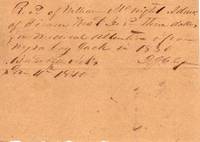
184012966Batesville AR: January 11 1840. 1p. 4 x 5.5 inches docketed on verso. Old horizontal fold toning. Very good. An interesting manuscript record of slave care in Arkansas in the 1830s. The short but impactful document reads in full: "Recd of William McNight Admin. Of Hiram West Decd three dollars for medical attention upon negro boy Jack in 1836. Batesville Ark. Jan 11 1840 DJ Chipman." Such documents are increasingly rare in the market and more uncommon than slave sale documents from the same period. Arkansas has just achieved statehood four years before the presetn document was written. January 11 unknown
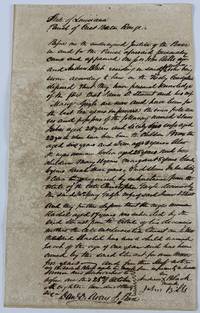
183613107East Baton Rouge Parish LA: October 25 1836. 1p. on a single folded sheet integral blank docketed on verso. Old folds moderate toning and foxing short closed tear along one fold line a few small instances of ink burn. Overall good condition. An interesting document of legal testimony involving numerous named slaves in Louisiana in 1836 ranging in age from one year to almost thirty years of age and including seven children. According to the docketing the document is effectively a "Title to Slaves." The deponents were two local citizens John Bills and Andrew Black who had "personal knowledge of the fact that James D. Stuart and his wife Mary Gayle are now and have been for the last ten years & upwards the bona fide owners and possessors of the following named slaves: Juba Aged 25 and Sicily his wife aged 22 to whom have been born the children Braxton aged six years and Dan aged 3 years. Also the negro woman Celia aged 28 years and her children Mary 11 years Margaret 8 years Charley 6 years Sarah three years which slaves Juba Sicily & Celia were acquired by inheritance from the estate of Christopher Gayle. And they further depose that the negro woman Rachel aged 17 years was inherited by the said Stuart from the estate of his deceased mother.and that the said Rachel has now a child named Jacob of the age of one year." The document is signed by Black Bills and the Justice of the Peace Daniel D. Avery. Documents involving slave inheritance of and subsequent ownership by not one but both members of a marriage are exceedingly rare. October 25 unknown
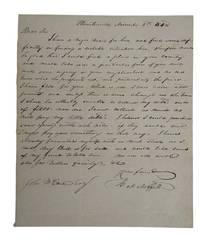
1842209651842. Slavery North Carolina Letter signed offering a "negro man" to settle debts. Letter signed by "H.M. Moffett" of Huntersville Virginia now West Virginia. Dated November 8th 1842. Measures 9.5" by 7.75". The letter reads in full: "Dear Sir I have a negro man for hire and find some difficulty in finding a suitable situation here therefore would be glad that I could find a place in your country and would take in as a particular favor if you will make some inquiring in your neighborhood and let me know what the prospects are and particularly the price- I have $200 for you which is all I can raise at present and unless their is some change in the times I shall be utterly unable to collect my debts of $1600 now due. I can't collect as much as will pay my little debts. I believe I could purchase some young cattle with notes if they would . I might pay you something in that negro sic. I have already furnished myself with as much stock as I need my Bull is for sale and would like some of my friends to take him. We are all well also Jan sic Millers family - . -- your friend H.M. Moffett." The letter was likely penned by Henry Hiller Moffett second Clerk of Pocahontas county Virginia present day West Virginia. Moffett is listed in the 1850 census with eight enslaved persons. Original folds some minor foxing. Overall very good condition. unknown
184618128London; Chapman Brothers. 1846. The True 1st Edition. Hardback. Very good copy in the original blind-blocked fine-ribbed cloth. Minor nick to the spine crown with the usual dust-dulling to the bands and panel edges. Remains an uncommonly well-preserved example of a scarce and seminal title; 296 pages; Physical desc. : 296 p. ; 22 cm. Intended by the publisher as the first in a 'Library' of political and literary importance for discerning readers. Subject: Slaves - United States - Social conditions. The Clarke Family Narrative - Witness accounts - Jonathan Walker's Trial - etc. London; Chapman Brothers. hardcover
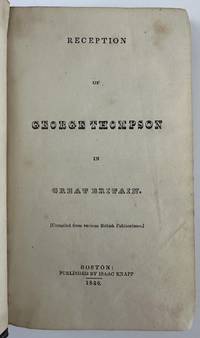
18361691Boston: Isaac Knapp 1836. About very good. xvi13-238pp. 12mo. Original publisher's blue boards with black sheep spine gilt. Boards rubbed corners and spine moderately worn. Text lightly foxed. Scarce work addressing the anti-slavery work of George Thompson following his visit to America. Thompson 1804-1878 was British lecturer and reformer who worked as a commercial clerk. "Thompson first came to prominence in 1831 when he was recruited by the London Anti-Slavery Society's Agency Committee as an itinerant lecturer. In the run up to the Emancipation Act of 1833 he became the most effective British anti-slavery lecturer since Thomas Clarkson. With the struggle against British slavery apparently won Thompson was instrumental in reorienting anti-slavery effort towards the Americas and particularly the United States. . In 1834 he encountered the charismatic American abolitionist William Lloyd Garrison. Recognizing Thompson's talent Garrison invited him to travel to the United States with his growing family to labour there on behalf of the enslaved people of America" - DNB. <br /> <br /> Thompson employed sarcasm and vitriol in his orations attacking anti-abolitionist sentiment across the northern states. In the process he failed to make very many friends or converts and alienated those with more moderate views. "Opponents attacked him as a foreign interloper and an anti-American agitator. They also discovered a scandal in Thompson's past alleging that in 1829 he had absconded with £80 embezzled from his employer. His supporters angrily rejected this charge though Thompson later privately admitted it was true he eventually repaid the sum in full. Hostility increasingly turned violent and in fear of his life he was smuggled out of the country in October 1835 returning to a hero's welcome in Britain" - DNB.<br /> <br /> This work is a rebuttal made by Thompson's American supporters aggregating information from British sources to defend his good name and abolitionist efforts after fleeing America for his homeland. It includes some of Thompson's speeches on slavery in America given before audiences in Scotland and England and discusses his work with the American Anti-Slavery Society. Though there are a handful of institutional copies the work is scarce on the market and does not appear in auction records over the pasty forty years.<br /> <br /> Sabin 9324. American Imprints 36449. Isaac Knapp unknown
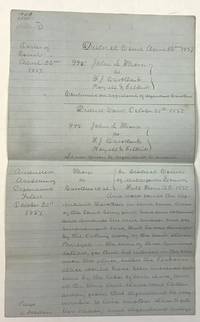
1850106404<p>Folio manuscript legal sheets 11 pp. plus docketing on final back sheet. Traces of wax in some margins. Paper is browned and aged some minor creasing at folds margin hole on a couple of pages not affecting text; otherwise very good. This is a very complex legal case about the ownership of two slaves. These manuscript documents are signed by the three Constables deposed as witnesses. The testimony is taken at the law offices of Lysander G. Gordon. It seems that an individual who owed people money was forced to give the slaves to a sheriff and were then sold to William Knox in Southern Tennessee. However it appears that the slaves actually belonged to someone else. These documents try to sort though this mess. </p>
1807190225London: W. Flint 1807. First edition published soon after the abolition of the slave trade in the British Empire appealing for Britain to make the international end of the trade a core part of its aims in the ongoing Napoleonic Wars. Quarto 248 x 194 mm 4 pp. Recent white and grey boards printed paper label to front cover. Light stain at bottom fore corner and light spotting: a good copy. hardcover
18609565Charleston: Steam-Power Presses of Evans & Cogswell 1860. Disbound. Very Good binding. Octavo. 30 2 blank pp. First edition. Removed from binding. Vertical crease from old fold; a few instances of pencil bracketing; De Bow's name is penciled in on the title page by a later hand. Generally a well preserved copy. <br /> <br /> One of a series of pamphlet issued by Charleston's "1860 Association" a group of wealthy slave-holders who moved to promote immediate secession. In this tract De Bow a Charlestonian by birth who was living and publishing pro-Southern essays in his New Orleans Commercial Review of the South and Southwest offers and economic argument about the "benefits" of slavery on the Southern worker's wages and working condition. De Bow's essay is followed by extracts from an article on the rights of secession as well as lengthy extracts from a sermon by Rev. Henry J. Van Dyke "The Character and Influence of Abolitionism" in which this Northern pastor argues that abolitionism has no Biblical foundation and that its principles are misrepresented for men's gain. Uncommon in commerce. Parrish & Willingham 5330; Confederate Hundred 28; Work p. 399; Afro-Americana 5157; Turnbull III p. 298. Steam-Power Presses of Evans & Cogswell unknown
1842106407<p>Folded letter sheet four pages and remnant of wax seal. Creases at folds normal aging; otherwise very good or better. The letter is to Henry J. Carter Stockbridge Mass. from his brother. An unemployed 20 year-old Massachusetts teacher who had left home the year before in "exceeding hard times" Edward had gone to Baltimore – where some 50 teachers were out of work – and taken a job working for a wealthy man who had 4 acres of farm land worked by slaves. "…he has given me the office of overseer to look after the blacks in their work. O but you ought to see me walk over the lot with my cane in my hand to see how my work is going on. Then you ought to see the darky when he wants anything of me come up and take off his hat before he speaks…" Praising the "fine folks live in this beautiful part of the world" Carter proves that even a Massachusetts Yankee could quickly adapt to Southern culture and make peace with slavery. The letter is unsigned. </p>
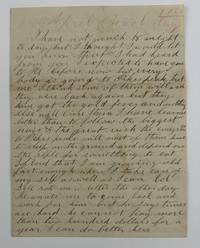
18604105Missouri: April 1 1860. Very good. 4pp. on a single folded sheet. Original mailing folds minor toning. An informative letter written by Charles H. Cram in Missouri to a friend in New England dated "April Fools Day 1860" in red pencil at the top of the first page. Cram mentions hoop skirts Pike's Peak and slavery while trying to decide whether to continue westward during the latter years of the California Gold Rush. Cram's letter reads in part: "Everybody is going to Pikes Peak but me. I think some of them will wish they were back again but they have got the gold fever and nothing else will cure them. I have learned better than to follow the biggest nois and the great rush. The emigrants to Pikes Peake will most of them will have to sleep on the ground and depend on the rifle for something to eat. I may start for Santa Fe about the first of June. I can git 15 dollars a month to drive a teem to Santa Fe. If I do cross the plains I shall go to California but if I have good health I shall stay here though I do not like to live in a slave state."<br /> <br /> In another portion of his letter Cram addresses his correspondent's question of whether slaves and freedpersons wore hoop skirts in Missouri. Cram writes: "You wanted to know if niggers wore hoops. Some do and some don't some slaves in broadcloth and silk and some go nearly naked. Slaves have there stent to do so much & if they do more they are payed for it. Most of them have a piece of ground that they call their own. What time they get they work on it. That is how they git their fine cloths. There is not a nigger in Missouri that works as hard as I do but I have consolation that I can work only when I am a mind to. You tell Albert not to start out among strangers as I did for he will find the people different in the country from them in New England."<br /> <br /> Cram then speaks to the emigrant populations he encounters out west as well as the agricultural bounty and animal life of Missouri: "The greatest difficulty I had was to learn the French and German language. I have been for weeks where I could not understand a word but now I can understand anything that comes along. But now for something else. The peach trees are in flower and the woods look green. Cattle and horses pick their living here the year round. I have not seen a barn in the country. The way to feed a horse is to tie him up to a tree and throw him a few ears of corn on the ground. I cannot rite to day much for there is half a dozen in the room talking about pikes peak or some young lady and how many negroes her father owns etc."<br /> <br /> Cram ends his letter with some advice for his friends back east: "Tell Mr. Bosworth that if he can rais $500 that he had better go to Cansas Kansas and go to farming. If you can persuade Andrew Marshall to go west it will be a good lesson for him."<br /> <br /> A mid-19th century manuscript letter with informative observations on the clothing of slaves and with notable observations of western life in Missouri. April 1 unknown
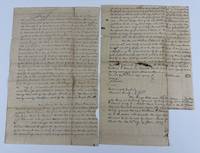
18393013Washington D.C. 1839. Fair. 3pp. Large folio. Separated into six pieces with a very small section of the final attestation lacking altogether. Still highly readable. A wounded but important document. A rare and historically-important document relating to slavery in the District of Columbia which was outlawed on April 16 1862 nearly nine months before the issuance of the Emancipation Proclamation. The present document is an indenture made between William G. Howison and Alexander Hunter Esquire both citizens of Washington D.C. associated with property conveyed to Hunter by the deceased Joseph Birch. In 1824 Birch conveyed to Hunter land "and also a negro man slave for life named Lewis - another named George - two horses - 4 cows - 3 calves." The document indicates that Lewis was subsequently sold for four hundred dollars and George was sold to Birch in his lifetime. Documents recording the movement of slaves within the District especially among two citizens of the city are rare in the market. unknown
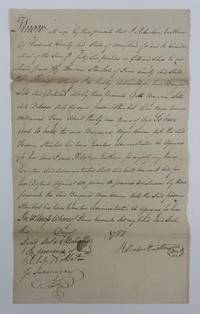
17884111Frederick County Md: March 7 1788. About very good. 1p. folio docketed on verso. Old folds short splits along a couple of fold lines minor toning. An impactful manuscript document from the early national period in Maryland formalizing the sale of a slave woman in Frederick County. The sale was made by Robertson Eastburn whose family emigrated from England to Maryland in the early 18th century. The document reads in part: "In consideration of the sum of forty six pounds in Gold and Silver to me in hand and paid by Frederic Strombol.I do hereby Acknowledge have Bargain'd Sold and Delivered and by these presents doth Bargain Sell and Deliver Unto the said Frederic Strombol One Negro Woman named Torry about thirty years of age To Have and to hold the said Bargained Negro woman unto the said Frederic Strombol."<br /> <br /> Slavery in Maryland lasted over 200 years from its beginnings in 1642 when the first Africans were brought as slaves to St. Mary's City to its end following the Civil War. In 1664 under the governorship of Charles Calvert 3rd Baron Baltimore the Assembly ruled that all enslaved people should be held in slavery for life and that children of enslaved mothers should also be held to the same standard of law. 19th-century American slave sale documents are growing increasingly scarce in the market. March 7 unknown
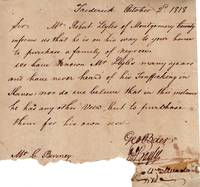
181812956Frederick MD: October 2 1818. 1p. docketed on verso. Roughly torn along bottom edge minor foxing and spotting. Good condition. An uncommon document in Maryland slave history in which George Baer the future mayor of Frederick and a few other men attest that another local citizen named Robert Lyles is not a slave trader. The document reads in part: "Lyles is on his way to your house to purchase a family of negroes. We have known Mr. Lyles many years and have never heard of his Trafficking in Slaves nor do we believe that in this instance he has any other view but to purchase them for his own use." Baer served as mayor of Frederick from 1820 to 1823; his correspondent "C. Burney" is perhaps Clotworthy Birney 1765-1845 a farmer and real estate trader living near Taney Town. An unusual Maryland slave document concerning a slave owner who just wants to buy slaves for his own use not traffic in them because that's somehow better. October 2 unknown
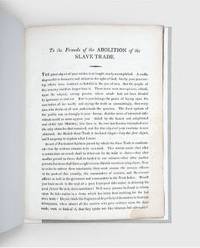
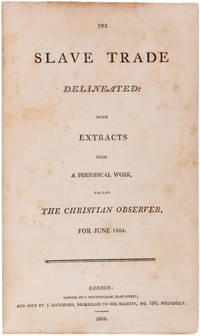
180521055261805. London: Whittingham for Hatchard. 1805. 8vo. Recent marbled wrappers; pp. 20 printed in two columns; one corner of title-page clipped light browning; a good copy of a great rarity.This combined offprint opens with a first-hand report by 'Leo Africanus' of a journey recently made on a slave ship from West Africa to the West Indies. On board the ship the Captian told the visitors and traveller 'that a slave ship was a very different thing from what it had been represented. We should find the slaves rejoicing in their happy state' p. 3. The truth however showed the sheer horror of this crime against humanity at high sea. This is followed on page ten by a discussion of a Hatchard-published pamphlet on the abolition of the slave trade. The present pamphlet is concluded by the refutation of the printed Letter to the Right Honorable W.Pitt containing some new Arguments against the Abolition of the Slave Trade in which the author Britannicus had argued 'if we give freedom to the negroes we shall ourselves indubitable become slaves of Bonaparte' p. 13. Post-truth over two hundred years ago. unknown
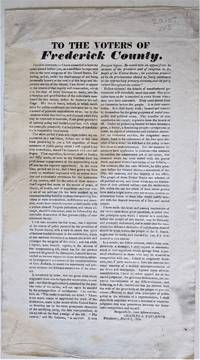
1833713Winchester Va. 1833. Broadside 4to. 290 x 160 mm. 11 ¼ x 6 ¼ inches. Printed in two columns signed in type by Charles J. Faulkner at Winchester dated March 8 1833 at conclusion. Lightly dust-soiled pale stain affecting perhaps one-third of the left-hand margin and column of text. Neatly silked on verso. Withal about very good. Following the August 1831 Nat Turner rebellion in Southampton County a last effort was made by moderate Virginians to gradually abolish slavery. Faulkner a 26-year-old lawyer and assemblyman along with Thomas Jefferson Randolph sponsored legislation to free all children born of slave parents after July 4 1840. His speech emphasized the evil of slavery for Southern white labor noting that slavery "converts the energy of the community into indolence--its power into imbecility--its efficiency into weakness.Shall society suffer that the slave-holder may continue to gather his crop of human flesh" As the Assembly was malapportioned in favor of the Tidewater slaveocracy the proposal lost rather narrowly and nearly thirty years later the Confederacy was assured of Virginia's succession. It is perhaps not surprising that Faulkner "comparatively a stranger" to the county but a member of the Virginia House of Delegates at this time 1831-34 was not successful in his campaign to represent Virginia in the U.S. Senate. However Faulkner was elected to three terms in Congress from Virginia in the 1850s. He was elected to Congress from West Virginia after the Civil War. In the interim he served as Minister to France during the Buchanan administration and on the staff of Stonewall Jackson. Dictionary of American Biography. Not in Hummel. Not found in American Imprints for 1833 and not in the 1830-1839 title index. OCLC records four copies at The Library of Virginia University of Virginia Virginia Historical Society and American Antiquarian Society. unknown
185740346Matagorda County Texas 1857. Six pages in neat ink manuscript on lined pale blue legal paper. Fine. The document is probably the record for Carothers' appeal of the Court's judgment in favor of Thorn.<br /> <br /> The parties having waived a jury trial the Court found in favor of Thorn the Plaintiff. In addition to the failure to pay Thorn for the hire of Taswell Thorn claimed that Carothers had failed to pay $100 rent to Thorn for farming on Thorn's property. <br /> Carothers said that the slave Bridget upon whom Carothers had relied for performing work on the property had been "taken away" apparently by Thorn during the term of the agreement. Bridget's absence Carothers said caused his nonperformance and thus excused his failure to pay. The Court disagreed and ordered Carothers to pay the amount of the notes plus costs and interest. unknown
188452888Boston: Printed by the Order of the City Council 1884. First Edition. Small quarto 26.5cm; marbled paper over navy blue calf spine in seven compartments with six raised bands leather labels titling and decorative elements stamped in gilt on spine; marbled endpapers; engraved portrait frontispiece1011-70 with an additional 31 leaves bound in. Armorial bookplate of Walter Merriam Pratt on front pastedown. Re-backed with the original spine laid down; light wear to upper and lower board edges with some touch-up to leather at crown and heel; Very Good. A grangerized copy containing 22 ANS and ALS ca.1-4pp one autograph sentiment a 4.25" x 6.5" cabinet card signed by Phillips and several clipped portraits of various sizes depicting Phillips his wife and his son in uniform. Most prominent among the letters are those written to G.W. Putnam 6 H.G. Denny 2 R.L. Winthrop 2 John Boyle O'Reilly 1 and an October 8 1853 ALS to abolitionist and social reformer Gerrit Smith in which he claims to have mislaid his letter but is available to come to Brooklyn either on 15 December or 5 January 1854 and that his fee would be fifty dollars. Handsome volume memorializing American abolitionist and orator Wendell Phillips 1811-1884 commissioned by the City of Boston in an edition of 5000 copies. Nearly half the text is comprised of the eulogy by George William Curtis and includes extensive remarks by city council members and aldermen a prayer by Rev. Minot J. Savage an address by the Mayor and a poem by Mrs. Mary E. Blake. A proud son of Boston Phillips abandoned a career in law after being converted to the cause of abolitionism by William Lloyd Garrison in 1836. He was a frequent speaker at meetings of the American Anti-Slavery Society active in the free-produce movement a member of the Boston Vigilance Committee and an early advocate of women's rights. Later in life he turned considerable effort towards gaining equal rights for Native Americans and together with Helen Hunt Jackson and Massachusetts Governor William Claflin helped found the Massachusetts Indian Commission. cf.BAL 4347. Printed by the Order of the City Council unknown
186063532New York: Published and for sale at 5 Beekman Street 1860. First Edition. 12mo. 20th-c. binding of tan calf over paper-covered boards; marbled page edges; 951pp. About fine and complete; the pamphlet appears to have been offered without cover wrappers in any case not noted by Blanck.<br /> <br /> Uncommon first edition of this late tract by the important abolitionist and feminist Lydia Maria Child 1802-1880. Child's intention with this work was to make a direct case to southern slaveholders based not on any moral grounds but purely on business hoping that the Caribbean example would convince southerners that abolition could be achieved without wrecking their economy. "Child suggested to Samuel B. May the publisher .that the title page omit any mention of the American Anti-slavery Society giving only an address but no publisher. She even considered issuing the tract anyonymously but decided that her notoriety would probably help rather than hinder its circulation" see Karcher The First Woman in the Republic: a Cultural Biography of Lydia Maria Child. Durham 1994; p.428ff. Blanck notes two editions in 1860 as well as a reissue in 1862; this with verso of the final leaf unprinted is the first. Rarely encountered in commerce. BAL 3189. Published and for sale at 5 Beekman Street unknown
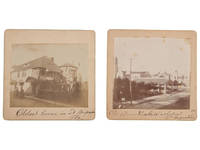
1897185871897. Albumen photographs of slavery-related sites circa 1890s document physical locations tied to the sale and habitation of enslaved people in the United States and the persistence of those sites in post-Emancipation visual culture. The images include a pavilion in St. Augustine Florida identified in contemporary sources as a site where enslaved Africans were bought and sold a photographic negative depicting outbuildings identified as Mississippi slave quarters and a mounted view of the González Alvarez House a colonial structure associated with early settlement in St. Augustine. Together the photographs provide material evidence of how spaces connected to slavery were recorded labeled and circulated in the late nineteenth century linking architectural survival to the historical memory of enslavement in both the Southeast and the Gulf South.<br /> <br /> Collection of three albumen photographs. United States circa 1890s. One mounted photograph approximately 3 3/16 x 3 inches bears the ink inscription "Old Slave Market Cathedral St. Augustine Fla." and depicts the waterfront pavilion constructed in the early nineteenth century originally used as a commercial market and identified in local records as a site of slave trading. One photographic negative approximately 3 1/2 x 3 3/4 inches shows three small structures identified as Mississippi slave quarters. One mounted photograph approximately 3 1/8 x 2 5/8 inches is inscribed "Oldest house in St. Augustine Fla. Built in the early 1700s" depicting the González Alvarez House. Mounts and inscriptions indicate a documentary intent linking the images to historically significant sites.<br /> <br /> By the late nineteenth century sites associated with slavery were being reframed within local historical narratives often presented as landmarks while still retaining traces of their earlier function within systems of forced labor and sale. The identification of the St. Augustine pavilion as a slave market in inscription and record aligns the image with documented urban sites of sale in Spanish and later American Florida while the Mississippi quarters image extends the archive into the plantation landscape of the postbellum South. The grouping provides a concise visual record of how structures tied to enslavement were preserved interpreted and circulated in photographic form decades after abolition. Minor adhesive residue to one mount small tear to negative and light toning and staining to mounts; overall good condition. unknown
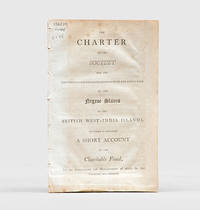
1794126550London no printer 1794 or later. First edition variously dated by ESTC and WorldCat between 1794 the date given at the end of the preliminary "Short Account of the origin and present state of the charitable fund" and 1823. The short account dated March 1794 is followed by a tipped in leaf reporting on the first meeting of the society which took place on Thursday April 3 1794 electing the Lord Bishop of London as president. The Charter of the Society 18 pages in length is dated at Westminster "this thirtieth Day of October in the thirty-fourth Year of our Reign" which again falls in 1794. Octavo 190 x 123 mm pp. ix 18. Sometime in a pamphlet vol. now disbound. Spine shows evidence of earlier binding sometime folded vertically; title lightly dust soiled page ix trimmed down and tipped onto p. viii; a good copy. Sabin 85881. unknown