(Slavery)Biblio.com
224 résultats
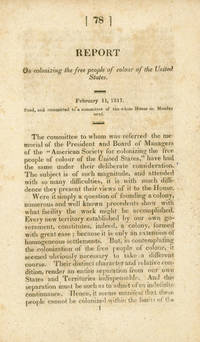
18179350Washington City 1817. First Edition. 5 pp. 1 vols. 8vo. Disbound. Some foxing. First Edition. 5 pp. 1 vols. 8vo. First edition of the government's reply to the request of a group of Virginia planters for a "colony" to essentially rid them of the problem of "free coloured people." In December of 1816 a group of Virginia planters approached the government with a request asking for a location where freed blacks might be sent. In January this "memorial" was presented and in February it was answered with this "Report." This reply discusses location etc. In the end the government officially refused to have anything to do with the plan - thus the American Colonization Society was born. For a detailed account of these events see Dumond Anti-Slavery pp. 126-127. S&S 42738 2 copies unknown
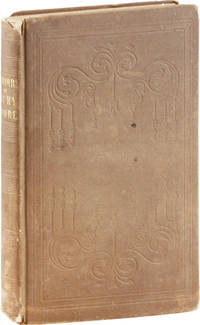
184657411Boston: Anti-Slavery Office 1846. Sixth Edition. Two volumes bound in one; small octavo 20cm.; publisher's embossed cloth titled in gilt on spine1231115pp. Slight rubbing and wear to cloth heavier at board corners and with small loss at crown of spine; text tight and unmarked but moderately foxed; sound and Good. Contemporary ownership signature "Lucia A Haynes" to front free endpaper. <br /> <br /> A popular and much-reprinted anti-slavery novel though its sensational portrayal of an incestuous triangle between the protagonist Archy his sister Cassy and their father Colonel Moore generally inspired disgust more than abolitionist sympathy among contemporary reviewers. However the novel did provide "first-hand observation of Southern plantation life and slavery conditions" Friedland p. 129 based on the two years the author spent in Florida for the benefit of his health. For additional information see Louis S. Friedland "Richard Hildreth's Minor Works" in "The Papers of the Bibliographical Society of America" Vol. 40 no. 2 2nd Quarter 1946. LCP AFRO-AMERICANA 4798-4800 for other editions; SABIN 31790; WRIGHT I 1189. Anti-Slavery Office unknown
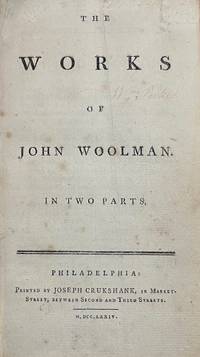
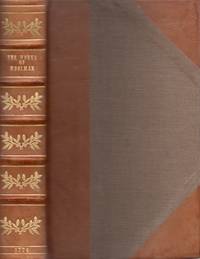
177435034Philadelphia: Joseph Crukshank 1774. First Edition. Leather bound. Fair. Octavo. 1 xiv 2 436 pages 1. Polished calf leather covers. Chipped title on the spine. Missing a section of leather bottom spine and another section is coming loose. Front cover is detached. Text lightly toned with scattered light brown stains. <br /> <br /> Two title pages with continuos pagination. Chapter in part 2 pages 279-311 is titled "Considerations On the Keeping of Negroes." This first edition was published after the death of Woolman 1720-1772. Several later editions have been published. John Woolman was a Quaker minister and early abolitionist. He traveled to England in 1772 to promote the abolition of Slavery but died soon after arriving in England. He is buried in York. <br /> <br /> Howes W 669; Sabin 10524. Joseph Crukshank unknown
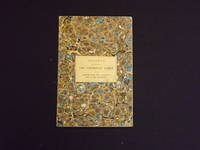
18361005398vo pamphlet marbeled wrappers with printed label on front cover 32 pp.some minor spine snd edge wear slight aging; very good or better.The work begins with the original source of funds for its "Charitable Fund" which began with estate of Robert Boyle in 1691. Since the 500000 Negro Slaves in the West Indies were mostly "infidels and heathens" converting them to Christianity would be doing them a favor and help the empire.Converting the slaves to Christianity would make them more virtuous more comfortable offer them a prospect of eternall happines and even make them better servants. Richard Clay,
183094792Circa 1830s. 1830s. Good . - The close of a letter on a 3-1/4 inch high by approximately 6 inch wide piece of note paper is signed "Geo Thompson". The paper is darkened with some staining not affecting the signature. The paper is mounted on a sheet of yellow paper and has been folded twice for mailing. Good. <p>The British antislavery orator and activist George Donisthorpe Thompson 1804-1878 worked toward the abolition of slavery through lecture tours and by introducing legislation while serving as a member of Parliament. An able orator he was hired by the London Anti-Slavery Society in 1831. While in Scotland in 1832 where he became interested in abolishing slavery in the United States as well as other parts of the world he met William Lloyd Garrison and the African-American abolitionist Nathaniel Paul. Invited to visit New England by Garrison he traveled to the US in 1834 where he drew the attention of pro-slavery supporters and was forced to flee for his life. The Hobart Town Courier later printed a letter in which Thompson stated that he had ".left the United Sates to escape the assassins knife." the editor noting that attempts had been made to "burn and murder" him in several US towns. He returned to the US following the passing of the Fugitive Slave Law in 1850. By then the abolitionist movement having substantially grown and gained in influence Thompson found a warmer welcome. Returning to London he and his son founded the London Emancipation Society which supported the Union during the Civil War. Returning to America he allied himself with William Wells Brown and met President Abraham Lincoln. Throughout his life Thompson was a powerful voice for emancipation. He supported East Indian reform free trade Chartism non-resistance and the peace movement often protesting legislation that offered only limited restrictions on slavery.<p>RARE. Circa [1830s]. unknown
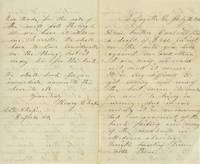
1861Cat338Lafayette Ohio 1861. Autograph letter signed 2 pp. Addressed to D. T. Chapin of Enfield Connecticut. Good condition with normal folds and light wear. A concise but revealing early Civil War letter combining financial anxiety agricultural reporting and clear-eyed political commentary on slavery and the future course of the conflict. Writing amid the first months of the American Civil War Chapin opens with the immediate purpose of the letter—forwarding “a draft of $240 for int. on the noteâ€â€”before situating the payment within a deteriorating economic landscape: “It is very difficult to get money now even of the best men.†He describes a local economy under strain noting “no market for wool to bring in money†compounded by regional instability “on account of the bank failing and many of the merchants in Medina closing†concluding bluntly: “Terrible bursting times with them.†Even the act of sending funds carries uncertainty as he cautions that “in these times I consider there is a risk in the best of banks.†Alongside these concerns Chapin provides a snapshot of agricultural conditions: “Corn is very backward and short wheat nearly middling grass rather below middling†summing up the situation as “rather tight times as well as troubled times.â€<br /> <br /> The most significant portion of the letter however turns to the war itself and the unresolved question of slavery. He writes:<br /> <br /> “We hope the end will be well but our nation will have to be humbled. It is well to put down rebellion but it is rather queer that the cause of the trouble must be let entirely alone. The nation will get their eyes open after a while. The President possesses the war power to abolish slavery and Congress possess the power also in my humble opinion and the time will come when they will have to do it unless the south run their heads so hard against the rock as to do it themselves.â€<br /> <br /> The letter closes with a brief note on a failed business transaction—“our trade for the sale of the mill fell throughâ€â€”underscoring the economic uncertainty of the moment before returning to family matters. Overall an evocative early Civil War letter by a merchant expressing fears and anxiety for the pending conflict. unknown
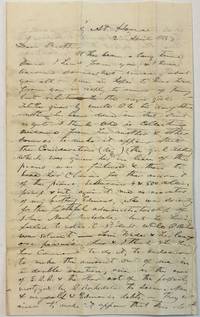
184740201Stewartsboro TN 1847. Folio 15" x 12-3/4" sheet folded to 7-1/2" x 12-3/4". 4 pp. Completely in ink manuscript integral address leave bearing Stewartsboro Tennessee April 3 1847 manuscript postal marking. mailing address on last page. The initials of the writer's name are difficult to decipher; this is our best guess. Old folds two short fold splits and a few tiny holes at fold corners. Wax seal remnant with tear at edge loss of a few letters some toning. Good to Very Good. <br /> <br /> The writer is concerned that Thomas had not responded to his letter "relating to the negro girl Tabitha given by Uncle R. to his daughter- nothing has been done in that suit as yet. I think she is collecting evidence from her mother & other sources to make it appear that the consideration viz the girl Tabitha which was given her in lieu of the piano was a failure & then to base her claim for the amount of the piano between 4 and 500 dollars princp. & int. against me as executor of my brother Edmond who was security for the faithful administrationship of John Nash Barksdale but he having failed to collect sd. debt while R. Barksdale was solvent. Levi Wade & her lawyer are persuading her. . . " He gives Thomas permission to "calculate on receiving a portion of the money for which Paulina sold. . . Negroes have advanced within 3 or 4 months but I fear one diseased as your boy Phil will command but a small price."<br /> Dr. Thomas Hill Read 1798-1874 of Tennessee settled in Macon County Illinois in 1831. He was the brother-in-law of Capt. David L. Allen one of the most prominent early citizens having married his sister. Dr. Read became known for his success in the treatment of children's ailments and was considered an expert in cholera infantum. He had a reputation for honesty and was said to have acted as administrator of more estates than anyone else in Macon County. Dr. Read was a member of the Decatur Board of Trustees in 1839 1841 1846 and 1847; County Treasurer from 1845-1846 and County Probate Judge from 1846-1849.<br /> John Nash Barksdale 1818-1844 Thomas Read's maternal cousin was born in Tennessee graduated from the University of North Carolina and became a lawyer. He practiced law in Tennessee for a few years and then moved to Columbus Mississippi and entered the law firm of his cousin Gen. William Barksdale. The Columbus bar announced that its members would wear the badge of mourning for thirty days following his death. "Death of John N. Barksdale" Republican Banner Nashville TN Dec. 6 1844 Page 2.<br /> Uncle R was likely Randolph Barksdale 1795-1844 Thomas H. Read's maternal uncle and John Nash Barksdale's father. Randolph settled in Tennessee with his father in 1808 and later established his own plantation. He was married three times and became the owner of a large estate and several slaves in Rutherford County Tennessee thanks to the wealth of his first wife. He also owned an estate near Chulahoma in Marshall County Mississippi. unknown
1836216961836. Slavery & Abolition CHILD Lydia Marie. An Appeal in Favor of That Class of Americans Called Africans. New York: Published by John S. Taylor 1836. Second edition. Illustrated with 2 plates. Coleridge quote on title page. In original blue cloth boards with embossing and gilt to spine. 8vo 216 pages. Child was a vocal abolitionist women's rights activist anti-American expansionist and proponent of racial equality amongst African and Native Americans. An Appeal in Favor of That Class of Americans Called Africans was the first written by a white woman in support of the immediate emancipation of slaves without compensation to their enslavers. Child begins by writing about the history of the slave trade as well as harrowing stories on it's detrimental and immoral faculties in order to engage readers to action. One illustrated plate showcases shackles and chains used on enslaved individuals. First published in 1833 Child's work was a prominent contribution to the abolitionist movement and her writing influenced many notable figures including Harriet Beecher Stowe and Frederick Douglass. Missing frontispiece some foxing to pages some wear to covers. Small tear affecting a few words in the fist first sentence on page 127. Binding is tight and text is clean and legible. Overall very good condition. unknown
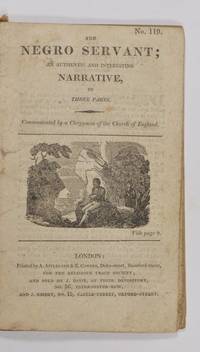
41475London: Printed by A. Applegath & E. Cooper for the Religious Tract Society c. 1825. 12mo 24pp. woodcut vignette to title-page disbound. London: Printed by A. Applegath & E. Cooper, for the Religious Tract Society, [c. 1825.] unknown
1827213910London: John Hatchard and Son 1827. Illustrated by 9 etchings. viii 464 pp. 1 vols. 8vo. Full calf spine gilt. Upper board missing 8 leaves damp-stained else Near Fine. Illustrated by 9 etchings. viii 464 pp. 1 vols. 8vo. John Hatchard and Son unknown
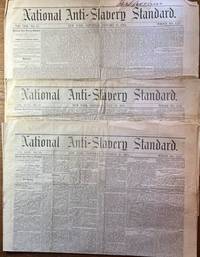
186536786New York: American Anti-Slavery Society 1865. Newspaper. Good. Newspapers. Approximately 27" x 18.5". 4 pages each. Several folds. Some light creases and several closed edge tears to the papers not affecting the print. Previous owner name written in the upper right corners of the front page first three issues. Light toning and foxing to the papers.<br /> <br /> 5 issues:<br /> <br /> New York: Saturday November 3 1855. Vol. XVI. No. 24. Lead article "The Boston Mor"<br /> New York: Saturday December 29 1855. Vol. XVI. No. 32. Lead article "Mr. Channing on American Slavery."<br /> New York: Saturday January 11 1862. Vol. XXII. No. 35. Lead article "The Emancipated South Carolinians."<br /> New York: Saturday July 29 1865. Vol. XXVI. No. 12. Lead article "Pro-Slavery South Carolina Loyalty. A "Union" Speech from Provisional Governor Perry."<br /> New York: Saturday November 18 1865. Vol. XXVI. No. 28. Lead article "Pro-Slavery Negro Suffrage Extract from the Message of Gov. Marvin of Florida to the State Convention. American Anti-Slavery Society unknown
186223579<p><i>"It is a fact that the enslavement of human beings has so far infused its insidious poison into the very hearts of the Southern people that they have come to believe and declare the evil of slavery to be a good and to require the power of Government to be exerted to maintain extend and perpetuate an institution that enables thousands to sell their own children to be enslaved with all their posterity into hopeless bondage." </i></p><p>The founder of New York City's Cooper Union for the Advancement of Science and Art echoes the language and logic of the Emancipation Proclamation as well as citing some Southern pro-slavery arguments to demonstrate their ridiculousness in this open letter to President Lincoln. Cooper and the Cooper Union had long been advocates of abolition and both Lincoln and Frederick Douglass had famously lectured at the institution.</p> <b>PETER COOPER. SLAVERY.</b>Pamphlet. <i>Letter of Peter Cooper on Slave Emancipation</i> Loyal Publication Society New York 1862 8pp. disbound.<p><b><br /></b></p><p><b>Excerpts:</b></p><p><i>"It is a fact that the enslavement of human beings has so far infused its insidious poison into the very hearts of the Southern people that they have come to believe and declare the evil of slavery to be a good and to require the power of Government to be exerted to maintain extend and perpetuate an institution that enables thousands to sell their own children to be enslaved with all their posterity into hopeless bondage." </i></p><p><i>"In the original formation of that Constitution it became absolutely necessary to make a compromise with that great and all pervading interest which had then already entered into the very life-blood of the nation rendering the formation of an union of States hopeless without such a compromise."</i></p><p><i>"The constitutional requirement to return fugitive slaves on their being demanded by Southern men having been acknowledged and performed by the States has been reaffirmed by an almost unanimous vote in Congress.These honest efforts on the part of the North to maintain peace and friendship were met by a relentless war waged for the destruction of the Constitution and the dissolution of the Union.<i>"</i></i></p><p><i>"The time has now come when Southern men must know that the Union must be preserved and it is for them to determine whether they will persevere in their rebellion until the North shall be compelled in the most reluctant self defence to render contraband of war the slaves and property of all persons found in arms against the laws and Government of the country."</i></p><p><b>Condition</b></p><p>Fine. Disbound and lacking front wrap.</p>
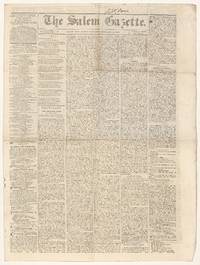
1850515519Salem Mass: Published by C. Foote 1850. Unbound. Very Good. First edition. Folio. 4pp. Printed self-wrappers. Owner's contemporary ink name on front cover in upper margin. Text is folded lightly creased few spots of faint soiling very good. Text includes: "The Beloved Tune" by Lydia Maria Child three full columns and a thirty-six line announcement about the pending publication of Nathaniel Hawthorne's The Scarlet Letter. Also includes a brief article entitled "Mr. Clay on Slavery" printing extracts from a debate between Senator Clay and General Cass; also prints a three-line announcement about the liberation of fourteen slaves: "Fourteen slaves belonging to Dr. John Casson of Mississippi have been taken to Cincinnati and liberated by their owner. Published by C. Foote unknown
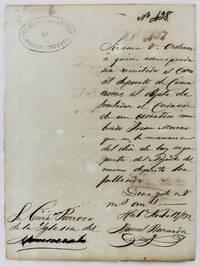
18723066Havana 1872. Very good. Manuscript form approximately 8.5 x 6.25 inches. Minor wear at edges; a few small worm holes. Contemporary ink stamp. Light tanning and offsetting. This 1872 manuscript form from a Havana jail the Celaduria de la Punta notes the death there of an "Asiatico" a Chinese indentured servant with the given name of Juan Macao and orders the transfer of the body to the mortuary for cremation. Indentured servants found themselves jailed for several reasons including suspicion of theft and other crimes recapture following runaway or mere suspicion of abandoning a contract. unknown
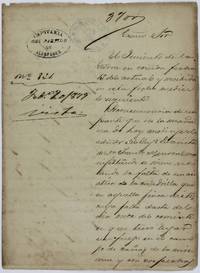
18792090Cuba 1879. About very good. 3pp. on a small bifolium. Contemporary ink stamps; accomplished in a fairly legible hand. Minor wear. A few small wormholes. Light tanning and dust soiling. Brief but very interesting manuscript report on the case of a missing Chinese indentured servant in the district of Alagranes near Matanzas. On February 18 1879 the owner of the plantation Juanita reports the missing person stating that there was a fire in his sugar cane field and it is thought that the laborer might have been burned. It seems that the present document serves to register the case with regional authorities in Matanzas and is a good record of the bureaucracy controlling indentured servitude in Cuba at this time. unknown
177434482Philadelphia: Joseph Crukshank 1774. First Edition. Three-quarter leather. Good. Octavo. 1 xiv 2 436 pages 1. Rebound in three quarter leather with tan cloth covered boards. Raised bands gilt decorations and title on the spine. Two title pages but continuos pagination. Inscription by the previous owner on the front blank end sheet. Front blank end sheet has some holes upper corner partly affecting the inscription. Moderate toning to the contents. Small worm hole lower back foredge not affecting the text. Pages 407-428 also has a small worm hole top edge not affecting the text. Chapter in part 2 pages 279-311 is titled "Considerations On the Keeping of Negroes."<br /> <br /> This first edition was published after the death of Woolman 1720-1772. Several later editions have been published. John Woolman was a Quaker minister and early abolitionist. He traveled to England in 1772 to promote the abolition of Slavery but died soon after arriving in England. He is buried in York. <br /> <br /> <br /> Howes W 669; Sabin 10524. Joseph Crukshank unknown
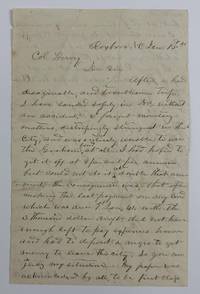
18605563Roxboro N.C.: January 15 1860. Good. 2pp. Wrinkled previously folded. A few minor losses at folds not affecting text. Two half-inch closed tears from edges. Light toning and foxing. After arriving in Roxboro North Carolina in mid-January 1860 planter J.C. Barnett writes to his friend and business partner a Colonel Henry to complain about the tight money situation in the state which has forced him essentially to pawn a slave in order to raise cash: "I found monetary matters distressingly stringent in the City and was entirely unable to use the Graham bond at all. I had hoped to get it off at 8 per cent per annum but could not do it at double that amount the consequence was that after making the last payment on my land which was due 1st Jan 61 with the 3 thousand dollar draft I did not have enough left to pay expenses home and had to deposit a negro to get money to leave the city. So you can judge my situation." Furthermore he has other unpaid debts that he hopes to settle with future cotton sales: "I gave R.H. Williams a draft for 93 dollars also Messrs Lea & Cheatham of Louisville one for 111 dollars and owing to the circumstances just mentioned was unable to meet them. You will do me a favor when you see these gentlemen to explain the reason. When you sell my cotton after paying Mr. Batt and yourself the expenses if there is a remainder please apply it to my Louisville and Williams debt. Also Mr. Gratiot has a claim of an hundred dollars. I will write to these gentlemen and tell to apply to you when you sell my cotton." Interesting detail on economic difficulties in the south just prior to the Civil War. January 15 unknown
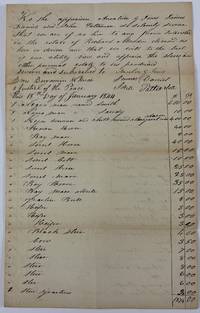
184413105St. Genevieve County MO: January 18 1844. 4pp. on a single folded sheet. Original folds minor wear. Very good condition. A sobering manuscript inventory from the estate of Richard Maddin following his death in Missouri in 1843 detailing his "slaves and other personal" property. The inventory begins by listing the enslaved persons by name along with an assignation of value for each of them as such: "1 Negro man named Smith $600. 1 Negro man named Sandy $10. 1 Negro woman and child named Margaret and Jason $400." The inventory then goes on to list the other property beginning with a long list of livestock followed by equipment household goods and so forth. The document is certified and witnessed by a number of local citizens who attest to the "full and perfect inventory of the goods chattles and personal estate" of the deceased Mr. Maddin. The reasoning is unclear why the second listed slave Sandy was worth only $10. January 18 unknown
186413103Quincy FL: January 1 1864. 1p. of manuscript docketed on verso. Old crease minor staining. Very good. A short but impactful and somewhat unusual document memorializing the inheritance of a young slave named "Anderson aged about twenty years" from a Florida estate in the penultimate year of the Civil War. Anderson was formerly owned by Daniel Love of Gadsden County and is here inherited by "John Shaw for Margaret E. Shaw" by Love's executor and likely brother Edward Love. The document is dated New Year's Day 1864. An unusual occurrence of a Florida slave being transmitted to a woman through inheritance. January 1 unknown
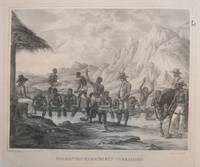
#[36399]München ca. 1830 Original lithographed plate by Meier E. Meyer and printed by J. Selb depicting the Brazilian diamond mines of Curralinho. Ca. 39 x 46 cm. From: Johann Baptist von Spix & Karl Friedrich Philipp von Martius Atlas zur Reise in Brasilien. - The atlas appeared in instalments and is rarely found complete. From 1817 to 1820 the botanist and traveller Martius 1794-1868 travelled in Brazil together with the zoologist Spix 1781-1826. Their journey was a scientific expedition financed by king Maximillian Joseph I of Bavaria. - Famous slavery print of the Brazilian diamond mines. - Unobtrusive dampstain in margin left lower corner mainly to be seen on verso few spots in margin otherwise a very fine copy. Borba de Moraes II p.p. 829; Bosch Brasilien-Bibliothek 346. unknown
1845332998United States 1845. 16pp. 8vo. Self-wrappers dampstaining. 16pp. 8vo. An anti-slavery work in German written in the form of a dialogue between Gottlieb who argues that the slave trade is a sin and Nabob who begins by arguing in defense of slavery but is swayed by Gottlieb's arguments. unknown
1805369319London 1805. 4 46pp. Folio. Disbound. 4 46pp. Folio. A British Parliamentary paper on the slave trade issued in the midst of the debates for its abolition. The paper includes the correspondence between the British government and their West India colonies from 1804-1805 with statistical information on the enslaved populations of various islands and plantation owners. unknown
181935648Milledgeville: S. Grantland 1819. First Edition. Leather bound. Fair. Octavo. iv 463 pages. Polished sheepskin leather binding with red leather title label on the spine. A brown piece of linen tap used at the top and at the bottom of the spine. Covers rubbed. Internal hinges in good condition. Some arithmetic written on the right front flyleaf. "Augusta Wylie King 1929" written in blue pen on the verso of the right front flyleaf. Light toning and foxing to the contents. A few pages have ink splotches. Newspaper clipping stored between pages 342 343 has left stains to the pages. <br /> <br /> Contents include sections on "Free Negroes" and a section on "Slaves". 11 page list of subscriber names by county located in the back. Subscriber names are listed alphabetically by county. List includes the name of Daniel Ross of the Cherokee Nation. Fair.<br /> <br /> Shaw & Shoemaker 47639; Not in Sabin; Derenne Georgia Catalog Vol. I page 366 - "Probably printed in Philadelphia for notice of copyright on Sept. 28 1819 by Mathew Carey & Son as proprietors in Eastern District of Pa. appears on verso of the title page. S. Grantland unknown
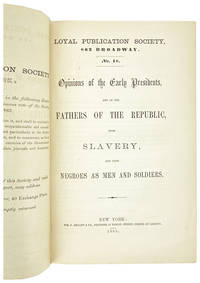
186330221New York: Wm. Bryant & Co. Printers 41 Nassau Street Corner of Liberty 1863. Very Good. New York: Wm. Bryant & Co. Printers 41 Nassau Street Corner of Liberty 1863. First Edition. Octavo. 19 pp. Printed wraps. Housed in more recent marbled paper wraps with brown backstrip staples noticeable beneath. Abrasions and glue remnants to front wraps with loss to text; light creasing to edges; a few smudges. Binding sound and interior unmarked; Very Good. Includes excerpts from Presidents Washington to Jackson as well as quotations from Benjamin Franklin John Jay and Alexander Hamilton.<br /> <br /> Sabin 57406. Wm. Bryant & Co., Printers, 41 Nassau Street, Corner of Liberty unknown
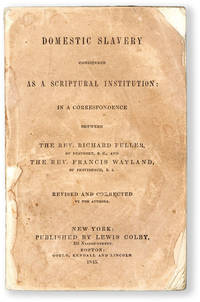
184554623New York: Lewis Colby 1845. First Edition. Wrappered Issue. 18mo. 15cm; original peach wrappers with titles printed in black on front cover; viii2541pp. Modest wear front wrapper split along lower half of front joint with shallow loss to right corners of same; old faint tide-mark along lower edge of textblock with creasing to upper and lower corners of first and last few pages; terminal blank present though lacking rear wrapper; Good. Uncommon wrappered issue of this significant debate between two 19th century Baptist leaders over the Bible's teachings on slavery which went through at least four subsequent editions between 1847-1860. "The chapters were originally letters published in a Baptist newspaper in Boston Massachusetts. Southern pastor Richard Fuller and Northern educator Francis Wayland were each able defenders of their respective positions. These men were also good friends who believed that a difference of opinion about slavery should not necessiatate a breaking of Christian fellowship. Unfortunately these two Baptist leaders proved naive in this regard. Just weeks after the publication of the correspondence in book form Fuller's Southern Baptist Convention broke away from the larger Baptist denomination and formed a new ecclesiastical body. A number of issues factored into the division though the slavery debate was what ultimately led to the creation of a separate Baptist denomination in the South" from the Mercer University Press edition 2008. SABIN 26170; LCP AFRO-AMERICANA 3944. Lewis Colby unknown