(Slavery)Biblio.com
1 561 résultats
1846319747Boston: Eastburn's Press 1846. 20pp. 8vo. Removed. Staining lower text. 20pp. 8vo. <br/><br/> Eastburn's Press unknown
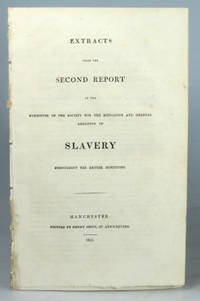
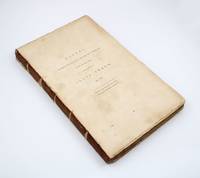
182529465Manchester: Printed by Henry Smith 1825. 8vo 36 pp. Disbound. The report running to 193 pages was published the same year in London. Manchester: Printed by Henry Smith unknown
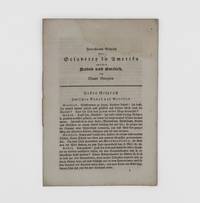
1845332998United States 1845. 16pp. 8vo. Self-wrappers dampstaining. 16pp. 8vo. An anti-slavery work in German written in the form of a dialogue between Gottlieb who argues that the slave trade is a sin and Nabob who begins by arguing in defense of slavery but is swayed by Gottlieb's arguments. unknown
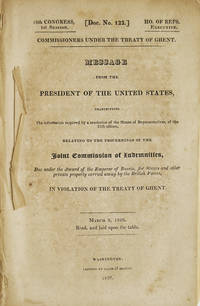
182634337Washington: Printed by Gales & Seaton 1826. 181 pp. 1 vols. 8vo. Disbound some browning to title page else a good tightly sewn copy. 181 pp. 1 vols. 8vo. John Quincy Adams' brief memorandum transmits Secretary of State H. Clay's report; a detailed list of slave owners and the names of their slaves comprises the bulk of this document. <br/><br/> Printed by Gales & Seaton unknown
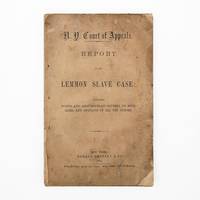
1860372448New York: Horace Greeley & Co 1860. 146pp. 8vo. Stitched self wrappers. Toned title a bit tattered at edges scattered minor staining. 146pp. 8vo. In 1852 the Lemmon family took a ship from Virginia to New York along with eight enslaved people planning to embark immediately on another ship for New Orleans. With slavery abolished in New York the slaves were freed by a writ of habeas corpus. Chief Justice Paine upheld the writ and in 1860 the case went to the court of appeals where the original judgment was overturned to preserve peace in the Union. The case would likely have been considered by the Supreme Court if not for secession and the outbreak of the Civil War.<br /> <br /> "The fullest legal examination of slave transit and comity before the Civil War . One of the most extreme examples of hostility to slavery in Northern courts . pushed the nation one step closer to Civil War" Finkelman Slavery in the Courtroom pages 56-57. Cohen 11900; Library Co. Afro-Americana 7104; Sabin 40003; Work page 346 Horace Greeley & Co unknown
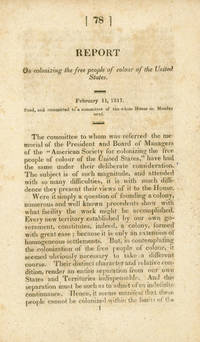
18179350Washington City 1817. First Edition. 5 pp. 1 vols. 8vo. Disbound. Some foxing. First Edition. 5 pp. 1 vols. 8vo. First edition of the government's reply to the request of a group of Virginia planters for a "colony" to essentially rid them of the problem of "free coloured people." In December of 1816 a group of Virginia planters approached the government with a request asking for a location where freed blacks might be sent. In January this "memorial" was presented and in February it was answered with this "Report." This reply discusses location etc. In the end the government officially refused to have anything to do with the plan - thus the American Colonization Society was born. For a detailed account of these events see Dumond Anti-Slavery pp. 126-127. S&S 42738 2 copies unknown
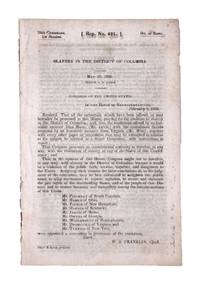
1836346520Washington D.C. 1836. 24th Congress 1st Session House Rep. No. 691. 24pp. 8vo. Disbound. 24th Congress 1st Session House Rep. No. 691. 24pp. 8vo. Many of the early anti-slavery efforts focussed on the abolition of slavery in the District of Columbia as Congress had full control over the laws within the District thus obviating any argument over state's rights. Until "retroceded" back to Virginia in 1846 the city of Alexandria and its notorious slave market was considered part of the District of Columbia making slavery in the District of particular importance. Inundated with petitions calling for the abolition of slavery in the District in 1836 Congress passed the so-called Pinckney Resolution which asserted that Congress "ought not" to consider slavery in the District and created a gag rule whereby all petitions memorials or other resolutions on the subject would be automatically tabled. unknown
1856257105Washington D.C.: Globe Office 1856. Signed by Kelsey ordering 2500 and by James Livingston for 100 and another. Old folds. Blind embossed " Platner & Porter Cobngress" staionary. Signed by Kelsey ordering 2500 and by James Livingston for 100 and another. Globe Office unknown
1856218<b>First edition of "the most complete record available" of the controversial Pennsylvania case on fugitive slaves establishing a "precedent set in federal and state courts… and important cause célèbre for the antislavery movement" crucial in asserting a clear path for the following year's Dred Scott decision and provoking a "legal crisis… that led to the Civil War" elusive in original cloth. An overall clean text with soiling on top of pages 1-16 & pgs. 161-191 and contemporary ink marginalia by Strawbridge on a few pages. John Strawbridge is inscribed in old ink on page prior to title page. A book which has become difficult to find in the original cloth.</b> Uriah Hunt & Son hardcover
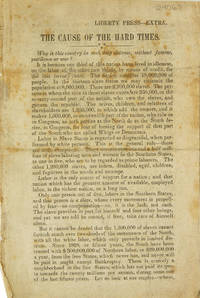
184324068Utica 1843. 4pp. 1 vols. 8vo. Disbound spotted and soiled separated along spine else a good copy of this rare piece. 4pp. 1 vols. 8vo. Rare. An "Extra" to the "Liberty Press" relating to slavery and the "deep distress" and idleness caused by slavery. The author signed "Truth-Teller" attributes most of the labor problems and many of the economic ones to the instution of slavery. He recommends allowing Florida a place in the Union as a free state and Congress guaranteeing each state a republican form of government which he feels would bring about the end of slavery. <br/><br/> unknown
186062260Atlanta: Printed at the Daily Locomotive Job Office 1860. 47 pp. 1 vols. 8vo. Original blue printed wrappers. Wrapper a bit chipped else Fine. 47 pp. 1 vols. 8vo. Printed at the Daily Locomotive Job Office unknown
1805369285London 1805. 309; 4 46pp. Uncut. 2 vols. Folio. Disbound. 309; 4 46pp. Uncut. 2 vols. Folio. Two British Parliamentary papers on the slave trade issued in the midst of the debates for its abolition. The first paper organized by West Indian island includes the correspondence between the British government and their West India colonies regarding slavery from the period 1797 to 1800 and includes the text of the Leeward Island Amelioration Act of 1798. The paper includes a wealth of statistical information on the enslaved populations of each island as well as the names of plantation owners and their holdings. The second paper continues the correspondence from 1804-1805 with updated statistics. unknown
1805369319London 1805. 4 46pp. Folio. Disbound. 4 46pp. Folio. A British Parliamentary paper on the slave trade issued in the midst of the debates for its abolition. The paper includes the correspondence between the British government and their West India colonies from 1804-1805 with statistical information on the enslaved populations of various islands and plantation owners. unknown
185562372Boston: Bela Marsh 1855. Second printing. Frontispiece portrait. 122 pp. 1 vols. Small 8vo. Brown cloth stamped in blind and gilt. Upper half of spine shaky else a nice tight copy. Second printing. Frontispiece portrait. 122 pp. 1 vols. Small 8vo. The author was convicted of aiding slaves to escape from Washinton D.C.--Blockson. Sabin 20912 Blockson 9838 for first ed. Bela Marsh unknown
1842313227Philadelphia: stereotyped by L. Johnson 1842. First edition. 140 pp. 1 vols. 8vo. Original brown ribbed cloth rebacked with original spine laid down titled in gilt. Marginal dampstaining throughout scattered foxing some wear to boards good. First edition. 140 pp. 1 vols. 8vo. First edition of this report of this monumental Supreme Court decision regarding escaped slaves preceding by 15 years and rivaling in importance the Dred Scott case of 1857. "In Prigg the Court identified slavery as a core constitutional commitment with which states could not interfere. In this case the Court struck down northern states' 'personal liberty laws' established to protect alleged fugitive slaves from recapture without due process of law. When the professional 'slave catcher' Edward Prigg tried to remove Margaret Moran an alleged runaway he was unable to meet the burden of proof set out by Pennsylvania's 1826 Personal Liberty Law and failed to obtain the legal certificate permitting him to remove her. When Prigg proceeded to ignore this and removed Moran illegally to Maryland Pennsylvania convicted him of kidnapping. The US Supreme Court however overwhelmingly overturned Prigg's conviction 8-1 and pronounced state laws interfering with the return of alleged runaways a violation of the Fugitive Slave Clause." Beaumont The Civic Constitution 2014 p. 128. Blockson 9905; Dummond p. 140; Sabin 61207 stereotyped by L. Johnson unknown
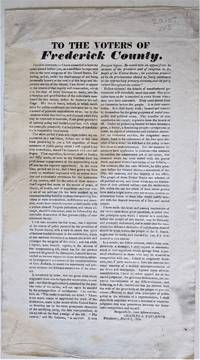
1833713Winchester Va. 1833. Broadside 4to. 290 x 160 mm. 11 ¼ x 6 ¼ inches. Printed in two columns signed in type by Charles J. Faulkner at Winchester dated March 8 1833 at conclusion. Lightly dust-soiled pale stain affecting perhaps one-third of the left-hand margin and column of text. Neatly silked on verso. Withal about very good. Following the August 1831 Nat Turner rebellion in Southampton County a last effort was made by moderate Virginians to gradually abolish slavery. Faulkner a 26-year-old lawyer and assemblyman along with Thomas Jefferson Randolph sponsored legislation to free all children born of slave parents after July 4 1840. His speech emphasized the evil of slavery for Southern white labor noting that slavery "converts the energy of the community into indolence--its power into imbecility--its efficiency into weakness.Shall society suffer that the slave-holder may continue to gather his crop of human flesh" As the Assembly was malapportioned in favor of the Tidewater slaveocracy the proposal lost rather narrowly and nearly thirty years later the Confederacy was assured of Virginia's succession. It is perhaps not surprising that Faulkner "comparatively a stranger" to the county but a member of the Virginia House of Delegates at this time 1831-34 was not successful in his campaign to represent Virginia in the U.S. Senate. However Faulkner was elected to three terms in Congress from Virginia in the 1850s. He was elected to Congress from West Virginia after the Civil War. In the interim he served as Minister to France during the Buchanan administration and on the staff of Stonewall Jackson. Dictionary of American Biography. Not in Hummel. Not found in American Imprints for 1833 and not in the 1830-1839 title index. OCLC records four copies at The Library of Virginia University of Virginia Virginia Historical Society and American Antiquarian Society. unknown
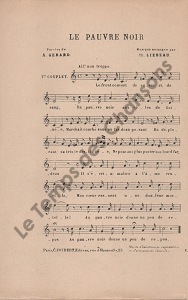
190018080Joubert 1900 approx.
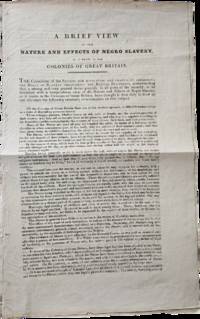
1823List3302London England: Ellerton and Henderson 1823. Three page document measuring 8 ½ x 13 ¼ inches. Folded with some small wrinkles at edges else Near Fine. A document produced by the Society for Mitigating and Gradually Abolishing the State of Slavery throughout the British Dominions better known as the Anti-Slavery Society. The group was founded in London in 1823 by a group of politicians philanthropists and businessmen including William Wilberforce Joseph Sturge and Zachary Macaulay. The document discusses the horrors of enslavement—even unfavorably comparing the British colonies’ conditions with those in the US—and decries the fact that after the 1807 Slave Trade Act essentially nothing more had been done to put “an end to a condition of society which so grievously outrages every feeling of humanityâ€. We find a single copy of the Ellerton and Henderson edition in physical format listed in OCLC as accession number 83930673. Ellerton and Henderson unknown
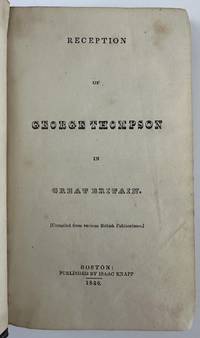
18361691Boston: Isaac Knapp 1836. About very good. xvi13-238pp. 12mo. Original publisher's blue boards with black sheep spine gilt. Boards rubbed corners and spine moderately worn. Text lightly foxed. Scarce work addressing the anti-slavery work of George Thompson following his visit to America. Thompson 1804-1878 was British lecturer and reformer who worked as a commercial clerk. "Thompson first came to prominence in 1831 when he was recruited by the London Anti-Slavery Society's Agency Committee as an itinerant lecturer. In the run up to the Emancipation Act of 1833 he became the most effective British anti-slavery lecturer since Thomas Clarkson. With the struggle against British slavery apparently won Thompson was instrumental in reorienting anti-slavery effort towards the Americas and particularly the United States. . In 1834 he encountered the charismatic American abolitionist William Lloyd Garrison. Recognizing Thompson's talent Garrison invited him to travel to the United States with his growing family to labour there on behalf of the enslaved people of America" - DNB. <br /> <br /> Thompson employed sarcasm and vitriol in his orations attacking anti-abolitionist sentiment across the northern states. In the process he failed to make very many friends or converts and alienated those with more moderate views. "Opponents attacked him as a foreign interloper and an anti-American agitator. They also discovered a scandal in Thompson's past alleging that in 1829 he had absconded with £80 embezzled from his employer. His supporters angrily rejected this charge though Thompson later privately admitted it was true he eventually repaid the sum in full. Hostility increasingly turned violent and in fear of his life he was smuggled out of the country in October 1835 returning to a hero's welcome in Britain" - DNB.<br /> <br /> This work is a rebuttal made by Thompson's American supporters aggregating information from British sources to defend his good name and abolitionist efforts after fleeing America for his homeland. It includes some of Thompson's speeches on slavery in America given before audiences in Scotland and England and discusses his work with the American Anti-Slavery Society. Though there are a handful of institutional copies the work is scarce on the market and does not appear in auction records over the pasty forty years.<br /> <br /> Sabin 9324. American Imprints 36449. Isaac Knapp unknown
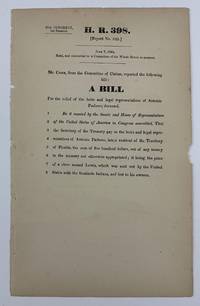
18445887Washington DC: June 7 1844. Very good. Broadside 12.25 x 7.75 inches. Light tanning shallow marginal chips and some fraying to left and right edges. An unrecorded slip-bill printing of a House Resolution with a phenomenal back story involving an erudite elusive and resourceful Florida slave. The slip bill authored by Howell Cobb U.S. Representative from Georgia stipulates that the Secretary of the Treasury pay the sum of five hundred dollars to the heirs and representatives of Antonio Pacheco a former resident of Florida the sum "being the price of a slave named Lewis which was sent out by the United States with the Seminole Indians and lost to his owners." That's where the plot thickens. The slave is now known to history as Luis Fatio Pacheco born in 1800 to enslaved parents on the "New Switzerland" plantation in Florida which was surrounded by a mix of Europeans Africans and Native Americans. As such Luis became fluent in several languages including Seminole which later made him a valuable asset.<br /> <br /> After a conflict with his owner Luis attempted to escape slavery in 1824 by fleeing to Spanish fisheries on Florida's Gulf Coast but he was captured by U.S. military authorities the following year. Skilled as he was in languages and literacy by the military Luis was sold in 1832 to Antonio Pacheco a Cuban merchant. After Antonio's death Luis became the property of Pacheco's widow. When tensions began to ratchet up again between American military forces and the Seminole tribe a U.S. Army officer made a deal to rent Luis from the Pacheco estate at the rate of $25 a month to take advantage of his services as an interpreter. In December 1835 Luis was accompanying a troop detachment led by Major Frances L. Dade in a march to reinforce Fort King near the present-day city of Ocala Florida. Evidently that day Luis was assigned as a scout; he has said to have attempted to warn Dade of a possible ambush by the Seminoles which went unheeded by the commander. The result is today known as the Dade Massacre in which Dade and most of his men were killed.<br /> <br /> According to the narrative provided by Luis who spoke Seminole he explained to the warriors that he was a slave and successfully pleaded for his life. Luis lived with the Seminoles as a captive for nearly two years before again managing to escape. In September 1837 Luis surrendered to the U.S. Army at Fort Peyton near St. Augustine. Soon after he was accused of collaborating with the Seminoles in the Dade Massacre. In 1841 negotiations between the US government and Seminole leader Coacoochee the Native American leader claimed Luis as his property captured in war. Coacoochee was permitted to take Luis together with other Black Seminoles to Oklahoma for resettlement. This event led to the claim by Anthony Pacheco‘s heirs for restitution of a lost slave. The Joint Committee on Claims approved the claim. Luis's story eventually became a focal point in the abolitionist argument against slavery and in 1858 Ohio representative Joshua R. Giddings published a book portraying Luis as a hero against the system. In any case the question of whether or not Luis betrayed Dade has never been completely resolved. June 7 unknown
184657411Boston: Anti-Slavery Office 1846. Sixth Edition. Two volumes bound in one; small octavo 20cm.; publisher's embossed cloth titled in gilt on spine1231115pp. Slight rubbing and wear to cloth heavier at board corners and with small loss at crown of spine; text tight and unmarked but moderately foxed; sound and Good. Contemporary ownership signature "Lucia A Haynes" to front free endpaper. <br /> <br /> A popular and much-reprinted anti-slavery novel though its sensational portrayal of an incestuous triangle between the protagonist Archy his sister Cassy and their father Colonel Moore generally inspired disgust more than abolitionist sympathy among contemporary reviewers. However the novel did provide "first-hand observation of Southern plantation life and slavery conditions" Friedland p. 129 based on the two years the author spent in Florida for the benefit of his health. For additional information see Louis S. Friedland "Richard Hildreth's Minor Works" in "The Papers of the Bibliographical Society of America" Vol. 40 no. 2 2nd Quarter 1946. LCP AFRO-AMERICANA 4798-4800 for other editions; SABIN 31790; WRIGHT I 1189. Anti-Slavery Office unknown
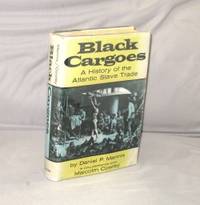
196229404<p>New York:: Viking Press 1962. Second Printing of the First Edition. A Very Good copy in a Very Good plus unclipped dust jacket with light edge wear to the extremities. The African slave trade in the Americas officially began in 1518 with the landing in the West Indies of the first black cargo direct from Africa and was offically suppressed in the United States in 1865. It is estimated that approximately 15 million Africans had crossed the Atlantic during this period. This book attempts to tell where the slaves came from how they were enslaved in Africa how they were purchased by sea captains how they wre transported and how the trip survivors were sold in West Indian and American markets.</p> Viking Press, hardcover
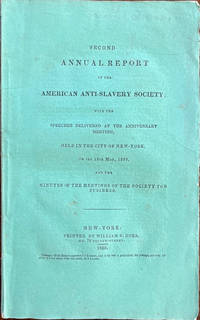
183560564New York: Printed by William S. Dorr No. 70 Fulton Street 1835. 8vo. 87 1 pp. Printed blue-green publisher’s softcovers contents on back cover punch-sewn at gutter margin as issued minor edgewear slight chipping to spine 1 closed tear w/ minor archival repair on inner back cover still VG- copy. First edition of this surprisingly uncommon report of the second meeting of this pioneering American abolitionist society founded by William Lloyd Garrison editor of The Liberator magazine and Arthur Tappan while also featuring contributions by Frederick Douglass and William Wells Brown an African-American freedman. The society was very controversial as by the mid-1830’s slavery was ensconced into the American economy feeding wealth not only to Southern planters but also Northern merchants textile factory owners and shipowners. The first meeting and later misrepresentation had set off violent the violent Farren riots in New York where abolitionists homes and properties were attacked. The 1835 meeting not only agreed on the Society Constitution but also used fundraising to sponsor a great postal campaign to flood the South with Abolitionist literature. White supremacists responded by seizing and destroying the mail and on July 29 1835 3000 people gathered to burn Abolitionist writings and burn three in effigy. The speeches detail the progress of the result of Great Britain freeing 800000 slaves encouraging continued efforts to enroll African-American children and freed slaves into schools and declared that “prejudice which excludes our colored brethren from the rights and privileges of Men the Society lays the axe at the root of slavery. It removes the final bugbear that ‘the Slaves will be worse off when emancipated.’†This also features the extended interview and discussion with Abolitionist former slaveholder James Gillespie Briney 1792-1857 who freed his slaves joined the American Anti-Slavery Society and founded The Philanthropist in Cincinnati OH in 1835 after selling his plantation. Worldcat locates 5 physical copies Cornell DLC NYPL Howard AAS Lib. Printed by William S. Dorr, No. 70 Fulton Street, paperback
186064001London UK: William Tweedie 337 Strand 1860. Small 4to. 5.25 x 7.5 in. xv 1 3-172 xi 1 pp. Woodcut-engraved frontisp. of the author still preserving tissue guard. Publisher’s ribbed plum-coloured cloth dark maroon coloured title label & price of 1 shilling 6 pence mounted front cover very minor chipping head & foot of spine slight fraying title label stamping dimmed and minor bumping to a couple corners still a VG copy w/ London UK bookseller’s label partially removed at gutter margin front pastedown. First edition first printing of the first book wholly devoted to the Underground Railroad published only in England and by an African-American/Native-American author. Mitchell was a pivotal figure in the Underground Railroad who also aided the escaped slave “Eliza†whose escape over the Ohio River ice inspired the key dramatic moment in Harriet Beecher Stowe’s pivotal Uncle Tom’s Cabin. “Eliza†was sheltered originally in the network by noted abolitionist John Rankin passed on to Mitchell who then subsequently ensured her safe passage along the network overseen by Levi Coffin 1798-1877. Ironically the passage of the 1850 Fugitive Slave Act which criminalized those aiding in the Underground Railroad to free slaves with fines of $ 1000 and six months imprisonment fueled resistance and forced Mitchell to publish this seminal work in Great Britain rather than the U.S. As a freeborn orphan Black in North Carolina Mitchell was forced into apprenticeship with a North Carolina plantation owner where he witnessed the deprivations of slavery and became inspired to aid African-American slaves to escape to Canada. From 1842-1855 he helped over 1300 slaves reach Canada from his Washington Court House Fayette County Ohio way station. This memoir recounts many anecdotes of the formerly enslaved including: one enslaved woman who died from frostbite while protecting her three children and a former slave John Mason brought Mitchell in just 19 months of that 13 year span “265 human beings whom he had been instrumental in redeeming from slavery.†Mitchell further recounts Mason’s recapture in Kentucky and later escape from New Orleans to Canada. Mitchell estimates in his book that 60000 enslaved peoples escaped into Canada on the Underground Railroad modern estimates range from 40000 to 100000. At the end of the 1850’s he moved to Toronto and began serving as a minister to African-American Baptist Free Mission congregations largely composed of freed slaves and the final section details the lives of these Canadian Black immigrants. In the final appendix he urgently pleads for a boycott of Southern cotton by Great Britain attempting to overcome resistance to the economic impact and hardship it would have on British cotton mills and related industries. Mitchell c. 1826-c.1879 was encouraged to write this historic work by W.H. Bonner A British abolitionist and had toured Britain in 1860 with William Howard Day and British abolitionist George Thompson to oppose the condition of slavery before the outbreak of the Civil War. This work is quite scarce with only 2 copies at auction in the last 50 years and both those appear to have been the 2nd edition which removed the hyphen in “Under-Ground†extended the title and a couple other revisions. William Tweedie, 337, Strand, hardcover
1824GF264941824 Paris - Eymery - 1824 - 1 volume in12 - Reliure d'époque pleine basane mouchetée - tranches rouges - pièces de titre en maroquin rouge - dos lisse orné de fleurons - Coupes orné de filets - Bon exemplaire -