1 561 résultats
1863101890Letterpress broadside 18 7/8" x 11 3/4" bold black type for highlighted words. Paper evenly toned some wrinkling considerable archival conservation and restoration with archival paper repair; despite the imperfections it is still a decent copy with a nice impression. This appears to fall into the political dirty tricks department in an election between John Brodhead and Henry Bumm for city treasurer in Philadelphia. The broadside is supposed to highlight a letter from John Brodhead to Jefferson Davis in 1860. It has strong racist overtones as Brodhead supposedly requests a position in Nicaragua so he can "help open it up to civilization and Niggers." He goes on to state he is "tired of being a white slave at the North and long for a home in the sunny South." These kinds of political tricks were not uncommon during the Civil War period perhaps that's still true today and the racist overtones would certainly not help one's chances in a Northern election. books
1855CAT0116Peterboro: Self-Published 1855. First Edition. Single sheet folded 10 x 10 inches. Very Good. One of several public letters by Smith to Seward this one discussing the Fugitive Slave Law. Smith by the mid-1850s had grown increasingly frustrated by the abolitionist movement's willingness to compromise. Seward an early figure in the Republican party sought more gradual measures. Smith writes: "Instead of interpreting constitutions and statutes in the light of human rights you interpret human rights in the light of constitutions and statutes. I own that you stand as an antislavery man very far above most of our statesmen. but I would have you stand farther above them." Smith's growing impatience with the compromising nature of the abolitionist movement would later lead him to support the efforts of John Brown and the free-state movement in Kansas. "When most Liberty party leaders agreed to merge with more moderate antislavery factions to form the Free Soil party in 1848 Smith balked at what he regarded as abandonment of the abolitionist commitment to immediate emancipation." - ANB. A very good copy with a light stain to margin else near fine. Six copies in OCLC. Self-Published unknown books
1854CAT0114New York: H. Long 1854. First Edition. 8vo publisher's brown cloth 259 pp. Good Plus. The Vermont-born Chase moved to Tennessee in 1838. He was elected as a member of the Democratic Party to the Twenty-ninth and Thirtieth Congresses serving from 1845-1849 before returning north to New York City to practice law. In this work of fiction which is mostly intended as a diatribe against the hypocrisy of the English he proposes that "The African adopts him-self with greater readiness than the white man." In his view wage slavery in the North and in England was worse than the slavery in the South. An uncommon first edition copy. Some wear and tears to boards some light marginal foxing to contents but still sound and usable good plus condition overall. H. Long unknown books
1877CAT0113J.A. Brush: Minnesota 1877. 2 ¼ x 4 inch image on slightly larger mount. Fine. Chambers a seven-year-old boy at the time of the Civil War followed the soldiers Jasper Dickey and David Scofield from Georgia back to their homes in Minnesota. The two soldiers raised him. He died in 1936 at the age of seventy-eight. Inscription on album page from which photograph was removed reads "Samuel Chambers / Zumbrota Minnesota. / Born a slave but followed northern troops to Minnesota at close of war." Verso identifies the photographer as J.A. Brush of 223 Nicollet Av. Minneapolis. A fine example. Minnesota unknown books
1333734212.Gpaperback. Good. Access codes and supplements are not guaranteed with used items. May be an ex-library book. paperback
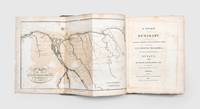
1807177680London: Richard Phillips 1807. First edition of this account of the British colonies within modern-day Guyana. Bolingbroke was a staunch supporter of the Transatlantic slave trade which he discusses in Chapter Five and dedicated this work to the colonial secretary William Windham. Henry Bolingbroke 1785-1855 was a Norfolk merchant who first visited Demerara in 1798. This region had been under the control of the French and Dutch until it was captured by the British in 1796. Bolingbroke remained in the colony until 1805; he then travelled to Surinam in Dutch Guiana to become Deputy Vendue Master in 1807 responsible for public sales and auctions including those of enslaved people. He was one of the 16 MPs who voted against the abolition of slavery in March 1807. In Chapter Five Bolingbroke writes about slavery and what he viewed as its economic importance. In his dedication to Windham 1750-1810 he praised him for relaxing monopoly restrictions and "resisting the abolition of a liberty essential at new settlements of importing additional labourers" p. iii. Quarto pp. xii 400. Folding engraved map. Original green paper-covered boards rebacked modern spine label edges untrimmed. Signature of one George Atkinson on front pastedown a few pencil notes internally. Spine head stabilized boards marked foxing and toning to map and contents two small closed tears to map repaired offsetting to title page: a very good copy. Sabin 6182. hardcover
183431598Philadelphia 1834. 3pp. Later annotation at head of first page. Scarce letter on the Liberian colonization movement by one of its founders.<br/> <br/> Writing to Hawes a member of Parliament and a committee member of the Society for the Extinction of the Slave Trade Cresson wishes for success in the British anti-slavery action off the coast of Sierra Leone writing "I hope that you may yet enjoy the satisfaction of crushing one of the worst & most unacceptable of the slave markets in existence that at Gallinas." After mentioning the travels of the colonial governor of Liberia he writes: ". I have been gratified to learn from several highly respectable sources that such a Colony as you propose located either at the mouth of the Cape Mount River or even a little more to the Northward say at Sugaree & provided with a good supply of trade goods to exchange with the natives would have a powerful tendency to break up the monopoly now enjoyed by the Spanish Slavers. My letters from Africa state that the demand is so great in Cuba from the ravages of Cholera among their ill-fed human cattle as to have rendered the shipments from the Gallinas during the past year almost unprecedented. It appears that the benevolent efforts of your Govt. are not likely to extirpate the evil until commercial & agricultural colonies shall be substituted for cruisers." The letter continues with news from their consul at Liberia before turning to American politics: ". political affairs engrossing the entire energies of the nation. The excitement is painfully great . Our military chieftan Jackson by his acts of unauthorized assumption has called forth a burst of indignation which cannot subside until we get rid of the offender." The letter concludes with an introduction for Gerard Ralston. Cresson a noted Philadelphia businessman and philanthropist was among the most ardent supports of colonization the movement to relocate former slaves and free African Americans to colonies in Liberia. In 1833 Cresson and the Philadelphia Young Men's Colonization Society a branch of the American Colonization Society founded Port Cresson in Liberia. However the colony was attacked in 1835 by Bassa tribesmen incited by Spanish slave traders and destroyed. unknown
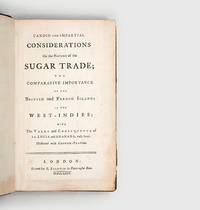
1763132583London: R. Baldwin 1763. A classic of in the field of colonial and Caribbean literature First edition of the first-named fourth of the second which was first published in Antigua 1750 under the pseudonym of "An Old Planter". John Campbell 1708-1775 was a highly successful historian and miscellaneous author Johnson thought well of him and praised the usefulness of his knowledge also describing him as "the richest author that ever grazed the common of literature" ODNB. The present work was commissioned by Lord Bute to rebut criticism of the Treaty of Paris by demonstrating "the value of colonial holdings in general and of sugar islands in particular" Ragatz. That is was felt to have done its job is perhaps confirmed by Campbell's appointment in 1765 as king's agent to Georgia. Considered by Ragatz to be a "classic of in the field of colonial and Caribbean literature embodying as it does one of the clearest statements of eighteenth-century philosophy regarding the relations that should exist between the metropole and its outlying possessions". This copy has additional material bound in: Bew's map of St Christopher's a 2-page manuscript index and bound at the rear a copy of Martin's practical essay on plantation management. Samuel Martin 1694/5-1776 had been born on Antigua but spent some considerable time thereafter in Britain on his full-time return to the island he found the family estates much run down and "embarked on a rigourous policy of reconstruction. Although he helped to pioneer improvements at most of the key stages in sugar-making and rum distillation his interests focused mainly on the non-manufacturing side of production. He was a firm advocate of crop rotation followed by marling in order to improve soil fertility. He was also instrumental in developing more effective systems of drainage and utilising windmills rather than animals for crushing the cane. By the standards of his contemporaries Martin was an enlightened slave owner. He advocated the provision of adequate supplies of food clothing shelter and medical facilities for slaves and ground for the cultivation of their own food" ODNB. His methods made him Antigua's leading and most progressive planter and during his own lifetime he certainly "succeeded in making sugar production a moderately profitable enterprise on his own estates". Both titles are moderately well-represented institutionally but neither appear with any great frequency at auction just a handful of copies of Campbell in the last fifty years and no copy of the Essay upon Plantership in any edition has passed through the rooms since 1951. Two works bound in a single vol. octavo 196 x 120 mm. Both bound without half-titles. 4 folding maps to the first-named 3 as called for; Caribbee Islands and Guyanna coloured in outline; The Harbour of Calivenie. Island of Grenada. Drawn by John Powell Topographer; and Plan of Fort Royal in the Island of Grenada and additionally a map of St. Christophers by J. Bew dated 1782 coloured. Contemporary streaked calf flat spine ruled gilt red morocco label single gilt rule to board edges Dahlia marbled endpapers. A little rubbed particularly on the joints label chipped no loss of lettering corners through small patch of insect damage to the lower board pastedowns lifting at the lower corners front free endpaper torn without loss slight erosion at the lower corner of the text-block for the first thirty pages or so mild worming to the fore-margin pp. 39-176 some small splits and closed tears to the maps no losses; overall very good. Campbell: ESTC T65879; Ragatz p. 284; Kress 6081; Sabin 10232. Martin: ESTC T81835; Sabin 44920 hardcover
198115264Princeton: Princeton University Press 1981. First Edition. Octavo. Cloth boards; dustjacket; 262pp; Removed from a non-circulating private library with ink ownership markings to front flyleaf and accompanying black ink elisions from de-accession on front endpaper. Very mild rubbing to jacket; else clean and unmarked copy. Princeton University Press unknown books
183945020Philadelphia: Printed for the Committee / J. Richards 1839. First Edition. 12mo 19cm.; side-stitched self-wrappers; 12pp. Some foxing faint fold lines else Very Good or better. Extracts taken chiefly from British abolitionist Thomas Fowell Buxton's larger work "The African Slave Trade" in which he argued that the African slave trade could be stamped out by other forms of trade as well as the spread of Christianity. Printed for the Committee / J. Richards unknown books
196315364Denver: Sage Books 1963. First Edition. Octavo. Cloth boards; dustjacket; 218pp. Removed from a non-circulating private library with ink ownership markings to front endpaper and accompanying black ink elisions from de-accession. Moderate dusting and rubbing to jacket; else clean crisp copy in very good jacket with unmarked text. Sage Books unknown books
197515257Berkeley: University of California Press 1975. First Edition. Octavo. Cloth boards; dustjacket; 172pp; 5 inserted leaves of black and white plates; includes bibliography. Removed from a non-circulating private library with ink ownership markings to front endpaper and accompanying black ink elisions from de-accession. Else an unmarked copy in a lightly worn dustwrapper. Translated by J.W.S. Judge. University of California Press unknown books
198315288Princeton: Princeton University Press 1983. First Edition. Octavo. Cloth boards; dustjacket; 515pp; illus; includes bibliography. Removed from a non-circulating private library with ink ownership markings to front endpaper and accompanying black ink elisions from de-accession. Light rubbing to boards; otherwise bright copy in near fine dustwrapper with unmarked text. Princeton University Press unknown books
12584Group of two partly-printed tax receiptstwo receipts collected by Sheriff Farrar of Mecklenburg County and Aylor Sheriff of Madison. Both receipts are dated 1861. 1 is for "Slaves and money $6.80" and "War Tax of $1.36." Dated August 23 1861 and signed by Sheriff Farrar. The other is signed by Sheriff Aylor. In excellent condition. A nice group of slave tax receipts. unknown books
163153 handwritten documents in ink regarding the sale of slave girls in Cuba. The documents are written in Spanish and include details such as purchase price age and names of the girls being sold. Documents are large: 12 ½ x 8 ¾ in. Some shadows from storage with other documents paper acidification from ink. Some losses from ink acidification and wormholes. Marks from previous binding along left edge. Sale documents are numbered at bottom of pages with signatures and all have stamp from Cuban government. Good condition. One of the documents includes the year 1875 dating some of these papers to the dwindling years of the slavery in Cuba which was officially outlawed in 1886. unknown books
163143 handwritten documents in ink regarding the sale of slave girls in Cuba. The documents are written in Spanish and include details such as purchase price age and names of the girls being sold. Large size Documents 12 ½ x 8 ¾ in. Some shadows from storage with other documents paper acidification from ink. Some losses from ink acidification and wormholes. Marks from previous binding along left edge. Sale documents are numbered at bottom of pages with signatures and all have stamp from Cuban government. Good condition. One of the documents includes the year 1875 dating some of these papers to the dwindling years of the slavery in Cuba which was officially outlawed in 1886. unknown books
15101This rare pamphlet "Act No. XIX of 1929 Passed by the Indian Legislature.An Act to Restrain the Solemnisation of Child Marriages" was a critical step in protecting girls. No other copies in OCLC Worldcat<br/><br/>Child marriage was historically prevalent in India where the International Center for Research on Women reported that 47% of Indian weddings in the early 20th century involved brides under the age of 18. Poverty was a driving factor in child marriage as families in financial straits could improve their economic standing by marrying their daughters to wealthier older men. Yet as other countries began making improvements for women and girls India too recognized the dangers inherent to girls' health and well-being when they were married and became mothers while still in their own childhoods. This pamphlet which is the only known copy according to OCLC Worldcat details the "punishment for male adult below twenty one years of age marrying a child punishment for male adults over twenty one years of age marrying a child and punishment for solemnizing a child marriage." While child marriage does persist in India its rates have gone down and modern India has joined the South Asian Initiative to End Violence Against Children SAIEVAC which adopted a regional action plan to enforce the marriage bans and end child marriage in and beyond its own borders. unknown books
1856WRCAM34592Montpelier 1856. 19pp. Self-wrappers. Upper edge gnawed and stained else good. This report from a committee of the Vermont House of Representatives was made in response to events in Kansas resulting from the introduction of slavery into that territory. According to the report Vermonters in Kansas had been harassed and attacked by pro-slavery forces with a situation of lawlessness ensuing. The Vermont House asserts the state's rights to protect its citizens in Kansas and allots a sum of $20000 to alleviate the suffering of afflicted Vermonters. OCLC locates only four copies. Quite scarce. OCLC 34605036. unknown books
143781771 Newspaper with slavery ad. Boston. 15" by 10." The Almanack lists two advertisements relating to slavery "To be sold for want of employment a likely Negro Boy that won't drink rum he is about 14 years old." An interesting slavery related advertisement which chronicles a dark era in American history. Overall foxing some soiling and small tears. Otherwise very good condition. unknown books
10137Slavery Handwritten letter signed. Silvanus Patch 1 page March 1823 in which Mr. Hatch writes in somewhat phonetic English to a John Bourding concerning the sale of one of his slaves in part ".I wish you to assist Mr. Nicholson in the gitten sic of the money from the sale of Davis and the 50 of Collens as I am in det debt to Mr. Nicholson.use every excursion to git sic that from him and you will obliage sic your well wisher." Foxing in very good condition. unknown books
183331599England 1833. 3pp. Scarce letter on the Liberian colonization movement by one of its founders.<br/> <br/>The letter begins with the 2-page text of a resolution to establish the British African Colonization Society: " . that Colonies composed of fare settlers of African race established on judicious principles on the Coast of Africa appear calculated beyond any other plan to put an effectual stop to the slave trade . Resolved that a Society be formed to be called the British African Colonization Society and that is objects be to cooperate with the American Colonization Society and with the several missionaries and other religious and charitable societies in Great Britain and the United States of America in such measures as may promote the total abolition of the slave trade and the establishment of Christianity and Civilization among the Natives of Africa chiefly by the employment of Free Persons of African birth or descent." The proposed Society was to be established under the patronage of the Duke of Sussex. In the letter which follows Cresson writes of William Lloyd Garrison's opposition to the colonization movement: " . I send the list of officers as far as accepted several others have not yet answered but I trust we shall present a bold front. I have just heard thro his Chaplain from the Duke. Garrison has written to poison his mind and probably will annoy our meeting. I trust that as the notice has been so short our friends will bring many with them . My letter to the Times in answer to Garrison they have not yet noticed so that it will be put in the Globe whose Editor has offered it a place in his columns." Cresson a noted Philadelphia businessman and philanthropist was among the most ardent supports of colonization the movement to relocate former slaves and free African Americans to colonies in Liberia. In 1832 he travelled to England to promote international support for the movement. The following year Cresson and the Philadelphia Young Men's Colonization Society a branch of the American Colonization Society founded Port Cresson in Liberia. However the colony was attacked in 1835 by Bassa tribesmen incited by Spanish slave traders and destroyed. Although initially in favor of colonization William Lloyd Garrison would change his mind decrying the efforts of the American Colonization Society as a perpetuation of slavery. For Garrison's 28 June 1833 letter to the Duke of Sussex referenced above see The Letters of William Lloyd Garrison I:107. unknown books
183431598Philadelphia 1834. 3pp. Later annotation at head of first page. Scarce letter on the Liberian colonization movement by one of its founders.<br/> <br/>Writing to Hawes a member of Parliament and a committee member of the Society for the Extinction of the Slave Trade Cresson wishes for success in the British anti-slavery action off the coast of Sierra Leone writing "I hope that you may yet enjoy the satisfaction of crushing one of the worst & most unacceptable of the slave markets in existence that at Gallinas." After mentioning the travels of the colonial governor of Liberia he writes: ". I have been gratified to learn from several highly respectable sources that such a Colony as you propose located either at the mouth of the Cape Mount River or even a little more to the Northward say at Sugaree & provided with a good supply of trade goods to exchange with the natives would have a powerful tendency to break up the monopoly now enjoyed by the Spanish Slavers. My letters from Africa state that the demand is so great in Cuba from the ravages of Cholera among their ill-fed human cattle as to have rendered the shipments from the Gallinas during the past year almost unprecedented. It appears that the benevolent efforts of your Govt. are not likely to extirpate the evil until commercial & agricultural colonies shall be substituted for cruisers." The letter continues with news from their consul at Liberia before turning to American politics: ". political affairs engrossing the entire energies of the nation. The excitement is painfully great . Our military chieftan Jackson by his acts of unauthorized assumption has called forth a burst of indignation which cannot subside until we get rid of the offender." The letter concludes with an introduction for Gerard Ralston. Cresson a noted Philadelphia businessman and philanthropist was among the most ardent supports of colonization the movement to relocate former slaves and free African Americans to colonies in Liberia. In 1833 Cresson and the Philadelphia Young Men's Colonization Society a branch of the American Colonization Society founded Port Cresson in Liberia. However the colony was attacked in 1835 by Bassa tribesmen incited by Spanish slave traders and destroyed. unknown books
186539270Boston: Geo. C. Rand & Avery 1865. 8vo. 8 1/2 x 5 3/4 inches. 16pp. With the author's compliments. Disbound.<br/> <br/>This address was given to the Phi Beta Kappa Society of Dartmouth College on July 19 1865 by Alpheus Crosby. In it Crosby details the dangers of a divided country with headings titled "Our National Debt" "Increase of Southern Power in Congress" "Natural Antipathy between the Races" and "Danger in Case of Foreign War." Alpheus Crosby was a scholar and professor of mathematics and Greek. He entered Dartmouth at the young age of 13 where he was a leading scholar and tutor to fellow students. He was involved in abolition editing an abolitionist journal during the Civil War and writing on the reconstruction of the South. Following the war he edited a series of textbooks aimed at the recently freed slaves.<br/> <br/>Sabin 17626. Geo. C. Rand & Avery unknown books
28345Confidant of Missouri pioneer Jonathan Bryan 1759-1846 of the noted St. Charles family whose relatives included their neighbor Daniel Boone. DS 1p 7½" X 12" St. Charles County MO 1847 February 2. Near fine. Acknowledgment that Tuter who signs himself as "Administrator of the Estate of Johnathan Bryan" has had a writ of replevin made out and issued to the St. Charles sheriff Edward C. Cunningham 1809-65 for delivery to an unnamed offender. The writ seeks to recover the following property apparently wrongfully taken from Jonathan Bryan's estate: "one negro man a Slave named Heney one Two horse waggon and one pair of Briches Two Black horses one Lorrel horse with bold face one walnut Cupboard one clock one Bureau one bedstead and bedding one walnut Table one Trunk one Bible." In other words everything but the kitchen sink. Signed at the conclusion by Tater in his definitely untutored hand. Tales of slaves are found in the Bryan family lore such as: "Mrs. Jonathan Bryan a kinswoman of Daniel Boone was working in her yard with a slave woman when a boy slave screamed. She saw an Indian warrior heading for them with a tomahawk in one hand and a gun in the other. The women ran for the house. Just as they were slamming the door they caught the warrior's head and right arm between the door and facing. The slave woman grabbed the hatchet from his hand and killed him with a sharp blow. The women had barely recovered from their fright when the boy shouted again." Could the slave boy in this old family legend by none less than the "Slave named Heney" whose return is demanded in this replevin suit Quite unusual slavery item with an intriguing history. unknown books
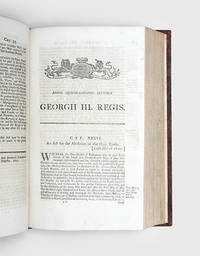
1807182125London: printed by George Eyre and Andrew Strahan 1807. The African Slave Trade. is hereby utterly abolished prohibited and declared to be unlawful First edition of one of the most consequential acts of legislation in world history abolishing the slave trade within the British Empire. The Act the culmination of many years of campaigning by British abolitionists ended two centuries in which Britain took the pre-eminent role in the transatlantic slave traffic. The act paved the way for other European empires to abolish the trade and for Britain to use its navy to intercept slave ships which effectively ended the transatlantic slave trade by the latter half of the century. However the act did not end slavery in the British Empire which did not follow until 1833. Parliamentary acts were issued individually and in collected format printed from the same type. This copy includes the full acts for 1807 comprising the only session of the Third Parliament with the first session of the Fourth the second session was held in 1808 together with the separately published report on vaccination. It was bound for use by the civic authorities of the town of Elgin in Scotland. 3 parts in 1 vol. folio 289 x 181 mm pp. 16 466 1; 14 578 2 blank; 16. Contemporary sprinkled calf twin red and green morocco labels "Town of Elgin Acts of Parliament / 1807" edges speckled blue. Pencilled notation at head of title page. Neatly restored at extremities very minor foxing and finger-soiling to contents. A very good copy. unknown