Stanczyk, JanMareMagnum

5 326 résultats
Original Wraps. 8vo. 15 pages. 22 cm. First edition. Declaration by Jan Stanczyk on the heroic struggle of the underground movement in Poland (Jewish and Polish) , the vicious eradication of all Polands citizens by the Nazi occupation, and the need to redress previous wrongs committed by the Polish government against its Jewish citizens. Contains six illustrations. A pledge of Jewish equality in a 'post-war democratic Poland freed of the Nazi yoke, ' was given here today by Jan Stanczyk, Polish Minister of Labor and Social Welfare at a press conference preceding his address to the executive committee of the Jewish Labor Committee. 'The future relations between Gentiles and Jews in liberated Poland, ' said Mr. Stanczyk, 'will be built on entirely new foundations. Poland will guarantee all her citizens including the Jews full legal equality. This Poland will be a true democracy and every one of her citizens will enjoy equal rights irrespective of race, creed or origin. ' Emphasizing that the Jewish underground movement in Poland today is part of the great Polish underground army waging the struggle for the common cause of liberation, Mr. Stanczyk declared that the present war 'has wiped out the institutions and destroyed the power of groups which had striven to foment hatred among the people of Poland' and that their common fate has created a strong bond between Gentile and Jew. - JTA, 'Post-war Poland Will Guarantee Equality to Jews, Stanczyk Pledges', December 11, 1941. Subjects: Rzeczpospolita Polska (Government-in-exile) ; Jewish Labor Committee (U. S. ) . Jews - Legal status, laws, etc. - Poland. Civil rights - Poland. World War, 1939-1945 - Poland. Civil rights. Jews - Legal status, laws, etc. World War (1939-1945) . OCLC lists 8 copies. Light wear to wraps, overall very clean and fresh. Very good condition. Very important. (HOLO2-123-27)
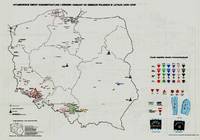
197941929Warszawa Warsaw: Pan´stw. Wydawn. Naukowe 1979. 1st Edition. Original black printed portfolio 8vo. Portfolio of seven large folding maps on on 4 sheets of heavy paper 3 are double sided 1 is singled sided. Primarily black and white with some color. Text in Polish. <br> Title translates to “Nazi camps in Poland 1939 - 1945. An Encyclopaedic Reference Book: Maps." Collection of 7 maps each 84 cm x 60 cm 33 x 24 inches produced by Jan Laskowski at the Main Commission for the Investigation of Nazi Crimes in Poland. The maps comprise Volume II of the work; Volume I is a heavily illustrated 676-page book of the same title which we offer separately. <br> The Seven maps all present are: <br> - Map 1 Single Sided: Hitlerowskie obozy na ziemiach polskich w latach 1939 - 1945. “Nazi camps in Poland in the years 1939 - 1945â€. Showing: concentration and extermination camps sub-camps of concentration camps extermination centers POW camps more important sub-camps working divisions commandos and temporary POW camps penal labor camps major labor camps prisons transit camps & ghettos. <br> - Map 2A: Getta na ziemiach polskich w okresie okupacji hitlerowskiej w latach 1939 - 1945 “Ghettos in Poland during the Nazi occupation in 1939 - 1945â€. <br> - Map 2B: Hitlerowskie obozy przejsciowe na ziemiach polskich w latach 1939 - 1945 “Nazi transit camps in Poland in 1939-1945â€. <br> - Map 3A: Hitlerowskie wiezienia i areszty na ziemiach polskich w latach 1939 - 1945 “Nazi prisons and arrests in Poland in 1939 - 1945â€. <br> - Map 3B: Hitlerowskie obozy pracy na ziemiach polskich w latach 1939 - 1945 “Nazi labor camps in Poland in the years 1939 - 1945â€. <br> - Map 4A: Hitlerowskie obozy jenieckie na ziemiach polskich w latach 1939 - 1945 “Nazi POW camps in Poland in 1939 - 1945â€. <br> - Map 4B: Hitlerowskie obozy koncentracyjne i osrodki zaglady na ziemiach polskich w latach 1939 - 1945 “Nazi concentration camps and extermination centers in Poland in 1939 - 1945â€. <br> Maps 2A & 2B have been described as a “Terrifying pair of maps showing the locations of German POW and internment camps in Poland during World War II highlighting the widespread locations of these establishments. In some parts of the map the information becomes so dense that three inset maps are shown. This map was designed by Jan Laskowski and printed in 1979 as part of a work on the Nazi extermination machine produced by PWN Warsaw a state-owned research-focused publishing house in Poland.<br> The map on the front is particularly interesting for its depiction of symbols used to classify internees in German camps. The uppermost of these depictions shows the combinations that can be made for different types of prisoners of different levels of importance. The armbands that would have been worn by these prisoners is shown as well as the prison uniforms. Other details are also shown. <br> The map lists hundreds of sites run by Nazi operators throughout the country. These include concentration camps death camps transitional camps and ghettos. The map is divided according to Poland's voivodeships with a key in the lower left. Names of cities too long to spell are also provided in the lower left. <br> This map was produced during a point in Poland's history during which it was actively revisiting the period during the Second World War. Leading social scientists devoted their time to trying to gather all the living as well as the recorded history of the events of the Holocaust and related atrocities before this information vanished. Leading these efforts particularly during the 1960s and 1970s was the Glówna Komisja Scigania Zbrodni przeciwko Narodowi Polskiemu known as the Chief Commission for the Prosecution of Crimes against the Polish Nation. They were active in publishing maps both for domestic educational purposes and for international remembrance and diplomatic efforts regarding the Holocaust. Jan Laskowski was a leading cartographer who produced a number of maps in this field. <br> These maps were produced as part of a series of maps that purported to combine to form an atlas of all of Hitler's crimes in Poland. Many of the large wall maps produced during this period could only show a fraction of the crimes or only the atrocities committed in one region. Thus a series of maps was needed to show all the points necessary which this present work contributes to. <br> Polish Reinterpretations of the Holocaust: Studying the effects of German occupation in Poland is a delicate subject. While it is certain that Poland suffered at least as badly as any other European nation during the Second World War reinterpretations of the Holocaust in the country have also been used to satisfy nationalistic tendencies. It has become evident to Western observers in the last several years that there is a strong nationalist movement in Poland that seeks to place blame for the Holocaust solely on the shoulders of non-Polish actors a movement originally fostered under Soviet rule. This movement has gone so far as to limit freedom of speech criminalizing with a three-year sentence the suggestion that Poland or its citizens in any form participated in the murders committed by Nazis. As such the term ‘Polish concentration camps’ has been deemed unacceptable with the government-approved term being ‘concentration camps on Polish territory.’ <br> All lines of evidence show that this map 2A & 2B was produced using the most accurate and impartial historical sources. The language on the map is simple naming only ‘Hitler's Atrocities’ and there is no evidence of a clear anti-German bias. However it is impossible to separate this map one of the most important productions of the remembrance movement during this period from the social situation in which it was produced. Maps like these can easily be converted into propaganda instruments and today's Polish leaders most of whom grew up during Soviet occupation will have formed their understanding of the Holocaust through maps like these. <br> Soviet Censorship: While the content of the map appears to have been produced free from bias the map still had to go through Soviet censorship. Mentioning prisoner of war camps in which primarily Soviet troops were interned would have been a prerequisite condition upon which the publication of the map rested. Further the lack of mention of any Soviet killings or camps requires no explanation….The map unlike many later maps makes no differentiation between the populations who suffered at the various camps. This represents the Soviet agenda that all nations suffered fought and won equally which sought to limit divisions in this post-identity state†Ruderman 2022. <br> SUBJECTS: World War 1939-1945 -- Prisoners and prisons German. -- Concentration camps -- Poland. Guerre mondiale 1939-1945 -- Prisonniers et prisons des Allemands. -- Camps d'internement -- Pologne. Obozy koncentracyjne -- Polska -- 1900-1945. OCLC: 830885973. <br> Light shelf wear to portfolio as expected. All maps in pristine condition with normal folds as issued. Very Good Condition. Complete and dramatic BR5 holo2-147-19-'cc. Warszawa (Warsaw): Pan´stw. Wydawn. Naukowe unknown
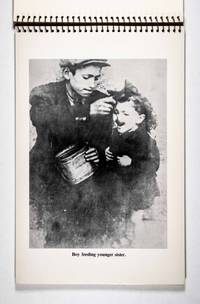
198347653Los Angeles: American Congress of Jews from Poland and Survivors of Concentration Camps 1983. First edition. Softcover. g to vg. Oblong Quarto. 4 55 leaves incl. 49 photographic plates. Original white stiff spiral-bound wraps with black lettering and publisher's device on cover. Catalog of the photo-exhibition "The Tragedy of the Jewish Child Under the Nazis" by the Holocaust Documentation Committee in Los Angeles. <br /> <br /> The exhibition is structure into six categories: Children orphaned and Starving 7; Child Labor Exploited 9; Struggle to Survive Physically and Mentally Warsaw Ghetto Scenes; 17 The Final Destination; 10 Child Partisans 3; After Liberation 3. The exhibition was curated in consideration of the younger viewers therefore omitted those pictures which in their stark and gruesome reality might harm the impressive minds of children Benjamin Grey. Introduction by Dr. Judah Pilch "Lest we forget." Illustrated with forty-five full page b/w photographs documenting the suffering of Jewish children during the Holocaust. Cover with very light soiling and rubbed. Last two plates with some wear along bottom edge not affecting images. American Congress of Jews from Poland and Survivors of Concentration Camps unknown
Original blue gilt-tooled calf leather. 12mo. 120, 194, 194 pages. 18 cm. Survivors Bible, printed by Vaad Hatzala. Pentateuch, Haftarot and Megilot with commentary of Rashi and Targum. 'Matanah me-et Va'ad ha-hatsalah le-she'erit ha-peletah. ' Title page has coloured illustration. With dedication page to President Harry Truman with superimposed American Flag. "The remnants of Israel that survived the great destruction wrought upon our people by Hitler's hoards, these shattered remenats the 'Sherith Hepleita' were weakened physically and spiritually...we wish to dedicate this Holy Bible, the very ancient well of civilization, to his Honor, the President of the United States of America, Harry S. Truman. His courageous and kind words, his noble acts and deeds in behalf of our people have served as a ray of hote in these trying, troubleed and most cdritical period of our people..." With "Mr. M. Shipper inscribed in gilt on upper cover.Issued by the Vaad Hatzala Rescue Committee for the benefit of the survivors of the Nazi Holocaust (Sheerit Hapleita). This custom-bound copy likely prepared for an American donor.See A.J. Karp, From the Ends of the Earth: Judaic Treasures from the Library of Congress (1991) p. 34 (illustrated). Subjects: Haftarot - Commentaries. Bible. Pentateuch - Commentaries. Bible. Five Scrolls - Commentaries. Pentateuch. Hebrew. 1947.; Holy Bible: Vaad Hatzala, Germany. OCLC lists 15 copies. A copy sold at auction in 2021 for over $1200. Outstanding copy in original deluxe blue leather binding, Very Good condition. (HOLO2-117-58B)
xxiv, 179 pages. Index, bibliography, references, glossary. Almost one hundred black and white reproductions of photos and documents. Two fold-out maps. "This study was exciting and personally rewarding to me. I treasure the many Dutch and Canadian friends who so patiently worked with me to reconstruct the events of half a century ago. I still think it highly important that the record of Canadian actions in helping to throw off the Nazi yoke in the Netherlands be accurately and fully told to Canadian and Dutch peoples before we have all passed on. But this publication is really devoted to the 363 killed and 1760 other casualties suffered by the South Saskatchewan Regiment in the Second World War, to the other units involved in the liberation of Kamp Westerbork, but most of all to the 876 prisoners, mainly Jewish, we helped to liberate in Kamp Westerbork, the 4000 or so who passed through this transit camp to hell, but lived, and to the more than 103,000 who did not." - Foreword. After serving in WWII Professor Law [1922-2011] moved on to a career at Queen's University where he established the Business School's microcomputer lab in the 1980s, where this bookseller had the opportunity to meet him. Clean and unmarked with light wear. A quality copy of this important and highly-detailed study. Book
Original wraps. 8vo. 246, [2] pages. 23 cm. Serial publication. In Hungarian, with Yiddish. OMZSA Yearbook. The Országos Magyar Zsidó Segíto Akció (National Hungarian Jewish Aid Association; OMZSA) was a general assistance organization for the large Budapest community. The OMZSA was involved with cultural, legal, and economic battles on behalf of the (religious) Jewish Budapest community. For example, a series of drawings by the artist Imre Amos (1907-1945) entitled Zsidó ünnepek (Jewish Holidays) , representing the Jewish holidays in the shadow of annihilation, became emblematic for Hungarian Jewry. (The series appeared in 150 copies published in 1940 by the Országos Magyar Zsidó Segito Akció [National Hungarian Jewish Aid Action]. ) (YIVO encyclopedia) . According to OCLC, four issues of the yearbook are known to exist (the earliest issue is titled OMZSA Naptár OMZSA Calendar) . This issue contains a calendar of the days and holidays for the year (In Hungarian and Yiddish) , and extensive literary (poems, letters, short stories) and journalistic pieces by dozens of writers and editors from the Budapest community. For many of these authors, this would be their last published work. [T]he Germans occupied the country on 19 March 1944, Gestapo chief Adolf Eichmann set up his SS command in Budapest, and the Budapest Jewish Council was established. What had been an extended process of stigmatization, ghettoization, deportation, and murder elsewhere was greatly concentrated and executed with great efficiency and speed in Hungary. The deportation and gassing of almost 440, 000 provincial Jews at Auschwitz-Birkenau began in mid-May and was swiftly accomplished by July as a result of full cooperation of the Hungarian authorities. Only intense diplomatic pressure threatening harsh postwar retribution caused Regent Horthy to call a halt to the deportations on 6 July, giving Budapest Jewry a temporary reprieve. In Budapest, a series of measures increasingly placed limitations on Jews who remained in the capital. Restrictions were placed on using the public transport; later telephones, bicycles, and cars were confiscated, and an evening curfew was imposed. From 3 April, all persons defined as Jews were obligated to wear a yellow star on their outer clothing The reverses suffered by the Germans emboldened Horthy to announce in mid-October his intention to withdraw Hungary from the war. With German backing, Ferenc Szálasi and his Arrow Cross Party seized power on 15 October. Budapests Jews were now threatened by a far more vicious regime whose radical antisemitic ideology was wholly in tune with Hitlers apocalyptic vision. Forced death marches began on 20 October and along with German deportations, affected some 75, 000 Budapest Jews. The city rapidly descended into chaos as roving Arrow Cross bands combed the streets rounding up Jews. The first murders in the streets began on 12 November; the first executions took place by the riverbank on 23 November. (YIVO Encyclopedia) Subjects: Jews - Hungary - Periodicals. Jewish almanacs. OCLC lists 7 copies. Wraps lightly worn, with light pencil marks on front cover and first endpage. Pages lightly aged, otherwise fresh. Very good condition. (HOLO2-103-36)
328 pages. "A significant document by which the author acquitted himself of the obligation bequeathed on the survivors of the Holocaust by its victims to tell the world what happened to the Jews during World War Two, when to be a Jew was a crime. The Memoirs based on the author's own experiences and reports told to him by his relatives and friends, survivors of the Holocaust, describe the fate of hundreds of thousands of Polish Jews, banished by the Russians to Siberia and in particular the lot of those who came under the Nazi regime... A rich source of first hand information about the life in the ghetto, the Judenrat, the Jewish Ghetto Police and the methods used by the Nazis in the destruction of the Jews." - dust jacket. Author lost his parents, wife and two sons in the Holocaust. Map endpapers. Black and white illustrations. Book clean and unmarked with light wear. Dust jacket lightly sunned at spine, bears several closed tears and is missing some small chips - now preserved in glossy new archival-grade Brodart cover. A sound copy.. Book
1st edition. Original period boards. 8vo. 328 pages, 21 cm. In German. Includes a 107-page dictionary of Jewish Criminals slang at rear. Title translates to The Jewish Crooks in Germany: Their Tactics, Peculiarities, and Language, along with Detailed News About the Most Notorious Jewish Criminals Staying in Germany and at its Borders. Thiele was a German court clerk in the criminal court in Berlin (Kierkegaard, 2015) . SUBJECTS: Jewish criminals. Jews -- Germany. Cant -- Dictionaries -- German. OCLC lists 19 copies worldwide (OCLC: 1423903) , most are in Europe. Spine is chipping. Some pages are lightly soiled, but no loss to text. Overall good condition. Important. (GER-54-4)
First edition. Original paper wrappers. 4to. [203] pages. 29cm. In English. Massive report written on November 21, 1947 and dealing with matters related to Jewish settlement in Palestine and the Jewish refugees coming from Europe to America and elsewhere. Section II on the ADJC, includes sections on: The Displaced persons Countries, Eastern European Countries, Western European Countries and then Shanghai, Central and South America, and Special Passover Relief. Section IV, on the United Service for New Americans, includes subsections on Who are the Newcomers? , Resettlement from New York, European Jewish Childrens Aid, Physicians and Dentist Unit, Location Service, Central Refugee Index, and many others. In January 1939, the United Jewish Appeal for Refugees and Overseas Needs was established, combining the efforts of American Jewish Joint Distribution Committee, led by Rabbi Jonah Wise; the United Palestine Appeal, led by Rabbi Abba Hillel Silver; and the National Coordinating Committee Fund led by William Rosenwald. The three founders emphasized that the funds needed to support Jews in Europe and Palestine would be triple to quadruple the amount raised in the previous year. While the organizations would raise funds together, the Joint Distribution Committee would assist Jews in Europe, the United Palestine Appeal would aid the Jewish community in Palestine, including refugees from Europe arriving there and the National Coordinating Committee Fund would assist refugees arriving in the United States (Wikipedia, 2016) . OCLC lists 3 copies worldwide (Harvard, JHU, NLI) , none in the US outside the East Coast. Wrappers are edgeworn and chipped. Minor soiling to some pages with no damage to text. Overall Good Condition. (ZION-10-13)
(1945) . Original Illustrated Paper Wrappers, Small 8vo, 216 pages. Eredeti borítóval. Includes 9 powerful original linocut illustrations, and cover design, by Shagra Weil. Also includes a bit of music.Title translates as "The Yellow Book. Data on the War Losses of Hungarian Jewry. 1941-1945." One of the earliest book about the Hungarian Holocaust. Published by Hechaluc (Hehalutz), the Zionist resistant movement, whose legendary headquarters was located at the Üvegház (Glasshouse) in Budapest, a former glass-store. During the Holocaust about 3000 people found shelter there and it was the center for producing fake identification documents to save Hungarian Jews from persecution. Shraga Weil (Ferenc Ferdinánd; 1918-2009) was a Hungarian born Israeli painter. He studied at the Academy of Art in Prague and École des Beaux Arts in Paris. During WWII he was active in the Zionist underground movement in Budapest, working in the workshop for forging documents. After the war he sailed for Palestine on an illegal immigrant ship and became a member of Kibbutz Ha'ogen where he lived until his death. In 1959 Weil was awarded the Dizengoff Prize for painting. He created the doors of the main entrance to the Knesset building and the President's residence in Jerusalem. Weil painted the wooden panels in the Israeli Hall at the Kennedy Center. Sándor Groszmann (Alexander Grossmann, Ben Erec; 1909-2003) was a journalist and publisher, one of the main activists of the Hungarian Zionist movement and co-founder of "Hashomer Hatzair" in Hungary. He was one of the leaders at the "Glasshouse". "When the argument arose about whether to absorb more Jews into the 'Glass House' as they might endanger the lives of those already living there, he said: 'For the sake of one hundred thousand Jews it is worth to endanger our own lives'". (Gur, D.; 2007). After the liberation he was the secretary of JDC (American Jewish Joint Distribution Committee) in Budapest and member of the board of the Hungarian Zionist Association and of the "Eretz-Israel" office. In 1949 he left Hungary and after living in Austria and Israel he settled down in Switzerland where he started to publish books and the periodical "Jöv?" (Future). [Bibl.: Gur, D.: Brothers for Resistance and Rescue. The Underground Zionist Youth Movement in Hungary during Word War II. Jerusalem-New York, 2007; Cohen, A.: The Halutz Resistance in Hungary, 1942-1944. New York, 1986.]. Paper aged, Very Good Condition. (holo2-125-27) xx
Original paper wrappers with colorful illustrated dust jacket, 8vo, 83 pages, plus 12 plates of facsimiles and photos of survivors taken by Burger just after liberation, (including one photo of former Sonderkommandos) . Original 1945 edition Adolf Burgers memoirs about his journeys through the Nazi concentration camps and his work in the counterfeiting workshop in Oranienburg, narrated by Sylva and Oskar Krejci. His memoirs are the basis for the film, The Counterfieters, which won the 2007 Academy Award for Best Foreign Language Film. Adolf Burger took up a job in a printing house in Bratislava in 1938 he became one of those who received government-sponsored waivers from deportations as someone with skills indispensable for the country's economy. At the request of resistance members, Burger began to print false baptismal certificates for Jews scheduled for deportation, which stated that they had been Roman Catholic from birth, or baptized so before World War II. Slovaks with such documents were not deported. Burger's activity was discovered. He was deported to the Auschwitz concentration camp After eighteen months at Auschwitz-Birkenau, Burger's training came through for him once more. He was selected for Operation Bernhard, transferred to the Sachsenhausen concentration camp in April 1944, and eventually to the Ebensee site of the Mauthausen camp network where he was liberated by the US Army on 6 May 1945 (Wikipedia, 2016) . The covers use a montage design of US currency, British documents, and Burgers concentration camp insignia. SUBJECT(S) : WWII, Resistance, Concentration Camps. Minimal pencil markings that do not affect text. Some tears to jacket at folds, Minimal stains and slight toning. Very good condition. Dramatic and attractive. (HOLO2-134-63A)
158 pages. Author wrote the manuscript for this work from memory in 1918 but it was not published until 1969. Dedicated it to "the thousands of innocent Armenian men, women and children of Ourfa, Turkey, who perished amid the horrors of the infamous genocide of 1915-18". Documents the experiences of a civil prisoner in Turkey during the Great War. In 1914 he was deported from Beirut to the interior of Turkey where he remained until his release in 1918. Average wear to clean and unmarked book. Binding sound. Above-average wear and soiling to dust jacket. A worthy copy of this important eye-witness account. Book
BN66063Unternehmen Legalon: Die Jagd nach dem Erbe des Holocaust Sante Joel Dominique <br/><br/> unknown
1st edition. Original wrappers. 4to, 29 cm. each issue approx. 16 pages each issue. Each volume includes 12 monthly issues. Illustrations throughout. In Czech with some English. This run includes vol. I, (1-12, beginning in October 1, 1939), vol. II (1-12), vol. III (1-12, beginning in 1941), vol IV (1-12, beginning in October 1942), vol. V (1-12), vol. VI (1-12), vol VII (1-12), vol. VIII (1-12, beginning October 1946), vol. IX (1-11, beginning in October 1947), vol X (1-12, beginning in October 1948), vol. XI (1-12, beginning in October, 1949), vol. XII (1-12, beginning in October 1950), vol. XIII( 1-12, beginning in October 1951), vol. XIV(1-12, beginning in October 1952), vol XV (1-5, 7-12, beginning in October 1953), vol. XVI (1-12, beginning in October 1954), vol. XVII (1-12, beginning in October 1955), vol. XVIII (1-12, beginning in October 1956) ,vol. XIX (1, 3-12, beginning in October, 1957), vol. XX (1-12, beginning in October 1958), vol. XXI (1-12, beginning in October 1959), vol. XXII (1-12, beginning in October 1960), vol. XXIII (1-12, beginning in October 1961), vol. XXIV (1-12, beginning in October 1962), vol. XXV (1-12, beginning in October 1963), vol. XXVI (1-12, beginning in October 1964), vol. XXVII (1-12, beginning in October 1965), vol. XXVIII (1-12, beginning in October 1966), vol. XXIX (1-12, beginning in October 1967), vol. XXXIV (7-11, beginning in May 1973), vol. XXXV (1-12, beginning in November 1973), vol. XXXVI (1-12, beginning in November 1974), vol. XXXVII (1-8, 10-12, beginning in November 1975), and vol. XXXVIII (4-8, beginning in February 1977). Total of 390 issues Publication began October 1, 1939. The Czech-American National Alliance began as the Bohemian (later Czech) National Alliance in America (Ceske narodni sdruzeni) which led a victorious fight against Austro-Hungary in the US. Czech Chicago was in the center of this liberation movement, together with the help of various Alliances branches, e.g., New York, Detroit and Omaha. Under the leadership of Dr. Fisher, who became the chairman, and Josef Tvrzicky, the executive secretary, the number of these branches throughout the US eventually grew to 350. SUBJECT(S): History. Periodicals. Czechoslovakia. OCLC: 5048975, OCLC lists 10 copies worldwide. Most have previous owners name and address on front, few have notes on cover and pages, few have some tearing and chipping, some wear and sunning on most, Good Condition Overall. (HOLO2-159-12-LGG-f)
1st edition. Original stiff paper wrappers. 12mo. 63 pages, 18 cm. Published as the Allies were closing in on Nazi Germany as part of imagining what kind of compensation and restitution should be extracted from Germany for the Jews. SUBJECTS: Restitution and indemnification claims (1933- ) -- Germany. Jews -- Legal status, laws, etc. OCLC lists 6 copies worldwide (USHMM, UMi, Senckenberg, Hebrew U. , Columbia) , only 3 in the US. Wrappers are mildly edgeworn. Pages browning. Very good. (HOLO2-142-39)
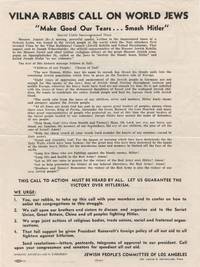
1941204434Los Angeles: Jewish People's Committee of Los Angeles 1941. Folded once horizontally fine. Broadsheet printed on both sides of single leaf 9-1/4 X 12-1/4 inches. Rare bilingual broadsheet appeal to the Jewish community printed in English and Yiddish and quoting the statement from the Vilna Rabbinical Council sent to the world August 26 1941 via Moscow begging for help after the nazi invasion and praising the Russian Red Army and "our redeemer Joseph Stalin." This sheet is slightly larger than one printed by the Daily Worker in New York of which OCLC locates only a single copy. The summer of 1941 saw the mass executions of Lithuanian Jews by German einsatzkommano forces. This appeal emerged in the midst of the horror and months before the U.S. entry into the war. Jewish People's Committee of Los Angeles unknown books
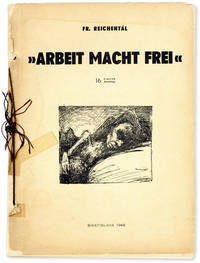
194652694Bratislava: Central Union of Jewish Communities of Slovakia 1946. First Edition. Bratislava: Central Union of Jewish Communities of Slovakia 1946. First Edition. Trade issue. One of a stated 5000 copies; this copy inscribed by the artist on title page: "To my friends Rossi and Mikloš Foltari / F. Reichental" undated but apparently contemporary with publication. Quarto 36cm; cord-bound printed card wrappers; 2 preliminary leaves; 16 unnumbered leaves of plates on coated paper printed recto-only; printed colophon leaf and blank terminal leaf 20ll complete. Covers somewhat worn; two small marginal tape-repairs to front cover with is partially detached from cord binding; internal text leaves somewhat age-toned; plates clean and unfaded. Very Good. <br/>Preface printed in both Slovak and English by Vojtech Winterstein. <br/><br/>Album of drawings depicting the daily lives of prisoners in Nazi concentration camps rendered in Reichentál's singular Expressionist style. Well known and highly-regarded as an avant-gardist through the Twenties and Thirties Reichentál exhibited widely in Germany and Eastern Europe until 1939 when German troops occupied Slovakia forcing the mass exodus of the native Jewish population. Though Reichentál himself was able to evade capture by the Nazis many of his family members died in the camps. He returned to Czechoslovakia after the war finally emigrating to the U.S. in 1950 where he continued to exhibit new work until his death in 1971. Despite the rather generous stated printing of 5000 copies plus 1000 copies of a signed numbered edition this album is notably scarce with only about 15 holdings worldwide noted in WorldCat KVK and COPAC of which ten are in North America. Central Union of Jewish Communities of Slovakia unknown books
Some wear, paper starting to brown but not fragile. Many are stamped "probenummer" ("Sample Number"--issues sent in free exchange with other political journals and left wing parties) on front cover. ; 8vo; This run includes the following 17 issues: Vol 10 (1935) : #s 1, 2, 3, 4, 11, 12; Vol 11 (1936) : #s 4, 8, 9, 10, 11, 12, 13; Vol 13 (1938) : #s 23; Vol 15 (1940) #s 8, 10, 18, 19; 24 cm. German anti-fascist periodical published from France during Hitler's reign, essentially as an exile periodical. Excellent insight in to Socialist critiques of the Nazis from those who had been, until recently, inside Germany. Some writers include: Martin Hart, Hans Israel, Walter Buchholz, E. Kolb, Fritz Kempf, Arthur Seehof, Fritz Dreher, etc, Includes material on Antisemitism, Zionism, the Spanish Civil War, Pacifism, etc. Socilaistische Wart was issued monthly through 1935; then biweekly and later weekly. It began in May 1934 and ceased publication in May 1940 with Volume 15. Issues for May-Oct. 1934 are called 1. Jahrgang [volume 1]. ; beginning Nov. 1934, they are called 9. Jahrgang [Vol 9], continuing the numbering of the earlier title, ISK. (HOLO2-135-27)
1st Edition. Original Paper Wrappers. 8vo. 14 pages ; 23 cm. In English. From the 15th Annual Sol Feinstone Memorial Lecture series at West Point. This lecture given by Elie Wiesel a year after he was awarded the Nobel Peace Prize. Speaking to the US Military Academy, Weisel says, I shall always remember the day I was liberated by the American Army: April 11, 1945 I remember a black sergeant, huge, marvelous. I saw him cry, and I heard him curse; he saw the corpses, he saw the victims, he understood what no one would ever understand, that something had happened in history that had changed history, and in his helplessness, he simply cursed, and to me his curses became pure prayers OCLC lists just 3 copies worldwide (West Point, US Army War College, Texas A&M) . Ex-library with Jewish Institutional Stamp and Usual Markings. Very good+ Condition. Scarce and important. (HOLO2-130-55A)
1st edition. Original green printed wrappers, 8vo, 32 pages. Early Zionist plea from the pivotal year of 1904, which saw both Herzls death as well as the first American publication of Herzls The Jewish State. Indeed, by 1904, cultural Zionism was accepted by most Zionists and a schism was beginning to develop between the Zionist movement and Orthodox Judaism. In 1904, Herzl died unexpectedly at the age of 44 and the leadership was taken over by David Wolffsohn, who led the movement until 1911. During this period, the movement was based in Berlin (Germany's Jews were the most assimilated) and made little progress, failing to win support among the Young Turks after the collapse of the Ottoman Regime .Under Herzl's leadership, Zionism relied on Orthodox Jews for religious support, with the main party being the orthodox Mizrachi. However, as the cultural and socialist Zionists increasingly broke with tradition and used language contrary to the outlook of most religious Jewish communities, many orthodox religious organizations began opposing Zionism. Their opposition was based on its secularism and on the grounds that only the Messiah could re-establish Jewish rule in Israel.Therefore, most Orthodox Jews maintained the traditional Jewish belief that while the Land of Israel was given to the ancient Israelites by God, and the right of the Jews to that land was permanent and inalienable, the Messiah must appear before the land could return to Jewish control (Wikipedia. Albert M. Friedenberg (18811942) was an American lawyer and historian. At the age of 19, he joined the American Jewish Historical Society and became one of its leading members; he was largely responsible for the issuance of 17 volumes of the Publications of the American Jewish Historical Society (ajhsp, nos. 1834). Friedenberg wrote numerous papers and articles on the early history of Jews in America, immigration, historical aspects of Zionism, Jews in Masonry, and the Jewish periodical press, and also on local German Jewish history, literature, and biography. He acted as the New York correspondent of the Baltimore Jewish Comment (190210) and the Chicago Reform Advocate (190531), and as contributing editor of the New York Hebrew Standard (190723). Includes bibliographical references (Encyclopedia.com). SUBJECT(S): Zionism. Interestingly, OCLC lists not a single hard copy anywhereonly microfilm and digital access copies (for example, OCLC: 894106828). An absolutely pristine, unread copy, amazingly preserved, Very Good+ Condition. Extremely rare, important, and well-preserved (zion2-3-3)
Original Wraps. 8vo. 11, [1] pages. 25 cm. First edition. In French. 'Memorial Ceremony; Eternal Memory! For the Martyrs 1940-1944'. With two full page illustrations (wall memorial in Bordeaux, for those who perished 1940-1944; photograph of the minute of silence held during the memorial ceremony) ; contains an introduction, and the content of memorial speech given by Rabbi Joseph Cohen to survivors of the Bordeaux Jewish community. Subjects: Holocaust, Jewish (1939-1945) - France - Bordeaux - Sermons. OCLC lists only one copy worldwide (HUC) . Light soiling to wraps, light soiling to margins, otherwise fresh. Good + condition. Rare early Bordeaux Holocaust imprint. (HOLO2-117-3)
Original Wraps. 8vo. 11, [1] pages. 25 cm. First edition. In French. 'Memorial Ceremony; Eternal Memory! For the Martyrs 1940-1944'. With two full page illustrations: wall memorial in Bordeaux, for those who perished 1940-1944; and photograph of the minute of silence held during the memorial ceremony. Contains an introduction, and the content of memorial speech given by Rabbi Joseph Cohen to survivors of the Bordeaux Jewish community. Subjects: Holocaust, Jewish (1939-1945) - France - Bordeaux - Sermons. Slight toning. Mild edgewear. Very minimal markings. Very good + condition. Rare early Bordeaux Holocaust imprint. (HOLO2-117-3A)
First edition. Original blue, yellow, and grey paper wrappers. 4to. About 122 pages each; 24 cm. In Hebrew and English. Title translates to Archives of the Yishuv Rescue Board in Istanbul. Volume 5 includes Register of the Palestinian Swiss, Swedish, English, Spanish and Portugese Files. Volume 6 includes Register of the Hungarian (corrected) , Italian, Albanian, Yugoslavian, Greek, French, German, Danish, Dutch, Belgian Files. Volume 7 includes Register of the Romanian and the Bulgarian Files. The most important part of the letters contains a description of the changes taking place in the Golah, in the nature of a summary of the reports received from the lands under Nazi occupation, and from countries subject to German influence. All these reports were received either directly or via the bureau in Switzerland. The time span embraced the peak period of the mass murders in Eastern Europe, including also the desperate attempts to effect rescue, especially of the remaining Jews in Slovakia and Hungary. SUBJECT(S) : Holocaust, Records, Archives. OCLC lists only 2 holdings for one or more of these volumes (Harvard, Swiss Nat Libr) . Slight rubbing. Very minimal markings and stains. Very minimal edgewear. Very good + condition. Scarce and important (HOLO2-134-54)
No Date, proabably 1944 based on dates in image on front cover. 1st edition. Original paper wrappers. 4to, [4] pages. Single-fold oversize pamphlet. Big illustration on front of newspapers with headlines such as The Jew Refugee Invasion of America Through Immigration and What To Do About It and Gentile News. THESE ARE DANGEROUS WORDS! is written across in red. On the back is the title Truth is a Weapon! and text calling for the support and expansion of The Joint Defense Appeal. Inside is more headlines and newspapers under the title of Missiles of Hate. One such is a poster campaigning for Loyd Smith for congress. It says, Loyd Smith will oppose having this nation, the United States of America, controlled by, or by the influence, of either, international Nazi, international Communist, Japanese imperialism, British imperialism or the international Jews. I solicit only the support of true Americans. Acorss the 2 inside pages, Circulated by thr hundreds and thousands, these are the words of the demagogue, who exploits Anti-Semitism to destroy the American way of Life Their Repercussions Appear in the Daily Press with Increasing Frequency. Not listed on OCLC or for sale anywhere else. Few horizontal creases, else Very Good Condition. Very displayable and exceedinly rare (HOLO2-144-27)
First edition. Original illustrated paper wrappers with black-and-white photographs. About 12 pages; 28 cm. Good Nazi-era run of this sometimes monthly, sometimes bimonthly periodical published by the Union of Orthodox Jewish Congregations of America covering news related to Orthodox Jews. Issues filled articles, advertisements for Kosher products, a list of Kosher food options, and photographs. The question is insistent and cannot be evaded: As what kind of Jews shall we survive? SUBJECT (S) : Orthodox Judaism, Periodicals. OCLC and WorldCat list 6 holdings worldwide. Overall, very good condition. Postage and mailing address. Slight toning. Minimal edgewear. Minimal pencil markings that do not affect text. Very minimal staining. (SPEC-44-4)