DEBUCOURT, Philippe-LouisBiblio.com
129 résultats
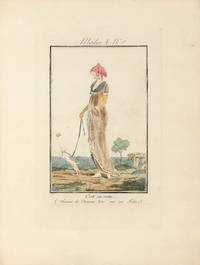
NY32<p>Paris Bureau du Journal des Dames 1798-1808.</p><p>4to 295 x 235 mm of 1 engraved title l. in lieu of cover 52 etched plates out of pagination and enchanced with watercolor numbered from 1 to 52.</p><p>Red quarter-morocco flat spine decorated with gilt and blind-tooled motifs front cover engraved and restored. Slipcase. <i>Later binding.</i></p><p><b>First edition of this "charming collection that became very rare" </b>Vinet 2248.</p><p>Colas 814; Hiler p. 223; not in Lipperheide.</p><p><i>"It is the most interesting and also the rarest collection of fashion so characteristic from the beginning of the 19th century"</i> Colas <i>Bibliographie des costumes et de la mode</i> n°814.</p><p>This precious suite has been sold up to 15 000 Gold fr. at the Montgermont's sale of 1913 the equivalent of 150 000 current euros.</p><p>The first plate bears on the upper part: <i>Modes et manières du jour</i>; the second: <i>Manières et modes;</i> the others: <i>modes</i> etc. except for the last two whose title is: <i>Modes et manières</i>.</p><p>Here is the plates list:</p><p>1. le prétexte : tunique courte jupe transparente.</p><p>2. Turcaret du jour prenant une leçon de tournure.</p><p>3. la promenade grand Schall avec bande à jour.</p><p>4. Chaise vacante Bonnet du matin schal transparent.</p><p>5. C'est en vain Tresses de cheveux liées sur un fichu</p><p>6. la petite coquette Toquet orné de plumes. Chapeau à cotes brodé.</p><p>7. la rencontre Coiffure avec guirlande en spirale. Shall garni de dentelle.</p><p>8. les cerises Coiffure en cheveux et perles.</p><p>9. l'escarpolette Chapeau de paille brodé sans ruban.</p><p>10. A ce soir Shall de gaze noire en échiquier.</p><p>11. l'agression Bonnet chapeau de gaze.</p><p>12. Correspondance furtive coiffure antique. Schall en écharpe.</p><p>13. Il va l'apaiser Robe avec canezon à col.</p><p>14. La phrase changée robe croisée. D. B.</p><p>15. N'allez pas vous perdre robe boutonée cornette à fond ouvert D B.</p><p>16. Ah quel vent ! fichu. noir. Tablier de gaze.</p><p>17. le messager fidèle fichu canezou. Robe avec nœuds de Comettes.</p><p>18. la robe déchirée Bonnet à un papillon.</p><p>19. l'écolière craintive fichu avec efilé Palatine Niv. an 8.</p><p>20. la chute capotte spencer garni de poil Niv an 8.</p><p>21. Elle le suit. Pluv. an 8.</p><p>22. le billet doux cheveux retroussés Spencer de velours. An 8.</p><p>23 Réponse au billet Chapeau blanc à petit bord.</p><p>24. Prends vite Coiffure en cheveux.</p><p>25. Retour de Longchamp Chapeau avec fichu Germ. an 8.</p><p>26. le Lilas Capotte ornée d'épis et de coquelicos Floréal an 8.</p><p>27. Il va fleurir cheveux et fichus. Robe de gaze Floréal an 8</p><p>28. Elle est prête à cueillir Capotte ornée de jacinthe. Floréal an VIII.</p><p>29. Que lui conte-t-il Chapeau en coquille. Large pantalon de Nankin</p><p>30 Ne laissai-je rien Robe en organdis de couleur.</p><p>31. Venez vous reposer Pantalon du matin. Capotte en crêpe. Prair. an 8.</p><p>32. la lecture Chapeau à petit bord. Spencer sans manches.</p><p>33. le voila Robe à manches et franges noires. Mess. an 8.</p><p>34. Il a plu Chapeau à boucles. Therm. an 8.</p><p>35. Il ne vient pas ! Coiffure étrusque. Ceinture en X Therm. an 8.</p><p>36. Ah qu'il fait saud ! Caraco garni de dentelles Thermid. An 8.</p><p>37. les deux amies Capotte à boucles. Tunique de crêpe Fructid. an V III.</p><p>38. Adieu Foquet. Schall long. robe garnie de dentelle Fructid. an 8.</p><p>39. La réflexion coiffure formée de 3 bandes de dentelle.</p><p>40. Tenez vous droit Capotte à fond ouvert Vend an IX.</p><p>41. Elle y pense Paysane avec barbes liées sous le menton.</p><p>42. Baisez Maman Capotte de velours avec bande zébrée Brum an 9.</p><p>43. M. N. et Mme Large redingote à grand collet de velours. Schal d'hiver.</p><p>44. les aprets du bal coiffure étrusque costume grec.</p><p>45. la signature Coiffure en fichu et tresses de cheveux. Tunique à pointes.</p><p>46. Elle le boude Chapeau ovale. Voile froncé Floréal an 9.</p><p>47. Il ne m'a pas vu Coiffure arec un voile. Tunique de crêpe noir.</p><p>48. Plus posément Toquet noué sous le menton. Schall quarré.</p><p>49. la solitude Fichu posé en Marmotte. Corsage bouffant. Manches longues et larges.</p><p>50. la conversation mistérieuse voile formant coiffure. Robe boutonee Manches à l'anglaise.</p><p>51. Lui a-t-il tout rendu D. B. 1808.</p><p>52. Me trompe-t-i1 1808. </p><p>This collection not only gives garment models but even more "the spirit of the time" with funny captions sometimes laconic and yet very expressive.</p><p><i>"Very rare series of 52 figures drawn and etched by Debucourt".</i>Fenaille <i>L'oeuvre gravé de P.-L. Debucourt</i> pp. 71-122.</p><p>"<i>In his prime…Debucourt 1755-1832 ranked as the supreme master of engravings printed in color. He was already an accomplished genre painter in 1785 when he perfected his process of printing in color with five successive coppers which enabled him to achieve in his prints the delicacy the suavity and the freshness of painting itself</i>" Ray <i>The Art of the French Illustrated Book</i> p. 146.</p><p><b>Precious copy of this rare and lovely suite of 52 costumes from the Empire delicately enhanced with watercolor at the time.</b></p><p>OCLC/KVK locate only 1 complete copy of the first edition at the <i>Morgan Library</i>.</p><p><br /></p><p><u>Français</u><br /></p><p>Paris Bureau du Journal des Dames 1798-1808.</p><p>In-4 de 1 f. de titre gravé tenant lieu de couverture 52 planches hors-texte gravées à l'eau-forte et rehaussées à l'aquarelle chiffrées 1 à 52. </p><p>Demi-maroquin grenat à coins dos lisse orné de motifs dorés et à froid premier plat de couverture gravé et restauré. Etui. <i>Reliure postérieure.</i></p><p>295 x 235 mm.</p><p><b>Edition originale de ce " charmant recueil devenu fort rare " </b>Vinet 2248.</p><p>Colas 814 ; Hiler p. 223 ; pas dans Lipperheide.</p><p>" <i>C'est le plus intéressant et aussi le plus rare des recueils de modes si caractéristiques du commencement du XIXe siècle</i> " Colas <i>Bibliographie des costumes et de la mode</i> n°814.</p><p>Cette suite précieuse a été vendue jusqu'à 15 000 F OR à la vente Montgermont de 1913 soit l'équivalent de 150 000 € actuels.</p><p>La première planche porte en haut : <i>Modes et manières du jour</i> ; la seconde : <i>Manières et modes </i>; les autres : <i>modes</i>etc. sauf les deux dernières dont le titre est : <i>Modes et manières</i>.</p><p>Voici la liste des planches :</p><p>1. le prétexte : tunique courte jupe transparente.</p><p>2. Turcaret du jour prenant une leçon de tournure.</p><p>3. la promenade grand Schall avec bande à jour.</p><p>4. Chaise vacante Bonnet du matin schal transparent.</p><p>5. C'est en vain Tresses de cheveux liées sur un fichu</p><p>6. la petite coquette Toquet orné de plumes. Chapeau à cotes brodé.</p><p>7. la rencontre Coiffure avec guirlande en spirale. Shall garni de dentelle.</p><p>8. les cerises Coiffure en cheveux et perles.</p><p>9. l'escarpolette Chapeau de paille brodé sans ruban.</p><p>10. A ce soir Shall de gaze noire en échiquier.</p><p>11. l'agression Bonnet chapeau de gaze.</p><p>12. Correspondance furtive coiffure antique. Schall en écharpe.</p><p>13. Il va l'apaiser Robe avec canezon à col.</p><p>14. La phrase changée robe croisée. D. B.</p><p>15. N'allez pas vous perdre robe boutonée cornette à fond ouvert D B.</p><p>16. Ah quel vent ! fichu. noir. Tablier de gaze.</p><p>17. le messager fidèle fichu canezou. Robe avec nœuds de Comettes.</p><p>18. la robe déchirée Bonnet à un papillon.</p><p>19. l'écolière craintive fichu avec efilé Palatine Niv. an 8.</p><p>20. la chute capotte spencer garni de poil Niv an 8.</p><p>21. Elle le suit. Pluv. an 8.</p><p>22. le billet doux cheveux retroussés Spencer de velours. An 8.</p><p>23 Réponse au billet Chapeau blanc à petit bord.</p><p>24. Prends vite Coiffure en cheveux.</p><p>25. Retour de Longchamp Chapeau avec fichu Germ. an 8.</p><p>26. le Lilas Capotte ornée d'épis et de coquelicos Floréal an 8.</p><p>27. Il va fleurir cheveux et fichus. Robe de gaze Floréal an 8</p><p>28. Elle est prête à cueillir Capotte ornée de jacinthe. Floréal an VIII.</p><p>29. Que lui conte-t-il Chapeau en coquille. Large pantalon de Nankin</p><p>30 Ne laissai-je rien Robe en organdis de couleur.</p><p>31. Venez vous reposer Pantalon du matin. Capotte en crêpe. Prair. an 8.</p><p>32. la lecture Chapeau à petit bord. Spencer sans manches.</p><p>33. le voila Robe à manches et franges noires. Mess. an 8.</p><p>34. Il a plu Chapeau à boucles. Therm. an 8.</p><p>35. Il ne vient pas ! Coiffure étrusque. Ceinture en X Therm. an 8.</p><p>36. Ah qu'il fait saud ! Caraco garni de dentelles Thermid. An 8.</p><p>37. les deux amies Capotte à boucles. Tunique de crêpe Fructid. an V III.</p><p>38. Adieu Foquet. Schall long. robe garnie de dentelle Fructid. an 8.</p><p>39. La réflexion coiffure formée de 3 bandes de dentelle.</p><p>40. Tenez vous droit Capotte à fond ouvert Vend an IX.</p><p>41. Elle y pense Paysane avec barbes liées sous le menton.</p><p>42. Baisez Maman Capotte de velours avec bande zébrée Brum an 9.</p><p>43. M. N. et Mme Large redingote à grand collet de velours. Schal d'hiver.</p><p>44. les aprets du bal coiffure étrusque costume grec.</p><p>45. la signature Coiffure en fichu et tresses de cheveux. Tunique à pointes.</p><p>46. Elle le boude Chapeau ovale. Voile froncé Floréal an 9.</p><p>47. Il ne m'a pas vu Coiffure arec un voile. Tunique de crêpe noir.</p><p>48. Plus posément Toquet noué sous le menton. Schall quarré.</p><p>49. la solitude Fichu posé en Marmotte. Corsage bouffant. Manches longues et larges.</p><p>50. la conversation mistérieuse voile formant coiffure. Robe boutonee Manches à l'anglaise.</p><p>51. Lui a-t-il tout rendu D. B. 1808.</p><p>52. Me trompe-t-i1 1808. </p><p>Ce recueil donne non seulement des modèles de vêtements mais plus encore " l'esprit du temps " avec des légendes amusantes parfois laconiques et cependant très expressives.</p><p>" <i>Série très rare de 52 pièces dessinées et gravées à l'eau-forte par Debucourt</i> ". Fenaille<i>L'oeuvre gravé de P.-L. Debucourt</i> pp. 71-122.</p><p>"<i>In his prime…Debucourt 1755-1832 ranked as the supreme master of engravings printed in color. He was already an accomplished genre painter in 1785 when he perfected his process of printing in color with five successive coppers which enabled him to achieve in his prints the delicacy the suavity and the freshness of painting itself</i>" Ray<i>The Art of the French Illustrated Book</i> p. 146.</p><p><b>Précieux exemplaire de cette rare et ravissante suite de 52 costumes de l'Empire finement rehaussés à l'aquarelle à l'époque.</b></p><p>OCLC/KVK localisent seulement 1 exemplaire complet de l'édition originale à la <i>Morgan Library</i>.</p> hardcover
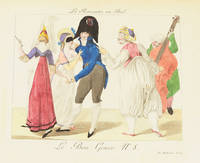
05714Paris: Chez l'Editeur 1827. The Rarely Seen Parisian Scene <br /> The Rise of the Post-Revolution French Middle Class<br /> Its Customs Costumes and Leisure Activities<br /> <br /> BON GENRE LE. Observations sur les Modes et les Usages de Paris pour Servir d'Explication aux 115 Caricatures Publiées Sous le Titre De Bon Genre Depuis le Commencement du Dix-Neuvième Siècle. Paris: Chez L'Éditeur Pierre de la Mésangère 1827. <br /> <br /> Third edition with eleven additional plates not found in the first edition of 1817. <br /> <br /> Large folio 14 7/8 x 10 7/8 in; 378 x 277 mm. 4 24 pp. of descriptive text 115 hand-colored plates. Engraved by Georges-Jacques Gatine. Printed by Vassal et Essling. With a duplicate of plate no. 16 loosely inserted. Some light foxing which is mainly confined to the blank margins. <br /> <br /> Contemporary half crimson straight-grain morocco over marbled boards smooth spine elaborately tooled and lettered in gilt. Some light wear to top and bottom of spine. An excellent example of one of the rarest suites of fashion and caricature.<br /> <br /> OCLC/KVK note only four copies of this edition in library holdings worldwide no copies of the first edition and only two copies of the 1822 edition.<br /> <br /> One of the rarest suites of fashion and caricature featuring superbly colored plates. In addition to satirizing the extravagances of contemporary fashion and society the finely rendered illustrations portray a range of public entertainers-including the rope-dancing troupes of Forioso and Ravel a magic lantern show two performing dog acts Indian jugglers acrobats and four distinct aerial runways.<br /> <br /> Le Bon Genre was one of the earliest series of prints to record the social trends and leisure activities of contemporary Parisians. It is the most important fashion portfolio of its time documenting through its caricatures the rise of the modern city of Paris and the emerging middle-class bourgeois its fashions recreations and dating customs. It also has fun at visitors' expense particularly the English whose customs and fashions the French found incomprehensible and unfashionable; the years of hostility between France and England did nothing to improve relations and the French lost few opportunities to ridicule the British. Le Bon Genre's popularity influenced most of the later fashion illustrators and journals as well as the satirical albums so typical of mid-19th century France and remains a key record of French social history. Overall Le Bon Genre bears witness to the colorful post-Revolution period of Parisian society as it evolves into the early Republican era.<br /> <br /> Of particular interest is the descriptive text preceding the plates that details the content of each caricature. One is astonished and charmed by images of a trio enjoying a magic lantern show #31; three women rapturously eating sorbets #4; a trained and costumed dog act #35; a circus balancing act #91; a man who eats anything #93; a huge amusement park slide #97; and so many more enchanting engravings delicately and vividly hand-colored.<br /> <br /> "Le Bon Genre.was first published in 1817 and went through several editions. This is a record of English and French fashions since the beginning of the nineteenth century; the English fashions are more in the nature of caricatures to show how badly Englishwomen dress as compared with the Parisiennes" Vyvyan Holland Hand Coloured Fashion Plates 1770 to 1899 p. 51.<br /> <br /> "The 'Bon Genre's' first edition 104 plates appeared in 1817. The 1822 edition included eleven additional plates; a third edition was published in 1827. Its illustrations are lively and witty statements of the life of Paris since the beginning of XIXc. with a text of explanatory paragraphs rather than fashion plates" Millia Davenport The Book of Costume II p. 814.<br /> <br /> "Georges-Jacques Gatine was the leading costume engraver of his time. For many years he supplied plates for the Journal des dames. He engraved the 115 designs which make up Le bon genre a lively mélange caricaturing people and scenes of contemporary interest" Ray The Art of the French Illustrated Book p. 141.<br /> <br /> <br /> <br /> <br /> <br /> <br /> <br /> <br /> <br /> Le Bon Genre's publisher and editor Pierre Joseph Antoine Le Bouc of Mésangère 1761-1830 better known by the name of Le Mésangère was a fascinating character whose eclectic career covered a very wide period from the French Revolution 1789 up to the Second Restoration 1815 -1830. First an eccleslastlc philosopher and writer then fashion journalist he was for more than thirty years editor-in-chief of Le Journal des Dames a periodical that had an enormous influence upon contemporary French standards of elegance and taste. Born in Anjou 1761 to a middle-class family Mésangère entered the order Congregation of the Brothers in 1784 and held the philosophie belles lettres Chair at the College de la Fleche. In hiding during the Terror 1793-1794 after Robesplerre's death July 28 1794 he began to be known as a writer for Parisian literary journals. He wrote Le Voyageur a Paris ou Tableau pittoresque et moral de cette capitale 1797 a book that gained a certain notoriety. In 1799 he became editor of Le Journal des Dames a magazine founded two years earlier. It reigned supreme amongst the women's magazines of the epoch. With engraver Gatine executing the designs Mésangère was the pre-eminent writer editor and publisher of works devoted to French women's fashion of his era.<br /> <br /> The contributing artists to Le Bon Genre included George Dutailly François Joseph Bosio Louis Marie Lante Horace Vernet and others but it is Mésangère the editor and publisher who guided them and Gatine the engraver who executed their designs who were and remain the stars here.<br /> <br /> Colas 2240. Vicaire I 839-842. Rahir 332. Davenport 2280A-2281. Paris: Chez l'Editeur, 1827 unknown
182787629chez l'éditeur, boulevard Montmartre, no 1 Vassal et EsslingImprimeurs | Paris [1801-1827] ; 1827 (pour le texte) | 41.20 x 27.80 cm | relié
182787629Paris: chez l'éditeur boulevard Montmartre no 1Vassalet EsslingImprimeurs 1827. Fine. Princess Murat's copy chez l'éditeur boulevard Montmartre no 1 Vassal et EsslingImprimeurs Paris 1801-1827 ; 1827 pour le texte 41.20 x 27.80 cm relié Complete set of 115 copper-engraved plates with an additional plate 116 plates all printed on either laid or wove paper all hand-colored with watercolor. Two entirely different plates 39 follow each other in first issue: ""Les Titus et les cache-folies"" was published in the 1817 and 1822 sets and the other ""La Politicomanie"" appeared in 1827. This is the most complete series which also includes the 11 new plates published from 1818 to 1822 numbered 105 to 115. According to Vicaire the plates were probably all printed between 1801 and 1822 and only the text preceding the plates was reprinted in 1827. 3/4 long-grained cherry half-morocco smooth spine elaborately framed in gilt lentghwise gilt tooled center of spine gilt lettered title at head of spine framed in gilt marbled boards marbled paper endpapers and flyleaves. Minor brown spots are mainly confined to the 24 pp. of text with very few on the plates mainly on the margins and versos. A rare and famous collection of costumes genre and entertainment scenes from the French First Empire and Restoration eras with very wide margins and magnificently hand-colored at the time. A veritable encyclopedia of thrills pleasures and pageantry published by Pierre de la Mésangère leading fashion editor at the turn of the century. This copy includes two versions of plate 39 both of which are extremely scarce. These magnificent copper-engraved prints by Georges Jacques Gatine Schenker and others were based on drawings by the greatest painters of Parisian fashion: Carle Vernet Philippe-Louis Debucourt Jean-Baptiste Isabey Louis-Marie Lanté Dutailly. They were initially sold as a supplement to the successful magazine Le Journal des Modes before being published as a collection. Some plates bear the engraver's name and several the draftsmen's. This gallery of figures is singularly representative of a period of upheaval in French history in terms material but also moral and intellectual values - depicting a frivolous and daring part of feminine society eager to please and well-versed in the games of love. The ensemble perfectly combines social satire with the refinement expected of fashion engravings. It includes the famous portraits of the extravagantly dressed Directoire women called ""Merveilleuses"" and ""Incroyables"" - representations that have henceforth served as a reference. From beautiful silhouettes reclining on Greek-style beds to provocative and undressed courtesans everything is designed to illustrate the finery of these pretty coquettes often followed by a host of suitors and servants. Dresses hats and furs rub shoulders with elegant male figures in frock coats and even a few transvestites Trois grâces parisiennes no. 16. Many of the scenes have a clear erotic connotation especially the salon games featuring suggestive embraces and positions. Dancing takes pride of place: no fewer than twenty plates feature fashionable ballroom dances ""Danse du Schall"" named after the popular scarf quadrille figures such as ""La Poule"" ""La Trénis"" or more daring ones like ""La Sauteuse"" ballets or even the famous tightrope dancers Ravel and Forioso. The movement of the characters is reflected in the drapery of the large Empire muslin gowns and hair flowing in the wind. Among the dozens of hand-colored plates a great many are devoted to leisure and entertainment activities available at the beginning of the 19th century. Gastronomy games of skill sports acrobatics circus tricks music and even real sensational attractions: several plates depict the very first Parisian roller coaster installed in Belleville then at the Odeon for the 1817 Carnival. Clowns pierrots and masked figures are seen dancing in front of the structures and hurtling down steep slopes on small carriages. Anothe chez l'éditeur, boulevard Montmartre, no 1Vassalet EsslingImprimeurs hardcover