CANAL, Giovanni Antonio, "Il Canaletto" (artiste) et BRUSTOLON Giambattista (graveur).Livre Rare Book
72 101 résultats
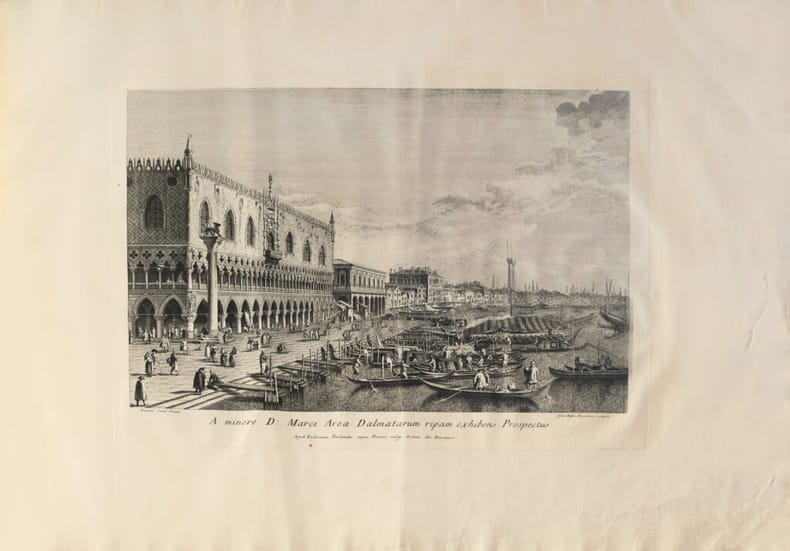
LCS-17633Première édition et premier état de cette somptueuse et magnifique suite de vues sur Venise. Venice, Ludovico Furlanetto, 1763. In-folio oblong de (1) f. de titre et 21 planches à pleine page. Demi-vélin à coins, dos lisse avec titre manuscrit en long, non rogné. Reliure de l’époque. 715 x 512 mm.
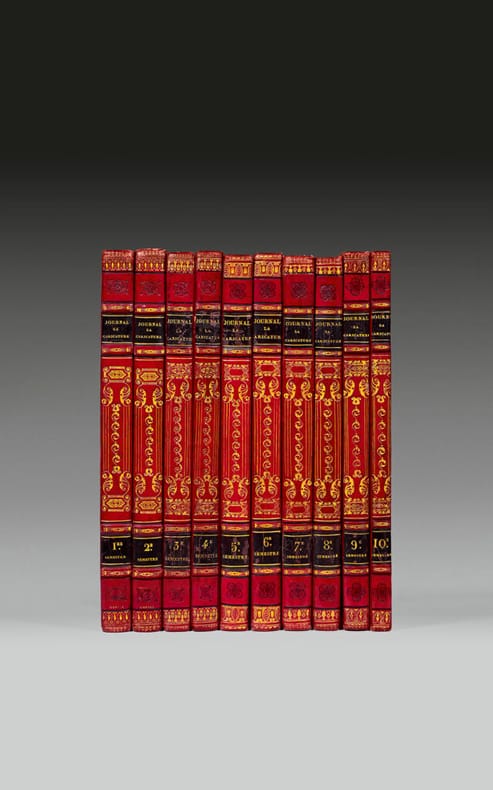
LCS-18395Précieux exemplaire conservé dans ses reliures uniformes de l’époque signées Grenet. Paris, chez Aubert, au grand magasin de caricatures et nouveautés lithographiques, 1830-1835. 10 volumes in-4 avec titres et tables et 530 planches. Rahir indique qu’il n’y a des titres et tables que pour les vol. 1 à 9. Qq. rousseurs et ff. brunis. Demi-basane rouge à coins, dos à nerfs orné de motifs dorés et estampés à froid, pièce de titre et de tomaison de veau noir. Étiquette du relieur Rue St-Honoré, n. 99, dans la cour, papetier-relieur. Reliure de l’époque signée Grenet. 333 x 253 mm.
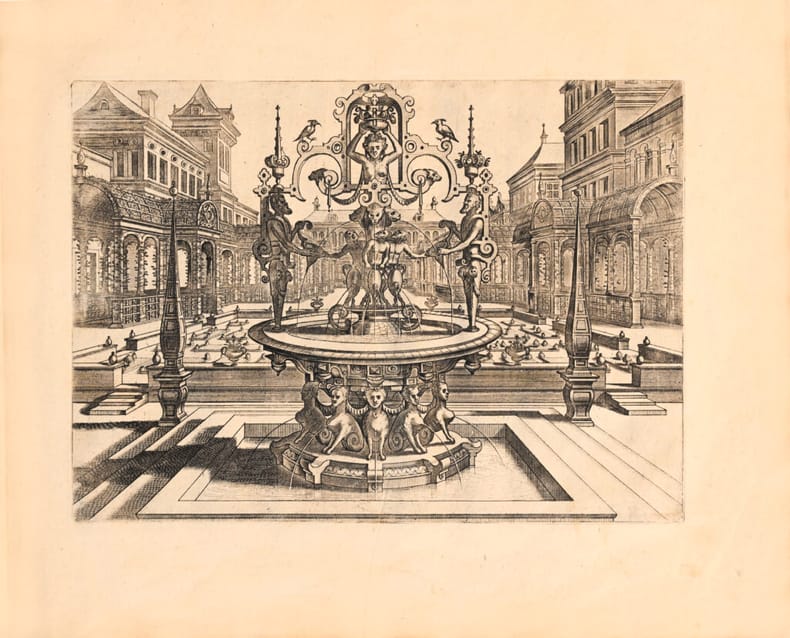
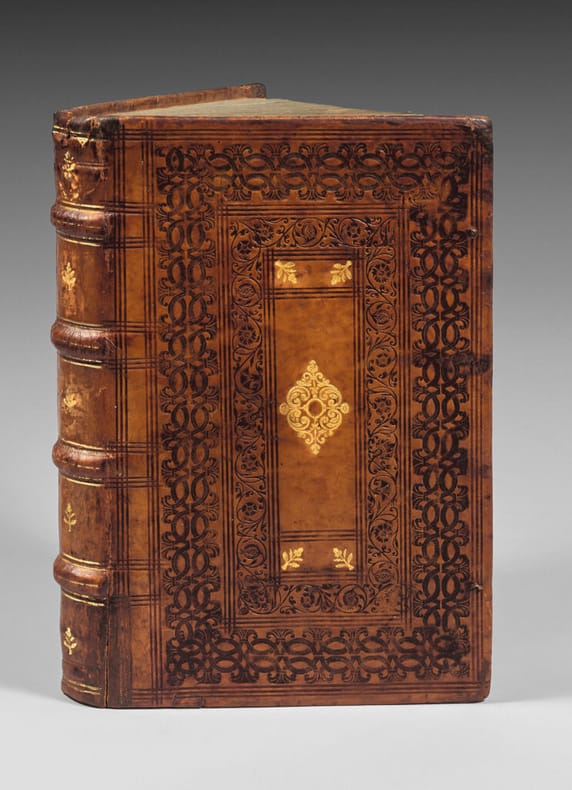
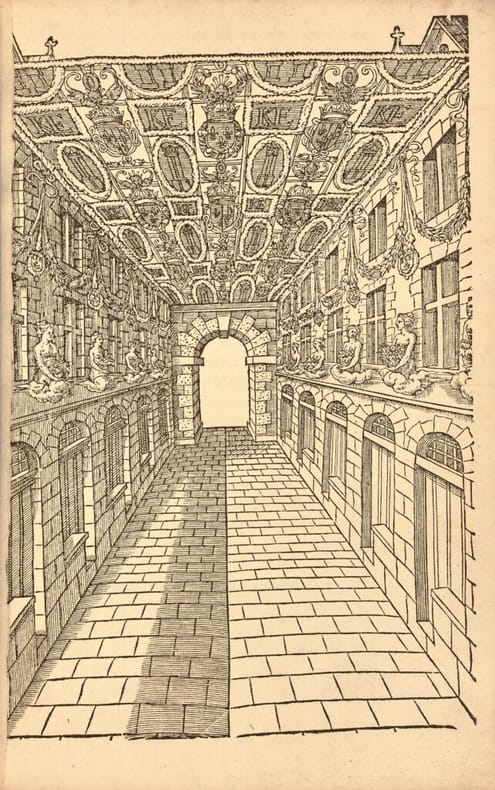
LCS-18476Provenance: Rothschild; Baron Alexis de Rédé. Vredeman de Vries, Jan (1527-1609), Floris, Cornelis (1514-1575) et Galle, Philippe (1537-1612). - Hortorum viridariorumque elegantes & multiplicis formae… Anvers, Philippe Galle, 1583. In-folio oblong (260 x 323 mm). Titre-frontispice et 20 planches de jardins, numérotées. Edition originale. Berlin Kat. 3390 ; Hollstein XLVIII, 470-490. - [Relié avec] : du même : Jardins. Anvers, Philippe Galle, c. 1583. 6 gravures numérotées. Edition originale. - [Relié avec] : du même : Artis Perspectiuae plurium generum elegantissimae Formulae, [graphic], multigenis Fontibus, nonnullisq[ue] Hortulis affabre factis exornatae, in comodum Artificum, eorumq[ue] qui Architectura, aedificiorumq[ue] comensurata uarietate delectantur, antea nunquam impressae. Anvers, Gerardus de Jode, 1568. Titre-frontispice et 17 gravures. Edition originale. - [Relié avec] : du même : Puits et fontaines. Anvers, Philippe Galle, 1573. 24 gravures numérotées sur 12 feuillets, minime déchirure à une planche. - [Relié avec] : Floris, Cornelis. Veelderleij niewe inventien van antijcksche sepultueren diemen nou zeere ghebruijkende is met noch zeer fraeije grotissen... Anvers, Jerôme Cock, 1557. Titre et 15 planches gravées montrant des décorations fantastiques, et des monuments funéraires dans le style grotesque. Edition originale rarissime. Reliure en vélin ancien, gardes renouvelées. Titre de la première suite frotté et effrangé avec déchirures marginales et pliure et joint à la garde ; taches à quelques planches. 257 x 326 mm.
NYBF15<p>Amsterdam Nicolas Visscher 1660.</p><p>Large folio 535 x 358 mm of 9 double-pages with 36 engravings bound in 18th century paperboards.</p><p><b>Complete copy printed on large paper in sumptuous contemporary colouring of the baroque atlas of the Netherlands. </b></p><p>In the last 60 years auction records mention only 2 copies of the standard issue one from the first edition of 1657 the other one from the present edition of 1660. A third copy which was incomplete was sold in 1987.</p><p><b>The present compilation contains</b><b> 36 engravings</b> printed by groups of 4 on the recto of double folio<b>s that illustrate baroque architecture of the Netherlands in the middle of the 17th century.</b></p><p>The prints not only depict towns canals ports village scenes mains monuments but also precarious housing return from the market hunting scenes sailing castles churches convents wind mills as well as ornamental gardens the whole entirely enhanced with warm contemporary colouring.</p><p>Hollstein Schut 32; Hollstein Publ. Clae Claesz Visscher I 7</p><p><b>The present copy printed on large-paper is the only one recorded from this de luxe edition. </b>In the posterior editions the Ottens ones for instance engravings were cut and presented separately and so printed in a 4to format.</p><p>The <i>Visscher</i> family is famous in the history of printing Atlases in the Netherlands in the 17th century. <i>Nicolas Visscher I</i> the editor of the present atlas was born in Amsterdam in 1618. Only son of <i>Claes Jansz</i> <i>Visscher</i> he got married in 1643. When his father died in 1652 he carried on the activity and settled in the Kalverstraat in Amsterdam until his passing in 1679.</p><p><br /></p><p><u>Français</u><br /></p><p>Amsterdam Nicolas Visscher 1660.</p><p>Grand in-folio de 9 double-pages regroupant 36 estampes cartonnage du XVIIIè siècle.</p><p>535 x 358 mm.</p><p><b>Exemplaire complet imprimé sur grand papier en somptueux coloris de l'époque de l'Atlas baroque des pays bas.</b></p><p>Depuis 60 ans le répertoire des ventes publiques ne mentionne que 2 exemplaires en tirage normal l'un de la première édition de 1657 l'autre de la présente édition de 1660 un troisième incomplet fut vendu en 1987.</p><p><b>Ce recueil présente 36 estampes gravées</b> groupées par 4 vues imprimées au recto d'un double folio -<b>illustrant l'architecture baroque des Pays Bas au milieu du XVIIè siècle</b><b>.</b></p><p>Sont dessinés et peints avec bonheur les villes canaux ports scènes villageoises les principaux monuments mais aussi l'habitat précaire le retour du marché les scènes de chasse la navigation les châteaux églises couvents moulins ainsi que les jardins d'agrément le tout rehaussé en chaleureux coloris de l'époque. Hollstein Schut 32 ; Hollstein Publ. Clae Claesz Visscher I 7</p><p><b>Le présent exemplaire imprimé sur grand papier est le seul répertorié dans ce tirage de luxe. </b>Dans les éditions postérieures par exemple les éditions Ottens les gravures furent coupées et présentées séparément et donc imprimées au format in-4.</p><p>La famille <i>Visscher</i>est célèbre dans l'histoire de l'imprimerie des Atlas aux Pays Bas au XVIIè siècle. <i>Nicolas Visscher I</i> l'éditeur du présent atlas est né à Amsterdam en 1618. Fils unique de <i>Claes Jansz</i> <i>Visscher</i> il se maria en 1643. A la mort de son père en 1652 il poursuivit l'activité et s'établit sur la Kalverstraat jusqu'à sa mort survenue en 1679.</p> hardcover
LCS-10989Rare exemplaire complet de l’Atlas baroque de Visscher sur les Pays Bas, imprimé sur grand papier, somptueusement colorié à l’époque. Amsterdam, Nicolas Visscher, (1660). Grand in-folio de 9 double-pages regroupant 36 estampes, cartonnage du XVIIIè siècle. 535 x 358 mm.
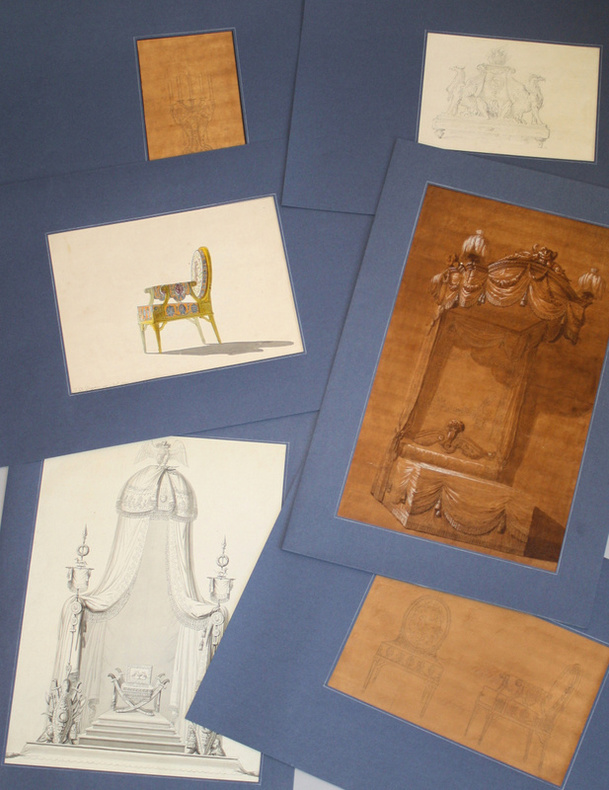
LCS-17663Un recueil témoignant de l’imagination créative de l’artiste, inventeur de talent du néo-classicisme et dont l’influence dans l’art décoratif serait de première importance à la veille de la Révolution. 6 dessins ou aquarelles de format in-folio, sous maries-louises bleues, regroupés dans une boite-étui en demi-maroquin rouge signée Devauchelle. -Projet de fauteuil en cabriolet vu de trois quarts. Aquarelle, plume et encore noire. 245 x 320 mm. Signé en bas à gauche à la plume « J.D. Dugourc. Inv. Del. Paris », vers 1790. Fauteuil en cabriolet au dossier ovale décoré d’une lionne dans un semis de fleurs. Les accotoirs, dégagés du dossier, sont recouverts d’un motif de palmette, comme le coussin. -Projet de fauteuil de profil et de chaise de face. Plume et encre noire sur papier calque collé sur le support en deux morceaux. 197 x 330 mm. Titre « Fauteuil et chaise pour salle à manger », vers 1790. La chaise décorée d’une lionne est assortie au fauteuil et reprend les mêmes motifs. -Projet de feu à griffons. Pierre noire. Titre « Idées de Bronzes ». 190 x 255 mm. Le feu est orné de deux griffons médaillés, séparés par un autel de feu. Sur l’autel, les initiales des prénoms du Comte de Provence, à qui ces feux étaient destinés. -Projet de girandole à cinq branches. Plume et encre noire sur papier calque collé sur le support. Titre « 24, girandolle ». 225 x 145 mm. Girandole à cinq branches portées par deux grotesques dont le corps terminé en volute est posé sur un socle aux pieds en sabre. Ces figures sont reliées entre elles par des pendeloques de cristal. -Projet de lit à la duchesse. Plume et encre noire, rehaussée de lavis brun et de gouache blanche sur papier calque collé sur le support. Titre « Lit à la duchesse ». 510 x 308 mm. Couronnement décoré de plumets et de petits amours. -Projet de trône. Plume, encre noire et lavis gris. Un aigle, ailes étendues figure au-dessus de l’impériale, un brin de laurier au bec et le pied sur la foudre. Deux pans de rideaux retenus par des trophées tombent de chaque côté du trône aux piétements en forme de sabres courbes entrecroisés ; deux hérons buvant dans une coupe décorent le dossier du trône.
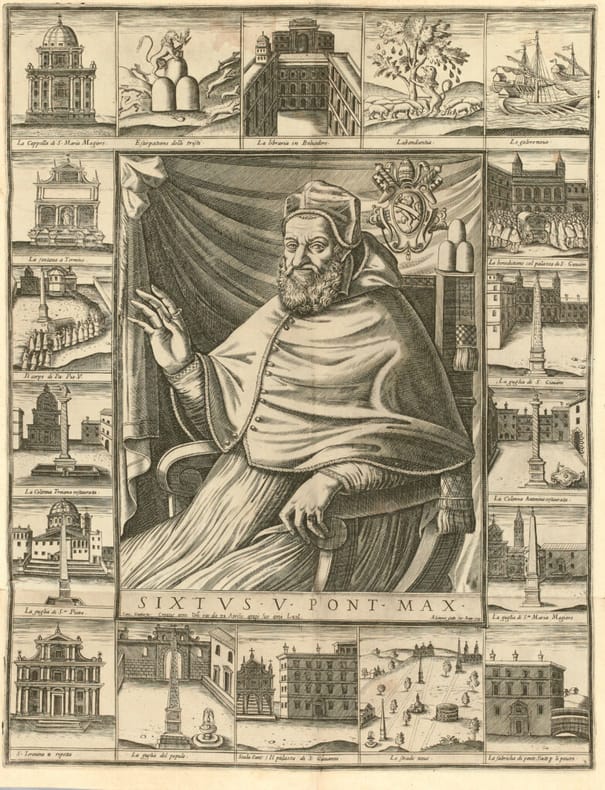
LCS-18538Fort bel exemplaire en vélin ivoire de l’époque. Rome, Domenico Basa, 1590. In-folio, portrait-frontispice replié, titre illustré gravé, 108 ff. (certains numérotés en double et un feuillet 66bis), (4) ff. (tables, errata et colophon), et 2 planches dont une dépliante. Plein vélin ivoire, dos lisse. Reliure de l’époque. 407 x 272 mm.
LCS-18327L’une des plus précieuses et des plus rares suites de l’école de Fontainebleau, gravée sur cuivre. Paris, s.n. [Jean de Mauregard], 1563. Petit in-folio de (4) feuillets oblongs repliés : titre, épître dédicatoire au roi Charles IX signée Jehan de Mauregard, et 4 pages de texte en langue latine de Jacques Gohory, suivies de 25 planches gravées (sur 26, la n°19 est manquante) en noir sur double page, montées sur onglets. Qq. taches marginales, inscriptions manuscrites biffées en marge inf. de 4 planches. Les planches ne sont pas légendées contrairement à celles des tirages ultérieurs. Plein veau brun granité, filet à froid autour des plats, dos à nerfs richement orné, pièces de titre en maroquin rouge et citron, coupes décorées, tranches rouges, charnières, coiffe supérieure et coins restaurés. Reliure vers 1720. 228 x 162 mm.
LCS-17893Ces deux premières éditions magnifièrent les antiquités grecques et romaines, et exercèrent la plus grande influence dans le développement du mouvement néo-classique en France et en Angleterre. Paris chez l’auteur, (de l’imprimerie de Cailleau), 1785 [- 1788]. 5 volumes in-8 : [2]-103-[1], 134, 142, 180-[4], 110-[2] pp. ; 365 h.-t. protégées pour la plupart par des serpentes. Complet. Plein veau marbré, triple filet doré cernant les armoiries sur les plats, dos à nerfs fleuronnés dorés et étiquettes de cuirs rouge et vert, filet et roulette dorés sur les coupes et remplis, tranches dorées (T. V non armorié. Reliure armoriée de l’époque. 200 x 125 mm.
LCS-18545Précieuse réunion de quatre ouvrages importants sur l’architecture classique et l’histoire de l’art, tous somptueusement reliés de manière uniforme en veau orné de l’époque. Piranesi, Francesco. Pianta delle fabriche esistenti nella Villa Adriana. (Rome, 1781). - Et: [Monumenti degli Scipioni pubblicati dal cavaliere Francesco Piranesi. Rome: 1785.] [And:] - Peintures de la Sala Borgia, au Vatican. Paris: Piranesi & Leblanc, Rome: Piroli, An II-1803. [Bound with:] - Peintures de la Villa Lante a Rome. Paris: Piranesi & Leblanc, Rome: Piroli, Xn II-1803. Hamilton, G. Schola Italica Picturae … incisae cura et impensis Gavin Hamilton. Rome, 1773. 4 volumes in-folio, veau brun, décor doré, grand losange central brun avec des fleurs stylisées, des têtes d'anges et de lions et une couronne évoquant la couronne papale, large bande en encadrement, de teinte plus sombre, ornée de feuillages et de dessins floraux, de motifs d'urne et de têtes de lions aux angles, dos à nerfs ornés de motifs dorés refaits, tranches dorées. Riche reliure romaine de l'époque. 533 x 360 mm / 530 x 395 mm / 552 x 400 mm / 632 x 460 mm.
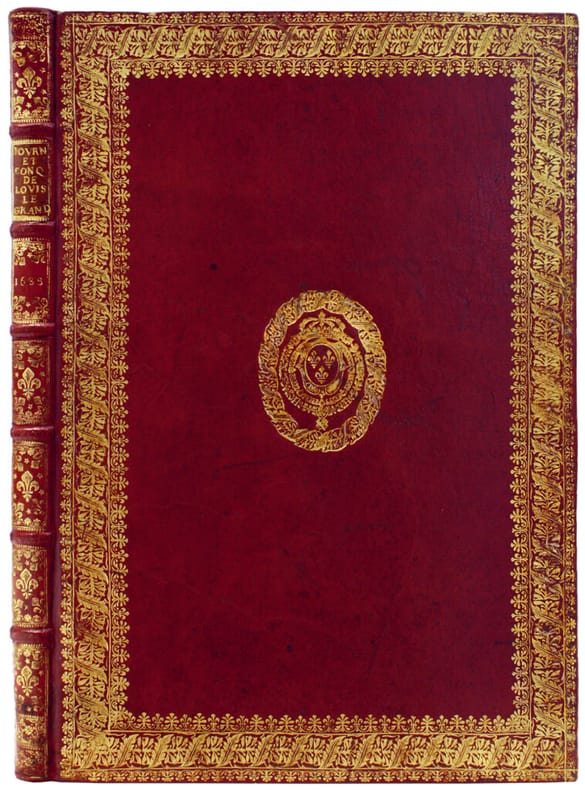
LCS-18301Le journal manuscrit des évènements politiques et militaires, de l’année 1688. S. l. n. d. [Paris, vers 1715]. In-folio de (46) ff., 9 double-page aquarellées. Plein maroquin rouge, dentelle du Louvre encadrant les plats, armes royales frappées or au centre, dos à nerfs richement orné de fleurs-de-lys et étoiles dorées, roulette dorée sur les coupes, roulettes intérieure dorée, tranches dorées. Epidermures. Reliure de l’époque. 445 x 307 mm.
1870ABC_47963Madrid 1870. Contemporary gold- and blind-stamped green leather with the intials "M.L.B." blind-stamped on the front board gold-tooled turn-ins green watered silk endpapers gilt edges. Oblong folio 62 x 46.5 cm. With 72 large size albumen photographic prints with architectural views including numerous views of Spanish and Western Islamic architectural treasures ca. 33.5 x 24.5 cm 3 large composite photographic panoramas the Alhambra and Granada Cordoba and San Sebastian and 5 photographs of people 3 handcoloured photographs of Spanish costumes and 2 portraits of a woman. 58 of the 72 photographs contain the name of photographer title and number of the image in the negative. An exceptional album with fine views of Sevilla Granada Cordoba San Sebastian and many more. The photographer Jean Laurent was born in France but opened a photo studio in Madrid in 1856. In 1858 the Spanish government commissioned him to photograph the construction of the railroad line from Madrid to Alicante. The results were published and exhibited in many places which brought him considerable success. From 1861-68 Laurent held the title of "Fotógrafo de S. M. la Reina" and produced photos of members of the Spanish royal family. His photo studio in Madrid became one of the best-known from his time which allowed him to open gallery in Paris where he exhibited and sold premium-quality prints from his work in Spain. Although he was interested in industrialisation and intended to convey the image of a modern and economically flourishing country his photographs of the more picturesque aspects of Spain became more popular. The present album contains 34 views of Western Islamic architectural structures and a large 4-part folding panorama of the Alhambra and Granada. Furthermore it contains two examples of photographs on leptographic paper a collodio-chloride printing paper which was sold ready to use. Its manufacture was perfected by Laurent in collaboration with Martínez-Sánchez in 1866.With some slight signs of wear around the spine and the corners of the boards the panorama views are mounted on grey cloth which is somewhat foxed not affecting the actual photograph the album leaves are very slightly browned. Overall in very good condition.l Hannavy Encyclopedia of Nineteenth-Century Photography II 829/830. hardcover
LCS-17061Rare et magnifique recueil sur les Fontaines et les jardins de Rome et Tivoli en reliure de l’époque. Rome, 1691. De la bibliothèque Earls of Macclesfield. Rome, G. G. de Rossi, vers 1691. 33 feuillets entièrement gravés dont le titre, la dédicace et les estampes. [Relié à la suite] : FALDA. Le Fontane delle ville di Frascati, nel Tusculano, con li loro prospetti, Parte seconda. Ibid, vers 1691. 18 feuillets entièrement gravés dont un dépliant. [Relié à la suite] : VENTURINI, Giovanni Francesco. Le Fontane ne’Palazzi e ne’giardini di Roma. Ibid, 1691. 28 feuillets entièrement gravés, dont une planche dépliante. Ibid. Le Fontane del giardino Estense in Tivoli… Parte quarta. Ibid, [vers 1691]. 28 feuillets entièrement gravés, dont une planche dépliante. Soit 4 parties reliées en un volume in-folio oblong, veau moucheté, double filet doré et roulette à froid autour des plats, dos à nerfs richement orné de fleurs-de-lys dans les caissons, coupes décorées, tranches mouchetées rouges. Reliure de l’époque. 275 x 395 mm.
LCS-18544Le recueil consacré aux réalisations de Raphaël est un témoignage d'un intérêt artistique manifeste de l'harmonie et de l'extraordinaire richesse imaginative de l'artiste dans la décoration des stucs, plafonds et voûtes de la galerie du Vatican. Roma, Pagliarini, 1772-1777. 3 volumes grand in-plano, oblong in plano et éléphant in-plano; demi-maroquin rouge, dos lisses ornés. Reliure de la toute fin du XVIIIe siècle. 680 x 475 mm; 525 x 660 mm; 750 x 660 mm.
LCS-17041Los Proverbios de Goya. Publicala la Real Academia de Nobles Artes de San Fernando, Madrid, 1891. Album in-folio comprenant un titre et la suite complète de 18 eaux-fortes publiées sous le titre « Los Proverbios » mais dont le titre prévu par Goya était « Disparates » (Extravagances). Brochure verte de l’époque défraichie. 315 mm x 490 mm.
LCS-18424Superbe exemplaire de cette édition originale imprimée en 1617 et 1618 ornée de 100 estampes sur les moulins et leur mécanique. Francfort sur le Main, Paul Jacques, aux despens dudit Octave, & se vendent en la boutique de Lucas Jennis, 1617-1618. In-foliode (10) pp., 50 planches doubles numérotées de 1 à 50; 18 pp., (1) f.bl., 50 planches numérotées 51 à 100; relié à l’époque comme la plupart des rares exemplaires passés sur le marché sans les 8 ff. d’explication de la première partie tels les exemplaires Christie’s du 12 juin 2013 relié en vélin moderne (vendu 11000 €) et l’exemplaire Koller du 2 avril 2012; ces deux exemplaires étaient considérés complets. 5 pl. légèrement piquées, pl. 22 et 64 brunies, pl. 57 et 66 fendues sans manque, pl. 67, 68, 93et 94 reliées à l’envers. Plein veau havane, plats entièrement cernés de roulettes variées et de filets à froid avec fleurons d'angles et fleuron central doré, dos à nerfs orné de filets dorés et entrenerfs fleuronnés dorés, tranches bleutées. Superbe reliure de l’époque. 289 x 183 mm.
LCS-18268Précieux exemplaire, conservé dans ses belles reliures de l’époque, cité par Cohen (col. 1056) provenant des bibliothèques du Comte Greffulhe et d’André Langlois avec ex-libris. Paris, Audran et Chereau, [1726-1728]. 2 volumes in-folio de : T. I / (4) ff. gravés (frontispice dessiné et gravé par Boucher, épitaphe, et autoportrait de Watteau gravé par Boucher), et 101 planches portant 132 sujets numérotés. Sans le titre, la Vie (2 ff.) et la préface (un f.), gravés, jamais reliés dans l'exemplaire (voir ci-après) ; T. II / 121 planches portant les sujets numérotés de 133 à 350 et 1 gravure non numérotée entre la 270 et 271. Sans le titre et le f. d’Avertissement. Veau marbré, triple filet à froid encadrant les plats, dos ornés de filets, fleurons, et étoiles, pièces de titre et tomaison de maroquin rouge et noir, tranches dorées. Reliure de l'époque. 495 x 325 mm.
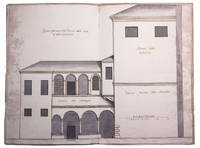
1720653FKG01U79OVerona 1720. Contemporary stiff paper wrappers. Folio 38.5 x 25.5 cm. With 4 architectural drawings 3 double-page ca. 37 x 50 cm at a scale of about 1:60 and 1 loosely inserted full-page 24 x 35 cm at a scale of about 1:107 skillfully drawn in brown ink and several shades of grey watercolour. Two of the double-page drawings are elevations 1 partly in cross-section the other 2 drawings are floor plans each plan with a folding flap tipped on showing the plan of a higher level. The original designs for the alterations to the chapter library at Verona situated in the Church of St. Helena abutting the famous Cathedral of San Zeno the common wall appears in the drawings. The alteration was ordered by Scipione Maffei 1675-1755 and Jacopo Muselli and executed by the architect Lodovico Perini; it was finished in 1726. In 1713 Maffei a leading scholar poet and man of letters had made a remarkable discovery in the library: in its old cupboards he found late-classical and early Christian manuscripts from the 5th to 9th century stored there centuries earlier apparently to protect them against danger of flooding of the river Adige. On the basis of these old manuscripts and helped by the Canon Carlo Carinelli Maffei formulated a completely new and epoch-making theory regarding the development of the Latin script in three variants: the Roman majuscule the minuscule and the cursive hand showing an uninterrupted evolution from Roman Antiquity to the Renaissance. Maffei published the results of his studies in his Istoria diplomatica 1727 and Verona illustrata 1742. The rediscovery of these old manuscripts also resulted in a revival of Patristic studies and many new editions of the works of the Church Fathers.With some faint stains near the fore-edges an one edge of the loosely inserted drawing and a couple rust spots in the paper but still in very good condition. unknown
LCS-18448Il renferme des poèmes de Ronsard, Baïf, Jamyn, Dorat et Pasquier en édition originale. Paris, Denis du Pré pour Olivier Codoré, 1572. 54 ff. dont 8 planches à pleine page, 1 planche hors texte à pleine page et 1 planche dépliante hors texte. C’est l’ordre et forme qui a este tenu au sacre & couronnement de tres-haute, tres-excellente, & très-puissante princesse Madame Elizabet d’Autriche Roine de France: faict en l’Eglise de l’Abbaie sainct Denis en France le vingt cinquiesme iour de Mars, 1571. A Paris, de l’imprimerie de Denis du Pré, pour Olivier Codoré, 1571. Avec privilège du roy. 10 ff. Entrée de la Reine. 26 ff., (1) f., (1) f.bl., 6 planches. Soit 3 parties en 1 volume in-4. Veau fauve, double filet or encadrant les plats avec armes au centre, dos à nerfs orné. Reliure début XVIIe siècle.
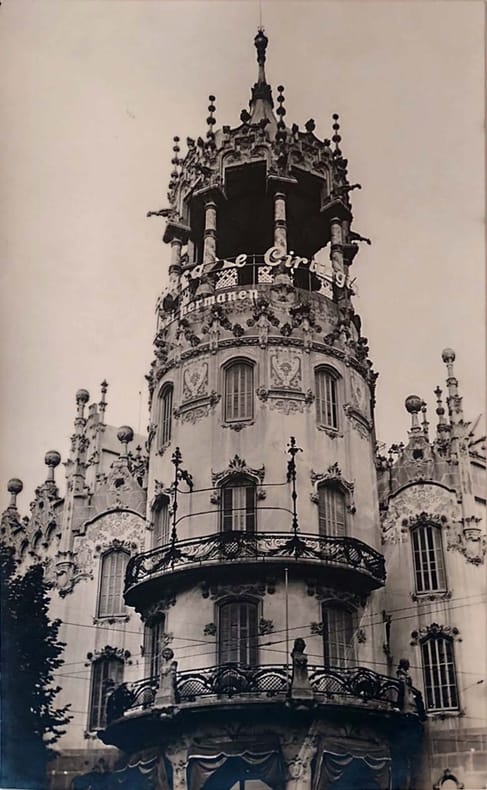
105845-4 images des pavillons d’Antonio Gaudi i Cornet (1852-1926) dans le Parc Güell.-1 image de la Tour Andreu ou Rotonda d’Adolf Ruiz i Casamitjana (1869-1937) et Enric Sagnier (1858-1931)Cinq tirages originaux de l’époque sur papier aux sels d’argent, 230x150mm environ.
LCS-18442Premier tirage de l’une des plus admirables suites d’estampes. Paris, 1635. Suite complète de cinq eaux-fortes. (G. Duplessis 1071 à 1075 – A. Blum 1028 à 1032). 325 x 255 mm.
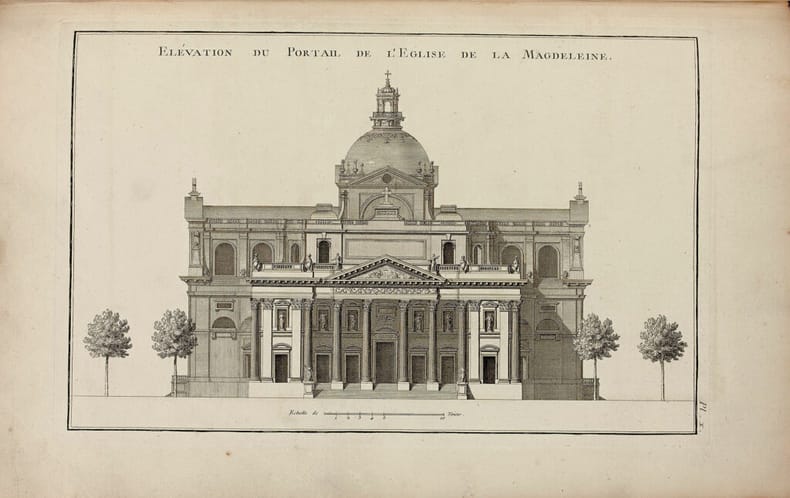
LCS-17542Édition originale et premier tirage de ce superbe ouvrage consacré aux monuments érigés à travers la France à la gloire du roi Louis XV. Paris, chez l’auteur, et chez Desaint et Saillant, 1765. In-folio de : (2) ff., 232 pp., (1) f. d’approbation et privilège, 57 planches numérotées (33 pl. à pleine page et 24 sur double-page dont 9 dépliantes), 4 vignettes gravée dans le texte. Qq. ff. brunis, marge de la pl. LII anciennement restaurée sans atteinte à la gravure. Plein maroquin rouge, triple filet doré encadrant les plats, grandes armes frappées or au centre, chiffre doré couronné frappé aux angles, dos à nerfs orné du même chiffre couronné dans les caissons, pièce de titre de maroquin havane, double filet or sur les coupes, roulette intérieure dorée, tranches dorées. Reliure de l’époque. 417 x 283 mm.
763-Eo.J. Aquarell über leichter Bleistiftskizze, mit Gummi arabicum besonders im Vordergrund über-gangen, auf festem chamoisfarbenem Zeichenkarton, rechts unten signiert ?F. Horner?. 41:55,8 cm. Literatur: Johannes Fichter, Weisslingen/Schweiz, hat das Aquarell unter Nr. 149 in das in Vorbereitung befindliche Werkverzeichnis aufgenommen (Brief vom 10.05.2006). Im Kupferstichkabinett des Kunstmuseums Basel befinden sich 80 Blätter von Horner mit orientalischen Motiven (Balkan, Griechenland und Türkei), zu denen eine Legende des Künst-lers existiert. Blatt 34 zeigt die gleiche Ansicht wie das oben beschriebene, wenn auch zahlrei-che Details ? besonders im Vordergrund ? verändert sind. Zu diesem Blatt gibt es in Basel auch zwei Vorzeichnungen. Wahrscheinlich hat Horner für beide Aquarelle dieselbe Vor-zeichnung benutzt. ?Die 80 Blätter in Basel sind alle mit viel grün bzw. einheitlichen Farbtö-nen aus einem Guß gemalt. Es kann sehr gut sein, dass Ihr Blatt zu den an die Großfürstin verkauften Blättern gehörte. Ihr Blatt ist etwas größer und m.E. lebendiger und schöner. Bis-her ist mir nur eine Ansicht des Hippodroms bekannt, die auch mit der gleichen Farbgebung wie Ihr Blatt gemalt wurde und von der auch ein entsprechendes Blatt in der Basel Serie vor-handen ist.? (zit. aus dem o.g. Brief von J. Fichter).
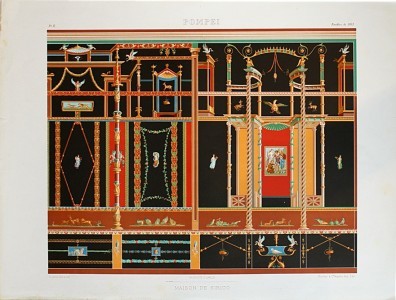
LCS-303Les peintures murales de Pompéi à travers 20 superbes chromolithographies du plus haut intérêt. Proprietà Cav. Uff. Pasquale d’Amelio, Napoli, n.d. [1886]. Grand in-folio de (1) f. de couverture, ix pp. (dont le titre lithographié orné d’une vignette), 20 pp. de texte et 20 chromolithographies numérotées. Infimes rousseurs. Conservé en feuilles, tel que paru, dans la chemise de l’éditeur. 630 x 445 mm.
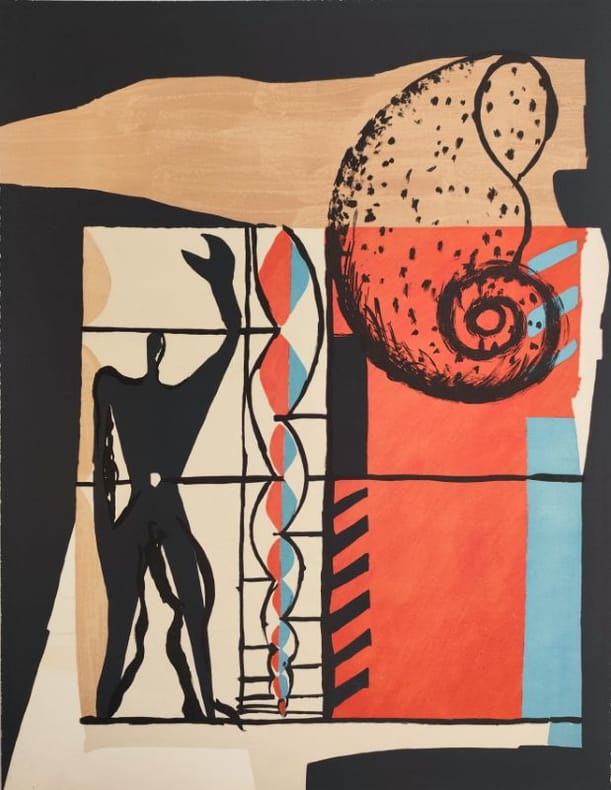
19551054881955 Paris, Tériade, 1955, in-folio en feuilles 420x320mm, 158p., sous couverture et étui chemise.