15 963 résultats
189553540Chicago & New York: Rand McNally & Co. 1895. 8vo. 333 1 pp. Red linen decorated & lettered in gilt on front cover gilt lettering on spine t.e.g. minor rubbing minor soiling to spine slightly cocked still VG- copy. First American edition of this curious Henty title first published in book form in England by Chatto & Windus 1894 of this curious mystery of mystery and kidnapping of one of two twin girls used to inflict pain upon the father and the twin sister. The mystery is resolved by the young hero in the last half of the book in the gold camps above Sacramento CA. Rand, McNally & Co., unknown
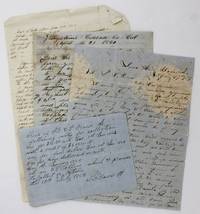
1850List1929California 1850. With thirteen letters most multi-page written from Monterey in 1850 a 7 pp facsimile transcription of a 1834 Mexican land grant on cloth measuring 11 x 14 inches and and eleven page document on paper in Spanish relating to a Monterey land grant transcribing an 1841 document. Letters heavily worn with some loss at margins but mostly legible land grant in good to very good condition transcribed document in Spanish in fair condition with water damage to margins. Fair. An interesting archive of 1850s-era material relating to the life and career of the surveyor Edward Williams which recently surfaced in the central mother lode region. The group includes his personal letters from the California Gold Rush as well as well two interesting documents form his work for the Surveyor General J.W. Mandeville in 1858 where he transcribed two Mexican land grants. <br /> <br /> Lt. Edward Williams was a member of Company E New York Volunteers under Capt. Nelson Taylor. He came to California around 1847 and found employment as a deputy surveyor later working for the Office of the Surveyor General of the Unites States for California. In 1858 Surveyor General J.W. Mandeville commissioned a report on Mexican-era California Land Grants. Mandeville had Williams copy the original documents exactly - inclusive of an ink copy on linen that is an "exact tracing" of the original documents starting with 1834 up through about 1840. These "copies" were submitted to the Surveyor General in 1858 for use in the report. Williams continued the title work by copying other documents from about 1841 though this time not as a tracing but hand copied on the usual blue paper of the 1850s.<br /> <br /> The documents illustrate the length officials went to while they investigated Mexican Land Grant titles to California properties in the 1850s. The process was difficult and involved two distinctly separate cultures and legal systems that clearly conflicted. The Mexican Government granted rights for these large land parcels in California to various people but clearly stated they could not sell parts of the property. The wording was used many times in litigation of the period in both defense of the land grants and in opposition to how the land grants were handled. The issues were actually quite simple in that the Mexican legal standards for land grants was far different from those in the United States and the two differing forms of written land ownership and use clashed. <br /> <br /> These documents reflect a parcel of land granted to Francisco Mesa at "Corral de Tierra" a large parcel in Monterrey County California. Mesa had requested land for "his personal use and that of his family." In the Grant the title papers reflect "while the land is under Francisco's possession it cannot be divided mortgaged or a levy placed on it nor handed down." These original documents help illustrate the complex story of Mexican Land Grants in California. <br /> <br /> Also included are thirteen letters from Ed aka "Ned" to various family members primarily his mother and sister Alice and vice versa. About half are from Ed the other half are written to him. The dates of the letters are; 1850: February 10th April 15th April 16th April 28th June 10th July 30th October 11th and November 17th and 1851: September 9th. One undated letter with heavy loss is written from Panama. The letters are generally readable but the condition far from perfect with water stains throughout and chips abundant along edges and significant textual loss. The letters are generally at least two pages sometimes four or more inclusive of writing in the crossed line custom to save paper. Most are datelined at Monterrey where he discusses the people the customs setting and more. <br /> <br /> Despite the condition flaws there is much to be gleaned from his correspondence. In his April 15 1850 letter . he describes his trip to San Juan Bautista from Monterrey in detail while he was on his way to San Francisco. Williams writes of his great pleasure on tasting cooked beef by the Indians that he found was the best he ever tasted as they camped on the way to San Jose with the ultimate goal Mission Dolores in San Francisco: “this the beef they put on the embers of the fire and broiled it - I never tasted anything like it before so tender so juicy…†One of his first notes on San Francisco: "There are regular streets filled with all kinds of sorts of stores… The shipping covers the water as far as you can see. And those nearest the shore are converted into store houses the rigging being taken down and the and holes cut in the sides for doors.The best houses in town are occupied by gamblers . a large saloon filled with tables on which are played all kinds of games of chance - at some of the tables are displayed immense amounts of coin and gold in lumps worth from 1 to 5000 dollars which some poor infatuated fool of a miner has at some time lost to them."<br /> In his letter of April 16th he discusses both his difficulties with women in California and his lack of fitting in back east: “The Spanish Girls are very nice and all that sort of thing but the trouble is to find one that is educated. I can’t bear an uneducated wom an and I think I shall have to come to N.Y. and bring one out here… I know one or two in N.Y. but I don’t believe they would have such an uncouth specimen of an ‘hombre’ as me…†In his next letter he describes Carmel in detail. He states: “I haven’t been to the mines nor have I any inclination to go†though he intends to settle in California permanently. In his next letter he discusses the people he’s met and how he detests the anglophone community there: “How do I like the People Those of Spanish whom I call my friends I love with all my soul - there is not much society except among them… the Eng. and Am. population I detest from the bottom of my heart. This may sound strange but you will know the por que when you arrive.†He then praises the climate and scenery of Monterey. One letter written from Panama which has unfortunately sustained heavy losses at margins offers some details of the trip on the Chagres River. The replies to Williams from his family offer details on life in New York and are similarly compromised in condition but overall there is enough to glean from the group to provide a detailed example of family correspondence from the period. <br /> <br /> Overall a very interesting and unusual archive of a young professional who moved to California during the Gold Rush period and rejected the Anglophone mining community with particular interest to historians of Monterey and of the systems of land grants that shaped Mexican and American land policy in the nineteenth century. unknown
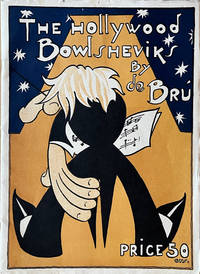
192762150Hollywood CA: Hollywood Bowl Assoc. 7046 Hollywood Blvd. 1927. 4to. 32 pp unpaginated. decorated title w/ tinted background borders 28 Xavier Cugat illustrated plates throughout. Colour-illustrated softcovers Art Deco cover art of caricature conductor by Cugat yapp fore-edges minor wear dustsoiling slight scuffing still VG copy. First edition of this surprisingly scarce and splendidly illustrated caricature rendering of the stars and performers at the Hollywood Bowl for the 1927 Season. Caricatured among the “Hollywood Bowlsheviks†are Alfred Hertz who inaugurated the first Hollywood Bowl season of music in 1922 Bruno Walter Vladimir Shavitch Cecil B. De Mille Louis B. Mayer Pola Negri Hestelle Heartt Dreyfuss Lloyd Wright Pierre Monteux Douglas Fairbank and Mary Pickford. De Bru 1900-1990 was a child prodigy taken to Cuba where he trained as a classical violinist played with the Orchestra of the Teatro Nacional in Havana and after New York was hired as musician and caricaturist in Hollywood at the Bowl. He also put together a tango band in 1927 which performed at the Cocoanut Grove at the Ambassador and later took up a long term residency at the Waldorf Astoria in New York for 15 years and one of the noted performers was Desi Arnaz. His famed caricature “Curtain of Stars†measuring 40 x 60 feet hunt at Grauman’s Chinese Theatre. Cugat’s brother Francis was a noted illustrator best remembered for his cover art of Fitzgerald’s The Great Gatsby. Worldcat locates 1 copy Cal. Hist. Soc. Lib.; Paul Spitzzeri Striking a Chord: A Program for Summer Concerts at the Hollywood Bowl 19-23 July 1927 Homtesead Museum July 20 2020. Hollywood Bowl Assoc., 7046 Hollywood Blvd., paperback
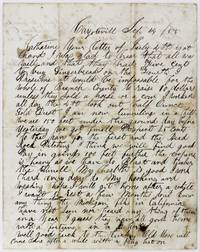
18553206Coyoteville: September 12 1855. Very good. 2pp. plus integral blank. Original mailing folds moderate toning staining and ink spotting but still easily readable. Bottom fourth of integral blank excised. An informative Gold Rush letter about mining in the long-vanished ghost town of Coyoteville which was an extraordinarily rich gold area for a couple of years in the early 1850s. A noted tunneling method nicknamed "coyoteing" was developed in the town and subsequently inspired the name of the town. In the present letter Moses Pine writes to "Catherine" in Branch County Michigan and signs his name simply as "Mose Esq" at the conclusion. The author informs Catherine presumably his wife or sister of his activities some of the economic realities and some of the practical details of prospecting for gold in California. Presuming that "it would be impossible for the whole of Branch County to raise $10 unless they sell a horse" Pine comments that he had ginger bread on the Fourth of July after working all day and yielding a "half Ounce Gold Dust." He then provides a detailed description of his mining: "I am now tunneling in a hill. We are 150 feet under the ground. Day before yesterday we got small respect 25 cents to the pan for the first and the bed rock pitching. I think we will find good pay in the going 100 feet further the expense is heavy as we have to blast and timber the tunnel." Pine also talks of his health and that "I work hard every day do my cooking and baking." He then expresses his hope to get back to Michigan to "rest a few months" but knows nothing of other Michigan folks in California: "Have not seen nor heard anything of them in a year. I guess they have all gone home with a fortune in a horn. Well good luck to the lucky. Old Mose will come home after a while with a pretty hat on." A nicely-detailed letter from an unusual and obscure Gold Rush location. September 12 unknown
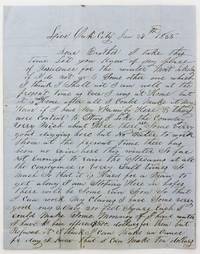
18555504Live Oak City Ca: January 27 1855. Still very good. 4pp. on a bifolium. Previously folded with manuscript docketing on lower half of second leaf verso. Minor wear along old folds with a couple of short separations. Minor soiling and dampstaining somewhat heavier to addressed area. A detailed mid-1850s California Gold Rush letter from Elias Hunt Jr. to his brother in the tiny of Poolville New York southeast of Hamilton. Hunt was camped in Live Oak north of Yuba City when he wrote this letter home on January 27th 1855. He tells his brother that he has good claims but that a lack of rain has not allowed him to work them:<br /> <br /> "It is hard for a man to get along. I am stopping here in hopes there will be some rain soon so that I can work my claims. I have some very good ones 2 only 200 feet square each. I could make some money if I had water. I have been offered $500 dollars for them but I refused it -- I think I can make an ounce per day; I know that I can make ten dollars for I have done that before."<br /> <br /> There is talk of irrigating the area but Hunt is not sure that it will be finished before he wants to return east:<br /> <br /> "There is a ditch coming in here to suply sic the place with water but it will not be completed until Spring some time in April & I should like to come home in June. I shall stay until there is water in the ditch then I can wash a part of my claims & sell the rest to a good advantage for they are situated immediately on the line of the ditch."<br /> <br /> Continuing upon his plans to return he writes:<br /> <br /> "I have had a very good offer to come home across the plains by a man in Sacramento. He is from Utica; his name is Hamilton. He is going to cross with four hundred Spanish horses or mares. He has offered me good money to come with him as I have been over to Carson Valley this last season. It will take some sixty days to do it if I should get through with my claims by the time time that he gets ready to start. I think I shall come with him if the Indians are not to hosstille sic. They were very bad this last season; they got possession of one of Uncle Sam's forts."<br /> <br /> Hunt continues writing about local hunting prospects and family in New York before delivering a Crockett-esque farewell -- "Please give my respects to all may inquire for me & let the rest go to Hell for all that I care." A good letter from one of the less trafficked areas of the California Gold Rush. January 27 unknown
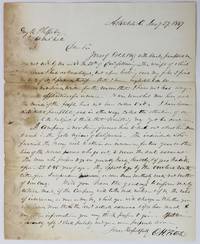
18492389Ashtabula Oh: January 29 1849. About very good. 1pp. on a bifolium. Previously folded. Light dampstaining and short closed tears along gutter somewhat affecting first few lines of text but not overall sense. An interesting letter from O.H. Field an aspirational field representative of the Connecticut Mutual Life Insurance Company in Ashtabula Ohio to the company secretary George R. Phelps inquiring about a policy for a group of men headed to the Gold Rush in California in January 1849. Connecticut Mutual was founded in Hartford three years prior to the composition of this letter in 1846. Fitch's missive begins with a report on his efforts to drum up interest in life insurance in his area with pamphlets and other materials sent to him by Phelps: <br /> <br /> "Yours of Oct 1 1849 with blanks pamphlets &c was not received by me until the 25th of Dec. following. I have not had any definitive applications for insurance. It was somewhat new here and the minds of the people had not been called to it. I have however distributed pamphlets and in other ways called the attention of our citizens to the subject. I think that something yet might be done.<br /> <br /> The letter goes on to describe a potential policy for a group soon leaving for the Gold Rush and requests a favorable rate in order to stimulate interest in policies from additional parties: <br /> <br /> "A company is now being formed to head out about ten men to work in the gold regions of California. The individuals who furnish the money wish to obtain an insurance for two years on the lives of the several persons who go out to secure the amount advanced. The men who propose to go are generally hardy healthy & of good habits & from 25 to 45 years of age. They expect to go by the overland route either from Independence Missouri or some more southerly route not south of Vera Cruz. Will you have the goodness to inform me by return mail if the company will take such risks -- & if so the rates of insurance as near as may be which you will charge -- whether you will insure more than the amt. actually advanced & if so how much & any other information you may think proper to give. If I receive a favorably sic reply I shall probably send you more proposals soon."<br /> <br /> A neat letter concerning the preparations and considerations necessary for a journey to California in the early days of the Gold Rush and the role and rise of early American insurance companies in the planning of such lengthy and dangerous overland travel. January 29 unknown
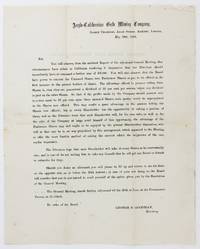
18555250London: May 19 1855. About very good. 2pp. on a bifolium. Previously folded. Light wear along top edge; short closed tear at right margin. Scattered faint foxing. With original mailing envelope. This two-page printed circular dated May 19th 1855 from the Anglo-California Gold Mining Company in London offers to convert "unissued shares" of company stock into "preference shares." The first page of the circular reads in part:<br /> <br /> "You will observe from the enclosed report not present of the adjourned General Meeting that circumstances have arisen in California rendering it imperative that the Director should immediately have at his command a further sum of £6600. You will also observe that the Board have power to convert the unissued shares into preference shares at par to be offered in the first instance to the present holders of shares. The advantage offered to persons taking those Shares is that they are guaranteed a dividend of 25 per cent per annum before any dividend is paid on the other Shares."<br /> <br /> The second leaf of the bifolium prints a blank form for recipients to purchase said preferred shares. During the first years of the California gold rush approximately 120 companies formed in Great Britain to offer mining shares in the booming goldfields to the public. Many saw these companies as an opportunity to invest in the boom without facing the expense or the danger of traveling to California. Most however ended in failure and investors collectively lost almost £2 million at the time.<br /> <br /> The Anglo-California Gold Mining Company formed by Luke Williams in March 1849 was one of the first and largest of these British ventures and it sold thousands of ten shilling shares to the public. Williams sent a former Royal Navy Captain Henry Vere Huntley to the Calaveras River in early 1850 to start the operation. When he failed Williams arranged a deal with Fremont's Quartz Rock Mariposa Gold Company to crush and refine their ore and the ore of smaller ventures. To that end the company sent two steam-powered crushing mills to California and when those proved useless to the task the company failed. May 19 unknown
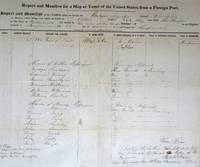
1850List2418Callao: Alsop and Company 1850. Folded ship manifest measuring 15 ¼ x 12 ½ inches. Fine condition with slight normal wear. A very scarce Gold Rush period shipping manifest for the Barque Equator captained by William Weir listing the passengers and cargo for a voyage to San Francisco in December of 1850 with notations showing the vessel’s arrival in San Francisco in May of 1851. Alsop & Co. was the work of Joseph Alsop the grandson of Continental Congress delegate John Alsop and his friend Henry Chauncey. Originally from Middletown Connecticut the pair established Alsop & Co. in New York City in 1824 and would eventually play a large role in the gold trade in California and trade extensively in South and Central America. Chauncey Alsop and others were among the partners in the trans-Panamanian railway that helped transform trans-continental trade in 1850. One of Alsop & Co.’s treasure boxes was aboard the S.S. Central America when it sank in 1857 carrying gold to the Eastern United States from Panama. <br /> <br /> The shipping manifest offered here lists the primary cargo as 195 tons of coal and also lists the names of fourteen passengers on the voyage. Imported coal - from Callao in this case - was essential to heat houses and run furnaces at factories including assay offices before the development of a local coal industry in California. We find only two instances of Gold Rush-era ship manifests - which were usually thrown away - surfacing in the trade or auction records this one and one other which sold for $3600 at PBA Galleries in 2014. Alsop and Company unknown
18604301Eldorado & Iowa Hill 1860. Good. Four manuscript documents including three letters totaling six pages. Old folds moderate toning minor edge wear a few tears a small hole in one letter. A neat group of four manuscript letters and documents all related to the mining activities of L.D. Davis of Georgia over a four-year period during the latter years of the California Gold Rush. Davis appears to be a lawyer living somewhere back east and may have been an investor in California mines or managing the financials for some mining concern from afar. The documents include an 1856 promissory note regarding "noted for collection" a long undated letter likely from California to Davis detailing amounts of gold taken from an unspecified mine and the mine's ownership situation and two letters overtly datelined from California -- the first from Iowa Hill in 1859 and the second from Georgetown in El Dorado County in 1860. Each document presents a unique set of concerns for Davis. Notable details of the three letters are as follows:<br /> <br /> 1 Autograph Letter Signed from A.J. Huff to Mr. L.D. Davis. Iowa Hill Ca. April 17 1859 2pp. The text reads in part "I have been very very sick for the last three weeks but am at this time improving.the disease is caused by the exposure of this last winter having worked continually in the rain and snow preparing my claim for the season. Times are very hard in this country now everyone has to work hard and is in big luck if he makes a decent living. A great many are making money very fast but in comparison not one in ten to the number than used several years back to make money or in other words the chances are about one in ten when they were one in fifty two and three in this country. If a man can get a good claim he can make more clear money out of it than he could then owing to the fact that everything is cheaper and experience has taught the People of California a great deal in respect to saving the gold and expediting the work. I think I have a very good claim which will last for a long time three or four years. It has been very expensive opening it but that is pretty well all over with now."<br /> <br /> 2 Autograph Letter Signed from J.D. Arranaut to L.D. Davis. Georgetown Eldorado County Ca. April 28 1860 2pp. Here a colleague of Davis's in California seems to be struggling and writes thanking Davis for a loan. The text reads in part with spelling normalized: "I was glad to hear from you and to.learn that you would comply with my request by letting my wife have $25 worth of corn for her use and please find enclosed a bank draft. I take it as a great favor as I am far from home. Let me know how my wife is getting along and if she stands in need of anything."<br /> <br /> 3 Autograph Letter Signed from J.H. Worley to L.D. Davis Esq. N.p. n.d. 1p. The letter concerns percentage ownership in an unspecified mine and opens with a four-line listing of the "amt. of gold taken from mine 513.51.1 while under my control." The author then writes in part: "The rent and expenses were take out of the above account and after the gold was sold one half after paying expenses. I know you are too well positioned in law to know that I dare not have settled with any other person unless I had been so instructed according to law. When Mr. Findley returned from Burke County he stated to me that one half the mine was for Mr Adams and myself and the other was for himself and his friends but did not say who they were. unknown
195962286Denver CO: Fred A. Rosenstock The Old West Publishing Co. 1959. 4to. 221 1 pp. Title in red & black frontisp. 3 folding maps 1 large chart of travel folded in rear pocket. Brick-red publisher’s cloth illustration vignette printed on front cover gilt lettering on spine partially uncut & unopened w/ d.j. slight scuffing upper right corner minor chipping dustsoiling couple closed tears & creasing NF/G copy. First edition of this exceptional effort by Morgan to present the Overland diary of Pritchard along with two previously unpublished maps of the 1849 gold rush miners by J. Goldsborough Bruff and the exceptional and immense chart tracing the emigration of no less than 162 diarists across the South Pass route to California demarcating 80 important points along the trail. Fred A. Rosenstock, The Old West Publishing Co., hardcover
195962285Denver CO: Fred A. Rosenstock The Old West Publishing Co. 1959. 4to. 221 1 pp. Title in red & black frontisp. 3 folding maps 1 large chart of travel folded in rear pocket. Brick-red publisher’s cloth illustration vignette printed on front cover gilt lettering on spine partially uncut & unopened w/ d.j. slight scuffing upper right corner F/NF copy. First edition of this exceptional effort by Morgan to present the Overland diary of Pritchard along with two previously unpublished maps of the 1849 gold rush miners by J. Goldsborough Bruff and the exceptional and immense chart tracing the emigration of no less than 162 diarists across the South Pass route to California demarcating 80 important points along the trail. Fred A. Rosenstock, The Old West Publishing Co., hardcover
190261749Unadilla NY: Sold by the Vestry of St. Matthew’s Church Press of Geroge D. Raitt 1902. 8vo. xv 1 323 pp. plus 3 pp. publisher’s ads for Halsey’s “The Old New York Frontier.†Frontisp. plates 1 folding map. Red publisher’s linen gilt device front cover gilt lettering on spine minor soiling head of spine edgewear rubbing still VG- copy from the library of former California State Librarian Gary Kurutz. First edition one of 650 copies printed and then distributed by St. Matthew’s Church of this uncommon work where the second half of the book consists primarily of Dr. Halsey’s experiences as a member of a 49er Gold Rush “Company†and featuring his diary. Inspired by Horace Greeley’s Tribune trumpeting the California gold discovery Dr. Halsey and several friends after catching a Broadway production of “California and the Gold Diggings†organized pooled their money and set out for Panama. While waiting to sail from Panama City he notes a cargo of 200 gold ingots each weight 150 lbs. enroute from California. After arriving in San Francisco June 4 1849 the group experience the wild gambling dens hyper-inflation and head for Sacramento and the diggings at Big Bar on the Middle Fork of the American River. Even though Halsey tries to break off from the Company and speculate in real estate and set up a medical practice the company refuse to release him and they actually succeed in pulling 20-36 ounces a day from their diggings. After making back their investment and a little more he decides the area is over-saturated with doctors and returns to Unadilla NY. See: Kurutz California Gold Rush 308. Sold by the Vestry of St. Matthew’s Church, [Press of Geroge D. Raitt], unknown
10514Paris Banque de France s.d. Un volume in-12 dos collé, couverture jaune illustrée, 185 pages, illustrations en couleurs. Bon état.
1911009679Hambourg [Paris] A fond de cale 1911 In-12 Demi-reliure
Sevilla, Sociedad de Bibliófilos Andaluces, 1868. 8o.; IX pp., 27 pp., 1 h. Edición limitada de 300 ejemplares. Cubiertas en papel.
Madrid, 1947 ("Cuadernos de Ínsula, 1). 4to.; 229 pp. Cubiertas originales.
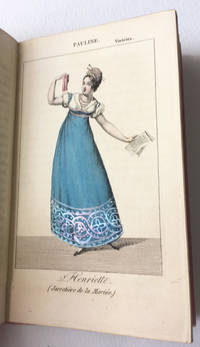
1818Flo136<p>Very rare complete set of all 8 volumes of this review of French theatre in the years 1818-1824.</p><p>All eight years of publication complete with 8 handcolored engraved title pages and over 90 finely handcolored engraved portraits of actors actresses opera singers ballet dancers and comedians in costumes of their famous roles.</p><p>"Very interesting almanac attributed to Charles Malo or Francois-Adolphe Loeve-Weimars giving a summary of Parisian and provincial theaters reviews on the plays and their performers notes on debuts repertoires etc." Grand-Carteret<em> Les almanachs français</em></p><p>Includes portraits of sopranos Mme. Gavaudan and Angelica Catalini tenors Jean-Blaise Martin and Simon Cheard ballet dancers Emilie Bigottini Genevieve Gosselin Antoine Paul and Mlle. Clotilde child actress Leontine Fay actors Francois-Joseph Talma and Charles-Gabriel Potier and many more. Odd volumes turn up occasionally but it is very rare to find the complete set of this intriguing anecdotal overview of Parisian theatre from the first quarter of the 19th century.</p><p>Condition: All volumes in their pastel card slipcases paper bindings holding some spots of foxing to a few plates but overall very good with tissue guards. Complete with all engravings and calendars at end.</p><p>Charles Malo 1790-1871 was a French author editor and translator whose books included a series of gift books for women illustrated by Pancrace Bessa almanacs city guides battlefield guides etc.</p> Louis Janet paperback
98101501Canton 1860-80's Cheungqua. A group of 7 pith or Tongcao color paintings usual minimal issues mostly clean & solid sold "as is" as a collection with the typical chips & a few fox spots else very good clean examples. A RARE GROUP ! . . . . A SUITE OF 7 FINE CHINESE COLOR PITH PAINTINGS . . . SHOWING BEAUTIFULLY DRESSED CHINESE WOMEN . . . PLAYING MUSICAL INSTRUMENTS . . . EXECUTED IN STUNNING & BRILLIANT COLORS . . . AKA: CHINESE EXPORT WATERCOLOURS . A group of typical "trade paintings" executed by Chinese native artists for foreign traders visiting Canton or Macao during the early to mid-19th century. . A SUPERB SUITE OF FABULOUS COLOR PITH PAINTINGS: A stunningly beautiful group of hand-painted color pith paintings depicting a woman playing a musical instrument. . "GOLDEN LOTUS" or "LOTUS FEET" BOUND FEET Chanzu: This like most illustrations of the period show the women with bound feet. Chanzu bound feet was an erotic obsession and fetish in ancient China. The erotic ramifications are outlined in the references below. . The paintings illustrate Chinese women in a domestic scene with furniture playing musical instruments. Subjects are: . a. Yue1in Ruan Moon Guitar Moon Zither 4 stringed . b. Yanqin Chinese Dulcimer . c. Sanxian three-stringed Chinese lute . d. Drumming on the back of a Chinese ceramic bowl . e. Dizi Chinese bamboo flute . f. Huqin Chinese violin . g. Tong Luo Chinese Brass Gong . DESCRIPTION OF THE PAINTING ART WORK AND CONDITION: . Each painting is in brilliant vivid and stunning colors. Each is skillfully painted with a fine hand delicate fine-point brush with great detail incredible reality texture and appeal. . As usual the set paintings were tipped to a contemporary backing period Each painting is backed with a contemporary stiff paper or a more current back card. . Items "a" & "b" are matted see cover.jpg & title.jpg photos posted to our website. . Each painting is approximately 21 x 34 cm. most have a blue silk ribbon border partial border or border lacking chipped and the like on has restorations on the verso in the margin only. . Each painting has some chips parts missing on the edges or with small holes here and there 'e' by and large the images are complete but some may have usual and often typical age-related cracks or splits a touch of fox spots on "c." . Suitable for framing & display. Please review photographs posted to our website for details. . "RICE PAPER" PAINTINGS: Several authors refer to this name rather than the proper name "Pith" paper paintings also can be called "Tung Tsao." . THE CANTON ARTIST OR 'SCHOOL' OF CHEUNG QUA: Cheung Qua was an export watercolor painter in Canton. He and followers of his school produced various single and albums of these paintings which were sold from his studio. . Often his in-house artists began painting on their own thus replicating the techniques subjects and essence of their masters. Because these paintings were rarely signed the one and only identification ever found was occasionally on the album cover or spine with the studio name. . Often these paintings were sold in various shops in Macao the main resting and gathering place of foreigners during part of the year. . REFERENCE: . CLUNAS Craig.: CHINESE EXPORT WATERCOLOURS. This entire book is devoted to Pith or Rice paper paintings. For musical instruments see color plates on pp.50-53 especially plates on pp.66-67 plates 39 & 40 are particularly similar to our examples that is to say by the same or an artist who was in the same house of Cheungqua or that school. CHU Arthur. et al.: ORIENTAL ANTIQUES AND COLLECTIBLES: A GUIDE pp.62-66. THE CHINESE PITH PAINTING COLLECTION AT THE NATIONAL LIBRARY OF AUSTRALIA: An Annotated Guide. Crossman Carl L. The decorative arts of the China trade : paintings furnishings and exotic curiosities. LEVY Howard S.: CHINESE FOOT BINDING: The History of a Curious Erotic Custom. . --. THE LOTUS LOVERS: The Complete History of the Curious Erotic Custom of Foot binding in China. JACKSON Beverly.: SPLENDID SLIPPERS: A THOUSAND YEARS OF AN EROTIC TRADITION. . . unknown
38044201Canton 1860-80's Cheungqua. A single pith or Tongcao color painting usual minimal issues clean & solid example brilliantly vivid colors rarely found in such clean & fine condition. A RARE EXAMPLE ! . . . . FINE CHINESE COLOR PITH PAINTINGS . . . SHOWING BEAUTIFULLY DRESSED CHINESE IMPERIAL COURT LADY . . . EXECUTED IN STUNNING & BRILLIANT COLORS . . . AKA: CHINESE EXPORT WATERCOLOURS . A stunning Chinese Imperial Court. She wears a golden-embroidered outer dress with elaborate collar sleeves and hem. She wears pink silk-embroidered pants and her "lotus" bound feet are on a wooden stool. She sits on a Ming dynasty style Huahuali wood chair with a fan in her right hand and silk-embroidered accessory in her left. Adjacent to her is a matching Ming table with three ripe 'You' fruits pommel. . This is a typical studio trade painting" executed by Chinese native artists hand-painted color pith painting for foreign traders visiting Canton or Macao during the early to mid-19th century. . "GOLDEN LOTUS" or "LOTUS FEET" BOUND FEET Chanzu: This like most illustrations of the period show the woman with bound feet peeking out below her pant cuff. Chanzu bound feet was an erotic obsession and fetish in ancient China. The erotic ramifications are outlined in the references below. . DESCRIPTION OF THE PAINTING ART WORK AND CONDITION: . This painting is in brilliant vivid and stunning colors. Skillfully painted with a fine hand delicate fine-point brush with great detail incredible reality texture and appeal. . As usual this paintings was tipped to a contemporary stiff backing paper card. . This painting is approximately 19.5 x 27.5 cm. . There are a few old mends on the verso the image is not impacted it remains quite solid and very stable. By and large a far and above average excellent example. Suitable for framing and display. . Please review the photograph posted to our website for details. . "RICE PAPER" PAINTINGS: Several authors refer to this name rather than the proper name "Pith" paper paintings also can be called "Tung Tsao." . THE CANTON ARTIST OR 'SCHOOL' OF CHEUNG QUA: Cheung Qua was an export watercolor painter in Canton. He and followers of his school produced various single and albums of these paintings which were sold from his studio. . Often his in-house artists began painting on their own thus replicating the techniques subjects and essence of their masters. Because these paintings were rarely signed the one and only identification ever found was occasionally on the album cover or spine with the studio name. . Often these paintings were sold in various shops in Macao the main resting and gathering place of foreigners during part of the year. . REFERENCE: . CLUNAS Craig.: CHINESE EXPORT WATERCOLOURS. This entire book is devoted to Pith or Rice paper paintings. For musical instruments see color plates on pp.50-53 especially plates on pp.66-67 plates 39 & 40 are particularly similar to our examples that is to say by the same or an artist who was in the same house of Cheungqua or that school. CHU Arthur. et al.: ORIENTAL ANTIQUES AND COLLECTIBLES: A GUIDE pp.62-66. THE CHINESE PITH PAINTING COLLECTION AT THE NATIONAL LIBRARY OF AUSTRALIA: An Annotated Guide. Crossman Carl L. The decorative arts of the China trade : paintings furnishings and exotic curiosities. LEVY Howard S.: CHINESE FOOT BINDING: The History of a Curious Erotic Custom. . --. THE LOTUS LOVERS: The Complete History of the Curious Erotic Custom of Foot binding in China. JACKSON Beverly.: SPLENDID SLIPPERS: A THOUSAND YEARS OF AN EROTIC TRADITION. . . unknown
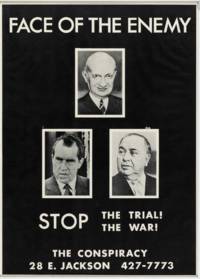
1969List911Chicago 1969. 21 1/4 x 29 1/4 inches. Some light toning and edgewear near fine condition overall. The first example of this poster we have encountered which shows Judge Julius Hoffman Chicago Mayor Richard Daley and President Richard Nixon. We find no other records and can only assume it was produced in the same era as the previous offering as it bears the same address of 28 E. Jackson. unknown
1969List910Chicago 1969. Poster. 24 x 20 inches. Minimal wear fine condition. Fine. An iconic poster protesting the arrest of the Chicago 8 on conspiracy charges relating to the protests at the 1968 Democratic Convention. The group originally as eight members consisted of Abbie Hoffman and Jerry Rubin founders of the Youth International Party YIPPIES Tom Hayden a co-founder in Students for a Democratic Society Black Panther Chairman Bobby Seale whose case would be declared a mistrial during the trial leading to his exclusion from the Chicago 7 David Dellinger and Rennie Davis members of the National Mobilization Committee to End the War in Vietnam MOBE and John Froines and Lee Weiner. The address 28 E. Jackson was a building where Rennie Davis rented a space so it is possible that the MOBE printed this though we cannot confirm. unknown
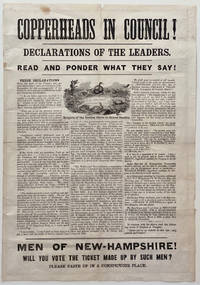
1863List1004New Hampshire: Printer Unknown 1863. First Edition. Printed broadside 16 ½ x 11 ½ inches archivally mounted and matted. A very good copy with some light toning small closed tear at upper margin light foxing at upper margin very tiny spot of loss to illustration at fold. Franklin Pierce remained politically active upon his return to New Hampshire following his presidency advocating for the Democratic cause and generally opposing the Civil War and Lincoln’s policies. This scarce pro-Union anti-slavery broadside printed for the 1863 New Hampshire elections which happened March 12 takes aim at Pierce and his fellow Democrats repeating the unfounded claim first made in 1862 by William Seward that Pierce belonged to the secret Knights of the Golden Circle the secret society formed with the goal of forming a new territory out of the CSA Mexico Central America and the Caribbean. There was never evidence that Pierce had any involvement in the KGC though the society had members in southern parts of some Union states such as Indiana Ohio Illinois and Missouri.<br /> <br /> The broadside printed for the March 12 elections quotes heavily from Pierce as well as the other Democrat candidates and party officials who were either running for office in New Hampshire or involved in politics a group which included Ira Eastman John Goerge Josiah Minot Thomas Treadwell Daniel Marcy William Burns and George Stevens. The broadside includes an engraving of coiled snakes each with these politicians named and the caption “et id omne genus.†Eastman the Democratic candidate for governor won the popular vote but lacked the constitutional majority necessary for election. Marcy was successful in his bid for the First District. “Men of New Hampshire!†the broadside asks: “Will you Vote the Ticket Made up by Such Men†with the final line imploring to “Please paste up in a Conspicuous Place.†<br /> <br /> Overall an uncommon survival from the 1863 elections. A very good copy with some light toning small closed tear at upper magin light foxing at upper margin very tiny spot of loss to illustration at fold. Quite scarce with OCLC locating two copies only at the Huntington Library and the New York Historical Society. Printer Unknown unknown
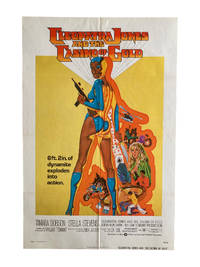
1975004250Warner Bros. 1975. Single sided printed poster approximately 690mm x 1040mm in size. Slightly creased from old folds with some light abrasion to image along those folds and a couple of Japanese tissue repairs to reverse but generally quite bright and clean. Directed by Chuck Bail and starring Tamara Dobson wearing some fantastic outfits. First Edition. Unbound. Good. US One Sheet. Poster. Warner Bros. Paperback
20080Bruxelles, Musées royaux d'art et d'histoire / Crédit communal, 1991 1 volume 25 x 29,7cm Broché sous couverture noire illustrée couleurs. 263p.; cartes et nombreuses illustrations in texte, vignettes et pleines pages, en noir et en couleurs. Bon état.
20112[s.l, Metz], Editions Serpenoise, [d.l. 1994] 1 volume 23,8 x 30cm Cartonnage éditeur sous jaquette illustrée couleurs. 132p., 2 feuillets; cartes et nombreuses illustrations in texte, vignettes et pleines pages, la plupart en couleurs. Très bon état.