542 résultats
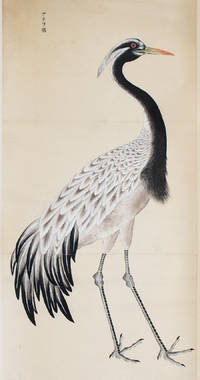
6952Scroll 420 x 12000 mm. with elaborate silk brocade endpaper at beginning. Japan: 1880-86. This beautifully rendered scroll of natural history paintings was executed with one exception by Akio or Keigu Yamamoto 1827-1903 Confucian scholar doctor botanist and highly gifted artist. He was born in Kyoto the son of the prominent doctor and botanist Boyo Yamamoto 1778-1859 the direct disciple of Ono Ranzan 1729-1810 the famous professor of botany who wrote a series of classic botanical books. Keigu "continued his father's work in his private school in Osaka and spent his time organizing meetings that were regularly attended by both honzogaku amateurs and Japanese biologists."-Federico Marcon The Knowledge of Nature and the Nature of Knowledge in Early Modern Japan p. 301. Keigu travelled widely throughout Japan drawing plants and animals. He gave botanical instruction to the Meiji emperor and other members of the royal family. Keigu also wrote several standard works on materia medica and left many sketch books and scrolls which entered the Kyoto rare book trade in 1932; some of these were published only in the 1980s. All of his sketch books and scrolls offered valuable and unique information regarding native plants and animals as well as those that had been introduced into Japan. Our scroll contains 14 very finely executed color paintings of plants birds and animals. The paintings are quite unique in their remarkable spaciousness. For instance the image of the octopus is 1410 mm. long. The images include a most unusual morning glory three joined sheets and 1190 mm. long; an edible yellow lily two joined sheets 800 mm.; an ungei flower two joined sheets 795 mm.; a magnificent red toki a now-endangered crane species three joined sheets 765 mm.; a large akowa tsuru another species of crane three joined sheets 815 mm.; a young white crane three joined sheets 935 mm.; a sea lion umiuso painted in many shades of delicate black two joined sheets 545 mm.; a carp two joined sheets 597 mm.; an octopus four joined sheets; a chameleon three joined sheets 844 mm. dated "1880"; a deer antler two sheets 545 mm.; a "Dutch" dog two sheets 545 mm.; a lion seen at exhibitions in Tokyo and Kyoto two sheets 640 mm. with a seal and note stating this was the work of "Ariyoshi" dated "1886"; and two camels two sheets 545 mm. long. Four of the paintings have the signature and seal of Yamamoto and another painting - the final - has the seal only. Three of the paintings have additional text by Yamamoto regarding where seen and painted alternative regional names date etc. Very fine condition preserved in a new wooden box. All but the penultimate painting are the work of Yamamoto. unknown books
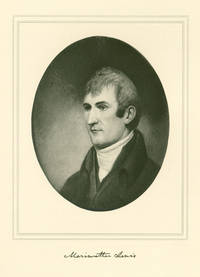
1905247478New York: Dodd Mead and Co 1905. First edition one of 200 large paper sets on Van Gelder paper. Seven volumes bound in fourteen parts plus atlas volume atlas with 56 maps & plates on 62 sheets. 15 vols. Large 8vo. Original gilt green cloth. Bookplate on front pastedowns. Spines lightly worn several lightly faded. Internally fine much of the text unopened. A very good set. First edition one of 200 large paper sets on Van Gelder paper. Seven volumes bound in fourteen parts plus atlas volume atlas with 56 maps & plates on 62 sheets. 15 vols. Large 8vo. One of 200 Sets on Large Paper. "The most elaborate work on this expedition" - Howes. <br/><br/>A cornerstone of modern historical research printing for the first time many major primary documents which did not appear in the Biddle edition including the Floyd and Whitehouse journals and material from the Clark-Voorihis papers along with facsimile manuscripts maps portraits and other illustrative matter. Also valuable is Victor Paltsits' bibliography of the Lewis and Clark expedition in the first volume. "This edition is notable for its thorough Introduction covering the history of the expedition and earlier exploration and a detailed account of the original journals and their various editions.In its maps and numerous illustrations the Thwaites edition is an outstanding source of visual materials relating to the expedition" - LITERATURE OF THE LEWIS AND CLARK EXPEDITION. Graff 2485; Howes L320 "b"; Wagner-Camp 13:7 note to 1842 Harpers ed.; Tweney Washington 76; Literature of the Lewis and Clark Expedition 5d.1 Dodd, Mead and Co unknown books
15465968Venice: Cornelio Adelkind for Daniel Bomberg 1546. First edition. Very Good/First printed edition editio princeps of the 11th century commentary on portions of the pentateuch by the Bulgarian poet and Talmudist Tobiah ben Eliezer. Published by the house of the seminal printer of Hebrew books Daniel Bomberg under the supervision of his scholar-in-residence extraordinaire Cornelio Adelkind. Venetian law at this time limited Hebrew publishing to Gentile printers. Bomberg a protestant from Antwerp entered this lucrative market and with Adelkind's help became its prime exponent until his death in 1549. . Folio 32 cm; 93 leaves. Text in Hebrew. Title within architectural border reproduced in Amram "Makers of Hebrew Books in Italy" p. 215 also in the Jewish Museum's 1989 exhibition catalogue "Gardens and Ghettos: the Art of Jewish Life in Italy" page 50. Some section headings within ornamental borders. Bound in c19 or c20 dark red crushed morocco ruled in gilt and decorated with arabesques on both boards; spine with raised bands and compartments tooled and titled in gilt; green polished leather doublures with red crushed morocco dentelles bordered in pointillé accented with arabesques; green moiré free endleaves. Edges gilt. Binding not signed. Joints and crown adroitly reinforced with Japanese paper; corners somewhat worn down. Occasional contemporary notes in manuscript in text; brief stain on leaf mem-tet and lightly along the bottom edge of leaves nun-bet and nun-gimmel. Text otherwise pristine. Title page light possibly washed. Old library ink stamps from an institution in Warsaw on title page. Red morocco ex-libris of mining magnate and philanthropist Adolph Lewisohn 1849-1938. References: Adams T-766; BM Italian 674; Steinschneider 7304 #1; Amram 215 illustration and 222. Cornelio Adelkind for Daniel Bomberg hardcover books
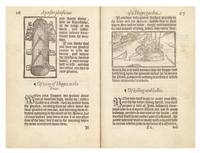
6551Numerous woodcut illus. in the text. Largely printed in black letter. 7 p.l. first leaf blank except for signature mark 63 1 pp. Small 4to early 20th cent. polished mottled calf by Riviere triple gilt fillet round sides spine richly gilt red morocco lettering pieces on spine dentelles gilt a.e.g. London: H. Denham 1576. Second edition "nowe newly corrected and augmented" of the first English book on hops. The first edition appeared two years earlier; both editions are very rare. This is "an eminently practical treatise illustrating the various methods of setting the roots making the hills and ramming the poles tying the bine and its pulling up and preservation with a number of curious cuts. It was the work of a practical man written for practical men and in this respect is far in advance of most of Scot's contemporaries who were still much interested in the superstitions of the time and the traditional pseudo-science of the Middle Ages."-Fussell I p. 12. Clinch in his English Hops a History of Cultivation and Preparation for the Market from the Earliest Times 1919 states that in many respects "the information is as useful today as it was nearly three-and-a-half centuries ago when it was published." Scot d. 1599 is most famous for his The Discoverie of Witchcraft 1584 in which he attacked the general belief in witchcraft and other forms of credulity and superstition including astrology alchemy and Catholicism. For more on Scot and his fascinating life see ODNB. Fine copy. Signature of T. Barling on first leaf. ❧ Henrey I p. 64 & no. 338. McDonald Agricultural Writers from Sir Walter of Henley to Arthur Young 1200-1800 pp. 34-36. unknown books
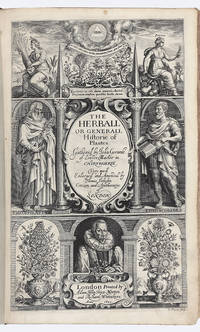
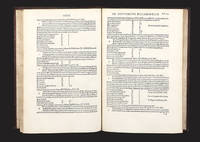
5564Finely engraved title woodcut head- & tailpieces & 2776 woodcuts in the text. 20 p.l. incl. initial blank & engraved title 1630 48 pp. one blank leaf. Thick folio 350 x 210 mm. cont. calf well-rebacked by Trevor Lloyd with the original spine laid-down a few gouges carefully filled-in corners bruised panelled in gilt & blind large gilt device in center of each cover with initials "W H" on either side. London: A. Islip for J. Norton & R. Whitakers 1633. First edition of Thomas Johnson's expanded and corrected version of Gerarde's Herball 1st ed.: 1597 the most famous of all English herbals. "Many errors made by Gerard in his text and in the identification of the illustrations were corrected by the apothecary and botanist Thomas Johnson d. 1644 of London who prepared an expanded edition of The Herball that first appeared in 1633.Johnson's painstaking revision of Gerard's herbal constituted in itself a valuable contribution to botany and to the art of the printed book. He added the descriptions of many new plants with illustrations some of them borrowed from the botanical texts published by Christophe Plantin in Antwerp in this way bringing the total number of engravings to 2776. Any new passages were carefully marked with special symbols so that the reader could distinguish them from the original text. "The title-page of The Herball is particularly attractive. It was executed by John Payne 1607-1647 one of the most talented engravers of the period.In the upper part of Payne's work we see a luxuriant garden with the goddesses Ceres and Pomona on either side. Below them are the fathers of botany Theophrastus and Dioscorides while in the lower section two imposing vases filled with flowers surround a portrait of Gerard who is shown facing in the opposite direction to that of the portrait by Rogers. The vase on the left is crowned with a bunch of bananas as a tribute to Johnson. "One of the most significant additions made by Johnson was his chapter on the 'Maracot' or 'Grandilla' as it was called at the time actually the passion-flower. He includes a full page illustration p. 1592 and refers the reader to Monardes for more information on this exotic species.In the long preface Johnson traces the history of the botanical sciences analyzing the contributions of celebrated figures from the mythical King Solomon to William Turner.He closes with some critical remarks on John Gerard and the origins of his herbal."-Tomasi & Willis An Oak Spring Herbaria p. 84. An uncommonly nice and crisp copy. Bookplates of John Charles Bigham Viscount Mersey Bignor Park and Oliver Howard. ❧ Garrison-Morton 1820-1st ed. of 1597-"The most important edition of his book is the second published by T. Johnson in 1633." Henrey I pp. 48-54-"Johnson produced an edition that was noteworthy for its many corrections improvements and additions" & no. 155. Hunt 223. unknown books
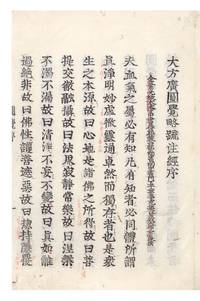
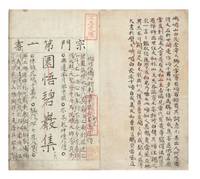
6775Eight columns per page 17 characters per column. Three sizes of type. 42; 41; 38; 40 folding leaves. Four vols. Large 8vo 280 x 195 mm. orig. dark wrappers dyed with persimmon juice shibubiki new stitching. Enryakuji Temple Mount Hiei: mid-Kan'ei ca. 1626-30. An unrecorded moveable type edition of the commentary and subcommentary of Zongmi 780-841 on the Sutra of Perfect Enlightenment. This is a rare example of an Eizan-ban a book printed with moveable type at the temples on Mount Hiei outside of Kyoto where Enryakuji Temple one of the most important monasteries of Japan and the headquarters of the Tendai sect of Japanese Buddhism is located. Printing began there in the 13th century. "There were few of these printed books in the medieval period perhaps due to the dominance of Kyoto itself as a printing centre.Eizan printing came into its own on a large scale only from the end of the sixteenth century with the introduction of movable-type printing. Typographic printing flourished at various temples on Hieizan from the Keicho to Kan'ei periods 1596-1644 and with the publication of Chinese works as well as Tendai scriptures publication and distribution at Hieizan began to develop into the beginnings of a commercial enterprise."-K.B. Gardner "Centres of Printing in Medieval Japan: Late Heian to Early Edo Period" reprinted in Brokaw & Kornicki eds. The History of the Book in East Asia 2013 p. 450. The writings of Dushun 557-640 Zhiyan 602-68 Fazang 643-712 and Zongmi are considered by many as the "crowning glory of Chinese thought. marking the maturation of a process by which the Chinese made Buddhism their own."-Bowring The Religious Traditions of Japan 500-1600 p. 104. Zongmi was a Tang dynasty Buddhist scholar monk; he was the fifth patriarch of the Huayan school as well as a patriarch of the Heze lineage of Southern Chan. The Sutra of Perfect Enlightenment was the scripture that led Zongmi to enlightenment in 808; he resolved to prepare a commentary and subcommentary on the text which he accomplished fifteen years later. As stated above this moveable type edition is unrecorded. Kawase in his bibliography of Japanese moveable type editions records another printing of this text dated 1626 but with ten columns per page and 20 characters per column Vol. I p. 304. Sorimachi in his amazing 40th anniversary catalogue of moveable type books issued in 1972 describes what appears to be yet another moveable type printing of this text with the same number of columns and characters as the Kawase example but using three different sizes of type they might be the same printing. It is described as four parts in two volumes in their original bindings printed in mid-Kan'ei ca. 1630 and with a slightly different title. The NIJL records no moveable type editions and only the woodblock-printed Seihan edition of 1644. On the printed title-labels of the second and fourth volume covers the title is given as Engaku ryakusho chu. The labels on Vols. I and III are no longer present. As mentioned above the wrappers have been dyed with persimmon juice which serves a dual purpose: to strengthen the paper and act as an insect repellent. Nevertheless the wrappers are somewhat wormed. Each volume has some worming but this set is in rather fresh and appealing condition. unknown books
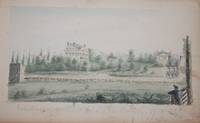
1828006534New York City 1828. Hardcover. Cloth spine. Marbled pastedown on boards. Leather centerpiece label on front board. Good. Original watercolors of rural Manhattan as it appeared in 1828. Among these and captioned are a farmhouse on Broadway and 8th Street; Kips Bay showing a boy sailing a small craft with a farmhouse in the background; a house in Bloomingdale the location of an early village now the Upper West Side along the river between 96th and 106th Streets; and a stately mansion surrounded by fields and less important buildings we would conjecture in or around Bloomingdale but captioned surely incorrectly the Battery. Most of the paintings are uncaptioned. Of these some are surely the Upper Hudson area or are scenes that we can't tell whether they are upstate or in the present day city. The artist also ventured away from the New York areas. Among the non-New York paintings are a depiction of the Cape Pogue Lighthouse on Martha's Vineyard which still stands; Fowey Harbour which is in Cornwall; and a few scenes which look very much like Scotland. Oblong 14 by 19.5 cm. 55 watercolors generally fully finished. Although the sketchbook has a label on its front board bearing the name of Walter Oddie who was a listed artist we believe a good amount of the artwork contained in this sketchbook is of his father-in-law Henry Meigs. Meigs had been a U.S. Congressman from New York and also held a number of other political positions in the city over the course of his career. More pertinently Meigs was known to be an amateur painter and as such an inspiration to Oddie. Given Oddies youth at the time -- he was 20 or 21 years old and from his diary for the years 1828 and 1829 now housed in the Winterthur Library we know he was just starting to paint we find it inconceivable that he would have had the skill yet to produce the sensitive and fine renderings of nature and buildings that typify this sketchbook. Further underlying our thinking about attribution is that some of captioning only makes sense if Meigs were the primary artist. We do consider it quite likely that Oddie may have done some of the sketchier work contained herein as well as contributing in bits and pieces to his father-in-laws work as well as perhaps copying some of it in this sketchbook. To us it isnt really so important who was responsible for particular paintings in the sketchbook. Rather the significance lies in the recording of New York City and its surroundings at the time we suspect that there may be no recording anywhere of some of the buildings and locations at this time. And of course not to be minimized is the beauty of the better paintings contained in the sketchbook.Whatever the degree of Oddies contribution the sketchbook does have something to say about his career and visa versa given that it contains the type of artwork for which he became known later. Oddie was born in Maryland Washington D.C. or possibly New Orleans but spent almost his entire life in New York and more specifically New York City Brooklyn or Long Island. In 1828 the year most of the watercolors in the catalogue were executed Oddie was spending much of his time in the city.Once Oddies interest in painting was sparked he was believed to have been largely self-taught but he did come to study art with Hudson River School painter Robert Walter Weir and Anthony Lewis De Rose a portrait and historical painter. From the diary we know that Oddie did work with De Rose in 1829; we believe that his tutelage with Weir came later. From the diary we know that Oddie was regularly going to art exhibits and critiquing what he saw. The diary also discloses or corroborates our prior sense that Oddie sometimes would work off of engraved prints. To what degree he was merely copying the prints as opposed to using the prints as a spur to his own imagination we can not determine with certitude. We tend to think the views of Scottish and Welsh castles contained in the Sketchbook were done by Meigs not Oddie and so they might well have been done from life.From the diary we know that Oddie had some day job that occupied him during the week and so he did most of his painting at that time on the weekends when he would often go for long hikes along the Hudson. Oddie also refers in the diary to having been in Hudson then and now the county seat of Columbia County and so it is very plausible that some of the upstate scenery is from around there. Again we think some of these paintings may have been done by Meigs.Oddie would become an associate member of the National Academy of Design where he frequently exhibited his artwork.One further note we spoke of questioning one caption referring to the Battery. In 1828 the urbanized part of the city didnt even reach 14th Street but the Battery as the oldest part of the city was thoroughly urbanized. Thus the painting could not be of the Battery. But the landscape is very consistent with the topography of Upper Manhattan. <br /> hardcover books
6549Fine woodcut vignette on title see below. 32 pp. Small 4to early 20th-cent. calf double gilt fillet round sides a.e.g. London: P. Short 1600. First edition and of the greatest rarity this is the first of three issues as described by ESTC which locates only two copies of all the issues in North America. "Sir Hugh Platt 1552-1608 held by Richard Weston to be 'the most ingenious husbandman of the age he lived in'.was admitted at Lincoln's Inn. Much of his life was devoted to literary work and to the study of husbandry and gardening. He was also interested in all kinds of inventions and experiments.In 1600 appeared Platt's New and admirable arte of setting of corne a treatise in which this author advocates growing corn by setting the seed at regular distances apart the usual method of sowing corn at that time being by broadcast. On the title-page of this small quarto volume is a woodcut of a growing plant of corn over which is a spade lying in a scroll bearing the words 'Adam's toole revived'."-Henrey I p. 155 & no. 301. The book is divided into eight chapters and is signed by Plat at end. Fine copy. Natural marginal paper flaw to D2 carefully repaired. ❧ ESTC S122434. Fussell I p. 15-"Deals with the then new idea of setting corn seed at equal distances apart both in the row and between the rows so that seed might be conserved and the crop enhanced." McDonald Agricultural Writers from Sir Walter of Henley to Arthur Young 1200-1800 p. 58. unknown books
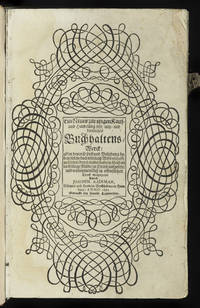
3399Title within elaborate calligraphic woodcut border title a little soiled & frayed around edges. 242 leaves the last a blank. Small folio cont. blind-stamped panelled pigskin over wooden boards binding somewhat soiled pigskin at one corner worn away remains of clasps & catches. Hamburg: A. Lichtenstein 1682. First edition extremely rare of this large and comprehensive Hamburg manual of accounting techniques. Only two other copies seem to be extant: one at the British Library and the other Tübingen. The book was a success and a second edition was published in 1714 under the title Der Werth-geschätzte Handels-Mann. Joachim Rademann was a chartered accountant at Hamburg. At the end of this his first published work he describes himself a "young man" and according to Schröder he married in 1683; otherwise nothing seems to be known of his life. Based on Christoph Achatius Hager's treatise Buchhalten uber proper Commission und Compagnia Handlungen first published at Hamburg ca. 1625 Rademann's book takes into consideration the changes and innovations that trading and coinage had seen since then and focuses on practical matters. The general ledger section comprises a Memorial a Journal and a Hauptbuch; the associated accounts include a Cassa-Buch cash journal a Banca-Buch bank account an Unkostenbuch book of charges a Monat-Buch monthly journal and a Factura-Buch and Rechnungs-Copey-Buch books of invoices. Precise examples taken from actual trading accounts at Hamburg are given throughout. "Rademann dispenses with long theoretical preambles and instead when differentiating between debtor and creditor points to the works of Hager and Gebhardt Overheiden. To the associated accounts Rademann adds the Portbuch von Briefe today's petty cash book. In the Memorial Rademann follows his predecessor Hager but adds a wealth of detail. The same applies to the Journal.The impersonal accounts that follow are remarkable not only for their multitude but also for the exceptionally delicate and skillful handling of the accounts. Rademann's work is nothing short of excellent."-Penndorf Geschichte der Buchhaltung in Deutschland p. 219 in trans. Very good copy of this extremely rare book. First fifteen leaves with light dampstaining. ⧠Hausdorfer 198. Historical Accounting Literature 28. Hoock/Jeannin II R.1. 1. Humpert 396. Schröder VI 3077 1. Not in Goldsmiths Kress or Rapp. hardcover books
667022 leaves including some blanks or pages ruled in ink for entries. Agenda format 315 x 100 mm. stitched as issued uncut. Nuremberg: 1598. A fascinating document of a type that rarely survives: the manuscript account book for the spring 1598 Leipzig fair of Hans Straub I or the Elder 1541-1610 the prominent Nuremberg gold- and silversmith alderman and son-in-law of Wenzel Jamnitzer the best-known German goldsmith of his time. The first leaf bears Straub's hallmark interwined initials "HS" over an arrow pointing upward within a plain shield & also containing the inscription "No. 72". Our manuscript sheds important light on the business relations in the late 16th century between the Nuremberg goldsmiths and their trade at the Leipzig fairs. Our account book is a list of sales orders and expenditures of Nuremberg goldsmith Hans Straub the Elder during the Leipzig Easter fair held in May 1598. While Straub is not expressly named he can be identified by his hallmark on the first leaf. At the fair trade was done in goblets rings knife-sheaths cutlery jewelry gemstones etc. Several business partners are named including the Nuremberg goldsmiths Heinrich Hahn Haan David Lauer and Paulus Koch. As an example of a transaction we see that the council of Halle paid over 33 florins for a goblet. In 1596 Straub was elected Alderman of the Artisans the most elevated and honorable office to which a Nuremberg artisan could aspire. Straub retained this position until his death in 1610. In 1569 he married Anna daughter of the famous goldsmith Wenzel Jamnitzer. On his father-in-law's death in 1585 Straub inherited his casting molds and used them extensively in his own creations. Despite his long period of activity relatively few pieces made by Hans Straub have survived see Nürnberger Goldschmiedekunst 1541-1868 2007 ed. by Karin Tebbe et al. Vol. I p. 409. In fine condition. ❧ The mark is similar to Marc Rosenberg Der Goldschmiede Merkzeichen Frankfurt 1925 Vol. III no. 3969. unknown books
670514; 13 folding leaves. Two parts in one vol. Large 8vo cont. or later dark wrappers dyed with persimmon juice shibubiki new stitching. Japan probably Kyoto: printed with moveable types ca. 1615-40. A very rare edition printed with moveable types apparently unrecorded in the standard bibliographies of the story - or legend - of the creation of the first statue of Siddhartha Gautama or Gautama Buddha the founder of Buddhism. The statue executed while Buddha was still alive was commissioned by King Udayana of Kaushambi a contemporary of Buddha. It was the very first image of Buddha and is especially important as it was carved from life. Copies of this statue made their way to China with the spread of Buddhism and later as we shall see to Japan. The text provides a history of the creation of the first statue of Buddha which is perhaps the most famous of all Buddha images. King Udayana commissioned the statue "so that he could gaze upon the sacred form of the Buddha while the latter was off preaching to his mother in the heaven of Indra. Buddha's disciple Maudgalyayana transported thirty-two craftsmen up to the heavenly realm so that they could observe the special marks of the Buddha firsthand thereby insuring the representational accuracy of the image they created. When the Buddha eventually returned to the earth King Udayana's statue rose into the air to greet him of its own accord and the Buddha proclaimed that it would one day help to transmit his teachings."-Brown ed. The Oxford Handbook of Religion and the Arts p. 371. We learn that the statue was carved out of sandalwood and that later copies were made of gold silver bronze lead tin or iron as well as of wood. This text was translated by the Khotanese monk Tiyunbanruo d. 691 or 692 whose original Sanskrit name was Devendraprajna. Khotan was an ancient Iranian Saka Buddhist kingdom on the branch of the Silk Road that ran along the southern edge of the Taklamakan Desert near modern-day Xinjiang. Tiyunbanruo came to Luoyang the "Eastern Capital" of the Tang dynasty of China in about 688 with a considerable reputation as a Buddhist missionary and set up a bureau to translate Buddhist texts into Chinese. An earlier edition of this text was published in Beijing in 1593 and only one copy is known at the BnF. This book was probably printed and issued as a way to reinforce the legitimacy of the famous Buddha statue of the temple of Seiryoji in the Saga fields of Kyoto. It is one of the chief objects of religious veneration in Kyoto. A copy of the original statue also commissioned by King Udayana was brought from the castle at Kaushambi in north-central India to China by Hsuan-tsang in 645. The statue moved many times and ultimately arrived at Kaifeng the Sung capital. The Japanese monk Chonen 938-1016 who spent the years 983-86 in China studying and collecting texts had worshiped the statue in Kaifeng and commissioned men in 984 to carve a copy to bring back to Japan. The copy was ultimately installed at Seiryoji and according to Japanese tradition the Chinese "original" and Chonen's copy had miraculously changed places - the Seiryoji Buddha was actually the authentic example commissioned by Udayana. The Seiryoji Buddha is "probably the most important best-documented and best-preserved sculpture now existing which represents the school and tradition of Buddhist sculpture connected with the sacred Udayana image of the living Buddha of which Hsuan-tsang brought a copy to the court at Ch'ang-an."-Henderson & Hurvitz "The Buddha of Seiryoji: New Finds and New Theory" Artibus Asiae Vol. 19 No. 1 1956 p. 43-and see the whole fascinating article. As mentioned above this rare work is printed with moveable types. It was at one time owned by the great Japanese dealer Shigeo Sorimachi. The chitsu has the characteristic handwriting on the label of Sorimachi's assistant Mr. Mori who has written: "Zozo kudoku kyo. Genna kan'ei chu kan. Kokatsu ban" "Creation of the Statue a Pious Act. From Genna to mid-Kan'ei edition ca. 1615-40. Moveable type". It is not cited by Kazuma Kawase Kokatsuji-ban no kenkyu Study of the Early Typographic Editions of Japan 1967 the definitive bibliography of Japanese moveable type books. There is no copy in WorldCat nor the Union Catalogue of Early Japanese Books. In very good condition. The first ten folding leaves which are a little stained have some repaired worming and strengthening. The following leaves have some worming some carefully repaired and others as the worming lessens not repaired. Several characters affected by the worming. As mentioned above the wrappers have been dyed with persimmon juice which serves a dual purpose: to strengthen the paper and act as an insect repellent. ❧ Wang Zhenping "Chonen's Pilgrimage to China 983-986" Asia Major Third Series Vol. 7 No. 2 1994 pp. 63-97. Martha L. Carter The Mystery of the Udayana Buddha Naples: 1990. unknown books
7024Japan: 1816 or after. A fine complete and uncommonly well-illustrated set of scrolls concerning the famous gold silver and copper mine on Sado Island illustrating all the steps from mining to refining to minting along with the administrative and commercial activities associated with the mines. We have had several sets of "Sado Island Scrolls" and this is by far the finest in terms of the quality of the illustration completeness and richness of detail. The skilled artist of these scrolls has provided an enormous amount of valuable factual content by labeling each depicted person's role in the production of gold silver and copper. For a really excellent account of the history of mining on Sado Island and the scrolls produced there see Hamish Todd "The British Library's Sado Mining Scrolls" in The British Library Journal Vol. 24 No. 1 Spring 1998 pp. 130-43. Our description is largely based on this wonderful and beautifully researched article. Gold silver and copper mining on Sado Island just off the coast of Niigata Prefecture had its beginnings in ancient times. With the discovery in 1601 of the rich Aikawa gold and silver mine Sado experienced an economic boom. The Edo shogunate assembled miners and slave laborers mostly the homeless from throughout Japan and sent them to Sado to exploit the Aikawa mine and three other principal mines. It soon became the largest gold and silver mine in Japan attracting a population of 200000 and to a very large degree financed the Edo shogunate for several hundred years. A series of unique mining smelting and minting technologies developed at Sado were disseminated to other mines within Japan. Today the Sado complex of mines is on the "Tentative List" of Unesco World Heritage Sites. The Aikawa mine was one of the few mines at the time to be based on kodobori mine-digging. A series of pre-modern mine management systems and mining-related technologies ranging from mining to smelting were developed at Sado including methods for extracting gold from silver such as the Chinese haifuki cupellation method brought in from the Iwami Ginzan Silver Mine Shimane Prefecture; the yakikin method; as well as manufacturing-based operational formats such as the yoseseriba. It is particularly important to remember that the entire series of processes from mining and smelting to ultimately the production of gold coinage were carried out at this single mine and its environs. The finely drawn scrolls depict every process of extraction refining and minting. Each scroll has a title on a label on the outside: "Sado kozan saikutsu jikkei" "Actual View of Sado Mining". As we unroll the scroll we find another title "Sashu kingin saisei zenzu" "Sado Gold & Silver Extracted & Processed Illustrated" and a grand index of the pictorial contents of the three scrolls. The first scroll begins with a map showing the Aikawa mountain and the numerous entrances to the mining complex with names and locations of refining buildings. This is followed by wonderful paintings of the main entrance to the mine and the surrounding buildings; miners entering and working in the shafts; the ladders made from logs into which steps have been cut; lamps made of iron dishes to hold oil and attached to long iron handles; buckets and pulleys to remove water; baskets to carry ore; government officials the mine operator and surveyors discussing the best location for a new tunnel; carpenters constructing support beams; etc. Each person has a label so we know his exact title and function. The remainder of the scroll takes place outside of the mine: blacksmiths making tools; women removing waste material from the ore and placing the ore in sieves to be washed under the watchful eye of government supervisors; the administrative center for the mine where the ore is graded for sale to the smelters with a bookkeeper recording all the transactions; a back office where managers senior administrators of the mine and accountants are meeting; a room where the ore is examined once again; the ore sewn into sacks and carried out to be loaded onto oxen to be transported to the smelting works; a storage area with big locks; another government office where mine workers turned in their ID cards at the beginning of their shifts; the building known as Kanaba where the ore was pulverized to win the precious metals; a horsetail sieve to separate the ore into various constituents; grinding of the ore using ishiusu grindstones; the process of nekonagashi which used cotton cloth in wooden troughs to extract the very smallest particles using the gravimetric principle etc. The second scroll depicts the smelters called fukidaiku with men operating the bellows all watched by a guard. The gold/silver/lead alloy was then taken to an area called the Haifukidoko where the alloy was subjected to roasting in a cupel. The following scene shows the government office where the gold sujimengane and silver yamabukigin samples are examined. Now we shift to the scenes showing the processing of copper. We see the pulverizing and winning of the copper using methods similar to those for gold and silver with the addition of extensive smelting scenes employing large smelting furnaces nibukidoko mabukidoko and nanbandoko. There are a number of processing scenes including daifukisho which are not present in the BL set of scrolls. From the copper works we move to the coast of Sado where we see the extraction of alluvial gold and silver from the sand of the beaches by means of a technique called sluicing or nekonagashi. An Archimedes screw is used to draw water up to form a flow that could be used for sluicing. The material is then taken to a building called the Hamanagashi no seriba for further processing. The third scroll is devoted to minting in the Kobandokoro where small coins called koban were produced. Using the cementation process called shioyaki the partly refined gold is further refined. Above is a criss-cross construction of wooden planks known as a senryodana designed to trap any gold dust mixed with smoke from the smelting. The workers are wearing only loin cloths to prevent theft. The powdered gold is then mixed with salt and shaped into cones. Then the cones are burned slowly for seven or eight hours. Further processing steps are shown finally resulting in balls of gold called yosegane suitable for minting. Next the silver by-product is shown being processed and refined in a series of scenes. The following series of scenes show the gold being formed into metal strips called nobegane which were then polished by salt before being sent to the office run by the Goto family the Goto Yakusho. We see Sanemon Goto 2nd d. 1845 in his office. He succeeded to running the Goto Yakusho in 1816 and this is the basis for dating these scrolls. In this office the strips were tested for purity before being cut into small sections. In fine condition. There is minor marginal worming in the beginning of the second and third scrolls. hardcover books
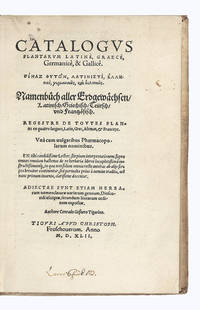
55064 p.l. 162 leaves. Small 4to cont. blindstamped panelled pigskin remains of two deerskin ties. Zurich: C. Froschauer 1542. First edition of a very rare book on the market; this is a lovely fresh copy in contemporary blind-stamped pigskin. This Gesner's second botanical work is "an alphabetically arranged catalog of plant names in four languages the first of its kind and an indication of the growing interest in botany beyond purely philological investigations into the writings of the classics. The Greek names are based on the works of Dioscorides. This early work is already characteristic of Gessner's life-long endeavour to arrange scientific topics in alphabetical or systematic order; it also show his proficiency in languages and his interest in their comparative treatment."-Wellisch 8.1. A fine copy. Signature at foot of title of "Lucas Schröck M.D." Schröck 1646-1730 was a professor of medicine at Jena and president of the Deutschen Akademie der Naturforscher see Hirsch V pp. 139-40. Early inscription on front free endpaper stating this is a duplicate from the Royal Library of Munich. Engraved armorial bookplate dated 1744 of Franziskus Topsl 1711-96 prior of the Polling Abbey in Upper Bavaria. Modern booklabel of D. Henry. Some minor worming to upper inner corner of first seven leaves touching a few letters of the first two leaves. ❧ Pritzel 3298. unknown books
86003001Edo c.1700-50 n.p. Brown & silver covered boards very clean 7 double-page b.w. erotic woodblock illustrations mounted on mica flecked paper 18 x 25 cm. accordion folded illustration size: 31 x 12 cm. FIRST & ONLY UNRECORDED COPY! . . . . A VERY RARE UNRECORDED EARLY BOOK . . . A BIZARRE & UNIQUE EROTIC BOOK . . . UNSIGNED BUT CLEARLY THE WORK OF A MASTER ARTIST . BY SUKENOBU OR HIS :SCHOOL: . A unique and hitherto unfound odd and most unusual erotic book of the early-mid-18th century. One of the most bizarre erotic books ever done in Japan. . The graphically explicit work portrays men and women with genitals on their foreheads engaged in heterosexual and homosexual intercourse. There is no other book with such unusual and strange illustrations. . . THE TITLE: THE LEGEND OF AMANJAKU or AMAN NO JAKU: Chinese Title: TIAN XIE GUI YUN . THE MEANING OF AMANJAKU: Japanese Buddhist literature is abundant with variations on the theme of "Aman-No-Jaku" aka. "Amanjaku" "Manojaku" commonly understood to be a "Heavenly Evil Spirit." . This spirit or demon-like creature in Japanese folklore is usually depicted as being a male during the day and female at night. The demon is usually depicted as a kind of small Oni devil and is thought to be able to provoke a person's darkest desires and instigate him into perpetrating wicked deeds. . Amanjaku is also depicted in Chinese and Japanese mythology the AMANOJAKU is a changeling a water spirit that infiltrates the human world to play cruel tricks on people by reading their minds and twisting their requests or desires to be used against them. . The "AMANOJAKU" is also known the "Lord of the River" and in Japan serves Bishamonten one of the four Deva kings of Buddhism as a minor demon. See Wikipedia below. . In Japanese the term "Amanojaku" also refers to a person who is deliberately contradictory someone who argues for the sake of arguing or can be used in common Japanese conversation to refer to someone who is a "Perverted Demon." . THE ILLUSTRATIONS: THE BUDDHIST THEME:. This work is unusual in that the genitals of common people are located on their foreheads. A symbolist meaning can be in Buddhist concept that sex and sexual hedonism is openly on the minds of 'lay' people. The Buddha and his disciples on the other hand do not have sex organs on their foreheads meaning their organs are covered and in a different usual location. This can symbolize 'self control' over such biological energies. Devout Buddhist disregard sex as a pleasurable pastime and devote themselves to monastic focus. By contrast "lay" people are distracted with hedonistic pleasure a path away from rather than towards the Dharma or teachings of Buddhism. . In a sense this work illustrates the overwhelming force of evil or the "Amanojaku" and how it distracts people from the "Righteous Path" towards the Dharma and the ultimate goal of attaining Nirvana. It can be posited that this work is designed to give understanding to "lay" people by way of visual example of what forces direct their energies away from the Buddhist teachings in an effort to redirect them towards the "Righteous Path" and life style. . EXCEPTIONALLY RARE UNIQUE WORK: . The work is exceptionally RARE unusual and erotic there are no other example showing genitals on the foreheads of any other Japanese book cited anywhere in the bibliographic literature or record. . This work is certainly RARE in subject content and quantity. Though it was woodblock printed and unsigned which was usual for Japanese erotic works which were banned by the Shogun we have not found anything similar or recorded anywhere in the bibliography. Being woodblock printed one assumes there are other copies in existence. The average printing from woodblocks were somewhere between 100-200 copies. However in this instance no others exist. We have the strong feeling the book could have been the production of a famous Japanese illustrator and perhaps financed by a Buddhist temple again there are no known facts about this rarity. . THE EROTIC ILLUSTRATIONS: . Number 1: This work begins showing the Buddha flanked by two of his disciple monks. The title is written in four Japanese Kanji in Kambun & Chinese characters. The Buddha and his two disciples listen to two elderly Buddhist believers: one is a male he has and erect penis on his forehead. The other is a woman she has a vagina on her forehead. Neither the Buddha nor his two disciples monks show genitals on their foreheads. The couple have come to consult with the Buddha about their grievances. . Number 2: Shows a man and a woman in a Tatami matted room both wear lovely 18th century decorated Kimono. They embrace each other and are engaged in making love from their foreheads which show an erect penis and testicles inserted into the woman's forehead where her vagina is located. Adjacent to the young couple is an older woman who has become aroused by the adjacent couple's making love. The old woman uses a dildo tied to a post which she hugs while inserting the dildo into the vagina on her forehead. . Number 3: Shows a couple laying on a blanket their Kimono pulled down and opened and used as a top cover. They engage in love-making and kiss. The man has an erect penis on his forehead the woman a vagina on hers. There is some used Chirishi toilet paper just above her head on the floor used to wipe the love fluids. There is a folded package of yet unused Chirishi in readiness. Chishiri shown in Japanese Shunga erotic prints prints & paintings is an 'erotic symbol' indicative of sexual excitement with lots of love fluids flowing. Ergo the need for paper to clean up the results of erotic love-making. . Number 4 shows an adult man with an erect penis on his forehead penetrating the anus of a younger man who's smaller but erect penis is seen on his forehead as he faces his lover. The younger man has no pubic hair yet indicating his youth. . Adjacent to these two men is a woman in the next room. The door is open she is a secret voyeur of the two men. Her vagina is also on her forehead. A Shogi board and two bowls for stones is located in the front left of the illustration. Gay activities in Japanese society were accepted as a norm and were not especially unusual. However to find graphic examples in Japanese erotic books are exceptionally rare and seldom found. . Number 5: Depicts a fully clothed man on his knees he bends over a sleeping woman. He has a very large erect penis and begins to penetrate a woman with her vagina on her forehead. She is fully clothed and sleeping on a wooden "pillow" which supports her elaborate hair coiffeur. . Number 6: Depicts a lively scene of two men and a woman. One man with a very large and erect penis pulls the woman's arm toward him while she fends him off with a straight arm to his head. A second excited man also with a large and erect penis on his forehead masturbates and ejaculates in ecstasy. The woman has a vagina on her forehead. The scene is likely an intended rape of a young girl. She looks away in an effort not to allow him to pull her close enough to insert his penis into her exposed vagina. . Number 7: Illustrating a lonely old man in bed. He has an erect penis on his forehead and holds a kind of pot with a large opening. He faces down and inserts his penis into the pot for gratification. . THE TEXT: The text in Shunga erotic Japanese books & prints is often an erotic dialogue describing the erotic action. Often these words are onomatopoetic mimicking the sounds of people in orgasm or making comments about making love or the pleasure and good feelings. The size and hardness of the penis or the flavor and the juices of the vagina and its supple feelings of euphoria when engaged in love-making. All wear 18thcentury period Kimono. . MODE AND FASHION OF THE MID-18TH CENTURY: The room furnishing and Kimono of the participants in this work all wear 18th century period Kimono with period decorations. The style of Kimono and room screens reflect this period. . BINDING AND MOUNTING: Binding: The book has probably been rebound sometime after the 1750's with a more recent thin brown decorated paper with a silver chrysanthemum and a Mon family crest with gold and black on both front and rear covers. Each cover has a distinctly different kind of illustration but of the same theme. The corners and edges are a bit worn some loss to the paper as usual for a work from this period. . Mounting: At an earlier time each page was expertly mounted on a stiff Washi hand-made Japanese paper into an accordion folded book. Each illustration is bordered with a rare and stunning crushed oyster-shell powder mixed with rice-glue and overlaid on the border paper. The stunning effect is a rare shimmering pearl-like color and hue with a remarkable effect. This rare and largely unknown effect has been used for print backgrounds by some of the later masters. . This was no ordinary mounting and appropriate for an exceptionally and most unusual RARE book ! . Contents: By and large the contents are clean solid with a two old worm holes for the first 6 of 7 pages. These are small and towards the edge and does not detract from the overall quality of the illustration. On page 7 there are a few center margin old minor worm holes. All of these have been restored when the prints were laid down on the thick Washi paper creating book format. The work is otherwise solid and firm. There are a few 'rubs' on the old Washi paper which was made from very soft Kozo fibers common to any item of this period on this on handmade papers of the period. . CONDITION OF THE WOODBLOCK PRINTS: . These are very early black and white woodcut prints. Each print has an excellent and vivid impression key blocks are black and superbly printed with strong images. The paper is old and has the patina of paper from that age the usual minor mild surface rubbing or thumbing in the lower corners which is common. . We tend to be overly critical of any flaws found on our books and believe it is better to overly describe rather than avoid such discussion any imperfections. Suffice to say by and large this is an excellent item in very nice condition something that any collector or museum would be proud to own. Please review photos posted to our website. . R A R I T Y OF SUBJECT: The placement of the genitals on the forehead gives one a lot of room to theorize on the meaning of such artistic expression. In our 50 years of experience in dealing Japanese woodblock printed books and painted original art this is the first and only example with such imaginative and symbolist expression. With the beginning of the work showing the Buddha and his two disciples lacking any genitals on their foreheads one can simply assume that in a Buddhist way they have given up carnal desire as represented by common people who's foreheads display genitals perhaps meaning that sex is on their minds or they simply view others as sexual objects eager to make love and engage in carnal thoughts and activities. Obviously seeing an erect penis on some man whiles others see what he thinks and feels is an insight to his innermost thoughts and desires. In all cases in this book the men all show an erect penis. The women are a bit more difficult to fathom. Their vaginas are simply visible on their foreheads and no fluids are visible or other evidence of their carnal desire or sexually excited stated. All of the men have public hair adjacent to their sex organs while all women are lacking any pubic hair completely. This is an erotic symbolism giving full view to women's genitals. . "BANNED" or "PROHIBITED" BOOKS: Shun Pon Haru Bon: In the case of this item it is very likely that it was printed in a much smaller discreet quantity than the 200 copies possible off the blocks. Due to the "banned" nature of such books there is no date publisher nor place cited. One is simply left to determine the date and artist by stylistic analysis. It is well-known that during the Tokugawa period 1603-1868 erotic prints and books were "BANNED" or "PROHIBITED" by decree of the Shogun. One of the influencing factors was that during this period some Shoguns were changing their views and being influenced by Christians who entered Japan during this period. The Shogun did not want foreigners and Jesuit missionaries to think that Japan was a crass and base nation. Naturally foreigners soon learned that prostitution was rampant and so this strange logic from the Shogun never had much affect on the Christians and surely not on the Japanese. . The Shogun enforced severe punishments for persons involved in drawing printing carving blocks and publishing erotic books and prints. With out the "Kiwame" or censor's approval seal all such items were "Banned" outright by the Shogun decree. . While these "Prohibited" books and prints were widely circulated in an "underground" society there are ample examples of famous artists taking on commissions to produce erotic books and prints fun or profit. The record and bibliography is loaded with these examples. "Banning" such erotic works simply meant that the number printed were limited to smaller numbers and distribution was done under the table discretely circulating such books privately among collectors. During these times it was not necessary for artists to sign their such artistic creations by-and-large the population had a very good idea who the artist was by being familiar with their style and other works it was simply a "public secret" who the artist was. Often the artist poked fun at the Shogun with political jokes and assumed names to confound any chance of being discovered by the authorities. . Over the centuries this knowledge decreased and is now the domain of the art historian or scholar to identify and determine the actual artist. Stylistic analysis remains the standard method for unsigned works. . THE ARTIST/SCHOOLS: While there are no signatures or seals indicating the artist's name or even his alternate Go studio name we believe this work is part of the "Primitives and First Century of Ukiyo-e School 1660-1765" period. See Lane below. The women's coiffeur is very similar to those found in this period as well as the drawing style technique and genre. It is this cataloger's opinion that this work was likely the creation of one of the Moronobu School masters. Perhaps done by Sukenobu Yoshikiyo Morishige Sugimura Moronobu Kiyonobu Masanobu or others from this period. We believe this work was likely done from around 1710-1750. It was also likely that it was done by one of the artists listed below. . LIKELY ARTIST ATTRIBUTION: . MORONOBU SUKENOBU SCHOOL: Nishikawa Sukenobu 1671 -August 20 1750 often called simply "Sukenobu" was a Japanese printmaker from Kyoto. He was unusual for a Ukiyo-e in being based in the imperial capital of Kyoto. He did prints of actors but gained note for his works concerning women. His Hyakunin Joro Shinasadame: Appreciating 100 Women in two volumes published in 1723 depicted women of all classes from the empress to prostitutes and received favorable results His Hyakunin Joro Shinasadame: Appreciating 100 women in two volumes published in 1723 depicted women of all classes from the empress to prostitutes and received favorable results Leading members of this school were: Nishikawa Sukenobu the founder; Nishikawa Suketada; Kawashima Nobukiyo; Nishikawa Terunobu; and Takagi Sadatake. . NISHIKAWA MORONOBU SCHOOL: Nishikawa Moronobu 1618-July 25 1694 was a Japanese painter and printmaker known for his advancement of the Ukiyo-e woodcut style starting in the 1670s. Leading members of the MORONOBU school were: Nishikawa Moronobu the founder; Hishikawa Morofusa; Hishikawa Moroyoshi; Hishikawa Moronaga; Hishikawa Moroshige; Hishikawa Morohira; and Tamazaki Ryujo. . BIBLIOGRAPHY: . This title is NOT listed in any of the below resources: SHIBUI Kiyoshi. UKIYO-E NAISHI. BIBLIOGRAPHY OF JAPANESE EROTIC ILLUSTRATED WOODBLOCK PRINTED BOOKS. H. KERLEN. CATALOGUE OF PRE-MEIJI JAPANESE BOOKS & MAPS IN PUBLIC COLLECTIONS IN THE NETHERLANDS. Richard Lane: IMAGES FROM THE FLOATING WORLD THE JAPANESE PRINT; pages 28 40-60 show examples of the Ukiyo-e primitives 1660-1765 especially the Moronobu school pp.60-88 et al. . NOT LISTED IN: . KSM SHIBUI Kiyoshi: UKIYO-E NAISI. BIBLIOGRAPHY OF JAPANESE EROTIC ILLUSTRATED WOODBLOCK PRINTED BOOKS. Modern Reading: UKIYO-E NAISHI KERLEN H.: CATALOGUE OF PRE-MEIJI JAPANESE BOOKS & MAPS IN PUBLIC COLLECTIONS IN THE NETHERLANDS. Not in any other usual bibliographies on Japanese E-hon woodblock printed books. . See: WIKIPEDIA: http://en.wikipedia.org/wiki/Amanjaku . hardcover books
5595148 leaves including the final blank Roman letter except for the two-line title in gothic type 51 lines & headline capital spaces with guide letters. Folio 290 x 188 mm. late 17th-cent. panelled English speckled calf rebacked with the orig. spine laid-down minor staining to a few leaves in blank upper margins. Basel: J. Amerbach 1494. First edition of the "first bibliography to be compiled as a practical work of reference."-Grolier Club Bibliography 7. Tritheim 1462-1516 one of the leading polymaths of his age was appointed the 25th abbot of the monastery at Sponheim in 1483. "One of the first of his many self-imposed tasks was the reorganization and cataloguing of the monastic library if one can call reorganization the process of transforming forty-eight mongrel volumes into a splendid collection of 2000 printed books and manuscripts many of great importance and rarity. "It was during the progress of this work no doubt as his exceptional knowledge of books caused inquiries frequently to be addressed to him that he conceived the notion of compiling a new and ambitious bibliography of ecclesiastical writers. He began work in 1487 and by the spring of 1492 he was able to send the complete manuscript to the bishop of Worms. He then revised it and in 1494 the Liber de scriptoribus ecclesiasticis a folio of nearly 300 pages issued from the Basle press of Johann Amerbach. "From Alexander bishop of Cappadocia down to himself Tritheim sets out in chronological order nearly a thousand writers largely but not exclusively ecclesiastical giving a short account of each followed by a list of his or her writings. Nor are these lists merely perfunctory: it is obvious from such a heading as that for St. Augustine under which he enumerates 277 works that Tritheim must have lavished an immense amount of genuine research on his bibliography. In all about 7000 books are recorded. An alphabetical index of authors arranged of course by Christian names is added. The contrast between the feeble theological bibliographies of the manuscript age and this first attempt in the printing era is very striking."-Besterman The Beginnings of Systematic Bibliography pp. 7-8. The title of the book is somewhat misleading since the work is not restricted to ecclesiastical writers but also includes authors such as Dante Poggio and Sebastian Brant. A fine and crisp copy of a book which has become uncommon on the market preserved in a box. Bookplate of the Society of St. John the Evangelist Cowley Oxford. With a note on the rear paste-down referring to "Derby" the Earls of Derby and a shelf-mark. ❧ Goff T-452. unknown books
7036Printed in Chinese with Japanese reading marks. 11 columns per page 21 characters per column. 79; 59; 51; 49; 67 folding leaves. Ten parts in five vols. 8vo 240 x 149 mm. orig. brown wrappers new stitching. Japan: mid-Muromachi ca. 1440-50. An extremely rare and important "mid-Muromachi" Gozan-ban edition of The Blue Cliff Record in Chinese: Pi yen lu a collection of Chan Buddhist koan. These were verbal tests used to practice or test a student's progress in Zen compiled in the Song Dynasty and expanded by the great Northern Song Chan master Yuanwu Keqin 1063-1135 abbot of Tianning Wanshou Chan Monastery in Beijing. The text was first printed in China in 1125 or 1128 and has long been celebrated for both its startling beauty and profound complexity. Around 1140 one of Yuan Wu's successors Ta Hui destroyed the printing blocks and copies of the Pi yen lu because the work's rapid and widespread popularity made him fear that its beauty of expression would distract its readers from seeking enlightenment directly within themselves. The text was brought back from China by Dogen 1200-53 the Japanese Buddhist priest who was a founder of the Soto school of Zen in Japan. He had studied in China for four or five years and returned to stay at the Kenninji temple where he introduced many texts. This text was first printed in Japan about 1336-50 early-Nanbokucho by Gyokuho Shorin at the Kenninji; there is a copy at the National Diet Library. Our edition is a reprint of that first Japanese edition using the same woodblocks with minor changes. A later edition appeared in the Donald and Mary Hyde sale lot 65. "For some time Chan monks had been in the habit of extracting snippets from the 'records' yulu of past masters isolated them as 'ancient precedents' and commenting on them sometimes in verse sometimes in prose. By the mid-eleventh century the core situation was known as a 'case to be investigated' or a gong'an. The process was incremental and difficult to stop. Yuanwu's Emerald Cliff Record for example took a previous eleventh-century collection entitled Master Xuetou's verses on a hundred old cases and added an introduction and extensive commentary to each 'case' sometimes also dropping in comments on the appositeness or more usually inappositeness of the relevant verse so becoming in his turn 'magistrate.' A gong'an collection therefore reveals many layers all of them dedicated to undercutting the stability of language while at the same time playing a complex game of competing authorities. Herein lies their fascination."-Richard Bowring The Religious Traditions of Japan Cambridge U.P. p. 301. "Gozan-ban is a general term embracing all those books published by monks of the Zen sect chiefly at the five Zen monasteries at Kamakura and the five at Kyoto over a period of more than 200 years between mid-Kamakura and late Muromachi. The appearance of the printed page in most Gozan editions follows a distinctly Chinese style. The effect is somewhat dense and crowded caused by packing the Chinese characters tightly together with more regard for economy of space than for aesthetic effect. In this the Gozan editions differ markedly from all other early Japanese printed books which are more generously spaced. The reasons for this are twofold: the books tend to be chiefly reprints of Chinese song and Yuan editions and during the fourteenth century many Chinese blockcutters came over from the continent and practised their craft of a semi-commercial basis and on a fairly large scale."-K.B. Gardner "Centres of Printing in Medieval Japan: late Heian to early Edo period" in British Library Occasional Papers 11. Japanese Studies ed. by Yu-Ying Brown London: 1990 p. 164. PROVENANCE: This copy has the seals of Hirokata Yashiro 1758-1841 "Shinobazu Bunko"; Awa no Kuni Bunko; and Goroza Uchino b. 1873 "Kyotei Bunko". It later belonged to the great collector and bibliographer of early Japanese books Kazuma Kawase 1906-99 and has his seal. The chitsu has Kawase's manuscript title label stating in trans.: "Gozan-ban. Hekiganroku. Mid-Muromachi edition. Shinobazu Bunko provenance. Kazuma put the title on this label" also with his seal. There are four Prefaces: the first is undated the second dated 1300 the third dated 1305 and the fourth is dated 1304. Two leaves of manuscript probably written by Yashiro have been inserted at the beginning of Vol. I. They provide a commentary and a sort of title-page the work was issued without a title. Following Part I there are another two leaves of manuscript relating to this text. Following the tenth part are five Afterwards dated 1125 undated 1302 1317 and 1317. In fine condition all contained in a modern wooden box. The top of the box has been covered in a most attractive silk brocade. A few natural paper flaws and minor staining. Berkeley has an edition of this text but because of the very vague WorldCat cataloguing it is impossible to tell which exact edition it is. ❧ Kornicki Language Scripts and Chinese Texts in East Asia p. 245. unknown books
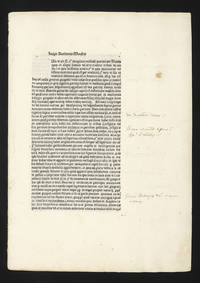
338122 leaves Gothic type 43 lines. Folio 301 x 213 mm. disbound some worming towards end. Padua not Pavia: Pierre Maufer about 1475. First edition a remarkable discovery of the third known copy of the true first edition of the first modern book devoted solely to anatomy. The other two surviving copies are in the Biblioteca Corsiniana Rome and the Biblioteca Comunale Viterbo. The rarity of this book is well-known: it is revealing that Castiglioni Choulant and Garrison all cite the 1478 edition as the first printing. Its influence was great: "The first outstanding anatomist worthy of the name.the Anathomia of Mondino was the most used anatomical text up to the end of the sixteenth century probably because it contained the most important technical indications in brief and concise form."-Castiglioni A History of Medicine pp. 341-43. Mondino ca. 1275-1326 a native of Bologna was the son of an apothecary and the nephew of a professor of medicine. He attended the University of Bologna where he studied under Alderotti Thaddeus of Florence an early dissector and took his medical degree in 1300. Mondino soon became a professor of medicine at the university. "Mondino's chief work is his compendium of anatomy Anatomia Mundini completed in 1316 which made him in Castiglione's sic words 'the first outstanding anatomist worthy of the name.' Mondino's book dominated anatomy for over two hundred years. The major reason for Mondino's great popularity was the simplicity conciseness and systematic arrangement of his book which is divided into six parts: 1 an introduction to the whole body and a discussion of authorities; 2 the natural members including the liver spleen and other organs in the abdominal cavity; 3 the generative members; 4 the spiritual members the heart lungs trachea esophagus and other organs of the thoracic cavity up to the mouth; 5 the animal members of the skull brain eyes ears; and 6 the peripheral parts bones spinal column extremities. This organization was not the result of any philosophical approach to the subject but rather derived from the necessity of dissecting the most perishable organs first. "Mondino should be regarded as the restorer of anatomy if only because his popular textbook and his experimental teaching were instrumental in preparing the revival of the subject. His text was the first book written on anatomy during the Middle Ages that was based on the dissection of the human cadaver; his efforts consolidated anatomy as a part of the medical program at Bologna and encouraged further study. His book also dominated the teaching of anatomy and no real improvements were made upon it until 1521 when Berengario da Carpi wrote his famous commentary on Mondino."-D.S.B. IX pp. 468-69. "Mondino's book soon became a classic text; he was venerated soon after his death as a divine master and anyone who was found differing from his book was regarded as monstrous. For three centuries the lecturers on anatomy were required to use his book in their teaching as may be seen in the statutes of many medical schools."-Castiglioni op. cit. pp. 344-45-& see the detailed account of the contents of this book and methods of dissection which it reveals on pp. 341-45. A very fine copy with all edges uncut and preserved in a slipcase. Two contemporary annotators have made a number of neat comments in the wide margins. This copy was clearly removed from a sammelband. The final four leaves have some worming becoming increasingly more pronounced but not at all offensive touching the text of the final three leaves. ❧ Choulant-Frank pp. 88-96. Garrison-Morton 361-describing the 2nd edition of 1478-"The first modern book devoted solely to anatomy written for his students in 1316. Mundinus re-introduced human dissection which had been neglected for 1500 years before him; he was the most noted dissector of his period." Garrison History of Medicine pp. 160-61. GKW M25666-citing Pavia in error. ISTC im00871200. Klebs 688.1. Sarton III Pt. I p. 843-"In spite of his personal observations Mondino was almost entirely dependent upon Galen and Theophilos and upon Arabic authorities.". unknown books