542 résultats
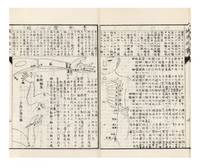
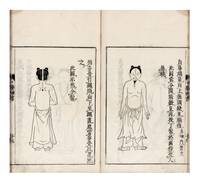
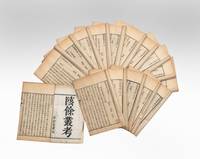
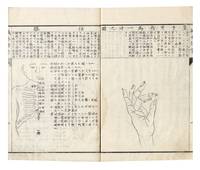
6530Numerous woodcut illustrations in the text. 31 folding leaves. 8vo orig. wrappers wrappers a little rubbed orig. block printed title label on upper cover label a little defective new stitching. Kyoto & Tokyo: 1864. First edition and rare. Imamura 1814-90 a leading doctor and historian of Japanese medicine was physician to the future Emperor Taisho when he was a youth. Imamura professor of medicine at Tokyo University found that many of the contemporary Japanese works on acupuncture had strayed from the classic teachings of the Chinese physicians. In this work Imamura makes a series of highly detailed and organized corrections to refine the fourteen meridians. The numerous striking woodcuts depict various parts of the body and pressure points. Very nice copy. Some light dampstaining. ❧ Mestler Old Japanese Medical Books I p. 297. unknown books
7485Numerous woodcut illustrations in the text. Title-page 31 folding leaves one leaf of colophon. 8vo orig. patterned blue semi-stiff wrappers orig. block-printed title label on upper cover label rubbed new stitching. Tokyo Kyoto & Osaka: 1864.<br /> First edition and rare. Imamura 1814-90 was a leading physician and historian of Japanese medicine of his period. Professor of medicine at Tokyo University he was physician to the future Emperor Taisho when he was a youth.<br /> Imamura found that many of the contemporary Japanese works on acupuncture had strayed from the classic teachings of the Chinese physicians. In this work he makes a series of corrections to refine the fourteen meridians.<br /> The numerous woodcuts depict various parts of the body and pressure points.<br /> Very nice copy. Light stain to first few leaves.<br /> ⧠Mestler Old Japanese Medical Books I p. 297. unknown books
6812Eight full-page drawings & one illus. in the text. 17 folding leaves. 8vo 243 x 165 mm. orig. blue semi-stiff wrappers some dampstaining to upper portion of each leaf. Japan: mid-Edo. Kagawa 1683-1755 a member of the medical family dynasty studied in Kyoto with Ryozan Goto and Jinsai Ito from whom he learned moxibustion and the therapeutic value of the waters of hot springs. Kagawa established the successful Ippondo medical school and was one of the most enthusiastic practitioners of moxibustion of his time. There is another manuscript of this text at Kyoto University attributed to Kagawa. Some of the illustrations are very different. The introductory remarks describe the importance of the precise placement of the moxa on the skin how to measure the placements based on distance from certain bones or joints of the body and the various techniques and occasions for moxibustion applications. Following this the text precisely describes the moxibustion locations on the body and how to locate each one with references to Simiao Sun's classic text Qian jin fang Essential Prescriptions Worth a Thousand Gold Pieces compiled in 650-59. Kagawa lists many diseases and injuries for which moxibustion is appropriate. There is a most interesting section on how to treat unsuccessful moxibustion procedures application of certain ointments etc. The attractive illustrations depict moxibustion loci on an osteological background and loci on the stomach arms legs and feet. As mentioned above there is dampstaining to the upper fifth of each leaf but all the characters remain completely legible. unknown books
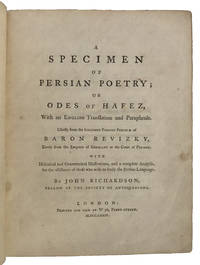
1774ME1081London:: Printed and Sold at No. 76 Fleet-Street 1774. 1774. 4to. iv xv 1 68 pp. Original full calf gilt spine; neatly rebacked to style preserving original endsheets. Inscribed by an early owner "This Book belonging to Monsieur Pierre Monneron." Extremely rare. This is the first edition in English of the ghazals of Hafez translated by one of the leading Persian orientalists of his day John Richardson FAS of Wadham College Oxford and famous for his seminal work written in conjunction with Sir William Jones the work being A Dictionary Persian Arabic and English 1777. / Hafez was previously unknown to the western world until Count Karl Emerich Reviczky von Revisnye 1737-1793 the Hungarian Orientalist and bibliophile 'discovered' him and brought his poetic classic to Europe with this Vienna printing. The work features an extensive text on Hafez and a translation of selected ghazals . Reviczky von Revisnye also issued in 1784 1794 a catalogue of his Greek and Latin library using the pseudonym of "Periergus Deltophilus". In the prefatory essay for that volume he shows an interest in the printing of Nicolas Jenson Aldus Manutius and the Estiennes. / Hafez was born in Shiraz Persia and lived approximately from 1325/26–1389/1390. He is considered a mystic and poet. His life and poems are the subject of much analysis commentary and interpretation influencing post-fourteenth century Persian writing more than any other author. FULL TITLE: A Specimen of Persian Poetry; or Odes of Hafez With an English Translation and Paraphrase. Chiefly from the Specimen Poeseos Persicae of Baron Revizky Envoy from the Emperor of Germany to the Court of Poland. With Historical and Grammatical Illustrations and a complete Analysis for the assistance of those who wish to study the Persian language. Printed and Sold at No. 76, Fleet-Street, 1774. unknown books
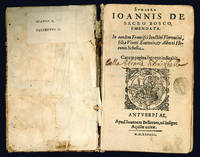
158273<p>COPY CONTAINING THE MINUTE OF A LETTER ADDRESSED BY GIORGIO RAGUSEO TO HIS COLLEAGE OF THE UNIVERSITY OF PADUA GIROLAMO PALLANTIERI</p><p>8vo 153x93 mm. 16 327 1 pp. and 1 folding plate with the movable parts to be cut out and the instructions on how to assemble them. Collation: †8 A-V8 X4. Printer's device on title page and several woodcut diagrams and illustrations in text. On the front pastedown label with the shelf mark "Scansia N. G10 Palchetto N.". On title page is the ownership's entry "Della libraria di Brisighella" and an old faded stamp. Contemporary binding made with a manuscript vellum leaf datable to the 12th-13th century inked title on spine and on the upper edge round worm holes and small losses to the panels heavier loss to the bottom part of the spine lacking ties and front flyleaf. Leaves †6 and †7 stained and with minor losses of paper and occasionally also of text small hole in the middle of quire M affecting a few letters other hole in the lower blank margin of ll. V3-X4 with no loss of text uniformly browned throughout first quire slightly loose. A genuine copy.</p><p>On back flyleaf recto is a manuscript note containing the minute of a letter presumably autograph by Giorgio Raguseo d. 1622 dated "Patavi ex academia nostra V. Non. Marti 94" 3 March 1594 and addressed to the "Admodum Rev.do ac Ecellentiss.o Patri Magistro Hieronimo Palanterio in almo Patavino Gimnasio theologiam publice proficienti" in which Raguseo thanks his colleague and professor of theology Girolamo Pallantieri 1533-1619 and asks his permission to print some not better specified academic "conclusiones ex variis doctoribus scholasticiis" which he thinks are worth publishing. It is also not clear which academy he is referring to in the letter.</p><p>On the verso of the same leaf is another note by the same hand quoting as a reminder the 1566 Giovanni Battista & Marchiò Sessa edition of <i>Le nuove teoriche de i pianeti</i> by Georg Peurbach in the translation by Orazio Toscanella.</p><p>RARE EDITION published in Antwerp of Sacrobosco's famous astronomical treatise accompanied by notes of Francesco Giuntini 1523-1590 Elie Vinet 1509-1587 and Albert Hero d. 1589 which appeared for the first time in the Lyon edition of 1562.</p><p>"Sacrobosco's <i>Sphaera</i> written in Paris around 1220 enjoyed a long popularity as the leading introduction to spherical astronomy. First printed in 1472 it went through at least a score of editions in the fifteenth century and something over 100 in the sixteenth … Publishing Sacrobosco entered a new and different phase in Wittenberg in 1531. Prior to that year all the editions were folio or quarto that is large often quite beautiful and presumably expensive volumes. In 1531 the Lutheran University of Wittenberg apparently sponsored a version cheap enough to become a required textbook for the astronomy course. It is fully illustrated with didactic figures and comes with a preface in praise of astronomy by Philipp Melanchthon … Demand for the small Sacrobosco textbook remained high at Wittenberg and a new edition was issued every few years. In 1538 a revised revision appeared: for the first time three of the diagrams incorporated moving parts. This proved to be such a popular feature that virtually every octavo Sacrobosco from the 1540s on – regardless of whether it was printed in Paris Antwerp Cologne or Venice – included these same identical volvelles. Incidentally these volvelles were not pre-cut and pasted by the printer. They were issued on ancillary sheets together with instructions for assembling them. Hence it is possible to find copies of these text books with no sign that the volvelles were ever in place and very occasionally the original sheet with the instructions and cutouts can still be found with the book" O. Gingerich <i>Sacrobosco as a Textbook</i> in: "Journal of History of Astronomy" 19 no. 4 Nov. 1988 pp. 269-273.</p><p>The letter contained in the present copy is particularly interesting as it connects two prominent figures of the University of Padua at the end of the 16th century highlighting their academic and professional ties. It is also worth noting that Raguseo wrote a commentary on Sacrobosco's <i>Sphaera</i> <i>Expositio super spheram Ioannis de Sacrobosco</i> Milan Biblioteca Ambrosiana manuscript N.207 sup. which has remained unpublished.</p><p>Giorgio di Ragusa or Raguseo as he was called after the name of his hometown today's Dubrovnik in Dalmatia was born on an unspecified date in the second half of the 16th century. He spent his youth in Venice where he was educated in mathematics by his father in the letters by L. Natali and in astrology his favourite discipline by Osvaldo da Gent and F. Barozzi. He then studied and graduated at the Studio of Padua first in the arts the exact date is not known then in 1592 in theology and in 1601 in medicine. In the meantime he took the minor orders and gained a certain reputation as an expert in Lull's art taking part in two public disputes over theological conclusions exposed according to R. Lull's method one in Venice in 1594 and the other in Padua in 1595. In 1599 he set off on a journey that kept him away from Venice for two years. In Pisa he met G. Mercuriale while in Naples he made the acquaintance of G. Della Porta. When he returned to Padua in the spring of 1601 he was appointed to the second ordinary chair of natural philosophy at the local Studio replacing C. Cremonini recently promoted to the first chair. In the following years he was deeply involved in all academic activities not only in teaching. His name in fact is one of those that most often appears in the commission that conferred the doctorate titles according to the practice of the Palatine counts and in this capacity on April 25 1602 he conferred the title of doctor in philosophy and medicine to W. Harvey. In 1613 in Venice he published twenty-four Aristotelian disputes under the title of <i>Peripateticae disputationes</i>. Around 1618 Raguseo took part in the discussions raised by the appearance of a comet. Despite his academic Aristotelianism he expressed an original position in the debate supporting the need for critical scrutiny by the senses and experience. From a letter of 1611 we also know that he used the telescope to verify some of discoveries announced by Galileo in the <i>Sidereus nuncius</i>. Raguseo died in Padua on 13 January 1622 cf. C. Preti <i>Giorgio da Ragusa</i> in: "Dizionario Biografico degli Italiani" LV 2001 s.v.; see also L. Thorndike <i>A history of magic and experimental science</i> VI New York 1941 pp. 198-202; M. Josipovic <i>Il pensiero filosofico di G. Raguseo</i> Milan 1985; and G.F. Tomasini <i>Gymnasium Patavinium</i> Udine 1654 pp. 309 and 445 for Ragueseo and p. 284 for Girolamo Pallantieri professor of theology from 1580 to 1603.</p><p>Bernardino Pallantieri was born in Castel Bolognese in 1533. In 1547 at the age of fourteen he entered the order of friars minor conventual taking the name of Girolamo. In Ferrara he studied philosophy with the theologian Filippo Braschi and the famous philosopher Vincenzo Maggio. He then continued his studies in Bologna under the guidance of Giovanni Antonio Delfini and Franceschino Visdomini. At first appointed regent of the Studio of Pavia in 1566 Pallantieri took up the chair of theology at that university. In 1568 he was called to Milan by St Charles Borromeo archbishop of that city who appointed him as preceptor of the candidates for priesthood and as his personal theologian. Pallantieri remained in Milan for 5 years then in 1573 he resumed his teaching in Pavia. Between 1575 and 1581 he was in Rome at the service of Cardinal Felice Peretti as his personal advisor and theologian. In 1581 he was called back to Bologna and in 1582 he was elected minister provincial of the friars minor of the province of Bologna. He was also a member of the Accademia degli Infiammati of Parma with the name of "Solingo". When his three-year mandate in Bologna expired in 1585 Pallantieri was called by the Reformers of the Studio of Padua to occupy the chair of theology and at the same time he was appointed superior of the convent of the Saint Anthony the patron of the city. Girolamo remained in Padua for ten years until about 1595. In 1603 he was appointed bishop of Bitonto by Pope Clement VIII but he moved to his diocese only in 1605. Pallantieri died in Bitonto in 1619 at the age of eighty-six cf. E. Papagna <i>Pallantieri Bernardino</i> in: "Dizionario Biografico degli Italiani" LXXX 2014 s.v.</p>Houzeau-Lamcaster no. 1658; L. Desgraves <i>Elie Vinet</i> Genève 1977 no. 125. Jean Bellère books
15384474Venice: Per Agostino de Bindoni 1538. Sm. 8vo. 344pp. Illustrated with a large woodcut vignette on title page verso of title and colophon with devices and 78 woodcuts of hands keyed to the text. Nicely rebound in faux period calf gilt tooled spine in 3 compartments. Small chip and tear into blank upper margin of B1 and small printing flaw at bottom corner of A2 verso. An early Italian language edition of one of the most popular works on chiromancy of the 16th century. Tricasso 1491-c.1550 was a disciple of Barthelemy Cocles. At variance with Cocles on a number of points he set out in this work to analyze the significance of 78 configurations of hands as well as to outline the supposed astrological implications. His work is frequently cited by many later writers on the subject. As with other copies cited in OCLC the date at the conclusion of the author's preface is misprinted "1635" it should be "1535" the date of the first Italian edition of this title. Brunet V:945; STC of Italian Books p. 680. Caillet 10830. Per Agostino de Bindoni unknown books
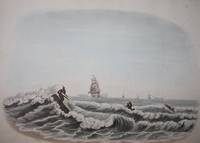
1806004050London: G. and W. Nicoll spelled on the plates with one "l". Printed by Bunney and Co. 1806. Half Leather Marbled Boards. Very Good Minus. Folio 34.5 by 27.5 cm. Only 25 of 49 hand-colored aquatint plates but including several of the most interesting of plates including the Cattamarans -- possibly the earliest depiction of surfing -- a Gentoo Zealot Snake-Men Plates are watermarked 1798 to 1801. A few bear no date. Abbey Travel 428. Rebacked with most of original spine preserved and laid on missing lower compartment. The surviving spine is rubbed cracked and dry but nonetheless a plus to have. Marbled boards are rubbed and worn. Corners are heavily rubbed and abraded. Hinges restored. Scattered light soiling and a few minor closed tears. <br/><br/> G. and W. Nicoll (spelled on the plates with one "l"). Printed by Bunney and Co. hardcover books
1963C1354Program for the First Piatigorsky Cup: International Grandmaster Chess Tournament July 2 to 27 1963 48 pages with photographs including photographs of the contestants table and diagrams. Octavo 8 1/2" x 4 1/2" bound in original publisher's spiral binding in blue felt wrappers with black and silver Piatigorsky Cup stamped to cover. Included nine first day tickets for the cup. Signed or inscribed by all the contestants to Mrs Piatigorsky. <br /><br />The Piatigorsky Cup was a triennial series of double round-robin grandsmaster chess tournaments held in the United States in the 1960's. Sponsored by the Piatigorsky foundation only two events were held in 1963 and 1966. the Piatigorsky Cups were the strongest U S Chess tournaments since New York 1927. Jacqueline Piatigorsky was married to cellist Gregor Piatigorsky. One of the strongest woman chess players in the U S and a regular competitor in the U S Women's Chess Championship she designed the cup and was the primary organizer of the tournaments. The prize funds were among the largest of any chess tournament up to that time. Every player was guaranteed a prize and all traveling and living expenses were paid. The First Piatigorsky Cup was held in the Ambassador Hotel Los Angeles in July 1963. The tournament field of eight included players from five countries. the soviet representatives Paul Keres and World Champion Tigran Petrosian finished equal first to share the cup with a score of 8 1/2/14 receiving more than half of the $10000 prize fund $3000 for first. Keres won most of the games in the tournament six but lost twice to Samuel Reshevsky. The Cup was Petrosian's first tournament since winning the 1963 World Championship match with Mikhail Botvinnik and was one of two first prizes he shared in his six-year reign as champion. He was the first reigning champion to play in an American tournament since Alexander Alekhine at Pasadena 1932. After losing the second round to Svetozar Gligoric Petrosian was never in danger the rest of the tournament. The remainder of the tournament field included to Americans Reshevsky and Pal Benko two Argentinians Oscar Panno and Miguel Najdorf and two Europeans Gligoric Yugoslavia and Frank Olafsson Iceland. U S Champion Bobby Fischer decline an invitation after his demand for $2000 appearance fee was refused by the tournament organizers. Gligoric led halfway through the tournament with 4 1/2/7 but scored only three draws in the last seven games and finished fifth behind Najdorf and Olafsson. Petrosian finished the strongest with 5/7 in the second half. Before the last round Petrosian led with 8 points followed by Keres with 7½ and Najdorf and Ólafsson with 7. Both Petrosian and Keres had Black in the final round. Petrosian drew his game against Reshevsky but Keres beat Gligorić to result in a tie for first place with 8½ points each.<br /><br /><b>Condition:</b> Edges sunned inscriptions to front end paper and title else spiral spine cracked else very good. Piatigorsky Cup Committee paperback books
167535334London: William and John Leake 1675. Two parts in one 8vo. 28 148; 16 159 1pp. Contemporary mottled calf covers ruled in blind rebacked to style flat spine ruled in blind red morocco lettering piece<br/> <br/>Provenance: F. H. early initials on the title<br/> <br/>The final edition complete with both parts of among the most influential English gardening books of the 17th century.<br/> <br/>"Sir Hugh Platt 1552-1608 held by Richard Weston to be 'the most ingenious husbandman of the age he lived in' . devoted his life to literary work and to the study of husbandry and gardening. He was also interested in all kinds of inventions and experiments and in consideration of his services in this field was knighted by James I on 22 May 1605 . His work on gardening entitled Floraes paradise . appeared in 1608 the year of his death . He wrote his book from his own practical experience as well as from information supplied to him by other gardeners . Floraes paradise continued to be published after the author's death but with the new title of The Garden of Eden and edited by Charles Bellingham . In 1660 was issued The second part of The Garden of Eden . Readers who questioned the authenticity of this work were invited to 'see the original manuscript under the authors own hand.'" Henrey. Styled on the title as the sixth edition it is the second combined edition of both parts and the final edition published in the 17th century. The second part includes its own title and pagination.<br/> <br/>Fussell pp.15-16; Henrey 299; Hunt 340; Wing P2388; ESTC R31801. William and John Leake unknown books
15386173Venice: Per Agostino de Bindoni 1538. Sm. 8vo. 344pp. Illustrated with a large woodcut vignette on title page verso of title and colophon with devices and 78 woodcuts of hands keyed to the text. Cont. vellum with manuscript spine lettering. Light browning and soiling including title page but overall a very nice copy in a contemporary binding. An early Italian language edition of one of the most popular works on chiromancy of the 16th century. Tricasso 1491-c.1550 was a disciple of Barthelemy Cocles. At variance with Cocles on a number of points he set out in this work to analyze the significance of 78 configurations of hands as well as to outline the supposed astrological implications. His work is frequently cited by many later writers on the subject. As with other copies cited in OCLC the date at the conclusion of the author's preface is misprinted "1635" it should be "1535" the date of the first Italian edition of this title. Brunet V:945; STC of Italian Books p. 680. Caillet 10830. Per Agostino de Bindoni hardcover books
1636D6036Rome: Typis S. Cong de propag: Fide 1636. Hardcover. Very Good. 4to 230 x 170mm. xxiv 338pp. ii. Illustrated throughout with woodcut tables and charts of Egyptian characters and hieroglyphs. Contemporary vellum; intermittently browned occasional spots. <br/><br/>Father Athanasius Kircher was a 17th-century German Jesuit scholar and polymath who published around 40 works most notably in the fields of oriental studies geology and medicine. He was heralded as possessing the secret of deciphering hieroglyphics and was widely regarded as the physical embodiment of all the learning of his age. He had over 760 correspondents including scientists Jesuit missionaries and world potentates and wrote about an enormous range of interests ranging from optics to music from Egyptology to magnetism. Perhaps best known of his correspondents is Jan Marek Marci of Kronland 1595-1667 for sending Kircher a mysterious illustrated manuscript written in an unknown script famously known today as the Voynich Manuscript. In 1635 Kircher began to write his book Prodromus Coptus Introduction to Coptic Language and in the autumn of 1636 the book was printed. Kircher saw the ancient languages as an essential foundation for any pious philosophy. Kircher envisioned Rome as a unique center within to unlock the mysteries of Hermetic knowledge inscribed on the obelisks. The project of restoring Egyptian wisdom entailed nothing less than an effort to renovate the lost arts of communication that linked divine and human languages. Unfortunately while in other disciplines he made valuable discoveries his explanation of hieroglyphs was absolutely incorrect. We can probably explain it by his passion that might have sometimes blinded his reasoning. Yet Kirchers Prodomus remains an important study from a most respected scholar. Brunet III 668; Caillet II 5790. Typis S. Cong de propag: Fide hardcover books
185128441New York: Nagel & Weingaertner 1851. Hand-coloured lithograph after Hanson titled below the image. Expert restoration closing tears into the image. The first America's Cup: a scarce hand coloured lithographed view of the winning yacht which gave its name to the cup.<br/> <br/>In 1851 the Royal Yacht Squadron proposed a race around the Isle of Wight. A group of New York Yacht Club members led by Commodore John Cox Stevens built a yacht designed to compete in such races. Designed by Steers and Co. and captained by Richard Brown the yacht America would win the race by eighteen minutes giving its name to one of the oldest and best-known trophies of the sport: the America's Cup. This lithograph and lithographer are unrecorded by Harry T. Peters; we find no other extant examples of this rare print.<br/> <br/>On Nagel and Weingaertner see Peters America on Stone pp. 291-294. Nagel & Weingaertner unknown books
16711002105London: E.T. and R.H. for H. Brome B. Tooke and T. Sawbridge 1671. First edition in English of the complete Colloquia Familiaria of Erasmus first published in 1518 and expanded by Erasmus over the next fifteen years a lively collection of Latin dialogues that found a readership far beyond the Renaissance schoolroom. Originally intended to model colloquial conversation for students of Latin the dialogues feature pointed free-thinking exchanges on modern political religious and philosophical questions. In "Of the Abbot and Learned Woman" an ignorant abbot tries and fails to get the better of the classically educated Magdalia a character almost certainly based on Thomas More's eldest daughter: "I think thou art some sophistress thou protest so wittily." Magdalia: "I will not tell thee what I think thou art." And later: "I have often heard it usually spoken that a wise woman is twice a fool." Magdalia: "Indeed it useth to be said so but by fools." The Colloquia Familiaria was widely read and debated across Europe drawing immediate notice for its anticlerical satire: "its influence on the dialogues of Reformation Germany and Tudor England is a critical commonplace" Zlatar Reformation Fictions 11. The original purpose of the Colloquies as a text for teaching Latin postponed its direct translation; this first complete English edition was published more than 150 years after the work's first appearance. The edition opens with a short life of Erasmus and concludes with the first appearance in English of De utilitate colloquiorum Erasmus's 1526 defense of the Colloquies published after the Sorbonne condemned the book for impiety. In response Erasmus makes a case for the educational value of his dialogues' humor: "I cannot tell whether any thing be learned more successfully than that which is learned in playing." Despite his efforts the Colloquies would remain on the Papal Index of banned books through the end of the nineteenth century. Wing E-3190; PMM 53. A very good copy of a humanist landmark in a handsome contemporary binding. Octavo measuring 6.5 x 4.25 inches: 8 555 1. Contemporary Cambridge-style full speckled calf boards ruled and ornamented in blind raised bands red morocco spine label lettered and decorated in gilt top edge stained black. Engraved frontispiece portrait of Erasmus. Final leaf containing second page of bookseller catalogue excised. Joints and spine head expertly repaired; evidence of bookplate removal on front pastedown; effaced signature on title page; some running titles shaved. E.T. and R.H. for H. Brome, B. Tooke, and T. Sawbridge unknown books
6449viii 268 pp. 8vo early 19th-cent. marbled boards spine defective. Amsterdam: P. Yver 1785. The extremely rare French edition there was an edition in Dutch the same year of this catalogue of an impressive sale. A contemporary annotator has supplemented it with prices buyers' names and commentary on the artworks almost all dismissive in the margins. Van Slingelandt 1701-82 a great patron of the arts who lived in Dordrecht amassed one of the most notable Dutch painting collections of the 18th century. This heavily annotated volume is the first and most important part of the sale describing 701! paintings along with eight drawings. The second part of drawings and sculptures followed shortly thereafter. Van Slingelandt's collection consisted of Old Masters and contemporary Dutch artists some of whom the collector himself patronized. The present catalogue details the works of Asselijn Bakhuizen Berghem J. Brueghel père et fils Cuyp 38 lots Dou van Dyck Jordaens Metsu Netscher Adrian and Isaac van Ostade Potter Rembrandt Rubens Ruysdael Steen Teniers ter Borch Wouwerman etc. etc. All lots are priced with buyers' names. It is clear the annotator viewed and attended the sale. For almost every item he has provided the name of the buyer. The annotator likely a connoisseur has written generally disparaging comments on the works for sale deriding them as copies or incorrectly attributed: "mauvais" "bizarre" "lourd" "médiocre" "not by Rembrandt." There are additional remarks on condition and provenance which are very interesting. The rare positive observation praises the work of a young artist or salutes a master's finest painting. This sale presided over by Pierre Yver 1712-87 and Abraham Delfos 1731-1820 the preeminent Dutch art dealers of the period was attended by many of their competitors including Pierre Fouquet who frequently purchased on behalf of the famous French expert Jean Baptiste Pierre Lebrun 1748-1813 as corroborated by several annotations in this copy. Lebrun solidified his position as the leading dealer in Netherlandish pictures by purchasing directly from the source and was buying heavily at sales such as these. Other notes indicate there were dealers from Brussels Lyon Antwerp Amsterdam Germany the Hague and Rotterdam. An extremely interesting annotated copy. A few of the annotations are cropped. ❧ Lugt 3936. Oxford Art online Delfos & Yver. hardcover books
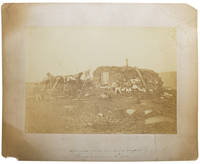
1872303445London 1872. Albumen print measuring 11-5/8 x 16-1/4 in 295 x 412 mm. Laid down on thick cream card with manuscript caption measuring 17 x 21 in. Image slightly faded card chipped with some minor soiling one tear not affecting image. Albumen print measuring 11-5/8 x 16-1/4 in 295 x 412 mm. A rare survival. This image appears in William Bradford's fabled book of photographs Arctic Regions. It was taken by either Dunmore or Critcherson the two professional photographers from Boston who accompanied Bradford on his 1869 expedition to the Arctic on the steamship Panther. It was probably taken at Upernavik a settlement on an island off Greenland's west coast or Godhavn.<br/><br/>Arctic Regions included 141 albumen prints in addition to Bradford's account of the voyage. The title of the photograph here varies from the printed caption in the book where it reads: "Plate Number: 116 Esquimaux igloe or winter hut made of turf and stones. The entrance is to the left through a door which is about three and a half feet high. The length of the passage is about twelve or fifteen feet and at the farther end is another door through which one almost has to crawl on his hands and knees. After passing through there is then room to stand erect but one is forced to leave very soon owing to the bad air." <br/><br/>This photograph is slightly larger than the one in the book which is 277 x 365mm. Furthermore the image in the book is cropped closer on the right and left margins. <br/><br/>The New York Public Library has a folio of 26 images of near identicle size mounted on card. The portfolio was donated to the library in 1892 as part of the Robert Stuart Collection. According to Horch originally all of these images were captioned in manuscript though were later remounted with typed captions as "the original ink-written captions for the photographs had badly faded by 1940." It's interesting that the caption on their duplicate of this image is the same as ours and the image itself has not been cropped. Horch writes that Bradford probably not only selected these images himself but "closely directed the actual taking of the photographs." <br/><br/>It's entirely likely that Bradford would have had extra prints made to distribute to friends repay favors and most of all to solicit subscribers to what was a very expensive book to publish. Given how it conforms to the examples in the Robert Stuart portfolio this particular image is probably one of them. Horch Frank. "Photographs and Paintings by William Bradford". American Art Journal 5.2 1973: pp 61-70; cf Parr and Badger I p31Prm/photo unknown books
7008Twelve full-page woodcuts & numerous woodcuts in the text. 36 folding leaves. Two parts in one vol. 8vo orig. blue wrappers wrappers rubbed & somewhat wormed orig. block-printed title label on upper cover no longer present modern stitching. "Ichijo-dori" a street in Kyoto: Tomikura Tahei 1690. First edition of this early and rare book providing prescriptions for treatments in the different stages of tuberculosis. The author describes ten drugs made from vegetables that give miraculous results in treating the disease. The second part entitled "Mujo Gengen santen shinden gyokudo shoshi chiden shirochu soho" describes the parasitic worms said to grow in the stomach and intestinal system of patients suffering from tuberculosis. The text illustrations depict many of these parasites. The text is Chinese with Japanese reading marks presumably compiled in the 14th century by Ge 1305-53 a Yuan dynasty physician and writer. He came from a family of hereditary physicians and wrote a number of books. The Japanese reading marks have been provided by Shuhaku Asai 1643-1705 who was a fellow student with Ippo Okamoto of the prominent doctor Sanpaku Ajioka. There are substantial sections on acupuncture and moxibustion several of the full-page woodcuts depict pressure points. Very good copy. Minor marginal worming towards end. unknown books
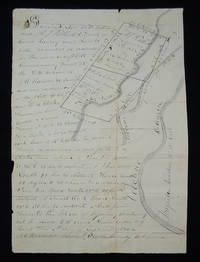
68368A Gold Rush Manuscript Land Survey GOLD RUSH. Gold Rush Map Manuscript. Being a Survey for the adjoining plots of land belonging to H.H. Watson and A.J. Polhill. Placer County California: 1852. Two pages on a single sheet 17 1/8 x 10 7/8 in.; 438 x 275 mm. Manuscript document with map dated variously between 4-24 September 1852 and signed by H.H. Watson A.J. Polhill and others. Sheet with some mild staining and ink blots. Some minor chipping at edges and some separations at the creases. Creases reinforced with nearly invisible tape. Overall a very interesting piece of gold rush history. We could not find any other California mine surveys at auction in the past 50 years. "Survey for H.H. Watson and A.J. Polhill. A Tract of land laying near ville bounded as described in the annex plot commencing point as the S.W. corner of J.H. Hancock survey." "Survey made by N.O. Hinman County Surveyor." "In the present survey the tracts of land being issued to Watson and Polhill are bounded on the right by the Volcano Mining Company Ditch and Volcano Canion sic with the Todds sic Valley Company Ditch running through each plot. The Volcano Gold Gravel Mining Company was one of the most extensive gravel mines during the Gold Rush and hundreds of acres of valuable mining lands were drained by its enterprises. Placer County falls in both the Sacramento Valley and Sierra Nevada regions in what is known as the Gold Country. The discovery of gold in this region in 1848 brought tens of thousands of miners from around the world and thousands more settled in the area to provide goods and services to them. The name "Placer" is taken from the Spanish word for gravel or sand deposits containing gold." From Sotheby's. HBS 68368. $4500 1852 unknown books
634118 leaves. Small 4to attractive modern marbled boards red morocco lettering piece on spine. Wittenberg: C. Heyden 1619. First edition of this rare book which is considered by A.D.B. to be the author's most important scientific work; it is a careful record of the third of the three bright comets of 1618-19. Schmidt 1570-1637 was "one of the last of the scholars of Germany who taught the language and literature of Greece in the spirit of Melanchthon. Schmidt was professor first of Greek and next of Mathematics at Wittenberg. His principal work was an edition of Pindar with a Latin translation and a careful commentary 1616."-Sandys II p. 272. Fine copy. ❧ A.D.B. Vol. 32 pp. 27-28. Zinner 4785. hardcover books
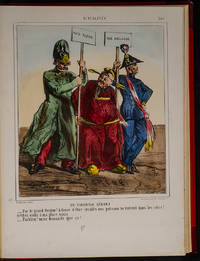
05043Paris: A. de Vresse & Maison Martinet 1862. A Fine French Album of Sixty-Six Caricatures Including Twenty-Eight with Hand-Coloring<br/><br/>PELCOQ Jules illustrator. Actualités. Paris: A. de Vresse & Maison Martinet 1862-1863. <br/><br/>Folio 13 3/4 x 10 1/8 inches; 350 x 257 mm. Twenty-eight fine and mainly amusing hand colored lithograph plates all heightened with gum arabic and thirty-eight black and white lithograph plates making a total of sixty-six plates all signed numbered and titled Actualités. All plates mounted on stubs. A few of the black & white plates and one color plate No. 363 with light mainly marginal foxing. One of the color plates No. 133 lightly toned and color plate No. 226 with neat marginal repair just touching image.<br/><br/>Contemporary half red morocco over red pebbled cloth boards ruled in gilt. Front cover with rectangular black morocco label lettered in gilt. Smooth spine decoratively tooled and lettered in gilt marbled endpapers. A wonderful collection.<br/><br/>The Plates:<br/><br/>Color: Numbers 13 14 15 19 31 56 78 133 137 215 226 227 241 251 281 291 317 318 331 335 337 342 346 347 349 356 360 & 363 <br/><br/>Black & White: Numbers 4 5 6 43 77 99 102 107 115 116 122 135 147 148 155 161 162 163 165 168 201 210 217 223 227 265 282 292 317 318 324 325 363 386 389 389 397 & 398.<br/><br/>Note: Some plate numbers are duplicated but the plates are all different.<br/> <br/>Pelcoq Jules 1825-1887. "Jules Pelcoq born in Belgium was a Parisian book illustrator and colleague of Honoré Daumier and contributed to Le Charivari and other French periodicals of the time. He also covered the French side for the Illustrated London News during the Franco-Prussian War. While covering the 1870 siege of Paris Pelcoq dispatched his work by balloon to London. Wood engravings were then made from his sketches once they arrived in England. His work captures the attempt by Parisian troops to break through the surrounding Prussian army and the plight of citizens on the edge of starvation forced to eat animals from the Parisian zoo. Pelcoq often signed his name with pseudonyms such as: Jipé or Pipey<br/><br/>By the 19th century caricature in France had become a highly evolved form of public discourse about famous figures politicians artists and writers etc. and the events of the day. During the 19th and early 20th centuries French periodicals such as La vie Parisienne Le journal amusant Le petit journal pour rire and Le Charivari became well-known for the caricatures they published. Caricaturists many of whom published under pseudonyms themselves became public figures. Paris: A. de Vresse [&] Maison Martinet, 1862 unknown books
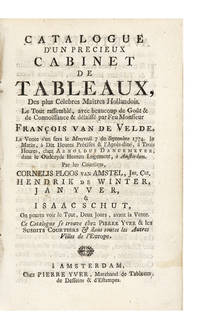
61592 p.l. 72 pp. Small 8vo cont. red sheep-backed marbled boards extremities slightly rubbed spine gilt green morocco lettering piece on spine. Amsterdam: P. Yver 1774. bound with: -. Catalogue d'un precieux Cabinet de Desseins Coloriés & Non-Coloriés des plus célebres Maîtres Hollandois & Flamands &c. De même que d'une tres belle Collection d'Estampes de Choix. Parmi lesquelles il y a quelques Petits Oeuvres & des Ouvrages d'Estampes Reliées & non-Reliées presque Toutes Premieres Epreuves & des mieux conservées.La Vente s'en fera le Lundi 16 de Janvier 1775 & les Jours suivants.Par les Courtiers. 2 p.l. 235 1 78 pp. 8vo. Amsterdam: P. Yver 1775. The rare sale catalogues largely priced in a contemporary hand of this comprehensive collection of 17th-century Dutch and Flemish pictures prints and drawings. These are the French editions bound together there were editions in Dutch published simultaneously. The first catalogue 124 lots with most buyers' names and fully priced consists exclusively of Dutch paintings mostly 17th-century by artists such as Berchem Eeckhout van Goyen Lairesse Maas Metsu Potter Steen Teniers van de Velde Elder & Younger Wouwerman Wynands etc. The contents of each painting are described along with comments and measurements. According to the contemporary annotator Yver Amstel and Fouquet bought many of the lots. Devoted to drawings and prints the second catalogue 1545 lots fully priced in a contemporary hand as well as the annotator's comments on several lots describes 1006 drawings 537 prints and two armoires. The majority of the contents are gathered in 17 recueils A-Q but the pieces were sold separately. The remaining lots were either grouped into 24 livres or offered individually. Despite the exceptional volume of artworks the catalogue frequently offers descriptions of the contents quality and condition of the lots. Fine copies copiously annotated. Engraved bookplate of the Parisian art dealer Georges Pannier 1853-1944. ❧ I. Lugt 2323. II. Lugt 2349. hardcover books
718743 parts in 16 vols. 8vo orig. wrappers new stitching. China: Zhan yi tang Prefaces dated 1790 & 1791. First edition. Zhao 1727-1814 "was an important poet and historian from Yanghu. He was born poor and supported himself at first as a private tutor. In 1761 he passed the imperial examination and in a long career served in many official capacities. Upon being appointed the prefect of Zhenan Guanzi province in 1766 he showed himself to be a reformer dedicated to helping the common people. From 1784 to 1786 he became the director of the Anting Academy in Yangzhou. In addition to writing a collection of 'poetry talk' critical notes on poetry he wrote a dynastic history histories of military campaigns and other important works. He was a friend of Yuan Mei 1716-1798 and was considered along with Yuan Mei and the poet and playwright Jiang Shiquan 1725-1785 one of the three greatest poets of Southern China."-Barnstone & Chou eds. The Anchor Book of Chinese Poetry p. 339. The present work is a collection of Zhao's miscellaneous poetry and writings on classical Chinese literature especially poetry history and historiography one volume is devoted to a discussion of the Tongjian Gangmu of 1172 politics dynastic history philosophy and various other subjects. One of the foremost historians of his day he was among the first to turn his attention to the larger more fundamental problems of historiographical method and social and institutional history. Fine set. ❧ Nienhauser ed. The Indiana Companion to Traditional Chinese Literature Vol. 1 pp. 229-30-"Chao's literary talents were manifold encompassing those of poet essayist calligrapher and critic. He mastered many poetic forms including both old- and new-style verse.Chao was a prolific writer producing many works on a great variety of subjects including history politics and philosophy.". unknown books
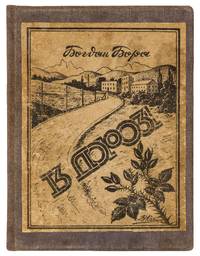
1946423496Rimini Italy: Zyttia w tabori 1946. Hardcover. Very Good. Limited edition one of 280 copies. Mimeographed. Octavo. pp. 1-4 i-iv v-vi 1-104. Illustrated with a portrait of Bogdan and four other full-page illustrations. Bound in original army linen over boards with mimeographed illustration mounted on the front cover. Small contemporary name in ink on front free endpaper slight staining and rubbing to the boards small marginal tears to endpapers very good. A very scarce book of poetry by the Ukrainian poet Bogdan Bora 1920-97 written and published at a prison camp in Rimini Italy about one year after World War II. Bora had been captured by British forces and sent to the prison camp in Rimini where he spent the following two years and published three books of poetry including this collection the title of which translated as "On the Road." Bora's poems written in Ukrainian are moving works evocative of the turbulent era. The cover design and a full-page portrait of Bogdan Bora were made by fellow inmate Volodimir Kaplun. In 1947 Bora was moved to Britain where he was given his freedom and lived out the rest of his days. Very scarce. OCLC locates only six copies in institutional holdings worldwide. Zyttia w tabori hardcover books
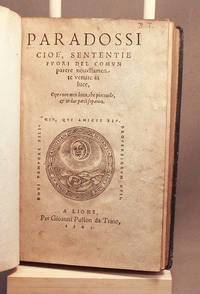
15436296Lyon: per Gioanni Pullon da Trino" i.e. Jean Pullon dit de Trin 1543. First edition. Very Good/Exquisitely rare first printing of Ortensio Lando's most famous book his first in a modern language that in later editions and in translations became a 16th-century best seller. Lando's name does not appear on the title page or anywhere in the book except in code. His real name shows up on no edition published in the 16th century. A dedicatory leaf after the colophon attributes the text to "M.O.L.M" interpreted generally as "Messer Ortensio Landi Milanese." More cryptically there is a phrase printed after the telos "SVISNETROH TABEDVL" mirror writing for "ludebat Hortensius" Ortensio has played. It is serious play. The Paradossi undertakes in the key of popular "world upside down" folklore to prove black what is commonly accepted as white. For instance it is better to be poor than rich better ugly than handsome better drunk than sober and so on. Biographical sketches of Lando are remarkable for how little information about him is available. Peer of Aretino and Doni friend to Etienne Dolet later incinerated for heresy he was a non-believer who nevertheless took Augustinian orders and later deserted them. Member of a prestigious literary club L'accademia degli elevati he was above all an outsider. All of his books landed on the Index of Prohibited Books and "I paradossi" in particular was widely banned and copies of it were confiscated. Probably the first book printed by the obscure Italian printer working in Lyon Giovanni Pullone da Trino later called "Jean Pullon de Trin". Following Pullon's modest press run the text was quickly taken up and reprinted badly by Bindoni and others in Venice twice in 1544 1545 1563 1594 etc. and translated into Latin into French by Charles Estienne 1553 and into English 1596. If you Google "Jean Pullon" you will get dozens of pages advertising pull-on jeans. . Octavo 17cm; 112 leaves signed A-O8. Printer's device on title page Ferraris 1 showing a human-faced moon in the sky reflected on the surface of the land. Bound in later 18th-century or 19th-century dark green leather in neoclassical style with gilt central losenge within gilt borders on both boards; gilt-tooled spine with leather title label. Joints reinforced but tender; light marginal stain along bottom edge; O7 torn and repaired remains of tape. Early marginalia trimmed close. Later c19 notes in French on endleaves. Pages not bright. All in all a very good copy of a very rare book. References: Ferraris "Giovanni Pullone e altri stampatori trinesi a Lione" in "Trino e l'arte tipografica nel XVI secolo." 2014 #1; USTC 116008 BM Italian 399; Grendler "Critics of the Italian World" #8; Gültlingen "Bibliographie des livres imprimés à Lyon." vol. X p. 7; Bongi "Catalogo delle opere di M. Ortensio Lando" p. xxxvi "eseguita in bel carattere rotonde cui la originalità e la bellezza danno il pregio sopre le ristampe"; not in Adams; not in Baudrier. per Gioanni Pullon da Trino" (i.e., Jean Pullon dit de Trin) hardcover books
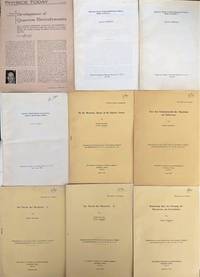
1940S13395Tokyo:: Scientific Papers of the Institute of Physical and Chemical Research 1940. 1940. 8 offprints 1 extract. Original wrappers. From the collection of Abraham Pais. Very good. INVENTORY: 1. TOMONAGA Sin-itiro. Uber den Zusammenstoß des Mesotrons mit Elektronen. Offprint from: Scientific Papers of the Institute of Physical and Chemical Research no. 976 vol. 37 pp. 399-413 June 1940. Original yellow printed wrappers. Signed by Pais. "In 1940 Dr. Tomonaga directed his attention to the meson theory and developed the intermediate coupling theory in order to clarify the structure of the meson cloud around the nucleon." :: Nobel Lectures 1972. 2. TOMONAGA Sin-itiro. Zur Theorie des Mesotrons. I. Offprint from: Scientific Papers of the Institute of Physical and Chemical Research no. 1071 vol. 39 pp. 247-266 Dezember 1941. Original yellow printed wrappers. Signed by Pais. 3. TOMONAGA Sin-itiro. Bemerkung uber die Streuung der Mesotronen am Kernteilchen. Offprint from: Scientific Papers of the Institute of Physical and Chemical Research no. 1105 vol. 40 pp. 73-86 September 1942. Original yellow printed wrappers. Signed by Pais. 4. TOMONAGA Sin-itiro; Miyazima Tatuoki. Zur Theorie des Mesotrons. II. Offprint from: Scientific Papers of the Institute of Physical and Chemical Research no. 1103 vol. 40 pp. 21-67 August 1942. Original yellow printed wrappers. Signed by Pais. 5. TOMONAGA Sin-itiro; Miyazima Tatuoki. On the Mesotron Theory of the Nuclear Forces. Offprint from: Scientific Papers of the Institute of Physical and Chemical Research no. 1124 vol. 40 pp. 274-310 March 1943. Original yellow printed wrappers. Signed by Pais. 6. TOMONAGA Sin-itiro. Remarks on Bloch's Method of Sound Waves applied to Many-Fermion Problems. Offprint from: Progress of Theoretical Physics vol. 5 no. 4 pp.544-569 July-August 1950. Signed by Pais. 7. TOMONAGA Shin-ichiro. Elementary Theory of Quantum-Mechanical Collective Motion of Particles I. Offprint from: Progress of Theoretical Physics vol. 13 no. 5 pp.467-481 May 1955. 8. TOMONAGA Shin-ichiro. Elementary Theory of Quantum-Mechanical Collective Motion of Particles II. Offprint from: Progress of Theoretical Physics vol. 13 no. 5 pp. 482-496 May 1955. 9. TOMONAGA Sin-itiro. Development of Quantum Electrodynamics. Extracted from: Physics Today vol. 19 no. 9 pp. 25-32 September 1966. Signed by Pais. . / BIOGRAPHY: Tomonaga was a prominent Japanese physicist influential in the development of quantum electrodynamics work for which he was jointly awarded the 1965 Nobel Prize in Physics :: along with Richard Feynman and Julian Schwinger :: for the study of QED specifically for the discovery of the renormalization method. Nobel biography: Tomonaga completed work for Rigakushi bachelor's degree in physics at Kyoto Imperial University in 1929 with one of his intimate friends. Dr. Hideki Yukawa Nobel laureate. He was engaged in graduate work for three years at the same university and was then appointed a research associate by Dr. Yoshio Nishina at the Institute of Physical and Chemical Research Tokyo where he started to work in a newly developed frontier of theoretical physics quantum electrodynamics - under the guidance of Dr. Nishina. His paper on the photoelectric pair creation is well-known. Tomonaga stayed in Leipzig Germany from 1937 to 1939 to study nuclear physics and the quantum field theory in collaboration with the theoretical group of Dr. W. Heisenberg where he published a paper "Innere Reibung und Warmeleitfahigkeit der Kernmaterie" which was chosen as the thesis for Rigakuhakushi Doctor of Science at Tokyo Imperial University in December1939. In 1940 Dr. Tomonaga directed his attention to the meson theory and developed the intermediate coupling theory in order to clarify the structure of the meson cloud around the nucleon. He joined the faculty of Tokyo Bunrika University which was absorbed into the Tokyo University of Education in 1949 as Professor of Physics in 1941. It was in 1942 when he first proposed the covariant formulation of the quantum field theory in which the concept of the quantum state was generalized so as to be relativistically covariant. During the Second World War Dr. Tomonaga was interested in developing a theory of microwave systems. He solved the motion of electrons in the magnetron and also developed a unified theory of the systems consisting of wave guides and cavity resonators. As soon as the War was over Tomonaga came back to academic research again with a programme in which he was first to summarize and extend the intermediate coupling theory and secondly to apply the covariant field theory to actual physical systems. His aim was to investigate the nature of field reaction in the meson theory as well as in quantum electrodynamics. He was confident prior to the Lamb-Retherford experiment by means of a model calculation that divergence difficulty in quantumelectrodynamics could be overcome simply by handling the infinite mass and charge due to field reactions in some way or another. It was only a step further for him to develop the renormalization theory with covariant formalism in his right hand and experimental support in his left. Dr. Tomonaga was invited to the Institute for Advanced Study Princeton in 1949 where he was engaged in the investigation of a one-dimensional fermion system. Thus he first succeeded in clarifying the nature of collective oscillations of a quantum-mechanical many-body system and opened a new frontier of theoretical physics modern many-body problem. In 1955 he published an elementary theory of quantum mechanical collective motions. Dr. Tomonaga took the leadership in establishing the Institute for Nuclear Study University of Tokyo in 1955. From 1956 to 1962 he was appointed President of the Tokyo University of Education and since 1963 he has been President of the Science Council of Japan and Director of the Institute for Optical Research Tokyo University of Education. He occupies an important position in various governmental committees for scientific research and policymaking. Tomonaga's honours and awards include the Japan Academy Prize 1948; the Order of Culture 1952; the Lomonosov Medal U.S.S.R. 1964. Dr. Tomonaga is a member of the Japan Academy the Deutsche Akademie der Naturforscher "Leopoldina" and a foreign member of the Royal Swedish Academy of Science. He is a corresponding member of the Bayerische Akademie der Wissenschaften and a foreign associate of the National Academy of Science of U.S.A. Tomonaga has published widely in scientific journals on such subjects as quantum electrodynamics the meson theory nuclear physics cosmic rays and the many-body problem. His book "Quantum Mechanics" was published in 1949 and translated into English in 1963. Scientific Papers of the Institute of Physical and Chemical Research, 1940. unknown books
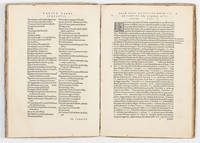
675816 p.l. 74 leaves. Folio later vellum-backed boards foot of spine defective occasional light soiling & dampstaining. Basel: H. Petri 1529. First edition of the two texts together. The De Temporum Ratione is a significant book in several ways. Most notably "this book helped to establish the custom of counting years from the birth of Christ. When we say that Queen Elizabeth II was born in 1926 not 'in the 16th year of the reign of George V' or 'in the year 2678 after the foundation of Rome' or in the '2nd year of the 481st Olympiad' we are indebted to the Venerable Bede."-Printing & the Mind of Man 16n. "Bede's greatest practical effect was on the Western calendar. His decisions beginning the year calculation of Easter names of days and months calculations of eras and so forth in most instances finally determined usage that was only refined not changed by Gregorian reform."-D.S.B. I p. 565. "The De Ratione Temporum first published in 1505 is particularly important. It contains a remarkable theory of tides based upon Pliny but also upon personal observation; first mention of the establishment of a port i.e. the mean interval between the moon's meridian passage and high water following; this interval is different in different ports."-Sarton I p. 511. Pierre Duhem described Bede's establishment of a port as the only original formulation of nature to be made in the West for some eight centuries. This is the first printing of De Natura Rerum which contains such physical science as was then known. It collects the wisdom of the ancient world on these subjects and has the special merit of referring phenomena to natural causes. It contains a particularly important section - the "De Comptu vel Loquela digitorum" - which is "our main almost our only source for the study of mediaeval finger reckoning or symbolism."-Sarton I pp. 510-11. See also Smith History of Mathematics II p. 200. This work was edited by Johannes Sichardt 1499-1552 professor of law who during the years 1526-30 lived in Basel and while teaching also edited and prepared for printing Latin manuscripts he had found in libraries in monasteries. He also served as adviser to the Basel printers Cratander Bebel and Henricus Petri. Good copy preserved in a box. Early signature of "Mallarii" on title with motto in Greek. Armorial bookplate dated 1915 of Bishop's College Cheshunt an Anglican theological college that closed in 1968. ❧ Sichardt: Bietenholz ed. Contemporaries of Erasmus Vol. III p. 247. hardcover books