542 résultats
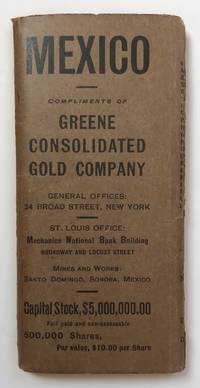
19041269Chicago: Rand McNally 1904. About very good. Folding map approximately 21 x 27.5 inches. Original wallet-style printed wrappers. Light wear to wraps; a few short separations along fold lines. Light tanning. Uncommon cartographic promotional for this early 20th-century mining company with operations near Cananea and Magdalena in the Northern Mexican state of Sonora. The Rand McNally map is overprinted in red to show the locations of Greene Consolidated Gold Company properties as well as major railroad lines across the country. A special inset titled "Topographical Map of the Eastern Portion of the State of Sonora Showing the Operating and Projected Railways with Relation to the Property of the Grene Consolidated Gold Co. and Other Important Mining Districts" provides a magnified view of the region where the company operated and also shows other significant commercial mining ventures in this part of Sonora as well as planned railroad construction in the area. A brief promotional text and additional information about the business are printed on the wrappers which also incorporate a tear-off order form for stock in the company. Rand McNally unknown books
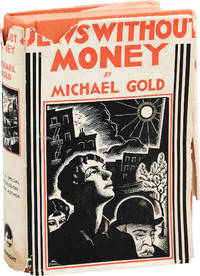
1935144630New York: Horace Liveright 1935. Fifteenth printing published in 1935. In the uncommon dust jacket.<br/><br/>An important book originally published in 1930 from the underside of the Jazz Age and anticipating the socialist and labor-oriented fiction of the Depression. Gold whose real name was Irwin Granich also wrote for the radical magazine "The Liberator." <br/><br/>Small contemporary owner name dated 1938 on the half title page else Near Fine in a Good to Very Good and very bright dust jacket with separation along the front flap fold and a few triangular chips to the top edge see images with listing. Horace Liveright unknown books
1961114804New York: Midwood Books No. F-96 1961. Vintage paperback. First printing of this edition. Very Good plus condition. Spine slightly cocked and faded light rubbing overall date stamp to the top page edges. A very presentable copy of an important book written during the 1920s from the underside of the Jazz Age. Gold whose real name was Irwin Granich also wrote for "The Liberator" a radical magazine. The first edition was published in 1930 and is exceptionally scarce the dust jacket close to impossible. Midwood Books No. F-96 unknown books
18756056031875. "Faithfully yr friend Joaquin Miller Nov. 2 1875" in black ink on small leaf 4 7/8" x 2 1/2". Very good old tape in top margin from previous mounting. Together with a vintage sepia photograph. 3 3/4" x 5 1/4". Signed by Authors. No Binding. Very Good. unknown books
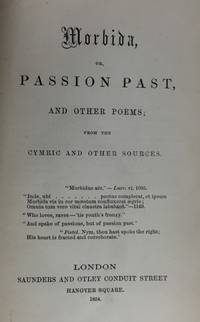
18542657London: Saunders and Otley 1854. First edition. First edition. Octavo. Original blue embossed cloth with gilt design on cover. A very scarce book cited in Quarterly Review: "The book called 'Morbiida'- and which needs no second title- is the production of one who has evidently received his inspiration at second hand. Unable to elaborate it for himself he freely dilutes some of the finest of English poetry." And then in the Eclectic Review "It is sickly and feeble. The author has evidently mistaken his vocation. He might make as times go a creditable man in various professions but Nature in endowing him with a polished mediocrity evidently intended him for anything rather than a poet.". 168 pages. <br/><br/> Saunders and Otley hardcover books
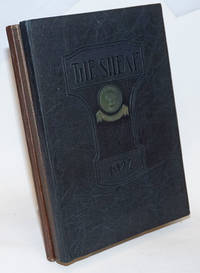
1927231699Saint Louis MO / Elsah IL: The Principia Junior College 1927. Three standard-format yearbooks rather more neatly designed and produced than most with cover decoration in blind and tint or gilding to cover seal. The 1928 issue features a subtle background printblock by Bernard Maybeck on every page; alkaline glazed paperstock throughout; and aside from touches of edgewear in as-issued condition pace some endsheet autographs in '28 which also has laid in a certificate made out to book's owner one Tommy King permitting him to wear the football team's letter. Three separate items as a small lot. The Principia Junior College unknown books
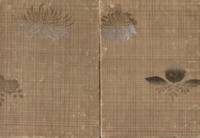
86003001Edo c.1700-50 n.p. Brown & silver covered boards very clean 7 double-page b.w. erotic woodblock illustrations mounted on mica flecked paper 18 x 25 cm. accordion folded illustration size: 31 x 12 cm. FIRST & ONLY UNRECORDED COPY! . . . . A VERY RARE UNRECORDED EARLY BOOK . . . A BIZARRE & UNIQUE EROTIC BOOK . . . UNSIGNED BUT CLEARLY THE WORK OF A MASTER ARTIST . BY SUKENOBU OR HIS :SCHOOL: . A unique and hitherto unfound odd and most unusual erotic book of the early-mid-18th century. One of the most bizarre erotic books ever done in Japan. . The graphically explicit work portrays men and women with genitals on their foreheads engaged in heterosexual and homosexual intercourse. There is no other book with such unusual and strange illustrations. . . THE TITLE: THE LEGEND OF AMANJAKU or AMAN NO JAKU: Chinese Title: TIAN XIE GUI YUN . THE MEANING OF AMANJAKU: Japanese Buddhist literature is abundant with variations on the theme of "Aman-No-Jaku" aka. "Amanjaku" "Manojaku" commonly understood to be a "Heavenly Evil Spirit." . This spirit or demon-like creature in Japanese folklore is usually depicted as being a male during the day and female at night. The demon is usually depicted as a kind of small Oni devil and is thought to be able to provoke a person's darkest desires and instigate him into perpetrating wicked deeds. . Amanjaku is also depicted in Chinese and Japanese mythology the AMANOJAKU is a changeling a water spirit that infiltrates the human world to play cruel tricks on people by reading their minds and twisting their requests or desires to be used against them. . The "AMANOJAKU" is also known the "Lord of the River" and in Japan serves Bishamonten one of the four Deva kings of Buddhism as a minor demon. See Wikipedia below. . In Japanese the term "Amanojaku" also refers to a person who is deliberately contradictory someone who argues for the sake of arguing or can be used in common Japanese conversation to refer to someone who is a "Perverted Demon." . THE ILLUSTRATIONS: THE BUDDHIST THEME:. This work is unusual in that the genitals of common people are located on their foreheads. A symbolist meaning can be in Buddhist concept that sex and sexual hedonism is openly on the minds of 'lay' people. The Buddha and his disciples on the other hand do not have sex organs on their foreheads meaning their organs are covered and in a different usual location. This can symbolize 'self control' over such biological energies. Devout Buddhist disregard sex as a pleasurable pastime and devote themselves to monastic focus. By contrast "lay" people are distracted with hedonistic pleasure a path away from rather than towards the Dharma or teachings of Buddhism. . In a sense this work illustrates the overwhelming force of evil or the "Amanojaku" and how it distracts people from the "Righteous Path" towards the Dharma and the ultimate goal of attaining Nirvana. It can be posited that this work is designed to give understanding to "lay" people by way of visual example of what forces direct their energies away from the Buddhist teachings in an effort to redirect them towards the "Righteous Path" and life style. . EXCEPTIONALLY RARE UNIQUE WORK: . The work is exceptionally RARE unusual and erotic there are no other example showing genitals on the foreheads of any other Japanese book cited anywhere in the bibliographic literature or record. . This work is certainly RARE in subject content and quantity. Though it was woodblock printed and unsigned which was usual for Japanese erotic works which were banned by the Shogun we have not found anything similar or recorded anywhere in the bibliography. Being woodblock printed one assumes there are other copies in existence. The average printing from woodblocks were somewhere between 100-200 copies. However in this instance no others exist. We have the strong feeling the book could have been the production of a famous Japanese illustrator and perhaps financed by a Buddhist temple again there are no known facts about this rarity. . THE EROTIC ILLUSTRATIONS: . Number 1: This work begins showing the Buddha flanked by two of his disciple monks. The title is written in four Japanese Kanji in Kambun & Chinese characters. The Buddha and his two disciples listen to two elderly Buddhist believers: one is a male he has and erect penis on his forehead. The other is a woman she has a vagina on her forehead. Neither the Buddha nor his two disciples monks show genitals on their foreheads. The couple have come to consult with the Buddha about their grievances. . Number 2: Shows a man and a woman in a Tatami matted room both wear lovely 18th century decorated Kimono. They embrace each other and are engaged in making love from their foreheads which show an erect penis and testicles inserted into the woman's forehead where her vagina is located. Adjacent to the young couple is an older woman who has become aroused by the adjacent couple's making love. The old woman uses a dildo tied to a post which she hugs while inserting the dildo into the vagina on her forehead. . Number 3: Shows a couple laying on a blanket their Kimono pulled down and opened and used as a top cover. They engage in love-making and kiss. The man has an erect penis on his forehead the woman a vagina on hers. There is some used Chirishi toilet paper just above her head on the floor used to wipe the love fluids. There is a folded package of yet unused Chirishi in readiness. Chishiri shown in Japanese Shunga erotic prints prints & paintings is an 'erotic symbol' indicative of sexual excitement with lots of love fluids flowing. Ergo the need for paper to clean up the results of erotic love-making. . Number 4 shows an adult man with an erect penis on his forehead penetrating the anus of a younger man who's smaller but erect penis is seen on his forehead as he faces his lover. The younger man has no pubic hair yet indicating his youth. . Adjacent to these two men is a woman in the next room. The door is open she is a secret voyeur of the two men. Her vagina is also on her forehead. A Shogi board and two bowls for stones is located in the front left of the illustration. Gay activities in Japanese society were accepted as a norm and were not especially unusual. However to find graphic examples in Japanese erotic books are exceptionally rare and seldom found. . Number 5: Depicts a fully clothed man on his knees he bends over a sleeping woman. He has a very large erect penis and begins to penetrate a woman with her vagina on her forehead. She is fully clothed and sleeping on a wooden "pillow" which supports her elaborate hair coiffeur. . Number 6: Depicts a lively scene of two men and a woman. One man with a very large and erect penis pulls the woman's arm toward him while she fends him off with a straight arm to his head. A second excited man also with a large and erect penis on his forehead masturbates and ejaculates in ecstasy. The woman has a vagina on her forehead. The scene is likely an intended rape of a young girl. She looks away in an effort not to allow him to pull her close enough to insert his penis into her exposed vagina. . Number 7: Illustrating a lonely old man in bed. He has an erect penis on his forehead and holds a kind of pot with a large opening. He faces down and inserts his penis into the pot for gratification. . THE TEXT: The text in Shunga erotic Japanese books & prints is often an erotic dialogue describing the erotic action. Often these words are onomatopoetic mimicking the sounds of people in orgasm or making comments about making love or the pleasure and good feelings. The size and hardness of the penis or the flavor and the juices of the vagina and its supple feelings of euphoria when engaged in love-making. All wear 18thcentury period Kimono. . MODE AND FASHION OF THE MID-18TH CENTURY: The room furnishing and Kimono of the participants in this work all wear 18th century period Kimono with period decorations. The style of Kimono and room screens reflect this period. . BINDING AND MOUNTING: Binding: The book has probably been rebound sometime after the 1750's with a more recent thin brown decorated paper with a silver chrysanthemum and a Mon family crest with gold and black on both front and rear covers. Each cover has a distinctly different kind of illustration but of the same theme. The corners and edges are a bit worn some loss to the paper as usual for a work from this period. . Mounting: At an earlier time each page was expertly mounted on a stiff Washi hand-made Japanese paper into an accordion folded book. Each illustration is bordered with a rare and stunning crushed oyster-shell powder mixed with rice-glue and overlaid on the border paper. The stunning effect is a rare shimmering pearl-like color and hue with a remarkable effect. This rare and largely unknown effect has been used for print backgrounds by some of the later masters. . This was no ordinary mounting and appropriate for an exceptionally and most unusual RARE book ! . Contents: By and large the contents are clean solid with a two old worm holes for the first 6 of 7 pages. These are small and towards the edge and does not detract from the overall quality of the illustration. On page 7 there are a few center margin old minor worm holes. All of these have been restored when the prints were laid down on the thick Washi paper creating book format. The work is otherwise solid and firm. There are a few 'rubs' on the old Washi paper which was made from very soft Kozo fibers common to any item of this period on this on handmade papers of the period. . CONDITION OF THE WOODBLOCK PRINTS: . These are very early black and white woodcut prints. Each print has an excellent and vivid impression key blocks are black and superbly printed with strong images. The paper is old and has the patina of paper from that age the usual minor mild surface rubbing or thumbing in the lower corners which is common. . We tend to be overly critical of any flaws found on our books and believe it is better to overly describe rather than avoid such discussion any imperfections. Suffice to say by and large this is an excellent item in very nice condition something that any collector or museum would be proud to own. Please review photos posted to our website. . R A R I T Y OF SUBJECT: The placement of the genitals on the forehead gives one a lot of room to theorize on the meaning of such artistic expression. In our 50 years of experience in dealing Japanese woodblock printed books and painted original art this is the first and only example with such imaginative and symbolist expression. With the beginning of the work showing the Buddha and his two disciples lacking any genitals on their foreheads one can simply assume that in a Buddhist way they have given up carnal desire as represented by common people who's foreheads display genitals perhaps meaning that sex is on their minds or they simply view others as sexual objects eager to make love and engage in carnal thoughts and activities. Obviously seeing an erect penis on some man whiles others see what he thinks and feels is an insight to his innermost thoughts and desires. In all cases in this book the men all show an erect penis. The women are a bit more difficult to fathom. Their vaginas are simply visible on their foreheads and no fluids are visible or other evidence of their carnal desire or sexually excited stated. All of the men have public hair adjacent to their sex organs while all women are lacking any pubic hair completely. This is an erotic symbolism giving full view to women's genitals. . "BANNED" or "PROHIBITED" BOOKS: Shun Pon Haru Bon: In the case of this item it is very likely that it was printed in a much smaller discreet quantity than the 200 copies possible off the blocks. Due to the "banned" nature of such books there is no date publisher nor place cited. One is simply left to determine the date and artist by stylistic analysis. It is well-known that during the Tokugawa period 1603-1868 erotic prints and books were "BANNED" or "PROHIBITED" by decree of the Shogun. One of the influencing factors was that during this period some Shoguns were changing their views and being influenced by Christians who entered Japan during this period. The Shogun did not want foreigners and Jesuit missionaries to think that Japan was a crass and base nation. Naturally foreigners soon learned that prostitution was rampant and so this strange logic from the Shogun never had much affect on the Christians and surely not on the Japanese. . The Shogun enforced severe punishments for persons involved in drawing printing carving blocks and publishing erotic books and prints. With out the "Kiwame" or censor's approval seal all such items were "Banned" outright by the Shogun decree. . While these "Prohibited" books and prints were widely circulated in an "underground" society there are ample examples of famous artists taking on commissions to produce erotic books and prints fun or profit. The record and bibliography is loaded with these examples. "Banning" such erotic works simply meant that the number printed were limited to smaller numbers and distribution was done under the table discretely circulating such books privately among collectors. During these times it was not necessary for artists to sign their such artistic creations by-and-large the population had a very good idea who the artist was by being familiar with their style and other works it was simply a "public secret" who the artist was. Often the artist poked fun at the Shogun with political jokes and assumed names to confound any chance of being discovered by the authorities. . Over the centuries this knowledge decreased and is now the domain of the art historian or scholar to identify and determine the actual artist. Stylistic analysis remains the standard method for unsigned works. . THE ARTIST/SCHOOLS: While there are no signatures or seals indicating the artist's name or even his alternate Go studio name we believe this work is part of the "Primitives and First Century of Ukiyo-e School 1660-1765" period. See Lane below. The women's coiffeur is very similar to those found in this period as well as the drawing style technique and genre. It is this cataloger's opinion that this work was likely the creation of one of the Moronobu School masters. Perhaps done by Sukenobu Yoshikiyo Morishige Sugimura Moronobu Kiyonobu Masanobu or others from this period. We believe this work was likely done from around 1710-1750. It was also likely that it was done by one of the artists listed below. . LIKELY ARTIST ATTRIBUTION: . MORONOBU SUKENOBU SCHOOL: Nishikawa Sukenobu 1671 -August 20 1750 often called simply "Sukenobu" was a Japanese printmaker from Kyoto. He was unusual for a Ukiyo-e in being based in the imperial capital of Kyoto. He did prints of actors but gained note for his works concerning women. His Hyakunin Joro Shinasadame: Appreciating 100 Women in two volumes published in 1723 depicted women of all classes from the empress to prostitutes and received favorable results His Hyakunin Joro Shinasadame: Appreciating 100 women in two volumes published in 1723 depicted women of all classes from the empress to prostitutes and received favorable results Leading members of this school were: Nishikawa Sukenobu the founder; Nishikawa Suketada; Kawashima Nobukiyo; Nishikawa Terunobu; and Takagi Sadatake. . NISHIKAWA MORONOBU SCHOOL: Nishikawa Moronobu 1618-July 25 1694 was a Japanese painter and printmaker known for his advancement of the Ukiyo-e woodcut style starting in the 1670s. Leading members of the MORONOBU school were: Nishikawa Moronobu the founder; Hishikawa Morofusa; Hishikawa Moroyoshi; Hishikawa Moronaga; Hishikawa Moroshige; Hishikawa Morohira; and Tamazaki Ryujo. . BIBLIOGRAPHY: . This title is NOT listed in any of the below resources: SHIBUI Kiyoshi. UKIYO-E NAISHI. BIBLIOGRAPHY OF JAPANESE EROTIC ILLUSTRATED WOODBLOCK PRINTED BOOKS. H. KERLEN. CATALOGUE OF PRE-MEIJI JAPANESE BOOKS & MAPS IN PUBLIC COLLECTIONS IN THE NETHERLANDS. Richard Lane: IMAGES FROM THE FLOATING WORLD THE JAPANESE PRINT; pages 28 40-60 show examples of the Ukiyo-e primitives 1660-1765 especially the Moronobu school pp.60-88 et al. . NOT LISTED IN: . KSM SHIBUI Kiyoshi: UKIYO-E NAISI. BIBLIOGRAPHY OF JAPANESE EROTIC ILLUSTRATED WOODBLOCK PRINTED BOOKS. Modern Reading: UKIYO-E NAISHI KERLEN H.: CATALOGUE OF PRE-MEIJI JAPANESE BOOKS & MAPS IN PUBLIC COLLECTIONS IN THE NETHERLANDS. Not in any other usual bibliographies on Japanese E-hon woodblock printed books. . See: WIKIPEDIA: http://en.wikipedia.org/wiki/Amanjaku . hardcover books
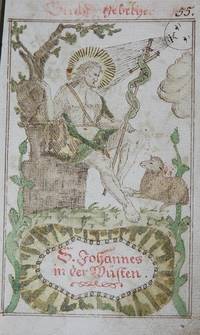
1797006602Keuth an der Crassen 1797. Full Blindstamped Calf. Good. A fine Folk Art manuscript prayer book from the late eighteenth century. 8vo. 17.5 by 10.5 cm. 516 13 1 pp. With eight full page paintings plus vignette decoration throughout much pretty floral ornamentation but also a serpent a basilisk etc. Most writing is a neat now archaic cursive but headings and the like rendered in an easily readable ornamental Fraktur Gothic. The paintings are the highlight most will find. Their subject matter is quintessential and perhaps not unusual or original -- Momento Mori St. George slaying the dragon etc. -- but the execution is done with uncommon polish. The authorship is stated but also a tad confusing. Our interpretation is that a Konrad Mueller created the book for Margaretha Pfaden-Hauerin. Condition: moderate wear to contemporary full calf binding. Unusual is a 13 page "Register" or Table of Contents in the rear. By unusual we mean for such a manuscript prayer book. Also a page of handwritten genealogical notes written on a prior blank leaf and written much later in the mid to late 19th Century. Moderate sometimes heavy soiling to margins of leaves. Corner cut out of front endpaper. Some loose gatherings. <br/><br/> unknown books
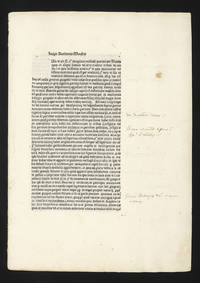
338122 leaves Gothic type 43 lines. Folio 301 x 213 mm. disbound some worming towards end. Padua not Pavia: Pierre Maufer about 1475. First edition a remarkable discovery of the third known copy of the true first edition of the first modern book devoted solely to anatomy. The other two surviving copies are in the Biblioteca Corsiniana Rome and the Biblioteca Comunale Viterbo. The rarity of this book is well-known: it is revealing that Castiglioni Choulant and Garrison all cite the 1478 edition as the first printing. Its influence was great: "The first outstanding anatomist worthy of the name.the Anathomia of Mondino was the most used anatomical text up to the end of the sixteenth century probably because it contained the most important technical indications in brief and concise form."-Castiglioni A History of Medicine pp. 341-43. Mondino ca. 1275-1326 a native of Bologna was the son of an apothecary and the nephew of a professor of medicine. He attended the University of Bologna where he studied under Alderotti Thaddeus of Florence an early dissector and took his medical degree in 1300. Mondino soon became a professor of medicine at the university. "Mondino's chief work is his compendium of anatomy Anatomia Mundini completed in 1316 which made him in Castiglione's sic words 'the first outstanding anatomist worthy of the name.' Mondino's book dominated anatomy for over two hundred years. The major reason for Mondino's great popularity was the simplicity conciseness and systematic arrangement of his book which is divided into six parts: 1 an introduction to the whole body and a discussion of authorities; 2 the natural members including the liver spleen and other organs in the abdominal cavity; 3 the generative members; 4 the spiritual members the heart lungs trachea esophagus and other organs of the thoracic cavity up to the mouth; 5 the animal members of the skull brain eyes ears; and 6 the peripheral parts bones spinal column extremities. This organization was not the result of any philosophical approach to the subject but rather derived from the necessity of dissecting the most perishable organs first. "Mondino should be regarded as the restorer of anatomy if only because his popular textbook and his experimental teaching were instrumental in preparing the revival of the subject. His text was the first book written on anatomy during the Middle Ages that was based on the dissection of the human cadaver; his efforts consolidated anatomy as a part of the medical program at Bologna and encouraged further study. His book also dominated the teaching of anatomy and no real improvements were made upon it until 1521 when Berengario da Carpi wrote his famous commentary on Mondino."-D.S.B. IX pp. 468-69. "Mondino's book soon became a classic text; he was venerated soon after his death as a divine master and anyone who was found differing from his book was regarded as monstrous. For three centuries the lecturers on anatomy were required to use his book in their teaching as may be seen in the statutes of many medical schools."-Castiglioni op. cit. pp. 344-45-& see the detailed account of the contents of this book and methods of dissection which it reveals on pp. 341-45. A very fine copy with all edges uncut and preserved in a slipcase. Two contemporary annotators have made a number of neat comments in the wide margins. This copy was clearly removed from a sammelband. The final four leaves have some worming becoming increasingly more pronounced but not at all offensive touching the text of the final three leaves. ❧ Choulant-Frank pp. 88-96. Garrison-Morton 361-describing the 2nd edition of 1478-"The first modern book devoted solely to anatomy written for his students in 1316. Mundinus re-introduced human dissection which had been neglected for 1500 years before him; he was the most noted dissector of his period." Garrison History of Medicine pp. 160-61. GKW M25666-citing Pavia in error. ISTC im00871200. Klebs 688.1. Sarton III Pt. I p. 843-"In spite of his personal observations Mondino was almost entirely dependent upon Galen and Theophilos and upon Arabic authorities.". unknown books
186364926Austin TX 1863. 4to. One page approximately 125 words in part: "Gents I am as a military board constituted by the authority of the state submitted to me for sale . thirty four United States Bonds Texas Indemnity with coupons attached . and I sold the same about the 10th of January 1863 to James Thorpe of the state of Louisiana for 85 cents on the dollar in Confederate notes . handed over to you with this report." Murrah a native of Alabama eventually read law and settled in Texas in the late 1840s opening an office in Marshall for his practice. He served in the Texas house before the war then in administrative offices before succeeding Lubbock as Governor in November 1863. Fleeing Texas at the end of the war he died in Mexico in August 1865. Very good. Folded for mailing. 11144. <br/><br/> unknown books
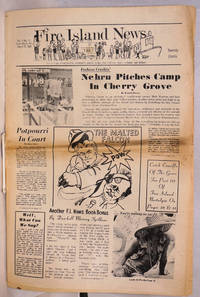
1968179223Ocean Beach: Fire Island News 1968. Newspaper. 20p. folded tabloid newspaper photographs articles reviews and advertisements toning and creasing from fold otherwise good. Fire Island News unknown books
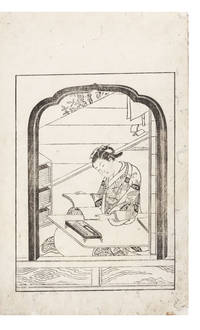
6330Edited by Yusuishi Tanaka. Woodcut frontis. & eight fine double-page woodcut illus. 21; 18 folding leaves. Two vols. Large 8vo orig. blue wrappers wrappers rather worn & rubbed orig. block-printed title labels on upper covers rubbed new stitching. Osaka Edo & Kyoto: 1749. First edition of this beautifully illustrated book; the fine woodcuts are by Sukenobu Nishikawa 1671-1750 or -51 or -54 who "counts among the foremost masters of so-called ukiyo-e primitive prints. His subject matter like that of his contemporaries revolved around images of women walking. These images are stylised lending the rhythmic movement of the sumptuous robes an almost sculptural effect. Nishikawa also did many book illustrations.Nishikawa founded a whole school and according to his family archives Harunobu 1725-1770 was a follower of his."-Oxford Art Online. This work is concerned with the education of women in its widest sense combining knowledge with taste. Four types of girls' "play" are described and illustrated; each providing instruction in behavior and ethics. The fine woodcut frontispiece depicts a young woman reading a book surrounded symbols of knowledge and refinement: bookshelves and brushes for calligraphy. Her clothes and hairstyle are appropriate. The first volume is concerned with dolls hina. In Japan dolls are not for play but have high spiritual value which offer girls preparation for adulthood and marriage. For the Japanese dolls are living creatures possessing heart and soul from which girls can learn discipline obedience and control. Nakanishi 1634-1709 was a scholar and writer on Shintoism and the present text was edited and posthumously published by Yusuishi Tanaka who has contributed a preface. The theme of the text is instructional and written for girls and young women: there are many references to texts essential for proper behavior and ethics. Nakanishi draws on the Nihon Shoki the oldest chronicle of Japan; Man'yoshu the eighth-century anthology of Japanese poetry; the Tale of Genji; and Makura no Soshi the famous Pillow Book. There are four fine double-page woodcut illustrations in the first volume. The first illustration depicts an upper-class woman sending her dolls away in a boat thereby sending her suffering away. The second illustration depicts the hinamatsuri doll festival with dolls arranged on shelves. The following illustration depicts a young woman facing her suitor her dowry behind her all are objects of knowledge and culture: a calligraphy set fine papers in a box picture scrolls books etc. The final illustration in this volume depicts an offering made to the sky referencing tanabata the star festival. According to legend the Milky Way separates two lovers; they are allowed to meet only once a year on the seventh day of the seventh lunar month of the lunisolar calendar. The second volume is concerned with kai-awase the Japanese shell-matching game. Again there are four fine double-page illustrations each filled with deep meaning. Matching the shells symbolizes the unity of partners in a marriage. There are many references to the Tale of Genji and Lady Murasaki; scenes from this novel were often used to illustrate the shells. One of the illustrations depicts the traditional card game called uta-garuta being played by several women. A very good set and rare. Some carefully repaired worming mostly confined to the margins. The lower outer corners of many leaves are "thumbed." ❧ Brown Block Printing & Book Illustrations in Japan p. 131. hardcover books
197546395Cagayan de Oro: Xavier University 1975. Hardcover. Very Good/Very Good. frontis photos index xi 806p. plus 12p. plates plus 3p. errata/corrigenda. Blue leatherette. dj some chipping and wear. 22cm. Tear in one plate. SIGNED by editor Francisco R. Demetrio on title-page. <br/><br/> Xavier University hardcover books
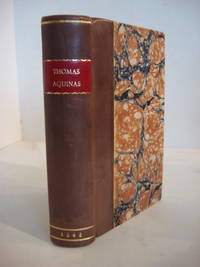
15439601Paris: Joannis Boulle 1543. Full calf. Very good. 8vo. ff.82394. 20th century tan calf with red morocco spine label over modern boards. The first 4 leaves have an old round embossed stamp of a seminary in Granby Mass. Title page also with an inked Catholic stamp of some order otherwise a nice clean copy. This work has been falsely attributed to Saint Thomas Aquinas. Apparently the author/editor is Nicolaus de Gorra or spelled Nicolas de Corran. Adams B1852. Joannis Boulle unknown books
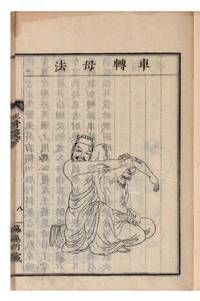
7010Many fine full-page woodcut illus. 46; 59 folding leaves. 8vo orig. yellow wrappers wrappers a little soiled orig. woodblock title-slips on upper covers labels a little soiled new stitching. Kyoto Osaka & Edo: 1808. First edition of one of the three most important Japanese works on orthopedic medicine. The book is based on Chinese medical science most notably the Sheng ji zong lu written in the 11th century and the Yi zong jin jian by Qian Wu active 1736-43 who also wrote the famous Yusuan Yizong Jinjian Imperially Commissioned Golden Mirror of Medical Learning published in 1742. Our work presents a system of surgical treatment to cure injuries to bones principally fractures and dislocations with instructions on how to stop bleeding and to bind or immobilize the injured part by bandaging. There is a substantial section on materia medica and the compounding of prescriptions considered essential to the treatment of bones in Japan. The numerous and fine woodcuts depict braces and corsets plasters manipulations bandaging techniques casts etc. Many of these techniques are clearly taken from Western medicine. Ninomiya 1754-1827 was a prominent medical doctor who laid down the foundations of orthopedic surgery in Japan. He studied in Nagasaki where he learned Western and Japanese techniques from Kogyu Yoshio 1724-1800 interpreter of Dutch and a famous physician and surgeon who had a "Western-style" room at his home in the city. After further study under a number of doctors throughout Japan including Gento Yoshiwara Ninomiya established himself in Edo where he had an extremely successful practice. After contracting syphilis as a baby from his wet nurse Ninomiya lost his nose and wore a artificial nose for the rest of his life. Nice set. Both volumes have some minor marginal dampstaining. ❧ Mestler A Galaxy of Old Japanese Medical Books III p. 152. unknown books
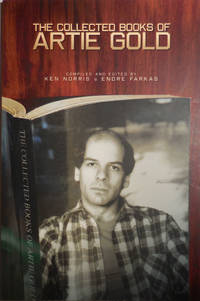
201030150Vancouver: Talon Books 2010. First edition. Paperback. Fine. Trade paperbound book. 298 pp. Stated first printing. Compiles the eight collections of poems written during Artie Gold's lifetime. A fine unread copy. Talon Books paperback books
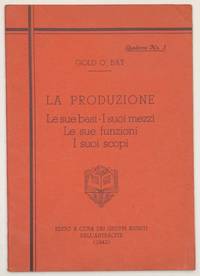
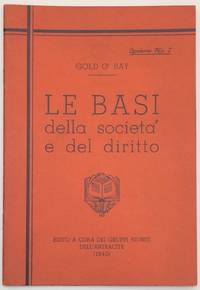
194241548Newark NJ: L'Adunata dei Refrattari 1942. 28p. staplebound pamphlet very good. Quaderno no. 3. The anarchist poet and journalist author associated with the Futurist movement had arrived in the United States in 1938. L'Adunata dei Refrattari unknown books
194042146Newark NJ: L'Adunata dei Refrattari 1940. 28p. staplebound pamphlet very good. Quaderno no. 2. The anarchist poet and journalist author associated with the Futurist movement had arrived in the United States in 1938. L'Adunata dei Refrattari unknown books
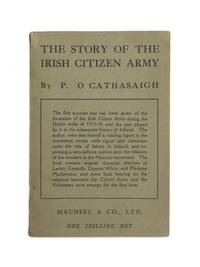
191973486Dublin and London: Maunsel & Co. Ltd 1919. First Edition. Wraps. Very good. The first account of the Irish Citizen Army a small paramilitary group of trained union volunteers formed by James Larkin James Connolly and Jack White during the Dublin strike of 1913-14. This is also the first published work by Irish playwright Sean O'Casey who served as General Secretary of the Irish Citizen Army. Small octavo: 72 p. Original printed paper wrappers. Some general toning to the contents. Small nick to the spine head which has been mended with a tiny piece of tape and a bit of light creasing to the bottom corner of the front panel; else about very good. Maunsel & Co., Ltd unknown books
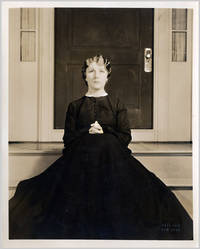
1932WRCLIT73415New York: Vandamm Studio 1932. Original 10 x 8" double weight sepia toned portrait photograph. Vandamm studio stamp and identifying text on verso small Vandamm blindstamp in lower right corner. Fine. A superb meditative character portrait of Judith Anderson in the role of Lavinia Mannon in the Theatre Guild revival of O'Neill's play staged by Philip Moeller which ran for 16 performances in May 1932 at the Alvin Theatre. The Vandamm Studio were the Broadway photographers of record for nearly four decades. While it is not possible to absolutely credit this photo to Florence she specialized in the character portraits while Tommy covered the photographs of staged productions. Vandamm Studio unknown books
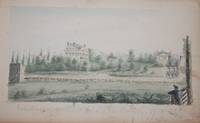
1828006534New York City 1828. Hardcover. Cloth spine. Marbled pastedown on boards. Leather centerpiece label on front board. Good. Original watercolors of rural Manhattan as it appeared in 1828. Among these and captioned are a farmhouse on Broadway and 8th Street; Kips Bay showing a boy sailing a small craft with a farmhouse in the background; a house in Bloomingdale the location of an early village now the Upper West Side along the river between 96th and 106th Streets; and a stately mansion surrounded by fields and less important buildings we would conjecture in or around Bloomingdale but captioned surely incorrectly the Battery. Most of the paintings are uncaptioned. Of these some are surely the Upper Hudson area or are scenes that we can't tell whether they are upstate or in the present day city. The artist also ventured away from the New York areas. Among the non-New York paintings are a depiction of the Cape Pogue Lighthouse on Martha's Vineyard which still stands; Fowey Harbour which is in Cornwall; and a few scenes which look very much like Scotland. Oblong 14 by 19.5 cm. 55 watercolors generally fully finished. Although the sketchbook has a label on its front board bearing the name of Walter Oddie who was a listed artist we believe a good amount of the artwork contained in this sketchbook is of his father-in-law Henry Meigs. Meigs had been a U.S. Congressman from New York and also held a number of other political positions in the city over the course of his career. More pertinently Meigs was known to be an amateur painter and as such an inspiration to Oddie. Given Oddies youth at the time -- he was 20 or 21 years old and from his diary for the years 1828 and 1829 now housed in the Winterthur Library we know he was just starting to paint we find it inconceivable that he would have had the skill yet to produce the sensitive and fine renderings of nature and buildings that typify this sketchbook. Further underlying our thinking about attribution is that some of captioning only makes sense if Meigs were the primary artist. We do consider it quite likely that Oddie may have done some of the sketchier work contained herein as well as contributing in bits and pieces to his father-in-laws work as well as perhaps copying some of it in this sketchbook. To us it isnt really so important who was responsible for particular paintings in the sketchbook. Rather the significance lies in the recording of New York City and its surroundings at the time we suspect that there may be no recording anywhere of some of the buildings and locations at this time. And of course not to be minimized is the beauty of the better paintings contained in the sketchbook.Whatever the degree of Oddies contribution the sketchbook does have something to say about his career and visa versa given that it contains the type of artwork for which he became known later. Oddie was born in Maryland Washington D.C. or possibly New Orleans but spent almost his entire life in New York and more specifically New York City Brooklyn or Long Island. In 1828 the year most of the watercolors in the catalogue were executed Oddie was spending much of his time in the city.Once Oddies interest in painting was sparked he was believed to have been largely self-taught but he did come to study art with Hudson River School painter Robert Walter Weir and Anthony Lewis De Rose a portrait and historical painter. From the diary we know that Oddie did work with De Rose in 1829; we believe that his tutelage with Weir came later. From the diary we know that Oddie was regularly going to art exhibits and critiquing what he saw. The diary also discloses or corroborates our prior sense that Oddie sometimes would work off of engraved prints. To what degree he was merely copying the prints as opposed to using the prints as a spur to his own imagination we can not determine with certitude. We tend to think the views of Scottish and Welsh castles contained in the Sketchbook were done by Meigs not Oddie and so they might well have been done from life.From the diary we know that Oddie had some day job that occupied him during the week and so he did most of his painting at that time on the weekends when he would often go for long hikes along the Hudson. Oddie also refers in the diary to having been in Hudson then and now the county seat of Columbia County and so it is very plausible that some of the upstate scenery is from around there. Again we think some of these paintings may have been done by Meigs.Oddie would become an associate member of the National Academy of Design where he frequently exhibited his artwork.One further note we spoke of questioning one caption referring to the Battery. In 1828 the urbanized part of the city didnt even reach 14th Street but the Battery as the oldest part of the city was thoroughly urbanized. Thus the painting could not be of the Battery. But the landscape is very consistent with the topography of Upper Manhattan. <br /> hardcover books
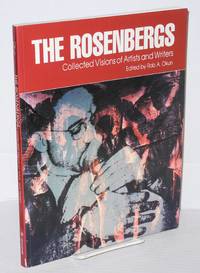
1988126530New York: Universe Books 1988. Oversized Paperback. 160p. 8.5x11 inches essays illustrated with b&w and color art and photographs lightly-worn first edition trade paperback in pictorial wraps. Catalog for the exhibit: Unknown secrets art and the Rosenberg era. Universe Books paperback books
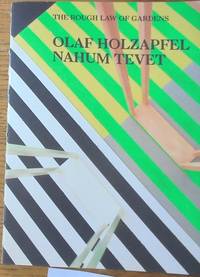
2016160042Berlin: Sternberg Press 2016. Softcover. VG. Fluorescent green and illus. wraps with intentionally glued spine; 18 text pp. plus many illustrated pages. Issued in conjunction with a 2015 exhibition of installation art by German contemporary artist Olaf Holzapfel b. 1967 and Israeli sculptor Nahum Tevet b. 1946. With an essay by Galia Bar Or and many views from the exhibition. Rare. Sternberg Press paperback books
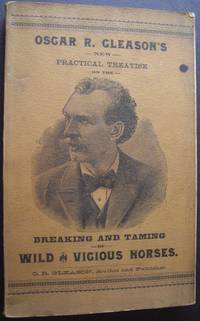
18898588Baltimore: Self-published 1889. 1st. Original Wraps. Collectible; Very Good. Wonderful --and uncommon-- 1889 treatise on the "breaking and taming of wild and vicious horses" with over 200 illustrations complementing the text. Written by Oscar Gleason the inventor of "The Gleason Bridle" and "The Gleason New Break Harness". Solid and well-preserved and VG in its brown pictorial wrappers with one small spot at the front panel. Octavo 300 pgs. <br/><br/> Self-published paperback books
9308pamphlet. 23 pages. Tall slim 8vo modern wrappers; uncut & unopened. Newark 1891.<br/><br/> unknown books